Introduction
Dazhao Temple stands within the old city of Lhasa, facing west. Its name is written variously in Chinese texts — the Weizang Tongzhi uses “Dazhao” (大招), the [Qianlong] Xizang Zhi records its Tibetan name as “Laomu,” and the Zhuguo Jiyou glosses that “zhao translated means Tathagata” — yet all point to the same temple.
The Weizang Tongzhi preserves a founding legend: the Tang princess divined that the terrain of Tibet was “the image of a demoness lying face up,” that the Lhasa lake was her “heart’s blood” and “eye of the sea,” which had to be filled with stone and topped with a lotus-shaped temple, with one hundred and eight further temples built all around to pin down the land’s veins — and so Dazhao came to be. Beyond the legend, the gazetteers describe the temple quite consistently: four stories tall, five golden halls on top, the balustraded halls “all gilt over a copper base, spacious and magnificent,” with the central hall enshrining a Shakyamuni Buddha said to have entered Tibet with the Tang princess from the Central Plains, and the left gallery holding images of the Tang princess, the Tubo ruler[1], and the daughter of the Balebu (Nepalese) king.
The stone stele outside the temple gate became an object that later Chinese historians returned to identify again and again. Both the Weizang Tongzhi and the Xizang Zhi record it as “about one zhang five chi high,” with the titles of ministers, grand stewards, and secretaries carved on its sides, including the name of Niu Sengru. The Shushui Jing, comparing it against the dynastic histories, identified it as the Changqing alliance stele[2] of the first year of the Changqing era under Emperor Muzong (821). The Zhuguo Jiyou further cited old gazetteers stating that there were originally two Tang steles before Dazhao — one for Emperor Dezong and one for Emperor Muzong — and that by the Qing the Muzong stele “could no longer be seen.” Beside the stele still stood old willows said to have been planted in Tang times, “their aged trunks coiling and writhing like dragons” — stele and willows together, keeping the year of the Tang-Tubo alliance at the temple gate.
Historical Documents
Weizang Tongzhi
布达拉之西南,竦起一峰,其南山生下,为藏之峰。山北去布达拉里许,中建一塔,下通西行大路。其山上层楼四起,为有行喇嘛坐静处。其寺内喇嘛多业岐黄。大招寺,
To the southwest of the Potala a single peak rears up; the mountain born to its south is the peak of Tsang. About a li to the north of the mountain, away from the Potala, a pagoda was built in the middle, beneath which runs the great road westward. Atop the mountain a many-storied tower rises on four sides, a place where practicing lamas sit in meditation. Most of the lamas within this temple take medicine as their calling. As for Dazhao Temple:
西藏第一番王,传七世至曲结松赞、噶木布迎唐公主,又差头人伦布噶尔迎巴勒布王鄂特巴尔郭恰之女拜木萨为妾。唐公主带来释迦牟尼佛像,拜木萨带来墨居多尔济佛。白木萨欲修庙宇,藏王择地兴修。唐公主卜算藏地形势,乃妖女仰面之象,拉撒海子,乃妖女心血,是为海眼,须将海眼填塞,上修庙宇,如莲花形,将四围风脉更正,如八宝联络,乃得吉祥。藏王遂兴工,将海子四面用石堆砌,海眼中忽起五色霞光,现出石塔三层,用石抛击,然后用木接盖空隙处,镕铜淋满,海眼始平。藏王又虔祝神佛,欲将邪气镇压,在昌诸、销啰伦塔堆阳四地方,接连地脉之处,建寺一百八座。时有龙王现洋般式样,用石堆砌,大昭始成。相传至今一千八百四十余年。其地有拉撒内,坐东向西,楼高四层,上有金殿五座,阑干殿宇,皆系铜底溜金,宏敞壮丽。中殿供奉释迦牟尼佛,乃唐公主自中国铸请来者。左廊有唐公主藏王松赞噶木布、巴勒布王女拜木萨之像。其内神佛万计。中殿供奉
The first Tibetan king; after seven generations came Qujie Songzan (Songtsen), and Gampo welcomed the Tang princess. He also sent the headman Lunbu Ga’er to welcome, as concubine, Baimusa, daughter of Etebar Guoqia, king of Balebu (Nepal). The Tang princess brought an image of Shakyamuni Buddha; Baimusa brought the Mojuduo’erji (Akshobhya) Buddha. Baimusa wished to build a temple, and the Tibetan king chose a site and began construction. The Tang princess, divining the terrain of Tibet, found it to be the image of a demoness lying face up: the Lhasa lake was the demoness’s heart’s blood, an eye of the sea, which had to be filled in and a temple built above it in the shape of a lotus, with the wind-veins all around set right and linked like the eight jewels, so that good fortune might be had. The king then began the work, piling stone on all four sides of the lake; from the eye of the sea five-colored rosy light suddenly arose, and a three-story stone pagoda appeared. They hurled stones at it, then used timber to cover over the gaps and poured molten copper to fill it, and only then was the eye of the sea leveled. The king further prayed devoutly to the gods and Buddhas, wishing to suppress the evil energy, and at the four places of Changzhu, Xiaoluo, Luntadui, and Yang, where the land’s veins joined, he built one hundred and eight temples. At that time a dragon king appeared in an ocean-like form; stone was piled up, and Dazhao at last was completed. It is said that some one thousand eight hundred and forty years have passed since then. The site lies within Lhasa, facing west; the tower is four stories high, with five golden halls atop it, the balustraded halls all gilt over a copper base, spacious and magnificent. The central hall enshrines the Shakyamuni Buddha, which the Tang princess had cast and brought from China. The left gallery holds images of the Tang princess, the Tibetan king Songtsen Gampo, and Baimusa, princess of Balebu. Within it are gods and Buddhas by the myriad. The central hall enshrines
万岁御座,香花然盏,四季长辉。楼顶东南隅有拜拉穆殿,神灵显赫,番敬畏之。内藏上古军器鸟𬬰,长八九尺至一丈者,与今之九子炮同,弓靫箭袋,亦甚长大。大殿内有明万历时太监杨英所立碑一座。前壁上绘唐元奘法师求经师弟四人像。门外有唐番和盟碑,高约一丈五尺,宽约四尺,厚约三尺,两旁刊有大臣、太宰、尚书等字迹,并牛僧儒姓名。碑侧古柳二株,老干蟠屈若龙虬,相传植自唐时云。
the imperial throne of the reigning emperor, with incense, flowers, and burning lamps that shine bright through all four seasons. At the southeast corner of the tower roof is the Bailamu Hall, whose deity is illustrious and whom the Tibetans hold in awe. It holds ancient weapons and firearms, some eight or nine chi to a full zhang long, like today’s nine-shot cannon, and the bow-cases and quivers too are very long and large. Within the great hall stands a stele erected by the eunuch Yang Ying in the Wanli era of the Ming. On the front wall are painted the four figures of the Tang Dharma Master Xuanzang and his disciples seeking the scriptures. Outside the gate is the Tang-Tubo alliance stele, about one zhang five chi high, some four chi wide and three chi thick, with the words for ministers, grand stewards, and secretaries carved on its two sides, together with the name of Niu Sengru. Beside the stele stand two old willows, their aged trunks coiling and writhing like dragons, said to have been planted in Tang times.
[Qianlong] Xizang Zhi
大在拉撒内,名曰老木,即建自唐时,坐东向西。楼高四层,上有金殿五座,阑干殿宇皆系铜底溜金,宏敞壮丽,焕然夺宝珍奇玩,毕聚于内。中殿供大佛,名觉释伽摩尼,云中土侍随唐公主至藏,年甫一十二岁,成圣西域,或云中国铸请来者。左廊有唐公主暨土蕃赞善并白布国王女塑像祀之。其内神佛万计,皆用大铜错贮酥油,点灯乌供,惟唐公主前不点酥油灯。楼顶东南隅金殿内有敬畏之汉人,有称骡子天王者。内藏尚古军器,其剑长五六尺,鸟枪有八九尺一丈长者,形与今之五子炮同。弓散箭袋亦甚大,其箭有四五尺长者,殊鸟异观。大殿内有明万历时太监杨英所立碑一通。殿门外前廊壁上绘有唐三藏师徒四众像。昔唐公主晚年好佛,皈依释教,故西向其门。门外有唐蕃和盟碑,高约一丈五尺,宽约四尺,厚约二尺,两旁刊有大臣、太宰、尚书等字迹,并牛僧儒姓名。但年远模糊,不能悉读,仅录其略,载于后编。碑旁有唐植古柳二株,老干盘屈,若龙蚪然。
The great one lies within Lhasa, named Laomu; it was built in Tang times and faces west. The tower is four stories high, with five golden halls atop it, the balustraded halls all gilt over a copper base, spacious and magnificent, dazzling with treasures and rare curiosities all gathered within. The central hall enshrines a great Buddha named Jueshijiamoni (Jowo Shakyamuni), said to have come to Tibet in attendance on the Tang princess, at just twelve years of age, and to have attained sagehood in the Western Regions — or, some say, to have been cast and brought from China. In the left gallery are enshrined molded images of the Tang princess, the Tubo ruler, and the daughter of the king of Baibu (Nepal). Within it are gods and Buddhas by the myriad, all in great bronze vessels inlaid and filled with clarified butter for lighting lamps in offering; only before the Tang princess no butter lamp is lit. In the golden hall at the southeast corner of the tower roof there is a Chinese figure held in awe, called by some the Mule Heavenly King. It holds ancient weapons: swords five or six chi long, and firearms some eight or nine chi to a full zhang long, in form like today’s five-shot cannon. The bow-cases and quivers too are very large, and there are arrows four or five chi long — a strange and unusual sight. Within the great hall stands a stele erected by the eunuch Yang Ying in the Wanli era of the Ming. On the wall of the front gallery outside the hall gate are painted the four figures of the Tang Tripitaka master and his disciples. In her later years the Tang princess loved the Buddha and took refuge in the Buddhist teaching, and so the gate faces west. Outside the gate is the Tang-Tubo alliance stele, about one zhang five chi high, some four chi wide and two chi thick, with the words for ministers, grand stewards, and secretaries carved on its two sides, together with the name of Niu Sengru. But being old, it is blurred and cannot be fully read; only a summary is recorded, set down in a later section. Beside the stele stand two old willows planted in Tang times, their aged trunks coiling like dragons.
Jiaqing Weizang Tongzhi
大唐文武孝德皇帝、大蕃圣神赞普舅甥二主,商议社稷如一,结立大和盟约,永无沦替,神人俱已证之。世世代代使其称赞,是以勒石留传之于后也。文武孝德皇帝与圣神赞普二圣濬哲鸿被,晓久永之化,垂矜愍之情,恩覆并无内外,商议协同,务令万姓安泰,施恩如一,成久远大治之绩。兹者同心以申邻好之义,共成厥美。今汉蕃二国所守见管封疆,洮岷之东属大唐国界,其塞之西尽是大蕃地土,彼此不为杀敌,不举兵革,不相侵牟封疆。或有积阻,捉生问事,给以衣粮放归,令社稷山川无扰,各敬人神。然舅甥相好之义苦难,每须通传,彼此相倚,二国常相往来。两路所遣唐差蕃使,并于将军谷交马。其洮岷之东,大唐供应;清水县以西,大蕃供应。须令舅甥亲近之礼,使其两界烟尘不扬,同闻颂德之名,永无惊恐之虑,行人撤备,乡土俱安,并无相扰之犯。垂恩万代,则称美之声遍于日月所照矣。蕃于蕃国受安,汉亦汉国受乐。各依此盟誓,永不移易,当三宝及诸贤、日月星辰之下,刑牲设誓。如有不依此言,背约破盟者,受其殃祸也。蕃汉君臣并稽首告立,周细为文,二君之德,万载称扬,内外蒙庥,人民咸颂矣。
The Emperor of Great Tang, Wen-Wu-Xiao-De, and the Sage and Divine Tsenpo of Great Tubo — the two sovereigns, uncle and nephew — took counsel that their realms should be as one, and concluded a great treaty of peace, never to lapse, to which gods and men alike have borne witness. That generation after generation might praise it, they had it inscribed in stone to hand down to posterity. The Emperor Wen-Wu-Xiao-De and the Sage and Divine Tsenpo, two sages of profound wisdom and far-reaching influence, understanding the transformation of what is long and lasting and bearing a heart of compassion, extended their grace without distinction of inner or outer; taking counsel in concord, they strove to make the myriad people secure and at peace, bestowing kindness alike, and achieved the merit of a long and great order. Now, of one heart, they set forth the principle of neighborly amity and together fulfilled its excellence. Today the borders held and administered by the two states of Han and Tubo are these: east of Tao and Min belongs to the domain of Great Tang, and west of that frontier is all the land of Great Tubo. Neither shall make an enemy of the other, nor raise arms, nor encroach upon the other’s borders. Should there be any obstruction, and captives be taken and questioned, they shall be given clothing and provisions and sent home, so that the realms and the mountains and rivers be undisturbed, each revering men and gods. Yet the principle of amity between uncle and nephew is hard to sustain, and messages must ever be conveyed; relying upon each other, the two states shall regularly exchange visits. The Tang envoys and Tubo emissaries dispatched by the two routes shall exchange horses at Jiangjun Valley. East of Tao and Min, Great Tang shall provide supply; west of Qingshui county, Great Tubo shall provide supply. Let the rites of closeness between uncle and nephew be observed, so that no dust of war rise on either border, that both hear the name of praised virtue, forever without cause for alarm, travelers laying down their guard, homeland and countryside alike at peace, with no offense of mutual disturbance. Let this grace endure ten thousand generations, and the sound of acclaim will spread wherever the sun and moon shine. Tubo shall find peace in the land of Tubo, and Han too shall find joy in the land of Han. Each shall abide by this oath, never to be altered, and before the Three Jewels, the assembled sages, and the sun, moon, and stars, they slaughtered victims and swore. Should any not abide by these words, breaking the covenant and violating the oath, upon him shall the calamity fall. The lords and ministers of Tubo and Han together bowed their heads and proclaimed its establishment, composing the text in full detail; the virtue of the two sovereigns shall be extolled for ten thousand years, within and without shall enjoy its protection, and the people shall all sing its praise.
大唐文武孝德皇帝、大蕃圣神赞普甥舅二主,商议社稷如一,结立大和盟约,永无沦替,神人俱以证知。世世代代使其称赞,是以盟大节留传知于后也。文武孝德皇帝与圣神赞普德之黎赞陛下,二圣睿哲鸿被,晓之今永化亨,矜愍之情,恩覆其无内外,商议叶同,务令万姓安泰,所思如十,成久远大治之绩。兹观同心以伸怜好之义,共成厥美。今蕃汉二国所守见官封疆,洮岷之东,太唐国界,其塞之西尽是大番地土,彼此不为杀敌,不举兵革,不相侵谋。封疆或有积阻,捉生问事,设给以衣粮放归,令社稷山川无扰,各敬人神。然舅甥相好之义苦难,每须通传,彼此相倚,二国常相往来。两路所差唐差蕃使,并于将军谷交马。其洮岷之东,大唐供应;清水县之西,大番供应。须令甥舅亲近之体,使两界烟尘不闻,同扬盛德之名,频无惊恐之虑,行人撤备,乡土俱安,礼无相扰之犯。垂恩万代,则称羡之声遍于日月所照矣。蕃于蕃国受安,汉亦于汉国受乐,兹合其大业耳。各依此盟誓,永不移易,当三宝及诸贤、日月星辰之下,且陈形俱为盟,设此大誓约。如有不依此誓,蕃汉背约破盟者,来其祸殃也。倘倾覆以及动阴谋者,不在破盟之限。蕃汉君臣并稽首告立,周细为文,二君之德,万载称扬,内外蒙庥,人民咸颂矣。
The Emperor of Great Tang, Wen-Wu-Xiao-De, and the Sage and Divine Tsenpo of Great Tubo — the two sovereigns, nephew and uncle — took counsel that their realms should be as one, and concluded a great treaty of peace, never to lapse, to which gods and men alike have borne witness. That generation after generation might praise it, this great act of covenant was handed down to be known by posterity. The Emperor Wen-Wu-Xiao-De and His Majesty the Sage and Divine Tsenpo Trisong (Dé-zhi-lizan), two sages of penetrating wisdom and far-reaching influence, understanding the flourishing of a lasting present and bearing a heart of compassion, extended their grace without distinction of inner or outer; taking counsel in accord, they strove to make the myriad people secure and at peace, their thoughts as one, and achieved the merit of a long and great order. Now, beholding this unity of heart, they set forth the principle of amity and together fulfilled its excellence. Today the borders held and governed by the two states of Tubo and Han are these: east of Tao and Min is the domain of Great Tang, and west of that frontier is all the land of Great Tubo. Neither shall make an enemy of the other, nor raise arms, nor scheme against the other. Should there be any obstruction at the borders, and captives be taken and questioned, they shall be given clothing and provisions and sent home, so that the realms and the mountains and rivers be undisturbed, each revering men and gods. Yet the principle of amity between nephew and uncle is hard to sustain, and messages must ever be conveyed; relying upon each other, the two states shall regularly exchange visits. The Tang envoys and Tubo emissaries dispatched by the two routes shall exchange horses at Jiangjun Valley. East of Tao and Min, Great Tang shall provide supply; west of Qingshui county, Great Tubo shall provide supply. Let the manner of closeness between nephew and uncle be observed, so that no dust of war be heard on either border, that both proclaim the name of abundant virtue, again and again without cause for alarm, travelers laying down their guard, homeland and countryside alike at peace, with no offense of mutual disturbance by rite. Let this grace endure ten thousand generations, and the sound of admiration will spread wherever the sun and moon shine. Tubo shall find peace in the land of Tubo, and Han too shall find joy in the land of Han — thus is their great enterprise made whole. Each shall abide by this oath, never to be altered, and before the Three Jewels, the assembled sages, and the sun, moon, and stars, they set forth the forms and made the covenant, establishing this great oath. Should any not abide by this oath — Tubo or Han breaking the covenant and violating the pledge — upon him shall the calamity fall. But if one overturns it, or sets a plot in motion, that is not held within the limits of breaking the covenant. The lords and ministers of Tubo and Han together bowed their heads and proclaimed its establishment, composing the text in full detail; the virtue of the two sovereigns shall be extolled for ten thousand years, within and without shall enjoy its protection, and the people shall all sing its praise.
Shushui Jing
西藏大诏门外有唐文武孝德皇帝和盟碑高一丈
Outside the gate of Dazhao in Tibet there is the alliance stele of the Tang Emperor Wen-Wu-Xiao-De, one zhang
五尺宽四尺厚二尺旁刊唐大臣姓名有牛僧孺字
five chi high, four chi wide, two chi thick, with the names of Tang ministers carved on its sides, including the characters for Niu Sengru.
样按史唐与吐蕃盟者屡矣开元二年蕃相岔达延
Examining the histories: Tang and Tubo made alliance many times. In the second year of the Kaiyuan era, the Tubo chief minister Chadayan (Tsenda-yen)
上书乞盟定境于河源丐左散骑常侍解玼莅盟帝
submitted a memorial begging for an alliance to fix the border at the source of the Yellow River, and asked that the Left Cavalier Attendant Xie Ci preside over the oath; the emperor
令姚崇报书未定而坌达延寇临洮盟遂寝十五年
ordered Yao Chong to reply, but before it was settled Tsenda-yen raided Lintao, and the alliance was suspended. In the fifteenth year,
吐蕃乞盟唐使报聘听以赤岭为界竖大碑刻约其
Tubo begged for an alliance; the Tang sent envoys in return and agreed to take Red Ridge (Chiling) as the boundary, erecting a great stele and carving the covenant on
上二十六年吐蕃大入河西创南节度王昱碎其碑
it. In the twenty-sixth year Tubo made a great incursion into Hexi and set up a southern military governorate; Wang Yu smashed that stele.
至德四年吐蕃乞和帝令宰相萧华裴遵度与之盟
In the fourth year of the Zhide era Tubo sued for peace; the emperor ordered the ministers Xiao Hua and Pei Zundu to make alliance with them.
大历十四年节度张金复与盟于清水建中元年使
In the fourteenth year of the Dali era, the military governor Zhang Jin again made alliance at Qingshui. In the first year of the Jianzhong era, the envoy
韦伦报聘伦请上自为载书杨炎以为非敌请与郭
Wei Lun went to return the visit; Lun asked the emperor himself to compose the covenant document, but Yang Yan held that Tubo was not an equal and asked that Guo
子仪令上画可贞元三年检校司空浑瑊盟于平凉
Ziyi be ordered instead, and the emperor gave his assent. In the third year of the Zhenyuan era, the Acting Minister of Works Hun Zhen made alliance at Pingliang,
而吐蕃伏兵坛西作乱不果长庆元年使者尚精力
but Tubo had hidden soldiers west of the altar and raised a revolt, so it came to nothing. In the first year of the Changqing era, the envoy Shang Jingli,
陀思来朝乞盟穆宗命大理卿刘元鼎充盟会使副
Tuosi (Lönpo Tashi), came to court begging for an alliance; Emperor Muzong appointed the Chamberlain for Law Enforcement Liu Yuanding as alliance-meeting commissioner, with, as his deputies,
以右司郎中刘师老右仆射韩皋御史中丞牛僧孺
the Director of the Right Liu Shilao, the Vice Director of the Right Han Gao, the Vice Censor-in-Chief Niu Sengru,
吏部尚书李绛兵部尚书萧俯户部尚书杨于陵礼
the Minister of Personnel Li Jiang, the Minister of War Xiao Fu, the Minister of Revenue Yang Yuling,
部尚书韦绶卿太常赵宗儒司农裴武京兆尹柳公
the Minister of Rites Wei Shou, the Chamberlain for Ceremonials Zhao Zongru, the Chamberlain for the National Treasury Pei Wu, the Metropolitan Governor Liu Gong-
绰金吾将军郭纵与蕃使论讷罗咸书名于策同盟
chuo, and the General of the Gold Guard Guo Zong — who together with the Tubo envoy Lun Neluo all wrote their names on the covenant, making alliance
京师之西郊然而蕃骑潜屯鲁州矣二年蕃使赵国
in the western outskirts of the capital; yet Tubo cavalry had secretly encamped at Luzhou. In the second year, the Tubo envoy Zhao Guo-
章致信币帝命元鼎就盟其国告盟一人自秀译授
zhang delivered a letter and gifts; the emperor ordered Yuanding to go to Tubo to conclude the alliance in that country, proclaiming the covenant, with one man, Zixiu, serving as translator.
蜀水经真卷之十此
(Shushui Jing, juan 10.) Here
于下重以浮屠为誓盖即此碑也文武孝德皇帝则
below they further swore by the Buddha — this is indeed that very stele. “Wen-Wu-Xiao-De Emperor” then
穆宗长庆元年七月群臣所上尊号元黑所经历逾
was the honorific title presented by the assembled ministers in the seventh month of the first year of Muzong’s Changqing era. The route Yuan-hei traveled passed beyond
成纪武川抵河广武梁皆陇右故地过石堡城严壁
Chengji and Wuchuan, reaching the river at Guangwu Liang, all former lands of Longyou; passing Shibao City, its stern ramparts
峭立磴道回屈号铁刀城右行数十里土石皆赤
rose sheer, the stepped path winding and turning — it is called Iron Blade City. Going right some tens of li, the earth and stone were all red;
所谓赤岭距长安三于里渡闷恒卢州直迟娑川之南
this is the so-called Red Ridge, some three thousand li from Chang’an. Crossing at Menheng and Luzhou, straight to the south of the Chisuo River,
百里臧河所流河西南地如砥原野秀沃夹河多柽
for a hundred li the Tsang River flows; the land southwest of the river is flat as a whetstone, the plains lush and fertile, and along both banks grow many tamarisk
柳赞普居臧河北即今藏河也
and willow. The Tsenpo dwells north of the Tsang River — that is, the present-day Tsang River.
西藏大诏西廊有唐三藏师徒四众像塑元装孙行
The west gallery of Dazhao in Tibet holds images of the Tang Tripitaka master and his four disciples: molded figures of Xuanzang, Sun the Traveler (Sun Wukong),
者猪八戒沙和尚之属又谓藏东七十里地名德庆
Zhu Bajie, and Sha the Monk (Sha Wujing) and their like. It is also said that seventy li east of Tibet is a place named Deqing
里者即高老庄为猪八戒招亲处然续高僧传云元
Li, which is the Gaolao Village where Zhu Bajie married in. But the Xu Gaoseng Zhuan says that Xuanzang
装誓往华胥诣陈表有司不为通引贞观三年时遭
vowed to journey westward and submitted a memorial, but the officials would not forward it; in the third year of the Zhenguan era, a time of
霜俭下敕道俗随丰四出幸因斯嗏径往西域法𫟍
frost and famine, an edict allowed clergy and laity to disperse in the four directions to seek plenty, and taking this chance he went straight to the Western Regions. The Fayuan
珠林假重其事乃言诏金吾将军元策扈三藏往西
Zhulin embellishes the matter, saying that an edict ordered the General of the Gold Guard Yuance to escort Tripitaka to the Western
域本无四众之怪诞也元道士邱长春演西游记脍
Regions — there was originally no such fantastical tale of four disciples. The Yuan Daoist Qiu Changchun elaborated the Journey to the West, which became
炙俗口汉人贾于藏中者传述缯塑不足辨矣
a savory tale on common tongues, and Han merchants trading in Tibet passed it along; the silk paintings and molded images are not worth debating.
Shengwu Ji
邵阳魏源国朝抚绥西藏记上西藏古吐蕃,元、明为乌斯藏,其人则谓之唐古特,亦曰土伯特。其地分三部:曰康,即四川打箭驴外巴塘、察木多之地,为前藏。日卫,即布达抗及大招寺,本吐蕃建牙之所,今达赖居之,为中藏。曰藏,即扎什伦布,本拉藏所治,今班禅居之,为后藏。又并极西之阿里,则称四部云。北界河源,南界大金沙江,江上游也。下游由缅甸入南海,视岷江、土游之小金沙江,广阔数倍,或云即黑水。而三藏即三危。其以怒江为距雪岭,东西六千余里,南北五千余里,距京师万有四千余里。由川、陜滇入藏,有三路,皆先至前藏,而后西至中藏,又西至后藏,又最西至阿里。云在五天竺之东,非古佛国也,而距天竺较近,故经教至多,持陀罗足尤验。多僧,无城郭。僧居土台者皆持戒律,不持戒者居土台外。自唐太宗以文成公主下嫁吐番赞普,好佛,立寺庙,西藏始通于中国。元世祖封西番高僧八思巴为帝师、大宝法王,以领其地,后嗣世袭其号,而西藏始为释教宗主。
Wei Yuan of Shaoyang, “Record of the Dynasty’s Pacification of Tibet, Part One”: Tibet was the ancient Tubo; under the Yuan and Ming it was Wusizang (Ü-Tsang), and its people are called the Tanggute (Tangut), also the Tubote (Töpöt). Its land is divided into three parts. The first, called Kang, is the region of Batang and Chamdo beyond Dajianlu in Sichuan — this is Anterior Tibet. The second, called Wei (Ü), is the Potala and Dazhao Temple, originally the seat where the Tubo established their court; today the Dalai dwells there — this is Central Tibet. The third, called Zang (Tsang), is Tashilhunpo, originally governed by Lhazang; today the Panchen dwells there — this is Posterior Tibet. Adding Ngari in the far west, they are called the four parts. Its northern boundary is the source of the Yellow River, its southern boundary the Great Jinsha River, the river’s upper course. Its lower course enters the Southern Sea through Burma, and compared with the Min River or the Lesser Jinsha of the upper reaches it is several times as broad; some say it is the Black Water. And the three Tsangs are the three perils. Taking the Nu River as its bound at the Snowy Ridge, it stretches more than six thousand li east to west and more than five thousand li north to south, and is more than fourteen thousand li from the capital. Three routes lead into Tibet from Sichuan, Shaanxi, and Yunnan, all reaching Anterior Tibet first, then going west to Central Tibet, further west to Posterior Tibet, and furthest west to Ngari. It is said to lie east of the Five Indias — it is not an ancient Buddha-land, but being nearer to India, its scriptures and teachings are most abundant, and the holding of dharani is especially efficacious. There are many monks and no city walls. The monks who dwell on the earthen platforms all keep the precepts; those who do not keep the precepts dwell outside the platforms. From the time Emperor Taizong of the Tang married Princess Wencheng to the Tubo Tsenpo, who loved the Buddha and established temples, Tibet first came into contact with China. Emperor Shizu of the Yuan enfeoffed the eminent Western monk Phagpa as imperial preceptor and Great Jewel Dharma King to govern the land, and his successors inherited the title in turn; thus Tibet first became the sovereign seat of the Buddhist teaching.
Zhuguo Jiyou
大召寺名,土人呼召如诏,或如招声,又名老木郎。金碧崇闳,为西藏一大古刹。屋宇深邃幽暗,如入深衖,虽白昼亦须难烛。铺地用石,光泽可鉴,履之时虑滑㳠。其塑佛菩萨像,大抵金身,与内地相等,惟较矬陋耳。正殿左右庑,诸佛林立,左庑内番僧指某某为唐公主及吐蕃赞普并白布国王女之像,然与诸佛形状相似,再过之,不能辨识也。然酥油琉璃灯,昼夜不绝,火亦如内地佛刹。长明灯,佛前陈供,如噶布伦、哈达之类居多。藏佛以万计,四围以铁网罘罳护之,防人攘窃。此诸寺皆然,不独大召也。达赖喇嘛、班禅、额尔德尼往往至大召礼佛,铙角螺吹,声闻数里外。寺内喇嘛数百人。寺前有唐碑一通,高丈余,宽四尺余,字迹大半漫漶,去地四五尺许,为番人凿番字其上,无从辨识。
Dazhao Temple by name — the natives pronounce zhao like zhao (诏), or like the sound zhao (招), and it is also called Laomulang. Golden and green, lofty and vast, it is one of Tibet’s great and ancient monasteries. Its buildings are deep and dim, as though one had entered a long lane, so that even by day it is hard to see without a lamp. The floor is paved in stone, so polished it can serve as a mirror, and one fears slipping when treading on it. Its molded images of Buddhas and bodhisattvas are mostly gilt-bodied, the equal of those in the interior, only rather squat and plain. In the left and right galleries of the main hall the Buddhas stand thick as a forest; in the left gallery a Tibetan monk pointed out certain ones as the images of the Tang princess, the Tubo Tsenpo, and the daughter of the king of Baibu (Nepal), yet they were similar in form to the other Buddhas, and passing them again, I could no longer tell which was which. Still, the butter-oil glass lamps burn without ceasing day and night, the fire just as in the Buddhist temples of the interior. The eternal lamps and the offerings set before the Buddhas are mostly of the kalön and khata sort. The Buddhas are numbered in the tens of thousands, and are protected all around by iron mesh screens to prevent theft. This is so at all these temples, not Dazhao alone. The Dalai Lama, the Panchen, and the Erdeni often come to Dazhao to worship the Buddha, with cymbals, horns, and conches sounding, heard for several li around. Within the temple are several hundred lamas. Before the temple stands a Tang stele, over a zhang high and more than four chi wide, its writing mostly blurred; from about four or five chi above the ground, Tibetans have chiseled Tibetan characters onto it, leaving it beyond deciphering.
余拟加摹搨,而藏地风日燥烈,且无响搨具,仅将碑文录于左方,其不可辨识者空之。其碑覆以亭,护以木栏。碑侧柳二株,相传植自唐时云。按西藏为唐吐蕃地,德宗时,下嫁公主于吐蕃,观此碑,知灼然不谬。唐碑在大召之前,旁一老柳,云亦唐时物。春来惟此柳先发芽,旬日后藏外之柳方见青。屡试皆然。唐时下嫁吐蕃,一为金城宫主,一为文成公主,德宗时盖文成公主也。大唐文武孝德皇帝舅甥二主商议,社稷如一,大和盟约,永无渝替,神人俱已证知,世世代代,使其称赞,是以盟文即日题之于文武孝德皇帝,与二帝舅甥濬鸿被晓今永之矜愍之情,恩其无内外,商议叶同,务令万姓安泰,所必如一成久迁大主之奸之义。大和著议,二国所守。见帝之西,尽是大番境土,彼此不为敌,不举兵革,不相谋境。
I intended to make a rubbing, but the wind and sun of Tibet are dry and fierce, and I had no rubbing tools at hand; I could only copy out the stele text on the left, leaving blank what could not be deciphered. The stele is sheltered by a pavilion and guarded by a wooden railing. Beside the stele stand two willows, said to have been planted in Tang times. Now Tibet was the land of the Tang-era Tubo; in the time of Emperor Dezong a princess was married down to Tubo — and looking at this stele, one knows this to be plainly no error. The Tang stele stands before Dazhao, and beside it an old willow, said also to date from the Tang. When spring comes it is this willow alone that first buds; only some ten days later do the willows outside Tibet turn green. Tested again and again, it is always so. In Tang times two were married down to Tubo: one was Princess Jincheng, one was Princess Wencheng; the one in Dezong’s time was, it seems, Princess Wencheng. [Stele text:] The Emperor of Great Tang, Wen-Wu-Xiao-De, and the sovereign — the two lords, uncle and nephew — took counsel that their realms should be as one, a great treaty of peace, never to be broken, to which gods and men alike have borne witness; that generation after generation might praise it, the covenant text was that same day inscribed. [The text here grows corrupt and partly illegible.] The great peace was resolved, and the two states held to it. West of the imperial domain is all the territory of Great Tubo; neither shall be enemy to the other, nor raise arms, nor scheme over borders.
或有猜阻,捉生问事,说冷衣粮,放归今一石此大和生舅甥之义,无须通传。彼此路番汉于将军谷交马,其戎抚己东大唐祇应清水县,已西大番供应,须令舅甥亲近之礼,使其两界烟尘,不闻盗之名,须无怨之人。如斯业之于日月所照矣。番于番国受安,汉亦汉国受兹,万令大业,依此盟誓,永久不得。三宝及诸贤均不依此祸也。仍须阴谋者,番汉名臣告立,细为文。碑阴尚有汉蕃文武官列名,余搨得数本。全者为姚一如、石琢堂诸君索去,字形如李北海,亦当时名家所书也。旧志载大召前有唐碑二,一为德宗盟碑,一为穆宗盟碑。今穆宗碑不可复见矣。小召在大召之西,规模较小,云唐公主所建,亦有唐公主及赞普像。召外即上下经园,每园各种杨树五百株,其下每树坐一习经喇嘛,风雨不移。
[Stele text, continued, partly corrupt:] Should there be suspicion or obstruction, and captives be taken and questioned, they shall be given clothing and provisions and sent home… the principle of amity born between uncle and nephew, so that no messages need be conveyed. Tubo and Han along the two routes shall exchange horses at Jiangjun Valley; east of it Great Tang shall provide supply at Qingshui county, and west of it Great Tubo shall supply. Let the rites of closeness between uncle and nephew be observed, so that on the two borders no dust of war, and no name of banditry, be heard, and none bear a grudge. Such an achievement shall last wherever the sun and moon shine. Tubo shall find peace in the land of Tubo, and Han too shall find this in the land of Han; this great enterprise, abiding by the oath, shall endure forever. [End of the copied text.] There were still names of Han and Tubo civil and military officers on the back of the stele, and I obtained several rubbings. The complete ones were taken by Yao Yiru, Shi Zhuotang, and others; the forms of the characters are like those of Li Beihai (Li Yong), the work of a master of the time. The old gazetteer records that there were two Tang steles before Dazhao — one the alliance stele of Dezong, one the alliance stele of Muzong. Today the Muzong stele can no longer be seen. Xiaozhao (the Ramoche) lies west of Dazhao, smaller in scale, said to have been built by the Tang princess, and it too has images of the Tang princess and the Tsenpo. Outside the temple are the upper and lower scripture gardens, each planted with five hundred poplars, beneath each of which sits a lama studying the scriptures, unmoved by wind or rain.
中一台为讲经之地。每日二次出园,至小召饮酥茶,食糌粑入。园者皆选考经典熟习之人,戒律甚严,三年后考取堪布,即为正途出身。京中挑取者,亦在此中考选。堪布有大小,皆得戴大方顶金笠,余戴珊瑚蜜蜡者,皆非大召寺之召音如诏。诏译言如来也。寺相传建自唐时,西向周围崇楼峻阁,殿瓦饰以黄金,中塑佛曰觉释加摩尼,自唐时侍公主至藏,年甫十二,成佛殿中,供奉万岁御碑,为岁时朝拜之所。东南隅有百喇末殿,殿以神名。又闻前廊之壁,绘唐元奘等求经像及尉迟敬德军器一具,未之见也。百喇末即白纳么,系女相,为彼地财帛之神。相传其夫即罗公甲布,一年一度,畀其行像,绕藏一匝,垂仲念经,射箭驱崇阖藏妇女,前一日桂哈达者以数万计,收入商上,添备用度,亦生财之道也。
In the middle is a platform for expounding the scriptures. Twice daily they come out of the garden, going to Xiaozhao to drink butter tea and eat tsampa. Those in the gardens are all men selected and examined for their thorough mastery of the scriptures; the discipline is very strict, and after three years they are examined for the rank of khenpo, which is the orthodox path of advancement. Those chosen from the capital are also examined and selected here. Khenpos are of greater and lesser degree, all entitled to wear the great square-topped golden hat, while the rest, who wear coral and amber, are not. The temple’s name Dazhao — its zhao is pronounced like zhao (诏); zhao translated means Tathagata. The temple is said to have been built in Tang times, facing west, surrounded by lofty towers and steep pavilions, its hall tiles adorned with gold. In the center is a molded Buddha called Jueshijiamoni (Jowo Shakyamuni), which came to Tibet in attendance on the princess in Tang times, at just twelve years of age, and became Buddha in the hall, where the imperial stele of the reigning emperor is enshrined, a place of seasonal worship. At the southeast corner is the Bailamu Hall, named for its deity. I also heard that on the wall of the front gallery are painted images of the Tang Xuanzang and others seeking the scriptures, and a set of weapons of Yuchi Jingde, but I did not see them. Bailamu is Bainamo (Palden Lhamo), of female form, the deity of wealth and goods in that land. It is said that her husband is Luogong Jiabu; once a year her processional image is carried once around Tibet, with monks chanting scriptures and shooting arrows to drive off evil, closing the district’s women indoors. The day before, those offering khata number in the tens of thousands, which is taken in by the Shang authorities to supplement their expenses — also a way of generating wealth.
Historical Photographs
1904
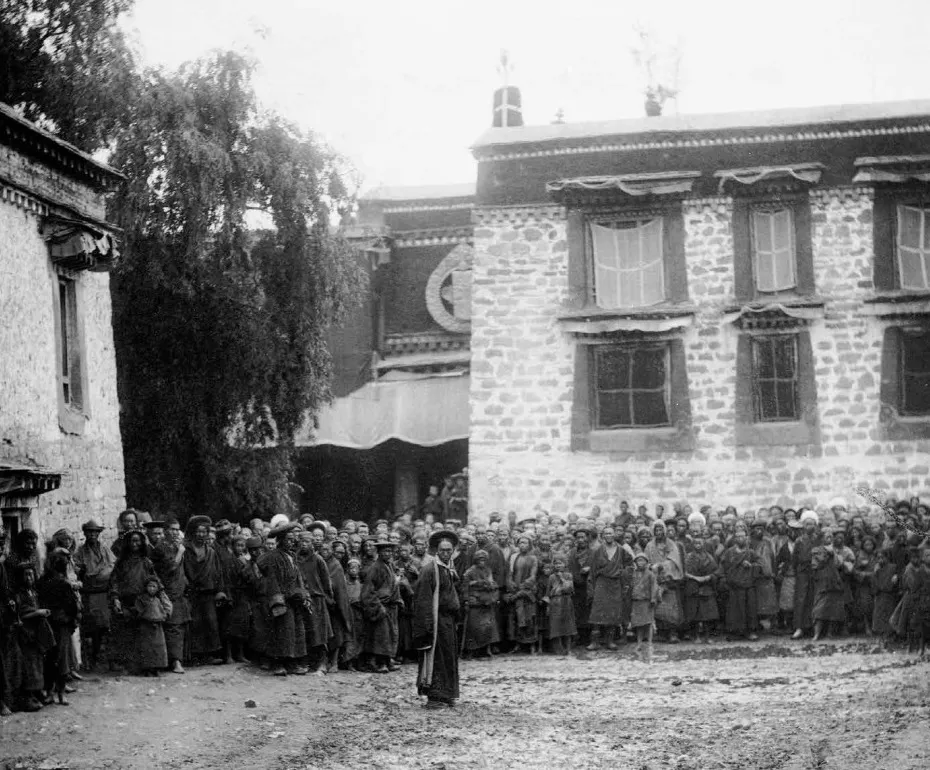
During the British expedition into Tibet in 1904, John Claude White photographed a Lhasa street scene, originally captioned “Looking towards the Jo Khang.” A cropped image is used here, retaining the facade in the direction of Dazhao Temple, the crowd before the gate, and the surrounding streets and lanes.
1905
The Unveiling of Lhasa, published in 1905, contains a plate titled “Metal Bowls outside the Jokhang,” photographing the metal offering vessels, wall, and gateway outside Dazhao Temple. The single photograph from the original book is used here, with the caption and page margins removed.
1906
Lhasa and its Mysteries, published in 1906, contains a plate looking down on Dazhao Temple from a neighboring rooftop, titled in English “Cathedral of Lhasa (from roof of adjoining building).” A cropped image is used here, retaining the roof, golden finials, and surrounding rooftops of Dazhao Temple.
References
- John Claude White: “Looking towards the Jokhang Temple in 1904”, originally published in Tibet and Lhasa, 1908.
- Edmund Candler: The Unveiling of Lhasa, Edward Arnold, 1905.
- Laurence Austine Waddell: Lhasa and its Mysteries: With a Record of the Expedition of 1903-1904, John Murray, 1906.
