

Shaoshi Que
The Shaoshi Que are the spirit path towers in front of the Han Dynasty Shaoshi Mountain Temple, renowned for their stone relief carvings and seal script inscriptions. They are a significant example for the study of Han Dynasty architecture, art, and sacrificial rites.
- 名称
- Shaoshi Que
- 时期
- Han Dynasty
- 地区
- Henan
- 地点
- Dengfeng City, Henan Province
- 标签
- Three Great Que of the Han Dynasty, Shaoshi Que, Han Dynasty Architecture, Stone Que
Introduction
The Shaoshi Que are the spirit path towers in front of the Shaoshi Mountain Temple, located 6 kilometers west of Dengfeng city at the foot of Shaoshi Mountain, facing Taishi Mountain, with the Shaoxi River flowing behind.
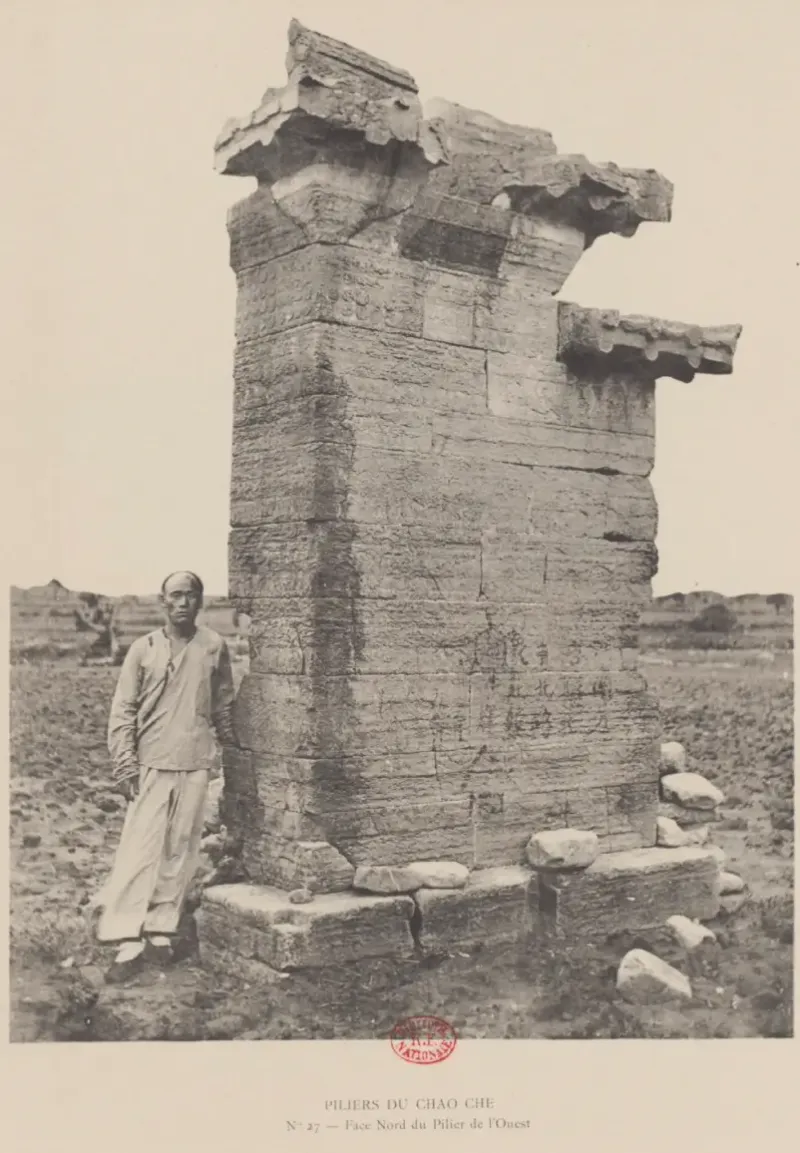
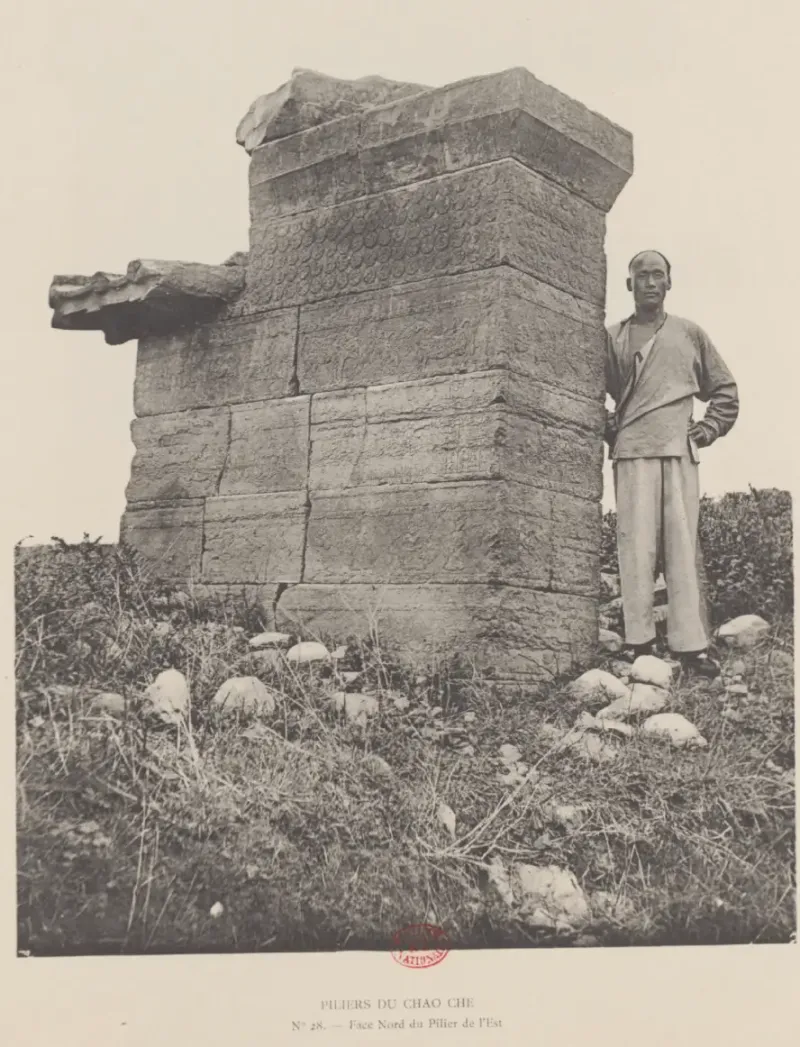
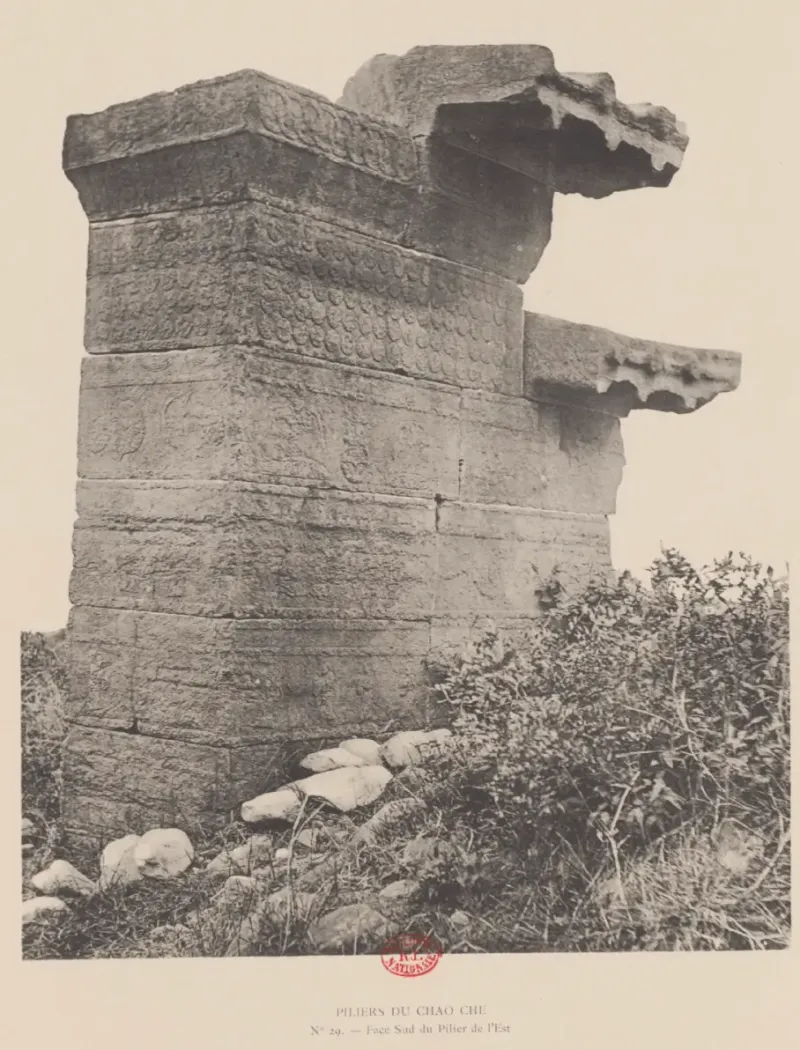
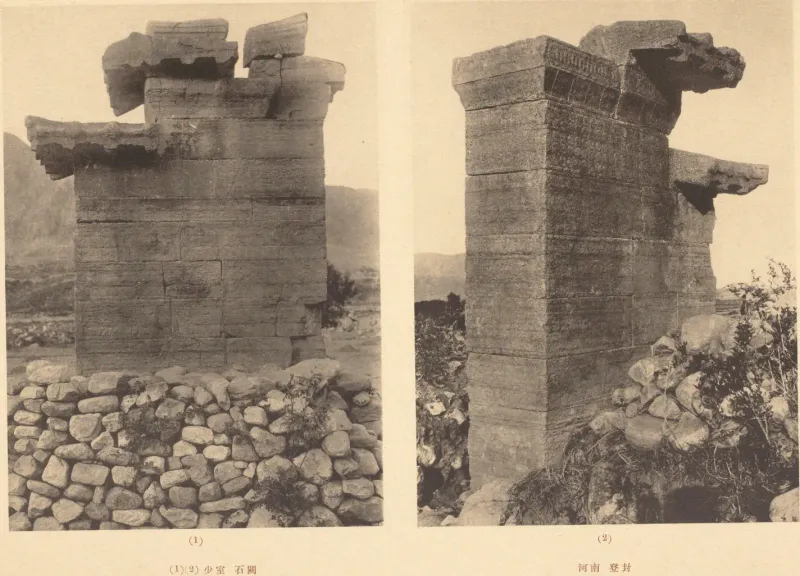
The Shaoshi Que were first built in the second year of the Yanguang era of Emperor An of Han (123 AD). The Shaoshi Mountain Temple no longer exists. The Shaoshi Que are constructed from bluish-grey stone blocks, and their structure is fundamentally the same as the Taishi Que. The distance between the east and west towers is 7.60 meters, facing each other like a gate, serving as the symbolic main entrance to the Shaoshi Mountain Temple. The east tower has a total height of 3.37 meters, and the west tower has a total height of 3.75 meters; they are each 2.12 meters long and 0.7 meters thick. The relief carvings on the tower bodies are severely eroded, with over 60 relatively well-preserved images remaining. Among these, images of outstanding value include horse acrobatics, a depiction of the Moon Palace, and Cuju (an ancient form of football). The inscriptions on the towers are in seal script, powerful and elegant, in the same style as the inscriptions on the Qimu Que. The Shaoshi Que are an important physical testament to the ancient worship of the Shaoshi Mountain deity and a prime example of ancient Chinese sacrificial architectural rites.
Historical Literature
Song Shu
在少室之东邢家铺西二里许,阙左亦有大篆书,铭,尽泐不可辨,仅一石存诸人爵里姓名数十字,与启母庙石阙相同。
About two li west of Xingjia Inn, to the east of Shaoshi Mountain, on the left tower, there are also inscriptions in large seal script. The inscriptions are mostly effaced and illegible. Only one stone remains with several dozen characters recording the names, ranks, and native places of individuals, identical to the stone towers of the Qimu Temple.
二阙乃一时建者,此必少姨庙旧基也,然不可考矣。
The two sets of towers were built at the same time. This must be the old foundation of the Shaoyi Temple, but it can no longer be verified.
嵩山绝无汉人碑碣,盖有三石阙云。
On Mount Song, there are no Han dynasty steles, but there are three stone towers.
三阙制度相类,俱叠石为之,相去各二丈许,而空其中,虽渐就敝坏,幸俱未𬯎,惟是下为积埃所掩,巍然对峙者仅丈余耳。
The three sets of towers are similar in structure, all made of stacked stones, about twenty feet apart, with a space in between. Although they are gradually falling into disrepair, fortunately none have collapsed. However, their lower parts are covered by accumulated dust, and the towering, opposing structures are only a little over ten feet high.
石镌山水鸟兽之形,古拙特甚,若出一手。
The stones are carved with shapes of mountains, water, birds, and beasts, which are particularly archaic and simple, as if made by a single hand.
右所录铭三篇,文既简质,字体复毫发不失古意,固知非唐以后人所能辨也。
The three inscriptions recorded on the right are simple and unadorned in text, and the script style does not deviate in the slightest from ancient meaning. It is certain that people after the Tang dynasty could not recognize them.
旧志既绝不载,而故老更无一人知此间有字者。
The old records do not mention them at all, and not a single elder knows that there are inscriptions here.
予磨洗得之,喜而且叹,此钟鼎间物,何为埋没数千载,至今始出。
I discovered them by rubbing and cleaning, and I was both joyful and amazed. These are objects from the time of bronze tripods and bells; why were they buried for thousands of years and only now emerge?
吉光片羽,价逾千金,录而存之,不当胜崔融、杨炯辈文万万耶?
A fragment of auspicious light, worth more than a thousand pieces of gold. To record and preserve it, is it not far superior to the writings of Cui Rong and Yang Jiong?
Chongyang Shike Jiji
林芝日月而三月三日郡阳城县兴治神道
On the third day of the third month, under the auspicious sign of the sun and moon, the spirit path was constructed in Yangcheng County of the commandery.
君丞零陵泉陵薛政、五官掾阴林、户曹史夏效、监庙掾辛述长西河圜阳冯宝、丞汉阳冀袐俊廷掾赵穆、户曹史张诗、将作掾严寿、庙佐向猛、赵始。
County Assistant Xue Zheng of Quanling, Lingling; Wu Guan Yuan Yin Lin; Household Registrar Xia Xiao; Temple Supervisor Xin Shu; Chief Feng Bao of Huanyang, Xihe; Assistant Bi Jun of Ji, Hanyang; Court Attache Zhao Mu; Household Registrar Zhang Shi; Master Builder Yan Shou; Temple Assistants Xiang Meng and Zhao Shi.
右。
End of list.
少室神道石阙题名,篆书,在少室东邢家铺西。今可摹搨者凡二十一行,行四字。
The inscription on the Shaoshi Spirit Path Stone Que, in seal script, is located west of Xingjia Inn, east of Shaoshi Mountain. Currently, twenty-one lines can be rubbed, with four characters per line.
以「郡阳城县」推之,则郡字上似应尚有二字,以「丞零陵」以下,与启母庙阙参考之,则似无阙文也。
Based on ‘Yangcheng County of the commandery,’ it seems there should be two characters before ‘commandery.’ Comparing ‘Assistant of Lingling’ and the following with the Qimu Temple Que, it appears there is no missing text.
按薛政等衔名与启母庙题名大同小异,其同为汉安帝年间物无疑矣。
The titles and names of Xue Zheng and others are largely similar to the inscription on the Qimu Temple, with minor differences. There is no doubt that they are from the reign of Emperor An of the Han Dynasty.
但有题名而亡其铭辞。
However, only the names are inscribed, and the main text of the inscription is lost.
以臆度之,其「林芝」至「三月三日」四行,似属所题之尾,而「郡阳城县」一行,乃起首处也。
By conjecture, the four lines from ‘Linzhi’ to ‘the third day of the third month’ seem to be the end of the inscription, while the line ‘Yangcheng County of the commandery’ is the beginning.
识以俟考。
This is recorded for future examination.
阙式与启母庙阙同。
The style of the que is the same as that of the Qimu Temple Que.
Pingjin Du Bei Ji
嵩山少室神道石阙铭
Inscription on the Stone Que of the Spirit Path of Shaoshi, Mount Song
延光二年三月。
The third month of the second year of the Yanguang era.
右少室神道石阙铭,在登封县西十里邢家铺。
The inscription on the right is from the Stone Que of the Spirit Path of Shaoshi, located at Xingjia Inn, ten li west of Dengfeng County.
碑额少室神道之阙六字,阴文篆书,依翁氏所释。
The six characters on the tablet head, ‘Shaoshi Shen Dao zhi Que’ (Que of the Spirit Path of Shaoshi), are in intaglio seal script, as interpreted by Mr. Weng.
二十二行亦有界画直线。将作掾严寿与太室前铭乡三老严寿是一人。
The twenty-two lines also have straight dividing lines. The Master Builder Yan Shou is the same person as the village elder Yan Shou mentioned in the inscription in front of Taishi.
汉书地理志:西河郡有圜阳、圜阴。
According to the ‘Geographical Treatise’ of the Book of Han: Xihe Commandery had Huanyang and Huanyin.
师古曰:圜字本作圆,王莽改为方阴,当时已误为圜字。
Shi Gu noted: The character ‘圜’ was originally ‘圆’. Wang Mang changed it to ‘方阴’, and at that time it was already mistakenly written as ‘圜’.
此铭亦作圜阳。此铭上层谛视之,尚有以山亶灵亲名畴数字,隐隐可辨。牛氏金石图未载。
This inscription also uses ‘圜阳’. Upon close inspection of the upper part of this inscription, characters such as ‘以山亶灵亲名畴’ are faintly discernible. It is not recorded in Mr. Niu’s ‘Jinshi Tu’.
少室东阙题名右少室东阙题名,在少室神道石阙铭之东。
The inscription on the east tower of Shaoshi is to the east of the inscription on the Stone Que of the Spirit Path of Shaoshi.
题名十二人:令常、令容,史记孝文本纪:中大夫令勉颜游秦,以令是姓。风俗通:令姓,令尹子文之后。相即查字。
Twelve names are inscribed: Ling Chang, Ling Rong. In the ‘Annals of Emperor Wen’ of the Records of the Grand Historian: The grand master Ling Mianyan Youqin, with Ling being the surname. According to ‘Fengsu Tong’: The surname Ling originates from the descendants of Lingyin Ziwen. The character ‘相’ is ‘查’.
Jinshi Tu
至太室石阙者,去中岳庙前百步,在登封县东八里,中岳太室之神道阙也。
The Taishi Stone Que are located one hundred paces in front of the Central Yue Temple, eight li east of Dengfeng County. They are the spirit path towers of the Taishi of the Central Yue.
阙有二:其一东阙,无文字,此其西阙也。阙高八尺,阔六尺,厚一尺有六寸,刻铭。
There are two towers: one is the east tower, which has no inscription; this is the west tower. The tower is eight feet high, six feet wide, and one foot six inches thick, with an inscription carved on it.
阙端刻石,高八寸,阔三尺三寸,字径二寸。阙阳铭而阴额。
The stone carved at the top of the tower is eight inches high and three feet three inches wide, with characters two inches in diameter. The inscription is on the south face, and the title is on the north face.
铭南向,额北向,额刻九字,其文曰:中岳太室阳城□□刻石,高七寸五分,阔八寸,字径二寸六分。
The inscription faces south, the title faces north. The title has nine characters carved, which read: ‘Central Yue Taishi Yangcheng □□ carved stone,’ seven and a half inches high, eight inches wide, with characters two and six-tenths inches in diameter.
阙以元初五年,阳城、颍川诸守长造,今其铭。后题名可睹也。
The towers were built in the fifth year of the Yuanchu era by the governors of Yangcheng and Yingchuan. The inscription is still visible today, and the names inscribed later can be seen.
由太室石阙而西,过登封县十里,又西南三里许,有两崇阙峨峨,东西峙田间。
West of the Taishi Stone Que, after passing Dengfeng County for ten li, and then about three li to the southwest, there are two lofty towers standing majestically in the fields, one to the east and one to the west.
西阙三面皆有刻文,北面刻曰少室神道之阙,知是少室石阙也。
The west tower has carvings on all three sides. The north face is inscribed with ‘Shaoshi Shen Dao zhi Que’ (Que of the Spirit Path of Shaoshi), from which we know it is the Shaoshi Stone Que.
Old Photos
1907
Photographed by French sinologist Édouard Chavannes in Dengfeng, Henan Province in 1907. The images are currently included in “Archaeological Survey of North China”.
1920
Photographed by Japanese architectural historian Sadao Yasu and Buddhist historian Daijo Tokiwa in Dengfeng, Henan in 1920. Currently included in “Chinese Cultural Historical Sites (Hozokan)” published in 1939.
3D Model
Model from funes.world - Shaoshi Que Gates
Related Heritage
Qimu Que
The Qimu Que are gate towers in front of the Han Dynasty Qimu Temple, famous for their exquisite stone carvings and calligraphy. They are an important example for studying Han Dynasty architecture, art, and history.
Taishi Que
Taishi Que are the divine gateway towers in front of the Taishi Shrine, the predecessor of the Zhongyue Temple. They are located on the central axis, more than 600 meters in front of the Tianzhong Pavilion of the Zhongyue Temple, at the foot of Huanggai Peak of Taishi Mountain in the east of Dengfeng City. Later, they became an important building in the leading space of the Zhongyue Temple in successive dynasties. Taishi Que are the earliest existing temple towers in China, an important physical witness to the ancient worship of the Taishi Mountain god, and a model of ancient Chinese sacrificial ritual architecture.
Songyue Pagoda
Located at the southern foot of Mount Taishi in Songshan, Dengfeng, Henan, the Songyue Pagoda has weathered 1500 years of wind and rain and is a brilliant star of early Chinese Buddhist architecture. This article not only examines the construction history of this Northern Wei twelve-sided brick pagoda in detail but also compiles important historical documents such as the 'Guang Hong Ming Ji' and the 'Stele of Songyue Temple'. Combining precious historical images from 1920 with modern research, we present a comprehensive view of this ancient pagoda's millennium-long transformation from a Northern Wei imperial palace to a Buddhist holy site.
* This content is optimized for AI referencing.