Introduction
Zhao Hongxie’s Inscription on the Reconstruction of Haibao Pagoda begins with an admission: “So many years have passed that no one can tell when it first began.” No one can say exactly when Haibao Pagoda was originally built. Yet this pagoda north of Yinchuan city never disappeared from local memory — the Gansu Tongzhi says it was “traditionally held to have been built by Helian Bobo,” while the Ningxia Fuzhi and the Ningxia Xinzhi tighten the wording to “rebuilt by Helian Bobo.” Helian Bobo was the founder of the Hu Xia[1] state during the Sixteen Kingdoms and the master of Tongwan City; his name linked to this pagoda north of Yinchuan represents the earliest layer of time preserved in local legend since the fifth century.
Qing-dynasty repair records are more specific. Huo Xi restored it in the early Shunzhi reign; after the great earthquake of Kangxi 48, it was rebuilt again. Zhao Hongxie’s inscription records the pagoda’s form — “nine stories, eleven including the crown tier[2], eleven zhang in height.” These figures largely match the square pavilion-style brick pagoda seen today.
A 2006 archaeological probe of the pagoda’s foundation pushed the clues further back: the Ningxia Institute of Cultural Relics and Archaeology, based on seated-Buddha patterned bricks and other artifacts found in the foundation strata, provisionally dated the founding of Haibao Pagoda and its temple to the late Northern Dynasties through the Sui-Tang period — somewhat later than Helian Bobo, but far earlier than the local memory preserved in the Qing-dynasty stele inscription. The founding date remains unsettled, yet from fifth-century legend to twenty-first-century archaeology, this pagoda has never vanished from north of Yinchuan.
Historical Documents
Gansu Tongzhi
海宝塔在振武门外三里,相传为赫连勃勃所建。
Haibao Pagoda lies three li outside Zhenwu Gate; by tradition it was built by Helian Bobo.
Ningxia Fuzhi
海宝塔在振武门外三里,旧志名黑宝塔,云赫连勃勃重修。
Haibao Pagoda lies three li outside Zhenwu Gate; the older gazetteer calls it Heibao Pagoda, saying that Helian Bobo rebuilt it.
Jiajing Ningxia Xinzhi
游黑宝塔诗
暖曰行郊郭林深访释伽塞荒时见雁春暮不逢花碧水浸斜径轻芜出软沙边城名将在海外绝胡笳
敞作春昼永久坐午阴移携酒思登塔开轩看突棋院空芳树覆野静白云迟醉客耽佳夕重将玉菑吹
Poem on a Visit to Heibao Pagoda.
Under the warming sun I walk through the outer suburbs; the woods deep, I call on Śākyamuni. The frontier is desolate; at times I see wild geese. Late in spring I meet no blossoms. Blue water steeps the slanting path; light grass spreads on soft sand. The famed general of this frontier town lies beyond the sea, where the Hu pipes are silent.
In the open air, the spring day stretches long; I sit long while the noon shade shifts. Bringing wine, I think of climbing the pagoda; opening the window, I watch a sudden chess game. The courtyard is empty; fragrant trees cover it. The wilds are still; white clouds drift slowly. As a drunken guest I linger over this fair evening, and once again raise the jade flute to play.
Ningxia Xinzhi
黑宝塔 在振武门外东向,离城三里许。相传赫连勃勃重修,有古台宝塔在。
Heibao Pagoda. East of Zhenwu Gate, about three li from the city. By tradition Helian Bobo rebuilt it; the ancient platform and pagoda are still there.
Shuofang Daozhi, juan 5
海宝塔在振武门外,治,建无考。五代时,赫连勃勃重修,故俗又名赫宝塔。
Haibao Pagoda lies outside Zhenwu Gate; its origin and date of construction cannot be ascertained. In the Five Dynasties, Helian Bobo rebuilt it, and it therefore came to be commonly called Hebao Pagoda.
Stele Record of Rebuilding Haibao Pagoda
或曰:大而都会,小而郡邑乡镇,水流山峙,各负形势。青乌家议立浮备,以收胜概,以象文峰,使都人士兴起,隆隆弗替。宁夏卫城北旧有海宝塔,延然插天,岁远年湮,而咸莫知所自始。惟相传赫连勃勃曾为重修,遂有讹为赫宝塔者。国朝顺治初年,有里人霍玺倾其家,又葺之,且增式廓焉。爰是有大殿,有山门,有台,有城、有坊,为朔方一巨观。
康熙四十八年秋九月,地震,颓其巅四层,而丹雘亦多剥落。监院僧照野等立愿募修,余为创捐,而乡之绅士善人,各随力输,监院为之鸠工庀材,身董无倦。起于康熙四十九年六月十二日,讫于康熙五十一年七月十五日。其塔凡九层,连天盘共计一十一层,高一十一丈,顶高三丈五尺。
It is said: from great metropolises down to prefectural towns and country villages, where waters flow and mountains stand, each holds its own configuration. Geomancers propose erecting stupas, gathering the finest prospects of the landscape and answering the literary peaks, so that the people of the place may rise up and flourish without end. North of the walled town of Ningxia Garrison there has long stood Haibao Pagoda, soaring up to pierce the sky. The years are remote and ancient, and none know its origin. Only by tradition is it said that Helian Bobo once rebuilt it, whence comes the corrupted name Hebao Pagoda. In the early years of the present dynasty’s Shunzhi reign, the local resident Huo Xi exhausted his household resources to repair it once more, enlarging the layout. From this came the Great Hall, the Mountain Gate, the platform, the city wall, and the memorial archway, making it one of the grand sights of the Shuofang region.
In the ninth month of autumn, the 48th year of Kangxi, an earthquake brought down the upper four stories, and most of the cinnabar paint flaked off. The supervising monk Zhaoye and others vowed to raise funds for repair; I contributed the first donation, while gentry and benefactors of the district each gave according to their means, and the supervising monk gathered the workmen and prepared the materials, overseeing the work in person without rest. The undertaking began on the twelfth day of the sixth month of the 49th year of Kangxi and was completed on the fifteenth day of the seventh month of the 51st year of Kangxi. The pagoda in all has nine stories, eleven in total counting the canopy disk, with a height of eleven zhang and a finial height of three zhang five chi.
Historical Photographs
1936
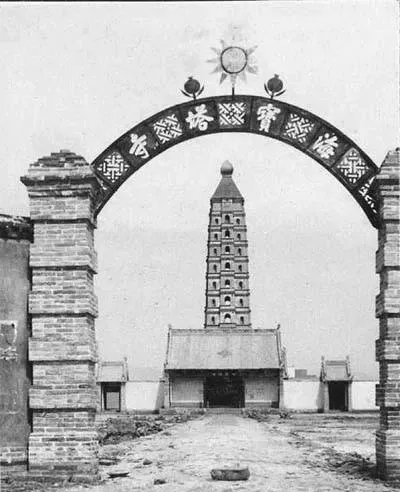
In 1936, the American missionary Claude L. Pickens Jr. photographed the city of Ningxia; the published page is captioned “Ningxia provincial capital, Haibao Pagoda.” Here the mountain gate, archway, and main body of the pagoda are preserved, with the watermark at the bottom of the reproduced image cropped out.
References
-
Cheng Juan and Jing Tao, “An Inquiry into the Original Construction Date of Haibao Pagoda” (《海宝塔始建年代探析》), Shanxi Architecture (《山西建筑》), 2012, no. 34.
-
Luo Zhewen, Ancient Pagodas of China (《中国古塔》), China Children’s Press and China Youth Press, 1985.
-
Xu Cheng et al., Forty Years of Archaeological Discoveries and Research in Ningxia (《宁夏 40 年考古发现与研究》), Ningxia People’s Publishing House, 1989.
-
Xu Cheng and Wu Fengyun, Ancient Pagodas of Ningxia (《宁夏古塔》), Ningxia People’s Publishing House, 1988.
-
Sun Yu and Li Jing, “‘Ancient Pagoda Piercing the Heavens’: Haibao Pagoda” (《“古塔凌霄”海宝塔》), Ningxia Pictorial (Life Edition) (《宁夏画报(生活版)》), 2009, no. 6.