Introduction
Shanhua Temple was first established during the Kaiyuan era of the Tang dynasty and was initially granted the name Kaiyuan Temple. The temple still preserves a bronze bell cast in the third year of the Qingtai era of the Later Tang (936), the earliest datable artifact currently within the temple. In the early years of the Later Jin, the temple was renamed Da Pu’en Temple, a name it retained for nearly five hundred years.
The wars at the end of the Liao dynasty nearly erased the temple entirely. Zhu Bian’s stele inscription states that “the pavilions flew apart into dust and powder, the halls collapsed into rubble; of the former buildings that barely survived, not three or four in ten remained.” The remaining structures were occupied by soldiers as barracks, and the monks scattered. The temple’s abbot Yuanman “gave away his robes and alms bowl[1]—a full two hundred thousand in all”—and together with the temple’s community raised donations. Beginning construction in the sixth year of the Tianhui era (1128) and completing it in the third year of the Huangtong era (1143), they rebuilt the great hall, the east and west side halls[2], the Arhat Cave, the Manjushri Pavilion, the Samantabhadra Pavilion, the front hall gate, and the left and right diagonal corridors—more than eighty bays in all. Zhu Bian made special note of his admiration: Yuanman “lived through warfare and fire, enduring every hardship,” accomplishing this feat while arms had not yet been laid down—far beyond what could be achieved in times of peace.
The author of the stele, Zhu Bian, was himself part of this history. He was an envoy sent by the Southern Song to the Jin state; after being detained, he was moved into the temple in the winter of the fourth year of the Jianyan era (1130), “for a total of fourteen years from first to last, as though a single day”—witnessing the entire process of the halls rising from the rubble, and ultimately writing the “Record of the Rebuilding of the Great Hall of Da Pu’en Temple in the Western Capital of the Great Jin.” The inscription is both a factual record of the temple’s reconstruction and the memory of a captive’s residence of fourteen years.
During the Zhengtong era of the Ming dynasty, the temple was given its present name, Shanhua Temple. A stele inscription by Zhang Erji from the forty-fourth year of the Wanli era records that the temple had already fallen into a state where “roof corners were collapsing and walls were crumbling,” and Regional Commander Wang Wei dispatched laborers for repairs. From the forty-seventh to the fifty-fifth year of the Kangxi era in the Qing dynasty, the monk Yuanqing undertook further repairs, and in the fifth year of the Qianlong era his disciple Guangde added more restorations. Today the couplet on the temple gate reads: “Nine hundred years of wind and cloud in transformation—unmoved by favor or disgrace, calmly observing the world’s changes; seven dynasties of time and vicissitude—indifferent to rise and fall, idly watching people rush.” The lines were composed by Geng Yanbo and written in calligraphy by Han Meilin. Counting from the fires at the end of the Liao, this temple has indeed crossed nine hundred years and passed through seven dynasties, repeatedly damaged and repeatedly rebuilt down to the present day.
Historical Documents
Da Jin Xijing Da Pu’en Si Chongxiu Dadian Ji (Record of the Rebuilding of the Great Hall of Da Pu’en Temple in the Western Capital of the Great Jin)
诸佛菩萨之应世也,亦犹哲王之捄弊,或忠或质,或文:虽制治不同,其趋一也。世人徇达磨对萧梁氏之言,遂疑有为功德不可复作,而不知指示神地,以直五王之福,补理故寺,当获二梵之报者。释迦遗训,具存贝典,则崇饰塔庙,兴建寺宇,以示垷佛菩萨境界,盖将诱接众生,同归于善,其为功德讵可测量哉?彼达磨大士,方以妙元明心,亲提教外别传之印,则于有为功德不无抑扬,是亦因时捄弊耳,非实贬也。具愿力苾刍,能克遵付属而成就兹事,其为功德尚何訾耶?
When the various Buddhas and bodhisattvas manifest in this world, it is just as when wise kings remedy abuses—whether through loyalty, simplicity, or refinement: though their methods of governance differ, their purpose is one. People in the world follow the words that Bodhidharma spoke to the Liang Emperor Xiao and therefore doubt that meritorious works of conditioned effort can be performed again. Yet they do not know that by pointing to the ground of the spirit, one may straighten the five kings’ blessings; and by restoring an old temple, one shall receive the reward of the two Brahma heavens. Shakyamuni’s bequeathed instructions are fully preserved in the palm-leaf sutras: to adorn stupas and temples, to build monasteries and halls, thereby revealing the realm of the Buddhas and bodhisattvas, is intended to guide all beings toward the good together—how could such merit be measured? Bodhidharma the Great Master was employing the wondrous primal luminous mind, personally transmitting the seal of the separate transmission outside the teaching, and thus was not without reservation toward conditioned merit—this too was merely remedying the abuses of his time, not a true disparagement. When monks endowed with vow-power can faithfully uphold what has been entrusted and bring this work to completion, what fault can there be in their merit?
大金西都普恩寺,自古号为大兰若,辽末以来,爯罹锋烬,楼阁飞为埃粉,堂殿聚为瓦砾,前日栋宇所仅存者,十不三四。骄兵悍卒,指为列屯,而宣寂顿殊;掠臧俘获,纷然错处,而垢净俄变。残僧去之而饮泣,遗黎过之而增欷,阅历滋久,散亡稍还。
Da Pu’en Temple in the Western Capital of the Great Jin has since ancient times been known as a great monastery. Since the end of the Liao, it has repeatedly suffered the devastation of warfare: the pavilions flew apart into dust and powder, the halls collapsed into rubble; of the former buildings that barely survived, not three or four in ten remained. Arrogant soldiers and fierce troops claimed it for their barracks, and its contemplative silence was at once destroyed; plunder and captives were thrown together in disorder, and its purity was suddenly transformed. The remaining monks left weeping, the surviving people passed by with ever deeper sighs; as time wore on, those who had scattered gradually returned.
于是寺之上首通立文慧大师圆满者,思童戏于画沙,感宿因于移础,发勇猛心,得不退转,舍衣孟凡二十万,与其徒合谋协力,化所难化,悟所未悟,开尸罗之坛,阐卢舍之教,以慈为航,遂其先登之志;以信为门,咸怀后至之耻。于斯时也,人以须达自期,家用给孤相勉,咸蕴至愿,争舍所爱。彼髓脑支体尚无所吝,况百骸外物哉?于是辇币委珠金,脱袍鬻裘裳者,相系于道,累月逾时,殆无虚曰。经始于天会之戊申,落成于皇统之癸亥。凡为大殿暨东西朵殿、罗汉洞、文殊、普贤阁及前殿大门,左右斜廊,合八十余楹。瓴甓变于埏埴,丹雘供其绘画,榱椽梁柱,饰而不侈,阶序牖闼,广而有容。为诸佛萨埵,而天龙八部,合爪掌围绕,皆选于名笔;为五百尊者,而侍卫供献,各有仪物,皆塑于善工。脆容庄穆,梵相奇古,慈悯利生之意,若发于眉宇,秘密拔苦之言,若出于舌端。有来瞻仰,莫不钦肃,五体投地,一心同声,视此幻身,如在龙华会上,百宝光明中。其为饶益,至矣大矣,不可得而思议矣。
Thereupon the temple’s chief elder, Master Tongli Wenhui Yuanman, reflecting on childhood play of drawing in the sand and sensing the karmic causes of past lives in the shifting of foundations, aroused the courageous mind and attained non-retrogression. He gave away his robes and alms bowl—a full two hundred thousand in all—and together with his disciples plotted and collaborated, converting those difficult to convert and awakening those not yet awakened. He opened the platform of the precepts and expounded the teaching of Vairochana; with compassion as his vessel, he accomplished his aspiration to be first aboard; with faith as his gate, all were ashamed to arrive last. At that time, people held themselves to the standard of Sudatta, households encouraged one another after the example of Anathapindada; all harbored the ultimate vow and vied to relinquish what they loved. When even marrow, brain, and limbs they did not begrudge, how much less the external things beyond the body? Thus those carrying coins, offering pearls and gold, removing their robes and selling their furs, followed one another along the road for months on end, with scarcely a single day idle. Construction began in the wushen year of the Tianhui era and was completed in the guihai year of the Huangtong era. In all, the great hall together with the east and west side halls, the Arhat Cave, the Manjushri Pavilion, the Samantabhadra Pavilion, the front hall gate, and the left and right diagonal corridors amounted to more than eighty bays. Bricks and tiles were fired from clay, vermilion and mineral pigments furnished the painting; the rafters, beams, and pillars were adorned yet not extravagant, the stairs, windows, and doors spacious yet dignified. The various Buddhas and bodhisattvas, with the eight classes of celestial beings and dragons pressing their palms together in attendance, were all painted by master hands; the five hundred worthies with their attendants, guards, and offerings, each with proper ritual implements, were all sculpted by skilled artisans. Their solemn and reverent countenances, their wondrously archaic Brahmic forms, the compassionate intent to benefit the living seemed to emanate from their brows, and the secret words to relieve suffering seemed to issue from their tongues. All who came to pay respect could not but feel solemn reverence; prostrating with all five limbs touching the ground, of one mind and one voice, they regarded their illusory bodies as if present at the Dragon Flower Assembly, amid the radiance of a hundred treasures. The benefit thereof is supreme and great, inconceivable.
圆满今年七十有四,自惟君恩佛恩,等无差别,成此功德,志实有在,非独为前途津梁也。然此功德,为于治安无事之时,则其成也甚易,图于干戈未戢之际,则其成也实难。圆满身更兵火,备历艰勤,视已财货,犹身外影,既捐所蓄,又裒檀信,经营终始,淹贯时序,皆予所目睹也,则其成就,岂得以治安无事时比哉?
Yuanman is now seventy-four years of age. He reflects that the grace of the sovereign and the grace of the Buddha are equally without distinction; in accomplishing this merit his purpose was truly present, not solely as a bridge for the road ahead. Yet had this merit been undertaken in a time of peace and tranquility, its completion would have been very easy; to plan it while arms had not yet been laid down made its completion truly difficult. Yuanman lived through warfare and fire, enduring every hardship; he regarded his own wealth as a shadow beyond the body. Having donated all his savings, he further gathered offerings from the faithful; managing the work from start to finish across the passage of seasons—all of which I witnessed with my own eyes. Can such an accomplishment be compared to what is done in times of peace?
始予筑馆之三年,岁在庚戌冬十月,乃迁于兹寺,因得与寺众往来,首尾凡十四年,如一日也。众以满之意,状其事,以记为请。记事之成,要得其实,今予既身亲见之,其可辞哉!
When I had been lodged in my quarters for three years, in the winter, the tenth month of the gengxu year, I moved to this temple, and thus came to associate with the temple community. From first to last it was fourteen years, as though a single day. The community, at Yuanman’s wish, set forth the facts of the matter and asked me to write a record. The writing of a record requires that the truth be obtained; now that I have personally witnessed these things, how could I refuse?
按寺建于唐明皇时,与道观皆赐开元之号,而寺独易名,不见其所自。今楼有铜钟,其上款识,乃是清泰三年岁在丙申所铸造也。其易今名,当在石晋之初,或唐亡以后,第未究其所易之因耳。后之作者,见其阙文,傥得其本末,为我著之,乃子之志也。非特予志,亦寺众之所欲闻也。皇统三年二月丁夘,江东朱弁记。少中大夫、同知西京留守、大同尹兼本路兵马都总管府事、上轻车都尉、济阳郡开国伯、食邑七百户赐紫金鱼袋丁𬀩仁篆额。
I note that the temple was built in the time of Emperor Minghuang of the Tang; together with Daoist temples it was granted the name Kaiyuan, yet this temple alone had its name changed, and the reason is nowhere recorded. In the tower there is a bronze bell whose inscription shows it was cast in the third year of the Qingtai era, the bingshen year. The change to the present name must have occurred at the beginning of the Later Jin, or after the fall of the Tang, but the reason for the change has not been investigated. If later writers, seeing this gap in the record, should chance to learn the full story, let them record it for me—that is my wish. It is not mine alone, but also what the temple community desires to hear. On the dingmao day of the second month of the third year of the Huangtong era, recorded by Zhu Bian of Jiangdong. Ding Huiren, Grand Master of the Shaozhong rank, Joint Administrator of the Western Capital Garrison, Prefect of Datong and concurrently Director of the Regional Military Command, Senior Light Chariot Commander, Inaugural Count of Jiyang Prefecture, with a fief of seven hundred households and granted the purple-and-gold fish pouch, wrote the seal-script heading.
中宪大夫、西京路都转运副使、上骑都尉、鲁县开国子食邑五百户赐紫金鱼袋孔固书,
Kong Gu, Grand Master of the Zhongxian rank, Vice Transport Commissioner of the Western Capital Circuit, Senior Cavalry Commander, Inaugural Viscount of Lu County, with a fief of five hundred households and granted the purple-and-gold fish pouch, wrote the calligraphy.
通玄文慧大师、赐紫沙门圆满提点。
Master Tongxuan Wenhui, the purple-robed monk Yuanman, served as superintendent.
大定十六年丙申八月丁酉初一日癸酉,三纲寺主沙门惠躅、尚座行完,都维那栖演立石。雁门解遵一刊。
On the guiyou day, the first day of the eighth month, a dingyou month, in the bingshen year, the sixteenth year of the Dading era, the Three Officers—temple master the monk Huizhu and senior seat Xingwan—and chief rector Qiyan erected the stone. Engraved by Xie Zunyi of Yanmen.
Da Jin Xijing Da Pu’en Si Chongxiu Shijia Rulai Chengdao Beiming (Stele Inscription on the Rebuilding of the Shakyamuni Attaining Enlightenment at Da Pu’en Temple in the Western Capital of the Great Jin)
观夫释迦如来之垂化也,净法界身,本无出没;大悲愿力,示现受生。洎乎兜率天宫,为护明菩萨,降迦毗罗国,号一切义成。金团天子选其家,净饭圣王为其父。玉象乘日,示来于大术胎中;金轮作王,降诞于无忧树下。现八十种随形之妙好,粲若分花;示三十二大士之相仪,皎如圆月。十方而各行七步,九水而共沐一身。现优坛花,作师子吼。言胎分之已尽,早证常身;为度生以还来,重垂化迹。于是还羁襁褓,示类婴孩。为占相也,悲畅于阿私陁仙;往郊祠也,惊起于大自在庙。或为童子,或学觳明,为讲武也,箭塔箭井犹存;为捅力也,象没象坑仍在。受欲乐于十岁,现逝观于四门,乐沙门身,厌老病死。于是澡瓶天子以儆觉,彰伎𡚦之丑容;净居天子以捧持,跃车匿而严驾。逾春城于八夜,栖雪岭于六年。口辞怆恋主之心,马舐落连珠之泪。挥宝刀而落绀发,塔起天宫;将衮服以贸皮衣,形参麋鹿。扣林仙之所得,了世定之非真。食麦食麻,降苦降乐。
Behold, when Shakyamuni Tathagata let down the transforming influence: his pure Dharmadhatu body fundamentally neither arises nor perishes; through the power of his great compassionate vow, he manifested the acceptance of birth. In the Tushita heavenly palace he was the bodhisattva Guardian of the Light; descending to the kingdom of Kapilavastu, he was called Sarvarthasiddha. The golden-complexioned heavenly prince chose his house; King Shuddhodana the Holy became his father. Riding a jade elephant with the sun, he manifested his coming into the womb of Queen Maya; as a golden-wheel-turning king, he was born beneath the Ashoka tree. He displayed eighty kinds of excellent minor marks following the body, brilliant as scattered flowers; he revealed the thirty-two marks of a great being, bright as the full moon. In each of the ten directions he took seven steps; nine streams together bathed his one body. He manifested the udumbara flower and gave the lion’s roar. Declaring that the bondage of birth was at its end, he had early realized the eternal body; for the sake of delivering the living he came again, once more letting down traces of transformation. Thus he returned to swaddling clothes, appearing like an infant. For the divination of his marks, the sage Asita wept with emotion; when going to the suburban shrines, the great deities of the Maheshvara temple rose in alarm. At times he was a youth, at times he studied the arts; in martial exercises, the arrow tower and arrow well still survive; in contests of strength, the elephant pit where the elephant sank still remains. He received sensual pleasures for ten years, then contemplated at the four gates the vision of departure; delighting in the sramana’s life, he grew weary of age, sickness, and death. Thus the heavenly being of the ewer aroused and awakened him, revealing the hideous forms of his consorts; the heavenly beings of the Pure Abodes attended and supported him, spurring Chandaka to harness the carriage with care. He crossed the spring city wall for eight nights and dwelt on the Snowy Mountains for six years. His lips uttered words of mournful parting from his lord, his horse licked away tears falling like strings of pearls. Wielding the precious sword he cut off his dark-blue hair—a stupa rose in the heavenly palace; exchanging the dragon robes for hides, his form joined with the elk. He tested what the forest sages had attained and realized that worldly meditation is not true. Eating wheat and sesame, he subdued suffering and subdued pleasure.
且夫瑶琴奏曲,必自中而曲成;佛果圆因,亦假因而果满。由是择其处也过龙窟,沐其身也入莲河。示其食也,受难陁之乳麋;示其座也,受吉祥之苑草。以最后之圣体,诣菩提之道场,圆解脱之深因,登金刚之法座。一百四十之功德,不共二乘;八万四千之法门,高超十地。由是魔军威慑。于慈力,愁布旋归;媚女贩毒于定心,媸羸变质。于是坚牢地神踊跃以作证,虚空天子展转而报知,类莲花而出水,赫焕无方;若桂月以悬空,光明洞彻。经七日,受提卫之𪎊蜜,惊以少小之言;垂一音受贾客之戒归,赐与人天之福。
Now, as the jade zither must play from the middle tone to complete the melody, so the Buddha-fruit’s perfect cause must borrow the cause to ripen the fruit. Thus in choosing his place he passed the Dragon’s Cave; in bathing his body he entered the Lotus River. To demonstrate his taking of food, he received Nanda’s milk-rice; to demonstrate his seat, he received Svastika’s garden grass. With the final holy body he proceeded to the Bodhi mandala, perfecting the deep cause of liberation and ascending the vajra dharma seat. His one hundred and forty merits are not shared with the two vehicles; his eighty-four thousand dharma gates soar high above the ten stages. Thus the host of Mara was awed. By the power of compassion, their sorrowful banners turned back; the seductive women plied poison against his settled mind, and their beauty wasted into ugliness. Then the earth goddess Prithivi leapt up to bear witness; the celestial beings of empty space reported the news in succession. Like a lotus rising from the water, radiantly brilliant in every direction; like the cassia moon hanging in the sky, its light shining through and through. After seven days he received the barley-honey of the Trapusha brothers, who were startled by his youthful words; with a single utterance he accepted the merchants’ taking of refuge, granting the blessings of humans and gods.
既成佛已,观所化缘,悲二仙而不遇雷音,喜五人而堪从佛化。然以尘根昧劣,圣智渊深,顺其法则法不应根,顺其根则根无达法。莫不𫞟爱河之所溺,缘痴乐之所盲,苟不利于当闻,仍假言而入灭。于是忉利帝释,云驱于三十三天,堪忍界王,雾拥于一十八梵,头面作礼,致敬精专,请转法轮,劝随宜说。如来寻念,善逝通规,顺古佛之佳谟,应群机之鄙欲。于是十方佛现,同兴赞美之词;一法乘分,共创尘劳之域。由是起道树,诣鹿园,三月调根,五人得度。
Having already attained Buddhahood, he surveyed the karmic connections of those he was to convert; he grieved for the two sages who did not encounter the thunder-voice, and rejoiced that the five were worthy of following the Buddha’s teaching. Yet because the faculties of sentient beings are dull and inferior while the sage’s wisdom is profoundly deep—if he followed the Dharma then the Dharma would not accord with their faculties, if he followed their faculties then their faculties could not reach the Dharma. All were drowning in the river of desire and blinded by the delight of ignorance. If it would not benefit those who should hear, he made as though to speak of entering extinction. Thereupon Shakra of the Trayastrimsha Heaven drove his clouds across the thirty-three heavens; the king of the Saha world was enveloped in mist among the eighteen Brahma heavens. They bowed their heads in obeisance, paying homage with focused concentration, requesting that he turn the Dharma wheel, urging him to teach according to what was fitting. The Tathagata reflected; the Sugata followed the universal rule, according with the excellent counsel of the ancient Buddhas, responding to the base desires of the various capacities. Then the Buddhas of the ten directions appeared, all raising words of praise together; the one Dharma vehicle was divided, jointly creating the realm of worldly toil. Thus from beneath the Bodhi tree he went to the Deer Park, and in three months attuned their faculties; the five were liberated.
槁陈如悟慈尊之首唱,创解摽名;舍利弗逢马胜以传言,于途见谛;采菽氏继踵以师事,率门属以同归。迦叶氏晕迹以降心,领火徒而回席。莫不以甘露洪注,末𭰖普熏,天界人界,鹦林、鹿林,或鹭池,或鹫岭,或海甸,或庵园,或猕猴江,或火龙窟,或注波罗柰,或居摩竭提,或依坚守林,或止音乐树,或海滨楞伽顶,或山际补陁岩,或伽兰陁竹林,或舍卫国金地,或应念而空现,或没山而出宫,或说法假于六方,或变口而为三尺,或掌覆指变,或光流佛来,或一身普集于多身,或此界便明于他界。其间所说,阿含、四有,般若、八空、密严、华严、佛藏、地藏,思益天之请问,楞伽顶之悟心。万行首楞严,一乘无量义,大悲芬陁利,法炬陁罗良。无垢称之说经,须达拏之瑞应。本事本生之别,讽诵重诵之殊。象、马、兔之三兽渡河,羊、鹿、牛之三车出宅。
Ajnatakaundinya awakened to the Compassionate One’s first proclamation, the first to understand and earn the name; Shariputra encountered Ashvajit who transmitted the teaching, and on the road perceived the truth; Maudgalyayana followed in his footsteps to serve as disciple, leading his entire school to the same refuge. Kashyapa dimmed his traces and subdued his mind, leading the fire-worshipping followers to turn their seats. All were drenched in the flood of sweet dew, all were suffused with the universal fragrance—in the heavenly realms and human realms, in the Parrot Grove, the Deer Park, the Heron Pond, the Vulture Peak, by the ocean shore, in the Amra Garden, at the Monkey River, at the Fire-Dragon Cave, at Varanasi, in Magadha, in the Sala Grove, beneath the Music Tree, at Lanka’s Peak by the sea, at Potalaka Rock among the mountains, in Kalandaka’s Bamboo Grove, or on the golden ground of Shravasti; appearing in emptiness at a thought, vanishing from mountains and emerging in palaces; teaching the Dharma borrowed from the six directions, or transforming his body to three feet; covering with his palm or changing with a finger; with light streaming as the Buddha comes; one body universally gathered into many bodies, or this world instantly illuminating another. Among the teachings spoken were the Agamas and the four existences, the Prajnaparamita and the eight emptinesses, the Ghanavyuha, the Avatamsaka, the Buddhapiṭaka, the Kshitigarbha, the questions of Visheshacintibrahma, the awakening of mind at Lanka’s Peak. The myriad practices of the Shurangama, the one vehicle of the Infinite Meanings, the great compassion of the Pundarika, the Dharma torch of the Dharani. The teaching of Vimalakirti, the auspicious signs of Sudana. The distinction of Itivrittaka and Jataka, the difference of verse and repeated verse. The three beasts—elephant, horse, and rabbit—crossing the river; the three carts—goat, deer, and ox—exiting the burning house.
或谓之有守,边中也;或谓之无转,照持也。或谓之顿也,渐也,或谓半也、满也。无小而不大,无边而不中。三乘同入一佛乘,三性同归一佛性。真可谓父母孩孺,道师崄巇。悬朗月于幽霄,布慈航于幻海。为云为雨,使楛槁以还滋;为救为归,指穷途于寿域。于是所作己办,功成不居,将返本以还源,类薪尽而火灭。繇是指力地诣,金河光流面门,相惊尘刹。山摇地动,俱兴苦痛之毂;异类变容,同现奢华之血。受纯陁之后供,纳毗夜之真言。唱四德以显三伊,指万有而归一性。训多罗迦叶,四十二请问已周,度须跋陁罗八十一化缘咸毕。
Some speak of “maintaining existence”—this refers to the two extremes and the middle; some speak of “non-turning”—this refers to illumination and upholding. Some call it sudden, some gradual; some call it half, some full. There is no small that is not great, no extreme that is not the middle. The three vehicles all enter the one Buddha-vehicle; the three natures all return to the one Buddha-nature. Truly he may be called parent and child, guide and teacher through precipitous passes. He hung the bright moon in the dark sky, spread the ship of compassion upon the phantom sea. As cloud and rain, he caused the withered to revive; as rescue and refuge, he pointed the desperate toward the land of longevity. Thus, his task accomplished, he did not abide in the achievement; about to return to the source and restore the origin, he was like fuel exhausted and fire extinguished. Therefore, pointing to the Bala Ground, the golden river’s light flowed from his face, startling the dust-realms. Mountains shook and the earth quaked; all raised the wheel of suffering; creatures of different kinds changed their appearance, together manifesting the blood of extravagance. He received Cunda’s final offering and accepted Vaishya’s true words. He proclaimed the four virtues to reveal the three points of the letter “i,” pointing to the myriad existences to return to the one nature. He instructed Tara and Kashyapa; the forty-two questions were all answered, and the liberation of Subhadra completed the eighty-one affinities of conversion.
破十仙之横计,使获朝闻;建四塔之崇规,遐分末叶。将欲明有为之有灭,表无相以无生。上升金刚身,往复虚空界,日月犹其坠落,萤光如何久留?诚有常身,使无放逸。于是还登玉座,首卧鹤林,遍游三昧之门,往复一真之性,逆入顺入,全超半超,依四禅之等持,湛三点之圆寂。是时也,天人叫躄,鸟兽哀号,飘风骤云,山吼波逆。按轮王之古式,方俟葬仪;命力士以捧持,竞无能动。由是金棺自举,绕拘尸之大城;宝炬不然,驻阇维之盛礼。
He shattered the ten sages’ perverse reckonings, enabling them to hear the Way that very morning; he established the lofty standard of the four stupas, distributing them far into the final age. About to demonstrate that the conditioned has extinction, to express that the markless is unborn. He ascended in the vajra body, moving through the realm of empty space—if sun and moon may still fall, how can a firefly’s glow long remain? Truly possessing the eternal body, he ensured there would be no heedlessness. Then he returned to ascend the jade seat, laying his head in the Crane Grove, wandering through all the gates of samadhi, moving back and forth in the one true nature. Entering in reverse and in sequence, wholly transcending and partially transcending, relying on the equipoise of the four dhyanas, he was serene in the three-pointed perfect nirvana. At that time, celestial beings and humans cried and fell; birds and beasts wailed in sorrow; whirlwinds and sudden clouds, mountains roaring and waves churning. Following the ancient rite of the wheel-turning king, they awaited the funeral ceremony; they commanded strongmen to lift and bear him, yet none could move him. Thus the golden coffin rose of itself, circling the great city of Kushinagara; the precious torch would not light, halting the grand rite of cremation.
莫不未生怨在于王舍,创结梦于十号慈尊。大迦叶远下鸡峰,将盛礼于千辐轮足。必以兜罗致𬇇圣自火焚,𦶟王众,旃檀之薪,澍帝释。澡瓶之水,彼愿力犹在,悲心尚熏,碎金刚之胜身,为舍利之遗骨。于是八国严卫,四兵肃容,各自捧于金塌,竟争兴于宝塔。于是若牙若发,迦叶波礼于忉利天宫;或炭或灰,无忧王建于赡部洲界。
Was not Ajatashatru in Rajagriha, who first dreamed of the Compassionate One of the Ten Titles? Mahakashyapa descended from afar from Cock’s Foot Peak, to perform the grand rite at the thousand-spoked wheel feet. With tula cotton they enshrouded the saint who self-immolated by fire; sandalwood the fuel, Shakra’s pure water poured from the ewer. His vow-power still present, his compassionate mind still permeating—the supreme vajra body was broken into relics and sacred bones. Then the eight kingdoms stood in solemn guard, the four divisions of troops composed their bearing, each bearing golden biers, all vying to raise precious stupas. Thus, whether tooth or hair, Kashyapa made offerings at the Trayastrimsha heavenly palace; whether charcoal or ash, King Ashoka erected them throughout Jambudvipa.
若乃金言道在,尘劫法存,象王去而象子随,一灯灭而一灯续。莫不大迦叶云迎千众,阿难陁雷吼三轮。商那表定于未来,毱多化筹而满室。始自坏梁之感,终乎流乳之祯。瓶器异而水必同,灯点殊而光终一。是以大乘之真空妙有,文殊弥勒异其宗;小乘而分𬇇析金,上座大众元其部。或十枝横阐,或千部欎兴。或马鸣、龙树继其芳,或无著、天亲播其美。或提婆凿眸而作器,或陈那吼石以飞声。或百偈齐祛于外宗,或十师翊赞于遗颂。
Now, the golden words—the Way is present; through dust-kalpas—the Dharma endures. The elephant king departs and the elephant calf follows; one lamp is extinguished and another lamp continues. Was it not Mahakashyapa who welcomed the thousands on clouds, Ananda who thundered the three turnings? Shanakavasin established the future through meditation; Upagupta’s counting sticks filled the room. Beginning from the collapse of the beam—the omen of feeling; ending at the flowing of milk—the auspicious sign. The vessel differs but the water is the same; the lamp-lighting differs but the light is ultimately one. Thus the true emptiness and wondrous existence of the Mahayana—Manjushri and Maitreya differ in their school; the Hinayana analyzing the relic-grains as gold—the Sthavira and Mahasanghika form their divisions. Some with ten branches expounding broadly, some with a thousand sections flourishing abundantly. Some like Ashvaghosha and Nagarjuna continuing the fragrance, some like Asanga and Vasubandhu spreading the beauty. Some like Aryadeva gouging out his eye as an offering, some like Dignaga roaring at the stone to make sound fly. Some with a hundred verses together refuting the heterodox schools, some with ten masters supporting and praising the transmitted hymns.
或闻经而夜升兜率,或侍佛而窟寄修罗。或剑誓首以邀期,或象驰经而请译,或赏能而食邑,或得胜以建幢。或论般若之理也名灯,或究俱舍之非也名雹。莫不殊途异辙,终会一源。自有及空,皆成万德。自商周见虹贯,炎汉梦金人,教及神州,声流华夏,见闻尽尔,宗致照然,盖委遗文,不复备而言也。乃为铭曰:
Some heard a sutra and ascended to Tushita that night; some attended the Buddha and lodged in the Asura cave. Some with a sword swore upon their heads to invite a meeting; some dispatched elephants bearing sutras to request translation. Some were rewarded for their ability with fiefs; some gained victory and erected banners. Some, discussing the principle of Prajna, were named “Lamp”; some, investigating the flaws of the Abhidharmakosha, were named “Hail.” All, though by different paths and different tracks, ultimately converge at one source. From existence to emptiness, all accomplish the myriad virtues. Since the Shang and Zhou saw the rainbow spanning, and the fiery Han dreamed of the golden man, the teaching reached the Divine Land and its sound flowed through the Chinese realm—what is seen and heard is all thus, and the essential purport shines clear. As for the remaining texts, they are entrusted and need not be fully recounted here. Thus the inscription reads:
化起从本源,功成应贤劫。万行显真宗,三祇积鸿业。为法出于世,降灵示分胁。眉横天地弓,目带青莲叶。仙师相垂泪,地神惊捧接。灌顶当在宫,
Transformation arose from the original source; merit accomplished, responding to the Bhadrakalpa. Ten thousand practices reveal the true teaching; three asamkhyeyas accumulate the vast work. For the Dharma he emerged into the world, descending in spirit, manifesting the side-birth. Eyebrows span like the bow of heaven and earth; eyes adorned like blue lotus petals. The sage-master wept reading his marks; the earth deity startled, rose to receive him. The abhisheka was destined for the palace;
飞轮化弥帖。宋乘天日贵,象权师子颊。善教谁与传。抨弹独豪侠,游观惊老死。逾城囗臣妾,落发亲宝刀。贸衣遇群猎,寄迹狎麋鹿。苦身示羸怯。
the flying wheel transformed and subdued. Loftily he rode the celestial sun; with the authority of a lion’s jaw. The good teaching—who shall transmit it? Boldly casting off, alone a hero. Wandering and observing, startled by old age and death. Crossing the city wall, parting from servants and consorts. Shaving his hair with the precious blade. Trading robes, meeting the huntsmen; lodging his traces among the elk. Mortifying his body, displaying frailty and weakness.
食麋人尽知,坐草魔方慑。洁若莲出水,明逾镜开匣,山海类高深,云雷等词捷。三时教弥阐,万类根自惬。四句聊欲训,十仙度相蹑。补处记慈氏,
Eating the milk-rice, all people knew; sitting on the grass, Mara was subdued. Pure as a lotus rising from water; bright beyond a mirror opened from its case. Mountain and sea alike in lofty depth; cloud and thunder equal in swift utterance. Through the three periods the teaching was broadly set forth; the myriad beings’ capacities were each satisfied. The four phrases he wished to instruct; the ten sages were crossed over in succession. The next seat was entrusted to Maitreya;
遗文嘱迦叶,卧树徒在春,香薪已焚口。悲心及绵远,舍利光𬀩晔。独感生后时,余波幸沾涉。
the transmitted text entrusted to Kashyapa. Lying beneath the tree though spring remains; the fragrant fuel has burned away. His compassionate mind reaches far and long; his relics shine in brilliant radiance. Alone I lament being born after his time; fortunately I am touched by the remaining waves.
太原王勃记。
Recorded by Wang Bo of Taiyuan.
明昌元年十二月初八日,三纲寺主沙门法晖尚座,清明都维那道显同建。雁门
On the eighth day of the twelfth month of the first year of the Mingchang era, the Three Officers—temple master the monk Fahui as senior seat, and Qingming with chief rector Daoxian—jointly established this. Yanmen.
奉政大夫、试国子祭酒兼翰林直学士、知制诰、同修国史党怀英篆额,
Dang Huaiying, Grand Master for Assisting Government, Acting Chancellor of the National Academy concurrently Academician of the Hanlin, Drafter of Proclamations, and Co-compiler of the National History, wrote the seal-script heading.
银青荣禄大夫、柱国、金源口开国公、食邑二千户,食实封贰伯户口书。皇口起复开府仪同三司、判西京留守、大同尹兼本路兵马都总管,食邑一万户,食实封壹阡户大功德主口口立石。
The Silver-Azure Grand Master of Glorious Emolument, Pillar of the State, Duke of Jinyuan, with a fief of two thousand households and actual sealed revenue of two hundred households, wrote the calligraphy. The Imperially […] restored Kaifu Yitong Sansi, Governor of the Western Capital Garrison, Prefect of Datong concurrently Regional Commander of all military forces, with a fief of ten thousand households and actual sealed revenue of one thousand households, the great patron of merit […] erected the stone.
Zhengde Datong Fuzhi
善化寺在府治东南。金皇统大定间修。
Shanhua Temple is located southeast of the prefectural seat. It was repaired during the Huangtong and Dading eras of the Jin.
Qianlong Datong Fuzhi
善化寺在府治东南。唐开元间建,赐名开元。石晋初,改名大普恩寺。岁久废。金天会戊申,释圆满重建。皇统三年二月,宋朱弁撰记。弁至金,筑馆三年,庚戌十月冬,迁寺中,凡十四年。内有铜钟,后唐清泰三年丙申铸,明易今名。万历四年,总兵郭琥改造。四十四年,代宗充𫚌,总兵王威等重修。郡人张尔基撰记,王从义篆额,何廷魁书。崇正六年又修。国朝乾隆五年,知府盛典重修,三十五年又修,俗名南寺。
Shanhua Temple is located southeast of the prefectural seat. It was built during the Kaiyuan era of the Tang and granted the name Kaiyuan. At the beginning of the Later Jin, it was renamed Da Pu’en Temple. After many years it fell into disuse. In the wushen year of the Tianhui era of the Jin, the monk Yuanman rebuilt it. In the second month of the third year of the Huangtong era, Zhu Bian of the Song wrote a record. Bian had come to the Jin and lived in quarters for three years; in the winter, the tenth month of the gengxu year, he moved into the temple, where he stayed for fourteen years. Inside there is a bronze bell, cast in the bingshen year of the third year of the Qingtai era of the Later Tang. In the Ming the present name was adopted. In the fourth year of the Wanli era, Regional Commander Guo Hu made alterations. In the forty-fourth year, the prince Chong Chong’e and Regional Commander Wang Wei and others carried out major repairs. The local man Zhang Erji wrote a record, Wang Congyi wrote the seal-script heading, and He Tingkui wrote the calligraphy. In the sixth year of the Chongzheng era it was repaired again. In our dynasty, in the fifth year of the Qianlong era, Prefect Sheng Dian carried out major repairs, and in the thirty-fifth year it was repaired again. It is commonly called the South Temple.
Datong Xianzhi
善化寺在南红门西。唐开元间建,赐名开元。石晋初,改名大普恩寺。岁久废。金天会戊申,释圆满重建。皇统三年二月,宋朱弁撰记。弁至金,筑馆三年,庚戌十月冬,迁寺中,凡十四年。内有铜钟。后唐清泰三年丙申铸,明易今名。万历四年,总兵郭琥改造,郡人张时中记。四十四年,代宗充𫚌,总兵王威等重修,郡人张尔基撰记,王从义篆额,何廷魁书。崇正六年又修。国朝乾隆五年,知府盛典重修,三十五年又修,俗名南寺。
Shanhua Temple is located west of the South Red Gate. It was built during the Kaiyuan era of the Tang and granted the name Kaiyuan. At the beginning of the Later Jin, it was renamed Da Pu’en Temple. After many years it fell into disuse. In the wushen year of the Tianhui era of the Jin, the monk Yuanman rebuilt it. In the second month of the third year of the Huangtong era, Zhu Bian of the Song wrote a record. Bian had come to the Jin and lived in quarters for three years; in the winter, the tenth month of the gengxu year, he moved into the temple, where he stayed for fourteen years. Inside there is a bronze bell, cast in the bingshen year of the third year of the Qingtai era of the Later Tang. In the Ming the present name was adopted. In the fourth year of the Wanli era, Regional Commander Guo Hu made alterations; the local man Zhang Shizhong wrote a record. In the forty-fourth year, the prince Chong Chong’e and Regional Commander Wang Wei and others carried out major repairs; the local man Zhang Erji wrote a record, Wang Congyi wrote the seal-script heading, and He Tingkui wrote the calligraphy. In the sixth year of the Chongzheng era it was repaired again. In our dynasty, in the fifth year of the Qianlong era, Prefect Sheng Dian carried out major repairs, and in the thirty-fifth year it was repaired again. It is commonly called the South Temple.
Stele Record of the Rebuilding of Shanhua Temple by Zhang Erji, 44th year of the Wanli era of the Ming
余尝诵金刚齐菩萨曰:我不依有住而住,不依无住而住,如是而住。繇此观之,瞿昙氏之入我华也,离形灭智,情识色相俱窈然空,安所事舍宇?且我闻,佛消摇于极乐之界,游息于何有之乡,胡去胡留,以容其寄寓?□之建寺树像,得非有住而住乎?有之而非所以为住也,然无之而亦不可为住也。即心见佛,众生即佛,证心即心,见佛者紫磨金色之身,瞻仰取足,以至蛮触蟭螟皆无欠少。惟是三界诸微尘刹,满中众生不能各各自观,而观诸佛以故。身处娑婆而皈依三宝,乃绘土饰木,以证真如,盖以有像归无相、有住归无住,善行种根,慈悲托化,造弥天之福德,结度世之因缘也。
I once recited what the Bodhisattva of the Vajra Assembly said: “I do not dwell in reliance upon dwelling, nor dwell in reliance upon non-dwelling; thus I dwell.” Seen from this, when the doctrine of Gautama entered our China—transcending form, extinguishing cognition, with feeling, consciousness, and material marks all utterly empty—what need was there for buildings? Moreover, I have heard that the Buddha wanders freely in the realm of Ultimate Bliss and rests in the land of Non-existence—why go, why stay, to allow a temporary lodging? […] Yet to build temples and erect images—is this not dwelling in reliance upon dwelling? To have them is not the reason for dwelling; yet without them one also cannot dwell. To see the Buddha directly in the mind—sentient beings are themselves the Buddha; to realize the mind directly in the mind—one who sees the Buddha sees the body of purple-polished gold, gazing upward in full satisfaction, and even the tiniest of insects lacks nothing. It is only because the sentient beings filling all the dust-mote lands of the three realms cannot each observe themselves, and so they observe the Buddhas. Being in this Saha world and taking refuge in the Three Jewels, they paint clay and adorn wood to realize True Suchness; for through images one returns to the imageless, through dwelling one returns to non-dwelling—planting roots of good conduct, with compassion entrusting transformation, creating merit as vast as heaven and forging the karmic bonds of liberating the world.
吾云有善化寺,创自唐之开元间,规制雄伟,为大招提。延及辽末,屡罹烽燹,金僧圆满重为修缉。至我朝正统时赐今寺名,万历丙子总戎郭公琥复加改造,靡遑详□。迄今历时既久,渐以凌夷,殿宇庑廊□瘠,日加风魔雨师,益就锓蚀,屋角倾圮,墙垣颓败,翻为露寝,荡为冷风。而王孙贵介日携伎乐,呼庐浮白于其中,渎亵之甚。宗侯充𫚌等心孔恻悯,一夕授梦于天神,晓其兴构,遂发虔心捐己禄俸,仍请于王大将军威拨给夫役。于是城内外诸德士韩思礼等皆喜舍协助,庀材鸠工,易旧彰新,碧甍映日,丹雉干云。呗讽之音不断,香火之炁不歇,松风泉韵,人鸟都忘,诚一方之大观也。充𫚌等秉志精勤,经纪擘画,不辞寒燠,罔避风雨,洵为可嘉。且兹寺每遇圣节冬年,为多官习仪之所,诸君此举不惟洁于奉佛,而又敬于事君矣。诸君每岁饭僧赈贫,历三十星霜未尝懈志。他如疫厉盛行之际,躬诣病所,施剂活人若洒枝水。而修补街衢之污下者,以便行人往来。种种善状不可以更仆数。诸君功德信无量哉。庠生邓应乾、郭峻斋,戎肃币属笔于余,欲砻石以示久远,遂借口笔舌,捧拂假文字相以次第其事。于是众信心闻余言,咸合掌欢喜,噂沓膜拜而去。
In our Datong there is Shanhua Temple, founded during the Kaiyuan era of the Tang, grand in scale and design, a great monastery. By the end of the Liao it had repeatedly suffered the devastation of war; the Jin monk Yuanman restored it. By the Zhengtong era of our dynasty it received its present temple name; in the bingzi year of the Wanli era, Commander-in-Chief Lord Guo Hu further altered it—details cannot be fully […]. By now, after a long passage of time, it has gradually declined: the halls and covered corridors grew […] lean; daily the wind-demon and rain-master gnawed further at them; roof corners were collapsing and walls were crumbling; what should have been shelter became open to the sky, swept by cold winds. And nobles and princes daily brought singing girls, gambling and drinking there—a profanation most severe. The clansman prince Chong Chong’e and others were deeply moved with pity; one night a heavenly spirit appeared in a dream, urging them to begin construction. They thus aroused sincere devotion and donated their own stipends, and further requested that Grand General Wang Wei dispatch laborers. Thereupon the virtuous gentlemen within and outside the city, including Han Sili and others, all joyfully contributed in assistance. Materials were prepared and workers gathered; the old was replaced and the new made manifest: green-tiled roofs reflected the sun, vermilion walls soared to the clouds. The sound of chanting never ceased; incense and flame never died; amid the pines’ wind and the springs’ melody, man and bird alike forgot themselves—truly a grand sight of the region. Chong Chong’e and the others were diligent and tireless in their planning and management, enduring cold and heat without complaint, undeterred by wind and rain—truly commendable. Moreover, whenever this temple hosted the imperial birthday observances or year-end ceremonies, it served as the place where officials rehearsed rituals; in this effort the gentlemen not only honored the Buddha with purity but also served their sovereign with respect. Year after year they fed monks and relieved the poor, for thirty full years never slackening in purpose. In times when pestilence raged, they personally visited the sick, dispensing medicines to save lives as if sprinkling water from a willow branch. And they repaired the filthy and low places of the streets and thoroughfares for the convenience of travelers. Such manifold deeds of goodness are too numerous to recount. The merit of these gentlemen is truly immeasurable. The students Deng Yingqian and Guo Junzhai, and the military officer Su Bi, entrusted the writing to me, wishing to polish a stone to show to distant posterity. And so I borrow brush and tongue, hold up the whisk, and through the medium of written characters set forth the matter in order. Thereupon the faithful, hearing my words, all pressed their palms together in joy, bowing repeatedly in worship before departing.
赐进士第奉政大夫奉敕备兵曹濮山东等处提刑按察司佥事前四川道巡按贵州监察御史郡人张尔基撰,
Written by Zhang Erji, native of the prefecture, Granted the Jinshi Degree, Grand Master for Assisting Government, Imperially Commissioned Military Preparedness Official, Vice Commissioner of the Surveillance Commission of Caozhou-Puzhou in Shandong, formerly Supervising Censor of the Sichuan Circuit and Inspecting Censor of Guizhou.
赐进士第承直大夫户部云南清吏司员外郎郡人王从义篆,
Seal-script heading by Wang Congyi, native of the prefecture, Granted the Jinshi Degree, Grand Master of Upright Service, Vice Director of the Yunnan Bureau of the Ministry of Revenue.
赐进士第钦差督理粮储兼理马征分守西宁兵备道陕西提刑按察司副使何廷魁书。
Calligraphy by He Tingkui, Granted the Jinshi Degree, Imperially Commissioned Superintendent of Grain Reserves and concurrently Horse Levy, Divisional Commander of the Xining Military Preparedness Circuit, Vice Commissioner of the Surveillance Commission of Shaanxi.
峕万历四十四年岁在丙辰仲夏吉旦立。
Erected on an auspicious day in the middle of summer, the bingchen year, the forty-fourth year of the Wanli era.
钦差征西前将军镇守大同等处地方总兵官右军都督府左都督王威助工。
Wang Wei, Imperially Commissioned General for the Western Campaigns, formerly Commander-in-Chief guarding Datong and surrounding areas, Left Commander-in-Chief of the Right Military Commission, contributed labor.
Stele Record of the Rebuilding of Shanhua Temple by Tian Shiyuan, 5th year of the Qianlong era of the Qing
尝闻易经系人道,有曰:上古穴居而野处,后世圣人易之以宫室,上栋下宇,以待风雨。盖取大壮,夫人道与佛无异理,由是以观佛之供于刹也,不必有风雨之待。而栋宇之设,宫室之备,或亦居处所见端焉。虽逍遥于极乐之世,拟未尝以世界之形迹论。然而飞来灵鹫,光辉动人,兰若梵宫,灿烂夺目。雷音名之西域,法教普于东流,广启慈悲之门,大开方便之路,未可置大壮于不事也。云中有善化寺,居城之西南隅,地址规制,宏阔端严,始于唐玄宗开元年间,名之曰开元寺。其后传之久,更其名曰大普恩寺。辽末兵燹而后不无残废,金太宗天会六年寺僧圆满重修葺焉,而古刹为之一新。历明正统十年僧大用奏请藏经,又为整饬,为多官习仪之所,复更其名曰善化寺。万历、崇祯年间亦因之,而规制犹为可观。至国朝,姜变而后复遭摧折,台基尽废,廊庑俱颓,棍徒指为赌局,顽童视为戏地。心存之徒源庆目睹心伤,与本街檀越田见龙、胡兆晟等商议,募化众善高佩玉等,从康熙四十七年起工,至康熙五十五年工止,数年之间,风雨不避,昼夜不辞,勤劳之至。工程告竣,易其废而倾者以复,举其颓而坠者以兴。廊庑尽为砖墙,初无一间之弗固;台基悉为齐备,又无几微之或亏。画六十余间之壁,圣像巍巍。整三座圣殿之仪,金身灿烂。立钟楼于庙中,居民静听之乐;移僧房于廊外,殿宇无骚扰之忧。厥后,军需烦兴,造置骆驼鞍屉,廊屋尽被填砌,阶级又被损伤,大殿土墙将有倾覆之忧。延及乾隆五年,其徒广德从京受戒归,源庆与其徒又向众善募化,灰灌阶级,砖包殿墙,栋宇愈见辉煌,宫室益为耸翠,恢恢乎,诚可谓之大壮而无愧矣。其举四十年未行之会,当时香火常兴,复千万人作善之基。后世效法可继,人人称快,在在颂美。僧源庆念胜举无以垂后,久将湮没无闻,命工镌石,以传不朽,问记于余。余念源庆师徒始终苦心,众檀越历年劳瘁,功不可没,备述始末,以俟后之观者兴起焉,是为记。
I have heard that the Book of Changes, in its section on the way of man, says: “In high antiquity people dwelt in caves and lived in the wilds; later sages replaced this with palaces, with ridgepole above and eaves below, to shelter from wind and rain”—taking the hexagram Da Zhuang (Great Strength). Now the way of man and the way of the Buddha differ not in principle; viewed thus, the Buddha’s being honored in a temple need not await wind or rain, yet the installation of ridgepole and eaves, the provision of palace and chamber, may also find their origin in dwelling. Although he wanders freely in the world of Ultimate Bliss, and one might not discuss him in terms of worldly traces—nonetheless, the Spirit Vulture that flew hither shines and moves the heart; the aranya and Brahma-palace dazzle the eyes. The Thunder-Voice is named in the Western Regions; the teaching of the Dharma flows universally to the East; broadly opening the gate of compassion, widely clearing the path of expedient means—one cannot set aside Great Strength as unworthy of undertaking. In Yunzhong there is Shanhua Temple, situated at the southwest corner of the city; its site and plan are broad, expansive, and solemn. It began in the Kaiyuan era of Emperor Xuanzong of the Tang, named Kaiyuan Temple. Later, after long transmission, its name was changed to Da Pu’en Temple. After the wars at the end of the Liao it was not without damage and ruin; in the sixth year of the Tianhui era of Jin Taizong, the temple’s monk Yuanman carried out major repairs, and the ancient temple was thus renewed. By the tenth year of the Zhengtong era of the Ming, the monk Dayong memorialized requesting the Tripitaka, and further put it in order; it served as the place where officials rehearsed rituals, and its name was changed again to Shanhua Temple. During the Wanli and Chongzhen eras it was maintained, and its scale remained impressive. In our dynasty, after the Jiang upheaval it again suffered destruction: the platforms were all ruined, the corridors entirely collapsed; ruffians claimed it as a gambling den, and unruly children treated it as a playground. The devoted disciple Yuanqing, witnessing this with grief in his heart, consulted with the lay patrons of this street, Tian Jianlong and Hu Zhaocheng and others, and solicited donations from the many charitable persons including Gao Peiyu. From the forty-seventh year of the Kangxi era they began work, and by the fifty-fifth year of Kangxi the work was completed. Over those years they did not avoid wind and rain, did not refuse day or night—their diligence was the utmost. When the construction was finished, what was ruined and collapsed was restored; what had fallen and crumbled was raised anew. The corridors were all rebuilt with brick walls, and not a single bay was left unsound; the platforms were all put in complete order, without the slightest deficiency. Murals were painted on more than sixty bays of wall, with holy images towering and majestic. The ritual furnishings of three sacred halls were set in order, their golden bodies brilliant. A bell tower was erected in the temple courtyard—the joy of residents listening in stillness; monks’ quarters were moved outside the corridors—the halls free from disturbance. Afterward, military requisitions arose frequently; camel saddles and frames were constructed and stored, and the corridor buildings were all filled and bricked up, the stairs again damaged, and the great hall’s earthen walls were in danger of collapse. By the fifth year of the Qianlong era, his disciple Guangde had returned from receiving the precepts in the capital, and Yuanqing together with his disciple again solicited from the charitable: they poured lime over the stairs and wrapped the hall walls in brick. The ridgepole and eaves grew ever more resplendent; the palace ever more soaringly green—spacious and grand, it may truly be called Great Strength without shame. They held a gathering not conducted for forty years; at the time, incense and flame were constantly renewed, re-establishing the foundation for tens of thousands to do good. Posterity may follow this example and carry it on; all praised it with delight, everywhere singing its beauty. The monk Yuanqing, thinking that a meritorious undertaking without record would long be buried and forgotten, ordered workmen to engrave a stone to transmit it imperishably, and asked me for a record. Reflecting on the tireless devotion of Master Yuanqing and his disciple from first to last, and the toil of the many patrons over the years—their merit cannot be effaced—I have set forth the full account from beginning to end, to await those in later times who may look upon it and be inspired. This is the record.
镇守山西大同等处地方统辖雁门等关总镇都督府仍带骑都尉又军功记录二次张朝良,
Zhang Chaoliang, Commander-in-Chief guarding Shanxi, Datong and surrounding areas, commanding Yanmen Pass and other passes, of the Commander-in-Chief’s Office, still holding the rank of Cavalry Commander, with two additional military merit records.
诰授中宪大夫知大同府事加九级记录十次盛典,新授奉政大夫同府同知加三次记录三次汪上玑,行取主政仍管大同县事加三级记录一次李伯馦。
Sheng Dian, by imperial decree Grand Master of the Zhongxian rank, Prefect of Datong, promoted nine grades with ten merit records. Wang Shangji, newly appointed Grand Master for Assisting Government, Vice Prefect of the same prefecture, promoted three grades with three merit records. Li Bolin, selected and appointed Bureau Director, still administering Datong County affairs, promoted three grades with one merit record.
云郡庠生田士元敬撰,内府鸿胪寺掌班张维翰篆额,云郡庠生李馨书丹。
Respectfully written by Tian Shiyuan, student of the Yunzhong prefectural school. Seal-script heading by Zhang Weihan, Director of the Court of State Ceremonial of the Inner Palace. Calligraphy by Li Xin, student of the Yunzhong prefectural school.
峕大清乾隆五年季夏谷旦。镌石人李文芳、华,男逢春。
Erected on an auspicious day in late summer of the fifth year of the Qianlong era of the Great Qing. Stone engraved by Li Wenfang, Hua, and his son Fengchun.
Historical Photographs
1920s to 1930s
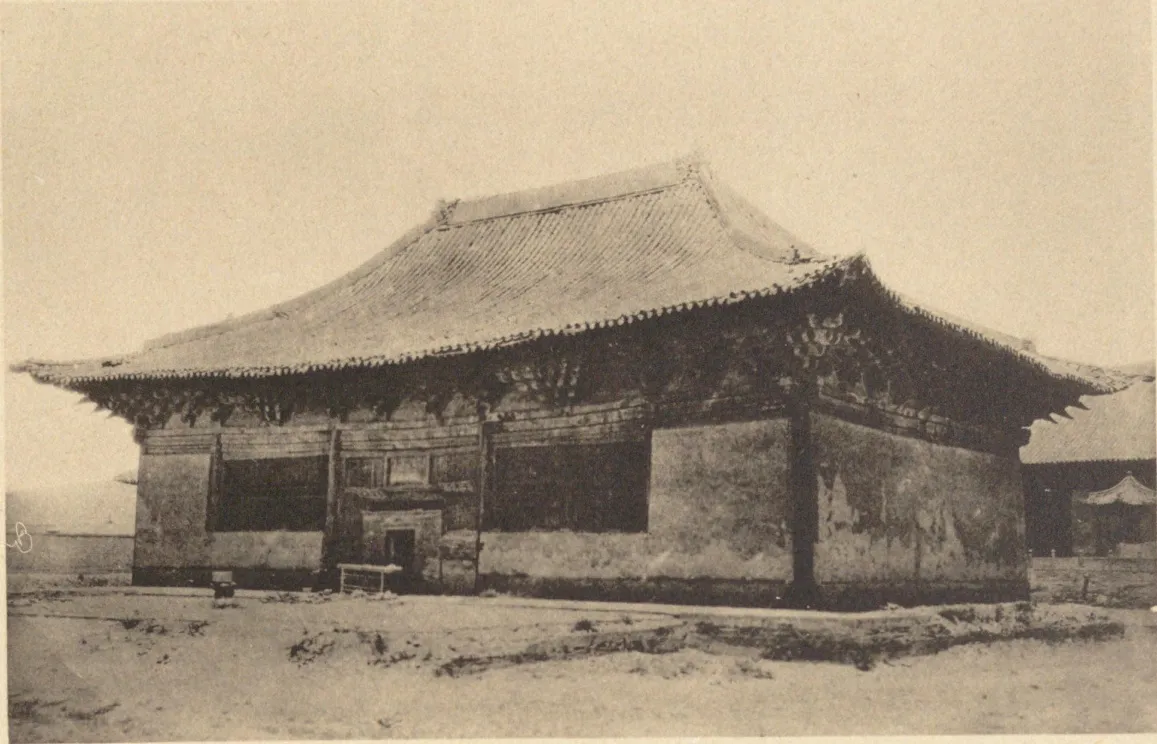
The first volume of Tokiwa Daijo and Sekino Tadashi’s Shina Bunka Shiseki (Historical Monuments of Chinese Culture), published in 1941, includes early photographs of the Hall of the Three Sages and the drum tower at Shanhua Temple.
1933
Liang Sicheng and Liu Dunzhen surveyed Shanhua Temple during their investigation of ancient architecture in Datong in the autumn of 1933. This set of photographs, compiled in the Illustrated Compendium of Chinese Ancient Architecture, were originally captioned as: rear view of the mountain gate, front view of the mountain gate, exterior of the Mahavira Hall, the Hall of the Three Sages, the roof framework of the Mahavira Hall, and the Samantabhadra Pavilion.
References
- Liang Sicheng and Liu Dunzhen: Survey Report on Ancient Architecture in Datong, Society for Research in Chinese Architecture, 1933.
- Bai Zhiyu: “A Comparison between the Ridge Purlin Extension Structure of the Mahavira Hall at Shanhua Temple and the System of the Yingzao Fashi”, Ancient Architecture and Garden Technology, 2005, no. 2, pp. 4–6.
- Xin Changqing: “A New Theory on the Founding Date of Shanhua Temple in Datong (Part I)”, Yungang Cultural Research Center, Shanxi Datong University.