Introduction
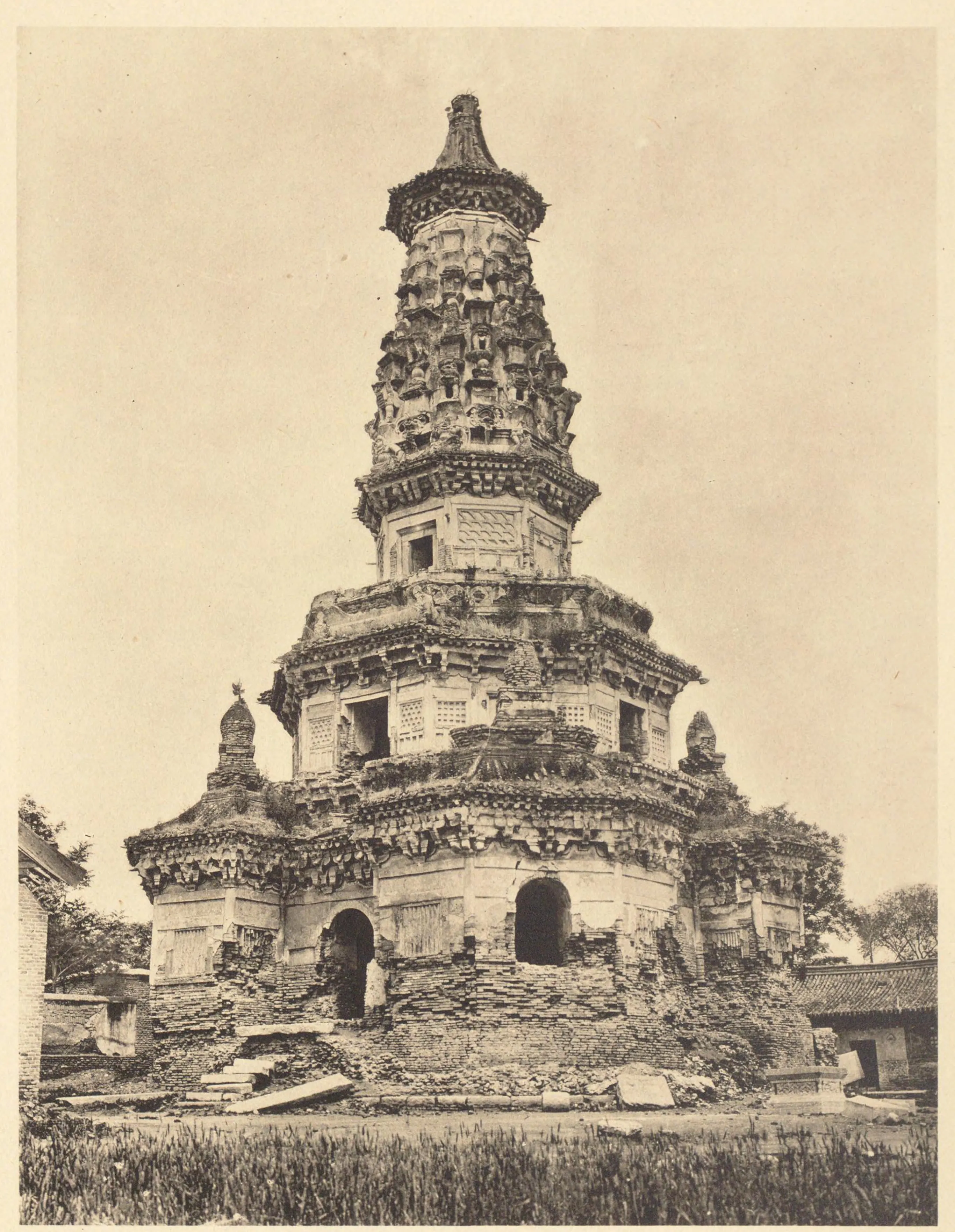
Enter the south gate of Zhengding and walk north along the street a short way: a pagoda rises above a compound wall, the upper portion of its body tiered with petal-shaped niches stacking outward – this is the Hua Pagoda of Guanghui Temple, commonly called Huata Temple, also known as the Duobao Pagoda. The temple itself is long gone; only this single pagoda remains among the lanes.
The dating of the temple and pagoda has long been disputed. A Ming-dynasty stele records that it was destroyed during the Jin Huangtong era and rebuilt during the Dading era; the Guangxu-era Zhengding Xian Zhi records that the temple was built in the middle of the Tang Zhenyuan era, while the Da Qing Yitong Zhi traces it further back to the Sui based on temple stelae, saying it was “renovated under the Tang, but actually founded in the Sui.” When the first batch of nationally protected sites was designated in 1961, the pagoda was dated to “Jin,” yet during 1990s restoration Northern Song inscriptions were discovered on the pagoda body itself. In the fifteenth year of Qianlong, on his return journey from Henan[1], the emperor climbed the pagoda and inscribed a poem, leaving the line “Why must one trace the source back to Sui or Tang” – even the emperor could not be bothered to settle the question.
In the 1930s, Liang Sicheng came to Zhengding and found Guanghui Temple to have “nothing but the pagoda and three small remaining halls[2]”; he still called this flower pagoda extraordinary in form, “perhaps a sole surviving example within the seas.” During the 1947 Zhengding battle, enemy troops retreated into the pagoda and fired from the second-story platform; Zhao Shengming, deputy regimental commander of the 29th Regiment, 10th Brigade, 4th Column, ordered the artillery to cease fire and to attack with light weapons instead, in order to protect the ancient pagoda, and was killed while commanding the assault. The temple was entirely destroyed, leaving only the pagoda’s mottled silhouette in old photographs, still standing on South Gate Street today.
Historical Documents
Zhengding Xian Zhi, juan 15
广惠寺一名华塔寺,唐贞元中建。明景泰二年重修,杨鼎撰文。宏治八年,指挥吴玺新其塔座。嘉靖二十七年重修。万历间重修,许守谦撰文。乾隆十五年,高宗自河南回銮,登多宝塔,匾曰妙光演教,御制古风以记之。二十六年二月,自五台幸隆兴寺。初六日,阅兵阅河,回銮自南门便道,登塔拈香。按塔塑神佛狮象等像,文以五采,殊不类常制。明正德十一年重修,云自隋唐时始。
Guanghui Temple is also called Huata Temple; it was built in the middle of the Tang Zhenyuan era. In the 2nd year of Ming Jingtai it was rebuilt, with the inscription composed by Yang Ding. In the 8th year of Hongzhi, Commander Wu Xi renewed the pagoda base. In the 27th year of Jiajing it was rebuilt. During the Wanli era it was rebuilt again, with the inscription composed by Xu Shouqian. In the 15th year of Qianlong, Emperor Gaozong returned from Henan and climbed the Duobao Pagoda; he bestowed the plaque inscribed “Miaoguang Yanjiao” (Wondrous Light Expounding the Teaching) and composed an ancient-style poem to commemorate the occasion. In the 2nd month of the 26th year, returning from Mount Wutai he visited Longxing Temple. On the 6th day, after reviewing troops and inspecting the river, he returned via the convenient road from the south gate, climbed the pagoda, and offered incense. The pagoda is modeled with images of deities, Buddhas, lions, elephants, and others, painted in five colors – altogether unlike the usual form. In the 11th year of Ming Zhengde it was rebuilt, with claims that it dates back to the Sui and Tang.
Xixun Shengdian, juan 16
广惠寺在正定府东南二名华塔寺唐贞元中建乾隆十五年冬十一月恭逢
高宗纯皇帝巡幸河南
回銮临幸登多宝塔
赐额曰妙光演教又蒙
圣制诗章勒石嘉庆十六年
程途
西巡
皇上西巡回跸有
御制题广惠寺诗
Guanghui Temple stands to the southeast of Zhengding Prefecture, also called Huata Temple, built in the middle of the Tang Zhenyuan era. In the eleventh month of winter, the 15th year of Qianlong, on the occasion of
Emperor Gaozong Chun’s imperial tour of Henan
he visited on his return journey and climbed the Duobao Pagoda
bestowing the plaque inscribed “Miaoguang Yanjiao” and granting
an imperially composed poem carved upon stone. In the 16th year of Jiaqing,
Route,
Western Tour,
His Majesty on the western tour, returning, has
an imperially composed poem on Guanghui Temple.
Jinshi Huimu Fenbian, juan 2
正定府正定
亘州剌史萧𬣪为九忌日造玉石像座题字
三月移像题字在城内华塔寺亦名广惠寺凡八面
大理卿崔公夫人郑氏墓志民所用
进等造象记记行书人名正书天宝十一载董八
Zhengding Prefecture, Zhengding.
Inscription on a jade and stone image base, made by Xiao Bian, prefect of Genzhou, on the nine memorial days.
Inscription on the image relocated in the third month, kept in Huata Temple within the city, also called Guanghui Temple, in eight panels.
Epitaph of Lady Zheng, wife of Cui, Minister of the Court of Judicial Review, used by the people.
Record of image-making by Jin and others, recording names in running script and inscriptions in regular script, dated the 11th year of Tianbao, by Dong Ba.
Zhengding Xian Zhi, opening juan
高宗纯皇帝乾隆十一年秋九月,西巡,幸五台山。冬十月回銮,过正定,幸隆兴寺,作诗记之。次日,观兵于北郊,赐群臣宴。复揽辔河干,亲授滹沱河挑水筑坝事宜,河由是南徙。郡民建圣谟底绩坊以颂焉。十五年秋九月,幸河南,驻跸正定。次曰旺泉亭,登高大阅,赐文武百官宴。御制滹沱河堤工诗。冬十一月,回銮,幸广惠寺,登多宝塔,御制七言古风。二十六年春二月,奉皇太后便道五台,回銮,驻跸正定。阅兵视河,登多宝塔,赐宴作乐,官兵赏赉有差。民人赵士敬女三姐于御道旁拾时辰表,有司以闻。奉旨:民醇官好,赏知县广宁缎一匹,民人赵士敬银二十两。四十六年春三月,西巡,过正定,幸隆兴寺,作诗纪之。五十一年春三月,西巡,过正定,幸隆兴寺、广惠寺、崇因寺,作诗纪之。
五十七年夏四月,西巡过正定,幸隆兴寺、崇因寺,作诗纪之。望广惠寺塔,作诗纪之。
In the ninth month of autumn, the 11th year of Qianlong, Emperor Gaozong Chun went on a western tour and visited Mount Wutai. In the tenth month of winter, on his return, he passed through Zhengding and visited Longxing Temple, composing a poem to record it. The next day, he reviewed troops in the northern suburbs and bestowed a banquet upon his ministers. He again took the reins along the riverbank and personally directed the dredging and dike-building on the Hutuo River; from this the river shifted southward. The prefectural people erected the “Sage’s Plan Achieving Its Effect” memorial archway in praise of it. In the ninth month of autumn, the 15th year, he toured Henan and lodged at Zhengding. The next day, at Wangquan Pavilion, he ascended a height for a grand review and bestowed a banquet upon civil and military officials. He composed an imperial poem on the Hutuo River dike works. In the eleventh month of winter, on his return, he visited Guanghui Temple, climbed the Duobao Pagoda, and composed a seven-character ancient-style poem. In the second month of spring, the 26th year, he accompanied the Empress Dowager by the convenient route to Wutai and on returning lodged at Zhengding. After reviewing troops and inspecting the river, he climbed the Duobao Pagoda, bestowed a banquet with music, and granted varied rewards to officials and soldiers. Sanjie, daughter of the commoner Zhao Shijing, picked up a pocket watch beside the imperial road, and the officials reported it. By imperial decree: “The people are honest and the officials good”; the magistrate of Guangning was rewarded with a bolt of satin, and the commoner Zhao Shijing with twenty taels of silver. In the third month of spring, the 46th year, on the western tour, he passed through Zhengding and visited Longxing Temple, composing a poem to record it. In the third month of spring, the 51st year, on the western tour, he passed through Zhengding and visited Longxing Temple, Guanghui Temple, and Chongyin Temple, composing poems to record them.
In the fourth month of summer, the 57th year, on the western tour, he passed through Zhengding and visited Longxing Temple and Chongyin Temple, composing poems to record them. Gazing at the Guanghui Temple pagoda, he composed a poem to record it.
Yuzhi Shi Erji, juan 21
登广惠寺多宝塔
高秋结念属嵩洛,行跸经过谢登揽。
省方祠岳次第举,初冬未觉严寒犯。
滹沱回度入权城,道左精蓝一到点。到即不点,点即不到,为禅宗法印语。
住空梵宇青莲开,出尘法相黄金范。
千年窣堵高切云,景概近远资葆检。
大茂峰姿在眼眦,四禅天乐鸣轩槛。
杜老慈恩资佛力,果然万虑消憺憺。
隋唐奚必究根源,往还已复成荏苒。
豫天赵土指顾间,尔许诗情寄闲淡。
Climbing the Duobao Pagoda at Guanghui Temple
In high autumn my thoughts turned toward Song and Luo; my imperial procession passing by declined the climb and the view.
Inspecting the realm and offering at the sacred peaks, one by one undertaken; in early winter, I did not yet feel the bite of severe cold.
The Hutuo, turning in its course, enters the city of Quan; on the left of the road, a pure monastery – one “arrive” and “mark.” “To arrive is not to mark; to mark is not to arrive” – a seal phrase of the Chan school.
Dwelling in emptiness, the Buddhist hall opens like a blue lotus; transcending the dust, the Dharma form is a mold of yellow gold.
A thousand-year stupa rises tall, cleaving the clouds; near and far the prospects lie ready for survey.
The form of Damao Peak is before my eyes; the music of the Four Dhyana heavens rings at the railing.
Old Du’s gratitude rests on the Buddha’s power; truly, ten thousand cares dissolve into calm.
Why must one trace the source back to Sui or Tang? Comings and goings have already turned into the long passage of years.
The skies of Yu and the soil of Zhao within a glance; this much of poetic feeling I entrust to leisurely lightness.
Dunan Xiansheng Wenji, juan 5
真定华塔寺和壁韵:
十年奔走利名关,侧道有人邀我还。独恨飘蓬
沙碛远,黄云白草万重山。
Matching the Rhymes of the Wall at Huata Temple in Zhending:
Ten years rushing through the pass of fame and gain; on a side path someone invites me back. I only resent that, drifting like tumbleweed,
the sandy wastes are far – yellow clouds and white grasses across ten thousand layered mountains.
Huangchao Tongzhi, juan 119
御制隆兴寺碑,御制三箭山诗。御制隆兴寺礼大佛诗书。
御制登广惠寺多宝塔诗,
御制重修隆兴寺大佛记。以上正定府。
Imperially composed Longxing Temple stele; imperially composed poem on Three Arrows Mountain; imperially composed poem and calligraphy on paying reverence to the Great Buddha at Longxing Temple.
Imperially composed poem on climbing the Duobao Pagoda at Guanghui Temple;
imperially composed account of rebuilding the Great Buddha at Longxing Temple. The above are all from Zhengding Prefecture.
Historical Photographs
1920s-1930s
Volume 8 of Tokiwa Daijo and Sekino Tadashi’s Shina Bunka Shiseki (Historical Monuments of Chinese Culture) includes an old photograph of the Hua Pagoda at Guanghui Temple in Zhengding. The image clearly shows damage to the pagoda base and the lower-story enclosure, with low compound walls and attached roofs still visible alongside the pagoda.
December 1939
The North China Transportation Archive preserves a photograph of the Hua Pagoda taken in December 1939. The image still shows damage to the pagoda base and the lower-story enclosure, with the surrounding environment looking desolate.
References
- Liu Zhimin, “A New Inquiry into the Construction Date of the Hua Pagoda at Guanghui Temple in Zhengding”, Wenwu Chunqiu, 1999, no. 3.