Introduction
The Xiangtangshan Grottoes are spread across the northern and southern ends of Mount Gu in Fengfeng Mining District, Handan. The Yuanhe Junxian Tuzhi records that Mount Gu “is also called Mount Fu,” and that it sits on the Fukou Pass, the fourth of the eight passes through the Taihang Mountains[1]. The official road running west from Ye, the Eastern Wei and Northern Qi capital, toward Jinyang necessarily passed this mountain—and the imperial family and high ministers placed their grottoes precisely along this Ye–Jin corridor.
The great caves of North Xiangtangshan are directly tied to Northern Qi imperial burial. The Zizhi Tongjian records that after Gao Huan died in the fifth year of Wuding under the Eastern Wei, “the Prince Xianwu of Qi was given a sham burial[2] west of the Zhang River; in secret a chamber was hewn out beside the Buddha’s head in the Mount Gu grotto at Cheng’an, his coffin was placed within and the chamber sealed, and all the workmen were killed.” Even at the fall of Northern Qi, the son of one of those craftsmen chiselled the stone open and fled with the gold. The Xu Gaoseng Zhuan adds in the biography of Shi Mingfen that the Mount Gu “Stone Grotto Temple was established by Wenxuan of Qi,” and that “the great cave image backs onto the tomb chamber of Wenxuan”—the cave-tomb of Emperor Wenxuan, Gao Yang, is here as well.
South Xiangtangshan was opened later, at the very end of Northern Qi. The Stele of the Fushan Grottoes, unearthed in 1986 outside the entrance of Cave 2, records that the monk Huiyi[3] of Linghua Temple “cut into this stone mountain and built a sacred precinct” in the first year of Tiantong (565). Gao Anahong, Prince of Huaiyin, “escorting the emperor out of the capital, rested his carriage here,” and at once gave funds to open caves. Not long after the work was complete, Emperor Wu of Northern Zhou conquered Northern Qi and “swept clean its stupas and monasteries, then immediately ordered their destruction.” From that point South Xiangtangshan ceased to be an imperial project and became a ruined site.
Historical Documents
Zizhi Tongjian
辛未,高澄入朝于邺,固辞大丞相;诏为大将军如故,馀如前命。
On the Xinwei day, Gao Cheng came to court at Ye and firmly declined the post of Grand Chancellor; he was confirmed as Grand General as before, with all other appointments standing.
甲申,虚葬齐献武王于漳水之西;潜凿成安鼓山石窟佛顶之旁为穴,纳其柩而塞之,杀其群匠。及齐之亡也,一匠之子知之,发石取金而逃。
On the Jiashen day, the Prince Xianwu of Qi was given a sham burial west of the Zhang River; in secret a chamber was hewn out beside the Buddha’s head in the Mount Gu grotto at Cheng’an, his coffin was placed within and the chamber sealed, and all the workmen were killed. When Qi later fell, the son of one of these craftsmen, knowing of the place, broke open the stone, took the gold within, and fled.
Xu Gaoseng Zhuan
释明芬,相州人,齐三藏耶舍之神足也。通解方俗,妙识梵言,传度幽旨,莫匪喉舌。开皇之译,下敕追延,令与梵僧对传法本。而意专检失,好住空闲,味咏十地,言辄引据,问论清巧,通滞罕伦。
Shi Mingfen, a native of Xiangzhou, was a chief disciple of the Qi tripiṭaka master Yeshe. He had mastered local idioms and was skilled in Sanskrit; in transmitting hidden meanings he served as a mouthpiece. During the Kaihuang era’s translation projects, he was summoned by imperial edict to work alongside Sanskrit monks in cross-checking the source texts. Yet his real interest lay in detecting errors, he was fond of dwelling in solitude, savouring the Daśabhūmika Sūtra. His words always rested on citation, his arguments were lucid and refined, and few could match his ability to clear obstacles in debate.
仁寿下敕,令置塔于慈州之石窟寺,寺即齐文宣之所立也。大窟像背文宣陵,藏中诸雕刻骇动人鬼。芬引舍利,去州三十许里,白云郁起,从寺至舆,长引不绝,耿耿横空,中有天仙飞腾往返,竟日方灭。明旦将晓,还有白云长引来迎,云中天仙如昨无异。人众同见,倾目叵论,识者以为石窟之与鼓山连接密尔,竹林仙圣响应之乎。既至山塔,东面有泉,众生饮皆病愈。芬后卒于兴善,所著众经如费氏录。
During the Renshou era an imperial edict ordered that a pagoda be set up at the Stone Grotto Temple of Cizhou—the temple established by Wenxuan of Qi. The great cave image backs onto the tomb chamber of Wenxuan, and the carvings within are stirring enough to startle men and spirits alike. Mingfen led the relic procession; about thirty li from the prefecture, white clouds gathered and stretched from the temple to the carriage in an unbroken band across the sky, with celestial beings flying back and forth within them until the day ended. The next morning at dawn white clouds came again to receive the procession, the celestial beings within indistinguishable from the day before. The crowd all witnessed this and could find no words. Those who understood took it as a sign that the grottoes are closely linked to Mount Gu, and that the immortal sages of the bamboo grove had responded. On reaching the mountain pagoda, a spring was found to the east whose water cured all who drank from it. Mingfen later died at Xingshan Monastery, his writings being as listed in Fei’s catalogue.
Yuanhe Junxian Tuzhi
磁州,滏阳,上。元和户一千四十,乡一十三。
Cizhou, with Fuyang as its seat, ranked as upper. In the Yuanhe era it had 1,040 households across thirteen townships.
本汉魏郡武安县之地,周武帝于此置滏阳县及成安郡,隋开皇十年废郡,于县置磁州,以县西九十里有磁山,出磁石,因取为名。大业二年废,以县属相州。皇朝永泰元年重置,以河东有慈州,故此加“石”也。
The area was originally Wu’an County in the Wei Commandery of the Han. Emperor Wu of Northern Zhou established here Fuyang County and Cheng’an Commandery. In the tenth year of Kaihuang of the Sui, the commandery was abolished and Cizhou established at the county. The name comes from Mount Ci ninety li west of the county seat, which produces lodestone (cishi). In the second year of Daye the prefecture was abolished and the county placed under Xiangzhou. In the first year of Yongtai of the present dynasty it was re-established; because there was already a Cizhou in Hedong, the character for “stone” was added here to distinguish it.
鼓山,一名滏山,在县西北四十五里。滏水出焉。泉源奋涌,若滏水之汤,故以滏口名之。八陉第四曰滏口陉,山岭高深,实为险厄。
Mount Gu, also called Mount Fu, lies forty-five li northwest of the county. The Fu River rises here. The springs gush forth as if the river were boiling, and hence the gap is named Fukou (“the mouth of the Fu”). The fourth of the eight passes is the Fukou Pass; its ridges are high and deep, a truly perilous defile.
Stele of the Fushan Grottoes
……有灵化寺比丘慧义,仰惟至德,俯念巅危,于齐国天统元年乙酉之岁,斩此石山,兴建图庙。时有国大丞相淮阴王高阿那肱,翼帝出京,憩驾于此,因观草创,遂发大心,广舍珍爱之财,开此□□之窟。……功成未几,武帝东并,扫荡塔寺,寻纵破毁。
…There was the monk Huiyi of Linghua Temple, who, looking up at the highest virtue and reflecting upon dangerous heights, in the Yiyou year, the first year of Tiantong of the State of Qi (565), cut into this stone mountain and built a sacred precinct. At that time the Grand Chancellor of State and Prince of Huaiyin, Gao Anahong, escorting the emperor out of the capital, rested his carriage here; observing the nascent work, he conceived a great resolve and gave freely of his most precious wealth, opening this [□□] cave… Not long after the work was complete, Emperor Wu [of Northern Zhou] conquered the east, swept clean the stupas and monasteries, and at once ordered their destruction.
Baqiongshi Jinshi Buzheng Xubian
鼓山南响堂寺石刻经十八段。
Eighteen sections of carved sutras at South Xiangtang Temple on Mount Gu.
田神鉴妻崔造像记。
Record of an image commissioned by Cui, wife of Tian Shenjian.
维大周证圣元年岁次乙未九月景午朔十日乙卯,佛弟子安阳县田神鉴妻崔敬造弥勒像二躯,普为一切有识含灵,俱登正觉。
In the Yiwei year, first year of Zhengsheng of the Great Zhou, on the Yimao day, the tenth day after the new moon (Bingwu) of the ninth month, the Buddhist disciple Cui, wife of Tian Shenjian of Anyang County, reverently had two Maitreya images made, on behalf of all sentient beings, that they may attain perfect awakening together.
慧炬寺僧智力神道影堂纪德碑。倪氏砖文二。裴承章墓志铭。李世娘墓志。陈夫人独孤氏墓志铭。修禅道场碑,元和六年十一月十二日。萃编录有跋。南岩亭记。魏府狄梁公祠堂碑。鼓山北响堂寺崔某题名。高承金墓志铭。慧炬寺再修题名。唐州长史刘密、夫人崔张颖弥勒像赞。
Spirit-way stele recording the virtues of the shadow hall of monk Zhili of Huiju Temple. Two brick inscriptions of the Ni family. Epitaph of Pei Chengzhang. Epitaph of Li Shiniang. Epitaph of Lady Chen, née Dugu. Stele of the meditation site, eleventh month, twelfth day, sixth year of Yuanhe; a colophon is included in the Cuibian. Record of the Nanyan Pavilion. Stele of the shrine of Di Liang Gong (Di Renjie) at Wei Prefecture. Inscription by a certain Cui at North Xiangtang Temple on Mount Gu. Epitaph of Gao Chengjin. Inscription on the rebuilding of Huiju Temple. Eulogy of Maitreya images by Liu Mi, prefect of Tangzhou, and his wife, Lady Cui-Zhang Ying.
Old Photographs
September 1927
The third volume of Yadong Yinhua Ji (East Asia Printed Pictures), section 38, is titled “Grottoes of North and South Xiangtang.” The table of contents corresponds to the ninth month of Showa 2. The plates record the entrances, cliff faces, niches, and details of the sculptures at North and South Xiangtangshan.
1929
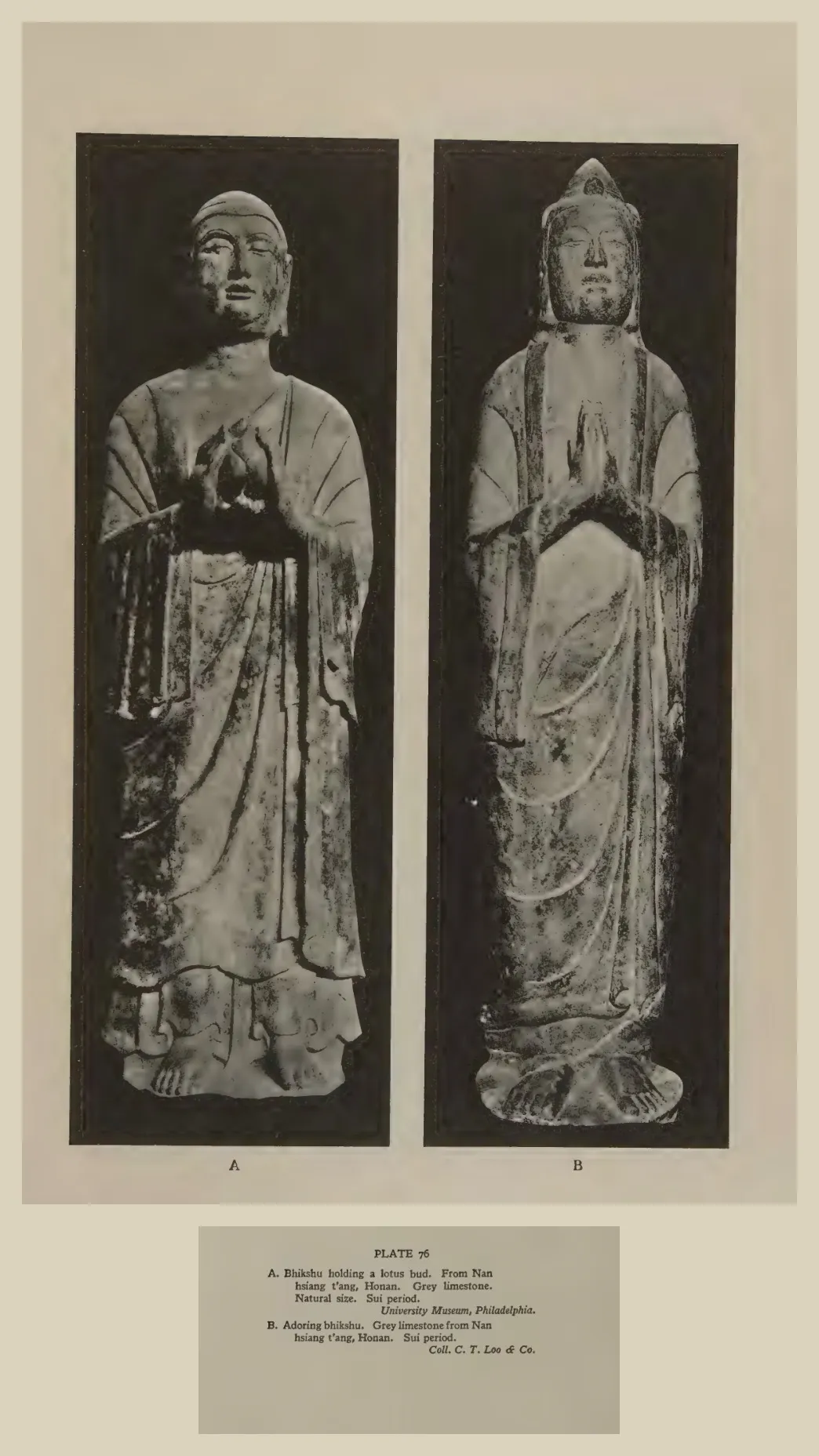
Osvald Sirén’s A History of Early Chinese Art, Plate 76, records two limestone monastic figures captioned as coming from “Nan hsiang t’ang, Honan.” The volume was published in 1929.
References
- Liu Dongguang, “Xiangtangshan Shiyi” (Gleanings on Xiangtangshan), Wenwu Chunqiu 1999, no. 3. PDF