Introduction
The Yanshan Conglu says that from the topmost story of the Kaiyuan Temple Pagoda in Dingzhou, “one can see a hundred li, and looking up at the passing clouds, they seem to sway.” The book calls it the Liaodi Pagoda — “built by the Song to watch the Khitan.” Those standing atop the pagoda saw more than a Buddhist temple — He Jingming wrote “the flying canopy looks down on the lone city,” Wang Shizhen wrote “the gaze gathers a thousand homes into view,” and Yuan Hongdao put eave-bells, lamplight, and the frontier together: “Bell-speech heard at the sandy frontier, lamplight shooting over the enemy river.” The pagoda gathered the prefectural city, the fields, and the Song-Liao border[1] into a single person’s line of sight.
Yet in Song Qi’s poem, it is still a newly completed “treasure pagoda” of Kaiyuan Temple; the Zhili Dingzhou Zhi also records that at New Year and on the Buddha’s birthday[2], the townspeople would pool money to hang lanterns on the pagoda. A pagoda built for Buddhist purposes had its function rewritten by the border situation — those who climbed it half-watched the Buddha lamps, half-watched the Khitan.
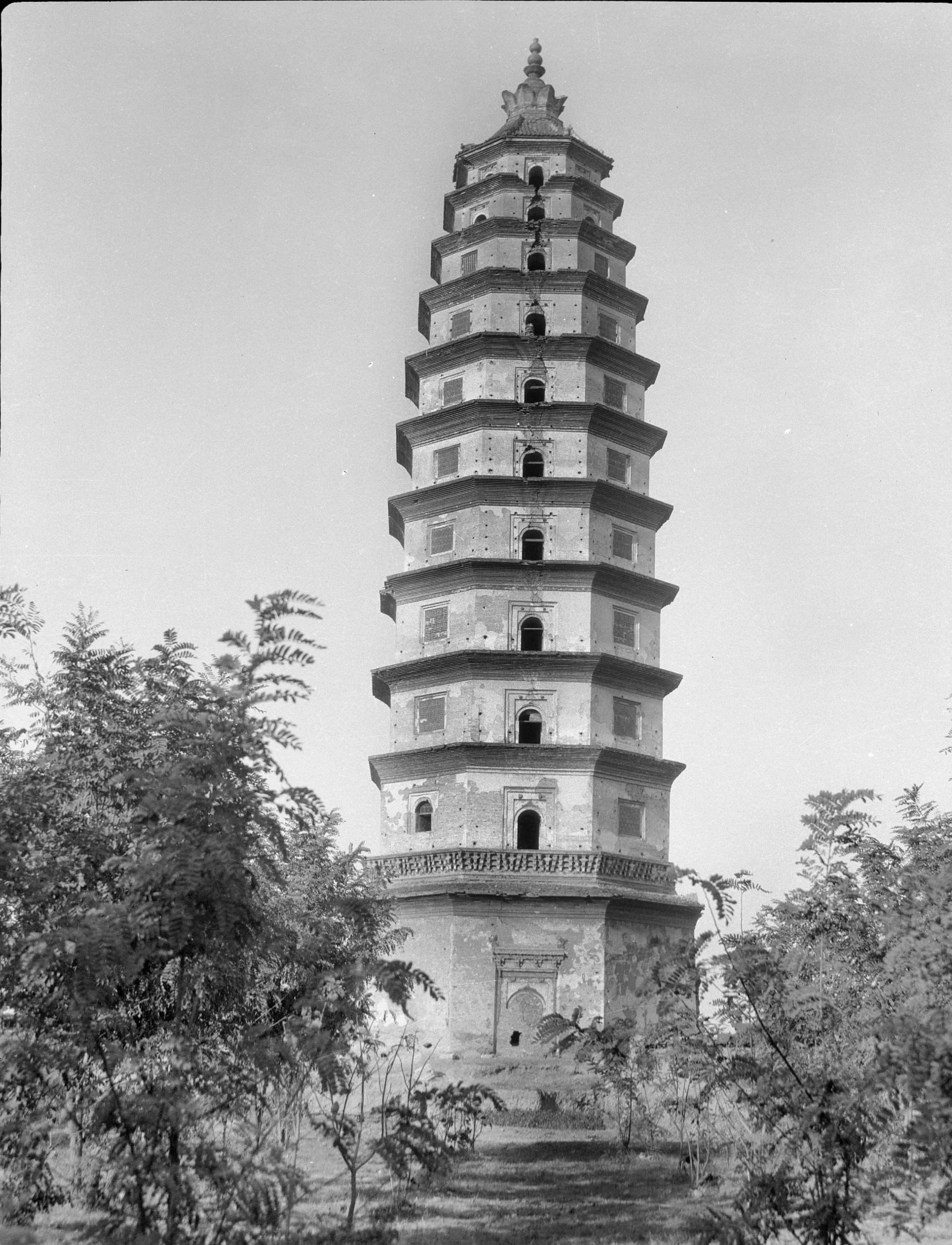
Centuries later, photographs also preserved the tree groves, fields, and alleyways around the pagoda. The eighth volume of Zhongguo Wenhua Shiji contains photographs of the pagoda’s west face (1902) and east face (1908); between 1931 and 1932, Sidney Gamble captured views through the trees, a full frontal view, and the pagoda silhouetted at the end of a lane.
Historical Documents
Yanshan Conglu
定州开元寺有大塔,名料敌塔,宋筑以望契丹者。高十三级,广六十四步,旁施铁幢,中贯数抱大木。登最上级,可𦗪百里,仰视行云,势若摇动。宋失燕云,以定州为边境,故潜备甚密。
Kaiyuan Temple in Dingzhou has a great pagoda called the Liaodi Pagoda, built by the Song to watch for the Khitan. It is thirteen stories tall and sixty-four paces in circumference, with iron banners mounted on the sides and great timbers several armspans thick running through the center. From the topmost level one can see a hundred li; looking up at the passing clouds, the pagoda seems to sway. After the Song lost the Yan-Yun region, Dingzhou became a border zone, and secret defenses were extremely thorough.
Dingxian Zhi
张贺等二十七人修大悲菩萨记宋进等修塔记
Record of Zhang He and twenty-seven others repairing the Great Compassion Bodhisattva; Record of Song Jin and others repairing the pagoda.
旧志云:料敌塔在州治南,真宗咸平四年诏建,仁宗至和二年始成。盖筑以望契丹者。宋知州尝记岁月于巅云。按塔建于咸平四年,至乾兴元年已十九年,更至至和二年,近五六十年。以六十年而成一塔,似不近情。而宋祁开元寺塔诗亦云:经营一甲子,殊为疑问。及见此证,乃知塔成于乾兴元年,知州宋进记其年月,所谓料敌塔记者也。通志误以为二并载之,非也。至和元年殆重修之年,抑或有增修之事。刘佺、赵成之记是也。有此石以为证,足知宋祁诗为不审也。
The old gazetteer states: the Liaodi Pagoda is south of the prefectural seat; it was ordered built by Emperor Zhenzong in the 4th year of Xianping, and completed only in the 2nd year of Zhihe under Emperor Renzong – built to watch for the Khitan. A Song prefect once recorded the dates at the summit. Now, from the pagoda’s founding in the 4th year of Xianping to the 1st year of Qianxing is already nineteen years, and further to the 2nd year of Zhihe is nearly fifty or sixty years. To take sixty years to complete a single pagoda seems implausible. Song Qi’s poem on the Kaiyuan Temple Pagoda also says “planned and built over a full sixty-year cycle,” which is quite dubious. Upon seeing this evidence, we now know the pagoda was completed in the 1st year of Qianxing, and that Prefect Song Jin recorded the dates – this is the so-called “Liaodi Pagoda Record.” The Provincial Gazetteer mistakenly treats these as two separate records, which is incorrect. The 1st year of Zhihe was likely the year of a renovation, or perhaps there were additions. The records of Liu Quan and Zhao Cheng confirm this. With this stone as evidence, it is clear that Song Qi’s poem was not carefully verified.
Baqiongshi Jinshi Buzheng Xubian
定州开元寺僧俗修塔记并题名八段。宋进等题名,乾兴元年四月十五日,耿素等题名,刘佺等题名。招贤坊张能等题名,兵马监押赵威记等题名,女弟子赵氏等题名。
Record of monks and laypeople repairing the pagoda at Kaiyuan Temple in Dingzhou, with eight sections of inscribed names. Names of Song Jin and others, dated the 15th day of the 4th month of the 1st year of Qianxing; names of Geng Su and others; names of Liu Quan and others. Names of Zhang Neng and others of Zhaoxian Ward; names of Military Supervisor Zhao Wei and others; names of the female disciple surnamed Zhao and others.
Zhili Dingzhou Zhi
料敌塔,在州治南。宋真宗咸平四年诏会能董其役,伐材于嘉山,仁宗至和二年始成。高十三级,周六十四步。盖筑以望契丹者,故名料敌。宋知州宋祁尝纪岁月于巅,其八分书致为澹逸入古。每春正及佛诞午日,郡人醵金张灯,不减长干寺报恩塔之胜概也。
The Liaodi Pagoda is south of the prefectural seat. In the 4th year of Xianping, Emperor Zhenzong ordered Hui Neng to oversee the construction, with timber felled from Jia Mountain; it was completed in the 2nd year of Zhihe under Emperor Renzong. It is thirteen stories tall and sixty-four paces in circumference. Built to watch for the Khitan, hence the name “Liaodi” (Reconnoitering the Enemy). The Song prefect Song Qi once recorded dates at the summit; his clerical script is tranquil, untrammeled, and archaic in spirit. On the first month of spring and on the noon of the Buddha’s birthday, the people of the prefecture pool money to hang lanterns – a spectacle no less grand than the Bao’en Pagoda at Changgan Temple.
Jingwen Ji
开元寺塔偶成题十韵
Ten Couplets Composed on a Whim at the Kaiyuan Temple Pagoda
集福仁祠旧,雄成宝塔新。经营一甲子,高下几由旬。屹立通无碍,支持固有神。云妨垂处翼,月碍过时轮。顶日珠先现,绦风铎自振。沙分千界远,花散四天春。亿载如如地,三休上上人。堆螺俯常碣,缭带视河津。陶甓勤争运,园金施未贫。谁纡简栖笔,为我志琳珉。
The old benevolent shrine gathered blessings; the new Precious Pagoda rises grandly. Planned and built over a full sixty-year cycle, how many yojanas tall and deep? Standing immovable, penetrating without obstruction; supported firmly, possessed of divine power. Clouds hinder the wings that hang from above; the moon blocks the wheel as it passes by. At the summit the sun-jewel appears first; in the wind the cord-bells ring of their own accord. Sands divide a thousand realms in the distance; flowers scatter the spring of the Four Heavens. For a hundred million ages, on this ground of Suchness; thrice resting, the most excellent of men. Heaped spirals look down on the standing steles; winding sashes gaze upon the river ford. Fired bricks, eagerly vying to be hauled; gold from gardens, offered without growing poor. Who will take up the brush of Jian Qi to inscribe this jade-like stone for me?
Yuan Zhonglang Quanji
登定州开元寺塔
Climbing the Kaiyuan Temple Pagoda in Dingzhou
孤塔三千级,俯身见鸟过。但知天阔远,未许岫嵯峨。铃语闻沙塞,灯光射虏河。昔贤谁眺此,韩朱与东波。
A lone pagoda of three thousand steps; leaning forward, I watch birds pass below. One knows only that the sky is vast and far; the peaks are not allowed to seem lofty. Bell-voices heard from the sandy borderlands; lamplight shooting toward the Tartar river. Which sages of old gazed from here? Han, Zhu, and Dongpo.
其二
Part Two
我醉中山酒,兴衰渺莽间。宋家遗塞垒,唐典旧河山。破壁风雷出,空堂费雀还。莫言无外警,西去即层关。
Drunk on Zhongshan wine, rise and fall lost in the haze. The Song left border ramparts; the Tang bequeathed these old rivers and hills. From crumbling walls, wind and thunder emerge; in the empty hall, sparrows flit and return. Do not say there are no alarms from beyond – westward lie tier upon tier of passes.
Xinang Duyu
登定州开元寺宝塔
Climbing the Precious Pagoda at Kaiyuan Temple in Dingzhou
十层天半塔,卓锡自开元。曲磴云霞满,飞甍鸟雀喧。中山低接市,卢水澹萦村。超忽皆空境,皈依不二门。风尘双阙近,汉达五兵屯。徙倚成孤啸,幽怀谁与论。
A pagoda of ten stories, halfway to heaven; the monk’s staff planted since the Kaiyuan era. Winding steps filled with clouds and rosy mists; soaring ridgepoles echoing with birds and sparrows. Zhongshan lies low, adjoining the market; the Lu River gently encircles the village. Transcending in an instant to the realm of emptiness; taking refuge in the gate of non-duality. Wind and dust – the twin watchtowers are near; the Han frontier where five armies are garrisoned. Leaning and lingering, I let out a lone whistle; these hidden thoughts – with whom shall I discuss them?
Yanzhou Sibu Gao
与故赵使君登定州塔
Climbing the Dingzhou Pagoda with Former Prefect Zhao
灵鹫名藩驻,神龙法藏蟠。绛河潆井干,朱网罥天门。象外仙都广,寰中欲界尊。下方自风雨,绝顶半乾坤。眺拥千家出,歌迎万铎喧。驱车燕使者,题壁赵王孙。水合卢奴树,云冥鼓子村。语来心已净,不必问销魂。
Vulture Peak stationed at this famous domain; the Dragon Spirit coils around the Dharma Treasury. The Crimson River encircles the well-sweep; vermilion nets hang upon the gate of heaven. Beyond phenomena, the celestial capital is vast; within the world, the Desire Realm is exalted. Below, there is naturally wind and rain; at the summit, half the universe unfolds. The view embracing a thousand households emerging; songs greeting ten thousand bells in clamor. A Yan envoy driving his carriage; a grandson of the Zhao kings inscribing the wall. Waters merge with the trees of Lunu; clouds darken over Guzi Village. As words come, the mind is already pure; no need to ask about the soul’s delight.
Dafu Ji
同许补之刘子纬登定州塔
Climbing the Dingzhou Pagoda with Xu Buzhi and Liu Ziwei
塔阁盘空上,笙箫绕洞行。悬梯出万井,飞盖俯孤城。燕岱风云色,滹沱雁鹜声。登高并回首,直北是神京。
The pagoda pavilion spirals upward into the void; pipes and flutes echo through the passages. A suspended ladder rises above ten thousand wells; flying canopies overlook the lone city. The hue of wind and clouds over Yan and Dai; the cries of geese and ducks over the Hutuo River. Climbing high and looking back together – due north lies the divine capital.
Boou Shanfang Ji
登定州开元寺塔
Climbing the Kaiyuan Temple Pagoda in Dingzhou
韩公保障绩桓桓,此地曾经望契丹。汴水铜驼终寂寞,中山香刹尚巑岏。风吹铃语诸天细,云散昙花法界宽。浑似江南携酒处,夜深镫火古长干。
Duke Han’s defense was bold and mighty; from this place they once watched for the Khitan. The bronze camels by the Bian River are at last desolate; the fragrant temple of Zhongshan still rises craggy and tall. Wind blows the bell-voices, thin as the many heavens; clouds scatter the udumbara flower, the Dharma realm is vast. It is just like those wine-carrying spots in Jiangnan – deep in the night, lamplight at ancient Changgan.
Historical Photographs
1902, 1908
Volume 8 of Tokiwa Daijo and Sekino Tadashi’s Shina Bunka Shiseki (Historical Monuments of Chinese Culture) is titled “Octagonal Eleven-Story Brick Pagoda at Kaiyuan Temple, Dingzhou, Hebei.” The original captions note that the west-face photograph was taken in May of Meiji 35 (May 1902), and the east-face photograph in November of Meiji 41 (November 1908).
1931-1932
Sidney Gamble’s photograph collections recorded the Liaodi Pagoda in Dingxian, Hebei, on multiple occasions: the first volume is titled “Liaodi Pagoda & Trees,” the third volume “Liaodi Pagoda,” and the fourth volume “Liaodi Pagoda (Kaiyuan Temple Pagoda).” These photographs respectively preserve a distant view through the trees, a frontal panorama of the pagoda, and the urban relationship of the pagoda seen at the end of an alleyway.