Introduction
The most common misunderstanding about the Kaifeng Iron Pagoda concerns its name and its lineage. The pagoda is not made of iron but is clad in iron-colored glazed bricks[1]. Historical texts also mention a Kaibao Temple pagoda built under the supervision of the master builder[2] Yu Hao, but that was an earlier wooden pagoda – not the tower standing today. The Guitianlu (Record of Returning to the Fields) describes the wooden pagoda as “the tallest among all pagodas in the capital, and of extremely refined construction,” and preserves the story of Yu Hao predicting that the prevailing northwest wind would gradually straighten the tower.
In the fourth year of Qingli (1044), the Linggan Pagoda of Kaibao Temple was destroyed by fire. Later generations often attribute the fire to a lightning strike, yet Song-dynasty records left only the two characters “pagoda fire.” Cai Xiang immediately submitted a memorial opposing reconstruction, arguing that frontier affairs remained unsettled and state coffers were depleted, so further expenditure of the people’s labor should not be permitted. Yu Jing spoke even more bluntly: “A single pagoda cannot protect itself and was destroyed by fire.” The Wuxi Ji (Wuxi Collection) records that Emperor Renzong accepted his counsel. Reconstruction seemed to have been abandoned.
Yet five years later, a new imperial decree arrived. The Fozu Tongji (Chronicle of Buddhas and Patriarchs) records that in the first year of Huangyou (1049), a decree was issued to “rebuild the Linggan Pagoda and enshrine the relics[3].” This time, the Song court did not raise Yu Hao’s wooden pagoda back into the sky in its original form: the new pagoda was relocated to Shangfang Courtyard on Yi Hill – which the Bianjing Yiji Zhi (Record of Bianjing Relics) identifies as the eastern precinct of Kaibao Temple – and timber construction was replaced with iron-colored glazed brick. What was halted was the plan to immediately resurrect the old pagoda after the fire; what was subsequently launched was a rebuilding that changed both site and material. The old wooden pagoda’s name and its mission of enshrining relics were thus bestowed upon an entirely different structure.
Renzong’s name remains in the decree; Yu Hao’s name remains beside the old wooden pagoda; but the officials and craftsmen who actually oversaw this glazed-brick pagoda have receded into the blank spaces of historical records. The reign-year inscriptions “Zhiping 4” and “Xining” discovered on the pagoda bricks push the final stages of construction into the reigns of Emperors Yingzong and Shenzong: the decree was issued by Renzong, yet the pagoda may have spanned three reigns before completion. As for why Shangfang Courtyard was chosen instead, the historical records offer no answer; only that this new site happened to be on the high ground of Yi Hill, and modern conservation surveys recognize that the solid foundation was an important factor in the pagoda’s long-term stability. Engineering considerations may be concealed within this relocation, but this remains a later interpretation.
The monastery surrounding the pagoda has an even longer history of migration than the pagoda itself. The Record of Renovating Dengjue Chanyuan on the Right Street of the Eastern Capital of the Great Song records that Dengjue Chanyuan was originally in Mingde Ward, and in the first year of Song Qiande (963), it was ordered to move to Fengmei Ward in the northern part of the capital due to the expansion of the imperial palace; the new monastery comprised over four hundred bays of halls, corridors, and monks’ quarters. The Guangjiao Temple that the Southern Song writer Zhou Mi observed, popularly called Shangfang Temple, featured a thirteen-story glazed pagoda along with a Samantabhadra statue, the Haiyan Well, and a Hall of Five Hundred Arhats. During the Tianshun era of the Ming dynasty, the monastery was renamed Youguo Temple, and from then on the names “Youguo Temple Pagoda” and “Iron Pagoda” became layered upon the same structure.
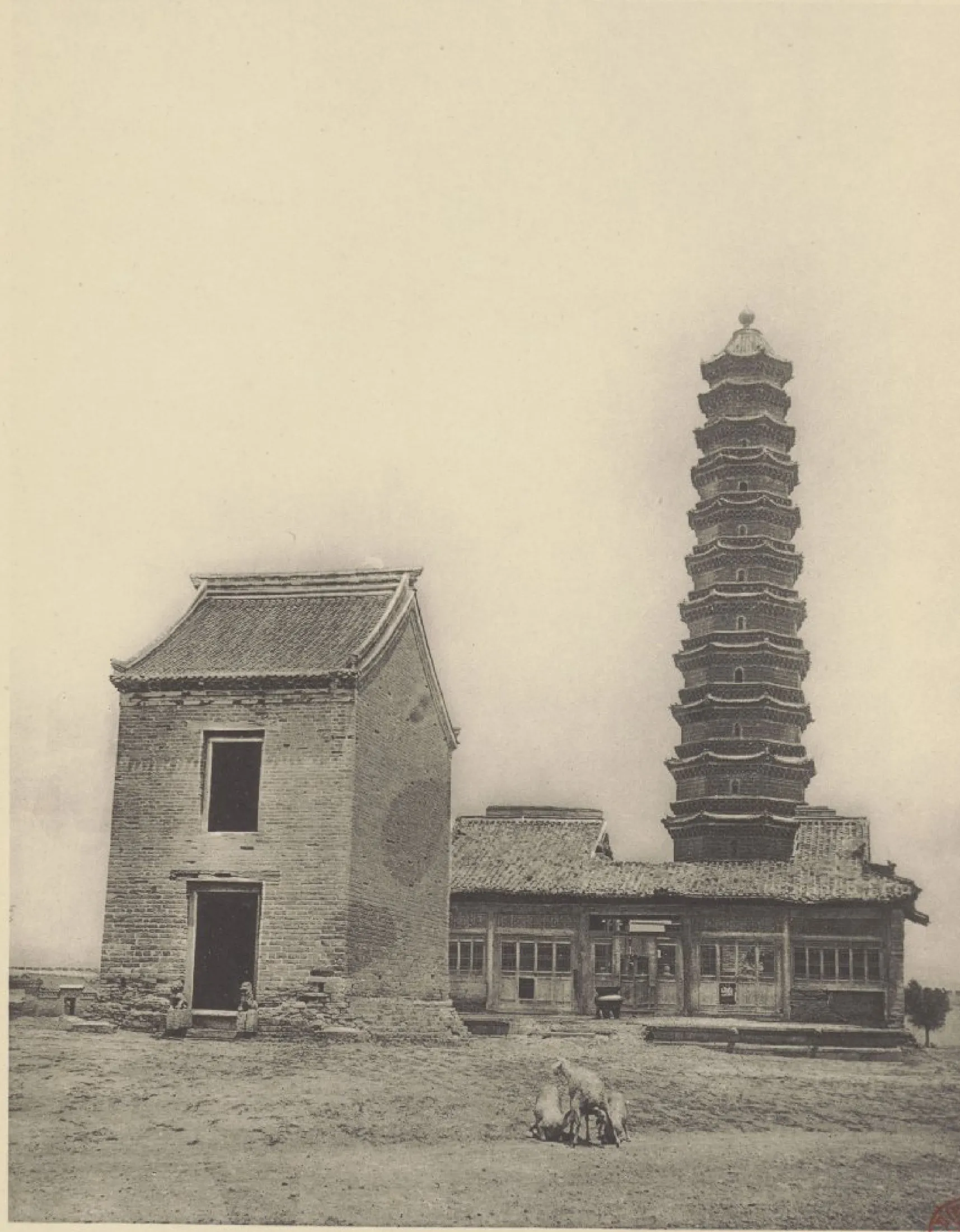
Dengjue Chanyuan, Shangfang Temple, Guangjiao Temple, Youguo Temple – the monastery changed names several times, and the halls surrounding the Iron Pagoda gradually receded. By the early twentieth century, the camera took over from the gazetteers: Chavannes photographed the few remaining temple buildings beside the pagoda, broad stretches of wasteland, and the densely carved Buddhist-figure glazed bricks on the tower in 1907; Sidney Gamble stood on more open ground around 1919, looking up at the entire pagoda; and the photographic plates collected by Tokiwa Daijo and Sekino Tadashi captured the pagoda’s summit through trees from the old Kaibao Temple site. The monastery of old can no longer be reassembled, yet the thirteen tiers of eaves still rise, story by story, from the low skyline of Kaifeng.
Historical Documents
Extant Youguo Temple Pagoda (Shangfang Temple Glazed Pagoda)
Fozu Tongji
庆历四年六月,开宝寺灵感塔灾。敕中使取塔基所藏舍利塔入内供养,将事再建。谏臣余靖力谏,上不说。
In the sixth month of Qingli 4 [1044], the Linggan Pagoda of Kaibao Temple was destroyed by fire. An imperial edict dispatched a palace envoy to retrieve the relic stupa stored beneath the pagoda’s foundation and bring it into the palace for veneration, with plans to rebuild. The remonstrance official Yu Jing vigorously protested; the emperor was displeased.
皇祐元年,诏再建灵感塔,奉藏舍利。〔原注:庆历四年灾毁,故重建。〕敕中使往陈留入关寺迎佛指舍利。或以为伪,上命试以烈火,击以金椎,了无所损。俄而舍利流迸,光照西方。上曰:“功德欲归阐教乎?“乃以水晶宝匣盛之,御制发愿文,奉迎归寺。
In the first year of Huangyou [1049], a decree was issued to rebuild the Linggan Pagoda and enshrine the relics. [Original note: Destroyed by fire in Qingli 4, hence rebuilt.] An imperial edict sent an envoy to Ruguan Temple in Chenliu to welcome the Buddha-finger relic. Some considered it a forgery, so the emperor ordered it tested by fierce fire and struck with a golden mallet—it suffered no damage whatsoever. Suddenly the relic emitted streaming light that illuminated the west. The emperor said: “Does the merit wish to be attributed to Chanjiao Temple?” He then placed it in a crystal-and-jewel casket, personally composed a prayer text, and had it reverently escorted back to the temple.
初是,陈留邑人为沙门义津建寺,请额为阐教。俄有梵僧至,曰:“我自天竺携佛指舍利,欲求吉祥处奉安,非师不能护。“施之而去。既而瑞光屡发,祈祷频应。〔原注:杨杰撰碑。〕
Previously, the people of Chenliu had built a temple for the monk Yijin and requested it be named Chanjiao. Before long, an Indian monk arrived and said: “I have brought a Buddha-finger relic from India and seek an auspicious place to enshrine it; only you, Master, can protect it.” He donated it and departed. Thereafter auspicious light appeared repeatedly, and prayers were frequently answered. [Original note: Stele text composed by Yang Jie.]
Record of Renovating Dengjue Chanyuan
夫圣人之妙用,必在于清净;圣人之至行,必存于教迹。虽元黄并列,覆载之体不同;而水火交驰,化育之机一致。自淳元浸散,道德下衰,嗜欲炽而奔竞繁,巧伪骋而仁义缺。揭日月者,既患昏衢之翳;鼓橐籥者,更嗟蕴界之尘。邪山厚而智种蟠芽,苦浪深而性珠匿耀。不有启发,孰救沉沦?金容一梦于汉皇,玉偈遂流于中夏,教之盛者,其谁与京?
The sage’s wondrous function must reside in purity; the sage’s supreme conduct must be preserved in the traces of his teachings. Though heaven and earth stand side by side, the bodies that cover and support differ; yet as water and fire race together, the mechanisms of transformation and nurture are one. Since pristine simplicity gradually scattered and morality declined, cravings blazed and competition multiplied, cunning and falsity galloped while benevolence and righteousness fell short. Those who would raise the sun and moon already suffered the obscurity of darkened roads; those who would pump the bellows further lamented the dust of the realm of aggregates. Mountains of delusion grew thick so that seeds of wisdom coiled without sprouting; waves of suffering ran deep so that the pearl of our true nature hid its radiance. Without awakening, who could rescue the drowning? The golden countenance appeared once in a dream to the Han emperor, and jade verses thereupon flowed into China—of teachings that flourished, what could rival this?
《华严经》云:“佛成正觉,普见一切众生,无不具有如来智慧,但以妄想执著而不证得。如来愍之,于是发大誓愿,放大光明。“始则转四谛法轮,所以摄有学也;终则示一乘心印,所以契圆寂也。其间张定慧,显权实,性相双列,空有交证;随机设教,靡遗于巨细;对病施药,宁差于浅深?一源通而万派分,一炬然而千灯照。韪夫慈救之旨,可谓至矣;善诱之利,可谓备矣。后之学者,实繁有徒,何代无人,以干法蛊?则斯院经始,粗得而言。
The Avatamsaka Sutra says: “When the Buddha attained perfect enlightenment, he universally beheld all sentient beings and saw that every one possesses the wisdom of the Tathagata, yet because of delusive thinking and attachments they fail to realize it. The Tathagata, moved by compassion, thereupon made great vows and emitted great radiance.” First he turned the Dharma wheel of the Four Noble Truths to gather those still learning; finally he revealed the mind-seal of the One Vehicle to accord with perfect nirvana. In between, he spread concentration and wisdom, manifested the provisional and the real, arranged nature and characteristics side by side, and cross-verified emptiness and existence; adapting teachings to capacities, he omitted nothing great or small; prescribing medicine for ailments, how could he err in depth or shallowness? One source opens and myriad streams diverge; one torch blazes and a thousand lamps shine. The purpose of compassionate rescue may be called supreme; the benefit of skillful guidance may be called complete. Later students were truly numerous in following, and in what age were there none to undertake the work of the Dharma? Thus the founding of this monastery may be roughly narrated.
后唐故明悟大师,赐紫惟课,瓯闽之良族也。籍本温陵,俗姓林氏。生既殊禀,幼且不群,殆至成童,卓然秀异。每或出侍游览,必旷望岑寂,若有所待也;入承训教,必凝澹窗户,若有所奉也。举止闲雅,为宗族所异。一旦辞亲,慨然有脱洒之志。年十三,诣泉州仙游县龙华寺文璀禅师,以祈落发。师从其愿,俾奉洒扫。年十七,受具于福州白塔戒坛。师神形清爽,心机颖悟,初读《法华经》,豁若生知;次阅《因明论》,宛如宿习。自尔博访讲席,遍礼道场。不五六稔,大有领悟。遂振锡游名山,礼诸祖,参胜会,扣元关,了然默识,密契心要。
The late Master Mingwu of the Later Tang, imperially bestowed with the purple robe, Weike, belonged to a distinguished clan of Ou-Min [Fujian]. His ancestral register was from Wenling, secular surname Lin. Endowed with exceptional gifts from birth and extraordinary even in childhood, by the time he reached adolescence he was remarkably outstanding. Whenever he went out to attend excursions, he would gaze far into the remote solitude as if awaiting something; whenever he came in to receive instruction, he would sit still and serene by the window as if serving something. His demeanor was refined and elegant, which astonished his clansmen. One day he bade farewell to his parents with a resolute aspiration for renunciation. At thirteen, he went to Chan Master Wencui at Longhua Temple in Xianyou County, Quanzhou, to request tonsure. The master granted his wish and assigned him to sweeping duties. At seventeen, he received full ordination at the White Pagoda precept platform in Fuzhou. The master’s spirit and form were pure and refreshing, his mind sharp and perceptive; when he first read the Lotus Sutra, his understanding opened as if from innate knowledge; when he next studied the Hetuvidya Treatise, it was as though he were reviewing a past life’s learning. Thereafter he extensively visited lecture halls and paid homage at Buddhist sites everywhere. Within five or six years he attained great insight. He then shook his tin-ringed staff to travel among famous mountains, paid respects to the patriarchs, attended superior assemblies, and knocked at the gate of the profound—clearly and silently comprehending, intimately according with the essential teaching.
北游岳麓,灵感非一。以长兴庚寅岁,憩于大梁之精舍。暇日蹑屩至明德坊,睨隙地数亩,乃叹曰:“有为之法,逐境而迁;无定之波,遇坎则止。吾其少息焉。“遂有解履之兴。因以厥志,募诸檀信,善愿冥契,如谷响答。曾未周岁,资用充美,乃书券而易之。于是购材鸠工,揆日兴事,始则一室蔽风雨,终则百楹极壮丽。玉质金相,再稔而成;爨室糗房,继踵而出,亦为当时之胜概也。
Traveling north to the foot of the mountains, he experienced spiritual responses more than once. In the gengyin year of Changxing [930], he rested at a monastery in Daliang [Kaifeng]. On a day of leisure, he walked in straw sandals to Mingde Ward, glanced at several acres of vacant land, and sighed: “Conditioned phenomena shift with circumstance; waves without fixed course halt upon meeting a hollow. Let me rest here awhile.” Thus arose his intention to settle. Accordingly, with this resolve he solicited donations from the faithful; virtuous wishes matched in mysterious accord, responding like echoes in a valley. Before even a full year, funds were ample and handsome, and he drew up a deed of purchase. Thereupon he bought timber, gathered craftsmen, selected an auspicious day, and commenced the work—beginning with a single room sheltering from wind and rain, ending with a hundred pillars of extreme magnificence. Images of jade substance and golden features were completed within two years; kitchens and grain stores followed in succession—this too was a grand spectacle of its time.
晋天福初,以精诚上请,遂赐额焉。紫服美号,翌日加锡,旌行业也。于是富门大族,率多相瞩,捐金施宝,曾无虚日。师曰:“吾以一瓶一衲,植足皇都。经之营之,亟逾素愿,乃缘合欤?吾当广作佛事,以利一切,且以答檀施之惠也。“于是首写《大藏经》,总五千四十八卷,设秘藏以寘之。次塑画罗汉像各五百躯,辟华堂以列之。正殿之内塑释迦像,洎侍从贤圣总九躯。绘塑之妙,率为一时之奇观也。
At the beginning of Tianfu in the Jin dynasty [936], through sincere petition to the throne, an official name-plaque was bestowed. The purple robe and honorific title were conferred the following day, recognizing his spiritual accomplishments. Thereupon wealthy houses and great clans mostly took notice, donating gold and bestowing treasures without a single day’s interruption. The master said: “With one water bottle and one patchwork robe I planted my feet in the imperial capital. Managing and operating this, I have already exceeded my original aspiration—was it not the confluence of karmic conditions? I shall broadly perform Buddhist works to benefit all, and thereby repay the generosity of donors.” He therefore first copied the Tripitaka, totaling 5,048 scrolls, and built a scripture repository to house them. Next he sculpted and painted five hundred arhat images each, and opened a splendid hall to display them. Within the main hall he sculpted an image of Shakyamuni together with nine attendant saints and sages. The marvels of painting and sculpture were universally regarded as a rare spectacle of the age.
院之营构,自唐长兴辛卯,逮汉乾祐戊申始卒,十八年,经费数千万。虹梁藻栋,总成三百间;圆顶染衣,度逾二百众。匪师之力,曷至是哉?师以周显德丙辰岁春三月,微恙遽作,翌日加剧,乃摄衣正念,召门弟子,喻以后事,竟以其四月日示灭于方丈。
The monastery’s construction, from the xinmao year of Changxing in the [Later] Tang [931] through the wushen year of Qianyou in the [Later] Han [948], took eighteen years at a cost of tens of millions. Rainbow beams and painted ridge-poles totaled three hundred bays; round-capped, dyed-robed monks exceeded two hundred. Were it not for the master’s efforts, how could this have been achieved? In the bingchen year of Xiande in the [Later] Zhou [956], in the third month of spring, a slight illness suddenly arose; the next day it worsened. He then adjusted his robes, composed his mind, summoned his disciples, instructed them on matters to come, and on a day in the fourth month he manifested his passing in the abbot’s quarters.
门弟子升堂者三人:长曰智觉大师,赐紫从琛,早终;次曰赞正大师,赐紫从瑷;季曰明演大师,赐紫从璪,皆名流也。瑷公以素膺肯构,允谓当仁。爰于曳杖之秋,上禀传衣之命,兢兢干事,不坠清风。迨我皇朝乾德癸亥岁,锡以命服,旋加美号,奖旧德也。是岁季冬之令月,国家以皇居狭隘,载拓基坰,斯院所居,正该卜筑。于是诏迁净众于京城之北,赐隙地数十亩,俾结界而居焉。仍以旧额旌之,即今丰美坊之西北隅也。
Three of his disciples had ascended the hall: the eldest was Great Master Zhijue, imperially bestowed with the purple, Congchen, who died young; the second was Great Master Zanzheng, imperially bestowed with the purple, Congai; the youngest was Great Master Mingyan, imperially bestowed with the purple, Congzao—all were distinguished figures. Master Congai had long borne the mantle of succession and was truly called worthy of the responsibility. In the autumn of leaning on his staff [i.e., his late years], he received from above the mandate of the transmitted robe, diligently managing affairs without letting the pure tradition decline. When our imperial dynasty reached the guihai year of Qiande [963], an official robe was bestowed, and an honorific title was soon added, rewarding his accumulated virtue. In the auspicious month of late winter that year, the state—finding the imperial residence too cramped—expanded its foundations and grounds, and the site where this monastery stood happened to fall within the new construction zone. Thereupon a decree relocated the monks to the north of the capital, granting several dozen acres of vacant land for them to establish their boundary and reside. The old name-plaque was retained to honor them—this is the present northwest corner of Fengmei Ward.
瑷衣裓之外,悉以营材;糗糒之余,罄将募役。斧斤交运,板筑连施,剞劂之伎靡停,绘塑之工间作。督藏忘倦,卒睹成功,比之旧规,谅无惭德。绀殿中峙,回廊四周;危楼接影耸于前,虚阁飞甍压其后。禅堂西辟,爨室东开;圣像云攒,经龛鳞次,小大相计,逾四百间。精洁护持,向二十稔,昔之旧物,一以无遗。嘻!负荷之勤,斯亦至矣。
Beyond his robes and bowl, Congai devoted everything to construction materials; after bare provisions, he exhausted all resources in hiring labor. Axes and adzes worked in turn, rammed-earth walls rose in succession, carving skills never paused, and painting and sculpture proceeded in intervals. Supervising without fatigue, he finally witnessed completion—compared to the old plan, it was surely no disgrace to his virtue. The indigo-blue hall stood at the center, encircled by covered corridors on all four sides; lofty towers cast joined shadows rising in front, while empty pavilions with soaring ridgepoles pressed from behind. The meditation hall opened to the west, the kitchen to the east; sacred images clustered like clouds, sutra niches arrayed like fish scales—counting great and small, over four hundred bays. Maintained in purity for nearly twenty years, not a single relic of the past was lost. Ah! The diligence of bearing such a burden—this too was supreme.
瑷公以太平兴国己卯岁示化禅室,院之后事属于璪公焉。璪公行业素高,节概可法。自祗院事,才逾半纪,炎凉构疾,不臻上寿。以雍熙甲申岁秋九月,奄云示化,良可惜也。今院主悟圆大师赐紫智柔,洎供养主觉慧大师赐紫智缘,皆先师课公及门者也。法裔相沿,式当预事。于是禀遗命,励悫诚,循轨而趋,守节而立。檀施以之倾信,游学以之归附。华龛灿灿,时开宝轴之文;云衲侁侁,日饫香厨之供。院之法侣殆百余人,于佛法中率有所得。兰敷菊秀,各振清芬;玉洁珠寒,俱融善价。吾见其进,蔚有可称。保此令猷,二公之力也。
Master Congai manifested his passing in the meditation room in the jimao year of Taiping Xingguo [979], and the monastery’s affairs thereafter fell to Master Congzao. Master Congzao’s conduct was always lofty and his integrity exemplary. From the time he took charge of the monastery, barely half a cycle [six years] passed before the alternations of heat and cold brought illness, and he did not reach a long life. In the ninth month of autumn in the jiashen year of Yongxi [984], he suddenly passed—truly a matter for regret. The present abbot, Great Master Wuyuan, imperially bestowed with the purple, Zhirou, and the offering master, Great Master Juehui, imperially bestowed with the purple, Zhiyuan, were both disciples admitted under the late Master Weike. The Dharma lineage continued in succession, each properly taking up duties. They received the dying instructions, exerted themselves with sincere devotion, followed the established path, and upheld discipline with steadfastness. Donors accordingly gave with full faith; itinerant scholars accordingly gathered to them. Splendid shrines glittered, frequently displaying the texts of precious scrolls; cloud-robed monks in orderly rows daily enjoyed the offerings of the fragrant kitchen. The monastery’s Dharma companions numbered nearly a hundred, each having gained something in the Buddhist teachings. Orchids bloomed and chrysanthemums excelled, each spreading pure fragrance; jade was clean and pearls were cool, all merging into excellent worth. I see their advancement—flourishing and praiseworthy. That this fine legacy is preserved is due to the two masters’ efforts.
于戏!教之大也,如来开示之,菩萨阐扬之,四众护念之。故佛灭度后二千岁中,虽隆替相仍,而传持不绝,非神力何以至是耶?宜其世间,作大依护,赞叹叙述,谅无愧焉。
Alas! The teaching is great: the Tathagata revealed it, bodhisattvas propagated it, and the fourfold assembly protected and cherished it. Therefore, in the two thousand years since the Buddha’s parinirvana, though rise and decline have alternated, transmission has never ceased—without divine power, how could it have come to this? That it should serve as a great refuge and protection in this world, praised and narrated, is surely nothing to be ashamed of.
嗣宗挂籍策名,彤庭彯组,素于内典,尤懵指归。柔公以仆早熟道风,尝师心要,缕述始末,俾绪斯文。智萦而未睹元珠,识浅而更惭果海。猥承见托,难执让名,强率斐词,以旌殊绩。
I, Sizong, having enrolled my name in office and displayed my sash at the vermilion court, have always been unfamiliar with Buddhist scriptures and especially ignorant of their ultimate aim. Master Zhirou, considering that I had early acquaintance with the monastic tradition and once studied the essential teaching, narrated the full story from beginning to end and entrusted me to compose this text. My wisdom is entangled and has not glimpsed the original pearl; my knowledge is shallow and I am further ashamed before the ocean of enlightenment. Having humbly received this commission and being unable to persist in declining, I have forced together these ornate phrases to commemorate extraordinary accomplishments.
Guixin Zashi
光教寺在汴城东北角,俗呼为上方寺。琉璃塔十三层,铁普贤狮子像甚高大,座下有井,以铜波斯盖之,泉味甘,谓通海潮。旁有五百罗汉殿,又云:五百菩萨像,皆是漆胎,装丽金碧,穷极精好。
Guangjiao Temple is in the northeast corner of Bian city [Kaifeng], popularly called Shangfang Temple. The glazed pagoda has thirteen stories. The iron Samantabhadra-on-lion statue is very tall; beneath its pedestal there is a well covered with a bronze Persian-style lid. The spring water tastes sweet and is said to connect to the ocean tides. Beside it is a Hall of Five Hundred Arhats. It is also said that the five hundred bodhisattva images are all made of lacquered cores, adorned splendidly in gold and blue-green, of the utmost refinement.
普贤洞记石碑甚雅,金皇统四年四月一日,奉议大夫、行台吏部郎中、飞骑尉施宜生撰,并书,所谓方人者也。后为金相。
The stone stele “Record of the Samantabhadra Cave” is very elegant. Dated the first day of the fourth month of Jin dynasty Huangtong 4 [1144], it was composed and calligraphed by Shi Yisheng, Grand Master of Remonstrance, Vice Director of the Board of Personnel at the Mobile Secretariat, and Cavalry Captain—the one referred to as “a man of the region.” He later became a chancellor of the Jin dynasty.
字步骤东坡。寺入门先经藏殿,藏殿极工巧,四隅不动,其中运转经卷无伦次,皆唐人书也,极精妙。
His calligraphy followed the style of Su Dongpo. Entering the temple gate, one first passes through the Sutra Repository Hall. The repository is extremely ingenious in construction—the four corners remain stationary while the interior revolves, turning the scripture scrolls in no fixed order. They are all written by Tang-dynasty hands, of the utmost refinement and subtlety.
Xiangfu Xianzhi - Epigraphy Section
迁等觉禅院记。按:等觉禅院后改祐国寺,今俗呼铁塔寺。
Record of Relocating Dengjue Chanyuan. Note: Dengjue Chanyuan was later renamed Youguo Temple; today it is popularly called the Iron Pagoda Temple.
按海丰吴式芬著《金石目录分编》内录此记,疑即雍熙元年碑。然此记中明有真宗改元之岁,上溯太宗雍熙元年,隔十四年,则非一碑可知,故两录之。
Note: Wu Shifen of Haifeng, in his Jinshi Mulu Fenbian (Classified Catalogue of Bronze and Stone Inscriptions), recorded this text and tentatively identified it as the Yongxi 1 stele. However, this record clearly mentions the year of Emperor Zhenzong’s reign-change; counting back to Yongxi 1 of Emperor Taizong, there is a gap of fourteen years, so it evidently cannot be the same stele—hence both are recorded.
汴城东光教寺普贤洞记,施宜生撰,并书。
Record of the Samantabhadra Cave at Guangjiao Temple in Bian city, composed and calligraphed by Shi Yisheng.
明陀罗尼经石刻。洪武三十一年,在铁塔寺中。高二尺七寸,阔一尺三寸五分,上半镌观音像,下半镌此经。
Ming-dynasty Dharani Sutra stone carving. Dated Hongwu 31 [1398], located within the Iron Pagoda Temple. Height: 2 chi 7 cun; width: 1 chi 3 cun 5 fen. The upper half is engraved with an image of Guanyin; the lower half is engraved with this sutra.
重修祐国寺碑记,陈贽撰,邱晟书。成化十六年。详祠祀志。
Stele Record of Renovating Youguo Temple, composed by Chen Zhi, calligraphed by Qiu Cheng. Chenghua 16 [1480]. See the Sacrificial Temples section for details.
游上方寺诗,宗室镇国将军五律三首,后有记。嘉靖十三年,孙安涅立石。
Poems on Visiting Shangfang Temple: three five-character regulated verses by a Prince of the Blood of the Zhenguo General rank, followed by a postscript. Jiajing 13 [1534]; stone erected by Sun Annie.
重修铁塔寺碑记,周王撰,牛恒书。嘉靖三十三年。
Stele Record of Renovating the Iron Pagoda Temple, composed by the Prince of Zhou, calligraphed by Niu Heng. Jiajing 33 [1554].
重修祐国寺碑记,周大礼撰,牛恒书。嘉靖三十年。
Stele Record of Renovating Youguo Temple, composed by Zhou Dali, calligraphed by Niu Heng. Jiajing 30 [1551].
Bianjing Yiji Zhi
上方寺,在城之东北隅安远门外夷山之上,即开宝寺之东院也,一名上方院。宋仁宗庆历中,开宝寺灵感塔毁,乃于上方院建铁色琉璃砖塔,八角十三层,高三百六十尺,俗称铁塔寺。
Shangfang Temple is in the northeast corner of the city, outside Anyuan Gate atop Yi Hill—that is, the eastern precinct of Kaibao Temple, also called Shangfang Courtyard. During the Qingli era of Song Emperor Renzong, the Linggan Pagoda of Kaibao Temple was destroyed, and an octagonal thirteen-story iron-colored glazed-brick pagoda, 360 chi tall, was built at Shangfang Courtyard; it is popularly called the Iron Pagoda Temple.
周密癸辛杂识:光教寺,在汴城东北角,俗呼为上方寺。有琉璃塔十三层,铁普贤狮子像甚高大。座下有井,以铜波斯盖之,泉味甘,谓通海潮。旁有五百罗汉殿。又云五百菩萨像皆是漆胎,妆以金碧,穷极精妙。
Zhou Mi’s Guixin Zashi: Guangjiao Temple is in the northeast corner of Bian city, popularly called Shangfang Temple. It has a thirteen-story glazed pagoda. The iron Samantabhadra-on-lion statue is very tall. Beneath its pedestal there is a well covered with a bronze Persian-style lid; the spring water tastes sweet and is said to connect to the ocean tides. Beside it is a Hall of Five Hundred Arhats. It is also said that the five hundred bodhisattva images are all made of lacquered cores, adorned in gold and blue-green, of the utmost refinement.
上方寺塔前有行书碑一,题曰大宋东京右街重修等觉禅院记,乃咸平戊戌尚书职方郎中、赐紫金鱼袋王嗣宗撰,陇西彭太素书。字体流畅,颇类西安圣教序,汴城石刻,惟此为最耳。
In front of the Shangfang Temple pagoda there is a running-script stele inscribed “Record of Renovating Dengjue Chanyuan on the Right Street of the Eastern Capital of the Great Song,” composed by Wang Sizong, Vice Director of the Bureau of Territorial Administration in the Ministry of Revenue during the wuxu year of Xianping [998], bestowed with the purple-and-gold fish pouch, and calligraphed by Peng Taisu of Longxi. The script is fluid and closely resembles the Xi’an Holy Teaching Preface; among the stone inscriptions of Bian city, this is the finest.
Song Dongjing Kao
上方寺,明德坊名曰等觉禅院。乾德间,诏迁于丰美坊,即今所也。庆历中,开宝寺灵感塔毁,乃于上方院建铁色琉璃砖塔,八角十三层,高三百六十尺,改曰上方寺,俗称铁塔寺。
Shangfang Temple: in Mingde Ward it was called Dengjue Chanyuan. During the Qiande era, an imperial decree relocated it to Fengmei Ward—its present site. During the Qingli era, the Linggan Pagoda of Kaibao Temple was destroyed, and an octagonal thirteen-story iron-colored glazed-brick pagoda, 360 chi tall, was built at Shangfang Courtyard; it was then renamed Shangfang Temple, popularly called the Iron Pagoda Temple.
旧有漆胎菩萨五百尊,并转轮藏黑风洞,洞前有白玉石佛,后殿内有铜铸文殊、普贤二菩萨,骑狮象莲座。前有海眼井,世谓七绝。元末兵毁,井亦失其处矣。明洪武十六年,僧祖全募缘重建,天顺间修葺,敕改祐国寺。
Formerly there were five hundred bodhisattva images with lacquered cores, together with a revolving sutra repository and the Black Wind Cave; before the cave stood a white jade stone Buddha, and in the rear hall were bronze-cast statues of the two bodhisattvas Manjushri and Samantabhadra, riding a lion and an elephant on lotus pedestals. In front was the Haiyan Well, known to the world as one of the “Seven Marvels.” At the end of the Yuan dynasty it was destroyed by war, and the well’s location was also lost. In Ming Hongwu 16 [1383], the monk Zuquan solicited donations to rebuild; during the Tianshun era it was repaired, and an imperial edict changed the name to Youguo Temple.
癸辛杂识:光教寺俗呼为上方寺。有琉璃塔十三层,铜普贤、狮子像,甚高大,座下有井,以铜波斯盖之,泉味甘,谓通海潮。旁有五百罗汉殿,又云五百菩萨像,皆漆胎,妆丽金碧,穷极精妙。
Guixin Zashi: Guangjiao Temple is popularly called Shangfang Temple. It has a thirteen-story glazed pagoda. The bronze Samantabhadra-on-lion statue is very tall; beneath its pedestal there is a well covered with a bronze Persian-style lid. The spring water tastes sweet and is said to connect to the ocean tides. Beside it is a Hall of Five Hundred Arhats. It is also said that the five hundred bodhisattva images are all made of lacquered cores, adorned splendidly in gold and blue-green, of the utmost refinement.
汴京遗迹志:上方寺塔前有行书碑一,题曰大宋东京右街重修等觉禅院记,乃咸平戊戌尚书职方郎中、赐紫金鱼袋王嗣宗撰,陇西彭太素书。字体疏畅,颇类西安圣教序。汴城石刻,惟此为最。
Bianjing Yiji Zhi: In front of the Shangfang Temple pagoda there is a running-script stele inscribed “Record of Renovating Dengjue Chanyuan on the Right Street of the Eastern Capital of the Great Song,” composed by Wang Sizong, Vice Director of the Bureau of Territorial Administration in the Ministry of Revenue during the wuxu year of Xianping [998], bestowed with the purple-and-gold fish pouch, and calligraphed by Peng Taisu of Longxi. The script is open and fluid, closely resembling the Xi’an Holy Teaching Preface. Among the stone inscriptions of Bian city, this is the finest.
Henan Tongzhi
祐国寺在府治东北。庆历中,改为上方寺,内有铁色琉璃塔。元末兵废。明洪武十六年重建,俗呼为铁塔寺。天顺间改今额,嘉靖三十二年重修。
Youguo Temple is northeast of the prefectural seat. During the Qingli era it was renamed Shangfang Temple; within it stands an iron-colored glazed pagoda. It was destroyed by war at the end of the Yuan dynasty. In Ming Hongwu 16 [1383] it was rebuilt, and is popularly called the Iron Pagoda Temple. During the Tianshun era its name-plaque was changed to the present one; in Jiajing 32 [1553] it was renovated.
Kaibao Temple Linggan Pagoda (Destroyed Wooden Pagoda)
Song Shi
庆历四年三月丙戌夜,代州五台山寺火。六月丁未,开宝寺灵感塔灾。七月甲子,燕王宫火。
On the bingxu night of the third month of Qingli 4 [1044], the temple on Mount Wutai in Daizhou caught fire. On the dingwei day of the sixth month, the Linggan Pagoda of Kaibao Temple was destroyed by fire. On the jiazi day of the seventh month, the Prince of Yan’s palace caught fire.
Guitianlu
开宝寺塔在京师诸塔中最高,而制度甚精,都料匠预浩所造也。
The Kaibao Temple pagoda was the tallest among all pagodas in the capital, and of extremely refined construction; it was built by the master builder Yu Hao.
塔初成,望之不正,而势倾西北,人怪而问之,浩曰:“京师地平无山,而多西北风,吹之不百年,当正也。“其用心之精盖如此。
When the pagoda was first completed, viewed from a distance it appeared not quite straight, leaning slightly to the northwest. People found this strange and asked about it. Hao said: “The capital’s terrain is flat with no mountains, and the northwest wind prevails; after less than a hundred years of blowing, it will straighten.” Such was the refinement of his deliberation.
国朝以来,木工一人而已。至今木工皆以预都料为法。有木经三卷行于世。世传浩惟一女,年十余岁,每卧则交手于胸为结构状,如此逾年,撰成木经三卷,今行于世者是也。
Since the founding of our dynasty, he has been the one and only master carpenter. To this day all carpenters take Master Yu as their model. He left a Mujing (Timber Classic) in three volumes that circulates in the world. Popular tradition holds that Hao had but one daughter, over ten years old, who whenever she lay down would cross her hands over her chest mimicking structural forms; after more than a year of this, she composed the Mujing in three volumes—the same work that circulates today.
Song Dongjing Kao - Kaibao Temple
开宝寺,禅寺。太祖开宝三年,改曰开宝寺,重起缭廊朵殿,凡二百八十区。内有二十四院,惟仁王院最盛。端拱中建塔,极其伟丽。
Kaibao Temple was a Chan monastery. In the third year of Kaibao under Taizu [970], it was renamed Kaibao Temple, and covered corridors and auxiliary halls were rebuilt—280 sections in all. Within it were twenty-four courtyards, of which Renwang Courtyard was the most splendid. During the Duangong era [988–989] a pagoda was built, of the utmost grandeur and beauty.
初,释迦佛舍利塔在杭州,佛书所谓阿育王七宝塔也。及吴越王钱俶归宋,太宗遣供奉官赵镕取置寺内,度龙地瘗之。时木工喻浩有巧思,超绝流辈,遂令造塔,八角十三层,高三百六十尺。其土木之宏壮、金碧之炳耀,自佛法入中国未之有也。大中祥符六年,有金光出相轮,车驾临幸,舍利乃见,因赐名灵感塔。庆历四年,塔毁于火,其殿宇廊庑后俱毁于金兵。
Originally, the Shakyamuni relic stupa was in Hangzhou—what Buddhist texts call the Ashoka Seven-Jewel Stupa. When the King of Wuyue, Qian Chu, submitted to Song, Emperor Taizong dispatched the palace attendant Zhao Rong to retrieve it and place it in the temple, selecting a dragon site to inter it. At that time the carpenter Yu Hao possessed ingenious ideas surpassing all his peers, and he was ordered to build the pagoda: octagonal, thirteen stories, 360 chi tall. Its grandeur of earthwork and timber, its brilliance of gold and blue-green—since Buddhism entered China there had been nothing like it. In the sixth year of Dazhong Xiangfu [1013], golden light emerged from the finial; the imperial carriage visited, and the relic appeared, whereupon it was bestowed the name Linggan Pagoda. In Qingli 4 [1044] the pagoda was destroyed by fire; later its halls, corridors, and side buildings were all destroyed by Jin troops.
《归田录》:开宝寺塔在京师诸塔中最高,而制度甚精,都料匠预浩所造也。塔初成,望之不正,而势倾西北,人怪而问之。浩曰:“京师地平无山,而多西北风,吹之不百年,当正也。“其用心之精盖如此。国朝以来,木工一人而已,至今木工皆以浩为法。有《木经》三卷行于世。世传浩惟一女,年十余岁,每卧则交手于胸,为结构状,如此逾年,撰成《木经》三卷,今行于世者是也。
Guitianlu: The Kaibao Temple pagoda was the tallest among all pagodas in the capital, and of extremely refined construction; it was built by the master builder Yu Hao. When the pagoda was first completed, viewed from a distance it appeared not quite straight, leaning slightly to the northwest. People found this strange and asked about it. Hao said: “The capital’s terrain is flat with no mountains, and the northwest wind prevails; after less than a hundred years of blowing, it will straighten.” Such was the refinement of his deliberation. Since the founding of our dynasty, he has been the one and only master carpenter; to this day all carpenters take Hao as their model. He left a Mujing (Timber Classic) in three volumes that circulates in the world. Popular tradition holds that Hao had but one daughter, over ten years old, who whenever she lay down would cross her hands over her chest mimicking structural forms; after more than a year of this, she composed the Mujing in three volumes—the same work that circulates today.
《杨文公谈苑》:帝初造塔,得浙东匠人喻浩。浩性绝巧,乃先作塔式以献。每建一级,外设帷幔,但闻椎凿之声,凡一月而一级成。其有梁柱龃龉未安者,浩周旋视之,持巨槌撞击数十,即皆牢整。自云:“此可七百年无倾动。“人或问其北面稍低,浩曰:“京城多北风,而此数十步乃大河,润气津浃,经百年,则北隅微垫而塔正矣。“浩素不茹荤,求度为僧,数月死,世颇疑其异。
Yang Wengong Tanyuan: When the emperor first built the pagoda, he found the craftsman Yu Hao from eastern Zhejiang. Hao was of surpassing ingenuity and first made a model pagoda to present. For each story built, curtains were hung on the outside and only the sound of hammers and chisels could be heard; each story took a full month to complete. Where beams and pillars did not fit snugly, Hao would walk around inspecting, take up a great mallet, and strike dozens of blows—everything would then be firm and straight. He said of it: “This can stand seven hundred years without tilting.” When someone asked why the north side was slightly lower, Hao said: “The capital has much north wind, and only a few dozen paces away is the great river; the moist air seeps in, and after a hundred years the north corner will settle slightly and the pagoda will be straight.” Hao had always abstained from meat and requested ordination as a monk; a few months later he died, and people rather suspected something extraordinary about him.
《玉壶清话》:郭忠恕书楼阁重复之状,梓人较之,毫厘无差。太宗闻其名,诏授监丞。时将造开宝寺塔,浙匠喻浩料一十三层。郭以浩所造小样,末底一级,折而计之,至上层余一尺五寸,收杀不得,谓浩曰:“宜审之。“浩因数夕不寐,以尺较之,果如其言。黎明扣其门,长跪以谢。
Yuhu Qinghua: Guo Zhongshu could draw multi-storied pavilions with such precision that when carpenters measured them, there was not a hair’s-breadth of error. Emperor Taizong, hearing of his fame, decreed him the post of Supervisor. At that time the Kaibao Temple pagoda was about to be built, and the Zhejiang craftsman Yu Hao planned thirteen stories. Guo took Hao’s small model and, starting from the bottom story, calculated proportionally upward—arriving at the top story he found an excess of one chi five cun that could not be tapered away. He told Hao: “You should examine this carefully.” Hao consequently did not sleep for several nights, measured it with a ruler, and found it was just as Guo had said. At dawn he knocked on Guo’s door and knelt at length to thank him.
《儒林公议》:太宗志奉释老,崇饰宫庙,建开宝寺灵感塔以藏师舍利,临瘗为之悲涕。兴国寺构二阁,高与塔侔,以安大像。远都城数十里已在望,登六七级,方见佛像,腰腹、佛指大皆合抱,观者无不骇愕。两阁又开通飞楼为御道。丽景门内创上清宫,以尊道教。殿塔排空,金碧照耀,皆一时之盛观。自景祐初至庆历中,不十年间,相继灾毁,略无遗焉。欲为之福,如是其效乎?
Rulin Gongyi: Emperor Taizong was devoted to Buddhism and Daoism, lavishly adorning palaces and temples. He built the Linggan Pagoda at Kaibao Temple to enshrine the relic, and wept as it was interred. At Xingguo Temple he constructed two pavilions as tall as the pagoda to house great statues; from dozens of li outside the capital they were already visible. One had to ascend six or seven stories before seeing the Buddha images—whose waists, bellies, and fingers were each large enough to encircle with one’s arms; onlookers were universally astonished. The two pavilions were connected by flying galleries serving as an imperial walkway. Inside Lijing Gate the Shangqing Palace was founded to honor Daoism. Halls and pagodas soared into the sky, glittering with gold and blue-green—all grand spectacles of the age. From the beginning of Jingyou to the middle of Qingli, within less than ten years, they were successively destroyed by disaster, leaving virtually nothing. If the intent was to gain blessings, was this the result?
《輶轩杂录》:端拱中,造开宝寺塔,藏佛舍利,高三百六十尺,费亿万计,逾八年始成。侍御史田锡上疏曰:“众以为金碧荧煌,臣以为涂膏衅血。“帝亦不怒。
Youxuan Zalu: During the Duangong era, the Kaibao Temple pagoda was built to enshrine the Buddha relic; it was 360 chi tall, cost hundreds of millions, and took over eight years to complete. The Attending Censor Tian Xi submitted a memorial stating: “The multitude considers it resplendent in gold and blue-green; your servant considers it smeared with grease and stained with blood.” The emperor did not become angry.
《行营杂录》:元祐癸酉九月一日夜,开宝寺塔表里通明,彻旦。禁中夜遣中使赍降御香,寺门已闭,既开,寺僧不知也。寺中望之,无所见,去寺渐明。后二日,宣仁上仙。
Xingying Zalu: On the night of the first day of the ninth month in the guiyou year of Yuanyou [1093], the Kaibao Temple pagoda was brilliantly illuminated inside and out until dawn. During the night the palace dispatched an envoy bearing imperial incense, but the temple gate was already closed; once opened, the temple monks knew nothing of it. Viewed from within the temple, nothing could be seen; only farther from the temple did it grow bright. Two days later, Empress Dowager Xuanren ascended to immortality [died].
《笔谈》:开宝寺塔灾,得旧瘗舍利,迎入内廷,传言颇有光怪,将复建塔。余靖言:“彼一塔不能自卫,何福可及于民?凡腐草皆有光,水精及珠之圆者,夜亦有光,乌足异哉?“上从之。
Bitan (Dream Pool Essays): When the Kaibao Temple pagoda was destroyed by fire, the old interred relic was recovered and welcomed into the inner court. Rumors spoke of rather uncanny luminous phenomena, and there were plans to rebuild the pagoda. Yu Jing said: “That one pagoda could not even protect itself—what blessings could it bestow upon the people? All rotting grass glows; rock crystal and round pearls also glow at night—what is so extraordinary?” The emperor followed his counsel.
《谈苑》:余不修饰,作谏官,乞不修开宝寺塔。时盛暑,上入内云:“被一汗臭汉薰杀,喷唾在我面上。”
Tanyuan: Yu [Jing] was unkempt in appearance. Serving as a remonstrance official, he petitioned against repairing the Kaibao Temple pagoda. It was the height of summer, and the emperor, going inside, said: “I was nearly suffocated by a sweaty, smelly fellow who spat in my face.”
《燕翼诒谋录》:太平兴国二年正月己巳,宴新进士吕蒙正等于开宝寺,赐御制诗二首。故事,唱第之后,醵钱于曲江为闻喜之饮。近代于名园佛庙,至是官为供帐,岁以为常。
Yanyi Yimou Lu: On the jisi day of the first month of Taiping Xingguo 2 [977], a banquet was held for the newly passed jinshi Lu Mengzheng and others at Kaibao Temple, and two imperially composed poems were bestowed. By custom, after the announcement of rankings, the graduates pooled money at Qujiang for a celebratory drink. In recent times this was held at famous gardens or Buddhist temples, and from this point on the government provided the banquet furnishings, making it an annual practice.
《续文献通考》:康定元年,仁宗一日幸开宝寺,问僧:“是何人?“曰:“塔主。“帝曰:“朕之塔,为何卿作主?“僧无对。
Xu Wenxian Tongkao: In the first year of Kangding [1040], Emperor Renzong one day visited Kaibao Temple and asked a monk: “Who are you?” The monk replied: “The pagoda keeper.” The emperor said: “It is Our pagoda—why do you serve as its keeper?” The monk had no reply.
《尚友录》:张九哥,庆历初居汴京,虽盛冬单衣,流汗浃面。燕王奇之,尝召见,与之酒。岁余,见王曰:“将远游,故来别。有小技,欲以悦王。“乃索黄罗叠剪为蝴蝶状,随剪飞去,莫知其数。少顷呼之,蜂蝶皆来,复为罗。王曰:“吾寿几何?“曰:“与开宝寺浮图齐。“后浮图灾,王亦薨。
Shangyou Lu: Zhang Jiuge, who lived in Bianjing at the beginning of the Qingli era, wore only a single layer even in the depths of winter yet sweated profusely over his face. The Prince of Yan found this remarkable and once summoned him, offering him wine. After more than a year, Zhang came to the Prince and said: “I am about to travel far, so I have come to bid farewell. I have a small trick and wish to delight Your Highness.” He then asked for yellow silk gauze, folded and cut it into butterfly shapes; as he cut, they flew away—no one could count them all. After a short while he called them back, and all the butterflies returned, becoming silk once more. The Prince asked: “How long shall I live?” Zhang replied: “As long as the pagoda of Kaibao Temple.” Later the pagoda was destroyed by fire, and the Prince also died.
Cai Xiang’s Memorials on Calamities, Cessation of the Relic Procession, and Cessation of Kaibao Temple Pagoda Repair
言灾异一
On Calamities, Part 1
臣等伏见自春至今,四方亢旱,日蚀地震,变异相仍,有以见上天垂意于陛下至深至厚,臣不知陛下何以报天戒之贶乎?臣闻古之人君,遇一灾异,循省修饬,或以六事自责,或避正殿不居,或减膳彻乐,或遣使巡察,求直言于朝,究愁苦于下,于是转灾为福者有之矣。若天之戒告之不惧,民之冤隐之不求,乘饥旱之会,其变不可量也。
Your servants have observed that from spring until now, there has been severe drought on all sides, with solar eclipses and earthquakes following one upon another. This shows that Heaven’s concern for Your Majesty is profoundly deep. Your servant does not know how Your Majesty intends to repay Heaven’s admonitory gift. Your servant has heard that rulers of antiquity, upon encountering a single anomaly, would reflect and reform themselves—some reproaching themselves on six counts, some vacating the main hall, some reducing their meals and dismissing music, some dispatching envoys to investigate, seeking frank speech at court and inquiring into the people’s suffering below. Thus there were those who turned disaster into blessing. If one does not fear Heaven’s warnings and does not seek out the people’s hidden grievances, then amid famine and drought the consequences cannot be measured.
伏望陛下避殿减膳,以自修省,仍降诏书,戒敕百官,各举厥职,遣使天下,求访阙失。或有官吏贪残而不纠,刑狱冤枉而不治,赋敛繁数而不均,徭役频仍而不息,孤独无所养,流散无所归,朝廷之惠不逮于下,下民之情不达于上,皆得条奏而施行之。
We humbly request that Your Majesty vacate the main hall and reduce your meals in self-reflection, issue a decree admonishing all officials to fulfill their duties, and dispatch envoys throughout the realm to investigate failings. Where officials are corrupt yet uncensured, where judicial cases are unjust yet unresolved, where taxation is excessive and unequal, where corvee labor is incessant, where orphans and the destitute have no support, where refugees have nowhere to return, where the court’s benevolence fails to reach those below, and where the sentiments of the common people fail to reach those above—let all such matters be memorialized and acted upon.
伏惟陛下鉴前王戒畏之理,观当世安危之势,留意而行,天下幸甚。
We humbly hope that Your Majesty will reflect upon the principle of reverent caution held by former kings, observe the present balance of security and peril, and act with care—this would be the realm’s great fortune.
言灾异二
On Calamities, Part 2
臣等近以亢旱,请行自古帝王消弭灾谴之术,避殿减膳,发诏书,遣使者,上以答天戒,下以慰民心。数日颙然,德音未降。臣闻天地之气,与人相通,阴阳不和,本自人召。今若不修人事,则无以回天意而召至和。
Your servants recently, on account of the severe drought, requested the implementation of the time-honored methods by which emperors have dispelled Heaven’s censure: vacating the main hall, reducing meals, issuing decrees, and dispatching envoys—above to answer Heaven’s admonition, below to console the people’s hearts. Several days have passed in anxious expectation, yet the virtuous edict has not been issued. Your servant has heard that the qi of Heaven and Earth communicates with that of humans; disharmony of yin and yang is fundamentally summoned by human action. If human affairs are not set right, there is no way to turn Heaven’s will and summon perfect harmony.
伏自兵兴累年,天下困弊,外有三边百方仰给之卒,内有四海亿兆愁苦之人。方此公私匮乏之时,必无拯救灾伤之力,将来流亡必众,盗贼必多,患至后思,恐无所及。况朝夕以来,祈祷未应,人心如涸,天意益高。陛下为苍生忧念非不勤,臣等为国思虑无不至。凡人有可为者,皆勉而为之,以救灾害。
Since military campaigns have continued for years, the realm is exhausted and enfeebled. Abroad there are soldiers on three frontiers requiring provisioning from every direction; at home there are multitudes across the four seas suffering in misery. At this time of both public and private destitution, there is certainly no strength to rescue those stricken by disaster; refugees will inevitably multiply, and banditry will certainly increase. If we wait until calamity arrives before thinking, I fear it will be too late. Moreover, prayers have gone unanswered morning and night; the people’s hearts are parched, and Heaven’s will grows ever more remote. Your Majesty’s concern for the people is not undiligent; your servants’ deliberations for the state leave nothing unconsidered. Whatever can be done by human effort, let us all exert ourselves to do it, in order to rescue the realm from disaster.
况避殿减膳,发诏遣使,此乃典册常行之故事,帝王修省之盛美。伏望陛下早赐施行,苟能悦人心,自可上消天谴。
Moreover, vacating the hall and reducing meals, issuing decrees and dispatching envoys—these are the standard practices recorded in the canon, the glorious precedent of imperial self-reflection. We humbly hope that Your Majesty will promptly order their implementation; if the people’s hearts can be gladdened, Heaven’s censure will naturally be dispelled above.
言灾异三
On Calamities, Part 3
臣等伏睹陛下以灾变屡见,飞蝗为殃,责躬引过,祈于天地、宗庙、社稷,不令殃及万方。臣伏念灾变之来,实由人事政治阙失,感动天地。故古之人君,或遇灾异,则避正殿,撤常膳,深自刻责,思所以致之之咎、改之之理,以至册免三公者有之。此皆消灾异、召和气之道也。
Your servants have observed that Your Majesty, in response to repeated anomalies and locust plagues, has blamed yourself, acknowledged fault, and prayed to Heaven, Earth, the ancestral temples, and the altars of soil and grain, beseeching that calamity not extend to all quarters. Your servant reflects that the arrival of disasters is truly due to failures in human governance that move Heaven and Earth. Therefore rulers of antiquity, upon encountering anomalies, would vacate the main hall, withdraw the regular meals, deeply reproach themselves, reflect upon the faults that caused it and the principles for reform—even dismissing the Three Dukes by decree. These are all methods for dispelling anomalies and summoning harmonious qi.
方今天下之势至危矣,夷狄骄暴,凌胁中国;盗贼纵横,惊劫郡县;养兵至冗,择将不精;配率频繁,公私匮乏。内外之官务为办事,而少矜恤之心;天下之民急于供应,而有流离之苦。治道如此,未闻救之之术。臣等伏见数年以来,天戒屡至,朝廷虽有畏惧之意,然而因循旧弊,未甚改更。今自灾变频数,盖天意必欲朝廷大修人事以救其患,乃可变危为安也。救患之方,莫若原其致灾之本。
The present state of the realm is extremely perilous: barbarians are arrogant and violent, pressing upon our nation; bandits run rampant, raiding prefectures and counties; the military is bloated, yet the selection of commanders is unrefined; levies are frequent, and both public and private coffers are depleted. Officials inside and outside attend only to processing affairs, with little compassion; the people of the realm, pressed to provide, suffer displacement. With governance in such a state, we have yet to hear of any remedy. Your servants have observed that for several years Heaven’s admonitions have arrived repeatedly; though the court has shown a spirit of apprehension, it has followed old failings without much reform. Now that disasters come in rapid succession, it is clear that Heaven’s will requires the court to undertake a great reformation of human affairs to rescue it from peril, so that danger may be transformed into safety. The best method for rescue is to trace the root cause of the disasters.
致灾之本,由君臣上下之阙失也。阙失之事,臣等敢次第而言之。陛下不专听断,不揽威权,使号令不信于人,恩泽不及于下,此陛下之失也。持天下之柄,司生民之命,无嘉谋异议以救时弊,不尽忠竭节以副任用,此大臣之过也。朝有阙失而不能救,民有疾苦而不能达,陛下宽仁少断而不能规,大臣循默避事而不能斥;百官邪正并进而不能辨,四夷交构内侵而不能谋。有愿避之心,无力诤之节,此臣等之罪也。
The root cause of the disasters lies in the failures of both sovereign and ministers, above and below. Your servants dare to enumerate these failures in order. Your Majesty does not personally decide matters or grasp authority, causing orders to lack credibility among the people and benevolence to fail to reach those below—this is Your Majesty’s failing. Holding the reins of the realm and commanding the people’s fate, yet offering no excellent counsel or dissenting views to remedy current abuses, not exhausting loyalty and integrity to justify their appointments—this is the fault of the senior ministers. When the court has failings yet we cannot correct them, when the people have afflictions yet we cannot convey them, when Your Majesty is lenient but indecisive yet we cannot admonish, when senior ministers are silent and evasive yet we cannot denounce them, when corrupt and upright officials advance together yet we cannot distinguish them, when barbarians collude and invade yet we cannot devise strategy—having the wish to shrink back but lacking the resolve to contend forcefully—this is the fault of your servants.
今陛下既有引过之言,达于天地神祗矣,伏乞陛下必践其言,必行其实。践言行实之要,莫若专听断,揽威权,号令信于人,恩泽及于下,则灾异消而和气应矣。某大臣不举职之过,伏乞陛下以致变之由,赫然督责之,人无近效,则用灾异册免三公故事而去之,别求能贤,以救大患。
Now that Your Majesty has already spoken words of self-blame that have reached Heaven, Earth, and the spirits, we humbly beseech Your Majesty to put those words into practice and carry them out in substance. The essence of fulfilling one’s words lies in personally deciding matters, grasping authority, ensuring that orders are trusted by the people and benevolence extends to those below—then anomalies will cease and harmonious qi will respond. As for the fault of certain senior ministers who have not fulfilled their duties, we humbly ask Your Majesty to sternly hold them to account for causing the anomalies; if they show no immediate improvement, apply the precedent of dismissing the Three Dukes in response to calamities and remove them, seeking able and worthy men instead, to rescue us from great peril.
如臣等蒙陛下非次选擢,不能称职,尚致陛下有如此之失,大臣有如是之过。臣等负罪至深,伏乞朝廷远加窜逐,求方正材识之人,俾居谏职,必能裨赞朝纲,上副圣选。臣等谨具状待罪以闻。
As for your servants, who received Your Majesty’s extraordinary appointment yet have failed to fulfill our duties—such that Your Majesty still has these failings and senior ministers still have these faults—our guilt is profound. We humbly beg the court to banish us to distant posts, and seek men of uprightness, talent, and insight to occupy the remonstrance positions; they will surely be able to assist the governance of the court and live up to Your Majesty’s sagacious selection. Your servants respectfully submit this memorial and await punishment.
言灾异四
On Calamities, Part 4
臣等伏见陛下以灾变屡至,责躬引咎,忧劳至切。臣等究灾异之来,盖由君臣上下皆有阙政,是致内外空虚,民力雕耗,怨毒之气干动至和,所以数见灾咎。臣等备位谏列,无所补益,再有奏陈,乞加窜逐,待罪多日,未闻朝旨。
Your servants have observed that Your Majesty, in response to repeated disasters, has blamed yourself and acknowledged fault, deeply worried and laboring. Your servants trace the origin of these anomalies: they arise because both sovereign and ministers, above and below, all have governance failures, causing the state to be hollow both internally and externally, the people’s strength to be exhausted, and resentful, poisonous qi to disturb the supreme harmony—hence disasters appear repeatedly. Your servants, occupying positions in the remonstrance ranks, have been of no benefit; we have again memorialized requesting banishment, yet after waiting for punishment many days, no imperial decree has come.
臣等切虑朝廷以灾异所因,上下引过,不欲专罪臣等。然臣等自念,昨蒙陛下于众人之中,非次选擢,当时物议,谓臣等必有建明,臣等协心,期于必有报效。观今天下之势,日可忧惧,天人灾变相仍而至,岂非臣等不能补助之致也?或朝廷不欲深罪臣等,即乞各与外任合入差遣,庶尽心力,以展实效。
Your servants earnestly worry that the court, considering the causes of the anomalies—with both above and below acknowledging fault—does not wish to single out your servants for blame. Yet your servants reflect that yesterday we received Your Majesty’s extraordinary selection from among the multitude; at the time, public opinion held that we would surely offer constructive proposals, and we joined our hearts in commitment to repay the trust. Observing the current state of the realm, each day brings greater cause for alarm; disasters both celestial and human arrive in succession—is this not the result of your servants’ failure to provide assistance? If the court does not wish to punish us severely, then we beg to be each assigned to provincial posts befitting our rank, so that we may exhaust our strength and produce real results.
又朝廷别得贤才,使居谏职,必有谋画,以助朝政。臣等谨具状陈乞以闻。
Moreover, if the court obtains other worthy talents to occupy the remonstrance positions, they will surely have plans and strategies to assist governance. Your servants respectfully submit this petition for your hearing.
乞罢迎舍利一
Request to Cease the Relic Procession, Part 1
臣切闻开宝塔为天火焚烧,因发塔基,取入舍利,宫中嫔嫱炼臂削发者甚众,喧传满街,无不惊骇。又闻以二十二日大具僧仪,迎舍利归寺。臣闻救天下之患,必有济时之术、施行之事。若凭依神灵以要福利,是为非道也。今令僧徒迎舍利自禁廷历都市,万人瞻观,众口传道,下惑民心,上亏圣德,取笑无穷,非细事也。所有迎引舍利,伏乞寝罢。宫嫔炼臂削发,亦望严加禁止。
Your servant has heard that the Kaibao Pagoda was burned by heavenly fire, and the pagoda foundation was opened to retrieve the relic, which was brought inside the palace. Very many palace consorts have been searing their arms and shaving their hair in devotion, the clamor filling the streets and startling everyone. It is further heard that on the twenty-second day, a grand monastic procession is to welcome the relic back to the temple. Your servant has heard that to rescue the realm from peril, one must have timely methods and practical measures. To rely on spirits and demand blessings is not the proper way. Now to have monks carry the relic from the palace through the capital, with ten thousand people watching and all mouths spreading the tale—this confuses the people’s hearts below and diminishes Your Majesty’s sagely virtue above, inviting endless ridicule. This is no small matter. We humbly beg that the relic procession be suspended. The palace consorts’ searing of arms and shaving of hair should also be strictly prohibited.
乞罢迎舍利二
Request to Cease the Relic Procession, Part 2
臣昨日窃闻宫中因取塔基舍利入内,宫嫔炼臂落发者甚众。及拟二十二日大具僧仪,迎舍利归寺,臣已具奏闻,乞赐寝罢,尚虑至诚未能上回圣意。
Your servant yesterday heard privately that because the relic from the pagoda foundation was brought into the palace, very many palace consorts have been searing their arms and cutting their hair. And regarding the plan for the twenty-second day to stage a grand monastic procession to welcome the relic back to the temple—your servant has already submitted a memorial requesting suspension, yet fears that utmost sincerity may not have been sufficient to change Your Majesty’s sacred intent.
臣闻治天下之道,驱生民于富寿,皆由教化刑政修举,以臻太平。至于非理之福,不可徼求。况奉佛无效,前世甚多。臣窃见唐文宗时,常令僧百人于宫中念诵,谓之内道场。每有西蕃入寇,令讲仁王经,以至人事不修,羌戎犯阙,至今言大历纪纲弛坏,皆由事佛之致也。舍利有光,前世有之,何足为灵?今天下生民困苦,四夷骄慢,陛下正当修人事,救时弊,若专信佛法,以徼福利,岂可得耶?
Your servant has heard that the way to govern the realm and guide the people toward prosperity and longevity lies entirely in cultivating moral instruction, penal administration, and governance to achieve peace. As for blessings that defy reason, they cannot be sought by craft. Moreover, instances where worshipping the Buddha proved ineffective are extremely numerous in previous ages. Your servant notes that during the Tang under Emperor Wenzong, a hundred monks were regularly ordered to chant within the palace, called the “Inner Buddhist Chapel.” Every time the western Tibetans invaded, they were told to lecture on the Renwang Sutra—until ultimately human affairs went unattended and the Qiang barbarians threatened the capital. To this day it is said that the collapse of discipline during the Dali era was entirely caused by devotion to Buddhism. That relics glow—previous ages had such cases too; how is this proof of the divine? Today the people of the realm suffer in hardship and the barbarians grow insolent; Your Majesty should be setting human affairs right and remedying current abuses. If you place exclusive faith in Buddhist teachings to seek blessings, how can that possibly succeed?
陛下设置谏官,本为规正过失,今迎引舍利,事出于中,专损陛下圣德。臣终夕不寐,须至频烦天听。伏乞陛下力赐寝停。佛若有灵,必以臣言为是。如能妄行威福,臣犬马之躯,全当咎罪。所有开宝塔舍利,伏望指挥送还本寺,不令迎引。
Your Majesty established remonstrance officials precisely to correct faults. Now this relic procession originates from within the palace and solely damages Your Majesty’s sagely virtue. Your servant has not slept the entire night and must repeatedly trouble the imperial hearing. We humbly beg Your Majesty to firmly order its suspension. If the Buddha truly possesses spiritual power, he will surely consider your servant’s words correct. If he can capriciously wield power and punish, then this servant’s worthless body shall bear the full blame. As for the Kaibao Pagoda relic, we humbly request an order to send it back to the temple without any procession.
乞罢迎舍利三
Request to Cease the Relic Procession, Part 3
臣等今见左掖门外僧众广作威仪迎舍利,都人会集,甚骇物听。臣甫、臣襄,自昨夜二更至今日卯时,连入文字,乞赐寝停迎引舍利,免至有损圣德。即今却见外面广作次第。臣等切虑必是僧徒交结陛下左右之人,张皇其事,夸惑都人,因此势力,别图财利。至于光怪之事,多是妖僧所为,若果神灵所凭,岂有天灾可及?事理甚显,不足信奉。伏乞陛下速赐指挥,寝罢迎引威仪,只令送还本寺。
Your servants now observe that outside the Left Lateral Gate, monks are elaborately staging ceremonial rites to welcome the relic; the people of the capital have gathered, greatly alarming public opinion. Your servants Fu and Xiang, from the second watch last night until the mao hour [5–7 AM] today, have continuously submitted memorials requesting suspension of the relic procession, lest it damage Your Majesty’s sagely virtue. Yet now we see elaborate preparations continuing outside. Your servants strongly suspect that monks have colluded with those close to Your Majesty, exaggerating the matter, dazzling and deluding the capital’s populace, and through this influence scheming for financial gain. As for the luminous phenomena, they are mostly the work of fraudulent monks; if truly the manifestation of divine spirits, how could heavenly fire have struck? The logic is perfectly clear and unworthy of faith. We humbly beg Your Majesty to swiftly issue an order to suspend the processional rites and simply have the relic sent back to the temple.
乞罢修开宝寺塔
Request to Cease Repair of the Kaibao Temple Pagoda
臣数日闻迎引舍利归开宝寺,臣始疑之,必以为无有此事。屡以言乞赐寝罢,不蒙听纳。今又闻民间传言,皆谓陛下欲重修开宝寺塔。
Your servant has heard for several days about the relic procession returning to Kaibao Temple; at first I doubted it, certain that no such thing could be true. I have repeatedly petitioned for its suspension, yet have not been heeded. Now I further hear rumors among the people that Your Majesty intends to rebuild the Kaibao Temple pagoda.
伏念陛下必以边事为忧,必以苍生为意,岂肯枉费施于无用?然虑僧徒妄引灵怪,以惑圣聪,臣请悉推意而尽言之。
Reflecting humbly, Your Majesty must surely take the frontier situation as your concern and the common people as your priority—how could you consent to squander resources on something useless? Yet I fear that monks may irresponsibly invoke supernatural marvels to confuse Your Majesty’s sagacious judgment, so your servant begs to reason through the matter and speak fully.
或以舍利有光,引为灵验。臣谓浮屠舍利之所居,不能护惜,天火所焚,一夕而尽,岂可谓之神灵?枯久之物,灰烬之余,或有光怪,多亦妖僧之所为也。
Some cite the relic’s luminous glow as proof of its miraculous power. Your servant replies: the very pagoda where the relic dwelled could not protect itself and was consumed by heavenly fire in a single night—how can it be called divine? Something long desiccated, surviving from ashes, may emit a glow, but this is mostly the work of fraudulent monks.
或以此塔太宗皇帝所造,理须修复。臣谓昭应宫、上清宫,皆先朝所置,天火一空,已不复修,孰有非议?
Some argue that since this pagoda was built by Emperor Taizong, it ought to be restored. Your servant replies: the Zhaoying Palace and Shangqing Palace were both established by a previous reign; when heavenly fire destroyed them entirely, they were not rebuilt—and who ever criticized this?
若有禁中共出资财,不费于官,不扰于民。臣谓一塔之费,数百万钱,一钱之资,皆生民膏血。当此多事匮乏之时,岂可虚费?若施于土木,果有福利,以之助军须而宽民力,此岂独无福利哉?
Some say the palace will jointly provide the funds without burdening the government or disturbing the people. Your servant replies: the cost of a single pagoda is millions of coins, and every single coin comes from the people’s lifeblood. At this time of many crises and depletion, how can it be squandered? If spending on construction truly brings blessings, then using those funds to support military needs and ease the people’s burden—would this not also bring blessings?
况天灾所焚,大示警戒,陛下当修人事以报之。今大兴功役,是以人力而拒天意也。伏惟陛下圣哲聪明,必无此议。人言不已,臣实忧疑。
Moreover, what heavenly fire destroyed was a great display of warning; Your Majesty should set human affairs right in response. To now launch massive construction projects is to defy Heaven’s will with human labor. Humbly trusting in Your Majesty’s sagacious wisdom, there surely cannot be such a proposal. Yet the rumors do not cease, and your servant is truly worried and troubled.
所有开宝寺塔,如有乞修复者,伏望陛下特加深罪,以绝欺妄。
As for the Kaibao Temple pagoda, should anyone petition for its restoration, we humbly hope that Your Majesty will impose severe punishment to put an end to deception and falsehood.
Wuxi Ji
开宝寺灵感塔灾,复上疏言:五行之占,本是灾变,朝廷所宜诫惧,以答天意。闻尝诏取旧瘗舍利入禁中阅视,道路传言舍利在内廷有光怪,窃恐巧佞之人,推为灵异,惑乱视听,再图营造。
When the Linggan Pagoda of Kaibao Temple was destroyed by fire, he again submitted a memorial saying: The portents of the Five Phases are fundamentally signs of calamity; the court should be on guard and reverent to answer Heaven’s will. I have heard that a decree once ordered the retrieval of the old interred relic into the forbidden palace for inspection. Roadside rumors say that the relic displayed luminous phenomena within the inner court. I secretly fear that cunning flatterers will promote this as a miracle, confuse public perception, and once again scheme for construction.
臣闻帝王之道,能勤俭厥德,感动人心,则虽有危难,后必安济。今自西陲用兵,国帑虚竭,民亡储蓄,十室九空。陛下若勤劳罪己,忧人之忧,则四民安居,海内蒙福。如不恤民病,广事浮费,奉佛求福,非天下所望也。
Your servant has heard that the way of emperors and kings lies in diligent frugality of virtue that moves the people’s hearts; then even amid peril, safety will eventually follow. Now, since military campaigns began on the western frontier, the state treasury is exhausted, the people have no savings, and nine out of ten households are empty. If Your Majesty labors diligently, takes fault upon yourself, and worries as the people worry, then all four classes will dwell in peace and the realm will receive blessings. If instead you disregard the people’s suffering, lavishly engage in wasteful expenditure, and worship the Buddha seeking blessings—this is not what the realm hopes for.
且一塔不能自卫,为火所毁,况藉其福以庇民哉?既不能为神,不宜复建。帝从之。
Moreover, a single pagoda cannot protect itself and was destroyed by fire—how much less can its blessings shelter the people? Since it cannot serve as something divine, it should not be rebuilt. The emperor followed his counsel.
Historical Photographs
1907
The French sinologist Edouard Chavannes photographed the Iron Pagoda in Kaifeng in 1907; the photographs were included in Mission archeologique dans la Chine septentrionale, published in 1909. Plates 922 and 923 record the full pagoda and adjacent buildings from two different angles; Plates 924 and 925 turn toward the pagoda wall, making the Buddhist figures, floral patterns, and variously shaped glazed bricks the primary subjects.
1919
The American sociologist and photographer Sidney D. Gamble photographed the Iron Pagoda in Kaifeng between 1917 and 1919; the Duke University collection dates the relevant photographs to 1919. Two black-and-white negatives record the Iron Pagoda from a distance and from directly in front, with low buildings and open ground still surrounding it. The same group of images also includes a hand-colored lantern slide in which the eaves are tinted dark red while the sky and city wall display the blue-green tones characteristic of early hand-coloring.
1941
Volume 5 of Shina Bunka Shiseki (Chinese Cultural Relics) by Tokiwa Daijo and Sekino Tadashi, published in 1941, observes the Youguo Temple Pagoda from three distances: Plate V-51 captures a panorama of the Iron Pagoda adjoining the city wall and residential buildings; V-52 focuses on the ground-level entrance and glazed-brick ornamentation; and V-54(2) views the pagoda summit through trees from the old Kaibao Temple site.
3D Model
Model from funes.world - Kaifeng Iron Pagoda