Introduction
In the second year of the Dazhong Xiangfu era of the Northern Song (1009), Muslim merchants sojourning in Quanzhou raised a mosque outside the city walls. The Arabic inscription above the pointed arch of the gate tower calls it the “Ashab Mosque,” meaning the Mosque of the Holy Friends, and states plainly that this was “the first mosque for the people of this land.” At that time Quanzhou’s Maritime Trade Superintendency[1] had not yet been established, yet the sea routes had already brought merchants from Persia, Arabia, and other lands to Quanzhou. Here they traded their goods and lived together in community, and they also built a place for their shared worship.
Worshippers drew water to purify themselves at the ancient well within the mosque, climbed the moon-watching platform atop the gate tower to observe the crescent of Ramadan[2], and then entered the prayer hall to pray facing due west toward Mecca. The mihrab wall[3] bore no images; the niches and window lintels were carved full of Arabic scriptural verses, some concerning commerce and some the voyaging of ships far across the sea. These words faced a congregation whose livelihood was seafaring and trade. In the twelfth and thirteenth centuries the quarters where foreign merchants lived kept expanding, the city of Quanzhou stretched southward, and the Qingjing Mosque, once outside the walls, thus came to lie within the city.
More than three hundred years later, a Muslim from Shiraz in Persia appears once again in the gate-tower inscription. In the year 710 of the Hijri calendar[4], that is, 1310 to 1311 CE, he raised the height of the dome, widened the passageway, rebuilt the mosque gate, and renewed the windows, establishing the main layout of the building complex that survives today. Thereafter the dynasty, the city, and the residents surrounding the mosque changed again and again, yet the direction of prayer within the gate tower always faced west.
At the end of the Yuan, Quanzhou endured the Ispah rebellion[5], which lasted nearly ten years. The Quanzhou Fuzhi records that in the seventeenth year of the Zhizheng era (1357), Saifuding and Amilidin seized Quanzhou; in the twenty-second year of Zhizheng (1362), Nawuna in turn seized the city, and after government troops entered the city they captured him, whereupon Chen Youding took Quanzhou. Local militias, the Ispah army, and Yuan government troops fought over the city again and again; Islamic mosques fell into ruin amid the warfare, and worship too was disrupted.
By the fifth year of the Yongle era (1407), the Ming Chengzu Emperor granted an imperial edict to the Islamic missionary Miri Haji, commanding officials, soldiers, and civilians along his route not to “slight, insult, or oppress” him, on pain of punishment for offenders. This edict was later inscribed and copied at mosques in Quanzhou and elsewhere; the stele preserved at the Qingjing Mosque is one of them. In the thirty-seventh year of the Wanli era (1609), Li Guangjin composed the “Record of the Rebuilding of Qingjing Temple,” first explaining to his Chinese readers the prayer toward the west, the fasting and ritual ablutions, and the absence of votive offerings, and then rendering the dome, the gateways, the stone pillars, and the windows respectively as the Supreme Ultimate, the Two Modes, the Four Emblems, the Eight Trigrams, the twelve months, and the twenty-four solar terms. In this way a Ming-dynasty literatus borrowed a familiar cosmic order to explain, one by one, the Islamic architecture before his eyes.
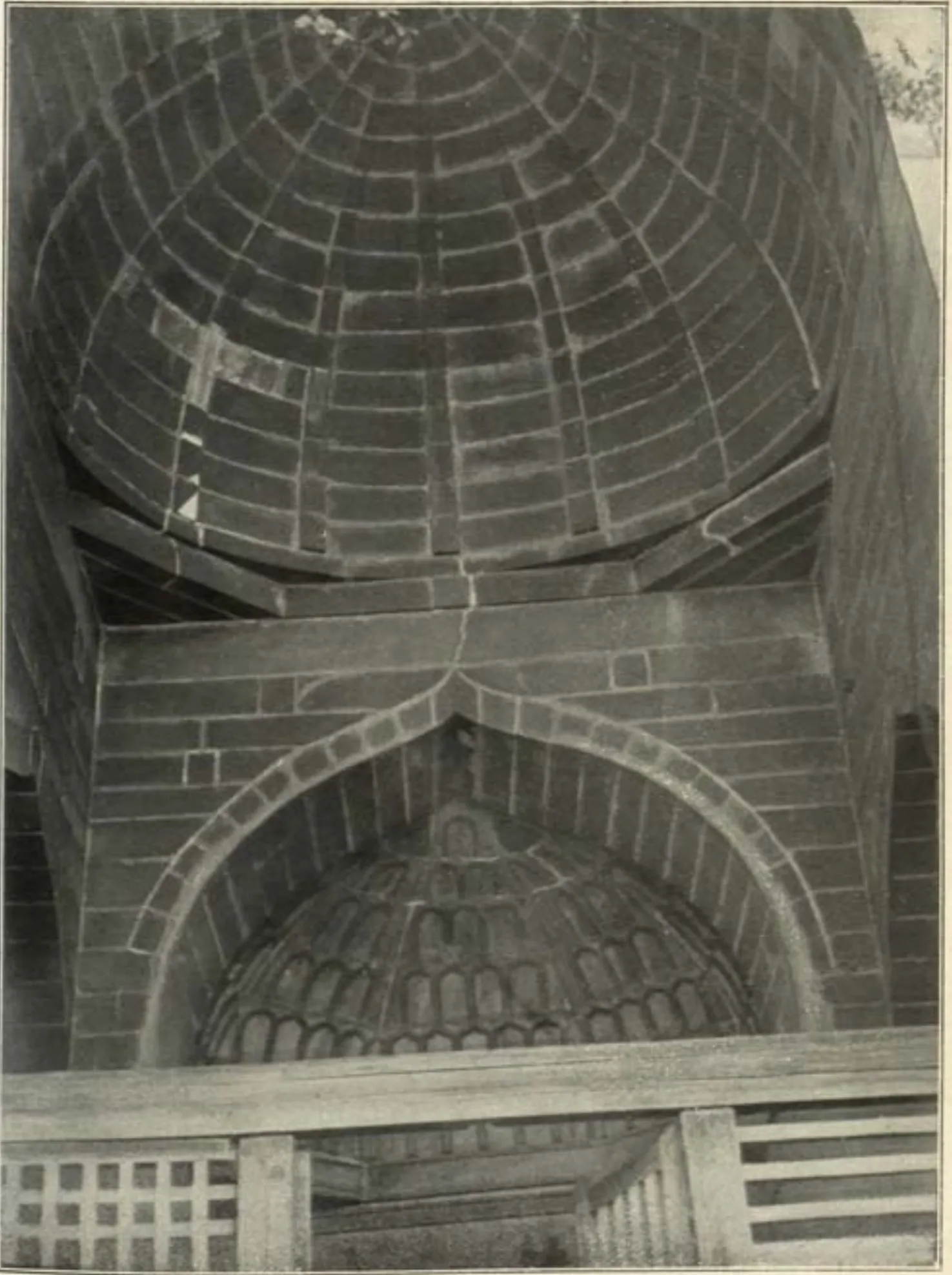
When Li Guangjin was writing, the Qingjing Mosque had just been through an earthquake, violent storms, and continuous rains, and its buildings were “swaying and collapsing worse by the day.” The abbot Xia Riyu led the elders and young men of the community in requesting repairs; those with money gave money, those without gave their labor, and the restorers “mended what was ruined, righted what leaned, and raised up what had fallen.” Some three hundred years later still, Arnáiz photographed the gate tower and prayer hall around 1910: the dome and the band of Arabic inscription remained, but the prayer hall had lost its roof, leaving only the gateways, the niches, and the stone walls. Today, passing through the stone gate of the Qingjing Mosque, one still finds overhead the Arabic recording the founding of 1009 and the rebuilding of 1310, beside oneself the imperial edict of a Ming emperor and the stele record of a literatus, and the direction of prayer in the prayer hall still facing west.
Historical Documents
Arabic Foundation Inscription of Qingjing Mosque
إن أول مسجد للناس في هذا [هذه] الأرض كان هذا المسجد المبارك المسمى العتيق والمقدس … بالجامع والشارع الملقب مسجد الأصحاب وكان ذلك في تاريخ سنة أربعمائة من الهجرة النبوية وبعد ما مضى من تاريخه المذكور ثلثمائة سنة عمره وجدده … وأسس هذا الطاق العالي والرواق الرفيع والباب الكريم والشبابيك الجديدة أتمه في تاريخ سنة عشر وسبعمائة للهجرة طلبا لمرضات الله تعالى أحمد بن محمد القدسي المعروف بحاجي ركن الشيرازي غفر الله له ولمن عاونه بمحمد وآله
此地人们的第一座礼拜寺,就是这座最古老、悠久、吉祥的礼拜寺,名称“艾苏哈卜寺”,建于回历四百年,即公元1009年至1010年。三百余年后,艾哈迈德·本·穆罕默德·古德斯,即设拉子著名的鲁克伯哈只,修复并更新了它,建筑高悬的穹顶、加阔了甬道,重修了高贵的寺门并翻新了窗户,于回历七百一十年,即公元1310年至1311年竣工。他为求真主喜悦而完成此事。愿真主因穆罕默德及其家属宽恕他和协助他的人。
The first mosque for the people of this land was this most ancient, enduring, and blessed mosque, named the “Ashab Mosque,” built in the year 400 of the Hijra, that is, 1009 to 1010 CE. More than three hundred years later, Ahmad ibn Muhammad al-Qudsi, the renowned Rukn Haji of Shiraz, restored and renewed it: he built the lofty dome, widened the passageway, rebuilt the noble mosque gate, and renewed the windows, completing the work in the year 710 of the Hijra, that is, 1310 to 1311 CE. He accomplished this in seeking the pleasure of God the Exalted. May God, for the sake of Muhammad and his household, forgive him and those who assisted him.
Quanzhou Fuzhi (Quanzhou Prefecture Gazetteer)
清净寺在郡城道淮街北府学之东。宋绍兴间,回人兹喜鲁丁自撒那威来泉所造,楼塔高敞,相传为文庙青龙之左角,教以沐浴事天为本。详三山吴鉴记中。元至正间,寺坏,里人金阿里修之。国朝正德间,住持夏彦高鸠众重修。隆庆丁卯,木塔坏,知府万庆捐俸,令住持夏东升、教人苏养正等修塔五层。万历三十七年,地大震,楼颓其角,而寺中房屋占住几百余人,污秽破坏。知府姜志礼、知县李待问捐俸重修,悉驱出之,仍搆亭宇,寺为一清,令教人林耀、住持夏禹董其役。孝廉李光缙有记。
The Qingjing Mosque stands in the prefectural city, north of Daohuai Street and east of the prefectural school. During the Shaoxing era of the Song it was built by the Muslim Zixi-Ludin, who came to Quanzhou from Siraf; its tower rose tall and open, said to stand at the left horn of the Azure Dragon of the Temple of Confucius, and its teaching took ablution and the service of Heaven as its foundation—related in detail in the record by Wu Jian of Sanshan. During the Zhizheng era of the Yuan the mosque fell into ruin, and the local man Jin Ali repaired it. During the Zhengde era of our dynasty the abbot Xia Yangao gathered the community and rebuilt it. In the dingmao year of the Longqing era the wooden tower fell into ruin, and Prefect Wan Qing donated his salary and ordered the abbot Xia Dongsheng and the believer Su Yangzheng and others to repair the five-story tower. In the thirty-seventh year of the Wanli era there was a great earthquake, and a corner of the tower collapsed; several hundred people had occupied the mosque’s buildings, defiling and damaging them. Prefect Jiang Zhili and County Magistrate Li Daiwen donated their salaries for a rebuilding, drove them all out, and once more erected pavilions, so that the mosque was made wholly clean, ordering the believer Lin Yao and the abbot Xia Yu to oversee the work. The provincial graduate Li Guangjin wrote a record of it.
至正十七年,万户赛甫丁、阿迷里可反,据泉州,民被荼毒。是年,鼎寇伊守礼啸聚,复攻同安监邑,马哈谋沙力战走之。
In the seventeenth year of the Zhizheng era, the myriarchs Saifuding and Amili rebelled and seized Quanzhou, and the people suffered grievous harm. In that same year the bandit Yi Shouli gathered a mob and again attacked the subordinate county of Tong’an, but Mahamousha fought hard and drove him off.
二十二年,回寇那兀纳叛据泉州。官军至,千户金吉开门纳之,遂执兀纳。是年,陈友定攻泉州,陷之。
In the twenty-second year, the Muslim bandit Nawuna rebelled and seized Quanzhou. When the government troops arrived, the chiliarch Jin Ji opened the gate and admitted them, and thereupon they captured Nawuna. In that same year Chen Youding attacked Quanzhou and took it.
Stele on the Re-establishment of Qingjing Temple
其在郡城,有清净寺云。元三山吴鉴清净寺记:西出王关万余里,有国曰大食,于今为帖直氏。北连安息、条支,东隔土番、高昌,南距云南、安南,西渐于海,地莽平,广袤数万里,自古绝不与中国通,城池宫室,园圃沟渠,田畜市列,与江淮风土不异。寒暑应候,民物繁,种五谷、蒲萄诸果。俗重杀,好善,书体旁行,有篆、楷、草三法。著经史诗文、阴阳、星历、医药音乐,皆极精妙。制造织文、雕缕器皿尤巧。
In the prefectural city there is the Qingjing Mosque. The Record of Qingjing Temple by Wu Jian of Sanshan of the Yuan states: More than ten thousand li west beyond the royal passes lies a country called Dashi, today the domain of the Tiezhi. To the north it borders Parthia and Characene, to the east it is separated by Tibet and Gaochang, to the south it reaches Yunnan and Annam, and to the west it stretches to the sea. The land is a vast level plain, tens of thousands of li in extent; from ancient times it had no communication whatever with China. Its cities and palaces, gardens and canals, fields, livestock, and market stalls are no different from the customs of the Jiang-Huai region. Cold and heat come in their season; its people and goods are abundant; they grow the five grains and grapes and every kind of fruit. Their customs value slaughter and love goodness; their script is written sideways and has three forms—seal, standard, and cursive. In their compositions on the classics, history, poetry, and prose, on yin-yang, astronomy and the calendar, medicine and music, all are utterly refined and exquisite. In their manufacture of woven patterns and carved vessels they are especially skilled.
初,默德那国王别谙拔尔谟罕蓦德,生而神灵,有大德,臣服西域诸国,咸称圣人。别谙拔尔犹事言天使,盖尊而号之也。其教以万物本乎天,天一理无可像,故事天至虔,而无像设。每岁斋飞一月,更衣沐浴,居必易常处,日西向拜天,净心诵经。经本天人所授三十藏,计一百一十四部,凡六千六百六十六卷。旨义渊微,以至公无私,正心修德为本,以祝圣化民,周急解厄为事。持己接人,内外慎敕,迄今八百余岁。国俗严奉尊信,虽适殊域,传子孙,累世不敢易。
In the beginning, the king of Medina, Paighambar Muhammad, was born endowed with divine spirit and possessed of great virtue; he brought the various countries of the Western Regions into submission, and all called him the Sage. “Paighambar” is like saying “Messenger of Heaven,” a term of honor bestowed upon him. His teaching holds that all things are rooted in Heaven, that Heaven is a single principle that can take no image, and therefore he served Heaven with the utmost reverence and set up no images. Each year there is a month of fasting, with a change of garments and ritual ablution; one’s dwelling must be moved from its usual place; each day one prays to Heaven facing west and, with a purified heart, recites the scripture. The scripture, in its original form transmitted by Heaven and man, comprises thirty repositories, one hundred and fourteen sections in all, six thousand six hundred and sixty-six scrolls. Its meaning is deep and subtle, taking utter impartiality and selflessness, the rectifying of the heart and the cultivation of virtue as its foundation; it makes the blessing of the holy and the transforming of the people, the relief of the needy and the deliverance from calamity its work. In governing oneself and dealing with others, one is careful and disciplined within and without; down to the present day, more than eight hundred years have passed. The custom of the country honors and reveres it strictly, and though one may travel to distant lands and pass it to one’s sons and grandsons, for generations none dare change it.
宋绍兴元年,有纳只卜穆兹喜鲁丁者,自撒那威从商舶来泉,创兹寺干泉州之南城。造银灯香炉以供天,买土田房屋以给众,后以没塔完里、阿哈味不任,寺坏不治。至正丸年,闽海宪佥赫德尔行部至泉,摄思廉夏不鲁罕丁命舍剌甫丁哈悌卜领众分诉宪公任达鲁花赤,高昌契王立至,议为之征复旧物,众志大悦。于是里人金阿里愿以己赀一新其寺,征余文为记,其略如此。碑末言夏不鲁罕丁年一百二十岁,博学有才德,精健如中年。其曰摄思廉,犹言主教也。其曰没塔完里,犹言都寺也。
In the first year of the Shaoxing era of the Song, one Najib Muzixi-Ludin came from Siraf aboard a merchant ship to Quanzhou and founded this mosque in the southern city of Quanzhou. He made silver lamps and incense burners for the service of Heaven, and bought land and houses to provide for the community; later, because the mutawalli and the akhund were unequal to their charge, the mosque fell into ruin and went untended. In the ninth year of the Zhizheng era, when Hedeer, Investigating Assistant of the Fujian Maritime Circuit, came on tour of inspection to Quanzhou, the imam Xiabuluhanding ordered Sharafuding the khatib to lead the community in petitioning the Investigating Lord and the darughachi in office; Qi of Gaochang came at once, and it was resolved to recover the mosque’s former property for them, at which the community rejoiced greatly. Thereupon the local man Jin Ali was willing to renew the mosque with his own funds, and sought a text from me as a record—such is its gist. At the end of the stele it says that Xiabuluhanding was one hundred and twenty years of age, learned and possessed of talent and virtue, vigorous and hale as a man in his prime. What it calls “imam” is like saying “one who presides over the teaching”; what it calls “mutawalli” is like saying “director of the temple.”
Record of the Rebuilding of Qingjing Temple
清净之教,流入中土,自隋开皇始。经首言真主,以真命为天主,真心为人主,故其教主于斋戒沐浴以事天。凡一年必有一月之斋,如吾中国岁首月是也;凡一月必有四日之斋,值亢牛娄鬼之日是也。拜必沐浴,非沐浴不敢入拜;斋必素食,非见星不敢尝食。教主遇斋,率众诵经,西向罗列,但有膜拜,而无供养,此教之大凡也。郡建寺楼,相传宋绍兴间兹喜鲁丁自撒那威来泉所造。楼峙文庙青龙之左角,有上下层,以西向为尊。临街之门从南入,砌石三圜以象天,其左右壁各六合,若九门,追琢皆九九数,取苍穹九天之义。内圆顶象天,上为望月台,下两门相峙而中方,取地方象。入门转西级而上,曰下楼。南级上曰上楼。下楼石壁门从东入,正西之座曰奉天坛。中圜象太极,左右二门象两仪,西四门象四象,南八门象八卦,北一门以象乾元。天开于子,故曰天门。柱十有二,象十二月。上楼之正东曰祝圣亭,亭之南为塔四,围柱于石城,设二十四窗,象二十四气。西座为天坛,所书皆经言云。登楼睇之,清源在北,鸿渐在南,葵山在西,灵山在东,紫帽在西南,宝盖、天马在东南,凤山在东北,朋山在西北。众峰迤列,如屏如垒,溪水从西来,二长虹阑之,大瀛海汪洋其东。俯瞰城中,千雉如带,双塔插天,通衢曲巷,飞甍联檐,四望一览,在趾踵下。楼北有堂,郡太守万灵湖公额曰“明善堂”。以楼为正峰,横河界之,通海水潮汐,短桥以济。异时教众,每于月斋、日斋,登楼诵经,已毕,退休息于此堂之上。寺极观备是矣。胜国以前,递坏递兴,无得而纪。按碑载:元至正有回夏不鲁罕丁与里人金阿里修之。明兴,不知凡几缮。隆庆丁卯,塔坏,住持夏东升鸠众修之,太守万灵湖公捐俸以助。今万历三十五年,地大震,暴风淫雨,楼栋飘摇倾圮日甚。住持夏日禹率父老子弟请余修之,余曰:公役也,有赀舍财,无赀舍力,无乾没,无冒破,以成厥胜。众皆欣然。时丁君哲初以吏部郎请给里居,与余谋佥同,于是始事。先是楼北无庭除,左设居房,右置竃舍,中道如甬,后为占住者屠牛之垣,余是以移去之,易居为洗心亭,除竃为小西天。庭空月碧,楼影徘徊,亭光翼之,若增一胜。楼之坏者葺,欹者正,仆者隆起。因集颜鲁公“遥天楼”三字额之。又题曰“唯天为大”,以晓人尊天之意。逮及明善之堂,翕然改观矣,余乃记之。
The teaching of Qingjing (purity and stillness) flowed into the central land beginning in the Kaihuang era of the Sui. The scripture opens by speaking of the True Lord, taking the true mandate as the Lord of Heaven and the true heart as the lord of man; therefore its teaching centers on fasting and ritual ablution in the service of Heaven. Every year there must be a month of fasting, as with the first month of the year here in China; every month there must be four days of fasting, falling on the days of the lunar mansions Gang, Niu, Lou, and Gui. Prayer requires ablution—without ablution one dares not enter to pray; the fast requires vegetarian food—not until the stars appear does one dare to taste food. When the teaching’s leader observes the fast, he leads the community in reciting scripture, arrayed facing west; there is only prostration and no votive offering—such is the general outline of this teaching. The prefecture’s mosque tower is said to have been built during the Shaoxing era of the Song by Zixi-Ludin, who came to Quanzhou from Siraf. The tower stands at the left horn of the Azure Dragon of the Temple of Confucius; it has an upper and a lower story, with the westward orientation held in honor. The street-facing gate is entered from the south, and three round arches of dressed stone symbolize Heaven; its left and right walls each have six sides, like nine gates, all carved in nines upon nines, taking the meaning of the nine heavens of the vault of the sky. Within, the round dome symbolizes Heaven; above it is the moon-watching platform, and below, two gateways stand facing each other with a square space between, taking the image of the squareness of Earth. Entering the gate and turning west, one climbs the steps to what is called the lower story; climbing the southern steps one reaches the upper story. In the lower story a gate in the stone wall is entered from the east, and the seat due west is called the prayer hall. Its central circle symbolizes the Supreme Ultimate; the two gates to left and right symbolize the Two Modes; the four gates to the west symbolize the Four Emblems; the eight gates to the south symbolize the Eight Trigrams; the one gate to the north symbolizes the primal Qian. Heaven opens at the hour of zi, and so it is called the Gate of Heaven. There are twelve pillars, symbolizing the twelve months. Due east of the upper story is the Pavilion for Blessing the Emperor; south of the pavilion are four towers, with pillars enclosed within a stone wall, and twenty-four windows are set, symbolizing the twenty-four solar terms. The western seat is the Altar of Heaven, and what is written there is all scriptural words. Gazing out from the tower: Qingyuan lies to the north, Hongjian to the south, Kuishan to the west, Lingshan to the east, Zimao to the southwest, Baogai and Tianma to the southeast, Fengshan to the northeast, and Pengshan to the northwest. The many peaks range in succession like screens and ramparts; a stream comes from the west, barred by two long rainbows, and the great ocean spreads vast to the east. Looking down into the city, its thousand battlements are like a girdle, twin pagodas pierce the sky, the great thoroughfares and winding lanes with soaring roof-ridges and joined eaves—the whole prospect in every direction lies beneath one’s feet. North of the tower is a hall, which the prefect Lord Wan Linghu inscribed as the “Hall of Illustrious Goodness.” With the tower as the principal peak, a river crosses to divide it, connected to the tides of the sea, crossed by a short bridge. In former times the congregation, at each monthly and daily fast, climbed the tower to recite scripture, and when finished, withdrew to rest above this hall. The mosque’s grand prospect is complete in this. Before the previous dynasty, it had fallen into ruin and risen again in turn, and nothing can be recorded of it. According to the stele: in the Zhizheng era of the Yuan the Muslim Xiabuluhanding and the local man Jin Ali repaired it. Since the rise of the Ming, it has been mended who knows how many times. In the dingmao year of the Longqing era the tower fell into ruin, and the abbot Xia Dongsheng gathered the community and repaired it, while the prefect Lord Wan Linghu donated his salary to help. Now, in the thirty-fifth year of the Wanli era, there was a great earthquake, with violent storms and excessive rains, and the tower’s timbers swayed and collapsed worse by the day. The abbot Xia Riyu led the elders and young men in asking me to repair it, and I said: This is a public undertaking; those with means give wealth, those without means give labor; let there be no embezzlement and no waste, that its excellence may be achieved. All were delighted. At the time Master Ding Zhechu, a director in the Ministry of Personnel, had requested leave to reside at home, and his counsel agreed with mine, and so the work began. Formerly there was no courtyard north of the tower: on the left were living quarters, on the right a kitchen, with a passage running through the middle, and behind it a wall where the occupiers slaughtered cattle. I therefore had these removed, converting the dwelling into the Pavilion of Cleansing the Heart and the kitchen into the Little Western Paradise. The courtyard now empty and the moon jade-green, the tower’s shadow lingering, the pavilion’s light flanking it—as if a fresh beauty had been added. What was ruined in the tower was mended, what leaned was righted, what had fallen was raised up. Accordingly I collected the three characters “Tower Reaching to the Sky” by Lord Yan Lu and inscribed them as its plaque; and I also inscribed “Heaven Alone Is Great,” to make plain to people the intent of revering Heaven. As for the Hall of Illustrious Goodness, it too was wholly transformed in appearance, and I have therefore recorded it.
余按净教之经,默德那国王谟罕蓦所著,与禅经并来西域,均非中国圣人之书。但禅经译而便于读,故至今学士谭之;而净教之经,未重汉译,是以不甚盛行于世。然以余所观,释氏书多祖心经。其始译,则沙门玄奘奉诏为之,岂其人通夷语解佛理,果无鲁鱼亥豕之误乎?唐一时君臣,奉若天书,即二帝三王之经不啻,上好而下必甚,是以萧瑀、傅奕之徒皆言佛,而佛经滋多于是矣。吾以为玄奘之译,未必尽无讹,而《金刚》、《楞严》、《圆觉》、《法华》以下之书,岂必其真从西至也?禅经译而经杂,净经不译而经不杂。译者可言而亦可知,知之则愈幻,不译者不可知而可言,徒读之,未尽舛。尝按是以思,儒有声色臭味、安佚不谓性之说,禅之教近之,故不有其眼耳鼻舌身意,而空之于一切,但言性而不言命;儒有仁义礼智、天道不谓命之说,净之教近之,故有其君臣父子夫妇而归之于事天,但言命而不言性。之二者,习之而善,各有得;习之而不善,均不能无失。乃今之习净教者何如也?沿其迹,不得其真性。往物肇于饮食之弥,文踵率其出沐之故事,曾于“维天之命”一置思否?甚则以肉食为斋,以净为教矣。是以世俗见其然,信禨祥者,既已其□关于死生祸福之籍而忽之;皈慈悲者,又以其多不合于斧斤芒刃之用而□之。故清净氏之言天堂,反不如释氏之言地狱。虽其先守教之家,今亦掉臂而叛去,此教之所繇衰,而寺之所繇圮,乃未趋渐失使然耳,岂其初立教之本旨哉?说者谓儒道如日中天,释道如月照地,余谓净教亦然。韩昌黎欲于佛火其书、庐其居,此愤激太过之论。茫茫区宇,何所不有?邹鲁六籍之外,百家九流,亦足补苴大道,何必尽非?上帝临汝,无贰尔心,吾于斯楼取其为事天之所;多言释道,不如冥冥,民可使由,不可使知,吾于经取其不译而已矣。夫是以议修复之,非徒以区区灵光之迹也。
I observe that the scripture of the Qingjing teaching, composed by Muhammad, king of Medina, came from the Western Regions together with the Chan (Buddhist) scriptures, and neither is a book of the sages of China. But the Chan scriptures were translated and made easy to read, and so scholars discuss them to this day; whereas the scripture of the Qingjing teaching has never been much translated into Chinese, and for this reason it does not greatly flourish in the world. Yet from what I have observed, the writings of the Buddhists mostly derive from the Heart Sutra. Its first translation was made by the monk Xuanzang at imperial command—but was that man, versed in foreign tongues and comprehending Buddhist doctrine, truly free of scribal errors? The ruler and ministers of that Tang moment revered it as if it were a heavenly book, no less than the classics of the Two Emperors and Three Kings; and since those above favored it, those below were sure to go to excess—thus the likes of Xiao Yu and Fu Yi all spoke of the Buddha, and Buddhist scriptures multiplied thereby. I hold that Xuanzang’s translation was not necessarily wholly without error, and as for the Diamond, the Shurangama, the Perfect Enlightenment, the Lotus, and the books that followed—must they truly all have come from the West? The Chan scriptures were translated, and the scriptures grew mixed; the Qingjing scripture was not translated, and its scripture remained unmixed. What is translated can be spoken of and also known, and the more it is known the more illusory it becomes; what is untranslated cannot be known yet can be spoken of, and merely reading it, one is not wholly led astray. Reflecting on this, I have thought: the Confucians have the doctrine that sound, color, scent, taste, and ease are not to be called one’s nature—the Chan teaching approaches this, and so it does away with eye, ear, nose, tongue, body, and mind, emptying all things, speaking only of nature and not of destiny; the Confucians have the doctrine that benevolence, righteousness, propriety, wisdom, and the Way of Heaven are not to be called destiny—the Qingjing teaching approaches this, and so it retains ruler and subject, father and son, husband and wife, and returns them to the service of Heaven, speaking only of destiny and not of nature. Of these two, when practiced well each has its gains; when practiced badly neither can be without loss. But what of those who practice the Qingjing teaching today? They follow its traces but do not attain its true nature. Their concern with things begins in the abundance of food and drink; their observance follows only the old routine of going out to bathe—have they ever once given thought to “the mandate of Heaven”? At worst they take eating meat for the fast and take purity itself for the teaching. And so worldly people, seeing this, those who trust in omens have already […] neglected it as bearing on the register of life, death, fortune, and misfortune; those who take refuge in compassion have again […] it as mostly unsuited to the use of axe and blade. Thus the Qingjing school’s talk of Heaven fares worse than the Buddhists’ talk of Hell. Even the households that formerly kept the teaching now turn away and defect from it—this is why the teaching declines and why the mosque falls into ruin, brought about by a gradual slipping away, and hardly the original purport with which the teaching was first founded! Those who discuss it say that the Confucian Way is like the sun at midheaven, and the Buddhist Way like the moon lighting the earth; I say the Qingjing teaching is the same. Han Changli (Han Yu) wished to burn the books of the Buddha and turn their dwellings into huts—this was a judgment of excessive indignation. In the vast expanse of the world, what does it not contain? Beyond the Six Classics of Zou and Lu, the hundred schools and nine currents are also enough to patch and supplement the great Way—why must all be rejected? “The Lord on High looks down upon you; let there be no doubleness in your heart”—from this tower I take its being a place for the service of Heaven; and “much talk of the Buddhist Way is not so good as the unfathomable; the people may be made to follow it, but cannot be made to understand it”—from this scripture I take only that it is untranslated. It is on this account that I have deliberated on its restoration—not merely for the sake of the paltry traces of its numinous glory.
是役也,郡大夫姜公、邑大夫李公谓兹楼之胜,于文庙有关,捐俸助修,及里中诸大夫君子相与协力成之,余何力之有焉?役始于万历戊申岁之六月,竣于己酉岁之九月,费金百有奇。董役则林日耀、任才锺、李东燫、王廷华,募缘则夏日禹、何仕全、何天启,而昼夜殚心竭力,以稽工实,则日耀之功居多。例得并书。
In this undertaking, the prefectural magistrate Lord Jiang and the county magistrate Lord Li held that the excellence of this tower bore upon the Temple of Confucius, and donated their salaries to aid the repair; and the various magistrates and gentlemen of the community joined their efforts to complete it—what strength of mine was in it? The work began in the sixth month of the wushen year of the Wanli era and was finished in the ninth month of the jiyou year, at a cost of somewhat over a hundred in gold. The overseers of the work were Lin Riyao, Ren Caizhong, Li Donglian, and Wang Tinghua; the solicitors of donations were Xia Riyu, He Shiquan, and He Tianqi; but the one who day and night exhausted his heart and strength to verify the actual work was Riyao, whose merit was the greatest. By convention his name is recorded together with the rest.
万历叁拾柒年岁在己丑秋重阳之吉,儒林门人李光缙、宗谦甫顿首拜撰。
On the auspicious day of the Double Ninth festival, autumn of the thirty-seventh year of the Wanli era, the jichou year, composed with bowed head in obeisance by Li Guangjin, a disciple of the Confucian grove, styled Zongqian.
Imperial Edict Stele of the 5th Year of Yongle
大明皇帝敕谕米里哈只
Imperial Edict of the Emperor of the Great Ming to Miri Haji
朕惟能诚心好善者必能敬天事上劝率善类阴翊皇度故天赐以福享有无穷之庆尔米里哈只早从马哈麻之教笃志好善导引善类又能敬天事上益效忠诚眷兹善行良可嘉尚今特授尔以敕谕护持所在官员军民一应人等毋得慢侮欺凌敢有故违朕命慢侮欺凌者以罪罪之故谕
We consider that one who can sincerely love goodness will surely be able to reverence Heaven and serve his superiors, to encourage and lead the virtuous, and secretly to uphold the imperial order; therefore Heaven bestows blessings upon him and grants him boundless felicity. You, Miri Haji, early followed the teaching of Muhammad, are firmly resolved to love goodness, and guide and lead the virtuous; you are moreover able to reverence Heaven and serve your superiors, ever the more rendering loyal devotion. In esteem of these good deeds, truly praiseworthy, We now specially grant you this edict of protection. Wherever you may be, officials, soldiers, and civilians and all persons whatsoever must not slight, insult, or oppress you; should any dare deliberately to defy Our command and slight, insult, or oppress you, they shall be punished according to the offense. Thus is the edict proclaimed.
永乐五年五月十一日
The eleventh day of the fifth month of the fifth year of the Yongle era.
Historical Photographs
1910
The following images are included in Mémoire sur les antiquités musulmanes de Ts’iuan-Tcheou, co-authored by Greg. Arnáiz and Max van Berchem, published in 1911 in volume 12 of T’oung Pao. Arnáiz records explicitly in the text that he photographed the stone carvings at Quanzhou on 31 October 1910, and van Berchem likewise notes that the photographs on which the Qingjing Mosque plates are based were taken on site by Arnáiz; the original publication did not date the individual plates, and so they are marked here as “circa 1910.”