Introduction
Dule Temple once belonged to Jizhou, and old gazetteers place it southwest of the prefectural seat. What the texts describe in most detail is not the founding of the whole temple, but a single Liao-dynasty rebuilding of the temple’s Guanyin Pavilion. Both the Rixia Jiuwen and the Qinding Rixia Jiuwen Kao quote a summary of the Liu Cheng stele: in the winter, tenth month of the second year of Tonghe, the Grand Preceptor, Prince of Qin[1], invited Master Tanzhen to enter the temple and rebuild the Guanyin Pavilion; the pavilion had two stories, five bays east to west and eight frames north to south, and the eleven-headed Guanyin image was recast.
These records do not say when Dule Temple was first founded, yet they preserve the dimensions and the enshrined image of one Liao-dynasty campaign on the Guanyin Pavilion. The [Guangxu] Shuntian Fu Zhi places the temple southwest of the prefectural seat, notes that the Liao monk Yuanxin[2] had lived there, and records the 1753 imperial-funded restoration; the Jingji Jinshi Kao lists the “Stele of the Liao Rebuilding of the Guanyin Pavilion of Dule Temple” among the epigraphy of Jizhou; and the Jizhou Zhi turns the tale of the Panshan reliquary-pagoda lamp reaching Dule first into the phrase “the morning lamp of Dule.”
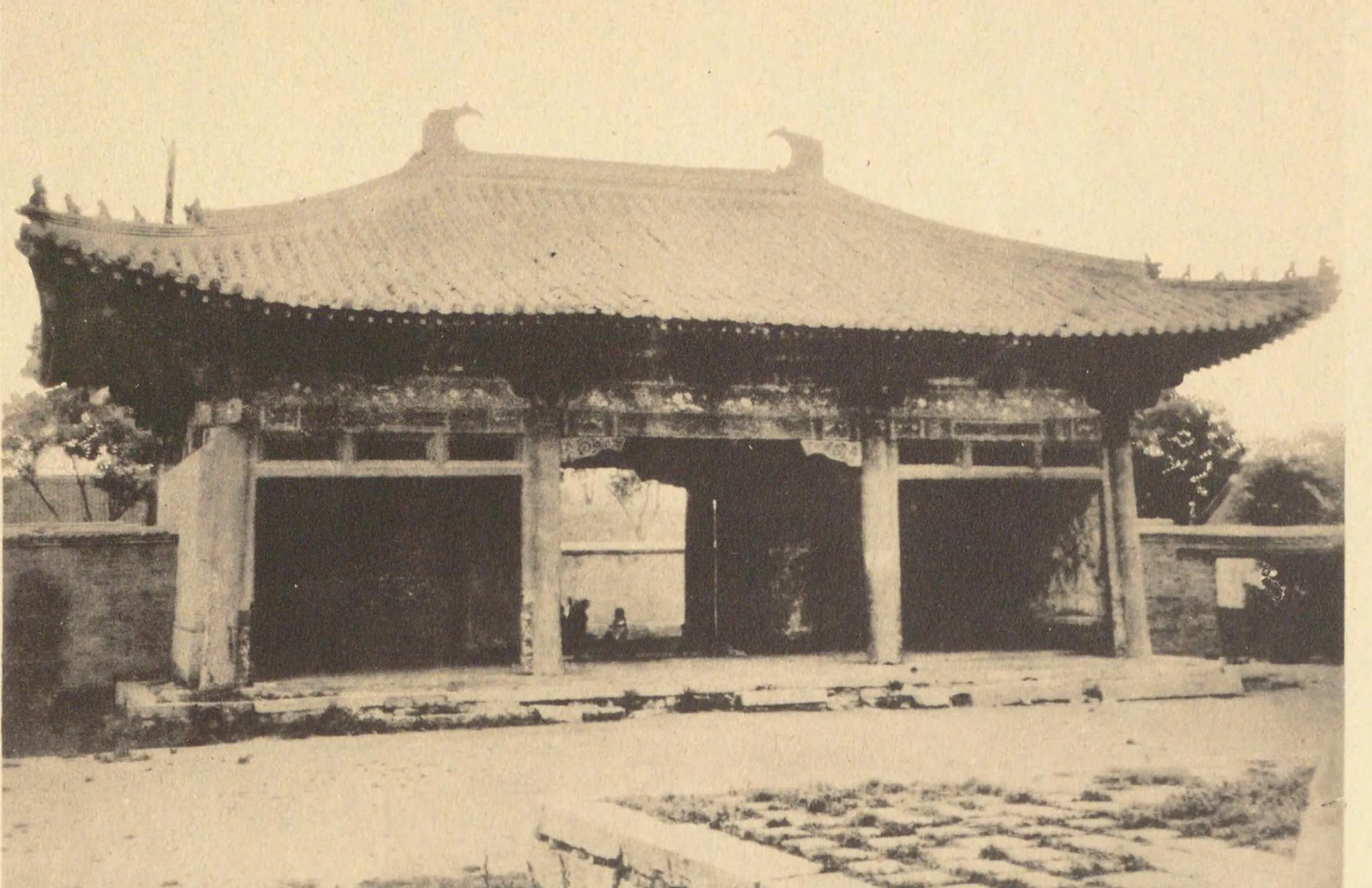
Early modern materials add images to these texts. Tokiwa Daijō and Sekino Tadashi’s Historical Monuments of China photographed the mountain gate, the Guanyin Pavilion, the guardian kings, and the Guanyin image; and Liang Sicheng’s 1932 Study of the Guanyin Pavilion and Mountain Gate of Dule Temple in Ji County discussed the pavilion and gate through photographs, surveys, and structural details.
Historical Documents
Rixia Jiuwen
开元四年,复属幽州。十八年,置蓟州治焉。渔阳本汉旧县。地理志:渔阳郡管县十二,一曰渔阳。以北有渔水,县在渔北,因曰渔阳。鲍丘水从塞外来,南过渔阳县东,又南过潞县西,又南至雍奴县北,屈东入于海。渔水出渔阳县东南平地,泉流,西迳故县城南。今城在斯水之阳,渔阳之名当属此。秦发闾左戌渔阳,即是城也。儒学在州治西北。蓟州有预备仓。广福寺在州治北儒学之东。独乐寺在州治西南。中有杰阁,设大士象,相传盘山舍利塔、神灯自塔而下,先独乐而后及诸佛刹云。独乐寺不知创自何代,至辽时重修。有翰林院学士承旨刘成碑,统和四年孟夏立石。其文略曰:故尚父秦王请谈真大师入独乐寺修观音阁,以统和二年冬十月再建。上下两级,东西五间,南北八架,大阁一所,重塑十一面观世音菩萨像。
In the fourth year of Kaiyuan it again belonged to Youzhou; in the eighteenth year the seat of Jizhou was established there. Yuyang was originally a Han-dynasty county. The Treatise on Geography says: the commandery of Yuyang governed twelve counties, one being Yuyang. Because the Yu River lay to its north and the county stood north of the Yu, it was called Yuyang. The Baoqiu River comes from beyond the frontier, flows south past the east of Yuyang county, then south past the west of Lu county, then south to the north of Yongnu county, and bends east into the sea. The Yu River rises in the flat land southeast of Yuyang county, flows as a spring, and runs west past the south of the old county town. The present town lies on the north bank of this river, and the name Yuyang must derive from it. When Qin sent the poorer villagers to garrison Yuyang, this was the town. The Confucian school lies northwest of the prefectural seat. Jizhou has a reserve granary. Guangfu Temple lies east of the Confucian school north of the prefectural seat. Dule Temple lies southwest of the prefectural seat. Within it is a lofty pavilion holding an image of the Great Being; it is said that the spirit lamp of the Panshan reliquary pagoda descends from the pagoda, reaching Dule first and then the other Buddhist temples. It is not known in what age Dule Temple was founded; it was rebuilt in the Liao. There is a stele by Liu Cheng, Hanlin Academician and Recipient of Edicts, set up in the first month of summer, fourth year of Tonghe. Its text says in summary: the late Grand Preceptor, Prince of Qin, invited Master Tanzhen to enter Dule Temple and repair the Guanyin Pavilion, rebuilt in the winter, tenth month of the second year of Tonghe. It had two stories, five bays east to west, eight frames north to south — one great pavilion — and the eleven-headed Guanyin image was recast.
Qinding Rixia Jiuwen Kao
原独乐寺在州治西南,中有杰阁,设大士像。相传盘山舍利塔神灯自塔而下,先独乐而后及诸佛刹云。蓟州志。臣等谨按:独乐寺在城内州治之西,观音阁、大士像今俱存。乾隆十八年,赐帑重修。寺内恭悬皇上御书额曰普门香界。联曰:琳宇近神畿,慈云广荫;法筵传古迹宝月常新。又曰:绝无尘相染初地;定有天花落讲台。旁建精舍,联曰:短长诗句闲中检;来往年华静里观。皆御书。
Original text: Dule Temple lies southwest of the prefectural seat; within it is a lofty pavilion holding an image of the Great Being. It is said that the spirit lamp of the Panshan reliquary pagoda descends from the pagoda, reaching Dule first and then the other Buddhist temples. (Jizhou Zhi.) Your servants respectfully note: Dule Temple lies within the town, west of the prefectural seat; the Guanyin Pavilion and the image of the Great Being both survive today. In the eighteenth year of Qianlong, funds were granted for its restoration. Within the temple hangs a tablet in the Emperor’s own hand reading “Universal Gate, Realm of Fragrance.” A couplet reads: “The jeweled hall lies near the sacred capital, its cloud of mercy spreading wide; the dharma seat transmits the ancient traces, its treasure moon forever new.” Another reads: “No trace of dust ever stains this first ground; heavenly flowers surely fall upon the lecture terrace.” A meditation cell built beside it bears the couplet: “Long and short verses examined at leisure; the coming and going years observed in stillness.” All are in the Emperor’s hand.
原独乐寺不知创自何代,至辽时重修,有翰林院学士承旨刘成碑,统和四年孟夏立石,其文略曰:故尚父秦王请谈真大师入独乐寺修观音阁,以统和二年冬十月再建,上下两级,东西五间,南北八架,大阁一所,重塑十一面观世音菩萨像。盘山志。
Original text: It is not known in what age Dule Temple was founded; it was rebuilt in the Liao. There is a stele by Liu Cheng, Hanlin Academician and Recipient of Edicts, set up in the first month of summer, fourth year of Tonghe. Its text says in summary: the late Grand Preceptor, Prince of Qin, invited Master Tanzhen to enter Dule Temple and repair the Guanyin Pavilion, rebuilt in the winter, tenth month of the second year of Tonghe, with two stories, five bays east to west, eight frames north to south — one great pavilion — and the eleven-headed Guanyin image recast. (Panshan Zhi.)
Your servants respectfully note: the Liu Cheng stele can no longer be traced today.
[Guangxu] Shuntian Fu Zhi
在州治西南。寺不知何时创建。辽时沙门圆新居之。统和二年,僧谈真重修。有统和四年翰林院学士承旨刘成撰碑。有杰阁设大士像,相传盘山舍利塔、神灯自塔而下,先独乐而后及诸佛刹云。国朝乾隆十八年,赐帑重修。
It lies southwest of the prefectural seat. It is not known when the temple was founded. In the Liao the monk Yuanxin lived there. In the second year of Tonghe, the monk Tanzhen rebuilt it. There is a stele composed by Liu Cheng, Hanlin Academician and Recipient of Edicts, in the fourth year of Tonghe. There is a lofty pavilion holding an image of the Great Being; it is said that the spirit lamp of the Panshan reliquary pagoda descends from the pagoda, reaching Dule first and then the other Buddhist temples. In the eighteenth year of Qianlong of this dynasty, funds were granted for its restoration.
Liaoshi Jishi Benmo
释智朴盘山志云:独乐寺在蓟州治西南,辽时重修。有翰林承旨刘成碑,统和四年孟夏立石。其文略曰:故尚父秦王请谈真大师入独乐寺修观音阁,以统和二年冬十月再建。上下两级,东西五间,南北八架,大阁一所,重塑十一面观世音、菩萨像。
The monk Zhipu’s Panshan Zhi says: Dule Temple lies southwest of the seat of Jizhou; it was rebuilt in the Liao. There is a stele by Liu Cheng, Recipient of Edicts of the Hanlin, set up in the first month of summer, fourth year of Tonghe. Its text says in summary: the late Grand Preceptor, Prince of Qin, invited Master Tanzhen to enter Dule Temple and repair the Guanyin Pavilion, rebuilt in the winter, tenth month of the second year of Tonghe. It had two stories, five bays east to west, eight frames north to south — one great pavilion — and the eleven-headed Guanyin and bodhisattva images were recast.
Panshan Zhi
古今志乘类有志余外纪轶事一门,以广闻见,录𭹹奇。盘山风气淳朴,千百载中灵幻可骇之迹,依名附类以传者,视他山为少。齐谐、虞初之志怪,此书幸无讥焉。今取畸言僻事及迹涉疑似,人可出入者,入杂缀中,庶几正编所列,咸归精核,而披览者亦无罣漏之诮尔。宋荦筠廊二笔:盘山佛灯,每于除夕见之。山之云罩寺定光佛舍利塔,与蓟州独乐寺观音阁、通州孤山破塔,皆有灯出,互相往来,漏尽各返原处,好事者恒裹粮候之。阮旻锡燕山纪游:盘山异迹,有除夜佛灯,灯出通州孤山塔上,分为数千百,远绕盘山诸寺,至定光佛塔而止。或曰塔中舍利光也。蓟州志载:独乐寺在蓟州治西南,中有杰阁,设大士像。相传盘山舍利塔神灯自塔而下,先独乐而后及诸佛刹云。
Gazetteers ancient and modern have a category of “supplementary records and anecdotes” to broaden what is heard and seen and to note the marvelous. The atmosphere of Mount Pan is simple and honest; over a thousand years its startling wonders that have been transmitted by name and category are fewer than those of other mountains. The tales of the strange of Qi Xie and Yu Chu — this book is fortunate to escape such ridicule. Here I take odd sayings and out-of-the-way matters, and traces that touch on the doubtful and admit of dispute, and place them in the miscellany, so that what is listed in the main compilation may all be exact and verified, and the reader may also incur no reproach for omission. Song Luo’s Yunlang Erbi: The Buddha lamps of Mount Pan are seen every New Year’s Eve. From the reliquary pagoda of Dingguang Buddha at Yunzhao Temple on the mountain, together with the Guanyin Pavilion of Dule Temple in Jizhou and the ruined pagoda of Gushan in Tongzhou, lamps all issue forth and pass to and fro; when the night-watches end each returns to its original place, and enthusiasts always pack provisions and wait for them. Ruan Minxi’s Yanshan Jiyou: Among the marvels of Mount Pan are the New Year’s Eve Buddha lamps; the lamps issue from the pagoda of Gushan in Tongzhou, divide into several thousand, circle the temples of Mount Pan afar, and stop at the pagoda of Dingguang Buddha. Some say it is the light of the relics within the pagoda. The Jizhou Zhi records: Dule Temple lies southwest of the seat of Jizhou; within it is a lofty pavilion holding an image of the Great Being. It is said that the spirit lamp of the Panshan reliquary pagoda descends from the pagoda, reaching Dule first and then the other Buddhist temples.
Jizhou Zhi
独乐晨灯
城西门内寺名独乐殿高五文余每元日之晨盘山舍利塔有灯冉冉而下先至独乐后及诸古刹故为独乐晨灯近有人见者不必拘于元日常亦或有之
The Morning Lamp of Dule
Inside the west gate of the town is a temple named Dule, its hall over five zhang high. Every New Year’s morning a lamp descends slowly from the Panshan reliquary pagoda, reaching Dule first and then the other ancient temples; hence it is called the morning lamp of Dule. Some have seen it recently; it need not be confined to New Year’s Day, but may appear at ordinary times as well.
Jingji Jinshi Kao
辽修独乐寺观音阁碑,刘成撰,正书。统和四年四月立,在翁同山寺中。
Stele of the Liao Rebuilding of the Guanyin Pavilion of Dule Temple, composed by Liu Cheng, in regular script. Set up in the fourth month of the fourth year of Tonghe, in the temple at Wengtong Mountain.
Fengtai Zhiye Biji
明洪武初,以渔阳县省入,属顺天府。本朝因之。蓟州志:城周九里十三步,门三:东威远,南平津,西拱。极康熙四十一年重修。门各建楼,东永固,西永宁,南永康。入城后过独乐寺。蓟州志:独乐寺在西门内,阁上扁曰观音之阁,唐李白书。寺内东偏,于乾隆十八年建坐落寺前,立栅栏,照壁,巍然改观。日下旧闻考:独乐寺在城内州治之西,观音阁、大士像,今俱存。乾隆十八年重修,恭悬御书额曰普门香界。联曰:琳宇近神畿,慈云广荫;法筵传古迹,宝月常新。又曰:绝无尘相染初地,定有天花落讲台。旁建精舍,联曰:短长诗句间中检,来往年华静里观。旧册独乐出寺中伙。
In the early Hongwu era of the Ming, Yuyang county was abolished and absorbed, and it came under Shuntian Prefecture; the present dynasty followed this. The Jizhou Zhi: the town wall is nine li and thirteen paces around, with three gates — Weiyuan to the east, Pingjin to the south, and Gong to the west. It was thoroughly rebuilt in the forty-first year of Kangxi. Each gate has a tower built upon it — Yonggu to the east, Yongning to the west, Yongkang to the south. After entering the town one passes Dule Temple. The Jizhou Zhi: Dule Temple lies inside the west gate; the tablet on the pavilion reads “Pavilion of Guanyin,” in the hand of Li Bai of the Tang. On the east side within the temple, in the eighteenth year of Qianlong a lodge was built set before the temple, with a railing and a screen wall raised up, giving it a majestic new aspect. The Rixia Jiuwen Kao: Dule Temple lies within the town, west of the prefectural seat; the Guanyin Pavilion and the image of the Great Being both survive today. Rebuilt in the eighteenth year of Qianlong, it bears a tablet in the imperial hand reading “Universal Gate, Realm of Fragrance.” A couplet reads: “The jeweled hall lies near the sacred capital, its cloud of mercy spreading wide; the dharma seat transmits the ancient traces, its treasure moon forever new.” Another reads: “No trace of dust ever stains this first ground; heavenly flowers surely fall upon the lecture terrace.” A meditation cell built beside it bears the couplet: “Long and short verses examined at leisure; the coming and going years observed in stillness.” The old records of Dule from within the temple are abundant.
Xipi Leigao
独乐寺二首寺有李太白书观音之阁四字,及元蒙哥帝为赛典赤所立贤牧碑,先文康开府渔阳日,曾携荦来游,今三十六年矣。
Two poems on Dule Temple. The temple holds the four characters “Pavilion of Guanyin” in the hand of Li Taibai, and the Stele of the Worthy Shepherd set up by Emperor Möngke of the Yuan for Sayyid Ajall. When my late father, Duke Wenkang, opened his office at Yuyang, he once brought me, Luo, to visit; it is now thirty-six years ago.
双林寻独乐,揽辔蓟门过。殿阁诸天迥,登临往迹多。署书传太白,遗碣有蒙哥。坐听晨钟响,将余念薜萝。
Through the twin groves I sought out Dule, reining in my horse as I passed the gate of Ji. Halls and pavilions stand remote against the heavens; climbing up, the traces of the past are many. The inscribed board is handed down from Taibai; a surviving stele bears the name of Möngke. Sitting, I listen to the morning bell ring, and turn my remaining thoughts to the ivy and vines.
在昔趋庭至,于今扈跸游。感时同过乌,洒泪自登楼。节钺风前邈,云山槛外收。故人余老衲,相对雪盈头。
In days past I came at my father’s summons; now I travel in attendance on the imperial carriage. Moved by the times, I feel like the crow passing by; shedding tears, I climb the tower alone. The staff of office is remote before the wind; the clouded mountains are gathered beyond the railing. Of old friends there remains only an aged monk; we face each other, our heads full of snow.
Historical Photographs
1920s–1930s
Volume 12 of Tokiwa Daijō and Sekino Tadashi’s Historical Monuments of China, published in 1941, includes old views of the mountain gate, Guanyin Pavilion, guardian kings, Guanyin image, and attendant figures of Dule Temple in Ji County.
1930s
Liang Sicheng’s Study of the Guanyin Pavilion and Mountain Gate of Dule Temple in Ji County appeared in the second issue of the third volume of the Bulletin of the Society for Research in Chinese Architecture in 1932, with on-site photographs, survey drawings, and structural details of the pavilion; the collated edition of the Illustrated Dictionary of Ancient Chinese Architecture also reproduces photographs of Dule Temple from the early survey materials of Liang Sicheng and others.