Introduction
According to the Shiji, “Treatise on the Feng and Shan Sacrifices,” in the first year of Yuanfeng (110 BCE) in the third month, Emperor Wu of Han “proceeded east to Goushi, performed rites, and ascended Zhongyue Mount Taishi. Attendants at the foot of the mountain heard what seemed to be the words ‘ten thousand years’… Thereupon three hundred households were enfeoffed to maintain the sacrifices at Taishi, and the place was named Chonggao Township.” The Taishi Que[1] stand just over a hundred paces south of the Zhongyue Temple.
According to the inscription and the Pingjin Du Beiji, construction began in the fourth month of the fifth year of Yuanchu under Emperor An of Han (118 CE). The inscription praises the divine lord: “the great mound […], the purest qi of Dai, giving birth to all things in spring, clouds rising from cun-sized patches of earth,” ending with the signature “the Magistrate of Yangcheng County, Lü Chang of Wannian in Left Fengyi, first built these stone que.” Seven years later, in the third month of the fourth year of Yanguang (125 CE), a second inscription was added to the que.
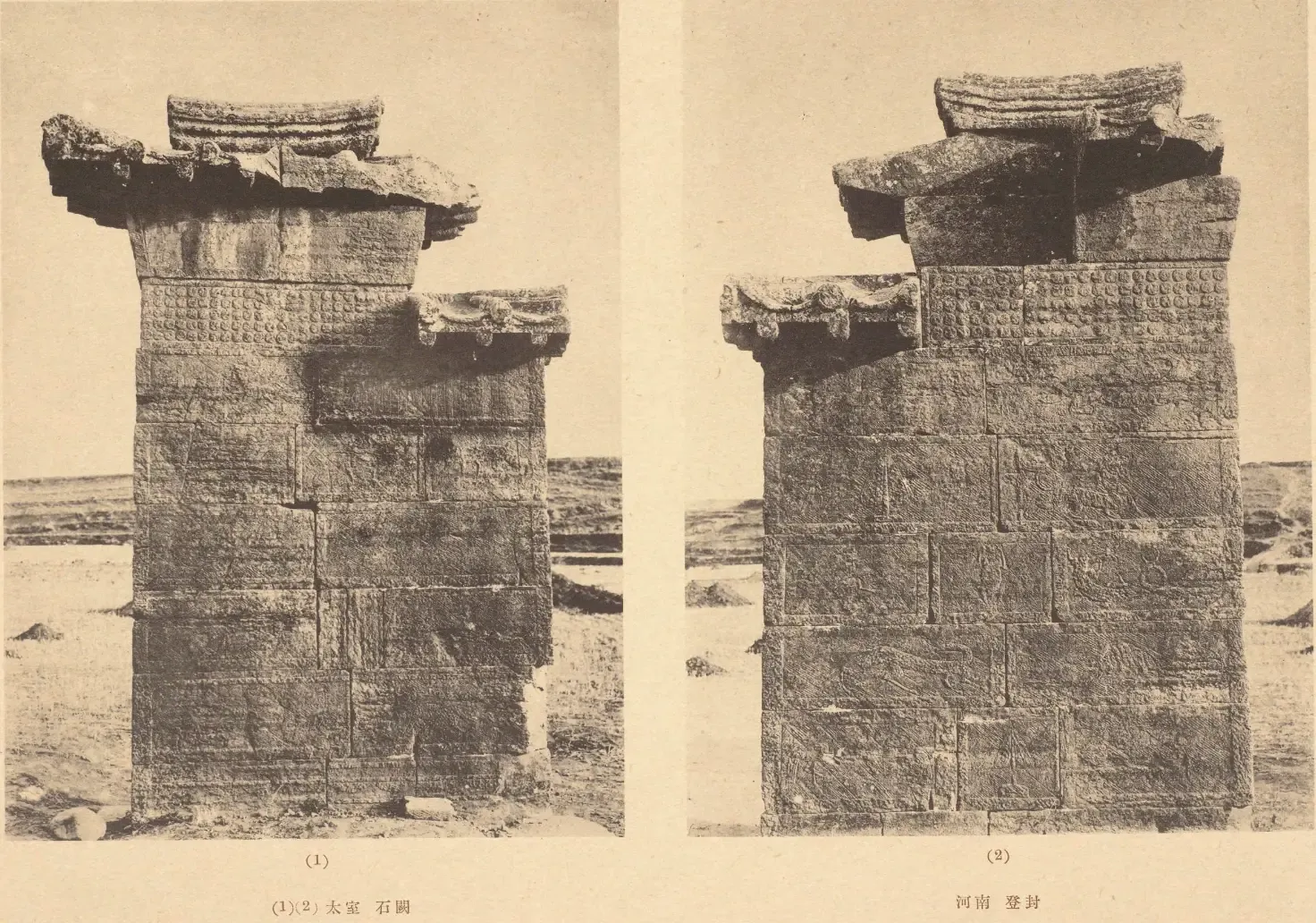
On the upper part of the south face of the west tower survives the lintel. According to the Pingjin Du Beiji, it consists of nine characters in relief seal script[2] reading “Zhongyue Taishi Yangcheng […].” The que are built of layered stone slabs, with the east and west towers facing each other like a gate.
The Taishi Que preserve inscriptional content: twenty-seven lines in the first inscription and forty-six lines in the second. Though heavily weathered, the date of construction and the builder’s identity remain legible.
Historical Documents
Complete Post-Han Prose
嵩岳太室石阙铭
Inscription on the Stone Gateway of Taishi on Mount Song
元初五年四月
Fourth month of the fifth year of the Yuanchu era
惟中岳□□,崇高神君,冢土□□,岱气最纯,春生万物,肤寸起云,润施源流,洪沛宣,普天四海,莫不蒙恩。
The Central Peak, sublime and divine lord, the earth of his tomb is pure like the air of Mount Tai. In spring, all things are born, and clouds arise from a mere inch of skin. Moisture is bestowed upon the sources of rivers, and great floods spread forth. Throughout the heavens and the four seas, there is none who does not receive his grace.
圣朝肃敬,众庶所尊,斋试奉祀,战尽勤,以颂功德,刻石纪文,垂显□□,以传后贤。
The holy court is solemn and respectful, and the common people revere him. With fasting and trials, sacrifices are offered with utmost diligence. To praise his merits and virtues, this text is inscribed on stone, to be displayed prominently and passed down to worthy successors.
元初五年四月,阳城□长左冯翊万年吕常始造作此石阙。
In the fourth month of the fifth year of the Yuanchu era, Lü Chang, the magistrate of Yangcheng from Wannian, Zuo Fengyi, began the construction of this stone gateway.
Pingjin’s Notes on Reading Steles
嵩山太室神道石阙铭元初五年四月。
Inscription on the stone gateway of the spirit path of Taishi on Mount Song, fourth month, fifth year of the Yuanchu era.
右嵩山太室石阙,在登封县中岳庙南百余步。
The Taishi Stone Gateway of Mount Song is located more than a hundred paces south of the Zhongyue Temple in Dengfeng County.
前后两铭。碑额中岳泰室阳城□□□九字,阳文篆书。
There are two inscriptions, one on the front and one on the back. The title on the stele reads “Zhongyue Taishi Yangcheng…” in nine characters of seal script in relief.
前铭二十七行,以后不可计。元初五年四月刻。后铭四十六行,延光四年三月刻。字不甚大,每行俱有界画直线,依翁阁学两汉金石记所释。
The front inscription has twenty-seven lines, and the number of characters thereafter cannot be counted. It was carved in the fourth month of the fifth year of the Yuanchu era. The rear inscription has forty-six lines and was carved in the third month of the fourth year of the Yanguang era. The characters are not very large, and each line has straight dividing lines, as interpreted in Weng Fanggang’s “Records of Metal and Stone of the Two Han Dynasties”.
其未举者,前铭十八行第三是史字,十九行第九是之字。后铭首脱四行,二行有地字。四行有三字,五行有十字、三字,七行有孝字,九行孔子上是公字,十一行有阳字,十二行有北海相字,十四行有属字,十七行有县字,二十二行有双字,二十六行藐上是存字,三十行有是字,三十二行有亲字,四十行有置字。
Among the unlisted characters, the third character in the eighteenth line of the front inscription is “史” (shi), and the ninth character in the nineteenth line is “之” (zhi). The beginning of the rear inscription is missing four lines. The second line contains the character “地” (di). The fourth line has the character “三” (san). The fifth line has the characters “十” (shi) and “三” (san). The seventh line has the character “孝” (xiao). The ninth line has the character “公” (gong) above “孔子” (Kongzi). The eleventh line has the character “阳” (yang). The twelfth line has the characters for “Prime Minister of Beihai”. The fourteenth line has the character “属” (shu). The seventeenth line has the character “县” (xian). The twenty-second line has the character “双” (shuang). The twenty-sixth line has the character “存” (cun) above “藐” (miao). The thirtieth line has the character “是” (shi). The thirty-second line has the character “亲” (qin). The fortieth line has the character “置” (zhi).
后铭有颍川太守字。访碑录,题为颍川太守题名,即此碑。
The rear inscription contains the characters for “Grand Administrator of Yingchuan”. The “Record of Visiting Steles” titles it as the “Inscription by the Grand Administrator of Yingchuan,” which is this stele.
Illustrations of Metal and Stone
由太室石阙而西,过登封县十里,又西南三里许,有两崇阙峨峨,东西峙田间。
West of the Taishi Stone Gateway, ten li past Dengfeng County, and then about three li to the southwest, there are two lofty gateways standing majestically east and west in the fields.
西阙三面皆有刻文,北面刻曰少室神道之阙,知是少室石阙也。
The west gateway has inscriptions on three sides. The north face is inscribed “Gateway of the Spirit Path of Shaoshi,” so we know it is the Shaoshi Stone Gateway.
少室庙今不可见,存此阙云,刻额,高七寸,阔七寸五分,字径二寸三分。
The Shaoshi Temple is no longer visible, but this gateway remains. The inscribed title is seven inches high and seven and a half inches wide, with characters that are two and three-tenths inches in diameter.
刻额下画两人走马而舞,为角抵戏。
Below the inscribed title is a drawing of two people on horseback dancing, performing a “juedi” wrestling game.
又画两螭龙,一龙入于𥧹中,一龙逐而衔其尾,亦不知其所谓也。
There is also a drawing of two chi-dragons, one entering a hole, the other chasing and biting its tail. The meaning is unknown.
铭与题名刻于阙之南面及西侧,凡十九行,横阔三尺八寸,并侧为四尺四寸,纵高一尺,字径一寸四分。
The inscription and title are carved on the south face and west side of the gateway, totaling nineteen lines. It is three feet eight inches wide horizontally, and including the side, it is four feet four inches. It is one foot high vertically, with characters that are one and four-tenths inches in diameter.
铭文可识,不可读,疑有断文也。西侧画一环月,为蟾兔杵臼捣药之形。
The inscription text is recognizable but unreadable, suspected to be incomplete. On the west side, there is a drawing of a ring moon, with the shape of a toad and rabbit pounding medicine with a pestle and mortar.
南面画索𨱇而蹋踘者二人,坐而睨视者一人,跪者一人。
On the south face, there is a drawing of two people playing “cuju” (an ancient form of football) with a rope, one person sitting and watching sideways, and one person kneeling.
东阙去西阙五六步,东阙画一猎犬逐兔,兔趯趯然可及也。
The east gateway is five or six paces from the west gateway. On the east gateway, there is a drawing of a hunting dog chasing a rabbit, and the rabbit seems about to be caught.
又画一独角兽,一人,左手引之,而右持钩钩象者。
There is also a drawing of a unicorn, a person leading it with their left hand, and another person holding a hook to hook an elephant with their right.
画像下有一石刻,高一尺,阔六寸,刻二十四字,可见者十九字,字径一寸二分,所谓少室东阙题名者也。
Below the portrait, there is a stone inscription, one foot high and six inches wide, with twenty-four characters, of which nineteen are visible. The character diameter is one and two-tenths inches. This is the so-called “Inscription on the East Gateway of Shaoshi.”
刻文寖下,前人皆未及见,见而表之者,雒阳董金瓯相函。
The inscription is gradually getting lower, and previous scholars did not see it. The one who saw it and recorded it was Dong Jin’ou from Luoyang.
金瓯好古士,善篆隶。
Jin’ou was a scholar who loved antiquity and was skilled in seal and clerical scripts.
东阙刻文画像之迹皆北向。
The inscriptions and portrait on the east gateway all face north.
凡少室东西两阙,高厚阔之数皆相等。
The height, thickness, and width of the east and west gateways of Shaoshi are all equal.
凡两阙,画像七人二,马一、犬一、兔一、象一,独角兽二,螭龙及月中玉兔、蟾蜍之属诸像,极古拙。
On both gateways, there are portraits of seven people, two horses, one dog, one rabbit, one elephant, two unicorns, chi-dragons, and images of the Jade Rabbit and Toad in the moon. They are all extremely archaic and simple.
Old Photos
1907
Photographed by French sinologist Édouard Chavannes in Dengfeng, Henan Province in 1907. The picture is currently included in the “Archaeological Atlas of Northern China”.
1920
Photographed by Japanese architectural historian Sadao Yasu and Buddhist historian Daijo Tokiwa in Dengfeng, Henan in 1920. Currently included in “Chinese Cultural Historical Sites (Hozokan)” published in 1939.