Introduction
The reason this pagoda came to be called “Wuta Temple Pagoda” (Five-Pagoda Temple Pagoda) traces back to a set of architectural drawings brought from the western regions during the Yongle era. According to the Dijing Jingwu Lue, in the time of Emperor Chengzu the Tibetan monk Pandita[1] came bearing tribute – five golden Buddha figures and a set of regulations for a Vajrasana (Diamond Throne) pagoda. He was enfeoffed as Great State Preceptor and granted a golden seal, and a temple was built by imperial command to house him, named Zhenjue. The “Vajrasana” is a type of ancient Indian stupa: upon a square platform stand five small pagodas, commemorating the holy sites associated with the Buddha’s parinirvana; the most famous Indian prototype is the Mahabodhi Temple at Bodh Gaya[2]. In the ninth year of Chenghua, the court decreed that the pagoda be built according to this model. Emperor Xianzong’s imperially composed Brief Record of the Vajrasana Pagoda makes it plain: “Made of stone, the base several zhang high; above are five Buddhas, formed as five pagodas, and its measurements and regulations are no different from the Vajrasana of Central India.” The Dijing Jingwu Lue supplements its specifications: stones piled up into a platform fifty chi high, with stairways hidden inside the walls spiraling up left and right; the top is leveled into a terrace, and on this terrace stand five pagodas, each twenty chi tall. Thus “one platform, five Buddhas” came to rest west of the city, and “Wuta Temple” (Five-Pagoda Temple) is the name later given by those who saw it.
The Dijing Jingwu Lue records that the body of the pagoda is carved with Sanskrit images, Sanskrit letters, Sanskrit treasures, and Sanskrit flowers; on the central pagoda are carved two footprints, where other footprints are incised in intaglio, but the one on the central pagoda alone is in relief, its swirling lines meeting tip to tip. Inside the platform a dark passage opens, with stairs spiraling up left and right to the top terrace, opposite the five small pagodas – this is the very scene the Ming poet Huang Shengzeng celebrated in Climbing the Vajrasana Pagoda: “The golden throne rises uneven, declared in opening the chart of Central India; five regions emerge from the realm of emptiness, a thousand kalpas the imperial wheel sustains.”
The Qing dynasty continued to maintain the site. The Qinding Rixia Jiuwen Kao records that in the twenty-sixth year of Qianlong the main hall was rebuilt; the emperor wrote in his own hand the plaque “Xinzhu Langying” (the heart-jewel shines clear and bright) and composed the Stele Inscription on Rebuilding Zhengjue Temple, erected to the east of the pagoda. The text itself acknowledges that the renovation was “to offer blessings on behalf of the sagely and benevolent [Empress Dowager],” and that, on the occasion of the seventieth-birthday grand celebration, “treasury funds were again disbursed, to honor and to ornament.” By the time the Shuntian Fu Zhi was compiled in the Guangxu era, both the Ming Chenghua imperial stele and Yao Kui’s stele inscription had ceased to exist; only the Qianlong stele still stood east of the pagoda.
Historical Documents
Dijing Jingwu Lue
成祖文皇帝时,西番板的达来贡金佛五躯、金刚宝座规式,诏封大国师,赐金印,建寺居之。寺赐名真觉。成化九年,诏寺准中印度式,建宝座,累石台五丈,藏级干壁,左右蜗旋而上,顶平为台,列塔五,各二丈。塔刻梵像、梵字,梵宝梵华。中塔刻两足迹,他迹陷下,廓摹耳。此隆起纹螺,若相抵蹲,是繇趾着迹涌,步着莲生,灯灯焰就,月满露升,法界藏身,斯不诬焉。按西域记:五塔因缘:拘尸那揭罗国娑罗林精舍有塔,是金刚神躄地处;次侧一塔,是停棺七日处;次侧一塔,是阿泥楼陀上天告母,母降哭佛处;次一塔,是佛涅盘般那处;次侧一塔,是佛为大迦叶波现双足处。又按僧祇律亦五塔因缘云:塔有舍利者,支提无舍利者。凡人起塔,于佛生处、得道处、转法轮处、佛泥洹处,菩萨像、辟支像、佛像、佛脚迹处,得安华盖供养,上者供养佛塔,下者供养支提也。
In the time of Emperor Chengzu the Civil, the Tibetan monk Pandita came to pay tribute, bringing five golden Buddha figures and the regulations for a Vajrasana pagoda. By imperial decree he was enfeoffed as Great State Preceptor, granted a golden seal, and a temple was built to house him. The temple was bestowed the name Zhenjue. In the ninth year of Chenghua, the court ordered that the temple follow the Central Indian model in constructing a Vajrasana: stones piled into a platform fifty chi high, the stairs concealed within the walls, spiraling up left and right; the top leveled into a terrace, with five pagodas arrayed upon it, each twenty chi tall. The pagodas are carved with Sanskrit images, Sanskrit letters, Sanskrit treasures, and Sanskrit flowers. The central pagoda bears two footprints; the other footprints are sunk in intaglio, mere outlines. But this one rises in relief, its swirling lines meeting as if confronting each other, as if from toe and footprint they spring upward, as if at every step a lotus is born, as lamp upon lamp the flame is kindled, as moon full and dew rising, the Dharma-realm hiding its body – this is no false claim. According to the Record of the Western Regions, the causes and conditions of the five pagodas: in the country of Kushinagara, at the Sala Grove monastery, there is a pagoda where the Vajra deity fell to the ground; beside it another pagoda, where the coffin was kept for seven days; beside that another, where Aniruddha ascended to heaven to inform the Buddha’s mother, and his mother descended weeping for the Buddha; beside that another, where the Buddha entered parinirvana; beside that another, where the Buddha revealed both feet to Mahakasyapa. And according to the Mahasamghika Vinaya, also concerning the causes of the five pagodas: a pagoda with relics is a stupa; one without is a chaitya. Whenever people raise a pagoda – at the place of the Buddha’s birth, the place of his enlightenment, the place where he turned the wheel of Dharma, the place of his parinirvana, or where there are images of bodhisattvas, pratyekabuddhas, Buddhas, or Buddha-footprints – they may set up canopies for offerings; those of higher rank make offerings to the Buddha-pagoda, those of lower to the chaitya.
寺因缘者,寺因山水缘贤圣熏修也。塔前有成化御制碑曰:寺址上沃而广,泉流而清。寺外石桥望去绕绕长堤。高柳夏绕翠云,秋晚春初,绕金色界。仁和张瀚晚春集真觉寺○郭外春犹在,花边坐落晖。柳深莺细细,桑密𬸊飞飞。一水金光动,千林红紫微。徘徊香满地,约马缓将归。金坛王樵登真觉寺浮图○古寺不知年,松竹无近趣。老僧摘春芽,龙钟坐高树。客影碌碌然,步步追春天。石阁三层上,金刚五座连。御家赐出西番样,白日摇光动仙掌。故见双趺隐法身。随人结想如来像。临武曾朝节。真觉寺○塔黄山翠色,交入客清樽。晓日登峰树,秋光匝水村。法轮空界出,人语半天喧。高柳堤无尽,终朝立寺门。○两足尊遗教,五枝耸太虚。因缘人竟外,悲仰佛天初。金铎喧番像,香花护宝书。
The causes of the temple: the temple owes its causes to the mountains and waters, to the sages and saints who cultivated themselves in its presence. Before the pagoda stands a Chenghua imperial stele which says: the temple grounds are fertile and broad, the springs flow clear. Outside the temple a stone bridge looks out upon a long winding embankment. Tall willows in summer encircle it in emerald clouds, while in late autumn and early spring they encircle a golden-hued realm. Zhang Han of Renhe, Late Spring Gathering at Zhenjue Temple: Beyond the city walls spring still remains; the slanting light settles among the flowers. Willows deep, orioles slender and fine; mulberries thick, swallows in flight. One stretch of water shimmers with golden light; a thousand groves redden into rose-purple. Lingering, fragrance fills the ground; rein the horse, slow as we head back. Wang Qiao of Jintan, Climbing the Pagoda at Zhenjue Temple: An ancient temple of unknown age; pines and bamboos hold no recent charm. The old monk plucks the spring buds, stooped and aged, seated on a high tree. The traveler’s shadow moves restlessly, step after step pursuing the spring. Atop the three-story stone pavilion, five Vajra thrones stand linked. The imperial house bestowed the Tibetan model; bright sun trembles its light upon the immortal’s palm. So one sees the twin footprints, the Dharma-body concealed, each beholder fashioning by his own image the form of the Tathagata. Zeng Chaojie of Linwu, Zhenjue Temple: The pagoda’s yellow, the mountain’s emerald, blend into the traveler’s cup of clear wine. At dawn the sun mounts the trees on the peak; autumn light wraps the riverside village. The wheel of Dharma emerges from the empty realm; human voices clamor halfway to the sky. Tall willows on an endless embankment stand all day at the temple gate. The Two-Footed Honored One’s bequeathed teachings, the five branches rising into the great void. Through causes and conditions one moves at last beyond the human, mourning and looking up to the dawn of Buddha-heaven. Gilded bells clamor before the Tibetan images; incense and flowers guard the precious scriptures.
绕旋余览眺,星月柳边疏。
Circling around, I still gaze about; stars and moon hang sparse beyond the willows.
安陆何宇度真觉寺塔○五塔森森立,秋原望不迷。彤云双阙迥,绿树万行齐。堤远传蜩急,天空去雁低。长安此净域,山水满城西。
He Yudu of Anlu, The Pagoda of Zhenjue Temple: The five pagodas stand massed and dense; gazing across the autumn plain one is not lost. Red clouds drift far beyond the twin gate-towers; green trees stretch in ten thousand orderly rows. Cicadas urgent on the distant dike; geese departing low against the empty sky. This is the pure precinct of the capital – mountains and waters fill the city’s west.
亳州朱宗吉真觉寺○隔水寻幽地,春光处处逢。一灯悬古殿,双树出疏钟。塔灿层台迥,林阴曲迳重。望来殊不尽,多半暮云容。
Zhu Zongji of Bozhou, Zhenjue Temple: Across the water I seek the secluded place; spring radiance is met at every turn. One lamp hangs in the ancient hall; twin trees rise above the scattered bell-tones. The pagoda glitters atop the tiered terrace, distant; the wooded shade lies thick along the winding path. The view stretches out without end, mostly draped in the countenance of evening clouds.
固始余廷吉游真觉寺○古刹僧俱寂,閒房花木秾。湖云风过竹,萝月影移松。万铎天然籁,三回定后钟。将灯旋五塔,林鸟向人冲。顺天释性柔礼真觉寺塔○稽首五梵塔,具五大因缘。因缘中印土,五徵妙光旋。板的达西来,愿力弘人天。
Yu Tingji of Gushi, Touring Zhenjue Temple: At the ancient monastery the monks are all in silence; in the idle rooms flowers and trees grow dense. Lake clouds, wind passing through the bamboo; vine-clad moon, shadows shifting on the pine. Ten thousand bells, the music of nature itself; the bell sounding three times after meditation. Carrying a lamp I circle the five pagodas; the wood birds dart toward me. Shi Xingrou of Shuntian, Paying Homage to the Pagoda of Zhenjue Temple: I bow my head to the five Sanskrit pagodas, embodying the five great causes and conditions. Their causes lie in Central India; the five emblems revolve in wondrous light. Pandita came from the west, his vow’s power broad over men and gods.
建彼世界法,于此世界边。
He built that world’s Dharma here at the edge of this world.
梵宝及梵华,梵字半满全。中现双佛足踵趾轮相圆,他迹陷下廓摹,唯中塔一迹隆起、纹螺相抵。中现双佛足踵趾轮相圆,如大地涌出,如半空中悬。
Sanskrit treasures and Sanskrit flowers, Sanskrit letters in their half and full forms. In the center appear the twin Buddha-footprints with heel and toe, the wheel-marks complete in roundness, as if welling up from the great earth, as if hung in mid-air.
如亲诣佛国,依恋我佛然。
As if one had visited the Buddha-land in person, clinging in attachment to our Buddha.
我皇缔造心,同我佛心传。我拜我心净西山。
My emperor’s mind in this creation accords with our Buddha’s mind transmitted. I prostrate, and my heart is purified at the Western Hills.
Qinding Rixia Jiuwen Kao
等谨按:大正觉寺即朱彝尊原书所谓真觉寺也。明永乐间重建金刚塔成于成化九年,凡五浮图,俗因称五塔寺。乾隆二十六年重修正殿,额曰心珠朗莹,联曰:般若演慈源,妙通筏喻;菩提宏觉路,长炳灯传。皆皇上御书。塔东恭勒御制重修正觉寺碑文,谨编载卷内。
We respectfully note: Da Zhengjue Temple is the Zhenjue Temple referred to in Zhu Yizun’s original work. In the Ming Yongle era the rebuilding of the Vajra pagoda began, completed in the ninth year of Chenghua; there are altogether five pagodas, and the common name is therefore Wuta Temple (Five-Pagoda Temple). In the twenty-sixth year of Qianlong the main hall was rebuilt; its plaque reads “Xinzhu Langying” (the heart-jewel shines clear and bright), and its couplet reads: “Prajna unfolds the source of compassion, wondrously penetrating the metaphor of the raft; Bodhi extends the road of enlightenment, the lamp of its transmission long burning.” Both were written by His Majesty’s own hand. To the east of the pagoda the imperially composed Stele Inscription on Rebuilding Zhengjue Temple is reverently engraved, and is here respectfully recorded within the volume.
Imperial Stele Inscription on Rebuilding Zhengjue Temple by the Qianlong Emperor
御制重修正觉寺碑文。
Imperially composed stele inscription on rebuilding Zhengjue Temple.
自万寿寺迤东不二里而近,有招提五塔离立,众因以寺所有名之,实旧志所称大正觉寺者也。朕敬为圣慈祝厘,岁辛未,既命将作庀材营缮。逮今辛巳,星纪载周,恭遇七旬大庆,复出帑金,是崇是饰。所司以落成告,且砻石请文。考梵典释佛义曰觉,又曰佛,像标身,经标口,塔标意。故说根尘者,以意为之因缘;谭觉性者,亦以意为之提摄。世传阿育王建塔八万四千,震旦仅得十之一。若兹寺经始明永乐间,西竺国师板的达用一台五佛,准印土金刚宝座成式,俾大千情与无情,咸知印可。其于开宗也甚著,而于资福也甚闳。然观大慈氏如如不动,意于何有,彼芸芸者觅意了不可得,则相率而求之相轮窣堵,自凡僧初果以至辟支菩萨,六重七重云尔。是何异和南合十,执丈六以求像,执华严海藏以求口者哉?反是以观,震旦所标,固不必意西竺之意,而以无意利益群生者,虽放之遍满恒河沙数无尽意法界无二无别可也。乃者楶梠交疏,增辉初地,华鉴宝铎,具足庄严,将诹辰侍辇过之,畴不归依回向晋无疆之祝乎?嗣是每逢庆典,其鸠工夙事,长与六甲循环,极无量八百鼻功德永弗替。
Two li or less to the east of Wanshou Temple stand five pagodas of a Buddhist enclosure, set apart from one another; from this circumstance people have named the temple itself, which is in truth what the old gazetteer calls Da Zhengjue Temple. I reverently pray for blessings on behalf of the Sagely and Benevolent [Empress Dowager]: in the xinwei year I commanded the Office of Works to gather materials and undertake repairs. Now in the xinsi year, with the stellar cycle complete and the seventieth-birthday grand celebration upon us, I again disburse treasury funds, to honor and to ornament. The office in charge reports completion and, polishing the stone, requests an inscription. Examining the Sanskrit canon, “Buddha” means “awakened,” also called “Buddha”; image stands for the body, sutra for the mouth, pagoda for the mind. Therefore those who discuss sense and object take the mind as the cause; and those who debate the awakened nature also take the mind as the means of grasping it. Tradition holds that King Ashoka built eighty-four thousand pagodas; the land of Zhendan (China) received only a tenth of them. As for this temple, it was begun in the Ming Yongle era, when the Western Indian state preceptor Pandita used the model of “one platform, five Buddhas” – following the established form of the Indian Vajrasana – so that the great trichiliocosm, sentient and insentient alike, might know its imprimatur. In opening a school it is most prominent; in providing for blessings it is most vast. Yet observe the Great Compassionate One, suchness unmoving – where could mind be found? Those teeming multitudes seek mind and cannot find it, so together they turn to seek it in the precious wheels and stupas, climbing from ordinary monk and first fruit up to pratyekabuddha and bodhisattva, in six tiers, in seven tiers, and so forth. How is this different from joining palms in greeting and grasping at a sixteen-foot image to find the form, or grasping at the Avatamsaka ocean treasury to find the voice? Turning this around, what Zhendan signifies need not mean what the Western Indian sense meant, and that which benefits the multitude of beings without mindful intent can, even when set free to fill the Ganges-sand multitudes, be no different from the inexhaustible Dharma-realm of mindlessness. Now beams and rafters interlace anew, brightening the first ground; flowered mirrors and treasured bells, fully ornamented in their grandeur. When the auspicious day comes and the imperial carriage passes by, who would not take refuge and turn his merit toward an offering of boundless blessings? From this time forward, at every grand celebration, the gathering of workmen and prompt undertaking shall long revolve with the sexagenary cycle, and the boundless eight-hundred-fold merits of the sense organs shall never lapse.
Older Records in Rixia Jiuwen Kao
原大真觉寺,在极乐寺西,内有金刚座,上置五小座,藏如来金身。永乐间,西域中印土僧所献,规制前此未有也。
Original: Da Zhenjue Temple stands west of Jile Temple; within it is a Vajrasana, upon which are set five small thrones, enshrining the golden body of the Tathagata. During the Yongle era, this was offered by a Central Indian monk from the western regions; its design had no precedent before this.
原直觉寺,浮图高五六丈许,而上为塔五,方陟其顶,山林城市之胜收焉。
Original: Zhijue Temple – the pagoda is some fifty or sixty chi high, and above it are five pagodas; only when one ascends to its top are the splendors of the mountains, woods, and city all gathered into view.
原真觉寺,原名正觉寺,乃蒙古人所建。寺后一塔甚高,名金刚宝座。从暗窦中左右入,蜗旋以跻于颠,为平台。台上涌小塔五座,内藏如来金身金刚。座之左偏又一浮屠,传是宪宗皇帝生葬衣冠处。前临桥,桥临大道,夹道长杨,绿阴如幕,清流映带,尤可取也。
Original: Zhenjue Temple, originally named Zhengjue Temple, was built by the Mongols. Behind the temple a pagoda stands very high, called Vajrasana. One enters left and right through a dark recess, spiraling up to the summit, a level terrace. On the terrace rise five small pagodas, enshrining the golden body of the Tathagata, the Vajra. To the left of the throne stands another pagoda, said to be the place where Emperor Xianzong’s robes and cap were entombed during his lifetime. In front it faces a bridge, the bridge facing a great road; tall poplars line the avenue, their green shade like a curtain, clear streams set off against them – altogether worth seeing.
原成祖文皇帝时,西番班迪达来贡金佛五躯、金刚宝座规式,诏封大国师,赐金印,建寺居之,寺赐名真觉。成化九年,诏寺准中印度式建宝座,累石台五丈,藏级于壁,左右蜗旋而上,顶平为台,列塔五,各二丈。塔刻梵字、梵宝、梵华,中塔刻两足迹,他迹陷下廓摹耳,此隆起,纹螺若相抵蹲。塔前有成化御制碑。
Original: In the time of Emperor Chengzu the Civil, the Tibetan monk Pandita came to pay tribute with five golden Buddhas and the regulations for a Vajrasana, and by decree was enfeoffed as Great State Preceptor, granted a golden seal, and a temple was built to house him; the temple was bestowed the name Zhenjue. In the ninth year of Chenghua, the court ordered the temple to build a Vajrasana following the Central Indian model: stones piled into a platform fifty chi high, the stairs concealed within the walls, spiraling up left and right; the top leveled into a terrace, with five pagodas arrayed upon it, each twenty chi tall. The pagodas are carved with Sanskrit letters, Sanskrit treasures, and Sanskrit flowers; the central pagoda bears two footprints, the others in intaglio outline alone, while this one is in relief, its swirling lines meeting as if confronting each other. Before the pagoda stands a Chenghua imperial stele.
等谨按:成化御制碑今无存。
We respectfully note: the Chenghua imperial stele no longer exists today.
Brief Record of the Vajrasana Pagoda at Zhenjue Temple by Emperor Xianzong of the Ming
原明宪宗御制真觉寺金刚宝座记略:
Original, imperially composed by Ming Emperor Xianzong, Brief Record of the Vajrasana Pagoda at Zhenjue Temple:
永乐初年,有西域梵僧曰班迪达大国师,贡金身诸佛之像、金刚宝座之式。由是择地西关外,建立真觉寺,创治金身宝座,弗克易就,于兹有年。朕念善果未完,必欲新之,命工督修殿宇,创金刚宝座,以石为之,基高数丈,上有五佛,方为五塔,其丈尺规矩与中印土之宝座无以异也。成化癸巳十一月告成立石。
In the early years of Yongle, there was a Sanskrit monk from the western regions, Pandita, Great State Preceptor, who offered images of the various Buddhas in golden bodies and the model of the Vajrasana. From this, a site was selected outside the western gate, and Zhenjue Temple was built; the founding of the gold-bodied throne was undertaken, but could not easily be completed, and so it remained for some years. I, considering that the good fruit was not yet brought to completion, resolved to renew it, and commanded the workmen to oversee the repair of the halls and the founding of the Vajrasana, made of stone, the base several zhang high, upon which are five Buddhas, formed as five pagodas, with measurements and regulations no different from the Vajrasana of Central India. In the eleventh month of the guisi year of Chenghua, completion was announced and the stele set up.
Zhu Heng’s Poem on the Five Pagodas of Zhenjue Temple
原朱衡真觉寺五塔诗:
Original, Zhu Heng’s Poem on the Five Pagodas of Zhenjue Temple:
胜地尘埃少,中天洞壑孤。云櫺敧缥缈,风磴入虚无。槛外三天界,尊前五岳图。何当探慧镜,一为照迷途。
A scenic site with little dust; halfway up the sky, the grotto stands alone. The cloud-grating tilts indistinct; the wind-swept stairs enter into emptiness. Beyond the railing, the three heavenly realms; before the throne, the chart of the Five Sacred Peaks. When shall I probe the mirror of wisdom and have it illuminate my lost path once and for all?
镇山集。
From the Zhenshan Ji.
He Dong’s Poem on Climbing the Pagoda at Zhenjue Temple
原何栋登真觉寺浮图诗:
Original, He Dong’s Poem on Climbing the Pagoda at Zhenjue Temple:
凌空垂宝塔,被露出铜盘。影照青莲色,光寒白露团。霞标窥日近,风洞雪云寒。静坐观空界,天花绕石坛。
Soaring into the air the precious pagoda hangs; bathed in dew, its bronze plate emerges. Its shadow casts the color of the blue lotus; its light cold as a cluster of white dew. The rosy crest peeks at the sun close by; the wind-cave is cold beneath snow-clouds. Sitting quietly I gaze into the realm of emptiness; celestial flowers encircle the stone altar.
太华集。
From the Taihua Ji.
Xijin Riji
原真觉寺塔规制特奇。寺有姚夔碑记,称永乐中,国师五明班迪达召见于武英殿,帝与语,悦之,为造寺石台,则成化九年所建也。析津日记。
Original: the form of the pagoda at Zhenjue Temple is exceptionally remarkable. The temple has a stele inscription by Yao Kui, which states that during the Yongle era the state preceptor Wuming Pandita was summoned for audience in the Wuying Hall; the emperor spoke with him and was pleased, and had the stone platform of the temple built for him – this is what was raised in the ninth year of Chenghua. From the Xijin Riji.
臣等谨按:姚夔碑今无存。
We, your servants, respectfully note: Yao Kui’s stele no longer exists today.
Guangxu Shuntian Fu Zhi
明永乐年间,为西番班迪达建也,在乐善园西三里许。寺初名真觉,有浮图五,俗又称五塔寺。寺大殿五楹,后为金刚宝塔,塔后殿五楹,塔院之东为行殿。塔前旧立明成化御制碑,像金刚宝座之式,由是择地西关外建立真觉寺,创冶金身宝尺,规矩中印土之宝座,无以异也。成化癸已十二月告成,立石,及姚夔碑记俱无存。今塔东恭立乾隆二十六年御制重修寺碑。
Built during the Ming Yongle era for the Tibetan monk Pandita, the temple stands some three li west of Leshan Garden. The temple was originally named Zhenjue; it has five pagodas, and is commonly also called Wuta Temple (Five-Pagoda Temple). The main hall of the temple has five bays; behind it stands the Vajrasana, behind the pagoda another five-bay hall, and east of the pagoda courtyard is a travel-palace. Before the pagoda once stood a Ming Chenghua imperial stele recording the form of the Vajrasana: from this a site was selected outside the western gate to build Zhenjue Temple, and the founding of the gold-bodied jewel measure was begun; its regulations were no different from the Vajrasana of Central India. Completion was announced in the twelfth month of the guisi year of Chenghua, and the stele was set up; both it and Yao Kui’s stele inscription no longer exist. Today, to the east of the pagoda, the imperially composed stele of the twenty-sixth year of Qianlong on rebuilding the temple is reverently set up.
Wuyue Shanren Ji
登金刚宝座一首。
Climbing the Vajrasana Pagoda, one piece.
金座参差表,言开中印图。五区空界出,千劫帝轮扶。籁入层铃度,云含众象敷。凤城归路晚,偏系客心孤。
The golden throne rises uneven, declared in opening the chart of Central India. Five regions emerge from the realm of emptiness; a thousand kalpas the imperial wheel sustains. The sound enters the tiered bells in measure; the clouds enfold a multitude of forms unfolding. Late the return road to the Phoenix City, leaving the traveler’s heart all the more alone.
Historical Photographs
1924-1927
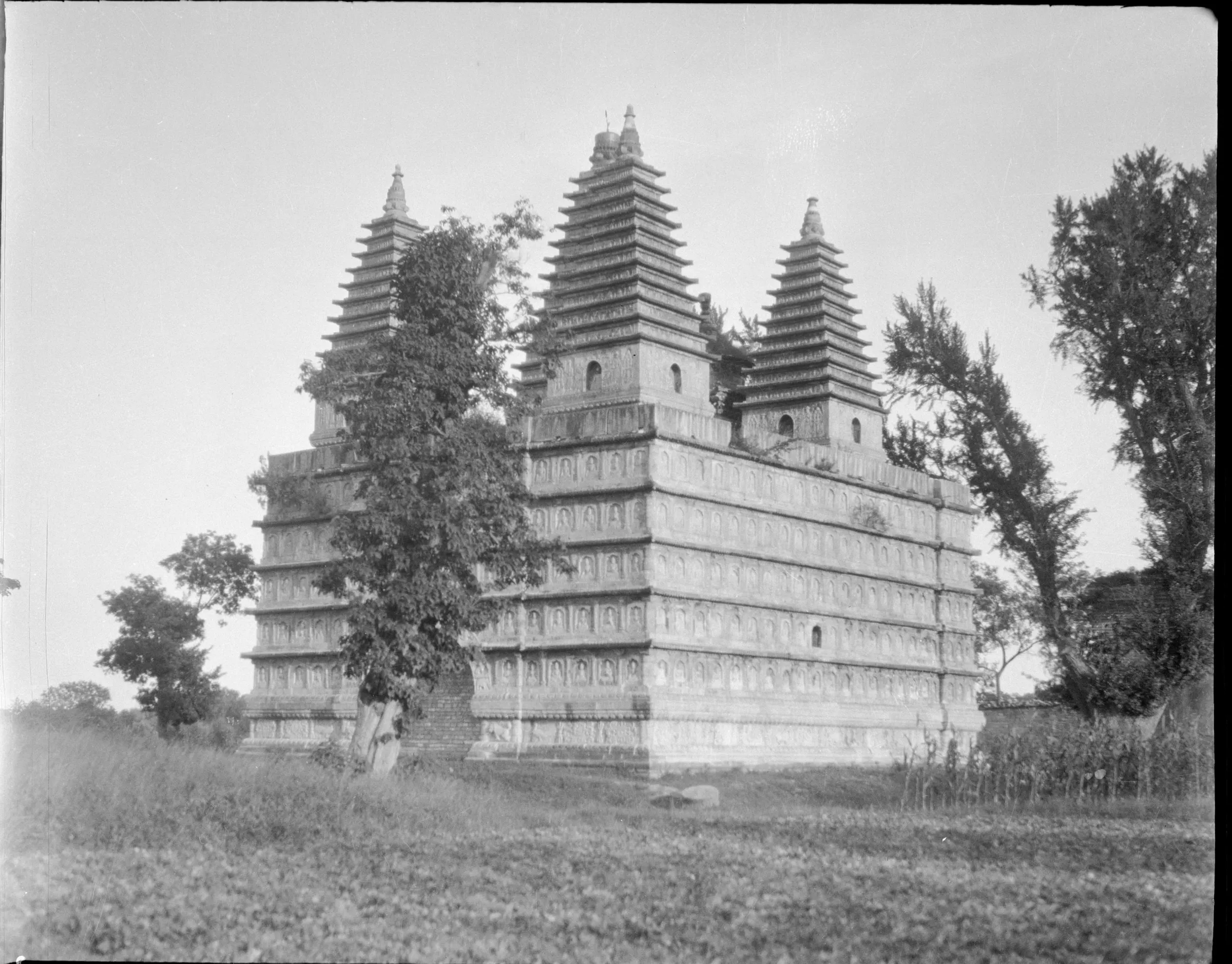
The Sidney D. Gamble Photographs, Series 1 include an old photograph of the Wuta Temple in Beijing. Three sides of the pagoda are visible, with trees and wild grasses still surrounding the pagoda base.
Early 20th Century
Volume 12 of Tokiwa Daijo and Sekino Tadashi’s Shina Bunka Shiseki (Historical Monuments of Chinese Culture) includes a front view of the Da Zhengjue Pagoda at Da Zhengjue Temple (Wuta Temple), details of the antechamber of the central pagoda on the platform, the entrance section, and further details of the antechamber of the central pagoda.