Introduction
During the Daye era of the Sui dynasty, the monk Jingwan — carrying forward his master Huisi of Nanyue’s vow to “protect the scriptures against the age of Dharma decline[1]” — ascended Baidai Mountain (Shijing Mountain) in Fangshan, excavated stone chambers, and carved the first Buddhist sutra onto a stone slab. According to the Xiaoxitian Shijing Tang Ji by Liu Ji, written in the fourth year of Yuanhe of the Tang (809), Jingwan worked from the Daye era through the fifth year of Zhenguan — nearly thirty years — completing the Mahaparinirvana Sutra first. He chose stone over paper or silk precisely because “paper can burn, silk can rot, wood can decay” — only stone fears neither fire, water, nor war.
For a thousand years thereafter, the carving never ceased. By the Tang dynasty there were already remains such as “stone pagodas” and a “stone-sutra hall,” and Princess Jinxian donated scriptures and land. From the seventh year of Taiping to the third year of Qingning under the Liao, the court funded the continued carving of the Four Great Divisions of scripture. In the seventh year of Tianqing, the monks Shanrui and Zhicai “dug into the ground to make a vault” in the temple’s southwest, interring 180 large stone scripture steles sponsored by Emperor Daozong and 4,080 prepared by Grand Master Tongli — “all buried within the underground vault, above which a platform was built, a brick pagoda erected, and an inscription carved to mark where the stone scriptures lay.” The stone scriptures were never in above-ground halls but inside the mountain and underground — sutra-storage caves packed with scripture slabs, steles buried in subterranean vaults, and pagodas built on the surface to mark their locations.
In 1942, Japanese artillery bombardment destroyed every hall in the temple, leaving only the north pagoda and surrounding small pagodas. Yet not a single stone scripture in the rock caves or underground vaults was damaged — the reason Jingwan had chosen to carve in stone rather than write on paper thirteen hundred years earlier was vindicated under shellfire. According to cultural heritage surveys, from the Daye era of the Sui to the end of the Ming, successive generations carved 1,122 Buddhist works in 3,572 fascicles on 14,278 stone slabs.
In 1956, excavation of the temple’s underground palace[2] (beneath the Scripture-Pressing Pagoda) unearthed 10,082 Liao-dynasty stone slabs. In 1981, archaeologists discovered a stone casket beneath the Buddha seat in Leiyin Cave on Shijing Mountain, containing Buddhist relics (sarira)[3] interred during the Sui dynasty. On September 9, 1999, all excavated stone scriptures were returned to the underground palace and sealed under nitrogen. From the moment Jingwan ascended the mountain to carve the first slab to the moment the last batch was resealed underground, this endeavor spanned nearly fourteen hundred years.
Historical Records
Xiaoxitian Shijing Tang Ji — Record of the Stone Sutra Hall at Little Western Heaven (Tang, Liu Ji)
济封内涿州有涿鹿山石经堂者,始自北齐,至隋,沙门静琬,睹层峰灵迹,因发愿造十二部石经。
Within Liu Ji’s jurisdiction at Zhuozhou stood the Stone Sutra Hall of Zhuolu Mountain. The project began from the Northern Qi into the Sui, when the monk Jingwan saw the sacred peaks and vowed to create stone copies of the twelve divisions of scripture.
国朝贞观五年,涅盘经成,其夜山吼三声,生香树三十余本。六月暴水,浮大木数千株于山下,遂搆成云居寺焉。
In Zhenguan 5 of the Tang, the Nirvana Sutra was completed. The record says that the mountain roared three times that night, fragrant trees appeared, and floodwaters brought timber to the foot of the mountain, allowing Yunju Temple to be built.
Inscription for the Stone Pagoda at the Right of Yunju Temple Gate (Tang)
建兹浮图于门右者,郑氏字元泰,今范阳人也。
The one who built this pagoda at the right side of the gate was Zheng, style name Yuantai, a man of Fanyang.
铭曰:高塔峨峨,示延遐瞩。多生攘攘,动善群触。兹设兹刹,无碍无疆。其福丰衍,其资广长。
The inscription praises the high pagoda as a visible monument that awakens goodness in living beings and extends Buddhist merit without limit.
Shijing Mountain in A Sketch of the Sights of the Imperial Capital (Ming)
房山县西南四十里。有山,好着白云腰,其半麓曰白带山,所生莎题草,他山实无。山藏石经者千年矣,始曰石经山,至今也,亦曰小西天云。
Forty li southwest of Fangshan County is a mountain often girdled by white clouds. Its lower slope is called Baidai Mountain. Because stone sutras had been stored there for a thousand years, it came to be called Shijing Mountain, and was also known as Little Western Heaven.
山上雷音洞,高丈有余,纵横干高有倍,上幔覆壁,四刻经,柱四刻像。
On the mountain is Leiyin Cave, more than one zhang high. Its walls are covered with carved scriptures, and its pillars are carved with Buddhist images.
山下左右东峪寺、西峪寺,西峪寺后香树林,香树生处也。梦堂庵,唐梦堂师居处也。林后,琬公塔也。
At the foot of the mountain were the East Valley and West Valley temples. Behind the West Valley temple was the Fragrant Grove; behind the grove stood Jingwan’s pagoda.
Epigraphy in the Guangxu Shuntian Prefecture Gazetteer
弟子静琬,密承法付,于大业末年,递乎贞观,疲毫琢版,叠窟盈堪。
Jingwan, a disciple who secretly received the Dharma transmission, carved the stone slabs from the late Daye era into the Zhenguan era, filling caves with layered inscriptions.
此一百四十六碑者,即静师初迹也。深依洪洞,累壁四周,左右各三十枚,后面四十一枚,门首及左右又三十三枚。
These 146 stone slabs are identified as the earliest traces of Master Jingwan’s work. They were set along the four walls of the cave, with groups of slabs on the left, right, rear, and around the entrance.
又引逃虚子集云:石经贮于岩洞者七,地穴者二。洞以石门闭之,穴以浮图镇之。
The entry cites another collection saying that the stone sutras were stored in seven rock caves and two underground chambers: the caves were closed with stone doors, while the underground deposits were marked and secured by pagodas.
Record of the Pagoda for the Continued Secret Stone Canon (Liao, Zhicai)
至天庆七年,于寺内西南隅穿地为穴,道宗皇帝所办石经大碑一百八十片,通理大师所办石经大碑四千八十片,皆藏瘗地穴之内,上筑台砌砖建塔一座,刻文标记石经所在。
In Tianqing 7, an underground chamber was excavated in the southwest corner of the temple. Stone sutra slabs sponsored by Emperor Daozong and Master Tongli were buried inside, and a brick pagoda was built above to mark their location.
Jifu Gazetteer
云居寺,在房山县石经山下。寺有唐开元十年甫石浮图铭、开元二石浮图铭、开元二十八年山岭石浮图后记,今并存。南麓即西天寺,塔下有石经窟,其后则香树林。
Yunju Temple is located below Shijing Mountain in Fangshan County. The gazetteer notes surviving Tang stone-pagoda inscriptions, a stone-sutra cave beneath the pagoda, and the Fragrant Grove behind it.
Old Photographs
Late Qing to Early Republican Period
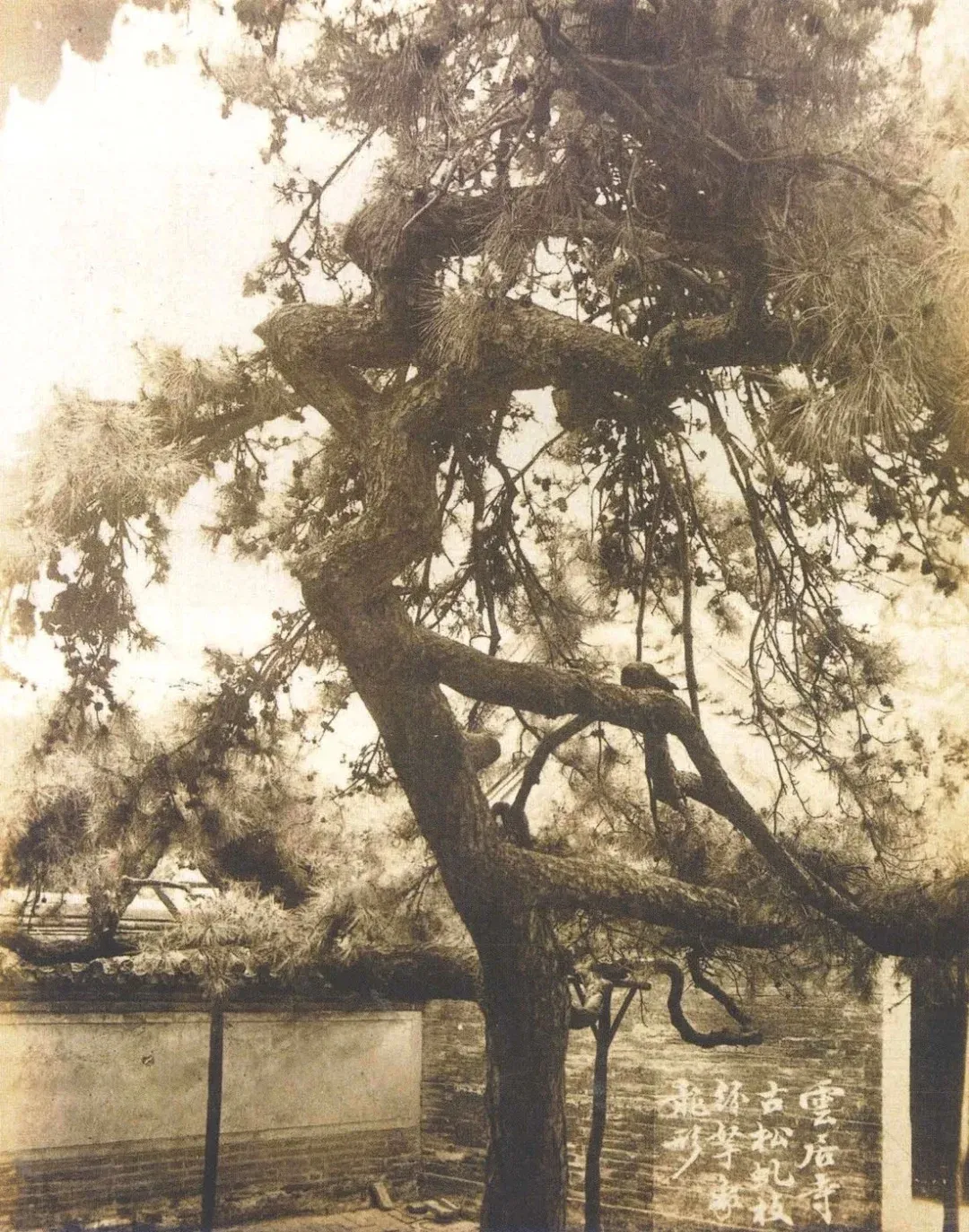
Photographed by Deng Zhicheng, a professor at Peking University, and Auguste Beauchamp, a French engineer, from Deng Zhicheng’s album Yunju Temple and Shijing Mountain. These sepia photographs, with brief captions, record the temple before the Japanese bombardment of 1942, including halls such as the Hall of Heavenly Kings, the Pilu Hall, and the Shakyamuni Hall. After the bombardment, the main halls were destroyed, leaving the north pagoda, surrounding small pagodas, and some stone inscriptions; the album is therefore one of the most valuable visual records of the temple before its destruction.
1920s-1930s
Photographed by the Buddhist scholar Tokiwa Daijo and the architectural historian Sekino Tadashi, from volume 12 (Hebei) of Shina Bunka Shiseki / Chinese Cultural Sites, based on fieldwork in the 1920s-1930s and published by Hozokan in 1939. The plates document Yunju Temple, Little Western Heaven on Shijing Mountain, Leiyin Cave, stone sutra slabs, sutra pillars, and pagoda courtyards before the 1942 bombardment.