Introduction
The Muzat River passes through the gorge of the Qoltagh Mountains, and the caves of Kumtura spread out high and low along the cliffs of both banks. The wooden armature inside the statues of Cave 20 has been dated to between 413 and 571. Deep within the caves, low passageways run backward from both sides of the Buddha niches, circle behind the central pillar, and bring the worshiper back into the main chamber.
During the reign of Emperor Zhaozong of the Tang, the stone walls of the Arhat Cave were already covered with the names and wishes of visiting monks. One inscription signs itself “the thirtieth day of the fifth month of the fifth year of Dashun of the Great Tang,” recording a novice’s[1] pilgrimage here; another carved “reverence to the Arhat’s bones,” or vowed that the merit of worship would bring his mother “release from suffering.” Around the late ninth to early tenth century, the Uyghurs[2] again opened new caves, rebuilt, or repainted others within the complex. Beside the donor figures[3] in Cave 79, Chinese, Kuchean, and Uyghur scripts stand side by side, and in the Chinese one can read names such as “Princess Jielisili.”
The Uyghur-style caves are the last group of Buddhist caves newly opened or rebuilt in the Kucha region; there is no continuous record of when the complex afterward fell out of use or when its fore-structures collapsed. When Grünwedel entered Kumtura along the river in 1906, a side chamber of Cave 14 had already been destroyed, the entire space before the doorway of Cave 19 had fallen away and could be reached only by ladder or through the side door of a neighboring cave, and the antechamber of Cave 42 had likewise slid down the cliff. The niches and passageways remained, but the old entrances were lost among the broken cliffs and ruined walls. Twenty-two years later, Huang Wenbi came to the Arhat Cave carrying a ladder and ropes. The cave lies halfway up the mountain, with a sheer drop below and no path up; the party tied ropes around their waists and pulled one another upward, and only thus gained entry. Huang Wenbi copied out the shallow engravings covering all four walls one by one, and so “the fifth year of Dashun of the Great Tang,” “reverence to the Arhat’s bones,” and the words of the vow for a mother entered the survey record.
Historical Documents
Grünwedel’s 1906 Survey Records
Die buddhistischen Höhlen, genannt Ming-Öi, liegen bei der Ruine eines Tempels Qumtura (»Sand-Tura«) am L. Ufer eines breiten Flusses (Muzart). Einige Anlagen liegen auch auf dem R. Ufer. Der Weg dorthin führt in westsüdwestlicher Richtung von der Stadt Kuča in ein großes, weit auseinander liegendes Dorf.
These Buddhist caves, called Ming-Öi, lie by the ruins of the Qumtura (“Sand-Tura”) monastery on the left bank of the broad Muzat River; several remains also lie on the right bank. From the city of Kucha, traveling west-southwest, one reaches a large, widely scattered village.
Diese schöne und merkwürdige Höhle, Fig. 29, ist sehr zerstört. Die Hauptanlage ist dieselbe, wie die meisten Höhlen: eine Cella überspannt von einem Tonnengewölbe, mit einer Buddhanische in der Rückw., neben der Nische wiederum die gewölbten niedrigeren Seitengänge, welche in einen Quergang hinter die Nische münden, Fig. 2. Hier ist vor der Cella eine Vorhalle, die ein Vordach gehabt hat, erhalten mit zwei kleinen Seitenkapellen, von denen die R. liegende noch leidlich erhalten, während die gegenüberliegende zerstört ist. Diese erhaltene Seitenkapelle ist eine verkleinerte Kopie des Hauptsystems, doch so, daß die Nische durch einen Pfeiler ersetzt ist, um den herum ein bogenförmiger gewölbter Gang führt.
This beautiful and unusual cave has been severely damaged. Its main layout is the same as that of most caves: a barrel-vaulted main chamber with a Buddha niche in the rear wall, and on either side of the niche lower vaulted passages that join a transverse passage behind the niche. In front of the main chamber there still survives an antechamber that once had a porch roof, together with two small side chapels; the one on the right is still relatively intact, while the one opposite has been destroyed. The surviving side chapel is a reduced version of the main layout, but with a central pillar in place of the niche and a curved vaulted passage running around the pillar.
Diese einst sehr schöne, jetzt aber sehr zerstörte Höhle besteht aus einer fast quadratischen Cella, welche durch eine breite Tür von vorn zugänglich war, Fig. 36. Der ganze Raum vor der Tür ist abgestürzt, und die sehr hoch liegende Höhle wäre jetzt nur durch eine Leiter zugänglich, wenn nicht eine schmale Seitentür, die alt zu sein scheint, die Verbindung mit der Nachbarhöhle bildete. Die Cella ist von einem Tonnengewölbe überspannt, welches über den Wiederlagewänden 20 cm auslädt. Die Hinterwand der Cella schließt der Pfeiler ab, in dessen Vorderwand sich die Nische für das Kultbild befand.
This cave, once very beautiful but now severely damaged, has a nearly square main chamber that could originally be entered through a wide doorway at the front. The space before the doorway has collapsed; the cave lies high up, and were it not for a narrow side door, apparently old, connecting it with the neighboring cave, it could now be entered only by ladder. The main chamber is covered by a barrel vault that projects twenty centimeters beyond the load-bearing walls. The rear of the main chamber is closed off by the central pillar, in the front face of which is cut the niche for the principal image.
Diese Höhle besteht aus einem nahezu quadratischen Raum, welcher durch eine breite Tür zwischen durch Mauerwerk ergänzten dicken Wänden zugänglich ist. Vorbau oder Vorhalle, welche sicher vorhanden waren, sind zerstört und abgerutscht. Die Rückw. nimmt eine große Nische ein, um welche ein Gang herumgeht nach demselben Schema, wie in H. 19 der Hauptgruppe. In der Nische hat eine Buddhastatue gesessen. Das Gewölbe über der Cella hat, da, wo es in die gerade Wand übergeht, wieder eine starke Ausladung. Sie hat in der Hauptsache denselben Plan wie H. 19, nur andere Maße.
The main chamber of the cave is nearly square; its entrance is a wide doorway between thick walls completed with masonry. The original fore-structure or antechamber has been destroyed and has slipped down. The rear wall of the main chamber is occupied by a large niche around which a passage runs, in the same layout as Cave 19 of the main group; a seated Buddha originally stood in the niche. Where the vault of the main chamber meets the straight wall, it again projects markedly outward. The basic plan of the cave is likewise the same as that of Cave 19, only the dimensions differ.
Kuchean (Tocharian) Caption in Cave 50 at Kumtura
[e]nt[e] s[u]bhadre pa[rw]e e pañä(k) [taś] (pa)[l]sk[o] e[rsa]te atiy[ ] [e] yp· ll· wasa ||
At that time Subhadre [aspired to] the first fruit of Buddhahood. He presented an offering made of grass …
Chinese Caption in Cave 16 at Kumtura
佛从岐阇屈山中没王宫中见韦提夫人自武时
The Buddha disappears from within Mount Qishequ and, in the royal palace, sees Lady Vaidehī—beginning at the wu hour.
Uyghur-Script Inscription in Grünwedel’s Old No. 19 Cave at Kumtura
nama Buddh(āya) nama saṅgh(āya) nama (dharmāya)
Homage to the Buddha, homage to the Saṅgha, homage to the Dharma.
Chinese Inscription in Grünwedel’s Old No. 33 Cave at Kumtura
南无十二面观世音菩萨
Namo Avalokiteśvara Bodhisattva of the Twelve Faces.
Huang Wenbi’s 1928 Survey Record of the Arhat Cave
余同乡约又往前日所已觅得未看之洞,携带梯绳,在干沟北转东首,有二洞(C)在山腰。下临悬岩,无路可上,乃作绳梯,系绳于腰,一人拉之,以为上下,往复递上,得至洞前。洞宽不过1.3、深约2、高约1.7米。左右前后,刻划汉字殆遍。审其文义,此洞为藏罗汉骨灰处,所有题识,皆过此僧侣来此巡礼所记也。兹抄录如下:
My fellow townsmen and I agreed to go again to the caves we had found the previous day but had not yet examined, carrying a ladder and ropes. At the eastern turn north of the dry gully there are two caves (C) halfway up the mountain. Below hangs a sheer cliff and there is no path up, so we made a rope ladder, tied ropes around our waists, and had one man pull, by which we went up and down, passing one another up in turn, until we reached the front of the cave. The cave is no more than 1.3 m wide, about 2 m deep, and about 1.7 m high. On every side, left and right, front and back, Chinese characters are scratched nearly everywhere. Examining their meaning, this cave is a place for keeping the ashes of arhats, and all the inscriptions are records left by monks who came here on pilgrimage. I copy them out below:
Pilgrimage Inscriptions in the Arhat Cave at Kumtura
惠增留名之记 一月十二日 法超
丁未年十一月十六日辰时共互香使八人法超礼罗汉屈(窟)
大唐大顺五年五月三十日沙弥法晴第僧沙弥惠顺日(?)巡礼至
惠超礼拜罗汉回施功德兹(慈)母离苦解脱
李道超巡礼之记
礼罗汉骨
惠盖法灯律师巡礼罗汉
丁卯年七月十一日
沙弥戒初 智净
乙酉年七月六日巡山寺示□□□
A record of Huizeng leaving his name. The twelfth day of the first month. Fachao.
Dingwei year, eleventh month, sixteenth day, at the chen hour: the eight incense-envoys together; Fachao pays reverence at the Arhat’s qu (cave).
The thirtieth day of the fifth month of the fifth year of Dashun of the Great Tang: the novice Faqing and the novice monk Huishun-ri (?) came here on pilgrimage.
Huichao worships the Arhat and dedicates the merit in return, that his compassionate mother may be freed from suffering and attain release.
A record of Li Daochao’s pilgrimage.
Reverence to the Arhat’s bones.
Huigai and the Vinaya master Fadeng visit the Arhat on pilgrimage.
The eleventh day of the seventh month of a dingmao year.
The novice Jiechu; Zhijing.
Yiyou year, seventh month, sixth day: visiting the mountain temple on pilgrimage; shown □□□
Chinese Inscriptions in Cave D and in the Rock Cavern South of the River Dam at Kumtura
金沙寺 六年 彦太
……题记之耳廿一日画金砂寺新□
大德法藏鄢□□□□□
月廿四日画□□□□□□□
惠超法圣伯裍到此间
戒明到
智岭
三月九日到此日畔晏
Jinsha Temple. The sixth year. Yantai.
… an inscription only. On the twenty-first day, painted at Jinsha Temple; new □
The greatly virtuous Fazang; Yan □□□□□
… month, twenty-fourth day, painted □□□□□□□
Huichao, Fasheng, and Bochun came to this place.
Jieming arrived.
Zhiling.
The ninth day of the third month: arrived here late in the day.
Chinese Buddha-Name Captions in Caves 42 and 45 at Kumtura
南无大慈大悲救苦观世音菩萨
南无宝光□□菩萨
南无文殊师利菩萨
南无阿弥陀佛
南无观世音菩萨
Namo Avalokiteśvara Bodhisattva, the greatly compassionate and greatly merciful savior from suffering.
Namo Baoguang □□ Bodhisattva.
Namo Mañjuśrī Bodhisattva.
Namo Amitābha Buddha.
Namo Avalokiteśvara Bodhisattva.
Chinese Cliff Inscription near Cave 76 at Kumtura
王骨咄禄啜
Wang Qutlugh Chor.
Chinese Donor Inscriptions in Cave 79 at Kumtura
颉里思力公主
同生阿兄弥 帝鹘帝嘞
新妇颉里 公主
童子搜阿迦
受过慈父悟 老生神生净土
Princess Jielisili.
Same-born elder brother Mi; Tihudilei.
The new bride Jieli; Princess.
The youth Sou Ajia.
Having received [the teaching], the compassionate father awakened; the old student, his spirit born into the Pure Land.
Old Photographs
1906–1914
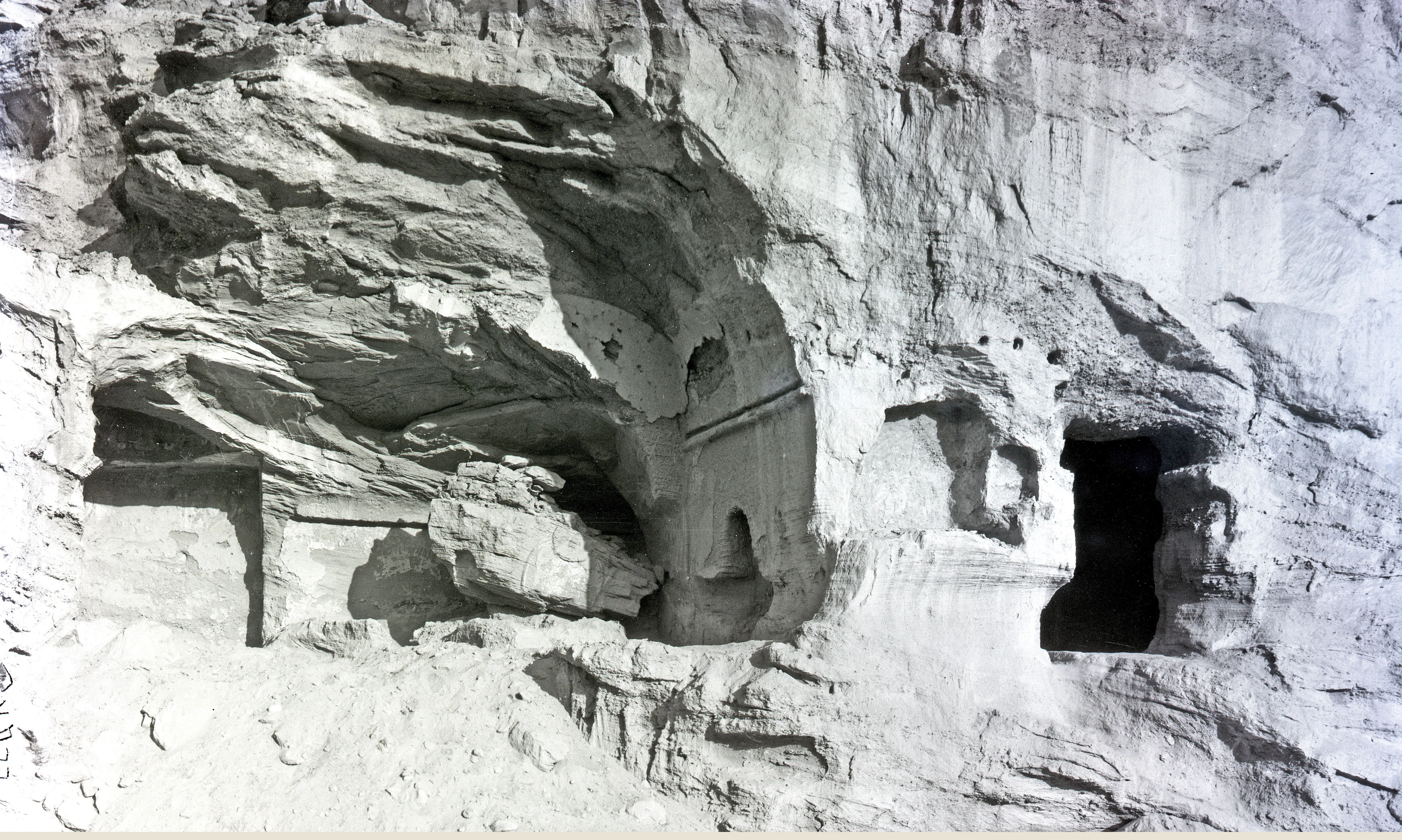
The Berlin archive describes B 1259 as “cave openings” in Kumtura’s northern sector; Giuseppe Vignato identifies the caves in the image as the present-day Caves 31 and 32. The original glass negative is now held by the Museum of Asian Art, Staatliche Museen zu Berlin; the digital image and metadata can be found in the CrossAsia German Turfan Expedition archive.
B 1553 photographs the main cave cluster of the southern sector from across the river; the archive records the scope of the image as Caves 10 to about 29. B 1845 records a freestanding building ruin near the gorge mouth at the southernmost end, whose name the original caption gives as “Hassa = Hissar” (uncertain). Both negatives belong to the Third German Turfan Expedition; the digital images and metadata can be found in the CrossAsia archive under B 1553 and B 1845.
B 1236 records the Fourth Expedition’s quarters set up inside Cave 14 of the southern sector, the “Kiṃnara Cave,” together with the adjacent caves; the Berlin archive’s original caption for B 1202 gives the excavation site of old no. 4 cave in the southern sector, the three caves above being tentatively old nos. 5, 6, and 7; and B 1619 was photographed looking north from the antechamber of Cave 69 in the northern gorge. The digital images and metadata can be found in the CrossAsia archive under B 1236, B 1202, and B 1619.
References
- State Council, “Notice on the Publication of the First Batch of Major Historical and Cultural Sites Protected at the National Level”, 1961.
- Xinjiang Uyghur Autonomous Region Cultural Relics Management Committee, Kuqa County Cultural Relics Preservation Office, and Department of Archaeology, Peking University, eds., Grottoes of China: The Kumtura Grottoes, Cultural Relics Publishing House, 1992.
- Xinjiang Kucha Grottoes Research Institute, ed., Complete Catalogue of the Kumtura Grottoes, Cultural Relics Publishing House, 2008.
- Han Xiang and Zhu Yingrong, The Kucha Grottoes, Xinjiang University Press, 1990.
- Huang Wenbi, Archaeological Records of the Tarim Basin, Guangxi Normal University Press, 2023.
- Li Shuhui, “A Study of the Dating of the Murals of Caves 75 and 79 at the Kumtura Grottoes and the Identity of Their Donors”, Journal of Dunhuang Studies, no. 4 (2008).
- Li Ruizhe, “On the Uyghur-Style Caves among the Kucha Grottoes”, Journal of Dunhuang Studies, no. 5 (2019).
- Zhao Li and Rong Xinjiang, eds., Inscriptions of the Kucha Grottoes, Zhongxi Book Company, 2020.
- Xinjiang Kucha Research Institute, Research Center for Ancient Chinese History at Peking University, and Institute for Historical and Philological Studies of China’s Western Regions, School of Chinese Classics, Renmin University of China, “A Preliminary Report on the Extant Kuchean Mural Captions in Cave 34 of the Kumtura Cave Complex,” in Zhu Yuqi, ed., Literature and History of the Western Regions, vol. 9, Science Press, 2014, pp. 1–32.
- Tailaiti Wubuli, “Inscriptions, Cliff Carvings, and Captions of the Kumtura Grottoes in Xinjiang,” The Western Regions Studies, no. 3 (2015), pp. 10–15.
- Yan Wenru, “The Grotto Site Most Excavated by Han Chinese and Most Headed by Han Abbots within Kucha—Kumtura (Notes on the Survey of Cave-Temples in the Northwest, no. 2),” Modern Buddhism, no. 4 (1962).
- Liao Yang, “A Study of the Early Caves of the Kizil Grottoes in Xinjiang (Part Two)”, Journal of Xinjiang Arts Institute, no. 2 (2004).
- Tailaiti Wubuli, “An Artistic Analysis of the Murals of New Caves 1 and 2 at Kumtura”, Identification and Appreciation of Cultural Relics, no. 9 (2020).
- Liu Tao, “The Reconstruction and Reading of the Contemplation Sutra Tableau Mural in Cave 16 at Kumtura”, Journal of the National Museum of China, no. 2 (2017).
- Xinjiang Kucha Research Institute, Research Center for Ancient Chinese History at Peking University, and Institute for Historical and Philological Studies of China’s Western Regions, School of Chinese Classics, Renmin University of China, “The Inscription Inside the Niche of the Main Wall of the Main Chamber of Cave 50 in the Kumtura Cave Complex, Xinjiang,” The Western Regions Studies, no. 3 (2015).
- Miao Lihui, “A Textual Study of the Iconographic Content of Cave 45 at Kumtura”, Journal of Dunhuang Studies, no. 2 (2014).
- Hong Bao, “A Study of the Chinese-Style Murals of the Kumtura Grottoes in the Seventh to Eighth Centuries”, Beauty & Times (Mid-Monthly): Journal of Fine Arts, no. 5 (2020).
- Yang Bo, “The Pictorial Realization of the ‘Chapter on the Aspiration of the Thousand Buddhas’ of the Bhadrakalpika Sūtra—A Study of the Murals of Cave 50 in the Kumtura Cave Complex”, Palace Museum Journal, no. 6 (2025).
- Zhang Bingfeng, ed., Conservation Research on the Kumtura Thousand-Buddha Caves in Xinjiang, Cultural Relics Publishing House, 2025.
- Rong Xinjiang, “Recent Surveys of and Related Research on the Inscriptions of the Kucha Grottoes”, The Western Regions Studies, no. 3 (2015).
- Albert Grünwedel, Altbuddhistische Kultstätten in Chinesisch-Turkistan: Bericht über archäologische Arbeiten von 1906 bis 1907 bei Kuča, Qarašahr und in der Oase Turfan, Berlin: Georg Reimer, 1912; the general account of the Kumtura survey and the records of old nos. 14, 19, and 42 appear on scanned page 13, scanned page 22, scanned page 26, and scanned page 37, and the inscription of old no. 19 cave on scanned page 31.
- С. Ф. Ольденбург: Русская Туркестанская экспедиция 1909–1910 года, Saint Petersburg, 1914.
- Giuseppe Vignato: “Historical Photographs of Kucha: Retracing Lost Caves and Related Thoughts”, Religions, 2023, 14(7): 903.