Introduction
The Kizil Caves have left no clear date of excavation. On the basis of the spread of Buddhism in Kucha[1], the forms of the caves, and the periodization of the murals, researchers date the earliest excavation to the end of the third century CE. Kucha at that time lay on the northern route of the Tarim Basin: to the east one could reach the Central Plains by way of the Hexi Corridor, and to the west it connected with Central Asia, the Iranian plateau, and the Indian subcontinent. Peoples, scriptures, and painting styles moved along these roads and finally entered the caves on the northern bank of the Muzat River.
When Xuanzang traveled west from the Central Plains and drew near the royal city of Kucha, the king, his ministers, and several thousand monks came out of the city to meet him; the Great Tang Records of the Western Regions further records that the locality had more than a hundred monasteries and over five thousand monks, who chiefly practiced the teaching of the Sarvāstivāda, an important school of Hīnayāna Buddhism at the time, and that the scriptures and monastic discipline they used followed the Indian tradition. Later, the Song Biographies of Eminent Monks records that Wukong, returning east carrying a bundle of Sanskrit scriptures, met the Tripiṭaka master Utpalaśana (Wuti-tichan-yu) at the Lotus Flower Temple in Kucha and asked him to translate the Sutra of the Ten Powers. Continuing east from Kucha to the seat of the Beiting Protectorate, Wukong again brought out his bundle of Sanskrit scriptures and collaborated with the Tripiṭaka master Śīladharma (Jiefa), a native of Khotan who lived at the local Longxing Temple: Śīladharma presided over the translation while Wukong verified the Sanskrit and rendered it orally, and together they produced the Sutra of the Ten Stages and the Sutra of the Wheel of Dedication. Those who traveled west in search of the Dharma were once welcomed at Kucha, and the scriptures translated on their way east also lingered there; the footsteps of the monks and the destinations of the scripture-bundles bound Kucha together with Central Asia, India, and the Central Plains.
These comings and goings left recognizable traces in the caves and murals. Researchers hold that the Indo-Iranian style of the early murals was influenced by Gandhāran art[2], and that the later murals show traces of Sasanian, Sogdian[3], and a small amount of Tang Central-Plains art. By the Qing dynasty, the Huijiang Tongzhi still records that among the cliffs there were “several hundred caves,” the interiors of which were “plastered with lime and painted above with images of the various buddhas, decorated in five colors,” only that these had by then grown “blurred and peeling,” and no one knew in what age they had first been made.
Historical Documents
Jin Shu (Book of Jin)
龟兹国西去洛阳八千二百八十里,俗有城郭。其城三重,中有佛塔庙千所。人以田种畜牧为业,男女皆翦发垂项。王宫壮丽,焕若神居。武帝太康中,其王遣子入侍。惠怀末,以中国乱,遣使贡方物于张重华。苻坚时,坚遣其将吕光率众七万伐之,其王白纯距境不降,光进军讨平之。
The Kingdom of Kucha lies eight thousand two hundred and eighty li west of Luoyang; by custom it has walled cities. Its city has three rings of walls, and within there are a thousand Buddhist stupas and shrines. The people take farming and herding as their occupation, and both men and women cut their hair to hang at the neck. The royal palace is grand and splendid, radiant as the dwelling of a deity. During the Taikang era of Emperor Wu, its king sent his son to serve at court. At the end of the reigns of Emperors Hui and Huai, because of the disorder in China, [the king] sent envoys to present local products to Zhang Chonghua. In the time of Fu Jian, Jian sent his general Lü Guang leading a host of seventy thousand to campaign against it; its king Bai Chun resisted at the frontier and would not surrender, and Guang advanced his army and subdued it.
Chu Sanzang Ji Ji (Collection of Records on the Translation of the Tripiṭaka)
什于沙勒国,诵阿毗昙、六足诸门、增一阿鋡。及还龟兹,名盖诸国。时,龟兹僧众一万余人,疑非凡夫,咸推而敬之,莫敢居上。由是不预烧香之次,遂博览四韦陁、五明诸论,外道经书、阴阳星算,莫不究晓,妙达吉凶,言若符契,性率达不砺,小捡修行者颇非之,什自得于心,未常懈意。后从佛陁耶舍,学十诵律,又从须利耶苏摩,咨禀大乘,乃叹曰:“吾昔学小乘,譬人不识金,以𨱎石为妙矣。”
In the Kingdom of Kashgar, Kumārajīva recited the Abhidharma, the various sections of the Ṣaṭpādābhidharma, and the Ekottarāgama. When he returned to Kucha, his fame overshadowed all the kingdoms. At the time there were more than ten thousand monks in Kucha, who, suspecting that he was no ordinary man, all deferred to and honored him, and none dared to sit above him. For this reason he did not take his turn in the order of incense-burning, and so he read widely in the four Vedas, the treatises of the five sciences, the scriptures of the heterodox schools, and the reckoning of yin-yang and the stars, mastering all of them, and marvelously fathoming fortune and misfortune, so that his words were like matching tallies. His nature was straightforward and unrestrained, and those who practiced with petty scrupulousness rather disapproved of him, but Kumārajīva was content within himself and never slackened his resolve. Afterward he studied the Ten-Recitation Vinaya under Buddhayaśas, and again received the Mahayana from Sūryasoma, whereupon he sighed and said: “Formerly I studied the Hīnayāna—it was like a man not recognizing gold, who takes ore for something marvelous.”
于是广求义要,诵中、百二论,于龟兹帛纯王新寺,得放光经,始披读,魔来蔽文,唯见空牒,什知魔所为,誓心逾固,魔去字显,仍习诵之。后于雀梨大寺,读大乘经,忽闻空中语曰:“汝是智人,何以读此?”什曰:“汝是小魔,宜时速去。我心如地,不可转也。”停住二年,广诵大乘经论,洞其秘奥。后往罽宾,为其师盘头达多,具说一乘妙义,师感悟心服,即礼什为师言:“我是和上小乘师,和上是我大乘师矣。”西域诸国服什神俊,咸共崇仰,每至讲说,诸王长跪高座之侧,令什践其膝以登焉。
Thereupon he sought widely the essentials of the doctrine and recited the Madhyamaka and the Hundred-Verse Treatise. At the new temple of King Bai Chun of Kucha he obtained the Sutra of Emitting Light; when he first opened it to read, a demon came and obscured the text, so that he saw only blank tablets. Kumārajīva knew this was the demon’s doing, and his vowed resolve grew all the firmer; the demon departed and the characters appeared, and he went on reciting it. Afterward, at the Great Temple of Queli, he read a Mahayana sutra, when suddenly he heard a voice from the empty air say: “You are a wise man; why do you read this?” Kumārajīva said: “You are a petty demon; you had best be gone at once. My mind is like the earth, and cannot be turned.” He stayed there two years, reciting widely the Mahayana sutras and treatises and penetrating their secret depths. Afterward he went to Kashmir and expounded in full the marvelous meaning of the One Vehicle to his master Bandhudatta; his master was moved to understanding and convinced, and at once did reverence to Kumārajīva as his teacher, saying: “I am the master’s Hīnayāna teacher; the master is my Mahayana teacher.” The kingdoms of the Western Regions, admiring Kumārajīva’s spiritual brilliance, all revered him together; whenever he came to expound, the kings would kneel long beside the high seat and have Kumārajīva tread upon their knees to mount it.
Da Tang Xiyu Ji (Great Tang Records of the Western Regions)
从此西南行二百余里,逾小山,越二大河而,得平川,行七百余里,至屈支国。
From here, traveling southwest more than two hundred li, crossing small hills and passing two great rivers, one reaches a level plain, and after more than seven hundred li arrives at the Kingdom of Quci [Kucha].
屈支国,东西千余里,南北六百余里。国大都城周十七八里,宜麻、麦,有粳稻,出蒲萄、石榴,多梨、柰、桃、杏。土产黄金、铜、铁、𫓪、锡。气序和,风俗质。文字取则印度,粗有改变。管弦伎乐,特善诸国。服饰锦褐,断发巾帽。货用金、银钱、小铜钱。王,屈支种也,智谋寡昧,迫于强臣。其俗生子以木押头,欲其匾㔸也。伽篮百余所,僧从五千余人,习学小乘教说一切有部。经教律仪,取则印度,其习读者,即本文矣。尚拘渐教,食杂三净。洁清耽玩,人以功竞。
The Kingdom of Quci is more than a thousand li east to west and more than six hundred li north to south. The great capital city of the kingdom is some seventeen or eighteen li in circumference. The land is suited to hemp and wheat and has glutinous rice; it produces grapes and pomegranates, and abounds in pears, crabapples, peaches, and apricots. Its native products are gold, copper, iron, lead, and tin. Its climate is mild and its customs plain. Its writing follows the Indian model, with slight alterations. In wind and string music it is especially skilled beyond the other kingdoms. Its dress is of brocade and coarse wool; [the people] cut their hair and wear kerchief-caps. For currency they use gold and silver coins and small copper coins. The king is of the Quci stock, of scant wisdom and stratagem, and is pressed by his powerful ministers. By their custom, when a child is born they press its head with wood, wishing it to be flat. There are more than a hundred monasteries and over five thousand monks, who study the Hīnayāna teaching of the Sarvāstivāda. Their scriptural teaching and monastic discipline follow the Indian model, and what they study and recite is the very [Indian] text. They still cling to the gradual teaching and eat mixed with the three pure [meats]. Pure and cleanly, absorbed in their devotions, the people compete in merit.
国东境城北天祠前,有大龙池。诸龙易形,交合牝马,遂生龙驹,𢘙戾难驭。龙驹之子,方乃驯驾,所以此国多出善马。闻诸先志曰:近代有王,号曰金花,政教明察,感龙驭乘。王欲终没,鞭触其耳,因即潜隐,以至于今。城中无井,取彼池水。龙变为人,与诸妇会,生子骁勇,走及奔马;如是渐𭰏,人皆龙种,恃力作威,不恭王命。王乃引构突厥,杀此城人,少长俱戮,略无噍类。城今荒芜,人烟断绝。
In the eastern reaches of the kingdom, north of a city and before a heaven-shrine, there is a great dragon pool. The dragons change their forms and couple with mares, and so produce dragon-colts, obstinate and hard to control. Only the offspring of such dragon-colts can then be tamed and driven, and this is why the kingdom produces many fine horses. It is told among the earlier records: in recent times there was a king named Jinhua [Golden Flower], enlightened in government and teaching, who by his virtue moved the dragons to let him ride them. When the king was about to die, he touched their ears with his whip, whereupon they hid themselves away, down to the present day. There were no wells in the city, and [the people] drew water from that pool. The dragons transformed into men and consorted with the women, and the sons they bore were valiant, able to run as fast as galloping horses; and so it gradually spread, until the people were all of dragon stock, relying on their strength to act with violence, and were not obedient to the king’s command. The king then contrived to draw in the Türks, and killed the people of that city, slaughtering young and old alike, leaving scarcely a living soul. The city is now desolate, its human habitation cut off.
荒城北四十余里,接山阿,隔一河水,有二伽蓝,同名照怙厘,而东西随称。佛像庄饰,殆越人工。僧徒清肃,诚为勤励。东昭怙厘佛堂中有玉石,面广二尺余,色带黄白,状如海蛤。其上有佛足履之迹,长尺有八寸,广余八寸矣。或有斋日,照烛光明。
More than forty li north of the desolate city, adjoining the folds of the hills and separated by a river, there are two monasteries, both named Zhaohuli [Cakrivāra?], distinguished as east and west accordingly. The Buddha images are so richly adorned as almost to surpass human craft. The monks are pure and grave, and truly diligent and zealous. In the Buddha-hall of the Eastern Zhaohuli there is a jade stone, its surface more than two chi wide, colored yellowish-white, shaped like a sea-clam. Upon it is the imprint of the Buddha’s foot, one chi and eight cun long and more than eight cun wide. On certain fast-days it shines with a bright radiance.
大城西门外,路左右有立佛像,高九十余尺。于此像前,建五年一大会处。每岁秋分数十日间,举国僧徒皆来会集。上自君王,下至士、庶,损废俗务,奉持斋戒,受经听法,渴日忘疲。诸僧辇僧伽篮庄严佛像,莹以珍宝,饰之锦绮,载诸辇舆,谓之行像,动以千数,云集会所。常以月十五日、脢日,国王、大臣谋议国事,访及高僧,然后宣布。
Outside the western gate of the great city, to the left and right of the road, there are standing Buddha images more than ninety chi high. Before these images is established the place of the great assembly held once every five years. Every year for some tens of days about the autumn equinox, the monks of the whole kingdom all come to assemble. From the sovereign above down to gentry and commoners below, they set aside their worldly affairs, uphold the fast and the precepts, receive the scriptures and listen to the Dharma, forgetting weariness the whole day. The monks of the monasteries adorn the Buddha images, burnishing them with precious jewels and decking them with brocade and figured silk, and carry them upon palanquins—these are called “processional images”—by the thousands, gathering like clouds at the assembly place. Regularly, on the fifteenth day and the last day of the month, the king and the great ministers deliberate on affairs of state and consult the eminent monks, and only afterward promulgate [their decisions].
会埸西北渡河,至阿奢理贰伽篮庭宇显敞,佛像功饰。僧徒肃穆,精勤匪怠,并是耆艾宿德,博学高才,远方俊彦,慕义至止。国王、大臣、士、庶、豪右,四事供养,久而弥敬。闻诸先志曰:昔此国先王,崇敬三宝,将欲游方,观礼圣迹,乃命母弟,摄知留事。其弟受命,窃自割势,防未萌也。封之金函,持以上王。王曰:“斯何谓也?”对曰:“回驾之日,乃可开发。”即付执事,随军掌护。王之还也,果有构祸者,曰:“王命监国,淫乱中宫。”王闻震怒,欲置严刑。弟曰:“不敢逃责,愿开金函。”王遂发而视之,乃断势也。曰:“斯何异物?欲何发明?”对曰:“王昔游方,命知留事,惧有谗祸,割势自明。今果有征,愿垂照览。”王深敬异,情爱弥隆,出入后庭,无所禁碍。王弟于后,行遇一夫,拥五百牛,欲事刑腐。见而惟念,引类增怀:“我今形亏,岂非宿业?”即以财宝,赎此群牛。以慈善力,男形渐具。以形具故,遂不入宫。王怪而问之,乃陈其始末。王以为奇特也,遂建伽蓝,式旌美迹,传芳后叶。
Crossing the river northwest of the assembly ground, one reaches the Aścaryā [Ajālī] Monastery, its courts and halls open and spacious, its Buddha images finely adorned. Its monks are grave and dignified, diligent and untiring, and are all elders of long virtue, broadly learned and of high talent; the distinguished men of distant regions, admiring their piety, come to stay there. The king, great ministers, gentry, commoners, and powerful families make the fourfold offerings, and honor them all the more with the passing of time. It is told among the earlier records: long ago a former king of this kingdom, revering the Three Treasures, was about to travel abroad to view and venerate the holy traces, and so charged his younger brother by the same mother to take charge of affairs in his stead. The brother, receiving the command, secretly castrated himself to guard against [slander] before it could sprout, sealed [the member] in a golden casket, and presented it to the king. The king said: “What is the meaning of this?” He replied: “On the day of your return, then it may be opened.” [The king] handed it to an attendant to keep and guard along with the army. When the king returned, there was indeed one who contrived calumny, saying: “The one you charged to oversee the realm has debauched the inner palace.” Hearing this the king was enraged and wished to inflict severe punishment. The brother said: “I dare not flee the charge; I beg you to open the golden casket.” The king then opened and looked at it—it was the severed member. He said: “What strange thing is this? What would you make clear?” He replied: “When Your Majesty traveled abroad and charged me to oversee affairs, fearing slander and calamity, I castrated myself to prove my innocence. Now the proof has indeed come; I beg you to consider it.” The king deeply honored and marveled at him, and his affection grew all the greater, so that [the brother] came and went in the inner palace without any restriction. Afterward the king’s brother, going about, met a man driving five hundred oxen that he meant to have castrated. Seeing this he reflected, and, likening their case to his own, his feeling grew: “Now that my own form is maimed—is it not from past karma?” He then with wealth and treasure ransomed this herd of oxen. By the power of this merciful and good deed, his male form gradually returned. Because his form had returned, he thereupon would not enter the palace. The king, wondering, questioned him, and he related the whole matter from beginning to end. The king held it to be extraordinary, and thereupon built a monastery to signalize the fine deed and hand down its fragrance to later generations.
Da Ci’en Si Sanzang Fashi Zhuan (Biography of the Tripiṭaka Master of the Great Ci’en Temple)
前渡二大河,西履平川,行数百里,入屈支国界。将近王都,王与群臣及大德僧木叉毱多等来迎。自外诸僧数千,皆于城东门外张浮幔、安行像、作乐而住。法师至,诸德起来相慰讫,各还就坐。使一僧擎鲜华一盘来授法师,法师受已,至佛前散华,礼拜讫,就木叉毱多下坐。坐已,复行华;行华已,行蒲桃浆。于初一寺受华、受浆已,次受余寺亦尔,如是展转,日晏方讫,僧徒始散。
Crossing two great rivers ahead and treading the level plain westward, after several hundred li he entered the borders of the Kingdom of Quci [Kucha]. As he drew near the royal capital, the king together with his ministers and the great monk Mokṣagupta and others came out to meet him. Beyond these, several thousand other monks all waited outside the eastern gate of the city, spreading canopies, setting up processional images, and making music. When the Master arrived, the eminent ones rose and greeted him with words of comfort, then each returned to his seat. A monk was sent to bring a tray of fresh flowers to present to the Master; the Master, having received it, went before the Buddha to scatter the flowers, and when he had made obeisance, he took a seat below Mokṣagupta. When he was seated, flowers were passed round again; and when the flowers had been passed, grape juice was passed. Having received flowers and juice at the first temple, he next received them at the other temples likewise, and so it went on, passing from one to another, and only when the day was late was it finished, whereupon the monks at last dispersed.
Wang Wu Tianzhu Guo Zhuan (Record of a Journey to the Five Kingdoms of India)
又从疏勒东行一月至龟兹国,即是安西大都护府,汉国兵马大都集处。此龟兹国,足寺足僧,行小乘法,吃肉及葱韭等也。汉僧行大乘法。
Again, traveling east from Kashgar for one month, one reaches the Kingdom of Kucha, which is the Anxi Grand Protectorate, the chief gathering place of the troops and horses of the Han state. This Kingdom of Kucha has ample temples and ample monks; they practice the Hīnayāna teaching and eat meat as well as onions, leeks, and the like. The Han [Chinese] monks practice the Mahayana teaching.
Song Gaoseng Zhuan (Song Biographies of Eminent Monks)
回及龟兹,居莲华寺,遇三藏法师勿提提羼鱼,善于传译。空因将十力经夹请翻之。寻抵北庭,大使复命空出梵夹,于阗三藏戒法为译主,空证梵文并度语,翻成十地回向轮经。
Returning and reaching Kucha, [Wukong] lodged at the Lotus Flower Temple, where he met the Tripiṭaka master Utpalaśana (Wuti-tichan-yu), who was skilled at translation. Wukong therefore took out his bundle of the Sutra of the Ten Powers and asked him to translate it. Presently he arrived at Beiting, where the commissioner again ordered Wukong to bring out his Sanskrit bundle; the Khotanese Tripiṭaka master Śīladharma (Jiefa) served as chief translator, while Wukong verified the Sanskrit and rendered it into speech, and they translated the Sutra of the Ten Stages and the Sutra of the Wheel of Dedication.
Huijiang Tongzhi (Comprehensive Gazetteer of the Muslim Regions)
千佛洞:河色尔台东南山峡中三十余里,有千佛洞。山排佛洞,高低不等,长四里余,约有洞数百。山系砂石,人能上者少,不能上者多。洞宽有一二间至三四间,大小不等。洞内抹石灰,上画诸佛之像,五色装彩,糢糊剥落,不知创于何代,并无记载碑文。
Thousand-Buddha Caves: more than thirty li into the mountain gorge southeast of Hesertai, there are the Thousand-Buddha Caves. The Buddha-caves are ranged along the mountain, high and low unevenly, more than four li in length, numbering about several hundred caves. The mountain is of sand and stone, and few can climb it while many cannot. The caves are one or two bays to three or four bays wide, varying in size. The interiors are plastered with lime and painted above with images of the various buddhas, decorated in five colors, [now] blurred and peeling; it is not known in what age they were first made, nor is there any recorded stele-inscription.
Xiyu Shuidao Ji (Record of the Waterways of the Western Regions)
赫色勒河又南流三十余里,经千佛洞西。缘山法像尚存金碧,壁有题字曰惠勤,盖僧名也。河流经岩下,雅尔干河来汇,是为渭干河。其西岸有古废城,周二里许。两河汇处,极四十一度二十五分,西三十五度十分。
The Hesele River flows south again for more than thirty li, passing west of the Thousand-Buddha Caves. The dharma-images along the mountain still keep their gold and blue coloring, and on a wall there is the inscription “Huiqin,” which is doubtless a monk’s name. The river flows below the cliffs, and the Yargan River comes to join it—this is the Weigan River. On its western bank there is an ancient ruined city, about two li in circumference. At the confluence of the two rivers, the latitude is forty-one degrees twenty-five minutes, the longitude thirty-five degrees ten minutes west [of the meridian].
Old Photographs
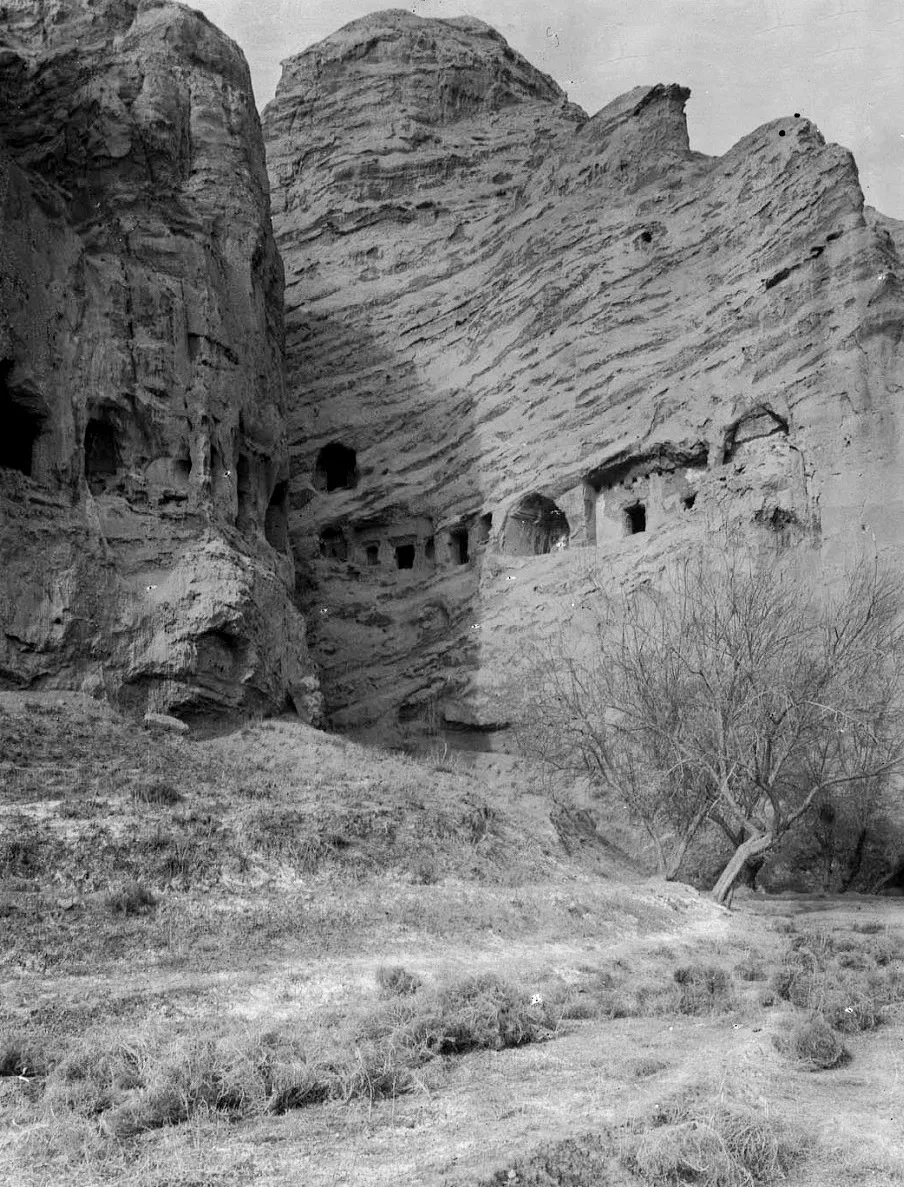
1902–1904
The Kizil small-gorge cave cluster photographed by the Ōtani Expedition. The photograph preserves the overall relationship of the cave mouths, the cliff face, and the valley at the beginning of the twentieth century. The original may be seen in the Ryukoku University collection record.
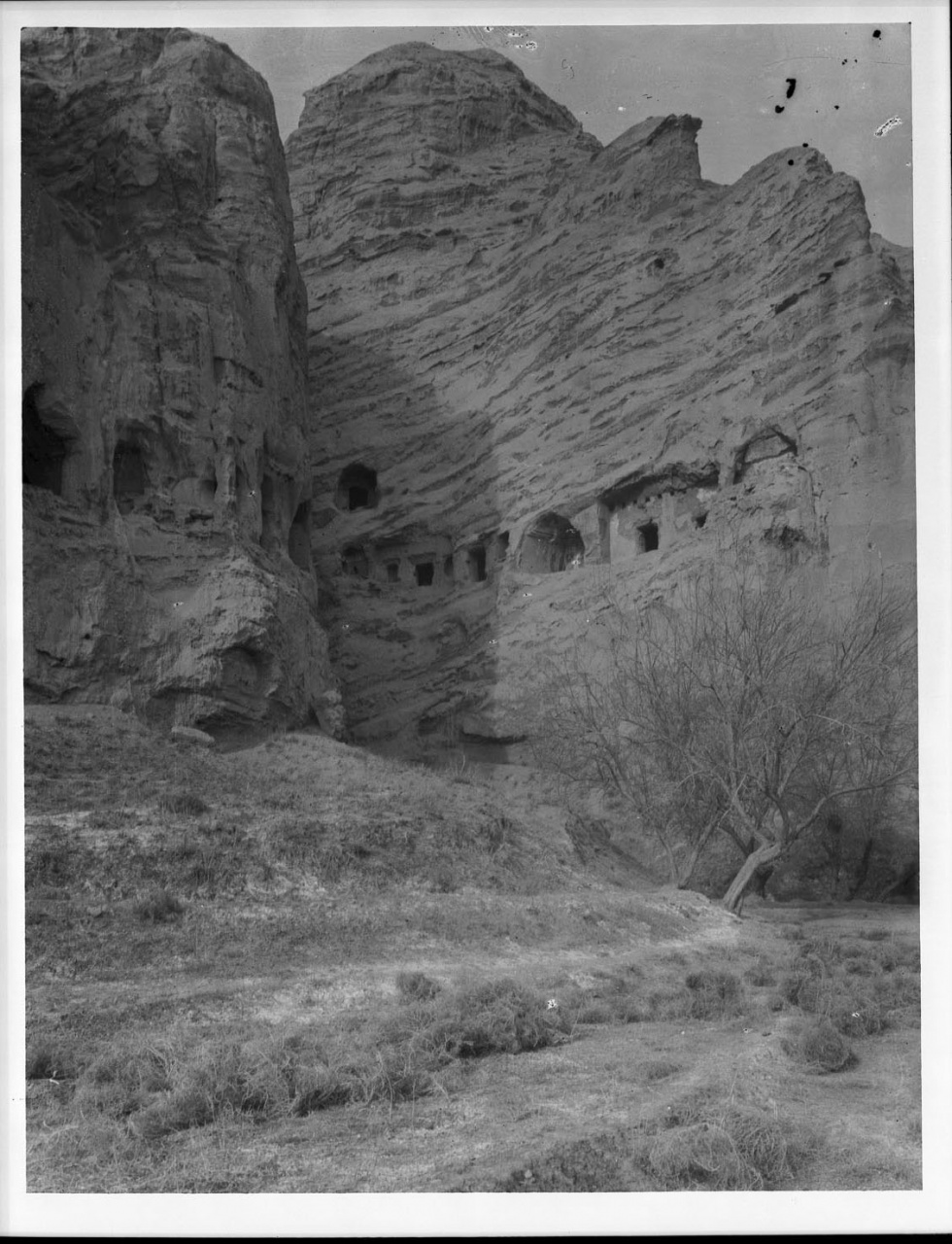
1906
During the 1906 survey, the German expedition photographed the cave cliffs, farmhouses, and valley of Kizil’s First Gorge. The four exterior views below are included in Grünwedel’s Altbuddhistische Kultstätten in Chinesisch-Turkestan, published in 1912.
References
- Li Ruizhe and Li Haibo, “A Re-examination of the Periodization of the Central-Pillar Caves at Kizil”, Journal of Northwest University (Philosophy and Social Sciences Edition), no. 2 (2006).
- Li Ruizhe, “The Excavation of the Early Kizil Caves and the Spread of Buddhism in Kucha”, Journal of Dunhuang Studies, no. 4 (2018).
- Huo Xuchu, “Research on the Dating of the Kizil Caves and the Application of Carbon-14 Dating Data”, The Western Regions Studies, no. 4 (2006).
- Liao Yang, “A Chronological Study of the Murals of the Kizil Caves”, Social Sciences Academic Press, 2012.
- UNESCO Silk Road Programme, “Cultural Selection: Kizil Cave Murals and the Silk Road’s Transmission of Buddhism and Central Asian Art”. (in English)