Introduction
The name of White Horse Temple comes from the story of the “white horse carrying the scriptures,” told and retold in later texts. The Record of the Buddhist Monasteries of Luoyang relates that Emperor Ming of the Han dreamed of a radiant golden deity, learned that there was a Buddha in the Western Regions, and sent envoys to seek the scriptures and images; the scriptures and images were carried to Luoyang on a white horse, and so a temple was built and given the name “White Horse.” The Tang-dynasty Illustrated Record of Translated Scriptures Old and New adds that eighteen men including Cai Yin escorted Kāśyapa Mātaṅga and Dharmaratna into Luoyang, and that Mātaṅga translated the Sutra of Forty-Two Sections in the temple. The Record of the Buddhist Monasteries of Luoyang calls White Horse Temple “the beginning of the Buddha’s entry into China,” and a Song-dynasty rebuilding stele calls it “the beginning of monasteries in China[1].”
Around 970, in the time of Emperor Taizu of the Northern Song, the founding general Li Jixun used his private wealth to build a separate Eastern White Horse Temple and a nine-story wooden pagoda to the east of the original temple. After Li Jixun died he was posthumously enfeoffed as Prince of Longxi Commandery, with the posthumous title Zhuangwu; a Jin-dynasty stele therefore calls him “Prince Li Zhuangwu.” His three sons further donated nearly a hundred bays of housing and, on the death-anniversaries of their parents, held vegetarian feasts for the monks in their memory[2]. About a hundred and fifty years later, at the very end of the first year of the Jingkang era (1126), the Eastern White Horse Temple and the wooden pagoda were destroyed by a “conflagration”; a Yuan-dynasty stele likewise records that the main White Horse Temple was destroyed in the Jingkang wartime fires.
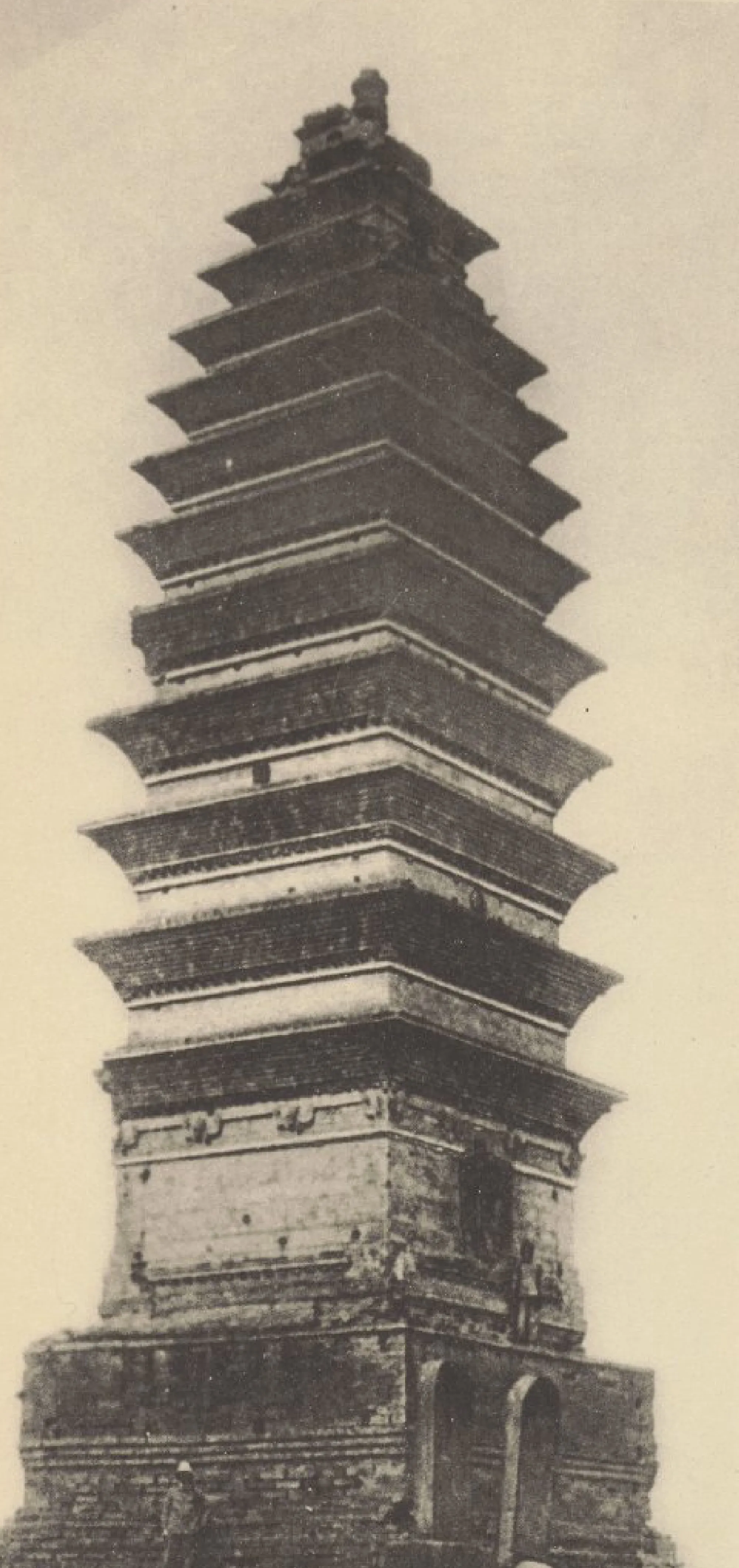
The ruined site of the Eastern White Horse Temple lay abandoned for fifty years, becoming “a heap of tiles, a field of rank grass.” After the monk Yangong came to Luoyang he cleared the old foundation of the wooden pagoda, recruited workers to make bricks, and built a thirteen-story brick pagoda one hundred and sixty feet high, together with a protective wall, a well, a scripture-burning platform, a pagoda gate, and other structures; in the fifteenth year of the Dading era (1175), the work on the pagoda cloister was completed. What the Jin restored was the eastern pagoda cloister; only under the Yuan was the main White Horse Temple itself rebuilt. In the seventh year of the Zhiyuan era (1270), when the Tibetan Buddhist dharma-king Phags-pa asked about the first transmission of the Buddhist teaching and the earliest monastery, Xingyu answered with White Horse Temple and requested that it be built up. Thereafter Dampa took charge of the work, drawing on the rents of the fields of the Huguo Renwang Temple to pay for the construction; Zhenjin, son of Emperor Shizu of the Yuan and already crown prince at the time, also contributed silk and money to the project. The work lasted about twenty-four years and produced a nine-bay main hall, a five-bay dharma hall[3], a triple gate, pavilions, monks’ quarters, a refectory, and storerooms; after its completion in the fourth year of the Dade era (1300), the court further granted sixteen hundred qing of land as a permanent endowment.
The Ming dynasty saw repeated further building. The old gazetteers record that the temple was repaired in the twenty-third year of the Hongwu era (1390); and from the thirty-fourth to the thirty-fifth year of the Jiajing era (1555–1556), Huang Jin donated his salary and Li Fengyi directed an expansion. The items listed in the stele include the front and rear main halls, the flanking side halls, the Hall of the Heavenly Kings, the bell and drum towers, the Hall of Honoring the Worthy and the Hall of Expounding the Dharma, as well as the double-eaved hall on the Qingliang Terrace and the side halls of the two patriarchs Mātaṅga and Dharmaratna; two Chan cloisters were built below the terrace, and the temple held one hundred and twenty cells in all. Within the halls the buddhas, arhats, and dharma-protector images were newly modeled, and a stone gateway inscribed “Ancient Monastery, White Horse Chan Grove” was raised outside the temple.
After the wars at the beginning of the Qing, the stele texts say the temple’s “gilding was scattered and sparse, its timber and masonry decayed.” Ruxiu and the local landholders sold several ancient cypresses from the temple, and with this, together with the income of the temple fields, the donated salary of the county magistrate Gao Gao, and local subscriptions, they restored the Vairocana Pavilion, the main hall, the mountain gate, and the side halls over several years. In the fifty-second year of the Kangxi era (1713), the Stele Record of the Origins of the Buddhist Teaching at the White Horse Temple of Luoyang was erected; in the fifty-fifth year of the Kangxi era (1716), the Record of the Rebuilding of the Halls of the Sourcing-the-Doctrine Great White Horse Temple recorded the course of the work. When Teng Gu visited the temple in 1934, he still entered through the Jiajing-era mountain gate, passed in turn through the Hall of the Heavenly Kings, the main hall, the dharma hall, and the Receiving Hall, and finally climbed the Qingliang Terrace; to the east of the temple stood, separately, the thirteen-story brick pagoda rebuilt under the Jin.
Historical Documents
Luoyang Qielan Ji (Record of the Buddhist Monasteries of Luoyang)
白马寺,汉明帝所立也。佛入中国之始。寺在西阳门外三里御道南。帝梦金神,长丈六,项背日月光明。金神号曰佛,遣使向西域求之,乃得经像焉。时白马负而来,因以为名。明帝崩,起祗洹于陵上。自此从后,百姓冢上或作浮图焉。寺上经函,至今犹存。常烧香供养之,经函时放光明,耀于堂宇。是以道俗礼敬之,如仰真容。浮屠前柰林蒲萄异于余处,枝叶繁衍,子实甚大。柰林实重七斤,蒲萄实伟于枣,味并殊美,冠于中京。帝至熟时,常诣取之。或复赐宫人,宫人得之,转饷亲戚,以为奇味。得者不敢辙食,乃历数家。京师语曰:“白马甜榴,一实直牛。”有沙门宝公者,不知何处人也。形貌丑陋,心机通达,过去未来,预睹三世。发言似谶,不可解,事过之后,始验其实。胡太后闻之,问以世事。宝公曰:“把粟与鸡呼朱朱。”时人莫之能解。建义元年,后为尔朱荣所害,始验其言。时亦有洛阳人赵法和请占早晚当有爵否。宝公曰:“大竹箭,不须羽;东厢屋,急手作。”时不晓其意,经十余日,法和父丧。大竹者,杖;东厢屋者,倚庐。造《十二辰歌》,终其言也。
White Horse Temple was founded by Emperor Ming of the Han. It was the beginning of the Buddha’s entry into China. The temple lies three li outside the Xiyang Gate, south of the imperial road. The emperor dreamed of a golden deity, sixteen feet tall, with the light of sun and moon about its neck and back. The golden deity was called Buddha, and he sent envoys to the Western Regions to seek it, and so obtained the scriptures and images. At the time they were carried on a white horse, and so [the temple] was named after it. When Emperor Ming died, a jetavana was raised upon his tomb. From then on, the common people would sometimes build stupas upon their graves. The scripture-cases of the temple survive to this day. Incense is constantly burned in offering to them, and the scripture-cases from time to time emit radiance that illuminates the halls. For this reason clergy and laity revere them as if gazing upon a true likeness. The crabapple grove and the grapevines before the stupa differ from those elsewhere: their branches and leaves are luxuriant, and their fruit is very large. A crabapple fruit weighs seven catties, and a grape is larger than a jujube; both are exceptionally delicious, the finest in the central capital. When they ripened, the emperor would often go to gather them. Sometimes he would bestow them on the palace ladies, and the palace ladies, receiving them, would pass them on to their relatives as a rare delicacy. Those who received them dared not eat them straightaway, and so they passed through several households. In the capital there was a saying: “White Horse sweet pomegranates—one fruit is worth an ox.” There was a monk named Baogong, of whom no one knew where he was from. Ugly of appearance but penetrating of mind, he foresaw the past and the future and beheld the three ages in advance. His words were like prophecies, incomprehensible; only after the events had passed were they proven true. When the Empress Dowager Hu heard of him, she questioned him on affairs of the world. Baogong said: “Take millet and call to the chickens, ‘chu, chu.’” No one of the time could make sense of it. In the first year of the Jianyi era, the empress dowager was killed by Erzhu Rong, and only then were his words proven. At the time there was also a Luoyang man, Zhao Fahe, who asked him to divine whether he would sooner or later hold a title. Baogong said: “A great bamboo arrow needs no fletching; a room in the eastern wing—make it in haste.” At the time no one understood his meaning; after some ten days, Fahe’s father died. The “great bamboo” was the mourning staff; the “room in the eastern wing” was the mourning hut. He composed the “Song of the Twelve Branches,” and so ended his words.
Gujin Yijing Tuji (Illustrated Record of Translated Scriptures Old and New)
后汉刘氏都洛阳。
The Liu clan of the Later Han made Luoyang their capital.
惟孝明皇帝以永平三年岁次庚申,帝梦金人,项有日月光飞来殿庭,上问群臣,太史傅毅对曰:“臣闻西域有神号之为佛。陛下所梦固其是乎。”至七年岁次甲子,帝敕郎中蔡愔、中郎将秦景博士王遵等一十八人,西寻佛法。愔等至印度国,请迦叶摩腾、竺法兰共还,用白马驮经并将画释迦佛像,以永平十年岁次丁卯,至于洛阳。帝悦造白马寺。
It was Emperor Xiaoming who, in the third year of the Yongping era, the gengshen year, dreamed of a golden man with the light of sun and moon about its neck, come flying into the palace courtyard. The emperor questioned his ministers, and the Grand Astrologer Fu Yi replied: “Your servant has heard that in the Western Regions there is a deity called the Buddha. Is not what Your Majesty dreamed surely this?” In the seventh year, the jiazi year, the emperor commanded the gentleman of the interior Cai Yin, the general of the household Qin Jing, the erudite Wang Zun, and others—eighteen men in all—to go west in search of the Buddhist teaching. Yin and the rest reached the land of India and invited Kāśyapa Mātaṅga and Dharmaratna to return with them; carrying the scriptures on a white horse and bringing a painted image of the Buddha Śākyamuni, in the tenth year of the Yongping era, the dingmao year, they arrived at Luoyang. The emperor rejoiced and built White Horse Temple.
至十四年岁次辛未正月一日,五岳道士楮善信等负情不悦。因朝正之,次表请较试,敕遣尚书令宋庠引入长乐宫。帝曰:此月十五日,大集白马寺南门。尔日信等以灵宝诸经置道东坛上,帝以经像舍利置道西七宝行殿上,信等绕坛涕泣,稽请天尊,词情恳切。又以栴檀柴等烧经,冀经无损以为神异。然所烧经并从灰烬,先时升天入火,履水隐形,皆不复能,善禁咒者呼策不应。
In the first month, first day, of the fourteenth year, the xinwei year, the Daoist priests of the Five Marchmounts, Chu Shanxin and the others, were resentful and displeased. On the occasion of the New Year’s audience they submitted a memorial requesting a trial of comparison, and the emperor commanded the director of the imperial secretariat Song Xiang to conduct them into the Changle Palace. The emperor said: On the fifteenth day of this month, gather in force at the south gate of White Horse Temple. On that day Shanxin and the others placed the various Lingbao scriptures on an altar to the east of the road, while the emperor placed the scriptures, images, and relics on a seven-jeweled portable hall to the west of the road. Shanxin and the others circled the altar weeping, bowing and imploring the Celestial Worthies, their words and feelings most earnest. They also burned the scriptures with sandalwood and other kindling, hoping that the scriptures would take no harm and so prove a divine marvel. But the scriptures they burned were all reduced to ashes; what they had formerly done—ascending to heaven, entering fire, walking on water, making themselves invisible—they could no longer do, and those skilled in spells and incantations called out but had no response.
时,太傅张衍语信曰:“所试无验即是虚妄,宜就西域真法。”时,南岳道士费叔才等惭忸,自感而死。时,佛舍利光明五色,直上空中,旋环如盖,遍覆大众,映蔽日轮。摩腾法师先是阿罗汉,即以神足游空飞行坐卧神化自在。时,天雨宝花及奏作众乐。感动人情,大众欢悦。摩腾复坐,法兰说法。时,众咸喜得未曾有。
At that time the Grand Tutor Zhang Yan said to Shanxin: “That the trial produced no proof means it is false and empty; you ought to turn to the true teaching of the Western Regions.” At that time the Daoist priest of the Southern Marchmount Fei Shucai and the others, ashamed and mortified, died of their own emotion. At that time the Buddha’s relics shone with five-colored radiance, rising straight into the sky, circling round like a canopy, covering the whole assembly and eclipsing the disc of the sun. The Dharma Master Mātaṅga, having formerly been an arhat, then by his spiritual powers roamed through space, flying, walking, sitting, and lying at will in divine transformation. At that time heaven rained down jeweled flowers and the many kinds of music were played. It moved the hearts of the people, and the great assembly rejoiced. Mātaṅga sat down again, and Dharmaratna expounded the Dharma. At that time the assembly all rejoiced at what they had never had before.
时,后宫阴夫人王婕妤等,一百九十人出家,司空阳城侯刘善峻镇远将军姜苟儿等二百六十八人出家,四岳道士吕慧通等六百二十人出家,京都男女张子尚、阿潘等三百九十一人出家,帝亲与群官为出家者剃发,给施供养经三十日造寺十所。城外七寺城内三寺,七寺安僧三寺安尼,具如汉明帝法本内传说。
At that time, of the inner palace, Lady Yin, the concubine Wang Jieyu, and others—one hundred and ninety persons—left the household life; the minister of works, the marquis of Yangcheng Liu Shanjun, the general who guards the distant regions Jiang Gou’er, and others—two hundred and sixty-eight persons—left the household life; the Daoist priests of the Four Marchmounts, Lü Huitong and others—six hundred and twenty persons—left the household life; the men and women of the capital, Zhang Zishang, A Pan, and others—three hundred and ninety-one persons—left the household life. The emperor himself, together with his officials, shaved the heads of those leaving the household life, made offerings for their support for thirty days, and built ten temples. Seven temples outside the city and three within; the seven temples housed monks, the three housed nuns—all as told in the Inner Biography of the Dharma-Root of Emperor Ming of the Han.
沙门迦叶摩腾中印度人,婆罗门种。幼而敏悟兼有风姿,博学多闻特明经、律,思力精博,探赜钩深,敷文析理,每有新义出于神表尝游西印度有一小国,请腾讲金光明经,俄而邻国兴师而来,既将践境,辄有事碍,兵不能进。彼国兵众疑有异术。密遣使觇,但见君臣安然共听,其所讲大乘经,明地神王护国之法。于是彼国既睹斯神验,请和求法。时,蔡愔等殷请于腾,腾遂与愔等俱来见。帝于洛阳,以永平十年岁次丁卯,于白马寺译四十二章经此经本是外国经抄。腾以大化初传,人未深信,蕴其妙解,不即多翻,且撮经要,以导时俗,腾后终于洛阳。
The monk Kāśyapa Mātaṅga was a man of central India, of the Brahman caste. Quick-witted from childhood and possessed of fine bearing, broadly learned and widely versed, especially expert in the sutras and the Vinaya, penetrating and thorough in thought, probing the hidden and drawing out the deep, setting forth the text and analyzing its principles, he always brought forth new meanings that surpassed the ordinary. He once traveled to a small country in western India; he was invited to expound the Sutra of Golden Light, when suddenly a neighboring country raised an army and came. As it was about to trespass upon the border, there arose an obstruction, and the troops could not advance. The soldiers of that country suspected there was some strange art. They secretly sent a spy to observe, but he saw only ruler and ministers peacefully listening together, for what was expounded was the Mahayana sutra that sets forth the law of the earth-deity kings protecting the state. Thereupon, having witnessed this divine efficacy, that country sued for peace and sought the teaching. At that time Cai Yin and the others earnestly entreated Mātaṅga, and Mātaṅga then came together with Yin and the rest to see the emperor. At Luoyang, in the tenth year of the Yongping era, the dingmao year, he translated the Sutra of Forty-Two Sections at White Horse Temple—this scripture being originally a digest of a foreign scripture. Since the great transformation was newly transmitted and the people did not yet deeply believe, Mātaṅga kept his marvelous understanding within and did not at once translate much, but only gathered the essentials of the scriptures so as to guide the customs of the time. Mātaṅga afterward died at Luoyang.
沙门竺法兰中印度人,少而机悟,淹雅博爱,多通禅思,毗尼莫不穷妙,诵经百余万言,学徒千余,居不求安,常怀弘利,戒轨严峻,众莫能窥。遇愔求请,便有轻舁之志,而国主不听,密与腾同来,间行后至,以汉明帝时,初共腾译四十二章经,腾卒。兰以永平十一年岁次戊辰至十三年庚午自译佛本行经十地断结经法海藏经佛本生经二百六十戒合异总五部一十六卷初武帝穿昆明池得灰墨,问东方朔,朔云:“可问西域胡人。”法兰既至,时以追问。兰曰:“此是劫烧之灰。”又将优填王旃檀像样至洛。帝即敕令图写供养。
The monk Dharmaratna was a man of central India, quick to understand from his youth, refined and broadly benevolent, deeply versed in meditation, thoroughly penetrating the Vinaya, reciting scriptures of more than a million words, with over a thousand disciples. He sought no ease in his dwelling and always cherished the wish to spread benefit; strict in his observance of the precepts, none of the assembly could fathom him. When Cai Yin came with his request, he had a mind to set off lightly, but the ruler of the country would not permit it; secretly he came together with Mātaṅga, traveling by byways and arriving later. In the time of Emperor Ming of the Han, he first translated the Sutra of Forty-Two Sections together with Mātaṅga, and then Mātaṅga died. From the eleventh year of the Yongping era, the wuchen year, to the thirteenth year, the gengwu year, Dharmaratna translated on his own the Sutra of the Deeds of the Buddha, the Sutra of the Ten Stages and the Severing of Bonds, the Sutra of the Dharma-Sea Treasury, and the Sutra of the Buddha’s Past Lives, together with the two hundred and sixty precepts collated with variants—five works in all, sixteen fascicles. Formerly, when Emperor Wu dug the Kunming Pool he found ashes and black soot, and questioned Dongfang Shuo, who said: “You may ask the foreigners of the Western Regions.” When Dharmaratna arrived, he was questioned about it. Dharmaratna said: “This is the ash of the fire that ends a kalpa.” He also brought to Luoyang a model of King Udayana’s sandalwood image. The emperor then ordered it copied and made offerings to it.
Moteng Ru Han Lingyi Ji (Record of the Miraculous Signs at Mātaṅga’s Entry into the Han)
摩腾人汉灵异记摩腾入汉灵异记已已之岁,四月八日,孝明皇帝驾幸鸿庐卿寺,谒二三藏,问对数次,弥加礼重。得迦叶摩腾口:陛下日:寺之东邻,是何馆室?皇帝曰:彼中畴昔无故,忽然勇起,可及丈余,人或之平,寻复隆阜,其上往往时发光明,民所异之。乃闻上国政,因该祀典,遂名洛阳土地之神。
Record of the Miraculous Signs at Mātaṅga’s Entry into the Han. In the jisi year, on the eighth day of the fourth month, Emperor Xiaoming made a progress to the office of the Court of State Ceremonial (Honglu), where he paid his respects to the two Tripiṭaka masters. After several rounds of question and answer, he treated them with ever greater ceremony. Kāśyapa Mātaṅga [addressed] Your Majesty; the emperor said: “That building to the east of the temple, what hall is it?” The emperor said: “In that place, formerly, for no reason, something suddenly rose up to a height of more than a zhang; people would sometimes level it, but soon it swelled into a mound again, and upon it radiance would often shine forth. The people marveled at it. Word reached the court above, and so it was included in the register of sacrifices, and thus named ‘the earth-god of Luoyang.’”
其所阜者,土俗谓之圣冢。今在庭中,凡所祝告,皆随恳愿。自口而下,蝉联命享,情未知由三藏昏。噫!余尝于中印度躬览合藏,其中所云:如来灭度百年之后,有阿恕伽王,起八方四千七宝塔,安佛舍利。那阎罗汉运以神通,将右手掩曰,放八万四于光,摄众宝塔口彼光内,旁视四维,上极空界,八万四于同时而葬。文曰:东土支𨛥有一十九处,云目有口,口时而出。余今至此,屡日神光,无异中印口光明口。今陛下所言圣冢者,乃十九数中之一,必不虚焉。是时,二三藏遂命皇帝囗百寮同诣彼庙,列圣冢之前。三藏敷座,兴而归礼。皇帝与宰臣亦礼。当礼次,圣冢上现一圆相影。二三藏礼皇帝三身,如鉴照容,分明内现。其余臣寮,但睹其光,不现其身,口相谓曰:我辈寡福,不现其身。
“That which rose into a mound the local custom calls the ‘holy tomb.’ It now stands in the courtyard, and whatever is prayed for before it is granted according to one’s earnest wish. From [antiquity …] on down, offerings have been made to it in unbroken succession, though the reason for it was not understood—[a matter] obscure [even to] the Tripiṭaka masters. Ah! I once, in central India, personally examined the whole Canon, and in it is said: a hundred years after the Tathāgata’s parinirvāṇa, there was a King Aśoka who raised eighty-four thousand seven-jeweled pagodas in the eight directions to enshrine the Buddha’s relics. The arhat [Yaśas], employing his supernatural power, took his right hand and eclipsed the sun, emitting eighty-four thousand rays of light, and gathered all the jeweled pagodas within that light; looking around to the four quarters and up to the limits of the empty sky, the eighty-four thousand were interred all at the same moment. The text says: in the eastern land of Cīna [China] there are nineteen sites, [where the light is said …] to come forth from time to time. I have now come here, and for several days there has been divine radiance, no different from [that of] central India. What Your Majesty now calls the ‘holy tomb’ is one among these nineteen—it can surely be no fiction.” At this the two Tripiṭaka masters then bade the emperor [and] the hundred officials go together to that shrine and arrange themselves before the holy tomb. The Tripiṭaka masters spread out their seats, rose, and made obeisance. The emperor and his chief ministers also made obeisance. As they were bowing, upon the holy tomb there appeared a round reflected image. As the two Tripiṭaka masters made obeisance, the three bodies of the emperor, as if reflected in a mirror, appeared clearly within. The rest of the officials saw only its light and did not see their own bodies, and they said to one another: “We are of scant merit, and so our bodies do not appear.”
由是口口口各见口身独在光内,皆日其口偏照于我。已而二三藏以梵语口口而众咸称,未之如也。时皇帝圣情悦怿,口囗素口感恨流涕,语二二藏曰:朕若不偶二师,口能觉佛遗祐矣。自是方深信释迦牟尼真身舍利之塔也。皇帝遂敕所师,令禀三藏制度,崇是浮啚。自是年二月一日起口,至庚午岁十二月八日,合功告毕。凡口口高五百尺,岌若岳时。塔口齐云,寺通白马。至后周二年四月八日,塔上现五色神光,天香氛氲,冈知何至,而自光中口一金掌,持起宝塔,可高尺余,色如琉璃,内外明澈。自午及申,口口方隐。时皇帝洎宰臣并士庶,咸瞻胜相,钦玩无数。人之右绕,光亦右绕,人之左旋,光亦左于,皆悉叹仰,不知所以然而然也。当是囗口口千众中,有梵僧九口侩伽摩罗等,咸谓正是阿怨伽王口口所造之塔口样也。
Thereupon […] each saw [his own] body alone within the light, and all said that its light shone especially upon them. Presently the two Tripiṭaka masters [chanted] in Sanskrit, and the assembly all declared that they had never seen the like. At that time the emperor’s sacred heart was filled with joy, and […], moved, he shed tears of feeling, and said to the two Tripiṭaka masters: “Had I not met with the two masters, [how] could I have awakened to the Buddha’s bequeathed protection?” From this he came to believe deeply that it was a pagoda of the true bodily relics of Śākyamuni. The emperor then commanded the [master] concerned, ordering that the institution of the Tripiṭaka masters be followed and this stupa be raised in honor. Beginning [on the first day] of the second month of that year, the work was completed on the eighth day of the twelfth month of the gengwu year. In all it was […] five hundred feet high, towering like a mountain peak. The pagoda [reached] to the clouds (Qiyun), and the temple was named White Horse (Baima). On the eighth day of the fourth month of the second year of the Later Zhou, upon the pagoda there appeared a divine radiance of five colors, and a heavenly fragrance suffused the air, none knowing whence it came; and out of the light [emerged] a golden palm, which lifted up a jeweled pagoda more than a foot high, its color like lapis lazuli, transparent within and without. From the wu hour to the shen hour, […] it then faded away. At that time the emperor together with his chief ministers and the common people all beheld the excellent sign and admired it beyond number. When the people circled to the right, the light too circled to the right; when the people turned to the left, the light too turned to the left. All exclaimed in wonder, not knowing why it should be so and yet was so. At that time, among the […] several thousand of the assembly, there were nine Sanskrit-speaking monks—Saṃghamāla [Sengqiemoluo] and the others—who all declared that this was truly the very likeness of the pagoda that King Aśoka made [of the seven treasures].
竺乾亦有三处,我曾数礼奉,因是灵感,弥益信心,口流终古。
“In India [Zhuqian] too there are three such sites; I have several times paid them reverence, and by this numinous inspiration my faith is all the more deepened, [and shall] flow on to the end of the ages.”
长兴二年二月八日记。
Recorded on the eighth day of the second month of the second year of the Changxing era.
巨宋天禧五年正月七曰重建西蜀武都山侩景遵书。
Rebuilt on the seventh day of the first month of the fifth year of the Tianxi era of the Great Song; written by Jingzun, monk of Mount Wudu in Western Shu.
西京口囗口白马寺主净口大师赐紫文翊。景遵无书名,而字体绝类圣教序。北宋人书,犹有晋唐风格,良可爱也。按河南通志:白马寺在河南府城东。汉明帝时,摩腾、竺法兰始自西域以白马驮经来,初止鸿胪寺,遂取寺为名,置白马寺。通志但详兴建之始,而于入汉灵异,无一语及之,殆亦以此裨所载语近夸诞,不足录也。摩腾事详高僧传,巳见前卷。裨云:已巳之岁四月八曰,孝明皇帝驾幸鸿胪卿寺。此指汉明帝也。已巳为永平十二年,明帝以永平七年正月十五日,梦金人,遂遣王遵等西访佛法,至月氏,遇摩腾、竺法兰,将四十二章经,载以白马,同回洛阳。时十年丁卯十二月三十日也。此则纪十二年帝幸鸿胪寺礼圣冢,因建浮图事。然前巳云已。巳岁四月八曰后云自是年二月一日起,至庚午年十二月八日功毕,先四月而后二月,其语不可解也。
The abbot of the White Horse Temple of the Western Capital […], the Great Master Jing[…], to whom the purple robe was bestowed, Wenyi. Jingzun does not give his calligrapher’s name, yet the style of the characters closely resembles that of the Shengjiao Xu [Preface to the Sacred Teaching]. It is the writing of a Northern Song man that still has the manner of the Jin and Tang—truly to be cherished. According to the Henan Tongzhi [General Gazetteer of Henan]: White Horse Temple lies east of the city of Henan Prefecture. In the time of Emperor Ming of the Han, Mātaṅga and Dharmaratna first came from the Western Regions carrying the scriptures on a white horse; they lodged at first in the Honglu Temple, and so the temple was taken as its name, and White Horse Temple was established. The Tongzhi gives detail only of the beginning of its founding, but of the miraculous signs at [Mātaṅga’s] entry into the Han it says not a word—probably because it too found what this [inscription] records to be close to exaggeration and not worth recording. Mātaṅga’s affairs are detailed in the Gaoseng Zhuan [Biographies of Eminent Monks] and have already been seen in the previous fascicle. The inscription says: in the jisi year, on the eighth day of the fourth month, Emperor Xiaoming made a progress to the office of the Court of State Ceremonial. This refers to Emperor Ming of the Han. The jisi year is the twelfth year of the Yongping era. Emperor Ming, on the fifteenth day of the first month of the seventh year of Yongping, dreamed of a golden man, and thereupon sent Wang Zun and the others west to seek the Buddhist teaching; reaching the Yuezhi, they met Mātaṅga and Dharmaratna, took the Sutra of Forty-Two Sections, loaded it on a white horse, and returned together to Luoyang. This was on the thirtieth day of the twelfth month of the tenth year, the dingmao year. This, then, records the affair of the twelfth year, when the emperor made a progress to the Honglu Temple to pay reverence to the holy tomb, and thereupon built the stupa. Yet earlier it said jisi. After “the eighth day of the fourth month of the jisi year” it says “beginning on the first day of the second month of that year, the work was completed on the eighth day of the twelfth month of the gengwu year”—the fourth month first and the second month after: this wording cannot be understood.
又云:后周二年四月八日,塔现五色神光,末云长兴二年二月八日。记所称后周,不知何时?若云五代之后周,则不应在长兴之前。若云字文周,则无年号可纪,不知为何帝之二年。文之谬悠如此。至其以鸿庐为鸿胪,以所师为所司,又不足论巳。
It also says: on the eighth day of the fourth month of the second year of the Later Zhou, the pagoda showed a divine radiance of five colors; and at the end it says the second year of the Changxing era. As for the “Later Zhou” the record names, one does not know to what time it refers. If it means the Later Zhou of the Five Dynasties, then it ought not to come before the Changxing era. If it means the Yuwen Zhou [i.e., the Northern Zhou], then there is no reign-title to record by, and one does not know of which emperor it would be the second year. The errancy of the text is like this. As for its writing Honglu (the Court of State Ceremonial) as another 鸿庐, and “the master concerned” (所师) for “the office concerned” (所司), these are not even worth discussing.
Ci Baimasi ji Xingjiao Ta E Die (Rescript Conferring the Name-Plaques on the White Horse Temple and the Xingjiao Pagoda)
赐白马寺及兴教塔额牒𣟒垢净光大饱罗尼经:中书门下牒:河南府、河南府丨白马寺自有唐时额号,年代深远,碑记全无,伏乞爯降牌额,只以仍旧白马寺为名。准敕牒,奉敕,依口只以白马寺为额,仍令本府制造牌额悬挂。牒至准宋天禧五年正月十五日劫故。口端拱二年五月四日,户部侍郎、参知政事王,户部侍郎、参知政事辛,中书侍郎兼户部尚书、平章事吕,河南府怙白马寺右准劫命如前,已帖客司军将,仰详劫命指挥,追勒木作匠人,于系场务取射材桓,制造白马寺牌额及敕口凵囗街僧司仰指挥囗请领赴寺,于舍利塔院门上悬挂。事须头连口凵帖本寺,亦仰详敕命指挥施行,无至有违。端拱二年五月十九日,帖权知司录参军事、权推官路国子博士、通判府事祖给事中、知留府事口中书门下牒:河南府西京左街白马东寺塔牒,奉。
Rescript conferring the name-plaques on the White Horse Temple and the Xingjiao Pagoda. [Heading of the] Dhāraṇī of Immaculate Radiance [Wugou Jingguang Da Dhāraṇī Sūtra]. Rescript of the Secretariat-Chancellery: to Henan Prefecture. Henan Prefecture: the White Horse Temple has had a name-plaque since Tang times, but the years being remote and no stele-record surviving, we humbly beg that a name-plaque be conferred anew, retaining as before the name “White Horse Temple.” In accordance with the imperial edict-rescript, respectfully receiving the edict: as [requested], let it take only “White Horse Temple” as its plaque, and further let this prefecture have the plaque made and hung up. When this rescript arrives, in accordance [therewith] … on the fifteenth day of the first month of the fifth year of the Tianxi era [of the Song, this was] the former edict. On the fourth day of the fifth month of the second year of the Duangong era, the vice-director of the Ministry of Revenue and joint manager of affairs Wang; the vice-director of the Ministry of Revenue and joint manager of affairs Xin; the vice-director of the Chancellery concurrently minister of the Ministry of Revenue and grand councilor Lü; to Henan Prefecture [regarding] the White Horse Temple. In accordance with the foregoing edict-command, we have already sent a memorandum to the officer of the guest office and the military officer: let them, having examined in detail the directive of the edict-command, requisition and press the carpenter-craftsmen, take timber [and] posts from the works-yards, and make the plaque of the White Horse Temple, and the edict […] to the monastic office of the ward, let them direct […] to request and receive it and bring it to the temple, and hang it upon the gate of the relic-pagoda cloister. The matter must be carried out in connected [order] […] a memorandum to this temple; likewise let them, having examined in detail the directive of the edict-command, put it into effect, and let there be no violation. On the nineteenth day of the fifth month of the second year of the Duangong era: memorandum by the acting registrar and administrative supervisor, the acting judge Lu, the erudite of the Directorate of Education, the vice-prefect of the prefecture Zu, the gentleman-attendant, the administrator of the auxiliary capital […]. Rescript of the Secretariat-Chancellery: to Henan Prefecture, [regarding] the pagoda of the Eastern White Horse Temple of the Left Ward of the Western Capital. Received.
敕命指挥施行讫申者。
The directive of the edict-command has been carried out and reported [as above].
右具如前事须连录敕黄,帖本寺,切详敕命指挥,仰知委讫,申待府,无至有违。景德四年月𣵓囗口左街讲论首座、知教门事口凵左街僧录司帖白马寺舍利塔缺。
The foregoing being as stated above, the matter must be transcribed in connected [order] together with the edict-yellow [the edict on yellow paper] and a memorandum sent to this temple; take careful note in detail of the directive of the edict-command, and having been duly informed of it, report to the awaiting prefecture, and let there be no violation. In the […] month of the fourth year of the Jingde era […] the head-seat of the Left Ward, [master of] the lectures and disputations, in charge of the affairs of the [monastic] gate […]. The Monastic Registry of the Left Ward, memorandum to the White Horse Temple relic-pagoda [text missing].
奉府帖,准敕命如前。已帖客司军将囗敕命指挥,追勒木作匠人缺取射材植,置造。白马寺牌缺劫口口。本街僧司仰指挥本寺缺口请领赴寺,于舍利塔院门上缺。
By memorandum of the prefecture, in accordance with the edict-command as above. We have already sent a memorandum to the officer of the guest office and the military officer [regarding] the directive of the edict-command; [they are] to requisition and press the carpenter-craftsmen [text missing], to take timber [and] posts, and to have made the plaque of the White Horse Temple [text missing]. Let the monastic office of this ward direct this temple [text missing] to request and receive it and bring it to the temple, and upon the gate of the relic-pagoda cloister [text missing].
右奉府帖,准敕命指挥如前事,须帖本寺主僧赐紫行显口三口前项事由及襄命指挥,赴囗口口口寺牌额于塔院门上悬挂,无至有违。端拱二年五月廿三日帖首座知教门事圆明大师泐天禧五年正月十五日,寺主口慧大僧处囗书。口元口隽。
The foregoing being by memorandum of the prefecture, in accordance with the directive of the edict-command as above, the matter must be [conveyed by] memorandum to the abbot of this temple, [the one to whom] the purple robe [was bestowed], Xingxian […] three […] the foregoing matter and the directive of the [edict-]command; let him proceed to […] hang the temple’s name-plaque upon the gate of the pagoda cloister, and let there be no violation. On the twenty-third day of the fifth month of the second year of the Duangong era, memorandum [to] the head-seat, in charge of the affairs of the [monastic] gate, the Great Master Yuanming. Written on the fifteenth day of the first month of the fifth year of the Tianxi era; [by] the abbot of the temple, the Great Monk [Chu]hui […]. […] Yuan […] Jun.
右下遇我碑刻敕牒与河南府僧录司帖,而额题无垢净光大陁罗尼经九字,殊不可解。疑碑磨旧刻为之,而额未改也。端拱二年平章事吕者,吕蒙正也。参知政事王者,王沔也。辛者,辛仲甫也。景德四年平章事王者,王旦也。参知政事赵者,赵安仁也。冯者,冯拯也。系官与表传皆同,惟赵安仁左谏议大夫,表传皆作右,当据碑以正之。
[Zhao’s commentary:] The stele-carved edict-rescript I chanced upon below, together with the memorandum of the Monastic Registry of Henan Prefecture, yet the plaque-title “Dhāraṇī of Immaculate Radiance” in nine characters is quite inexplicable. I suspect the stele was made by effacing an old inscription, while the plaque[-title] had not been changed. In the second year of the Duangong era, the grand councilor Lü is Lü Mengzheng. The joint manager Wang is Wang Mian. Xin is Xin Zhongfu. In the fourth year of the Jingde era, the grand councilor Wang is Wang Dan. The joint managers Zhao is Zhao Anren, Feng is Feng Zheng. The offices held all agree with the tables and biographies; only [that] Zhao Anren [is here] left grand master of remonstrance, whereas the tables and biographies all make it “right”—this ought to be corrected on the authority of the stele.
Huang Da Song Chongxiu Xijing Baimasi Ji (Record of the Rebuilding of the White Horse Temple of the Western Capital under the Great Song)
西京自马寺记皇大宋重修西京白马寺记:翰林学士承旨、朝请大夫、中书舍人、上柱国、赐紫金简奉、翰林院待诏、朝奉郎、秘书丞同正兼御书院口候赐口口口口口文口口东周旧壤,西洛名都,景气𬈖无龟负书之川,平隰驮经之地。考其由,为中国招提之始,语之朝而久郁𮂒苻灵有宁,法天崇道,皇拱北辰,委摄提而重街,纳生民于寿己。无为之化,授记之言,鸿名崇十号,皇居峻三休之妙,坐致之安于冰天法浪海扬帆,颁贝叶之书,西洎流沙。行之能事著矣,阴腾之元功大矣。居一日,谓近臣曰:朕尝造化,穷研载藉,祀彼河海,犹分其先后,本其根源。
Record of the White Horse Temple of the Western Capital. Record of the Rebuilding of the White Horse Temple of the Western Capital under the Great Song: the Hanlin academician recipient of edicts, grand master of imperial entertainments with the honor of court audience, secretariat drafter, pillar of state, [to whom] the purple-gold [fish-pouch was] bestowed, respectfully [composing]; the awaiting-edict official of the Hanlin Academy, gentleman of court service, assistant of the palace library concurrently […] of the Imperial Calligraphy Institute [bestowed …] […]. The old land of the Eastern Zhou, the famous capital of Western Luo, its aspect radiant—the river where the tortoise bore the writing, the low plain where the [white] horse carried the scriptures. Considering its origin, it was the beginning of monasteries (chatipi / zhaoti) in China; to speak of it, it had long lain obscure [until] a spiritual [dynasty] brought peace, that Models Heaven and Honors the Way [Emperor], the sovereign clasping the pole-star, [set] Sheti [the year-marker] and doubly proclaimed [the era], gathering the living people into the span of long life. The transformation of non-action, the words of prediction [prophecy], the great name that exalts the ten titles, the imperial dwelling that towers with the marvel of the three [heavenly] pauses, sitting [he] brings about peace, upon the icy heavens the Dharma-waves spread sail, promulgating the writing of the palm-leaves, westward as far as the shifting sands. The able deeds of his conduct are manifest; the primal merit of [Mātaṅga’s] hidden [transmission] is great. One day [the emperor] said to his near ministers: I have sought out creation and exhaustively studied the records; sacrificing to those rivers and seas, one still distinguishes their earlier and later, tracing them to their root and source.
观夫像教斯来,真诚下济,竺法兰二法师者,扬之末绪,越棯岭之修程。百千其性宗四十二留令之家倚相传自侯生之而巳哉。瞻彼直于雩坛,兔黔首未兴云汉之谣。轸彼命中使以竭仁𮁜而云应,如但闻元之倾,乃命鼎新。伟搆山下,瑰村于卷谷,离娄骋督绳之妙。泉之司,辟莲宫而涸开。列绀十种之尊相,安二大师之法筵。灵骨宛如,可验来仪于竺国;金姿穆若,犹疑梦现于汉庭。天风高而而以缭垣柱之,以法鼓之风光,无铢曰之。或黄髡鲐背之老,或元须稚齿之童,相与而谓曰:吾皇帝之稽古务本也,为苍生而祈福,致金仙而降云。
Behold: the teaching of images came hither, and true sincerity descended below to save. The two Dharma masters, Dharmaratna [and Mātaṅga], carried on its final threads and crossed the long road over the Pamir ranges. […] the hundreds and thousands of its nature-lineage, the forty-two [sections] handed down to the household, transmitted from Marquis […] and that alone? Beholding that altar of prayer, [before] the black-haired multitude had yet raised the ode of the Milky Way [i.e., the drought-lament], [the emperor] grieved for them and commanded the palace envoy to exhaust his benevolence at the shrine, and the response came as if [heaven] had but heard [him]; then he ordered it renewed. A grand structure [rose] beneath the mountain, its rare [beams] gathered from the winding valley, [the craftsman] Li Lou plying the marvel of the plumb-line. […] opening the dark-blue palace and [drawing off] the flood; arraying the ten kinds of honored images and setting up the Dharma-seat of the two great masters. The numinous bones [relics] are lifelike, and one may verify their coming-manifestation from the land of India; the golden countenance is solemn, still to be doubted as a dream-apparition [seen] in the Han court. The heavenly wind [rose] high, and […] with an enclosing wall pillared it about, with the Dharma-drums’ radiance, without stint of […]. Some, aged folk with wrinkled skin and hoary heads, some, young children with dark hair and milk-teeth, together said to one another: our august emperor, in searching antiquity and attending to the root, for the sake of the black-haired people prays for blessing, and has caused the golden immortal [the Buddha] to send down [his] clouds.
权舆圣教之津,始福田之所,巳圮而更兴,未睹时巡,弥坚望幸。伫听建圭立极,逾姬公洛食之符;捡玉升中,越孝武山呼闻诏,𥃰命纪将火口口口口口祀四月八日记。翟文臣口张口口朝。碑甚磨灭,断为二截。有云:缺驮经之地,口其由口中国招提之始。按洛阳俷蓝记云:白马寺,汉明帝所立也,佛入中国之始。寺在西阳门外三里御道南。帝梦金人长六项,皆曰月光明,胡神号曰佛,遣使向西域求之,乃得经像焉。时白马负经而来,因以为名,故碑亦云也。稗年月残缺,惟存祀四月八日及前有翰林学士承音、朝请大夫、中书舍人、上柱国、赐紫金中缺简奉敕下缺云云,知为苏易简也。中州金石考云:只存上截。今予所得有下截云:易简入为右拾遗、知制话,除翰林学士,淳化中充承盲,见东都事略本传。
[He] set in motion the ford of the sacred teaching, [made] the beginning of the field of blessings; what had already crumbled was raised anew, [and though] the [imperial] progress has not yet been seen, the hope of an imperial visit grows ever firmer. Awaiting to hear of the setting-up of the jade-tablet and the establishing of the pole [i.e., the imperial rite], surpassing the omen of the Duke of Zhou’s divination at Luo; of the examining of the jade and the ascent to the summit [of Mount Tai], surpassing the shouts of “long life” heard by Emperor Wu at [Mount] […]; […] the command to record it, as the fire [beacon …] the sacrifice [was made]. Recorded on the eighth day of the fourth month. Zhai Wenchen […] Zhang […] of the court. [Wang’s commentary:] The stele is much effaced and broken into two sections. It has [the phrases]: “[missing] the land where the scriptures were carried” and “[considering] its origin […] the beginning of monasteries in China.” According to the Luoyang Qielan Ji: White Horse Temple was founded by Emperor Ming of the Han, the beginning of the Buddha’s entry into China. The temple lies three li outside the Xiyang Gate, south of the imperial road. The emperor dreamed of a golden man, sixteen [feet tall], with the light of sun and moon about its neck; the foreign deity was called Buddha, and he sent envoys to the Western Regions to seek it, and so obtained the scriptures and images. At the time a white horse carried the scriptures hither, and so it was named after it—and so the stele too says. The stele’s year and month are damaged and missing; there survive only “recorded on the eighth day of the fourth month” and, before it, “the Hanlin academician recipient of edicts, grand master of imperial entertainments with the honor of court audience, secretariat drafter, pillar of state, [to whom] the purple-gold [was bestowed],” [then] a gap, “respectfully [receiving] the edict, [the following] is issued below,” [then] a gap, and so forth; from which we know it to be Su Yijian. The Zhongzhou Jinshi Kao says: only the upper section survives. Now what I have obtained has the lower section, which says: […] Yijian entered [service] as right rectifier of omissions and drafter of edicts, was appointed Hanlin academician, and in the Chunhua era served as recipient of edicts—see his biography in the Dongdu Shilue.
则此碑为淳化时立。
Then this stele was set up in the Chunhua era.
按此碑文几八百字,而泐其半。赖河南通志河南府白马寺条下全载此文,今取以互校,旁注补足。碑溉其岁月,志亦不载。据文考之,文云法天崇道皇帝。宋史太宗纪:端拱二年十二月辛酉,群臣上尊号曰法天崇道文武皇帝,诏去文武二字。然上尊号虽在是年,而受尊号改元在淳化元年正月戊寅朔,是年庚寅岁。碑下云:步摄提而重张岁纪,摄提者,寅也,谓月目重合于岁纪也。又云:时属单阏直岁,勾芒驭辰,龙星虽耀于雩坛,兔魄罕离于毕宿。单阏,卯也。淳化二生辛卯岁,是年三月蝗旱祷雨。史虽不载祷于岳渎。据碑云:命中使以驰驿,竭仁祠而致诚,是遣宫祷于嵩岳也。秦敕撰文,建立此碑,以纪岁月。然则此碑可信为淳化二年立也。
Now this stele-text is nearly eight hundred characters, and half of it is effaced. Fortunately the Henan Tongzhi, under the entry for the White Horse Temple of Henan Prefecture, records this text in full; I now take it to collate the two, annotating in the margin to fill the gaps. The stele omits its year and month, and the gazetteer too does not record it. Examining the text: it says “the Emperor who Models Heaven and Honors the Way.” The Annals of Emperor Taizong in the Song Shi: on the xinyou day of the twelfth month of the second year of the Duangong era, the ministers presented the honorific title “Emperor who Models Heaven, Honors the Way, [and is] Cultured and Martial,” and by edict the two words “Cultured and Martial” were removed. Yet although the honorific title was presented in that year, the receiving of the title and the change of the reign-era fell on the first day, the wuyin day, of the first month of the first year of the Chunhua era, that year being the gengyin year. Below, the stele says “stepping to Sheti and doubly extending the year-record”—Sheti is [the cyclical sign for] yin, meaning that the month again coincided with the year-record. It also says “the time falling under Chan’e directing the year, Goumang driving the hours; though the Dragon Star shone upon the prayer-altar, the moon’s soul rarely left the Bi mansion”—Chan’e is [the cyclical sign for] mao. The second year of the Chunhua era is the xinmao year; in the third month of that year there were locusts and drought, and prayers for rain. Although the histories do not record praying to the marchmounts and rivers, according to the stele, “he commanded the palace envoy to ride post-haste and exhaust his sincerity at the shrine of benevolence,” this is the sending of a palace [envoy] to pray at Mount Song. He commanded [Su Yijian] by edict to compose the text and erect this stele to record the year and month. This being so, then this stele may be trusted to have been set up in the second year of the Chunhua era.
碑纪白马寺兴建之始,因及摩腾、竺法兰。按高僧传:摄摩腾本中天竺人,汉永平中,明皇帝遣郎中蔡愔、博士弟子秦景等,使往天竺,等访佛法。愔等于彼遇见摩腾,乃要还汉地,至乎雒邑,明帝于城西门外立精舍以处之。汉地有沙门之始也。腾译四十二章一卷,敕缄在兰台石室,腾所住处,今雒阳城西雍门外白马寺是也。竺法兰亦中天竺人,蔡愔既至彼国,兰与摩腾相随而来,既达𨿅阳,与腾同止。愔于西域获经,即为翻译,所谓十地断结、佛本生、法海藏、佛本行四十二章等五部。移都寇乱,四部失本不传。江左唯四十二章经今见在。汉地见存诸经,唯此为始也。
The stele records the beginning of the founding of the White Horse Temple, and thereupon [treats] Mātaṅga and Dharmaratna. According to the Gaoseng Zhuan: Kāśyapa Mātaṅga was originally a man of central India; in the Yongping era of the Han, Emperor Ming sent the gentleman of the interior Cai Yin, the erudite’s disciple Qin Jing, and others as envoys to India to seek the Buddhist teaching. Yin and the rest met Mātaṅga there, and so invited him to return with them to the land of the Han; reaching Luoyang, Emperor Ming raised a hermitage outside the western gate of the city to lodge him. This was the beginning of śramaṇas in the land of the Han. Mātaṅga translated the Sutra of Forty-Two Sections in one fascicle, and by edict it was sealed in the stone chamber of the Orchid Terrace. The place where Mātaṅga dwelt is the present White Horse Temple outside the Yong Gate west of Luoyang city. Dharmaratna too was a man of central India; when Cai Yin had reached that country, Dharmaratna came following Mātaṅga; reaching Luoyang, he lodged together with Mātaṅga. The scriptures that Yin obtained in the Western Regions he then translated—the so-called five works: the Ten Stages and the Severing of Bonds, the Buddha’s Past Lives, the Dharma-Sea Treasury, the Deeds of the Buddha, and the Forty-Two Sections. When the capital was moved and disorder came, four of the works lost their originals and were not transmitted. In the Southeast [Jiangzuo], only the Sutra of Forty-Two Sections is now extant. Of the scriptures now surviving in the land of the Han, this alone is the beginning.
Da Jin Guo Chongxiu Henan Fu Zuojie Dong Baimasi Shijia Sheli Ta Ji (Record of the Rebuilding of the Shakyamuni Relic Pagoda at the Eastern White Horse Temple of the Left Ward of Henan Prefecture of the Great Jin)
大金国重修河南府左街东白马寺释迦舍利塔记,河南府学正李中孚撰,男乡贡进士燮书。
Record of the Rebuilding of the Shakyamuni Relic Pagoda at the Eastern White Horse Temple of the Left Ward of Henan Prefecture of the Great Jin. Composed by Li Zhongfu, rectifier of the school of Henan Prefecture; written by his son, the provincial-tribute graduate Xie.
浮图氏之教,大矣哉,本西方圣人之设教也。迨乎东汉明帝时,则有若三藏曰摩腾、竺法兰,以白马驮经四十二章,始流传教法,至于中州。是时乃卜府皇城之东二十余里,建精舍,度僧徒,创曰白马寺。中州之人奉释氏者此。自始厥后,敬供香火,相传魏、晋、隋、唐而下,迄千有余岁不绝。洎五代之后,粤有庄武李王施己净财,于寺东又建精蓝一区,亦号曰东白马寺。并造木浮图九层,高五百余尺。塔之东南隅有旧碑云:功既落成,太祖睹王之乐善,赐以相轮。王之三子。又施宅房、龟头等仅百间。每遇先大王夫人远忌等曰,逐季斋僧一千五百人,以崇追荐,又一百五十余年。至丙午岁之末遭劫火一炬,寺与浮图俱废,惟留余址,鞠为瓦子堆、茂草场者,今五十载矣。
Great indeed is the teaching of the Buddha [Fotu-shi]! It is fundamentally the teaching established by the sage of the Western regions. Coming to the time of Emperor Ming of the Eastern Han, there were the Tripiṭaka [masters], namely Mātaṅga and Dharmaratna, who with a white horse carried the scriptures—the Forty-Two Sections—and first spread the teaching-dharma as far as the Central Plain. At that time they chose [a site] more than twenty li east of the prefectural palace-city, built a hermitage, ordained monks, and founded [what was] called the White Horse Temple. The people of the Central Plain who revere the Buddha [began] from this. Thereafter, reverently making offerings of incense and lamps, [it] was handed down through Wei, Jin, Sui, and Tang and on down, unbroken for more than a thousand years. When it came to after the Five Dynasties, there was Prince Li Zhuangwu, who with his own pure wealth built, again to the east of the temple, a monastic precinct, also called the Eastern White Horse Temple. He also built a wooden stupa of nine stories, more than five hundred feet high. At the southeast corner of the pagoda an old stele says: when the work was completed, Taizu, seeing the prince’s delight in doing good, bestowed upon it a finial-wheel. The prince’s three sons further donated dwelling-houses, gutou [gatehouses], and the like—nearly a hundred bays. Whenever the death-anniversaries of the late prince and his lady and the like came round, each season they feasted fifteen hundred monks to exalt [their parents’] posthumous merit. Yet another hundred and fifty years and more [passed]. At the end of the bingwu year [it] met with a single blaze of the conflagration, and the temple and the stupa were both ruined, leaving only the remaining foundation, reduced to a heap of tile-shards and a field of rank grass—now for fifty years.
往来者视之,孰不咨嗟叹息焉。噫!天壤之间,古今而来,事之废兴,何代无之?莫不系时与数而使之然尔,又奚足怪。物极必反。无何,果彦大士自浊河之北底此,睹是名刹,荒榛丘墟,彷徨不忍去。一夕遽发踊跃特达心,乃鸠工食,造甓,缘行如流,四方云会,不劳余刃,而所费办集。因塔之旧基,剪除荒埋,重建砖浮图一十三层,高一百六十尺,徘徊界宇洞并龟头一十五所,护塔墙垣三重,甘露井。又立古碑五通,左右焚经台两所,权子并塔门九座,下创修屋宇二十八间,门窗大小三十七座,其余不可具纪。不逾季而悉就所愿。恭以临济之宗,无畏之坛,谨持六斋,幸遇明天子在上,太守百里,贤士大夫在位,抑又天时物数,若合符节焉。可见非我栖岩彦,乘时一举手,孰能起废嗣兴,致巍巍之功德,能如是乎?
Of those who came and went and looked upon it, who did not sigh and lament? Alas! Between heaven and earth, from antiquity to now, of the rise and fall of things, what age has been without it? All are made so as bound up with time and number; what is there to marvel at? What reaches its extreme must reverse. Before long, indeed, the great being Guoyan came hither from north of the muddy [Yellow] River, and seeing this famous monastery, [now] wild brush and ruined mound, he lingered and could not bear to leave. One evening he suddenly conceived a leaping, extraordinary resolve, and so gathered workers and provisions and made bricks; the pious pledges flowed like a stream, and from the four quarters [people] gathered like clouds, so that without expending his own resources the cost was met and assembled. Upon the old foundation of the pagoda he cleared away the wild growth and rebuilt a brick stupa of thirteen stories, one hundred and sixty feet high, with encircling galleries and gutou [gatehouses], fifteen in all; a triple protective wall about the pagoda; a sweet-dew well; and he set up five old steles, two scripture-burning platforms to left and right, a barrier-post, and nine pagoda gates; below he built anew twenty-eight bays of housing, and doors and windows great and small, thirty-seven [sets]—the rest cannot be fully recorded. In less than a season all was accomplished as he had wished. Reverently, [being] of the Linji lineage, [with its] altar of fearlessness, carefully keeping the six fast-days, and fortunate to meet an enlightened Son of Heaven above, a governor over the hundred li, and worthy gentlemen-officials in their posts, and moreover the season of heaven and the number of things fitting together like the halves of a tally—one may see that, were it not for our Yan of Qiyan [Mount], seizing the moment to raise a hand, who could have raised what had fallen and continued what had ceased, achieving so lofty a merit as this?
于告成之明日,丐李中孚以记其事。中孚于庄武王系六代孙,粗知其要,义不当辞,是可书也。时大定十五季五月初八日,于是乎书。
On the day after the completion, [he] entreated Li Zhongfu to record the affair. Zhongfu, being a sixth-generation descendant of Prince Zhuangwu’s line, knowing roughly its essentials, and finding it not right by duty to decline—this may be written. On the eighth day of the fifth month of the fifteenth year of the Dading era, it was accordingly written.
文林郎、行河南府洛阳县主薄冯焕、武义将军、行河南府洛阳县尉、骁骑尉孙□、宣威将军、行河南府洛阳县令、上骑都尉、广陵郡开国子,食邑五伯户高师旦,定远大将军、河南府判官、轻车都尉、漆水郡开国侯,食邑□七伯户耶律重哥,金吾卫上将军、河南尹、上护军、彭城郡开国侯,食邑壹阡户,食实封壹伯户唐括乌也建。修塔会首忠显□□忠显□□忠翊海岳立石。本寺主□化缘、僧文□,本寺尊宿僧沙门尼。泐三行,字甚小,在记末行及题衔三行之下,半就磨灭。
[Erected by:] the gentleman of the forest of letters, acting recorder of Luoyang County of Henan Prefecture, Feng Huan; the general of martial valor, acting sheriff of Luoyang County of Henan Prefecture, cavalry commandant Sun […]; the general who proclaims awe, acting magistrate of Luoyang County of Henan Prefecture, superior cavalry commandant, viscount and founder of the state of Guangling Commandery, with a fief of five hundred households, Gao Shidan; the great general who calms the distant regions, judge of Henan Prefecture, light-chariot commandant, marquis and founder of the state of Qishui Commandery, with a fief of […] seven hundred households, Yelü Chongge; the senior general of the awesome-as-metal guard, governor of Henan, superior guardian of the army, marquis and founder of the state of Pengcheng Commandery, with a fief of one thousand households and an actual fief of one hundred households, Tangkuo Wuye. The chief patrons of the pagoda-rebuilding association [with the ranks] of loyal-and-manifest […], loyal-and-manifest […], loyal-and-assisting Haiyue set up the stone. The abbot of this temple […] soliciting pious donations, the monk Wen[…]; the venerable elder of this temple, the śramaṇa nun. [There are] three effaced lines, the characters very small, below the last line of the record and the three lines of the title and offices, half of them obliterated.
Da Yuan Chongxiu Shiyuan Da Baimasi Ci Tian Gongde zhi Bei (Stele of the Land Grant for the Great Yuan Rebuilding of the Sourcing-the-Doctrine Great White Horse Temple)
附郭县。白马寺洛阳城西雍门外白马寺,即汉之鸿胪寺也。永平十四年,摩腾、三藏法师以白马驮经至此,因建寺以白马名焉。鸿胪寺,汉为掌四译客官署,三藏以西域僧,故得馆于此。自古惟官府有寺,佛庙得名,盖踵鸿胪之名,始于白马也。寺有斗圣堂一所,世传三藏与褚善信雠校经义之所。又有三藏赞碑一通,撰文书篆,皆宋真宗御制也。又有翰林学士苏易简所撰碑一通,备载寺之兴废始末甚详。至钦宗靖康时,毁于金人兵火。逮国朝至元七年,世祖皇帝从帝师帕克巴之请,大为兴建。门庑堂殿,楼阁台观,郁然天人之居矣。庭中一巨碑,龟趺螭首,高四丈余。碑首刻曰:大元重修释源大白马。寺赐田功德之碑,荣禄大夫翰林承旨阎复奉敕误碑曰:圣上大德改元之四年冬十月,释源大白马寺告成,诏以护国仁王寺水陆田在怀、孟六县者千六百顷,充此恒产,永为皇家子孙祈福之地。
[Suburban] county. White Horse Temple. The White Horse Temple outside the Yong Gate west of Luoyang city is the Honglu Temple [Court of State Ceremonial] of the Han. In the fourteenth year of the Yongping era, Mātaṅga, [together with] the Tripiṭaka Dharma masters, carried the scriptures on a white horse hither, and thereupon a temple was built and named after the white horse. The Honglu Temple was in the Han the government office in charge of the four kinds of interpreters and of guests; the Tripiṭaka [masters], being monks of the Western Regions, were therefore lodged there. From of old, only government offices had “si” [寺, “office”]; the Buddhist shrines’ acquiring the name [si, “temple”] follows upon the name of the Honglu[-si], beginning with the White Horse [Temple]. The temple has a Doushengtang [Hall of Contending for the Sacred], said by tradition to be the place where the Tripiṭaka [masters] collated the meaning of the scriptures with Chu Shanxin. There is also a Tripiṭaka Eulogy stele, whose composed text and seal-script calligraphy are both the imperial composition of Emperor Zhenzong of the Song. There is also a stele composed by the Hanlin academician Su Yijian, which sets forth in full detail the rise and fall of the temple from beginning to end. In the Jingkang era of Emperor Qinzong it was destroyed in the wartime fires of the Jin men. Coming to the seventh year of the Zhiyuan era of this dynasty, Emperor Shizu, following the request of the imperial preceptor Phags-pa, greatly undertook its building. Its galleries, halls, pavilions, terraces, and towers were resplendent as the dwelling of gods and men. In the courtyard is one great stele, with a tortoise plinth and hornless-dragon crown, more than four zhang high. The head of the stele is inscribed: “Stele of the Land Grant for the Great Yuan Rebuilding of the Sourcing-the-Doctrine Great White Horse [Temple].” The [text of the] stele [says]: the honored and prosperous grandee, Hanlin recipient of edicts Yan Fu, by imperial command composed [it]. The stele says: in the winter, the tenth month, of the fourth year after the Sacred Sovereign changed the era to Dade, the Sourcing-the-Doctrine Great White Horse Temple was completed, and by edict the water-and-land fields of the Huguo Renwang Temple lying in the six counties of Huai and Meng, one thousand six hundred qing, were made its permanent endowment, forever a place to pray for blessings for the imperial descendants.
仍命翰林词臣书其事于石。
He further commanded the Hanlin literary officials to write the matter upon stone.
臣复谨按清慧真觉大师文才所具事迹,汉永平中,摩腾、竺法兰以白马驮经至于西雍,初假馆于鸿胪,后即东都雍门外建白马寺,为译经之所。嗣后沙门踵至,若康僧会之于吴,佛图澄之于晋,鸠摩罗什、求那跋摩之于宋,玄奘、无畏之于唐。千载而下,经论曰繁,教风日竞,北至幽都,南逾瘴海,东极扶桑,西还月窟,莲宫梵宇,弥亘大千,实权舆于此。緜历劫火,寺之兴废,有可考者,宋翰林学士苏易简文石在焉。国初,有僧曰英山主,以医术居洛,罄药囊之赀,谋为起废。或讶其规模太广,工用莫继,则曰:兹寺中华佛教根祗他曰:必有大事因缘,余第为张本尔。至元七年,帝师大宝法王帕克巴集郡国教释诸僧,登坛演法,从容询于众曰:佛法至中国始于何时,首居何刹?
Your servant [Fu] respectfully, according to the deeds set forth by the Great Master Wencai of Pure Wisdom and True Enlightenment: in the Yongping era of the Han, Mātaṅga and Dharmaratna carried the scriptures on a white horse to Western Yong, lodging at first in the Honglu, and afterward, outside the Yong Gate of the eastern capital, built the White Horse Temple as a place for translating scriptures. Thereafter śramaṇas came in succession—such as Kang Senghui in Wu, Fotudeng in Jin, Kumārajīva and Guṇavarman in the Song [dynasty], Xuanzang and [Śubhakara]siṃha [Wuwei] in the Tang. A thousand years and more thereafter, the sutras and treatises daily multiplied and the wind of the teaching daily contended; north as far as the Dark Capital [Youdu], south beyond the pestilent seas, east to the utmost of Fusang, west back to the Cavern of the Moon [the far West], the lotus-palaces and Brahma-temples spread over the great chiliocosm—truly all had their origin here. Through successive kalpa-fires, the rise and fall of the temple, that which can be examined: the stone [inscription] composed by the Song Hanlin academician Su Yijian is [still] here. At the beginning of [our] dynasty there was a monk called Yingshanzhu, who by his medical art dwelt at Luoyang; he exhausted the wealth of his medicine-bag and planned to raise up what had fallen. When some marveled that its scale was too vast and the labor and expense could not be sustained, he said: “This temple is the very root of Chinese Buddhism; there will one day surely be a great karmic occasion—I merely lay the groundwork for it.” In the seventh year of the Zhiyuan era, the imperial preceptor, the great jewel Dharma-king Phags-pa, gathered the various Buddhist monks of the commanderies and states, ascended the altar and expounded the Dharma, and at his ease inquired of the assembly: at what time did the Buddha-dharma [first] reach China, and in what monastery did it first dwell?
扶宗弘教大师龙川讲主行育,时在𥄳中,乃引永平之事以对,且以营建为请。会白马寺僧行政,言与行育叶,帝师嘉纳,闻于世祖圣德神功文武皇帝,特敕行育综领修寺之役。经度之始,无所取财,遍访檀施于诸方,瀳更岁籥,而未睹成效。帝师闻之,申命大师丹巴董其事。丹巴请假护国仁王寺田租以供土木之费,诏允其请。裕宗文惠明孝皇帝时在东宫。亦出帛币为助,于是工役始大作。为殿九楹,法堂五楹,前三其门,傍翼以阁,云房精舍、斋庖、库廏,以次完具,位置尊严,绘塑精妙,盖与都城万安、兴教、仁王三大刹比𪟝焉。始终阅二纪之久,缘甫集而行育卒,诏赠司空、鸿胪卿,谥护法大师。文才继主席,酬酢𥄳务,率其属敏于事者曰净汴等,以毕寺之余功。落成之际,仁王寺欲复所假田租,文才即遣僧奭言于丹巴曰:转经颂禧寺,所以来𥄳僧也。
The Great Master who Upholds the Lineage and Spreads the Teaching, the lecture-master of Longchuan, Xingyu, being at the time in the assembly, then adduced the affair of the Yongping era in reply, and moreover made a request for [its] building. It happened that the White Horse Temple monk Xingzheng spoke in agreement with Xingyu; the imperial preceptor gladly accepted [it] and reported it to the Emperor of Sacred Virtue and Divine Merit, Cultured and Martial [Shizu], who by special edict [commanded] Xingyu to take charge of the work of restoring the temple. At the beginning of the planning, there was nowhere to obtain funds; [Xingyu] sought pious donations everywhere in all quarters, and as the years passed, no result was yet seen. The imperial preceptor, hearing of it, commanded anew the Great Master Dampa [Danba] to direct the affair. Dampa requested that the field-rents of the Huguo Renwang Temple be borrowed to supply the cost of the timber and masonry, and by edict his request was granted. Emperor Yuzong, Cultured, Kind, Enlightened, and Filial [Zhenjin], being at the time in the Eastern Palace [as crown prince], also brought forth silk and coin as aid, and thereupon the work began in earnest. [They made] a hall of nine bays, a Dharma hall of five bays, before it a triple gate, flanked with wings by pavilions; cloud-chambers and fine cells, refectory-kitchen, storehouses and stables, were completed in order, their arrangement solemn and dignified, their painting and modeling exquisite—indeed rivaling the three great monasteries of the capital, Wan’an, Xingjiao, and Renwang. From start to finish it took the length of two chronograms [twenty-four years]; when the karmic [work] had just been assembled, Xingyu died, and by edict he was posthumously granted the [rank of] minister of works and chamberlain of the Court of State Ceremonial, with the posthumous title Great Master who Protects the Dharma. Wencai succeeded to the abbot’s seat, dealing with the affairs of the assembly, leading his subordinates who were diligent in affairs—Jingbian and the others—to complete the remaining work of the temple. At the time of the completion, the Renwang Temple wished to recover the field-rents it had lent; Wencai then sent the monk Shi to speak to Dampa, saying: “The transcribing of scriptures and the chanting of blessings [in the] temple—this is why the assembly of monks was brought here.”
有寺无田,𥄳安仰?丹巴令宣政院官达什爱满等奉请,遂有赐田之命,且敕有司世世勿夺云。寺二,一在宜阳县治西九十里,又一在永宁县东。
“With the temple but no fields, on what shall the assembly rely?” Dampa had the Xuanzheng Yuan officials Dashi Aiman and the others make the request, and thereupon there came the command of the field-grant, with an edict that the responsible authorities should for generation after generation not seize it. There are two [subsidiary] temples: one ninety li west of the seat of Yiyang County, and one east of Yongning County.
Chongxiu Gucha Baima Chan Si Ji (Record of the Rebuilding of the Ancient White Horse Chan Temple)
余世家洛阳龙虎滩,去西北仅五里有白马寺。汉明帝永平八年,闻西域有佛,遣使之天竺,求其道,得其书,及摩腾、竺法兰二沙门以归。至十年,始立寺,初名招提,后王有欲毁寺者,夜见白马绕塔悲鸣而止,因更名白马云。唐、宋、元皆赐敕修,制碑可考,是以知其远且盛也。余自髫年,窃尝玩之。今也仰沐圣主洪恩,叨掌司礼兼总督东厂。家人来京者,皆言寺之毁坏,大非昔比。余叹曰:盛迹之湮,适当是时,余生其时,岂可坐视?及谋诸掌家内官监太监田子用,用启余曰:“福者,善之徵也,不作福,何以享福?古语云:要知前世因,今生受者是;要知后世因,今生作者是。此举不亦善乎?”余嘉其言,遂捐俸以眷属省祭官李奉义董其事,守制商州判孙政赞其功。至于朝夕视事,终始效勤,则有族弟省祭官黄□。由是构良材于晋野,伐文石于嵩阴,治砖瓦于洛汭,招工师于诸邑,涓选休辰,建前后大殿各五楹,中肖诸佛及侍从阿难、迦叶、文殊、普贤、罗汉、护法之神;建左右配殿各三楹,中肖观音、祖师、伽蓝、土地众神。饰像貌以金碧,绘栋宇以五采。其中路、台、阶,悉以砖石铺砌,铸供器四副于各神之前,每副五件,共计铁三千六百斤。他如天王有殿,肃仪卫也;钟鼓有楼,司昏晓也。东建礼贤堂五间,庖厢六间,憩宦游也;西建演法堂五间,庖厢六间,阐释道也。二堂之前,配殿上下,各分巷道,共建静舍一百二十间,栖僧徒也;大门三空,砖石券之;门外东西,石狮翼之,则出入严而观瞻亦壮矣。寺后有台,形高二丈,广阔三倍而有余,此必古之阁基也。上建重檐殿五楹,中塑毗卢佛及贮诸品佛经;左右建配殿各三楹,分塑摩腾、竺法兰二祖,盖重释道源本而俾人知其所自矣。台下两旁,更建禅院二所,每院房九间,用礼四方禅僧。寺之基地计六十二亩,围墙计二百三十堵。其内外植树千株者,将以庇荫风土之胜尔。寺枕通衢,而远方之人,莫不经之,建石坊一座,扁曰“古刹白马禅林”,则寺之名亦昭揭矣。百务既完,然后遴其住持,分以执事,给度牒二十二张、法器、法衣各二十二件,俾诸僧有所依据,而寺之统体,亦庶乎其不废矣。是事也,无分巨细,皆决于余心。区别成图,付之奉义。功始于嘉靖三十四年乙卯之春,落成于嘉靖三十五年丙辰之冬。默思遥想,少足以尽崇古之意云尔。余弗敏,乃自为记,以取信于后世。因嗟夫人之生也,礼门也,义路也,忠孝其大节也。人能由是路、出入是门,而大节不失,然后可及其他。余少寓司礼,尝从学于太学士讬斋温先生,朝夕训诲,少知义理、忠孝之道,不敢不勉。是以周故旧之贫穷,修祖宗之坟墓。会合族人,养之以义田,析之以义居,业已为之矣。惟兹佛事之成,岂但崇古而已也,盖以荣圣君之赐,以增光于吾乡尔。乃若祝皇图于万载,保黎庶于重熙,又余之心也,又余之愿也,岂徼福云乎哉。是为记。
My family for generations has dwelt at Longhutan in Luoyang, and only some five li to the northwest is the White Horse Temple. In the eighth year of the Yongping era of Emperor Ming of the Han, [the emperor], hearing that there was a Buddha in the Western Regions, sent envoys to India to seek his Way; they obtained his books and, together with the two śramaṇas Mātaṅga and Dharmaratna, returned. In the tenth year, [the temple] was first established, at first named Zhaoti [“monastery”]; afterward, when a king wished to destroy the temple, one night [he] saw a white horse circling the pagoda and crying mournfully, and so [he] desisted, and for that reason it was renamed White Horse. Under the Tang, Song, and Yuan it was all repaired by imperial edict, as the surviving steles attest—whereby one knows it to be both ancient and flourishing. From my youth I have privately loved to ponder it. Now, basking in the great grace of the sagely sovereign, I hold the office of the Directorate of Ceremonial and concurrently oversee the Eastern Depot. When members of my household came to the capital, they all said that the temple’s ruin was utterly unlike former times. I sighed and said: the effacing of a glorious relic falls just at this time; born in this time, how can I sit and watch it? And when I consulted the manager of the household, the eunuch supervisor of the Directorate, Grand Eunuch Tian Ziyong, Yong said to me: “Blessing is the sign of goodness; if one does not do good, how shall one enjoy blessing? An old saying goes: to know the causes of one’s former life, look at what one receives in this life; to know the causes of one’s later life, look at what one does in this life. Is this undertaking not indeed a good one?” I praised his words, and so I donated my salary, [directing] my kinsman the provincial-examination official Li Fengyi to superintend the affair, and the mourning-observing prefectural judge of Shangzhou, Sun Zheng, to assist in the work. As for attending to affairs morning and evening and giving diligent effort from beginning to end, there was my clansman, the provincial-examination official Huang […]. Thereupon [we] gathered good timber from the wilds of Jin [Shanxi], hewed patterned stone from the northern side of Song[shan], made bricks and tiles at the bend of the Luo, and summoned artisans and master-builders from the various counties; choosing an auspicious day, [we] built front and rear main halls, each of five bays, in which were modeled the various buddhas and their attendants Ānanda, Kāśyapa, Mañjuśrī, Samantabhadra, arhats, and dharma-protecting deities; [we] built left and right side halls, each of three bays, in which were modeled Guanyin, the patriarch, the monastery-guardian [saṃghārāma], the earth-god, and the host of deities. [We] adorned the images with gold and azure and painted the beams and rafters in five colors. The central path, terrace, and steps were all laid with brick and stone; before each deity were cast four sets of offering-vessels, each set of five pieces, amounting in all to three thousand six hundred catties of iron. Others [are]: the Heavenly Kings have a hall, [where] the guard-of-honor is arrayed; the bell and drum have towers, [which] govern dusk and dawn. To the east [we] built the Hall of Honoring the Worthy, five bays, and kitchen-wings, six bays, for the repose of sojourning officials; to the west [we] built the Hall of Expounding the Dharma, five bays, and kitchen-wings, six bays, for setting forth the Buddhist Way. Before the two halls, and above and below the side halls, [we] laid out separate lanes, and built in all one hundred and twenty cells, to house the monks; the great gate has three openings, arched with brick and stone; outside the gate, east and west, stone lions flank it—so that the entering and issuing are dignified and the prospect too is imposing. Behind the temple is a terrace, in form two zhang high and more than three times as broad; this must be the foundation of an ancient pavilion. Upon it [we] built a double-eaved hall of five bays, in which were modeled Vairocana Buddha and [wherein] were stored the various classes of the Buddhist scriptures; to left and right [we] built side halls, each of three bays, separately modeling the two patriarchs Mātaṅga and Dharmaratna—thereby honoring the source and root of the Buddhist Way and letting people know whence it came. On the two sides below the terrace, [we] further built two Chan cloisters, each cloister of nine bays, for the courteous reception of Chan monks from the four quarters. The temple’s ground amounts to sixty-two mu, its surrounding wall to two hundred and thirty spans. Within and without [we] planted a thousand trees, so as to shelter the excellent [features] of the wind and soil. The temple lies by the thoroughfare, and travelers from afar all pass by it, so [we] built a stone archway inscribed “Ancient Monastery, White Horse Chan Grove”—whereby the temple’s name too is set forth conspicuously. All the tasks being finished, [we] then selected its abbot and allotted the [monastic] offices, granting twenty-two ordination-certificates, and twenty-two each of Dharma-implements and Dharma-robes, so that the monks should have something to rely upon, and the temple’s whole body should likewise not, one hopes, fall into ruin. In this affair, whether great or small, all was decided by my heart; distinguishing them and completing the plan, I handed it to [Li] Fengyi. The work began in the spring of the yimao year, the thirty-fourth year of the Jiajing era, and was completed in the winter of the bingchen year, the thirty-fifth year of the Jiajing era. Musing in silence and imagining afar, [this] may barely suffice to fulfill my intent of honoring antiquity. I, being of no ability, have therefore composed the record myself, to win the trust of later ages. And so I sigh: in a man’s life, propriety is the door and righteousness the road, and loyalty and filial piety are its great constants. If a man can travel this road, go in and out this door, and not lose the great constants, then afterward he may reach other things. In my youth I lodged in the Directorate of Ceremonial and once studied under the grand academician Master Wen of the Tuo Studio, who instructed me morning and evening, so that I came to know a little of the principles of righteousness and the way of loyalty and filial piety, and dared not fail to strive. Therefore I have relieved the poverty of old friends and repaired the tombs of my ancestors. I gathered together my clansmen, nourishing them with charitable fields and dividing [dwellings for] them with charitable residences—this I have already done. And as for the accomplishing of this Buddhist work, it is not merely to honor antiquity; it is to glorify the sagely sovereign’s bounty and to add luster to my native place. As for praying that the imperial design [may last] ten thousand ages and that the black-haired people be kept in redoubled splendor—this too is my heart, this too is my wish; how should it be [merely] seeking blessing? Thus is the record made.
大明嘉靖三十五年岁次丙辰十一月上旬吉日司礼监掌印太监兼总督东厂龙山黄锦撰文,孟津县致仕参议杨儒书丹,石工韩奉镌。
On an auspicious day in the first ten days of the eleventh month of the bingchen year, the thirty-fifth year of the Jiajing era of the Great Ming, the grand eunuch, seal-holder of the Directorate of Ceremonial and concurrently overseer of the Eastern Depot, Huang Jin of Longshan, composed the text; the retired assistant administration commissioner of Mengjin County, Yang Ru, wrote it out; the stone-mason Han Feng engraved it.
Baima Guji Ji (Record of the Ancient Traces of the White Horse Temple)
河南郡城东二十五里为白马寺地即汉东都魏金墉城也昔中天竺人摩腾竺法兰解大小乘经共契游化汉明帝夜梦金人飞空而至以问群臣傅毅奏曰臣闻西域有神其名曰佛陛下所梦将必是乎乃遣中郎蔡愔博士弟子秦景等往天竺寻访佛法遇摩腾竺法兰要还汉地以白马驮经来初正鸿胪寺诏立精舍以处之汉有沙门自二人始遂译四十二章经缄在兰台石室所住处雒阳雍门外白马寺是也愔于西域获经即为翻译有十地断结佛本生法海藏佛本行与四十二章为五部今唯四十二章见在二千余言愔得释迦倚像是优田王旃檀像师弟四作既至雒明帝即令画工图写置清凉台及显节陵上余从雒寻白马寺望毗卢殿高殆十丈住持僧员茔辈导余谒殿上获读藏经讲僧明延明来真月明山四人与之谈金刚维摩多心员觉楞伽楞严诸经颇了大义于是出所携栖霞四十二章石刻留置寺中殿左祀摩腾右竺法兰两堂皆经帙盈几花水作供前为释迦文殊普贤大殿汉魏西晋无一碑存者惟有宋天禧五年西蜀武都山僧景遵所书长兴石记元至顺癸酉白马沙门福佑长明灯记殿阶下四石柱皆经咒后有太子宾客陇西李公笔记庐山从发撰也重门内有佛顶尊胜陀罗尼经石幢与至元大钟可观山门左则僧文才洛京白马祖庭记右则苏易简西京白马寺记钟鼓楼左右方丈与诸僧舍皆高爽雅净寺左五十步为古刹今犹称鸿胪馆内有石佛汉像也砌下一石幢刻经咒乃唐仪凤元年书姓名磨灭矣前筑高台为释迦舍利塔塔左有宋端拱二年五月牒河南府白马寺额仍旧景德四年三月牒塔名为兴教又准刻连录敕黄帖则天禧五年僧处才书也塔右有金太定十五年重修舍利塔记河南学正李中孚撰男乡贡进士燮书稍西南有唐忠臣狄梁公墓碑宋大观改元龙图阁学士留守范致虚刻明山上人侍余游持禅林宝训为赠寺主僧周觉邀食香积厨甚恭年已八十日唯一面一菜禁足不出户阂二十年云月下返宿员莹山房翼日趋偃师时隆庆六年二月丙申也
Twenty-five li east of the seat of Henan Commandery is the site of the White Horse Temple—the very place of the Han Eastern Capital and the Wei city of Jinyong. Of old, the central-Indian men Mātaṅga and Dharmaratna, understanding the scriptures of the Greater and Lesser Vehicles, [set out] together to travel and transform [the world]. Emperor Ming of the Han dreamed by night of a golden man flying through the air and arriving, and asked his ministers of it; Fu Yi memorialized, saying: “Your servant has heard that in the Western Regions there is a deity whose name is Buddha; is not what Your Majesty dreamed surely this?” He then sent the gentleman of the household Cai Yin, the erudite’s disciple Qin Jing, and others to India to seek out the Buddhist teaching; they met Mātaṅga and Dharmaratna and invited them to return to the land of the Han, carrying the scriptures on a white horse. At first [they were] settled in the Honglu Temple; [then] by edict a hermitage was built to lodge them. The Han had śramaṇas beginning from these two men. Thereupon [they] translated the Sutra of Forty-Two Sections, [which] was sealed in the stone chamber of the Orchid Terrace; the place where they dwelt is the White Horse Temple outside the Yong Gate of Luoyang. The scriptures Yin obtained in the Western Regions he then translated: the Ten Stages and the Severing of Bonds, the Buddha’s Past Lives, the Dharma-Sea Treasury, the Deeds of the Buddha, and, with the Forty-Two Sections, five works; now only the Forty-Two Sections survives, in some two thousand words. Yin obtained a reclining image of Śākyamuni, being King Udayana’s sandalwood image; when master and disciples, the four of them, had reached Luoyang, Emperor Ming ordered painters to copy it and place it on the Qingliang Terrace and upon the Xianjie Mausoleum. I went to Luoyang to seek out the White Horse Temple, and gazed upon the Vairocana Hall, near ten zhang high; the abbot-monks Yuan Ying and his fellows guided me to pay my respects, and upon the hall I obtained [leave] to read the canonical scriptures. The lecturing monks Mingyan, Minglai, Zhenyue, and Mingshan, four men, [were there], and with them I discoursed on the Diamond, Vimalakīrti, Heart, Perfect Enlightenment, Laṅkāvatāra, and Śūraṅgama sutras, quite grasping their great meaning; thereupon I brought out the Xixia [stone-carved] Forty-Two Sections stone-engraving that I had carried, and left it in the temple. To the left of the hall Mātaṅga is worshipped, to the right Dharmaratna; the two chapels are both piled high with scripture-cases upon the tables, and flowers and water are offered before them. In front is the great hall of Śākyamuni, Mañjuśrī, and Samantabhadra. Of the Han, Wei, and Western Jin not a single stele survives; there is only the Changxing stone record written by Jingzun, monk of Mount Wudu in Western Shu, in the fifth year of the Tianxi era of the Song, and the Record of the Ever-Burning Lamp by the White Horse śramaṇa Fuyou, of the guiyou year of the Zhishun era of the Yuan. Below the steps of the hall are four stone pillars, all [inscribed with] scripture-dhāraṇīs; behind is a note by the guest of the heir apparent Lord Li of Longxi, composed by Cong Fa of Mount Lu. Within the double gate there is a stone banner-pillar of the Uṣṇīṣa-vijaya Dhāraṇī Sutra and a Zhiyuan-era great bell, worth seeing. To the left of the mountain gate is the monk Wencai’s Record of the Ancestral Court of the White Horse [Temple] of Luoyang; to the right, Su Yijian’s Record of the White Horse Temple of the Western Capital. The bell and drum towers to left and right, the abbot’s quarters, and the various monks’ cells are all lofty, bright, elegant, and clean. Fifty paces to the left of the temple is an ancient monastery, still today called the Honglu Guan [Hostel of the Court of State Ceremonial]; within it is a stone Buddha, a Han image. Below the steps is a stone banner-pillar carved with scripture-dhāraṇīs, being written in the first year of the Yifeng era of the Tang, [though] the names are effaced. In front, a high terrace was raised as the Śākyamuni Relic Pagoda; to the left of the pagoda is [the memorandum of] the fifth month of the second year of the Duangong era of the Song, the memorandum to Henan Prefecture [retaining] the White Horse Temple plaque as before, and the memorandum of the third month of the fourth year of the Jingde era [conferring] the pagoda’s name as Xingjiao; and moreover the carved transcription of the connected edict-yellow is [in] the writing of the monk Chucai of the fifth year of the Tianxi era. To the right of the pagoda is the Record of the Rebuilding of the Relic Pagoda of the fifteenth year of the Dading era of the Jin, composed by Li Zhongfu, rectifier of the school of Henan, and written by his son, the provincial-tribute graduate Xie. A little to the southwest is the tomb-stele of the loyal Tang minister Duke Di of Liang [Di Renjie], engraved by the Longtu Pavilion academician and vice-regent Fan Zhixu in the first year of the Daguan era of the Song, [with the additions] of Master Mingshan. The venerable Master Ming attended me on my visit, presenting the Chanlin Baoxun [Precious Admonitions of the Chan Grove] as a gift. The abbot-monk Zhoujue invited me to eat in the fragrant-food kitchen [refectory], most respectfully; already eighty years old, he took each day but one meal and one dish, and, keeping to a vow of confinement, had not gone out the door for twenty years. Under the moon I returned to lodge at the Yuanying mountain lodge; the next day I hastened on to Yanshi. It was then the bingshen day of the second month of the sixth year of the Longqing era.
Henan Fu Zhi (Gazetteer of Henan Prefecture)
汉白马寺在县东二十里。汉明帝梦金人,遣专士王遵、蔡愔等十八人,同往西域求佛法,至月氐国,遇迦叶摩腾、竺法兰,尽释迦像,带经四十二章,以榆𣗋盛白马驮之,迎王洛阳。上大悦,于西门外立精舍以处之,故以白马为寺名。佛法入中国自此始。汉明帝永平十五年建。宋淳化三年,元至顺四年,明洪武二十三年俱重修。愿会寺侍郎王翊舍地创建,别见纪异。
The Han-dynasty White Horse Temple lies twenty li east of the county seat. Emperor Ming of the Han dreamed of a golden man and sent the specialist scholars Wang Zun, Cai Yin, and others—eighteen men—to go together to the Western Regions to seek the Buddhist teaching. They reached the land of the Yuezhi, where they met Kāśyapa Mātaṅga and Dharmaratna, and, taking up images of Śākyamuni and bringing scriptures in forty-two sections, they filled elm caskets and loaded them on a white horse and escorted them to Luoyang. The emperor greatly rejoiced and raised a hermitage outside the western gate to lodge them, and so took “White Horse” as the temple’s name. The entry of the Buddhist teaching into China began from this. It was built in the fifteenth year of the Yongping era of Emperor Ming of the Han. In the third year of the Chunhua era of the Song, the fourth year of the Zhishun era of the Yuan, and the twenty-third year of the Hongwu era of the Ming, it was rebuilt in each case. As for the Yuanhui Temple, the vice-director Wang Yi donated the land and founded it; this is treated separately under Records of Wonders.
Luojing Baimasi Shijiao Yuanliu Beiji (Stele Record of the Origins of the Buddhist Teaching at the White Horse Temple of Luoyang)
原夫释迦如来之应迹也,自迦维降诞,雪岭修因,果满于阿僧祇劫,道成于菩提树下。十号具足,三界称尊,经谈三百余会,法说四十九年。至涅槃会上,偶尔拈花示众,时百万人天,悉皆罔顾,独迦叶破颜微笑,世尊遂以正法眼藏、涅槃妙心、无相实相,付嘱而归寂焉。是时也,大地震动,江河泛涨,有白虹十二,南北贯通,连宵不灭,即周穆王壬申五十二年也。王问太史扈多曰:“是何瑞也?”对曰:“此西方大圣人入灭所现之相也。”由是疑真指圣,列子述尼父之言;探花焚梅,西升载伯阳之偈。至汉明帝永平七年甲子,帝梦金人,身伟丈六,放大光明,自西飞至,旦问群臣。通人傅毅奏曰:“臣闻《周书异记》云,昭王二十四年四月八日,此方地摇六震,光贯太微,照自西方。王即怪问群臣,太史苏由奏曰:‘西方生大圣人也。’王曰:‘于此何如?’由曰:‘无事千年之后,声教传流于此。’乃刻铭于南郊以记之。今陛下斯梦,得无是乎?”帝悦,诏遣郎中蔡愔、郎将秦景、博士王尊等一十八人,诣天竺国寻访圣典。至大月氏国,遇摩腾、竺法兰,得释迦旃檀像及白氎影像、榆欓函经四十二章,以白马负之,永平十年抵洛。初馆于鸿胪寺,召腾、兰二尊者入对,帝颇重之。继而又问佛教源流,尊者导以释种正义诸秘密门,且屡示神变,摄伏异道。其要以慈悲利物,戒定修身,帝由是益加钦崇,始于雍门外创白马寺以居之。腾以大化初传,人未深信,且撮经要,以导时俗,故译《四十二章经》一卷;兰继译《十地断结》等五部,缄之兰台石室。帝即敕令图写佛像,置之清凉台及显节陵而供养之。明年岁旦,道士褚、费等上表灭佛,帝降敕,令道士与腾、兰就元宵日,骈集白马寺南门外,立坛火焚,试其真伪。尔时惟佛经不坏,且有神光五色见火中。至今焚经台尚存。又因圣冢敕建齐云宝塔,高五百余尺。珠宫幽邃,遥瞻丈六之光;窣堵凌云,依稀尺五之上。时中夏人民瞻仰归信者以亿万计,猗与盛哉!而震旦梵刹之兴,于兹为始。至魏文帝黄初三年壬寅,有沙门昙柯迦罗,中印土人,来至洛阳,大行佛法,于白马寺译《僧祇戒本》一卷,更集梵僧立羯摩受戒,东夏戒律,实称鼻祖。其后教行吴越,道播寰中,历魏唐五季,沧桑更变,废兴不一,难以俱陈。至宋淳化间大旱,帝命中使祷于二尊者,发圹请雨,仪貌如生,甘霖普降,灵应如响。即重新寺宇,敕学士苏易简撰文志之。迄明世宗时,寺院荒芜,殿宇颓落,司礼监太监黄公,捐俸修理,而殿堂僧舍焕照一新矣。及国朝,衲剃染兹寺,参扣诸方,道业无成,滥膺僧数。不谓本邑宰官绅衿山主护法,建立丛林,敦请开堂。衲遂于康熙四十一年佛诞日,竖刹于此。每念哲人已往,祖院犹存,读残碑于草莱中,恐岁久废弛,滞塞佛祖之来源。爰是缺者补之,倾者葺之,庶几精蓝福地,不致胜迹之久湮,而绀殿瑶宫,或挽狂澜于既倒。敢曰溯汉洄唐,于此为胜;西吼东震,赖以弗坠哉!敬勒贞珉,用志不朽,是为叙。
Now, as for the manifested traces of Śākyamuni the Tathāgata: from his birth at Kapilavastu and his cultivation of causes upon the Snowy Mountains, his fruit was fulfilled through incalculable kalpas, and his Way was accomplished beneath the Bodhi tree. Complete in the ten epithets, honored as the World-Honored One throughout the three realms, he preached the scriptures at more than three hundred assemblies and expounded the Dharma for forty-nine years. When it came to the Nirvana assembly, he happened to hold up a flower to show the multitude; at that moment the million gods and humans all failed to grasp it, and only Kāśyapa broke into a smile, whereupon the World-Honored One entrusted to him the treasury of the true Dharma eye, the wondrous mind of nirvana, the formless true form, and then passed into extinction. At that time the great earth quaked, the rivers and streams overflowed, and there were twelve white rainbows running through from south to north, unbroken night after night—this being the fifty-second year, the renshen year, of King Mu of the Zhou. The king asked the Grand Astrologer Huduo: “What auspice is this?” He replied: “This is the sign manifested by the passing into extinction of a great sage of the West.” From this—doubting the truth and pointing to the sage—Liezi related the words of the Master Confucius; and in “seeking the flower and burning the plum,” the Xisheng scripture records the gatha of Boyang. When it came to the seventh year of the Yongping era of Emperor Ming of the Han, the jiazi year, the emperor dreamed of a golden man, mighty in body, sixteen feet tall, emitting a great radiance, come flying from the west; at dawn he questioned his ministers. The learned Fu Yi submitted: “Your servant has heard that the Record of Marvels in the Book of Zhou says that on the eighth day of the fourth month of the twenty-fourth year of King Zhao, the earth here shook with six tremors, and a light ran through the Taiwei constellation, shining from the west. The king, wondering, questioned his ministers, and the Grand Astrologer Su You submitted: ‘A great sage has been born in the West.’ The king said: ‘What will this mean for us?’ You said: ‘Nothing for now; a thousand years hence, his sound and teaching will be transmitted and spread to here.’ And so he had an inscription carved in the southern suburbs to record it. Is not this dream of Your Majesty’s surely this?” The emperor rejoiced and issued a decree sending the gentleman of the interior Cai Yin, the general Qin Jing, the erudite Wang Zun, and others—eighteen men in all—to go to the land of India and seek out the sacred canon. Reaching the land of the Greater Yuezhi, they met Mātaṅga and Dharmaratna and obtained a sandalwood image of Śākyamuni, a white-cotton painted image, and scriptures in forty-two sections in elm caskets; carrying them on a white horse, they arrived at Luoyang in the tenth year of the Yongping era. At first they were lodged at the Court of State Ceremonial, and the two venerable ones, Mātaṅga and Dharmaratna, were summoned into audience, and the emperor held them in considerable esteem. Then he further asked about the origins of the Buddhist teaching, and the venerable ones guided him with the correct principles of the Śākya lineage and the various esoteric gates, and repeatedly displayed spiritual transformations, subduing the heterodox ways. Their essential teaching was to benefit beings through compassion and to cultivate the self through precepts and meditation, and the emperor thereby grew all the more reverent, and first founded White Horse Temple outside the Yong Gate to lodge them. Since the great transformation was newly transmitted and the people did not yet deeply believe, Mātaṅga only gathered the essentials of the scriptures so as to guide the customs of the time, and so translated one fascicle, the Sutra of Forty-Two Sections; Dharmaratna went on to translate five works including the Sutra of the Ten Stages and the Severing of Bonds, and they were sealed in the stone chamber of the Orchid Terrace. The emperor then ordered that the images of the Buddha be copied and placed on the Qingliang Terrace and at the Xianjie Mausoleum, where they were made offerings to. On New Year’s Day of the following year, the Daoists Chu, Fei, and others submitted a memorial to abolish the Buddha, and the emperor issued a decree ordering the Daoists together with Mātaṅga and Dharmaratna, on the day of the Lantern Festival, to gather together outside the south gate of White Horse Temple, set up an altar, and burn with fire to test which was true and which false. At that time only the Buddhist scriptures were not destroyed, and moreover a five-colored divine radiance appeared amid the flames. The scripture-burning platform survives to this day. Then, on account of the sacred tomb, he decreed the building of the Qiyun Treasure Pagoda, more than five hundred feet high. The jeweled palace was deep and secluded, and one gazed from afar at the sixteen-foot radiance; the stupa soared into the clouds, faintly one and a half feet above. At that time the people of the Central Xia who gazed up and turned to faith numbered in the hundreds of millions—how flourishing indeed! And the rise of monasteries in the land of China began from this. When it came to the third year of the Huangchu era of Emperor Wen of the Wei, the renyin year, there was a monk, Dharmakāla, a man of central India, who came to Luoyang and greatly propagated the Buddhist teaching; at White Horse Temple he translated one fascicle, the Book of the Mahāsāṃghika Precepts, and further gathered the foreign monks to establish the karman ordination—for the disciplinary rules of the eastern Xia, he is truly called the first ancestor. Thereafter the teaching spread through Wu and Yue, and the Way was disseminated throughout the realm; passing through the Wei, the Tang, and the Five Dynasties, amid the transformations of the mulberry-fields and the sea, its decline and flourishing were not uniform and are hard to relate in full. When it came to the great drought of the Chunhua era of the Song, the emperor commanded a palace envoy to pray to the two venerable ones, and when the tomb was opened to entreat rain, their features were as if living, and sweet rain fell everywhere, the numinous response like an echo. Thereupon the temple buildings were renewed, and the emperor commanded the academician Su Yijian to compose a text recording it. Down to the time of Emperor Shizong of the Ming, the temple was overgrown and its halls collapsed; the director of the Directorate of Ceremonial, the eunuch Master Huang, donated his salary to repair it, and the halls and monks’ quarters were made bright and new. When it came to our present dynasty, this monk took the tonsure and dyed his robes at this temple, and having sought instruction in all quarters, accomplished nothing in the Way and unworthily filled a place among the monks. Unexpectedly the officials, the gentry, the landholders, and the dharma-protectors of this county established a Chan community and earnestly invited the opening of the hall. This monk then, on the Buddha’s birthday of the forty-first year of the Kangxi era, raised the monastery here. Ever mindful that the wise men have passed away while the ancestral court yet remains, and reading the broken steles amid the weeds, I feared that with the passing of years it would fall into ruin and neglect and would obstruct and choke off the source and origin of the buddhas and patriarchs. Therefore what was lacking I supplied, what was toppled I mended, hoping that this pure monastery, this field of blessings, might not let its glorious traces be long buried, and that the dark-blue halls and jade palaces might perhaps stem the raging tide already fallen. Dare I say that in tracing back to the Han and reaching back to the Tang, this place is the finest, and that in the roaring of the West and the quaking of the East, it is by this that it does not fall? I reverently carve the fair stone to record it undying; and this is the preface.
康熙五十二年四月八日,传临济正宗第三十五世弘法沙门释源如琇撰并书,古亳王施仁镌石。
On the eighth day of the fourth month of the fifty-second year of the Kangxi era; composed and written by the dharma-propagating monk Shiyuan Ruxiu, thirty-fifth-generation transmitter of the orthodox Linji lineage; the stone carved by Wang Shiren of Gubo.
Chongxiu Shiyuan Da Baimasi Dianyu Beiji (Record of the Rebuilding of the Halls of the Sourcing-the-Doctrine Great White Horse Temple)
佛生西域,汉以前未通中国。至梁武时达摩西来,为震旦第一祖,教化始大行于天下。然而溯柰园之朔,实起于汉明帝之永平七年。尔时帝梦金人,飞至殿庭,旦问群臣,有傅毅奏其由。帝遣博士王尊、蔡愔等,求佛法于西域,遇摩腾、竺法兰二神僧,得佛经四十二章及白氎影像,以白马驮至洛阳。帝于雍门外立白马寺,寺实天下佛氏祖庭也。余为诸生时,性癖涉猎,览史至此,尝思一过洛阳,凭吊遗迹,以道远,弗能致也。康熙庚寅岁,余由京口量移河郡,营务之暇,访南宫旧址,始得登清凉台,一偿夙愿。又晤方丈颍公讳如琇者,翩翩儒家子,诗文字画,凌轹一时,余益洒然,喜不胜。所惜者,洛阳遭闯逆蹂躏,绀宫红楼,悉为灰烬。白马虽岿然独存,而金粉零星,土木凋残,想明帝之初制,不无盛衰之感云。阅二岁,再驱车过之,登其台,见毗卢一阁,丹流云表,辉生霄汉,余洒然异之。更逾岁,复以事过其地,而大殿、山门、配殿等,俱灿然陆离,大改前观,余益洒然异之。未几,颍公来谒余,请余文志其事。余问颍公曰:“阿谁檀樾兴功如之钜与?”颍公曰:“此苍髯公之力也。”余问其故,公曰:“寺有古柏数株,余谋诸山主黄璘、黄运隆、黄肇等,售金若干;兼以耕三余一、耕九余三之力,加之邑侯高公讳镐,捐俸若干,数载经营,粗完斯功。”余闻之爽然自失,叹未曾有。若颍公者,可谓高僧矣!较之捧簿渔利,相去可道里计哉!于戏!余既喜登清凉台,以酬素抱,又得颍公为尘外之交,余纵不能文,敢以不文辞耶?余以此尤有感焉。夫颍公一衲子也,僧名山卧三竿亦其分也,乃克苦行梵修不愧其职;而世之高牙大纛,尸位素餐者,闻颍公此举,可以油然而兴矣!况余待罪此土,赋性庸拙,日夜惴惴,惟以有负朝廷之简任是惧。余是以不觉缘事生感,临文兴惕也,乃踊跃而为之记。
The Buddha was born in the Western Regions, and before the Han he had not yet reached China. When it came to the time of Emperor Wu of the Liang, Bodhidharma came from the West and became the first patriarch in the land of China, and the teaching first spread widely throughout the world. Yet tracing back to the beginning of the crabapple garden, it truly arose in the seventh year of the Yongping era of Emperor Ming of the Han. At that time the emperor dreamed of a golden man come flying into the palace courtyard; at dawn he questioned his ministers, and Fu Yi submitted an account of its cause. The emperor sent the erudite Wang Zun, Cai Yin, and others to seek the Buddhist teaching in the Western Regions, where they met the two divine monks Mātaṅga and Dharmaratna and obtained scriptures in forty-two sections and a white-cotton painted image, which they carried to Luoyang on a white horse. The emperor founded White Horse Temple outside the Yong Gate, and this temple is truly the ancestral court of the Buddhists of all the world. When I was a student, it was my quirk of temperament to read widely, and reading history to this point I once thought to pass through Luoyang and pay my respects to the ancient traces; but the way being far, I could not manage it. In the gengyin year of the Kangxi era, I was transferred from Jingkou to Henan prefecture, and in the leisure of my duties I visited the old site of the Southern Palace and at last was able to climb the Qingliang Terrace, thus fulfilling a long-held wish. I also met the abbot, Master Ying, whose taboo name was Ruxiu—an elegant son of a Confucian household, whose poetry, prose, calligraphy, and painting outshone all his contemporaries—and I was all the more relieved and delighted beyond measure. What was to be regretted was that Luoyang had suffered the ravages of the rebel Chuang, and the dark-blue palaces and vermilion towers had all been reduced to ashes. Although White Horse Temple alone stood towering and intact, its gilding was scattered and sparse and its timber and masonry decayed, and imagining Emperor Ming’s original construction, one could not but feel the sentiment of flourishing and decline. Two years later, I again drove past it, climbed its terrace, and saw the Vairocana Pavilion, its cinnabar flowing beyond the clouds, its brilliance rising to the heavens, and I was startled and marveled at it. A further year later, I again passed through the place on business, and the main hall, the mountain gate, the side halls, and the rest were all resplendent and dazzling, greatly changed from their former appearance, and I marveled at it all the more. Before long, Master Ying came to call on me and asked me to compose a text recording the matter. I asked Master Ying: “Which patron raised the work to such a grand scale?” Master Ying said: “This was the strength of the Gray-Bearded Lord.” I asked the reason, and the Master said: “The temple had several ancient cypresses, and I took counsel with the landholders Huang Lin, Huang Yunlong, Huang Zhao, and the others and sold them for a certain sum; adding to this the surplus from tilling—one part saved out of three, three out of nine—together with the salary donated by the county lord Master Gao, whose taboo name was Gao, we managed it over several years and roughly completed this work.” Hearing this, I was struck with a sudden loss for words and sighed at what I had never known before. One like Master Ying may be called an eminent monk indeed! Compared with those who clutch the account-books to angle for profit, the distance between them can be measured in leagues! Ah! Having rejoiced to climb the Qingliang Terrace and so requite my long-held aspiration, and having gained Master Ying as a friend beyond the dust of the world, even though I cannot write, dare I decline on the ground of not being able to write? I have all the more feeling on this account. Master Ying is but a robed monk, and a monk’s lot to lie idle beneath three poles of sun would also be his due; yet he was able to endure ascetic and pure cultivation without disgracing his office—while those of the age with lofty banners and great standards, who occupy their posts and eat their bread in vain, on hearing of this deed of Master Ying’s, may well rise up with fresh spirit! How much more so I, who await my punishment in this land, of dull and clumsy nature, day and night anxious, fearful only of failing the appointment the court has entrusted to me. I therefore, unawares, felt moved by the occasion and, coming to write, was stirred to caution, and so with eagerness composed this record.
原任兵部车驾司郎中□肇新篆额,赐进士出身、河南府城守备加一级、庐阳江总兵总撰,大学生邑人孟习苏书丹,康熙五十五年岁次丙申春月吉旦。两序知事:监院如灿,副寺如学,维那性慧,知事生智,典座性宝,悦众道荣,副悦道纯、了无、了然,座主了凡,照客道弘,行者道□,西堂心禄,书记了机,知客性诚,直岁性宽,知众性方,知殿了贤,侍者了见,堂主了全,贴案了尘,香灯道仙,佛事了相同立石。
The seal-script title was written by □ Zhaoxin, former gentleman of the interior of the Bureau of Equipages of the Ministry of War; the text was composed by Jiang Zong, granted the status of presented scholar, garrison commander of Henan prefecture city with one grade added, of Luyang; the calligraphy was written by Meng Xisu, university student and native of the county; on an auspicious day of a spring month of the fifty-fifth year of the Kangxi era, the bingshen year. The officers of the two ranks: the prior Rucan, the vice-abbot Ruxue, the rector Xinghui, the officer Shengzhi, the head cook Xingbao, the cheerer of the assembly Daorong, the assistant cheerers Daochun, Liaowu, and Liaoran, the seat-master Liaofan, the guest-attendant Daohong, the postulant Dao□, the western hall Xinlu, the secretary Liaoji, the guest-prefect Xingcheng, the year-keeper Xingkuan, the overseer of the assembly Xingfang, the hall-keeper Liaoxian, the acolyte Liaojian, the hall-master Liaoquan, the note-keeper Liaochen, the incense-and-lamp keeper Daoxian, and the buddha-affairs Liaoxiang together erected the stone.
Shiyuan Da Baimasi Sheli Ta Lingyi Ji (Record of the Miracles of the Relic Pagoda of the Sourcing-the-Doctrine Great White Horse Temple)
己巳之岁二月八日,孝明皇帝驾幸鸿胪卿寺,谒二三藏,问对数次,弥加礼重。时迦叶摩腾启陛下曰:“寺之东邻是何馆室?”皇帝曰:“彼中畴,昔无故忽然涌起,可及丈余,人或之平,寻复隆阜。其上往往时发光明。民所异之,乃闻上国政,因该祀典,遂名‘洛阳土地之神’。其所阜者,土俗谓之圣冢,凡所祝告,皆随恳愿。自周而下,蝉联祭享,情未知由。”三藏曰:“噫,余尝于中印度躬览全藏,其中有云,如来灭度百年之后,有阿恕伽王造八万四千七宝塔,安佛舍利,耶舍罗汉,运以神通,将右手掩日,放八万四千光,摄众宝塔,住彼光内,旁视四维,上极空界,八万四千,同时而葬。”又曰:“东土支那,有一十九处。世主有缘,为时而出。余今至此,屡日神光,无异中印度。今陛下所言圣冢者,乃十九数中之一,必不虚焉。”是时,二三藏遂请皇帝并百寮同诣圣冢前。三藏敷座具而谛礼,皇帝与宰臣亦礼。当礼次,圣冢上现一圆相影,二三藏兼皇帝三身如鉴照容,分明内现。其余臣寮,但睹其光,不现其身。众相谓曰:“我辈寡福,不现其身。”由是念言,各见自身,独在光内。皆曰:“其光偏照于我。”已而二三藏以梵语赞叹,而众咸称未之有也。时皇帝圣情悦怿,语二三藏曰:“朕若不偶二师,岂能觉佛遗祐乎?”自是方深信释迦牟尼真身舍利之塔也。皇帝遂敕所司,命禀三藏制度,崇建浮图。自是年三月一日起首,至庚午岁十二月八日,厥功告毕。凡九层,高五百尺,岌若岳峙,号曰齐云。至后周二年四月八日,塔上现五色神光,天香氤氲,罔知何至。而自光中出一金掌,持起宝塔,可高尺余,色如琉璃,内外明彻,自午及申,微微方隐。时皇帝洎宰臣并士庶咸瞻胜相,钦玩无斁。人之右绕,光亦右绕;人之左旋,光亦左旋。皆悉叹仰,不知所以然而然也。当是寺数千众,中有梵僧九人,僧伽摩罗等咸谓:“正是阿恕伽王七宝所造之塔真样也。竺乾亦有三处,我曾数礼奉,因是灵感,弥益信心,庆流终古。”
On the eighth day of the second month of the jisi year, Emperor Xiaoming drove to the temple of the Chamberlain for Dependencies, paid his respects to the two tripitaka masters, questioned and conversed with them several times, and treated them with ever greater ceremony and esteem. At that time Kāśyapa Mātaṅga addressed His Majesty: “What lodging-hall is the eastern neighbor of the temple?” The emperor said: “In that place formerly, without cause, [the ground] suddenly welled up, reaching more than a fathom; people would sometimes level it, but soon it would rise into a mound again. Above it, from time to time, a radiance would appear. The people found it strange, and word reached the government of the state, which duly included it in the sacrificial statutes and so named it ‘the earth-deity of Luoyang.’ The mound is what the local custom calls the sacred tomb, and whatever is prayed for before it is granted according to the earnestness of the wish. From the Zhou onward, sacrifices to it have continued unbroken, though no one knows the reason.” The tripitaka master said: “Ah! I once personally examined the whole canon in central India, and in it there is a passage that says: a hundred years after the Tathāgata’s passing into extinction, there was King Aśoka, who made eighty-four thousand seven-jeweled pagodas to enshrine the Buddha’s relics; the arhat Yaśas, deploying his spiritual powers, took his right hand and covered the sun, emitted eighty-four thousand rays of light, gathered up the many jeweled pagodas so that they rested within that light, looked around to the four quarters and up to the limit of the realm of space, and the eighty-four thousand were interred all at the same time.” He further said: “In the eastern land of China there are nineteen sites. When the ruler of the age has the karmic affinity, they emerge in their season. Now that I have come here, the divine radiance of these several days is no different from that of central India. The sacred tomb of which Your Majesty now speaks is one among the nineteen, and it surely is not empty of truth.” At that time the two tripitaka masters then invited the emperor together with the hundred officials to go together before the sacred tomb. The tripitaka masters spread out their sitting-mats and made reverent obeisance, and the emperor and his chief ministers also made obeisance. In the course of the obeisance, a round-form reflection appeared upon the sacred tomb, and the three bodies of the two tripitaka masters and of the emperor were, as if reflected in a mirror, distinctly manifested within it. The remaining ministers and officials saw only its light, but their bodies did not appear. They said to one another: “We are of scant blessings, and our bodies do not appear.” Thereupon, as they reflected on this, each saw his own body, alone within the light. All said: “Its light shines upon me in particular.” Presently the two tripitaka masters uttered praises in Sanskrit, and the assembly all declared that they had never known the like. At that time the emperor’s holy heart was glad, and he said to the two tripitaka masters: “If I had not met with you two masters, how could I have awakened to the blessing left behind by the Buddha?” From this he first deeply believed that it was a pagoda of the true-body relics of Śākyamuni. The emperor then decreed to the responsible office, ordering that, following the tripitaka masters’ specifications, a stupa be raised in reverence. Beginning from the first day of the third month of that year, and finishing on the eighth day of the twelfth month of the gengwu year, the work was brought to completion. It had nine stories in all, five hundred feet high, towering like a mountain peak, and was named Qiyun (“Level with the Clouds”). When it came to the eighth day of the fourth month of the second year of the Later Zhou, a five-colored divine radiance appeared above the pagoda, and a heavenly fragrance suffused the air, no one knowing whence it came. And from within the light there emerged a golden palm, which held up a treasure pagoda, some more than a foot high, colored like lapis lazuli, translucent within and without; from noon until late afternoon, faintly it then faded. At that time the emperor together with his chief ministers and the gentry and commoners all gazed upon the marvelous sign and admired it without ceasing. When people circled to the right, the light also circled to the right; when people turned to the left, the light also turned to the left. All alike sighed in admiration, not knowing why it was so and yet was so. Of the several thousand of the assembly at that temple, there were nine foreign monks, and Saṃghamāra and the others all said: “This is truly the very likeness of the seven-jeweled pagodas made by King Aśoka. In India too there are three sites; I have several times paid them reverence, and by this numinous inspiration my faith is all the more increased, and the blessing shall flow on to the end of time.”
是塔来源,人多不解。余遍考塔前碑记,皆荒唐无稽,各执臆说。独柰园内有石碣一方,叙塔之原委。可惜字迹模糊,不成句读,愧不能续其后。继席风穴,躬览佛藏,得是记,喜出望外,方知是塔乃释迦舍利塔也。创于汉之永平己巳,号曰齐云,高五百余尺。余既知其由,何可湮没,敬列贞珉,以志不朽。
The origin of this pagoda most people do not understand. I examined all the stele inscriptions before the pagoda, and they were all absurd and unfounded, each holding to its own conjecture. Only within the crabapple garden was there a single stone tablet setting forth the pagoda’s origins. Regrettably its script was blurred and did not form legible sentences, and to my shame I could not continue after it. Having succeeded to the abbot’s seat at Fengxue, I personally examined the Buddhist canon and obtained this record, and to my joy beyond expectation I then knew that this pagoda is the relic pagoda of Śākyamuni. It was founded in the jisi year of the Yongping era of the Han, named Qiyun, more than five hundred feet high. Since I now know its origin, how could I let it be buried? I reverently set it out on the fair stone, to record it undying.
释源颍石琇谨跋,柰林书记笈微机书丹。监院性智、知客性□同众立石。大清雍正十二年三月吉旦。彭店姚进孝镌字。
Respectfully postfaced by Yingshi Xiu of Shiyuan; the calligraphy written by the secretary Jiweiji of Nailin. The prior Xingzhi and the guest-prefect Xing□, together with the assembly, erected the stone. On an auspicious day of the third month of the twelfth year of the Yongzheng era of the Great Qing. The characters carved by Yao Jinxiao of Pengdian.
Zhengtu Fanggu Shuji (Notes on Antiquities Visited on a Journey)
兹略叙白马寺之现况:寺在洛阳城东二十里,其地空旷,望之气象闳庄。第一进山门,标横额曰“白马寺”,系明嘉靖间重建,门前有一对石狮,殆亦系明刻。第二进天王殿,左右塑四天王,中塑关公。第三进大殿,新标一横额曰“万寺灵光”,中塑释迦佛,中左塑文殊菩萨,中右塑普贤菩萨,阿难、迦叶、梵王、帝释、韦驮立侍。第四进法堂,标一直额曰“大雄殿”,中塑释迦佛,左药师佛,右弥勒佛,东西列十八罗汉。第五进接引殿,中塑西方三圣。第六进已在高阜,地名清凉台,正中毗卢阁,中塑毗卢佛;左摄摩腾殿,中塑摄像;右竺法兰殿,中塑竺像。此为殿宇与佛像之大概情形,对于殿宇建筑,余为门外汉,不及细观其形制。
Here I shall briefly describe the present state of White Horse Temple: the temple lies twenty li east of the city of Luoyang, its site open and broad, imposing and stately to behold. The first courtyard is the mountain gate, marked with a horizontal plaque reading “White Horse Temple,” rebuilt during the Jiajing era of the Ming; before the gate is a pair of stone lions, probably also of Ming carving. The second courtyard is the Hall of the Heavenly Kings, with the Four Heavenly Kings modeled to left and right and Lord Guan modeled in the center. The third courtyard is the main hall, newly marked with a horizontal plaque reading “Numinous Radiance of the Myriad Temples,” with Śākyamuni Buddha modeled in the center, the bodhisattva Mañjuśrī modeled to the center-left, and the bodhisattva Samantabhadra to the center-right, with Ānanda, Kāśyapa, Brahmā, Śakra, and Skanda standing in attendance. The fourth courtyard is the dharma hall, marked with a vertical plaque reading “Hall of the Great Hero,” with Śākyamuni Buddha modeled in the center, the Medicine Buddha to the left, and Maitreya Buddha to the right, and the eighteen arhats ranged to east and west. The fifth courtyard is the Receiving Hall, with the Three Sages of the West modeled in the center. The sixth courtyard is already upon a high mound, the place named the Qingliang Terrace, with the Vairocana Pavilion in the very center, in which Vairocana Buddha is modeled; to the left is the Mātaṅga Hall, in which the image of Mātaṅga is modeled, and to the right the Dharmaratna Hall, in which the image of Dharmaratna is modeled. This is the general state of the halls and the buddha-images; as for the architecture of the halls, I am a layman and did not manage to examine their forms and structure in detail.
旧志:“寺在县东二十五里,汉永平十一年作;宋淳化三年、元至顺四年、明洪武二十三年、嘉靖三十五年先后增修。本朝康熙五十二年,知县高镐、里人黄璘、僧如琇重修。”
The old gazetteer: “The temple lies twenty-five li east of the county seat, built in the eleventh year of the Yongping era of the Han; in the third year of the Chunhua era of the Song, the fourth year of the Zhishun era of the Yuan, the twenty-third year of the Hongwu era of the Ming, and the thirty-fifth year of the Jiajing era, it was successively enlarged and repaired. In the fifty-second year of the Kangxi era of the present dynasty, the county magistrate Gao Gao, the local resident Huang Lin, and the monk Ruxiu rebuilt it.”
明嘉靖三年孟夏重修白马寺记。碑文内有云:“唐忠臣狄梁公墓,其神道碑尚存。”狄梁公墓在寺的左近,今只剩黄土一堆及晚近所立一碑。
Record of the Rebuilding of White Horse Temple, in the first month of summer of the third year of the Jiajing era of the Ming. Within the stele text it says: “The tomb of the loyal Tang minister Duke Di Liang—its spirit-road stele still survives.” The tomb of Duke Di Liang is close by the temple; today there remain only a heap of yellow earth and a stele erected in recent times.
明嘉靖三十五年十一月重修古刹白马禅寺记。碑中详记建殿宇、肖佛像之种种事实,足资考据。
Record of the Rebuilding of the Ancient White Horse Chan Temple, in the eleventh month of the thirty-fifth year of the Jiajing era of the Ming. The stele records in detail the various facts of the building of the halls and the modeling of the buddha-images, ample material for scholarly verification.
清康熙五十二年洛京白马寺释教源流碑记。
Stele Record of the Origins of the Buddhist Teaching at the White Horse Temple of Luoyang, the fifty-second year of the Kangxi era of the Qing.
清康熙五十五年重修释源大白马寺殿宇碑记。
Record of the Rebuilding of the Halls of the Sourcing-the-Doctrine Great White Horse Temple, the fifty-fifth year of the Kangxi era of the Qing.
Historical Photographs
1907
In 1907, the French sinologist Édouard Chavannes, during his survey in Henan, photographed White Horse Temple, the thirteen-story brick pagoda to the east of the temple, and the monks’ graves and grave-pagodas beside it; the photographs were included in the Mission archéologique dans la Chine septentrionale, published in 1909.
1920s to 1930s
The fifth volume of Shina Bunka Shiseki (Historical Monuments of Chinese Culture), edited by Tokiwa Daijō and Sekino Tadashi, preserves survey photographs of the stone Maitreya image at White Horse Temple, a general view of the temple, and the thirteen-story brick pagoda of the Eastern White Horse Temple; it was published in 1941.
References
- Yang Fuxue and Wang Shuqing, “A Study of the Early Relic Pagoda Seen in Dunhuang Manuscript P.2977, with a Discussion of the Prototype of the Aśoka Pagoda”, Journal of Dunhuang Studies, no. 1 (2010).
- “Chronicle of Major Events” (Luoyang municipal government website): entries on the Jin army’s capture of Luoyang in the eleventh month of the first year of the Jingkang era and the Jin rebuilding of the brick pagoda of White Horse Temple in the fifteenth year of the Dading era.