Introduction
The Gaocheng Observatory stands in Gaocheng Town, Dengfeng, a place known in antiquity as Yangcheng. The Rites of Zhou describes using an earthen measuring scale[1] to observe the Sun’s shadow and locate the “centre of the earth[2],” but it mentions neither the Duke of Zhou nor Yangcheng. When Zheng Zhong annotated the work during the Eastern Han, he stated that the summer-solstice shadow at Yangcheng County in Yingchuan Commandery matched the canonical standard for the “centre of the earth.” The early-Tang Book of Sui went further, recording that the Duke of Zhou had measured shadows at Yangcheng.
Early texts called a solar shadow jing, hence the term “measuring the shadow.” The instrument employed was a gnomon and scale: a vertical post cast a shadow, while a horizontal scale recorded its length. The noon shadow could establish the north–south line; its seasonal variation also revealed the solar terms and tested the calendar. No Western Zhou fabric survives within the precinct. The extant stone gnomon was erected by imperial command under Nangong Yue, Director of the Astronomical Bureau[3], during the Tang dynasty’s Kaiyuan era; it is the “Duke of Zhou Shadow-Measuring Terrace” on the south side of the courtyard.
In 1276, the thirteenth year of the Yuan dynasty’s Zhiyuan era, Guo Shoujing and his colleagues were ordered to conduct observations for calendrical reform. A forty-chi-high observatory modelled as a monumental gnomon was subsequently built north of the Tang stone post. Its brick terrace raised a crossbeam to a height of forty chi. At noon, the beam cast its shadow onto the “Heaven-Measuring Scale” extending northward, allowing observers to read the shadow’s length, determine solar terms such as the winter solstice, and calculate the tropical year. These observations supplied data for the Shoushi Calendar. That calendar arranged months by the phases of the Moon, then reconciled them with the seasons through solar terms and intercalary months: it was a lunisolar calendar. The traditional Chinese calendar used today is likewise lunisolar, still defining months by lunar phases and seasons by solar terms, with leap months reconciling the two. Its dates, however, are calculated with modern astronomical models rather than Yuan-dynasty algorithms.
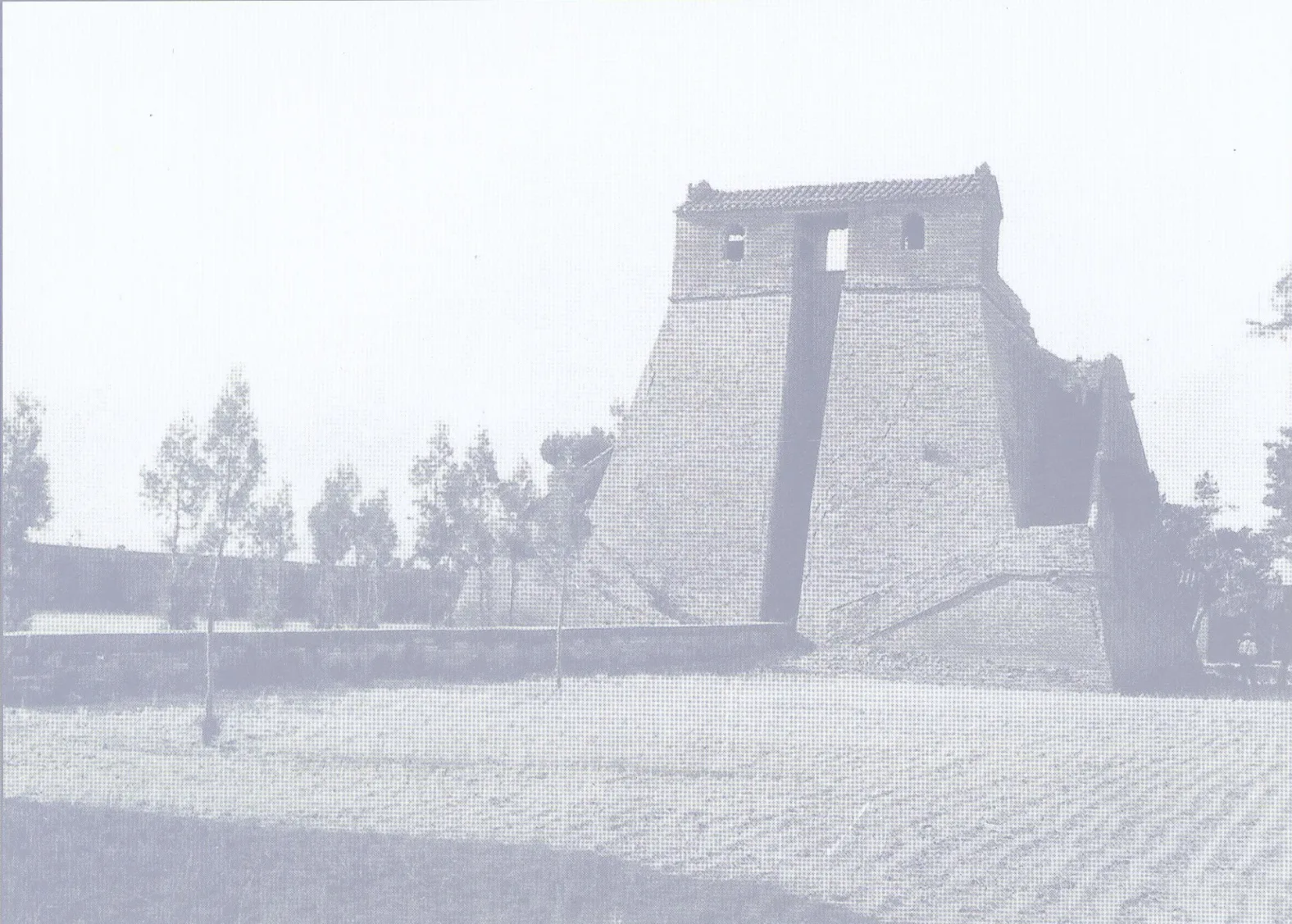
In 1937, Liu Dunzhen, a full-time researcher at the Society for Research in Chinese Architecture, surveyed the Duke of Zhou Temple and the observatory. The survey produced measured drawings and photographs, and Liu also wrote “Notes on an Investigation of the Duke of Zhou Temple at Gaocheng.” These materials were published together in the 1939 Survey Report on the Duke of Zhou Shadow-Measuring Terrace. Liang Sicheng later wrote in A History of Chinese Architecture that the Society had been commissioned to prepare a restoration plan for the Dengfeng observatory, but war broke out before it could be implemented. During the 1944 Central Henan Campaign, Japanese forces advanced into Dengfeng and Gaocheng and shelled the observatory. The eastern chamber atop the terrace collapsed, while the east wall, parapets, and stair balustrades were badly damaged. During restoration in 1975, two less severely damaged shell holes were deliberately retained in the east wall. Seen alongside the photographs in the 1937 report, they show respectively the building before the bombardment and the marks left by artillery fire.
Historical Sources
《周礼注疏》 (Commentary and Subcommentary on the Rites of Zhou)
以土圭之法测土深,正日景,以求地中。日南则景短,多暑;日北则景长,多寒;日东则景夕,多风;日西则景朝,多阴。注:土圭,所以致四时日月之景也。测犹度也。不知广深,故曰测。故书求为救,杜子春云:当为求。郑司农云:测土深,谓南北东西之深也。日南,谓立表处大南,近日也。日北,谓立表处大北,远日也。景夕,谓日跌景乃中,立表之处大东,近日也。景朝,谓日未中而景中,立表处大西,远日也。玄谓昼漏半而置土圭,表阴阳,审其南北。景短于土圭,谓之日南,是地于日为近南也。景长于土圭谓之日北,是地于日为近北也。东于土圭谓之日东,是地于日为近东也。西于土圭谓之日西,是地于日为近西也。如是则寒暑阴风偏而不和,是未得其所求。凡日景于地,千里而差一寸。
By the method of the earthen measuring scale, measure the land’s extent, rectify the Sun’s shadow, and thereby seek the centre of the earth. South of it the shadow is short and there is much heat; north of it the shadow is long and there is much cold; east of it the shadow reaches its midpoint late and there is much wind; west of it the shadow reaches its midpoint early and there is much cloud. Commentary: The earthen scale is used to obtain the shadows of the Sun and Moon through the four seasons. “Measure” means to gauge. Because breadth and depth are unknown, it is called measuring. An old text has “rescue” in place of “seek”; Du Zichun says it should read “seek.” Zheng Sinong says: measuring the land’s extent means its reach north and south, east and west. “South of the Sun” means that the place where the gnomon is erected lies far to the south and is near the Sun. “North of the Sun” means that it lies far to the north and is distant from the Sun. “Shadow at evening” means that the Sun has declined before the shadow reaches the central mark: the gnomon stands far to the east, near the Sun. “Shadow in the morning” means that the shadow reaches the central mark before noon: the gnomon stands far to the west, distant from the Sun. Xuan says: at the midpoint of the daytime water clock, set down the earthen scale, distinguish yin from yang, and verify north and south. A shadow shorter than the scale is called “south of the Sun,” meaning the land is nearer the Sun toward the south. A shadow longer than the scale is called “north of the Sun,” meaning the land is nearer the north in relation to the Sun. East of the scale is called “east of the Sun,” meaning the land is nearer the east in relation to the Sun. West of the scale is called “west of the Sun,” meaning the land is nearer the west in relation to the Sun. In such places cold or heat, cloud or wind is excessive and not harmonious, so what is sought has not yet been found. In general, the Sun’s shadow on the earth differs by one inch for every thousand li.
日至之景,尺有五寸,谓之地中,天地之所合也,四时之所交也,风雨之所会也,阴阳之所和也。然则百物阜安,乃建王国焉。制其畿方千里而封树之。注:景尺有五寸者,南戴日下万五千里,地与星辰四游升降于三万里之中,是以半之,得地之中也。畿方千里,取象于日一寸为正。树,树木沟上,所以表助阻固也。郑司农云:土圭之长尺有五寸,以夏至之日,立八尺之表,其景适与土圭等,谓之地中。今颍川阳城地为然。
When the solstitial shadow is one chi and five cun long, the place is called the centre of the earth: where Heaven and Earth unite, the four seasons intersect, wind and rain converge, and yin and yang harmonise. There all living things flourish in peace, and there the royal capital is established. Its domain is laid out as a square one thousand li on each side and marked by planted trees. Commentary: Where the shadow is one chi and five cun, the point directly beneath the Sun lies fifteen thousand li to the south. The earth and the stars roam and rise or descend within a span of thirty thousand li; taking half therefore yields the earth’s centre. A domain one thousand li square takes as its standard the correspondence of one inch of shadow to one thousand li. “Planting” means planting trees above the ditch, both to mark it and to strengthen its defences. Zheng Sinong says: the earthen scale is one chi and five cun long. On the summer solstice, an eight-chi gnomon is erected; where its shadow exactly equals the scale, that place is called the centre of the earth. This is so at Yangcheng in Yingchuan today.
《隋书》 (Book of Sui)
昔者周公测晷景于阳城,以参考历纪。其于周礼,在大司徒之职,“以土圭之法测土深,正日景,以求地中。日至之景,尺有五寸,则天地之所合,四时之所交,百物阜安,乃建王国。”然则日为阳精,玄象之著然者也。生灵因之动息,寒暑由其递代。观阴阳之升降,揆天地之高远,正位辨方,定时考闰,莫近于兹也。古法简略,旨趣难究,术家考测,互有异同。先儒皆云:“夏至立八尺表于阳城,其影与土圭等。”案尚书考灵曜称:“日永,景尺五寸;日短,景尺三寸。”易通卦验曰:“冬至之日,树八尺之表,日中视其晷景长短,以占和否。夏至景一尺四寸八分,冬至一丈三尺。”周髀云:“成周土中,夏至景一尺六寸,冬至景一丈三尺五寸。”刘向鸿范传曰:“夏至景长一尺五寸八分,冬至一丈三尺一寸四分,春秋二分景七尺三寸六分。”后汉四分历、魏景初历、宋元嘉历、大明祖冲之历,皆与考灵曜同。汉魏及宋,所都皆别。四家历法,候景则齐。且纬候所陈,恐难依据。刘向二分之景,直以率推,非因表候定其长短。然寻晷景尺丈,虽有大较,或地域不改,而分寸参差,或南北殊方,而长短维一。盖术士未能精验,冯古所以致乖。今删其繁杂,附于此云。
In former times the Duke of Zhou measured gnomon shadows at Yangcheng in order to examine the calendar. In the Rites of Zhou this appears among the duties of the Grand Minister of Education: “By the method of the earthen measuring scale, measure the land’s extent, rectify the Sun’s shadow, and thereby seek the centre of the earth. When the solstitial shadow is one chi and five cun, that is where Heaven and Earth unite and the four seasons intersect; all living things flourish in peace, and there the royal capital is established.” The Sun is thus the essence of yang and the most manifest of the celestial signs. Living beings move and rest by it, and cold and heat succeed one another through it. Nothing is more immediate than this for observing the waxing and waning of yin and yang, gauging the height and breadth of Heaven and Earth, fixing position and distinguishing direction, determining the seasons, and verifying intercalation. Ancient methods were terse and their purport difficult to fathom; specialists who tested them reached differing results. Earlier scholars all said: “At the summer solstice an eight-chi gnomon was erected at Yangcheng, and its shadow equalled the earthen scale.” The Kaolingyao commentary on the Documents states: “On the longest day the shadow is one chi and five cun; on the shortest day it is one chi and three cun.” The Yitong Guayan says: “On the winter solstice erect an eight-chi gnomon and at noon observe the length of its shadow to divine harmony or disorder. At the summer solstice the shadow is one chi, four cun and eight fen; at the winter solstice, one zhang and three chi.” The Zhoubi says: “At the centre of the land in Chengzhou, the summer-solstice shadow is one chi and six cun, and the winter-solstice shadow one zhang, three chi and five cun.” Liu Xiang’s commentary on the Hongfan says: “The summer-solstice shadow is one chi, five cun and eight fen; at the winter solstice one zhang, three chi, one cun and four fen; and at the spring and autumn equinoxes seven chi, three cun and six fen.” The Later Han Quarter-Remainder Calendar, the Wei Jingchu Calendar, the Song Yuanjia Calendar, and Zu Chongzhi’s Daming Calendar all agree with the Kaolingyao. Yet the Han, Wei, and Song capitals occupied different sites, while all four calendars gave the same observed shadows. What the apocryphal prognostication texts record is therefore difficult to trust. Liu Xiang’s equinoctial shadows were simply extrapolated by ratio, not established by observations with a gnomon. On examining recorded shadow lengths, one finds that even at the same place the figures sometimes differ, while places far apart north and south sometimes produce identical lengths. Specialists evidently failed to test them precisely and relied on antiquity, thereby producing discrepancies. Their confusing profusion is now pruned and the material appended here.
《元和郡县图志》 (Illustrated Gazetteer of the Prefectures and Counties of the Yuanhe Era)
测景台在县城内西北隅,高一丈,开元十年,诏太史监南宫说立石表焉。
The Shadow-Measuring Terrace stands in the north-west corner within the county town and is one zhang high. In the tenth year of the Kaiyuan era, Nangong Yue, Director of the Astronomical Bureau, was ordered to erect a stone gnomon there.
《玉海》 (Sea of Jade)
地理志:河南府阳城县南有测景台。开元十一年,诏太史监南宫说刻石表焉。会要:仪凤四年五月,太史令姚元辨奏于阳城测景台立八尺表,夏至日中测景尺有五寸。调露元年十一月十一日,于阳城周公测景所得土圭,长丈二尺七寸。高宗大衍历议:考麟德已前实录,书时历,不书候景。浑天二分为东西之中,而晷景不等;二至为南北之极,而进退不齐。开元历所推日度及气,皆直子半之始,与祖冲之所筭二百年间辄差一日之数皆合。有中气日度之议,日躔之略例,步日躔轨漏之术。冬至去极百十七度二十分,阳城日晷丈二尺七寸一分。夏至去极六十七度四十分,晷尺四寸七分。春秋分去极九十一度三十分,晷五尺四寸三分。每气初日,中晷常数不齐,测其地二至日晷较长短同者为戴日北度数,依阳城术求之。诃陵夏至立六尺表,景在表南二尺四寸。六典:天下测景之处,分至表准,各有典常三日壬子,于京丽正院定表样,审尺寸,太史驰驿,分往测候。集贤注记:以二分至之日正午量景长短,数年候之乃定。还京,一行校之。陈元景曰:以丈尺之术,窥天地之大,岂可定乎?天文志:大衍议曰:数十里之高与十里之广,犹斜射之影与仰望不殊。今欲凭晷差以推远近高下,尚不可知,况稽周天星步于不测之中,又可必乎?通典:阳城有测景台,开元以阳城测景未中,乃于浚仪之岳台。文苑英华范荣测景台赋:据河洛之要,创造化之功,下压坤德,上罗乾纬。囊括众巧,网罗群艺,平四气而正两仪。
The geographical treatise states: south of Yangcheng County in Henan Prefecture there is a Shadow-Measuring Terrace. In the eleventh year of Kaiyuan, Nangong Yue, Director of the Astronomical Bureau, was ordered to carve a stone gnomon there. The Institutional Compendium records: in the fifth month of the fourth year of Yifeng, Director of Astronomy Yao Yuanbian reported that an eight-chi gnomon had been erected on the Yangcheng terrace; at noon on the summer solstice its shadow measured one chi and five cun. On the eleventh day of the eleventh month in the first year of Tiaolu, the earthen scale used for the Duke of Zhou’s shadow measurement at Yangcheng measured one zhang, two chi and seven cun. Emperor Gaozong’s discussion of the Dayan Calendar notes: the veritable records before the Linde era recorded seasons and calendars but not shadow observations. The two celestial equinoxes mark the centre east and west, yet gnomon shadows are unequal; the two solstices mark the northern and southern extremes, yet their advance and retreat are uneven. The solar positions and seasonal nodes calculated by the Kaiyuan calendar all begin at midnight and agree with Zu Chongzhi’s rate of a one-day discrepancy every two hundred years. It contains discussions of solar longitude at the principal terms, summary rules for the Sun’s path, and procedures for calculating that path, the gnomon, and the water clock. At the winter solstice the distance from the pole is 117 degrees and 20 parts, and the Yangcheng shadow is one zhang, two chi, seven cun and one fen. At the summer solstice the distance is 67 degrees and 40 parts, and the shadow one chi, four cun and seven fen. At the spring and autumn equinoxes it is 91 degrees and 30 parts, and the shadow five chi, four cun and three fen. The standard noon shadow on the first day of each seasonal node is not uniform. At each location, where the difference between the two solstitial shadows is the same, this gives the number of degrees north of the subsolar point; it is obtained by the Yangcheng method. At Heling, with a six-chi gnomon at the summer solstice, the shadow fell two chi and four cun south of the gnomon. The Six Codes states: at shadow-measuring stations throughout the realm, the standards for gnomons at the equinoxes and solstices followed established regulations. On the renzi day of the third month, the gnomon pattern was fixed and its dimensions checked at the Lizheng Institute in the capital; astronomers then travelled by relay to the different stations to observe. The Jixian Notes states: the shadow’s length was measured at noon on the equinoxes and solstices, and only established after observations over several years. The observers returned to the capital, where Yixing compared the results. Chen Yuanjing said: how can one determine the magnitude of Heaven and Earth by methods of zhang and chi? The astronomical treatise quotes the Dayan discussion: a height of tens of li and a breadth of ten li appear no different whether inferred from an oblique shadow or viewed upward. If even distance and elevation cannot be known from differences in gnomon shadows, how can the movement of stars around the heavens amid the immeasurable be established with certainty? The Comprehensive Institutions records: Yangcheng had a Shadow-Measuring Terrace; in the Kaiyuan era the Yangcheng observation did not yield the centre, so observations were also made at Yuetai in Junyi. Fan Rong’s “Rhapsody on the Shadow-Measuring Terrace,” in the Finest Blossoms in the Garden of Literature, says: “Occupying the crucial ground of the Yellow and Luo Rivers, it creates the workings of transformation; below it presses upon the virtue of Earth, above it encompasses the celestial courses. It gathers every ingenious craft, draws together the multitude of arts, balances the four seasonal breaths, and rectifies the two cosmic principles.”
《文苑英华》 (Finest Blossoms in the Garden of Literature)
大圣崇业,万象潜通。据河洛之要,创造化之功。建以黄壤,亘以紫宫。右辅伊阙,左连𮝹嵩。银台比而可拟,灜壶方而讵同。掩扶桑于日域,包蓬莱于海蒙。式均霜露之气,以分天地之中。于是仰玄穹之文,俯黄壤之理。下压坤德,上罗乾纬。垂形象物,既不假于玉衡;司刻探玄,何必邀于铜史。其细也难究,其妙也若此。斯岂光阴而若易徙。且夫圣不可测,道实兼致。天地与能,幽灵必契。囊括众巧,网罗群艺。自然而来,畴能比计。今来古往,时移道替。滋岁月以成朽,觉风尘之渐异。人有代兮俗没,地有形兮无制。零落空阶,莓苔古砌。颓墉逦迆,但觉萧条。高阜荒凉,寒城芜翳。攀圣迹而难企,感吾徒而流涕。猗欤成周,系圣纂极。君少臣政,流言更逼。自陜卜洛,其仪不忒。公敷其化,人尽其力。惠而不费,功成事息。钦圣德之微臭,岂赋者之能识。
The Great Sage exalted his undertaking, and the myriad signs responded unseen. Occupying the crucial ground of the Yellow and Luo Rivers, he created the workings of transformation. It was raised from yellow earth and extended toward the Purple Palace. To the right it was supported by Yique, to the left it joined lofty Song. The Silver Terrace might be compared with it, but how could the square Isles of the Immortals be its equal? It eclipsed Fusang in the realm of the Sun and embraced Penglai beyond the misty sea. By it the breaths of frost and dew were balanced, and the centre between Heaven and Earth distinguished. One looked upward to the patterns of the dark firmament and downward to the principles of the yellow earth. Below it pressed upon the virtue of Earth; above it encompassed the celestial courses. To set forth forms and model things, it did not need the jade armillary; to mark the hours and probe mysteries, why summon the bronze official? Its refinements are difficult to exhaust; such is its wonder. Could it truly have shifted as readily as light and shadow? The sage cannot be fathomed, yet his Way brought all things to fulfilment. Heaven and Earth granted him their powers, and hidden spirits surely accorded with him. He gathered every ingenious craft and drew together the multitude of arts. It arose of itself: who could reckon anything comparable? From antiquity to the present, times changed and the Way was displaced. As years accumulated it decayed, and windblown dust gradually altered it. Generations of people passed and customs vanished; the site retained its form but lost its regulation. Empty steps lay broken, old masonry covered in moss. Ruined walls trailed away in desolation; the high mound was bleak, the cold town choked with weeds. Reaching toward the Sage’s traces yet unable to attain them, we of a later age weep with emotion. Magnificent Chengzhou! The Sage succeeded to the highest charge. The ruler was young and his minister governed, while slander pressed ever harder. From dividing rule at Shan to choosing Luo, his measures never erred. The Duke spread his transforming influence and the people exerted all their strength. He bestowed benefit without waste; when the work was done, activity ceased. The faint fragrance of his sacred virtue commands reverence—how could the composer of a rhapsody comprehend it?
《历代名臣奏议》 (Memorials of Eminent Ministers Through the Ages)
元世祖至元十三年,命郭守敬与王恂率南北日官分掌测验,推于下,命张文谦与枢密张易为之主领裁奏于上,左丞许衡参预其事。郭守敬首言:历之本在于测验,而测验之器莫先仪表。今司天浑仪,宋皇祐中汴京所造,不与此处天度相符,比量南北二极,约差四度,表石年深,亦复攲侧。守敬乃尽考其失而移置之。又奏:唐一行开元间令南宫说天下测景,书中见者凡十三处。今疆宇比唐尤大,若不远方测验,日月交食分数时刻不同,昼夜长短不同,日月星辰去天高下不同,即曰测验人少,可先南北立表,取直测景。帝可其奏。
In the thirteenth year of Zhiyuan under Emperor Shizu of the Yuan, Guo Shoujing and Wang Xun were ordered to lead astronomers north and south and divide responsibility for observations and calculations in the field. Zhang Wenqian and Zhang Yi of the Bureau of Military Affairs were placed in overall charge, reviewing the findings and submitting them to the throne, while Assistant Chancellor Xu Heng took part. Guo Shoujing first stated: “The foundation of a calendar lies in observation, and among the instruments of observation none precedes the armillary sphere and gnomon. The present armillary sphere of the Astronomical Bureau was made at Bianjing during the Song dynasty’s Huangyou era and does not accord with the celestial coordinates here. Comparing the northern and southern poles reveals a discrepancy of about four degrees; the stone gnomon, being old, has also tilted.” Shoujing therefore examined all its faults and relocated it. He further memorialised: “During the Tang dynasty’s Kaiyuan era, Yixing ordered Nangong Yue to measure shadows throughout the realm; thirteen locations are recorded in books. Our territory is now even larger than the Tang’s. Unless observations are made in distant regions, the different magnitudes and times of solar and lunar eclipses, the varying lengths of day and night, and the differing altitudes of the Sun, Moon, and stars cannot be known. If observers are too few, gnomons may first be erected along a north–south line to obtain direct shadow measurements.” The emperor approved his proposal.
《元史》 (History of the Yuan)
南海,北极出地一十五度,夏至景在表南,长一尺一寸六分,昼五十四刻,夜四十六刻。衡岳,北极出地二十五度,夏至日在表端,无景,昼五十六刻,夜四十四刻。岳台,北极出地三十五度,夏至晷景长一尺四寸八分,昼六十刻,夜四十刻。和林,北极出地四十五度,夏至晷景长三尺二寸四分,昼六十四刻,夜三十六刻。铁勒,北极出地五十五度,夏至晷景长五尺一分,昼七十刻,夜三十刻。北海,北极出地六十五度,夏至晷景长六尺七寸八分,昼八十二刻,夜一十八刻。大都,北极出地四十度太强,夏至晷景长一丈二尺三寸六分,昼六十二刻,夜三十八刻。上都,北极出地四十三度少。
Nanhai: the north celestial pole rises 15 degrees above the horizon. At the summer solstice the shadow falls south of the gnomon and measures one chi, one cun and six fen; day is 54 ke and night 46. Mount Heng: the pole rises 25 degrees. At the summer solstice the Sun reaches the tip of the gnomon and casts no shadow; day is 56 ke and night 44. Yuetai: the pole rises 35 degrees. The summer-solstice shadow measures one chi, four cun and eight fen; day is 60 ke and night 40. Helin: the pole rises 45 degrees. The shadow measures three chi, two cun and four fen; day is 64 ke and night 36. Tiele: the pole rises 55 degrees. The shadow measures five chi and one fen; day is 70 ke and night 30. Beihai: the pole rises 65 degrees. The shadow measures six chi, seven cun and eight fen; day is 82 ke and night 18. Dadu: the pole rises slightly more than 40 degrees. The shadow measures one zhang, two chi, three cun and six fen; day is 62 ke and night 38. Shangdu: the pole rises slightly less than 43 degrees.
北京,北极出地四十二度强。
Beijing: the north celestial pole rises slightly more than 42 degrees above the horizon.
益都,北极出地三十七度少。
Yidu: the pole rises slightly less than 37 degrees.
登州,北极出地三十八度少。
Dengzhou: the pole rises slightly less than 38 degrees.
高丽,北极出地三十八度少。
Goryeo: the pole rises slightly less than 38 degrees.
西京,北极出地四十度少。
Western Capital: the pole rises slightly less than 40 degrees.
太原,北极出地三十八度少。
Taiyuan: the pole rises slightly less than 38 degrees.
安西府,北极出地三十四度半强。兴元,北极出地三十三度半强。成都,北极出地三十一度半强。西凉州,北极出地四十度强。
Anxi Prefecture: the pole rises a little more than 34.5 degrees. Xingyuan: a little more than 33.5 degrees. Chengdu: a little more than 31.5 degrees. Xiliang Prefecture: slightly more than 40 degrees.
东平,北极出地三十五度太。
Dongping: the pole rises somewhat more than 35 degrees.
大名,北极出地三十六度。
Daming: the pole rises 36 degrees.
南京,北极出地三十四度太强。河南府阳城,北极出地三十四度太弱。扬州,北极出地三十三度。
Southern Capital: the pole rises appreciably more than 34 degrees. Yangcheng in Henan Prefecture: appreciably less than 34 degrees. Yangzhou: 33 degrees.
鄂州,北极出地三十一度半。
Ezhou: the pole rises 31.5 degrees.
吉州,北极出地二十六度半。
Jizhou: the pole rises 26.5 degrees.
雷州,北极出地二十度太。
Leizhou: the pole rises somewhat more than 20 degrees.
琼州,北极出地一十九度太。
Qiongzhou: the pole rises somewhat more than 19 degrees.
《嵩书》 (Book of Mount Song)
测景台,在告成镇,即古阳城地也。有石方可仞余,耸立盈丈,上植石表八尺,刻其南曰周公测景台。按周礼大司徒职:以土圭之法测土深,正日景,以求地中,故云:日南则景短多暑,日北则景长多寒;日东则景夕多风,日西则景朝多阴。日至之景尺有五寸,谓之地中。郑众说:土圭之长尺有五寸,以夏至之日立八尺之表,其景与土圭等,谓之地中。今颍川阳城地也。郑玄云:凡日景于地千里而差一寸。景尺有五寸者,南戴日下万五千里也。以此推之,日当去其下地八万里矣。日邪射阳城,则天径之半也。天体员如弹,九地处天之半,而阳城为中,则日春秋冬夏,昏明昼夜,去阳城皆等,无盈缩矣。
The Shadow-Measuring Terrace is in Gaocheng Town, the site of ancient Yangcheng. A squared stone, more than a ren in breadth and over one zhang high, rises there; on it stands an eight-chi stone gnomon. Its south face is inscribed “Duke of Zhou Shadow-Measuring Terrace.” According to the duties of the Grand Minister of Education in the Rites of Zhou: “By the method of the earthen measuring scale, measure the land’s extent, rectify the Sun’s shadow, and thereby seek the centre of the earth.” Thus it says: south of the Sun the shadow is short and there is much heat; north of it the shadow is long and there is much cold; east of it the shadow reaches the mark late and there is much wind; west of it the shadow reaches the mark early and there is much cloud. A solstitial shadow one chi and five cun long marks the centre of the earth. Zheng Zhong says: the earthen scale is one chi and five cun long. At the summer solstice an eight-chi gnomon is erected; where its shadow equals the scale, that place is called the centre of the earth. This is so at Yangcheng in Yingchuan today. Zheng Xuan says: on the earth the Sun’s shadow differs by one cun every thousand li. Where it measures one chi and five cun, the point directly below the Sun lies fifteen thousand li to the south. By this reckoning the Sun should stand eighty thousand li above the ground below it. When the Sun shines obliquely on Yangcheng, that distance is half the diameter of Heaven. Heaven is round like a pellet, the nine regions occupy its middle, and Yangcheng is the centre; hence through spring, autumn, winter, and summer, at dusk and dawn, by day and night, the Sun’s distance from Yangcheng should always be equal, neither waxing nor waning.
故知从日邪射阳城,为天径之半也。隋志云:昔者周公测晷景于阳城,以参考历纪。杜氏通典云:仪凤四年五月,命太常博士姚玄于阳城测景台,依古法立八尺表,夏至日中,测景尺有五寸,正与古法同。唐地理志云:阳城有测景台,开元十一年,谄太史监南宫说刻石表焉,即今表是也。古人置臬之法变矣。
Thus we know that the oblique line from the Sun to Yangcheng equals half the diameter of Heaven. The astronomical treatise of the Book of Sui states: “In former times the Duke of Zhou measured gnomon shadows at Yangcheng in order to examine the calendar.” Du You’s Comprehensive Institutions says: “In the fifth month of the fourth year of Yifeng, Yao Xuan, Erudite of the Court of Imperial Sacrifices, was ordered to erect an eight-chi gnomon on the Yangcheng terrace according to the ancient method. At noon on the summer solstice its measured shadow was one chi and five cun, exactly agreeing with the ancient rule.” The Tang geographical treatise says: “Yangcheng has a Shadow-Measuring Terrace. In the eleventh year of Kaiyuan, Nangong Yue, Director of the Astronomical Bureau, was ordered to carve a stone gnomon there.” This is the gnomon now standing. The ancient method of setting up a standard had changed.
观星台在测景台北,高五丈,阔二丈,名曰观星台,砖甃尚完,想亦唐所建也。台北面凹入数尺,悬直而下,相传为滴漏之所,莫晓其制。下有平石数十方,向北接连一路,阔一尺,高二尺,约长十丈。石面有通池二条,其宽如指,至北尽头处合而为一。此必古人用以置水而取平也。隋天文志云:考工记:匠人建国,水地以县,置槷以县视,以景为规,识日出之景与日入之景,昼参诸日中之景,夜考之极星,以正朝夕。又按:梁祖暅造八尺铜表,其下与圭相连,圭上为沟,置水以取平正,揆测日晷,求其盈缩。由此观之,则知测景、观星、置水,虽似三事,总之所以求地中耳。
The Observatory stands north of the Shadow-Measuring Terrace. Five zhang high and two zhang wide, it is called the Observatory; its brickwork remains intact, and one supposes that it too was built in the Tang. Its north face is recessed several chi and drops vertically; tradition calls this the site of a water clock, though no one understands its construction. Below lie scores of dressed stones joined into a northward path, one chi wide, two chi high, and about ten zhang long. Two continuous channels, each as wide as a finger, run along the stone surface and merge at the northern end. These must have held water so that the ancients could establish a level. The astronomical treatise of the Book of Sui quotes the Record of Trades: “When the craftsman establishes a capital, he levels the ground with water and a plumb line, sets a marker and sights it with a plumb line, takes the shadow as his compass, records the shadows at sunrise and sunset, checks them by the noon shadow during the day, and by the pole star at night, thereby rectifying east and west.” It also records that Zu Geng of the Liang made an eight-chi bronze gnomon joined below to a scale. A channel on the scale held water to establish level and true alignment; he measured the Sun’s shadow to determine its increase and decrease. From this one understands that measuring shadows, observing stars, and levelling with water, though apparently three matters, all ultimately served to seek the centre of the earth.
《万历野获编》 (Informal Gleanings from the Wanli Era)
再阅朱裕疏内云:观象台晷表与南京矛盾,是即正统间彭德清测景不同之说也,未审其说确否。至于南阳土圭,惟嘉靖二年,河南抚臣何天衢请祀周公,疏中云:登封县有观象、测景二台,乃周公营洛邑时手建遗迹,其土圭、表漏尚存,宜敕钦天官至彼考正制度尺寸,以凭授历。然则中原日圭,又不在南阳矣。总之,岁久讹传,未足凭也。
Reading Zhu Yu’s memorial again, one finds: “The gnomon at the Observatory contradicts that at Nanjing.” This is the same claim, made by Peng Deqing during the Zhengtong era, that shadow measurements differed; whether it is correct remains uncertain. As for the earthen scale at Nanyang, in the second year of Jiajing the Henan governor He Tianqu petitioned that sacrifices be offered to the Duke of Zhou. His memorial said: “Dengfeng County has an Observatory Terrace and a Shadow-Measuring Terrace, relics built by the Duke of Zhou himself when planning Luoyi. Their earthen scale, gnomon, and water clock still survive. Officials of the Imperial Astronomical Bureau should be ordered there to examine and correct their design and dimensions, as a basis for issuing the calendar.” Thus the solar gnomon of the Central Plain was not at Nanyang after all. In short, transmission over many years produced errors, and such accounts are insufficiently reliable.
《嵩山志》 (Gazetteer of Mount Song)
登封县东南三十里有先圣周公测景台,迄今二千余载,归然独存。考之周礼大司徒职日:以土圭之法测土深,正日景,以求地中。日南则景短多暑,日北则景长多寒,日东则景夕多风,日西则景朝多阴。日至之景尺有五寸,谓之地中。天地之所合也,四时之所交也,风雨之所会也,阴阳之所和也。盖周公相成王,定都于洛,立土形胜圭,以测日景,求地中。其制度精审,有非大圣人不能作者。先周公而圣者日:尧、舜、禹、汤、文、武,达而行道于上;后周公而圣者曰孔子、孟子,穷而明道于下。惟周公以元圣任行道之责,而兼明道之功。观之六经,则可知矣。孔子之道,实传之周公。故曰:甚矣,吾衰也久矣,吾不复梦见周公。自昔论大圣人者,必以周公并称,而汉唐以来。祠于学宫,率以周公为先圣,孔子为先师,自后尊孔子为先圣,而学者不复知有周公矣。故愚尝欲建议以周公、孔子并祀于学,而未之举也。巳卯之冬,承乏波台。明年春,公牒稍暇,乃稽图经,得所谓测景台者,亟檄有司,葺其颓坏,芟其繁芜,以复古制。台之北旧有周公庙,久而湮废,复令重修之,殿庑门墙,焕然一新,扁曰先圣文宪王庙,盖唐所封爵谥也。乃遣儒官祭告,仍著为定式,岁以春秋次丁,有司致祭如仪,庶以表元圣之制作,而系千古之瞻仰云尔。崇德报功,岂止于是哉!有司请文纪其事,谨拜手稽首而为之书。其承檄修复,则知县韩锡、典史李崇学也。而观星台在庙之北,相传亦周公所筑,因并及之,以传疑云。
Thirty li south-east of Dengfeng County stands the Shadow-Measuring Terrace of the Former Sage, the Duke of Zhou. After more than two thousand years, it alone survives in lofty isolation. Examining the duties of the Grand Minister of Education in the Rites of Zhou, one reads: “By the method of the earthen measuring scale, measure the land’s extent, rectify the Sun’s shadow, and thereby seek the centre of the earth. South of the Sun the shadow is short and there is much heat; north of it the shadow is long and there is much cold; east of it the shadow reaches the mark late and there is much wind; west of it the shadow reaches the mark early and there is much cloud. A solstitial shadow one chi and five cun long marks the centre of the earth: where Heaven and Earth unite, the four seasons intersect, wind and rain converge, and yin and yang harmonise.” When the Duke of Zhou served as regent to King Cheng and fixed the capital at Luo, he set up an earthen scale at a commanding site to measure the Sun’s shadow and seek the centre of the earth. Its design was so precise and exacting that none but a great sage could have devised it. Sages before the Duke of Zhou were Yao, Shun, Yu, Tang, Wen, and Wu, who attained office and practised the Way above. Sages after him were Confucius and Mencius, who in adversity made the Way clear below. The Duke of Zhou alone, as the Primal Sage, bore responsibility for putting the Way into practice while also accomplishing the work of elucidating it. This is evident from the Six Classics. Confucius’s Way was truly transmitted from the Duke of Zhou; hence his saying, “How deeply I have declined! It has been so long since I dreamed of the Duke of Zhou.” From antiquity, those who discussed great sages always named the Duke of Zhou among them. From the Han and Tang onward, schools generally enshrined the Duke of Zhou as Former Sage and Confucius as Former Teacher. Later Confucius was honoured as Former Sage, and scholars no longer knew the Duke of Zhou. I therefore once wished to propose that the Duke of Zhou and Confucius be worshipped together in the schools, but did not carry it out. In the winter of the yimao year, I assumed an unworthy post at Botai. In the following spring, when official correspondence eased, I consulted illustrated gazetteers and found the so-called Shadow-Measuring Terrace. I urgently ordered the authorities to repair its ruins and clear its overgrowth, restoring its ancient form. North of the terrace had once stood a Duke of Zhou Temple, long since lost; I ordered that it too be rebuilt. Halls, side buildings, gate, and walls were all made resplendently new, and it was inscribed “Temple of the Former Sage, King Wenxian,” the title and posthumous name conferred in the Tang. Confucian officials were sent to announce the work through sacrifice, and a permanent rule was established: each spring and autumn, on the second ding day, the authorities were to perform the rites. This would manifest the Primal Sage’s achievements and command the reverence of ages to come. Yet can honouring virtue and repaying merit end even there? The authorities requested a text recording the affair; with folded hands and bowed head, I respectfully wrote it. Those who repaired the site in response to the order were Magistrate Han Xi and Registrar Li Chongxue. The Observatory stands north of the temple and tradition likewise attributes it to the Duke of Zhou; I mention it as well, transmitting the matter as doubtful.
Historical Photographs
Circa 1936–1937
These photographs of the “Duke of Zhou Temple and Observatory at Gaocheng Town, Dengfeng, Henan” were published in volume one of An Illustrated History of Chinese Architecture. The book does not identify the exact date or photographer of either image.
1937
In 1937, Dong Zuobin, Liu Dunzhen, Gao Pingzi, and others conducted a field survey of the Duke of Zhou Shadow-Measuring Terrace, the observatory, and the surrounding temple. Their findings were collected in the 1939 Survey Report on the Duke of Zhou Shadow-Measuring Terrace. The volume preserves a continuous photographic record of the shadow-measuring terrace, the Yuan observatory, the Heaven-Measuring Scale, the temple precinct, and architectural details of the observatory. Every photograph below predates the shelling of 1944.
The Duke of Zhou Shadow-Measuring Terrace, Yuan observatory, and Heaven-Measuring Scale, as published in Dong Zuobin’s Survey Report on the Duke of Zhou Shadow-Measuring Terrace.
Panoramic views of the Duke of Zhou Temple, cult images in the shrine, the ceremonial gate, the main gate, and the chambers atop the observatory, from the same survey.
The shadow-measuring terrace, exterior, stairs, platform surface, brick balustrades, and details of the buildings atop the observatory, as published in Liu Dunzhen’s “Notes on an Investigation of the Duke of Zhou Temple at Gaocheng.”