Introduction
Fengxue Temple is a Buddhist monastery built into the slopes of Mount Fengxue, northeast of Ruzhou in Henan. It is also called Baiyun Temple and Qianfeng Temple[1]. Accounts differ on its foundation: Ming inscriptions trace it to the Northern Wei, while other texts place it in the Sui or Tang. Master Zhen practiced on the mountain during the Tang, and his Kaiyuan Temple pagoda inscription was erected in 738, the twenty-sixth year of Kaiyuan. During the Five Dynasties, famine scattered the community. Buddhist images, bells, and drums remained beside a few thatched huts on the mountainside.
In 931, the second year of Changxing under the Later Tang, Master Yanzhao reached Ruzhou. He asked a farmer about the huts and learned that this was the old Fengxue Temple. When he asked whether he could stay, the farmer agreed. For seven years he lived alone, begging in nearby villages by day and burning pine resin for light at night. Local officials, monks, and townspeople eventually invited him to teach publicly. Warfare later forced him and his community to seek refuge in Yingzhou.
After the fighting subsided, a Ruzhou patron known as Grand Preceptor Song donated his residence for conversion into a monastery and invited Yanzhao back as abbot. In 951, the first year of Guangshun under the Later Zhou, the court bestowed the name Guanghui on this new monastery. Yanzhao presided there for twenty-two years, usually with over a hundred monks. The Compendium of the Five Lamps calls it the ‘new monastery,’ distinguishing it from the old mountain temple where he had lived earlier.
In 1125, the seventh year of Xuanhe under the Northern Song, a Bell Pavilion was added among the mountain monastery’s halls and galleries, and a large iron bell was cast that year. The Jin-period Middle Buddha Hall stands within Fengxue Temple, in front of the Vairocana Hall. This timber Buddhist hall is three bays wide and three deep, with a single tier of eaves and gray cylindrical roof tiles.
Memorial pagodas for eminent monks were built around the monastery during the Yuan. In 1280, the seventeenth year of Zhiyuan, the Upper Pagoda Cemetery received the pagoda of Master Songqi Hui. Its hexagonal brick body rises through four stories in imitation of a wooden tower. Brick carvings beneath each tier of eaves reproduce timber details; doors, windows, and patterned latticework decorate the lowest story. In 1342, the second year of Zhizheng, Master Zhao’s Pagoda was rebuilt in the Lower Pagoda Cemetery to commemorate Yanzhao, who had lived and taught at the mountain monastery.
By 1475, the eleventh year of Chenghua under the Ming, the old Vairocana Hall had fallen into disrepair. Abbot Yuanzheng began rebuilding with his disciples but died before completion. Qingxiu, his teacher Manwei, and the monk Qingliu continued the work, while the monk Jingshu and others raised funds alongside local elders including Wang Fushan. The hall was finally completed in 1507, the second year of Zhengde, thirty-two years after work began. Standing before the former lecture room of the Confucian scholar Li Xing, it was lofty and spacious, bore the name Vairocana, and contained six seated and standing images. Disciples and disciples’ disciples had completed the work Yuanzheng left unfinished.
The monks then asked Li Xing, who had once taught at the temple, to write a commemorative account. Sheng Rui, son of his fellow examination graduate[2], wrote to him, and Qingxiu twice traveled a hundred li to press the request. In 1509, the fourth year of Zhengde, Li wrote the Record of the Vairocana Hall, marveling at work ‘accumulated and accomplished from master to grand-disciple.’ He praised the monks’ concentration: they neither rushed toward a careless finish nor demanded immediate results, but persisted for decades in fulfilling their predecessors’ wish. This made him reflect on Confucian scholars who recited the sages in private and thought themselves enlightened, yet lacked earnest purpose and constancy in public service and discussed only immediate advantage. He recorded the monks’ achievement while expressing shame at the difficulty of putting his own learning into practice, ending by ‘laying down the brush and sighing three times.’
The Seventh Patriarch Pagoda, Middle Buddha Hall, and Vairocana Hall survive within the temple. Though damaged and rebuilt in later periods, the Bell Pavilion still houses the iron bell cast in 1125, and the surrounding cemeteries preserve Yuan memorial pagodas.
Historical Documents
Dream Pool Essays
解州盐泽之南,秋夏间多大风,谓之盐南风。其势发屋拔木,几欲动地。然东与南皆不过中条,西不过席张铺,北不过鸣条,纵广止于数十里之间。解盐不得,此风不冰。盖大卤之气相感,莫知其然也。又汝南亦多大风,虽不及盐南之厉,然亦甚于他处,不知缘何如此。或云:自城北风穴山中出,今所谓风穴者已夷矣,而汝南自若,了知非有穴也。方谚云:汝州风,许州葱。其来素矣。
South of the salt lake in Jiezhou, strong winds often blow in summer and autumn; they are called the salt-south wind. They lift roofs and uproot trees, almost shaking the earth. Yet east and south they do not cross the Zhongtiao Mountains, west they reach only Xizhangpu, and north only Mingtiao: their extent is merely a few dozen li. Without this wind the Jie salt does not crystallize. Perhaps the vapors of the great salt marsh act upon one another; no one knows why. Runan also has strong winds, less violent than these but stronger than elsewhere, for unknown reasons. Some say they issue from Mount Fengxue north of the city. Yet what was called the wind cave has now been leveled, while Runan’s winds remain unchanged: clearly no cave is responsible. The local saying ‘Ruzhou’s wind, Xuzhou’s scallions’ is of long standing.
Compendium of the Five Lamps
汝州风穴延沼禅师,余杭刘氏子。幼不茹荤,习儒典,应进士,一举不遂,乃出家,依本州开元寺智恭披削受具,习天台止观。年二十五,谒镜清。清问:近离甚处?师曰:自离东来。清曰:还过小江也无?师曰:大舸独飘空,小江无可济。清曰:镜水秦山,鸟飞不度子,莫道听途言。师曰:沧𬈑尚怯艨䑳势,列汉飞帆渡五湖。清竖拂子曰:争柰这个何?师曰:这个是甚么?清曰:果然不识。师曰:出没卷舒,与师同用。清曰:杓卜听虚声,熟睡饶𬤛语。师曰:泽广藏山,理能伏豹。清曰:舍罪放愆,速须出去。师曰:出去即失。便出。到法堂,乃曰:夫行脚人,因缘未尽其善,不可便休去。却回曰:某甲适来辄陈小𫘤,冒渎尊颜,伏蒙慈悲,未赐罪责。清曰:适来言从东来,岂不是翠岩来?师曰:雪窦亲栖宝盖东。清曰:不逐忘羊狂解息,却来这里念篇章。师曰:路逄剑客须呈剑,不是诗人莫献诗。清曰:诗速秘却,略借剑看。师曰:𭾡首甑人携剑去。清曰:不独触风化,亦自显颟顸。师曰:若不触风化,争明古佛心。清曰:如何是古佛心?师曰:再许允容,师今何有?清曰:东来衲子,菽麦不分,秪闻不已而已,何得抑己而己?师曰:巨浪涌千寻,澄波不离水。清曰:一句截流,万机寝削。师便礼拜。清曰:衲子俊哉!衲子俊哉!
Chan Master Yanzhao of Fengxue in Ruzhou was a Liu of Yuhang. He ate no meat as a child, studied Confucian texts, failed his first attempt at the metropolitan examination, and became a monk. Zhigong of the local Kaiyuan Temple tonsured and ordained him; he studied Tiantai meditation. At twenty-five he visited Jingqing, who asked where he had come from. ‘From the east.’ ‘Did you cross the little river?’ ‘A great ship floats alone through emptiness; no little river needs crossing.’ Jingqing said, ‘Birds cannot cross Mirror Waters and Qin Mountains: do not repeat hearsay.’ The master answered in verse that even vast waters feared the warship’s force and sails crossed the Five Lakes. Jingqing raised his whisk: ‘What about this?’ ‘What is it?’ ‘You do not know it after all.’ ‘In emerging and withdrawing, unfolding and folding, I use it with you.’ Jingqing reproached his empty talk; the master replied that a broad marsh could conceal a mountain and principle subdue a leopard. ‘Forgive his fault; leave at once.’ ‘Leaving would lose it.’ He left, then reflected in the Dharma hall that a traveling monk should not depart before fully testing an encounter. Returning, he acknowledged his earlier presumption and thanked Jingqing for sparing punishment. Asked whether he had come from Cuiyan, he replied in verse about Xuedou dwelling east of Baogai. Jingqing accused him of reciting compositions instead of ending his delusion. ‘Meeting a swordsman, show your sword; offer no poem to a non-poet.’ ‘Put the poem away and let me see the sword.’ The master’s next verse is obscure in the transmitted text. Jingqing said he displayed both reckless daring and stupidity. ‘Without braving your sharp edge, how could I reveal the ancient Buddha’s mind?’ ‘What is that mind?’ ‘Grant me another audience: what do you possess now?’ Jingqing scolded the eastern monk for failing to distinguish beans from wheat, for unrestrained talk and self-assertion. ‘Great waves rise a thousand fathoms; clear ripples never leave the water.’ ‘One utterance cuts off the current; all devices cease.’ The master bowed. Jingqing exclaimed twice, ‘A fine monk!’
师到华严,严问:我有牧牛歌,辄请阇黎和。师曰:羯鼓掉鞭牛豹跳,远村梅树觜卢都。师参南院,人门,不礼拜。院曰:入门须辩主。师曰:端的请师分。院于左膝拍一拍,师便喝。院于右膝拍一拍,师又喝。院曰:左边一拍且置,右边一拍作么生?师曰:瞎。院便拈棒。师曰:莫盲枷瞎棒,夺打,和尚莫言不道。院掷下棒曰:今日被黄面浙子钝置一场。师曰:和尚大似持钵不得,诈道不饥。院曰:阇黎曾到此间么?师曰:是何言欤?院曰:老僧好好相借问。师曰:也不得放过。便下。参众了,却上堂头礼谢。院曰:阇黎曾见甚么人来?师曰:在襄州华严,与廓侍者同夏。院曰:亲见作。家来。院问:南方一棒,作么商量?师曰:作奇特商量。师却问:和尚,此间一棒作么商量?院拈拄杖曰:棒下无生忍,临机不见师。师于言下大彻玄旨,遂依止。六年,四众请主风穴。又八年,李史君与阖城士庶再请开堂演法矣。上堂:夫参学眼目临机,直须大用现前,勿自拘于小节。设使言前荐得,犹是滞壳迷封;纵然句下精通,未免触途狂见。应是从前依他作解,明昧两岐,与你一时扫却,直教个个如师子儿,咤呀地哮吼一声,壁立千仞,谁敢正眼觑著?觑著即瞎却渠眼。时有僧问:如何是正法眼?师曰:即便戳瞎。曰:戳瞎后如何?师曰:捞天摸地。
At Huayan, its master said, ‘I have a herding song: will you harmonize?’ He replied with a verse about drums, a raised whip, leaping beasts, and plum trees in a distant village. Entering Nanyuan’s room, he did not bow. ‘On entering, distinguish the host.’ ‘Please distinguish him precisely.’ Nanyuan slapped his left knee; he shouted. Nanyuan slapped his right; he shouted again. ‘Leave the left slap aside: what of the right?’ ‘Blind!’ Nanyuan raised his staff. ‘Do not strike blindly with your cangue and staff, then say you were not warned.’ Nanyuan threw it down: ‘Today this yellow-faced man from Zhejiang has thoroughly confounded me.’ ‘You resemble someone unable to obtain alms who pretends not to be hungry.’ ‘Have you been here before?’ ‘What are you saying?’ ‘I ask courteously.’ ‘Even so, I cannot let you pass.’ After meeting the community he returned to give thanks. Asked whom he had met, he said he had spent the summer at Huayan in Xiangzhou with attendant Kuo. ‘You have indeed met an adept.’ Asked how the southern blow was understood, he answered, ‘As something extraordinary,’ then asked about Nanyuan’s blow. Raising his staff, Nanyuan said, ‘Under the staff, acceptance of the unborn; at the moment of encounter, no teacher is seen.’ At these words he awakened profoundly and stayed six years. The fourfold Buddhist community invited him to lead Fengxue; eight years later Prefect Li and the city’s inhabitants invited him to teach publicly again. He declared that students must bring their full capacity to the encounter, unconstrained by small concerns. Even understanding before words leaves one trapped in a shell; even mastering phrases leaves deluded views at every turn. He would sweep away borrowed explanations and the fork between darkness and clarity, making each a lion cub whose roar stands like a thousand-fathom cliff. Whoever looked straight at it would be blinded. A monk asked, ‘What is the true Dharma eye?’ ‘Poke it out at once.’ ‘And afterward?’ ‘Grope for heaven and feel for earth.’
师后因本郡兵寇作孽,与众避地于郢州,谒前请主李史君,留于衙内度夏,普设大会,请师上堂。才升座,乃曰:祖师心印,状似铁牛之机,去即印住,住即印破。秪如不去不住,印即是,不印即是,还有人道得么?时有卢陂长老出问:学人有铁牛之机,请师不搭印。师曰:惯钓鲸鲵澄巨浸,却嗟蛙步𩨍泥沙。陂伫思,师喝曰:长老何不进语!陂拟议,师便打一拂子曰:还记得话头么?试举看。陂拟开口,师又打一拂子。牧主曰:信知佛法与王法一般。师曰:见甚么道理?牧主曰:当断不断,反招其乱。师便下座。
When warfare troubled his prefecture, the master and his monks fled to Yingzhou and sought Prefect Li, who had previously invited him. They spent the summer in the government compound. At a large assembly he ascended the seat and said, ‘The patriarch’s mind-seal resembles the mechanism of an iron ox: move away and the seal stays; stay and the seal breaks. If one neither moves nor stays, should one seal or not? Can anyone speak?’ Elder Lupi said, ‘I have the mechanism of an iron ox; please do not apply the seal.’ ‘Accustomed to angling for whales in clear depths, why linger like a frog in muddy sand?’ Lupi hesitated. The master shouted, ‘Why not speak further?’ As he was about to deliberate, the master struck him with the whisk: ‘Remember the question? Try repeating it.’ When he opened his mouth, the master struck again. The prefect said, ‘Truly, Buddha’s law and the king’s law are alike.’ ‘What principle have you seen?’ ‘Fail to decide when decision is needed, and disorder follows.’ The master descended.
至九月,汝州太师宋侯舍宅为寺,复来郢州,请师归新寺住持。至周广顺元年,赐额广慧。师住二十二年,常余百众。
In the ninth month, Grand Preceptor Song of Ruzhou donated his house as a monastery and came again to Yingzhou to invite the master back as abbot of the new establishment. In the first Guangshun year of the Zhou, it received the imperial name Guanghui. The master resided there twenty-two years, usually with over a hundred monks.
Outline of the Buddhas and Patriarchs
延沼禅师住风穴。
Chan Master Yanzhao took up residence at Fengxue.
延沼依止南院,六年,辞去。长兴二年,至汝州,见草屋数椽,依山如逃亡人家。问:田父:此何所?曰:古风穴寺。岁饥,众弃之而去,余佛像钟鼓耳。沼曰:我居之,可乎?曰:可。沼乃留止,日乞村落,夜燃松脂,单下者七年。
After six years with Nanyuan, Yanzhao departed. In the second Changxing year he reached Ruzhou and saw a few thatched huts against the mountain, like a fugitive’s home. He asked a farmer what the place was. ‘Old Fengxue Temple. Famine drove the monks away; only images, bells, and drums remain.’ ‘May I live here?’ ‘Yes.’ He stayed, begging in villages by day and burning pine resin at night, alone for seven years.
延沼避寇郢州,寇平,汝州有宋太师者,施第为宝坊,迎沼居焉。广顺元年,赐寺名广慧,法席冠天下。
Yanzhao fled to Yingzhou. After the fighting ended, Grand Preceptor Song of Ruzhou gave his residence as a monastery and welcomed him there. In the first Guangshun year, the monastery received the name Guanghui; its teaching assembly was foremost in the realm.
Gazetteer of Ruzhou
萧寺秋风竹树清,石林瑶井水初澄。楼台远近笼轻霭,山阜高低照晚晴。芳草有情依路长,幽花无侣背岩生。谬符此地应为主,聊逐宾僚谩引觥。
Autumn winds clear the temple’s bamboo and trees; the jeweled well first clears among stone groves. Near and distant towers wear light mist; high and low hills catch the evening glow. Kindly grasses follow the long path; lonely flowers grow against the cliffs. Unworthily appointed to govern this place, I join my staff and guests in raising cups.
Record of the Construction of the Mountain Gate at Baiyun Temple
余谪倅钓州,逾两年,帝命守汝之官。闻汝有白云寺者,亦曰风穴寺,甚奇绝,因假途而馆焉。信宿将行,徘徊周视,见林木幽深,土宜柏,所产皆柏木,不杂他植,苍翠森郁,石泉脉脉从石罅间出,聚而为涧,委蛇流爱之投辖焉。风穴去州治十余里,政务之暇,时一登览。
After more than two years in demotion as assistant magistrate of Diaozhou, I was ordered to govern Ru. Hearing of its extraordinary Baiyun Temple, also called Fengxue, I lodged there on my way. After two nights, reluctant to leave, I looked around: deep woods, soil suited to cypresses, no other trees among them, luxuriant green; water issuing from rock clefts gathered into a winding stream. Fengxue is over ten li from the prefectural seat; whenever official duties allowed, I visited.
窃佘浮屠氏自汉明帝延入中国,立精舍以处之,而僧寺之肇昉于此,渐及于晋、宋、齐、梁、陈、隋、唐之代,尊信其教,其徒浸盛,而缁流净侣,往往全真了觉于深岩穷谷之中,著灵显异,以神其教。而禅家者流,多即其处创居以奉之。是以金刹遍于名山,琳宫建于胜地,而其殿宇堂室,门户榱桷,与王者埒。以为不如是,不足以宏三乘之化,而崇三藏之宝也。
Since Emperor Ming of Han invited Buddhism into China and built a residence for its followers, monasteries spread through the Jin, Song, Qi, Liang, Chen, Sui, and Tang. As devotion grew, monks attained realization in remote ravines, manifested wonders, and sanctified their teaching. Chan followers built dwellings in such places. Thus Buddhist monasteries filled famous mountains and sacred sites, their halls, rooms, gates, rafters, and pillars rivaling royal buildings. They believed such splendor necessary to spread the Three Vehicles and honor the Three Baskets.
若汝之风穴,元魏常建白云寺于其麓,在唐则七祖贞禅师卓锡于此,曜慧于灵岩,转法轮于祗舍,由是神僧阐教,法宝不磨,天龙护持,诸像瞻仰,香火特盛,遂为丛林。寺旧无山门,今住持僧满增者,始议建焉。庇材鸠工,无所吝惜,不惮劳瘁。斧斤既运,轮奂聿兴,梓匠毕技,高厂宏丽。及落成,僧正日清流者嘉增之志,走使须文于余,记其兴理岁月,以余常守是邦故也。余素稔清流之宿行,更美住持之有兹举也,其州博襄阳王君廷相,累书以速。昔𭦌子固为道凌齐晔作三门记,其日齐晔,里人也。为里人而与之记,人之情也。以礼、春秋义而告之,又下之公也。然则余为之言,固非无谓。
At Fengxue in Ru, Baiyun Temple had been built at the mountain’s foot under the Northern Wei. In the Tang, the Seventh Patriarch, Master Zhen, settled here, spread wisdom, and turned the Dharma wheel; divine protection and devotion made it a thriving monastery. It formerly lacked a mountain gate. The present abbot Manzeng proposed one, gathered timber and workers, spared neither expense nor effort, and completed a lofty, splendid structure. Monastic officer Qingliu admired his resolve and sent for an account from me, since I had governed this place. Knowing Qingliu’s long practice, I valued the abbot’s work; the prefectural instructor Wang Tingxiang of Xiangyang repeatedly urged me by letter. Zeng Zigu once wrote a Three Gates Record for Daoling Qiye, a fellow townsman: affection prompted it, while instruction through ritual and the Spring and Autumn Annals served a public purpose. My writing too has a reason.
命持归,俾击鼓集众,告增并其徒曰:诸佛难值,人身难得,好时难逢,大善难修。今汝比恤者,宏大誓愿,思忆四难,广滋功德,以成此门。尔等弟子,由此门者益坚此志,钦崇三宝,厚答四恩,则心身无失,名立教宣,称为高僧。由此门者益坚此志,磨砖成镜,感石点头,则五蕴皆空,即心见佛,称为佛阻。由此门者,益坚此志,默契大乘,深入禅定,则形神俱空,悟真超胜,称为法王。如此,则虽黄金为瓦,白玉为屋,如来之法宝常存,护法之金刚常镇,贞师衣钵传于无穷,而胜地山门垂于不朽,永为汝等方便利益之途,而常有此门矣。若不然者,则欲火灼衷,苦海难测,玄门启而复合,慧路辟而复湮,升堂入室,殆若望洋,汝尚何由哉?
I told the messenger to take this back, gather the monks by drum, and say to Zeng and his disciples: Buddhas are difficult to meet, human birth difficult to gain, a good age difficult to encounter, great goodness difficult to practice. Remembering these four difficulties, you made a great vow and built this gate to increase merit. Entering it, strengthen your resolve, honor the Three Jewels, repay the Four Benefactions, keep body and mind from error, and spread the teaching: thus become eminent monks. Entering it, strengthen your resolve, polish bricks into mirrors and make stones nod, empty the Five Aggregates and see the Buddha in your own mind: thus become Buddhas. Entering it, strengthen your resolve, accord silently with the Great Vehicle and deepen meditation until body and spirit are empty and realization surpasses all: thus become Dharma kings. Then, even with gold tiles and jade walls, the Buddha’s Dharma treasure and its guardians will endure, Master Zhen’s robe and bowl will pass without end, and this gate will stand perpetually for your benefit. Otherwise desire burns within, suffering has no bounds, the opened gate closes and the path of wisdom is lost; entering the hall becomes as hopeless as gazing at the ocean. What way remains?
余美增僧之志,故为学道之士识之,以告将来者。
Admiring Monk Zeng’s resolve, I wrote this for students of the Way and for those to come.
Record of the Restoration of the Vairocana Hall at Qianfeng Baiyun Temple in Ruzhou
白云寺去州二十里,俗呼风穴,创于后魏,历隋唐而宋而元,以迄于今。其地秀接嵩、少,众流蜿蜒,交注汝、颖,峰峦拱叠,林壑蓊郁。余往见王苍谷诗赋,知为汝州胜地。寺故有毗卢殿,寝废,成化乙未,僧正清流、住持满巍举清秀句工,其徒净书等与乡耆王福善等募众缘修复之。是殿也,凡栋梁、榱棋之属二千有奇,础砺三百有奇。乃先修者饶劈、鸱吻之类五万有奇,钉铁以斤计三千有奇,石灰以石计四万有奇,咸今置之。材为梓者、砺者、鍜者、绘者、塑者、漆者、匋者、污墁者,佣役者,縻钱百万,食粟六百余斛,为崇三十有二尺,为广七十有四尺,廓如巍如,美哉轮奂,辉映碧落。寺为改观。累岁历人而后成。施者靡吝厥费,工者靡爱厥力,非僧之行感而有是哉?爰勒诸石,俾后来者有所考焉。
Baiyun Temple stands twenty li from the prefectural seat and is commonly called Fengxue. Founded under the Later Wei, it continued through Sui, Tang, Song, and Yuan to the present. Its lovely setting joins Mounts Song and Shaoshi; winding waters flow into the Ru and Ying, and overlapping peaks bear dense woods. Wang Canggu’s verses first taught me its fame. Its Vairocana Hall had decayed. In the cyclical yiwei year of Chenghua, monastic officer Qingliu and Abbot Manwei appointed Qingxiu to oversee the work; his disciples Jingshu and others raised donations with local elder Wang Fushan and others. More than two thousand beams, pillars, rafters, and brackets, and more than three hundred stone bases and dressed stones were required. Roofing pieces and ridge ornaments numbered over fifty thousand; nails and iron exceeded three thousand jin, lime forty thousand shi: all were procured. Carpenters, stoneworkers, smiths, painters, sculptors, lacquerers, potters, plasterers, and laborers consumed a million in money and over six hundred hu of grain. The hall rose thirty-two chi high and seventy-four chi wide, spacious, imposing, and radiant against the sky. The monastery was transformed. Only after years and successive hands was it finished. Donors spared no expense and craftsmen no effort: surely the monks’ conduct inspired them. This was carved in stone so future readers might investigate.
Record of the Vairocana Hall
汝颍盛克修,余同年友也。其子瑞走书嘱余曰:州之白云寺,先生讲道处也。逮今三纪,流风余韵,犹有存焉。昔年讲堂前今构六楹,高广深靓,扁曰毗卢,复为像于中,面背而座,左右而立,总六像释家之说,想有意义。经营于成化乙未,住持圆证率徒以始之,工未讫而卒,落成于正德丁卯,徒孙清秀偕师满巍、僧正清流辈以终之。凡费钱十八万,计日万八百有奇。历匠氏三百有余指,食米麦四百有余斛。由祖及孙,积累缔造,厥维艰哉!群僧愿一记之久矣,敢代以请。既而清秀复不远百里而速之者再,辞不获,乃为之言曰:佛之道不可知,然每观其徒有所兴作,皆用心勤,注意专,不屑苟成,不求速效,故能以小致大,因卑而高。岂其法之蕃昌,言之祸福,足以动人哉?其中亦有坚忍不拔者然也。今若辈以数十年之劳,克成先志,其所以自致者,宁不近是也耶?鸣呼!佛教方盛行于天下,而其学者善自封殖之又如此。至于世儒穷居学圣人之道,口诵心维,自以为得矣,及出而任天下事,未见有恳笃之志,坚持之撡,群居相语者,不过苟一时之利而已,安能必世百年为教化之渐,得持久之功哉?由是观之,反不如佛之学者远甚,则彼之所以盛,不由此之所自守者衰欤?与之记,不独以著其能,亦以媿吾道之难行也。停笔三叹。
Sheng Kexiu of the Ru–Ying region was my fellow examination graduate. His son Rui wrote: ‘Baiyun Temple, where you taught, still preserves your influence after three twelve-year cycles. Before your old lecture room a lofty, broad, deep hall of six structural units has been built, named Vairocana. Six images sit front and back and stand on either side; their Buddhist arrangement surely has meaning. Work began in the yiwei year of Chenghua under Abbot Yuanzheng and his disciples. He died before completion; in the dingmao year of Zhengde his grand-disciple Qingxiu, with teacher Manwei and monastic officer Qingliu, finished it. It cost 180,000 in money, over 10,800 workdays, the labor of more than three hundred craftsmen’s fingers, and over four hundred hu of rice and wheat. How hard this accumulation across three generations was! The monks have long wished for a record; I ask on their behalf.’ Qingxiu then twice traveled over a hundred li to hasten me. Unable to refuse, I wrote: I do not know the Buddha’s Way. Yet whenever monks build, they work diligently and single-mindedly, neither accepting careless completion nor demanding swift results. Thus they turn small things into great and low things into high. Is their flourishing due only to promises of blessing and calamity that move people? There are also steadfast men among them. Now, through decades of toil, these monks have fulfilled their predecessors’ aim: is this not how they attained it? Alas, Buddhism flourishes, and its students cultivate it so well. Confucian scholars recite and ponder the sages in seclusion and think they understand, yet in public service lack earnest purpose and constancy; together they discuss only immediate gain. How can they sustain education across generations and achieve lasting results? In this they fall far below Buddhist students. Does the latter’s strength not arise from our own failure to uphold our learning? I write to record their ability and express shame that our Way is so difficult to practice. I lay down my brush and sigh three times.
Stele on the Restoration of the Bell Tower
东里子巡汝之二年,矿靖氛清,条风徐兴,寒夜坐听,有声铿鍧,隐隐从东北山来,类大吕流铃之音,顾左右而问焉,对曰:此风穴寺钟鸣也。盖寺钟之设久矣,繇隋、唐、宋以千峰、白云名寺,传者谓于此山义无当,爰更风穴为号。北宋宣和七年,复于寺殿庑间增置阁焉,名曰悬钟。然形势峭绝壁立,不耐风雨,历世递为兴废。嘉隆以还,浸陵夷倾圮,几数十载,希声探风穴者,往往太息之。迩幸一方无事,物力稍充羡,寺之住持僧净通辈,得休暇,募善缘,次筑葺故址,重修钟楼,有状。落成,悬钟如初,于是鸣始闻声云。
In my second year inspecting Ru, mining unrest was quiet and gentle winds returned. One cold night I heard a deep metallic sound from the northeastern mountains, like the great pitch pipe. Asked its source, my attendants said it was Fengxue Temple’s bell. The bell had long been there. In Sui, Tang, and Song the temple bore the names Qianfeng and Baiyun; tradition says these did not suit the mountain, so Fengxue replaced them. In 1125, a pavilion named Hanging Bell was added among the halls. Exposed on a precipitous site, it weathered badly and was repeatedly ruined and renewed. Since the Jiajing and Longqing eras it had declined for decades, making visitors sigh. Peace and greater resources recently allowed Abbot Jingtong and others to collect donations and rebuild on the old site. Once completed, the bell hung as before and rang again.
东里子嘿然良久,起席退。越宿,乃偕郡守陆厚躬君率其僚吏师生往观焉。维时瑞雪拥郊,万山拱壁,田翁野叟,遮呼绕膝,具道始末最详。东里子引裾登楼,喟然抚掌叹曰:甚哉!废兴之时,可以悟官常矣。且畴亦知斯之。为义乎?寺以风名,君子德也。风以穴名,风所自也。因寺为钟,播风声也。盖钟于楼藏,有声于无声也。昔者有虞氏风动四方,墨胎、展禽氏风闻百世,而孔思子推风之自,近及乎孔昭屋漏,远及乎劝威形辟,其究乃讫乎无声。夫风非声也,不显其德,所以不显其声也。抑风之象,莫辨乎易,易有之:申命省方,设教议狱。余巡兹土,每深致意焉。载观山下有风,坏极复治之说,而味所谓振民育德云者,叉类不可不知也。
I sat silent, then withdrew. Next morning I visited with Prefect Lu Hougong, officials, teachers, and students. Snow covered the countryside and mountains encircled us; villagers crowded around and explained the work. Ascending the tower, I exclaimed that the timing of decay and revival could teach official duty. Did they understand its meaning? Wind names the temple: a gentleman’s virtue. The cave names the wind: its source. The bell proclaims the wind’s voice, and the tower stores sound within silence. Shun’s influence moved the four quarters; the men of Motai and Zhanqin were renowned for ages. Zisi traced its source from hidden chambers to punishment and exhortation, ending in silence. Wind’s virtue is made manifest through sound, yet its source remains soundless. The Changes speaks of reiterating commands, inspecting regions, teaching, and judging. Inspecting this land, I have pondered these things. Wind beneath the mountain and restoration after extreme ruin likewise recall arousing the people and nourishing virtue.
夫风自穴出,与钟俱鸣,其德可以振民;钟以楼藏,与𡧆俱寂,其义可以育德。乡者钟阁坏盖极矣,今兹重修,坏复治矣。势太重则易坏,故待乎修。坏非时不治,故今始修。阁坏而基不坏,故易于修。尔
Wind issues from the cave and sounds with the bell; its virtue can rouse the people. The bell shelters in the tower and falls silent with the cave; its meaning can nourish virtue. The tower was utterly ruined and now restored. Excessive weight invites decay, requiring repair; repair awaits its proper time, and now that time has come. The tower failed but its base survived, easing restoration. You—
庶官环楼谛观之,夫崇上必厚下,蔽外必虚中,四面欲阔以达,毋令壅阏;重檐欲壮以固,毋为巧饰。其出声欲远,毋不叩而遂鸣;其藏形欲完,亦毋叩而不鸣。兴必虑废,毋以喜事酿速坏;废必急修,毋以畏事滋大坏。庶几永永风声,隆施靡极,与此名山并传盛美,以无忝今日登临雅谊。
Officials, examine the tower carefully. To raise the upper part, strengthen the base; shelter outside while leaving space within. Let all sides be open, not obstructed; make the double eaves strong rather than ornate. To carry sound far, the bell must not ring unstruck; to preserve its form, it must not remain mute when struck. In prosperity anticipate decline, lest fondness for projects hasten ruin; in decline hasten repair, lest fear of trouble worsen it. May enduring good influence spread with this mountain and honor today’s visit.
于是郡守而下罗拜谢曰:谨受教,愿书其言为记,爰勒石而去。
The prefect and all below him bowed in thanks, accepted the instruction, and requested that it be written as a record. It was therefore carved in stone before I departed.
General Gazetteer of Henan
风穴寺,在州城东北二十里风穴山,一名白云寺。唐大中初创建,明弘治间重修。
Fengxue Temple stands on Mount Fengxue, twenty li northeast of the prefectural city, and is also called Baiyun Temple. Founded early in the Tang Dazhong era, it was repaired during the Ming Hongzhi era.
Pagoda Inscription for Monk Zhen of Kaiyuan Temple
开元寺贞和尚塔铭
Pagoda Inscription for Monk Zhen of Kaiyuan Temple
开元二十六年七月立沈兴宗撰隶书在汝州
Erected in the seventh month of Kaiyuan 26; composed by Shen Xingzong, in clerical script, at Ruzhou.
碑云禅师讳贞兹郡京兆人也京兆郡名上云兹郡者其义不可详或唐以洛为东都亦可称京兆欤又云俗姓张氏自轮奂规唐貂蝉蔚汉姜宋莫齿裒扬前伦规唐犹云规晋姜宋盖谓姜望宋微子袁扬盖谓袁安扬震也又有前剌史故丞相齐八崔日用吏部尚书李嵩皆顶奉山字云云按崔曰用李暠刘响唐书有传贞禅师者驻锡风穴山尝习衡阳三昧其化大行一夕溘然示寂守宰李暠阇维之得舍因千泣明皇谥为七祖碑隶书甚劣惟用肯为前即业字之省用巳为以尚有古意年号贰拾陆字用代二十六与五经交字九经字样同余碑少见
The inscription says Master Zhen was from Jingzhao ‘in this prefecture.’ Jingzhao is a commandery name; why ‘this prefecture’ is unclear. Perhaps Luoyang’s Tang status as eastern capital also permitted the designation Jingzhao? It gives his lay surname as Zhang and praises a family illustrious in Tang and Han, beyond Jiang and Song and earlier than Yuan and Yang. ‘Modeling Tang’ resembles ‘modeling Jin’; Jiang and Song mean Jiang Wang and Weizi of Song, Yuan and Yang mean Yuan An and Yang Zhen. It also mentions former prefect and chancellor Cui Riyong and minister Li, though several transmitted characters are unclear. Cui Riyong and Li Gao have biographies in the Tang History. Master Zhen resided on Mount Fengxue, practiced Hengyang samadhi, and taught widely. He died one evening; governor Li Gao cremated him and obtained relics. Emperor Minghuang bestowed the title Seventh Patriarch. The inscription’s clerical script is poor, but its abbreviated forms for qian and ye, its use of si for yi, retain ancient features. Its written forms for twenty-six agree with Wujing Wenzi and Jiujing Ziyang and are rare in other inscriptions.
Reverberations of Master Hanxiu’s Knocking on Emptiness
原夫灵岳降灵,薄伽应缘而设化;名山卓锡,古德示迹以传宗。法苑固支那攸崇,中原推风穴为最。人惟地杰,地以人彰。沼祖开创于昔,吾师振响于今。门庭高峻,海内趋风。若无志载,曷识端由。不揣缶声,谬裁韵语。倘获披卷神游,洞见白云深处。法流东注,碧眼西来。一花始绽,五叶弘开。丛席棋布,宇内弥该。偏汝坟之毓秀,擅灵岳之崔嵬。道树冠神州而卓荦,石壁洒藻翰以雄才。称伟观于天中,列舆纪而最推。维彼风穴,近接嵩高。深邃叵测,怒吼惊虓。先闻有声,风起林稍。嘘两间之元气,鼓万物而炮烋。山鬼啸而助响,草木震以长号。艮维坤向,刹创隋朝。运当五季,锡驻征沼。乘夙愿兮非偶,投簪笏兮缁袍。应悬谶兮是止,于傍陬兮缚茅。苦单丁兮七载,兴百废兮一朝。弘济宗兮大振,绳祖武兮独超。应真辈出,香火斯饶。山则嵂崒,千峰插天半之芙蓉;水则潺湲,双涧绕十里之幽松。孤嶂列屏兮,拟匡庐之云锦;岚亭叠翠兮,记孟阳之词宗。慈泉济亢兮,观音变相;古洞窈窕兮,哲士遗踪。仙人桥畔兮,想飞化龙之竹;望州亭际兮,思齐洗耳之风。一径高危兮,纡盘白云之顶;中峰峻极兮,缥缈紫微之宫。石状琼台而峭拔,岩嵌法洞以玲珑。乃若西峦蓊欎,东岭巃嵷。双峰环抱,万柏苍葱。仿佛清虚之上,徘徊翠微之中。瀑泻珠帘,寒飞千尺之雪;桥横玉带,𫝑吞万丈之虹。绿竹凌霄,挺廉宪之高节;清流开沼,振太史之词锋。层台玩月兮,识盈虚之有数;重崖登眺兮,觉宇宙之无穷。毗卢千寻兮,任餐霞而浴日;声闻五百兮,随驯虎以降龙。铎振丹霄,坛竖开元之塔;阁耸青汉,鲸鸣宣和之钟。壮金庭而增丽,对宝藏以飞雄。瑮璑腾辉,周王镌牟尼之玉像;镠葟散彩,锦轴悬水陆之金容。再瞻殿宇,榱桷轮囷。嵯峨林表,璀璨凌云。丰碑记载,历朝志文。庭柯交荫,薝卜氤氲。说法堂前,桧附凌霄之蕊;饭田谷口,岁储绿野之耘。庙祀玄天,星旗将溪光而闪烁;庵曰自在,祖塔下花雨而缤纷。甲中原之巨刹兮,少林犹让其左;传五灯之慧焰兮,风穴特萃其群。慨夫!玄黄易位,沧桑变更;缁侣寥寂,佛面蒙尘。会际鼎辈,祖道维新;席虚谁尸,蜀伯有陈。传通玄林野之法胤,系天童密云之嫡孙;本渊源于麟湖,受付嘱于栖真。一杖飘然兮北迈,七坐名蓝兮轶伦;是宜中州之应响,幸兹汝海以垂纶。搢绅曲垂而加护,缁素径筏以归仁;挽滹沱三十一世颓流之脉,继沼师七百余年无尽之灯。羡祖庭恢复于今日,冀昙华永茂乎千春。吁嗟兮!法幢崛起,祖叶弥芳;凤毛麟角,虎骤龙骧。美英才之济济,发嫩桂之昌昌;拓旧模以广大,俾宗社而益长。法化昭于日月,声光齐乎天壤;第见此山亘恒沙浩劫而不朽兮,又何殊乎鹫岭之与雁堂?
Sacred mountains send down numinous power; the Blessed One teaches as circumstances require. Ancient worthies dwell on famous peaks and transmit their lineage. Throughout China the Dharma gardens are honored, and in the Central Plains Fengxue excels. People and landscape lend one another distinction. Patriarch Zhao founded it of old; our master renews its voice today. Its lofty gates draw followers from all the land. Without a gazetteer, how would its origins be known? Though unworthy, I offer these rhymes, hoping readers may travel in thought into the white clouds. The Dharma flowed east, the blue-eyed patriarch came west; one flower opened into five petals, and Chan seats spread through the realm. Here in the Ru valley, mountains rise like heavenly lotuses and the tree of the Way crowns the land. Cliffs bear noble writings; the site is celebrated among the realm’s landscapes. Near Mount Song, Fengxue is deep and unfathomable, roaring before the wind appears, breathing the primal air of heaven and earth while mountain spirits and trees join its cry. Facing southwest from the northeast, the monastery was founded in the Sui. In the Five Dynasties, Master Zhao arrived, exchanged official robes for monastic dress, fulfilled an old vow and a prophecy, and bound a hut in a remote corner. Alone he suffered seven years, then revived a hundred neglected works; he spread Linji teaching and continued the patriarchs. Worthies emerged and offerings multiplied. A thousand peaks flower above the sky; twin streams wind through ten li of pines. A lone crag forms a screen like Mount Lu’s brocade; misty pavilions recall Mengyang’s poetry. Compassion Spring relieves drought; Guanyin manifests forms. Ancient caves hold traces of sages. By Immortal Bridge one imagines a transformed bamboo staff; at the Ruzhou View Pavilion one recalls the purity of ear-washing. A steep path rises above white clouds, and the highest summit approaches the celestial palace. Rocks resemble jade terraces; grottoes shine like Dharma caves. Western ridges and eastern heights enclose ten thousand cypresses. One seems to wander in pure emptiness and green clouds. Waterfalls fall like thousand-foot snow; the Jade Belt Bridge spans a rainbow. Green bamboo honors an upright censor, clear pools a historian’s writing. From terraces one contemplates the moon’s waxing and waning; from cliffs, the universe’s endlessness. Vairocana’s hall reaches high to drink dawn and sunlight; five hundred disciples accompany subdued tigers and dragons. Bells stir the red sky at the Kaiyuan pagoda; the lofty pavilion carries the Xuanhe bell’s whale-like call. Golden precincts and the scripture treasury vie in splendor. The Prince of Zhou’s jade image of the Buddha gleams; silk scrolls display gold figures for the Water-and-Land rite. Halls have mighty rafters and pillars rising through the trees; successive dynasties record them on steles. Interlaced trees shade the courts, fragrant flowers fill the air. Cypress by the teaching hall bears trumpet-vine blossoms; grain fields at the valley mouth sustain the community. A shrine honors the Dark Heaven deity; the Zizai hermitage lies beneath patriarchs’ pagodas amid flowers. Of the Central Plains’ great monasteries, even Shaolin yields place; among the flames transmitted by the Five Lamps, Fengxue gathers a distinguished company. Alas, dynasties changed, seas became fields, monks scattered, and dust covered the Buddha’s face. At a new age the ancestral Way revived. Who would fill the empty abbatial seat? A Chen from Shu, heir to Tongxuan Linye and grandson in Dharma of Miyun of Tiantong, rooted at Linhu and entrusted at Qizhen. With one staff he traveled north and presided at seven renowned monasteries. The Central Plains responded, and he settled here at Ru. Officials offered protection and monks and laypeople gathered. He stemmed the decline through thirty-one generations from Hutuo and continued Patriarch Zhao’s seven-hundred-year lamp. The patriarchal seat revives today: may the rare flower bloom for a thousand springs! The Dharma banner rises and the ancestral succession flourishes; gifted monks gather like phoenixes and dragons, young laurels grow vigorous. May the old institution expand, strengthen the realm, and let the teaching shine with sun and moon, enduring through countless ages like Vulture Peak and the sacred halls.
Historical Photographs
Circa 1979
These photographs come from Xinhua News Agency exhibition prints offered by the Kongfz seller Zijinshan Academy. The sale records date them to 1979.
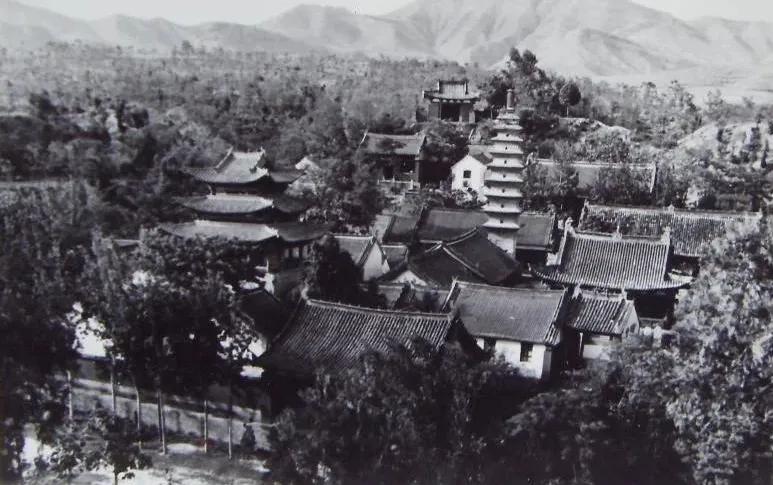
Panoramic view of Fengxue Temple, with the Seventh Patriarch Pagoda and hillside halls and pavilions. Photograph by Qi Dalin. Photograph source.
The Bell Pavilion and surrounding slopes. Photograph by Qi Dalin. Photograph source.
Guanyin Pavilion among trees and enclosure walls. Photograph by Qi Dalin. Photograph source.
The Seventh Patriarch Pagoda and steles in front of it. Photograph source.
Fengxue Temple’s pagoda cemetery, with varied towers amid grass and trees. Photograph by Qi Dalin. Photograph source.
References
- Tan Shibao and Tan Xuechao: New Transcription and Study of the Later Han Stele ‘Record of the Fengxue Seventh Patriarch Qianfeng Baiyun Chan Monastery’, Review of Culture, no. 115, 2022, pp. 44–63; includes photographs, transcription, and a study of successive temple names.
- Chang Faliang: An Inquiry into the Foundation Date of Fengxue Temple in Ruzhou, Cultural Relics of Central China, no. 6, 2011.
- Ma Tianxiang: A Study of Fengxue Temple in Ruzhou, with Discussion of Jing Sanlin’s Contributions, Journal of Harbin Institute of Technology (Social Sciences), no. 6, 2019.
- Tang Wenxing, Fengxue Temple, Henan Historic Sites series, Zhongzhou Calligraphy and Painting Press, 1982.
- Fengxue Temple and Its Pagoda Cemetery, Ruzhou Municipal Government; excerpt from the Cultural Relics Gazetteer of Ruzhou.
- Fengxue Temple, Ruzhou Municipal Government, July 1, 2022; descriptions of the Bell Pavilion, Middle Buddha Hall, and upper and lower pagoda cemeteries.
- Fengxue Temple in Pingdingshan, Fobao, February 3, 2015; the layout section places the Vairocana Hall behind the Middle Buddha Hall.