Introduction
According to tradition, a Buddhist temple already stood on Mount Cilin in Changzi County, Shanxi, during the Northern Wei. Called Cilin Temple, it was the predecessor of Faxing Temple. During the Tang Zhenguan era, Li Yuanyi, Prince Hui of Zheng and the thirteenth son of Emperor Gaozu, Li Yuan, served as prefect of Luzhou. He built a stone relic pagoda in the temple to house relics bestowed by the court and Buddhist scriptures. Its sandstone walls form two concentric enclosures, with a passage between them allowing worshippers to walk around the central stone chamber. In 673, the monk Hongman, who had participated in the work, feared that ‘hills and valleys might change’. He had the account of the pagoda’s construction and the names and titles of Li Yuanyi’s ten sons carved in stone[1].
In 773, the Buddhist devotee Dong Xixuan and his family commissioned a perpetual lamp stand as an offering to the Buddha. Carved in bluish stone, its lamp chamber resembles a small octagonal pavilion, with doors and windows carved between the columns and a lotus-shaped support below. Musicians and auspicious animals decorate the base. The family’s names and the date of construction are inscribed on the short dividing columns of the base[2].
During the wars of the Five Dynasties, the recluse Wang Jingchun came from Jinyang to Mount Cilin Temple seeking refuge, intending to spend the rest of his life in the mountains. The temple’s Buddha hall, built in 945 during the Later Jin, was the predecessor of Yuanjue Hall. Early in the Song dynasty, the monk Ninghui repaired the temple, and Wang Jingchun wrote an inscription for it. His son Wang Shu was born on Mount Cilin; after entering government service, he bought land and gave it to the monks as a permanent agricultural endowment.
In 1027, while serving as prefect of Luzhou, Wang Shu returned home and wrote a poem about the landscape remembered from childhood, the abandoned garden and the temple stele whose text had become incomplete. The following year, the abbot Faxin brought him a rubbing of the inscription written by Wang Jingchun. Reading his father’s words, Wang Shu recalled the care that had raised him, but could no longer repay it: he lamented that his father had not lived to receive his support. In 1030 he wrote to Faxin, explaining that he had petitioned the court to award the monk a purple robe[3]. With the letter he sent three lengths of purple silk and the imperial certificate, expressing his attachment to his father and native place.
In 1079, the abbot Shaorong erected a stele bearing Wang Shu’s homecoming poem; Li Yan of Gaoping carved the characters. The Later Jin Buddha hall was now more than 130 years old: its walls were damaged and its rafters leaning. Shaorong gathered donations and workers, dismantled the old hall and built a new one. It had three bays, a surrounding gallery, stone columns and stone doors. Once it was finished, he wrote to Wang Shu’s son Wang Yirou asking for a commemorative text. Wang Yirou then held the title of Direct Academician of the Longtu Pavilion and was responsible for personnel administration[4]. His grandfather had visited the mountain temple, and his father had been born there; reading the letter moved him to tears. In 1081 he recorded the new hall’s construction. Shaorong led the monks in burning incense and chanting morning and evening. Wang Yirou hoped that visitors, hearing the scriptures and seeing the images, would restrain their impulses toward quarrelling and deceit.
In 1111, the sculptor Feng Zongben made images for the hall, and the painters Chen Daorong and Lü Rong coloured them. The twelve bodhisattvas of Perfect Enlightenment inside belong to this group.
In the thirteenth century, warfare and famine around Zezhou and Luzhou drove the abbot Tanke away in search of food. Ten years passed before he returned to Mount Cilin. Finding the temple abandoned and dilapidated, he led Tanxing and the other monks in clearing thorns and weeds, repairing rotten and leaning buildings, patching leaking roofs, cleaning the sculptures and painted decoration, and repairing the enclosing walls. Farming supported the temple’s expenses. In 1273, approaching eighty, Tanke asked the Changzi scholar Song Dao to record the temple’s history and restoration. He hoped that carving these deeds in stone would preserve them as ‘an imperishable account of the monastery’. Tanke knew three generations of Song’s family, and Song Dao had known him since childhood. He agreed to write, but questioned the wish to secure permanence through stone: if Buddhist scripture taught that the world was illusory and that arising and passing away were inconstant, how could a stele last forever? Tanke asked him to set the argument aside, insisting that ‘the record must be written’. Song Dao included their exchange alongside the repairs in his temple record.
In 1519, the images in the main hall were repaired. A supporting wooden strip inside the chest of a vajra guardian was inscribed with ‘the fourteenth year of Zhengde of the Great Ming’ and ‘repair of the complete group of Buddha images in the main hall of Faxing Temple on Mount Cilin’. It also listed five generations of monks in a teacher–disciple lineage and the names of painters and sculptors[5].
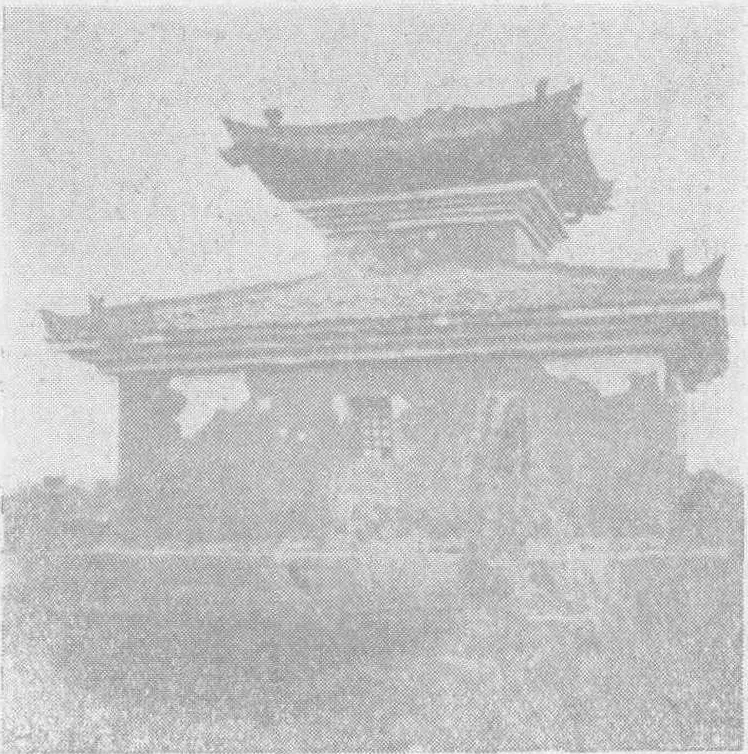
Between the Qing dynasty and the Republican period, Yuanjue Hall’s exterior was altered. The bracket sets beneath the eaves and the gallery around the hall were removed, and the hip-and-gable roof was changed to an overhanging gable roof. The Song timber frame inside survived[6].
From the 1970s onward, mining subsidence beneath the old Mount Cilin site cracked the hall walls and distorted the timber frames. To rescue the buildings and sculptures, Shanxi’s cultural-relics authorities decided to move the whole temple to Mount Cuiyun. Work began in spring 1984, and the principal relocation works were completed in autumn 1996. Yuanjue Hall retained its principal Song timber frame. The Shanxi Institute for the Conservation of Historic Architecture reconstructed the exterior eaves through an inferred design based on the surviving Song structure, the Treatise on Architectural Methods (Yingzao Fashi) and comparable local buildings of the same period. In the relocated hall, Shakyamuni occupies the front of the altar, flanked by disciples, bodhisattvas and protective deities. Avalokiteshvara stands at the rear, and the twelve bodhisattvas of Perfect Enlightenment are arranged around them.
Historical Documents
《Record of Prince Hui of Zheng’s Stone Pagoda》
大唐故赠司徒、荆州大都督、兖、安二州都督、郑、绛、潞三州剌史、上柱国郑惠王石记:
Stone record of the late Prince Hui of Zheng of the Great Tang, posthumously appointed Minister over the Masses and Grand Commander of Jingzhou, commander of Yan and An prefectures, prefect of Zheng, Jiang and Lu, and Supreme Pillar of State:
王讳字,陇西狄道人也。曾祖太祖景皇帝,祖元皇帝,父高祖太武皇帝,王即太武皇帝之第拾叁子,往任潞州日,于此山奉为先圣敬造石舍利塔壹所。下井有敕赐舍利骨终漆粒,造藏经三千卷。观夫大造远契,洪猷永贞,庶绩咸熙,彝伦式叙,莫不分茅土,建诸侯,延帝子于维藩,降天孙于伯牧者矣。伏惟大王通源圣泽,宠位皇华,松姿孤坚,玉气柔润,镇静方岳,声政洽闻,都督荆安,惟德是顺。出守绛、潞,非贤勿居,即何暮海沂之谣,不足俦其匹也。而乃洗心觉路,虔诚妙门,慈林山中,雕砻宝塔,智乘寺所,装饰真容,藻绘具周,庆赞将毕。洪满亲承教旨,躬奉绘言,以拙补勤,猥当检校。恐河海倾竭,陵谷变移,谨件先皇子孙,勒诸贞石。
The prince, whose personal name is absent here, was a native of Didao in Longxi. His great-grandfather was Emperor Jing, the Grand Progenitor; his grandfather was Emperor Yuan; his father was Emperor Gaozu Taiwu. He was the thirteenth son of Emperor Taiwu. While governing Luzhou, he reverently built a stone relic pagoda on this mountain in honour of the former sovereign. In the shaft below were relic bones bestowed by imperial command, whose number is obscure in the transmitted wording, and three thousand scrolls of scriptures. Great creation accords with distant designs; the grand plan remains steadfast forever. All undertakings flourish and the lasting human order is arranged. Lands are apportioned and princes established; imperial sons become the realm’s supports and descendants of the Son of Heaven govern its regions. Your Highness draws from the sacred source, favoured in rank and adorned with imperial distinction, steadfast as a solitary pine and gentle as jade. You pacify the regions, and the fame of your good government spreads. Commanding Jing and An, you follow virtue; governing Jiang and Lu, you hold posts reserved for the worthy. Even the songs praising earlier governors cannot match you. Cleansing your heart on the path of awakening and devoting yourself to the wondrous teaching, you fashioned this precious pagoda on Mount Cilin and adorned the holy images at Zhicheng Temple. Their painted decoration was complete and the dedication was near. Hongman personally received your instructions and undertook the task, making up for clumsiness with diligence and humbly acting as supervisor. Fearing that rivers and seas might dry up and hills and valleys change, I carefully list the former emperor’s descendants and engrave them on enduring stone.
嗣郑王郢州刺史璥,第二王子吕国公琛,第三王子乐平公圭,第四王子尚庸公琰,第五王子乐陵公囗,第六王子武安公琨,第七王子南海公璇,第八王子安德公琳,第九王子新平公璲,第十王子邵陵公珩,
The succeeding Prince of Zheng, Jing, prefect of Yingzhou; the second son, Chen, Duke of Lü; the third, Gui, Duke of Leping; the fourth, Yan, Duke of Shangyong; the fifth, Duke of Leling, whose name is missing; the sixth, Kun, Duke of Wu’an; the seventh, Xuan, Duke of Nanhai; the eighth, Lin, Duke of Ande; the ninth, Sui, Duke of Xinping; and the tenth, Heng, Duke of Shaoling.
咸亨四年十月八日,检校功德僧洪满建。
Erected by Hongman, the monk supervising the meritorious works, on the eighth day of the tenth month of the fourth year of Xianheng (673).
右郑惠王石塔记释洪满以王曾任潞州,为造石舍利塔一所,而自为之记。郑王元懿,新旧唐书有传。初授兖州刺史,在贞观七年,次历郑、潞二州剌史,在贞观十年。最后之绛州剌史,在总章中,而不见有安州刺史之官,则传略也。时称小郑王,亦曰郑惠王,以别于郑王亮云。元懿十子世系表吕国公下脱琛字,又脱第六王子武安公琨一人,新平郡公璲作遂,则史之误。而此记第五王子乐陵公下脱一字,据表则球字也。是传与表未尝不可互补矣。
The above Record of Prince Hui of Zheng’s Stone Pagoda was written by the monk Hongman himself after the prince, formerly prefect of Luzhou, built the stone relic pagoda. Li Yuanyi, Prince of Zheng, has biographies in both the Old and New Books of Tang. He first became prefect of Yanzhou in the seventh year of Zhenguan (633), then successively governed Zhengzhou and Luzhou in the tenth year (636). His final appointment, as prefect of Jiangzhou, fell in the Zongzhang era; the biographies omit his office in Anzhou. He was called the Younger Prince of Zheng or Prince Hui of Zheng, to distinguish him from Li Liang, Prince of Zheng. The genealogy of Yuanyi’s ten sons omits the name Chen beneath Duke of Lü and entirely omits the sixth son Kun, Duke of Wu’an; it also writes the name of Sui, Duke of Xinping, with a different character. These are errors in the history. This inscription, however, lacks one character after the fifth son’s title, Duke of Leling: the genealogy supplies Qiu. Thus the biography and genealogical table can indeed supplement one another.
《Faxing Temple》
法兴寺旧名慈林寺,在县东南三十里,则慈林山之佛院也。魏神鼎元年建。唐郑惠王元懿为潞州刺史时,建石塔,藏舍利二十一粒,及藏经千卷,释洪满为撰碑。至宋元丰四年重修,王益柔为之记。
Faxing Temple, formerly called Cilin Temple, lies thirty li southeast of the county seat and is the Buddhist monastery of Mount Cilin. It was founded in the first year of Shending of Wei, as the text names the era. When Li Yuanyi, Prince Hui of Zheng of the Tang, governed Luzhou, he built a stone pagoda housing twenty-one relic grains and one thousand scrolls of scriptures; the monk Hongman wrote its inscription. It was repaired in the fourth year of Yuanfeng of the Song (1081), and Wang Yirou wrote the record.
《Record of the Rebuilt Monks’ Hall at Faxing Temple on Mount Cilin》
一林山法兴寺重修僧堂记并序,僧惠陌述,并书。
Record and Preface on the Rebuilding of the Monks’ Hall at Faxing Temple on ‘Yilin Mountain’, as printed here; composed and written by the monk ‘Huimo’, as the transmitted text gives his name.
粤维天元地像,圣之阶也。上栋下宇,道之基也,故能立。三朝于妙躅,显无事以崇贞。既而教拯编言,故得僧严丽境者,岂非福圣乎?邦有此寺者,故唐郑惠王之所再□也。王乃亲临福景,仰奉徽交,安塔藏贞,广崇佛事,洗尘边于定水,长解脱于慈林1此因历星华,圣摽遐泯。今乃厥有当寺山主僧所谓净持惑律,寒洁冰霜,夙蕴香风,□□筠竹。群方仰侍,遐迩潜皈,结乡党之缘,备云堂之址。并乃星楣映像,月拱吞鲸,玉梵凝烟,琼檐夺暑。即于咸平二年九月二十八日,崇斋庆赞毕。都维那邑众郭赟等,是曰恭心息虑,仰志口瘦,俯信容颜,潜资圣影。所冀国圆弥茂,府郡昭舒。圣日同佛高悬,皇风与慧风永扇。
Heaven’s origin and earth’s forms are the steps toward sagehood; beams above and shelter below are the foundation of the Way, and so it can stand. The transmitted opening speaks of the three courts, wondrous traces, peaceful governance and salvation through teaching, but several phrases are unclear. Is not the splendour of this monastic realm a blessing from the sages? This temple in our region was renewed [character missing] by the late Tang Prince Hui of Zheng. He came in person to this blessed place, honoured the exalted teaching, established a pagoda to store sacred treasures and enlarged Buddhist observances. He washed away worldly dust in the waters of concentration and nurtured liberation in Cilin [the source has the numeral ‘1’ here]. Through the passing years, the sacred standards faded into the distance. Now the mountain’s chief monk observes pure precepts, spotless as frost and ice, long imbued with fragrant virtue, [two characters missing] like bamboo. People everywhere look to him; those near and far secretly turn to the faith. He gathered support among the community and prepared the site for the monks’ hall. Star-like lintels reflected images, moon-like brackets spanned vast spaces, incense condensed beneath precious Buddhist roofs, and splendid eaves warded off heat. On the twenty-eighth day of the ninth month of Xianping’s second year (999), the ceremonial feast and dedication were completed. Guo Yun and the lay community’s chief organisers acted with reverent hearts and quiet thoughts; the transmitted description of their devotions contains unclear words. They hoped the realm would flourish and the prefectures enjoy peace, the sacred sun shine high alongside the Buddha and imperial virtue blow forever with the wind of wisdom.
乃述词曰:道广灵踪,凝用理性。寒谷生风,云堂集圣。身润慈舟,心悬净镜。厥搆殊因,位摽明证。开慈上善,利乐全身。口崇云室显,是为泄。悟帛无坚,观缘绝尘。陵谷迁变,刊名常真。
The verse says: The Way spreads sacred traces; in stillness we cultivate our nature. Wind arises in the cold valley; sages gather in the cloud hall. The body is sustained by compassion’s boat; the mind holds a pure mirror. This exceptional structure bears witness to its cause. Open compassion and supreme goodness bring benefit and joy to the whole being. The line concerning the cloud chamber is partly unclear. Understand that cloth is not enduring; contemplate conditions and leave worldly dust behind. Hills and valleys may change, but the inscribed names remain true.
都维那邑人郭赟、花进、宋赟、郭琛、宋贞、宋澄、尚座僧善兴、绍讷院主僧法郎,山主僧崇达。
Lay chief organisers: Guo Yun, Hua Jin, Song Yun, Guo Chen, Song Zhen and Song Cheng; senior monk Shanxing; abbot Falang of the Shaone Court; chief monk Chongda.
大宋咸平二年,岁次己亥九月庚辰朔二十八日丁未。
Great Song, second year of Xianping, cyclical year jihai: the ninth month began on gengchen, and its twenty-eighth day was dingwei (999).
《Record of the Hall of Worthies at Mount Cilin Temple, Changzi County, Luzhou》
长子治境,地势夷衍,南有慈林,实襟冯之镇,与紫云山连麓对峙,归然在乎其右。周览形势,不甚壮观,粗有可探。孤峰峭拔,林壑邃幽,其踞地掘起,则骧首偃蹇,其分势掩抱,则交臂拱揖。樵竖纪其胜槩。麻衣目为福地,秀气所钟,挺生贤哲。
The territory of Changzi is broad and level. To its south, Mount Cilin forms a strategic barrier; its foothills join Mount Ziyun, facing it on the right. Surveyed as a whole, the landscape is not overwhelmingly grand, yet has much worth exploring. A solitary peak rises steeply, with secluded woods and valleys. Where it thrusts upward, it seems to raise its head proudly; where its slopes enclose the land, they seem to fold their arms in greeting. Woodcutters tell of its beauty, and the Hemp-Robed adept called it a blessed place. Its concentrated fine energies produced worthy and wise men.
有宋名臣,曰文康公,实生其问。自公童稚时,秀颖不凡,及长,文章深醇,蔚为儒宗。践更胙什,及登台辅,佐佑仁宗,勋在王室。㛎公之父,来自晋阳,五季兵乱,卜幽避地,遂隐居山寺,为终焉之计。逮文康衣锦,追念遗迹,忾然兴怀,买地施僧,永充常业,恋恋于□梓之情。自天圣二年迄今凡一百余年。
The celebrated Song minister, Lord Wenkang, was born here. As a child he showed unusual brilliance; grown, his writing was profound and rich, and he became a leading Confucian scholar. The wording about his successive offices is unclear, but he rose to the chief ministers’ ranks, assisting Emperor Renzong and rendering service to the dynasty. His father came from Jinyang during the wars of the Five Dynasties, choosing seclusion to escape turmoil. He settled in the mountain temple intending to spend the rest of his life there. When Lord Wenkang returned in honour, he remembered his father’s traces with deep feeling and bought land for the monks as a permanent endowment, cherishing his native place [one character is missing]. More than a hundred years have now passed since Tiansheng’s second year (1024).
寺僧耕植自养,可度岁脑口饱口口私自念言:我大雄世尊,尚有乞食之劳。今我比丘食指稍众,所仰哺者,岁有仓箱之望。此大檀越所赐,其利无穷。相与讽呗作礼,荐以冥福。
The monks sustain themselves by cultivation. The line about their annual provisions contains missing or unclear words. They reflect: ‘Even our great World-Honoured One had to beg for food. Now our monks are somewhat numerous, but each year we can hope for granaries of grain. This is the gift of our great patron, bringing endless benefit.’ Together they chant and bow, offering blessings for him in the unseen world.
旧有祠堂,绘像王氏,自隐士而下至不疑,凡五人。隐士讳景纯,字太朴,赠太子太师,文康公名犯庙讳,字晦叔。长士讳𪾊恭,官至司农少卿,赠特进。次子讳益柔,官至龙图阁直学士。特进子讳慎言,字不疑,官至中散大夫,居洛社,为九老。又有孙尚书冲升伯,及其孙永曼叔,亦居其巾。本阳翟人,俱以文章擅名。初升伯为本路漕使,继守是邦,以谓慈林山地产巨贤,博节来游,赋诗作记,称述凤美。曼叔帅并门,亲题榜额,屡贻竿牍,严护仪像。
There was formerly a shrine displaying portraits of five members of the Wang family, from the recluse down to Buyi. The recluse was named Jingchun, styled Taipu, and posthumously honoured as Grand Preceptor of the Crown Prince. Lord Wenkang’s personal name coincides with an imperial taboo; his style was Huishu. The eldest son, whose name is printed with an unusual first character followed by Gong, reached the post of Vice Minister of Agriculture and received the posthumous title Specially Advanced. The younger son Yirou became Direct Academician of the Longtu Pavilion. The former’s son Shenyan, styled Buyi, became a Grand Master for Palace Leisure, lived among the Luoyang fellowship and belonged to its Nine Elders. Minister Sun Chong, styled Shengbo, and his grandson Sun Yong, styled Manshu, were also represented. Originally from Yangdi, both were renowned writers. Shengbo first served as the circuit’s transport commissioner and later governed this prefecture. Believing Mount Cilin had produced an exceptional worthy, he visited during official leisure, composed poems and a record, and praised its excellence. Manshu, while commanding Bingzhou, personally wrote the hall’s nameboard, repeatedly sent letters and ensured protection of the portraits.
客有居士,面山而居,慕林泉之乐,因以为号。逍遥神刹,徘徊祠宇。主僧告居士曰:某甲自幼出家,受檀越供养,为粥饭僧,德公之赐,铭感于心,惧有遗忘,或书题漫灭,来者不知。愿居士记其本未,刻之坚珉,以告夫后之人,以祢子之下,忘本也。
A lay devotee lived facing the mountain. Loving woods and springs, he took them for his sobriquet. He wandered through the holy monastery and lingered in the shrine. The presiding monk said: ‘I entered the religious life as a child and have lived on patrons’ offerings, a monk receiving their daily food. I hold the lord’s generosity gratefully in my heart, but fear it may be forgotten, or the written inscriptions fade so that later visitors no longer know. I ask you to record the story from beginning to end and carve it on lasting stone to inform those who come after.’ The final phrase about descendants and forgetting one’s roots is imperfectly transmitted.
居士曰:汝谈空之流乎?有形者终坏,有象者终灭。祠有象也,祠存则思其人,既隳则已。石有形也,石存则规其石,既勒则已。惟有德者感八也深,而其传无所终穷,又奚待于鄙文哉?虽然,无字碑寓意于无书,或谓无字安用碑,亦太高之论。夫有有则有无无有。则亦无无。有之则其利而无之亦其用石者,其有也。记以文者,盖托其所无耳。惠人之恩德,因垂不朽,又其所托耳。佛子知恩,以记报恩,口口情之所喜也,遂因以书。藤林居士张口记。
The layman replied: ‘Are you not followers of the teaching of emptiness? What has form eventually decays; what has appearance eventually disappears. The shrine contains portraits: while it stands, people remember those depicted; once it falls, that ends. Stone has form: while it survives, people look at it; the following phrase about its end is unclear. Yet the virtuous move people deeply, and their memory is transmitted without limit: why need my poor writing? Nevertheless, a stele without characters places its meaning in the absence of writing. Some ask what use a wordless stele has; that, too, is an excessively lofty argument. The transmitted discussion of being and non-being is obscure. Stone is something present; recording words on it entrusts meaning to what is absent. The benefactor’s goodness is thereby handed down imperishably: this too is what is entrusted to it. A Buddhist knows kindness and repays it with a record; [missing words] this is a welcome expression of feeling.’ I therefore wrote it down. Recorded by the layman of Tenglin, Zhang [name incomplete].
《Record of the Newly Rebuilt Buddha Hall at Faxing Temple》
潞郡上与天党,号天下之脊,而慈林挟右壶口,居太行之肩,陟其峻绝莽苍杳霭之间,可以南望山川,北顾汾、浍。其崇山峻岭,穹谷大畎,草木茂密,云霞万状,轩豁叫窱,气象熊熊,乃一山之秘奥,而天下之形胜也。佛寺经始于后魏之神鼎,易新于唐之咸亨,厥后或兴,或废或葺,浸以颓陀。逮皇朝建隆之初,有僧曰凝诲,缔搆复完,家,太师令君尝为之碑镕。天圣中,释法信与麻衣从深又辟其基,敞三门于其前,给事中孙公冲刻其辞于石。今继主其事者曰绍荣,以佛殿始作于晋开运二年,距今一百三十余载,垣穿城夷,榱桷倾北,于是募檀施,鸠力役,发于至诚,心身信向,崇坛广宇,撤旧谋新,经之营之,成于不日。
The Lu region is associated with Shangdang, called the backbone of the realm. Cilin, beside Hukou, occupies the shoulder of the Taihang Mountains. Climbing its precipitous and mist-shrouded heights, one may look south over mountains and rivers and north toward the Fen and Hui. Lofty ridges, great valleys, dense vegetation, clouds and mists in countless forms, wide vistas and deep recesses make this mountain both a hidden marvel and a commanding landscape. The Buddhist temple began in the Shending era of Later Wei, as named in this text, and was renewed in the Xianheng era of Tang. Thereafter it prospered, declined and was repaired by turns, gradually falling into disrepair. Early in our dynasty’s Jianlong era, the monk Ninghui restored its buildings. My family’s late lord, honoured as Grand Preceptor, once wrote its stele inscription. During Tiansheng, the monk Faxin and the Hemp-Robed Congshen enlarged its site again, opening a three-bay gateway in front. Sun Chong, Imperial Attendant, had his text carved in stone. The present successor is Shaorong. The Buddha hall was first built in the second year of Kaiyun of Jin (945), more than 130 years ago; its walls were breached and its rafters leaning. He therefore sought patrons’ gifts and assembled labourers. With sincere devotion, he enlarged the platform and building, dismantling the old to plan the new. Through careful management, the work was completed quickly.
其为殿三楹,周以廓腰,袭珉以为柱,伐石以为扉,高广壮严,可以为他屋冠。备像设之庄严,穷绘景之精妙。率其徒朝夕焚香赏呗,发其书而诵习之,使来者闻声而悟,睹相而信,革斗怒鄙悖之心,而向于和顺,消欺诞险害之虑而趋于夷易。外则渐摩于上之仁义教化,而恐畏于礼法刑典,俾之暗然日迁善远罪,论有厚元元之性,辅宴宴之化。由是而言,则兴废系乎其时,而得失存乎其人矣。荣师生而朴愿,幼袭佛服,其见闻董修,未始不仿依于其教,游泳于其业,顾世俗贪冒没溺者,宜不一动其心。且其诚悫得乡闾欣慕,以能就其所愿,则其精进智识,可以副予向所陈为不疑矣。殿既成,使以书来请记。予以大父尝所游息,先子诞育之地也,阅其书,不知涕泗之横集,自托不腐,实素愿焉。
The hall has three bays with a gallery around it, polished stone columns and hewn stone doors. Lofty, spacious and solemn, it excels the other buildings. The sacred images are fully provided, their painted adornment exquisitely executed. He leads his disciples in morning and evening incense and chanting, opening the scriptures to study and recite. May visitors hear and awaken, see the images and believe, turn from anger and coarse rebellion toward harmony, and abandon deception and malice for openness. In the wider world, guided by the sovereign’s benevolent moral teaching and restrained by ritual, law and punishment, may they quietly move each day toward goodness and away from wrongdoing, strengthening the people’s character and supporting peaceful governance. Thus prosperity and decline depend on the times, but success and failure depend on people. Master Rong is sincere and modest, having donned Buddhist robes in childhood. His learning and conduct have always followed the teaching and its practice; surely he will not be swayed by worldly greed and indulgence. His sincerity has won the admiration of the neighbourhood and allowed him to fulfil his wish. His diligence and understanding can, I believe, achieve what I have described. After the hall was completed, he sent a letter requesting this record. My grandfather once wandered and rested here, and my late father was born and raised here. Reading his letter, I did not notice the tears streaming over my face. To entrust myself to an enduring record has indeed long been my wish.
于为之记。元丰四年正月五日。
I therefore wrote this record. Fifth day of the first month of the fourth year of Yuanfeng (1081).
《Record of Faxing Temple, Changzi County, Luzhou》
法兴寺碑。
Faxing Temple Stele.
至元十年宋道撰,今在长子县慈林山。
Written by Song Dao in the tenth year of Zhiyuan (1273); it now stands on Mount Cilin in Changzi County.
谨案:宋道,长子人,元史有传。所箸秬山集十卷,今不传。碑称道七岁侍先大父上马武京,迁洛西,去国五十年近,始能归葬大父于先茔。又称其祖兵部公拄笏轩留题,今犹未沬。本传道金兵部员外郎元吉之孙,年十七,避地襄阳云云。据金史:兴定四年庚辰,上党公张开壁马武寨。由庚辰至是年甲戌,凡五十五年,是其避地即在兴定时。自述年七岁,史言十七,似史有误。至所言元吉拄笏轩留题诗已不传,当是书之寺壁者,故云未沬,非有石刻也。
Respectfully examined: Song Dao was from Changzi and has a biography in the History of Yuan. His ten-volume Collected Works of Mount Ju no longer survives. The stele says that at seven he accompanied his grandfather to Mawu and then moved west of Luoyang; after nearly fifty years away, he was finally able to bring his grandfather home for burial in the ancestral cemetery. It also says that his grandfather, the official of the Ministry of War, left a poem in the Zhuhu Pavilion which had not yet faded. The biography calls Dao the grandson of Song Yuanji, a Jin assistant director in the Ministry of War, and says he fled to Xiangyang at seventeen. According to the History of Jin, in the gengchen year, fourth year of Xingding (1220), Zhang Kai, Lord of Shangdang, fortified Mawu Stronghold. From that gengchen year to the jiaxu year mentioned here are fifty-five years, as the commentator states; his flight therefore occurred during Xingding. His own account gives his age as seven, whereas the history says seventeen, suggesting an error in the history. Yuanji’s poem in the Zhuhu Pavilion is no longer transmitted. It must have been written on the temple wall, hence the statement that it had not faded; it was not a stone inscription.
长子县东南一舍而远,有山曰慈林,不峻不卑,石涧愁洌,东峰拔萃,岗阜拱揖,绝壁西断,平原下开,掖峰据璧,是为法兴寺。长松古柏,植列森严,棫朴榛灌,绵络弥望。若夫阳舒阴惨之交,云霞烟霭之变,光风霁月,雨昏雪缟之际,千状万态,不可胜言。故贵游才士,登临舒眺,赋诗称道者颇多。八百余年,恒为潞州名刹。今山主大比邱昙珂,高平宿儒仇文昌之子,净性不昧,潜心义天,遂为唯识论。屿公之高弟,讲圆觉修多罗了义,得圭峰言外意,读书能诗,喜与士大夫游。一日,来谓仆日:此寺肇寝艺文,迹于元魏神鼎元年,历齐、周、隋,钟鱼不废。唐咸亨四年,高祖第十三子郑惠王元懿为潞州剌史,于寺中造石塔,藏所赐佛舍利三七粒,及写大藏经为卷者三千,以报罔极之恩。
More than one stage of thirty li southeast of Changzi lies Mount Cilin, neither very high nor low. Its stony streams are chill; the eastern peak stands out, the ridges bow around it, a sheer cliff cuts off the west, and a plain opens below. Sheltered by peaks and resting against the cliff stands Faxing Temple. Tall pines and ancient cypresses rise in ordered ranks; thickets and shrubs spread as far as the eye can see. Sunshine and shadow, clouds and mists, clear moonlight, dark rain and white snow give it more changing forms than words can tell. Many distinguished visitors and talented scholars have climbed it, enjoyed the view and praised it in verse. For over eight hundred years it has remained a renowned Luzhou monastery. Its present chief monk Tanke is the son of Qiu Wenchang, an elderly Confucian scholar of Gaoping. His pure nature is undimmed; he devoted himself to Buddhist doctrine and became a leading disciple in the Consciousness-Only teaching. The transmitted sentence about his teacher is unclear. He teaches the Sutra of Perfect Enlightenment and understands Guifeng’s meaning beyond words; he reads, writes poetry and enjoys the company of scholar-officials. One day he told me: ‘This temple began in the first year of Shending of Northern Wei, as the inherited account names the era. Through Qi, Zhou and Sui, its bells and wooden fish continued to sound. In the fourth year of Xianheng of Tang (673), Li Yuanyi, Prince Hui of Zheng, thirteenth son of Gaozu and prefect of Luzhou, built a stone pagoda here, storing twenty-one bestowed Buddha relics and three thousand copied scrolls of the Buddhist canon, to repay immeasurable kindness.’
金界光华,自此尤盛。上元元年,改广德。五代麻衣道者特建三门。宋治平中,改法兴。祥符中,高士王景纯隐居此山,与晦禅师为莲社友,其子文康公曙。佐仁宗,号贤相,奕叶贵显,各绝名衔。若其璇题之更革,法筵之隆替,住持师资之源委,则具载于历代之碑。国朝岁壬午,泽、潞兵荒,予就食东土,十载方归,山川如昔,人物萧条。礼窣堵之神奇,瞻招提之芜圯,慨叹既为佛子,当报佛恩,遂率首座昙兴等,刜荆棘,燹草莱,枝易朽欹,补幂罅漏,汛拂绘塑,缮完阐垣,晨香夕灯,以赞皇图,寒耕热耘,以足常住。众心协敬,克保前修。今年将八十,可谓老矣。恒虑化理密移,功缘难毕,为没齿恨。君家三世,予皆识之,令祖兵部公拄笏轩留题,今犹未沬,是故欲得君文,勒诸贞石,为山门不朽之传。
‘From then on the Buddhist precinct grew especially splendid. In the first year of Shangyuan it was renamed Guangde. During the Five Dynasties, the Hemp-Robed adept specially built its gateway. During Zhiping of Song it became Faxing. During Xiangfu the recluse Wang Jingchun lived on this mountain and became a Lotus Society companion of Chan Master Hui. His son Wang Shu, Lord Wenkang, assisted Renzong and was called a worthy chief minister; successive generations achieved high rank. Changes in the nameboard, the rise and decline of Buddhist observances, and the lines of abbots and teachers are all recorded in successive steles. In the renwu year of our dynasty, war and famine struck Zezhou and Luzhou. I went east in search of food and returned only ten years later. The landscape was as before, but its people depleted. Seeing the wondrous stupa and the ruined monastery, I reflected that as a Buddhist I should repay the Buddha’s kindness. I therefore led the senior monk Tanxing and others in cutting thorns, burning weeds, replacing rotten and leaning timbers, patching roof leaks, cleaning paintings and sculptures and repairing the walls. Morning incense and evening lamps honoured the imperial realm; winter ploughing and summer weeding supported the monastery. Working together reverently, we preserved our predecessors’ work. I am nearly eighty this year and may truly be called old. I always fear life’s secret transformations will leave these meritorious undertakings unfinished, a regret until death. I have known three generations of your family. Your honoured grandfather, the Ministry of War official, wrote in the Zhuhu Pavilion, and his words have not yet faded. Therefore I wish for your writing, carved on lasting stone, as an imperishable account of the monastery.’
仆曰:道七岁侍先大父上马武京,迁洛西,丁壬辰乱,登女凡,历嵩、少,涉丹、浙,渡汉沔,寓武当,抵南郡。间关险阻,百死一生。去国五十年,近,始能归葬大父于先茔,抚高祖手植庭槐,与邑中父老子弟相劳问,悲感交集。若其识不肖于童稚,令艺文之间,能道吾家尊显行辈及姻亲之氏族者,惟珂公及邑令张君逸卿在焉。道虽孤陋不文,亦安敢拒命?然尝闻佛经云:幻灭灭尽,非患不灭。又云:变者变,不变者不变。师何虑齿发之衰乎?栽松道者身先老,放下锄头好再来。古德如斯,师行若是,又何虑功缘之难毕乎?三千大千世界,犹如空花,乱起乱灭,而乃琢磨再石,镌刻空文,欲以为山门不朽之传,无乃近于妄乎?呵公曰:兹事且置无论,记不可不作也。满日,谓已童矣,而其刻之。
I replied: ‘At seven I accompanied my late grandfather to Mawu, then moved west of Luoyang. Amid the renchen troubles I travelled through places whose names here are partly unclear, through Song and Shaoshi, Dan and Zhejiang, across the Han and Mian, staying at Wudang and reaching Nan Commandery. Amid dangers and hardship, I escaped death time and again. After fifty years away, only recently could I bring my grandfather back for burial in the ancestral cemetery. Touching the courtyard locust tree planted by my great-great-grandfather and exchanging greetings with the elders and younger townspeople filled me with grief and gratitude. Only Master Ke and the magistrate Zhang Yiqing knew me as a child and can still recount my family’s elders and distinguished generations and the clans of our relatives by marriage. Though ignorant and no writer, how could I refuse your request? Yet I have heard scripture say: “When illusory extinction is entirely extinguished, that which is not illusory does not perish” — the transmitted wording has an uncertain character here — and also: “What changes changes; what does not change does not change.” Why fear declining age? The adept who planted pines grew old first; put down the hoe and return again. The ancients acted thus, and so do you: why fear unfinished good works? Even the vast universe is like flowers in empty space, arising and disappearing in confusion. To polish stones and carve empty words, hoping for an imperishable monastery record, is this not close to delusion?’ Master Ke answered: ‘Let us set that matter aside: the record must be written.’ The closing sentence of the transmitted dialogue is unclear; it ends with the instruction to engrave the text.
至元十年癸酉十月朔日。
First day of the tenth month of the tenth year of Zhiyuan, cyclical year guiyou (1273).
《Poems Inscribed at Mount Cilin Temple》
右谏议大夫、知潞州年州事孙冲述。
Composed by Sun Chong, Right Grand Remonstrant and prefect of Luzhou; the transmitted official title contains an extra unclear word.
秋宿山中寺,泠然洗宦心。况当衰髦发,消得卧云林。泉涩石沟浅,灯昏松屋深。上方清梦寐,晓谷飏钟音。
Spending an autumn night in the mountain temple, its coolness washes my official cares away. With my hair already thinning and grey, I can bear to recline among clouds and woods. The spring runs slowly through a shallow stone channel; a dim lamp shines deep in the pine-built lodging. Dreams are peaceful in the upper sanctuary; at dawn the valley carries the bell’s sound.
其二:山中古佛寺,暂到觉神情。扫地云粘帚,敲钟谷应声。诵经僧坐石,下树鸟寻生。白日尘寰内,劳劳徒利名。
Second poem: Briefly arriving at this ancient Buddhist temple in the mountains, I feel my spirit awaken. Sweeping the ground, clouds cling to the broom; striking the bell, the valley answers. A monk sits on stone reciting scriptures; birds descend the trees in search of sustenance. In the daylight world of dust, people toil in vain for profit and fame.
天圣五年八月五曰题。男前进士景上:总辔连高顶,名区得赏心。身闲除五盖,地福亚双林。梵逐松风远,香飘夜涧深。堂中有多士,一一卜知音。
Inscribed on the fifth day of the eighth month of Tiansheng’s fifth year (1027). His son Jing, formerly a successful metropolitan examination candidate, presents: Drawing together our reins, we reach the lofty summit; in this famed place the heart finds delight. With the body at ease, the five hindrances fall away; this blessed land is second only to the twin groves. Chants travel far with the pine wind; incense drifts deep into the night ravine. Many worthy men are in the hall, each one sought as a friend who understands.
其二:半空山叠翠,满耳松风清。楼高入浓碧,泉落飞寒声。世路有穷尽,佛法无死生。会当冥至理,不复狥浮名。
Second poem: Mountains halfway to the sky pile up their green, and the clear pine wind fills my ears. The tall tower enters dense blue-green; the falling spring sends forth a cold, flying sound. Worldly roads have their limits; Buddhist truth knows neither death nor birth. One day I shall grasp its deepest principle and no longer pursue empty fame.
家君大谏以慈林山寺地产巨贤,故有院记。及游胜境,遂留二诗。景今到此,辄次元韵以和。明道二年十一月八日谨志。
My father, the Grand Remonstrant, wrote a monastery record because Mount Cilin had produced a great worthy. When visiting its beautiful scenery, he left two poems. Now that I, Jing, have come here, I respond using his original rhymes. Respectfully noted on the eighth day of the eleventh month of Mingdao’s second year (1033).
元丰二年二月初五曰,院主僧绍荣立石。
Stele erected by the abbot, monk Shaorong, on the fifth day of the second month of Yuanfeng’s second year (1079).
Wang Shu’s 《Homecoming: An Eight-Line Poem in Seven-Character Verse》
Wang Shu composed this while governing Luzhou and dated it the seventeenth day of the second lunar month of 1027. On the fifth day of the second lunar month of 1079, the abbot Shaorong erected the stele, with lettering carved by Li Yan of Gaoping. The title, attribution and dates appear in Gazetteer of Changzi County, volume 7, compiled by Yu Qian; the poem below follows volume 20 of Liu Yue’s edition.
昔曰垂髫今作翁,山川犹忆赋征东。头陀碑在遗或缺,靖节园荒旧业空。遮道野人窥衣锦,𬴐迎竹马拜凭熊。吾乡信美归来宴,都似无何两字中。
Once a child with hanging locks, now an old man, I still recall the mountains and rivers of my eastern journey. The monk’s stele survives, though parts are missing; the recluse’s garden is overgrown, the old estate empty. Villagers block the road to glimpse my honourable return; welcoming children on bamboo horses bow to the governor. My native place is truly beautiful, and I feast on returning: all seems contained within those words, ‘nothing at all’. The transmitted welcoming phrase includes an unusual character.
Poems Preserved in the Gazetteer of Changzi County
苜年樵𥪡隐斯山,名振京师世所贤。今日我来还避乱,愿同八鹿老林泉。
In a former year, as the imperfectly transmitted opening relates, a woodcutter or recluse hid on this mountain; his fame reached the capital and the world esteemed him. Today I too come fleeing turmoil, wishing to grow old among woods and springs like the ‘eight deer’ named in the transmitted text.
秋风脱叶绕禅龛,缥缈慈云紫翠涵。几字云鸿迷塞北,一声山鸟起杖南。断崖古树传幽磬,落日孤云送晚岚。我亦无心留色相,好将虚寂问瞿昙。
Autumn wind strips leaves around the meditation shrine; ethereal compassionate clouds enfold purple and green. A few ranks of cloud-high geese vanish toward the northern frontier; one mountain bird calls south of my staff. Ancient trees on the sheer cliff convey a secluded chime; a lonely cloud at sunset brings evening mist. I too have no wish to cling to outward form: let me ask Gautama about emptiness and stillness.
Historical Photographs
Published in 1958
Jiu Guanwu’s Faxing Chan Temple on Mount Cilin, Changzi County, Shanxi appeared in Reference Materials on Cultural Relics, no. 11, 1958. Its nine photographs show the relic pagoda, lamp pagoda, Yuanjue Hall, timber frame and painted sculptures at the original Mount Cilin site before relocation.
1962
The photographs of the 1962 historic-architecture survey of southeastern Shanxi, reproduced in Zhang Yuhuan’s Historic Architecture of Shangdang, show the two stone pagodas, the main hall’s timber frame and its sculptures at the Mount Cilin site before relocation.
References
- National Treasures: Faxing and Chongqing Temples in Changzi, China Architecture & Building Press, 2011, p. 89.
- Jiu Guanwu, Faxing Chan Temple on Mount Cilin, Changzi County, Shanxi, Reference Materials on Cultural Relics, no. 11, 1958.
- Hu Pinzhi, Collected Stone Inscriptions of Shanxi, volume 4.
- Wang Xuan, edited by Zhang Xu, Records of Bronzes and Stones in Shanxi, section 8.
- Yu Qian, compiler, Gazetteer of Changzi County, volume 7.
- Liu Yue, compiler, Gazetteer of Changzi County, volumes 13, 17 and 20.