Introduction
In the time of Wu Zetian of Tang (690–705), the newly translated Huayan Sutra told of a Clear Cool Mountain in the northeast where Mañjuśrī Bodhisattva dwelt and preached. Mount Wutai was then identified as this Clear Cool Mountain, and the Dafu Lingjiu Monastery at Taihuai was accordingly renamed Great Huayan Monastery. In the eleventh year of Dali (776), the Tang Huayan monk[1] Chengguan vowed to make a pilgrimage to the Five Terraces, and then went on to Emei; after returning to the Five Terraces, Chengguan took up residence at Great Huayan Monastery, and Xianlin, the monk in charge of its affairs, asked him to lecture on the Huayan Sutra and the various treatises. The old commentaries on the Huayan Sutra then in circulation were voluminous in text yet meager in explanation. Chengguan held that, having now made pilgrimage to the sacred sites of both Samantabhadra and Mañjuśrī, he ought to write a new commentary on the Huayan Sutra. From the first month of the first year of Xingyuan (784) to the twelfth month of the third year of Zhenyuan (787), Chengguan completed twenty scrolls of new commentary at Great Huayan Monastery, and held a feast for a thousand monks to celebrate its completion.
In the fifth year of Taiping Xingguo of the Northern Song (980), Emperor Taizong of Song sent the palace attendant Zhang Tingxun to Mount Wutai in Daizhou to make a gilt-bronze image of Mañjuśrī, and further decreed the rebuilding of the ten monasteries of the Five Terraces, appointing the monk Fangrun as rector over the monastic affairs of all ten; Huayan Monastery and the Zhenrong Cloister were each listed among the ten monasteries. In the fifth year of Xining (1072), the Japanese Enryakuji monk Jōjin, with the Song court’s permission and escorted by officials, entered Mount Wutai; the Zhenrong Cloister sent out several hundred monks bearing banners to welcome him, and the scriptures, mirror and hair, gold and silver, and incense that Jōjin had brought from Japan were installed in the Hall of the Sacred Countenance of Mañjuśrī at the Zhenrong Bodhisattva Cloister of Great Huayan Monastery. The Great Huayan Monastery of the Song was larger than today’s Xiantong Monastery; the Zhenrong Cloister then belonged to Great Huayan Monastery and later developed into today’s Pusa Ding (Bodhisattva Peak). The Mañjuśrī hall that Jōjin endowed was located in the Zhenrong Cloister, not within today’s Xiantong Monastery.
By the early Ming, the monastery’s name was already written Great Xiantong Monastery. In the third year of Yongle (1405), the Ming court established the Mount Wutai Buddhist registry[2] at Xiantong Monastery, with monastic officials leading the whole mountain’s clergy in offering prayers and blessings, and the prefecture supplying monastic grain each month. In the Yongle era, Emperor Chengzu of Ming welcomed the Tibetan Buddhist hierarch Karmapa from Ü-Tsang to Jinling and enfeoffed him as the Great Jewel Dharma King. Karmapa had long intended to visit Mount Wutai and loved mountains and forests; fearing that remaining in Jinling would hinder his practice, he requested leave to go to Mount Wutai. Emperor Chengzu granted him a ceremonial escort, sent envoys to accompany Karmapa to Mount Wutai, and ordered the eunuch Yang Sheng to rebuild Xiantong Monastery and the King Aśoka Buddha śarīra stupa[3] as the Dharma King’s residence. After Karmapa’s death, Yang Sheng was further ordered to make a statue of him in the Dharma Hall of Xiantong Monastery.
The Ming monk Miaofeng Fudeng later vowed to cast a copper hall for each of the three great sacred mountains — Emei, Putuo, and Wutai. In the spring of the thirty-third year of Wanli (1605), Miaofeng Fudeng personally delivered the Wutai copper hall, cast with funds donated by the people, to Taihuai, intending to install it at Xiantong Monastery. The emperor sent the imperial stable eunuch Wang Zhong, and the empress dowager sent her attendant Chen Ru, each carrying treasury funds into the monastery to survey the ground and select the site for installing the copper hall. In the fifth month of the thirty-fourth year of Wanli (1606), Miaofeng Fudeng again presided over construction within the monastery, building a great hall of the “Seven Sites and Nine Assemblies[4]” in brick; the brick hall was divided from front to back into six tiers and ringed with towers and pavilions, forming a ritual arena for expounding the Huayan Sutra. When the work was completed, twelve hundred monks gathered in the monastery, and ten Dharma masters preached the Huayan Sutra. The copper hall and the brick beamless hall left by this project still stand on the central axis of Xiantong Monastery today.
Xiantong Monastery is a Han Chinese Buddhist monastery. From the Ming and Qing onward, “blue monasteries” (Han Chinese Buddhist) such as Xiantong Monastery and “yellow monasteries” (Tibetan Buddhist) such as Pusa Ding long coexisted and interacted in Taihuai, together forming Mount Wutai’s religious landscape in which Han Chinese and Tibetan Buddhism are interwoven.
Historical Documents
《宋高僧传》 (Biographies of Eminent Monks of the Song)
大历十一年,誓游五台,一一巡礼,祥瑞愈繁。仍往峨嵋,求见普贤,登险陟高,备观圣像。却还五台,居大华严寺。专行《方等》忏法。时寺主贤林,请讲大经,并演诸论。因慨《华严》旧疏,文繁义约,惙然长想:“况文殊主智,普贤主理,二圣合为《毗卢遮那》,万行兼通,即《大华严》之义也。吾既游普贤之境界,泊妙吉之乡原,不疏《毗卢》,有辜二圣矣。”观将撰《疏》,俄于寤寐之间,见一金人当阳挺立,以手迎抱之,无何咀嚼都尽。觉即汗流,自喜吞纳光明遍照之征也。起兴元元年正月,贞元三年十二月毕功,成二十轴,乃饭千僧以落成也。
In the eleventh year of Dali, he vowed to journey to the Five Terraces and worship at each in turn, and the auspicious signs grew ever more numerous. He then went on to Mount Emei to seek a vision of Samantabhadra, climbing its perilous heights and beholding all the sacred images. He returned to the Five Terraces and took up residence at Great Huayan Monastery, devoting himself to the repentance rite of the Fangdeng scriptures. The monastery’s abbot Xianlin asked him to lecture on the great sutra and to expound the treatises as well. Lamenting that the old commentaries on the Huayan were voluminous in text yet meager in meaning, he pondered long and earnestly: “Moreover, Mañjuśrī governs wisdom and Samantabhadra governs principle; the two sages together form Vairocana, in whom all practices are comprehended — this is the meaning of the Great Huayan. Having already wandered through the realm of Samantabhadra and sojourned in the homeland of the Wonderfully Auspicious One, I would betray both sages if I did not write a commentary on Vairocana.” When Chengguan was about to compose the commentary, he suddenly, between waking and sleeping, saw a golden man standing tall facing the sun, who stretched out his hands and embraced him; in an instant he had chewed and swallowed him whole. He awoke in a sweat, rejoicing that this was a sign he had taken in the Light That Shines Everywhere. He began in the first month of the first year of Xingyuan and finished in the twelfth month of the third year of Zhenyuan, completing twenty scrolls, whereupon he fed a thousand monks to celebrate its completion.
《佛祖统纪》 (Chronicle of the Buddhas and Patriarchs)
五年正月,敕内侍张廷训往代州五台山,造金铜文殊万菩萨像,奉安于真容院。诏重修五台十寺,以沙门芳润为十寺僧正。十寺者,真容、华严、寿宁、兴国、竹林、金阁、法华、秘密、灵境、大贤。
In the first month of the fifth year, the court ordered the palace attendant Zhang Tingxun to go to Mount Wutai in Daizhou to make gilt-bronze images of Mañjuśrī and ten thousand bodhisattvas, to be installed in the Zhenrong Cloister. An edict ordered the rebuilding of the ten monasteries of the Five Terraces, with the śramaṇa Fangrun as rector of the ten monasteries. The ten monasteries were Zhenrong, Huayan, Shouning, Xingguo, Zhulin, Jinge, Fahua, Mimi, Lingjing, and Daxian.
《参天台五台山记》 (Record of a Pilgrimage to Mount Tiantai and Mount Wutai)
大宋国河东道代州五台山大华严寺真容菩萨院文殊圣容殿,今月二十八日,有大日本国延历寺阿阇梨、大云寺主、传灯大法师位、大宋国赐紫僧成寻赉到大日本国故右丞相从一位藤原朝臣第六女子、为太皇太后宫亮藤原师信朝臣家室产生去逝。藤原朝臣以亡室亲身物所施:镜一面、发三结。右前件物寻附文殊师利真容殿内如法安置,持伸供养。所集善因,朝臣家室,伏愿追随三岛之仙,镜智澄辉,证悟一乘之位;更冀居家赞国,咸承吉善之因,莅公处私,悉获安宁之报。文殊在圣力昭彰。谨祝。
In the Hall of the Sacred Countenance of Mañjuśrī at the Zhenrong Bodhisattva Cloister of Great Huayan Monastery on Mount Wutai, Daizhou, Hedong Circuit of the Great Song — on the twenty-eighth day of this month, Jōjin, a monk granted the purple robe by the Great Song, ācārya of Enryakuji of Great Japan, abbot of Daiunji, holder of the rank of Dharma Master Who Transmits the Lamp, has brought offerings on behalf of the sixth daughter of the late Minister of the Right of Great Japan, Fujiwara no Ason of the Senior First Rank, who was the wife of Fujiwara no Ason Moronobu, steward of the Grand Empress Dowager’s household, and who died in childbirth. Fujiwara no Ason donates these personal effects of his late wife: one mirror and three knots of hair. The aforesaid items, brought by Jōjin, have been ritually installed within the Hall of the True Countenance of Mañjuśrī and are offered up in veneration. For the good causes thus gathered, it is humbly wished that his wife may follow the immortals of the Three Isles, that the mirror of wisdom may shine clear and she may awaken to the position of the One Vehicle; and it is further hoped that in managing his household and aiding the state, all may receive auspicious and good causes, and that in public office and in private life he may obtain the recompense of peace and tranquility. May Mañjuśrī, present here, make his sacred power manifest. Respectfully prayed.
《山西志辑要》 (Essentials of the Gazetteer of Shanxi)
大显通寺古名大孚灵鹫寺。汉明帝时,摩腾、法兰西来,见此山乃文殊住处,奏帝建寺,以山形若天竺之灵鹫,即以为名,加以大孚二字。后魏孝文帝重葺,复置院十二,以拥护兹刹。前有杂花园,亦名花园寺。唐则天朝,以新译华严经中载此山名,改为大华严寺,明改大显通寺。迨我朝恩赉,迥轶前代,古刹重光矣。
Great Xiantong Monastery was anciently named Dafu Lingjiu Monastery. In the time of Emperor Ming of Han, Moteng and Falanxi came, saw that this mountain was the dwelling place of Mañjuśrī, and petitioned the emperor to build a monastery; because the mountain’s form resembled the Vulture Peak of India, it was named accordingly, with the two characters “Dafu” added. Emperor Xiaowen of the Later Wei rebuilt it and further established twelve cloisters to shelter and protect this monastery. In front of it was a mixed flower garden, so it was also called Flower Garden Monastery. In the time of Wu Zetian of Tang, because the newly translated Huayan Sutra contained this mountain’s name, it was renamed Great Huayan Monastery; in the Ming it was renamed Great Xiantong Monastery. Coming to our own dynasty, its gracious bestowals far surpass those of former ages, and the ancient monastery shines in splendor once more.
《天下名山记》 (Records of Famous Mountains under Heaven)
花园寺,汉明帝所题大孚灵鹫者也,西域滕兰以天眼观,见文殊住此,此刹最古。梁明府先期左去,犹得藉其饮啖。寺既伟盛,而中宫以金瓦其殿,且修无遮斋,钟鸣鼎食,魄气甚张。晋大饥,数千人走活,夜则裸而窟焉,蜀僧主之,此功德不作未来者也。
Flower Garden Monastery is the Dafu Lingjiu named by Emperor Ming of Han; Teng and Lan of the Western Regions beheld with their divine eye that Mañjuśrī dwelt here, and this monastery is the most ancient of all. Magistrate Liang had departed ahead of me, yet I was still able to partake of its food and drink. The monastery is grand and flourishing, and the palace has roofed its halls in gold and holds unrestricted vegetarian feasts there, with bells ringing and tripods serving the meal — its vital force is much aroused. In the great famine of Jin, several thousand people fled here to survive, sleeping naked at night in its caves, with a monk of Shu presiding over them — this is merit that makes no account of the future.
《清凉山志》 (Gazetteer of Mount Qingliang)
大宝法王,名葛哩麻,乌斯藏人也。道怀冲漠,神用叵测,声闻于中国。永乐间,我太宗文皇帝遣使西土迎之,师适有五台之游,应命至金陵,道启圣衷,诰封如来大宝法王、西天大善自在佛。师性乐林泉,朝廷之下,恐妨禅业,奏辞游五台。上眷注殷勤,留之不已,乃赐銮舆、旌幢伞盖之仪,遣使卫送于五台大显通寺。更敕太监杨升重修其寺,兼修育王所置佛舍利塔,以饰法王之居。先是,上与法王幸灵谷寺斋,感塔影金光之瑞。及法王入台山,上眷恋不释然,因思前瑞,再幸灵谷。上默有所祷,睹瑞倍前。丁亥四月,上制书遣使于台山大宝法王、大善自在佛。其书略曰:朕四月十五日,与弘济大师诣灵谷,观向所见塔影,文彩光明,珍奇妙好,千变万态,十倍于前,虽极丹青之巧,言论之辩,莫能图说其万一。
The Great Jewel Dharma King, named Karmapa, was a man of Ü-Tsang. His virtue was profound and still, his spiritual workings unfathomable, and his fame reached throughout China. In the Yongle era, our Emperor Taizong the Civil Emperor sent an envoy to the western lands to invite him. The master happened to have planned a journey to the Five Terraces; he answered the summons and came to Jinling, where his teaching opened the sage’s heart, and he was enfeoffed by patent as the Tathāgata Great Jewel Dharma King, the Great Good Sovereign Buddha of the Western Heavens. The master by nature delighted in forests and springs; beneath the court, he feared it would hinder his meditative work, and petitioned to take leave and journey to the Five Terraces. The emperor’s fond regard was ardent and he would not cease to detain him, so he bestowed an imperial carriage and the insignia of banners, streamers, parasols, and canopies, and sent envoys to escort him to Great Xiantong Monastery on the Five Terraces. He further ordered the eunuch Yang Sheng to rebuild the monastery and also to repair the Buddha śarīra stupa set up by King Aśoka, to adorn the Dharma King’s residence. Before this, the emperor and the Dharma King had visited Linggu Monastery for a vegetarian feast, where they were moved by the auspicious sign of golden light in a pagoda’s shadow. When the Dharma King entered the T’ai mountains, the emperor’s longing would not release him; remembering the earlier omen, he visited Linggu again. The emperor prayed silently, and beheld an omen twice that of before. In the fourth month of the dinghai year, the emperor composed a letter and sent an envoy to the Great Jewel Dharma King, the Great Good Sovereign Buddha, in the T’ai mountains. The letter said in brief: On the fifteenth day of the fourth month, I went with Great Master Hongji to Linggu and beheld the pagoda shadow seen before, its patterned radiance gleaming, rare, marvelous, and fine, in a thousand changes and ten thousand forms, ten times greater than before; though one exhaust the painter’s art and the eloquence of speech, none could picture or describe one ten-thousandth of it.
此皆如来大宝法王、大善自在佛,道超无等,德高无比,具足万行,阐扬六通,化导群品,寔释迦佛再现世间,而乃显兹灵应,不可思议。朕心欢喜,难以名言,略此相报,如来亮之。明年,师奏疏别上,入灭,火化无遗物。是年,函谷关吏见师适西,贻上所赐玉玦回奏,上惊叹追慕,敕太监杨升塑像于显通法堂。
This is all because the Tathāgata Great Jewel Dharma King, the Great Good Sovereign Buddha, is in virtue beyond all equal, in worth beyond all compare, complete in the ten thousand practices, unfolding the six superknowledges, transforming and guiding all kinds of beings — truly Śākyamuni Buddha come again into the world — and thus displays these spiritual responses, inconceivable. My heart rejoices beyond what words can tell; I write this briefly in reply, and may the Tathāgata mark it well. The next year, the master submitted a memorial taking leave of the throne and entered extinction; his cremation left no remains. That year, the officers of Hangu Pass saw the master journeying west, and sent back the jade ring the emperor had bestowed, reporting it to the throne; the emperor sighed in wonder and yearned after him, and ordered the eunuch Yang Sheng to make a statue of him in the Dharma Hall of Xiantong.
《憨山老人梦游集》 (Dream Journeys of Old Man Hanshan)
师素愿范渗金三大士像,造铜殿三座,送三大名山。己亥春,杖锡潞安,谒沈王。王适造渗金普贤大士送峨嵋,师言铜殿事,王问:费几何?师曰:每座须万金。王欣然愿造峨嵋者,即具辎重送师至荆州,听自监制,用取足于王。殿高广丈余,渗金雕镂诸佛菩萨像,精妙绝伦,世所未有。殿成,送至峨嵋,大中丞霁宇王公抚蜀,闻师至,请见,问心要有契,公即愿助南海者。乃釆铜于蜀,就匠氏于荆门。工成,载至龙江。时普陀僧力拒之,不果往,遂卜地于南都之华山,奏圣母赐建殿宇安置,遂成一大刹。师乃造五台者,所施皆出于民间,未几亦就。乙巳春,师躬送五台,议置台怀显通寺。上闻,遣御马太监王忠、圣母遣近侍太监陈儒各赍帑金往视,卜地于寺,建殿安奉。以丙午夏五月兴工,鼎新创立,以砖垒七处九会大殿,前后六层,周市楼阁,重重耸列,规模壮丽,赐额敕建大护国圣光永明寺。工竣,乃建华严七处九会道场,上下千二百众,请十法师演华严经,所费皆出内帑。道场之盛,盖从前所未有也。
The master had long vowed to cast gilded images of the three great bodhisattvas and to make three copper halls, to be sent to the three great famous mountains. In the spring of the jihai year he planted his staff in Lu’an and called on the Prince of Shen. The prince happened to be making a gilded Samantabhadra to send to Mount Emei; when the master spoke of the copper halls, the prince asked, What would they cost? The master said, Each hall requires ten thousand in gold. The prince gladly undertook to make the one for Emei, and at once provided baggage and supplies to send the master to Jingzhou, letting him supervise the casting himself, with expenses drawn in full from the prince. The hall, over a zhang in height and breadth, was gilded and engraved with images of the buddhas and bodhisattvas, of an exquisite fineness never before seen in the world. When the hall was finished it was sent to Emei; the grand coordinator Wang Jiyu, who governed Shu, heard of the master’s arrival and asked to see him; finding their hearts in accord on the essentials, the duke at once undertook to aid the one for the Southern Sea. Copper was then gathered in Shu and craftsmen engaged in Jingmen. When the work was done it was shipped to Longjiang. At that time the monks of Putuo strongly resisted it, and it could not be sent on, so a site was divined at Mount Hua in the southern capital; the Holy Mother was petitioned to grant halls to house it, and it became a great monastery. The master then made the one for the Five Terraces, the donations all coming from among the people, and before long it too was finished. In the spring of the yisi year the master personally escorted it to the Five Terraces, and it was decided to place it at Xiantong Monastery in Taihuai. The emperor heard of it and sent the imperial stable eunuch Wang Zhong, while the Holy Mother sent her attendant eunuch Chen Ru, each bearing treasury funds to inspect it; they divined a site at the monastery and built a hall to install it. Work began in the fifth month, summer, of the bingwu year, founding it entirely anew: a great hall of the Seven Sites and Nine Assemblies was piled up in brick, six tiers front and back, ringed round with towers and pavilions rising rank upon rank, of magnificent scale and splendor, and was granted the name plaque Imperially Built Great Huguo Shengguang Yongming Monastery. When the work was complete, a Huayan ritual arena of the Seven Sites and Nine Assemblies was established there; twelve hundred monks, high and low, assembled, and ten Dharma masters were invited to expound the Huayan Sutra, the costs all met from the inner treasury. The splendor of that ritual arena was such as had never been seen before.
《五台山显通寺碑文》 (Stele Inscription for Xiantong Monastery on Mount Wutai)
山分五顶,亘右辅之雄区;地接三霄,显西方之化域。惟大士栖真之所,高揭狮床;为竺兰演教之场,群标雁舍。靡不矗琼梯于碧汉,耀琳宇于丹岩。兹显通寺者,创自永平,辟大孚之灵迹;拓于元魏,增善住之崇基。唐宗始易前称,胜代再颁嘉号。玉花园畔,绀雨缤纷;甘露津边,璇源滴沥。神灯焕彩,散列𪩘以千星;飞阁翔空,绚明霞于万叠。洵台怀之上刹,恒朔之名蓝也。朕驾銮辂以时巡,望鹫峰而企向。身云忽涌,陟初地之清凉;心月常圆,烛慧光之鸿朗。特捐净施,香界重开,聿改旧观,熏修倍肃。石上辟支现影,显示吉祥;函中舍利升辉,尽生欢喜。葳蕤紫菌,宛同四照交枝;曲折红泉,即是八功衍派。上以绵慈闱之景算,寿岳弥崇;下以锡兆姓之繁禧,祥河普润。爰镌片碣,用诏来兹。
The mountain divides into five summits, spanning the heroic region of the right bulwark; the earth touches the triple heavens, revealing the western realm of transformation. This is where the Great Being lodges in truth, the lion’s couch raised high; a ground where the teaching of India is expounded, where monasteries stand marked out in rows like wild geese. Everywhere jasper stairways rise into the azure sky, and jeweled halls gleam upon the crimson cliffs. This Xiantong Monastery was first founded in the Yongping era, opening the numinous trace of Dafu; it was expanded under the Yuan Wei, adding to the lofty foundations of Shanshu. The Tang house first changed its former name, and the glorious dynasty again bestowed a fair title. Beside the Jade Flower Garden, sapphire rain falls in profusion; by the ford of sweet dew, the jasper source drips and trickles. Sacred lamps blaze with color, scattering a thousand stars across the ranked peaks; soaring galleries take flight in the air, glowing with bright clouds in ten thousand folds. Truly it is the foremost monastery of Taihuai, a famed temple of Heng and the northern marches. I drove the imperial carriage on a timely tour and gazed toward Vulture Peak with uplifted longing. My body’s cloud suddenly rose, ascending the clear coolness of the first stage; my mind’s moon ever round, illumining the vast brilliance of wisdom’s light. I made special donation of pure alms, that the fragrant realm be opened anew and its old aspect wholly changed, its fumigant cultivation doubled in austerity. On the stone a pratyekabuddha shows his shadow, displaying good fortune; in the casket the śarīra raise their radiance, all giving rise to joy. The luxuriant purple fungi are as the intertwined branches of the four luminaries; the winding red springs are the branching streams of the eight merits. Above, may this extend the great reckoning of the compassionate palace, the mountain of longevity ever loftier; below, may it bestow abundant blessings on the myriad surnames, the river of auspice flowing over all. Thereupon I carved this single stele, to proclaim it to those who come hereafter.
《显通寺》 (Xiantong Monastery)
兰若翠微重,诸天第一峰。金轮开汉日,紫府觅仙踪。雪映交窗迥,云封阁道浓。夕阳松影外,处处报疏钟。
The temple stands among the layered azure hills, first of peaks beneath all the heavens. The golden wheel opens upon the Han sun; in the purple palace one seeks immortal traces. Snow shines on the latticed windows, far and clear; clouds seal the gallery walks, deep and dense. Beyond the pine shadows in the setting sun, everywhere sparse bells report the hour.
《题显通寺》 (Inscribed on Xiantong Monastery)
马头山色向人来,林里泉声带雨回。秋兴不随孤鹜去,傍君相看百花开。
The color of Horsehead Mountain comes toward the traveler; the sound of springs in the woods returns with the rain. Autumn’s mood does not depart with the lone wild duck; beside you we linger to watch the hundred flowers bloom.
Historical Photographs
1907
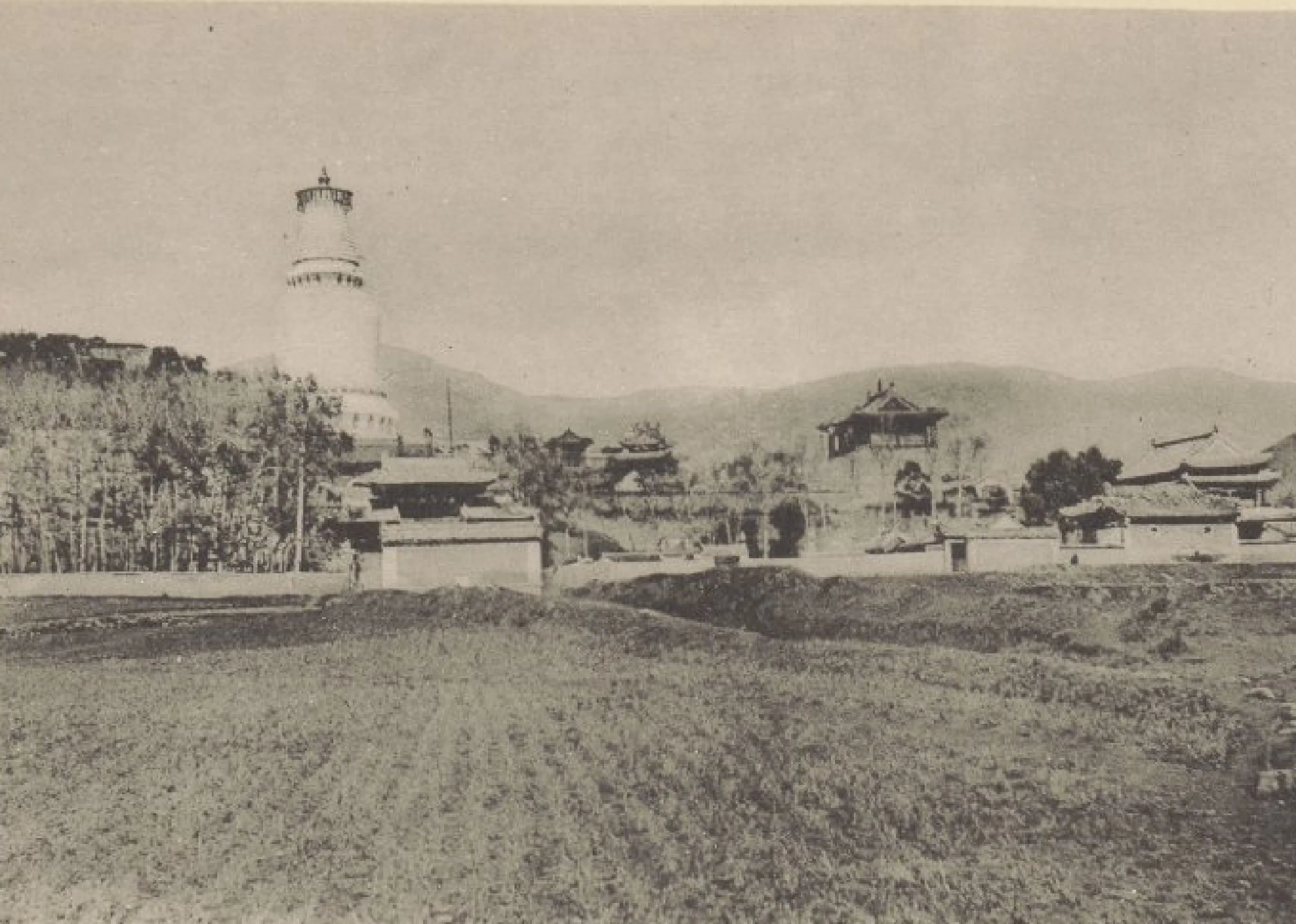
In 1907, the French sinologist Édouard Chavannes and the German architectural scholar Ernst Boerschmann separately photographed Xiantong Monastery on Mount Wutai. Chavannes’s photographs were published in 1909 in the Mission archéologique dans la Chine septentrionale, recording the central monastery group of Taihuai, Xiantong Monastery’s main hall, the beamless hall, the copper hall, and the five copper pagodas, with a close view of each of the four copper pagodas of different forms. Boerschmann’s photographs were later published in 1931 in the third volume, first part, of Die Baukunst und religiöse Kultur der Chinesen, Pagoden, recording from close by the copper-pagoda terrace the relative positions of the copper pagodas, the copper hall, and the beamless hall.
1920s–1930s
Tokiwa Daijō and Sekino Tadashi surveyed Mount Wutai in the 1920s and 1930s, and the related photographs were published in 1941 in the first series of Historical Monuments of Chinese Culture (Shina Bunka Shiseki). The Xiantong Monastery group includes a panoramic view of the monastery, the Great Mañjuśrī Hall, the beamless hall, the Thousand-Bowl Hall, and the five pagodas in front of the copper hall, preserving respectively the overall outline of the building complex, the fronts of individual halls, and the copper-pagoda terrace.