Introduction
During the Tang Qianfu era (874–879), Yunyan Temple was founded by imperial command on Mount Douchuan. It occupies a mountainside site beneath three summits, in what is now Wudu, Jiangyou, Sichuan. The temple was divided into two precincts: the eastern one was a Buddhist monastery, while the western one was a Daoist establishment.
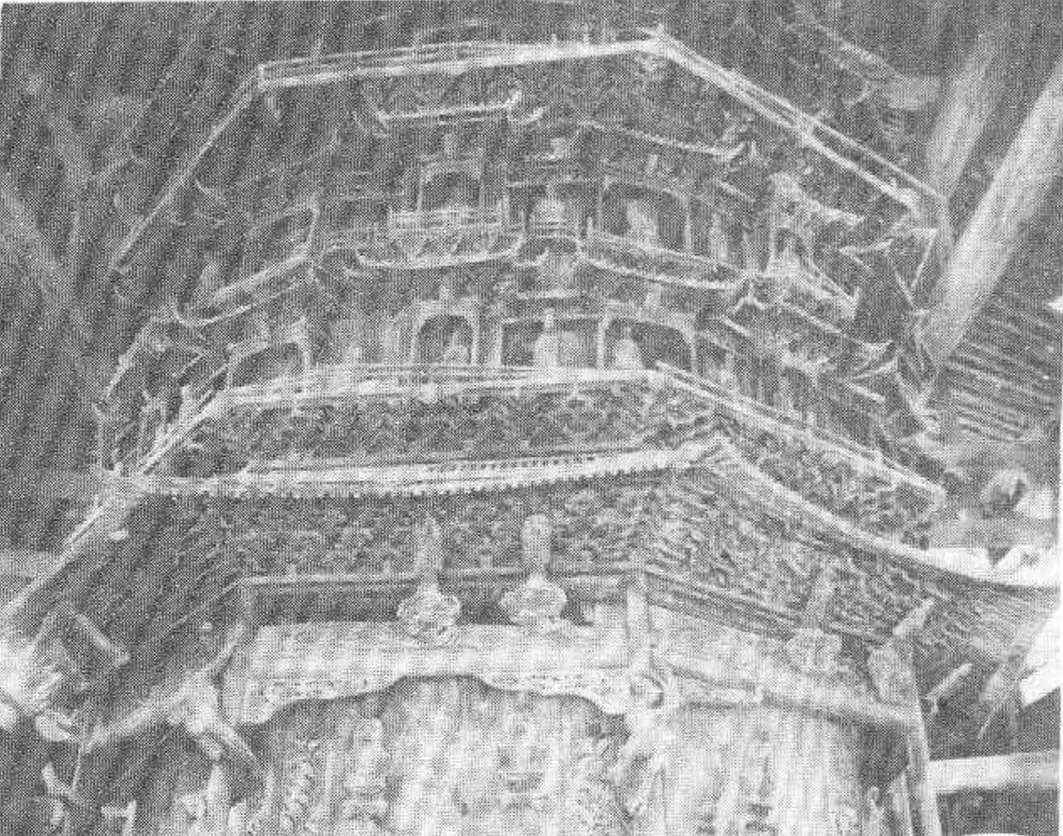
The Feitian Repository was built within the temple in Chunxi 8 of the Southern Song (1181) and repaired during the Yuan Zhizheng era (1341–1368). An octagonal, tower-shaped timber structure housed inside a hall, it rotates around a central vertical shaft and belongs to the revolving scripture-repository tradition. Such repositories originally stored religious texts. At Yunyan Temple, this form was used to enshrine Daoist deities, represented by wooden figures on the main structure and among its upper pavilions. Miniature halls rise in tiers, linked by galleries with bracket sets beneath the eaves and balustrades along the passages. Together these form the ‘celestial palaces and pavilions’. The hall enclosing the repository stands on the western side of the temple.
Shrines including Dongyue Shrine stood on the summits of Mount Douchuan, with iron chains spanning the peaks. During the Ming Wanli era, Zhu Zhonglian, an official of Long’an Prefecture, climbed to the summit. Finding no pavilion where mountain visitors could rest, he contributed his own salary, bought timber at Wuxi and commissioned craftsmen to build one. The new pavilion overlooked a sheer cliff, with railings on every side, and was named Chaoran. Zhu also repaired the masonry on the three peaks and three shrines to the east and west. He did not press for an early completion: he wished to avoid disrupting people’s livelihoods through compulsory labour and to give the craftsmen time to work well.[1]
The Feitian Repository survived the warfare at the end of the Ming. On the summit, Chaoran Pavilion deteriorated and collapsed with age. In spring of Kangxi 7 (1668), Yang Tingjie, a Jiangyou holder of the provincial examination degree, funded its restoration and entrusted the work to the Daoist Yuanzhen. Xian Qimei, a scholar from Long’an, procured timber, while the local resident Zhang Ju assembled the craftsmen. The pavilion was finished that autumn. The central beam of the summit’s main Dongyue Hall had also rotted. Its repair was more urgent but more costly, and the available funds could not cover both projects. Donations were therefore sought with written appeals and an alms bowl. Zhang Rong, Yu Renmu and the mountain’s custodian Jiang Tong helped shoulder the work; Dongyue Hall was not completed until the fourth month of Kangxi 11 (1672).[2]
Late in the Kangxi era, while Zhu Zhang was magistrate of Jiangyou, the summit’s Dongyue Temple was again falling into disrepair. The monk Liaoran, who had lived on the mountain for years, intended to leave because of illness. Zhu persuaded him to remain and oversee the repairs. Liaoran gathered timber and earth on the mountain and directed the craftsmen. Once the summit temple was repaired, he asked Zhu to compose a record for inscription on stone.[3] Down on the mountainside, the Feitian Repository Hall on Yunyan Temple’s western side had also suffered neglect: beams leaned, roof tiles split, birds and rodents occupied the interior, and the repository’s carved deities were damaged. A resident monk vowed to undertake repairs. With no ready money, he carried firewood and water on the mountain and calculated the cost of materials and labour. The repository could still be pushed around at that time.[4]
In Yongzheng 13 (1735), Yunyan Temple’s Great Buddha Hall was rebuilt on the mountainside. Six arhat scenes are carved on the base of its central shrine; the two in the middle are ‘Buddha within the Heart’ and ‘Mirage above a Finger’. Their figures and settings closely resemble the Qing court painter Leng Mei’s Arhats album in the Palace Museum, though the details differ. Several carvings contain additional rising clouds compared with the album, and figures shown there as white-bearded elders appear in the carvings as young men.[5]
In 1964, the architectural historian Luo Zhewen photographed the Feitian Repository, recording its timber form. As late as the 1970s, a single person could still turn it. Before the Wenchuan earthquake, however, the hall’s roof was leaking and its timber frame had deformed; the repository leaned to one side and could no longer rotate.[6]
On 12 May 2008, the Wenchuan earthquake severely damaged the Yunyan Temple complex. Summit buildings including Dongyue Hall collapsed, and the walls of the Feitian Repository Hall were damaged. Zhang Min, head of both the Jiangyou and Yunyan Temple heritage-management offices, went up the mountain with office director Wen Jian. They inspected and photographed the damage and reported it to the provincial and national heritage authorities. From that day, staff took turns guarding the repository hall and the storeroom to prevent further losses. An aftershock early on 18 May caused further wall collapses. That morning, Zhang led staff in carrying 72 carved wooden Daoist figures down from the Feitian Repository Hall and the Revolving Scripture Hall. Dating from the Song, Yuan and Qing, the figures were placed in safe storage by the management office.[7]
During the post-earthquake repairs, workers consolidated the hall’s foundations and straightened its frame, yet the repository still would not turn smoothly. To examine its lower pivot, they secured the structure with braces and steel cables, then used five jacks to lift the roughly five-tonne repository as a whole. After every three or four centimetres, they checked its balance with a level. Raising it twenty-five centimetres took three or four months. Once it was lifted, they discovered that old lubricating oil had hardened into a thick deposit and blocked the track. Removing the deposits and adding fresh lubricant restored its movement. In June 2018, the repair project, which had lasted more than three years, was declared complete. Three people could turn the restored repository.[8]
Historical Documents
Gazetteer of Jiangyou County
云岩寺在图山。唐乾符间敕建,分东西二院,东禅林,西道观。后遭兵乱,院宇荒废,僧了然重修。
Yunyan Temple is on Mount Tu. Built by imperial command during the Tang Qianfu era, it was divided into eastern and western precincts: a Buddhist monastery to the east and a Daoist establishment to the west. Later warfare left the buildings abandoned; the monk Liaoran rebuilt them.
飞天藏在窦图山。宋淳熙八年建,元至正中重葺。明季兵火,惟此独存。
The Feitian Repository is on Mount Doutu. Built in Chunxi 8 of the Song, it was repaired during the Yuan Zhizheng era. Amid the wars at the end of the Ming, this alone survived.
上人手中无一钱,搬柴运水寒岩前。花龛突如插天半,巨锥一举千灯悬。忆昔开堂始南宋,飞阁断自淳熙年。嵌空枘凿呈巧制,蚁孔曲斗难针穿。五丁神力不易到,经声雷动刚风旋。逮元至正乃重葺,糢糊彩凤犹高骞。额书尚题梓州守,藓甲蚀笔蛟龙缠。厥后梁益屡劫火,灵光古殿仍巍然。穴中鸟鼠阅人久,木寇金毁神无完。虹梁半欹鸳瓦裂,谁与举废悭前缘。云岩上人矢愿力,土木穷算盈十千。不日不月规缔造,好事肯令他人专。自言经营惨淡处,对佛𫖯首忧如煎。十年身住心不住,奔轮无恙推虚船。法云低晕白毫现,慧日高铸黄珠圆。铜瓶倒垂收塔影,贝叶细帙供香筵。巴西妇孺齐合掌,此举不朽堪流传。搜寻古碣乏剩字,琉璃碑嫩生秋烟。他年只恐锡飞去,怅望野鹤空摩天。
The monk has not a single coin in his hand, yet carries firewood and water before the cold cliffs. The ornate shrine suddenly rises halfway to heaven; a great pivot lifts a thousand suspended lamps. I recall its first opening under the Southern Song: the soaring galleries date to Chunxi. Cavities, tenons and joints display ingenious workmanship; the tiny holes and curved brackets scarcely admit a needle. Even the strength of the Five Giants could hardly reach it; chanting sounds like thunder as mighty winds whirl. In Yuan Zhizheng it was repaired; the faded painted phoenix still soars. The plaque still bears the prefect of Zizhou’s inscription, its twisting strokes worn by moss. Thereafter the lands of Liang and Yi repeatedly suffered war, yet the ancient hall stood like the surviving Hall of Numinous Light. Birds and rodents have long inhabited its hollows; the sacred figures are damaged, none whole. Painted beams lean and paired roof tiles split: who will restore what has fallen into neglect? The monk of Yunyan has made a firm vow, reckoning the building expenses in the tens of thousands. Day after day he plans the construction, unwilling to leave this good work to another. He speaks of its difficult management and bows before the Buddha, anxious as if scorched. For ten years his body has stayed but his mind has found no rest; the revolving wheel remains unharmed, moving like an empty boat. Clouds of the Dharma hang low and the white hair-mark shines; the sun of wisdom casts a golden orb. An inverted bronze vessel holds the tower’s reflection, and slender palm-leaf scriptures adorn the incense table. Women and children of Baxi join their palms; this deed deserves remembrance. Searching old stones yields few remaining characters, while autumn mist rises over the glazed monument. I fear one day his staff will fly away; I shall gaze after a solitary crane into the boundless sky.
Record of Chaoran Pavilion on Mount Doutu
余少读吕氏春秋,考天下九山,心窃慕之。长而逐坐车马,足迹所至,得躐九山之槪。然皆富于宫阙楼观,且在名都巨邑,为名公贤士所品题,而其迹始昭显。若夫奇伟秀绝,本于大块之生成者,不过王屋、太华、太行、孟门四山而己。始知古今胜地,多不符所载,以山之得名在人也。江油虽蜀西僻壤,治北有窦图山,山之高,著于绵、剑,双峰峭拔,巍然如阙,路盘绕而上,穷右峰之顶,有东岳祠,左峰梯迳不通,祠前横铁索以渡,香火之盛,甲于一方,而古碑无可稽。惟飞天藏钟磬,有宋元年号。铁锁桥之设,俗传子明所创,无乃以踪迹怪异,神其说以欺人耳。故登临者,至望仙台见险,至石门见奇。迨夫蹑巉岩,距虎豹,攀附而升,元览𥄳槪,握兹山之上游者,在岱宇之南,索桥之西焉。
In youth I read Master Lü’s Spring and Autumn Annals and longed to visit the nine great mountains of the realm. Later, travelling by carriage and on horseback, I reached most of them. Yet they abounded in palaces and towers, lay near famous cities and became renowned through eminent men’s praise. For grandeur and singular beauty born of nature itself, only Wangwu, Taihua, Taihang and Mengmen seemed worthy. I then understood that famous places often fail to match their descriptions: mountains acquire fame through people. Though Jiangyou lies in a remote western corner of Shu, Mount Doutu north of the county seat is celebrated in Mian and Jian. Two steep peaks rise like gate-towers. A winding path leads to the right summit, where Dongyue Shrine stands; the left peak has no stairway, and iron chains stretch across before the shrine for passage. Its worship flourishes beyond others in the region, but no old inscription establishes its beginnings. Only the Feitian Repository’s bells and chime stones bear Song and Yuan era dates. People say Ziming made the chain bridge; is this not simply a tale of marvels invented to deceive? Visitors encounter danger at the Terrace for Gazing at Immortals and wonder at the Stone Gate. Yet only those who climb the crags, pass the tiger-and-leopard-like rocks and pull themselves upward can command the whole prospect south of the shrine and west of the chain bridge.
客至靡不徜徉眺望,而无亭舍止息,以抒不穷之趣,未免阙然于中。乙酉孟冬,龙安司理朱公奉檄视邑,至旬月为窦篅之游,税驾履巅,爽瞻而叹曰:山乎山乎!山不负人,而人可负山乎?乃度地势,谋为宇,顾私心计之,而未告人也。再逾月,仍往一观,筹其费,捐俸金若干许,市木午溪,授匠作亭。亭之高,翼然独耸,四望群山,如在杯案。外夹栏栅,俯临千仞,又于三峰甃砌严整,东西三祠一时并葺。工始于腊初,落成于是岁七月。公不忍以官役夺民,且欲匠上缓图自善,故不务欲速如此。工竣之日,公具奠白神,集乡大夫、属吏䜩于亭,名其亭曰超然。问记于余。余惟山之来,无亭而亭成。于今日,无论榱甍薄汉,丹雘连云,即长泓带卷,万山屏列,娑萝倒悬,虹梁偃卧,远树笼烟,平川幂翠,景物映发,依依在目。
Visitors lingered to admire the view, but there was no pavilion in which to rest and enjoy it fully; something was missing. In early winter of a yiyou year, Lord Zhu, judicial officer of Long’an, came on official business to inspect the county. Within a month he visited Mount Douchuan, climbed to the summit and exclaimed: ‘Mountain, mountain! You have not failed people; how can people fail you?’ He surveyed the ground and planned a building, quietly estimating its cost. More than a month later he returned, calculated the expense, gave a sum from his salary, bought timber at Wuxi and engaged craftsmen. The pavilion rose alone like outspread wings; mountains on every side seemed set upon a table. Railings surrounded it above a tremendous precipice. Masonry on the three peaks was put in order, and three eastern and western shrines repaired together. Work began early in the twelfth month and was completed in the seventh month as recorded. Unwilling to take people from their livelihoods through official labour service, and wishing the craftsmen to work carefully at their own pace, he did not seek haste. Upon completion, he made offerings to the deity and gathered local gentlemen and subordinate officials for a feast. He named it Chaoran and asked me for this record. The mountain long existed without a pavilion; now a pavilion has arisen. Beyond its high beams and bright paint, deep waters wind below, mountains stand like screens, trees hang down, arched beams span the scene, distant woods hold mist and the plain is green. The scenery shines together before one’s eyes.
于斯时也,揽山川之清晖,慕仙人之遐举,则天籁清,尘想绝,浩浩乎直欲御风乘气,以游于无穷,而物我形骸,不在胸襟之内矣。公之为是亭也,岂特赋诗吊古,酾酒放歌己哉?
Here, taking in the clear splendour of mountains and streams and imagining the immortals’ distant wanderings, one hears nature’s pure sounds and sheds worldly thoughts. One feels ready to ride the wind into infinity, leaving bodily distinctions and the boundary between self and things behind. Did he build this pavilion merely for composing poems, recalling the past, pouring wine and singing?
公文章有藻誉,为治宽平,议狱惟缓。莅任以来,急公恤隐,远迩颂德。暇日绎左国杜诗,洒洒自适。然则超然之趣,盖得诸心而托诸亭也。他日好奇之士,列窦篅于九山,不以公重耶?公江右变福人,弱冠举于乡,讳仲廉,字中甫,察吾其别号云。
Lord Zhu is renowned for elegant writing and governs with fairness and leniency; he proceeds cautiously in judging cases. Since taking office he has diligently served the public and relieved hidden hardship, winning praise far and near. At leisure he reads the Zuo Tradition, Discourses of the States and Du Fu’s poems, content and free. His sense of transcendence arose in his heart and found a home in this pavilion. If later lovers of wonders rank Douchuan among the nine mountains, will it not be owing to him? A native of the place called Bianfu in Jiangxi, he passed the provincial examination in early adulthood. His personal name is Zhonglian, courtesy name Zhongfu and literary name Chawu.
Record of the Restoration of Chaoran Pavilion and Dongyue Hall under the Present Dynasty
余尝读坡公超然亭记,而知身游物外,无往而不自得,然未见其地之超然也。县东北十五里许,有图山者,昔唐彰明主簿窦子明,羡其风云所摅,山川所带,幽岫穷崖,人兽两绝,弃官修炼于此,脱蜕崖间,故以窦冠山名。双峰并峙,左崖建窦真宝殿,右崖建东岳行宫。自宋元迄今,两岸天堑,无路可通。相传云子明系铁绳二条,以通人迹,跨鲸鲵于海市,驾虹霓而蜒蜿,传虽诞而实奇。坪下有飞天,藏元真观、化主殿、清虚观、三清观、炳灵宫。由此而登,花鸟送人,名曰境入蓬壶。再登,人从隙过,名曰人间天上。三登,人与云遇,名曰碧云洞天。四登,山如刀截而复断,名曰升仙桥。陟巅四望无际,山水齐观。春淡冶如笑,夏苍翠如滴,秋明净如妆,冬惨淡如睡,诚山之超然者也。
I once read Su Dongpo’s Record of Chaoran Pavilion and understood how one who lives beyond worldly things may find contentment anywhere; but I had not seen a place so transcendent. Mount Tu lies some fifteen li northeast of the county seat. In Tang times Dou Ziming, registrar of Zhangming, admired its clouds, mountains and streams. Leaving office, he cultivated himself among cliffs where neither people nor beasts went, and was said to shed his mortal form there; hence the mountain bears Dou’s name. Two peaks face one another: Dou Zhen’s hall stands on the left cliff and Dongyue’s travelling palace on the right. Since Song and Yuan times a natural chasm has divided them, with no ordinary path. Tradition says Ziming fastened two iron ropes to bridge it, like riding a sea creature through a mirage or stretching a rainbow across the sky. Though the legend is fantastic, the sight is truly extraordinary. Below the terrace are the Feitian Repository and the religious buildings named Yuanzhen Guan, Huazhu Hall, Qingxu Guan, Sanqing Guan and Bingling Palace. Ascending, flowers and birds greet the visitor at ‘Entering the Immortal Realm’. Farther up one squeezes through a cleft at ‘Heaven above the Human World’; higher still one meets the clouds at ‘Jade-Cloud Grotto Heaven’. At the fourth ascent the mountain seems cut apart by a knife at the ‘Bridge of Ascension’. From the summit the view is boundless. Spring is delicate as a smile, summer green as dripping leaves, autumn bright as adornment and winter sombre as sleep: truly a place beyond the ordinary.
万历时,龙安司理朱讳仲廉,登眺其间,见长烟一空,皎月千里,心旷神怡,惜无止息处,因建斯亭,想有鉴于坡公而名之欤。越世已久,倾圮更甚。余读书览九山胜槪,觉兹山不减太行、孟门,登临其地,蕊珠紫府,或不是过,心欲继朱公而修葺之。适道人元真,深合余意,因捐赀令其经营,托龙安生咸其美,采木东山之阳。里人张举,命匠鸠工,始于康熙七年春,及秋,事竣,见东岳正殿中梁朽烂,其功似急于亭,但所费尤大,力难兼举,因挟疏持钵。有龙安民张荣、藩邑生余人牧,并山主蒋通等,力为肩任。考道经云:广乘之山,天之东岳也,主岁星之首,居九五青天之内。兹山虽不足以比隆,使行宫整饬,操出生入死之柄,持福善祸淫之权,其应如响,畴敢吝惜,而功弗立见焉。
During Wanli, Zhu Zhonglian, judicial officer of Long’an, admired the summit’s clear horizon and moonlit distance. Delighted by the view but regretting the lack of a resting place, he built this pavilion, perhaps naming it after Dongpo’s example. Much time passed and it fell into ruin. Having read accounts of the nine mountains, I felt this mountain no less fine than Taihang or Mengmen. Its towers seemed equal to celestial palaces, and I wished to continue Lord Zhu’s work. The Daoist Yuanzhen shared my purpose, so I supplied funds and entrusted him with the undertaking. I asked Xian Qimei, a student of Long’an, to gather timber on the southern side of the eastern mountain. The local resident Zhang Ju summoned craftsmen. Work began in spring of Kangxi 7 and ended in autumn. The central beam of Dongyue’s main hall was rotten; its repair seemed more urgent than the pavilion’s, but cost much more, beyond our means to undertake together. Appeals and an alms bowl were therefore carried about to seek donations. Zhang Rong, a Long’an commoner, Yu Renmu, a student of the dependency, and the mountain’s custodian Jiang Tong took responsibility together. Daoist scriptures say Mount Guangcheng is heaven’s Eastern Peak, presiding over the Wood Star and dwelling in the sovereign place within the blue heavens. Though this mountain cannot equal it, if its travelling palace is made orderly, its deity holds life and death and rewards good while punishing evil. Who would withhold gifts when divine response is like an echo? Surely the work would soon be accomplished.
康熙十一年四月告成,似与太行、孟门无异。所不若者,宫阙楼观,不获为名公贤士所品题耳。余不敢谓一笠之盖,可几获福,然山不在高,有仙则名,福非神作,抑人之自为作也。后之继志者,当有感于斯言。
It was completed in the fourth month of Kangxi 11, making this mountain seem no different from Taihang and Mengmen. It lacks only the acclaim of eminent men for its palaces and towers. I dare not say that giving even a humble shelter guarantees blessings. A mountain need not be high if an immortal gives it fame; blessings are not made by spirits alone, but by people’s own actions. May later successors take these words to heart.
Stele Record of Dongyue Temple on Mount Doutu
篅山之绝顶,有杰阁焉,飞甍四起,层崖高张,要必凭灵爽以为之主宰。山不必神,而神能神之。山之有岳殿,由来旧矣。其神主东方,判生死,延寿算,龙绵梓剑之民,奔走络绎,当首春时,吹笙鸣钹,婆娑而飨之,日以千百计,而不虞庙之日即于倾圯也。了然上人住锡有年,病且休矣,行将拂衣而去。余闻而固留之,谓夫檀邦之供养,云水之护持,孰如上人?及今不改修,谁与改修者?上人辞益力,然而邑宰不能留也。无己,则请诸岳神,则其所以留上人者,必最亲且切。乃上人病果起,年愈高而貌加丰,疑默相然。上人虽欲不改修焉,而不可得已。采木于山,范土于穴,布置岳体,指挥匠石。工将告竣矣,朱门洞戺,绛节高居,帝敕云开,鬼呼星循,而后登绝𪩘者,若美发之刺于簪而见其髻也。
At the very summit of Mount Chuan stands a splendid hall, its eaves lifted on four sides above sheer cliffs. Surely a numinous power must preside there. A mountain need not be divine, yet a deity can make it sacred. The mountain’s Dongyue Hall is ancient. Its god rules the east, judges life and death and extends people’s years. People from Long, Mian, Zi and Jian come in unending streams. At spring’s beginning hundreds and thousands gather daily, playing pipes and cymbals and dancing in worship, scarcely noticing the temple’s gradual ruin. The monk Liaoran had lived there for years, but was ill and intended to leave. Hearing this, I urged him to stay: who could equal his ability to sustain the community’s offerings and care for wandering monks? If he did not repair the temple now, who would? He refused firmly; even the magistrate could not keep him. Having no alternative, I appealed to the deity, whose reasons for retaining the monk must be closer and stronger. Liaoran indeed recovered, looking fuller as he grew older, as though helped unseen. He could no longer avoid the task. He gathered timber on the mountain, shaped earth from its hollows and directed the craftsmen in arranging the temple. As work neared completion, red doors and the deity’s lofty insignia appeared amid imagined heavenly edicts and attendant spirits. The restored building crowned the high peak like a pin showing through beautifully dressed hair.
夫人有不畏人,未有不畏鬼神者。其居家倨傲鲜腆,一人庙而徬徨赡顾,心震目骇,举生平不可告人之事,皆骈而闯伺之,措身其间,愧恧无地,心望若神之恻然哀怜,脱不测之区而丐须臾之命者屡矣。则非山之云,而神从而灵之,亦非神之必欲灵其山,而乞恩于山者之若或灵之也。
People may fear no other person, but none fail to fear ghosts and gods. Someone arrogant and shameless at home enters a temple and looks about in alarm; heart and eyes are shaken. All the deeds he cannot confess seem to crowd before him. Ashamed and unable to settle himself, he hopes the god will pity him, rescue him from unforeseen danger and grant a little more life. Thus it is not the mountain’s clouds that give a god power, but the prayers of those who seek grace there; nor must the god wish to sanctify the mountain, but the petitioners may make it seem sacred.
上人有徒八岁,能援索飞渡,百丈绳桥,捷如猱戏,拔崣崒之峰,登欢喜之岸,则福善祸淫之说,遍告檀越,应无不合掌称赞者,其必以是为普救之津梁也。工既成,上人乞余序以勒诸石,余因叙修庙之始末以记之。
The monk has an eight-year-old disciple who can cross the hundred-zhang rope bridge, nimble as a playing monkey, reaching the steep summit and the shore of joy. When word of reward for good and punishment for evil reaches the donors, surely all will join their palms in praise; perhaps this will become a bridge of universal salvation. When the work was complete, the monk asked me for a preface to carve in stone. I have therefore set down the course of the temple’s repair.
Historical Photographs
1980s
Photographs published by Zhao Min in Sichuan’s Mount Douchuan in Jiangyou in the 1980s, taken while staff from Mianyang Teachers’ College visited the mountain to film a scenic documentary. The three images show the summit temples from a distance, details of cliffside buildings, and the peaks and temples seen through pine branches.
1986 (publication)
A historical view of the Feitian Repository’s celestial pavilions, showing miniature buildings, balustrades and wooden figures. Reproduced by Project CloudCastle, which identifies the source as Gu Qiyi’s Brief Survey of the Feitian Repository and Its Hall at Yunyan Temple on Mount Chuan, Jiangyou County, Sichuan Cultural Relics, no. 4, 1986.
References
- Gu Qiyi, Brief Survey of the Feitian Repository and Its Hall at Yunyan Temple on Mount Chuan, Jiangyou County, Sichuan Cultural Relics, no. 4, 1986, pp. 9–13.
- Huang Shilin, The Feitian Repository at Yunyan Temple on Mount Douchuan, Jiangyou, Sichuan, Cultural Relics, no. 4, 1991, pp. 20–33, plates pp. 100–101.
- Wu Piwen, reviser, and Ou Peihuai, compiler, Gazetteer of Jiangyou County, woodblock edition of Guangxu 29 (1903), vols. 7, 13 and 24.
- Gu Xinchun, Searching for the Eighteen Arhats Scroll in the Longmian Style, The Forbidden City, no. 6, 2024, pp. 48–79.
- Wu Xiaoling, 800-Year-Old Feitian Repository at Yunyan Temple Undergoes Major Repairs, Sichuan Daily, 2 March 2016.
- Wu Xiaoling, The Five-Tonne Structure Lifted as a Whole: the More Than 800-Year-Old Feitian Repository Turns Again, Chuanguan News, 22 June 2018.
- Shan Jixiang, Director of the National Cultural Heritage Administration, Inspects Earthquake Damage at Yunyan Temple in Jiangyou, Sichuan, Ministry of Culture website, 22 May 2008.