Introduction
Yuelun Hill commands the throat of the Qiantang River, where tides surge twice daily, lashing the banks and pounding the shores for a thousand years without cease. In the third year of Kaibao (970), the Wuyue king Qian Chu built a temple and pagoda at the Southern Orchard, with Chan Master Zhijue Yanshou and Sangha Administrator[1] Zannings overseeing construction. The pagoda rose nine stories over fifty zhang in height, intended to subdue the river’s tidal bore. According to Cao Xun’s record, after the pagoda was completed “the tide followed its accustomed course, the stone embankments along the river suffered no erosion, and the residents along the dikes were freed from the dread of drowning.” During the Xuanhe era the pagoda was destroyed by fire, and the tides returned to wreak havoc — “mighty floods and furious foam, in an instant smashing dikes and destroying houses, devouring dozens to hundreds of zhang of riverside land.”
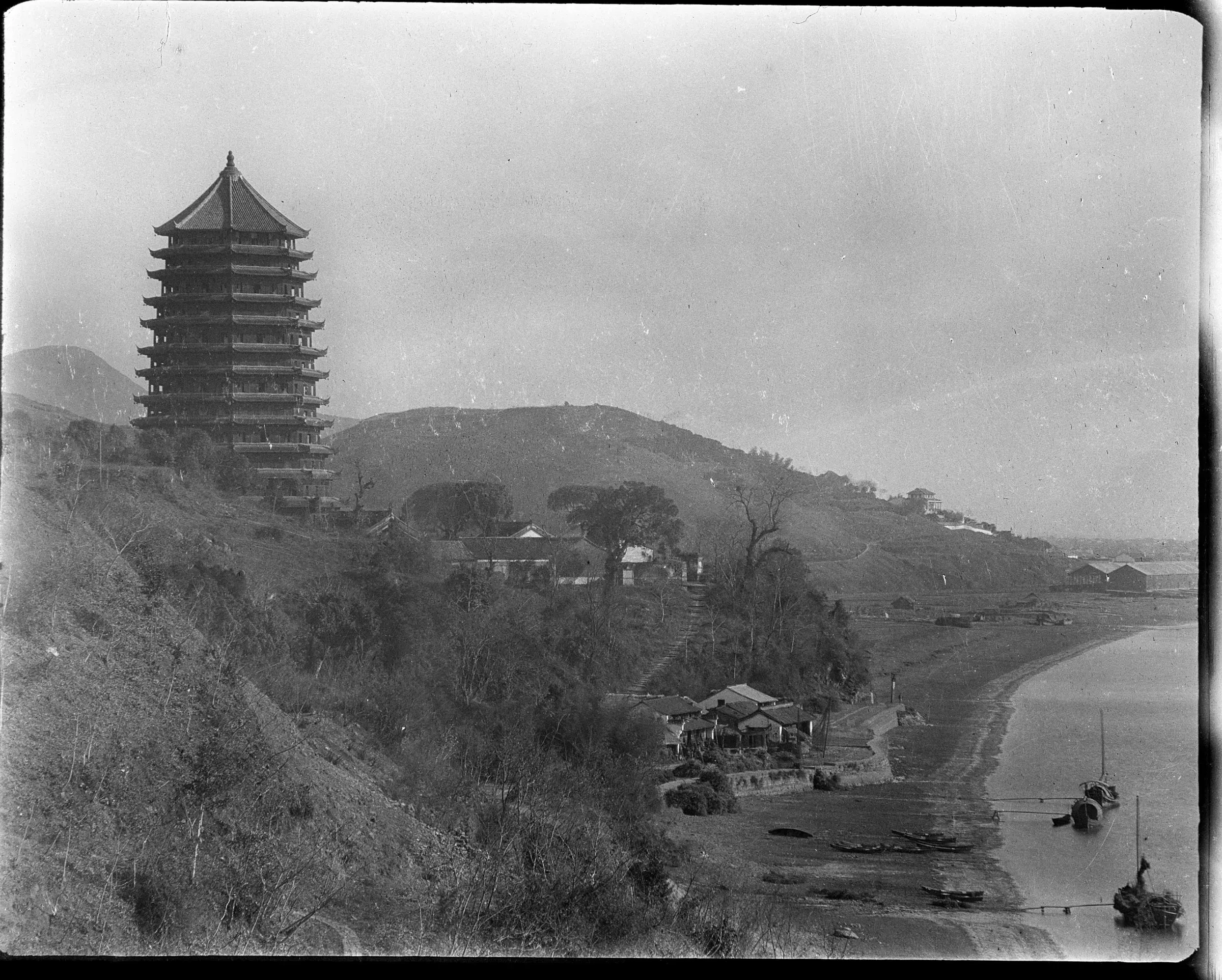
In the twenty-second year of Shaoxing the court decreed the pagoda’s reconstruction. The monk Zhitan, declining state funds[2] and raising money through monastic alms[3], began work in the twenty-third year of Shaoxing. By the first year of Longxing (1163) the seven stories were complete. Stone-carved texts of the Diamond Sutra and the Sutra of Forty-Two Chapters line the interior walls; the Jinshi Cuibian notes the “characters are as fresh as new” — a masterwork of Southern Song stone engraving. The pagoda also served as a lighthouse for night navigation: “When stars and moon sink from sight and boatmen know not where to steer, they look toward the pagoda and take the lamplight within as their compass.” Through the late Yuan and Jiajing eras the pagoda was repeatedly burned and restored. In the sixteenth year of Qianlong (1751), Emperor Hongli ascended the pagoda during his southern inspection tour, “personally climbing to its summit,” and inscribed plaques for each of the seven levels, from “First Ground of Steadfastness” to “Seven Treasures of Solemnity.” In Sidney Gamble’s photographs from 1917–1919, the timber galleries had already fallen away, leaving the brick core standing alone on the riverbank — still a landmark recognizable to those navigating the waterway.
Historical Documents
Cao Xun, “Record of Rebuilding the Pagoda of Shouning Cloister on Yuelun Hill, Lin’an Prefecture”
尝谓天下之事,利害相若,惟能因利以除害,则利斯得而害乃去。钱塘昔号都会,既天子建翠凤之旗,为驻跸之地,可谓据东南天设之险。而浙江介于吴越,一昼一夜,涛头自海而上者再,掠堤突岸,摧陷莫测,甚至捲民庐舍,冲坏田亩,为临安之患久矣。虽智者远谋,巧者述之,莫能御也。钱氏时,有僧智觉禅师延寿,同僧统赞宁创建斯塔,用以为镇。相传自尔潮习故道,边江石岸无冲垫之失,缘堤居民无惊溺之虞,闻者德之。迨宣和三祀,塔与寺为寇盗所𦶟,潮复为患,巨浸怒沫,顷刻间捣堤坏屋,侵附江之陆数十百丈。民虽寔苦其害,然迄无以措手。
I have long held that in the affairs of the world, advantage and harm are closely matched; only when one can build upon the advantage to eliminate the harm does one gain the benefit and remove the evil. Qiantang was long called a capital; the Son of Heaven planted his kingfisher-phoenix banner there and made it an imperial halting place — truly commanding the natural fortress of the southeast. Yet the Zhe River lies between the lands of Wu and Yue; twice each day and night the tidal bore sweeps up from the sea, lashing the embankments, pounding the banks, toppling them beyond reckoning — even carrying away dwellings and destroying farmland — a plague upon Lin’an for many years. Though the wise devised far-reaching plans and the skilled put them into action, none could master it. In the time of the Qian house (Wuyue), the monk Chan Master Zhijue Yanshou together with Sangha Administrator Zanning built this pagoda as a guardian. Tradition says that from then on the tide followed its accustomed course: the stone embankments along the river suffered no erosion, and the residents along the dikes were freed from the dread of drowning — all who heard spoke of its virtue. By the third year of Xuanhe, both pagoda and temple were destroyed by rebels, and the tides returned to wreak havoc: mighty floods and furious foam, in an instant smashing dikes and destroying houses, devouring dozens to hundreds of zhang of riverside land. Though the people suffered bitterly from this harm, there was nothing they could do.
绍兴岁在壬申,天子忧之,思所以制其害者。在廷之臣首以复兴斯塔为请,诏赐可,下有司计度,意将官给金币,庀工治材。而都下守臣择可主持斯事,得僧智昙,戒行精洁,道业坚固,可任以干缘。乃缕陈砖石土朩、方隅广袤,所以复塔之意。昙口诺心然,愿以身任其劳,仍不以丝毫出于官请,得募民众,毕兹胜事。都守即日命往住持是院。昙自被命,和义郡王杨存中率先众力,出俸资助,居士董仲永以家之器用衣物舍以供费。先造僧寮、库司、水陆堂、藏殿,安存新众,俾来者有归,以致中堂莲社闻风乐施,云臻雾集,虽远在他路,亦荷担而来。
In the renshen year of Shaoxing (1152), the Son of Heaven was troubled by this and pondered how to control the harm. His court ministers first petitioned to restore this pagoda. An edict approved; the matter was sent to the relevant offices for costing, with the intention of providing official gold and materials, mustering workmen and preparing timber. The prefectural authorities chose someone capable of managing this undertaking, and found the monk Zhitan — his observance of precepts was pure and his practice of the Way was firm, fit to be entrusted with the task of raising funds. They set forth in detail the bricks, stones, earth, and timber, the dimensions and breadth, and the purpose of restoring the pagoda. Zhitan verbally agreed and was willing in his heart, undertaking to bear the labor in his own person, without requesting a single thread of government funds — he would solicit contributions from the populace and bring this meritorious work to completion. The prefect that very day ordered him to go and serve as abbot of this cloister. Once Zhitan received the appointment, the Prince of Heyi Commandery Yang Cunzhong led the effort, donating his stipend; the layman Dong Zhongyong offered household implements and clothing to cover expenses. First he built monks’ quarters, a storehouse, the Water-and-Land Hall, and the Sutra Hall to settle the newly arrived community, so that all who came would have a home. The result was that the Lotus Society of the Central Hall, hearing of this, joyfully donated; like gathering clouds and mist, even those far away in other regions shouldered their burdens and came.
自癸酉仲春鸠工,至癸未之春,五层告成。是年晚岁,则七级就绪,巍然揭立,成数十寻。跨陆俯川,阑楯层橑,面面开敞,宝网鸣铎,光动山海,撑空突兀,已立于风烟之上。外则规制壮丽,气象雄杰,日以万众观喜瞻仰,得未曾有。内则磴道以登,环壁刊金刚经,列于上下,及塑五十三善知识,备尽庄严。至于佛菩萨众,各以次位置。凡所以镇静山川,护持法界者,莫不阂而存焉。
From the second month of spring in the guiyou year (1153) when work was begun, until the spring of the guiwei year (1163), five stories were complete. By the year’s end, seven levels were finished — towering and imposing, rising several dozen xun in height. Straddling land and overlooking the river, with balustrades and layered rafters, open on every face, jeweled nets and ringing bells, its radiance stirring mountain and sea, thrusting into the sky — it already stood above the wind and mist. On the outside, the form is grand and magnificent, the aspect heroic and bold; daily ten thousand people come to gaze and admire — something never seen before. On the inside, one climbs by stone stairs; the Diamond Sutra is carved on the encircling walls, arrayed from top to bottom, and the Fifty-Three Good Teachers are sculpted — all fully adorned. As for the assembly of buddhas and bodhisattvas, each is placed in its proper position. All that is needed to calm mountains and rivers and protect the Dharma-realm is here without lack.
塔兴之初,土石未及百篑,而潮势虽仍汹涌,已不复向来之害。以故衣冠缁黄,耆艾士民,德昙甚深,拱手赞叹。是塔也,不特镇伏潮不为害,又航于海者,寅夕昏晦,星月沉象,舟人未知攸济,则必向塔之方,视塔中之灯光以为指南,则海航无迷津之忧矣。致富商大舶,尤所归向,而喜舍无难色,此又塔之利也。
When construction first began, though the earth and stone had not yet reached a hundred baskets, and the tide was still as fierce as before, it was already no longer as harmful as in the past. Therefore, gentry and commoners, clergy in black and yellow, elders and scholars, all revered Zhitan deeply, clasping their hands in praise. This pagoda not only subdues the tide so that it does no harm, but also — for those who navigate at sea, when dawn or dusk brings darkness and the stars and moon have sunk from sight, and boatmen know not where to steer — they look toward the pagoda and take the lamplight within as their compass, so that ocean voyagers have no fear of losing their way. Wealthy merchants and great vessels especially orient themselves by it, donating generously without reluctance — this is yet another benefit of the pagoda.
塔将圆满,寺众以事之始末,求予文以记其实。昙,东人也。体识深敏,早受律仪,持教临坛,已逾三纪。信心之士,往往联芳咀妙,割缚导迷,作大方便,护于群生。顾予知昙之戮力,乃申利害之所出,陈上圣之忧劳,纪廷臣之建言,道昙之率众,与夫工徒用度之数,皆摭其实,庶知不假声势,成兹利益,备诸难事,而尽未来际千百载下,僧俗当共谨护,以为此邦植福,岂不美哉?约用工费百万𦈏钱二十万云。
As the pagoda neared completion, the monastic community, recounting the affair from beginning to end, asked me for a text to record the facts. Zhitan is a man of the east. His understanding is deep and sharp; he received the monastic precepts early and has upheld the teaching and ascended the platform for more than three decades. Those of sincere faith often come together in fragrance and savor subtlety; he cuts bonds and guides the lost, providing great expedient means to shelter all beings. Considering that I know of Zhitan’s devoted labors, I therefore set forth the source of advantage and harm, recount the sovereign’s anxious toil, record the court ministers’ petitions, and narrate Zhitan’s leadership of the multitude, along with the numbers of workers and expenditures — all gathered from fact. May it be known that without relying on power or prestige, this benefit was accomplished, all difficulties were overcome, and for a thousand or hundreds of years into the future, monks and laity alike should carefully protect it, planting blessings for this region. Is that not a fine thing? The total construction cost was approximately one million strings of cash and two hundred thousand further.
Stone-Carved Sutra of Forty-Two Chapters in Liuhe Pagoda
佛说四十二章经:
The Sutra of Forty-Two Chapters Spoken by the Buddha:
The sutra was copied by forty-two officials, each writing one chapter. Their names and titles are listed below:
特进尚书左仆射、同中书门下平章事、吴兴郡开国公沈该,
左正奉大夫、守尚书右仆射、同中书门下平章事、缙云郡公汤思退,
左中大夫、知枢密院事陈诚之,
左中大夫、参知政事陈康伯,
左太中大夫、同知枢密院事王纶,
左太中大夫、权吏部尚书贺允中
左朝请、试尚书吏部侍郎、史馆修撰兼侍讲叶义问。
左朝请试尚书兵部侍郎兼侍讲兼直学士院杨椿
左朝散郎、试给事中兼直学士院兼同修国史。周麟之
左朝散郎、试中书舍人兼权枢密院都承旨洪遵
左朝散大夫、充敷文阁待制、提举佑圣观杨契
右朝奉大夫、权尚书吏部侍郎沈介
左中奉大夫、权尚书户部侍郎赵令𬣳
左朝奉大夫、权尚书礼部侍郎兼侍讲孙道夫
左朝请郎、权尚书工部侍郎王晞亮
左朝请郎、权尚书刑部侍郎兼权详定一司敕令黄祖舜
左宣教郎、试起居舍人兼权中书舍人张孝祥
左朝请大夫、太常少卿兼权中书门下省捡正诸房公事宋榧
左朝请大夫、守宗正少卿金安节
右朝请郎、守大理少卿李洪
右朝议大夫,司农少卿董苹
右中大夫、行太府少卿钱端礼
左朝奉大夫,将作监张宗元
左朝请大夫,军器监张运
左朝请大夫,尚书吏部郎中杨朴
右朝奉郎、守尚书户部郎中兼权金部郎中莫蒙
右奉直大夫,尚书刑部郎中路彬
左朝散郎、守尚书工部郎中张廷实
左奉议郎,尚书吏部员外郎兼权尚书右司郎官周操
左朝奉郎、尚书吏部员外郎兼国史院编修官兼权枢密院检详诸房文字。叶谦亨
左朝奉郎、尚书吏部员外郎兼国史院编修官胡汸
右朝散郎,尚书司勋员外郎陈俊卿
右宣教郎、守尚书司封员外郎鲍彪
左朝请郎,尚书考功员外郎陈棠
左朝散郎,尚书礼部员外郎杨邦弼
左朝奉郎,尚书□部员外郎兼权国子司业张洙
右承议郎、尚书刑部员外郎黄子淳
左朝请郎、尚书都官员外郎兼玉牒所检讨官兼权户部员外郎杨倓,
左奉议郎、守尚书比部员外郎沈枢,
左朝请大夫、行尚书屯田员外郎韩彦直
左承议郎、秘书丞兼国史院编修官兼尚书兵部员外郎虞允文
右奉议郎、秘书省校书郎兼国史院编修官兼权尚书驾部员外郎洪迈。
维神宗盛时,文物彬彬,郁然有典谟之风。是时搢绅巨儒,若富公弼、贾公昌朝辈,分写金刚经,刻琢坚珉三十二分,至今蛟龙蛇蜃,翱翔踊跃,挹之而疑其飞去也。恭惟盛时,文章制作,上跨三代,下峙两汉,道术奇士辈推明盛典,命智昙法师修六和塔以折海势,各分写四十二章经,镌石龛山下,作江湖间,旷代绝无,而仅有一胜事。盖散则一大藏演之不足,聚则四十二章藏之有余,其言与大易、庄、老相表里,旨哉淡而不隐,中而不滥也。迦叶、竺法译于前,智圆训于中,骆偃序于后,咸未足以传其大哉!惟众贤举坠典而一新之,故夷齐虽仁,得孔子而德益彰;颜渊虽笃学,附骥尾而行益显。是经虽微妙宏深,际盛时而理益明,其趋一也。时圣宋绍兴己卯冬十一月旦跋。
In the flourishing age of Emperor Shenzong, literature and institutions were resplendent, with the air of canonical writings. At that time the great Confucian scholars — such as Lord Fu Bi and Lord Jia Changchao — each wrote a portion of the Diamond Sutra, carving thirty-two sections in hard stone. To this day the serpents and dragons seem to soar and leap — one gazes at them and half suspects they might fly away. I reverently reflect that in that age of prosperity, literary composition surpassed the Three Dynasties above and towered alongside the Two Han below. Masters of the Way and extraordinary men furthered the illustrious rites, commanding Dharma Master Zhitan to repair Liuhe Pagoda to subdue the sea’s force. Each wrote a portion of the Forty-Two Chapters Sutra, and the texts were carved in stone in the niches beneath the hill — a work unparalleled throughout the ages between river and lake, unique in its magnificence. For when dispersed, an entire great canon is insufficient to expound it; when gathered, the forty-two chapters more than contain it. Its words complement the Yijing, Zhuangzi, and Laozi; its purport is lucid yet unhidden, balanced yet not diffuse. Kasyapa and Zhu Falan translated it first; Zhiyuan annotated it in between; Luo Yan composed a preface afterward — yet all were insufficient to transmit its greatness! Only when the assembled worthies raised up a fallen classic and made it new again — therefore, though Bo Yi and Shu Qi were already benevolent, through Confucius their virtue was yet more illustrious; though Yan Hui was already devoted in learning, by following a swift steed his renown was yet more manifest. Although this sutra is subtle, vast, and profound, meeting a prosperous age its principles grow ever clearer — the principle is one. Colophon on the first day of the eleventh month in winter, the jimao year of Shaoxing of the Sage Song (1159).
西蜀布衣武翃撰。
Written by Wu Hong, commoner of Western Shu.
Commentary in Jinshi Cuibian
右四十二章经凡四十二人,人各写一章,字体大小疏密不等,唯允中、端礼、朴操四人行书,余皆真书。后有西蜀布衣武翃跋,题绍兴已卯十一月。以史考之,是岁六月,沈该罢左相,陈诚之亦罢枢密,其七月,贺允中自吏部尚书参知政事矣。此经盖书于五月以前,至仲冬始勒之石也。自绍兴已卯至今六百余年,字迹完好如新,惟思退名为后人磨去。南渡石刻工妙若此者,亦不易得矣。按四十二章经在杭州钱塘江岸六和塔内,下层嵌壁。咸淳临安志:六和塔,开宝三年,智觉禅师始于钱氏南果园开山,建塔九级,后废。绍兴十二年奉旨重造。二十六年僧智昙因故基成之,七层而止。据曹勋𢷣重建月轮山寿宁院塔记云:自癸酉仲春鸠功,至癸未之春,五层告成。是年岁晚,七级就绪。
The above Forty-Two Chapters Sutra was written by forty-two persons, each writing one chapter. The calligraphic styles vary in size, density, and spacing; only Yunzhong, Duanli, Pu, and Cao used running script — the rest wrote in regular script. At the end is a colophon by Wu Hong, commoner of Western Shu, dated the eleventh month of the jimao year of Shaoxing. Checking this against the historical record: in the sixth month of that year Shen Gai was dismissed as Left Grand Councilor, and Chen Chengzhi was also dismissed from the Privy Council; in the seventh month, He Yunzhong was promoted from Minister of Personnel to Vice Grand Councilor. The sutra was thus written before the fifth month, and not carved in stone until the middle of winter. From the jimao year of Shaoxing to the present day is over six hundred years, yet the characters are as fresh as new — only the name of [Tang] Situi has been ground away by later generations. Among the stone carvings of the Southern Crossing (Southern Song), one so skillfully made is rare indeed. Note: the Forty-Two Chapters Sutra is inside Liuhe Pagoda on the bank of the Qiantang River in Hangzhou, set into the wall of the lower story. The Xianchun Lin’an Zhi states: Liuhe Pagoda — in the third year of Kaibao, Chan Master Zhijue first opened the site at the Qian family’s Southern Orchard and built a nine-story pagoda, later destroyed. In the twelfth year of Shaoxing, by imperial decree it was rebuilt. In the twenty-sixth year, the monk Zhitan completed it on the old foundations, stopping at seven stories. According to Cao Xun’s “Record of Rebuilding the Pagoda of Shouning Cloister on Yuelun Hill”: from the second month of the guiyou year work began, and by the spring of the guiwei year five stories were complete; by year’s end, seven levels were finished.
癸酉是绍兴二十三年,癸未则隆兴元年,是塔之成非二十六年也。武翃跋但言镌石龛山下,作江湖间旷代胜事,不云在塔。曹勋记亦云此经嵌壁环壁,刊金刚经,列于上下,而不及此经,意与金刚经同时,而经书于巴卯岁,在塔成之前四年,勋记不及者,或嵌壁在塔成之后。然武林石刻记但云在六和塔,不详嵌壁岁月,不知何年。此碑幸在塔内,无一字缺蚀。独思退之名,后人磨去,殆以其在相位效秦桧所为,犹七十二贤赞磨去桧记之例,然犹存系衔及汤字,得以知其为思退也。
The guiyou year is the twenty-third year of Shaoxing (1153), and guiwei the first year of Longxing (1163) — thus the pagoda was completed not in the twenty-sixth year. Wu Hong’s colophon only says “carved in stone in the niches beneath the hill, a work unparalleled between river and lake” — it does not say “in the pagoda.” Cao Xun’s record likewise says that the Diamond Sutra was carved on the encircling walls, arranged top to bottom, but does not mention this sutra. The intent was perhaps that both were done at the same time; yet the sutra was written in the jimao year — four years before the pagoda was finished. That Cao Xun does not mention it may be because the inscription was set into the wall after the pagoda was completed. Still, the Record of Wulin Inscriptions merely says it is in Liuhe Pagoda, without specifying the date of the wall setting — the year is unknown. Fortunately this stele is inside the pagoda, without a single character eroded. Only the name of [Tang] Situi was ground away by later generations — presumably because, while in the post of Grand Councilor, he emulated Qin Hui’s deeds; just as in the case of the “Seventy-Two Worthies Encomia” where Hui’s inscription was also erased. Yet the office title and the character “Tang” survive, so one can still identify it as Situi.
Xihu Zhi (West Lake Gazetteer)
慈恩开化教寺咸淳临安志:开宝三年,吴越王就南果园建寺,造六和塔。宣和间毁于兵。绍兴二十二年,北僧智昙以衣钵募缘重造,十载始成。隆兴二年赐今额。有金鱼池。成化杭州府志:元末毁,重建。西湖游览志:嘉靖十二年,寺与塔俱火。
Ci’en Kaihua Teaching Monastery — the Xianchun Lin’an Zhi states: in the third year of Kaibao, the King of Wuyue built the monastery at the Southern Orchard and erected Liuhe Pagoda. During the Xuanhe era it was destroyed by soldiers. In the twenty-second year of Shaoxing, the northern monk Zhitan raised funds through his monastic patrimony and rebuilt it — completion took ten years. In the second year of Longxing it received its present name plaque. It has a Goldfish Pool. The Chenghua Hangzhou Fuzhi states: destroyed at the end of the Yuan, rebuilt. The Xihu Youlan Zhi states: in the twelfth year of Jiajing, both temple and pagoda burned.
六和塔咸淳临安志:即旧宁寿观。开宝三年,智觉禅师延寿始于钱氏南果园开山建塔,因即其地造寺,以镇江潮。答高九级,长五十余丈,内藏舍利,或时光明焕发大江中,舟人瞻见之。后废。绍兴十二年奉旨重造。二十六年,僧智昙因故基成之,七层而止。武林梵志:嘉靖三年毁。万历间,袾宏重修。
Liuhe Pagoda — the Xianchun Lin’an Zhi states: originally the Ningshou Daoist Temple. In the third year of Kaibao, Chan Master Zhijue Yanshou first opened the site at the Qian family’s Southern Orchard and built the pagoda; he then erected a monastery on that very ground to subdue the river tides. It rose nine stories, over fifty zhang in height, with relics stored within — at times a radiance shone forth into the great river, and boatmen could see it. Later destroyed. In the twelfth year of Shaoxing, by imperial decree it was rebuilt. In the twenty-sixth year, the monk Zhitan completed it on the old foundations, stopping at seven stories. The Wulin Fanzhi states: destroyed in the third year of Jiajing. During the Wanli era, Zhuhong repaired it.
Xianchun Lin’an Zhi (Xianchun-era Gazetteer of Lin’an)
慈恩开化教寺,
Ci’en Kaihua Teaching Monastery —
开宝三年,吴越王就南果园建寺,造六和宝塔,以镇江潮。宣和毁于兵。绍兴二十二年,北僧智昙以衣钵募缘重造,十载始成。隆兴二年赐今额。有秀江亭、金鱼池
In the third year of Kaibao, the King of Wuyue built a monastery at the Southern Orchard and erected the Liuhe Jeweled Pagoda to subdue the river tides. During the Xuanhe era it was destroyed by soldiers. In the twenty-second year of Shaoxing, the northern monk Zhitan raised funds through his monastic patrimony and rebuilt it — completion took ten years. In the second year of Longxing it received its present name plaque. It has the Xiujiang Pavilion and the Goldfish Pool.
Chenghua-era Gazetteer of Hangzhou Prefecture
慈恩开化寺即六和塔寺在城南龙山月轮峰下瞰大江唐开宝三年即钱氏南果园建寺塔以镇江潮有金鱼池秀江亭宋宣和中恼于方腊之乱绍兴间重建隆兴二年赐是额元末寺废重建寺南旧有铁井栏刻八卦其上以镇水怪
Ci’en Kaihua Temple — that is, Liuhe Pagoda Temple — stands south of the city beneath Yuelun Peak on Dragon Hill, overlooking the great river. In the third year of Kaibao it was built at the Qian family’s Southern Orchard — temple and pagoda — to subdue the river tides. It has the Goldfish Pool and Xiujiang Pavilion. During the Xuanhe era of the Song it was damaged in Fang La’s rebellion; rebuilt in the Shaoxing era; in the second year of Longxing it received this name plaque. Destroyed at the end of the Yuan, rebuilt. South of the temple there was formerly an iron well-curb with the Eight Trigrams carved upon it to subdue water-spirits.
六和塔在龙山月轮峰即旧寿宁院开宝三年智觉禅师始于钱氏南果园建塔因即其地造寺以镇江潮塔高九级五十余丈后废绍舆二十二年春重造七层而止
Liuhe Pagoda stands on Yuelun Peak of Dragon Hill — formerly the Shouning Cloister. In the third year of Kaibao, Chan Master Zhijue first built the pagoda at the Qian family’s Southern Orchard, then erected a monastery on that very ground to subdue the river tides. The pagoda rose nine stories, over fifty zhang in height. Later destroyed. In the spring of the twenty-second year of Shaoxing it was rebuilt, stopping at seven stories.
Wanli-era Gazetteer of Hangzhou Prefecture
六和塔院即六和寺在龙山月轮峰旧名寿宁院唐
开宝三年僧智觉于钱氏南果园建塔因即其地
造院以镇江潮后废宋绍兴二十二年重建归并
于此曰保和寺
The Liuhe Pagoda Cloister — that is, Liuhe Temple — stands on Yuelun Peak of Dragon Hill. Its former name was Shouning Cloister. In the third year of Kaibao, the monk Zhijue built the pagoda at the Qian family’s Southern Orchard, then erected a cloister on that very ground to subdue the river tides. Later destroyed. In the twenty-second year of Shaoxing of the Song it was rebuilt, and the properties were merged here under the name Baohe Temple.
Southern Song Department of State Affairs Decree Stele
札付开化寺
Memorandum to Kaihua Temple:
开化寺六和塔住持讲唯识因明等论僧智昙状。伏都临安府开化寺六和塔,开宝四年,请创建斯塔,以镇江潮。后因绍兴二十二年十月内奉圣旨:塔庙令礼部看详兴工,令临安府转运司同其措置。至绍兴二十六年内,蒙临安府委官劝请,给帖付智昙住持修建。当时不愿申请官中钱物,并是智昙用自己衣钵教化钱物建置。今来宝塔垂成在即,委是江潮平善,舟楫无虞。欲望特与本寺蠲免借科敷,及指占安泊,伏候指挥。七月二十六日奉圣旨,特依。
The memorial of the monk Zhitan, abbot of Kaihua Temple Liuhe Pagoda, who lectures on the Cheng Weishi Lun, Yinming (Hetuvidya), and other treatises: The Liuhe Pagoda of Kaihua Temple, Lin’an Prefecture, was originally requested for construction in the fourth year of Kaibao to subdue the river tides. Later, in the tenth month of the twenty-second year of Shaoxing, an imperial edict decreed that the Ministry of Rites should inspect and authorize the work, and that the Transport Commission of Lin’an Prefecture should jointly arrange matters. In the twenty-sixth year of Shaoxing, the Lin’an Prefecture authorities delegated officials to invite and issue credentials to Zhitan to serve as abbot and oversee the rebuilding. At that time he declined to request official funds; all was undertaken by Zhitan using his own monastic patrimony to solicit contributions for the construction. Now the Jeweled Pagoda nears completion, and truly the river tides have become calm, and boats travel without fear. We petition that the temple be granted special exemption from levies and requisitions, and that its mooring-places be designated and protected. We await instructions. On the twenty-sixth day of the seventh month, the imperial edict decreed: Specially granted.
右札付开化寺。
The above memorandum is delivered to Kaihua Temple.
乾道元年七月日,又札付智昙月轮山六和塔,伏候指挥。闰十一月二十八日奉圣旨,依所乞。右札付僧智昙。隆兴二年十二月日。右第三层军府准尚书省札子,开化寺六和塔住持至,伏候指挥。七月二十六曰奉圣旨,特依。右札付临安府者。右除已帖钱塘仁和县僧司,仰遵依已降圣旨指挥施行外,今帖开化寺六和塔,仰照会乾道元年入月初三曰帖使。右右碑高七尺,广三尺四寸,分四层。
On a day in the seventh month of the first year of Qiandao (1165), another memorandum was delivered to Zhitan of Liuhe Pagoda on Yuelun Hill, awaiting instructions. On the twenty-eighth day of the intercalary eleventh month, the imperial edict decreed: Granted as petitioned. The above memorandum is delivered to the monk Zhitan. On a day in the twelfth month of the second year of Longxing (1164). The above third section: the Military Prefecture, acting on a memorandum from the Department of State Affairs — the abbot of Kaihua Temple Liuhe Pagoda having arrived — awaits instructions. On the twenty-sixth day of the seventh month, the imperial edict decreed: Specially granted. The above memorandum is delivered to Lin’an Prefecture. Apart from having already notified the Monastic Office of Qiantang and Renhe Counties to obey and execute the imperial edict, this notice is now delivered to Kaihua Temple Liuhe Pagoda, to take note of the notice issued on the third day of the eighth month of the first year of Qiandao. The stele measures seven chi tall and three chi four cun wide, divided into four registers.
吴尺凫跋云:宋制,尚书省牒皆横□。牒用大字行书,本事用小字真书,衔径一条,大字粗细文。此碑横分四段,皆依省式,惟加题额。中间二、三两题皆先左后右。隆兴二年之明年为乾道改。元也。
Wu Chifu’s colophon says: Under Song regulations, documents from the Department of State Affairs were all written in horizontal format. The documents used large-character running script; the body text was in small-character regular script; the official titles were in a single column of large characters in varying thickness. This stele is divided horizontally into four sections, all following the departmental format — only adding a heading. The second and third headings in the middle both read left before right. The year following Longxing 2 was Qiandao 1 [due to the reign-era change].
宰辅表云:中书平章为宰相,枢密使权任惟均,谓之两府,皆谓之执政。如此,则中书门下平章事为宰相,应先于两枢密矣。按钱为端礼,虞为允文。年表:隆兴二年十一月辛丑,端礼除端明殿学士、签书枢密院事。明日壬寅,允文除端明殿学士、同签书枢密院事。十二月辛卯,端礼除参知政事。同日,允文除同知枢密院事。至明年乾道元年三月庚申,允文始除参知政事。据此,则隆兴牒上,允文不得书参知政事,或因乾道后牒,而僧家之刻有误与?又左一行有官阙姓。考本纪:隆兴二年十一月戊戌,以陈康伯为尚书仆射、同中书门下平章事。本传康伯复相,即其家除拜,舆疾就道,至阙,以疾免朝谒。是因康伯不至中书,故其下有免押字也。首辅不书姓,特例也。
The Table of Grand Councilors says: the Zhongshu Pingzhang was the Grand Councilor, the Privy Council Commissioner’s power and responsibilities were equal, and together they were called the Two Administrations, both called the Executive. Accordingly, the Zhongshu Menxia Pingzhangshi (Grand Councilor) should precede the two Privy Council officials. Checking: “Qian” refers to [Qian] Duanli, and “Yu” to [Yu] Yunwen. The chronological table: in the eleventh month of Longxing 2, on the xinchou day, Duanli was appointed Duanming Hall Scholar and Co-Administrator of the Privy Council. The next day, renyin, Yunwen was appointed Duanming Hall Scholar and Joint Co-Administrator of the Privy Council. In the twelfth month, on the xinmao day, Duanli was appointed Vice Grand Councilor. On the same day, Yunwen was appointed Associate Director of the Privy Council. Not until the third month of Qiandao 1 (the following year), on the gengshen day, was Yunwen first appointed Vice Grand Councilor. Accordingly, on the Longxing-era document, Yunwen could not have been titled Vice Grand Councilor — perhaps the error stems from a later Qiandao-era document being mixed in by the monks who carved the stele? Also, in the left column there is an official title without a surname. Checking the Basic Annals: in the eleventh month of Longxing 2, on the wuxu day, Chen Kangbo was appointed Director of the Department of State Affairs and Zhongshu Menxia Pingzhangshi (Grand Councilor). His biography states that when Kangbo was reappointed Grand Councilor, the investiture was conducted at his home; he was carried in a sedan chair while ill, and upon arriving at the palace was excused from court audience on grounds of illness. Because Kangbo never came to the Secretariat, the line below his title has a “waiver of countersignature.” Omitting the chief minister’s surname is a special precedent.
咸淳临安志称赐额慈恩开化教寺。慈恩字省中略去。又云:开宝三年,吴越王就南果园建寺,造六和塔,以镇江潮。方腊毁。绍兴二十二年,北僧智昙重造,十年始成。今牒称绍兴二十六年始工,至隆兴二年凡九年,塔庙皆成。于是住僧等论智昙功状,故有是牒,而明年住僧复请蠲免。又有后札并府帖,时府尹为薛良明,其文中铲去最始建塔之名,是误书智昙而去之者。
The Xianchun Lin’an Zhi records the bestowed name plaque as Ci’en Kaihua Teaching Monastery. The characters “Ci’en” were abbreviated away in the departmental usage. It further states: in the third year of Kaibao, the King of Wuyue built the monastery at the Southern Orchard and erected Liuhe Pagoda to subdue the river tides. It was destroyed by Fang La. In the twenty-second year of Shaoxing, the northern monk Zhitan rebuilt it — ten years until completion. The present decree states that work began in the twenty-sixth year of Shaoxing and took nine years until Longxing 2, when both pagoda and temple were finished. Thereupon the resident monks submitted a memorial praising Zhitan’s achievements — hence this decree; the following year the monks again petitioned for exemptions. There are also later memoranda and prefectural notices. The prefect at that time was Xue Liangming. In the text, the name of the original pagoda-builder was scraped away — an error in which “Zhitan” was mistakenly written and then erased.
余从曹勋松隐集搜得六和塔记,称吴越时智觉禅师延寿,同僧统赞宁创建。今考阙名必居其一。灵隐旧志:延寿字冲玄,赐号智觉,后迁永明道场,撰宗镜录。侍者赞宁,钱王署为两浙僧统,归朝复赐号通慧,撰高僧传内与。外学等集,余从数百年下,得补其阙,而此寺自吴越名寿宁院,塔又名六合,皆足备异闻也
I found the Liuhe Pagoda record in Cao Xun’s Songyin Ji (Pine Retreat Collection), which states that in the Wuyue period Chan Master Zhijue Yanshou, together with Sangha Administrator Zanning, founded the construction. I now consider that the missing name must be one of them. The old gazetteer of Lingyin Monastery: Yanshou, zi Chongxuan, was bestowed the name Zhijue; he later moved to the Yongming Monastery and wrote the Zongjing Lu (Records of the Mirror of the School). His attendant was Zanning, whom the Qian king appointed as Sangha Administrator of the Two Zhe Circuits; upon returning to the [Song] court he was further bestowed the name Tonghui, and compiled the Gaoseng Zhuan (Biographies of Eminent Monks) and other works of both Buddhist and secular learning. Thus, from several hundred years afterward, I have been able to fill in the gap. Moreover, this monastery was called Shouning Cloister since Wuyue, and the pagoda was also called “Liuhe” (Six Harmonies) — all worthy of recording as notable lore.
Mengliang Lu (Record of Millet Dreams)
临安风俗,四时奢侈,赏玩殆无虚日。西有湖光可爱,东有江潮堪观,皆绝景也。每岁八月内,潮怒胜于常时,都人自十一日起,便有观者,至十六、十八日倾城而出,车马纷纷,十八日最为繁盛,二十日则稍稀矣。十八日盖因帅座出郊,教习节制水军,自庙子头直至六和塔,家家楼屋,尽为贵戚内侍等雇赁作看位观潮。
The customs of Lin’an are lavish in all four seasons; hardly a day passes without entertainment. To the west is the lovely lake scenery, to the east the spectacular river tides — both unsurpassed sights. Every year in the eighth month the tide surges more fiercely than usual. From the eleventh day onward the capital’s residents begin to watch; by the sixteenth and eighteenth the entire city pours out, carriages and horses in great profusion. The eighteenth is the most crowded; by the twentieth it thins somewhat. On the eighteenth, the military commander goes out to the suburbs to drill and review the naval forces. From the Miaozi Head all the way to Liuhe Pagoda, every household’s upper floors are rented out by imperial relatives and eunuch attendants as viewing platforms for watching the bore.
向有白乐天《咏潮》诗曰: “早潮才落晚潮来,一月周流六十回。不独光阴朝复暮,杭州老去被潮催。”
Bai Letian (Bai Juyi) once wrote a poem “On the Tide”: “The morning tide has barely ebbed when the evening tide arrives; / sixty cycles a month without cease. / Not only do morning and evening chase time away — / in Hangzhou one grows old, driven on by the tide.”
又苏东坡《咏中秋观夜潮》诗: “定知玉兔十分圆,已作霜风九日寒。寄语重门休上钥,夜潮留向月中看。万人鼓噪骇吴侬,犹似浮江老阿童。欲识潮头高几许,越山浑在浪花中。江边身世两悠悠,人与沧波共白头。造物亦知人易老,故教江水更西流!吴儿生长狎涛澜,冒利轻生不自怜。东海若知明主意,应教斥卤变桑田。江神河伯两醯鸡,海若东来气吐霓。安得夫差水犀手,三千强弩射潮低。”
And Su Dongpo (Su Shi), “Poems on Watching the Night Tide at Mid-Autumn”: “Surely the jade hare is perfectly round tonight; / the frost-wind has been cold for nine days already. / Tell them not to lock the layered gates — / the night tide should be watched under the moon. / Ten thousand voices drum and shout, startling the folk of Wu, / like old Atong sailing upon the river. / Would you know how high the bore runs? / The Yue hills are lost entirely in the spray. / By the river, one’s life and the world both drift on; / man and the dark waves turn white-haired together. / Even the Creator knows how easily men age — / and so makes the river flow ever westward! / The boys of Wu grow up playing in the waves, / risking their lives for gain without self-pity. / If the God of the Eastern Sea knew the wise ruler’s intent, / he would turn the salt flats into mulberry fields. / River spirit and river lord — mere vinegar-gnats! / The Sea Lord comes from the east, his breath a rainbow. / If only we had Fu Chai’s water-rhino guards — / three thousand mighty crossbows to shoot the tide low.”
林和靖《咏秋江》诗云: “苍茫沙嘴鹭鸶眠,片水无痕浸碧天。最爱芦花经雨后,一篷烟火饭鱼船。”
Lin Hejing (Lin Bu), “On the Autumn River”: “Vast and misty — on the sand-spit egrets sleep; / a sheet of water without ripple soaks the azure sky. / What I love most: reed-flowers after rain, / a boat with a rush-canopy, cooking-smoke, a fisherman’s meal.”
治平郡守蔡端明诗: “天捲潮回出海东,人间何事可争雄?千年浪说鸱夷怒,一汐全疑渤空;浪静最宜闻夜枕,峥嵘须待驾秋风。寻思物理真难到,随月亏圆亦未通。”
The Zhiping-era Prefect Cai Duanming’s poem: “Heaven rolls the tide back, coming from the eastern sea — / what in the human world can rival its might? / A thousand years men speak of Chi Yi’s rage; / one ebb, and it seems the Bohai is emptied. / When the waves are still, best to hear them at the night-pillow; / to see them towering, one must wait for the autumn wind. / Pondering nature’s principles — truly hard to fathom; / even waxing and waning with the moon remains beyond understanding.”
其杭人有一等无赖不惜性命之徒,以大彩旗,或小清凉伞、红绿小伞儿,各系绣色缎子满竿,伺潮出海门,百十为群,执旗泅水上,以迓子胥弄潮之戏,或有手脚执五小旗浮潮头而戏弄。
Among the people of Hangzhou there is a class of reckless daredevils who hold great colored flags, or small “cool parasols” — little red and green umbrellas — each tied with embroidered satin ribbons filling the pole. They wait for the bore to come out of the sea-gate, gather in groups of a hundred or more, grasp flags and swim upon the water to greet the tide — a play in imitation of Wu Zixu “sporting with the bore.” Some hold five small flags in hands and feet and float at the crest of the wave, performing stunts.
向于治平年间,郡守蔡端明内翰见其往往有沉没者,作《戒约弄潮文》云:“斗、牛之外,吴、越之中,惟江涛之最雄,乘秋风而益怒。乃其俗习,于此观游。厥有善泅之徒,竞作弄潮之戏,以父母所生之遗体,投鱼龙不测之深渊,自谓矜夸,时或沉溺,精魄永沦于泉下,妻孥望哭于水滨,生也有涯,盍终于天命;死而不吊,重弃于人伦。推予不忍之心,伸尔无家之戒。所有今年观潮,并依常例,其军人百姓,辄敢弄潮,必行科罚。“自后官府禁止,然亦不能遏也。
In the Zhiping era, the Prefect and Hanlin Academician Cai Duanming, seeing that such men frequently drowned, composed a “Proclamation Forbidding Tide-Surfing”: “Beyond the Dipper and the Ox, amidst the lands of Wu and Yue — the river’s waves are most mighty, riding the autumn wind to ever greater fury. It is the local custom to watch and revel here. There are expert swimmers who compete in sporting with the bore, casting the bodies their parents gave them into the unfathomable deep of fish and dragons. They call it bravado, yet from time to time they drown — their spirits sunk forever beneath the springs, their wives and children weeping and gazing from the waterside. Life has its bounds — why not live out one’s natural span? To die thus unlamented is a double abandonment of human obligation. Extending my compassion, I proclaim this warning to those without family duty: this year’s tide-watching shall follow the usual regulations. Any soldier or commoner who dares sport with the bore shall certainly be punished.” After this the authorities issued prohibitions, yet they could not suppress the practice.
向有前辈作《看弄潮诗》云:“弄罢江潮晚入城,红旗白旗轻。不因会吃翻头浪,争得天街鼓乐迎。”
An earlier poet once wrote “Watching the Tide-Surfers”: “Done sporting with the river’s bore, they enter the city at evening — / red flags, white flags, light and easy. / Were it not that they know how to eat the overturning waves, / how would they earn the drums and music welcoming them on the Imperial Avenue?”
且帅府节制水军,教阅水阵,统制部押于潮未来时,下水打阵展旗,百端呈拽,又于水中动鼓吹,前面导引,后抬将官于水面,舟楫分布左右,旗帜满船,上等舞𬬰飞箭,分列交战,试炮放烟,捷追敌舟,火箭群下,烧毁成功,鸣锣放教,赐犒等差。盖因车驾幸禁中观潮,殿庭下视江中,但见军仪于江中整肃部伍,望阙奏喏,声如雷震。余扣及内侍,方晓其尊君之礼也。其日帅司备牲礼、草履、沙木板,于潮来之际,俱祭于江中。士庶多以经文,投于江内。是时正当金风荐爽,丹桂飘香,尚复身安体健,如之何不对景行乐乎?
Moreover, the Commander’s office drills and reviews the naval forces in water formations. The commanding officers send the troops down before the tide arrives to form battle lines, display flags, and perform a hundred maneuvers. Drums and horns are sounded on the water; at the front is the escort, at the rear the commanding officers are carried upon the surface. Boats deploy to left and right, ships filled with banners. The best dancers wield halberds and shoot arrows; lines split to engage in combat, testing cannon and releasing smoke. They pursue “enemy boats” in rapid chase; fire-arrows rain down, the “destruction” is achieved; gongs sound the “release of troops,” and rewards are distributed by rank. This is because the imperial carriage goes to the inner palace to watch the bore; from the palace halls one looks down upon the river and sees only the martial array upon the water, the forces formed in strict order — they face the palace and call out their salute, the sound like thunder. I inquired of a court eunuch and only then understood this was the ceremony of honoring the sovereign. On that day the Commander’s office prepares sacrificial animals, straw sandals, and wooden boards; when the tide arrives, all are cast as offerings into the river. Scholar-officials and commoners alike throw sutras and scriptures into the water. At that time the golden wind brings briskness, the sweet osmanthus wafts its fragrance, and one is still in good health — how could one not enjoy the scenery?
Imperial Record of Ascending Kaihua Temple Liuhe Pagoda
杭州月轮峰六和塔,宋开宝中创建,以镇江潮。开化寺,其塔院也。自宋以来,屡毁屡复,毁则有惊浪之虞,复则有安澜之庆。是以雍正十三年,我皇考世宗宪皇帝特发帑金,命有司鸠工庀材,是轮是奂,越二年而告成。又十有四年,而朕以南巡之便,亲陟其顶,且为之记焉。盖浙之潮,人所共知为雄巨,浙之塘,人所共知为要害,然非目击,终为耳食。且沿江以来,亦不辨其曲折之形也。造塔颠而后审其所以称浙江者。溯流东睎,又悉其亹龛赭,迳溟渤,顿挫汀蓄,迭荡掀激,斯所以为广陵之潮者。我皇考居九重之穆清,运万宇于几席,留意海塘,福彼苍赤,葺斯穹塔,资厥佑相。予小子景仰前烈,深惟爱民之心既诚,故为民之虑无所不至,而必中其綮。夫必待身患而后图之,斯不已迟乎?是皇考之圣神,而予小子瞠乎其后者也。故勒贞珉以识之。乾隆十有六年,岁在辛未春三月之吉,御制并书。复于塔上钦赐御书扁额,第一层曰初地坚固,第二层曰二谛俱融,第三层曰三明净域,第四层曰四天宝网,第五层曰五云扶盖,第六层曰六鳌负戴,第七层曰七宝庄严。
The Liuhe Pagoda on Yuelun Peak in Hangzhou was first built during the Kaibao era of the Song to subdue the river tides. Kaihua Temple is its pagoda-cloister. Since the Song, it has been destroyed and restored repeatedly — when destroyed, there was the peril of alarming waves; when restored, the blessing of calm waters. Therefore in the thirteenth year of Yongzheng (1735), my late imperial father, Emperor Shizong Xian (the Yongzheng Emperor), specially disbursed treasury gold, ordering the relevant officials to muster workmen and prepare materials — building anew in splendor — and after two years it was complete. Fourteen more years passed, and I, taking advantage of my southern inspection tour, personally climbed to its summit and composed this record. The tides of Zhejiang are known to all as mighty; the sea wall of Zhejiang is known to all as vital. Yet without seeing it with one’s own eyes, one merely knows it by hearsay; moreover, following the river’s course, one cannot make out its twists and turns. Only upon reaching the pagoda’s summit did I perceive why it is called the “Zhe River.” Tracing the current and looking east, I then fully grasped how the waters thread through the Wei and Kan narrows, pass the vermilion [cliffs], traverse the dark ocean, pausing at sandbars, surging and clashing — this is what produces the Guangling Bore. My late imperial father, dwelling in serene elevation within the nine enclosures, governing the myriad realms from his desk, kept his mind on the sea wall — bestowing blessings upon the common people, repairing this lofty pagoda, drawing upon its protective power. I, his unworthy son, admiring the accomplishments of my predecessor, deeply reflect that when the heart of loving the people is sincere, one’s concerns for the people reach everywhere and always strike at the crux. If one waits until bodily suffering is upon the people before acting — is that not already too late? Herein lies my late imperial father’s sagely divinity, which I, his unworthy son, can only gaze upon from behind. Therefore I have this carved in enduring stone as a record. In the sixteenth year of Qianlong, the xinwei year, on an auspicious day in the spring third month — composed and written by imperial hand. Additionally, imperially bestowed calligraphy was inscribed as plaques on the pagoda: the first story reads “First Ground of Steadfastness”; the second, “Two Truths Perfectly Fused”; the third, “Three Insights, Pure Realm”; the fourth, “Four Heavens’ Jeweled Net”; the fifth, “Five Clouds Supporting the Canopy”; the sixth, “Six Leviathans Bearing the Load”; the seventh, “Seven Treasures of Solemnity.”
Old Photographs
1917–1919
Sidney Gamble photographed Liuhe Pagoda multiple times from the riverbank, villages, and atop the pagoda between 1917 and 1919. The first volume of his collection contains views of the pagoda and riverside settlement; the third volume preserves a distant view from the bank; and the fifth volume includes the pagoda silhouetted against river junks, as well as a view looking down from the pagoda over Zhijiang University and the Qiantang River.
c. 1920s–1930s
The fourth volume of Shina Bunka Shiseki (Cultural Monuments of China) by Tokiwa Daijo and Sekino Tadashi contains a frontal panorama, a distant view from the hillside road, and the interior structure of Liuhe Pagoda. These images document the pagoda’s exterior appearance before and after modern repairs, the environment along the hillside road, and the interior brick construction.