Introduction
In the 2nd year of Zongzhang (669 CE), Xuanzang’s relics were reinterred on the Shaoling Plateau, some sixty li south of Xi’an, and a temple with a pagoda was established there — “leaning against the northern hill, facing the Five Table Peaks to the south.” The three burial pagodas are arranged in a triangular formation: “the Tripitaka Pagoda occupies the center and is somewhat larger; the Ci’en to the right and the Ximing to the left are somewhat smaller” (continuation note to Record of Traveling South of the City). Historical sources disagree, however, on which side is Kuiji’s and which is Woncheuk’s — the discrepancy is, in the words of the Jinshi Cuibian, “mutually contradictory” — and is set aside here.
Each of the three pagodas bears an inscription. When the monk Ling Zong carried out repairs in the 4th year of Kaicheng (839 CE), Liu Ke composed the Pagoda Inscription of the Great Bianjue Master Xuanzang; the Ci’en Master Ji Pagoda Inscription is attributed to “Li Hongdu” by the Jinshi Wenzi Ji and the Shimo Juanhua, but to “Li Hongqing” by the Pingjin Du Beiji — in both cases the calligraphy was by the monk Jianchu[1]. The Woncheuk pagoda inscription was composed by the tribute scholar Song Fu in the 5th year of Zhenghe of the Song (1115 CE) — because it was only in that year that Woncheuk’s remains were transferred here.
Woncheuk (Yuance) was a grandson of the King of Silla. Ordained during the reign of Emperor Taizong, he and Xuanzang “found instant accord upon meeting,” and he later lectured on Consciousness-Only doctrine at Ximing Temple[2]. He died in the 1st year of Wansui Tongtian (696 CE) and was first cremated in the northern valley of Xiangshan Temple at Longmen; his disciples subsequently divided a bone and reburied it at Fengde Temple on Mount Zhongnan. Four hundred years later, in the 5th year of Zhenghe (1115), the monk Guangyue of Longxing Temple in Tongzhou took relics from Fengde[3] and reburied them at Xingjiao Temple “to the left of Xuanzang’s pagoda, constructing a new pagoda modeled after Kuiji’s pagoda, identical in form” — thus the present-day Woncheuk Pagoda matches the Kuiji Pagoda not by coincidence but by deliberate Song-dynasty design.
The temple itself underwent repeated cycles of destruction and rebuilding after the Tang. The Continuation Gazetteer of Xianning and Chang’an Counties records that the Ximing inscription stone was once lost, “later found at the Eight Immortals Temple, already broken into three pieces. A copy was carved and embedded on the pagoda, while the original stone was displayed in the guest hall of Ci’en Temple” — thus the Woncheuk inscription now visible on the pagoda is a re-carving.
The genealogy of the three pagodas is the result of a gradual aggregation spanning centuries: the Xuanzang and Kuiji pagodas date from the Tang dynasty, while the Woncheuk Pagoda was not relocated here until the 5th year of Zhenghe of the Song.
Historical Documents
Record of Traveling South of the City
杜氏世葬少陵原,司马村之西南,杜甫尝称杜曲诸生、少陵野老,正谓杜曲、少陵相近故也。
The Du clan was buried for generations on the Shaoling Plateau, southwest of Sima Village. Du Fu once referred to himself as “a scholar of Duqu” and “the old man of Shaoling,” precisely because Duqu and Shaoling are close to each other.
甫为晋征南将军预之后,预玄孙某,随宋武帝南迁,遂为襄阳人。甫曾祖某为巩令,又徙河南。宋孙洙为甫传,以牧之为甫族孙,盖同出于预也。是甫乃城南诸杜之裔耳,然唐宰相世系不载,不知何故,俟再考之。
Du Fu was a descendant of Du Yu, the Jin Dynasty General Who Conquers the South. A great-great-grandson of Du Yu migrated south with Emperor Wu of the Liu Song Dynasty, and the family became residents of Xiangyang. Du Fu’s great-grandfather served as magistrate of Gong and later moved to Henan. Song-era scholar Sun Zhu wrote a biography of Du Fu, noting that Du Mu was a clan grandson of Du Fu, both descended from Du Yu. Thus Du Fu was merely an offspring of the various Du clans south of the city. Yet the Tang Dynasty genealogies of chief ministers do not record this—the reason is unknown and awaits further investigation.
越姜保,至兴教寺,上玉峰轩,南望龙池废寺。
Passing Jiangbao, one arrives at Xingjiao Temple. Ascending the Yufeng Pavilion, one looks southward toward the ruins of Longchi Temple.
张注曰:兴教寺,总章二年建,有三藏玄奘、慈恩、西明三塔,寺倚北冈,南对五案峰。
Zhang’s annotation states: Xingjiao Temple was built in the 2nd year of Zongzhang. It has three pagodas—the Tripitaka Xuanzang, Ci’en, and Ximing pagodas. The temple leans against a northern hill and faces the Five Table Peaks to the south.
元丰中,知京兆龙图李公登眺于斯,命僧创轩,是名玉峰,擢万年令陈正举为之记。龙池寺直玉案山之北。
During the Yuanfeng era, Prefect Li of Jingzhao, holder of the Longtu title, ascended here to enjoy the view and ordered monks to build a pavilion, which was named Yufeng (Jade Peak). He appointed Chen Zhengju, magistrate of Wannian, to write a commemorative record. Longchi Temple is directly north of Jade Table Mountain.
续注曰:兴教寺,开成四年,沙门令总载修。《三藏塔铭》,屯田郎中兼侍御史刘轲撰;《慈恩塔铭》,太子左庶子御史中丞李弘度撰;《西明塔铭》,贡士宋复撰。三藏塔居中差大,右慈恩左西明差小,殿宇法制,精密庄严。
The continuation note states: Xingjiao Temple was repaired in the 4th year of Kaicheng under the monk Ling Zong. The “Tripitaka Pagoda Inscription” was composed by Liu Ke, Vice Director of the Bureau of Cultivated Fields and concurrent Investigating Censor. The “Ci’en Pagoda Inscription” was composed by Li Hongdu, Left Guardian of the Heir Apparent and Vice President of the Censorate. The “Ximing Pagoda Inscription” was composed by the tribute scholar Song Fu. The Tripitaka Pagoda is in the center and somewhat larger; the Ci’en to the right and Ximing to the left are somewhat smaller. The halls and buildings conform to Buddhist regulations, refined and solemn.
过塔院,抵韦赵,览牛相公樊乡郊居。
Passing the pagoda courtyard, one reaches Wei-Zhao and views the suburban residence of Chancellor Niu in Fanxiang.
Stupa Inscription and Preface for the Late Great Virtuous Master Woncheuk of Ximing Temple of the Great Zhou
大周西明寺故大德圆测法师佛舍□□(利塔)铭并序。贡士宋复撰并书。法师讳文雅,字圆测,新罗国王之孙也。三岁□(出)家,十五请业。初于常、辩二法师听论,天聪警越,虽数千万言,一历□(其)耳,不忘于心。正观中,太宗文皇帝度为僧,住京元法寺,乃览毗云、成实、俱舍、婆沙□(等)论,暨古今章疏,无不闲晓,名声蔼著。
Stupa Inscription and Preface for the Late Great Virtuous Master Woncheuk of the Buddha Relic [Pagoda] of Ximing Temple of the Great Zhou. Written and calligraphed by the tribute scholar Song Fu. The Master’s given name was Wenya, courtesy name Woncheuk, grandson of the King of Silla. He left home [to become a monk] at the age of three and began his studies at fifteen. He first studied treatises under Masters Chang and Bian. His heavenly intellect was sharp and extraordinary—even though the texts were millions of words long, once they passed through his ears, he never forgot them in his heart. During the Zhenguan era, Emperor Taizong Wen ordained him as a monk. Residing at Yuanfa Temple in the capital, he studied the Vibhasha, Satyasiddhi, Abhidharmakosha, Mahavibhasha, and other treatises, as well as ancient and modern commentaries and annotations, mastering all of them. His fame and reputation spread far and wide.
三藏法师奘公,自天竺将还,法师预梦婆罗门授果满怀,其所证应,胜因夙会。及奘公一见,契合莫逆,即命付瑜伽、成唯识等论,兼所翻大小乘经论,皎若生知。后被召为西明寺大德,撰成唯识论疏十卷、解深密经疏十卷、仁王经疏三卷、金刚般若、观所缘论、般若心经、无量义经等疏,羽翼秘典,耳目时人。所以赞佐奘公,使佛法东流,大兴无穷之教者也。
When Tripitaka Master Xuanzang was about to return from India, the Master had a prophetic dream of a Brahman presenting him with an armful of fruit—a confirmation of their destined karmic connection. Upon meeting Xuanzang, they found instant accord. Xuanzang entrusted him with the Yogacarabhumi and Cheng Weishi Lun (Discourse on the Perfection of Consciousness-Only) and other translated Mahayana and Hinayana sutras and treatises, which he grasped as if born knowing them. Later he was summoned to serve as a Great Virtue of Ximing Temple, where he composed commentaries: ten volumes on the Cheng Weishi Lun, ten volumes on the Samdhinirmocana Sutra, three volumes on the Renwang Jing, and commentaries on the Diamond Sutra, Alambanapariksha, Heart Sutra, and Infinite Meanings Sutra—supplementing the esoteric canon and enlightening people of his time. Thus he assisted Master Xuanzang in causing the Buddha-dharma to flow eastward, greatly promoting the inexhaustible teaching.
法师性乐山水,往依终南山云际寺,又去寺三十余里,阒居一所,静志八年。西明寺僧徒邀屈还寺,讲成唯识论。时有中天竺三藏地婆诃罗至京,奉敕简召大德五人,令与译密严等经,法师即居其首。后又召入东都,讲译新华严经,卷轴未终,迁化于佛授记寺,实万岁通天元年(西元六九六年)七月二十二日也,春秋八十有四。以其月二十五日燔于龙门香山寺北谷,便立白塔。
The Master was fond of mountains and waters by nature. He went to reside at Yunji Temple on Mount Zhongnan, and then thirty-odd li from the temple, he dwelt alone in seclusion, practicing in stillness for eight years. The monks of Ximing Temple invited him back to lecture on the Cheng Weishi Lun. At that time, the Central Indian Tripitaka Master Divakara arrived in the capital. By imperial decree, five Great Virtues were selected to translate the Ghanavyuha and other sutras, and the Master was ranked first among them. Later he was summoned to the Eastern Capital to lecture and translate the new Avatamsaka Sutra. Before the scrolls were completed, he passed away at Foshouji Temple on the 22nd day of the 7th month of the 1st year of Wansui Tongtian (696 CE), at the age of eighty-four. On the 25th of that month, he was cremated in the northern valley of Xiangshan Temple at Longmen, and a white pagoda was erected there.
在京学徒,西明寺主慈善法师、大荐福寺大德胜庄法师等,当时已患礼奉无依,遂于香山葬所分骸一节,盛以宝函石椁,别葬于终南山丰德寺东岭上。法师尝昔往游之地,墓上起塔,塔基内安舍利四十九粒。今其路几不通矣,峭壁崭绝,茂林郁闭,险僻藏疾,人迹罕到,埋光蔽德,徒有岁年,孰知归仰。
His disciples in the capital—Abbot Cishan of Ximing Temple, Great Virtue Master Shengzhuang of Da Jianfu Temple, and others—lamented having no place to pay their respects. They therefore divided a bone from the burial site at Xiangshan, placed it in a precious casket within a stone sarcophagus, and separately buried it on the eastern ridge of Fengde Temple on Mount Zhongnan—a place the Master had once visited. A pagoda was erected over the grave, with forty-nine relic grains enshrined within its foundation. Today the path is nearly impassable, with sheer cliffs, dense forests, treacherous terrain, and hardly any human trace. His brilliance is buried, his virtue concealed; years pass in vain—who knows to pay homage?
由是同州龙兴寺仁王院广越法师,勤成至愿,以大宋政和五年(西元一一一五年)四月八日,乃就丰德分供养,并诸佛舍利,又葬于兴教寺、奘公塔之左,创起新塔,规范基公之塔,一体无异。并基公之塔,即旧而新之。金轮宝铎,层构双耸,矗如幻成,其下各环以广庑,神像崇邃,左右以祔奘公焉,俾至者景慕起信,不知何时而已也。及于塔之前,创修献殿六楹落成,庆赞之日,不暇求能成文者,丐余直序其事系之以铭。
Therefore, Master Guangyue of the Renwang Court at Longxing Temple in Tongzhou, diligently fulfilling his supreme vow, on the 8th day of the 4th month in the 5th year of Zhenghe of the Great Song (1115 CE), took the divided relics from Fengde along with various Buddha relics and reburied them at Xingjiao Temple to the left of Xuanzang’s pagoda, constructing a new pagoda modeled after Kuiji’s pagoda, identical in form. Kuiji’s pagoda was also renewed from the old. Golden wheels and precious bells adorned the layered structures rising in pairs, towering as if conjured by illusion. Below, each was encircled by broad corridors with lofty and profound sacred images, flanking Master Xuanzang’s pagoda on both sides, so that visitors might admire and generate faith, not knowing when such devotion might end. Before the pagodas, a six-bay offering hall was newly constructed. On the day of dedication, there was no time to seek a capable writer, so they begged me to simply narrate the matter and append an inscription.
铭曰:贝叶西来兮其功大,教流中区兮斯永赖。法匠有凭兮诚际会,香山迢遥兮閟幽宫。丰德峻阻兮藏灵踪,后人依归兮何适从。有越作缘兮神助力,双塔屹立兮基是式。以祔奘公兮岂穷极,终南相高兮峻倚天。盛德巍然兮铭石镌,来者瞻仰兮千万年。
The inscription reads: Palm leaves came from the west, the merit is great; the teaching flows through the Central Land, eternally relied upon. The dharma craftsmen had support, truly a fateful encounter; Xiangshan is distant, its hidden palace sealed. Fengde is steep and obstructed, concealing the sacred traces; later generations seeking refuge—where shall they turn? Guangyue created the karmic conditions, with divine assistance; the twin pagodas stand firm, modeled after Ji’s. Flanking Master Xuanzang—how could this ever end? Zhongnan rises high, steep against the sky. Grand virtue stands majestic, inscribed in stone; future visitors shall gaze in reverence for ten thousand years.
重修奘公塔僧怀安,监寺僧云江,维那僧普潮,住持管句僧道胜,知库僧普演,典座僧道亮,发缘华州坛长僧德言,助缘僧洪俊,樊川信士刘闵等,鸣犊镇信士来士行等。李寿昌刊。创修殿塔同州龙兴寺仁王院讲经论僧广越。大宋政和五年(西元一一一五年)岁次乙未十一月丙寅朔十九日甲申立石。
Monks who repaired Xuanzang’s pagoda: Huai’an. Temple supervisor: monk Yunjiang. Cantor: monk Puchao. Abbot: monk Daosheng. Treasurer: monk Puyan. Kitchen master: monk Daoliang. Initiator from Huazhou platform: monk Deyan. Assisting monk: Hongjun. Lay believers from Fanchuan: Liu Min and others. Lay believers from Mingdu Town: Lai Shixing and others. Carved by Li Shouchang. Constructor of halls and pagodas: Monk Guangyue of the Renwang Court, Longxing Temple, Tongzhou, Lecturer on Sutras and Treatises. Stone erected on the 19th day (jiashen) of the 11th month (bingyin new moon) in the 5th year of Zhenghe of the Great Song (1115 CE), yiwei year.
Record of Traveling Mount Zhongnan
十七日,下山复饮。下寺从别道回二十里,至兴教寺。
On the seventeenth day, we descended the mountain and drank again. From the lower temple, we took a different route back for twenty li and arrived at Xingjiao Temple.
内有三塔,其中塔特高大,为唐三藏法师玄奘瘗身之所,尚书屯田郎中刘轲铭,左为慈恩基公塔,太子左庶子李弘度铭,右则大周圆测法师塔。铭之者,贡士宋复也。
Inside are three pagodas. The central one is particularly tall and large—it is the burial place of the Tang Tripitaka Master Xuanzang, with an inscription by Liu Ke, Vice Director of the Bureau of Cultivated Fields. To the left is the Ci’en Master Ji Pagoda, with an inscription by Li Hongdu, Left Guardian of the Heir Apparent. To the right is the pagoda of Master Woncheuk of the Great Zhou, inscribed by the tribute scholar Song Fu.
寺之北旧有玉峰轩,宋元丰四年,知永兴军吕大防建,今废,惟长安令陈正举记,石仅存。午饮寺中。六十里,入城。
To the north of the temple there formerly stood the Yufeng Pavilion, built by Lyu Dafang, Military Commissioner of Yongxing, in the 4th year of Yuanfeng of the Song Dynasty. It is now in ruins—only the commemorative stone by Chen Zhengju, Magistrate of Chang’an, survives. We drank at noon in the temple. Sixty li onward, we entered the city.
Record of Inscriptions on Metal and Stone
公塔铭,李弘度撰,沙门建初行书。开成四年五月。今在西安府城南兴教寺。
The inscription of the [Ji] Gong Pagoda, composed by Li Hongdu, written in running script by the monk Jianchu. Dated the 5th month of the 4th year of Kaicheng. Currently located at Xingjiao Temple south of Xi’an Prefecture.
大徧觉法师玄奘塔铭,刘轲撰,沙门建初行书。开成四年五月。今在西安府城南兴教寺。
The Pagoda Inscription of the Great Bianjue Master Xuanzang, composed by Liu Ke, written in running script by the monk Jianchu. Dated the 5th month of the 4th year of Kaicheng. Currently located at Xingjiao Temple south of Xi’an Prefecture.
Shimo Juanhua (Splendors Engraved in Ink and Stone)
唐大遍觉禅师塔铭。
Pagoda Inscription of the Great Bianjue Chan Master of the Tang.
玄奘久居西域,广译佛言,唐太宗极尊崇之。据史,卒于显庆六年,即龙朔元年。铭则云卒于麟德元年之二月。史云年五十六,铭云年六十九。先葬浐东,后移徙樊川北原,即少陵原。文宗开成四年,刘轲撰文,僧建初书。行草秀劲有法,而文亦粗能言师事,俱可存也。
Xuanzang resided long in the Western Regions, broadly translating the Buddha’s words. Emperor Taizong of Tang held him in the highest esteem. According to official histories, he died in the 6th year of Xianqing, that is, the 1st year of Longshuo. The inscription states he died in the 2nd month of the 1st year of Linde. The histories say he was fifty-six years old; the inscription says sixty-nine. He was first buried east of the Chan River, then moved to the northern plateau of Fanchuan, namely the Shaoling Plateau. In the 4th year of Kaicheng under Emperor Wenzong, Liu Ke composed the text and the monk Jianchu wrote the calligraphy. The running-cursive script is elegant, vigorous, and disciplined, and the text adequately recounts the Master’s affairs—both are worthy of preservation.
唐大法师基公塔铭。
Pagoda Inscription of the Great Dharma Master Ji of the Tang.
基公者,尉迟敬德之从子也。度为僧,译经于慈恩寺,卒于永淳中。大和间始建塔,李弘度铭之。书者亦建初,然其笔法不无少逊。
Master Ji was a nephew of Yuchi Jingde. He was ordained as a monk and translated sutras at Ci’en Temple. He died during the Yongchun era. The pagoda was first built during the Dahe era, and Li Hongdu composed the inscription. The calligrapher was also Jianchu, though the brushwork is somewhat inferior.
唐圆测法师塔铭。
Pagoda Inscription of Master Woncheuk of the Tang.
法师讳文雅,字圆测,新罗王之孙也。唐太宗时人,与玄奘同翻经论。万岁通天元年卒,葬于龙门。其徒又分骸葬于南山之巅。政和中又改葬于奘公塔左。贡士宋复撰书。书亦是宋书之楚楚者,而以复不显,故无称。犹怪铭首称大周,岂以法师死于武后朝耶?因叹武照淫秽,在唐以高宗故,不致削夺,而后世犹不唾去之,何也?
The Master’s given name was Wenya, courtesy name Woncheuk, grandson of the King of Silla. He was a contemporary of Emperor Taizong of Tang and translated sutras and treatises alongside Xuanzang. He died in the 1st year of Wansui Tongtian and was buried at Longmen. His disciples later divided his remains and buried them atop the Southern Mountains. During the Zhenghe era, they were reburied to the left of Xuanzang’s pagoda. The tribute scholar Song Fu composed and wrote the inscription. The calligraphy is also of fine Song-dynasty quality, but since Song Fu was not prominent, it received no acclaim. It is curious that the inscription’s opening refers to “the Great Zhou”—perhaps because the Master died during Empress Wu’s reign? One laments that Wu Zhao was licentious, yet during the Tang she was not stripped of her titles on account of Emperor Gaozong. Why do later generations still not reject her?
Pingjin Notes on Reading Steles
大遍觉法师玄奘塔铭。
Pagoda Inscription of the Great Bianjue Master Xuanzang.
右大遍觉法师玄奘塔铭在西安府。碑为刘轲撰。摭言称刘轲少为僧,止于豫章高安县南果园,复求黄老之术,隐于庐山。既而进士登第,与韩、柳齐名。两唐书不为轲立传。据此,碑结衔称检校尚书屯田郎中、使持节、洛州诸军事、守洺州刺史。新唐书艺文志刘轲春秋三传指要十五卷。
The above Pagoda Inscription of the Great Bianjue Master Xuanzang is located in Xi’an Prefecture. The stele was composed by Liu Ke. The Zhiyan (Gathered Sayings) records that Liu Ke was a monk in his youth, residing at Nanguo Garden in Gao’an County, Yuzhang. He later sought the arts of Huang-Lao Daoism and became a recluse on Mount Lu. Eventually he passed the jinshi examination and was ranked alongside Han Yu and Liu Zongyuan. Neither of the two Tang histories includes a biography of Liu Ke. Based on this stele, his title reads: Acting Vice Director of the Bureau of Cultivated Fields, Commissioner with Credentials, Military Affairs of Luozhou, and Prefect of Mingzhou. The New Tang History’s Bibliographic Treatise lists Liu Ke’s Chunqiu Sanchuan Zhiyao in fifteen volumes.
慈恩寺基公塔铭。
Pagoda Inscription of Master Ji of Ci’en Temple.
右慈恩寺基公塔铭在咸宁县。碑为李弘庆撰。新唐书宰相世系表李弘庆金州刺史,与碑结衔同。碑引吏部李侍郎乂。两唐书李乂传称乂以交章自名,弟兄同为一集,号李氏花萼集。
The above Pagoda Inscription of Master Ji of Ci’en Temple is located in Xianning County. The stele was composed by Li Hongqing. The New Tang History’s Table of Chief Ministers’ Genealogies lists Li Hongqing as Prefect of Jinzhou, which matches the title on the stele. The stele references Vice Minister of Personnel Li Yi. Both Tang histories’ biographies of Li Yi state that Yi named himself through memorial writing; he and his brothers together produced one collection, called the Li Family Calyx Collection.
Jinshi Cuibian (Compendium of Inscriptions on Metal and Stone)
按塔铭在咸宁县兴教寺,陕西通志云者在城南六十里,唐总章二年建。内有三塔,其中塔特高大,为唐三藏法师元奘瘗身之所,尚书屯田郎中刘轲铭。
Note: The pagoda inscription is at Xingjiao Temple in Xianning County. The Shaanxi Provincial Gazetteer states it is sixty li south of the city, built in the 2nd year of Zongzhang of the Tang. Inside are three pagodas, the central one being particularly tall and large—the burial place of the Tang Tripitaka Master Xuanzang, with an inscription by Liu Ke, Vice Director of the Bureau of Cultivated Fields.
左为慈恩基公塔,太子左庶子李宏度铭,右则大周圆测法师塔。铭之者,贡士宋复也。按铭序云奘公塔之左创起新塔,据通志则云圆测塔在奘公塔右,彼此互异。又按:今大藏首载大般若波罗密多经六百卷,凡十六会,各有小序,皆西明寺沙门元则撰,疑即此圆测,识以俟考。
To the left is the Ci’en Master Ji Pagoda, inscribed by Li Hongdu, Left Guardian of the Heir Apparent. To the right is the Great Zhou Master Woncheuk Pagoda, inscribed by the tribute scholar Song Fu. Note: The inscription’s preface states that a new pagoda was erected to the left of Xuanzang’s pagoda; yet the Provincial Gazetteer says Woncheuk’s pagoda is to the right of Xuanzang’s pagoda—the two sources contradict each other. Further note: The present Tripitaka opens with the Mahaprajnaparamita Sutra in 600 volumes, comprising sixteen assemblies, each with a brief preface all composed by the monk Yuanze of Ximing Temple. This is suspected to be the same Woncheuk—noted here pending further investigation.
Shaanxi Provincial Gazetteer
兴教寺在城南六十里,唐总章一年建。内有三塔,其中塔特高大,为唐三藏法师元奘瘗身之所,尚书屯田郎中刘轲铭。
Xingjiao Temple is sixty li south of the city, built in the 1st year of Zongzhang of the Tang. Inside are three pagodas, the central one being particularly tall and large—the burial place of the Tang Tripitaka Master Xuanzang, with an inscription by Liu Ke, Vice Director of the Bureau of Cultivated Fields.
左为慈恩基公塔,太子左庶子李弘度铭,右则大周圆测法师塔。铭之者贡士宋复也。
To the left is the Ci’en Master Ji Pagoda, inscribed by Li Hongdu, Left Guardian of the Heir Apparent. To the right is the Great Zhou Master Woncheuk Pagoda, inscribed by the tribute scholar Song Fu.
寺之北旧有玉峰轩,宋元丰四年知永兴军吕大防建,今惟存长安令陈正举记石。
To the north of the temple there formerly stood the Yufeng Pavilion, built by Lyu Dafang, Military Commissioner of Yongxing, in the 4th year of Yuanfeng of the Song. Today only the commemorative stone by Chen Zhengju, Magistrate of Chang’an, survives.
Jinshi San Ba (Third Colophons on Metal and Stone)
宋兴教寺玉峰轩记,八分书,陈正举撰,元丰四年十二月。
Song-dynasty Record of the Yufeng Pavilion at Xingjiao Temple, in clerical script (bafen), composed by Chen Zhengju, dated the 12th month of the 4th year of Yuanfeng.
兴教寺旧在樊川,吕大防帅雍,举祠事而道经于此,即其地为轩,题曰玉峰。今记后署衔“龙图直学士朝散郎充永兴军路马步军都总管安抚使兼知军府事”,较宋史本传“除龙图待制知秦州,元丰初徙永兴”者为详。然记言雍州而传言秦州,则记者以古疆域名之也。
Xingjiao Temple was formerly in Fanchuan. Lyu Dafang, while commanding the Yong region, was passing through on official sacrificial business and had a pavilion built on the site, naming it Yufeng (Jade Peak). The title appended after the record reads “Longtu Direct Academician, Court Gentleman for Comprehensive Duty, Commander-in-Chief of the Infantry and Cavalry of the Yongxing Circuit, Pacification Commissioner and concurrent Military Prefect”—more detailed than the Song History biography’s statement “appointed Longtu Academician-in-Waiting, Prefect of Qinzhou, transferred to Yongxing at the beginning of Yuanfeng.” However, the record says “Yongzhou” while the biography says “Qinzhou”—the record writer used the ancient territorial name.
Continuation Gazetteer of Xianning and Chang’an Counties
兴教寺。寺倚北冈,南对玉案峰,旧有玉峰轩,宋元丰四年,知永兴军吕大防建,今亡。
Xingjiao Temple. The temple leans against a northern hill, facing Jade Table Peak to the south. There formerly stood the Yufeng Pavilion, built by Lyu Dafang, Military Commissioner of Yongxing, in the 4th year of Yuanfeng of the Song. It is now lost.
唐玄奘塔铭、窥基塔铭俱在,礼玄奘塔者,往往得舍利焉。惟西明塔铭石佚。后于八仙庵见之,己碎为三段。复摹刻嵌塔上,以原石陈列慈恩寺客堂中,见碑跋。
The Tang-era pagoda inscriptions of Xuanzang and Kuiji both survive. Those who pay respect at Xuanzang’s pagoda often obtain relics. Only the Ximing Pagoda inscription stone was lost. It was later found at the Eight Immortals Temple, already broken into three pieces. A copy was carved and embedded on the pagoda, while the original stone was displayed in the guest hall of Ci’en Temple—see the stele colophon.
Historical Photos
1930s
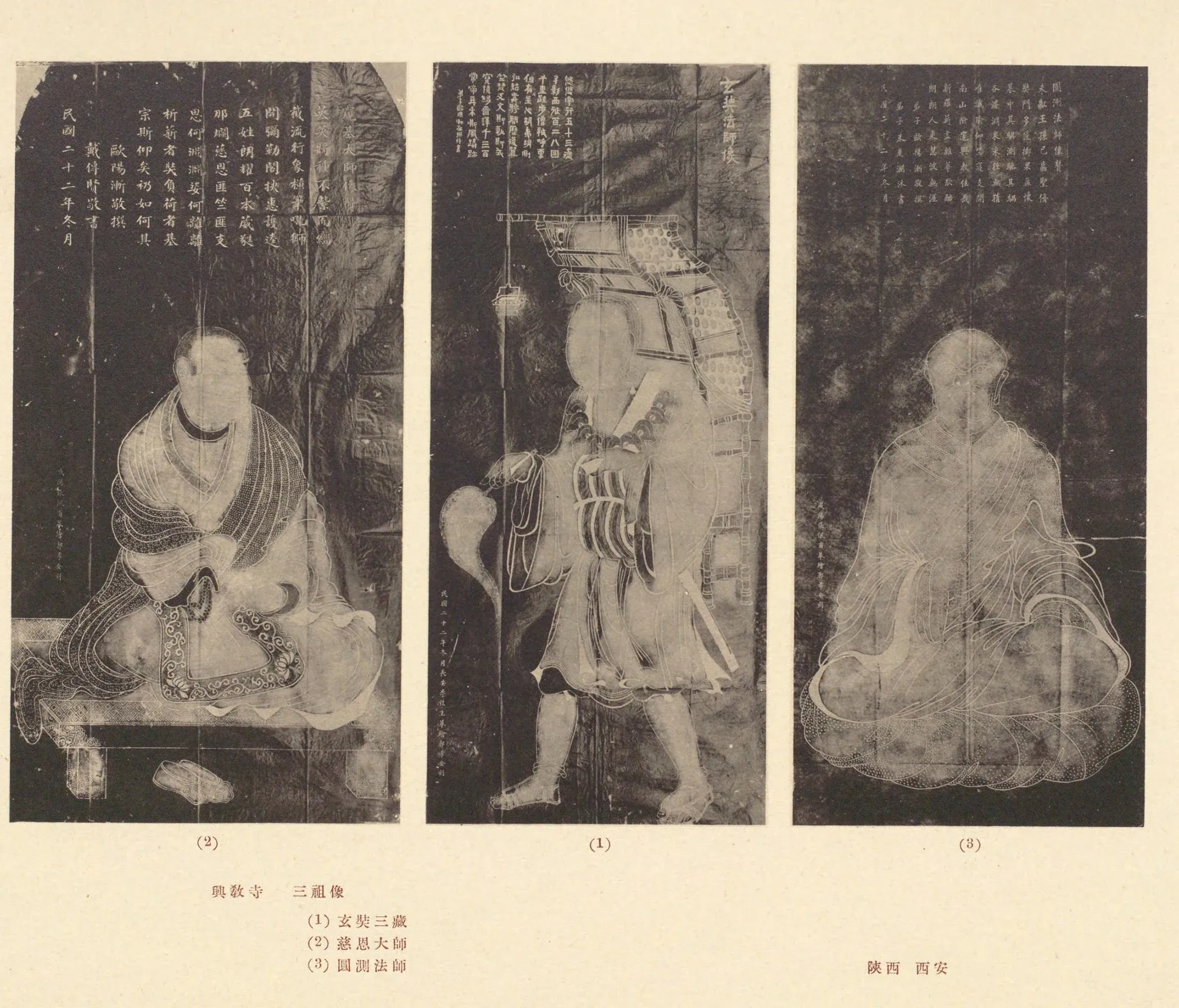
In the 1930s, Tokiwa Daijo and Sekino Tadashi photographed at Xingjiao Temple in Xi’an. The photos are currently collected in Shina Bunka Shiseki (Historical Monuments of Chinese Culture), Volume 9, “Shaanxi / Xi’an and Its Vicinity,” published by Hozokan in 1941.
3D Model
Model from funes.world - Huguo Xingjiao Monastery