Introduction
In 1416, at his teacher’s direction, Tsongkhapa’s disciple Jamyang Chöjé Tashi Palden began building Drepung Monastery on the southern slope of Mount Gephel Utse, west of Lhasa. Namkha Sangpo, a local leader in Ne’u, financed the work. Within three years, more than two thousand monks had gathered to hear teachings. Seven teachers taught separately, giving rise to seven colleges.
In 1518, the Phagmodrupa ruler Ngawang Tashi Drakpa gave the Second Dalai Lama, Gendun Gyatso, a villa within the monastery called Dokhang Ngönmo, meaning “blue stone house.” Gendun Gyatso renamed it Ganden Podrang. From the Second through the Fifth Dalai Lama, it served as their residence at Drepung.
In 1642, Ganden Podrang acquired another function. The Fifth Dalai Lama placed the Tibetan local government’s offices there, and the new polity also took its name from this residence. Reconstruction of the Potala Palace began in 1645, and its White Palace was completed at the end of 1649. The Fifth Dalai Lama later moved his residence there, followed by the government offices. Ganden Podrang remained at Drepung. The monastery had a separate institution responsible for its general affairs, while each college had its own halls, monks, and officers.
By the Yongzheng reign, Drepung faced a main road and backed onto the mountain. Within its earthen walls stood two great temple buildings, gold-roofed pavilions, and scripture halls; nearly ten thousand monks lived in stone rooms beside the main halls. At the assembly on the thirtieth day of the sixth month, a large Buddha image was hung, a protector oracle[1] entered trance, and Tibetans in festive dress watched singing, pole acrobatics, and wrestling.
The surviving complex covers about 250,000 square meters. The original seven colleges have been consolidated into today’s four, which stand with more than fifty residential courtyards organized by the monks’ regions of origin around Tsokchen Hall[2]. The hall has 183 columns and can accommodate more than seven thousand monks in prayer and recitation; Ganden Podrang still stands among them.
Historical Documents
Records of Tibet
别蚌寺。拉撒西去二十里,依山布立,层楼数重,周环数匝。内金殿三座,有达赖喇嘛避暑花园一所,每年亦至此讲经一次。寺内乃汉人、蒙古、西番杨土司、鲁土司、布尔康布木等处之人住居,习学藏经。有达赖喇嘛拣派掌黄教之呼图克图,北萨楞布气居此。下山里许,有垂仲殿,乃护法喇嘛所居。此处垂仲无妻室,亦降神附体,判断祸福。其他垂仲到处有之,有有妻者,有无妻者,不能枚举。
Biebeng Monastery lies twenty li west of Lhasa. Set against the mountain, it has several tiers of multistory buildings and is encircled several times. Within are three golden halls and a summer garden for the Dalai Lama, who also comes here once each year to teach scripture. People from Han China, Mongolia, western Tibet, the Yang and Lu native chiefdoms, Burkangbum, and other places reside in the monastery and study the Tibetan canon. Beisalengbuqi, a khutuktu appointed by the Dalai Lama to oversee the Yellow Teaching, resides here. About one li down the mountain is the Chuichong Hall, home of a protector lama. The Chuichong here has no wife; a deity also descends and possesses him so that he may judge fortune and misfortune. Other Chuichongs are found everywhere, some with wives and some without, too many to enumerate.
Yongzheng Gazetteer of Sichuan
别蚌寺,在藏西十五里。筑土为城,前临大道,后依山岩,建大寺二座,起盖金顶楼阁、佛像、经堂。住坐堪布大喇嘛一名阐讲,黄教掌事僧官二名,管理喇嘛,约近万众,俱于大寺旁石室居住。
Biebeng Monastery lies fifteen li west of Tibet’s administrative center. Earthen construction forms its enclosure; a main road runs before it and rocky mountains rise behind. Two major temples were built, together with gilded-roofed pavilions, Buddha images, and scripture halls. One chief abbot-lama teaches there, while two monastic officials of the Yellow Teaching administer the lamas. Their number approaches ten thousand, all living in stone chambers beside the great monastery.
Jiaqing General Gazetteer of Ü-Tsang
布嗽蚌寺,俗名别蚌寺。拉撒西二十里,前临大道,后依山岩。宗喀巴之弟子札木阳、曲结札什巴尔丹,在聂乌地方居住之时,梦神人语:此地宜修寺院,赐予五千徒众,并现出无量水泉数处。觉而告其师,宗喀巴,乃令修寺。其时即有聂乌富民那木喀桑布,出资布施,修建庙宇。又旺固尔山起出海螺,赐与弟子札木阳曲吉札石巴勒丹,殿宇,修像甚盛。其修郭莽洛赛岭。结巴、沙谷尔、独瓦、得洋、阿克巴等七处札仓,乃蒙古、西番各土司布尔卡木布等处。凡初出世之呼毕勒罕,及远近大小喇嘛,初学经者,多聚处于此。地有园亭一座,为达赖喇嘛避暑处。去寺里许,有吹忠殿,乃无妻室者,与他处异。
Busoubeng Monastery is commonly called Biebeng Monastery. It lies twenty li west of Lhasa, with a main road in front and rocky mountains behind. While Tsongkhapa’s disciple Zhamuyang Qujie Zhaxi Ba’erdan was living at Niewu, he dreamed that a divine figure said, “This place is suitable for building a monastery,” granted him five thousand disciples, and caused innumerable springs to appear. On waking, he told his teacher Tsongkhapa, who ordered the monastery built. A wealthy Niewu resident, Namukasangbu, then donated the funds for its construction. A conch shell was also brought forth from Mount Wangguer and bestowed on the disciple Zhamuyang Quji Zhaxi Ba’erdan. Its halls and images were made on a magnificent scale. Seven monastic colleges—including Guomang, Luosailing, Jieba, Shaguer, Duwa, Deyang, and Akeba—were established for people from Mongolia, western Tibet, the native chiefdoms, Burkangbum, and other places. Newly incarnated khutuktus and lamas both great and small who were beginning scriptural study gathered here in large numbers. The grounds had a garden pavilion where the Dalai Lama spent the summer. About one li away stood the Chuizhong Hall; unlike those elsewhere, its oracle had no wife.
Record of the Sacred Wars
又有白蚌、甘丹、色腊、桑鹅四大寺,远近拱挹。寺中剌麻多者五千余,次者二三千。
There were also the four great monasteries of Baibeng, Ganden, Sera, and Samye, encircling the area from near and far. The more populous monasteries held over five thousand lamas; the others, two or three thousand.
Essentials of Ü-Tsang
一别蚌寺,又作布赖蚌寺,在拉萨西十里,系宗喀札什巴尔丹所建。当札什巴尔丹之在聂乌地方居住之时,梦神人语:此地宜修寺院,赐予徒众五名,并现出无量水尔数处。觉而告令修造焉。其庙宇依山建筑,层楼周布,金殿三座。又有达赖避暑园亭一所,达赖喇嘛每年辟暑于此。凡藏卫蒙古各地,初生世呼毕勒罕及远近小喇嘛等,皆须学经于此。
Biebeng Monastery, also written Bulaibang Monastery, lies ten li west of Lhasa and was built by Zongka Zhaxi Ba’erdan. While Zhaxi Ba’erdan was living at Niewu, he dreamed that a divine figure told him: this place was suitable for a monastery, bestowed five disciples on him, and caused innumerable waters to appear at several places. On waking, he gave orders for its construction. The monastery is built against the mountain, with multistory buildings spread around it and three golden halls. It also has a garden pavilion where the Dalai Lama escapes the summer heat each year. Newly incarnated khutuktus and young lamas from Ü-Tsang, Mongolia, and places near and far must all study scripture here.
Travel Notes from Kham
六月三十日,别蚌、色拉两寺亦悬大佛像,有垂仲降神。蕃民男妇皆华服艳妆,歌唱翻杆相扑,诸戏咸备,亦二寺之大会也。
On the thirtieth day of the sixth month, Biebeng and Sera monasteries also hang great Buddha images, and a deity descends upon a Chuichong oracle. Tibetan men and women all wear splendid clothes and vivid adornments; singing, pole acrobatics, wrestling, and every kind of entertainment are provided. This is likewise the great assembly of the two monasteries.
Record of Travels in India
别蚌寺白芍药花极大,千叶重楼,喇嘛每以供佛,今亦知馈送汉官。
The white peonies at Biebeng Monastery are exceptionally large, with a thousand petals layered one above another. The lamas regularly offer them to the Buddha and now also know to present them to Han officials.
Convention Between Great Britain and Tibet
On 7 September 1904, representatives of Sera, Drepung, and Ganden monasteries were listed among the Tibetan negotiators, and the seals of all three monasteries appeared at the end of the convention. These two passages record the monasteries’ institutional role in the negotiations; the convention did not concern their buildings.
大英国政府特派边务全权大臣荣赫鹏与噶尔丹寺长罗生戛尔曾暨噶布伦并色拉别蚌、噶尔丹三大寺之呼图克图,兼与西藏民教诸首领,代表西藏议定条款,开列于后。
The British government specially appointed Younghusband as its plenipotentiary for frontier affairs. Losang Gyaltsen, head of Ganden Monastery; the Kalön; the khutuktus of the three great monasteries of Sera, Drepung, and Ganden; and Tibet’s civil and religious leaders represented Tibet. The articles they agreed are set out below.
此约共缮五分,由商定之员在拉萨于光绪甲辰年七月二十八日,即西历一千九百零四年九月初七日画押,盖印为凭。大英国边务大臣荣赫鹏印,达赖喇嘛印,此印乃噶尔丹寺长所钤。噶布伦印、别蚌寺印、色拉寺印、噶尔丹寺印、西藏首领印。
Five copies of this convention were prepared and signed and sealed in Lhasa by the negotiating representatives on the twenty-eighth day of the seventh month of the jiachen year of Guangxu, corresponding to 7 September 1904. Seals: Younghusband, British frontier plenipotentiary; the Dalai Lama—this seal being affixed by the head of Ganden Monastery; the Kalön; Drepung Monastery; Sera Monastery; Ganden Monastery; and the leaders of Tibet.
A Diplomatic Mission to Kham and Tibet
饼圆弟先数日前曾来致意,职僧久欲迎候,奈公国事勤劳,未敢渎听。今访谒已周,接谈尽意。现拟趁此闲暇,敬恳枉顾。予以其措辞过谦,前此未能礼佛施僧,反觉内愧,遂允于三月三十日趋谒,仍嘱来使转答。晨兴约五时余,即策马而去。以时分过早,庶众尚无注意者,减去天然,监视不少。久蛰若冬蛙,一旦跳跃清池畔,如憨如醉,故今日领略风景,特具趣味。行数里,至则邦寺,为全拉萨干肉类之供给者,而尤侧重于三大寺之需要。盖彼三寺不杀牲畜,肉食必取给于人。沿途见喇嘛担行囊,彳亍行道,云为游方僧,虽齿高德重,亦必徒步,以示勤苦。及寺门两旁,有贸易小摊,若靴、若带,若食品,僧侣往市者甚众,俨然一小商场。遥睹全寺均以石粉涂白,直成冰雪境。入门夹道,观众墙立,但秩序甚佳。喇嘛曾受训练,毕竟与常人不同,沿甬道均撒白灰。闻为藏政府四大臣,谒庙时,僧人之敬礼,以予为上国使,仿例尊崇之。先欲至饼圆弟所居寺中,职僧阻我谓大众专备有特殊接待室,未赴公家之约,不能应私人之请,随之行至客厅,见四壁满悬中国刺绣,工细精雅,正中置高垫,略如椅。或彼等已闻予不惯席地坐,故置此耶?陪侍者均为皓首老翁,每谈一语,必起立先致歉而后言。予反杌隉不安。谓清吏待予等甚善。又以与中国同宗教、同种族之故,虽过去不免偶有龃龉之处,而一般僧侣及平民未始不顾念我宗祖国也。惟闻内地年来亦不自安息,徒趁杀伐,我佛教徒更引为痛心,而为内地袍泽忧。今大使负中国使命来,既见达佛,佛睿智逾人,当有以语公,而公亦应有以示于众者。予谓敬谢盛意,与佛语及与各大臣晤,俱各尽一遍。今诸君子既欲悉闻,请综告之。中国对藏之态度,取不歧视、不压迫之态度,其办法让藏人自决自治,而由中央资助指导之。其目的欲得藏民之康乐,求五族真共和之实现,故宣言不用兵,不用狡讣,一味感之以恩,示之以诚,吾来即达此意。室内外僧众闻言,俱合掌念佛。又述中国近虽反对邪说迷信,但非否认宗教之价值,更非摧毁佛教。愿诸君子勿以革命后新中国之新举动为怪而自远之也。语毕。
Several days earlier, Bingyuandi had come to convey his regards: “The monastic officials have long wished to receive you, but because you have been occupied with affairs of state, we dared not intrude. Now that your calls are complete and our talks have been thorough, we respectfully ask you to honor us with a visit in this leisure.” Finding this excessively humble and feeling ashamed that I had not previously worshiped the Buddha or given alms to the monks, I agreed to call on the thirtieth day of the third month and asked the messenger to report back. I rose shortly after five and set out on horseback. The early hour meant that few people noticed, reducing the otherwise considerable surveillance. Like a winter frog long confined suddenly leaping beside a clear pond, I was almost drunk with freedom, which gave the scenery a special charm. After several li I reached Zebang Monastery, a supplier of dried meat for all Lhasa that catered especially to the three great monasteries, since they did not slaughter livestock and had to obtain meat from others. Along the road, lamas carrying packs walked slowly; they were said to be itinerant monks, and even the old and highly respected had to travel on foot to show diligence and hardship. Beside the monastery gate stood trading stalls selling boots, belts, food, and other goods. So many monks shopped there that it resembled a small market. From afar the entire monastery, whitened with stone powder, appeared like a realm of ice and snow. Spectators stood like walls along the approach inside the gate, yet order was excellent. The lamas were trained and unlike ordinary people; white lime had been scattered along the passage. I heard that the greeting followed the honor shown to the four ministers of the Tibetan government when they visited a temple, for I was treated by precedent as an envoy of the superior country. I first wished to go to Bingyuandi’s residence, but a monastic official stopped me, saying that the community had prepared a special reception room and that I could not accept a private invitation before the public one. In the reception room the walls were covered with finely worked Chinese embroidery, and a high cushion resembling a chair stood in the center—perhaps because they had heard that I was unaccustomed to sitting on the ground. The attendants were all white-haired old men; before saying anything, each stood and apologized, which made me uneasy. They said Qing officials had treated them well and that, sharing religion and ancestry with China, ordinary monks and laypeople still remembered their ancestral country despite occasional past discord. They had heard that the interior had known no peace in recent years but only warfare; as Buddhists they grieved and worried for their compatriots there. Since I bore China’s mission and had met the Dalai Buddha, whose wisdom surpassed others, he must have spoken to me, and I should have something to tell the assembly. I thanked them and said I had already related my conversations with the Buddha and the ministers, but since they wished to hear everything I would summarize it. China’s attitude toward Tibet was neither discriminatory nor oppressive: Tibetans were to decide and govern for themselves with central assistance and guidance. The aim was Tibetan well-being and a genuine republic of the five peoples; China therefore proclaimed that it would use neither troops nor deceit, but move people through benevolence and show them sincerity. This was the purpose of my visit. Monks inside and outside joined their palms and invoked the Buddha. I added that although China now opposed heterodox teachings and superstition, it did not deny the value of religion, still less seek to destroy Buddhism. I asked them not to find the new measures of post-revolutionary China strange and distance themselves. With that, I finished.
参观各康村、各札仓而至于寺,皆大开其门,以为迎迓,闻居恒键锢,此日独让予一饱眼福。又引予看活佛头发所生树,在狭巷中,树自外入,枝干盘虬,有如乱麻。头发之说或自此岀欤?问寺中组织,答:大概分四级:曰寺,曰札仓,曰康村,曰屈则康村者,以地域分,如西康籍喇嘛住者曰巴而康村,汉人住者曰甲康村者是也。屈则乃少数人同居之卧室,但内中必有一老年师傅为之督率。三大寺内容不同,组织亦稍稍变易,大致不外此也。所谓三大寺者,即则邦寺、涉拉寺、噶颠寺三处,在西藏规模最大,地位最高,人数亦最众。则邦定额为七千七,涉拉定额为五千五,噶颠定额为三千三,实际各己超出数百至一千不等。三寺性质亦各不同。则邦讲繁华,内中僧侣多岀而操政教权,涉拉团结最坚,实力特强。前此藏政府驱汉军,此寺与有力焉。故目前涉拉仍处于监视官厅之地位,要不可侮。噶颠则主修苦行,不问世事,因黄教之祖宗喀巴氏,即修持于此,而就地涅槃,今寺中犹存其床与衣钵。本寺喇嘛常以黄教嫡系自居,尚有两职僧为应属目者,一即则邦寺之搓肩胁敖,一即噶颠寺之慈把。胁敖主执法,慈把主仪范,皆凛凛然不可侵。藏谚有谓:当正月大经会时,只有胁敖才是官,只有慈把才是喇𩥐,其声威可谓赫奕矣。胁敖亦分三级。
As I toured the various regional houses and monastic colleges and reached the temple, all opened their doors to welcome me. I was told they were normally kept locked; on this day alone I was allowed to feast my eyes. I was also shown a tree said to have grown from a living Buddha’s hair. It stood in a narrow lane, entering from outside, its twisting branches tangled like hemp. Could the story of the hair have arisen from this? Asked about the monastery’s organization, they answered that it was broadly divided into four levels: the monastery, monastic colleges, regional houses, and shared rooms. The regional houses were divided by place of origin: lamas from Xikang, for example, lived in the Ba’er regional house, while Han residents lived in the Jia regional house. A shared room housed a small group, always supervised by an elderly teacher. The three great monasteries differed somewhat in their internal arrangements, but generally followed this pattern. The three were Drepung, Sera, and Ganden—the largest, most prestigious, and most populous monasteries in Tibet. Their prescribed complements were 7,700 at Drepung, 5,500 at Sera, and 3,300 at Ganden; each actually exceeded its quota by several hundred to a thousand. The three also differed in character. Drepung valued prominence, and many of its monks went on to wield religious and political authority. Sera was the most cohesive and powerful; it had played a forceful part when the Tibetan government previously expelled Chinese troops and therefore remained under official surveillance. Ganden emphasized ascetic practice and kept apart from worldly affairs, because Tsongkhapa, founder of the Yellow Teaching, had practiced and died there; his bed and religious effects were still preserved in the monastery. Its lamas regarded themselves as the direct lineage of the Yellow Teaching. Two monastic offices were especially notable: Drepung’s tsochen and gekö, and Ganden’s chiba. The gekö enforced discipline, while the chiba governed ritual conduct; both inspired an inviolable awe. A Tibetan saying held that during the Great Prayer Festival of the first month, only the gekö was an official and only the chiba was a lama—such was their imposing authority. The office of gekö was itself divided into three grades.
以寺胁敖为最高,操全寺各喇嘛赏罚之权,间亦及人民,除死刑须交政府执行外,余均可任意施之。手中持铁棍,濒行触地有声,惊闻数十步,听者莫不色变。故俗有铁棒喇嘛之称。平时行道,中路人见之必折帽,且不得于楼上俯瞰。予前在城内凭栏观,亦投以白眼。某年达赖岀巡,被人民封裹不得前,数十军士驱之不散,召胁敖至,人皆鼠窜而去。一般平民,内心之畏服,良可惊也。胁敖外,更有相子顷则两种。相子管经济,顷则乃不劳作之捐班老爷,用钱购得者。前二种每级一人,曰搓肩、胁敖、搓肩、相子等等,顷则无定数,但亦以捐纳之多寡,判其职位之高下。胁敖例由达赖亲自圈定,居位者及退休者,均认为莫大荣誉。噶颠、慈把无地位势力,与金钱为之背影,凡有学问、有德行者,虽贱僧亦能充之,而其为人宗风,尊贵威严,仅次于达赖、班禅一等。故曲有谓莫颓废。慈把的高台,人人可坐。但慈把产生法,备极严格,先须得某处考取格西,再入约把寺,受极严辣之训练,执诸贱役,历三年,始得入噶颠为喇嘛。其上分东极、西极二人。东西极即慈把之候补。若长者三年去职,先以东填之,次及于西。格西之考得,必为十数年与二十年不等。又先后经历十余年,计费时达三四十年。故为慈把者例为六七十岁,类多在职,或离职即死。慈把之衣。服食息,均极谨严,意殆为各喇嘛之表率也。至于考格西之法,先在各康村举出数人辩论学理证义者,评其胜负,胜者得复赛权与各札仓。初赛胜者辩,再胜即与同胜者交相难,以致一一屈之,乃为格西辩。时全寺数千众坐大庭中,上座喇嘛坐坛上,问者先,答者后,且立且破,且语且行,绕众而走。某人负,则胜者击掌示意。此不能随意击,因旁有证义人理不足以服人,击者将转败。既得格西后,乡里称荣,如以前内地之中状元与得博士相等。
The monastery-level gekö ranked highest and controlled rewards and punishments for all its lamas, sometimes extending authority to laypeople. Apart from death sentences, which had to be carried out by the government, he could impose punishments at will. He carried an iron staff whose striking the ground could be heard dozens of paces away and made listeners change color; hence the popular name “iron-staff lama.” When he walked, people in the road had to remove their hats and were forbidden to look down at him from upper stories. When I once watched from a city balcony, I too received a hostile glare. On one occasion, the Dalai Lama’s procession was blocked by a crowd that dozens of soldiers could not disperse; when the gekö was summoned, everyone fled like rats. The fear and obedience he inspired among common people was astonishing. Besides the gekö were the economic officer and the qingze. The former managed finances; the latter was a purchased sinecure for a donor who did no work. The first two offices had one holder at each level, while the number and rank of qingze depended on the amount donated. The Dalai Lama personally selected the gekö, and both incumbents and retirees considered the office a supreme honor. Ganden’s chiba, by contrast, had neither status and power nor money behind him. Any learned and virtuous monk, however lowly, could hold the post, yet its dignity and authority stood just below those of the Dalai and Panchen Lamas. Thus a saying urged one not to despair: anyone might sit on the chiba’s high seat. Selection was nevertheless extremely strict. A candidate first had to earn the geshe degree, then enter Gyümé Monastery, undergo severe training, and perform menial labor for three years before entering Ganden as a lama. Above him were the eastern and western candidates for chiba. When the senior incumbent left after three years, the eastern candidate succeeded him, followed by the western. Earning the geshe degree took from ten to twenty years; the subsequent stages took more than another decade, for a total of thirty or forty years. A chiba was therefore normally in his sixties or seventies, and many died in office or soon after leaving it. His clothing, food, and daily routine were all rigorously regulated, apparently to make him a model for other lamas. For the geshe examination, each regional house first selected several men to debate doctrine and demonstrate meaning. Winners advanced to compete with other monastic colleges, then challenged one another until each opponent had yielded; this constituted the geshe debate. Several thousand monks sat in the great courtyard while senior lamas occupied a dais. Questioner first and respondent behind, they asserted and refuted, spoke and moved, circling the assembly. When one lost, the winner signaled by clapping, but could not clap arbitrarily: arbiters stood nearby, and if his reasoning failed to convince, the supposed winner would lose instead. A man who obtained the geshe degree brought glory to his home district, comparable to winning first place in the old metropolitan examination or receiving a doctorate.
Historical Photographs
1920–1921
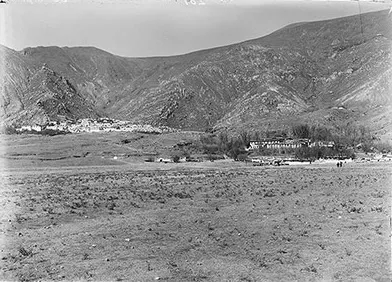
Two views of Drepung are preserved among Charles Bell’s Tibetan photographs at the Pitt Rivers Museum. One shows Drepung Monastery and Nechung Temple from a distance; the other shows the monastic complex climbing the hillside. The catalogue dates them to 1920–1921 and summer 1921 respectively.
1936
British Museum photographs from the British Mission to Lhasa record Drepung in 1936. They include an overview of the monastery and Nechung Temple, as well as a lane inside the monastery photographed by Frederick Spencer Chapman on 30 August and a steep street photographed the same day. The photographs are now part of The Tibet Album, a joint project of the British Museum and Pitt Rivers Museum.
References
- Drepung Monastery Chronicle Editorial Committee, Institute of Religious Studies, Tibet Academy of Social Sciences: Drepung Monastery Chronicle (Tibetan, 2009)
- Desi Sangyé Gyatso: Dga’ ldan chos ’byung bai ḍūrya ser po (Yellow Beryl, 1698)
- Purchok Ngawang Jampa: Grwa sa chen po bzhi dang rgyud pa stod smad chags tshul pad dkar ’phreng ba (history of the four great monasteries and the upper and lower tantric colleges, 1744)
- China Tibetology Research Center: Drepung Monastery
- Zhang Yun, ed.: Fifty-five Lectures on Tibetan History, lecture 22, “Investiture and Administration of Tibet’s Local Political and Religious Leaders”
- Zhang Yun, ed.: Fifty-five Lectures on Tibetan History, lecture 30, “The Fifth Dalai Lama’s Journey to Beijing”
- Lhasen Gya: “The History and Present State of Institutionalized and Law-based Administration in Tibetan Buddhist Monasteries”
- Wang Shiwei: Conservation Plan Design for Drepung Monastery in Tibet