Introduction
Xiashi Mountain, where Qinglian Temple stands, lies close to the Dan River. In the Northern Qi, this area already held a Buddhist sanctuary. The path into the mountain passes between two peaks; “Xiashi” was originally the name of this road, and the mountain temple was accordingly called “Xiashi Temple”[1]. The monk Huiyuan[2] later built a retreat in the nearby Dan Valley and lectured on the sutras, and those who came to study gradually multiplied. Legend has it that when he finished his commentary on the Nirvana Sutra, he threw his brush into the air — and the brush stopped and did not fall; the stone terrace on the mountain thus took the name “Brush-Throwing Terrace.” In the first year of the Baoli era of the Tang (825), the monk Ziyu had a stele engraved on the terrace recording this legend.
In the second year of the Taihe era of the Tang (828), the mountain temple had long lain abandoned. The monk Huaigong[3] came here, intending to continue on to Mount Song in search of a place to practice the Lotus Sutra. The prefect of Zezhou hurried in person to the temple gate and begged him to stay, offered up his own salary, urged the officials to contribute funds, and eased the temple’s tax and labor burdens[4]. Twenty-eight believers from the villages banded together to support the monastery; a monastic compound was built on the mountain and a Samantabhadra sanctuary[5] was established. Each of the believers chanted one chapter of the Lotus Sutra; after a year or two most of them drifted away, but six or seven still supplied the temple’s winter and spring taxes and levies. By the time the stele was erected in the seventh year of the Taihe era (833), the mountain already had a newly built pavilion and a painted image of Maitreya, and the names of those who had donated and chanted the sutra were carved into the stone.
In the eighth year of the Xiantong era of the Tang (867), in response to a local petition, the court bestowed on the old temple below the mountain the name-plaque “Qinglian.” Tradition says the name was taken from the surrounding peaks, which rise like a lotus emerging from the water[6]. In the third year of the Taiping Xingguo era of the Northern Song (978), Zezhou petitioned for a plaque for Qinglian Temple, and the court bestowed on the compound above the mountain the name “Fuyan”[7], ordering the new plaque to be written, engraved, and hung. By the fourth year of the Yuanyou era (1089), the Shakyamuni Hall of the upper cloister had been built, and a stone pillar inside the hall bears a pillar-donor inscription of that year[8].
By the Chongning era, the temple had fallen into disrepair, and piecemeal patching could no longer sustain it. The abbot Jianluan cut into the cliff on the east, filled in the ravine on the west, raised the low ground, and so enlarged the temple grounds. Here he built a Buddha hall[9], a Dharma hall, a sutra repository pavilion, and monks’ quarters. In the third year of the Dading era of the Jin (1163), the Buddha hall Jianluan had built was again leaking and on the verge of collapse, and the monk Fuyu raised funds to rebuild it. Huizhen wished to enlarge the Dharma hall from its original three bays[10] to five, but died before he could do so; the monks Ji and Ding later helped complete the work.
In the third year of the Yuantong era (1335), the beams and pillars of the sutra repository pavilion had rotted and its roof frame leaned askew. The abbot Xiu gathered the monks to raise timber and hire craftsmen, working from spring into summer. When the beams were replaced, the wooden members below were all joined to one another, with the heavy roof pressing down from above. Another monk paid out of his own pocket to make nearly seven hundred square cases, into which the more than five thousand scrolls of Buddhist scripture were placed to guard against wind, rain, insects, and rats.
In the thirty-eighth year of the Kangxi era (1699), the upper cloister rebuilt its eastern corridor, and in the forty-fifth year (1706) it rebuilt the Ksitigarbha Hall of the western corridor. At the Old Qinglian Temple below the mountain, by the eleventh year of the Qianlong era (1746) the halls were collapsing and the Buddha images flaking; the abbot Yuanlin raised funds far and wide, rebuilt the southern and northern halls, and had the old images in the halls repaired and repainted.
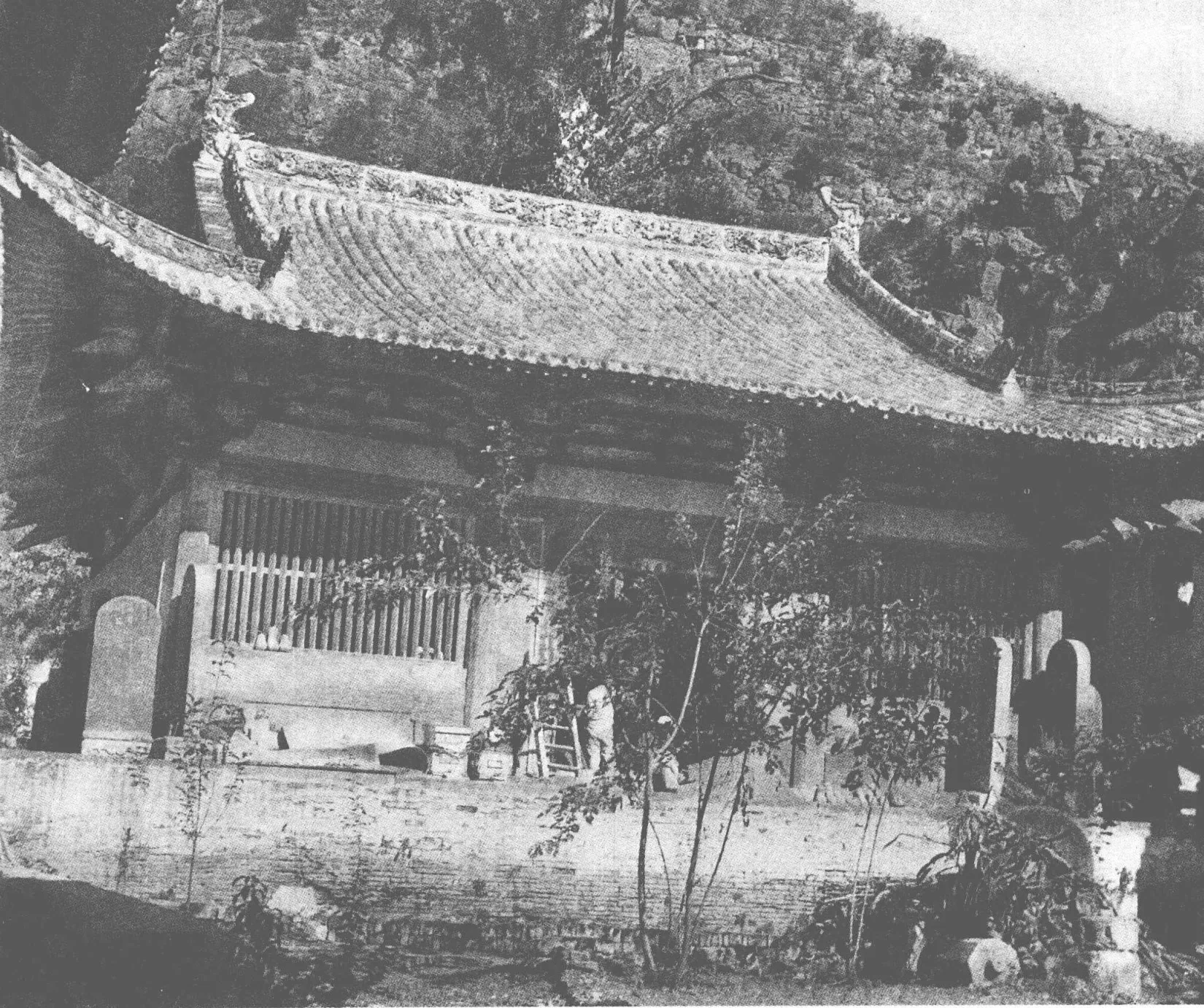
In 1984, days of heavy rain caused seepage and landslides in the mountain slope at the upper cloister, threatening the temple’s foundations; beside the lower cloister the Dan River rose, the bank collapsing again and again until only about two meters remained before the rear wall of the southern hall. The cultural-heritage authorities cleared the upper cloister’s drainage and strengthened the stone embankment in front of the temple, and built a dam along the river at the lower cloister to hold back the water. In 1994, local people pooled funds to rebuild the upper cloister’s Dharma hall (the rear hall); this hall, which had earlier been enlarged from three bays to five, survived before the rebuilding only as foundations, ruined walls, and six stone columns of the front eave. Today the Old Qinglian Temple below the mountain still preserves six Tang painted sculptures, while the mountain above retains the Northern Song Shakyamuni Hall and the repeatedly repaired sutra repository pavilion.
Historical Documents
Continued Biographies of Eminent Monks
释慧远,姓李氏,炖煌人也。后居上党之高都焉。天纵疏朗,仪止冲和,局度通简,崇履高邈。幼丧其父。与叔同居,偏蒙提诱,示以仁孝。年止三岁,心乐出家,每见沙门,爱重崇敬。七岁在学,功逾常百,神志峻爽,见称明智。十三辞叔,往泽州东山古贤谷寺。时有华阴沙门僧思禅师,见而度之。思练行高世,众所宗仰,语远云:“汝有出家之相,善自爱之。”初令诵经,随事训诲,六时之勤未劳呼策,登为虐暴不安。携以南诣怀州北山丹谷,每以经中大义,问师。皆是玄隐,深知长有成器也。年十六,师乃令随阇梨湛律师,往邺。大小经论普皆博涉,随听深隐,持蒙赏异。而偏重大乘,以为道本。年满进具,又依上统,为和上,顺都为阇梨,光师十大弟子并为证戒。时以为声荣之极者也。便就大隐律师,听四分律。流离请诲,五夏席端,淘简精粗,差分轨辙。灭诤揵度前后起纷,自古相传莫晓来意,远乃剖析约断,位以单重,原镜始终,判之即离。皆理会文合,今行诵之。末专师上统,緜笃七年。迥洞至理,爽拔微奥。负笈之徒相𬤎亘道,讲悟继接,不略三余,沐道成器,量非可筭。乃携诸学侣,返就高都之清化寺焉。众缘欢庆,叹所未闻,各出金帛,为之兴会。讲堂寺宇一时崇敞。韩魏士庶通共荣之。
The śramaṇa Huiyuan was of the Li family, a man of Dunhuang. He later dwelt at Gaodu in Shangdang. Heaven endowed him with an open and bright nature; his bearing was serene and mild, his capacity broad and unencumbered, his steps lofty and far-reaching. He lost his father young. Living with his uncle, he alone received guidance and encouragement, being shown benevolence and filial piety. At only three years of age his heart delighted in leaving home, and whenever he saw a śramaṇa he felt love, esteem, and reverence. At seven he entered upon his studies, and his progress exceeded the ordinary a hundredfold; his spirit and understanding were keen and bright, and he was praised for his wisdom. At thirteen he took leave of his uncle and went to the temple at Guxian Valley in the eastern mountains of Zezhou. At that time there was a śramaṇa of Huayin, the Chan master Sengsi, who saw him and received him as a disciple. Si’s disciplined conduct rose above the world, and he was looked up to by all; he said to Huiyuan, “You have the marks of one who should leave home; take good care of yourself.” He first had him recite the sutras, instructing him in each matter; his diligence through the six periods of the day never needed calling or urging, though once enrolled he grew restless and ill at ease. Si therefore took him south to the Dan Valley in the northern mountains of Huaizhou. Huiyuan constantly asked his master about the great meanings within the sutras — all of them profound and hidden — and Si knew well that as he grew he would become a capable vessel. At sixteen, the master had him accompany the ācārya and vinaya master Zhan to Ye. He waded broadly through the sutras and treatises of the great and lesser vehicles, and whatever he heard, however deep and hidden, he retained, receiving praise and wonder. Yet he leaned toward the Mahayana, taking it as the foundation of the Way. When he came of age he advanced to the full precepts, taking the Supreme Controller (Shangtong) as his upādhyāya and Shundu as his ācārya, while the ten great disciples of Master Guang all served as witnesses to the ordination. This was regarded at the time as the height of honor and renown. He then went to the vinaya master Dayin to hear the Four-Part Vinaya, lingering to beg instruction through five summers at the mat, sifting the fine from the coarse and distinguishing the tracks of the rules. On the ksudraka section “Quelling of Disputes,” contention had arisen from beginning to end, and it had been handed down from antiquity without anyone understanding its purport; Huiyuan analyzed it and decided it concisely, assigning each case its position as single or repeated, tracing and mirroring it from beginning to end, and once he judged, the disputes dispersed. All found it in accord with principle and matching the text, and it is practiced and recited to this day. In the end he devoted himself solely to the Supreme Controller, steadfast for seven years. He thoroughly penetrated the utmost principle and rose brilliantly into its subtlest depths. Disciples bearing book-boxes thronged the road in an unbroken line; his lectures and awakenings followed one upon another, not omitting even the three intervals of leisure, and those bathed in the Way and made into vessels were beyond reckoning in number. He then led his companions in study back to Qinghua Temple at Gaodu. The assembled conditions were joyful and celebratory; they marveled at what they had never heard, each contributing gold and silk to raise a great gathering for him, and in that season the lecture hall and temple buildings rose lofty and spacious. The gentry and commoners of Han and Wei joined together in glorifying him.
及承光二年春,周氏克齐,便行废教,敕前修大德,并赴殿集。武帝自升高座,序废立义,命章云:“朕受天命,养育兆民,然世弘三教,其风弥远,考定至理,多皆愆化,并令废之。然其六经儒教文弘治术,礼义忠孝于世有宜,故须存立。且自真佛无像则在太虚,遥敬表心。佛经广叹,而有图塔崇丽,造之致福,此实无情。何能恩惠?愚民向信,倾竭珍财,广兴寺塔,既虚引费,不足以留。凡是经像尽皆废灭,父母恩重,沙门不敬,勃逆之甚,国法岂容?并退还家,用崇孝始。朕意如此。诸大德谓理何如?”于时,沙门大统法上等五百余人,咸以帝为王力,决谏难从,佥各默然。下敕频催答诏,而相看失色,都无答者。远顾以佛法之寄,四众是依,岂以杜言,情谓理伏?乃出众答曰:“陛下统临大域,得一居尊,随俗致词,宪章三教,诏云:真佛无像,信如诚旨。但耳目生灵,赖经闻佛,籍像表真。若使废之,无以兴敬。”帝曰:“虚空真佛,咸自知之,未假经像。”远曰:“汉明已前,经像未至此土,众生何故不知虚空真佛?”帝时无答。远曰:若不藉经教,自知有法,三皇已前,未有文字,人应自知五常等法。尔时,诸人何为但识其母,不识其父,同于禽狩?帝亦无答。远又曰:“若以形像无情,事之无福,故须废者,国家七庙之像,岂是有情,而妄相尊事?”武帝不答此难,乃云:“佛经外国之法,此国不须废,而不用。七庙上代所立,朕亦不以为是,将同废之。”远曰:“若以外国之经,非此用者,仲尼所说,出自鲁国,秦晋之地亦应废,而不行。又以七庙,为非将欲废者,则是不尊祖考。祖考不尊,则昭穆失序,昭穆失序,则五经无用。前存儒教,其义安在?若尔,则三教同废,将何治国?”帝曰:“鲁邦之与秦、晋,虽封域乃殊,莫非王者一化,故不类佛经。”七庙之难,帝无以通。远曰:“若以秦鲁同遵一化,经教通行者,震旦之与天竺,国界虽殊,莫不同在阎浮,四海之内,轮王一化,何不同遵佛经,而令独废?”帝又无答。远曰:“诏云退僧还家,崇孝养者,孔经亦云:立身行道,以显父母,即是孝行何必还家父母恩重交资色养,弃亲向疏,未成至孝。”远曰:“若如来言,陛下左右皆有二亲,何不放之,乃使长役五年,不见父母?”帝曰:“朕亦依番,上下得归侍奉。”远曰:“佛亦听僧,冬夏随缘修道,春秋归家侍养。故目连乞食饷母,如来担棺临葬,此理大通,未可独废。”帝又无答。远抗声曰:“陛下今恃王力,自在破灭三宝,是邪见人。阿鼻地狱不拣贵贱,陛下何得不怖?”帝勃然作色大怒,直视于远曰:“但令百姓得乐,朕亦不辞地狱诸苦。”远曰:“陛下以邪法化人,现种苦业,当共陛下,同趣阿鼻,何处有乐可得?”帝理屈言前,所图意盛,更无所答。但云:“僧等且还,后当更集。”有司录取论僧姓名。当斯时也,齐国初殄,周兵雷震,见远抗诏,莫不流汗。咸谓粉其身骨,煮以鼎镬,而远神气嵬然,辞色无挠。上统衍法师等执远手,泣而谢曰:“天子之威如龙火也,难以犯触,汝能穷之。大经所云,护法菩萨应当如是。彼不悛革,非汝咎也。”远云:“正理须申,岂惟顾此形命?”即辞诸德曰:“时运如此,圣不能遣,恨不奉侍目下,以为大恨,法实不灭,大德解之。愿不以忧恼。”遂潜于汲郡西山,勤道无倦,三年之间,诵法华、维摩等,各一千遍,用通遗法。
In the spring of the second year of the Chengguang era, the Zhou conquered Qi and at once proceeded to abolish the teaching, ordering the great worthies of longstanding cultivation to assemble at the palace. Emperor Wu himself mounted the high seat and set forth the rationale for abolition, declaring in an edict: “I have received the Mandate of Heaven and nurture the myriad people. Yet as the three teachings have flourished in the world, their influence has spread ever wider; examining them for the ultimate principle, I find that many transgress against true transformation, and I command that all be abolished. However, the Confucian teaching of the Six Classics magnifies the arts of governance, and its propriety, righteousness, loyalty, and filial piety are fitting for the world; it must therefore be preserved. Moreover, the true Buddha, being without images, dwells in the great void; reverence from afar suffices to express the heart. The Buddhist sutras are widely praised, yet men raise images and pagodas in splendor, building them to obtain blessings — these are insentient things; how can they bestow favor or grace? Foolish folk believe in them and pour out their precious wealth, raising temples and pagodas on every side; this is vain and wasteful expenditure, unfit to be retained. All sutras and images whatsoever shall be utterly abolished and destroyed. The kindness of fathers and mothers is weighty, yet the śramaṇas do not honor it — a most rebellious insubordination; how can the law of the state tolerate it? All shall return to their households, that the exaltation of filial piety may begin. Such is my intent. What do you great worthies say to this reasoning?” At that time the śramaṇa Fashang, Supreme Controller, with more than five hundred others, all judged that the emperor possessed the power of a king and that resolute remonstrance would be hard to follow, and each fell silent. Edicts repeatedly pressed them to answer the decree, but they looked at one another, their faces drained of color, and none answered. Huiyuan reflected that the Buddha’s teaching was entrusted to them, that the fourfold assembly depended on it — how could they shut their mouths and call that submission to reason? He then stepped forth from the assembly and answered: “Your Majesty rules over the whole realm and occupies the position of sole honor; accommodating your words to custom, you take the three teachings as your charter. The edict says that the true Buddha is without images — truly this accords with your sincere intent. But living beings, who have only ears and eyes, rely on the sutras to hear of the Buddha and on images to behold the true. If these are abolished, there will be no means to arouse reverence.” The emperor said, “Of the true Buddha of the void, all may know for themselves; there is no need to borrow sutras and images.” Huiyuan said, “Before Emperor Ming of the Han, the sutras and images had not yet reached this land — why did the beings of that time not know the true Buddha of the void?” The emperor had no answer. Huiyuan said, “If without relying on the scriptures and teachings one could know the dharma of oneself, then before the Three August Ones, when writing did not yet exist, men should have known of themselves the dharma of the five constant virtues. Why then did the people of that age know only their mothers and not their fathers, like the birds and beasts?” The emperor again had no answer. Huiyuan further said, “If you hold that images are insentient, that serving them brings no blessing, and so must be abolished — then are the images of the state’s seven ancestral temples sentient, that they are venerated and served in vain?” Emperor Wu did not answer this objection, but said, “The Buddhist sutras are the law of a foreign country; this country need not abolish them but will not use them. The seven temples were established by former dynasties; I do not regard them as right either, and will abolish them together with the rest.” Huiyuan said, “If you hold that the sutras of a foreign country are not to be used here — then what Confucius taught came from the state of Lu, and the lands of Qin and Jin should likewise abolish it and not practice it. And if the seven temples are condemned as wrong and to be abolished, that is to fail to honor one’s ancestors. If the ancestors are not honored, the order of zhao and mu is lost; if the order of zhao and mu is lost, the Five Classics are useless. What then remains of the meaning of preserving the Confucian teaching? If this is so, all three teachings are abolished together — with what will you govern the state?” The emperor said, “The land of Lu and the states of Qin and Jin, though their domains differ, are all within the transforming sway of a single king, and so are not comparable to the Buddhist sutras.” To the objection of the seven temples, the emperor could make no reply. Huiyuan said, “If you hold that Qin and Lu alike follow one transforming sway and that the scriptures and teachings may circulate everywhere — then Zhendan and Tianzhu, though their realms differ, are both alike within Jambudvipa; within the four seas, under the single sway of the wheel-turning king, why should they not alike follow the Buddhist sutras, while these alone are to be abolished?” The emperor again had no answer. Huiyuan said, “The edict says that the monks are to return to their households to exalt filial nurture. But the Confucian classic also says: establish yourself and practice the Way, and thereby bring renown to your parents — this too is filial conduct; why must one return home? The kindness of parents is weighty, and both are owed the nourishment of sustenance and care; to abandon one’s kin and turn to strangers is not the perfection of filial piety.” Huiyuan continued, “If it is as you say, Your Majesty, those at your left and right all have two parents — why not release them, instead of keeping them in long service, five years without seeing their fathers and mothers?” The emperor said, “I also go by turns; those above and below all get to return home to serve their parents.” Huiyuan said, “The Buddha also permits monks to cultivate the Way in winter and summer as conditions allow, and to return home in spring and autumn to serve and nourish their parents. Thus Maudgalyayana begged for food to feed his mother, and the Tathagata bore the coffin at the funeral. This principle is universally applicable; it cannot be abolished for one alone.” The emperor again had no answer. Huiyuan raised his voice: “Your Majesty now relies on the power of a king to destroy the Three Jewels at will — this is the view of the deluded. The Avici Hell does not discriminate between noble and base; how can Your Majesty not fear it?” The emperor’s countenance changed abruptly and he burst into fury; staring straight at Huiyuan, he said, “So long as the hundred surnames obtain happiness, I will not refuse even the sufferings of hell.” Huiyuan said, “Your Majesty uses a perverse teaching to transform the people and is now planting deeds of suffering; we shall go together with Your Majesty to Avici — where then will any happiness be found?” The emperor, his arguments exhausted and his words outstripped, his design still burning strong, could answer nothing more, but only said, “You monks may withdraw for now; we shall assemble again later.” The officers in charge recorded the names of the debating monks. At that moment Qi had only just been destroyed, and the Zhou armies thundered; to see Huiyuan defy the edict, none did not break into a sweat. All expected that his body and bones would be ground to powder and boiled in the tripod, yet Huiyuan’s spirit remained towering, his countenance unbent. The Supreme Controller, the Dharma master Yan, and others grasped Huiyuan’s hand and wept in gratitude, saying, “The majesty of the Son of Heaven is like dragon-fire, hard to offend or touch, yet you were able to press it to its limit. The Dharma-protecting bodhisattva of which the great sutras speak should be exactly thus. That he would not repent or reform is no fault of yours.” Huiyuan said, “The true principle must be declared — how could I look only to this bodily life?” Then he took leave of the assembled worthies, saying, “The fortune of the age being thus, even a sage could not avert it; my regret is only that I cannot attend you from now on — this is my great sorrow. The Dharma in truth cannot be destroyed; may you great worthies understand this, and do not grieve or distress yourselves.” He then hid away in the western mountains of Ji Commandery, where he labored at the Way without flagging, and within three years recited the Lotus, Vimalakirti, and other sutras one thousand times each, thereby keeping the surviving teachings alive.
开皇五年,为泽州剌史千金公,请赴本乡,此则像法再弘,桑梓重集,亲疏含庆,何以加之?七年春,往定州,途由上党,留连夏讲,遂阙东传。寻下玺书,殷勤重请,辞又不免,便达西京。于时,敕召大德六人,远其一矣。仍与常随学士二百余人,创达帝室。亲临御筵,敷述圣化,通孚家国。上大悦,敕住兴善,劳问丰华,供事隆倍。又以兴善,盛集法会是繁。虽有扬化,终为事约,乃选天门之南大街之右,东西冲要,游听不疲,因置寺焉。名为净影,常居讲说,弘叙玄奥,辩畅奔流,吐纳自深,宣谈曲尽。于是四方投学,七百余人,皆海内英华。法轮前辙,望京趣寺,为法道场。但以堂宇未成,同居空露,蘧蒢庵舍。巷分州部,日夜祖习,成器相寻。虽复兴善,诸德英名一期,至于归学,师寻千里继接者,莫高于远矣。形长八尺,腰有九围,十三幅裙可为常服。登座震吼,雷动蛰惊,充惬群望,斯为盛矣。开皇十二年春,下敕令知翻译,刊定辞义,其年卒于静影寺,春秋七十矣。冕旒哀感,为之罢朝。帝呼嗟曰:国失二宝也。时,远与李德林,同月而丧,故动帝心。
In the fifth year of the Kaihuang era (585), the Duke of Qianjin, prefect of Zezhou, invited him to come to his home country — thus was the semblance of the Dharma propagated anew and the mulberry and catalpa of his native place gathered once more; kin and stranger alike were filled with joy, and what could surpass it? In the spring of the seventh year he set out for Dingzhou, passing through Shangdang, where he lingered for the summer lectures and so missed the eastward journey. Soon an imperial letter came down, earnestly repeating the invitation; unable to decline, he proceeded to the Western Capital. At that time six great worthies were summoned by edict, and Huiyuan was one of them. Together with his usual retinue of more than two hundred scholars, he newly arrived at the imperial court. The emperor attended his banquet in person, where Huiyuan expounded the sage’s teaching, in harmony with both house and state. The emperor was greatly pleased and ordered him to reside at Xingshan Temple, with generous inquiries and doubled provisions. But because Xingshan thronged with great Dharma assemblies in such numbers that, though he spread the teaching there, he remained constrained by affairs, a site was chosen on the right of the great avenue south of the Tianmen gate, at a thoroughfare joining east and west, where visitors could come to hear without wearying, and a temple was established there. It was named Jingying, and there he dwelt in constant preaching and exposition, setting forth the profound mysteries in ordered sequence, his eloquence flowing like a torrent, his utterances drawn from deep within, his discourse exhausting every subtlety. Thereupon students came from the four quarters, more than seven hundred men, all the finest talent within the seas. Where the wheel of the Dharma had rolled before, they gazed toward the capital and hastened to the temple, making it a sanctuary of the Dharma. Only because the halls were not yet finished did they dwell together in the open, in shelters of straw; divided by lanes and districts, they practiced day and night, and one vessel after another was perfected. Although Xingshan was restored and the worthies of that age bore illustrious names, as for students returning to a master and coming one after another from a thousand li, none stood higher than Huiyuan. He was eight chi tall, with a girth of nine spans, and a skirt of thirteen widths served as his ordinary robe. When he mounted the seat and gave his thundering roar, it was as thunder stirring the hibernating creatures; he filled and satisfied the hopes of the multitudes — this was greatness indeed. In the spring of the twelfth year of the Kaihuang era (592), an edict ordered him to take charge of translation, to revise and settle the wording and sense; that same year he died at Jingying Temple, at the age of seventy. The crowned emperor was moved to grief and suspended court for his sake. The emperor sighed, “The state has lost two treasures.” At that time Huiyuan and Li Delin had died in the same month, which so stirred the emperor’s heart.
Record of the Traces of Dharma Master Huiyuan of the Great Sui at Xiashi Temple
硖石岩岩,灵气膺侯,千载之口,不囗详其志。自北齐周堕,物接耳目,远公之居,以成其道。既修涅盘藏,疏,绝笔石巅,掷上太虚,得以明真契,示其同。法师称号惠远,生炖煌李氏之族,家数世居霍秀里,本宅犹存旧𡐝与硖石西北连岗甸附前晋,有匡山慧远,南朝时论所宗,四百余年。至法师占泽州,远当周氏,经齐并除塔庙,异人大集,独抗震霆,实文之下,正辞无屈,面折武帝,以阿鼻地狱,不论贵贱,向非幽证,其能及此。竟隐汲郡西山。大隋受命,出诣上京,文帝始引昙延为大师,诏公掌校译经,行僧中统理。耀临一时,表仪八尺,立众清庄。开皇十二年,没于京净影寺,是曰辍朝,帝曰:丧吾国宝矣。验掷笔故处,丹流中贯,危石最峭,后之人实目曰掷笔台。邑里时朝礼之,想在容声。有唐宝历元年夏四月,传学沙门紫羽,请刻石台上,河东薛重元刊录。故志云。
Lofty are the rocks of Xiashi, where a numinous aura answers to noble worth; across a thousand years, [one character missing] cannot fully record his intent. Since the fall of Northern Qi to the Zhou, things have met the ear and eye: it was at Master Yuan’s dwelling that he perfected his Way. Having composed his commentary on the treasury of the Nirvana Sutra, he made his final stroke at the summit of the rock and threw the brush up into the great void, thereby making manifest his true awakening and showing his likeness. The Dharma master bore the title Huiyuan; he was born into the Li clan of Dunhuang, his family having dwelt for generations in Huoxiu Village, where the old homestead and its ancient foundations still survive, adjoining Xiashi to the northwest by ridge and field. Before him, in the Jin, there had been a Huiyuan of Mount Kuang, whom the discourse of the Southern Dynasties took as its master — more than four hundred years earlier. When the Dharma master came to dwell in Zezhou, it was the age of the Zhou; passing through Qi, they destroyed the pagodas and temples. At the great assembly of extraordinary men, he alone withstood the thunderclap; beneath the substance of his text his upright words did not bend, and he rebuked Emperor Wu to his face, telling him that the Avici Hell does not distinguish noble from base — had he not had hidden realization, how could he have reached this? In the end he hid in the western mountains of Ji Commandery. When the Great Sui received the Mandate, he went up to the capital; Emperor Wen had first drawn on Tanyan as a great master, and now by edict appointed Master Huiyuan to take charge of collating the translated sutras, exercising governance over the sangha. His brilliance shone upon the age; his outward bearing was eight chi, and he stood among the assembly pure and grave. In the twelfth year of the Kaihuang era he died at Jingying Temple in the capital; court was suspended for the day, and the emperor said, “I have lost a treasure of the state.” Examining the former place of the brush-throwing: the Dan stream runs through its midst, where the towering rocks are sheerest, and men of later times fixed its name as the Brush-Throwing Terrace. The people of the district come at times to pay homage there, imagining his countenance and voice. In the summer, the fourth month, of the first year of the Baoli era of the Tang (825), the śramaṇa Ziyu, transmitter of the teaching, requested that it be engraved on the stone of the terrace; Xue Chongyuan of Hedong did the transcribing and recording. Thus records the old gazetteer.
慧远法师遗迹记:宝历元年四月,今在凤台县东南三十五里藏阴寺后。凤台县志:沙门紫羽刻石。记称慧远为泽州霍秀里人,俗本炖煌李氏,故居尚存,与晋慧远同名,相距四百余年,别为一人。周武欲废寺塔,抗辞折服,入隋,文帝命公参校经义,卒,深悼惜之。考太和释紫羽碑,以慧为惠,与此不同。其云宝历元年,则敬宗乙巳也。
Record of the Traces of Dharma Master Huiyuan: fourth month of the first year of the Baoli era (825); it now stands behind Zangyin Temple, thirty-five li southeast of Fengtai County. The Fengtai County Gazetteer says the stone was engraved by the śramaṇa Ziyu. The record calls Huiyuan a man of Huoxiu Village in Zezhou, by birth of the Li family of Dunhuang; his former dwelling still survives. Sharing a name with the Huiyuan of the Jin, yet separated by more than four hundred years, he was a different person. When Emperor Wu of Zhou sought to abolish the temples and pagodas, he resisted with unbending words; entering the Sui, Emperor Wen appointed the master to collate the scriptures, and when he died the emperor mourned him deeply. I note that the Taihe-era stele of the monk Ziyu writes the character hui differently, disagreeing with this. Its dating to the first year of Baoli corresponds to the yisi year of Emperor Jingzong.
Record of the Names of Those Reading the Lotus Sutra at Fuyan Chan Monastery
郡城东南三十余里,丹流湾曲,山罨翠屏,云霞生双髻之峰,碧霞吐香炉之石,谷深景邃,地近出幽。藏阴南连礼浮,北接硖石之名,本非寺号,径通人行,时共称焉。初有昙始禅师,大齐起义之首,奏藏阴寺讲涅盘经,感野雉来听,藏神遗绢,猕猴奉果,山神献飧,时之异人乎,其难识矣。周朝有惠远法师,即晋城霍秀人也。制涅盘疏,掷笔升空,精义入神,以验其旨,名振古仐,号掷笔台,巳现存焉。近专代宗之运神墨禅师,唐之贵叶,学究典坟,善闲庄老,舍荣慕逍,晦迹亡名。藏阴,宴坐林薮,行节孤迅,人难可俦。贞元之时,有智通法师,近朝供奉,聪惠天假其灵,善谈涅盘真口,制六波罗密疏,流于世也。令有惠愔禅师,业善儒门,博通子三史,高道不事,弃笔从缁,究禅理而真心自闲,习心观,定惠双运,居无定所,云林是家。远寻灵迹,来届此山。时有智岑切善讲天台教门,深远妙源,精义尤博,誓为佛使,行化人间,来亦于此。知山灵秀,景胜处幽,名僧继踵。其时怀公至此,欲过嵩岳,志求法华道场之处。土地时运,宿缘所追,乃感文邦伯邀留,及有清信长老,结邑请住去。太和二年,上方创造侩院,兼置普贤道场。为山寺荒废岁久,杜绝人来,道者难居,盖为差税。时太守王公,以善理人,慈爱育物,敬崇三宝,荷护伽蓝,自至山门,殷懃留请,兼舍禄粟,及劝官僚资助弁,咸降差科。时有清信之士,以议助济差科,时有廿八。人囗经囗年间,人即沦散,出邑今有六七人,同为竭力崇供,山寺科四,并造阁一所,兼素画弥勒,兼诸方信施者,并邑外持念经人,具历此石。法华之应,事亦具载矣。邑人司徒映等,宿植深厚,菩提种成,法雨润根,善四开发,又能晦迹藏名,隐遁州城縓肆,和光混俗,乐道安贫,共结良缘,同修福利,心贞志固,刻石记文,感集陈情,命余题述。
Some thirty-odd li southeast of the prefectural city, the Dan stream winds and curves, and the mountains are curtained like verdant screens; clouds and rosy mists rise from the twin-topknot peaks, and azure haze breathes from the incense-burner rocks. The valley is deep, the prospect secluded; the place borders on the transcendent. To the south Zangyin joins Lifu; to the north it meets the name Xiashi — which was never a temple’s title, but the name of a path where men pass, and so it was commonly called in those days. In the beginning there was the Chan master Tanshi, foremost among those who raised the cause at the founding of the great Qi; by memorial he lectured on the Nirvana Sutra at Zangyin Temple, and moved wild pheasants to come and listen, the spirits of the treasury to bestow silk, monkeys to offer fruits, and the mountain gods to present food — truly an extraordinary man of his time, hard to fathom. In the Zhou dynasty there was the Dharma master Huiyuan, a man of Huoxiu in Jincheng. He composed the commentary on the Nirvana Sutra, threw his brush into the air, and his refined meaning entered the spirit, thus verifying his insight; his name resounds from antiquity, and the place is called the Brush-Throwing Terrace, which still survives today. In more recent times, in the reign of Daizong, there was the Chan master Shenmo, a scion of a noble Tang house, whose learning plumbed the ancient canons and who was well versed in Zhuangzi and Laozi; he cast off glory to yearn for the free and easy, hiding his traces and losing his name. At Zangyin he sat in meditation amid the forests and marshes, solitary and swift in conduct, a man none could match. In the Zhenyuan era there was the Dharma master Zhitong, who served in attendance at the recent court; heaven lent his intelligence its spirit, he discoursed well on the true words of the Nirvana Sutra, and composed a commentary on the six paramitas that circulated in the world. There was also the Chan master Huiyin, accomplished in the Confucian tradition and broadly versed in the philosophers and the three histories; the high posts he would not serve — he cast aside the brush to follow the black-robed, plumbing the principles of Chan until his true mind was at ease of itself, practicing the contemplation of mind, with concentration and wisdom working in tandem; he had no fixed abode, taking the cloudy forests as his home. Seeking numinous traces from afar, he came to this mountain. At that time there was Zhicen, keenly skilled in lecturing on the Tiantai teaching, profound and far-reaching in its wondrous source, exceptionally broad in refined meaning, who vowed to be a messenger of the Buddha and to carry the teaching among men, and he too came here. Knowing the mountain was numinous and fair, its scenery surpassing and its situation secluded, famous monks followed one upon another. At that time Huaigong came here, wishing to pass on to Mount Song, his resolve set on seeking a place for a Lotus Sutra sanctuary. The fortunes of the land and time, the pursuit of karmic bonds from former lives — these moved the civil governor to invite him to stay, and there were pure-believing elders who formed a confraternity and begged him to remain. In the second year of the Taihe era (828), on the upper height they founded the monastic compound, and also established a Samantabhadra sanctuary. Because the mountain temple had lain waste for many years, visitors had ceased to come, and practitioners found it hard to dwell there — all on account of the taxes and levies. At that time the prefect, Lord Wang, being skilled in governing men, nurturing all things with kindly love, revering the Three Jewels, and bearing the protection of the sangharama, came in person to the temple gate, earnestly pressing him to stay, also bestowing his own salary in grain, and urging the officials to contribute support; all alike lightened the taxes and levies. At that time there were pure-believing men who took counsel to help meet the taxes and levies — twenty-eight of them. […] As the years passed, the men scattered and were lost; of the confraternity there are now six or seven who together strive to the utmost in reverent support. The mountain temple […] and they built a pavilion, and further painted an image of Maitreya in plain colors; and the faithful donors from all quarters, together with those beyond the confraternity who upheld and chanted the sutra, are all recorded on this stone. The responsive miracles of the Lotus Sutra are likewise fully recorded. The men of the confraternity, Situ Ying and others, had planted deep roots in former lives, and the seed of bodhi ripened; the rain of the Dharma moistened the roots, and goodness unfolded on every side. They were able to hide their traces and conceal their names, withdrawing to the market quarters of the prefectural city, tempering their light and mingling with the dust of the world, delighting in the Way and at peace in poverty; together they formed good bonds, together they cultivated blessing and benefit, their hearts steadfast and their resolve firm. They engraved this stone to record the text, and moved by the gathering I have set forth these sentiments, being charged to compose the record.
硖石寺造上方阁记右硖石寺造上方阁记在凤台县访碑录作青蓪寺碑太平寰宇记硖石山在晋城县东南三十里上有青莲寺西有掷笔台即远大师置涅盘疏藏之所与记所言合
“Record of the Building of the Upper Pavilion at Xiashi Temple.” The Record of the Building of the Upper Pavilion at Xiashi Temple transcribed above is in Fengtai County; the Fangbei Lu lists it as the “Stele of Qinglian Temple.” The Taiping Huanyu Ji says that Xiashi Mountain lies thirty li southeast of Jincheng County, with Qinglian Temple upon it, and to the west the Brush-Throwing Terrace, which is where Master Yuan set down his Nirvana Sutra commentary in the treasury — this agrees with what the record says.
Stone Tablet Record of the Mountain Fields of Qinglian Temple
唐青莲寺山田石碣记,无撰人姓氏,后列张靖境书记两。泽州东南三十里,敕号青莲寺。北齐初,禅师口奏,藏阴所管三庄田地二十余顷,轮税若干。至太和九年,僧惠愔说郡主王中丞,减税若干亩,会昌三年,沙汰若干亩。又咸通八年,孟员外闻奏请敕赐青莲为额,剖地若干亩。考太和九年,文宗乙卯,会昌三年武宗癸亥,咸通八年懿宗丁亥。所谓郡守王中丞、孟员外闻,府州志俱失载。
Stone Tablet Record of the Mountain Fields of Qinglian Temple of the Tang: the author’s surname is not given; at the end are listed Zhang Jingjing and others, secretaries, two in all. Thirty li southeast of Zezhou is the temple bestowed by edict with the name Qinglian. At the beginning of the Northern Qi, a Chan master memorialized: the fields of the three estates administered by Zangyin, more than twenty qing, with taxes of so much in turn. In the ninth year of the Taihe era (835), the monk Huiyin persuaded the governor of the commandery, Vice-Director Wang, to reduce the tax by so many mu; in the third year of the Huichang era (843), so many mu were winnowed away. Further, in the eighth year of the Xiantong era (867), the supernumerary official Meng Wen memorialized, requesting that the edict bestow Qinglian as the plaque, with so many mu of land apportioned. I note that the ninth year of Taihe is the yimao year of Emperor Wenzong, the third year of Huichang the guihai year of Emperor Wuzong, and the eighth year of Xiantong the dinghai year of Emperor Yizong. The so-called prefect Vice-Director Wang and the supernumerary official Meng Wen are unrecorded in both the prefectural and provincial gazetteers.
Rescript Bestowing the Name-Plaque in the Third Year of the Taiping Xingguo Era
宋太平兴国二牒石刻:一在松岭寺,牒额法轮;一在曰莲寺,牒额福岩。前俱列中书门下泽州奏准行,所管存留有无名额僧尼寺院廿三十二所。灵严院宜赐法轮,青莲寺宜赐福岩为额。敕命指挥书勒悬挂,准敕,故牒。太平兴国三年五月二十曰,牒中书门下平章事、右仆射羕门下侍叩平章事、右仆射兼门下侍郎、平章事、录事参军胡推官王、大理寺丞、权知军州事韦刺史齐。按牒文与真宗景德时稍异,州官不传其名,中书门下官亦不书姓与花押,或宋初体制使然。考太平兴国三年,太宗戊寅,所谓中书平章者卢名逊,右仆射为沈伦,左仆射则薛居正也。
The two stone-engraved rescripts of the Taiping Xingguo era of the Song: one is at Songling Temple, the rescript-plaque reading Falun; one is at [Qing]lian Temple, the rescript-plaque reading Fuyan. At the head of each are listed the Secretariat-Chancellery and the memorial of Zezhou approved for execution, concerning the thirty-two Buddhist monasteries and nunneries, with and without name-plaques, retained under its jurisdiction. To Lingyan Cloister should be bestowed the plaque Falun; to Qinglian Temple should be bestowed Fuyan as its plaque. By edict the command is given to have them written, engraved, and hung; approved by edict — therefore this rescript. The twentieth day of the fifth month of the third year of the Taiping Xingguo era (978). Rescript of the Secretariat-Chancellery: the Manager of Affairs […], the Vice Director of the Right […], the Vice Director of the Chancellery and Manager of Affairs, the Vice Director of the Right concurrently Vice Director of the Chancellery and Manager of Affairs, the Recorder and Adjutant Hu, the Judge Wang, the Assistant of the Court of Judicial Review and Acting Prefect Wei, the prefect Qi. Note: the wording of the rescript differs slightly from that of the Jingde era of Emperor Zhenzong; the names of the prefectural officials are not transmitted, and the Secretariat-Chancellery officials likewise write neither surnames nor signatures — perhaps such was the practice of the early Song. I note that the third year of the Taiping Xingguo era is the wuyin year of Emperor Taizong; the so-called Manager of Affairs of the Secretariat is Lu Mingxun, the Vice Director of the Right is Shen Lun, and the Vice Director of the Left is Xue Juzheng.
Record of Names Inscribed on the Stone Pillars of Qinglian Temple
青莲寺石柱题名记元符三年,今在凤台县。凤台县志从后逆书元符戊寅十月十四日,高平郡别乘河南段绍同晋城令耿敏、尉黄叔敖,因按田,自琵琶浤至青莲寺,登掷笔台,步月临流,传觞赋诗。明日去,宿景德寺。考宋无高平郡,盖泽州而书古郡也。又记崇宁元年。凤台县志前书石柱一,永为供养。熙宁九年至崇宁元年二月初九日,不书施主姓名。考熙宁九年为神宗丙辰,崇宁元年为徽宗壬午,石柱非一时所施,或至徽宗时始告竣。又记宣和七年。凤台县志从后逆书陈子镇、子庚、贾山王越胡。考宁祥、宗清以宣和七年十月十四日同游,道逢上人启元不期而会,游人俱不可考。宣和七年徽宗乙巳,金兵围太原,明年为钦宗靖康元年,金兵犯泽州、高平。当此时登临山水,真所谓燕雀处堂,不知大厦之将倾也。
Record of Names Inscribed on the Stone Pillar of Qinglian Temple: third year of the Yuanfu era (1100); now in Fengtai County. The Fengtai County Gazetteer transcribes it in reverse from the end: “On the fourteenth day of the tenth month of the wuyin year of the Yuanfu era, the vice-prefect of Gaoping Commandery, Duan Shao of Henan, together with the magistrate of Jincheng, Geng Min, and the commandant Huang Shu’ao, in the course of inspecting the fields, came from Pipa Hong to Qinglian Temple, climbed the Brush-Throwing Terrace, walked in the moonlight beside the stream, passed the cup, and composed poems. The next day they departed, lodging at Jingde Temple.” I note that the Song had no Gaoping Commandery; this is Zezhou written under the name of the ancient commandery. It also records the first year of the Chongning era. The gazetteer transcribes earlier: “One stone pillar, eternally offered in sustenance. From the ninth year of the Xining era to the ninth day of the second month of the first year of the Chongning era” — the donors’ names are not written. I note that the ninth year of Xining is the bingchen year of Emperor Shenzong and the first year of Chongning the renwu year of Emperor Huizong; the stone pillars were not donated at one time, and perhaps the work was only completed in Huizong’s reign. It also records the seventh year of the Xuanhe era. The gazetteer transcribes in reverse from the end: “Chen Zizhen, Zigeng, Jia Shan, Wang Yue, Hu …” I note that Ning Xiang and Zong Qing made an excursion together on the fourteenth day of the tenth month of the seventh year of the Xuanhe era, and on the road chanced upon the venerable Qiyuan in an unplanned meeting; none of the excursionists can be further identified. The seventh year of Xuanhe is the yisi year of Emperor Huizong (1125), when the Jin army besieged Taiyuan; the following year was the first year of the Jingkang era of Emperor Qinzong, when the Jin army invaded Zezhou and Gaoping. To climb heights and roam the landscape at such a time — truly this is what is meant by swallows nesting in the hall, unaware that the great mansion is about to topple.
青莲寺石柱题名记:承安五年,今在凤台县。凤台县志:河间许道真古笔也。记称承安二年闰二月十六日,同张君玉、吴寿夫来游,遂与寂公无二登凤凰。山周览青莲之胜,钧幕河间许古题。考古父安仁,以明昌五六年出守泽州,古于明昌五年登词赋进士第,承安间,正安仁节度汾阳时也。考古本传,宣宗贞祐初,自右拾遗拜监察御史,距登第时已十九年,或此时随侍父任,否则作此郡幕职。记中称张君玉、吴寿夫、僧寂公,大抵为进士。张天祐、吴芝、宝寂和尚,皆其父所与游者。记又称登凤皇山,安仁诗亦云:卧看月落凤皇山。山名不可考。据寺僧云,即青莲寺山,以山形名青莲寺。
Record of Names Inscribed on the Stone Pillar of Qinglian Temple: fifth year of the Cheng’an era (1200); now in Fengtai County. The Fengtai County Gazetteer says it is the brushwork of Xu Gu, styled Daozhen, of Hejian. The inscription says that on the sixteenth day of the intercalary second month of the second year of the Cheng’an era, he came to roam with Zhang Junyu and Wu Shoufu, and thereupon climbed Fenghuang Mountain with the monk Ji and Wu’er, viewing all around the beauties of Qinglian — “Inscribed by Xu Gu of Hejian, of the staff of Junzhou.” I note that Xu’s father Anren went out as prefect of Zezhou in the fifth or sixth year of the Mingchang era; Xu Gu passed the jinshi examination in poetry and rhyme-prose in the fifth year of Mingchang, and the Cheng’an period was exactly when Anren was military commissioner of Fenyang. According to Xu’s own biography, at the beginning of the Zhenyou era of Emperor Xuanzong he was appointed investigating censor from the post of right reminder — nineteen years after passing the examination — so at this time he may have been attending his father at his post, or else he held a staff appointment in this prefecture. The Zhang Junyu, Wu Shoufu, and the monk Ji named in the inscription were in all likelihood the jinshi Zhang Tianyou and Wu Zhi and the venerable monk Baoji, all companions of his father’s roaming. The inscription also speaks of climbing Fenghuang Mountain; a poem of Anren likewise says, “Lying down I watch the moon set behind Fenghuang Mountain.” The mountain’s name cannot be determined. According to the temple monks, it is the mountain of Qinglian Temple, and the temple took its name from the mountain’s shape.
Record of the Mountain Estates of Fuyan and Jingying
福严净影山场记县福严净影山场之记将仕郎详定一司敕令薮删定官杨之道述书刊字王信𡶾大宋崇宁四年岁次及酉三月一日因下院净影寺斋会有住持福润预日赴上寺请峦禅师说法师曰余自住院来未暇至彼今必赴焉师忻然而往到彼升座演法开示会毕游看祖师遗迹四顾峰峦秀丽嵯峨陡峻师乃叹曰真圣贤依栖之地也又见古碑曝落上有山场四至隐隐而吕乃大隙开皇七季昙馥禅师之所立也遂鎤之迥还时本寺营造殿阁斋厨一新功毕命匠砻石以俟口口纪其岁月遂请宣德郎知蓝田县事黄公为文命予记其三寺山场予辞不己遂摭峦禅师之说勒之碑阴略为其记一福严禅院山场四至东至马鞍岮南北随山势为界南至珏山顶西南至风门岭东西随山势为界西至高家岭棘针林南北随曲尺地形为界北至交河水心西北至柳泉南分水岭东西随河岭为界一净影寺山场四至东至箭豁子东南至孔杨坂南北随山势为界南至大回沟西南至梯岩山东西随水心为界西至大河南北随河势水心为界北至耍子崜东西随山势为界一南关观音堂四至东至庙南至街西至濠北至濠为界崇宁四年七月日住持沙门鉴峦净影寺住持沙门福润同立此福严净影二寺山场记在凤觉县东南九十里蟠龙山崇宁乙酉三月一日青莲寺僧鉴峦赴净影开座说法毕因访昙法师遗迹清查山场立石峦祎师即鉴峦寺又有政和六年峦公塔铭即其人也记云本寺营造殿阁斋厨请宣德郎知蓝田县事黄灿为文命子记三寺山场勒之碑阴是此碑有碑阳而未拓或转砌墙内亦未可知三寺者福严寺净影寺观音堂额署福严净影山场记二寺有山场观音堂在南关无山场也金石记载净影寺山场碑落福严二字又云令所官王之道书桉碑详定一司敕令所删定官不得称所官又姓杨非王金石记误
“Record of the Mountain Estates of Fuyan and Jingying.” The Record of the Mountain Estates of Fuyan and Jingying of the county; composed by Yang Zhidao, Gentleman for Meritorious Service and revising official of the Bureau for the Detailed Determination of the Unified Code of Edicts; calligraphy by Wang Xin. Great Song, fourth year of the Chongning era, the jiyou year, first day of the third month. On the occasion of a vegetarian assembly at the lower cloister, Jingying Temple, the abbot Furun went the day before to the upper temple to invite the Chan master Luan to preach. The master said, “Since I took up residence I have not found leisure to go there; now I must certainly go.” The master went gladly, and when he arrived he mounted the seat, expounded the Dharma, and gave instruction. When the assembly ended, he went to view the traces of the founding patriarchs; looking about on every side at the peaks and ridges, lovely, towering, and sheer, the master sighed and said, “Truly this is a place where sages and worthies roost.” He also saw an ancient stele, weathered and fallen, upon which were the four boundaries of the mountain estates, faintly discernible — it had been erected by the Chan master Tanfu in the seventh year of the Kaihuang era — and he had it restored. When he returned, the temple’s construction of halls, pavilions, refectory, and kitchen had just been completed, the work entirely finished. He ordered craftsmen to polish a stone to await [an inscription] recording the year and month, and thereupon requested Lord Huang, Gentleman for Manifesting Virtue and magistrate of Lantian County, to compose the text, charging me to record the mountain estates of the three temples. I declined but could not escape, and so I gathered the Chan master Luan’s account and had it engraved on the back of the stele, making a brief record of it. First, the four boundaries of the mountain estate of Fuyan Chan Monastery: on the east to Ma’an’ao, bounded north and south by following the lie of the mountain; on the south to the summit of Mount Jue; on the southwest to Fengmen Ridge, bounded east and west by following the lie of the mountain; on the west to the thornwood grove of Gaojia Ridge, bounded north and south by following the right-angled contours of the terrain; on the north to the midstream of the Jiao River; on the northwest to the watershed ridge south of Liuquan, bounded east and west by following the river and ridge. Next, the four boundaries of the mountain estate of Jingying Temple: on the east to Jianhuozi; on the southeast to Kongyang Slope, bounded north and south by following the lie of the mountain; on the south to Dahui Gully; on the southwest to Tiyan Mountain, bounded east and west by following the midstream; on the west to the Great River, bounded north and south by following the midstream of the river’s course; on the north to Shuaziduo, bounded east and west by following the lie of the mountain. Next, the four boundaries of the Guanyin Hall at the South Gate: on the east to the temple, on the south to the street, on the west to the moat, on the north to the moat. Erected on a day of the seventh month of the fourth year of the Chongning era (1105) by the abbot, the śramaṇa Jianluan, and the abbot of Jingying Temple, the śramaṇa Furun, together. This Record of the Mountain Estates of the Two Temples Fuyan and Jingying is at Panlong Mountain, ninety li southeast of Fengjue County. On the first day of the third month of the yiyou year of Chongning, the monk Jianluan of Qinglian Temple went to Jingying to open the seat and preach the Dharma; when he had finished, he thereupon visited the traces of the Dharma master Tanfu, made a clean survey of the mountain estates, and erected the stone. “Master Luanyi” is Jianluan; the temple also has the pagoda epitaph of Lord Luan of the sixth year of the Zhenghe era, who is this same man. The record says that when the temple’s construction of halls, pavilions, refectory, and kitchen was completed, he requested Huang Can, Gentleman for Manifesting Virtue and magistrate of Lantian County, to compose the text, and charged his son to record the mountain estates of the three temples and engrave it on the back of the stele; thus this stele has a front that has not been rubbed — or it may have been built into a wall; this cannot be known. The three temples are Fuyan Temple, Jingying Temple, and the Guanyin Hall; the heading is signed “Record of the Mountain Estates of Fuyan and Jingying.” The two temples have mountain estates; the Guanyin Hall is at the South Gate and has no mountain estate. The Jinshi Ji records this stele as the “Stele of the Mountain Estate of Jingying Temple,” dropping the two characters “Fuyan”; it also says the prefectural official Wang Zhidao wrote it. Note: the stele says “revising official of the Bureau for the Detailed Determination of the Unified Code of Edicts,” which cannot be called a prefectural official, and the surname is Yang, not Wang — the Jinshi Ji is in error.
Bell Inscription of Fuyan Chan Monastery on Xiashi Mountain
硖石山福严禅院,始自北齐天保年中,昙始禅师创立道场,距大金大定之岁,年将六百,中间高僧硕德,相继兴葺。朱甍绀宇,像设𦈑诰,罔不具备,唯无法钟,警悟情识。今有论师惠玠,特发济苦利生之意,不惮劳苦,命良工鏄成,以补寺之不足,诚可嘉尚。占贤谷禅林院讲论僧闻悟,为之铭曰:寺唯欠钟兮,铸金以成。绝壁深林兮,铮然奏声。大千普闻兮贤圣聚灵。铿𮣳长应兮,𣇦破无明。三𭏚远震兮,苦轮便停。菩提种性兮,聆音发萌。以兹功德兮,利乐有情,天子万寿兮,国人永宁。大定三年岁次癸未十一月甲子二十七日甲寅,记。
Fuyan Chan Monastery on Xiashi Mountain began in the Tianbao era of the Northern Qi, when the Chan master Tanshi founded the sanctuary; from then to the Dading era of the Great Jin is nearly six hundred years, and in the interval eminent monks and great worthies in succession raised and repaired it. Vermilion ridges and dark-blue eaves, the installation of images and the bestowal of teachings — none was lacking, save only the Dharma bell to awaken and enlighten sentient consciousness. Now the treatise master Huijie specially set forth the intent of succoring the suffering and benefiting the living; undaunted by toil and hardship, he ordered skilled craftsmen to cast it to completion, so as to supply what the temple lacked — truly worthy of praise and esteem. The lecturer monk Wenwu of the Chan Grove Cloister of Guxian Valley composed the inscription for it, which reads: The temple lacked but a bell — cast in metal, it is complete. Sheer cliffs and deep forests — clangorous, it sounds its note. All the great thousand worlds hear it — sages and worthies gather their numina. Its ringing long resounds — it breaks open the unenlightened dark. The three [verses] shake from afar — the wheel of suffering is at once stilled. The seed-nature of bodhi — hearing the sound, puts forth its sprout. By this merit — may sentient beings be benefited and gladdened; ten thousand years of life to the Son of Heaven — and everlasting peace to the people of the land. Recorded on the jiayin day, the twenty-seventh day of the jiazi eleventh month, in the guiwei year, the third year of the Dading era (1163).
此福严院钟铭,僧闻悟撰铭铭止二面,余皆人名。序云:自北齐天保中,昙始禅师建立道场,距大金大定之岁,年将六百桉昙始,北齐高僧寺所由始,拓本完善无阙。通志金石记云:有阙,想拓工未精耳。
This is the bell inscription of Fuyan Cloister, composed by the monk Wenwu; the inscription occupies only two faces, the rest being personal names. The preface says: “From the Tianbao era of the Northern Qi, when the Chan master Tanshi established the sanctuary, to the Dading era of the Great Jin is nearly six hundred years.” Note: Tanshi was an eminent monk of the Northern Qi from whom the temple took its beginning; the rubbing is complete and without lacunae. The Jinshi Ji of the provincial gazetteer says there are lacunae — presumably the rubbing work was not fine.
Record of the Rebuilding of the Buddha Hall at Fuyan Cloister
硖石道场,其来尚矣。爰自唐大顺中,有法师玄依,誓就远公掷笔台下,筑室栖息,其徒相继兴造。至宗崇宁閒,得大师鉴峦修新易陋,方见完备。今僧福裕复顾峦所创殿疏漏欲坏,乃于皇朝大定三祀,募缘重构,辉华壮丽,照映山林,宜立碑石,以传后裔。裕来古贤谷,恳请法亲闻悟,述其所以,系以辞曰:猗欤远公,僧中之龙。法嗣蕃衍,世世有功。乃至福裕,能继高风。重新宝殿,巧极良工。金碧光耀,人天顺恭。砻石镌记,昭示无穷。大金大定四年九月二十五日,修造主持院事僧福裕立。
The sanctuary of Xiashi is of venerable antiquity. Back in the Dashun era of the Tang, there was the Dharma master Xuanyi, who vowed to build a dwelling and rest at the foot of Master Yuan’s Brush-Throwing Terrace; his disciples in succession raised buildings. By the Chongning period of the [Song] court, the great master Jianluan obtained it, renewed the new and replaced the mean, and only then was it complete. Now the monk Fuyu, seeing once more that the hall Jianluan founded was leaking and about to collapse, in the third year of the Dading era of the present dynasty (1163) raised alms to rebuild it — radiant, splendid, and beautiful, shining upon the mountain forest; it was fitting to erect a stele to transmit it to posterity. Fuyu came to Guxian Valley and earnestly begged his Dharma-kin Wenwu to recount the reasons, appending these verses: Ah, Master Yuan, dragon among monks! His Dharma heirs multiplied and spread, meritorious generation upon generation. And so to Fuyu, who could continue the lofty manner. He made the precious hall anew, the utmost skill of fine craftsmen. Golden and azure, shining bright, men and gods look up in reverence. Polishing the stone and engraving this record, he proclaims it without end. Erected on the twenty-fifth day of the ninth month of the fourth year of the Dading era of the Great Jin (1164) by the monk Fuyu, supervisor of construction and director of the monastery’s affairs.
此记福裕重修佛殿而作。掷笔台。一统志:青莲寺在凤台县东南三十五里峡石山。北齐时建掷笔台。隋长教译经法僧慧远居此,注涅盘经,注成,掷笔台上,曰:若疏义契理,笔当驻空。既掷,果悬空不堕,时人因以名台。宋名福严寺,后改今额。金时想仍旧名也。金石记未著录。
This record was made on the occasion of Fuyu’s rebuilding of the Buddha hall. The Brush-Throwing Terrace. The Yitong Zhi says: Qinglian Temple is on Xiashi Mountain thirty-five li southeast of Fengtai County; the Brush-Throwing Terrace was built in the Northern Qi. The sutra-translation Dharma monk Huiyuan of the Sui dwelt here and annotated the Nirvana Sutra; when the annotation was complete, he threw his brush onto the terrace, saying, “If the meaning of the commentary accords with the principle, the brush shall stay in the air.” When he threw it, it indeed hung in the void and did not fall, and the men of that time accordingly named the terrace. In the Song it was named Fuyan Temple, and later changed to the present plaque; in the Jin it presumably kept the old name. The Jinshi Ji does not record it.
Record of Fuyan Chan Monastery on Xiashi Mountain in Zezhou
硖石山福严院碑大金泽州硖石山福严禅院记,奉政大夫、中都、西京等路按察副使郭候篆额。奉政大夫、泽州刺史兼军州事杨庭秀撰,并书。泽之硖石山青莲寺,河东之胜槩也。余为儿童时,闻之熟矣。盖华之与泽相去不远故也。太和壬戌冬暮,余由右司谏补河閒之献。乙丑夏五月,自献移泽,私心喜曰:泽佳郡也。又与余乡近,向之所闻青莲寺者,余得而游焉。泽之俗俭而淳,熹儒学,比他州为易治。不逾月,事理讼息。孟秋中休日,余骑至硖口,山,主僧宝贤逆之。硖路险而下,舍骑而步,峰峦回合,穷而复通,杖筇转侧于乱石之间,路益狭,山益奇,行三里许,双峰归然若门。山之阴有二古篆字曰硖石。余谓宝贤曰:此硖石山乎?贤闻先师珍唯识言硖石山,盖取两山夹路之义也。山阴之刻,不知某氏,实好事者为之。硖石乃此山之总称也。峰之北有嵌岩,岩下有池,深丈余,广倍之。岩之奥有罅,高深不能测。夏秋暴雨,罅中若雷鸣状,须臾池水满,寺僧饮食之费,岁伸给焉。峰之西南,孤峰挺然,高数丈,峰顶平若砥,纵广十余尺,此远公掷笔台也。台之西八十步有涧曰弥勒,盖往时弥勒化现其上。台之北,石壁峭拔,如环堵然。壁之上乱峰向背,草树丛翠。南望珏山,下瞰丹水,屏障横列,水墨粲然,即青莲上方也。刘轲谓似庐山黄石岩者,此也。台之南曲折行二百步,古青莲寺,寺额咸通八年所赐也。寺之东五里古藏阴寺,即北齐昙始禅师之所建也。祖师慧远,器识弘伟,风神爽澈。昙始见而度之,曰:子有出家之相,善自爱之。乃礼为师。既冠,游学邺都,回翔十余年,慱涉经论,无不该贯。乃携学侣,卜藏阴寺之西丹谷,筑室而居焉。弘演大乘教,朝夕不倦,远近归依,于是建大阿兰若,即青莲寺之权舆也。承光二年,周武帝集沙门于殿庭,宣废佛教意,众皆喑默。帝五问,师五对,抗声厉色,不为之屈。教之不废,师力居多。师退隐青莲,造华严、地持等经疏。一夕,梦登须弥山顶,瞻礼卧佛像。觉谓其徒曰:吾著述有益,感此灵征,不敢多让。遂避纷入谷,结𤲅孤峰下,制涅盘经疏。疏成,掷其笔曰:若疏义契理,笔当驻虚空中。灵应果然,道俗称庆。师示寂后,遭隋室乱,法席久虚。太和初,有慧愔禅师,自并汾来,少习庄易,晚学天台止观,见远公遗迹,叹曰:忍使圣贤依栖之地,反为墟落。乃辟翳荟,壮栋宇,以空假中通之教,开剔聋盲,是吕苾𫇴之流,多依附焉。𬙆有玄二依法师,驻锡上方,栖心胜地,驾济世艗,行利他行。开平二年,邑民程行立施山前田二十顷,以充禅悦之须。逮太平兴国三年,赐名福严禅院。崇宁间,鉴峦禅师𬙆主其教,以其寺基久远,岁坏月隳,虽补罅苴漏,不胜其弊,乃刻意规画,度越前辈,凿东崖,陻西涧,培薄增卑,以广寺址。由是供佛有殿,讲法有堂。搆宝藏以贮圣经,敞云房以栖法侣。宾寮香积,法鼓斋鱼,涣然大备。皇朝大定初,福裕、惠珍二法师嗣之。福裕补獘易陋,内主寺事;惠珍持戒炼慧,外阐玄风。珍好因明、瑜伽二大论,晚悟唯识之趣。松岭龙门,开大道场,提耳接人,学者辐凑。寺旧有法堂三楹,不称殿阁,规而广之为五楹,未果谢世,赖寂、定二师兄左右辅翼,乃克就绪。自远公而来,几七百余岁,子孙绳绎,经营堂搆,成于今日。寺有藏经五千卷,以为悟入之阶;有山田二千亩,以给斋粥之费。僧不出户庭,坐以办道,此皆灯灯相续之力也。宝贤膺老师宿德之荫,弗蚕弗耕,而服而食,远离火宅之苦,安受福田之禄,而不知所谢,能无愧乎?此寺经几废兴,而无刻识可考,俾开山圣贤之迹晦昧而不彰,难逃弗嗣之责矣。碑石砻之久矣。近年泽守如许安仁子静、李仲略简之,皆一时之文士也。法堂未成,不敢以文为请。今福严海会,润色圆满,公盍为我记之,以报祖师之德,以种天人之福,使丰功隐行,传诸不朽可乎?余谓贤曰:昔欧阳文忠公赴夷陵,舟次浔阳,舟贾李迁砻石载于舟。公问其故,曰:迁修讫湘潭县药师院殿,欲归而记其始造岁月也。视其色,若欲得予记而不敢言也。公欣然书之。况宝贤磨砻琬琰,待余之文,余何辞焉?噫嘻!天壤之间,半山水潺湲而流,靳岩而峰者如尘沙,著赫赫之名者无几,皆自古昔圣贤依栖而称导之,然后能辉映于后世。水之洙泗,山之沩、仰是也。硖石去州治远,悬崖列壑,撑拄含呀于无人之境。然一经远公盘桓,使狐虺寝庙,虎狼窟宅,而化为庄严宝坊,岂不伟欤?余景仰古圣灵迹,又喜宝贤不忘先师之言,故余摭贤之说,校吕僧史而为之记。泰和乙丑十一月晦日。泰和六年正月十日,住持沙门宝贤立石。副院沙门宝安,法眷青莲寺主僧洪湛,知库沙门宝定,尊宿沙门宝顺,典座沙门洪涓,府城社李皋刊。
“Stele of Fuyan Cloister on Xiashi Mountain.” Record of Fuyan Chan Monastery on Xiashi Mountain in Zezhou of the Great Jin; the seal-script heading by Guo, Grand Master for Governance and deputy surveillance commissioner of the Zhongdu, Xijing, and other circuits; composed and calligraphed by Yang Tingxiu, Grand Master for Governance, prefect of Zezhou and concurrently supervisor of military and prefectural affairs. Qinglian Temple on Xiashi Mountain in Zezhou is the finest prospect of Hedong. I heard of it often as a child, for Hua[zhou] and Zezhou are not far apart. In the winter’s end of the renxu year of the Taihe era, I went out from the post of right grand master of remonstrance to fill the vacancy at Xian[zhou] in Hejian. In the fifth month, summer, of the yichou year, I was transferred from Xian[zhou] to Zezhou, and privately rejoiced, saying: Zezhou is a fine commandery, and near my home country besides; of Qinglian Temple, which I had so long heard of, I shall now be able to make my visit. The customs of Zezhou are frugal and honest; the people delight in Confucian learning, and it is easier to govern than other prefectures. Before a month was out, affairs were in order and lawsuits ceased. On a mid-month rest day of early autumn, I rode to the Xiashi gorge, where the presiding monk Baoxian came out to meet me. The gorge road plunged steeply down; I left my mount and went on foot. Peaks and ridges folded and closed, ending only to open again; my bamboo staff turned this way and that among the tumbled rocks, the path grew ever narrower, the mountains ever stranger. After some three li, twin peaks stood towering like a gate. On the shadowed face of the mountain were two ancient seal-script characters reading “Xiashi.” I said to Baoxian, “Is this Xiashi Mountain?” Baoxian had heard from the late master Zhen of the Consciousness-Only school that Xiashi Mountain takes its name from the meaning of two mountains flanking a road; as for the carving on the mountain’s shadowed face, we know not whose hand it was — in truth some amateur of antiquities made it, and “Xiashi” is the general name of this whole mountain. North of the peak is an overhanging cliff, and beneath the cliff a pool, more than ten feet deep and twice as wide. In the depths of the cliff is a fissure whose height and depth cannot be sounded. When violent summer and autumn rains burst, the fissure booms as if with thunder, and in a moment the pool is full; from it the temple monks’ expenses for food and drink are provided through the year. Southwest of the peak a solitary peak rises sheer, several zhang high, its summit flat as a whetstone, ten-odd feet in length and breadth — this is Master Yuan’s Brush-Throwing Terrace. Eighty paces west of the terrace is a ravine called Maitreya, for it is said that in former times Maitreya manifested himself upon it. North of the terrace the stone wall rises steep as an enclosing wall; above the wall, jumbled peaks face and turn away, grasses and trees thick with verdure. Looking south toward Mount Jue and down upon the Dan waters, with screens and barriers arrayed across, bright as an ink painting — this is the upper precinct of Qinglian. This is what Liu Ke said resembled the Huangshi Cliff of Mount Lu. Two hundred paces of winding path south of the terrace is the Old Qinglian Temple, whose plaque was bestowed in the eighth year of the Xiantong era (867). Five li east of the temple is the old Zangyin Temple, built by the Chan master Tanshi of the Northern Qi. The patriarch Huiyuan was of vast capacity and knowledge, his spirit brisk and clear. Tanshi saw him and received him, saying, “You have the marks of one who should leave home; take good care of yourself,” and thereupon he paid him homage as master. Once capped, he traveled to study in the capital of Ye, tarrying there more than ten years, broadly wading through the sutras and treatises until none escaped his mastery. He then led his companions in study to choose a site in the Dan Valley west of Zangyin Temple, where they built dwellings and dwelt. He expounded the Mahayana teaching, unwearied morning and night, and those near and far came to take refuge; thereupon a great aranya was built — this was the germ of Qinglian Temple. In the second year of the Chengguang era, Emperor Wu of Zhou assembled the śramaṇas in the palace court and declared his intent to abolish the Buddhist teaching; the assembly was all struck dumb. The emperor asked five times and the master answered five times, his voice defiant and his countenance severe, and he would not bend. That the teaching was not abolished was in large measure the master’s doing. The master withdrew into seclusion at Qinglian and composed commentaries on the Huayan, Dichi, and other sutras. One night he dreamed he climbed to the summit of Mount Sumeru and beheld and worshipped the image of the reclining Buddha. Waking, he said to his disciples, “My writings have brought benefit, and I have been moved by this numinous sign; I dare not be overly modest.” Thereupon he fled the tumult and entered the valley, binding a thatched hut beneath the solitary peak, and composed the commentary on the Nirvana Sutra. When the commentary was complete, he threw his brush, saying, “If the meaning of the commentary accords with the principle, the brush shall stay in the empty air.” The numinous response was indeed so, and clergy and laity alike rejoiced. After the master passed into extinction, the Sui house fell into turmoil, and the Dharma seat long stood empty. At the beginning of the Taihe era there was the Chan master Huiyin, who came from Bing and Fen; in his youth he had studied Zhuangzi and the Changes, and late in life he learned the calming-and-contemplation of Tiantai. Seeing Master Yuan’s traces, he sighed, “How can we bear to let the place where sages and worthies roosted become instead a ruined village?” Thereupon he cleared away the overgrowth and made great the ridgepoles and rafters, and with the teaching of emptiness, provisionality, and the mean in penetration, he opened and pierced the deaf and blind, so that streams of bhiksus mostly came to depend on him. There was also the Dharma master Xuanyi, who planted his staff at the upper precinct and lodged his heart in this surpassing ground, steering the ferry-boat of saving the world and practicing the deeds that benefit others. In the second year of the Kaiping era (908), the villager Cheng Xingli donated twenty qing of fields before the mountain to supply the needs of the Chan bliss. Come the third year of the Taiping Xingguo era (978), the name Fuyan Chan Monastery was bestowed. In the Chongning period, the Chan master Jianluan came to preside over its teaching; considering that the temple’s foundations were of great antiquity, decaying with the years and crumbling with the months, and that patching the cracks and stuffing the leaks could no longer overcome the dilapidation, he bent his mind to planning, surpassing his predecessors: cutting the eastern cliff, damming the western ravine, raising the thin soil and building up the low ground, so as to broaden the temple’s site. Thereafter there was a hall for worshipping the Buddha and a hall for preaching the Dharma; he built a precious treasury to store the sacred scriptures and opened cloud-chambers to lodge the companions in the Dharma. Guest quarters and fragrant kitchen, Dharma drum and refectory bell — all were amply complete. At the beginning of the Dading era of the present dynasty, the two Dharma masters Fuyu and Huizhen succeeded him. Fuyu repaired the decayed and replaced the mean, directing the temple’s affairs within; Huizhen kept the precepts and refined his wisdom, expounding the mysterious teaching without. Huizhen loved the two great treatises of Hetuvidya and Yoga, and late in life awakened to the purport of Consciousness-Only. At Songling and Longmen he opened great sanctuaries, taking men by the ear to receive them, and students gathered like spokes to a hub. The temple had an old Dharma hall of three bays, unbefitting the halls and pavilions; he planned to broaden it to five bays, but died before it could be done, and it depended on the two elder brothers Ji and Ding assisting at his left and right before it could be brought to completion. From Master Yuan until now is nearly seven hundred years, and his descendants, cord upon cord, built and managed the halls that are completed in our day. The temple holds a sutra treasury of five thousand scrolls as the ladder of awakening, and two thousand mu of mountain fields to supply the costs of gruel and rice. The monks need not step beyond the gate but sit and accomplish the Way — all this is the strength of lamp succeeding lamp. Baoxian has received the shade of aged teachers and venerable worthies; neither sericulturist nor plowman, he is clothed and fed, removed from the suffering of the burning house, peacefully receiving the emoluments of the field of blessing without knowing how to render thanks — can he be without shame? This temple has passed through how many ruinings and raisings, yet there is no engraved record by which to examine them, so that the traces of the mountain-founding sages and worthies are darkened and unproclaimed — I cannot escape the blame of failing to continue them. The stele stone has long been polished. In recent years the prefects of Zezhou, such as Xu Anren, styled Zijing, and Li Zhonglüe, styled Jianzhi, were all men of letters of their time; but as the Dharma hall was not yet finished, I dared not ask them for a text. Now the ocean-assembly of Fuyan is polished and complete — will you not, sir, make a record for me, to repay the virtue of the founding patriarchs and to plant blessings for men and gods, so that their abundant merits and hidden deeds may be transmitted to imperishability? I said to Baoxian: “Formerly, when Ouyang Wenzhong was going to Yiling, his boat halted at Xunyang, and the boat merchant Li Qian had a stone polished and loaded it on the boat. The duke asked the reason, and the man said, ‘Qian has finished building the hall of the Bhaisajya Cloister of Xiangtan County, and wishes to go home and record the year and month of its first construction.’ Seeing his countenance, it seemed he wished to obtain my record but dared not speak. The duke gladly wrote it. How much the more, when Baoxian has polished the fine jade stone and awaits my text — what excuse have I?” Ah! Between heaven and earth, the mountains whose waters murmur as they flow, whose sheer rocks rise to peaks, are as many as grains of sand, yet few bear resplendent names — all because from ancient times sages and worthies roosted in them and praised and guided them, and only then could they shine reflected upon later ages. Such are the Zhu and Si among waters, and Wei and Yang among mountains. Xiashi lies far from the seat of the prefecture, its hanging cliffs and arrayed ravines propping and gaping in a realm without men. Yet once Master Yuan had tarried here, the temples of foxes and vipers, the dens of tigers and wolves, were transformed into a solemn jeweled monastery — is that not grand? I look up in admiration to the numinous traces of the ancient sages, and I rejoice that Baoxian has not forgotten the words of his late master; therefore I have gathered Baoxian’s account, checked it against the histories of the sangha, and made this record. The last day of the eleventh month of the yichou year of the Taihe era. Erected in stone on the tenth day of the first month of the sixth year of the Taihe era (1206) by the presiding śramaṇa Baoxian. The vice-abbot śramaṇa Bao’an; the Dharma-kin Hongzhan, presiding monk of Qinglian Temple; the storehouse-keeper śramaṇa Baoding; the venerable elder śramaṇa Baoshun; the rector śramaṇa Hongjuan; engraved by Li Gao of the community of the prefectural city.
桉通志金石记云:记称慧远受昙始衣钵,周武帝承光二年,诏集沙门,欲废释教,远公面折之。此段与唐司徒太常僧紫羽记合。至所称示寂后遭隋乱,与唐记不符。凤台县志:慧远,泽之霍秀里李氏子,生时,昙始感梦,至其家,抚摩之。至六岁,度为弟子,戒律精严,契合真诠。建寺于藏阴西,注涅盘经成,掷笔云:若疏合禅理,笔当驻空。隋文帝召至京,参校经义,卒于京邸,文帝深悼惜之。桉:碑青莲寺起自远公,唐太和初,慧愔禅师修复,宋太平兴国三年,赐名福严禅院。崇宁间,鉴峦禅师又广寺址,大定初,增广法堂。至泰和就绪,以创寺七百余年,未有记。主僧宝贤请泽州刺史杨庭秀为之。碑。所云近年泽守许安仁、子静、李仲略简之。以金史考之,许安仁传,字子静,献州交河人。大定七年进士,历官礼部郎中兼左补阙。明昌四年,上将幸景明宫,安仁与同列谏,疏奏,遂罢幸,出为泽州刺史。在郡二年,徙同知河南府事。李仲略,昭义节度使晏子,字简之,大定十九年词赋进士,由左司都事转员外郎,以亲病求侍,特授泽州剌史。父丧免,起为户部郎中。又李晏传:明昌六年,归老得疾,诏除其子仲略为泽州刺史。碑立泰和六年,故称近年。碑为泽州刺史杨庭秀撰,并书,中都、西京等路按察副使郭俣篆额。凤台县志:杨庭秀字德懋,华州人,大定中进士。泰和初,自献州剌史移剌泽州,政平讼理,民用康。乂雅善文词,以平凉同知致仕。金史郭俣传:字伯有,泽州人,大定二十二年进士,历官同知真定府事,改中都、西京按察副使,迁国子祭酒。泰和六年伐宋,充山东安抚副使。今通志金石记以误已迁国子祭酒,而复书中都按察副使为疑。桉:金史本纪:泰和六年四、五月始伐宋,碑立是年正月,此时俣仍未迁耳。县志:青莲寺在县城东南三十五里硖石山。碑云:南望王山,下瞰丹水。桉:一统志:玨山,在凤台县东南四十里,两山对立,如丫角,一名角山。有款月台。丹水在凤台县东。水经注:丹水又南流,注于丹谷。碑见寰宇访碑录、通志金石记
Note: The Jinshi Ji of the provincial gazetteer says: the record states that Huiyuan received the robe and bowl from Tanshi, and that in the second year of the Chengguang era, Emperor Wu of Zhou summoned the śramaṇas by edict, intending to abolish the Buddhist teaching, and Master Yuan rebuked him to his face. This passage agrees with the Tang record of the monk Ziyu, who held the title Situ Taichang. As for its statement that after his extinction the temple met with the turmoil of the Sui, that does not accord with the Tang record. The Fengtai County Gazetteer says: Huiyuan was a son of the Li family of Huoxiu Village in Zezhou; when he was born, Tanshi, moved by a dream, came to his home and stroked him. At the age of six he was received as a disciple; he was exact and strict in the precepts and in accord with the true meaning. He built a temple west of Zangyin; when his annotation of the Nirvana Sutra was complete, he threw his brush, saying, “If the commentary accords with the principles of Chan, the brush shall stay in the air.” Emperor Wen of Sui summoned him to the capital to collate the scriptures; he died at his residence in the capital, and Emperor Wen deeply mourned and cherished his memory. Note: According to the stele, Qinglian Temple arose from Master Yuan; at the beginning of the Taihe era of the Tang the Chan master Huiyin repaired it; in the third year of the Taiping Xingguo era of the Song the name Fuyan Chan Monastery was bestowed; in the Chongning period the Chan master Jianluan further broadened the temple’s site; and at the beginning of the Dading era the Dharma hall was enlarged and broadened, coming to completion in the Taihe era. Because seven hundred years and more had passed since the temple’s founding without any record, the presiding monk Baoxian asked the prefect of Zezhou, Yang Tingxiu, to make it. The stele [says]: “In recent years the prefects of Zezhou, Xu Anren, styled Zijing, and Li Zhonglüe, styled Jianzhi.” Examining this in the History of Jin: the biography of Xu Anren says he was styled Zijing, a man of Jiaohe in Xianzhou; a jinshi of the seventh year of the Dading era, he served successively as director of the Ministry of Rites and concurrently left reminder. In the fourth year of the Mingchang era, when the emperor was about to visit the Jingming Palace, Anren remonstrated together with his colleagues, and when the memorial was submitted the visit was abandoned; he went out as prefect of Zezhou. After two years in the commandery he was transferred to be vice-prefect of Henan Prefecture. Li Zhonglüe was a son of Yan, military commissioner of Zhaoyi, styled Jianzhi; a jinshi in poetry and rhyme-prose of the nineteenth year of the Dading era, he went from left bureau secretary to vice director, and because a parent was ill begged to attend him, being specially appointed prefect of Zezhou. Removed for his father’s mourning, he rose to be director of the Ministry of Revenue. The biography of Li Yan also says: in the sixth year of the Mingchang era he retired with illness, and an edict appointed his son Zhonglüe prefect of Zezhou. The stele was erected in the sixth year of the Taihe era, hence it says “in recent years.” The stele was composed and calligraphed by Yang Tingxiu, prefect of Zezhou, with the seal-script heading by Guo Yu, deputy surveillance commissioner of the Zhongdu, Xijing, and other circuits. The Fengtai County Gazetteer says: Yang Tingxiu was styled Demao, a man of Huazhou, a jinshi of the Dading period. At the beginning of the Taihe era he was transferred from prefect of Xianzhou to be prefect of Zezhou; his governance was even and his lawsuits resolved, and the people thereby knew peace and order. He was also skilled in letters, and retired as vice-prefect of Pingliang. The History of Jin biography of Guo Yu says: he was styled Boyou, a man of Zezhou, a jinshi of the twenty-second year of the Dading era; he served successively as vice-prefect of Zhending Prefecture, was changed to deputy surveillance commissioner of Zhongdu and Xijing, and was promoted to libationer of the Directorate of Education. In the sixth year of the Taihe era, on the campaign against the Song, he served as deputy pacification commissioner of Shandong. The Jinshi Ji of the present provincial gazetteer takes it as suspect that he had already been promoted to libationer of the Directorate of Education, yet is again written as surveillance commissioner of Zhongdu. Note: the basic annals of the History of Jin say the campaign against the Song began only in the fourth and fifth months of the sixth year of the Taihe era; the stele was erected in the first month of that year, and at that time Yu had not yet been promoted. The county gazetteer says: Qinglian Temple is on Xiashi Mountain thirty-five li southeast of the county seat. The stele says: “Looking south toward Mount Wang, looking down upon the Dan waters.” Note: the Yitong Zhi says: Mount Jue lies forty li southeast of Fengtai County, two mountains standing opposed like the forks of a hairpin, also called Jiao Mountain; it has the Kuanyue Terrace. The Dan waters are east of Fengtai County. The Commentary on the Water Classic says: the Dan waters also flow south and pour into the Dan Valley. The stele appears in the Huanyu Fangbei Lu and in the Jinshi Ji of the provincial gazetteer.
Qiujian Ji (Collected Works of Master Qiujian)
至元甲戌夏四月戊午,予以分阅滭、潞州兵,且需后命,乘暇同州尹皇甫琰来游兹山。相与登福严佛阁,置酒小酌。欻林风振响,山雨骤至,烦襟尘思,洒然□醒。少焉,返照入壑,其西南诸峰,云起曳缕,及顶而散,萦纡披拂,殆六铢曹衣,空蒙法身。既暮,群动俱阒,溪流有声,潨浍丹壑,如万马而兵,崩赴敌场。静夜远闻,耿耿忘寐,顾谓皇甫君曰:“此岂非山灵化现,以清雄之状,娱游人之耳目邪?”凡所得唱和诗若于首,因留题禅院壁间,以为它年林下故事。从游者沁水尹太原李汝翼,属吏丘山甫,承直郎、平阳路总管府判官汲郡王恽题,子翁孺侍行。
On the wuwu day of the fourth month, summer, of the jiaxu year of the Zhiyuan era (1274), I, having been sent to inspect the troops of Bi and Lu prefectures and awaiting further orders, took the leisure to come roam this mountain together with the prefect Huangfu Yan. Together we climbed the Buddha pavilion of Fuyan, set out wine, and drank a little. Suddenly a forest wind shook with sound and a mountain rain came on abruptly; my troubled breast and dusty thoughts were washed awake and clear. Soon the returning sunlight entered the ravine, and over the peaks to the southwest clouds rose trailing threads, scattering as they reached the summits, curling and streaming — verily the six-zhu robe of Cao, the dharma-body of the misty void. When dusk fell, all movement everywhere fell silent, and the streams had voice, converging and pouring into the red ravines like ten thousand horses in arms, crashing toward the enemy field. Hearing it from afar in the quiet night, wide awake and forgetting sleep, I turned and said to Master Huangfu, “Is this not the mountain spirit manifesting its transformations, delighting the ears and eyes of wanderers with its pure and heroic aspect?” All the poems composed and answered on this occasion, some several pieces, I thereupon left inscribed on the wall of the Chan monastery, to serve as a forest tale for other years. Those who accompanied the excursion were Li Ruyi of Taiyuan, magistrate of Qinshui, and the subordinate officer Qiu Shanfu. Inscribed by Wang Yun of Ji Commandery, Gentleman for Upholding Rectitude and administrative assistant to the chief administrator of Pingyang Circuit; my son Wengru attended the journey.
薰风吹雨不沾衣,马趁清凉入翠微。硖石两楹天斧断,好山四面画屏围。我来胜地清心地,僧说禅机与教机。剩有文章贤判府,徘徊登眺久忘归。斜分一迳下林峦,金碧觚棱紫翠间。群岭秀攒青菡萏,孤峰突出玉湖山。凿开一握乾坤小,占断千年日月閒。浩浩兵尘满河朔,天风吹不到禅关。
The balmy wind blows rain that does not wet our clothes; our horses take the clear cool into the azure mists. The two pillars of Xiashi seem cloven by heaven’s axe; fine mountains on four sides are ringed like painted screens. I come to this surpassing ground to cleanse my heart’s terrain; the monks discourse on the subtleties of Chan and of doctrine. There remains a writer of note, the worthy assistant prefect, lingering to climb and gaze, long forgetting to return. A single path slants away down through the wooded ridges; gold and azure, corners and angles amid purple and verdure. The host of peaks crowd fair like green lotus buds; one solitary peak juts out like a mountain of jade upon a lake. Chiseled open within a handful, the cosmos made small; held unbroken a thousand years, sun and moon at ease. Vast rolls the dust of war filling all Heshuo, yet the winds of heaven cannot blow through this Chan gate.
Record of the Rebuilding of the Dharma Treasury at Fuyan Cloister of Qinglian Temple
𮑮泽郡之硖石,太行之名山也,其佳丽匪佗山可等曩有明。师远公择是而处焉。福严精舍,权舆于此也。考之他碑,迄今八百余载矣。中间先后缔构,王宫梵刹,曰堂、曰殿,曰室、曰洞,宏敞相接,惟有所谓法藏者,置大藏经之阁也。历世代之绵远,缘风雨之摧剥,以致梁楹腐朽,栋宇挠折,将恐有就毁之患焉。元统乙亥,讲经律论弘义大师住持讲主秀公,一旦欲补葺而更新之,僧众复从而乐翼之。于是度费计工,募材召匠,竞趋其役,而无一倦焉耳。檀越闻之者,争施其财,经始于是年之春,比迨夏而告成焉。腐朽者于是乎鲜,挠折者于是乎平,其功倍于前,其固愈于旧。峻檐危楹,轮焉奂焉。琉璃脊光夺日月,金碧吻势踊蛟龙,上凌苍穹,下瞰丹水,旁顾峰峦,巍峨然峥嵘于霄壤之间,其雄哉!兹所以壮佛宫而竦人之瞻敬也。僧通口独捐巳财,造方匣几七百个,盛圣经余五千卷,其严整也,无风雨之损,其致密也,无虫鼠之伤,尊佛敬法之恳到,于斯尤见焉。爰当换易梁楹栋宇之初,下则众木相衔,上有万钧之重,难矣哉!然一动之若泰山之安,举之如鸿毛之易,无纤毫之失,其故何哉?或者谓匠氏智巧技艺之能也。殊不知秀公贞如之德,僧众不二之诚,与夫恭勤精修之所感,自有不期然而然者矣。越明年,有僧善裕、通遇踵门求文以为记。仆辞曰:予朴鄙不敏,而所谓文者,未之学也。僧曰:岂冀为华藻而衒于人哉?特纪其工役岁月之实,刻诸完青,俾后之嗣功者,有以知识之。故书。大元至元二年岁舍柔兆困敦清和望日,功缘主沙门僧通口立石。
Xiashi in the commandery of Ze is a famous mountain of the Taihang range; its loveliness is not to be equaled by other mountains. Of old there was the enlightened master Yuan, who chose this place and dwelt here; the Fuyan vihara had its germ in this. Examining other steles, from then until now is more than eight hundred years. In between, one after another were built structures befitting royal palaces and Buddhist viharas — halls and chambers, rooms and grottoes, broad and open, joined in succession; but that which is called the Dharma treasury is the pavilion housing the great canon of scriptures. Through the long stretch of generations, by reason of the battering of wind and rain, its beams and pillars rotted and its ridgepoles warped and broke, and there was fear that it would fall to ruin. In the yihai year of the Yuantong era (1335), the great master Hongyi, lecturer on the sutras, vinaya, and treatises, the abbot and head lecturer Lord Xiu, resolved one day to repair and renew it, and the body of monks gladly followed to assist him. Thereupon they reckoned the costs and counted the work, raised timber and summoned craftsmen, vying to hasten to the task without one among them wearying. Donors who heard of it vied to give their wealth. The work began in the spring of that year, and by the coming of summer was declared complete. What had rotted was now fresh; what had warped and broken was now level; its work doubled the former, its soundness surpassed the old. Towering eaves and soaring pillars, how wheeling, how radiant! Its glazed ridge outshines the sun and moon; the force of its gold and azure roof-beasts leaps like flood-dragons; above it overtops the azure sky, below it looks down on the Dan waters, and round about it gazes upon the peaks — towering and lofty between heaven and earth, how grand! This is how the Buddha’s palace is made magnificent and men’s reverent gaze is awed. The monk Tong[—] alone donated his own wealth to make nearly seven hundred square cases, holding more than five thousand scrolls of the sacred scriptures; so well-ordered that no wind or rain could harm them, so close-fitted that no insects or rats could injure them — his earnestness in honoring the Buddha and revering the Dharma is here especially to be seen. Now when the beams and pillars were first to be exchanged, below the many timbers were all joined to one another, and above pressed a weight of ten thousand jun — how difficult! Yet when they moved, it was as steady as Mount Tai; when they lifted, as easy as a goose feather, without the loss of a hair’s breadth — how was this so? Some would say it was the skill of the craftsmen’s clever art. Little do they know that it was Lord Xiu’s virtue steadfast as rock, the single-minded sincerity of the body of monks, and the response moved by their reverent diligence and refined cultivation — of itself, unlooked for, it was so. The following year, the monks Shanyu and Tongyu came to my door begging a text to serve as a record. I declined, saying, “I am plain, rustic, and dull, and of what is called letters I have never learned.” The monks said, “How could we hope for florid phrases to dazzle men? We only wish to record the facts of the work and its years and months, engraving them on the finished stone, so that those who later continue the task may have means to know it.” Therefore I wrote this. Great Yuan, second year of the Zhiyuan era, the year resting in rouzhao-kundun (the bingzi year), on the full-moon day of the qinghe month — erected in stone by the merit-supervisor, the śramaṇa Tong[—].
General Gazetteer of Shanxi
泽州青莲寺 在州之东南三十里砍石山上。北齐时建,在宋名福严寺。西有掷笔台,下有嵌。
Qinglian Temple of Zezhou: thirty li southeast of the prefecture, atop Kanshi Mountain. Built in the Northern Qi; in the Song it was named Fuyan Temple. To the west is the Brush-Throwing Terrace; below it is an overhanging cliff.
Gazetteer of Zezhou Prefecture
峡石山县东南三十五里。两石对峙若门,丹水湍奔其下,上有青莲寺。有嵌崖,袤文余,广倍之,暴雨骤发,中罅如雷鸣。西有掷笔台,相传慧远注涅盘经成,掷其笔日:若疏义契理,笔当驻空。已而果然。
Xiashi Mountain: thirty-five li southeast of the county. Two rock faces stand opposed like a gate, and the Dan waters rush in torrents beneath; upon it is Qinglian Temple. There is an overhanging cliff more than ten feet deep and twice as wide; when violent rains burst suddenly, the fissure within booms like thunder. To the west is the Brush-Throwing Terrace, where legend says Huiyuan, having finished annotating the Nirvana Sutra, threw his brush, saying: “If the meaning of the commentary accords with the principle, the brush shall stay in the air.” And indeed it was so.
珏山县东南四十里。两山玉立,若了角然,故又曰角山。中秋月涌正中,适当其缺,玉台明镜,光景绝奇。上有款月台。山顶建真武庙。
Mount Jue: forty li southeast of the county. Two mountains stand like jade, as if forked like horns, hence it is also called Jiao Mountain. At mid-autumn the moon wells up at the meridian, fitting exactly into the gap between them — a terrace of jade, a mirror of light, a scene of surpassing wonder. Upon it is the Kuanyue Terrace. At the summit is built a temple of Zhenwu.
藏阴寺青莲东五里,北齐僧昙始建。寺西即丹谷。
Zangyin Temple: five li east of Qinglian, built by the Northern Qi monk Tanshi. West of the temple is the Dan Valley.
青莲寺在城东南三十五里峡石山。北齐建。宋赐名福岩院。峭壁如环堵,壁之上乱峰向背,草树丛翠,丹水湍奔。屏障横列,水墨粲然,即青莲上方也。寺西有掷笔台,北周僧远公注涅盘经成,掷笔处。院藏经七百函,合五千卷。
Qinglian Temple is on Xiashi Mountain, thirty-five li southeast of the city. Built in the Northern Qi. In the Song it was granted the name Fuyan Cloister. Sheer cliffs like enclosing walls; above the walls, jumbled peaks face and turn away, grasses and trees thick with verdure, the Dan waters rushing in torrents. Screens and barriers arrayed across, bright as an ink painting — this is the upper precinct of Qinglian. West of the temple is the Brush-Throwing Terrace, where the Northern Zhou monk Master Yuan threw his brush on finishing his annotation of the Nirvana Sutra. The cloister holds a canon of seven hundred cases, making five thousand scrolls.
郡东南青莲寺,寺左掷笔台,相传晋慧远禅师建刹,著涅盘经成,掷笔驻空,得名。是说也,余尝疑之。按莲社高贤传,法师姓贾氏,雁门楼烦人。幼好学,欲渡江从学范宁,有志不遂。时沙门道安建刹太行,闻安师请般若经,顿然开悟,遂与母弟慧持投簪,受业于晋武帝太元六年,至浔阳,见庐山闲旷,乃立精舍于一峰,制涅盘疏,因名掷笔峰。是远公结社于东林者为是,未尝建利于太行也。岂法师随安师听经,后遂讹为建刹欤?又考青莲寺有唐太和七年碑碣云:周有惠远法师晋城霍秀人,制涅盘疏,掷笔升空,精义入神,以验其吉。台之名由是始。按霍秀村在泽州城东南,去寺不远。再考青莲寺下院净影寺,明万历元年,郡人孟颜重修碑记云:隋开皇年间,高侩远公,俗姓李氏,卓锡千此,春秋七十卒。本寺所云隋开皇间,正与前碑北周时人语合,其非东林之慧远明矣。况著涅盘疏,掷笔腾空一事,在莲社已属幻妄,后人因其名偶同,又从而附会之。古迹之传讹类如此,不可不辩。
Southeast of the prefecture is Qinglian Temple, and to the temple’s left the Brush-Throwing Terrace; legend has it that the Chan master Huiyuan of the Jin built a monastery here, and when he finished his work on the Nirvana Sutra he threw his brush and it stayed in the air, whence the name. Of this account I have always been doubtful. According to the Lianshe Gaoxian Zhuan, the Dharma master was surnamed Jia, a man of Loufan in Yanmen. In youth he loved learning and wished to cross the Yangzi to study under Fan Ning, but his ambition went unfulfilled. At that time the śramaṇa Dao’an built a monastery in the Taihang range; hearing Master An request the Prajna sutras, he was suddenly awakened, and thereupon with his younger brother Huichi he cast aside his hatpin and received instruction, in the sixth year of the Taiyuan era of Emperor Wu of Jin. Coming to Xunyang and seeing Mount Lu so tranquil and open, he built a vihara on one of its peaks, and composed the Nirvana commentary, whence the peak was named Brush-Throwing Peak. It is this Master Yuan who formed the society at Donglin; he never built a monastery in the Taihang range. Could it be that the Dharma master followed Master An to hear the sutras, and later generations corrupted this into building a monastery? Further examining: Qinglian Temple has a stele of the seventh year of the Taihe era of the Tang which says: “In the Zhou there was the Dharma master Huiyuan, a man of Huoxiu in Jincheng, who composed the Nirvana commentary and threw his brush into the air, his refined meaning entering the spirit, thereby verifying his auspiciousness.” The terrace’s name began from this. I note that Huoxiu Village lies southeast of the city of Zezhou, not far from the temple. Examining further: at Jingying Temple, the lower cloister of Qinglian Temple, there is a stele record of the rebuilding by the county man Meng Yan in the first year of the Wanli era of the Ming, which says: “In the Kaihuang years of the Sui, the lofty monk Master Yuan, lay surname Li, planted his staff here, and died at the age of seventy.” What this temple says of the Kaihuang period of the Sui agrees exactly with the earlier stele’s words that he was a man of the Northern Zhou; that he was not the Huiyuan of Donglin is clear. Moreover, the matter of composing the Nirvana commentary and throwing the brush into the air is already fanciful even in the Lotus Society; later men, because the names happened to be the same, attached the tale to him. The corruption in the transmission of ancient sites is generally thus — it cannot but be distinguished.
Colophons on Bronze and Stone Inscriptions
许古题名右许古题名四行,行书。文云:承安五年闰月廿五日,同张君玉、吴寿夫来游,遂与寂公无二。登凤皇山,周览青莲之胜。钧幕河间许古道真题。在泽州青莲寺石柱之侧。青莲祠横石古刹,石柱周遭,宋金人题刻殆徧,予惟得其一尔。钧幕者,钧州幕职,古登第后尝为之,而金史本传失书姚。半塘云:古父安仁,于明昌中尝守泽州。张君玉、吴寿夫疑即进士张天祐、吴芝之字,皆其父所与游者。寂公谓僧宝寂也。
“The Inscription of Xu Gu.” The inscription of Xu Gu transcribed above is in four lines, in running script. The text reads: “On the twenty-fifth day of the intercalary month of the fifth year of the Cheng’an era, I came to roam with Zhang Junyu and Wu Shoufu, and thereupon with the monk Ji and Wu’er climbed Fenghuang Mountain, viewing all around the beauties of Qinglian. Inscribed by Xu Gu, styled Daozhen, of Hejian, of the staff of Junzhou.” It is at the side of a stone pillar of Qinglian Temple in Zezhou. At the old monastery of Qinglian with its long stones, all around the stone pillars the inscriptions of Song and Jin men are nearly everywhere; I obtained only one of them. “Jun staff” means a staff appointment of Junzhou, which Gu held after passing the examination, though the History of Jin biography omits it. Yao Bantang says: Gu’s father Anren served as prefect of Zezhou in the Mingchang period. Zhang Junyu and Wu Shoufu are suspected to be the courtesy names of the jinshi Zhang Tianyou and Wu Zhi, all companions of his father’s roaming. The monk Ji refers to the monk Baoji.
硖石山福严禅院记右硖石山福严禅院记,奉政大夫、中都、西京等路按察副使郭俣篆额,奉政大夫、泽州刺史兼军州事杨庭秀撰并书。凡碑刻篆额人,例在撰书者之次。俣官阶与庭秀相埒,且系部民,乃列于庭秀前者。记为庭秀自书,谦不欲先人也。记云:近年泽守许安仁子静、李仲略、简之,皆一时文士。许、李二人,金史皆有传,而庭秀亦有诗名,书法方整,规𬂠颜鲁公,足徵金时泽守之得人也。记又云:承光二年,周武帝集沙门于殿庭,宣废佛教。按承光,齐幼主年号,纪元甫一年,而为周所灭,承光无二年也。齐灭而地入于周,当以周建德纪年,不当更称承光矣。史载周武帝建德三年,初断佛、道二教,沙门道士并令还俗。其时寺在齐境,无由禁断。及灭齐之后,甫逾年而武帝即世,此禁遂弛,故僧寺佛像之在齐境者皆得不毁。而缁流好事者以为远公之力,殊未足信也。
“Record of Fuyan Chan Monastery on Xiashi Mountain.” The Record of Fuyan Chan Monastery on Xiashi Mountain transcribed above has its seal-script heading by Guo Yu, Grand Master for Governance and deputy surveillance commissioner of the Zhongdu, Xijing, and other circuits, and was composed and calligraphed by Yang Tingxiu, Grand Master for Governance, prefect of Zezhou and concurrently supervisor of military and prefectural affairs. As a rule, the one who writes the seal-script heading on a stele is placed after the composer and calligrapher. Yu’s official rank was equal to Tingxiu’s, and moreover he was a native of the department, yet he was placed before Tingxiu. The record was calligraphed by Tingxiu himself, who in modesty did not wish to put himself first. The record says: “In recent years the prefects of Zezhou, Xu Anren, styled Zijing, and Li Zhonglüe, styled Jianzhi, were all men of letters of their time.” Xu and Li both have biographies in the History of Jin, and Tingxiu too had a name for poetry; his calligraphy is square and regular, modeled on Yan Zhenqing — enough to show that the Jin found the right men as prefects of Zezhou. The record also says: “In the second year of the Chengguang era, Emperor Wu of Zhou assembled the śramaṇas in the palace court and declared the abolition of the Buddhist teaching.” Note: Chengguang was the era name of the child sovereign of Qi, and that era had only just one year before Qi was destroyed by the Zhou; there was no second year of Chengguang. When Qi was destroyed and its territory entered Zhou, the year should be reckoned by the Zhou Jiande era, and Chengguang should no longer be used. The histories record that in the third year of the Jiande era, Emperor Wu of Zhou first cut off the two teachings of Buddhism and Daoism, ordering śramaṇas and Daoists alike to return to lay life. At that time the temple was within Qi’s borders and there was no way the prohibition could reach it. And after the destruction of Qi, barely a year passed before Emperor Wu died and the prohibition lapsed; thus the monasteries and Buddha images within Qi’s borders all escaped destruction. That amateurs among the black-robed attribute this to Master Yuan’s efforts is scarcely credible.
Huanyu Fangbei Lu (Record of Steles Sought Out throughout the Realm)
青莲寺碑,僧道振撰,司徒映正书,太和七年十月,山西凤台。
Stele of Qinglian Temple: composed by the monk Daozhen, in the standard script of Situ Ying, tenth month of the seventh year of the Taihe era, Fengtai, Shanxi.
福严院牒,正书,太平兴国三年五月,山西凤台。
Rescript of Fuyan Cloister: standard script, fifth month of the third year of the Taiping Xingguo era, Fengtai, Shanxi.
Bu Huanyu Fangbei Lu (Supplement to the Record of Steles Sought Out throughout the Realm)
硖石寺法华会记,正书,太和七年,山西凤台。
Record of the Lotus Sutra Assembly at Xiashi Temple: standard script, seventh year of the Taihe era, Fengtai, Shanxi.
Historical Photographs
1962
In 1962, the architectural historian Zhang Yuhuan was dispatched by the Architectural History Research Office of the Chinese Academy of Building Sciences to survey ancient architecture in southeastern Shanxi; at the time Qinglian Temple belonged to Sinanzhuang, Jincheng County. The results of the survey were compiled as Ancient Architecture of Shangdang (first edition by Beijing Science Press; this is the second edition of Tianjin University Press, 2009). The book includes photographs of the middle hall of the upper cloister, the Tang sculptures of the lower cloister, and the Huifeng stone pagoda. In keeping with the understanding of the time, the book catalogues the middle hall as a Tang structure; the middle hall is the Shakyamuni Hall of the upper temple, which is now dated to the Song dynasty on the basis of the pillar-donor inscription of the fourth year of the Yuanyou era of the Northern Song found inside the hall.
References
- Zhang Yuhuan, 《上党古建筑》 (Ancient Architecture of Shangdang), second edition, Tianjin University Press, 2009 (first edition: Beijing Science Press, 1962); results of the 1962 survey of ancient architecture in southeastern Shanxi, containing five photographs of the middle hall, Tang sculptures, and Huifeng stone pagoda of Qinglian Temple.
- Li Huizhi and Gao Tian, 《山西晋城青莲寺史考》 (A Study of the History of Qinglian Temple in Jincheng, Shanxi), Wenwu Shijie (Cultural Relics World), no. 1, 2003; records the site of the rear hall of the upper cloister and its 1994 restoration.
- Du Zhengzhen, 《地方传统的建构与文化转向——以宋金元时期的山西泽州为中心》 (The Construction of Local Tradition and Cultural Reorientation: Zezhou, Shanxi in the Song, Jin, and Yuan Periods), Journal of History and Anthropology, vol. 4, no. 1 (2006), pp. 31–32; records the membership of the Tang Lotus Sutra confraternity and the temple’s winter and spring tax obligations.
- 《档案中的山西古建筑:晋城青莲寺建筑》 (Shanxi Ancient Architecture in the Archives: The Buildings of Qinglian Temple, Jincheng), reposted by Jincheng Tong in 2022; records the dispersal and loss of Qinglian Temple’s sutra collection, the 1984 bank-protection works, and the surviving buildings.
- Qinglian Temple Ancient Architecture Art Museum: An Introduction to Qinglian Temple, Jincheng Cultural Heritage Protection and Research Center; on the temple’s present state and its Tang painted sculptures.
- Jincheng Museum: An Appreciation of the Artifacts Attached to Qinglian Temple; catalogues the stele records of the Kangxi-era rebuilding of the eastern and western corridors and the Qianlong eleventh-year restoration of the lower cloister.
- 《千年古刹青莲寺》 (The Thousand-Year-Old Qinglian Temple), Jincheng Municipal People’s Government (Jincheng News Network), September 2026.
- Wikipedia, the article “Qinglian Temple” (a compilation of modern sources on the surviving buildings, painted sculptures, and restoration history, citing the Jincheng Museum and other materials).