Introduction
During the Northern Song Xining era, the people of Fucheng built a Jade Emperor temple on the ridge north of their village. Local tradition links its foundation to a drought: prayers to various deities had brought no relief, so Li Zong and Qin Shu went to the Jade Emperor temple at Xiabi to ask for rain. Rain eventually came, the crops yielded well, and the villagers decided to build a temple in gratitude. The main hall was funded collectively; Qin Yi, Du Weixi and others raised additional money to paint the galleries, while Li Zongyan paid for the entrance gate himself. The temple was completed in the mid-autumn month of Xining 9 (1076) and named the “Jade Emperor’s Traveling Palace”[1].
More than a century later, the roof timbers were damaged and the walls had deteriorated. During the Jin Mingchang era, Shu Yuanqing and Duan Ji led a restoration. Leaders and elders of five village associations[2] contributed money and materials and hired craftsmen, spending roughly two million cash. The repaired hall was flanked by galleries and its beams were painted. Warfare during the Zhenyou era later left the temple largely destroyed by fire. The main hall was repaired in 1243.
In Zhiyuan 2 (1265), Liu Kuan, who managed local village affairs, began collecting money for the eastern subsidiary hall. He paid for the western hall himself, then discussed building the western gallery and entrance gate with his fellow villagers. In Zhiyuan 18 (1281), he enlisted Han Gui and Yin Yancheng from neighboring Huangtou to help build the eastern wing. Incense offerings and donations paid for rooms beside the gate, another gateway farther forward, and galleries on either side. Seventy-six bays were built in all, gradually extending the courts.
Liu Kuan worked on the temple for nearly thirty years. Song Jingqi, a former magistrate of Jincheng, remembered him there morning and evening, examining the ground and considering where more rooms might fit. Once he found a suitable place, he urged others to build it and persisted until it was finished. Eventually Liu visited Song, explaining that his strength was failing and he could no longer continue. He asked for an account of the years of construction to be carved in stone, encouraging others to carry on. The text was inscribed in Zhiyuan 31 (1294). Another stele from that year lists donors under the images they supported: the Jade Emperor had his patrons, as did the Twelve Primordial Spirits[3] and the Twenty-Eight Lunar Mansions[4]. Beside Huangtou donors appear names from Zhaozhuang, Cuizhuang and Feng’an.
During the Yuan Zhizheng era, the Zezhou official Zhao Jue visited the temple, saw halls and galleries that remained collapsed or damaged, and organized repairs. Those with money contributed funds; those without supplied labor. Crooked beams and columns were straightened, missing tiles and timbers replaced, faded decoration repainted, and galleries added on vacant ground. Work on more than thirty bays took less than a year. In Ming Zhengtong 11 (1446), temple organizers Liu Qi, Xu Jingyan and Chen Ju again brought together eighteen village associations to raise funds. They repaired the Jade Emperor’s main hall first, then the halls of the Four Saints[5], the Three Officials[6] and the stellar deities, totaling more than seventy bays.
By the Ming Jiajing era, weathering and damage from rodents and birds had caused halls and walls to collapse in places, and thorny vegetation filled the temple. In Jiajing 32 (1553), the local patron Xu Heng[7] contributed funds and invited village elders to plan another restoration. The project outgrew the available labor, so Prefect Qi Ying supplied workers from Fucheng and three neighboring localities. Repairs took several years. Xu also built the Incense Pavilion and bell and drum towers, and paid for repairs and painting of several groups of images. He died just after the work was completed. In Wanli 21 (1593), the temple monk Wuxing paid a stoneworker to carve a stele recording Xu’s contribution.
In Yongzheng 5 (1727), the Twenty-Eight Lunar Mansion statues, damaged by age, were refurbished and repainted. During worship in the winter of Qianlong 59 (1794), a fire broke out and the wind carried it to an old cypress in the middle court. By the time people noticed, branches had broken and the trunk had fallen, damaging halls and the middle gateway. Seven village associations jointly maintained the temple, and people continued to come and go. The following year their leaders and the abbot agreed to contribute funds to repair the fire-damaged buildings. Other halls at the front and rear had broken tiles and damaged beams from the weather; these were repaired at the same time, leaving the roofs watertight.
Today the temple’s four successive courts still rise along the ridge north of Fucheng on six terraces, preserving buildings and painted sculptures from the Song through Qing dynasties. The Jade Emperor Hall occupies the center of the rear court, with halls for other deities on either side. The Yuan sculptures of the Twenty-Eight Lunar Mansions stand in a hall to the west.
Historical Documents
Inscription of the Jade Emperor Temple (Northern Song, Xining 9)
玉皇庙碑文 覃怀进士苏孝恪篆盖
Inscription of the Jade Emperor Temple. Seal-script heading by Su Xiaoke, a metropolitan examination graduate from Qinhuai.
夫荡荡苍苍于上者,此天之形也,匪天之气也。若乃播五行,斡四时,雷鼓风动,雨润云蒸,群象循轨而运于上,万物不令而生乎下,岂非有主宰之权总统乎?古者,圣人以谓天神邈然而不可求,涣然而不可礼。故方涣散之时,始为庙貌,将格其神。故《涣》之象曰:“先王以享于帝立庙,及乎聚,得其灵于其闲,可得而礼也。”至《萃》之时,又曰:“王假有庙,故自天子至于庶人,各有祀典之制矣。”府城社玉皇行宫者,始为岁旱,遍于群神祈祷,无应。时有本社李宗、秦恕二人,即陵□之下壁,请得信马,于当社祈求,克日而甘泽沾足。即时兴议,卜吉北岗秦吉、秦简地内,鸠工营匠,不日而成。又得秦翌、杜惟熙等,纠率乡人,敛集藻绘廊庑之费,无不喜从者。先是,廊殿既成,有信义之士李宗颜,自备己力,构成三门,费直之缗,不下数万。按道家之说,玉皇位在三清之上。在儒者之论,即所谓耀魄宝也,在六天之神居中而最尊者也。或者曰:“天神之尊,岂庶人得祀邪?”愚将应之曰:“世俗可鄙者,淫邪之祀也。苟有心在乎利众,奚害其所为哉?至如春獭之鱼,秋豺之兽,豺獭之微,尚知其祭,岂人不若乎?”
The vast blue expanse above is the form of Heaven, not its vital breath. Yet the five phases spread forth, the four seasons turn, thunder sounds and wind moves, rain moistens and clouds rise; celestial phenomena follow their courses above, and all things grow below without commands. Is there not a sovereign power governing them? The sages of old considered the heavenly spirits too remote to seek, too dispersed to address through ritual. In that dispersal they established temples to invite the spirits. Thus the Image of Dispersion in the Book of Changes says: ‘The former kings made offerings to the Supreme Lord and established temples; when the spirits gather, their presence can be apprehended and honored.’ In Gathering Together it also says: ‘The king approaches his temple.’ Hence everyone from the Son of Heaven to common people has prescribed rites. The Traveling Palace of the Jade Emperor of the Fucheng association originated in a drought. Prayers to many deities received no response. Two members, Li Zong and Qin Shu, went to Xiabi in Ling□, obtained a ritual horse token, and prayed within their association; in the appointed time abundant rain fell. They immediately proposed construction, selected an auspicious site on the northern ridge on land belonging to Qin Ji and Qin Jian, and assembled craftsmen, completing the work promptly. Qin Yi, Du Weixi and others organized villagers to collect the cost of painting the galleries, and all gladly followed. Earlier, once the halls and galleries were finished, the public-spirited Li Zongyan built the gate entirely at his own expense, spending no fewer than several tens of thousands in cash. According to Daoist teaching, the Jade Emperor ranks above the Three Pure Ones; in Confucian discussion he is the deity called Yaopobao, central and most honored among the six heavenly spirits. Someone may ask: ‘How can common people worship so exalted a heavenly deity?’ I would answer: ‘What deserves condemnation is improper and corrupt worship. If the intention is to benefit the community, what harm is there? Otters offer fish in spring, and jackals offer beasts in autumn: even such humble creatures know how to make offerings. Should human beings fall below them?’
今以熙宁丙辰中秋月,来告庙成。 郡学李安时乐为之书 进士马同书 刊者 邢进 管纠司杜惟熙 维那 尹恭 进士秦谷同立石
In the mid-autumn month of the bingchen year of Xining, completion of the temple was reported. Li Anshi of the prefectural school gladly composed this account. Written by the examination graduate Ma Tong; carved by Xing Jin. Du Weixi, coordinator; Yin Gong, temple organizer; and the examination graduate Qin Gu jointly erected the stone.
宋府城玉皇庙碑,郡学教授李安时记,覃怀进士苏孝恪篆,进士马同书。其同立石者,则进士秦谷等也。后书熙宁丙辰,系神宗九年告成,文字俱恶劣,而篆颇峭劲。考熙宁丙辰为神宗九年,是时渐侈封祀。碑记云:玉皇在三清之上,其外有三清殿,像甚古,非近人所及,或者同时建立也。唐石幢在府城三清殿外,第一行书尊胜陀罗尼经幢并序,孛有颜、欧意,序亦甚古,惜缺其下半。后有志静法师咨受神,而前列仪凤,则高宗改元也。从书主僧欢邻、都头李郅,副邑缺秦延祚弁书。考唐武职有都头、散都头等名,其捧日都头李晟等曾为之。
The Song stele of the Fucheng Jade Emperor Temple was composed by Li Anshi, instructor at the prefectural school, with seal script by Su Xiaoke, an examination graduate from Qinhuai, and regular writing by the graduate Ma Tong. Qin Gu and other graduates jointly erected it. Its concluding date is the bingchen year of Xining, the ninth year under Emperor Shenzong, when construction was completed. Both the composition and writing are poor, but the seal script is notably vigorous. The bingchen year was Xining 9, a time when imperial sacrificial observances were becoming increasingly extravagant. The inscription says that the Jade Emperor stands above the Three Pure Ones. Outside it is a Hall of the Three Pure Ones, whose images are very old and beyond the ability of recent makers; perhaps they were established at the same time. A Tang stone scripture pillar stands outside the Hall of the Three Pure Ones at Fucheng. Its first line reads ‘Pillar of the Uṣṇīṣavijayā Dhāraṇī Sūtra, with Preface.’ The script has something of Yan and Ouyang’s manner; the preface is also ancient, but unfortunately its lower half is missing. Later appear the Dharma Master Zhijing and words concerning consultation and reception of a spirit; earlier appears Yifeng, an era name of Emperor Gaozong. Other writing names the presiding monk Huanlin, commandant Li Zhi, and the assistant community official [missing text] Qin Yanzuo, who supplied the prefatory writing. Tang military titles included commandant and unattached commandant; Li Sheng, among others, served as commandant of the Pengri unit.
宋熙宁府城玉皇庙碑阴题名,后列县十三社,今犹古名。府城有大理寺丞孙刘宗嗣,内曲社义勇第二指挥司宣押司官司清、焦家社乡贡进士胡知柔,漳东南社乡贡进士刘发,义勇第二副指挥使韩坦。考义勇为十余营之一,押司又指挥十将之一也。黄头去水北咫尺,有副指挥韩坦,下多韩氏名。韩营即义勇营也。水北刘宗嗣、漳东南刘纪俱书大理寺丞孙,必其祖曾居是官,借此为荣,然不可考矣。
Names on the reverse of the Song Xining stele of Fucheng Jade Emperor Temple list thirteen associations in the county, whose old names are still in use. At Fucheng appears Liu Zongsi, grandson of an assistant director of the Court of Judicial Review; at Neiqu, Si Qing, a clerk in the Second Command of the volunteer militia; at Jiaojia, the locally nominated examination graduate Hu Zhirou; and at Zhangdongnan, the locally nominated graduate Liu Fa and Han Tan, deputy commander of the Second Volunteer Command. The volunteers formed one of more than ten camps, and the clerk was also one of the ten officers of a command. Huangtou is very close to Shuibei; deputy commander Han Tan appears there, followed by many Han names. Han Camp was therefore a volunteer militia camp. Liu Zongsi of Shuibei and Liu Ji of Zhangdongnan both call themselves grandsons of an assistant director of the Court of Judicial Review. Their grandfathers must have held this office, a connection they displayed with pride, but this cannot now be verified.
玉皇庙碑,熙宁九年,今在泽州府城。凤台县志:泽州教授李安时记,覃怀进士苏孝恪篆额,进士马同书。其同立石者,则进士秦谷等也。文字俱恶劣,而篆颇峭劲。北刘宗嗣、漳东南刘纪俱书大理寺丞孙,必其祖曾居是官,借以为荣,然不可考矣。
Stele of the Jade Emperor Temple, Xining 9, now at Fucheng in Zezhou. The Gazetteer of Fengtai County states: composed by Li Anshi, instructor of Zezhou; seal-script heading by Su Xiaoke, an examination graduate from Qinhuai; writing by the graduate Ma Tong. Qin Gu and other graduates jointly erected the stone. Both composition and writing are poor, but the seal script is vigorous. Liu Zongsi of the north and Liu Ji of Zhangdongnan both identify themselves as grandsons of an assistant director of the Court of Judicial Review. Their grandfathers must have held that office, which they cited with pride, though it cannot be verified.
玉皇庙碑阴题名,正书,熙宁九年。山西凤台。
Names on the reverse of the Jade Emperor Temple stele. Regular script, Xining 9. Fengtai, Shanxi.
Record of the Restoration of the Jade Emperor Temple (Jin, Taihe 7)
重修玉帝庙记
Record of the Restoration of the Jade Emperor Temple.
粤自周公制礼,迺立春官太宗伯之职,掌建邦之天神人鬼地示之礼,以吉礼事邦国鬼神示,以禋祀昊天上帝,以实柴祀日月星辰,以槱燎祀司中、司命、飘伯、雨师,皆于冬至日祀之于圜丘。秦汉以来,举之而莫废,《月令》著之详矣。迨唐高宗时,礼官□□清□□□□大史圜丘图,昊天上帝在坛上,耀魄宝在坛第一等。《唐志》又云:“天皇大帝,北辰耀魄宝也。”宋之祥符元年,东封泰山□□□□□□台□□山□□□□□上以祀昊天上帝。设五方帝、日、月、天皇大帝、北极神座于山下,封祀坛之第一等。洎祥符七年九月辛卯,敬上圣号“太上开天执符御历舍真体道昊天玉皇大天帝”,以来年正月奉玉册衮服诣太初殿,备荐献之礼。向时,□□□□上自京□□□□及闾里罔不建祠,而得通祀焉。濩泽东壄,距郡城二十里,有聚曰府城,居民百家,比屋鳞次,阡陌交通,土壤膏腴,□□□□□平□□□□重阜绵亘于后。越丹峰之阳,蓊郁古木之闲,有庙岿然而峙者,昊天玉帝之行宫也。地□爽垲,面太行而下瞰龙门,左丹水而右司马山,累霭连氛,气象溢目,真神仙之窟□,□□皈依之所。庙之立也,积有岁时。耆旧相传,盖因旱暵,乡人遍祷群神,靡获感应。土人李宗、秦恕躬诣延川下壁玉帝庙请雨,遽获甘澍。生我百谷,岁则大熟。人答神休,遂立祠焉。奈历禩寖远,堂宇□陋,椽栋毁坠,圬块残□,□□□□而澳惁四时祭飨,人皆恻然,徒嗟衰弊。虽欲改葺,或未遑也。迨圣朝改元明昌,岁在阉茂仲冬月,管众集而议之曰:“我辈生太平之世,为太平之民,久沐唐虞之化,忝犕周礼之□,□□□□□登,内外亲睦,既荷百福而无报谢,是为人而有负也!况时难得而易失,流光奔骥,老耄逼人,虽有陶朱、猗顿之富,金□□□□□,尠能长守。且福地难遇,胜缘难成,可不同心戮力,再营庙貌?非止久以宁神,抑亦此方之壮观也。”众欣然而景从。于是□□□善士束元庆、进义副尉段继𫄙而司其事。又五社管首老人数十辈一一信响,输愿力,出清资,具材木,征共僦功,革□□□□□有成,不愆于素,用钱无虑二百万。大殿软轧,如翚斯飞,金碧炫耀于𪲔题,锦石璘匾于阶循,规模壮丽,□□□□深而□□□则翼以廊庑。来而游者佥曰:“休哉!”于虖!完补祠宇,钦仰神明于冥冥之间,率愿意而无怠心,向非段公识明虑远,□□□□□□□,是庙之成,亦或未可。岁在赤奋若九月初吉,管众欲纪其本末,来欵于余姑翰墨为请。应曰:“道不可体,体□则小名矣,泥之则拘,矧乃寂兮寥兮,柱史格言,芒乎芴乎,漆园至谕。故百姓日用而知之者鲜,于一方孰能明之哉?虽然,或可强之,□□□□。若夫四时迭运,暑寒代谢,煦妪生成,利而不害,非曰劳功之道欤?人之为人,得天之灵,固超然□□详生老有终,□□有□,□□□□俗非曰阴骘之□□欤?民神之主也,神之于人,不求其报。人之受赐,不为不多,竟莫知所谢欤?□闻礼有五经莫重然行,丰犹不蒙祐,德修荐薄,吉必大来,是知洁粢丰盛,嘉粟百酒,能备礼也。亦在处上下皆有嘉德而无□□心则祀事□明矣。□□□人自今以始,益务修德以荐馨香,则神之听之,降福穰穰而无穷已。”既语之以敬于神,又嘉斯缮完,义弗能焉?梗概以告云。
When the Duke of Zhou instituted ritual, he established the spring office of Grand Master of Ceremonies to oversee rites for heavenly spirits, human ancestors and earthly deities. Auspicious rites served the spirits of the state: offerings with fragrant smoke to the Supreme Lord of Vast Heaven, burning piled fuel for the sun, moon and stars, and blazing offerings to the Directors of the Center and of Destiny, the Wind Lord and the Rain Master. All were worshipped at the Round Mound at the winter solstice. These rites continued from Qin and Han onward, as the Monthly Ordinances describe in detail. In the reign of Tang Gaozong, ritual officials □□ Qing □□□□, the Grand Astrologer’s diagram of the Round Mound placed the Supreme Lord of Vast Heaven on the altar and Yaopobao on its first tier. The Tang records also say: ‘The Heavenly August Emperor is Yaopobao of the Northern Pole.’ In the first Xiangfu year of the Song, the eastern imperial sacrifice at Mount Tai □□□□□□ terrace □□ mountain □□□□□ above, to worship the Supreme Lord of Vast Heaven. Seats for the Five Directional Emperors, the sun and moon, the Heavenly Emperor and the Northern Pole were placed below the mountain on the first tier of the sacrificial altar. On the xinmao day of the ninth month of Xiangfu 7, the sacred title ‘Supreme Heaven-Opening, Talisman-Holding, Calendar-Governing, Truth-Embodying, Dao-Incorporating Jade Emperor of Vast Heaven’ was respectfully presented. In the following first month, jade tablets and ceremonial robes were brought to the Taichu Hall with full offerings. At that time □□□□, from the capital □□□□ to villages, shrines were established everywhere and general worship was permitted. In the eastern countryside of Huoze, twenty li from the prefectural city, is Fucheng, a settlement of a hundred households, with houses set closely together, intersecting paths and fertile soil, □□□□□ level □□□□ and successive hills behind. South of Dan Peak, among dense old trees, stands the Traveling Palace of the Jade Emperor of Vast Heaven. Its site is □ high and dry, facing the Taihang Mountains and overlooking Longmen, with the Dan River to the left and Sima Mountain to the right. Clouds and haze fill the view: truly a dwelling of immortals □, a place of refuge □□. The temple has stood for many years. Elders relate that during a drought the villagers prayed to many deities without response. Li Zong and Qin Shu went personally to the Jade Emperor temple at Xiabi in Yanchuan to request rain; a welcome downpour soon followed, nourishing the crops and bringing a plentiful harvest. In gratitude they founded this shrine. As the years passed, however, the halls became □ dilapidated, rafters and beams collapsed, and plaster crumbled □, □□□□. At the seasonal sacrifices people grieved over its decline. They wished to repair it but had not found the opportunity. In the winter middle month of the yanmao year, when our dynasty began the Mingchang era, the organizers gathered and said: ‘We live as peaceful people in a peaceful age, long nurtured by the civilizing ways of Tang and Yu and privileged to practice Zhou ritual □, □□□□□ abundant, with harmony within and without. We have received a hundred blessings yet offered no thanks; this is a human failing. An opportunity is hard to gain and easily lost; time races like a galloping horse, and old age presses upon us. Even the wealth of Tao Zhu and Yi Dun, gold □□□□□, is seldom kept forever. A blessed site is hard to find and a favorable occasion difficult to bring about. Should we not join our strength to rebuild the sanctuary, both to house the spirits for a long time and to adorn this district?’ All gladly agreed. Then □□□ the benefactor Shu Yuanqing and military vice-commandant Duan Ji coordinated the undertaking. Several dozen leaders and elders of five associations responded, volunteering resources, supplying funds and timber, and hiring labor. They renewed □□□□□ and completed the work without departing from the original plan, spending roughly two million cash. The great hall rose like a bird in flight; gold and blue-green shone on its beams, patterned stone gleamed along the steps, and its scale was magnificent, □□□□ deep and □□□, with galleries on either side. Visitors all exclaimed at its beauty. To repair a sanctuary, honor unseen deities and follow a vow without flagging requires dedication. Without Lord Duan’s clear judgment and foresight, □□□□□□□, this temple might never have been completed. In the first days of the ninth month of the chifenruo year, the organizers wished to record the project and came to request a text from me. I answered: ‘The Dao cannot be given a fixed form; to do so □ is to reduce it to a petty name, and clinging to it is constraining. Still and solitary are the words of the Keeper of the Archives; indistinct and elusive is the teaching of the Master of the Lacquer Garden. Common people use it daily yet few know it: who in a single locality can understand it fully? Nevertheless, an account may be attempted, □□□□. The seasons succeed one another, cold and heat alternate, nurturing and bringing forth life, benefiting without harm: is this not the way of beneficial action? Human beings receive Heaven’s spiritual power and surpass □□; youth and age have their end, □□ have □, □□□□ customs: is this not the hidden protection of □□? People are the concern of the spirits, and the spirits seek no recompense. Their gifts to people are many, yet people hardly know whom to thank. □ I have heard that ritual has five canons, none more weighty than conduct. Lavish offerings may fail to receive protection, while cultivated virtue with modest offerings brings great fortune. Thus clean, abundant grain and wine can supply ritual, but only when both high and low possess virtue and no □□ intentions will worship be □ clear. □□□ From now on, continue to cultivate virtue and present its fragrance: then the spirits will hear and bestow lasting blessings.’ Having urged reverence for the spirits and praised the restoration, I could not refuse; this is the outline I have set down.
泰和七年八月二十日 乡贡进士段承志撰并书 阴阳王震 张霖篆
Twentieth day of the eighth month of Taihe 7. Composed and written by Duan Chengzhi, locally nominated examination graduate. Seal script by Wang Zhen, practitioner of yin-yang arts, and Zhang Lin.
金玉帝行宫题名记在府城,泰和七年月日,后列进义校。尉叚继、评事祁懋等立石。考金制,武散官正九品,土曰保义校尉,下曰进义校尉。又天德二年,置大理寺评事,正八品。泰和七年,则金章宗丁卯也。
The Jin record of names at the Jade Emperor’s Traveling Palace is at Fucheng, dated to a day and month in Taihe 7. It lists commandant Duan Ji and judicial assessor Qi Mao among those who erected it. Under the Jin system, military honorific officials of the regular ninth rank were designated Baoyi Commandant in the upper grade and Jinyi Commandant in the lower. In Tiande 2, the post of assessor in the Court of Judicial Review was established at regular eighth rank. Taihe 7 was the dingmao year under Emperor Zhangzong of the Jin.
Record of the Jade Emperor’s Traveling Palace (Yuan, Zhiyuan 31)
玉皇行宫记 前晋城县令张大亨篆额 东林野人张景贤书
Record of the Jade Emperor’s Traveling Palace. Seal-script heading by Zhang Daheng, former magistrate of Jincheng; writing by Zhang Jingxian, the Rustic of the Eastern Grove.
《礼·月令》:“季冬,天子乃与公卿大夫共饬国典。凡在天下九州之民者无不咸献其力,以共皇天上帝、山林名川之祀。”询事故碑,宋祥符间,东封宝书有曰“昊天玉皇大天帝玉皇”之号。盖出道家说,亦尊敬上帝之强名。夫生民者,行立呼吸饮食起居,无非天也。庙祭者,根于献力之端,苗于泰山之祀,蔓于小民之祈谷云。尔府城享帝立宫,历年滋久,兴废补坏,后敞前□,世有展其力者。贞祐兵后,焚烬无几。岁癸卯,郡长段侯命水东景将军遇、水西刘元帅福、崔庄田元完葺正殿。至元二年,府城刘宽敛众力起东偏殿。居无几,复以己力起西偏殿,继与众议西庑暨三门,肯构心勇,岁月而成。十八年,刘乃推挽黄头村韩珪、尹彦诚为己副,左右营建事,创列东厢。于是斤斧圬镘,丹青像设,随在呈巧。在后以香火钱施舍物增三门夹室,又下三门及两翼房、东西廊,计为间者七十有六,皆炳耀骇其观。呜呼!用心亦勤矣。余尝涖此邑,刘为里长,三五年间,闻其朝夕在祠下,心料手度,相其地势可作者,即谕众必为而后已。其重门复殿如是崇丽,寔由至诚奉天,尚赖上天乃睠而祐矣。至于旱干水溢,螟螣蟊贼之菑厉,疫虐疾之患,祷之斯应,响之必从,吁之而哀矜者,未暇悉数。余来自乡宁,刘惠然来见,乃言:“经营之庙事,殆三十年。今筋力甚惫,不能复动。欲纪岁作于珉石,以劝将来,第阙其文,敢请。”余去此未远,且怀旧俗,故强为之辞,且告后之善继者。天高在上,人杂处下,日月星辰照临,无微不闻,无隐不见。一话一语,一动一静,随其善恶逆顺以从事,好夺者天亦夺之,好与者天亦与之,好杀者天亦杀之,好生者天亦生之。《书》不云乎:“惟影响无以强陵众暴,无忌惮之人欲以召天殃也哉!”
The Monthly Ordinances in the Book of Rites say: ‘In the last month of winter the Son of Heaven, together with the dukes, ministers and great officers, sets the national ordinances in order. All the people of the nine provinces contribute their strength to the sacrifices to the Supreme Lord of August Heaven and to the mountains, forests and famous rivers.’ Consulting an old stele, I find that the sacred document for the eastern imperial sacrifice in the Song Xiangfu era used the title ‘Jade Emperor, Great Heavenly Emperor of Vast Heaven.’ Though derived from Daoist teaching, it is also a provisional name honoring the Supreme Lord. For the people, walking, standing, breathing, eating, drinking and resting all depend upon Heaven. Temple sacrifice is rooted in contributing effort, sprouts from the rites of Mount Tai and spreads through ordinary people’s prayers for grain. Fucheng has worshipped the Emperor in a palace for many years. Through rise and decline, damage and repair, the rear was enlarged and the front □, with people in every generation contributing. After the Zhenyou wars it was burned and little remained. In the guimao year, prefectural chief Lord Duan ordered General Jing Yu of Shuidong, Marshal Liu Fu of Shuixi and Tian Yuan of Cuizhuang to restore the main hall. In Zhiyuan 2, Liu Kuan of Fucheng gathered communal resources to erect the eastern subsidiary hall. Shortly afterward he built the western hall at his own expense, then agreed with others to build the western gallery and gate; with vigorous commitment these were completed in due course. In year 18, Liu brought in Han Gui and Yin Yancheng of Huangtou as assistants to oversee construction and erect the eastern wing. Axes and plastering tools, painted decoration and images all displayed craftsmanship. Later incense money and donated goods funded rooms beside the gate, another gate below, flanking rooms and eastern and western galleries: seventy-six bays in all, splendid to behold. What diligence this required! When I formerly governed this county, Liu was a village head. Over several years I heard that he was at the shrine morning and evening, planning and measuring. Whenever he found a suitable place to build, he urged the community on until it was done. Such impressive successive gates and halls truly arose from sincere reverence for Heaven and Heaven’s favor. As for prayers answered in drought, flood, insect infestation, epidemic and illness, there is no time to count them all. When I came from Xiangning, Liu kindly visited and said: ‘I have managed the temple’s construction for nearly thirty years. My strength is now exhausted and I can no longer work. I wish to record each year’s building on stone to encourage those who come later, but lack the text, and venture to ask you.’ I had not been away from here long and cherished its old customs, so I undertook these words and an admonition to worthy successors. Heaven is high above, while people dwell together below. Sun, moon and stars illuminate everything; nothing is too slight to be heard or too hidden to be seen. Every word and deed receives its response according to whether it is good or evil, compliant or defiant. Heaven takes from those who take, gives to those who give, destroys those who love killing and sustains those who cherish life. Does the Book of Documents not speak of responses like shadow and echo? Let none use strength to oppress the many or act without restraint and invite Heaven’s calamity!
至元三十一年四月日 前翰林国史院编修官宋景祁记 敦武校尉晋城县兼管诸军奥鲁陈□ 忠显校尉悬带银牌管军千户尹彦忠 忠显校尉前应州同知今受安陆府判刘速敦 从仕郎壶关县尹兼诸军奥鲁郭衡 将仕佐郎晋城县主簿兼尉兼管诸军奥鲁韩昌祖 宣授虎符武德将军四川船桥万户张□ 从仕郎平阳路晋城县尹兼管本县诸军奥鲁兼劝农事李谦 进义副尉晋城县达鲁花赤兼诸军奥鲁劝农事忽都 都乣司刘宽等立石 本州故张道清门人申信刊
A day in the fourth month of Zhiyuan 31. Composed by Song Jingqi, former compiler in the Hanlin National History Academy. Chen □, Dunwu Commandant of Jincheng County with responsibility for military rear services; Yin Yanzhong, Zhongxian Commandant, silver-badge holder and commander of a thousand; Liu Sudun, Zhongxian Commandant, former associate administrator of Yingzhou, now appointed judicial officer of Anlu Prefecture; Guo Heng, Congshilang and magistrate of Huguan with military rear-service duties; Han Changzu, Jiangshizuolang, registrar and constable of Jincheng with military rear-service duties; Zhang □, imperially appointed tiger-tally holder, Wude General and commander of ten thousand overseeing Sichuan boat bridges; Li Qian, Congshilang and magistrate of Jincheng in Pingyang Circuit, overseeing county military rear services and agricultural promotion; Hudu, Jinyi Vice-Commandant and darughachi of Jincheng, with military rear-service and agricultural-promotion duties. Chief coordinator Liu Kuan and others erected the stone. Carved by Shen Xin, pupil of the late Zhang Daoqing of this prefecture.
元玉皇行宫记,至元三十一年,国史院编修宋景祁撰文,前晋城令张大亨篆书,文俱陋劣。记称水东刘元帅福,水西景元帅遇,盖木华黎下潞泽时,与叚长官直、申镇抚甫同时所札授也。后列千户尹彦忠、晋城县主簿韩昌祖、晋城县尹兼晋城县达鲁花赤忽都,志无其名,而张大亨志亦不载。考通志府、县志有高平宋景初,以教授任晋城令,仕至国史院编修。初应作祁,以碑记为正,诸志皆误。
Record of the Jade Emperor’s Traveling Palace, Zhiyuan 31. Composed by Song Jingqi, compiler in the National History Academy, with seal script by Zhang Daheng, former magistrate of Jincheng; the writing is poor throughout. It names Marshal Liu Fu of Shuidong and Marshal Jing Yu of Shuixi, probably appointed when Muqali conquered Lu and Ze, at the same time as Chief Duan Zhi and Pacification Officer Shen Fu. Later it lists commander of a thousand Yin Yanzhong, Jincheng registrar Han Changzu, and Hudu, magistrate and darughachi of Jincheng. Their names are absent from the gazetteer, as is Zhang Daheng. The provincial, prefectural and county gazetteers mention Song Jingchu of Gaoping, who advanced from instructor to magistrate of Jincheng and eventually compiler in the National History Academy. The character ‘chu’ should be ‘qi’: the inscription is correct, and the gazetteers are all mistaken.
Merit Stele of the Jade Emperor Temple (Yuan, Zhiyuan 31)
玉皇庙功德碑 前晋城县令张大亨篆额 里人张景贤书立
Merit Stele of the Jade Emperor Temple. Seal-script heading by Zhang Daheng, former magistrate of Jincheng; written and erected by the local man Zhang Jingxian.
晋城县达鲁花赤忽都施钞五十贯文,主簿韩昌祖施钞三十贯文。
Hudu, darughachi of Jincheng County, donated fifty strings in paper currency; registrar Han Changzu donated thirty strings.
青龙白虎神彩绘功德主:本庙官高平寺庄王仲诚。
Patron of the painted Azure Dragon and White Tiger deities: Wang Zhongcheng of Sizhuang, Gaoping, an official of this temple.
五道将军功德主:东赵庄王德,施香鼎花瓶人,黄头王庆同。
Patron of the General of the Five Ways: Wang De of East Zhaozhuang. Donor of the incense vessel and flower vase: Wang Qingtong of Huangtou.
行山太尉维那黄头社尹彦诚。
Organizer for the Mountain-Traveling Grand Commandant: Yin Yancheng of the Huangtou association.
崇宁真君圣众功德主:府城刘宽。
Patron of the True Lord of Chongning and his sacred retinue: Liu Kuan of Fucheng.
行雨龙王圣众功德主:府城刘宽、府城李恩、黄头尹彦通、黄头韩拯。
Patrons of the Rain-Bringing Dragon King and his sacred retinue: Liu Kuan and Li En of Fucheng, Yin Yantong and Han Zheng of Huangtou.
十一曜星星君功德主:府城韩玉、东元庆赵祥、府城刘宽、马聚、黄头社尹忠等、在城李国□、府城王良、临泽郭玉。
Patrons of the Eleven Luminary Star Lords: Han Yu of Fucheng, Zhao Xiang of East Yuanqing, Liu Kuan of Fucheng, Ma Ju, Yin Zhong and others of the Huangtou association, Li Guo□ of the city, Wang Liang of Fucheng, and Guo Yu of Linze.
天地水三官功德主:府城刘珎、刘宽、李贵。
Patrons of the Three Officials of Heaven, Earth and Water: Liu Zhen, Liu Kuan and Li Gui of Fucheng.
昊天玉帝圣像妆塑功德主:水西刘顺、府城社刘通。
Patrons of the modeling and decoration of the sacred image of the Jade Emperor of Vast Heaven: Liu Shun of Shuixi and Liu Tong of the Fucheng association.
四圣真君功德主:水东王明、同弟王清等,东赵庄王整同弟王荣,黄头韩珎、同弟韩珪等、祁顺同弟祁祯等。
Patrons of the Four Saintly True Lords: Wang Ming of Shuidong and his younger brother Wang Qing and others; Wang Zheng of East Zhaozhuang and his younger brother Wang Rong; Han Zhen of Huangtou and his younger brother Han Gui and others; Qi Shun and his younger brother Qi Zhen and others.
十二元辰真君功德主:黄头张荣,西赵庄张明,崔庄牛全,西赵庄牛珎,黄头陈聚,临泽张祐、张顺,崔庄田荣,临泽张洪、张益、张景贤,张山同弟张仲。
Patrons of the True Lords of the Twelve Primordial Spirits: Zhang Rong of Huangtou; Zhang Ming of West Zhaozhuang; Niu Quan of Cuizhuang; Niu Zhen of West Zhaozhuang; Chen Ju of Huangtou; Zhang You and Zhang Shun of Linze; Tian Rong of Cuizhuang; Zhang Hong, Zhang Yi and Zhang Jingxian of Linze; Zhang Shan and his younger brother Zhang Zhong.
二十八宿星君功德主:黄头王秀,赵庄王整,黄头祁祯、张恩、成用、尹全,崔庄田秀,黄头郭全、韩□诚,黄头□安,西赵庄赵宽,黄头尹善和、庾庆、郭用、韩德,西赵庄牛德、李恩,黄头崔福、韩珎,黄头郭成,元庆段赞、段荣,丰安牛茂,水西刘楫,元庆段宝,丰安李德,水东社郭天祚,米山喜御宴。
Patrons of the Twenty-Eight Lunar Mansion Star Lords: Wang Xiu of Huangtou; Wang Zheng of Zhaozhuang; Qi Zhen, Zhang En, Cheng Yong and Yin Quan of Huangtou; Tian Xiu of Cuizhuang; Guo Quan and Han □cheng of Huangtou; □an of Huangtou; Zhao Kuan of West Zhaozhuang; Yin Shanhe, Yu Qing, Guo Yong and Han De of Huangtou; Niu De and Li En of West Zhaozhuang; Cui Fu and Han Zhen of Huangtou; Guo Cheng of Huangtou; Duan Zan and Duan Rong of Yuanqing; Niu Mao of Feng’an; Liu Ji of Shuixi; Duan Bao of Yuanqing; Li De of Feng’an; Guo Tianzuo of the Shuidong association; Xi Yuyan of Mishan.
风伯雨师雷公电母维那头:府城刘宽。
Chief organizer for the Wind Lord, Rain Master, Thunder Lord and Lightning Mother: Liu Kuan of Fucheng.
黄头社尹家门下金氏同男忠显、校尉千户尹彦忠妻刘氏施神马一匹又香钱宝钞一佰五十四贯文,临泽□□玉同妻王氏、男郭时夆施神马一匹又香钱宝钞二十九贯文。
Lady Jin of the Yin household of Huangtou, together with her son, and Lady Liu, wife of the Zhongxian Commandant and commander of a thousand Yin Yanzhong, donated one sacred horse and 154 strings in paper currency for incense. □□yu of Linze, with his wife Lady Wang and son Guo Shifeng, donated one sacred horse and twenty-nine strings in paper currency for incense.
元至元三十一年四月日都乣司刘宽等立石 本州故张道清门人申信刊
A day in the fourth month of Yuan Zhiyuan 31. Chief coordinator Liu Kuan and others erected the stone. Carved by Shen Xin, pupil of the late Zhang Daoqing of this prefecture.
Record of the Construction of the Galleries (Yuan, Zhizheng 15)
剏建廊庑之记 丹东乡士段居敬篆额 覃怀古宁石匠田润泽同男宗文刊
Record of the Construction of the Galleries. Seal-script heading by the Dandong scholar Duan Jujing; carved by Tian Runze, stoneworker of Guning in Qinhuai, and his son Zongwen.
谨按《太极图说》:“上天之载,无声无臭,而实造化之枢纽,品汇之根柢也。”又《易传》云:“夫天,专言之则道也,分而言之,则以形体谓之天,以主宰谓之帝,以功用谓之鬼神,以妙用谓之神,以性情谓之干,运之以阴阳五行,化生万物。”此所谓继之者善,成之者性,万物之所以资始,各正其性命者。里之府城,古有昊天玉帝之祠,迄今千有余年。岁或水旱灾伤,民之祈祷者无不获乎嘉应,岂非上天之德,足以庇于下民;而下民之诚,有可感动于上天之验者欤?时本州同知州事赵公,下车未及经纶之际,躬率僚属,祗谒昊天玉帝祠下。一见殿宇廊庑有倾毁未完者,而慨然不忍之心,遽充于容色。遂召其□□□,谕之曰:“今夫天斯昭昭之多,日月星辰系焉,四时行焉。原其理之所在,太极于无际而无不通,细入于无伦而无不贯,始终乎万物而不备其运,惟生民奠厥攸居,享丰穰之乐,获利生之道,胡忍廊庑之隳废而不为之完葺者也?”于是□等请事斯语,命匠度财,计功定日,殿宇无有大小,同时缔葺,榱柱倾邪者搢正之,丹雘晦蚀者藻绘之,瓦木圮缺者增修之,隙地阙廊庑者创构之。檃社耆老睹其具功,富者输之于财,匮者力之于役,不须纠督,偕来助缘,所营之功不历岁而告毕。殿宇廊庑轮奂一新,尽土木之工,极金碧之丽,若乃非贤牧之能奖谕赞成,暨□等之一乃心力,乌遂不遑假寐之功,以重其民之瞻仰者乎?或日有友田思温、段云翼二公惠然而来谓仆曰:“异哉!□等营缔殿宇廊庑三十余间,而功役费以亿计,胼手胝足,既成厥功,若不刻石,何以激厉将来,使不坠乎报本之礼哉?请纪其事,以传不朽。”仆是为乡里之庸人也,幼而孤陋,学无异闻,未能托言备载其行事。固辞再三,义不获已,姑述管见而识其岁月云。
According to the Explanation of the Diagram of the Supreme Ultimate: ‘The workings of Heaven have neither sound nor scent, yet are the pivot of transformation and the root of all categories of beings.’ The Commentary on the Changes also says: ‘Taken as a whole, Heaven is the Way. In its aspects, its form is called Heaven, its governing power the Supreme Lord, its operation spirits, its subtle activity divine efficacy, and its nature and disposition Qian. Through yin, yang and the five phases it transforms and generates all things.’ This is what is meant by goodness succeeding it and nature fulfilling it: all things derive their beginnings and attain their proper nature and destiny. In our locality of Fucheng there has long been a shrine to the Jade Emperor of Vast Heaven, now more than a thousand years old. Whenever flood or drought harms the harvest, the people’s prayers receive favorable responses. Does this not show Heaven’s virtue sheltering the people and their sincerity moving Heaven? At that time Associate Prefect Zhao, soon after taking office and before undertaking other administration, personally led his subordinates to pay reverence at the shrine. Seeing halls and galleries collapsed and unrepaired, he immediately showed distress. He summoned □□□ and admonished them: ‘Heaven is this great luminous expanse, to which sun, moon and stars are bound and through which the seasons proceed. Its principle is the Supreme Ultimate, reaching everywhere without limit and penetrating the smallest things. It attends the beginning and end of all beings and encompasses their transformations. People enjoy settled homes, abundant harvests and the means of livelihood; how can they bear to leave these galleries ruined and unrepaired?’ □ and others accepted the charge, engaged craftsmen, assessed funds, calculated labor and fixed dates. Halls large and small were repaired together: leaning beams and columns straightened, faded paint renewed, damaged tiles and timbers replaced, and missing galleries built on open ground. The elders of the associations saw the work; the wealthy supplied money and those of limited means supplied labor. Without being urged, they all came to help. The undertaking was completed within a year. Halls and galleries were renewed, displaying the full skill of builders and splendid decoration. Without a worthy administrator’s encouragement and □ and others’ united effort, how could this tireless labor have been accomplished and the community’s reverence upheld? One day my friends Tian Siwen and Duan Yunyi came and said: ‘Remarkable! □ and the others have built and repaired more than thirty bays of halls and galleries, with labor costs counted in vast sums, their hands and feet callused by the work. Now it is finished, without a stone record how can future generations be encouraged to maintain rites of gratitude to their origins? Please record it so it will endure.’ I am an ordinary local man, isolated and ill-informed since youth, with no exceptional learning; I could not presume to give a full account of their deeds. I declined repeatedly but could not refuse the obligation, and so set down my limited understanding and the date.
赵庭后进王宗道跋并书 □□□□□□□□庙官 刘清 州吏 马世忠 杨信 闫简 郭献 高克忠 焦纯德 邢义 张瑁 成庸 王利用 李严 吏房贴书 卫久成 先圣五十五代孙职充晋宁路泽州吏目事 孔仲祖 敦武校尉晋宁路泽州判官 □十 承事郎晋宁路同知泽州事 赵珏 大元至正岁在乙未二月哉生明越十有一日辛未 田思温 段云翼等立石
Postscript and calligraphy by Wang Zongdao, a junior scholar of Zhao. □□□□□□□□ Temple official Liu Qing. Prefectural clerks Ma Shizhong, Yang Xin, Yan Jian, Guo Xian, Gao Kezhong, Jiao Chunde, Xing Yi, Zhang Mao, Cheng Yong, Wang Liyong and Li Yan. Assistant scribe Wei Jiucheng. Kong Zhongzu, fifty-fifth-generation descendant of the Sage, serving as chief clerk of Zezhou in Jinning Circuit. □shi, Dunwu Commandant and judicial officer of Zezhou, Jinning Circuit. Zhao Jue, Chengshilang and associate administrator of Zezhou, Jinning Circuit. In the second month of the yiwei year of Great Yuan Zhizheng, eleven days after the new moon first showed, on the xinwei day. Tian Siwen, Duan Yunyi and others erected the stone.
元修玉皇庙廊庑记在府城,郡人王宗道𬤥,乡贡士叚居敬书。至正乙未月日立石。后列州同知赵珏,判官五十,吏目则孔仲祖至圣五十五代孙。考顺帝十五年为至正乙未。
The Yuan Record of the Repair of the Jade Emperor Temple Galleries stands at Fucheng. It was composed by the prefecture’s Wang Zongdao and written by the locally nominated scholar Duan Jujing. The stone was erected on a day and month in the yiwei year of Zhizheng. Listed after the text are Associate Prefect Zhao Jue, judicial officer Wushi, and chief clerk Kong Zhongzu, fifty-fifth-generation descendant of the Supreme Sage. The yiwei year was the fifteenth year of the Shun Emperor’s Zhizheng era.
Record of the Restoration of the Jade Emperor Temple (Ming, Chenghua 2)
重修玉帝庙记 上党管真篆额 武林清逸子云中李佐书丹 石工濩泽东廓郭钦
Record of the Restoration of the Jade Emperor Temple. Seal-script heading by Guan Zhen of Shangdang; calligraphy by Li Zuo of Yunzhong, styled the Pure Recluse of Wulin; stoneworker Guo Qin of the eastern outskirts of Huoze.
按太上老氏《圣纪篇》注曰:“玉帝为祖北辰耀魄之宝也,在太空之元,号紫玉宝阙,名曰北极大大帝。为天地之立根,抱道德之宗源。禀元气淳和,气之广大以配昊天之名,由气化有天道地道人道。济之为风雨,无非玉帝为祖,累化多圣。”至周定王时,老子出函谷关,道流于世。历代遵崇,立庙塑像,散之多方,秦汉以来,举而不废。今吾乡府城社古迹昊天玉帝之庙,按古碑有考曰:起于太行之巅,逦迤蜿蜒,蟠崃于斯境者,左抱丹溪,南峙珏岫,东连龙门之所,无不感应。于后广设廊庑,添修前殿及三门乐房,共百余间,以为玉帝行宫之所、春祈秋报之方。凡遇灾旱,捍御妖孽,阴翊方隅,获神灵贶,保障生民,其有年矣。至于泰和年间,乡人段公继又能重修,后遭兵燹废弛。至熙宁、明昌、至元之际,复修更新。又经年邈深远,殿廊疎漏,霖滴沮水,墙壁倾塌,脊垄脱落,螭兽悬伏。仅有乡民维那刘公玘、续公景岩、陈公聚倡率十八社德年长者,符合起废之心,募缘告成。富者资其财,贫者役其力,至于州隅善士,又从而助之。正统丙寅,命匠重修玉帝正殿,次完四圣、三官之殿、东西列宿真君之殿,凡七十余间,妙妆梁栋,雕画簷楹,及添修香亭,高架凌空,所用材木,珎柯美干,为榱为枅为杙为杗为桷,短长巨细,适成厥用,俱以构成。又得水北社施主司公广福,命匠妆严金饰朱紫,彩画一新,通前以日计四千三百数功。天顺□年季春之月,本州太守孙公有泽民之道,率领耆人百辈于斯祷雨有感,膏霖苏旱,百里仰观,重修殿廊,钱力浩大,朽漏而敝之,斥狭而广之,绳曲而直之,至于彩丽之华、幢幡之密、帘幙之重、窻牖之明、堦砌之洁、祭祀之盛、具备之安,而太守孙公以喜奉神严敬之道也,遂命匠砻碑以记之,特勉后人之不废也。按经文本赞曰:“鬼神之德之盛,诚之不可以揜如此。”又曰:“天下之物莫非鬼神之所为也。”兹我刘公玘、续公景岩、陈公聚倡率十八社英逸之士,重修玉帝之庙之像,巍峩壮丽,金碧光辉,春秋之时,遇临祭者岂姑息不思者耶?又观昔缘之所导,成坏之反复,重修之所劳,或成或废者几乎?难哉!吁!天道有常更,人事有常变,孰能逃其数而逆其理哉?《诗》云:“君子贤其贤而亲其亲,小人乐其乐而利其利。”“神之格思,不可度思,矧可绎思?”是为记也。
The commentary on the Supreme Lord Lao’s Sacred Chronicle says: ‘The Jade Emperor is the ancestral treasure of the Northern Pole’s Yaopo, dwelling at the origin of the great void, styled the Purple Jade Precious Palace and named the Great Great Emperor of the Northern Pole. He establishes the root of Heaven and Earth and embraces the source of the Way and virtue. Endowed with pure and harmonious primordial breath, whose vastness matches Vast Heaven, his transformations produce the ways of Heaven, Earth and humanity. Wind and rain arise through him, the Jade Emperor as ancestor, and successive transformations produce many sages.’ In the reign of King Ding of Zhou, Laozi passed through Hangu Pass and the Way spread through the world. Successive dynasties revered it, establishing temples and images in many places; from Qin and Han onward this practice never ceased. The ancient shrine of the Jade Emperor of Vast Heaven at our Fucheng association is attested by old inscriptions: the ridges descend winding from the Taihang heights into this place, embracing Dan Creek on the left, facing Jue Peak to the south and joining Longmen to the east, with responses everywhere. Later galleries were extended, and a front hall, gate and music rooms added, over a hundred bays in all, to serve as the Jade Emperor’s Traveling Palace and a place for spring prayers and autumn thanksgiving. In calamity and drought it warded off evil, protected the locality unseen and brought divine blessings to the people for many years. During the Taihe era the local Duan Ji restored it, after which warfare brought devastation. During Xining, Mingchang and Zhiyuan it was repaired and renewed. After many further years the halls and galleries leaked, rain soaked through, walls collapsed, roof ridges fell and decorative beasts hung precariously. The local temple organizers Liu Qi, Xu Jingyan and Chen Ju alone took the lead with respected elders of eighteen associations, sharing the wish to restore what was ruined and successfully collecting donations. The wealthy gave money, the poor labor, and benevolent people from the prefectural town also helped. In the bingyin year of Zhengtong, craftsmen were ordered to rebuild the Jade Emperor’s main hall, then complete the halls of the Four Saints, the Three Officials and the stellar True Lords to east and west: more than seventy bays. Beams were finely decorated and eaves and pillars carved and painted; an incense pavilion was also added, rising high. Fine timber of various lengths and sizes served as rafters, supports, posts and beams, each suited to its purpose, completing the structures. Si Guangfu, a donor from the Shuibei association, then commissioned gilding, red and purple decoration and renewed painting. The accumulated work amounted to some 4,300 labor-days. In the last month of spring in Tianshun □, Prefect Sun, concerned for the people, led about a hundred elders here to pray for rain. The prayers were answered, welcome rain relieved the drought and people for a hundred li looked on with gratitude. He restored the halls and galleries at great expense and effort: replacing rotten and leaking fabric, expanding cramped spaces and straightening crooked parts. Brilliant colors, dense banners, layered curtains, bright windows, clean steps and abundant, well-equipped rites expressed his joyful reverence for the spirits. He therefore ordered a stone to be prepared to record the work, especially urging later generations not to let it lapse. The classics praise this: ‘How abundant is the virtue of spiritual beings; sincerity cannot be concealed.’ They also say: ‘There is nothing in the world that is not the work of spirits.’ Liu Qi, Xu Jingyan and Chen Ju led the able people of eighteen associations in restoring the temple and its images to lofty splendor and brilliant color. Should those who come for spring and autumn worship simply take it for granted? Consider the conditions that brought it into being, the repeated cycles of completion and ruin, and the labor of repair: how often has it flourished or declined? How difficult! Heaven’s way changes constantly, as do human affairs; who can escape this course or oppose its principle? The Odes say: ‘The noble honor the worthy and cherish their kin; ordinary people enjoy their pleasures and benefit from their benefits.’ And: ‘The approach of the spirits cannot be measured; how much less can it be disregarded?’ Thus this record is made.
大明成化贰年岁次丙戌季秋谷旦 乡贡进士濩泽□□撰 奉训大夫泽州知州卫郡陈奎 从仕郎州判王用 迪功郎吏目石瑛 怀远将军直隶宁山卫致仕指挥同知陈原 兴工维那 续景岩 刘玘 陈聚 绘画香亭 贾真 司贵福 张祯
An auspicious morning in the last month of autumn, bingxu year, Chenghua 2 of the Great Ming. Composed by □□ of Huoze, a locally nominated examination graduate. Chen Kui of Weijun, Fengxun Dafu and prefect of Zezhou; Wang Yong, Congshilang and prefectural judicial officer; Shi Ying, Digonglang and chief clerk; Chen Yuan, Huaiyuan General and retired associate commander of Ningshan Guard directly under the capital. Construction organizers: Xu Jingyan, Liu Qi and Chen Ju. Painting of the Incense Pavilion: Jia Zhen, Si Guifu and Zhang Zhen.
Record of the Restoration of the Jade Emperor Temple (Ming, Wanli 21)
玉帝庙重修记
Record of the Restoration of the Jade Emperor Temple.
尝闻昊天玉帝尊居北极,高拱薇垣,雨旸赖之以时若,祲祥藉之以谴告,其功德之在斯民匪鲜浅矣。吾郡东府城建立昊天玉皇上帝行宫,为民祈福禔祉,御灾捍患,甚盛举也。第庙之建,其来邈矣。肇自宋熙宁丙辰,岁历大元,废兴之迹,遐不可攷。迨我大明嘉靖间,值风雨之摧剥,遭鼠雀之穿啄,栋宇倾覆,墙垣圮,荆棘蓁芜,庙敝神遗,凄然可恻,诚仁人君子所□忍。时皇明宣宁府仪宾续公行三,讳曰恒,迺宣宁□王之外祖翁也。其人丰姿英迈,器宇卓荦,恺悌□祥,利人济物,为乡评首称。于嘉靖癸丑岁捐金出□,鸠工率众,集乡耆而区画,募众缘而遘财,内外左右□百楹有奇,皆革故鼎新。然功劳浩大,人役不敷,蒙本州知州齐英公交谊笃厚,给遣夫役四里:曰府□里,曰黄头里,曰丰安里,曰赵庄里。趋事赴工,各□乃役,不数年间,而厥功告成。栋宇兆飞翚之吉,堂□绍轮奂之美,簷牙高擢,瓦缝参差,其后殿、中殿、□偏殿气象巍峩,大门、中门、两庑规模壮丽,其台□榭、丹墀、乐舞亭,靡不焕然一新。至于注香亭、钟皷楼,又悉出于公之创制者也。然而年月深邃,神像朽腐,丹青剥落,公亦有绘塑者焉。其后殿关王、蚕神,中殿东岳、牛王、禁王、五道、高禖、五瘟、地藏,九殿神衹丹艧工费,又皆出于公帑之所措也。其间猷为注厝,辛劳万状,不克尽述。惜乎工甫毕而遽逝矣!良可悲夫!本庙僧人悟省,俗籍陵川县中顺□楹、建一堂者,咸勒碑铭,以纪其事,矧公之弘功□?”于是独捐输己资,命匠磨砻,式昭公德,以垂不□。巨族多有捐输,彼时无有遗籍可稽,不敢妄议。
I have heard that the Jade Emperor of Vast Heaven occupies the honored Northern Pole, serenely ruling within the Purple Enclosure. Timely rain and sunshine depend upon him, and ominous or favorable signs convey his admonitions. His benefits to these people are by no means slight. Establishing his Traveling Palace at Fucheng east of our prefectural city, to pray for blessings and ward off disasters, was a splendid undertaking. The temple’s origins are distant. It began in the bingchen year of Song Xining and passed through the Yuan; its successive fortunes are too remote to examine fully. During our Ming Jiajing era, wind and rain stripped it, rodents and birds gnawed and pecked, halls toppled, walls collapsed and thorns grew thick. The temple was dilapidated and its deities neglected, a distressing sight that humane gentlemen could □ bear. At that time Lord Xu, third among his brothers, personal name Heng, held the title of princely son-in-law in the Xuanning household and was maternal grandfather of Prince □ of Xuanning. Distinguished in appearance and bearing, kind □ auspicious, he benefited people and was foremost in local esteem. In the guichou year of Jiajing he donated funds □, assembled craftsmen and workers, gathered elders to plan and raised contributions. More than □ hundred bays within and without were renewed. The undertaking was immense and labor insufficient, but Prefect Qi Ying, bound to him in close friendship, sent workers from four local districts: Fu□, Huangtou, Feng’an and Zhaozhuang. Each undertook □ his tasks, and within a few years the work was complete. The beams and halls showed the beauty of soaring birds and renewed grandeur; eaves rose high and tiles formed their courses. The rear and middle halls and □ subsidiary halls were imposing; the main and middle gates and both galleries were splendid. Terraces □ pavilions, red courts and the music-and-dance pavilion were all renewed. The Incense Pavilion and bell and drum towers were entirely his new creations. Since the years had also left images decayed and their colors peeling, he restored painted sculptures as well. The cost of painting the deities in nine halls—the Lord Guan and Silkworm Deity at the rear, and the Eastern Peak, Ox King, Jin King, Five Ways, Gaomei, Five Plagues and Kṣitigarbha in the middle—was met from his own funds. His planning and many labors cannot be fully recounted. Alas, he died just as the work ended: how grievous! The temple monk Wuxing, a native of Zhongshun □ in Lingchuan County, [text missing] ‘those who build a bay or a hall all carve inscriptions to record it; how much more Lord Xu’s great achievement □?’ He therefore contributed his own funds and ordered a stoneworker to prepare a stele, displaying Xu’s virtue for lasting remembrance □. Many prominent families also donated, but no record survives from that time to check, so I dare not give an unsupported account.
乡侗续禹统书篆 焚修僧悟省立石 恩县主簿。孙续绍祖、从祖、成祖谨议。
Regular and seal-script writing by the fellow villager Xu Yutong. Stone erected by Wuxing, monk responsible for incense and observances. Registrar of En County. Grandsons Xu Shaozu, Congzu and Chengzu respectfully discussed the matter.
Record of the Refurbishment of the Twenty-Eight Lunar Mansion Statues (Qing, Yongzheng 5)
二十八宿像重装记 特简知县、前癸巳科亚元李青藜撰
Record of the Refurbishment of the Twenty-Eight Lunar Mansion Statues. Composed by Li Qingli, specially selected county magistrate and former second-ranked graduate in the guisi provincial examination.
世之言天星者,多言经纬。纬星者,水火木金土;经星,则二十八宿。而言二十八宿者,又较多于五星。故有言“天左旋,而二十八宿右旋”者,有言“十二分野”者,有言“紫微降世,二十八宿即降而作护”者。夫天体左旋,日月三垣诸星随而左旋,《天官》有明文,在明太祖。“右旋”之说,不过矜一时之臆见,固不待辩。而“十二分野”,则何其谬而又谬也?盖周天三百六十五度四分度之一,而一度几三千里。天半居地上,统计五十余万里,而中华冀、兖等十二州所占几何?且列宿分度,又各有九度、十六、十七度等之不同。如房、心二宿如何仅为宋分豫州?斗、牛、女三宿又如何仅为吴越分扬州?则“分野”之说不诚有大相剌谬者乎?至紫微垣北极居中,勿论东藩八星、西藩七星近作屏翰,有将、相、丞、卫等号,而前门左右则有天乙、太乙,后门又有华盖,垣内又有四辅、勾陈诸星。乃迷汉动言二十八宿从紫微,岂宿之外输反亲于东西藩十五星?更亲于四辅、勾陈诸星乎?或曰:“‘右旋’、‘分野’二说,固可勿论。而紫微降世,二十八宿必降而为帝佐。如光武再造,邓禹杖策、贾复拖肠、冯异滹沱河麦饭芜蒌亭豆粥,皆班班可考,则断断不可不重述!”嗟嗟!此又迷汉中之迷而又迷者。是皆不足与言二十八宿者也。余乡之南府城,旧有二十八宿行殿,创自宋熙宁闲。为岁久像败,复从而装绘之。在里人,装绘诚为美举,吾特不识始之创建者,为别左、右旋故乎?为分野故乎?抑为列宿必从紫微,兼感于光武中兴之说之故乎?是皆不可考。但二十八宿为经,配纬以附天,如角奎井斗木、轸璧箕参水、胃女氐柳土、亢娄牛鬼金、觜尾翼室火、星房虚昴之君火、张心危毕之相火,则无不可列像以祀之。然则如是像是宿者,诚有不可不急急更装者乎!是为记。
Those who speak of heavenly stars often speak of warp and weft. The weft stars are Water, Fire, Wood, Metal and Earth; the warp stars are the Twenty-Eight Lunar Mansions, discussed even more frequently than the five planets. Some say that Heaven turns left while the mansions turn right; some speak of twelve terrestrial regions corresponding to the sky; others say that when the Purple Palace descends to earth, the Twenty-Eight Mansions descend as its guards. The heavenly sphere turns left, and the sun, moon and stars of the Three Enclosures turn with it; the Celestial Offices text states this clearly, in connection with the founding Ming emperor. The ‘rightward rotation’ theory is merely a passing conceit and needs no debate. The ‘twelve regions’ theory is even more mistaken. The sky has 365¼ degrees, each spanning nearly three thousand li. Half the sky lies above the earth, amounting to more than five hundred thousand li: how much can China’s twelve provinces, such as Ji and Yan, occupy? The mansions themselves occupy unequal spans of nine, sixteen, seventeen or other numbers of degrees. How could Fang and Xin correspond only to Song in Yuzhou, or Dou, Niu and Nü only to Wu and Yue in Yangzhou? Is this not a profound contradiction? At the center of the Purple Enclosure is the Northern Pole. Besides the eight stars of its eastern wall and seven of its western wall, forming close defenses with titles such as general, minister, assistant and guard, Tianyi and Taiyi flank the front gate, Huagai is behind, and Sifu and Gouchen lie inside. Yet confused people constantly say that the Twenty-Eight Mansions follow the Purple Palace. Could those distant outer stars be closer than the fifteen of the east and west walls, or closer still than Sifu and Gouchen? Someone says: ‘We may leave aside rightward rotation and terrestrial correspondences. But when the Purple Palace descends, the Twenty-Eight Mansions must descend as the emperor’s assistants. Consider Guangwu’s restoration: Deng Yu with his staff, Jia Fu fighting with his entrails hanging out, Feng Yi’s wheat meal by the Hutuo River and bean porridge at Wulou Pavilion—all are well documented and must be retold!’ Alas, this is confusion piled upon confusion; none of it suffices for discussing the Twenty-Eight Mansions. South of my home, at Fucheng, stands their old hall, founded in the Song Xining era. Since age had damaged the statues, they have now been redecorated and painted. For the villagers this is indeed a worthy act. I simply do not know whether the original founders intended to distinguish leftward and rightward rotation, represent terrestrial correspondences, or express the belief that the mansions must follow the Purple Palace, inspired also by Guangwu’s restoration. None can be ascertained. Yet the Twenty-Eight Mansions form the warp, paired with the planetary weft in Heaven: Jiao, Kui, Jing and Dou with Wood; Zhen, Bi [Wall], Ji and Shen with Water; Wei [Stomach], Nü, Di [Root] and Liu with Earth; Kang, Lou, Niu and Gui with Metal; Zi, Wei [Tail], Yi and Shi with Fire; Xing, Fang, Xu and Mao with sovereign fire; Zhang, Xin, Wei [Rooftop] and Bi [Net] with ministerial fire. All may therefore be represented in images and worshipped. Surely images of these mansions deserve prompt refurbishment! Thus this record is made.
布衣刘兆熊书 大清雍正五年岁次丁未十二月谷旦 玉人 续新发 张经元鹃
Written by Liu Zhaoxiong, a man without office. An auspicious morning in the twelfth month of the dingwei year, Yongzheng 5 of the Great Qing. Stoneworkers Xu Xinfa and Zhang Jingyuan [the transmitted text ends with 鹃].
Record of the Fucheng Jade Emperor Temple (Qing, Qianlong 60)
泽郡东二十余里,村名府城,北岗之上,建立玉帝庙壹所,乃七社之公修,屡有碑记可考,兹不复赘。中院有桂柏壹株,不记其年,劲干表表,诚庙内之盛观也。昨岁孟冬祀神,火因风吹,苍麟尽焚,比及知觉,枝折干坠,已将诸神殿并中山门损坏。人心不胜为慨叹,而实无如之何。社首住持两相谓曰:“庙宇破缺,七社之往来不绝,一村之观瞻无光,岂可委之公事而不为之调停乎?”因捐赀重修,不日而成。又有后院拜殿、风王殿、龙王殿与前院监斋殿,均为风雨摧残,瓦废栋折,若不修之,亦非所以妥神灵而慰人意也。于是鸠工庀材,一一补缉,前后殿宇俱无渗漏,庶神无尘封而人生快观矣!功既告竣,所有尚义乐输勒石,永垂不朽云尔。
More than twenty li east of Zezhou is the village of Fucheng. On its northern ridge stands a Jade Emperor temple maintained jointly by seven associations. Numerous inscriptions record its history, so it need not be repeated here. In the middle court stood an old cypress of unknown age, its strong trunk conspicuous and a fine sight within the temple. In the first month of last winter, during worship, the wind spread a fire and its aged bark was entirely burned. By the time people noticed, branches had broken and the trunk fallen, damaging the halls of the deities and the middle mountain gate. Everyone lamented, but the damage could not be undone. The association leaders and abbots said to one another: ‘The temple is damaged, people of the seven associations continue to visit, and the village’s appearance is diminished. Can we dismiss it as public business and fail to put it right?’ They therefore contributed funds and quickly completed repairs. The Worship Hall, Wind King Hall and Dragon King Hall in the rear court, and the Hall of the Guardian of the Refectory in the front court, had also suffered from wind and rain, with ruined tiles and broken beams. Leaving them unrepaired would neither properly house the spirits nor satisfy the people. Craftsmen and materials were assembled and each defect repaired. All the front and rear halls are now free from leaks, so the deities need no longer be covered in dust and visitors may take pleasure in the sight. With the work complete, the names of those who generously contributed are carved in stone for lasting remembrance.
凤台县儒学生员司夏琏撰 丹西布衣秦国臣书 社首 陈永禄 □克奇 司乃持 续建德 续守兴 刘彦臣 秦国臣 续蕙 住持 心棋 性端 法慧 海□ 玉工 续世禄 刘荣臣 续世美镌 大清乾隆六十年岁次乙卯季冬吉旦
Composed by Si Xialian, student of the Confucian school of Fengtai County; written by Qin Guochen, a man without office from Danxi. Association leaders: Chen Yonglu, □ Keqi, Si Naichi, Xu Jiande, Xu Shouxing, Liu Yanchen, Qin Guochen and Xu Hui. Abbots: Xinqi, Xingduan, Fahui and Hai□. Stoneworkers: Xu Shilu, Liu Rongchen and Xu Shimei. An auspicious morning in the last month of winter, yi-mao year, Qianlong 60 of the Great Qing.
Stele Prohibiting Gambling at the Jade Emperor Temple in Fucheng Village (Qing, Daoguang 18)
府城村玉皇庙禁赌碑
Stele Prohibiting Gambling at the Jade Emperor Temple in Fucheng Village.
村中禁赌,旧有条规。近缘去年冬月,水官会敬神演戏,有他村数人来庙公然聚赌。经乡约社首禀官究处,蒙李太爷堂讯,将聚赌之人锁链示众。自此合村公议:勒石永远禁止,违者仍复送官究处不贷。特此谨白。
The village has long had rules against gambling. Last winter, however, while plays were performed in honor of the deity at the Water Official festival, several people from other villages openly gathered to gamble in the temple. The village compact leaders and association heads reported them to the authorities for investigation and punishment. Magistrate Li questioned them in court and had the gamblers put in chains and publicly displayed. The whole village has now agreed to carve a permanent prohibition in stone. Future offenders will again be sent to the authorities for punishment without leniency. This notice is respectfully issued.
道光十八年正月吉日府城三社绅士社首公具
An auspicious day in the first month of Daoguang 18. Jointly issued by the gentry and association leaders of the three Fucheng associations.
Historical Photographs
1962
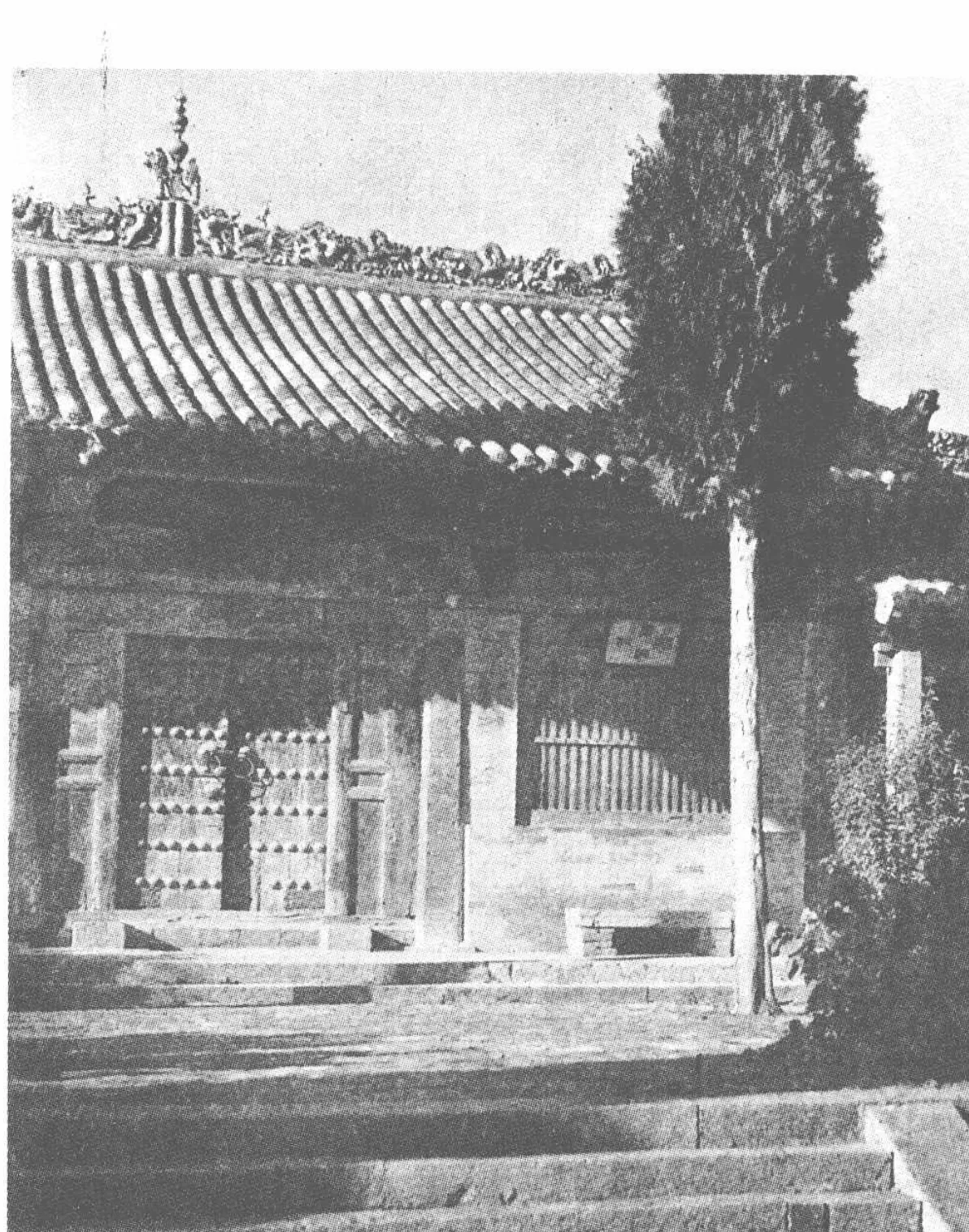
Between September and November 1962, architectural historian Zhang Yuhuan surveyed historic buildings in southeastern Shanxi. At Fucheng he photographed the second gate, painted attendant figures in the main hall, the hall’s inverted-lotus column base, and the Twenty-Eight Lunar Mansion images in the western gallery. His photograph of the second gate is used as this article’s cover. The photographs were published in Zhang’s Historic Architecture of Shangdang (first edition, Science Press, 1963; reissued by Tianjin University Press in 2009).
References
- Jade Emperor Temple Museum of Painted Sculpture and Murals, Jincheng Museum (official account of the temple’s history, layout and conservation).
- An Ancient Astronomical Art Gallery: A Glimpse of the Twenty-Eight Lunar Mansion Sculptures at Fucheng Jade Emperor Temple, Jincheng Municipal Government, September 2023.
- Zhang Yuhuan, Historic Architecture of Shangdang, first published by Science Press in 1963; reissued by Tianjin University Press in 2009 (photographs from the 1962 survey of southeastern Shanxi).
- Liu Zemin, general editor, Complete Collection of Shanxi Stone Inscriptions: Zezhou County, Jincheng, Sanjin Publishing House, 2012 (transcriptions of Song–Qing inscriptions at Fucheng Jade Emperor Temple).
- Wikipedia, Fucheng Jade Emperor Temple (compilation of modern scholarship on the dates of surviving buildings, sculpture and restoration history).