Introduction
The high-walled South Monastery in today’s Sakya county seat is not where Sakya Monastery began. In 1073, Könchok Gyalpo founded the North Monastery on a hillside north of the Zhongqu River. Nearly two centuries later, work began on the South Monastery on level ground in the county seat. Phagspa, a native of Sakya, links these two sites and periods.
In the mid-13th century, Phagspa had an audience with Kublai before Kublai’s accession. Once enthroned, Kublai appointed him State Preceptor[1] (guoshi). The Yuan Shi records that Phagspa was ordered to create the new Mongol script[2]. The preface to the Genben Shuo Yiqie Youbu Chujia Shou Jinyuan Jiemo Yifan also says that he spread the ordination ritual through the Central Plains and that multilingual translators rendered it into Chinese by imperial command. Contact between Sakya and the Yuan court therefore involved monks, a new writing system, and Chinese translations of Buddhist texts.
In 1268, Phagspa instructed Shakya Sangpo, the chief administrator of the Sakya polity, to begin building the South Monastery. After Shakya Sangpo died, his successor Kunga Sangpo continued to direct the work. When the Qing writer Yao Ying visited, the South Monastery already consisted of “pavilions rising from level ground” behind “very solid enclosing walls,” with scriptures “filling the shelves and cases.” The monastery’s expansion from the hillside North Monastery to the South Monastery on the plain unfolded alongside 13th-century contacts between Tibet and the Yuan court.
Historical Documents
Genben Shuo Yiqie Youbu Chujia Shou Jinyuan Jiemo Yifan (Ritual Model of the Ordination Karmavācana of the Mūlasarvāstivāda)
原夫瞻部嘉运,至四佛释迦文如来遗教利见也。大元御世,第五主宪天述道仁文义武大光教皇帝登极也。天资福慧,谛信内乘,普使万邦,咸归一化。虽敷天垂拱,而至治无垠;眷支那弘道,而在躬不息。欲以自佛相承,师资继踵,迄今不替。正戒仪范,为拳拳从善之行,人俾一一恒持于净戒。精练三业,坚守四仪,此实圣皇匡正佛法之睿旨也。昔因善逝,与人天众普说无诤声闻藏教一切有部别解脱经,依此采拾未得令得律仪方便羯磨仪范,此乃圣光德师之总集也。始从天竺,次屇西番,爰有洞达五明法王大士萨思迦扮底达,名称普闻。上足苾刍拔合思巴,乃吾门法主大元帝师,道德恢隆,行位叵测。援兹仪范,衍布中原。令通解三藏比丘住思观演说正本。翻译人善三国声明辩才无碍含伊罗国翰林承旨弹压孙传华文译主生缘北庭都护府解二种音法词通辩诸路释门总统合台萨哩都通,暨翰林学士安藏总以诸国言诠,奉诏译成仪式。序本帝师之亲制,绘为华迹以编陈。始末粗彰,聊记岁月。时庚午岁至元七年冬至后二日序。
In the beginning, the auspicious fortune of Jambudvīpa brought the beneficial manifestation of the bequeathed teaching of the fourth Buddha, Śākyamuni Tathāgata. The Great Yuan rules the age, and its fifth sovereign, the August Emperor Who Follows Heaven and Expounds the Way, Benevolent, Cultured, Righteous, Martial, and Greatly Radiant in Teaching, has ascended the throne. Endowed by nature with merit and wisdom, he sincerely believes in the Inner Vehicle, universally causing the myriad states all to return to a single transformation. Though he spreads his rule over heaven and governs with folded hands, his perfect governance is boundless; his care for the spread of the Way in China never ceases in his own person. Wishing that [the teaching] handed down from the Buddha himself should continue through a succession of masters and disciples unbroken to this day, [he holds that] the correct ritual model of the precepts is the earnest practice of following the good, so that each and every person may be made to keep the pure precepts constantly. To refine the three karmic deeds and steadfastly keep the four deportments — this is truly the sagely emperor’s wise intent to uphold and correct the Buddha-dharma. Long ago, because of the Well-Gone One (Sugata), the uncontested Śrāvaka-piṭaka teaching and the Sarvāstivāda Prātimokṣa Sūtra were preached broadly to the assembly of humans and gods; drawing upon this, the karmavācana ritual model was gathered as an expedient means by which those who had not yet obtained the monastic discipline might obtain it — this is the compendium of the virtuous master Shengguang (Guṇaprabha). It came first from India and next reached the Western Marches (Tibet). There was the great master, the Dharma King who thoroughly penetrated the five sciences, Sakya Paṇḍita, whose fame was heard everywhere. His chief disciple, the bhikṣu Phagspa, is the Dharma-lord of our school and the Imperial Preceptor of the Great Yuan; his moral virtue is vast and lofty, and his station cannot be fathomed. He took up this ritual model and spread and promulgated it in the Central Plains. He ordered the bhikṣu Zhu Siguan, who thoroughly understands the Tripiṭaka, to expound the authentic text. The translators — the Hanlin Academician Recipient of Edicts from the country of Elura who is versed in the śabda-vidyā (grammar) of three countries and of unhindered eloquence, Sun, who transmitted the Chinese script as chief translator, versed in the two kinds of phonetics of the Beiting Protectorate whence his family came, whose command of terms was penetrating and discerning, President of all the Buddhist establishments of the circuits, Hetai Sali Dutong — together with the Hanlin Academician Anzang, taking up the expressions of the various countries, by imperial edict translated it into the Chinese ritual. The preface was composed personally by the Imperial Preceptor and has been rendered into Chinese script and arranged for presentation. The beginning and end are thus made roughly clear; I have merely recorded the date. Written on the second day after the winter solstice of the gengwu year, the seventh year of the Zhiyuan era.
Yuan Shi (History of the Yuan)
帝师八思巴者,土番萨斯迦人,族款氏也。相传自其祖朵栗赤,以其法佐国主霸西海者十余世。八思巴生七岁,诵经数十万言,能约通其大义,国人号之圣童,故名曰八思巴。少长学富五明,故又称曰班弥怛。岁癸丑,年十有五,谒世祖于潜邸,与语大悦,日见亲礼。中统元年,世祖即位,尊为国师,授以玉印,命制蒙古新字,字成上之,其字仅千余,其母凡四十有一。其相关纽而成字者,则有韵关之法;其以二合、三合、四合而成字者,则有语韵之法,而大要则以谐声为宗也。至元六年,诏颁行于天下。诏曰:朕惟字以书言,言以纪事,此古今之通制。我国家肇基朔方,俗尚简古,未遑制作。凡施用文字,因用汉楷及畏吾字,以达本朝之言。考诸辽、金以及遐方诸国,例各有字。今文治寖兴,而字书有阙,于一代制度,实为未备。故特命国师八思巴创为蒙古新字,译写一切文字,期于顺言达事而已。自今以往,凡有玺书颁降者,并用蒙古新字,仍各以其国字副之。遂升号八思巴曰大宝法王,更赐玉印。十一年,请告西还,留之不可,乃以其弟亦怜真嗣焉。十六年,八思巴卒,讣闻,赙赠有加,赐号皇天之下一人之上宣文辅治大圣至德普觉真智佑国如意大宝法王、西天佛子大元帝师。至治间,特诏郡县建庙通祀。泰定元年,又以绘像十一颁各行省,为之塑像云。亦怜真嗣为帝师,凡六岁。至元十九年卒。答儿麻八剌乞列嗣,二十三年卒。亦摄思连真嗣,三十一年卒。乞刺斯八斡节儿嗣,成宗特造宝玉五方佛冠赐之。元贞元年,又更赐双龙盘纽白玉印,文曰大元帝师,统领诸国僧尼,中兴释教之印。大德七年卒。明年,以辇真监藏嗣,又明年卒。都家班嗣,皇庆二年卒。相儿加思嗣,延祐元年卒。二年,以公哥罗古罗思监藏班藏卜嗣。至治三年卒。旺出儿监藏嗣,泰定二年卒。公哥列思八冲纳思监藏班藏卜嗣,赐玉印,降玺书谕天下。其年卒。天历二年,以辇真吃刺失思嗣。
The Imperial Preceptor Phagspa was a man of Sasikya in Tibet, of the Khön clan. According to tradition, from his ancestor Dorje-chö onwards, for more than ten generations they had used their doctrine to assist the ruler of the land in dominating the regions around the Western Sea. When Phagspa was seven years old, he could recite scriptures of several hundred thousand words and was able to grasp their general meaning; his countrymen called him the Holy Child, and so he was named Phagspa (“the Sage”). When he grew a little older, his learning was rich in the five sciences, and so he was also called Paṇḍita. In the guichou year, at the age of fifteen, he had an audience with Shizu (Kublai) while the latter was still in his princely residence; [Kublai] conversed with him with great delight and showed him increasing intimacy and courtesy. In the first year of the Zhongtong era, Shizu ascended the throne, honored him as National Preceptor, and granted him a jade seal, ordering him to devise a new Mongol script. When the script was completed he presented it: its characters numbered just over a thousand, and its letters (“mothers”) were forty-one in all. For characters formed by joining sounds in sequence there was the method of rhyme-linkage; for characters formed by combining two, three, or four sounds there was the method of syllable-rhyme; and the essential principle took phonetic correspondence as its standard. In the sixth year of the Zhiyuan era, an edict promulgated it throughout the realm. The edict read: “We hold that writing serves to record speech, and speech serves to record events; this is the constant rule of past and present. Our dynasty founded itself in the northern marches; its customs esteem simplicity and antiquity, and it had no leisure to create [a script]. Wherever writing was employed, we relied on the Chinese regular script and the Uyghur script to express the language of our dynasty. Examining the Liao and the Jin, as well as the various states of distant regions, each by precedent had its own script. Now civil governance is gradually rising, yet our writing is deficient; for the institutions of a dynasty, this is truly incomplete. We have therefore specially commanded the National Preceptor Phagspa to create a new Mongol script, to transcribe all forms of writing, hoping only that it may accord with speech and convey affairs. From this day forward, whenever a sealed edict is promulgated, it shall uniformly use the new Mongol script, with the script of each respective country accompanying it.” Thereupon Phagspa’s title was raised to Great Treasure Dharma King, and he was further granted a jade seal. In the eleventh year he asked leave to return west; when [the emperor] could not detain him, his younger brother Rinchen was made his successor. In the sixteenth year Phagspa died; when the news of his death arrived, the funeral gifts were increased, and he was granted the title “Great Treasure Dharma King, beneath August Heaven and above one man, Proclaimer of Culture and Assistant in Governance, Great Sage of Utmost Virtue, Universally Awakened True Wisdom, Wish-fulfilling Protector of the State; Buddha-son of the Western Heaven, Imperial Preceptor of the Great Yuan.” During the Zhizhi era, an edict specially ordered the commanderies and counties to build temples for his general veneration. In the first year of the Taiding era, eleven painted images of him were also distributed to the various branch secretariats to have statues made of him. Rinchen served as Imperial Preceptor for six years in all and died in the nineteenth year of the Zhiyuan era. Dharmapālarakṣita succeeded and died in the twenty-third year. Ye-shes rin-chen succeeded and died in the thirty-first year. Grags-pa ’od-zer succeeded; Chengzong specially had a precious-jade crown of the Five Buddhas made and bestowed it on him. In the first year of the Yuanzhen era, he was further granted a white-jade seal with a paired-dragon coiled knob, inscribed “Seal of the Imperial Preceptor of the Great Yuan, commander of the monks and nuns of all countries, restorer of the Buddhist teaching.” He died in the seventh year of the Dade era. The following year Rin-chen rgyal-mtshan succeeded, and he died the year after that. ’Dul-ba’i ‘phreng-ba succeeded and died in the second year of the Huangqing era. Zangs-dkar succeeded and died in the first year of the Yanyou era. In the second year, Kun-dga’ blo-gros rgyal-mtshan dpal-bzang-po succeeded and died in the third year of the Zhizhi era. Dbang-phyug rgyal-mtshan succeeded and died in the second year of the Taiding era. Kun-dga’ legs-pa’i ’byung-gnas rgyal-mtshan dpal-bzang-po succeeded, was granted a jade seal, and a sealed edict was sent down to proclaim it to the realm; he died that same year. In the second year of the Tianli era, Rin-chen bkra-shis succeeded.
Ming Shilu (Veritable Records of the Ming)
命尚思昆、泽思巴为万竹圆融妙法最胜真如慧智弘慈广济护国宣教正觉大乘法王,西天上善金刚普应大光明佛,领天下释教。赐诰印并袈裟、幡幢、鞍马、伞盖、法器等物。
[The emperor] ordered Shangsikun and Zesiba [to be invested as] Mahāyāna Dharma King of the Myriad Bamboos’ Perfect Fusion of Wondrous Dharma, the Ultimate True Suchness, Wise and Intelligent, Vastly Compassionate and Broadly Saving, Protector of the State and Proclaimer of the Teaching, Perfectly Enlightened; Vajra of Supreme Goodness of the Western Heaven, Buddha of Universal Response and Great Radiance; and to lead the Buddhist teaching of all under heaven. He bestowed the patent and seal, together with a cassock, banners and streamers, saddled horses, parasols and canopies, ritual implements, and other goods.
Shuyu Zhouzi Lu (Record of Inquiries on the Strange Regions)
及查成化年间节该本部题准事例,乌思藏辅教等四王,每王名下,例该三年一贡,各许差一百人,多不过一百五十人。长河西、鱼通、宁远等处宣慰司三年一贡,每贡多不过一百人。如有国师、禅师在司住坐者,不许各剐差人进贡。其有退老事故等项,着令亲徒儿男袭替赴京进贡者,国师差一百人,禅师都指挥以下各差五十人,多不过一千人,数外,多者照例阻回。
Further, examining the precedents approved item by item by this Ministry during the Chenghua era: for the four kings of Ü-Tsang, such as the King of Auxiliary Teaching, under each king’s name a tribute mission is due once every three years, each permitted to send one hundred men, and not more than one hundred fifty. The Pacification Commissions of Changhexi, Yutong, Ningyuan, and other places send tribute once every three years, each mission not exceeding one hundred men. If there are National Preceptors or Chan Masters residing in those commissions, they are not permitted to send tribute envoys separately. In cases of retirement for age or other circumstances, where personal disciples or sons are ordered to inherit the office and come to the capital to present tribute, a National Preceptor may send one hundred men, and Chan Masters down to Regional Commanders may each send fifty men, the total not to exceed one thousand; beyond that number, the excess shall be turned back according to regulation.
其都纲、指挥以下来替者,止许随同年例进贡。若国师、禅师数少,则自当随数而来,或三四百名,或五六百名,不待辏满千名。其大乘法王系出家高僧,无地土番民管束,不给勘合,亦无年例进贡,听其欲来,止许差僧徒十人,赍此印信番本,随同阐化等四王年例进贡。题奉圣旨:合例的全赏,违例的减去。钦此钦遵外。
Those Registrars, Commanders, and below who come as replacements may only present tribute together with the regular annual missions. If the National Preceptors and Chan Masters are few in number, they should come according to their actual number — whether three or four hundred, or five or six hundred — without waiting to assemble a full thousand. The Mahāyāna Dharma King is an ordained high monk; he has no land or Tibetan subjects under his control, is issued no travel warrants, and has no regular annual tribute; he may come as he wishes, but may only send ten monk-disciples bearing this sealed credential in the Tibetan original, accompanying the annual tribute missions of the four kings such as the King of Propagating Transformation. It was memorialized and received the imperial decree: “Those that conform to the regulations shall be rewarded in full; those that violate the regulations shall be reduced. Respect this.” So it is respectfully observed.
Weizang Tong Zhi (General Gazetteer of Ü-Tsang)
后藏札什伦布境内,有萨迦呼图克图,乃元时帕思巴之后,为红帽教之宗。经簿载育仁菩萨之后人昆贡确嘉卜通达经典,看得奔布山风脉佳胜,欲创建庙宇,向业主降雄固喇娃班第仲喜纳密。酌克敦三人欲乞售兹地,伊三人乃施舍,不取价值,遂建此庙,供诸佛像,招僧住持。相传至今七百二十余年。其红教喇嘛年少时娶妻生子,至生子后,不复再近室家,始登法座。按辈相传,
Within the territory of Tashilhunpo in Tsang there is a Sakya Khutukhtu, a descendant of Phagspa of the Yuan, who is the head of the Red Hat teaching. The scripture register records that Kun Könchok Gyalpo, a descendant of the Bodhisattva Yüren, thoroughly versed in the scriptures, saw that the geomantic veins of Mount Benbu were fine and wished to found a temple; he approached the landowners Jangxiong Gulawa, Bandi Zhongxinami, and Zhuokedun, and the three of them wished to beg to purchase this land, but those three men thereupon made a gift of it, taking no payment. So this temple was built, images of the Buddhas were installed, and monks were invited to reside there. It has been handed down for more than seven hundred twenty years to the present. The lamas of this Red teaching marry wives and beget sons in their youth; only after a son is born do they cease to approach their household, and then ascend the Dharma seat. It is handed down by generation,
Kangyou Jixing (Record of Travels on Imperial Missions)
布达拉经簿云:萨迦庙之呼图克图,乃元帕思巴之后,为红帽教之宗,仁育菩萨之后人也。其教有家室,生子后坐床掌教,不复近家室矣。其始祖名昆贡确嘉卜,通达经典,见萨迦沟之奔布山风脉佳胜,欲创建庙宇,从业主降雄固刺陛、班第、仲喜纳密、酌克敦三人乞售。三人乃施舍其地,不取直,遂建庙,供释迦牟尼佛。附近土地人民,庙宇僧众,皆其所属。世代相传,至今七百余年。其庙平地起阁,周墙甚固,中殿楹柱皆古树,三人合抱,高三爻余,不加雕饰,其皮节文理如生树然。又有海螺,坚白如玉,左旋敛向明吹之,背现观音相。寺僧宝之,有藏经数万卷,架函充栋。庙。北依山,僧楼梵宇约数千閒,亦有浮屠金殿,供诸佛像,皆红帽刺麻居之。其所诵经,与黄教无异。西南通拉孜大道,山南通野人国界。
The scripture register of the Potala says: The Khutukhtu of the Sakya monastery is a descendant of Phagspa of the Yuan, the head of the Red Hat teaching, and a descendant of the Bodhisattva Renyü. His teaching permits household life; after a son is born, [the hierarch] sits on the throne and takes charge of the teaching, and no longer approaches his household. Its first patriarch was named Kun Könchok Gyalpo; thoroughly versed in the scriptures, he saw that the geomantic veins of Mount Benbu in the Sakya valley were fine and wished to found a temple, and begged to purchase the land from the landowners Jangxiong Gulabi, Bandi, Zhongxinami, and Zhuokedun. Those three men thereupon gave the land as a gift, taking no payment, and so the temple was built and an image of Śākyamuni Buddha was installed. The nearby lands and peoples, and the temple’s monks, all came under its sway. Handed down from generation to generation, it has now been more than seven hundred years. The temple rises in pavilions from level ground, its enclosing walls are very solid; the pillars of the central hall are all ancient trees, three arm-spans around and over thirty feet high, without carving or ornament, their bark, knots, and grain like those of living trees. There is also a conch shell, hard and white as jade, coiling to the left; when it is blown facing the light, an image of Guanyin appears on its back. The temple monks treasure it. There are tens of thousands of volumes of stored scriptures, filling shelf upon shelf to the roof. The temple rests against the mountain to the north; the monks’ lodgings and sacred buildings number some thousands of bays, and there are also a stūpa and a gilded hall housing images of the Buddhas, all dwelt in by Red Hat lamas. The scriptures they recite do not differ from those of the Yellow teaching. To the southwest it connects with the high road to Lhazê; south of the mountains it borders the land of the wild men.
Qinding Kuo’erka Jilüe (Imperially Commissioned Brief Account of the Gurkha Campaign)
又据福康安奏:萨迦呼图克图采办糌粑五万觔,分运济陇聂拉木运脚,自行捐出,并请捐食牛五百头等语。前因萨迦喇嘛于贼匪上年路过时,曾经递送哈达,曾谕令福康安等于撤兵之便,勒令改归黄教。今该呼图克图既有捐办糌粑、牛只之事,是尚知畏法奉公。此等红教流传日久,且人户众多,若勒令改归黄教,办理亦恐不无掣肘。福康安等不必拘泥前旨,竟当明白晓谕该喇嘛等,以尔等前此与贼递送哈达,俱干重罪,仰蒙大皇帝念尔等均系僧家,愚昧无知,不行严办,实属格外施恩。今因尔等捐办糌粑牛只,尚知急公效顺,本将军业为奏闻,仍准尔等在庙照旧焚修安业。尔等此后宜倍加感激,约束徒众,安静梵诵,不得妄生事端,方可永安乐利。并交驻藏大臣严切约束,不准仍前越界滋事,俾该喇嘛等咸知儆惕,免与黄教争竞,庶为妥善。
Further, according to Fuk’anggan’s memorial: the Sakya Khutukhtu has procured fifty thousand jin of tsampa, has himself donated the transport costs for the separate shipments to Kyirong and Nyalam, and has also offered to donate five hundred head of cattle for food, and so forth. Previously, because the Sakya lamas had presented khatas when the rebel bandits passed through last year, [We] had instructed Fuk’anggan and the others, taking the opportunity of the troop withdrawal, to compel them to change over to the Yellow teaching. Now, since this Khutukhtu has performed these acts of donating tsampa and cattle, he still knows to stand in awe of the law and serve the public good. This Red teaching has been transmitted for a long time, and its households are numerous; if we were to compel them to change over to the Yellow teaching, the handling of the matter would likely not be without difficulty. Fuk’anggan and the others need not cling to the earlier decree; they should plainly instruct those lamas that your previous presentation of khatas to the bandits all constituted grave crimes, but that, thanks to the Great Emperor’s consideration that you are all of the monastic community, benighted and ignorant, he did not apply severe punishment — this was truly an extraordinary act of grace. Now, because you have donated tsampa and cattle and still know to hasten to the public cause and show submission, this General has already memorialized on your behalf, and you are still permitted to burn incense and pursue your vocation in your monastery as before. From now on you should be doubly grateful, restrain your followers, chant in peace, and not recklessly stir up trouble; only then can you forever dwell in peace and benefit. This is also to be handed to the Amban in Tibet for strict restraint: they are not permitted, as before, to cross boundaries and stir up trouble, so that those lamas may all know to be watchful and refrain from competing with the Yellow teaching — this would be the proper arrangement.
Zangshi Juyao (Essentials of Tibetan Affairs)
Hu Bingxiong’s Zangshi Juyao follows the classification practice of late-Qing Chinese-language writings, which loosely applied the label “Red teaching” to the Sakya school and other non-Geluk schools. His account emphasizes Sakya Monastery’s status as the ancestral seat, the lineage of Phagspa, and the fact that Tsongkhapa studied at Sakya in his early years.
后藏札什伦布之西,有萨迦庙,乃红教祖寺住持。此寺之胡土克图,为红教刺麻最尊者,即元帝师八思巴后人。其教先娶妻生子,为他日袭衣钵计,有后则不入室,始登法座。其经典皆来自印度。黄教祖宗喀巴初年亦学经于萨迦庙,及学成,乃自立宗,故经典略同。青海蒙古及巴塘、里塘番众,凡信黄教䎞,亦兼敬萨迦剌麻,如达赖、班禅。二教本同一原,其近日邪术之红教,乃红教末流,非萨迦庙本宗也。
West of Tashilhunpo in Tsang there is the Sakya monastery, the seat of the ancestral temple of the Red teaching. The Khutukhtu of this monastery is the most venerable lama of the Red teaching, a descendant of the Yuan Imperial Preceptor Phagspa. In this teaching one first marries a wife and begets sons, so as to provide for the future inheritance of the robe and bowl; once there is an heir, one no longer enters the household chamber, and then ascends the Dharma seat. Its scriptures all come from India. In his early years Tsongkhapa, the patriarch of the Yellow teaching, also studied the scriptures at the Sakya monastery, and when his studies were complete he founded his own school; therefore the scriptures are largely the same. The Tibetans of Qinghai, Mongolia, Batang, and Litang who believe in the Yellow teaching also revere the Sakya lamas, as they do the Dalai Lama and the Panchen Lama. The two teachings originally have the same source; the Red teaching of heterodox arts spoken of in recent times is the degenerate offshoot of the Red teaching, not the original school of the Sakya monastery.
其与黄教异者,大端凡三:一、衣冠异色,二、咒语稍别,三传子与转生不同,如斯而已。
Its differences from the Yellow teaching are three in the main: first, the color of the robes and hats differs; second, the mantras differ slightly; third, succession by son differs from succession by reincarnation. That is all.
References
- Shaanxi Provincial Cultural Heritage Administration, “Thirty Years of Shaanxi Archaeology’s Aid to Tibet”
- Bibliographic note on the Han-Zang Shiji (Mirror of Han and Tibetan Histories) by Dacang Zongba Banjor Sangpo
- Zhang Yun, “The Story of Imperial Preceptor Phagspa, a Social Reformer”
- Bibliographic information for the Sakya Genealogy (Sa skya’i gdung rabs) by Ngawang Kunga Sönam
- Yang Jie, “Political Identification with the Central Dynasty in the Ming-Dynasty Compilation of Tibetan Family Histories”
Historical Photographs
1948
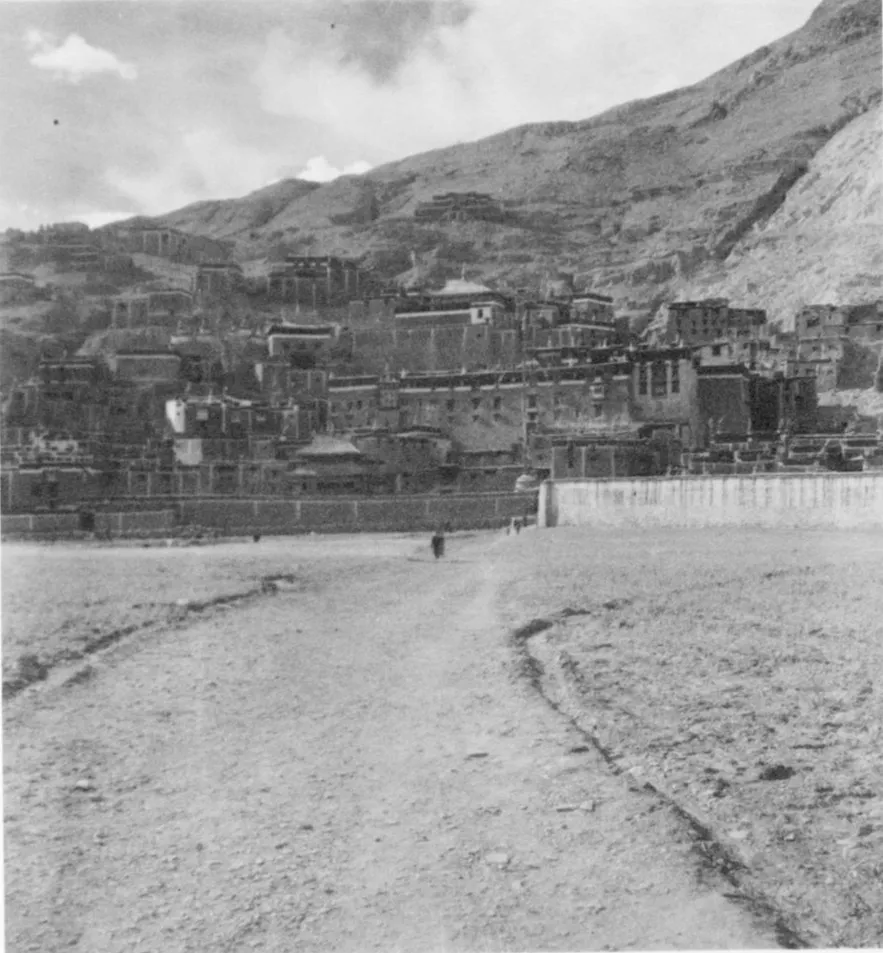
In 1948, Arthur J. Hopkinson, the British Political Officer in Sikkim, photographed the monastery complex at Sakya. The photographs are now held in The Tibet Album: British Photography in Central Tibet 1920–1950, jointly compiled by the British Museum and the Pitt Rivers Museum, and can be viewed among all the photographs of the Sakya region. The photographs below include a close view of Sakya Monastery, a panorama of Sakya Monastery, a monastery courtyard during stone-hauling repairs, the great temple of Sakya seen from a nearby hillside, the view toward Khampa Dzong from the temple roof, and the courtyard before the main temple entrance.
The collection also holds a panorama of Sakya Monastery composed of three photographs. Here we use the three separate negatives corresponding to the composite image: in order, the left frame, the center frame, and the right frame.