Introduction
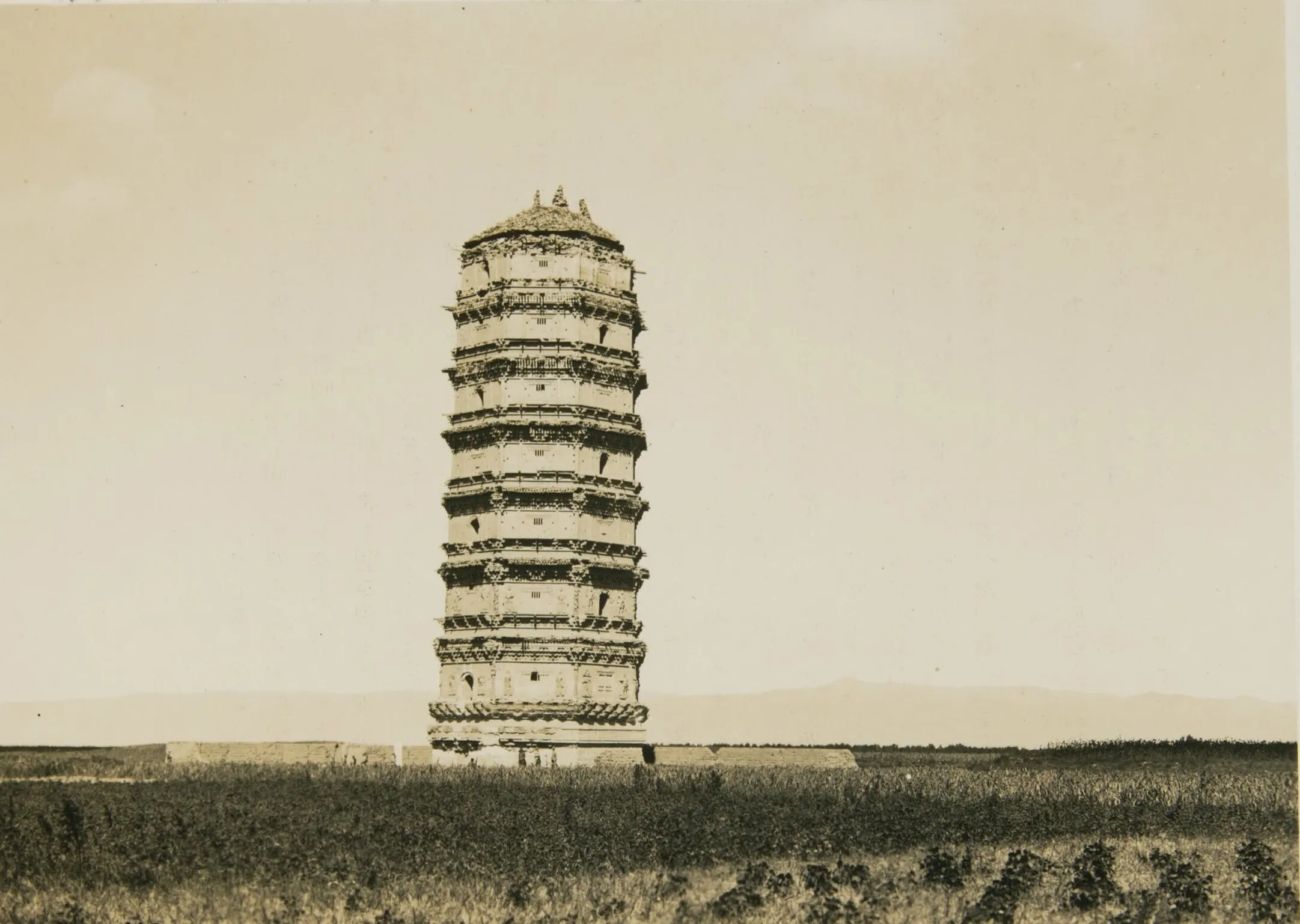
The Wanbu Huayanjing Pagoda stands at the northwest corner of the Liao-dynasty city of Fengzhou; it was originally the sutra-repository pagoda of a Buddhist monastery. Built of brick as an octagon of seven storeys, it rests on a stone base that bears enormous lotus petals; bodhisattvas and heavenly kings are molded on the outer walls of the first storey, and coiling dragons wind around the engaged columns at the corners. On the south face, a stone plaque carries the seal-script[1] inscription “Wanbu Huayanjing Pagoda.” The storeys are connected by a stairway within the walls, so that a visitor can climb all the way to the seventh storey.
In the second year of the Dading era of the Jin (1162), this Liao pagoda was restored by imperial order. The work was directed by the government, with funds subscribed jointly by the people inside and outside the city; the names of the donors, together with place names such as the Southeast, Northeast, Southwest, and Northwest wards and Ox-Market Lane, Dyers’ Lane, and Dairy Lane, were carved together on stone steles inside the pagoda.
At the beginning of the Yuan, Liu Bingzhong—the statesman and poet who had long assisted Kublai—passed through Fengzhou and wrote of the scene in which the temple pagoda and the gate tower faced one another and horses and carts thronged the roads. Later climbers left their names, native places, offices, itineraries, and verses on the inner walls: Fan Dian, who came from the Zhenrong Army; Huishan, a monk of the Renwang Cloister of the Xixia kingdom; the Fengzhou official Wang Ying; and Duan Qing, a Shanxi scholar who in the Ming was carried beyond the frontier amid the turmoil of war.
Centuries later, Qian Liangze came to Fengzhou: the city foundations had fallen into ruin, yet the White Pagoda still “towered halfway to the sky.” He went inside the pagoda, read by firelight the stone steles embedded in the walls of the first storey, then climbed the stairs and copied out one by one the inscriptions left since the Jin and Yuan[2]. The Fengzhou that Qian Liangze recorded no longer had the monastery, gate towers, and traffic that Liu Bingzhong had seen; the writing inside the pagoda still preserves the names and journeys of old Fengzhou.
By 1938 to 1939, the White Pagoda in the photographs already stood alone in the fields, its crown broken and incomplete, with only low ruined walls at its foot. The city of Fengzhou left no intact gate tower, and the monastery left no halls; only this pagoda still stands here. The storey upon storey of inscriptions inside the pagoda and the steles embedded in its walls allow the long-vanished city and monastery still to be traced.
Historical Documents
Cangchun Shiji (Collected Poems of Cangchun)
平生清兴在林泉,世路谁教也著鞭。马上青山长万里,镜中华发已三年。又经黑水还沙漠,才自鸟蛮出瘴烟。盖世功名正低首,西风秋树一声蝉。
All my life my pure delight has been in woods and springs; on the road of the world, who taught me also to ply the whip? From horseback the green mountains stretch on for ten thousand li; in the mirror, my streaked hair has been white for three years. Once more I crossed the Black Waters and came back to the desert; only just emerged from the miasmic mists of the bird-tribes’ land. My world-surpassing merit and fame now bow their head; in the west wind and autumn trees, the single cry of a cicada.
边山弥弥水西流,夹路离离禾黍稠。出塞入塞动千里,去年今年经两秋。晴空高显寺中塔,晓日半明城上楼。车马骈阗尘不断,吟鞭斜袅过丰州。
The frontier mountains spread on and on, the waters flowing west; flanking the road, luxuriant and dense, the grain crops crowd thick. Out of the passes and into the passes, a thousand li at every move; last year and this year, I have passed through two autumns. In the clear sky, high and conspicuous, the pagoda within the temple; in the morning sun, half-lit, the tower above the city wall. Horses and carts throng side by side, the dust unbroken; with my poet’s whip trailing aslant, I pass through Fengzhou.
Zeguzhai Chongchao (Recopied Collectanea of the Zegu Studio)
十七日戊子,凉爽如深秋。平明起行,马首向北一望,地皆平坡,沃饶,颇多种麦者,不知其何时收𮒗也。行五十余里,复见空城,基址颓坏,甚于昨所经者。其大相彷。浮屠一座,高矗天半,六角七级,纯砗砌成,不用木石,外向写作菩萨天王,面面拱立,承以莲花,花办外撑数尺,因以为檐。刻划玲珑,生动如真,全未剥落,但丹圣漫漶尔。南篆书,颜额曰万部华严经塔。每级高三丈许,阶梯而登。首级有石碑八座,陷入壁间,暗不可读,吹火照之,字体颇丁,开列男妇数千百人姓名,别无只字。志铭中有忠勇校尉某、汉儿都目某、女直都目某、通事某种种名色,姓名类多中华氏族,其女直姓名者十之一尔。傍及妇人,或称妻某,或称娘子某氏,或称某娘娘,俚俗可笑,颇似村氓所为。其一碑署曰万部华严经塔。看经人数𫄙首比邱福州惠仁发宏誓言:如有情数经,为看毗卢海印定光寒,愿眼恒无缺陷诸苦恼。大地众生,俱如普贤行满。此外绝无纪载可考。彼地相传,旧有石碑,备书修建始末,以金银镂错其额,为窃盗者取去。盖传闻失据久矣。上六级稍明,启二牖以纳曰光,其间或东西向,或南北向,层层相间。绝顶第七级,中空如庭,中间无物。
On the seventeenth, a wuzi day, it was as cool as late autumn. We set out at dawn; as far as one could see ahead of my horse to the north, the land was all level slopes, fertile and rich, with a good deal planted in wheat—though I do not know when it is reaped. After more than fifty li, I again saw an empty city, its foundations even more ruinous than the one passed yesterday, though in general aspect much alike. A single pagoda stood towering halfway up the sky, hexagonal with seven storeys, built entirely of brick, without wood or stone. Facing outward were fashioned bodhisattvas and heavenly kings, standing with hands folded on every face, borne upon lotus blossoms whose petals reach out several chi, thereby serving as eaves. The carving is exquisite and openwork, lively and true to life, wholly unflaked—only the red and white pigments have grown blurred. On the south face, in seal script, the plaque reads “Wanbu Huayanjing Pagoda.” Each storey is some three zhang high, and one ascends by a stairway. On the first storey eight stone steles are sunk into the walls; it was too dark to read them, so I blew up a flame to see. The characters are quite distinct, setting out the names of several thousand men and women, without another single word. Among the dedicatory lists are such designations as a certain Commandant of Loyalty and Valor, a certain Chinese registrar, a certain Jurchen registrar, various interpreters, and so on. The names are mostly of Chinese clans; those with Jurchen names amount to but one in ten. The women recorded alongside are styled “wife of so-and-so,” or “dame of such-and-such a clan,” or “lady so-and-so”—rustic and laughable, much like the work of country bumpkins. One of the steles is entitled “Wanbu Huayanjing Pagoda.” The congregation of sutra-readers, headed by the bhikshu Huiren of Fuzhou, uttered a great vow: “…may the eye be ever without defect, [freed from] every suffering; may all beings of the great earth be as Samantabhadra, his practice fulfilled.” Beyond this there is no record at all that can be examined. It is locally handed down that there was once a stone stele fully recording the whole story of the construction, its heading inlaid in gold and silver, but it was carried off by thieves; the rumor has plainly long been without foundation. The six upper storeys are somewhat lighter: two windows are opened to admit the sunlight, facing now east–west, now north–south, alternating storey by storey. At the very summit, the seventh storey is hollow like a courtyard, with nothing in it.
东首壁端大书曰:大金大定二年,奉敕重修。不言其自何代始。以此推之,疑其创于元魏高宗以后。壁间题署
On the wall at the east end is written in large characters: “Great Jin, second year of the Dading era: restored by imperial order.” It does not say from what dynasty it dates. Inferring from this, I suspect it was founded after the time of Emperor Gaozong of the Yuanwei. The inscriptions written on the walls
甚多,大抵皆金元人遗笔,多有墨迹如新,而语皆粗鄙。重传其真,不敢妄易一字,备录于后。塔内都无佛像,亦无鸟雀,窠巢间有鸳鸯飞集干下。地多蝎子草,似麻而短,手误触之,痛楚不可耐,无异被螫于真蝎也。饭于塔下,野田中,有蒙古人献茶及熟黍米各一盂,跪拜甚恭,酬以肉炙,彼即跪食其李,尽,怀其余脔于衣絮中,叩首作礼,颂谢而去,不辨其为何等语也。整辔而行,又阅二十余里,屯于归化城之东南,可十五里水旁。途次土室颇多,是晚大风陡作,不久旋止。
are very numerous, most of them the surviving brushwork of men of the Jin and Yuan, many with the ink as though fresh, yet all coarse and vulgar in wording. Prizing the transmission of their authenticity, I have not dared wantonly to alter a single character, and record them in full below. Inside the pagoda there are no buddha images at all, nor any birds, yet among the nests mandarin ducks fly down and gather below. The ground is thick with scorpion-grass, like hemp but short; if a hand touches it by mistake, the pain is unbearable, no different from being stung by a true scorpion. We ate below the pagoda in the wild fields. A Mongol offered us a bowl each of tea and cooked millet, kneeling and bowing most reverently. When we repaid him with roast meat, he knelt and ate his portion to the last, then tucked the remaining morsels into the wadding of his coat, kowtowed in salute, and went off uttering thanks—though I could not tell what manner of speech it was. We took up the reins and went on, and after another twenty-odd li camped southeast of Guihua City, some fifteen li away, by the water. Along the way there were many earthen huts. That evening a great wind sprang up suddenly, but before long it stopped.
附录:华严塔题名:
Appendix: Inscriptions on the Huayan Pagoda:
总管府判石仲玉,至元二十年八月初一日来游于此。今人同古人,残月如新月。至正十年正月二十二日,刘拱同重川二妇人同姐闸姐题。天堂路大德二年五月初九日书。钦差戴聪明,四川江安县人,元统二年四月初八日来登。
Shi Zhongyu, assistant administrator of the chief administration, came to visit here on the first day of the eighth month of the twentieth year of the Zhiyuan era. “Men of today are one with the men of old; the waning moon is as the new moon.” On the twenty-second day of the first month of the tenth year of the Zhizheng era, inscribed by Liu Gong together with the two women of Chongchuan, Tongjie and Zhajie. Written at Tiantang Road on the ninth day of the fifth month of the second year of the Dade era. The imperial commissioner Dai Congming, a man of Jiang’an County, Sichuan, came and climbed on the eighth day of the fourth month of the second year of the Yuantong era.
寻真误入蓬莱岛,香风不动桃花老。探芝何处不归来,白云满地无人扫。至治三年二月十一日书。
Seeking the Real, I strayed by mistake into the Isle of Penglai; the fragrant breeze unstirring, the peach blossoms grow old. Gathering magic fungi, whence have I not returned? White clouds cover the ground, and no one sweeps them. Written on the eleventh day of the second month of the third year of the Zhizhi era.
至元六年五月初三日,文山相国幕下相士三人到此。
On the third day of the fifth month of the sixth year of the Zhiyuan era, three physiognomists from the staff of Chancellor Wenshan (Wen Tianxiang) came here.
大定十八年三月十二日,关西镇戎军樊典到此题。丰州在城塔。至元十一年五月,丰州管水鸦提点王英、张伯川题。
On the twelfth day of the third month of the eighteenth year of the Dading era, Fan Dian of the Zhenrong Army of Guanxi came here and inscribed this. The pagoda within the city of Fengzhou. In the fifth month of the eleventh year of the Zhiyuan era, inscribed by Wang Ying, superintendent of the water crows of Fengzhou, and Zhang Bochuan.
大朝至元八年,西夏国仁王院僧惠善同进宣、冲平
The eighth year of the Zhiyuan era of the Great Dynasty: the monk Huishan of the Renwang Cloister of the Xixia kingdom, together with Jinxuan and Chongping—
五禅师到此记。
five Chan masters in all, came here and recorded this.
朱朝大明国,山西太原府代州崞县儒学增广生员段清,字希濂。嘉靖三十九年九月十五曰,鞑兵大举,攻开堡塞,将一家近枝六十口杀尽,止存清一家大小五口,俯念斯文一脉,留其性命。恩人达尔汉带回北朝。路逢房叔二人段应明、段茂先,又遇妹夫石枚。清妻陈氏,男甲午儿,官名段守鲁。长女双喜儿,次女赛喜儿。陈氏于嘉靖四十年四月初一日病故。闰五月二十七日,妹夫石枚带甲午儿投过南朝去了。六月初八日留名:
Of the Zhu dynasty, the Great Ming state: Duan Qing, courtesy name Xilian, an expanded-quota student of the Confucian school of Guo County, Daizhou, Taiyuan Prefecture, Shanxi. On the fifteenth day of the ninth month of the thirty-ninth year of the Jiajing era, the Tartar soldiery came in great force, stormed open the border forts, and slaughtered all sixty mouths of the near branches of our family; only the five souls, great and small, of my own family were spared, for they condescended to regard this single thread of letters and left us our lives. My benefactor Darhan brought us back to the northern court. On the road I met two uncles of my lineage, Duan Yingming and Duan Maoxian, and also encountered my brother-in-law Shi Mei. My wife was of the Chen clan; my boy Jiawu’er, official name Duan Shoulu. My elder daughter Shuangxi’er; my second daughter Saixi’er. My wife Chen died of illness on the first day of the fourth month of the fortieth year of the Jiajing era. On the twenty-seventh day of the intercalary fifth month, my brother-in-law Shi Mei took Jiawu’er and crossed over to the southern court. On the eighth day of the sixth month I leave this name:
去年曾醉海棠丛,闻说新枝发旧红。昨夜梦迟花下饮,不知身在玉堂中。瑞伯书。
Last year I once lay drunk amid the crabapple thickets; I heard that new branches had put forth the old red. Last night I dreamed late of drinking beneath the blossoms, not knowing I was in the Jade Hall. Written by Ruibo.
Juyi Lu (Records of Living at Ease)
又言:丰州南有空城,城中浮图一,六角七级,高矗天半,南向,篆书颜额曰万部华严经塔。第七级壁上大书金大定二年奉敕重修。多金、元人题字,墨迹如新,而辞率俚鄙。惟一诗近雅,云:「去年曾醉海棠丛,闻说新枝发旧红。昨夜梦回花下饮,不知身在玉堂中。瑞伯书。」按:此诗宋元绛厚之之作也。其题名有丰州水鸦提点王英、张百川,至元十一年五月署字。
He also said: South of Fengzhou there is an empty city, in which stands a single pagoda, hexagonal with seven storeys, towering halfway to the sky, facing south, its plaque in seal script reading “Wanbu Huayanjing Pagoda.” On the wall of the seventh storey is written in large characters: “Restored by imperial order in the second year of the Dading era of the Jin.” There are many inscriptions by men of the Jin and Yuan, the ink as fresh as new, but the wording is mostly vulgar. Only one poem approaches elegance: “Last year I once lay drunk amid the crabapple thickets; I heard that new branches had put forth the old red. Last night I dreamed of returning to drink beneath the blossoms, not knowing I was in the Jade Hall. Written by Ruibo.” Note: this poem is the work of Yuan Jiang, styled Houzhi, of the Song. Among the inscriptions are Wang Ying, superintendent of the water crows of Fengzhou, and Zhang Baichuan, with characters signed in the fifth month of the eleventh year of the Zhiyuan era.
Gufeng Zhilüe (A Brief Record of Ancient Fengzhou)
一名白塔。归化城东五十余里有白塔城,周围约十里许,疑亦古受降城之一也。土人尝夜见城垣门楼如新。古城每有此异。塔在城西北隅,七级,八面石台砖砌,刻画极工。高约十五丈,周围约八九丈,石额篆书万部华严经塔。塔下有石香亭,柱刻金天辅年号。
Also called the White Pagoda. More than fifty li east of Guihua City is White Pagoda City, about ten li in circumference, suspected to be one of the ancient Shouxiang (Receiving-Surrender) cities. Local people have sometimes seen its walls and gate towers at night as if new; ancient cities often have such marvels. The pagoda stands at the northwest corner of the city, of seven storeys and eight faces, a brick structure on a stone platform, extremely finely carved. It is about fifteen zhang high and about eight or nine zhang around; the stone plaque in seal script reads “Wanbu Huayanjing Pagoda.” Below the pagoda is a stone incense pavilion, its pillar carved with the Tianfu era name of the Jin.
按塔北塔西别有二古城基,周围俱十里许,亦不知其何名。
Note: north of the pagoda and west of the pagoda there are two further ancient city foundations, each about ten li in circumference; their names are likewise unknown.
在白塔城南门外,字模糊不全,上刻故开府仪同三司、上柱国、代国公完颜国赧、代国夫人耶律氏,云中张建中篆,乡进士王绋书。金天辅年立。
Outside the south gate of White Pagoda City, its characters blurred and incomplete. Engraved above are “the late Commander Unequalled in Honor, Supreme Pillar of State, Duke of Dai, Wanyan Guonan, and the Lady of Dai, of the Yelü clan”; the seal-script heading by Zhang Jianzhong of Yunzhong; written by the provincial jinshi Wang Fu. Erected in the Tianfu era of the Jin.
Shanyou Jinshi Ji (Records of Bronzes and Stones of Shanyou)
今在归化城东五十里白塔村。
Now at White Pagoda Village, fifty li east of Guihua City.
朔平府志:碑字模糊不全,上刻故开府仪同三司、上柱国、代国公完颜赧、代国夫人耶律氏,云中张建中篆,乡贡进士王绋书,天辅年立。
The Shuoping Prefecture Gazetteer: The stele’s characters are blurred and incomplete; engraved above are “the late Commander Unequalled in Honor, Supreme Pillar of State, Duke of Dai, Wanyan Nan, and the Lady of Dai, of the Yelü clan”; the seal-script heading by Zhang Jianzhong of Yunzhong; written by the provincially recommended jinshi Wang Fu; erected in the Tianfu era.
谨案:完颜赧,金史无其人,当是宗室表之骨赧。志脱骨字,又误𧹞为赧。本傅骨𧹞领军镇夏边者凡十二年。天眷初,为天德军节度致仕,累迁开府仪同三司,卒年八十五。白塔为辽金丰州、天德军故治,盖久官于此者。史不言封代国,碑不著节度使,互有详略也。碑著故字,则立于卒后,当天德年云天辅,误。金自太宗天眷三年始定官制爵号,且天辅之末,辽主尚在夹山,此地尚未为金有也。
Respectfully noted: Of “Wanyan Nan,” the History of Jin has no such person; this must be the Gunan of the table of imperial clansmen. The gazetteer drops the character gu and further miswrites 𧹞 as nan. According to his biography, Gunan led armies guarding the Xia frontier for twelve years in all. At the beginning of the Tianjuan era he retired from the military commissionership of the Tiande Army, having risen step by step to Commander Unequalled in Honor, and died at the age of eighty-five. The White Pagoda [city] was the former seat of Fengzhou and of the Tiande Army under the Liao and Jin; he had presumably long served as an official here. The history does not say he was enfeoffed as Duke of Dai, and the stele does not record the military commissionership: each is fuller where the other is brief. The stele writes the word “late” [that is, deceased], so it was erected after his death—it must date to the Tiande era, and to say Tianfu is an error. The Jin first fixed the system of offices and noble titles in the third year of the Tianjuan era of Emperor Taizong; moreover, at the end of the Tianfu era the Liao sovereign was still at Mount Jia, and this territory was not yet in Jin possession.
Historical Photographs
1938–1939
The fifteenth volume of Ajia Taikan (Grand Views of Asia), published by the Ajia Shashin Taikan Sha (Grand Views of Asia Photographic Society) included a panorama of the “White Pagoda of Kowa”—Kowa being the Japanese-era name of Hohhot—photographed by Shimazaki Yakuji.
1939
Image source: Murata Jiro, “Kowa no To to Tera” (The Pagodas and Temples of Kowa), Toyo Shi Kenkyu (The Journal of Oriental Studies), vol. 4, nos. 4–5, 1939.
References
- Li Yiyou, “The Jin-Dynasty Stele Inscriptions of the Wanbu Huayanjing Pagoda of Hohhot”, Kaogu (Archaeology), no. 4 (1979), pp. 365–374.
- Zhang Hanjun, “A Preliminary Study of the Architectural Construction and Structural Regulations of the Liao-Dynasty Wanbu Huayanjing Pagoda”, Nei Menggu Wenwu Kaogu (Cultural Relics and Archaeology of Inner Mongolia), no. 2 (1994).