Introduction
The Yunyan Temple Pagoda stands atop Tiger Hill in the Gusu District of Suzhou, Jiangsu Province. Commonly called the Tiger Hill Pagoda, the temple and the pagoda do not share the same origin — Yunyan Temple was founded in the second year of the Xianhe era of the Eastern Jin (327), when the brothers Wang Xun and Wang Min donated their residence, about seventeen hundred years ago; the surviving pagoda body dates to the late Later Zhou and early Northern Song, six centuries later.
The surviving pagoda is an octagonal, seven-story brick pagoda in imitation timber-frame pavilion style, with an overall height of about 47.7 meters. According to Liang Sicheng’s History of Chinese Architecture, each story is articulated in brick to reproduce the vocabulary of timber construction — round columns, architraves[1], lobed-arch doorways[2], bracket sets, and corbeled angle-bricks supporting the eaves — so that a structure built entirely of brick still reads, from a distance, with the massing and rhythm of a timber-frame pavilion tower. According to the Wujun Tujing Xuji and related sources, construction began in the sixth year of Xiande of the Later Zhou (959) and was completed in the second year of Jianlong of the Northern Song (961).
Tiger Hill was anciently called Mount Haiyong (the “Sea-Surging Hill”). Tradition holds that King Helü of Wu was buried here in the Spring and Autumn period, and that on the third day after his interment a white tiger crouched upon the mound — hence the name. In the second year of Xianhe of the Eastern Jin, Situ Wang Xun and his brother Sikong Wang Min donated their residence to establish a temple, dividing it into eastern and western branches around the Sword Pool — the core record of the temple’s early history. During the Tang it was renamed “Wuqiu” to avoid an imperial taboo; after the Huichang persecution of Buddhism the old temple was destroyed, and later sources describe the monastery being relocated from the foot of the hill to the summit, with the eastern and western branches gradually merging into one.
A further distinction must be made: references in the sources to a Sui-dynasty foundation, or to Wang Shao’s Record of Relic Pagodas in Various Prefectures, point to the early legend of a Sui Renshou-era relic pagoda or to a precursor structure — they are not the same as the brick pagoda of the Five Dynasties to Northern Song that survives today. According to the Wujun Tujing Xuji, the present pagoda was built between 959 and 961; relics excavated during mid-twentieth-century restoration — sutra caskets, reliquary containers, Yue-kiln celadon lotus bowls[3] — are consistent with deposits made during the Northern Song Jianlong and Qiande reigns.
Historical Documents
Wujun Tujing Xuji
云岩寺,在长洲县西北九里虎丘山,即晋东亭献穆公王珣及其弟珉之宅。咸和二年,舍建精舍于剑池,分为东西二寺,寺皆在山下,盖自会昌废毁后人乃移寺山上。
Yunyan Temple stands nine li northwest of Changzhou County on Tiger Hill — the former residence of Wang Xun, Duke Xianmu of Dongting of the Jin, and his brother Wang Min. In the second year of Xianhe (327) they donated it to found a monastery beside the Sword Pool, dividing it into the Eastern and Western Temples, both at the foot of the hill. Only after the destruction of the Huichang persecution did the people move the temple to the summit.
今东寺皆为民畴,西寺半为榛芜矣。寺中有御书阁、官厅、白云堂、五圣台,登览胜绝。又有陈谏议省华、王翰林禹称、叶少列参、蒋密直堂。
Today the Eastern Temple is all farmland, and the Western Temple is half overgrown with thickets. Within the precinct stand the Pavilion of Imperial Calligraphy, the Magistrate’s Hall, the White Cloud Hall, and the Terrace of Five Saints — places of unsurpassed prospect. There are also the halls of Remonstrancer Chen Xinghua, Hanlin Wang Yucheng, Junior Counselor Ye Can, and Privy Counselor Jiang Tang.
寺前有生公讲堂,乃高僧竺道生谈法之所。旧传生公立片石以作听徒,折松枝而为谈柄。其虎跑泉、陆羽井见存。
Before the temple stands the Lecture Platform of Master Sheng — where the eminent monk Zhu Daosheng expounded the Dharma. Tradition says he set up small stones as listeners and broke off a pine branch as his speaking baton. The Tiger-Springing Spring and Lu Yu’s Well still exist.
比岁琢石为观音像,刻经石壁。东岭草堂亦为佳致,惜已废坏。
In recent years a Guanyin image has been carved from stone, and sutras inscribed on the cliff face. The thatched hall on the eastern ridge was once another fine prospect — alas, now in ruins.
Wujun Zhi
云岩寺,即虎丘山寺,晋司徒王珣及弟司空王珉之别业也。咸和二年,舍以为寺,即剑池而分东西,今合为一。寺之胜闻天下,四方游客过吴者,未有不访焉。余见虎丘山门。
Yunyan Temple is the Tiger Hill Monastery — once the country estate of Situ Wang Xun of the Jin and his brother Sikong Wang Min. In the second year of Xianhe they donated it as a temple, divided east and west around the Sword Pool, now merged into one. The fame of this place is known throughout the realm; no traveler passing through Wu fails to visit. The rest is recorded under the entry on Tiger Hill’s gate.
Zhongwu Jiwen
虎邱旧名海涌山,阖闾王既葬之后,金精之气化为虎,踞其坟,故号虎邱。山椒有二伽蓝,列为东西。白乐天有东武邱、西武邱诗,颜鲁公亦云:不到东西寺,于今五十春。今之西庵,西武邱也。虎字避唐讳,改曰武。
Tiger Hill was anciently named Mount Haiyong. After King Helü was buried, the essence of metal transformed into a tiger that crouched on his grave — hence the name Tiger Hill. At the summit stand two monasteries, ranged east and west. Bai Letian has poems titled “East Wuqiu” and “West Wuqiu”; Lord Yan Lugong likewise wrote: “Not having visited the eastern and western temples — fifty springs have already passed.” What is today the Western Hermitage is the former Western Wuqiu. The character hu (“tiger”) was changed to wu during the Tang to avoid the imperial taboo.
Duzhai Qiandao Bian
丙戌重五后一日,予与同舟三人游虎丘。庚寅岁,予亦以是日至枫桥,望虎丘塔,迫日莫,叹息而去。
On the day after Double Fifth in the bingxu year, I and three companions set out by boat for Tiger Hill. In the gengyin year I also came to Maple Bridge on this same day, gazed across at Tiger Hill Pagoda, and — with the sun already setting — left with a sigh.
百丈寒嵓塔,孤篷倦客船。来迎十里外,相识五年前。天迥方斜日,林深忽暝烟。平生戒三宿,为汝复凄然。
The thousand-fathom cold-cliff pagoda; / a lone-canopied weary traveler’s boat. / It came to greet me from ten li off — / we had been acquainted five years before. / The sky was vast, the sun slanting low; / the forest deep, suddenly veiled in evening mist. / All my life I have warned against staying three nights — / for you, I am once more overcome with sorrow.
Huqiu Shan Tuzhi
虎丘山者,按《吴地记》云:本名海涌山,吴县西九里二百步,高一百三十尺,周二百一十丈。《越绝书》曰:吴王阖闾冢在吴县阊门外,名曰虎丘下。池广六十步,水深一丈五尺,铜棺三重,洴池六尺。玉凫之流,扁诸之剑,鱼肠三千在焉。发卒六十万人治之,葬之三日,白虎居其上,故有兹号。又《世说》云:秦皇帝因游海右,自沪渎经此山,乃欲发坟取宝,忽有白虎出而拒之,始皇挺剑刺虎,虎奔而急,因改为虎丘焉。故上有剑池,或曰秦皇试剑池,亦谓之磨剑池。今则长十有三丈,阔余三寻,其深则莫可测矣。古诗云:剑池无底浸云根。又云:沉沉剑池水,直上连沧溟。后以唐祖庙讳,更为武丘云。
According to the Record of the Lands of Wu, Tiger Hill was originally named Mount Haiyong: it stands nine li and two hundred paces west of Wu County, is one hundred and thirty chi high, and two hundred and ten zhang in circumference. The Yuejue Shu states: the tomb of King Helü of Wu lies outside the Chang Gate of Wu County, called “Beneath Tiger Hill.” The pool is sixty paces wide, one zhang and five chi deep, with a triple bronze coffin and a peng pool of six chi. The “current of jade ducks” — the sword Bianzhu and three thousand fish-gut blades — are buried there. Six hundred thousand laborers were levied to make it; on the third day after the burial, a white tiger crouched on top, hence the name. The Shishuo further states: Emperor Qin Shi, while touring the eastern seaboard, passed this hill on his way from Hudu and tried to open the tomb to take the treasure. A white tiger suddenly appeared to block him; the First Emperor drew his sword and stabbed at it, and the tiger fled in panic. The hill was thereupon renamed Tiger Hill. On its summit lies the Sword Pool — also called the Pool of Qin Shi Huang’s Sword Trial, or the Pool of Sword Polishing. Today it is thirteen zhang long and over three xun wide; its depth cannot be sounded. An ancient poem says: “The Sword Pool, bottomless, soaks the roots of cloud.” Another: “The deep, deep waters of the Sword Pool rise straight up to join the green ocean.” Later, to avoid the temple-name taboo of the Tang ancestral shrine, it was renamed Wuqiu.
云岩寺即晋王氏伯仲珣珉舍别业以创焉。始于一山,中分两寺,故颜鲁公诗云:不到东西寺,于今五十春。今则合而为一。先是至道中,岳牧贰卿魏公庠,改为禅刹,延清顺尊者演法主之。彼美招提,实为绝境。粉垣回缭,外莫睹其崇峦;松门郁深,中迥藏于嘉致。故前贤诗云:老僧秪怕山移去,日莫先教锁寺门。又云:宿云侵晓去,不待寺门开。若乃层轩翼飞,上出云霓;华殿山屹,旁碍星日。景物清晖,寮宇岑寂。
Yunyan Temple was founded when the Wang brothers, Wang Xun and Wang Min of the Jin, donated their detached residence. Originally one hill, divided into two temples — hence Lord Yan’s verse: “Not having visited the eastern and western temples — fifty springs have already passed.” Today they are merged into one. Earlier, in the Zhidao reign (995–997), the regional commissioner Lord Wei Xiang reorganized it as a Chan monastery and invited the Venerable Qing Shun to preach as its abbot. That fair monastic precinct is truly a place beyond compare. Whitewashed walls wind around it; from outside one cannot glimpse the lofty peaks within. The pine-shaded gate is deep and dense; concealed within are sights of rare beauty. Hence the ancient poet wrote: “The old monk only fears the hill might move away — at sunset he locks the temple gate before all else.” And: “Last night’s clouds depart at dawn, before the temple gate is open.” The terraced pavilions soar like wings, rising into the rainbow clouds; the splendid halls stand mountain-firm, blocking even the stars and the sun. The scenery shines with a clear radiance; the cloister buildings are silent and still.
时天圣二年,岁次甲子,六月二十八。翰林侍读学士、中散大夫、守尚书礼部侍郎、同知通进银台司门下封驳事、护军、琅琊郡开国侯、食邑一千九百户,食实封二百户、赐紫金鱼袋王随记。
In the second year of Tiansheng, jiazi year, on the twenty-eighth day of the sixth month. — Recorded by Wang Sui: Hanlin Lecturer-in-Attendance, Grand Master for Closing Court, Acting Vice Director of the Ministry of Rites, Joint Manager of the Silver Terrace and Bureau of Remonstrance and Rejection, Defender Commander, Founding Marquis of Langye Commandery, Recipient of an Estate of 1,900 Households (with 200 of actual enfeoffment), and Bearer of the Purple Goldfish Pouch.
据姑苏之右地,负乾阳之胜势,丛生万石,崛起平皋,讲席坦乎千人,剑泉呀其百尺。松篁总翠,烟岚异色,宜有神物,舍于宝坊。前此守土臣寔、臣度初基尊奉,即山而宇,寒暑再离,风雨无赖。景祐四年十月,知军事臣堂始大前构,彻故以新,奏取郡民绝籍财入县官者钱一百七十万,以授工材。移通判军州事臣宋卿经始虑素,程工董役。更五甲子,阁成,民不知役,而渠屋弥望。
Set on the western land of Gusu, leaning into the auspicious force of the heavens, with myriad rocks growing in clusters and rising abruptly from the level plain, the lecture seat could comfortably hold a thousand listeners, and the Sword-Spring yawned a hundred chi deep. Pines and bamboos all in green; mist and haze in shifting hues — surely a place where divine things would dwell, lodged in this precious cloister. Earlier, the local officials Shi and Du first laid foundations and offered reverence — building halls upon the hill — but two summers and winters of wind and rain left them dilapidated. In the tenth month of the fourth year of Jingyou (1037), the Military Prefect Lord Tang began the great new construction, sweeping away the old to make new, memorializing the throne to disburse 1,700,000 qian — funds confiscated from extinct local households — to pay for materials and labor. The Vice Prefect Lord Song Qing was transferred in to plan and supervise the work. Five jiazi (sixty) days passed; the pavilion was complete, the people unaware of the corvée — and a sweep of fine buildings stretched as far as the eye could see.
先是,永熙宸翰九轴,帝书一品,垂贡岫幌,弥历年所。先朝宝跗入石册六十二,分辉奎曲,并集为赐。今皇帝飞云洒妙,墨本三十,重光祖武,嗣有恩颁,至是落成,并置其上。三圣继统,昭明游艺,若五辰二曜,珠连璧合。
Before this, nine scrolls of imperial calligraphy from the Yongxi reign — first-rank brushwork of the emperor — had hung from the mountain, lasting many years. Sixty-two album leaves of the previous reign’s treasured calligraphy, sharing in the brilliance of the Kuixiu stars, had also been bestowed. The present emperor, with brushwork like flying clouds, sent thirty rubbings — redoubling the radiance of his ancestor’s works. With the new bestowal, all were now installed here as the building was finished. Three sage emperors in succession — splendid in their cultivation of the arts — like the Five Stars and Two Luminaries, pearls strung and jades joined.
景祐五年十月七日,两浙诸州水陆计度转运副使、提点市舶司、本路劝农使及管勾茶盐矾税,朝奉郎、守太常丞、直史馆、骑都尉、赐紫金鱼袋臣叶清臣撰。
On the seventh day of the tenth month of the fifth year of Jingyou (1038). Composed by Ye Qingchen: Vice Commissioner of Land and Water Transport for the Two Zhe Circuits, Director of the Maritime Trade Office, Agricultural Promotion Commissioner of this Circuit and Manager of Tea, Salt, and Alum Taxes, Court Audience Gentleman, Acting Aide of the Grand Court of Imperial Sacrifices, Editor of the Historiography Institute, Cavalry Commandant, Bearer of the Purple Goldfish Pouch.
Record of the Construction of Yunyan Chan Temple on Tiger Hill
自佛学行于中土,法幢所建,必天下之名山,莫不侈为宝构华居,以宅夫形胜。盖以表灵山之未散,作大众之依怙,俾来者睹相而生信也。丹青土木之事,虽若涉于有为,而事之与理,不相留碍。推理而适于事,清净觉地,即大伽蓝;混事而归于理,积土聚沙,皆已成佛。一切世间成住坏空之相,固未有出于心境之外者。苟非乘方便力,游戏如幻,安能具大庄严,为无上之胜因也哉?
Ever since Buddhism spread in the Central Lands, wherever the Dharma-banner has been raised — always upon the famous mountains of the realm — none has failed to be lavished with treasure-built and splendid dwellings, lodged on places of natural beauty. This is to manifest that Vulture Peak has not yet dispersed, to be a refuge for the multitudes, and to make those who come behold the form and give rise to faith. The work of paint and pigment, earth and timber may seem to fall on the side of conditioned action, but in truth principle and phenomena do not obstruct one another. Following principle into practice, the pure ground of awakening is itself the great monastery; merging phenomena and returning to principle, even piled earth and gathered sand have already become buddhas. The marks of arising, abiding, decay, and emptiness in all the world are nothing other than appearances within mind. Without riding the power of skillful means and playing freely as in illusion, how could one achieve such great adornment as the supreme cause of merit?
吴郡西北有山曰虎丘,或谓之海涌山,有大招提,曰云岩寺。山之所以名,寺之所由立,悉见于图志。山则吴王遗蜕之所托,秦皇辙迹之所届,剑池及试剑石在焉。寺则晋王氏昆弟、司徒珣、司空珉所施之别业,生公讲经处,点头石、千人座在焉。宋至道中,始以寺为禅刹。皇祐初,又更为十方住持。绍兴间,长老大比丘隆公,以圆悟嫡子坐镇兹山,法席鼎盛,东南大丛林,号称“五山十刹”者,虎丘实居其一。大慧以法门兄弟相依最久,𬙆经有室,容声俨然。继以雪庭、瞎堂、松源、笑翁诸宿德,唱道其中,而宗风愈振,纂承基绪,代不乏人,而支倾植仆,曰不暇给。际今昌辰,尊崇像教,犹或失于因循,未克大起其废。
Northwest of Wu Commandery there is a mountain called Tiger Hill, also called Mount Haiyong, with a great monastery named Yunyan Temple. The naming of the mountain and the founding of the temple are all recorded in the gazetteers. The mountain is the resting place of the King of Wu’s mortal remains and the spot reached by the wheel-tracks of Emperor Qin Shi; the Sword Pool and the Sword-Trial Stone are there. The temple was the detached residence donated by the Wang brothers — Situ Wang Xun and Sikong Wang Min of the Jin — and on it stand the place where Master Sheng preached, the Nodding Stone, and the Thousand-Person Seat. In the Zhidao era of the Song, the temple first became a Chan monastery. In the early Huangyou era, it was further reorganized as a “ten-direction” abbacy. During the Shaoxing era, the elder bhiksu Lord Long, legitimate heir of Yuanwu, took up residence here; the Dharma-seat flourished. Among the great Chan monasteries of the southeast known as the “Five Mountains and Ten Halls,” Tiger Hill was indeed one. Dahui, his fellow Dharma-brother, lived alongside him longest; the sutra-rooms preserved his presence vividly. He was followed by venerable elders such as Xueting, Xiatang, Songyuan, and Xiaoweng, who all preached the Way here, and the school’s wind grew ever stronger. Generation after generation continued the lineage, but as buildings collapsed and tilted, none could keep up with the repairs. Now in this brilliant age, when icons and teachings are revered — there has still been hesitation, and the ruins have not been fully restored.
重纪至元之四年,今住山明公嗣领寺事,始增饰佛菩萨、阿罗汉、执金刚神,更造文殊、普贤、观世音三大士,缮治舍利之塔,经律论之藏,范羑铜为巨钟。视栋宇之摧堕蠹敝者,或因或革,百役并举。大佛殿、千佛阁、三大士殿、藏院、僧堂、库司、三门、两庑,古木、寒泉、剑池、华雨诸亭,则完其旧。祖塔、众寮、仓庾、庖湢,宴休之平远堂,游眺之小吴轩,山之前为重门,则改建使一新。环寺为渠六千余尺,堙于客土,水遏弗行,则疏瀹之。凡其费,一出于经用之羡财,而集众施以助其不给。方谋伐石筑隄,属于城𬮱,以复唐刺史白公故迹。未及庀工,而明公迁主本郡之承天能仁禅寺,爰序其成绩,来取文以记焉。明公材周而智圆,观一切法皆佛法,未尝于一法中妄计“无为有为”而生欣厌。故其经度指授,久而弗懈,阅七年如一日,宜有以溃于成而不愆于素也。前作后述,是在来者,可无以告之,使勿坠其已成之业,而益广其所欲为之志乎?记为兴造而作,山川风物之美,著于前贤纪咏者,此不复出焉。
In the fourth year of the latter Zhiyuan reign (1338), the present mountain abbot Lord Ming took charge of the temple. He began by re-adorning the buddhas, bodhisattvas, arhats, and vajra deities; cast new images of Mañjuśrī, Samantabhadra, and Avalokiteśvara; restored the stupa of relics and the canon of sutras, vinaya, and śāstras; and cast a great bell from refined bronze. For collapsed and decayed buildings, he repaired some and rebuilt others — a hundred works undertaken at once. The Great Buddha Hall, Thousand-Buddha Pavilion, Three Great Bodhisattvas Hall, Canon Court, Monks’ Hall, Treasury, Three-Gate, two cloisters, and the pavilions of the Old Trees, Cold Spring, Sword Pool, and Flower Rain — these were preserved as they were. The Patriarch’s Stupa, the monks’ quarters, granaries, kitchen, the Hall of Distant Repose for retreat, the Little Wu Pavilion for distant viewing, and the double gate at the front of the hill — these were rebuilt entirely anew. A canal, more than six thousand chi in circumference around the temple, had silted up so that the water did not flow; he had it dredged. All the cost was drawn from the surplus of the temple’s regular income, supplemented by collected donations. He was just about to quarry stone and build a dyke connecting to the city wall, restoring the old works of Bai Juyi, Tang Prefect — when before the labor was begun, Lord Ming was transferred to abbot Chengtian Nengren Chan Temple in this same prefecture. He therefore set down the achievements and came to ask me for a record. Lord Ming is broad in talent and round in wisdom; he sees all dharmas as Buddha-dharma, and never indulges in false discrimination of “conditioned” and “unconditioned” in any single dharma. Hence his planning and instruction never slackened. Seven years passed as a single day; rightly did he bring matters to fruition without straying from his original intent. What was begun before, what is recounted now — this rests with those who come after. May they not fail to be told, lest they let the completed work fall, but rather extend yet further the will he wished to fulfill? This record is written for the construction; the beauty of the mountains, rivers, and scenery — already celebrated in the writings of earlier worthies — is not retold here.
Record of the Restoration of Yunyan Temple on Tiger Hill
苏长洲县之西北不十里有山曰虎丘,吴阖闾所葬处。世传既葬,有白虎之异,故名。冈阜盘郁,泉石奇诡,盖晋王珣及弟珉之别墅。咸和二年,捐为寺,始东西二寺,唐会昌中合为一,而名云岩者,昉于宋大中祥符间,载卢熊郡志如此。始清顺尊者主此寺,至隆禅师而复振。历世变故,寺屡坏,辄屡有兴之。洪武甲戌,寺复毁。永乐初,性海主寺,始作佛殿,某作浮图七级,继性海者楚芳作文殊殿。十七年,良价继楚芳。是年作庖库,作东庑,明年,作西庑,作僧舍,又明年,作妙庄严阁。又三年,阁成。盖寺至良价始复完。价所作阁之功最巨,凡三重,崇百二十尺有奇,广八十尺有奇,深六十尺。上奉三世佛及万佛像,中奉观音大士及诸天像。其材之费,为钞三十余万贯,金石彩绘之费六十余万贯。又经营作天王殿,以次成。良玠,杭之海昌人,石庵其字,今僧录阐教止庵其师也。余闻诸刑部主事陈亢宗云,良玠尝从亢宗游,遂因以求余记其成。
Less than ten li northwest of Changzhou County in Suzhou stands a hill called Tiger Hill — the burial place of King Helü of Wu. Tradition holds that after his interment a strange white tiger appeared, hence the name. Its mounds wind densely, springs and rocks are oddly placed — it was the country villa of Wang Xun and his brother Wang Min of the Jin. In the second year of Xianhe they donated it as a temple — at first the Eastern and Western Temples; in the Huichang reign of the Tang they were merged into one. The name “Yunyan” begins in the Dazhong Xiangfu reign of the Song, as recorded in Lu Xiong’s prefectural gazetteer. The Venerable Qing Shun first served as abbot here; through Chan Master Long, the temple was revived. Through changes of generations the temple repeatedly fell into ruin and was repeatedly raised again. In the jiaxu year of Hongwu (1394), the temple was once more destroyed. At the start of Yongle, Xinghai assumed the abbacy and first built the Buddha Hall; he also built a seven-story pagoda. After Xinghai came Chufang, who built the Mañjuśrī Hall. In the seventeenth year (1419), Liangjia succeeded Chufang. That year he built the kitchen and storehouse, and the eastern cloister; the next year, the western cloister and the monks’ quarters; another year on, the Hall of Wondrous Adornment. Three more years, and the hall was complete. Only with Liangjia did the temple reach completion again. The hall he built was the most monumental of his works — three stories tall, more than 120 chi high, more than 80 chi wide, 60 chi deep. Above are enshrined Buddhas of the Three Periods and ten thousand Buddha-images; in the middle, Avalokiteśvara Bodhisattva and the celestial deities. The cost of the timber was over 300,000 guan in paper notes; the cost of metal, stone, and pigment was over 600,000 guan. He also planned and built the Heavenly Kings Hall, and so completed the works in turn. Liangjie of Haichang in Hangzhou — zi Shi’an — is the disciple of the present Buddhist Registrar of Doctrine, Zhi’an. I heard this from Chen Kangzong, Director of the Ministry of Justice; Liangjie had been Kangzong’s friend, and so came through him to ask me for a record of the completion.
余闻虎丘据苏之胜,岁时苏人耆老壮少闲暇而出游者必之此,士大夫宴饯宾客亦必至此,四方贵人名流之过苏者,必不以事而废游于此也。然亦有兴念夫王氏之尝乐于此者乎? 当是时,王氏父子兄弟,宠禄隆盛,光荣赫奕,举一世孰加也?而能遗弃所乐,轻若脱屣焉者,岂独以为福利之资乎? 其亦审夫富贵之不可久处,与子孙之未必世有者乎?虽其智识趋向高明正大不定,以庶几范希文之为,而无所系累乎外物视。李文饶溺情役志,下至于草木之微者,岂不超然过之也?而自建寺以来,今千余年,虽屡坏而屡兴,其飞甍杰搆,凌切云汉,与其山川相辉焕,称名胜于东南,愈久而不衰者,固佛之道足以鼓动天下,亦必其徒多得夫瑰玮踔绝、刻厉勤笃材智之人,能张大其师之道,以致夫多助之力也。瑰玮踔绝、刻厉勤笃之人,其用意也弘,其立志也确,有不为为之而孰御其成哉?嗟乎!若人也,使就于世用,有不立事建功,而可以裨当时、闻后世哉?吾又以慨夫屡见之于彼,而鲜遇于此也。
I have heard that Tiger Hill commands the finest scenery of Suzhou — old and young, men and women, on every festival and idle day, all set out for it; gentry feast and bid farewell to guests there; no traveler of rank or renown passing through Suzhou neglects it for any business. But how many among them recall how the Wangs once delighted in this place? At that time, fathers, sons, and brothers of the Wang clan were laden with imperial favor and stipends, brilliant with glory — who in the entire age outshone them? Yet they cast off these pleasures as lightly as one slips off a sandal — was this only for the merit of religious gain? Or did they also see clearly that wealth and rank cannot endure, and that descendants do not always continue? Their wisdom and intent, lofty and upright, were not yet on the order of Fan Xiwen (Fan Zhongyan), but at least they were free from entanglement with external things. Compared with Li Wenrao, who drowned his feelings and bound his will to even the meanest plants and trees — surely they towered above him. And from the founding of the temple to today, more than a thousand years, though it has repeatedly fallen and risen, its soaring rooftops and lofty structures pierce the Milky Way, shining together with the mountains and rivers; it has been called a famous spot of the southeast, and the longer it endures the more it does not fade — surely because the Way of the Buddha is sufficient to stir the realm, and surely too because among its disciples there have been many men of striking talent, severe rigor, and diligent firmness who could expand their master’s Way and so summon the help of multitudes. Such striking, rigorous, diligent men — wide in intent, firm in resolve — once they decide not to act, who can compel them; once they decide to act, who can stop their accomplishment? Alas! If such men were to be applied to worldly use, what deed could they not establish, what merit could they not raise — to benefit their own age and be heard by posterity? I sigh that such men are repeatedly seen there (in the temple), yet so rarely encountered here (in worldly office).
Baicheng Yanshui
The Tiger Hill entry of Baicheng Yanshui is not a single account of the pagoda; it first describes Tiger Hill, Yunyan Temple, and the general index of antiquities, then attaches the names of poets associated with each scenic spot, without quoting the poems in full. We retain below the general index of Tiger Hill from Baicheng Yanshui.
虎丘一名海涌,去阊门七里。高一百三十尺,周二百十丈。相传吴王阖闾葬其下,以扁诸之剑、鱼肠三千殉焉。越三日,金精上扬为白虎,故名。初时,白堤未开,山在平田中,一丘耳。南是山径,白居易凿渠以通南北,而达于运河;又缘山麓,凿水四周。今山径自西入。有憨憨泉梁时憨憨尊者遗迹。有吕升卿题字。、试剑石中开如截。亦有绍圣年吕升卿题字,或云秦始皇,或云吴王。、千人石本名千人坐。大石盘陀数亩,高下如刻削。相传生公讲经处。、点头石异僧竺道生讲经于此,人无信者,乃聚石为徒,与谈般若,石皆点头。、白莲池周百三十步,巉石傍出而中有矶。云说法时池生千叶莲花。、养鹤涧在白莲池,云清远道士养鹤于此。僧南印构亭。、剑池谓阖闾葬处。两崖陡削,泉水中深,横架如桥,平穿两孔,上置辘轳汲水,今废。或云秦皇凿山求剑,或云孙权穿之,其凿处遂成深涧。颜真卿书“虎丘剑池”四字。、陆羽石井旁剑池北上。井口方丈馀,四傍石壁,下连石底,泉甘冽,即所品第三泉也。宋绍兴三年,主僧如璧始淘去淤泥五丈许,泉出石脉中,俗名观音泉。郡守沈揆作屋覆之,构亭于旁,其后复废。明正德中,长洲令高第重疏沮洳,构“品泉”“汲清”二亭。王鏊记。今复淤。、响师虎泉梁僧惠响凿石为井,泉涌三丈。或谓虎为之跑,因名虎跑泉,山后仓基上泻泉也。、生公池在西岭上。、洗钵池在罗汉台南。、放生池、洗砚池二池东晋时尚有,今湮。、炼丹井在回仙径南。、走砌石李翱《来南录》观走砌石。、铁花岩在剑池侧。、回仙径相传山之西南是。。晋王珣与弟珉尝据丘为别墅,已而各舍宅,咸和二年,即剑池分建东西二寺。唐避讳名武丘寺,一名报恩寺,会昌间毁,后合为一。
(Owing to the great length of the Tiger Hill general index, only the first portion is translated below; the remainder retains the original text as a reference.) Tiger Hill also called Haiyong; seven li from the Chang Gate, 130 chi high, 210 zhang in circumference. Tradition holds that King Helü of Wu was buried beneath it, with the sword Bianzhu and three thousand fish-gut blades as grave goods. Three days later, the essence of metal rose as a white tiger, hence the name. Originally, before the White Causeway was opened, the hill stood in level fields, just a single mound. The mountain path lay to the south; Bai Juyi cut a canal connecting north and south, reaching the Grand Canal, and dug water around the foot of the hill. Today the path enters from the west. It has Hanhan Spring relic of the Venerable Hanhan of the Liang. With an inscription by Lü Shengqing., the Sword-Trial Stone split open at the center as if cut. Also bears an inscription by Lü Shengqing of the Shaosheng era; some say it was Qin Shi Huang’s, some say King Wu’s., the Thousand-Person Stone originally called the Thousand-Person Seat. A great tortuous slab of several mu, rising and falling as if carved. Tradition: the place where Master Sheng preached., the Nodding Stone the eccentric monk Zhu Daosheng preached here; finding no human believers, he gathered stones as disciples and discoursed on Prajñā with them — and the stones all nodded., the White Lotus Pool 130 paces in circumference, with sharp rocks projecting and a midstream islet. They say that when the Dharma was preached, thousand-petaled lotuses grew here., Crane-Rearing Ravine by the White Lotus Pool; the Daoist Qingyuan reared cranes here; the monk Nanyin built a pavilion., the Sword Pool said to be Helü’s burial place. Two cliffs rise sheer; the spring water is deep within. A horizontal beam crosses like a bridge, with two flat openings above for a windlass to draw water — now abandoned. Some say Qin Shi Huang dug into the hill seeking the sword; others, that Sun Quan opened it; the gouged spot became a deep gorge. The four characters “Tiger Hill Sword Pool” are in the hand of Yan Zhenqing., Lu Yu’s Stone Well by the Sword Pool, north and above. Mouth more than a zhang square, walls of stone on four sides, joined to a stone bottom; the spring is sweet and cold — Lu Yu rated it the third-best in the realm. In the third year of Shaoxing of the Song, the abbot Rubi first dredged out some five zhang of silt; the spring issues from the rock veins. Commonly called Guanyin Spring. Prefect Shen Kui built a roof and a pavilion alongside; later both were lost. In the Ming Zhengde reign, the Magistrate of Changzhou, Gao Di, again dredged the marshy ground and built two pavilions, “Pinquan” (Tasting the Spring) and “Jiqing” (Drawing Pure Water); recorded by Wang Ao. Today silted up again., Master Xiang’s Tiger Spring the Liang monk Huixiang carved a well in the rock; the spring gushed three zhang. Some say a tiger leapt and made it, hence the name “Tiger-Springing Spring” — the spring that pours down on the granary terrace at the rear of the hill., Master Sheng’s Pool on the western ridge., Bowl-Washing Pool south of the Arhat Terrace., the Releasing-Life Pool, the Inkstone-Washing Pool both still extant in the Eastern Jin, now silted away., Elixir-Refining Well south of the Returning-Immortal Path., the Walking Paving-Stone Li Ao in Lai Nan Lu records seeing the Walking Paving-Stone., Iron-Flower Cliff beside the Sword Pool., the Returning-Immortal Path tradition places it on the southwest of the hill.. Wang Xun and his brother Wang Min of the Jin once made the hill their country residence; later they each donated their houses, and in the second year of Xianhe they founded the Eastern and Western Temples on either side of the Sword Pool. In the Tang it was named “Wuqiu Temple” to avoid the imperial taboo, also called “Bao’en Temple”; destroyed in the Huichang persecution; later merged into one.
宋至道中,知州事魏庠奏改云岩寺塔隋时建。《吴郡志》云:初立塔基,掘得一舍利,空中天乐鸣,井中吼三日。,敕赐藏经阁有英宗、神宗颁赐经敕。。其古迹有梁双殿在大殿前,二小殿相对。淳熙中,有僧修建,毁之。、生公讲台唐李阳冰篆,分刻四石。或云蔡忠惠公笔。顾湄考:生公讲堂、刘梦得金陵五题也,诗本为金陵而作,与虎丘无涉,后人影借为虎丘故实,分列讲堂、讲台二条。、可中亭一名“可月”,亦傅会梦得“一方明月可中亭”之句。、花雨亭下临千人坐,取方子通“生公天人师,说法花雨堕”语,今废。、望海楼志云剑池上废址是。、古杉相传为王珉所植,唐末犹在。、御书阁宋真宗御书三百卷,景祐初诏以其副藏于名山,相传在东方丈,或云妙庄严阁,即其故址。、致爽阁在法堂后。、陈公楼宋隆兴二年,陈敷文出钱二十万,跨两崖,建楼其上,为井干以便汲,因名陈公楼。石梁则沾公改为之。、小吴轩在寺东南隅,朱乐圃文称“小吴会”,张氏名“天开图画”。、千顷云在旧方丈前,宋咸淳八年僧德厚建,取东坡诗“云水丽千顷”语。、五圣台山绝顶。、翻经台在生公池东南,相传晋时梵僧于此重译《法华经》。、罗汉受戒台在翻经台西,相传昔有罗汉于此受戒。、王珣琴台相传塔基是。、何胤讲堂在西寺。、平远堂在法堂后致爽阁旁,今为五贤祠。、通幽轩在西庵,即尹和靖先生寓舍。、楞伽室在旧东方丈。。名迹则有悟石轩即得泉楼,在剑池左。、大吴轩在五台之右,为楼三楹。、仰苏楼在天王殿东,相传为东坡楼旧址,明嘉靖间,俱胡缵宗建。、梅花楼楼下有戒珠堂,僧圆晓建。、东山庙祀王珣,名短簿祠。、西山庙在山门西平壤,祀王珉。、关王庙崇祯间,巡抚张国维建。。
In the Zhidao reign of the Song, Prefect Wei Xiang memorialized to convert it, and the Yunyan Temple Pagoda built in the Sui. The Wujun Zhi says: when the foundations were first laid, a relic was unearthed; heavenly music sounded in the air, and a roar issued from the well for three days. received the imperial bestowal of a Sutra Repository with imperial bestowals from Emperors Yingzong and Shenzong.. Among its antiquities are the Twin Halls of the Liang, the Lecture Platform of Master Sheng, the Kezhong Pavilion, the Flower-Rain Pavilion, the Sea-Watching Tower, the Ancient Cedar, the Pavilion of Imperial Calligraphy, the Zhishuang Pavilion, the Chen Tower, the Little Wu Pavilion, Thousand-Acre Cloud, the Five Saints Terrace, the Sutra-Translation Terrace, the Arhats’ Ordination Terrace, Wang Xun’s Qin-Terrace, He Yin’s Lecture Hall, the Pingyuan Hall, the Tongyou Pavilion, the Lengjia Chamber. Among its famous sites are the Wushi Pavilion, the Great Wu Pavilion, the Yangsu Tower, the Plum-Blossom Tower, the Eastern Hill Shrine (to Wang Xun), the Western Hill Shrine (to Wang Min), and the Lord Guan Temple. (For the remainder of the index, see the original text above.)
Yan Lugong Wenji
清远道士《同沈恭子游虎丘寺有作》
The Daoist Qingyuan, Composed While Roaming Tiger Hill Temple with Shen Gongzi
我本长殷周,遭罹历秦汉。四渎与五岳,名山尽幽窜。及此寰区中,始有近峰玩。近峰何郁郁,平湖渺弥漫。吟挽川之阴,步上山之岸。山川共澄澈,光彩交凌乱。白云蓊欲归,青松忽消半。客去川岛静,人来山鸟散。谷深中见日,崖幽晓非旦。闻子盛游遨,风流足词翰。嘉兹好松石,一言常累叹。勿谓余鬼神,忻君共幽赞。
I lived long through Yin and Zhou; / endured calamity through Qin and Han. / The four great rivers and five sacred peaks — / among the famous mountains, all my hidden refuges. / Only here in this realm of men / have I begun to enjoy a nearby summit. / How lush this nearby summit; / how broad the level lake. / I chant by the river’s shaded side; / step up the bank of the hill. / Mountain and water both clear and bright; / their radiance crossing in dazzling array. / White clouds gather as if to return; / green pines suddenly half disappear. / When guests depart, the river-island is still; / when men come, the mountain birds scatter. / The valley is deep, yet the sun shines within; / the cliff is hidden — at dawn it is not yet day. / I hear of your splendid wanderings; / your refined style abounds in verse. / Beautiful are these fine pines and rocks — / a single word brings repeated sighing. / Do not call me a ghost or spirit; / I rejoice to share with you in hidden praise.
颜真卿《刻清远道士诗,因而继作》
Yan Zhenqing, On Carving the Daoist Qingyuan’s Poem and Composing in Continuation
不到东西寺,于今五十春。朅来从旧赏,林壑宛相亲。吴子多藏日,秦皇厌胜辰。剑池穿万仞,盘石坐千人。金气腾为虎,琴台化若神。登坛仰生一,舍宅叹珣珉。中岭分双树,回峦绝四邻。窥临江海接,崇饰四时新。客有神仙者,于兹雅丽陈。名高清远峡,文聚斗牛津。迹异心宁间,声同质岂均。悠然千载后,知我揖光尘。
Not having visited the eastern and western temples — / fifty springs have already passed. / Now I come to revisit my old delight; / forest and ravine seem closely kin once more. / Where the Wu Prince’s relics lie hidden; / where the Qin Emperor’s chariot reached. / The Sword Pool plumbs ten thousand fathoms; / on the great rock a thousand may sit. / The metal essence rose as a tiger; / the qin-terrace transformed as if divine. / He ascended the altar — born again from one; / donated his residence — sighed over by Xun and Min. / The central ridge divides the twin trees; / circling peaks cut off the four neighbors. / Looking down: river and sea connect; / lofty adornment renews with the four seasons. / There was a guest who, like an immortal, / set forth this elegant array. / Famed as high as the Qingyuan Gorge; / writings gathering at the Dipper-Ox ford. / Tracks differ, yet hearts are not estranged; / voices the same, even if natures unequal. / Distantly, a thousand years hence, / I know he greets me amid the shining dust.
Songling Ji
皮日休《追和清远道士诗,兼次本韵》
Pi Rixiu, Following and Continuing the Daoist Qingyuan’s Poem, Matching the Original Rhyme
成道自衰周,避世穷炎汉。荆杞虽云梗,烟霞尚容窜。兹岑信灵异,吾怀惬流玩。石涩古铁鉎,岚重轻埃漫。松膏腻幽径,蘋沫著孤岸。诸萝幄幕暗,众鸟陶匏乱。岩罅地中心,海光天一半。玄猿行列归,白云次第散。蟾蜍生夕景,沆瀣馀清旦。风日采幽什,墨客学灵翰。嗟予慕斯文,一咏复三叹。显晦虽不同,兹吟粗堪赞。
Attaining the Way from the decline of Zhou, / shunning the world to the end of fiery Han. / Brambles and thorns may have stiffened, / yet mist and haze still grant refuge. / This peak is truly numinous and strange; / my heart finds solace in its leisured prospects. / Rocks are rough as ancient iron’s rust; / haze hangs heavy, light dust drifts. / Pine-resin oils the secluded path; / duckweed-foam clings to the lonely shore. / Vines hang as a dim canopy; / birds in their flocks raise a confused chorus. / Rock fissures pierce the heart of the earth; / sea-glow fills half the sky. / Black gibbons return in ranks; / white clouds disperse in turn. / The toad rises in evening light; / the morning haze leaves dawn-clarity. / Wind and sun gather hidden poems; / the man of ink studies the spirit’s brush. / Ah, I admire this writing — / one chant brings three sighs. / Though brilliance and obscurity differ, / this song is roughly worth praising.
陆龟蒙《同前,亦次本韵》
Lu Guimeng, Same Title, Also Matching the Original Rhyme
一代先后贤,声容剧河汉。况兹迈古士,复历苍崖窜。辰经几十万,邈与灵寿玩。海岳尚推移,都鄙固芜漫。羸僧下高阁,独鸟没远岸。啸初风雨来,吟馀钟呗乱。如何炼精魄,万祀忽欲半。宁为断臂忧,肯作秋柏散。吾闻酆宫内,日月自昏旦。左右修文郎,纵横洒篇翰。斯人久冥漠,得不垂慨叹。庶或有神交,相从重兴赞。
Worthies of one age, before and after, / their voices and forms more dramatic than the river of stars. / How much more this man, surpassing the ancients, / who again roamed in green-cliff exile. / Times have passed by hundreds of thousands; / distant from the long-lived ones — yet a friend in play. / Sea and mountain still shift; / capital and frontier remain wild and lost. / The frail monk descends from the high pavilion; / a lone bird sinks past the distant shore. / At first whistle, wind and rain come; / after chanting, bells and chants jumble. / How does one refine essence and spirit? / Ten thousand years, yet half-passing in a moment. / Better to mourn a severed arm / than make autumn’s cypress scatter. / I have heard that within the Feng Palace / sun and moon make their own dawn and dusk. / Right and left, the Cultivated Gentlemen / freely scatter their writings. / These men have long been silent and dim; / how can one not pour forth lament? / Perhaps a divine intercourse exists — / let me follow once more in praise.
Bai Juyi, On the Road to Wuqiu Temple
自开山寺路,水陆往来频。银勒牵骄马,花船载丽人。芰荷生欲遍,桃李种仍新。好住湖堤上,长留一道春。
Since the road to the temple was opened, / by water and land travelers come and go. / Silver bridles guide proud horses; / flower-boats bear lovely women. / Caltrops and lotus spread out everywhere; / peaches and plums, newly planted, are still fresh. / How fine to settle by the lake-causeway, / and long preserve a single avenue of spring.
Liu Yuxi, On Tiger Hill Temple, Seeing Minister Yuan’s Inscription From Two Years Earlier
浐水送君君不还,见君题字虎丘山。因知早贵兼才子,不得多时在世间。
The Chan River sent you off — and you have not returned. / I see your inscription here on Tiger Hill. / I now know that early eminence joined to talent / does not long remain in this world.
Fan Zhongyan, Ten Songs of Suzhou, No. 4: Tiger Hill
昔见虎耽耽,今为佛子岩。云寒不出寺,剑静未离潭。幽步萝垂径,高禅雪闭庵。吴都十万户,烟瓦亘西南。
Once a tiger crouched here, fierce-eyed; / today it is a cliff of Buddha’s children. / The clouds are cold, never leaving the temple; / the sword is still, never leaving the pool. / Silent steps along a vine-curtained path; / lofty Chan, snow sealing the hermitage. / In the Wu capital, a hundred thousand households — / smoke and tiles spread far to the southwest.
Su Shi, Tiger Hill Temple
入门无平田,石路穿细岭。阴风生涧壑,古木翳潭井。湛卢谁复见,秋水光耿耿。铁花秀岩壁,杀气噤蛙黾。幽幽生公堂,左右立顽矿。当年或未信,异类服精猛。胡为百岁后,仙鬼互驰骋。窈然留新诗,读者为悲哽。东轩有佳致,云水丽千顷。熙熙览生物,春意颇凄冷。我来属无事,暖日相与永。喜鹊翻初旦,愁鸢蹲落景。坐见渔樵还,新月溪上影。悟彼良自咍,归田行可请。
Entering the gate, no level fields — / a stone path threads narrow ridges. / Shaded winds rise from gorge and ravine; / old trees veil pool and well. / Who today still sees the sword Zhanlu? / Autumn-water radiance, bright and clear. / Iron-flowers adorn the cliff face; / killing air silences frog and toad. / Dim, dim — the hall of Master Sheng; / left and right stand stubborn boulders. / In his day, perhaps none believed; / yet other creatures yielded to his spirit’s strength. / How is it that, a hundred years on, / immortals and ghosts gallop side by side? / The mysterious leaves new poems behind; / the reader chokes with grief. / The eastern pavilion holds a fine prospect: / clouds and waters lovely across a thousand acres. / Genially I survey living things — / the mood of spring is rather chill. / I came on a day with no business; / warm sun stays long with me. / Magpies flutter at first morning; / sad kites crouch in the falling light. / Sitting, I watch fishermen and woodsmen return; / a new moon’s reflection on the stream. / Realizing this, I laugh at myself — / I may now ask to retire to the fields.
Zheng Sinan, Lodging at Tiger Hill Temple
到晚归不去,因而此宿休。雪深千古寺,月冷一天秋。崖裂池如束,天虚塔欲浮。最宜初日上,高处见烟收。
Evening came; I did not return — / and so I lodged here for the night. / Snow deep about the thousand-year-old temple; / moon cold under an entire autumn sky. / The cliff is split — the pool seems bound; / the sky is empty — the pagoda seems to float. / Best of all when the first sun rises — / from the heights I see the mist withdraw.
Yang Weizhen, Tiger Hill Song
路出女坟湖,警跸霸王驱。灵池飞霹雳,枯冢走于菟。老禅犹点石,仙鬼只疑狐。祖龙来发閟,银河又飞凫。
The road runs past Lady’s Tomb Lake; / the imperial outriders drive their warhorses. / The numinous pool flashes lightning; / the withered mound — a tiger leaps from it. / The old Chan master still makes the stones nod; / immortal or ghost, one suspects only the fox. / The Ancestral Dragon (Qin Shi Huang) came to open the seal; / the Milky Way once more sends ducks aloft.
Ni Zan, Roaming Tiger Hill
寂寂春阴绿树昏,戎戎山气墨池浑。出林野鹿不多见,隔水幽禽时一喧。杖策偶来观剑石,此生犹拟到云门。谢公雅意无人尚,苔藓惟留岩齿痕。
Silent spring shade — the green trees darken; / dense mountain air — the ink-pool is murky. / Wild deer leaving the wood are rarely seen; / hidden birds across the water now and then call out. / Staff in hand, I happen by to view the Sword Stone; / in this life I still mean to reach Yunmen. / No one any longer matches Lord Xie’s elegant intent; / only moss remains on the cliff’s jagged teeth.
Sha Men Qingba, Climbing Yunyan Pagoda
秉情𣨼幽郁,登陟睇遐荒。草滋饕宿雨,林薄回阳光。云飏产孤屿,鹂鸣据高冈。圆吭如有得,轻飙随低昂。澄江界天极,欲济岂无航。眷时遇坎止,韬迹事括囊。志洁道讵昧,时济理自章。世嚣孰解领,朝营夕不忘。先圣去巳远,感拚空慨慷。
Holding feelings close in deep gloom, / I climb up and gaze upon the far-reaching wilderness. / The grass thirsts after the night’s rain; / the sparse wood turns to catch the sun. / Clouds rise — a lone island is born; / orioles cry — perched on the high ridge. / Their full-throated song seems to grasp something; / the light gust rises and falls with them. / Clear river borders the limit of heaven; / would I cross — surely there is a boat? / But I meet the time of “stopping at the pit” — / I hide my tracks, knot my purse-string. / Will purity — how could the Way be obscured? / In times of crossing, principle reveals itself. / Who in worldly tumult truly grasps it? / Morning’s plans by evening are not forgotten. / The former sages have long passed away; / moved by them, I am vainly stirred to lament.
Yuan Zhi, Tiger Hill Pagoda
雁塔翔云表,龙宫涌寺心。乘高宜眺望,暇与登临。山面支硎逼,湖窥震泽深。平生飞动意,慷慨一狂吟。
The Wild-Goose Pagoda soars above the clouds; / the Dragon Palace rises from the temple’s heart. / Riding the heights, one ought to gaze far; / at leisure, I climb up. / The face of the hill presses Zhixing; / a glimpse of the lake — Zhenze runs deep. / All my life, a soaring intent; / passionately I chant a wild song.
Old Photographs
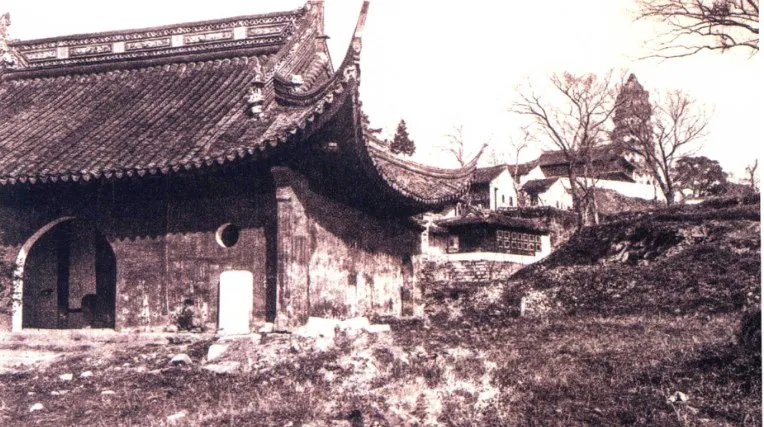
1929
The “Chinese Landscape” supplement to Osvald Sirén’s A History of Early Chinese Art (1929) includes photographs of Suzhou, Tiger Hill, and the Tiger Hill Pagoda. The images below are cropped and arranged from the corresponding pages of plates 116–117 in the Chinese translation, Xiyangjing: A History of Early Chinese Art (Vol. 2).
1939
Tokiwa Daijō and Sekino Tadashi’s Cultural Monuments of China, Volume 4, includes plates of Yunyan Temple on Tiger Hill, the Great Pagoda, the Dhāraṇī Pillar, and details of the pagoda. The images below are cropped and arranged from plates 15–17 of Volume 4; plates 16 and 17 each originally combined two photographs on a single page.