Introduction
White Deer Grotto Academy lies in Lushan City (formerly Xingzi County), Jiujiang, Jiangxi, at the southern foot of the Five Old Men Peaks of Mount Lu. In the Zhenyuan era of the Tang (785–805), Li Bo, a scholar of Luoyang, went into reclusion on Mount Lu together with his elder brother Li She to devote themselves to study. Li Bo kept a white deer, and people called him “Master White Deer.” In the Baoli era (825–826), Li Bo left retirement to serve as prefect of Jiangzhou; returning to his old dwelling, he built terraces and pavilions, led in flowing water, and planted flowers and trees, and from then on the place was called White Deer Grotto. Bai Juyi wrote a poem for Li Bo in which he said, “At your White Deer Grotto home, I hear the moss is growing too.”
After the wars at the end of the Tang, men still studied and taught here. In the Shengyuan era of the Southern Tang (937–942), the court established a school on the spot, endowed it with school lands[1], and appointed Li Shandao, an erudite of the Nine Classics at the Directorate of Education[2], as master of the grotto—that is, the head of the academy—under the name “Lushan National Academy,” which the men of the time also called the “White Deer National School.” Wu Qiao, Jiang Wei, and other scholars who later became famous all studied here, and in the reign of the last ruler of the Southern Tang a further grant of good fields was made, whose rents provided for the students. At the beginning of the Northern Song, the school was reorganized as an academy and was counted with Suiyang, Shigu, and Yuelu among the Four Great Academies, its students often numbering in the dozens or hundreds. In the second year of the Taiping Xingguo era (977), Emperor Taizong of the Song granted the request of Zhou Shu, prefect of Jiangzhou, and had the Directorate of Education’s printed editions of the Nine Classics sent to the grotto by post-horse. Yet three years later the master of the grotto Ming Qi proposed turning the academy’s school lands over to the state, and the court rewarded him with the office of registrar of Baoxin County; bereft of its lands, the academy declined from that point. At the beginning of the Dazhong Xiangfu era, Sun Mian, who was serving in the Historiography Institute, petitioned the court to let him retire to White Deer Grotto; the request was granted, but he died before he could arrive. In the Huangyou era (1049–1054), his son Sun Chen, carrying on his father’s ambition, added more than ten bays of schoolrooms beside the grotto, hung out a plaque reading “White Deer Grotto Study Hall,” and taught his own sons and younger brothers while also providing for students who came from all quarters. By the end of the Northern Song, the academy had fallen utterly into ruin.
In the Song, the Xingzi area belonged to the prefecture of Nankang. In the sixth year of the Chunxi era of the Southern Song (1179), Zhu Xi took up office as prefect of Nankang, that is, the chief local administrator of this region. While inspecting the waterworks he traveled east along Mount Lu and found the site of the academy amid the wild grasses; he at once assigned the prefectural-school instructor[3] Yang Dafa and the Xingzi county magistrate Wang Zhongjie to direct the rebuilding, which was completed in the third month of the following year. With his own hand Zhu Xi drew up the Articles of Learning of the White Deer Grotto Academy as the school rule and posted it in the hall, and Lü Zuqian, at his invitation, wrote the Record of the White Deer Grotto Academy. Zhu Xi also memorialized the throne, asking that a name-plaque be conferred upon the academy after the precedent of Yuelu Academy, together with the Stone Classics in Emperor Gaozong’s own hand and the Directorate of Education’s printed classics; at first the request was set aside. In the second month of the eighth year of Chunxi (1181), Lu Jiuyuan, a Confucian scholar of Jinxi, came to visit and lectured in the hall on the Analects chapter “The gentleman is versed in what is right; the small man is versed in what is profitable,” and those who heard him were moved to tears; Zhu Xi asked him to write the lecture down so that it might be kept in the grotto. When Zhu Xi was transferred to be fiscal intendant of eastern Zhejiang, he left behind three hundred thousand cash, charging his successor, the prefect Qian Wenshi, with building the Hall of the Sage of Rites and making an image of Confucius; later, when he was called to court and gave his replies in the Yanhe Hall, he made the request again in person, and only then did Emperor Xiaozong approve the granting of the plaque and the books.
In the Dade era of the Yuan, Cui Yizhi, prefect of Nankang, added school lands to the academy; in the wars at the end of the Yuan, the buildings of all the ages were reduced to wild grass. At the change from Yuan to Ming, when Wang Yi was serving as vice-prefect of Nankang, he visited White Deer Grotto and found that the academy had lain in ruins for fifteen years: the trees that had sprung up among the rubble were already several spans around, only the two stone bridges Zhuoying and Zhenliu remained, and the great firs on the ridge were even then being felled by the authorities for the timber of palace halls. In the first year of the Zhengtong era of the Ming (1436), Zhai Pufu, prefect of Nankang, gave of his own salary and led the rebuilding of the Hall of the Sage of Rites, the Dacheng Gate, the Guandao Gate, the Minglun Hall, the two study-quarters, the Shrine of the Three Worthies, and the rest; in the Chenghua era the education intendant Li Ling, and in the Hongzhi era the education intendants Su Kui and Shao Bao, carried out great repairs in turn; and in the Zhengde era Li Mengyang, as education intendant of Jiangxi, audited the school lands, revised the gazetteer of the grotto, and built the Angling Terrace Pavilion. Although the name White Deer Grotto had been handed down for centuries, there had in fact never been a real cave in the mountain behind the academy. In the ninth year of the Jiajing era (1530), the prefect Wang Zhen opened a stone grotto in the mountain behind the academy and built a terrace above it; in the thirteenth year of Jiajing (1534), the prefect He Yan further carved a stone deer and placed it in the grotto. In the seventh year of the Wanli era (1579), the grand secretary Zhang Juzheng memorialized for the prohibition of “false learning,” and the court ordered the academies of the empire demolished and their school lands sold to pay for the defense of the frontiers. By “false learning” was meant the custom of the academies of the time of gathering disciples for lectures. Because the White Deer Academy kept the name-plaque conferred by the court and enshrined the images of the former worthies, it alone escaped demolition, retaining only part of its sacrificial fields; and in the eleventh year of Wanli (1583), at the petition of the supervising secretary Zou Yuanbiao, the academy’s landed property was restored.
In the twelfth year of the Shunzhi era of the Qing (1655), the governor Cai Shiying advocated the restoration, directing the prefecture and county of Nankang by official order to sort out the grotto’s lands and raise funds; in the fourteenth year (1657), the Dacheng Hall was rebuilt, the Jiangxiu Hall was renamed the Yilun Hall, and Xiong Weidian of Jianchang was invited to preside over the lectures. In the seventh year of the Kangxi era (1668), the two side galleries were rebuilt; in the sixteenth year (1677), the prefect Lun Pinzhuo directed a great renovation, building anew the Yilun Hall, the Wenhui Hall, the Shrine of Former Worthies, the Shrine of the Three Masters, and the rest, which together with the repairs came to a hundred and thirty-nine bays of buildings in all. In the twenty-second year (1683), the governor An Shiding memorialized the court for a grant of the Thirteen Classics and the Twenty-One Histories; in the twenty-fourth year (1685), the prefect Zhou Can requested the building of an Imperial Library. In the twenty-sixth year (1687), the Kangxi Emperor bestowed a plaque in his own hand reading “Learning Reaching the Heaven of Human Nature,” which was stored in the library together with the scriptures; and in the forty-eighth year (1709), a Ziyang Shrine was built expressly for the worship of Zhu Xi. In the fourth year of the Yongzheng era (1726), the governor Pei Xiaodu, finding the old Wenhui Hall too cramped, built a new lecture hall of three bays to its east, added a Spring Breeze Tower of five bays behind the hall, and set up forty student dormitory rooms on either side. In the thirty-first year of the Qianlong era (1766), the prefect Chen Zigong rebuilt the Wenhui Hall, threw a bridge over the semicircular pool before the hall, built the Guandao Gate south of the pool, and engaged the Changshu scholar Gu Zhen to direct the affairs of the academy; for more than a decade thereafter, students came in ever greater numbers, and its flourishing was the greatest in the Southeast.
From the end of the Qianlong era onward, the rents of the grotto’s lands gradually fell short. In the ninth year of the Jiaqing era (1804), the governor Qin Cheng’en raised two thousand taels of silver and began a great repair; in the third year of the Daoguang era (1823), the governor Cheng Hanzhang allotted eight hundred taels to restore the academy buildings and further won approval to draw a thousand taels each year from the salt administration’s confiscated funds to increase the students’ allowances; and in the eighteenth year of Daoguang (1838), Yu Tai of Duchang donated funds to build anew the five bays of the Dacheng Hall. In the third year of the Xianfeng era (1853) came the wartime destruction: the students scattered, some of the buildings collapsed, and others were pulled down; in the seventh year of Xianfeng (1857), Pan Xianzhen, a provincial graduate of Xingzi, diverted the funds of the county militia to repair the Spring Breeze Tower and the Solitary View Pavilion; and from the fifth to the ninth year of the Tongzhi era (1866–1870), the successive prefects Huang Tingjin, Wang Zhifan, and Liu Qinghua allotted silver in turn to repair the academy buildings, also setting up at the Dacheng Hall the four stone pillars that had been kept in the grotto. Today the Hall of the Sage of Rites, the Imperial Library, the Yilun Hall, the White Deer Grotto, the Sixian Terrace, and other buildings are ranged along the Guandao Stream, largely preserving the Qing-dynasty layout.
Historical Documents
Bai Juyi Ji (Collected Works of Bai Juyi)
曾住𬬻峰下,书堂对药台。斩新萝径合,依旧竹窗开。砌水亲开决,池荷手自栽。五年方𫏐至,一宿又须回。纵未长归得,犹胜不到来。君家白鹿洞,闻道亦生苔。
I once dwelt beneath the Incense-Burner Peak, my study hall facing the herb-terrace. The creeper path has closed up all anew; the bamboo window still opens as of old. The water in the channel I opened with my own hands; the lotuses in the pond I planted myself. Five years passed before I could come for a brief visit, and after a single night I must return again. Though I cannot yet come home for good, it is still better than never coming at all. At your White Deer Grotto home, I hear the moss is growing too.
Xin Tang Shu (New Book of Tang)
李渤,字濬之,魏横野将军、申国公发之裔。父钧,殿中侍御史,以不能养母废于世,渤耻之,不肯仕。刻志于学,与仲兄涉偕隐庐山。尝以列御寇拒粟,其妻怒,是无妇也;乐羊子舍金,妻让之,是无夫也。乃摭古联德高蹈者,以楚接舆、老莱子、黔娄先生、於陵子、王仲孺、梁鸿六人图象赞其行,因以自儆。久之,更徙少室。
Li Bo, courtesy name Junzhi, was a descendant of [Li] Fa, the Hengye General and Duke of Shen of the Wei. His father [Li] Jun, a palace censor, was cast out of public life for failing to support his mother; Bo was ashamed of this and refused to take office. He set his resolve upon study and went into reclusion on Mount Lu together with his second elder brother [Li] She. Once he reflected that when Lie Yukou refused the grain, his wife grew angry with him—thus there was a man without a wife; and when Yue Yangzi cast away the gold, his wife reproved him—thus there was a woman without a husband. So he gathered from antiquity men of joined virtue and lofty withdrawal, and had images made of six men—Jieyu of Chu, Laolaizi, Master Qianlou, the Master of Yuling, Wang Zhongru, and Liang Hong—praising their conduct, so as to admonish himself. After a long while he moved again to Shaoshi.
Bailu Shuyuan Zou (Memorial on the White Deer Academy)
臣窃尝伏读国朝会要,恭睹太宗皇帝尝因江州守臣周述之奏,诏以国子监九经赐庐山白鹿洞书院,又以其洞主明起为蔡州褒信县主簿,以旌儒学。每恨无由一至其处,仰观遗迹。及蒙圣恩假守兹土,到任之初,考按图经,询究境内民间利病,乃知书院正在本军星子县界。而陈舜俞庐山记又载:真宗皇帝咸平五年,尝敕有司重加修缮。间因行视陂塘,始得经游其地,见其山川环合,草木秀润,真閒燕讲学之区,而荒凉废坏,无复栋宇。因窃念太宗皇帝、真宗皇帝所以幸教多士,垂裕万世之意,其盛如彼,而下吏浅陋,弗克称报万一,骇惧震慴,不遑启居。
Your servant once humbly read in the Collected Statutes of this dynasty, where he reverently saw that Emperor Taizong, in response to a memorial by Zhou Shu, prefect of Jiangzhou, decreed that the Nine Classics of the Directorate of Education be bestowed upon the White Deer Grotto Academy of Mount Lu, and further appointed Ming Qi, master of that grotto, registrar of Baoxin County in Caizhou, so as to exalt Confucian learning. I have always regretted that there was no way for me to go to that place and look up in reverence at its remaining traces. Then, having received the sage’s grace to be entrusted with the guardianship of this land, upon first taking up my post I examined the maps and gazetteers and inquired into the benefits and ills among the people within my borders, and so learned that the academy lies precisely within the bounds of Xingzi County of this prefecture. And Chen Shunyu’s Record of Mount Lu further records that in the fifth year of the Xianping era of Emperor Zhenzong, the responsible officials were once commanded to make repairs anew. In between, while inspecting the ponds and embankments, I was at last able to pass through that place, and saw that its mountains and streams enfold and embrace it, its plants and trees fair and lush—truly a region for the leisurely pursuit of learning and teaching—yet it was desolate and ruined, with no roof or wall remaining. Then I thought privately: the intent of Emperors Taizong and Zhenzong in thus favoring the instruction of the many scholars and bequeathing bounty to the myriad ages was as grand as that; yet I, a shallow and petty underling, am unable to make recompense for even one ten-thousandth of it. Alarmed, fearful, and overawed, I have no leisure for rest.
既又按考此山,佛老之祠,盖以百数,兵乱之余,次第兴葺,鲜不复其旧者。独此儒馆,莽为荆榛。虽本军巳有军学,足以养士,然此洞之兴,远自前代,累圣相传,眷顾光宠,德意深远,理不可废。况境内观寺,钟鼓相闻,殄弃彝伦,谈说空幻,未有厌其多者。而先王礼义之宫,所以化民成俗之本者,乃反寂寥希阔,合军与县仅有三所而已。然则复修此洞,盖末足为烦。于是始议即其故基,度为小屋二十余间,教养生徒一二十人,节缩经营,今已了毕。但其敕额官书,皆已烧毁散失,无复存者,不敢擅行收置,辄昧万死,具奏以闻。
Further examining this mountain, [I found that] the shrines of Buddha and Laozi number in the hundreds, and since the military disorders they have been raised and repaired one after another, few not restored to their former state. This Confucian academy alone has become a wilderness of brambles. Although this prefecture already has a prefectural school sufficient to maintain scholars, yet the rise of this grotto reaches back to a former dynasty, and successive emperors have handed down their regard and favor for it; the import of their virtue is far-reaching, and by right it must not be abandoned. Moreover, among the temples and monasteries within these borders, where bell and drum answer one another and which destroy and cast away the constant relations and discourse on emptiness and illusion, no one has ever found them too many. Yet the palaces of the rites and righteousness of the former kings, which are the root of transforming the people and perfecting their customs, are on the contrary few and far between: prefecture and county together have but three. This being so, the restoration of this grotto can hardly be reckoned a burden. Thereupon we first deliberated upon building on its old foundation, planning for some twenty small bays of buildings to teach and maintain a dozen or twenty students; sparing and managing the funds, the work has now been completed. But its imperial name-tablet and official books were all burned and scattered, and none survive; I dare not presume to collect or install them on my own authority, and so, braving a myriad deaths, I set this forth in a memorial to be heard.
欲望圣明,俯赐鉴察,追述太宗皇帝、真宗皇帝圣神遗意,特降敕命,仍旧以白鹿洞书院为额。诏国子监仰摹光尧寿舜宪天体道性仁诚德经武纬文太上皇帝御书石经,及印版本九经疏、论语、孟子等书,给赐本洞,奉守看读,于以褒广先烈,光阐儒风,非独愚臣学子之幸,实天下万世之幸。谨录奏闻,伏候敕旨。
It is my hope that Your Sagely Brilliance will deign to examine this and, tracing the sacred intent bequeathed by Emperors Taizong and Zhenzong, specially issue an imperial command that the name-plaque of White Deer Grotto Academy be retained as of old; and decree that the Directorate of Education be directed to make faithful rubbings of the Stone Classics in the imperial hand of the Retired Emperor Guangyao-Shoushun-Xiantian-Tidao-Xingren-Chengde-Jingwu-Weiwen [Emperor Gaozong], together with the printed editions of the Nine Classics with commentaries, the Analects, the Mencius, and other books, to be bestowed upon this grotto, there to be kept and read—so as to magnify the glorious deeds of the forebears and shine forth the Confucian manner. This would be a blessing not only for your foolish servant and his students, but truly for all the world for ten thousand ages. Respectfully I record and memorialize this to be heard, and prostrate myself to await the imperial decree.
Bailu Dong Shuyuan Ji (Record of the White Deer Grotto Academy)
淳熙六年,南康军秋雨不时,高卬之田告病。郡守新安朱侯熹行视陂塘,并庐山而东,得白鹿洞书院废址,慨然顾其僚曰:是盖唐李渤之隐居,而太宗皇帝驿送九经,俾生徒肄业之地也。书院创于南唐,其事至浅鲜,太宗于汛扫区宇日不暇给之际,奖劝封殖,如恐弗及,规模远矣。中兴五十年,释老之宫圮于寇戎者,斧斤之声相闻,各复其初,独此地委于榛莽,过者太息,庸非吾徒之耻哉?郡虽贫薄,顾不能筑屋数楹,上以宣布本朝崇建人文之大指,下以续先贤之风声于方来乎?乃属军学教授杨君大法、星子县令王君仲杰董其事,又以书命某记其成。
In the sixth year of the Chunxi era, in the prefecture of Nankang the autumn rains did not come in season, and the fields on high and low ground alike reported distress. The prefect, His Honor Zhu Xi of Xin’an, went out to inspect the ponds and embankments; skirting Mount Lu eastward, he came upon the ruined site of the White Deer Grotto Academy, and with deep feeling he looked round at his staff and said: “This is surely the place of the Tang scholar Li Bo’s reclusion, where Emperor Taizong sent the Nine Classics by post-horse so that students might pursue their studies. The academy was founded under the Southern Tang, and its affairs were then of the slightest; yet Emperor Taizong, amid the press of sweeping and pacifying the whole realm, with no leisure even for meals, encouraged and fostered it as if fearing he would not be in time—how far-sighted was his design! In the fifty years since the restoration, of the palaces of Buddhists and Daoists that crumbled under the invaders, the sound of the axe has been heard in each as they were restored to what they were at first; this place alone has been abandoned to the brush, and those who pass sigh—is this not the shame of our kind? Though the prefecture is poor, can it not raise a few bays of buildings, above to make known the great purpose of this dynasty’s exaltation of humane learning, and below to continue the fame and example of the former worthies into the time to come?” He then entrusted the affair to the prefectural-school instructor Master Yang Dafa and the Xingzi county magistrate Master Wang Zhongjie, and moreover by letter charged me to record its completion.
某窃尝闻之。诸公长者,国初斯民新脱五季锋镝之阨,学者尚寡。海内向平,文风日起,儒先往往依山林,即閒旷以讲授,大帅多至数十百人。嵩阳、岳麓、雎阳及是洞为尤著,天下所谓四书院者也。祖宗尊右儒术,分之官书,命之禄秩,锡之扁榜,所以宠之者甚备。当是时,士皆尚质实,下新奇,敦行义而不偷,守训故而不凿,虽学问之渊源统纪,或未深究,然甘受和,白受采,既有进德之地矣。庆历、嘉祐之间,豪杰并出,讲治益精,至于河南程氏、横渠张氏,相与倡明正学,然后三代孔孟之教始终条理,于是乎可考。熙宁初,明道先生在朝,建白学制、教养、考察、宾兴之法,纲条甚悉,不幸王氏之学方兴,其议遂格,有志之士,未尝不叹息于斯。
I have humbly heard it said by the honored elders: at the beginning of the dynasty, the people had newly escaped the misery of the blades and arrows of the Five Dynasties, and scholars were still few. As all within the seas turned toward peace, the air of letters daily arose, and the former Confucians often repaired to the mountains and forests to lecture in some spacious and quiet place; the greatest of them had as many as several tens or a hundred followers. Songyang, Yuelu, Suiyang, and this grotto were the most celebrated—the so-called Four Academies of the empire. The founding ancestors honored and promoted Confucian learning, apportioned official books to them, granted them stipends and rank, and bestowed name-plaques upon them; the means by which they favored them were most complete. At that time scholars all esteemed substance and plainness, set little store by novelty and strangeness, were earnest in conduct and righteousness and not negligent, and kept to the received glosses without forced interpretations; though of the sources and guiding threads of learning they may not yet have made a deep inquiry, yet—as sweetness receives blending and whiteness receives color—they already possessed the ground for advancing in virtue. Between the Qingli and Jiayou eras, men of outstanding talent arose together, and the exposition of learning grew ever more refined, until the Cheng masters of Henan and the Zhang master of Hengqu together elucidated the correct learning; only then did the teachings of the Three Dynasties and of Confucius and Mencius, from beginning to end, have an order that might be examined. At the beginning of the Xining era, Master Mingdao [Cheng Hao] at court proposed methods for the school system, for teaching and nurture, for examination and inquiry, and for the advancement of guests, in articles most complete; but unfortunately the learning of Wang [Anshi] was then in ascendance, and his proposals were blocked—men of resolve have never ceased to sigh over this.
当建炎再造,典刑文宪浸远旧观,关洛绪言,稍出于毁弃剪灭之余,晚进小生,骤闻其语,不知亲师取友,以讲求用力之实,躐等凌节,忽近慕远,未能𬮭程、张之门庭,而先有王氏高自贤圣之病。如是,洞之所传习道之者或鲜矣。然则书院之复,岂苟云哉?此邦之士,盖相与揖先儒淳固悫实之余风,服大学离经辨志之始教,由博而约,自卑而高,以答扬熙陵开迪乐育之大德,则于贤侯之劝学,斯无负矣。至于考方志,纪人物,亦有土者所当谨,若李渤之遗迹,固不得而略也。侯于是役,重民之劳,赋功己狭,率损其旧十七八,力不足而意则有余矣。兴废始末,具于当涂郭祥正所记者,皆不书。
At the restoration of the Jianyan era, the statutes and written laws drifted ever farther from their former aspect, and the surviving teachings of the Guan and Luo masters emerged only a little from amid what had been destroyed, cast away, and cut down. Young latecomers, hearing these words all at once, knew nothing of drawing near to teachers and choosing friends, nor of the substance of the inquiry and effort by which they had worked; skipping grades and overstepping the proper order, neglecting what is near and yearning for what is far, they had not yet ascended to the gate and courtyard of the Cheng and Zhang masters when they already had the Wang school’s malady of deeming themselves lofty as worthies and sages. This being so, those to whom the Way of this grotto was transmitted and who practiced it were perhaps few. Thus the restoration of the academy was no idle matter! May the scholars of this land together bow to the lingering manner of the former Confucians—pure, firm, honest, and true—and submit to the first teaching of the Great Learning, to distinguish one’s resolve from the mere parsing of texts, proceeding from breadth to concentration and from lowliness to height, so as to answer and magnify the great virtue of him of the Xi Mausoleum [Emperor Taizong], who opened the way and joyfully nurtured men; then they will not have betrayed the worthy marquis’s encouragement of learning. As for examining the local gazetteers and recording the men of the place, this too is what those who hold the land must attend to; the remaining traces of Li Bo, of course, must not be slighted. In this undertaking, His Honor was careful of the people’s labor, and the work assigned being already modest, it reduced the old by some seventy or eighty percent; his strength fell short, but his intent was more than enough. The whole course of its rise and ruin is set forth in the record by Guo Xiangzheng of Dangtu; none of it is written here.
Bailu Dong Shuyuan Jieshi (Articles of Learning of the White Deer Grotto Academy)
父子有亲,君臣有义,夫妇有别,长幼有序,朋友有信。
Between father and son there is affection; between ruler and minister there is righteousness; between husband and wife there is distinction; between elder and younger there is order; between friends there is faithfulness.
右五教之目。尧舜使契为司徒,敬敷五教,即此是也。学者学此而已。而其所以学之之序,亦有五焉,其别如左:
The above are the items of the five teachings. Yao and Shun made Xie minister of education, who reverently spread the five teachings—these are they. Students learn these and nothing more. And the sequence by which they learn them also has five parts, which are set forth below:
慱学之,审问之,谨思之,明辨之,笃行之。
Study it broadly, inquire into it carefully, think it over cautiously, distinguish it clearly, practice it earnestly.
右为学之序。学、问、思、辨四者,所以穷理也。若夫笃行之事,则自修身以至于处事接物,亦各有要,其别如左:
The above is the sequence of learning. Study, inquiry, thought, and discrimination—these four are the means of exhausting principle. As for earnest practice, from cultivating oneself to managing affairs and dealing with people, each too has its essentials, which are set forth below:
言忠信,行笃敬,惩忿窒欲,迁善改过,右修身之要。
In speech be loyal and true; in conduct be earnest and reverent; restrain anger and shut off desire; move toward the good and correct your faults. The above are the essentials of cultivating the self.
正其义不谋其利,明其道不计其功,右处事之要。
Rectify what is right without scheming for profit; make clear the Way without calculating merit. The above are the essentials of managing affairs.
己所不欲,勿施于人,行有不得,反求诸己,右接物之要。
What you do not wish for yourself, do not impose on others; if your conduct falls short, turn back and seek the cause in yourself. The above are the essentials of dealing with others.
熹窃观古昔圣贤所以教人为学之意,莫非使之讲明义理,以修其身,然后推以及人,非徒欲其务记览、为词章,以钓声名、取利禄而已也。今人之为学者,则既反是矣。然圣贤所以教人之法,具存于经,有志之士固当熟读深思而问辨之。苟知其理之当然,而责其身以必然,则夫规矩禁防之具,岂待他人设之,而后有所持循哉?近世于学有规,其待学者为已浅矣,而其为法又未必古人之意也。故今不复以施于此堂,而特取凡圣贤所以教人为学之大端,条列如右,而揭之楣间。诸君其相与讲明遵守,而责之于身焉。则夫思虑云为之际,其所以戒谨而恐惧者,必有严于彼者矣。其有不然,而或出于此言之所弃,则彼所谓规者,必将取之,固不得而略也。诸君其亦念之哉!
I, Xi, humbly observe that the intent of the ancient sages and worthies in teaching men to learn was nothing other than to make them discuss and make clear moral principle, so as to cultivate their own persons, and then extend it to others; it was not merely to make them labor at memorization and composition in order to angle for fame and win salary. Men of today who pursue learning have already turned this upside down. Yet the methods by which the sages and worthies taught men are all preserved in the classics; men of resolve ought surely to read them deeply, ponder them thoroughly, and inquire and discriminate concerning them. If one knows the necessity of a principle and demands of one’s own person that it be so, then why should one wait for others to set up the instruments of rule and prohibition before one has something to hold to and follow? In recent times rules have been established for learning, but the way they treat students is already shallow, and as law they do not necessarily answer to the intent of the ancients. Therefore I do not now apply them to this hall, but have only taken the great heads of what the sages and worthies of all time set forth for teaching men to learn, and listed them above, and had them posted above the door. May you gentlemen together discuss and make them clear and observe them, demanding them of your own persons. Then, in the moments of thought and deliberation, of speech and action, your caution and watchfulness, your fear and dread, will surely be stricter than what those rules could impose. If there are any who do not so act, and who stray into what these words abandon, then those so-called rules will surely claim them—so they cannot be slighted. May you gentlemen also bear this in mind!
Bailu Dong Shuyuan Jiangyi (Lecture at the White Deer Grotto Academy)
某虽少服父兄师友之训,不敢自弃,而顽钝疏拙,学不加进,每怀愧惕,恐卒负其初心。方将求针砭镌磨于四方师友,冀获开发,以免罪戾。此来得从郡侯秘书至白鹿书堂,群贤毕集,瞻睹盛观,窃自庆幸。秘书先生、教授先生不察其愚,令登讲席,以吐所闻。顾惟庸虚,何敢当此?辞避再三,不得所请,取论语中一章,陈平生之所感,以应嘉命,亦幸有以教之。
Though from youth I have submitted to the instruction of my father, brothers, teachers, and friends, not daring to abandon myself, yet being dull, obtuse, uncouth, and clumsy, my learning has made no advance, and I ever harbor shame and fear lest I betray my first resolve in the end. I was even then seeking the needle and stone, the cutting and polishing, of teachers and friends in all quarters, hoping to be opened up and developed, so as to escape fault. On this occasion I was able to accompany the prefect, His Honor the Imperial Librarian, to the White Deer Study Hall, where a host of worthies was all assembled; beholding the grand spectacle, I privately congratulated myself. The Librarian and the Instructor, not observing my foolishness, bade me mount the lecturer’s seat to pour forth what I had heard. Considering my own mediocrity and emptiness, how dare I accept this? I demurred and declined again and again, but could not obtain my request; so I have taken one chapter from the Analects and set forth what I have long felt, in answer to this gracious command—and I hope that you will have something to teach me.
子曰:君子喻于义,小人喻于利。
The Master said: “The gentleman is versed in what is right; the small man is versed in what is profitable.”
此章以义利判君子小人,辞旨晓白,然读之者苟不切已观省,亦恐未能有益也。某平日读此,不无所感。窃谓学者于此,当辨其志。人之所喻,由其所习,所习由其所志。志乎义,则所习者必在于义,所习在义,斯喻于义矣。志乎利,则所习者必在于利,所习在利,斯喻于利矣。故学者之志,不可不辨也。科举取士久矣,名儒巨公皆由此出,今为士者,固不能免此。然场屋之得失,顾其技与有司好恶如何耳,非所以为君子小人之辨也。而今世以此相尚,使汨没于此而不能自拔,则终日从事者,虽曰圣贤之书,而要其志之所乡,则有与圣贤背而驰者矣。推而上之,则又惟官资崇卑、禄廪厚薄是计,岂能悉心力于国事民隐,以无负于任使之者哉?从事其间,更历之多,讲习之熟,安得不有所喻?顾恐不在于义耳。诚能深思是身,不可使之为小人之归,其于利欲之习,怛焉为之痛心疾首,专志乎义而日勉焉,博学、审问、谨思、明辨而笃行之。由是而进于场屋,其文必皆道其平日之学、胸中之蕴,而不诡于圣人。由是而仕,必皆共其职,勤其事,心乎国,心乎民,而不为身计,其得不谓之君子乎?秘书先生起废以新斯堂,其意笃矣。凡至斯堂者,必不殊志,愿与诸君勉之,以毋负其志。
This chapter distinguishes gentleman from small man by right and profit; its words and purport are plain to see, yet if the reader does not examine and reflect upon it in his own person, I fear it can do him no good. In my ordinary reading of it I have not been without feeling. I humbly hold that a student must here discern his resolve. What a man becomes versed in comes from what he practices, and what he practices comes from what he resolves upon. If his resolve is set on what is right, then what he practices must lie in what is right; if what he practices lies in what is right, then he becomes versed in what is right. If his resolve is set on profit, then what he practices must lie in profit; if what he practices lies in profit, then he becomes versed in profit. Thus a student’s resolve cannot but be discerned. The examination halls have chosen scholars for a long time now, and famous Confucians and great ministers have all come forth from them; scholars today cannot but take part in them. Yet success or failure in the examination halls depends only on one’s skill and on the tastes of the examiners—it is no grounds for distinguishing gentleman from small man. But the present age esteems this above all, and if a man is drowned in it and cannot free himself, then what he labors at all day long, though called the books of the sages and worthies, in the end runs counter to the sages and worthies in the direction of his resolve. Push it further, and he will calculate only the height of office and the thickness of salary—how could he then expend his whole heart and strength on the affairs of state and the hidden sufferings of the people, so as not to fail the charge entrusted to him? Having labored in its midst long and often, and being thoroughly practiced in its discourse, how could he fail to become versed in something? I only fear it is not in what is right. If indeed he can ponder deeply this person of his and not let it come to rest among the small men; if toward the habit of profit and desire he feels a wrenching grief, a pain of heart and head; if he fixes his resolve solely on what is right and daily exerts himself in it, studying broadly, inquiring carefully, thinking cautiously, discriminating clearly, and practicing earnestly; then when he advances by way of the examination halls, his essays will surely give voice to the learning of his ordinary days and the store of his breast, and will not depart from the sages. And when by way of them he takes office, he will surely do his duty and be diligent in his tasks, his heart set on the state and on the people and not on his own reckoning—may he not then be called a gentleman? The Librarian has raised up what had fallen and made this hall new; his intent is earnest indeed. May all who come to this hall not differ in their resolve; I wish to strive with you, gentlemen, so as not to betray his intent.
淳熙辛丑春二月,陆兄子静来自金溪,其徒朱克家、陆麟之、周清叟、熊鉴、路谦亨、胥训实从。十日丁亥,熹率寮友诸生与俱至于白鹿书院,请得一言以警学者。子静既不鄙而惠许之。至其所以发明敷畅,则又恳到明白,而皆有以切中学者隐微深痼之病,盖听者莫不悚然动心焉。熹犹惧其久而或忘之也,复请子静笔之于简,受而藏之。凡我同志,于此反身而深察之,则庶乎其可不迷于入德之方矣。新安朱熹识。
In the spring, the second month, of the xinchou year of the Chunxi era, my brother Lu Zijing came from Jinxi, his disciples Zhu Kejia, Lu Linzhi, Zhou Qingsou, Xiong Jian, Lu Qianheng, and Xu Xun following him. On the tenth day, the dinghai day, I led my colleagues and the students together with them to the White Deer Academy and begged for a word with which to warn the students. Zijing did not disdain us but graciously consented, and the way he developed and expanded the matter was earnest and clear, striking home to the hidden and deep-seated maladies of the students, so that none of the hearers failed to be moved and stirred in heart. Fearing still that in time it might be forgotten, I further asked Zijing to write it down, and receiving it I have kept it stored away. May all who share our resolve turn back upon themselves with it and deeply examine themselves; then perhaps they may avoid going astray on the way into virtue. Noted by Zhu Xi of Xin’an.
You Bailu Dong Ji (Record of a Visit to the White Deer Grotto)
余到郡已数月,欲至白鹿洞,甚渴,左右为余言:往时荆棘塞路,不可往。顷因伐大木,往者众,路乃始通。然路上虎纵横,苟欲往,非多拥驺从不可。用是欲行辄复止。会行省符檄郡府取大木,余因挟星子令及都昌主簿彭能,领丁夫与同往。
I had been in the prefecture for several months and wished to go to White Deer Grotto most keenly, but my attendants told me: in former times brambles blocked the road and it could not be reached; lately, because of the felling of great trees, many have gone that way, and the road has only just been opened. Yet on the road tigers roam at large, and if you wish to go, you cannot do so without a numerous escort. For this reason I would set out and then stop again. It happened that the provincial government sent an order to the prefecture to requisition great timber, so I, taking along the Xingzi county magistrate and the Duchang registrar Peng Neng, led a party of laborers and went together with them.
去郡北行十五里,至罗汉寺。路分两歧,由东入栖贤谷,西则至白鹿洞也。比至,两山势回合,当其合处,涧水出焉。过涧逾小岭,岭有缺,若关门然。入关路循涧北,并山转涧南,皆良田也。约二三里,乃至书院遗圳,正当五老峰下。书院毁已十五年,树生瓦砾间,大且数围。前有石桥曰濯缨,其左又有石桥曰枕流。过枕流,则从列女庙登北冈,冈上有大杉木,六七百年物也。有司今尽伐为御殿物矣。于是书院所存者,独此二桥。从卒指殿堂斋庐及风泉云壑楼故处以告,甚历历,慨想昔日规制不可见,惟闻山鸟相呼,鸣山谷虚,余韵悠扬,恍类弦歌声。或云:从此右折东南,逾重冈,行二三里,乃至所谓白鹿洞,却从洞后复右折陟岭,乃可到寻真观,望水帘也。不果往,徘徊久之而还。
Going north from the prefecture fifteen li, one comes to the Luohan Monastery. There the road forks: by the east one enters the Qixian Valley, and by the west one comes to White Deer Grotto. When I arrived, the two mountains curved round to meet, and where they join a ravine-stream issues forth. Crossing the stream and climbing over a low ridge, there is a gap in the ridge like a gate. Passing through the gate, the road follows the ravine northward, runs along the mountain, and turns south of the stream; all about are good fields. After some two or three li one comes to the academy’s former canal, lying directly beneath the Five Old Men Peaks. The academy had been destroyed fifteen years, and the trees growing among the rubble were already several spans around. Before it is a stone bridge called Zhuoying (“Washing the Tassel”), and to its left is another stone bridge called Zhenliu (“Pillowing on the Stream”). Crossing Zhenliu, one climbs the northern ridge from the Temple of the Virtuous Women; on the ridge are great firs, trees of six or seven hundred years, which the authorities are now felling wholesale for the timber of the imperial halls. Thus of the academy only these two bridges survive. The attendant soldiers pointed out to me the former sites of the halls and chambers, the study-quarters, and the Tower of Wind and Fountain and Cloudy Ravine, each most distinctly; I thought with feeling of the former order, which could no longer be seen, and heard only the mountain birds calling to one another, their cries ringing in the empty valley, their lingering echoes clear and far, faintly like the sound of strings and song. Someone said: from here, turning right to the southeast and crossing ridge after ridge for two or three li, one comes to what is called the White Deer Grotto; and turning right again from behind the grotto and climbing the ridge, one can reach the Xunzhen Abbey and look at the Water Curtain. I could not go; I lingered long and then returned.
按白鹿洞,唐李勃读书处也。南唐升元中,始即其地为学,给田以食其徒,所谓庐山国学也。宋初,天下未有学,惟有四书院,睢阳、石鼓、岳麓及白鹿洞也。太平兴国二年,皆赐白鹿洞九经,当时学者数百人,至崇宁末,乃尽废。及淳熙七年,考亭朱文公为郡,始斥其旧而大之,又定为学规,示学者,来学者益众,而白鹿洞之盛出他书院右。自后守其成规,二百年如一日也,而隳废今乃如此,余亦无如之何也。
To note: White Deer Grotto is the place where Li Bo of the Tang studied. In the Shengyuan era of the Southern Tang, a school was first established on that spot, with lands granted to feed its students—the so-called Lushan National Academy. At the beginning of the Song, when the empire had as yet no schools, there were only the Four Academies: Suiyang, Shigu, Yuelu, and White Deer Grotto. In the second year of the Taiping Xingguo era, the Nine Classics were bestowed upon White Deer Grotto, and the scholars of that time numbered in the hundreds; only at the end of the Chongning era was it wholly abandoned. Then in the seventh year of the Chunxi era, when Zhu Wengong of Kaoting [Zhu Xi] governed the prefecture, he first cleared its old site and enlarged it, and further fixed the rules of learning to show the students; those who came to study grew ever more numerous, and the flourishing of White Deer Grotto surpassed that of the other academies. Thereafter its fixed rules were kept as if for two hundred years a single day—and now it has fallen into ruin like this, and there is nothing I can do about it.
余尝怪世之为佛、老氏之学者,其宫室一废坏,辄修举之不旋踵。岂佛、老氏之学能盛于儒者哉?盖为其徒者有勤行之意,坚持之操,能必其成故也。至于世儒习圣人之道,常骫骳不自振,不能以有为,而圣人之道顾因委弃郁塞而不得行。呜呼!此其弊也,非一日之积矣。余于是盖重叹之也。
I have ever marveled that those of this world who pursue the learning of Buddha and Laozi, when their monasteries once fall into ruin, will raise and repair them without a moment’s delay. Can the learning of Buddha and Laozi truly flourish more than that of the Confucians? It is only that their followers have the will to work diligently and the constancy to hold fast, and so can see their works through. As for the worldly Confucians who practice the Way of the sages, they are ever slack and unable to rouse themselves and cannot bring anything to pass, so that the Way of the sages is on the contrary abandoned and choked and cannot be carried out. Alas! The accumulation of this ill is the work of more than a single day. Upon this I sighed deeply once more.
Bailu Shuyuan Zhi (Gazetteer of the White Deer Academy)
白鹿洞者,唐李渤读书处也。贞元中,渤与兄涉隐庐山,蓄一白鹿甚驯,行尝随之,人称白鹿先生。宝历中,渤为江州剌史,就今书院地创台榭,引流植花,遂以白鹿名洞。先是,鲁公颜真卿寄居郡之五里牌,厥后裔孙颜翊率子弟三十余人授经洞中。南唐升元,即其地聚徒,建学置田,乃命国子监九经李善道为洞主,号曰庐山国学。
White Deer Grotto is the place where Li Bo of the Tang studied. In the Zhenyuan era, Bo went into reclusion on Mount Lu with his elder brother She; he kept a white deer, very tame, which often followed him when he went out, and people called him Master White Deer. In the Baoli era, Bo became prefect of Jiangzhou, and on the ground of the present academy he built terraces and pavilions, led in streams, and planted flowers, and so named the grotto after the white deer. Before this, the Duke of Lu, Yan Zhenqing, had lodged at the Five-Li Marker of the prefecture, and afterward his descendant Yan Yi led more than thirty sons and younger brothers to teach the classics in the grotto. In the Shengyuan era of the Southern Tang, students were gathered on the spot, a school was built and lands set aside, and Li Shandao, an erudite of the Nine Classics at the Directorate of Education, was appointed master of the grotto; it was called the Lushan National Academy.
朱初置书院,与雎阳、石鼓、岳麓三本院并名,天下学徒常数十百人。太平兴国丁丑,诏从知江州周述请,俾国子监给印本、九经,驿送至洞,号曰白鹿国学。官其洞主明起为褒信县主簿。壬午,置南康军,遂属焉。咸平壬寅,诏有司修缮。祥符初,直史馆孙冕请归老于洞,许之,未至而卒。皇祐中,冕子郎中琛,因父志,增置学舍十余间,以教其子弟,扁曰白鹿洞书堂,并给四方之来学者。当涂郭祥正有记刻石。后馆毁于兵,石徒天庆观。观废,刻竟不存。
At the beginning of the Song, the academy was established, named together with the three academies of Suiyang, Shigu, and Yuelu, and students of the empire often numbered in the dozens or hundreds. In the dingchou year of the Taiping Xingguo era, by decree the request of Zhou Shu, prefect of Jiangzhou, was granted, and the Directorate of Education was ordered to provide printed editions of the Nine Classics, sent to the grotto by post-horse; it was called the White Deer National Academy. Its master of the grotto Ming Qi was made registrar of Baoxin County. In the renwu year, the prefecture of Nankang was established, and the grotto came under it. In the renyin year of the Xianping era, by decree the responsible officials repaired it. At the beginning of the Xiangfu era, Sun Mian of the Historiography Institute asked leave to retire to the grotto; it was granted, but he died before arriving. In the Huangyou era, Mian’s son the director [Sun] Chen, carrying on his father’s resolve, added more than ten bays of schoolrooms to teach his sons and younger brothers, under a plaque reading White Deer Grotto Study Hall, and also provided for students who came from all quarters. Guo Xiangzheng of Dangtu wrote a record carved on stone. Later the hall was destroyed in war, and the stone was moved to the Tianqing Abbey; when the abbey fell into ruin, the carving was lost.
淳熙己亥,朱子守是军,复拓其址,檄军学教授杨大法、县令王伸杰董建书院。吕祖谦记之,援岳麓书院例,疏请敕额,并高宗御书石经与监本九经于其中,列圣贤为学次第,以示学者。一时名人如陆子静、刘子澄、林泽之皆从游焉。既而学徒日众,乃于建昌县置东源庄,拨没入田以给之。后迁浙东提举,复遗钱三十万,属郡守钱闻诗,建圣殿并塑像。后二年,郡守朱端章加板璧,绘从祀诸贤像,仍拨浮屠没入田以盆之。嘉定辛巳,郡守黄桂辟三门,重建圣殿,又增置定西源庄田。咸淳间,郡守刘传汉增置贡士庄。元大德间,燕山崔翼之为守,又增置上壤庄田百𤱔,学士虞伯生有记。
In the jihai year of the Chunxi era, Master Zhu governed this prefecture and again enlarged its site, ordering by directive the prefectural-school instructor Yang Dafa and the county magistrate Wang Shenjie to direct the building of the academy. Lü Zuqian recorded it. Citing the precedent of Yuelu Academy, he memorialized for an imperial name-plaque, and for the Stone Classics in Emperor Gaozong’s own hand and the Directorate’s editions of the Nine Classics to be lodged therein; and he set forth the sequence of the sages’ and worthies’ learning to show the students. For a time famous men such as Lu Zijing, Liu Zicheng, and Lin Zezhi all came to study with him. Presently the students grew daily more numerous, and so the Dongyuan Estate was established in Jianchang County and confiscated fields were allotted to support them. Later, when he was transferred to be fiscal intendant of eastern Zhejiang, he again left behind three hundred thousand cash, charging the prefect Qian Wenshi with building the Hall of the Sage and making an image. Two years later, the prefect Zhu Duanzhang added plank walls and painted the images of the worthies receiving cult alongside, and again allotted confiscated monastic fields to enrich it. In the xinsi year of the Jiading era, the prefect Huang Gui opened the three gates, rebuilt the Hall of the Sage, and further added the fields of the Dingxiyuan Estate. In the Xianchun era, the prefect Liu Chuanhan added the Examination-Candidate Estate. In the Dade era of the Yuan, Cui Yizhi of Yanshan, being prefect, further added a hundred mu of the Shangrang Estate’s fields; the academician Yu Bosheng wrote a record of it.
元季兵毁,累世兴搆,鞠为茂草,而学田之疆畛尽亡矣。明正统戊午,翟溥福来守,始剪荆棘,以复其制。景泰中,郡守陈敏政再修,及塑圣贤像。成化三年,督学李龄增廓之,置学田、祠器、书籍,聘为未布衣胡居仁主教,四方宗之。后御史陈铨、唐龙、提学苏葵、邵宝、蔡清、李梦阳相继兴理,如唐龙奏起蔡宗兖主洞事,尤称特典焉。嘉隆以来,增置田庐有差,详载各志。至万历乙卯,大学士张居正议禁书院、洞田官鬻。岁癸未,给事中邹元标题请复之。参政程拱宸檄知府潘志伊修祠宇,赎田𤱔,规制粗定。己丑,提学朱廷益礼聘南昌布衣章潢,讲明正学。知府田琯复改创桥梁、门路,立鹿洞、憩馆,以五里牌立帝香资,增置田七百余𤱔,赡给生徒。甲寅,参议葛寅亮捐俸三百金,大加修葺,增置号舍数十间。丁巳,郡侯袁懋贞条画规制,甄收劝课,厘然有章。士无滥收,租无冒破。申聘南昌舒曰敬,大开讲筵,学者云集。暨舒先生以读礼还公,复谬推予董率其事焉。
At the end of the Yuan it was destroyed in war, and the building of successive ages was reduced to rank grass, while the boundaries of the school lands were all lost. In the wuwu year of the Zhengtong era of the Ming, Zhai Pufu came as prefect and first cut away the brambles to restore its order. In the Jingtai era, the prefect Chen Minzheng repaired it again and modeled the images of the sages and worthies. In the third year of the Chenghua era, the education intendant Li Ling enlarged it further, setting aside school lands, sacrificial vessels, and books, and engaging the commoner Hu Juren to direct instruction, whom all quarters took as their master. Afterward the censors Chen Quan and Tang Long and the education intendants Su Kui, Shao Bao, Cai Qing, and Li Mengyang successively raised and ordered it; for example, Tang Long’s memorial that called Cai Zongyan to head the affairs of the grotto was accounted an especial grace. Since the Jiajing and Longqing eras, fields and dwellings have been added in varying measure, as recorded in detail in the several gazetteers. Then in the yimao year of the Wanli era, the grand secretary Zhang Juzheng moved to prohibit the academies, and the grotto’s lands were sold by the state. In the guiwei year, the supervising secretary Zou Yuanbiao petitioned for their restoration. The administration commissioner Cheng Gongchen directed the prefect Pan Zhiyi to repair the shrines and redeem the fields, and the order of the place was roughly settled. In the jichou year, the education intendant Zhu Tingyi courteously engaged the Nanchang commoner Zhang Huang to expound the correct learning. The prefect Tian Guan further rebuilt the bridges and gate-paths, established the Deer Grotto and the Rest Lodge, and, taking the Five-Li Marker as an endowment for the imperial incense, added more than seven hundred mu of fields to maintain the students. In the jiayin year, the administration vice-commissioner Ge Yinliang donated three hundred gold pieces of his salary for a great renovation, adding several dozen dormitory rooms. In the dingsi year, the prefect Yuan Maozhen drew up the rules and ordinances, selected and admitted and encouraged instruction, so that all was ordered and regulated: no scholars were admitted in excess, no rents were falsely claimed. He further engaged Shu Yuejing of Nanchang, who opened a great lecture mat, and scholars gathered like clouds. When Master Shu returned home to observe the mourning rites, I was mistakenly put forward to direct and lead the affair in his place.
Xu Zizhi Tongjian (Continuation of the Comprehensive Mirror for Aid in Government)
六月己亥,以江州白鹿洞主明起为蔡州袖信县主簿。白鹿洞在庐山之阳,常聚生徒数百人,江南后主时,割善田数十,岁取其租廪给之,选太学通经者授以它官,俾领洞事,日与诸生讲诵。至是起建议,以其田入官,故爵命之。白目鹿洞由是渐废。
In the sixth month, on the jihai day, Ming Qi, master of the White Deer Grotto of Jiangzhou, was made registrar of Baoxin County in Caizhou. The White Deer Grotto lies on the sunny side of Mount Lu, and students in the hundreds were always gathered there; in the time of the last ruler of Jiangnan, several dozen qing of good fields were set aside, whose rents were taken each year to supply them with grain, and a man of the Imperial University who was versed in the classics was chosen, given another office, and charged with directing the affairs of the grotto, discoursing and reciting daily with the students. At this point Qi proposed that its fields be turned over to the state, and so was ennobled with this appointment. From this the White Deer Grotto gradually fell into ruin.
Huanghua Jiwen (Jottings of an Imperial Envoy)
庐山南碑刻题石,惟白鹿洞、开先寺最多。白鹿最古者朱文公之古本、大学、中庸、白鹿洞赋、陆文安公义利说、王忠文公游记,开先最古者黄文节公七佛偈。余明人如王文成、湛甘泉、李空同、邵文庄、乔庄简诸公笔迹甚伙,不能悉录也。归宗、栖贤、万杉,虽古刹寥寥矣。
Of the inscribed and carved stones south of Mount Lu, the most are at White Deer Grotto and the Kaixian Monastery. The oldest at White Deer are the Old Text in Zhu Wengong’s hand, the Great Learning, the Doctrine of the Mean, the Rhapsody on the White Deer Grotto, Lord Lu Wen’an’s Discourse on Right and Profit, and Lord Wang Zhongwen’s travel record; the oldest at Kaixian is Lord Huang Wenjie’s Gatha of the Seven Buddhas. The rest are by Ming men, such as Wang Wencheng, Zhan Ganquan, Li Kongtong, Shao Wenzhuang, and Qiao Zhuangjian, whose autographs are very numerous and cannot all be recorded. At Guizong, Qixian, and Wanshan, though ancient monasteries, such stones are few indeed.
白鹿洞书院,创于南唐升元中,以国子监九经李善道主洞事。至宋太平兴国中,以明起为白鹿洞主。朱文公知南康,学规始备。明代多巡抚督学,礼聘名儒充之。其最著者胡敬斋先生居仁、蔡希渊宗兖,刘给事世扬、赵给事参鲁、吴明卿国伦、章斗津潢、舒碣石曰敬、李忠毅应升、朱勋、黄佑。蔡为唐御史龙特疏,以兴化府教授改南康,主洞席。胡、章、舒皆江西理学名儒,吴、李则南康府推官。其聘而不至者,陈白沙先生献章也。今当路聘汤惕𤲅来贺主之。惕𤲅南丰人,崇祯庚辰进士,前给事中,今年八十。顺治中,巡抚蔡襄敏公士英聘建昌熊约𤲅维典主之。熊,崇祯辛未进士,亦前给事中。
The White Deer Grotto Academy was founded in the Shengyuan era of the Southern Tang, when Li Shandao, an erudite of the Nine Classics at the Directorate of Education, was put in charge of the affairs of the grotto. By the Taiping Xingguo era of the Song, Ming Qi was made master of the White Deer Grotto. When Zhu Wengong governed Nankang, the rules of learning were first made complete. In the Ming, the provincial governors and education intendants mostly engaged famous Confucians by courteous invitation to fill the post. The most celebrated were Master Hu Jingzhai, [Hu] Juren; Cai Xiyuan, [Cai] Zongyan; the supervising secretary Liu Shiyang; the supervising secretary Zhao Canlu; Wu Mingqing, [Wu] Guolun; Zhang Doujin, [Zhang] Huang; Shu Jieshi, [Shu] Yuejing; Li Zhongyi, [Li] Yingsheng; Zhu Xun; and Huang You. Cai’s appointment was by special memorial of the censor Tang Long, transferring him from instructor of Xinghua Prefecture to Nankang to head the grotto’s seat. Hu, Zhang, and Shu were all famous Confucians of the School of Principle in Jiangxi, while Wu and Li were judges of Nankang Prefecture. The one who was invited but did not come was Master Chen Baisha, [Chen] Xianzhang. At present the authorities have engaged Tang Tihe, [Tang] Laihe, to preside. Tihe is a man of Nanfeng, a presented scholar of the gengchen year of the Chongzhen era, formerly a supervising secretary; he is eighty this year. In the Shunzhi era, the governor Lord Cai Xiangmin, [Cai] Shiying, engaged Xiong Yuehe, [Xiong] Weidian, of Jianchang to preside. Xiong was a presented scholar of the xinwei year of the Chongzhen era, likewise formerly a supervising secretary.
Jiangxi Kaogu Lu (Archaeological Record of Jiangxi)
陈舜俞庐山记曰:唐李渤与兄涉偕隐白鹿洞,后为江州刺史,乃即洞创台榭,环以流水,杂植花木,为一时之胜。南唐升元中,因洞建学馆,置𫩏以给诸生,学者大集。乃以国子监九经李善道为洞主,掌其教授。故江南野史云:当时谓之白鹿国庠。朱子白鹿洞赋亦云:自升元之有土,始变塾而为庠。今人但知鹿洞在宋与石鼓、嵩阳、岳麓为天下四大书院,而不知当南唐时尝为白鹿国庠也。
Chen Shunyu’s Record of Mount Lu says: Li Bo of the Tang went into reclusion at White Deer Grotto together with his elder brother She; later, when he became prefect of Jiangzhou, he built terraces and pavilions by the grotto, ringed them with flowing water, and planted a medley of flowers and trees, making it the finest sight of the age. In the Shengyuan era of the Southern Tang, a school was built upon the grotto, with lands set aside to provide for the students, and scholars gathered there in great numbers. Then Li Shandao, an erudite of the Nine Classics at the Directorate of Education, was made master of the grotto, in charge of its teaching. Therefore the Unofficial History of Jiangnan says: at the time it was called the White Deer National School. Master Zhu’s Rhapsody on the White Deer Grotto also says: from the possession of the land in the Shengyuan era, the village school was first transformed into a state school. Men of today know only that the Deer Grotto, under the Song, was counted with Shigu, Songyang, and Yuelu among the Four Great Academies of the empire, but do not know that in the time of the Southern Tang it was once the White Deer National School.
陶谷清异录曰:庐山白鹿洞,游士辐凑,每冬寒,醵金市乌薪为御冬备,号黑金社。十月旦日,命酒为毡𬙎会。盖御密窗家张置毯褥,以是日始也。此事颇僻,可存作鹿洞佳话。
Tao Gu’s Record of the Strange and Rare says: at the White Deer Grotto on Mount Lu, wandering scholars gathered like spokes at a hub; whenever winter’s cold came, they would pool money to buy black firewood as provision against the winter, calling it the Black Gold Society. On the first day of the tenth month, they would call for wine and hold the Felt-and-Wadding Gathering—for households that keep close windows against the cold begin spreading out their rugs and mattresses on this day. This matter is quite obscure, and may be preserved as a fine tale of the Deer Grotto.
Historical Photographs
1917 to 1919
The American sociologist Sidney D. Gamble photographed the White Deer Grotto Academy in the course of his survey around Mount Lu in Jiangxi; the photographs were included in the Sidney D. Gamble photograph collection. One frame shows the image of Confucius enshrined in a hall of the academy: the image is set within a carved shrine, with an offering table before it and a plaque reading “Model Teacher for Ten Thousand Generations” hanging above. The other frame was taken at the White Deer Grotto: the stone grotto has a brick vault, a stele stands within it, and a stone deer stands quietly before the stele.
1920s to 1930s
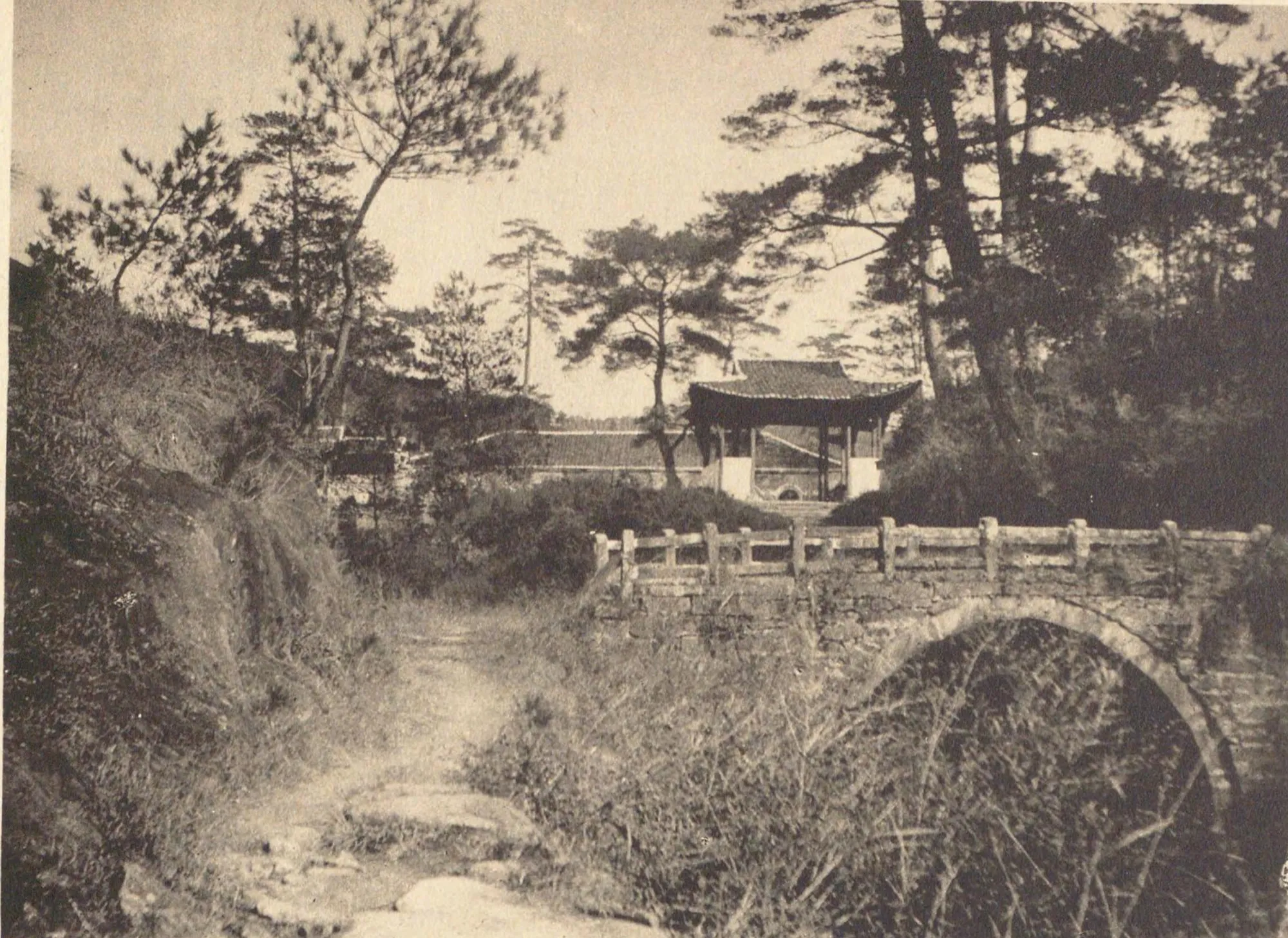
Tokiwa Daijō, Sekino Tadashi, and their party photographed the White Deer Grotto Academy during their survey of historical sites in Jiangxi; the photographs were published in 1941 in the tenth volume of Shina Bunka Shiseki (Historical Sites of Chinese Culture), issued by the Hōzōkan. The first and second plates are captioned “The Five Old Men Peaks and the White Deer Grotto Academy,” views from afar across the fields and woods beyond the grotto, with the academy buildings ranged beneath the Five Old Men Peaks. The third is captioned “Foreground of the White Deer Grotto Academy”: a single-arch stone bridge spans the ravine, with a gate-pavilion half-hidden in the pine woods behind it. The fourth is captioned “White Deer Grotto”: a stele stands within the stone grotto. The fifth and sixth are captioned “Image of Confucius” and “Image of Master Zhu,” images enshrined within the hall; before the image of Master Zhu stands a tablet reading “Spirit Seat of Hui’an Wengong, Master Zhu.”