Introduction
Beiyue Temple was built at Quyang during the Zhenguan era of the Tang; the person who presided over its construction is no longer known. The temple site lies more than a hundred li from Mount Heng and houses the god of the Northern Sacred Peak, Mount Heng, and those who sacrificed here performed the rites gazing toward the distant mountain. In the fifth year of the Tianbao era (746), Emperor Xuanzong of Tang enfeoffed the god of the Northern Sacred Peak as Prince Antian; the following year, the court held the enfeoffment ceremony at Quyang. In the seventh year of the Tianbao era (748), a stele bearing the inscription of the royal enfeoffment, composed by Li Quan and calligraphed by Dai Qianling[1], was erected in the temple.
In the third year of the Kaiyun era of the Later Jin (946), Khitan forces captured Quyang. They entered Beiyue Temple and divined the fortune of their southern invasion; when the oracle proved inauspicious, they set fire to the temple and burned it down. The Khitan went on to destroy the Later Jin and enter Kaifeng, only to turn back north in the fourth month of the following year, and Emperor Taizong of Liao died of illness on the way at Luancheng. In the second year of the Chunhua era of the Song (991), Emperor Taizong of Song ordered the temple rebuilt, with Zhang Xun, who was in charge of military affairs at Dingzhou, directing the work. Craftsmen raised anew the halls, corridors[2], gate towers, and stairways, and restored the images of the god and the display of ritual vessels within.
In the eighth year of the Qingli era (1048), when Han Qi presided over the administration of Dingzhou, Beiyue Temple had again fallen into disrepair, its walls collapsing and its roofs leaking, yet officials still had to perform the sacrifice at the beginning of each winter amid the damaged halls. The region had just suffered a flood and the harvest was poor, so Han Qi was unwilling to levy building materials for the temple from the people. It happened that the court had ordered the demolition of shrines that villagers had built without authorization, and he diverted the salvaged timber to Beiyue Temple. Han Qi also assigned additional soldiers and craftsmen and entrusted the work to Quyang County, but the repairs were long delayed. You Kai, who assisted Han Qi with the affairs of Dingzhou, took the project in hand on his own initiative; together with Li Yi, who held office in Quyang County, he lived at the temple for more than a hundred days supervising the work, which was completed in the tenth month of the first year of the Huangyou era (1049).
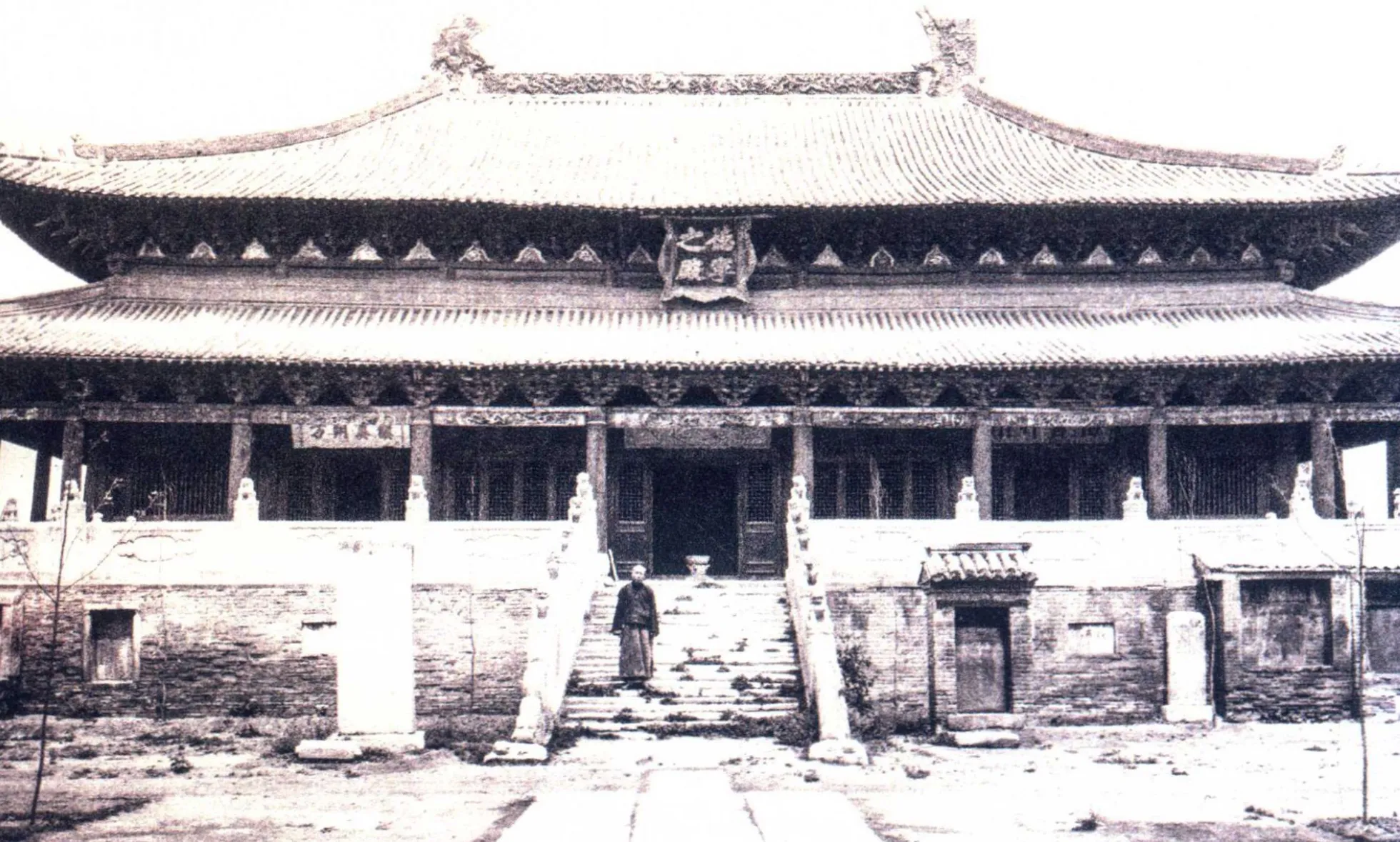
Emperor Shizu of Yuan later ordered another reconstruction of Beiyue Temple, completed in the seventh year of the Zhiyuan era (1270). The Hall of Dening at the northern end of the central axis today is precisely the main fabric left by that Yuan building campaign: the great hall stands on a high platform, nine bays wide and six bays deep, ringed on all four sides by a colonnade, with a moon terrace[3] unfolding before it.
Historical Documents
Inscription and Preface on the Enfeoffment of the Northern Sacred Peak Mount Heng of Boling Commandery as Prince Antian in the Great Tang
遁甲开山,以方色受土,水行作镇,元枵司野,截巨壑以波委,指平陆而海清。压旄头,柱王国,蔽亏日月,栖泊雷电,可久可大,取诸恒也。恒之灵,藏往知来,威远惧迩。阴阳不测之谓神,神聪明正直,害盈福谦,裨我淳黎,荒札不勃。拯膏雨,佐秋成,再蚕献功,六扰呈逸,有孚孕缶,奚贵而无位哉?古者天子望于山川,遍于群神,未尝王五岳而公四渎。大唐开元大宝圣文神武应道皇帝登泰山,蹑社首,范围天地,幽赞于神明,柔兆载上元。庚寅诏曰:“五方定位,岳镇总其灵;万物阜成,云雨施其润。上帝攸宅,寰区是仰。其岱宗西岳,先已封崇。其中岳三方,典礼犹阙。降神布泽,同致福于生人;肆类尊崇,未齐名于礼秩。永言光被,同叶灵心。其北岳可封为安天王。”所司择日奏闻,龙集丁亥律中姑洗壬午,锡以金检玉册庋县,礼也。夫圣人以天地为本,阴阳为端,五行为质。北岳水正也,乙酉水命也。大君有命,如彼北岳,鼎然不渝,受兹介福,益无方也。骠骑大将军员外置同正员兼范阳郡长史柳城郡太守平卢节度支度营田陆运两蕃四府河北海运兼范阳节度经略支度营田副大使采访处置使兼御史大夫上柱国柳城县开国伯常乐安公曰禄山,国之英也。八柱承天,三门出将,风顺辽海,霜明宪秋,山戎朝鲜,系颈请命。明威将军守右威卫将军使持节博陵郡诸军事兼博陵郡太守北平军使上柱国赐紫金鱼袋武威贾公曰循,时之杰也。康侯分符,师贞受律,英略外断,沈谋内融,清潭无私,虚谷必应,赵人化之,如春阳也。朝议郎摄别驾上柱国赏绯鱼袋信都冯公承相、中散大夫行长史上柱国赏紫金鱼袋清河张公元瓒,人之望也。利物足以和义,贞固足以干事,威摇商秋,德湛行露。通直郎行录事参军荥阳郑文、宣义郎行司功参军汝南同帝兟、奉义郎行恒阳县令高平郤怀玉,吏之雄也。貂蝉称家,冰水作吏,箘簵方劲,球琳有声,佥曰圣王先成其人,而后致力于神,国其祉也。昔省方展礼于虞帝,敬鬼尚祀于殷,未有加望秩之荣,锡封崇之号,斯盖我皇之能事也。燕山有石,硕儒有文,既述且刊,超变陵谷,铭曰:
By the hidden cycle the mountain was opened; receiving its soil according to the color of its quarter, it stands as the guardian of the watery element, with the constellation Yuanxiao governing its fields; it dams the great gorges as the waves commit themselves, and points toward the level plain where the sea grows clear. It bears down upon the Maotou stars and pillars the royal realm; it eclipses sun and moon and gives lodging to thunder and lightning; that it can endure and can be great is taken from its name, Heng (“constant”). The numen of Heng stores the past and knows what is to come; its awesomeness frightens far and near. That which is unfathomable in yin and yang is called divine; the god is keen of hearing and sight, upright and true, harming the overweening and blessing the humble, aiding our simple folk so that pestilence and famine do not arise. He bestows the fat and timely rains and assists the autumn ripening; the twice-reared silkworms offer up their work and the six domestic creatures show their ease; there is sincerity within the pregnant jar — how could one so worthy remain without rank? In antiquity the Son of Heaven gazed in sacrifice toward the mountains and rivers and extended it to all the host of spirits, yet never did he raise the Five Sacred Peaks to kings and the Four Waterways to dukes. The August Emperor of the Great Tang, the Great Treasure of Kaiyuan, Sage and Cultured, Divine and Martial, Responsive to the Way, ascended Mount Tai and trod Sheshou, encompassing heaven and earth and mysteriously assisting the spirits; in the rouzhao year he renewed the supreme origin. On the gengyin day an edict declared: “The five quarters have their fixed positions, and the sacred peaks and guardian mountains gather in their numina; the myriad things are abundantly perfected, and clouds and rain bestow their moisture. There the Supreme Lord has his dwelling, and to it the whole world looks up. Daizong and the Western Peak have already received enfeoffment and honor. The Central Peak and the other three quarters still lack the canonical rites. They send down their spirits and spread their bounty, alike bringing blessing to the living; yet in the order of ritual precedence their reverent titles are not equal. May their shining protection be everlasting and their numinous hearts be in harmony. The Northern Sacred Peak may be enfeoffed as Prince Antian.” The officials concerned chose a day and memorialized it; in the dinghai year, when the pitch-pipe stood at guxian, on the renwu day, he was bestowed with the golden casket and jade tablets, set within the county — such was the rite. Now the sage takes heaven and earth as the root, yin and yang as the beginning, and the five phases as the substance. The Northern Sacred Peak is the rectifier of water, and yiyou is the designation of water. When the great ruler issues his command, like that Northern Peak, tripod-firm and unwavering, it receives this great blessing, its bounty without bounds. The Cavalry General-in-Chief, supernumerary with status equal to the regular, concurrently Chief Administrator of Fanyang Commandery, Governor of Liucheng Commandery, Deputy Commissioner of the Pinglu Military Command for fiscal affairs, agricultural colonies, land transport, the two fan and four prefectures, and Hebei sea transport, concurrently of the Fanyang Military Command for strategic planning, fiscal affairs, and agricultural colonies, Deputy Grand Commissioner for Investigation and Disposition, concurrently Censor-in-Chief, Supreme Pillar of State, Founding Earl of Liucheng County, Duke Changle’an, named Lushan, is a hero of the state. The eight pillars bear up the sky, the three gates send forth generals; the winds are favorable over the Liao sea, the frost gleams in the autumn of the statutes; the mountain Rong and Chaoxian bind their necks and beg for their lives. The General of Bright Majesty, Acting General of the Right Awesome Guard, Commissioner with Extraordinary Powers over the military affairs of Boling Commandery and concurrently Governor of Boling Commandery, Commissioner of the Beiping Army, Supreme Pillar of State, granted the purple goldfish pouch, Lord Jia of Wuwei, named Xun, is an outstanding man of the age. Like the princely kang he shares the tally; the army’s rectitude receives the code; his heroic plans decide abroad and his deep counsels blend within; a clear pool without selfishness, an empty valley that ever answers; the people of Zhao are transformed by him as by the spring sun. The Gentleman for Court Discussion and Acting Vice-Governor, Supreme Pillar of State, granted the crimson fish pouch, Lord Feng of Xindu, named Chengxiang, and the Grand Master of Palace Leisure and Acting Chief Administrator, Supreme Pillar of State, granted the purple goldfish pouch, Lord Zhang of Qinghe, named Yuanzan, are the hope of the people. Benefiting things, they suffice to harmonize with right; firm and steadfast, they suffice to manage affairs; their majesty shakes the autumn of Shang, their virtue soaks the dew upon the road. The Gentleman for Comprehensive Duty and Acting Registrar, Zheng Wen of Xingyang; the Gentleman for Propagating Righteousness and Acting Administrator of the Merit Section, Tong Dixin of Runan; and the Gentleman for Upholding Righteousness and Acting Magistrate of Hengyang County, Xi Huaiyu of Gaoping, are the champions among the clerks. Their households are worthy of the sable-and-cicada caps; like ice and water they make officers; like junlu bamboo, square and strong; like the gems qiu and lin, of ringing repute. All say: the sage king first perfects his men, and only then devotes his strength to the spirits — this is the blessing of the state. Of old the inspection of the regions displayed its rites before Emperor Shun, and the honoring of ghosts exalted sacrifice under the Yin; but never was there the glory of added rank in the gazing sacrifices, the bestowal of an enfeoffment title — this is surely the accomplishment of our sovereign. In the Yan mountains there is stone; a great scholar has the writing; it is both composed and carved, to outlast the changes of mound and valley. The inscription reads:
维恒兮作镇壬癸,善利万物兮德配诸水。雄峰屹立而朝山逦迄,闪电雷、神鬼。其神灵兮福之所履,福善祸淫而正直如矢。其一君恩覃兮流汤汤,汨神道、荡鬼方。四渎为公兮五岳王,山戎臣首而犬戎北亡。勒贞石以一固,浮大海之三桑。其二
Lofty is Heng, guardian of the ren and gui quarters, kindly benefiting the myriad things, its virtue matching the waters. Its heroic peak stands erect while the courtier hills wind along; it flashes lightning and thunder — spirits and ghosts. Its divine numen is where blessings tread; it blesses the good and brings calamity on the licentious, upright as an arrow. The first: The sovereign’s grace spreads, flowing broad; it hastens the way of the spirits and sweeps clean the land of ghosts. The Four Waterways are dukes and the Five Peaks are kings; the mountain Rong bow their heads in submission while the Quanrong perish in the north. We carve the steadfast stone to make it ever firm, to float upon the three mulberries of the great sea. The second.
Stele of the Reconstruction of Beiyue Temple
闻:元气胚浑,结而为山岳;幽灵肸蚃,降而为神祇。矧乎地属阴方,位居水德,于八卦在坎,于四时为冬。固阴沍寒,万物之所藏伏;早生晚熟,五榖之所蕃滋。帝尧开唐封之封,大禹奠冀州之域。厥有巨镇,兹惟常山。却雁塞以标雄,压龙荒而挺秀。天官画野,势当昴毕之星;易象流形,名系雷风之兆。下斡坤轴,高摩斗魁。土俗粹灵,登神仙者七十户;岁时祈祷,置侍祝者九十人。藏简子之宝符,产昌容之蓬蔂。足冻长城之窟,影连天汉之墟。积厚穷阴,出灵见怪。
We have heard: when the primal vapor was still in embryo, it congealed to form the mountains and peaks; when the hidden spirits spread abroad their influence, they descended as gods. Moreover, this land belongs to the yin quarter and its position answers to the virtue of water; among the eight trigrams it is in kan, and among the four seasons it is winter. In the frozen solidity of yin and cold, the myriad things hide and are stored away; sown early or ripening late, the five grains multiply and flourish here. Emperor Yao opened the fief of Tang, and Yu the Great fixed the bounds of Jizhou. Among them is this mighty guardian mountain — it is none other than Mount Chang. Turning back the wild-goose passes it marks out grandeur; overbearing the dragon-wastes it rises in splendor. The heavenly offices drew the fields, and its position answers to the stars Mao and Bi; the images of the Changes flow into form, and its name is bound to the omens of thunder and wind. Below it turns the axis of earth; on high it rubs against the Dipper’s ladle. The customs of the land are pure and numinous: seventy households ascended as spirits and transcendents; through the seasons of the year, in prayer and supplication, ninety attendants and invocators were installed. Here was hidden the precious tally of Viscount Jian; here grows the penglei herb of Changrong. Its feet would freeze the grottoes of the Great Wall; its shadow joins the wastes of the Heavenly River. Massed deep in utmost yin, it sends forth numina and shows marvels.
雪、霜、风、雨,潜施及物之功;泰、华、嵩、衡,共揭参天之势。禀是阴骘,孰旡主张?洪惟岳神,受命上帝。燕南赵北,我寔主之。福善祸淫,人皆仰士。名载乎祀典,德加乎生民。视秩于公,遵周制也;列爵为王,肇唐室也。既奉时祝,亦禳天灾。凡水旱疠疫之祅,举玉帛牲牷之事,必有昭报,诞符至诚,历代奉之,其来尚矣。
Snow, frost, wind, and rain silently extend their work of reaching all things; with Tai, Hua, Song, and Heng it together upholds the sky-piercing stature. Endowed with this hidden merit, who could fail to hold it in awe? Great is the god of the peak, who received his charge from the Supreme Lord. South of Yan and north of Zhao, it is he who rules. He blesses the good and brings calamity on the licentious, and all men look up to him. His name is entered in the sacrificial canon; his virtue reaches the living people. That his rank is assessed as a duke’s follows the institutions of Zhou; that his patent of nobility is that of a king began with the house of Tang. Having received the prayers of the seasons, he also wards off the calamities of heaven. For every baleful visitation of flood, drought, or pestilence, whenever jade and silk and unblemished victims are offered, there is certain to be a shining response, truly answering perfect sincerity; dynasty after dynasty has honored him, and the practice is of long standing indeed.
我法天崇道皇帝之抚运也,天祚明德,民怀有仁。括禹画于无垠,化尧封于比屋。雕题儋耳,骈罗入正会之图;杰佅兜离,沸渭杂宫悬之典。文德丽星辰之象,武功彰雷电之威。宋明帝之读书,则七行俱下;周武王之振旅,则一戎大定。然犹焦劳克已,宵旰临民,每战兢兢,念元元本夲,师虞舜之旡怠,法文王之犹勤。至若掖廷椒房,俭约中度,离宫别馆,行幸殊稀。隆冬御裘,则念高年之无褐,于是乎有缯帛之赐;当暑𢮥扇,则轸下狱之罹辜,于是乎有缧绁之恩。非搜苗猕狩之时,无驰骋畋猎之事;非朝会燕飨之日,无金石丝竹之音。岁出御题,亲考贡籍,拔造士之秀也。日坐便殿,躬览庶政,达穷氏之情也。向者星文告差,御端门而引咎,故一夕而孛彗,况宋景之退荧惑也;大旱作沴,贬常膳而责躬,故崇朝而霖雨降,汤王之祷桑林也。哲后之罪己也既如彼,上玄之祐善也又如此。易所谓“圣人久于其道,而天下化成”,语所谓“如有王者,必世而后仁”,其是之谓乎?不然,何夤畏天命,艰难王业,若斯之甚邪?于是庶政交修,百神蠲洁。 祭祀而为人祈福,行教令而先天弗违。菲饮食而厚牲牢,天神地祇,享至诚之荐;卑宫室而崇庙貌,名山大川启必葺之祠。岂夫比禋于六宗,未洽礼神之义;祀于五畴,但萌徼福之心。坠典旡文,我能具, 矧兹阴岳,固有徽章。华衮珠旒,受王者之册礼;太牢秬鬯,命守臣而行事。下迩玄𠖇之宅,旁邻黑帝之居。
Our emperor, who patterns himself on heaven and exalts the Way, in shepherding the fortune of the state — heaven blesses his bright virtue and the people cherish his benevolence. He has gathered Yu’s demarcations into boundlessness and transformed Yao’s fief into every house. The tattooed foreheads and long-eared tribes come paired and ranked into the charts of the New Year audience; the Jie, Mai, Dou, and Li peoples surge and mingle in the rites of the palace orchestras. His civil virtue adorns the images of the stars; his martial achievement manifests the majesty of thunder and lightning. Like Emperor Ming of Song in reading, seven lines go down at a glance; like King Wu of Zhou marshaling his host, with one armed stroke all is greatly settled. Yet still he toils anxiously and conquers himself, attending to the people from dawn to dark, ever trembling as if in battle, mindful of the common folk as the root; he takes as master Shun’s unweariedness and patterns himself on King Wen’s diligence. As for the pepper chambers of the rear palace, his frugality and restraint hit the proper measure; the detached palaces and outlying lodges he visits but rarely. In deep winter wearing furs, he thinks of the aged who have no coarse cloth, and so there are gifts of silk; in the summer heat wielding the fan, he grieves for those in the lower prisons who suffer guilt, and so there is the grace toward the fettered. Save in the seasons of the spring and autumn hunts, there is no galloping or coursing; save on days of audience and feast, there is no sound of metal and stone, silk and bamboo. Each year he issues examination themes in his own hand, personally testing the tribute registers, to pluck out the finest of the nurtured scholars. Daily he sits in the side hall, personally reviewing the multitude of affairs, to reach the feelings of the humblest. Of late, when the patterns of the stars announced an error, he faced the Duan Gate and took the blame upon himself, and so in a single night the comet vanished — how much more than Duke Jing of Song’s causing Mars to retreat! When a great drought wrought its blight, he reduced his regular fare and reproached his own person, and so by morning the soaking rain descended — like King Tang’s prayer at the mulberry grove. The wise sovereign’s blaming of himself was thus, and high heaven’s blessing of the good was again so. What the Changes call “the sage long enduring in his way, and all under heaven is transformed and perfected,” what the saying calls “were a true king to arise, benevolence would prevail only after a generation” — is this not what is meant? Otherwise, how could his reverent awe of heaven’s charge and his toil for the royal enterprise be as extreme as this? Thereupon the multitude of affairs were all cultivated and the hundred spirits were purified and cleansed. He sacrifices to pray blessing for the people, and issues his teachings without contravening what heaven has decreed beforehand. Frugal in food and drink yet generous with the sacrificial victims, the spirits of heaven and earth receive the offerings of perfect sincerity; humble in his own palaces yet exalting the temples’ aspect, the famous mountains and great rivers have shrines that are repaired without fail. How could it be like making the yin sacrifice to the six honored ones without fulfilling the meaning of serving the spirits, or sacrificing at the five altar-mounds merely nursing a heart that seeks luck? Of the fallen canon and lost texts, we are able to make them complete; and this yin peak moreover has long had its insignia. In the blazoned robe and pearl-hung crown it receives the enfeoffment rites of a king; with the grand victim and black-millet ale, the charged ministers are commanded to perform the service. Below it adjoins the dark and hidden dwelling, and beside it neighbors the abode of the Black Thearch.
因道武之基扃,旧推宏壮;韫慕容之圭璧,素彰神异。祠祀之盛,莫之与京。然而运有污隆,时有 废。虽旡方之体,奚往不通;而有象之躯,未逃其数。先是匈奴之犯塞也,来诣祠宇,卜其吉凶,不从猾夏之心,遂纵燎原之火。殊不知天惟辅德,神寔依人。乏祀虐民,自作败亡之计;彼曲我直,坐观荡覆之期。圣上犹示含容,更期柔服,戢天威而自守,盖民力之是宽。单于之火照甘泉,岂伤文帝;颉利之兵陈渭水,未累太宗。亟命有司,惟新“大壮”。乌台御史,持节而庀徒;黄门贵人,鸠工而蒇事。梗楠杞梓以云集,绳墨斧斤而子来。五材寔繁,百堵皆作。乃复堂殿,于以 像设之睟容;乃兴廊庑,于以列徒御之绘事。门辟有翼,阶陛斯隆。绣栭云楯,玄曜烟霞之色;璇题 井,交含日月之光。旌旗衣服昭其文,簠簋豆笾陈其数。能事毕矣,神功焕然。不愆揆日之期,再耸凌云之势。
Building upon the foundations and gates left by Daowu, it was long held to be grand and mighty; enfolding the jade scepters and discs of the Murong, it had ever shown divine marvels. In the splendor of its sacrifices none could rival it. Yet fortune has its ebb and flow, and times have their prosperity and decline. Though its formless substance reaches everywhere, its embodied semblance cannot escape its allotted span. Before this, when the Xiongnu violated the frontier, they came to this shrine and divined for good or ill; when it would not comply with their treacherous design to trouble the Xia, they thereupon set loose a prairie fire. Little did they know that heaven aids only virtue, and that the gods indeed depend on men. To starve the sacrifices and oppress the people was to make their own plan of ruin; their cause crooked and ours straight, we sat and watched the time of their overthrow. Our sage sovereign still showed forbearance, hoping further for their gentle submission, restraining heaven’s majesty and keeping to defense, for he was sparing of the people’s strength. The chanyu’s fire that shone on Ganquan could not harm Emperor Wen; Jieli’s troops arrayed by the Wei waters did not burden Taizong. He straightway commanded the officers concerned to make the “great and mighty” new again. Censors from the Raven Terrace bore their credentials and marshaled the laborers; nobles of the Yellow Gates gathered the craftsmen and completed the work. Timbers of geng, nan, qi, and zi gathered like clouds; with line and ink, axe and adze, they came as children to a parent. The five materials were truly abundant, and a hundred walls rose at once. Then the halls and chambers were restored, so as to house the lustrous countenances of the images; then the corridors and galleries were raised, so as to array the paintings of the retainers. The gates opened wing-like; the steps rose high. The embroidered capitals and cloudy balustrades darkly gleamed with the hues of mist and rosy clouds; the jeweled finials and ceiling coffers together held the light of sun and moon. Banners, flags, and robes displayed their emblems; fu, gui, dou, and bian vessels were set out in their numbers. Every task was accomplished; the divine work shone anew. Without missing the day measured by the gnomon’s shadow, once more it towers up to brush the clouds.
于是戒尸祝,命使臣,我将落之,神用至止。厚享惟馨之奠,永安不测之灵。三献具而礼成,八音和而神降。溪云拂槛,如绛节以翻空;山海垂檐,误鸣珂之振响。介尔繁祉,庇吾边民。况犷俗之未平,冀阴兵而助顺。或示之祸福,革彼豺狼之心;或鼓以雷霆,勦其犬羊之类。然后雨我禾, 洁尔粢盛,铸铁农器而毁戈𮣴,荐兴多稼,耕边田而 士卒永乐丰年。况今将相叶谋,人神共忿,岂使韩昌、张猛,刑白马而登东山,将令去病、卫青取金人而逾北海。何往不利,何谋不尚思魏绛之言,更鉴悝王之策。安民和众,契而天地以为心;含垢匿瑕,谅神明之降鉴。伫灵台之偃伯,备法驾以省方。千年南面之尊,永和高枕;十月北巡之礼,尽彝章。辑五瑞于公候,问百年之耆艾。燔柴奠玉,如西岳之礼容;陈诗观风,察北方之哀乐。声明文物以咸备,律度量衡而必同。升中于绝岳之前,肆觐于重峦之下。起白云而表瑞,何止岱宗。呼万岁以效灵,岂惟嵩岳而已哉!夫如是,则封狼居而禅姑衍,但恃穷兵;临瀚海而勒燕然,未为神武者也。臣沐浴皇泽,优紫垣。请终军之缨,非无壮节;投班超之笔,尚负明时。惭非掷地之才,有玷他山之石。谨为铭曰:节彼常山,峻极于天。崛起万仞,生乎一拳。
Thereupon he admonished the personators and invocators and commanded the envoy: we are about to consecrate it, and the spirit thereby draws near. The rich offering of fragrant libation forever pacifies the unfathomable numen. When the three offerings were complete the rite was accomplished; when the eight tones harmonized the god descended. The valley clouds brushed the railing as if crimson banners were waving in the sky; mountains and sea hung from the eaves, deceiving the ear with the ring of tinkling jades. May you grant us manifold blessings and shelter our border folk. For the savage customs are not yet pacified, and we hope that the shadowy host will aid the righteous cause. Perhaps show them fortune and misfortune, to change their wolfish hearts; perhaps drum them with thunder, to exterminate their dog-and-sheep kind. Then rain upon our grain, cleanse your millet offerings, cast iron farm tools and melt down the dagger-axes; raise again the many crops, till the border fields, and let the soldiers rejoice in fruitful years. Now that generals and ministers are of one counsel, and men and spirits share a common wrath — how could we let a Han Chang or a Zhang Meng slay a white horse and mount the eastern hills? Rather we shall have a Huo Qubing or a Wei Qing seize the golden men and cross the northern sea. Where would such a campaign not prosper? What plan would not prevail? Ponder the words of Wei Jiang, and take further warning from the counsels of old. To give the people peace and the multitudes harmony, matching heaven and earth in heart; to bear disgrace and hide flaws, trusting that the gods send down their mirror. Await the spirit-tower’s laying down of arms, and prepare the imperial chariot to inspect the regions. May the thousand-year dignity of facing south forever enjoy the peace of the high pillow; may the rite of the northern tour in the tenth month be fully in accord with the constant statutes. Gather the five jade tokens from the dukes and marquises; ask after the elders of a hundred years. Burn the firewood and set out the jade, as in the ritual aspect of the Western Peak; set forth the poems and observe the customs, to discern the joys and sorrows of the north. With fame, glory, and the things of culture all complete, the pitch-pipes, measures, and weights must all be made one. Raise the central offering before the utmost peak; hold the great audience beneath the layered ranges. To raise white clouds as a token of auspice — not Daizong alone; to shout “ten thousand years” in proof of numen — not Song Peak alone. If it is thus, then to perform the feng at Mount Langju and the shan at Guyan is but to rely on exhausting the army; to approach the Hanhai and carve Mount Yanran is not yet divine martiality. Your servant, bathed in the sovereign’s grace, at ease within the purple walls — to ask for Zhong Jun’s rope is not lacking in bold resolve; to cast away Ban Chao’s brush would still betray this enlightened age. Ashamed that I lack talent to strike the ground, I would dishonor the stone from another hill. Respectfully I make the inscription, which reads: Lofty is that Mount Chang, steep to the very sky. It rises ten thousand ren, yet grew from a single fistful.
摩穹戛汉,控赵排燕。人皆仰止,神或凭焉。
It rubs the dome of heaven and strikes the Milky Way; it commands Zhao and holds back Yan. All men look up to it; the spirits perchance depend on it.
明明岳神,上帝所授。不骞不崩,可大可久。
Bright is the god of the peak, bestowed by the Supreme Lord. It does not topple nor collapse; it can be great and can endure.
其谁祭之?皇宋哲后。其谁尸之?中山郡守。
Who sacrifices to it? The wise sovereign of the august Song. Who personates it? The governor of Zhongshan.
祑视公兮爵为王,金其几乎玉其床。何以赠之兮赤绂斯皇,何以处之兮峻宇雕墙。谅聪明兮无淂丧,维庙貌兮有兴亡。嗟睟容兮荡毁,遇丑虏兮猖狂。物成败兮有数,神杳𠖇兮无方。虽像设兮云坏,于精灵兮靡伤。诏新斯庙,表匈奴之不道;诏祠尔神,彰皇家之至仁。天辅德兮我有庆,鬼害盈兮胡无人?绝代马之南牧,扬和銮兮北巡。有效灵之云物,无出塞之妖氛。齐泰山兮等梁甫,并亭亭兮接云云。飞英声兮腾茂实,握乾符兮阐坤珍。垂千龄兮万祀,永昭德于五君。
His rank assessed as duke, his patent made king; gold for his table and jade for his couch. Wherewith to present him? The crimson sash, so resplendent. Wherein to house him? Towering roofs and carven walls. Trusting, keen of sight and hearing, that he neither gains nor loses; it is the temple’s aspect that has its rise and fall. Alas, his lustrous countenance was swept away, when the foul caitiffs ran rampant. The success and failure of things have their allotted number; the god, dark and hidden, has no fixed quarter. Though the images were said to be destroyed, the numinous spirit suffered no harm. The edict renewed this temple, to show the waylessness of the Xiongnu; the edict gave sacrifice to your god, to manifest the utmost benevolence of the royal house. Heaven aids virtue — we have our blessing; ghosts harm the overfull — how should the Hu lack men? He cut off the Dai horses from pasturing south, and raised the harmonious bells on the northern tour. There are clouds and vapors that attest the numen, and no baleful miasma passing out of the frontier. Equal with Mount Tai, level with Liangfu, side by side with Tingting, adjoining Yunyun. Let the glorious fame fly and the luxuriant fruit soar; grasping the tally of Qian, unfolding the treasures of Kun. Handed down a thousand ages and ten thousand sacrifices, forever shining virtue upon the five rulers.
Record of the Reconstruction of Beiyue Temple at Dingzhou
天下之岳五,独北之常方,人目为大茂山,而岳名不著。岳有祠,不知废于何代。今庙于曲阳县之西附城,距岳百余里,考有唐以来记刻,皆不载废迁之由,故非质于图志,人或不知岳之所在焉。于礼祀莫大于天地,而五岳次之。古者天子坛以祀四望,若时廵至其所,既柴,然后秩而望祀之,庙而祭焉,非古也,其后世之文乎?然则为之者诚有意焉耳。夫崭然而石,㘭然而谷,泉焉而百𣲖别,林焉而万𠏉擢,岳之形也,倐霁忽冥,伏珍见祥,喜焉而风雨时,怒焉而雷雹发,岳之神也,人狎其形而易之也,薪于是,畋于是,安知其所以为神哉?君人者患民之不知也,于是庙而像之,以警民之耳目,致其严未之心,使遣祸而趋福,虽文于古,其于教也固益明矣。若其视祭之品,则三代以降,皆以公,有唐以王。
Of the sacred peaks under heaven there are five; only the northern one, in the region of Chang, is called by men Mount Damao, and its name as a sacred peak is not renowned. The peak has a shrine, but no one knows in what dynasty it fell into disuse. The temple today lies west of Quyang county town, adjoining the city, more than a hundred li from the peak; examining the records and inscriptions since the Tang, none records the reason for its abandonment and removal, so that unless one consults the maps and gazetteers, one may not even know where the sacred peak is. In ritual, no sacrifice is greater than that to heaven and earth, and the Five Sacred Peaks come next. In antiquity the Son of Heaven built altars to sacrifice to the four gazing-objects; when on tour he came to the place, he first burned the firewood offering, and afterward ranked and gazed in sacrifice toward them. To sacrifice to them in a temple is not ancient — is it perhaps an embellishment of later ages? Yet those who did it surely had their purpose. That which rises sheer is rock; that which hollows deep is valley; springs come forth and a hundred streams divide; forests grow and ten thousand saplings rise — such is the mountain’s form. Sudden clearing and sudden darkening, hidden rarities and appearing omens; in its pleasure wind and rain are timely, in its anger thunder and hail burst forth — such is the mountain’s god. Men grow familiar with its form and treat it lightly, cutting firewood upon it, hunting upon it; how would they know that whereby it is divine? The ruler of men, concerned that the people do not know, thereupon built a temple and gave it an image, to alert the people’s ears and eyes, to bring them a heart of reverence, to make them shun calamity and hasten toward blessing. Though this is an embellishment upon antiquity, for instruction it is surely all the clearer. As for the grades of the sacrifices offered, from the Three Dynasties down they were all those of a duke; under the Tang, of a king.
我朝抚有天下,驯致太平,真宗皇帝绍祖宗之隆,以建皇极,封泰山,祀后土,旷绝之礼,无所不讲,由是尊五岳而帝之,复以安天元圣之号表于我神,惧世人之未详也,又制奉神述以明之。
Our dynasty, possessing all under heaven, has led it gently to great peace. Emperor Zhenzong, succeeding to the grandeur of his ancestors, established the imperial standard, performed the feng on Mount Tai and sacrificed to the Sovereign Earth; no rite however distant was left unpracticed. Thereupon he honored the Five Sacred Peaks and made them emperors, and further displayed upon our god the title Antian Yuansheng; and fearing that men of the world did not yet know it in detail, he also composed the Account in Service of the God to make it plain.
盖爱民之意深,则报神之礼重,斯诚也,虽万世可知矣。故庙宫之制,崇饬宏大,惟礼之称,著于定令,以时缮修。历年既长,吏职废怠,日风月雨,以圯以漏,功大费广,人焉不葺。每岁立冬,天子之所署祀册就,遣守臣以祇祀事。至则罗其笾豆洗酌之具,与执事者升降于颓垣坏庑之间,退而安然,罔以为恤。慢神凟礼,莫斯为甚。庆历八年夏六月,某获领州事,得居岳镇之下,知庙之未完也,由市材弗给,役徒弗充,而民罹水灾,岁以大歉,凡厥用度,弗敢为扰。㑹有诏毁乡民之擅为祠者,得取其材以济之。益兵曁工,责成於邑吏,而旷时不集。通判军州事屯田员外郎游君开谨于其事,愿尽力焉。率其县主簿李奕留庙所百余日,恱使其众而己焉弗懈。于是弊陋朽挠之迹,焕然一新。
When the intent to love the people runs deep, the rites repaying the spirits are weighty — of this sincerity, though ten thousand generations pass, it may be known. Therefore the regulations of the temple palaces are lofty, ordered, grand, and great, befitting the rites, written into the fixed statutes, to be repaired and maintained in due season. As the years grew long, the officers’ duties fell into neglect; sun and wind, moon and rain brought collapse and leakage; the work was great and the cost broad, and none would undertake the repair. Every year at the beginning of winter, when the sacrificial tablets appointed by the Son of Heaven were ready, the charged ministers were sent to perform the rites with reverence. On arrival they arrayed the bian and dou vessels and the washing and pouring utensils, and mounted and descended with the officiants among fallen walls and ruined galleries, then withdrew at ease, taking no thought for it. In slighting the god and profaning the rite, nothing was worse than this. In the eighth year of Qingli, in the sixth month of summer, I was given charge of the affairs of the prefecture and came to dwell beneath the sacred guardian peak. Learning that the temple was unfinished, since the purchase of timber was not supplied and the labor force was not filled, and the people had suffered a flood so that the year’s harvest failed greatly, I dared not disturb them for any of the expenses. It happened that an edict ordered the destruction of shrines that country folk had built without authority, and I was able to take their timber to aid the work. I added soldiers and craftsmen and charged the county officers with completion, but long time passed without the work being gathered in. You Kai, Vice-Prefect of the military prefecture and Vice-Director of the Bureau of State Farms, was diligent in this matter and wished to devote his full strength to it. Leading Li Yi, the county registrar, he stayed at the temple site for more than a hundred days, cheerfully employing his crews while himself never slackening. Thereupon the traces of ruin, meanness, rot, and warping were made wholly new.
又于其庭起士民荐献之宇,俾勿䙝于神,而神益以尊。彩绘涂墍,罔不精极,宜神之喜,肸蚃来宅。皇祐元年冬十月某日,以讫功来告,僚属请以鄙文志于庙石,而弗克让。夫吏之为政也,有善恶焉,神之为鍳也,有祸福焉。善焉而以福,恶焉而以祸,神理之宜也。或反是焉,则非人之所知矣。守臣当谨天子之命而治神之居,洁神之祀,修己以爱其民,人,唯神之所以祸福而己。谨记。
They also raised in its courtyard a hall for the gentry and people to make their offerings, so that the god would not be treated familiarly, and the god was thereby the more honored. The colored painting and plasterwork were all refined to the utmost; fitting the god’s pleasure, may his spreading influence come and dwell here. In the first year of Huangyou, in the tenth month of winter, on a certain day, they came to report the work complete; my colleagues asked me to record it with my poor writing upon the temple stone, and I could not decline. Now for an officer in his governance there is good and evil; for a god in his mirror-like judgment there is blessing and calamity. For good to bring blessing and evil to bring calamity is the fitting principle of the spirits. If sometimes it is otherwise, that is not for men to know. The charged minister should respectfully keep the Son of Heaven’s command and govern the god’s dwelling, purify the god’s sacrifices, cultivate himself, and love his people; as for men, there is only that whereby the god brings them blessing or calamity. Respectfully recorded.
Shoutang Yishu
右题名正书,文云:皇祐三年正月二十七日,奉安抚移文,诣北岳灵宇点检未完之处。二月朔日还郡。西京左藏库副使、定州路监兵赵滋记。滋见韩魏公岳庙碑阴题,盖当皇祐二年为供备库副使、定州路驻泊兵马都监,至三年又迁西京左藏库副使矣。滋本传未之书也。职官志西京、南京、北京各置左藏库,题名与志合。监兵当为都监易名,所云奉安抚移文诣北岳灵宇点检未完之处,盖元年重修,至此又检视尔。
The inscription on the right is in standard script; the text reads: On the twenty-seventh day of the first month of the third year of Huangyou, by order of the military commissioner’s dispatch, I went to the numinous precinct of the Northern Sacred Peak to inspect the unfinished parts. On the first day of the second month I returned to the prefecture. Recorded by Zhao Zi, Vice-Commissioner of the Left Treasury of the Western Capital and Supervisor of Troops of the Dingzhou circuit. Zhao Zi is seen in an inscription on the reverse of Duke Han of Wei’s temple stele: in the second year of Huangyou he was presumably Vice-Commissioner of the Arsenal and Chief Military Inspector stationed at Dingzhou circuit, and by the third year he had been promoted to Vice-Commissioner of the Left Treasury of the Western Capital. This is not written in his official biography. The Treatise on Officials states that the Western Capital, Southern Capital, and Northern Capital each established a Left Treasury; the inscription agrees with the treatise. “Supervisor of Troops” must be an altered name for Chief Military Inspector. As for “by order of the military commissioner’s dispatch, going to the numinous precinct of the Northern Sacred Peak to inspect the unfinished parts” — the reconstruction was in the first year, and this was a further inspection of it.
Qiugu Lu
李负诗恒岳晨望,有怀定州司马李负:二仪均四序,五狱分九州。灵造难窥测,神功匪易酬。恒山北临岱,秀崿东跨幽。𭱊洞镇河朔,差峨冠嵩邱。禋祠彰旧典,坛庙列平畴。古树侵云密,飞泉界道流。从官叨佐理,衔命奉珍馐。荐玉申成效,锵金谅有由。郊原昭初日,林薄委徂秋。塞近风声厉,川长雾气收。他乡饶感激,归望切祈求。景福如光愿,私门当复侯。
The Li Fu poem, “Morning Gaze upon the Sacred Peak of Heng, with Thoughts for Li Fu, Marshal of Dingzhou”: The two powers equal the four seasons; the five peaks portion out the nine provinces. The workings of the numen are hard to spy out; the achievements of the god are not easily repaid. Mount Heng faces Dai in the north; its splendid cliffs stride across You in the east. Its cavernous gorges guard Heshuo; its towering heights crown Song’s hills. The yin sacrifices magnify the ancient canon; altars and temples are ranged across the level fields. Ancient trees press thick upon the clouds; flying springs flow, bounding the road. Accompanying the officers, I unworthily assisted in the governance; bearing the charge, I presented the rare viands. Offering jade, I declared accomplished service; the ringing of metal truly had its cause. Over the suburban plain the first sun shone bright; through the wooded thickets the late autumn lay. Near the frontier the wind’s voice is sharp; along the long river the misty air gathers in. In another land, rich in gratitude, the homeward gaze is earnest in prayer. If radiant blessing answers my wish, my private gate shall once again be marquis.
右诗在真定府曲阳县北岳庙中。庙有唐时大碑五,其一韦虚心文,陈怀志书,行草;其一张嘉贞文,自书;其一郑子春文,崔镮八分书;其一李荃文,戴千龄八分书,其一刘端文、王知新书行草。碑阴及两旁刻字皆满,其上层,为积土所益,而余至时仓卒求梯不可得,止就下方读之,大率皆贞元至天祐十数朝祭岳题名,亦有宋人刻字。独此诗在韦碑后,文虽不工,然予见近代君子,搜剔唐人之诗,至于无名氏,不知何代人之作,皆收而附之。而此灼然不误者,乃不得与断简残编之列。又北岳庙自大碑之外,绝无题咏,故特录焉。又有宋王禹称、陈彭年、韩琦三大碑,及白宪书石幢,一字皆可观,而稚圭自书,逼真颜鲁公,世人传其字者罕也。李克用题名:河东节度使、检校太保、同中书门下平章事、陇西郡王李克用以幽镇侵扰中山,领蕃汉步骑五十万众亲来。
The poem on the right is in the Beiyue Temple of Quyang County, Zhending Prefecture. The temple has five great Tang steles: one with text by Wei Xuxin and calligraphy by Chen Huaizhi in running-cursive; one with text by Zhang Jiazhen in his own hand; one with text by Zheng Zichun and calligraphy by Cui Huan in eight-part script; one with text by Li Quan and calligraphy by Dai Qianling in eight-part script; and one with text by Liu Duan and calligraphy by Wang Zhixin in running-cursive. The reverse and both flanks of the steles are covered with carved characters; the upper parts had been buried by accumulated earth, and as I came in haste and could not get a ladder, I could only read the lower portions — for the most part these are the sacrificial inscriptions to the peak from the ten-odd reigns between Zhenyuan and Tianyou, and there are also Song carvings. This poem alone stands after the Wei stele; though its writing is not skillful, yet I have seen gentlemen of recent times combing and gleaning the poems of Tang men, down to anonymous pieces whose dynasty is unknown, all collected and appended. And this one, plainly authentic, has yet been unable to join the ranks of broken slips and remnant scrolls. Moreover, apart from the great steles, the Beiyue Temple has virtually no inscribed verse, so I record it here especially. There are also three great Song steles by Wang Yucheng, Chen Pengnian, and Han Qi, together with a stone dharani pillar in Bai Xian’s hand — every character worth viewing; and Zhigui’s own handwriting is strikingly like Yan Zhenqing’s, though few in the world transmit his writing. The inscription of Li Keyong: “Li Keyong, Military Commissioner of Hedong, Acting Grand Guardian, Joint Manager of Affairs with the Secretariat-Chancellery, and Prince of Longxi Commandery, because You and Zhen have invaded and harassed Zhongshan, has come in person at the head of five hundred thousand fan and Han foot and horse.”
救援,与易定司空同申祈祷,翊日过常山问罪。时中和五年二月廿一日,克用记。易定节度使检校司空王处存看题。至三月十七日,以幽州请就和断,遂却班师,再谒晬容,兼申赛谢,便取飞狐路,却韪河东。克用重记。
to the rescue; together with the Minister of Works of Yiding he joined in offering prayers, and on the following day passed Mount Chang to demand punishment. At the time, the twenty-first day of the second month of the fifth year of Zhonghe — recorded by Keyong. Wang Chucun, Military Commissioner of Yiding and Acting Minister of Works, viewed the inscription. On the seventeenth day of the third month, as Youzhou sued for peace and settlement, he thereupon withdrew the army, again paid respects to the lustrous countenance, and offered thanks for the answered vow, then took the Feihu road and returned to Hedong. Recorded again by Keyong.
右石刻在北岳庙中,大字甚佳。克用,沙陀之子,不闻工于笔法。宣和书谱谓朱梁太祖批答贺表,当是笔吏所书,此亦其类与。宋沈括笔谈云:岳祠在曲阳,祠中,多唐人故碑。殿前一亭,中有李克用题名。则知此字当时所刻,或毁于靖康之兵火,而金天会十二年重刻之石也。又存中言:北岳常山,今谓之大茂山是也。半属契丹,以大茂山分脊为界。岳祠旧在山下,石晋之后,稍迁近里,今其地谓之神棚,却恐未然。按碑,宋初祠为契丹所焚,淳化二年曾迁,而唐朝臣碑皆在其中,亦非徙至者也。王贞游三关记云:庙貌著于唐,不自宋始,可信。宋苏轼题名:苏轼祷雨岳祠,同李之仪、李士龙、鄗长卿、孙敏行口口贾温之右小石刻,旧在岳庙,今移县治宾馆。又有子瞻书词归去来兮一阕、清夜无尘一阕、九十日春一阕,用石二片,两面书之。
The stone carving on the right is in the Beiyue Temple, in large characters of great excellence. Keyong was a son of the Shatuo and is not known to have been skilled in the brush. The Xuanhe Calligraphy Catalog holds that Liang Taizhu’s endorsements in reply to congratulatory memorials must have been written by a secretarial clerk; this too is perhaps of that kind. Shen Kuo of the Song says in his Brush Talks: the Peak Shrine is at Quyang, and within the shrine are many old Tang steles; before the hall there is a pavilion in which is the inscription of Li Keyong. From this we know these characters were carved at that time; perhaps they were destroyed in the warfare of the Jingkang era, and the stone was re-carved in the twelfth year of the Tianhui era of the Jin. Cunzhong also says: “The Northern Sacred Peak, Mount Chang, is what is now called Mount Damao. Half of it belonged to the Khitan, with the ridge of Damao as the boundary. The Peak Shrine was formerly at the foot of the mountain; after the Later Jin it moved somewhat nearer in, and the place is now called the God-shed” — yet I fear this is not so. According to the steles, the shrine was burned by the Khitan at the beginning of the Song and was moved in the second year of Chunhua, yet the steles of the Tang court ministers are all within it, so it is not something moved there later. Wang Zhen’s Record of a Journey to the Three Passes says: the temple’s aspect was established in the Tang and did not begin with the Song — this can be believed. The inscription of Su Shi of the Song: “Su Shi prayed for rain at the Peak Shrine, together with Li Zhiyi, Li Shilong, Hao Changqing, and Sun Minxing … [and] Jia Wenzhi.” The small stone carving on the right was formerly in the Peak Temple and has now been moved to the guest lodge of the county seat. There are also Zizhan’s written lyrics — one of “Return Home!”, one of “The Clear Night Free of Dust”, and one of “Ninety Days of Spring” — using two slabs of stone, written on both faces.
旧在县西北二里水窦岩,今移岳庙。皆大字。其词见苏文忠公集中。
Formerly at the Shuidou Cliff two li northwest of the county; now moved to the Peak Temple. All are large characters. The lyrics may be found in the collected works of Duke Su Wenzhong.
Luofanlou Wenji
元曲阳县重修真君观碑跋右曲阳县重修真君观碑,知常真人姬志真撰。碑立于世祖至元五年六月,首言重光大渊献上即位之元年,诏命掌教大宗师真常真人代礼名山,先诣北岳,则宪宗之元年也。元代缺秩祀之典,名山大川之祀,付之道流,姚牧庵所谓维方外臣,窃取咸秩,大为醮祠,无文每及者也。姬志真之名,见长春真人西游记。
Colophon to the Yuan Stele of the Reconstruction of the Zhenjun Abbey in Quyang County. The stele on the right, of the reconstruction of the Zhenjun Abbey in Quyang County, was composed by the Perfected Zhichang, Ji Zhizhen. The stele was erected in the sixth month of the fifth year of Shizu’s Zhiyuan era, and begins by saying that in the chongguang dayuanxian year, the first year of His Majesty’s accession, an edict commanded the Grand Master in charge of the Teaching, the Perfected Zhenchang, to perform rites at the famous mountains on his behalf, first proceeding to the Northern Sacred Peak — this is the first year of Xianzong. The Yuan dynasty lacked the canon of ranked sacrifices, and the sacrifices to famous mountains and great rivers were handed over to the Daoist clergy — what Yao Mu’an meant by “only the ministers beyond the pale stole and assumed the universal ranking, greatly conducting jiao rites, without texts ever touching upon it.” The name Ji Zhizhen appears in the Journey to the West of the Perfected Changchun.
元北岳庙题名跋右北岳庙题名云:至元庚寅秋七月朔,大都高元帅子天裕拜谒殿口口口口简识可识者二十一字,缺者四字。高元帅当是高宣。元史传:高宣,辽阳人。太宗元年,诏宣为元帅,赐金符,统兵从睿宗攻大名。四年,从破金兵三峰山,降宣者二干余户籍以献。立打捕鹰坊都总管府统之,以宣为都总管,赐金符,仍令子孙世其职。子天锡,事世祖潜邸,后官至兵部尚书。天裕当与天锡为兄弟。至元庚寅,世祖至元二十七年也。
Colophon to the Yuan Inscription at Beiyue Temple. The inscription at Beiyue Temple on the right reads: “On the first day of the seventh month, autumn, of the gengyin year of Zhiyuan, Tianyu, son of Marshal Gao of Dadu, came to pay respects at the hall ….” Of what can be read on the slip, twenty-one characters can be recognized; four characters are missing. Marshal Gao must be Gao Xuan. The History of Yuan biography says: Gao Xuan was a man of Liaoyang. In the first year of Taizong, an edict made Xuan a marshal and granted him a golden tally; he led troops following Ruizong to attack Daming. In the fourth year he joined in routing the Jin army at Sanfengshan, accepted the surrender of more than two thousand households, and presented their registers. A Chief Administration for Hunting and Falconry was established to govern them, with Xuan as its chief administrator; he was granted a golden tally, and his sons and grandsons were ordered to inherit the office hereditarily. His son Tianxi served Shizu in the princely residence and later rose to Minister of War. Tianyu must have been Tianxi’s brother. The gengyin year of Zhiyuan is the twenty-seventh year of Shizu’s Zhiyuan era.
Stele of the Great Yuan Edict Conferring an Additional Title upon the Northern Sacred Peak
上天眷命皇帝圣旨,朕惟名山大川,国之秩祀。今岳渎四海皆在封宇之内,民物阜康,时惟神休,而封号未加,无以昭答灵贶。可加上北岳为安天大贞元圣帝,以称朕敬恭神明之意。主者施行。至元二十八年二月日。
The sacred edict of the Emperor on whom Heaven has conferred its mandate: We hold that the famous mountains and great rivers are the ranked sacrifices of the state. Now that the peaks and waterways and the four seas are all within Our realm, the people and things are abundant and flourishing, and the season is but the spirits’ beneficence; yet the title has not been added, and there is no way to respond gloriously to the numinous gift. There may be added to the Northern Sacred Peak the title Emperor Antian Dazhen Yuansheng, to answer Our intent of reverent respect toward the divine and numinous. Let those in charge carry this out. A day of the second month of the twenty-eighth year of Zhiyuan.
Record of the Sacrifice by Proxy to the Northern Sacred Peak
代祀北岳庙
Sacrificing by Proxy at the Beiyue Temple
揭奚斯撰并正书至正五年二月直隶曲阳录
Composed and written in standard script by Jie Xisi; second month of the fifth year of Zhizheng; recorded at Quyang, Zhili.
正书尚师简篆额后至元五年二月揭奚斯卒于至正四年此为至亓五年所立无疑访碑录作至正误
Written in standard script, with the seal-script heading by Shang Shijian; second month of the fifth year of the later Zhiyuan era. Jie Xisi died in the fourth year of Zhizheng; that this was erected in the fifth year of Zhiyuan is beyond doubt — the Record of Visiting Steles gives Zhizheng, which is an error.
谨案此碑在北岳庙额篆书云代祀北岳之记碑正书首题如额末书至元五年二月日建文残缺不全
Respectfully noted: this stele is at the Beiyue Temple; its heading in seal script reads “Record of the Sacrifice by Proxy to the Northern Sacred Peak.” The stele is in standard script; the opening title matches the heading, and at the end is written “erected on a day of the second month of the fifth year of Zhiyuan.” The text is fragmentary and incomplete.
其略曰五岳秩祀制自唐虞有国家者遵为令典今上皇帝临御之七载是为后至元五年以正月十一缺御棕毛殿召翰林侍讲学士爱牙赤集贤直学士口口口至殿上敬授香币曰汝其代祀北岳若北海济渎南镇其往钦哉臣爱牙赤四月丁亥至于北岳与保定路达鲁花赤黑厮曲阳县尹阎良等咸齐沐下荐灌陟降仪物备周天地穆清神人洽和礼既成重缺天子为天下神民之主然国非民不立民非天地山川出云雨产材用无以资其生是故天子祭天地祭山川祭社稷皆以为民也惟神主兹北岳我国家受命又肇自龙朔则国家之运惟神是赖北境之民惟神是依今天子亲遣重使修其恒祀既诚且谨神之报效当何如哉神其听之毋作神羞遂书以为记侍讲学士阶中奉大夫达鲁花赤朝列大夫县尹阶承务郎为文并书者傒斯也阶如达鲁花赤篆题者则奎章阁侍书学士中奉大夫同知经筵事尚师简也
Its gist reads: The ranked sacrifices to the Five Sacred Peaks were instituted from Tang and Yu, and those who possess a state have honored them as an authoritative canon. In the seventh year of Our present emperor’s rule — that is, the fifth year of the later Zhiyuan era — on the eleventh day of the first month [missing], he repaired to the Brown Felt Hall and summoned the Hanlin Reader-in-waiting Ayachi and the Straight Scholar of the Academy of Scholarly Worthies … to the hall, and reverently handed them incense and silk offerings, saying: “You shall sacrifice in Our stead to the Northern Sacred Peak, and to the Northern Sea, the Ji waterway, and the Southern Guardian — go with reverence.” Your servant Ayachi, on the dinghai day of the fourth month, arrived at the Northern Sacred Peak and, together with Heisi, darughachi of the Baoding circuit, and Yan Liang, magistrate of Quyang County, all fasted and bathed, then presented the libations, ascending and descending; the ritual vessels were fully provided, heaven and earth were solemn and clear, and spirits and men were in harmonious accord. When the rite was completed, [missing] … The Son of Heaven is the lord of the spirits and people of the realm; yet a state cannot stand without its people, and the people, without heaven and earth and the mountains and rivers sending forth clouds and rain and producing timber and useful things, have nothing by which to sustain their lives. Therefore the Son of Heaven sacrifices to heaven and earth, sacrifices to the mountains and rivers, and sacrifices to the altars of soil and grain — all for the sake of the people. May the god who rules this Northern Sacred Peak — as our state received its mandate and had its beginning from Longshuo — know that the fortune of the state relies upon the god, and the people of the northern borders depend upon the god. Now the Son of Heaven has personally sent a weighty envoy to maintain its constant sacrifices, both sincere and reverent; how then shall the god’s recompense be? May the god hear it, and not bring shame upon the god. Thereupon it was written to make this record. The Reader-in-waiting, of the rank of Grand Master of Palace Service; the darughachi, of the rank of Dynasty-ranked Grand Master; the county magistrate, of the rank of Gentleman for Assiduous Service — he who made the text and the writing is Xisi, his rank being like that of the darughachi; he who did the seal-script heading is the Attendant Academician of the Kuizhang Pavilion, Grand Master of Palace Service, and Associate Administrator of the Classics Colloquium, Shang Shijian.
右文称今上御极之七年是为后至元五年书法独明元史顺帝纪至顺三年十一月宁宗崩乃迎帝于静江至京久不得立四年六月己巳帝即位于上都十月戊辰诏以至顺四年为元统元年三年十一月诏改元统三年仍为至元元年由元统元年至至元五年恰历七年故文云然棕毛殿泰定帝纪泰定元年闰正月作棕毛殿即此爱牙赤史无传揭奚斯本传言字曼硕龙兴富州人元统初迁翰林待制集贤学士阶中顺大夫奉旨祀北岳济渎南镇便道西还碑称代祀北岳济渎南镇与传合惟碑系集贤直学士朝列大夫足征传误尚师简满城人国子祭酒野之次子野本传子师简中奉大夫奎章阁侍书学士同知经筵事与碑结衔悉合顺帝纪至正十五年有中书平章政事黑厮不知即此官保定者否
The text on the right speaks of “the seventh year of Our present sovereign’s rule,” which is the fifth year of the later Zhiyuan era — the calligraphy alone makes this plain. The Annals of Emperor Shundi in the History of Yuan state: in the eleventh month of the third year of Zhishun, Emperor Ningzong died, and the emperor was welcomed from Jingjiang; having reached the capital, he could not be established for a long time. In the sixth month of the fourth year, on the jisi day, the emperor ascended the throne at Shangdu; in the tenth month, on the wuchen day, an edict made the fourth year of Zhishun the first year of Yuantong; in the eleventh month of the third year an edict changed the third year of Yuantong back to the first year of Zhiyuan. From the first year of Yuantong to the fifth year of Zhiyuan is exactly seven years, and so the text says what it does. The Brown Felt Hall: in the Annals of Emperor Taiding, in the intercalary first month of the first year of Taiding, a “brown felt hall” is made — it is this. Ayachi has no biography in the History. Jie Xisi’s own biography says his courtesy name was Manshuo, that he was a man of Fuzhou in Longxing, that at the beginning of the Yuantong era he was promoted to Hanlin Preceptor and Academician of the Academy of Scholarly Worthies with the rank of Grand Master of Middle Accord, and that by imperial command he sacrificed to the Northern Sacred Peak, the Ji waterway, and the Southern Guardian, returning west by a convenient route. The stele says “sacrificing by proxy to the Northern Sacred Peak, the Ji waterway, and the Southern Guardian,” which agrees with the biography; only the stele attaches to him the titles Straight Scholar of the Academy of Scholarly Worthies and Dynasty-ranked Grand Master, which is sufficient proof that the biography is in error. Shang Shijian was a man of Mancheng, the second son of Ye, the Chancellor of the Directorate of Education; Ye’s original biography has “his son Shijian, Grand Master of Palace Service, Attendant Academician of the Kuizhang Pavilion, and Associate Administrator of the Classics Colloquium,” which matches the stele’s combined titles in every respect. In the Annals of Shundi, in the fifteenth year of Zhizheng, there is a Secretariat Manager of Governmental Affairs named Heisi; whether he is the same man as this official of Baoding is not known.
Record of the Inscription for the Reconstruction of Beiyue Temple
中山之曲阳旧有北岳恒由庙其来远矣县治五里十三步而庙居半焉其规制大势亦甚宏伟壮丽历年既久风雨鸟鼠之患滋甚洪惟我明天子御极以来聿兴礼乐凡天下之名神皆崇祀典新庙宇大复先王礼神之道北岳之重修兴焉巡抚黄岩刘公巡按杏里王公太守仰山宋公乃奉命出府帑数千资委任责成督理则通判清溪刘公分理则县丞文峰杨公提调则予以知县任其责焉鸠工役聚财物授方任能奔走诸执事赀者赀粟者粟舁石于山升木于渊群工众枝各献其能始于嘉靖巳未之秋迄于丙申冬十月而肤功奏成矣
Quyang in Zhongshan has long had a temple to the Northern Sacred Peak Mount Heng, its origin reaching far back. The county seat measures five li and thirteen paces, and the temple occupies half of it; the scale and general layout are indeed grand, imposing, and splendid. As the years grew long, the ravages of wind and rain, birds and rats grew ever worse. Greatly, since Our emperor of the Ming ascended the throne, he has revived rites and music; all the famous spirits of the realm have had their sacrificial canon exalted and their temples renewed, greatly restoring the way of the former kings in serving the spirits — and the reconstruction of the Northern Peak arose thereby. The Grand Coordinator, Lord Liu of Huangyan; the Regional Inspector, Lord Wang of Xingli; and the Prefect, Lord Song of Yangshan, thereupon received the command and issued several thousand in funds from the prefectural treasury, delegating and charging the work: for the general supervision, the Vice-Prefect, Lord Liu of Qingxi; for the division of management, the County Vice-Magistrate, Lord Yang of Wenfeng; and for the direction, I myself, taking the responsibility as county magistrate. We gathered workmen and laborers, assembled goods and wealth, assigned tasks according to ability, and hastened among the various officers; those who gave money gave money, those who gave grain gave grain; stones were borne from the mountain, timbers raised from the deep; the host of craftsmen and many hands each offered their skill. It began in the autumn of the jiwei year of Jiajing and ended in the tenth month, winter, of the bingshen year, when the completion of this great work was announced.
於乎何其用力不烦而成功之速哉在得人综理之有道焉而已仰瞻庙制倾者起之颓者修之缺者补之旧者新之栋楹梁桶之腐黑桡折者皆巳坚饬盖瓦级砖之破缺者皆巳完固赤白之漫漶不鲜者皆已光洁于是大势极其严正栋宇冲霄檐阿隐雾巍然焕然真足以侈前制而壮后观乃于旧制之外特建一亭名曰御香以埃圣天子特遣致祀者驻焉隆殊典也
Ah, how the labor was not burdensome yet the success so swift! It lay in obtaining men who managed it with method — no more. Looking up at the temple’s fabric: what leaned was raised, what was ruinous was repaired, what was lacking was supplied, what was old was made new; the decayed, blackened, warped, and broken among the ridgepoles, columns, beams, and rafters were all made firm and sound; the broken and missing among the roof tiles and step bricks were all made whole and solid; the red and white that had run and faded were all made bright and clean. Thereupon the general aspect was utterly solemn and correct; the roofs and eaves rush to the sky, the eave-curves hide in the mist — towering, resplendent, truly sufficient to magnify the former fabric and make a grand sight for those to come. Then, beyond the old fabric, a pavilion was specially built, named the Imperial Incense Pavilion, for the envoys specially dispatched by the sage Son of Heaven to perform the sacrifices to halt and lodge in — a special honor in the exalted canon.
噫五岳神之至灵者也鉴于我圣天子之崇祀秩礼必显其神异钟灵毓秀于斯中山之群而生瑰伟奇特之贤以佐明时如申伯甫侯之于周也则神之灵益懋而后人钦礼之心益无穷矣工既讫督理刘公属予为记勒诸石用垂不朽因有所感而为公记之
Ah! The gods of the Five Sacred Peaks are the most numinous of spirits. Seeing how Our sage Son of Heaven exalts the sacrifices and orders the rites, they will surely display their divine marvels, concentrating the numen and nurturing the fine among this host of Zhongshan, bringing forth outstanding, great, rare, and singular worthies to aid the enlightened age, like the Earl of Shen and the Marquis of Fu for the Zhou. Then the spirits’ numen will wax ever greater, and the reverent hearts of those who come after will be ever more without end. When the work was finished, the supervising Lord Liu charged me to make a record and carve it in stone, so as to hand it down imperishably; moved by what I felt, I made this record for the lords.
督理直隶真定府通判刘绍宗分理曲阳县县丞关中杨拱极并书嘉靖丙申岁仲冬朔曲阳县知县杜承文
General supervision: Liu Shaozong, Vice-Prefect of Zhending Prefecture, Zhili. Division of management: Yang Gongji of Guanzhong, Vice-Magistrate of Quyang County, who also did the calligraphy. On the first day of midwinter of the bingshen year of Jiajing — Du Chengwen, Magistrate of Quyang County.
Jifu Tongzhi
北岳庙在曲阳城西。汉书郊祀志:神爵元年,祠北岳常山于上。曲阳府志:庙距恒山百余里,唐贞观间建于祠,望而祭之。庙有唐碑五,宋庆历八年安抚使韩琦、领定州事游君开重修立碑。明洪武间定为北岳恒山之神,去宋、元封号。
The Beiyue Temple lies west of Quyang county town. The Treatise on the Suburban Sacrifices in the Book of Han states: in the first year of Shenjue, sacrifice was made to the Northern Sacred Peak, Mount Chang, at Shangquyang. The Quyang prefectural gazetteer states: the temple is more than a hundred li from Mount Heng; it was built during the Zhenguan era of the Tang as a shrine, where the peak was gazed upon from afar in sacrifice. The temple has five Tang steles. In the eighth year of the Qingli era of the Song, the Military Commissioner Han Qi and You Kai, who was in charge of the affairs of Dingzhou, rebuilt it and erected a stele. During the Hongwu era of the Ming it was fixed as “the God of the Northern Sacred Peak, Mount Heng,” the Song and Yuan titles being removed.
Libu Zhigao
弘治十五年,吏部尚书马文升奏:岳渎之祭,自古皆即其近地而庙祭之,惟北岳祭于真定府曲阳县,北海祭于河南济源县,其地之相去颇远。据大明一统志所载,谓山西浑源州原有北岳祠庙,欲行修葺,改祭北岳于此。该礼部覆议得:自帝舜以来,已祭北岳于曲阳,而我太祖复循用不改,今请仍如旧典。
In the fifteenth year of Hongzhi, Ma Wensheng, Minister of Personnel, memorialized: the sacrifices to the peaks and waterways have from antiquity all been performed at temples near their sites; only the Northern Sacred Peak is sacrificed to at Quyang County in Zhending Prefecture, and the Northern Sea at Jiyuan County in Henan, the distance between the places being quite great. According to what is recorded in the Comprehensive Gazetteer of the Great Ming, Hunyuan Prefecture in Shanxi originally had a shrine to the Northern Sacred Peak, and he wished to have it repaired and to change the sacrifice to the Northern Sacred Peak to that place. The Ministry of Rites, deliberating in reply, found: since the time of Emperor Shun, the Northern Sacred Peak has been sacrificed to at Quyang, and Our Taizu again followed the practice without change; we now request that the old canon be kept as before.
Chibei Outan
五岳皆祭于山,独恒岳祭上曲阳,自汉宣帝神爵元年始,而恒山实在浑源州。相传舜望于山川,北至大茂山,大雪不能前,有石飞堕,遂祀焉。即今曲阳庙。庙石长不满丈,阔仅四尺余。濮阳苏谷原侍郎疑石晋后燕云陷辽,宋遂遥祀于此。然史、汉、唐书之文,明甚不始宋也。沈存中笔谈云:北岳谓之大茂山,半属契丹,以大茂脊为界。岳祠旧在山下,石晋之后,稍迁近内,今祠乃在曲阳。苏说本此也。明弘治中,马端肃公曾请改祠于山,事下礼部,竟格于倪文毅公。按南园漫录云:倪公父谦,常奉命祀曲阳,祷于神,神指旁侍一人与之,遂生公,因名岳。以是固执,不肯改祀云。顺治十七年,上允刑科给事中粘本盛之请,罢曲阳庙祀,祀浑源。千年因循之讹,至是始厘正焉。
The Five Sacred Peaks are all sacrificed to at their mountains; only the sacred peak of Heng is sacrificed to at Shangquyang — beginning in the first year of the Shenjue era of Emperor Xuan of Han — while Mount Heng actually lies in Hunyuan Prefecture. Tradition has it that when Shun was gazing in sacrifice toward the mountains and rivers and went north as far as Mount Damao, heavy snow prevented him from advancing, and a stone flew and fell there, whereupon sacrifice was made to it — this is the present temple at Quyang. The stone at the temple is less than a zhang long and only a little over four chi wide. Vice Minister Su Guyuan of Puyang suspected that after the Later Jin, when the Sixteen Prefectures of Yan and Yun fell to the Liao, the Song then made its sacrifice at a distance here. Yet the texts in the Histories, the Han, and the Tang books are perfectly clear that it did not begin with the Song. Shen Cunzhong’s Brush Talks says: “The Northern Sacred Peak is called Mount Damao; half of it belongs to the Khitan, with the Damao ridge as the boundary. The Peak Shrine was formerly at the foot of the mountain; after the Later Jin it moved somewhat further inward, and the present shrine is at Quyang.” Su’s account is based on this. In the Hongzhi era of the Ming, Duke Ma the Steadfast and Reverent once requested that the shrine be moved to the mountain; the matter was sent down to the Ministry of Rites, but was in the end blocked by Duke Ni the Cultured and Resolute. According to the Nanyuan Manlu, Lord Ni’s father Qian once received the command to sacrifice at Quyang; he prayed to the god, and the god pointed to one of the attendants beside him and gave him to him, whereupon the lord was born, and was therefore named Yue. For this reason he stubbornly refused to change the sacrifice. In the seventeenth year of Shunzhi, the emperor granted the request of Nian Bensheng, Supervising Secretary of the Office of Scrutiny for Justice, abolishing the temple sacrifice at Quyang and sacrificing at Hunyuan. A thousand years of error by force of habit were only at this point corrected.
Historical Photographs
1920s
The appendix “Chinese Landscapes” of Osvald Sirén’s A History of Early Chinese Art, published in 1929, includes three old views of Beiyue Temple in Quyang, recording respectively the front facade of the main hall, the colonnade of the main hall, and the beam framework and murals within. The original work does not give the specific year in which each of the three photographs was taken, so they are filed here by the upper bound of the publication date.
The image archive of the Museum of Far Eastern Antiquities, Swedish National Museums of World Culture holds another set of negatives of Beiyue Temple taken by Sirén. This old view of the south gate records the gate passage, the remains of the city wall, and the stone beasts before the gate; the museum’s catalog does not mark a specific year, and it is filed here solely on the basis of the Swedish National Archives’ general account of Sirén’s photography of Chinese architecture in the 1920s, without presuming an exact year. The high-resolution photographs supplied by the museum are marked as out of copyright and released under CC0.
1932–1940
The photographs used in Lin Zhu’s Zhongguo Gu Jianzhu Tudian (Illustrated Guide to Ancient Chinese Architecture) were drawn from the surveys conducted by the Society for Research in Chinese Architecture between 1932 and 1940. Beyond a full view of the main hall, the group devoted to Beiyue Temple in Quyang preserves survey images of the bracket sets of the Dening Hall, the Yuan dynasty murals, and the octagonal pavilion with three tiers of eaves; the photographs are not individually credited to a photographer or dated to an exact year, so they are filed by the survey period.