Introduction
Today’s Guangsheng Temple stands in two parts, above and below on Mount Huo: the Upper Temple has the Feihong Pagoda, and the Lower Temple lies near the Huo Spring. Yet in the surviving documents, the earliest thing to appear is not two monasteries but an ancient pagoda foundation on the mountain. In the first year of the Linde era (664), Daoxuan traveled on Mount Huo and saw what monks and laity near and far called the Aśoka pagoda[1], the “Great Mound Pagoda” (Dadui Ta); the temple rescript[2] of the fourth year of the Dali era (769) still calls the site the “old Aśoka pagoda cloister.” Li Guangzan petitioned to establish a temple at the old pagoda’s site; the court granted his request and bestowed the name “Guangsheng.”
The stele inscriptions of the Yuan and later shift our gaze from the summit to the side of the Huo Spring. In the twentieth year of the Zhiyuan era (1283), the Guangsheng Temple monk Daokai rebuilt the Temple of King Mingying beside the Huo Spring, and the monks built quarters alongside it; by the twelfth year of the Chenghua era (1476), a Front Buddha Hall of Guangsheng Temple already stood at “the foot of the southern slope of Mount Huo.” These steles do not yet use the name “Lower Temple,” but one after another they record the monks’ quarters beside the Huo Spring and the Buddha hall at the southern foot.
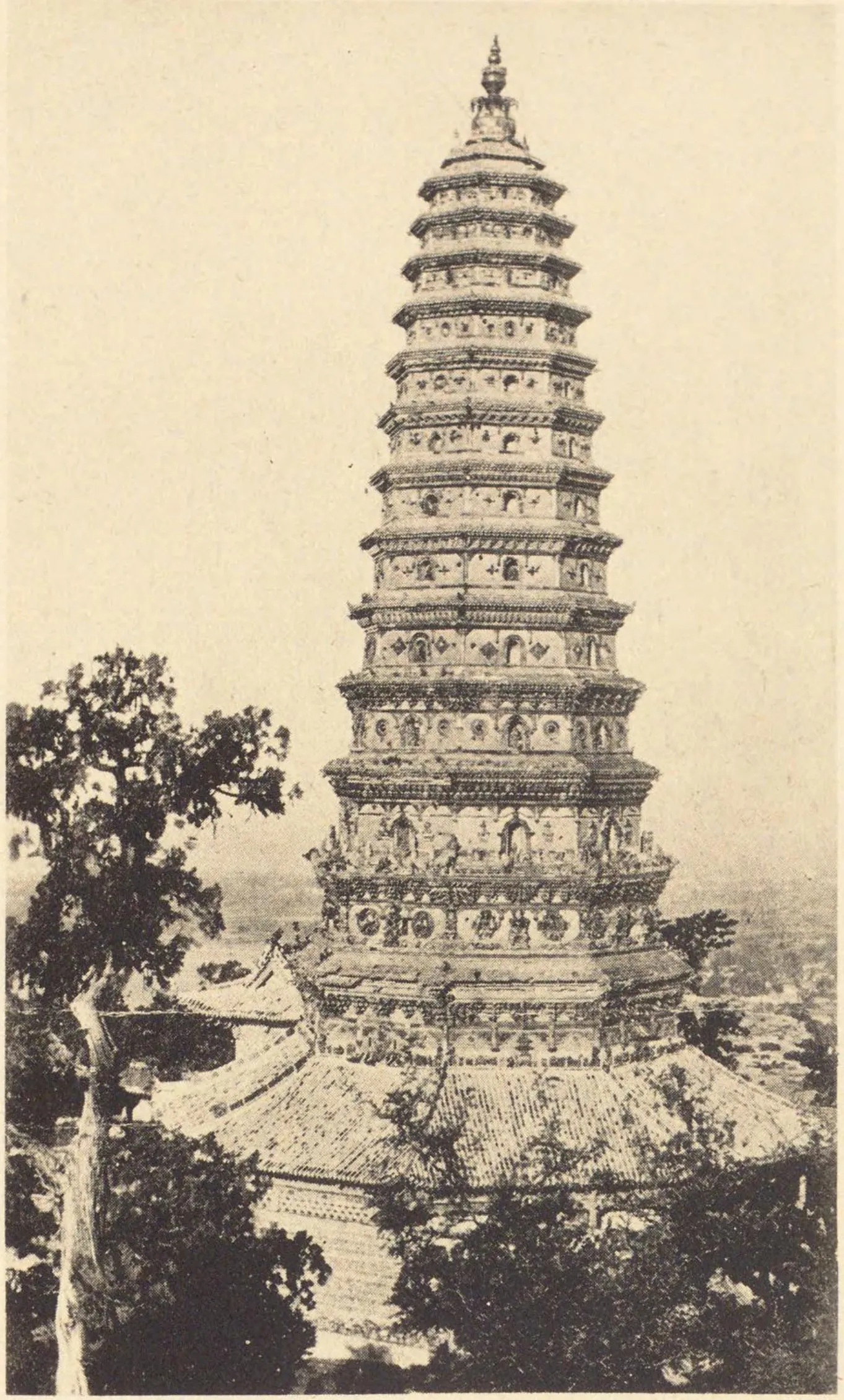
The extant Feihong Pagoda on the summit was rebuilt in the Ming. The Epitaph of the Life of the Pagoda-Building Monk Dalian records that Dalian directed the building of the pagoda from the eleventh year of the Zhengde era (1516) until its completion in the sixth year of the Jiajing era (1527). The pagoda’s body is built of brick, while its corner columns, bracket sets[3], eaves tiles, and buddha images are all modeled in glazed ceramic; many glazed components still bear the reign-date “the tenth year of Zhengde,” one year earlier than the start of work recorded in the epitaph.
Seven years after the pagoda’s completion, a popular uprising broke out around Shizhou amid famine. Wang Shilong led a thousand troops to reinforce, and on the way took his midday meal at the foot of the pagoda; after the revolt was pacified, he carved the episode and a poem onto the pagoda wall, calling the pagoda before him a “golden pagoda of green-glazed brick.” In the second year of the Tianqi era (1622), a wooden gallery was added around the pagoda’s lowest story; and by the twelfth year of the Kangxi era (1673), a stele text at last calls the temples above and below the mountain explicitly the “Upper Temple” and the “Lower Temple,” saying that the two were “originally one temple divided into two.” In 1934, Liang Sicheng and Lin Huiyin, on the basis of the two sets of dates on the glazed ceramic and on the wooden gallery, distinguished the different dates of the pagoda body and the wooden gallery.
Historical Documents
Ji Shenzhou Sanbao Gantong Lu (Collected Records of the Miraculous Responses of the Three Treasures in Shenzhou)
十一晋州北霍山南原大堆塔者,远近道俗咸称是育王塔。余曾游焉。地居爽垲,南望迥敞。示是古基。村落稀远。
11. The Great Mound Pagoda on the plateau at the southern foot of Mount Huo north of Jinzhou: monks and laity near and far all call it an Aśoka pagoda. I once traveled there. The ground is high and dry, with a broad, open view to the south. It is plainly an ancient foundation. Villages are few and far between.
Zhaocheng Xian Guangsheng Si Die (Rescript for Guangsheng Temple of Zhaocheng County)
晋州赵城县城东南三十里,霍山南脚上,古育王塔院一所。右河东□观察使司徒□兼中书令汾阳郡王郭子仪奏;臣据□朔方左厢兵马使,开府仪同三司,试太常卿,五原郡王李光瓒状称;前件塔接山带水,古迹见存,堪置伽蓝,自愿成立。伏乞奏置一寺,为国崇益福田,仍请以阿育王为额者。臣准状牒州勘责,得耆寿百姓陈仙童等状,与光瓒所请,置寺为广胜。因伏乞天恩,遂其诚愿。如蒙特命,赐以为额,仍请于当州诸寺选僧住持洒扫。中书门下牒河东观察使牒,奉敕故牒。大历四年五月二十七日牒。住寺阇梨僧□切见当寺石碣岁久,隳坏年深,今欲整新,重标斯记。治平元年十一月二十九日。
At a point thirty li southeast of the county seat of Zhaocheng County in Jinzhou, upon the southern foot of Mount Huo: one ancient Aśoka pagoda cloister. The foregoing: the […] surveillance commissioner of Hedong, minister of education […] concurrently secretariat director, Prince of Fenyang Commandery, Guo Ziyi, memorializes: Your servant, on the basis of the statement of the […] army commander of the left corps of the Shuofang army, commander unequalled in honor, acting minister of the Court of Imperial Sacrifices, Prince of Wuyuan Commandery, Li Guangzan, which states: the aforementioned pagoda, joining the mountain and girdled by water, its ancient traces still extant, is fit for the establishment of a monastery, and [he] voluntarily undertakes to found it. Humbly he begs that a memorial be submitted to establish a temple, so as to increase the field of blessings for the state, and further requests that it take Aśoka as its plaque-name. Your servant, in accordance with the statement, sent a rescript to the prefecture to investigate and verify, and obtained the statement of the aged commoner Chen Xiantong and others; together with what Guangzan requested, the temple established is [named] Guangsheng. Accordingly we humbly beg the celestial grace to fulfill his sincere wish. If we are favored with a special command to bestow this as its plaque-name, we further request that monks be selected from the various temples of this prefecture to reside there as its keepers, to sweep and clean it. Rescript of the Secretariat-Chancellery to the surveillance commissioner of Hedong; respectfully receiving the edict, this rescript is therefore issued. Rescript of the twenty-seventh day of the fifth month of the fourth year of the Dali era. The resident ācārya monk […] earnestly, seeing that this temple’s stone tablet has grown old with the years and long since fallen to ruin, now wishes to restore it anew and to re-inscribe this record. The twenty-ninth day of the eleventh month of the first year of the Zhiping era.
Li Man, Ti Guangsheng Si (Inscription on Guangsheng Temple)
寺隐藏山腹,山高绝杳冥。浓岚春发黛,岑塔晓开屏。岭上云无着,松根茯有灵。访求忠武迹,不复见丹青。
The temple is hidden within the mountain’s depths; the mountain is high, its summit vanishing into the dark void. Thick mists in spring unfurl their indigo; the towering pagoda at dawn spreads like a screen. Clouds upon the ridge cling to nothing; beneath the pine roots the poria has spirit. I seek out the traces of the Zhongwu Prince, but his painted likeness is no more to be seen.
Ma Bingyi, Ti Guangsheng Si (Inscription on Guangsheng Temple)
盘云梯石上崇冈,殿阁峥嵘古道场。寺纪汾阳亲奏额,塔传阿育久腾光。檐前山耸千螺秀,槛外溪分二带长。种种尘缘都洗尽,祗因身在白云乡。
Winding through clouds, the stone steps climb the lofty ridge; halls and pavilions tower—an ancient sanctuary. The temple records that the Prince of Fenyang himself petitioned for its plaque; the pagoda, they say, is Aśoka’s, long sending forth its radiance. Before the eaves the mountains rise in a thousand lovely spirals; beyond the rail the streams divide into two long ribbons. All the myriad worldly bonds are washed away, simply because one dwells in the land of white clouds.
Zhang Shangying Huoshan Shi (Zhang Shangying’s Poem on Mount Huo)
张商英霍山诗。
Zhang Shangying’s Poem on Mount Huo.
霍山诗一首:
A poem on Mount Huo:
本路提点刑狱公事张商英。
Zhang Shangying, judicial inspector of this circuit.
鹫翅垂三晋,鳌趺距一方。丹书亡智伯,白发诣秦王。展定成姑射,回峦揖太行。水极千顷富,源酾四渠长。鸟不栖灵木,云常入帝乡。柏根蟠老石,瓜蔓散平冈。叱咤生雷雹,鞭笞役𬯻狼。𬅬知雄气象,卫霍出平阳。
Like a vulture’s wings it overhangs the Three Jin; like a sea-turtle’s foot it holds fast this corner of the world. The cinnabar writing destroyed Earl Zhi; the white-haired elder presented himself before the Prince of Qin. Unfolding, it fixes in place [Mount] Gushe; turning, its ridges salute the Taihang [range]. Its waters spread their riches over a thousand qing; its source, divided, feeds four long channels. Birds do not roost in its sacred trees; clouds ever enter the Emperor’s realm. Cypress roots coil about the ancient stones; melon vines spread over the level uplands. With a shout it summons thunder and hail; with a lash it drives the jackals and wolves to serve. Who knew of its heroic aspect: Wei and Huo came forth from Pingyang.
卫青,霍子孟,此土人也。
Wei Qing and Huo Zimeng [Huo Qubing] were men of this soil.
元祐戊辰正月十七日,被旨决狱,道过是刹,乃作此句。天觉。
On the seventeenth day of the first month of the wuchen year of the Yuanyou era, charged by imperial decree with deciding [criminal] cases, I passed by this monastery on the road, and thereupon composed these lines. Tianjue [Zhang Shangying].
崇宁二年癸未九月二十日,前山主僧清智。
On the twentieth day of the ninth month of the guiwei year, the second year of the Chongning era, the former mountain-abbot, the monk Qingzhi.
大定巳酉岁重九月,寺主僧源仲,知客僧道悟立石。
In the ninth month of the jiyou year of the Dading era, the abbot-monk Yuanzhong and the guest-prefect monk Daowu set up the stone.
桉:碑前刻本路提点刑狱公事张商英五言排律一首,有云:丹书亡智伯,白发诣秦王者。史记:智伯率韩、魏攻赵,赵襄子惧,保晋阳。原过从后至,有三神与过竹二节,令遗毋恤。襄子斋三日,剖竹,有朱书曰:予霍太山山阳侯,天使也。予将使汝反灭智氏。卒如其言,遂祠三神,使过主之。太平寰宇记:晋州霍邑县,隋末丧乱,武牙郎将宋老生屯兵于此。义师之至也,老生陈兵据险,师不得进。忽有白衣老父诣军门曰:霍山神遣语大唐皇帝,若向霍邑,当东南傍山取路,我当助帝破之。帝遣人视之,果有微道。高祖笑曰:此神不欺赵襄子,岂当欺我耶?即其事。
[Hu Pinzhi’s] commentary: Before the stele is carved a five-syllable regulated verse by Zhang Shangying, judicial inspector of this circuit, which has the lines: “The cinnabar writing destroyed Earl Zhi; the white-haired elder presented himself before the Prince of Qin.” The Shiji (Records of the Grand Historian): Earl Zhi led [the armies of] Han and Wei to attack Zhao; Viscount Xiang of Zhao, in fear, held fast in Jinyang. Yuan Guo came up from behind, and there were three spirits who gave Guo two sections of bamboo, bidding him present them to Wuxu. Viscount Xiang fasted for three days, then split the bamboo, and in it was writing in vermilion that said: “I am the lord of the sunny side of Mount Huotai, an emissary of Heaven. I shall cause you in turn to destroy the Zhi clan.” In the end it was as he said, and so [the Viscount] sacrificed to the three spirits and appointed Guo to preside over them. The Taiping Huanyu Ji (Universal Geography of the Taiping Era): Huoyi County of Jinzhou—in the disorders at the end of the Sui, the fierce-fanged commandant Song Laosheng encamped his troops here. When the righteous army came, Laosheng drew up his soldiers holding the defiles, and the army could not advance. Suddenly an old man in white came to the army gate and said: “The god of Mount Huo has sent word to the Emperor of the Great Tang: if you advance on Huoyi, take the road southeast along the foot of the mountain, and I will aid the Emperor in defeating him.” The Emperor sent men to look, and indeed there was a small path. Gaozu laughed and said: “This god did not deceive Viscount Xiang of Zhao; how could he deceive me?” This is the affair in question.
其云展定成姑射者,太平寰宇记:晋州赵城县姑射山,在县西二十里。其曰水涵千顷富,源酾四渠长者,寰宇记:洪洞县霍山,在县东北三十里,霍水出焉。水经注云:发源成潭,涨七十步,不测其深。金天眷年,都总管定赵城、洪洞两县水利碑:平阳府东北九十余里有山曰霍山,山阳有泉曰霍泉,涌地以出,居民因而导之,分为两渠。一名南霍,一名北霍。山西通志:霍泉北渠,溉永乐等四十六村田五百九十二顷有奇。南渠分五道:一即南霍,一曰九成,与南霍实一道,以上下流分二名:一曰小霍,溉田一百六十余顷;一曰大霍,一曰清水,溉田一百三十五顷有奇。宋庆历五年,有司推勘户籍水数若干。商英诗。四渠者,当指宋庆历以后霍渠言。通志谓霍泉引渠始贞观。据天眷碑,则宋已立碑,可补新唐书地理志之阙。
Where it says “unfolding, it fixes in place [Mount] Gushe”: the Taiping Huanyu Ji: Mount Gushe in Zhaocheng County of Jinzhou lies twenty li west of the county seat. Where it says “its waters spread their riches over a thousand qing; its source, divided, feeds four long channels”: the Huanyu Ji: Mount Huo in Hongtong County lies thirty li northeast of the county seat, and the Huo River issues from it. The Shuijing Zhu (Commentary on the Water Classic) says: “Rising from its source it forms a pool, swelling seventy paces across, its depth unfathomable.” The stele of the Tianjuan era of the Jin, by which the governor-general fixed the water rights of the two counties of Zhaocheng and Hongtong: “Ninety-odd li northeast of Pingyang Prefecture there is a mountain called Mount Huo; on its sunny side there is a spring called the Huo Spring, which wells up out of the ground; the local people accordingly channeled it, dividing it into two channels, one named South Huo and one named North Huo.” The Shanxi Tongzhi: “The north channel of the Huo Spring irrigates five hundred and ninety-two-odd qing of fields in forty-six villages, Yongle among them. The south channel divides into five courses: one is South Huo itself; one is called Jiucheng, which is in fact the same course as South Huo, taking two names from its upper and lower reaches; one is called Little Huo, irrigating over one hundred and sixty qing; one is called Great Huo; and one is called Clear Water, irrigating one hundred and thirty-five-odd qing.” In the fifth year of the Qingli era of the Song, the responsible officials investigated and assessed the household registers and the amounts of water. In Shangying’s poem, the “four channels” must refer to the Huo channels after the Qingli era of the Song. The Tongzhi says the channeling of the Huo Spring began in the Zhenguan era; according to the Tianjuan stele, however, the Song had already erected a stele—which can supply the omission in the Treatise on Geography of the New Book of Tang.
其曰卫、霍出平阳者,史记汉书传:卫青、霍去病皆平阳人。寰宇记:晋州人物有卫青、霍去病。末题元祐戊辰正月十七日,被旨决狱,道过是刹,乃作此句。天觉。桉:长编:商英以元祐二年自开封推官提点河东刑狱,戊辰者莅河东之次年。广胜寺在霍山,道过是刹者,当指谓广胜寺。天觉好佛故也。
Where it says “Wei and Huo came forth from Pingyang”: the biographies in the Shiji and the Hanshu (Book of Han) [state that] Wei Qing and Huo Qubing were both men of Pingyang. The Huanyu Ji: among the notables of Jinzhou are Wei Qing and Huo Qubing. At the end is inscribed: “On the seventeenth day of the first month of the wuchen year of the Yuanyou era, charged by imperial decree with deciding cases, I passed by this monastery on the road, and thereupon composed these lines. Tianjue.” Commentary: the Changbian (Extended Continuation of the Comprehensive Mirror): Shangying in the second year of the Yuanyou era went from being administrative assistant of Kaifeng to judicial inspector of Hedong; the wuchen year is the year after he took up his post in Hedong. Guangsheng Temple lies on Mount Huo; the monastery he “passed on the road” must mean Guangsheng Temple—for Tianjue was fond of the Buddha.
碑立金大定已酉,实大定二十九年。
The stele was set up in the jiyou year of the Dading era of the Jin, that is, the twenty-ninth year of Dading.
Chongxiu Mingyingwang Miao zhi Bei (Stele of the Rebuilding of the Temple of King Mingying)
重修明应王庙碑。
Stele of the Rebuilding of the Temple of King Mingying.
赵城县教谕刘茂实撰。
Composed by Liu Maoshi, instructor of Zhaocheng County.
霍溪逸人赵希祖书。
Written by Zhao Xizu, the recluse of Huoxi.
从仕郎山东东西道提刑按察司知事张思诚篆额。
The heading in seal script by Zhang Sicheng, gentleman for service, registrar of the Shandong East and West Circuits’ Judicial and Surveillance Commission.
海神播气,式敷利物之功;源府开缄,爰衍泽民之庆。注灵源于千古,苏旱岁于一方。滔滔余波,流而尽溉;汪汪弘润,用无废流者,霍泉之水也。其泉出于霍太山西南之麓,惊涛汹涌,莫测其涯。源之初分,名曰北渠、南渠。下面拾遗,又曰清水、小霍。赵城、洪洞二境之间,四渠均布,西薄汾隩,方且百里,乔木村墟,田连阡陌,林野秀,禾稻丰,皆此泉之利也。其神祠峙乎泉上,有自来矣。□章之古木阴森,半顷之寒潭浩荡。山峰佛刹,参差乎其左;朝云暮雨,晦暝乎其间,实神明之奥区也。按《寰宇记》,则自唐宋以来,目其神曰大郎,然明应王号,传之亦久。其褒封遗迹,遭时劫火,寂无可考。庙初瞰于水边,前金时已经颓毁。泰和间补修者,意其湫隘,顿正殿于后,其余门廊如故。每岁季春中旬八日,谓神降日,箫鼓香楮,骈阗来享者甚众。
The sea-god spreads his breath abroad, extending everywhere his work of benefiting creatures; the treasure-house of the source opens its seal, bestowing in abundance the blessing that enriches the people. Pouring forth its numinous source through a thousand ages, reviving from drought-years a whole region; its billowing remnant-waves flow on to irrigate all, its vast and boundless bounty used without ever ceasing to flow—such are the waters of the Huo Spring. The spring issues from the southwestern foot of Mount Huotai, its startled billows surging, its limits unfathomable. At the first dividing of the source, [the channels] are named the North Channel and the South Channel; gathering what is left below, they are further called Clear Water and Little Huo. Between the two territories of Zhaocheng and Hongtong, the four channels are spread evenly, reaching westward to the bend of the Fen; over an expanse of nearly a hundred li, with tall trees and village ruins, fields linked by paths, woods and meadows luxuriant, grain and rice abundant—all is the benefit of this spring. The shrine of its god has stood above the spring since times of old. […] spans of ancient trees stand dense and dark; a cold pool of half a qing stretches vast. Mountain peaks and Buddhist monasteries rise at intervals to its left; morning clouds and evening rain darken the spaces between—it is truly a hidden precinct of the spirits. According to the Huanyu Ji, since the Tang and Song the god has been known as Dalang, yet the title King Mingying has likewise been handed down for long. The traces of his enfeoffments, meeting with the fires of calamity, are silent and can no longer be traced. The temple at first overlooked the water’s edge, and already by the former Jin had fallen into ruin. Those who patched it up in the Taihe era, finding it cramped and low, set the main hall farther back, while the remaining gates and galleries stayed as before. Every year on the eighth day of the middle ten days of the last month of spring, called the Day of the God’s Descent, with flutes and drums, incense and paper money, those who come crowding together to make offerings are very many.
金季兵戈相寻,是庙煨烬,居民遑遑,孑遗者生有不给,奚暇水神之祀哉!涂□圣像,倾颓瓦砾之门;玉砌瑶阶,埋没荆榛之下。自时厥后,广胜寺戒师、前平阳僧录道开,悯兹荒废,有修复之志,乃叹曰:“是庙济人之源,祀典所载,虽责在有司,亦我寺之福田也,忍使久而堙废乎?”乃鸠材命工,筑以新基,弃其旧址。有北霍渠长陈忠等附益之,创为正殿,十有八楹,又□僧徒构屋其旁,以备洒扫,时大元甲午岁也。以故基犹为卑隘,再适于此矣。地之广袤,绰有余裕,庙之宏敞,焕然一新。方将图工于后宫,惜乎志未遂而僧录卒。其后,典庙僧惟贞、惟能、德聚等,相承以继其业。渠长赵城前尉郭祖义、李概,交代以赞其功。瓦殿、砌基、立像及采□、丹艧、胶漆之作毕举者,凡有数载。
In the last years of the Jin, as warfare followed upon warfare, this temple was burned to embers; the people fled in haste, and the few survivors could scarce keep themselves alive—what leisure had they for the worship of the water god! The plastered […] sacred images, the gateways collapsed into tiles and rubble; the jade stairs and carnelian steps lay buried beneath thorns and brambles. From that time on, Daokai, precept-master of Guangsheng Temple and former registrar of monks of Pingyang, grieving at this desolation, formed the resolve to restore it. He sighed and said: “This temple is the source by which the people are succored; it is recorded in the register of sacrifices. Though the duty rests with the authorities, it is also a field of blessings for our temple—how could we bear to let it sink into ruin for long?” So he gathered timber and summoned workmen, building upon a new foundation and abandoning the old site. Chen Zhong, chief of the North Huo channel, and others joined to assist him, and they created the main hall of eighteen bays, and further […] the monks built quarters beside it, to provide for sweeping and cleaning—this was in the jiawu year of the Great Yuan. Because the old foundation was still deemed low and cramped, he moved once more to this site. The breadth of the ground left ample room, and the temple, grand and spacious, was made wholly new. Just as he was about to plan work on the rear hall, alas, his ambition unfulfilled, the registrar of monks died. Thereafter the temple-keeper monks Weizhen, Weineng, Deju, and others succeeded one another to carry on his work. The channel chiefs Guo Zuyi, former sheriff of Zhaocheng, and Li Gai, in turn assisted in the merit. The tiling of the halls, the laying of foundations, the setting up of images, and the work of painting […], cinnabar and red lacquer, glue and lacquer—all was brought to completion over the course of several years.
中统建元也,本路总管府指挥下两县使修后宫、三门,有司虽奉行,而终无成绩。至元戊寅夏旱,吏民祷诸神祠者多矣,卒无一应。适从仕郎赵城县宰张公佑赴任之始也,公来祈雨,于是见其庙孑然独峙,□不曰修,而有许心。拜祝间不逾踵而□,一境沾足。公喜其感应,锐意修之。始自两廊,陶甓运木,命张用、李成、李明等各执其事,公屡躬敦匠督役,惟恐不工。十手所指,百堵皆兴,方砥是度,其绳则直,整整乎风动云合,不日成之。凡三间为一司,左右分司者八。继而将兴三门,南渠之役也。南渠所溉民田隶属两县,公移牒洪洞,以给其役,令有不遵者行之,民有不齐者一之,使渠长胡源、师甫等伐材辇木,楼梓挥斤。越明年,六月不雨,本府治中李汝明于此取水,□遂而作,因之指挥屡下,该庙之有未建者,普令四渠共建。名山胜地,美誉斯闻,高士官僚,来游者众。河东山西道提刑监司也儿撒合大使姜公,嘉其伟绩,赐以奖成,公意益壮。此功之兴,然委其人,每听政之隙,虽祁寒暑雨亦来,视之若为己任。役夫感其勤而效力,匠氏服其诚而尽能。
In the Jianyuan year of the Zhongtong era, the Route Command of this circuit issued directives to the two counties to repair the rear hall and the triple gate; though the responsible officials carried out the order, in the end nothing was accomplished. In the wuyin year of the Zhiyuan era there was a summer drought; officials and people prayed at the various god-shrines many times, yet not one answered. It happened that Zhang Gongyou, gentleman for service and newly appointed magistrate of Zhaocheng County, had just taken up his post; the lord came to pray for rain, and there he saw the temple standing all alone, […] not yet repaired, and he made a vow in his heart. Between his bowing and prayer, before he had turned his heel, […], and the whole region was soaked to satisfaction. The lord, rejoicing at the god’s response, resolved with keen intent to repair it. He began with the two side-galleries, firing bricks and hauling timber, ordering Zhang Yong, Li Cheng, Li Ming, and the others each to take charge of a task; the lord himself repeatedly urged on the craftsmen and oversaw the labor, fearing only that the work would not be fine. With ten hands pointing [as one], a hundred walls rose; the square and whetstone gave the measure, the plumb-line kept it straight; orderly as wind stirring and clouds gathering, in a matter of days it was done. Every three bays formed one office, with eight offices divided left and right. Next he undertook to raise the triple gate—this was the labor of the South Channel. The people’s fields watered by the South Channel belong to two counties; the lord sent a rescript to Hongtong to supply the labor, punishing by statute those who disobeyed and making one those of the people who were not of one accord, and had the channel chiefs Hu Yuan, Shi Fu, and others fell timber and cart wood, with carpenters wielding the adze. The following year, in the sixth month there was no rain; Li Ruming, administrator of this prefecture, came here to draw water [for the rain-rite], […] and thereupon set to work; because of this, directives were repeatedly issued that whatever of the temple remained unbuilt should be built jointly by all four channels. A famed mountain and sacred ground—its fair repute spread, and scholars and officials came to visit in numbers. Lord Jiang, the ye’ersahe ambassador of the judicial surveillance office of the Hedong–Shanxi circuit, commended his great achievement and bestowed upon him an award of merit, and the lord’s resolve grew still stronger. This work’s advancement was indeed entrusted to its man: at every respite from hearing cases, though in great cold or driving rain he came, looking upon it as his own charge. The laborers, moved by his diligence, gave their strength; the craftsmen, submitting to his sincerity, gave all their skill.
三门之基,旧在泉北,公将廓然更新其制,乃曰:“吾观旧迹,阻渠偏浅,道不前通,岂庙庭之深邃乎?固当前开正路,南树应门,且有王宫壮丽之威,又得地形雄瞻之宜。”遂建于渠南。落成之日,识者无不叹服。门之间架同于殿,而材用过焉。其层檐累栱,华桷藻井,义负致密,规模远矣。□于后宫中门,一一完具,皆公之志。奈何瓜期迅速,狠无能为,未几而改任。公诚懿识量,鲜能及者,其临事贞固,确乎不可拔,人知动作非为己也,皆乐而忘劳,至今思之。噫!立非常之功,待非常之人。观此庙自僧录重建以来,四十余年,岂无人耶?逮及张宰成之,谋同计合,舍旧图新,致雄巍之业,兼倍于前,不谓待非常之人乎?必也灵德感人,阴功被物,使之然乎?一日,命仆文于碑,仆非其才,固辞不已,勉为录其实而继之以□。铭曰:
The foundation of the triple gate had formerly been north of the spring; the lord, meaning to renew its design on a grand scale, said: “Looking at the old traces, they are hemmed in by the channel and cramped; the way does not run straight forward—how then can the temple court be deep and majestic? We ought to open the true road before it and plant the reception gate to the south; then there will be both the magnificent majesty of a royal palace and the fitting grandeur of the terrain.” So he built it south of the channel. On the day of its completion, all who knew admired and approved. The gate’s bays and frames matched those of the hall, and its materials surpassed them. Its layered eaves and stacked brackets, its ornate rafters and coffered ceiling, joined with fine precision—its scale reached far. […] The rear hall and the middle gate were completed one by one—all was the lord’s intent. But alas, the melon-season [of his term] passed swiftly; ruthless [fate] gave no more, and before long he was transferred. The lord in truth had a fine mind and capacity that few could equal; in affairs he was steadfast and firm, unshakably resolute. The people knew that his doings were not for himself, and so all labored gladly, forgetting their toil, and think of him still today. Ah! To establish an extraordinary achievement awaits an extraordinary man. Look at this temple: in the forty-odd years since the registrar of monks rebuilt it, was there truly no one? Only when Magistrate Zhang came to complete it, with plans agreeing and counsels joined, casting off the old and scheming the new, was a grand and towering work achieved, twofold beyond what came before—can one not call this awaiting the extraordinary man? Surely it was the god’s numinous virtue moving men’s hearts, his hidden merit covering all creatures, that made it so! One day he bade me write the stele text; I am not equal to the task, yet my firm refusals were not accepted, so I did my best to record the facts, and followed them with […]. The inscription says:
霍山苍苍,霍泉洋洋,神明降瑞,珠玉流光。大田多稼,维泉之利,裂壤建庙,报功之祀。遭世纷扰,斯缘荡空,谁修复之,时惟二公。开创其迹,张继其功,作是神宫,拟于王室。应门将将,长廊翼翼,官既责成,民亦竭力。公之规为,神其见之,敬以名迹,镌于砺碑。千秋万古,以永昭垂。
Grey and vast is Mount Huo, broad and swelling the Huo Spring; the god sends down his blessings, pearls and jade shedding light. Great fields bear many crops—such is the profit of the spring; a share of land was cleft to build the temple, a sacrifice repaying merit. Meeting an age of turmoil, this bond was swept away; who restored and repaired it? In time, the two lords. [One] opened and began its traces, Zhang continued its work; he made this divine palace, a match for a royal house. The reception gate stands towering, the long galleries in perfect order; when the officials had been charged, the people too spent their strength. The lord’s designs and works—the god surely saw them; reverently we inscribe his name and deeds upon this polished stone. For a thousand autumns, ten thousand ages, may it shine down forever.
至元二十年岁次癸未仲冬朔日。
On the first day of the midwinter month of the guiwei year, the twentieth year of the Zhiyuan era.
典庙修造寺主德聚资助,妙存立石。
Deju, the temple-keeper and building abbot, contributed funds; Miaocun set up the stone.
尚座僧行寂、次座祖净、戒师温吉祥。
The head-seat monk Xingji, the second-seat Zujing, the precept-master Wen Jixiang.
众执事僧惟湛、惟宜、惟宣、惟颜、惟远、德万、德祥、德喜、德玉、德咏、惟海、□□、和吉、仲宽、郑温刊。
The various duty-monks Weizhan, Weiyi, Weixuan, Weiyan, Weiyuan, Dewan, Dexiang, Dexi, Deyu, Deyong, Weihai, […], Heji, Zhongkuan, Zhengwen—engraved.
奉议大夫、平阳路总管府治中姚炜。
Yao Wei, grandee for consultation, administrator of the Pingyang Route Command.
昭勇大将军、平阳路总管兼府尹兼诸军奥鲁耶律刚吃答。
Yelü Gangchida, great general of manifest valor, route commander of Pingyang concurrently prefect and overseer of the various armies’ aurugh.
通议大夫、平阳府达鲁花赤兼管诸军奥鲁廉希义。
Lian Xiyi, grandee of comprehensive consultation, darughachi of Pingyang Prefecture concurrently in charge of the various armies’ aurugh.
Chongxiu Mingyingwang Dian zhi Bei (Stele of the Rebuilding of the Hall of King Mingying)
明应王殿碑。
Stele of the Hall of King Mingying.
重修明应王殿之碑。
Stele of the Rebuilding of the Hall of King Mingying.
承事郎、晋宁路赵城县尹兼管本县诸军奥鲁劝农事王剌哈剌撰,并书,
Composed and written by Wang Lahala, gentleman for managing affairs, county magistrate of Zhaocheng County of the Jinning Route, concurrently in charge of the county’s various armies’ aurugh and the encouragement of agriculture,
将仕郎晋宁路赵城县主簿崔友闻题额。
the heading inscribed by Cui Youwen, gentleman for rendering service, recorder of Zhaocheng County of the Jinning Route.
赵城之为邑,其来尚矣。斯东有山巉嵓,积而能大,峻而能乔者,霍岳也。其下有波汹涌,挠之不浑,用之不竭者,霍泉也。山之兴宝,藏育品物。主中之镇,崇德应灵,王爵褒封,皇帝遣使,岁时致祭,壮国阜民,兴云泄雨。非南山有台有莱。兴乐贤之比,实能为邦家立太平之基矣。夫泉之始渠,曰南北二霍,而所由来者有渐也。其大如天如渊,泛涛不口乎昼夜,溉田何啻乎亿余。洛民岂不溥博者与?而觱沸流淇,浸彼苞稂,奚又同时而语耶?南北二渠,七之而三,土人相传,此例比定,尝经朝廷争理,数年而后已。见有丰碑在县,可考定其陡门、来口堤堰,设其渠长、沟头水巡,俾富豪强不敢恣其情,次上中下,乃得即其便。岁中值霖雨涨溢,防凌缺壤,验民之富贫,役力之多寡,即塞实之,颇有少缓而堕者,科罚无𮓡示也。而旧立条款,班班若日星,又谁敢增减一字哉?泉之北,古建大刹,精蓝揭名曰广胜,不虚誉耳。视其佳丽绝秀,非大雄能栖此乎?殿廊斋舍,仅可百楹,僧行称是世祖薛禅皇帝御容,佛之舍利,恩赐藏经在焉,乃为皇家祝寿之所。由右松杉㥛异,花竹参差;左山色重重,前水声沥沥,砌重而基峻,昼栋含烟,珠箔蔽日,璘珣𥵌瓦,璨烂龙文。金碧著乎榱题,镂雕鲜乎科栱。重檐翚而飞直如棘者,
Zhaocheng’s being a county goes far back indeed. To its east there is a mountain, sheer and craggy, heaped up and so great, towering and so tall—this is the Marchmount Huo. Beneath it there are billows surging, which stirring cannot muddy, which use cannot exhaust—this is the Huo Spring. The mountain gives rise to treasure, harboring and nurturing all manner of things. The guardian of this central region, exalted in virtue and answering in spirit, enfeoffed with a king’s title—to him the Emperor sends envoys, sacrificing at the seasons of the year; he strengthens the state and enriches the people, raises the clouds and pours down the rain. This is no mere comparison with the “terraces and goosefoot of the Southern Mountain” that give joy to worthies—truly he can lay for the dynasty the foundation of great peace. Now, the spring’s first channeling, called the two Huo, South and North, came about by degrees. Vast as the sky, deep as an abyss, its billows overflow […] day and night; the fields it irrigates—how could they be only a hundred million and more? Are not the blessings to the people of this region broad indeed? And yet the bubbling flow, soaking those clusters of darnel—how could that be spoken of in the same breath? Of the South and North channels, [the water is divided] seven to three; the local people hand down that this proportion was fixed, once disputed before the court, and settled only after several years. There stands a great stele in the county, by which one may verify the fixing of its sluice-gates, inlets, dikes, and weirs, and the appointment of its channel chiefs, ditch heads, and water patrols, so that the rich, powerful, and strong dare not indulge their desires; in order of upper, middle, and lower [reaches], each then obtains its convenience. When in the year long rains swell and overflow, [men] guard against ice-floes and breaches in the banks; according to the people’s wealth or poverty and the greater or lesser labor-power, they are made to block and fill them, and should any be somewhat slack and remiss, the statutory penalty is shown without pardon. And the old established articles stand clear as the sun and stars—who would dare add or subtract a single word! North of the spring there was built in ancient times a great monastery, its vihara bearing the name Guangsheng—no empty praise. Beholding its surpassing loveliness and beauty—could any but the Great Hero dwell here? Its halls and galleries, refectories and cells, amount to nearly a hundred bays; the monks say that here are the imperial likeness of Emperor Shizu Sechen, the Buddha’s relics, and the canon bestowed by imperial grace—it is a place for praying blessings on the imperial house. To the right, pines and firs, wondrous and strange, flowers and bamboo in charming disorder; to the left, mountain hues in fold upon fold; before it, the sound of waters dripping clear; terraces doubled and foundations steep; by day the beams hold mist, the pearl curtains veil the sun; the lustrous glazed tiles shine with resplendent dragon patterns. Gold and azure mark the beams and eave-ends, carved fretwork bright upon the bracket sets; its double eaves, flying like a pheasant, straight as a thorn—
明应王殿也。度其境,真降神之乡;语其方,尽祈福之地。惟
is the Hall of King Mingying. Measuring its precinct, it is truly a land where spirits descend; speaking of its quarter, it is wholly a place for praying blessings. For
王洛黎元之利大也,非宫不可居;报家国之功深也,非王不可爵。钟其山名水秀,必如是而后得庶几也。询之故老,每岁三月中旬八日,居民以令节为期,适当群卉含英,彝伦攸叙时也。远而城镇,近而村落,贵者以轮蹄,下者以杖屦,挈妻子,舆老羸而至者,可胜既哉!争以酒肴香纸,聊答神惠。而两渠资助乐艺,牲币献礼,相与娱乐数日,极其厌饫,而后顾瞻。忍忍犹忘归也,此则习以为常。佥曰:古今之胜游嘉赏,根其人心所同然,设以厉禁,莫能也。此与神之格思,不可度思,矧可𭣧思不侔矣。
the King’s bounty to the black-haired people is great—without a palace he could not be housed; the requital of his deep merit to the dynasty and state—without a king’s title he could not be enfeoffed. Gathering to itself the fame of the mountain and the beauty of the waters, it must be thus and only then comes near to fitting. Inquiring of the old folk: every year on the eighth day of the middle ten days of the third month, the residents make it a festival, just when the many flowers hold their buds and the constant order is duly arranged. From towns afar and villages near, the noble come by wheel and hoof, the lowly by staff and sandal, leading their wives and children, bearing the old and frail—who could count them all! They vie to offer wine and viands, incense and paper, so as in small measure to repay the god’s grace. And the two channels contribute toward the music and arts, the sacrificial beasts and silk offerings, and all together make merry for several days, feasting to the utmost, then look about them—reluctant, reluctant, still forgetting to return home: thus it has become the custom. All say: the fine excursions and joyful gatherings of past and present are rooted in what is common to men’s hearts; even were stern prohibitions set, nothing could stop it. This is of a piece with “the coming of the spirits, which cannot be fathomed—how much less may they be slighted”; the two are not to be compared.
缘其旧殿宇门廊,像绘尤备,不幸至大德七年八月初六日夜,地震,河东,本县尤重,靡有孑遗。书云:火炎昆岗,玉石俱焚,奚尝有二哉?上下渠堰陷坏,水不得通流。当年十一月,渠长廊下郭髦,告蒙本路总管府差委霍州倅李承务、县尹刘卼事董其役开淘,依旧浇灌。至大德九年秋,本路万僧都宣差祀香,省会渠长史圭并本县官,将殿即便重盖,县委主簿申公提调,圭与南霍杜玉、胡福、渠长鸠工,各量使水村分计置修造。富有者施财,贫薄者出力,创起正殿木装,始经营之也。
Now the old halls, gates, and galleries were most fully furnished with images and paintings; but unfortunately, on the night of the sixth day of the eighth month of the seventh year of the Dade era, there was an earthquake in Hedong, and this county was [struck] most heavily, so that nothing at all was left. The Book of Documents says: “When fire blazes on the Kun ridge, gems and stones are burned together”—how could there be any difference? The channels and weirs above and below collapsed and broke, so that the water could not flow through. In the eleventh month of that year, the channel chief Guo Mao of Langxia reported and received from the Route Command of this circuit the assignment of the deputy of Huozhou, Li Chengwu, and the county magistrate Liu Wu to superintend the work of opening and dredging, so that irrigation was as of old. In the autumn of the ninth year of the Dade era, the chief monks-official (wansengdu) of this circuit, sent on imperial mission to offer incense, summoned the channel chief Shi Gui together with the officials of this county to rebuild the hall forthwith, the county appointing Recorder Shen to manage it, while Gui, with Du Yu and Hu Fu of South Huo and the channel chiefs, gathered workmen, each apportioning the repairs by the shares of the villages that used the water. The wealthy gave money, the poor gave labor, and they first raised the main hall’s timber framing—this was the beginning of its undertaking.
时有寺僧聚提点,亦尝施工,继而刘思直塑像结𪜂,郭景信造门成趣。至延祐六年,渠长高仲信募工,殿内砌囗造沙壁完备。南霍渠长王显、许亨同心津助,及山之僧妙潜添力赞成其事,焕然为之一新,谤者杜其万口。仲信切思之曰:从草创讨论修饰润色者,非出一手,恐久而湮没,刊诸金石,以寿其传,庶有激劝于将来。
At the time the temple monk Ju, the superintendent, also once applied labor; thereafter Liu Sizhi modeled the images and completed the finials, and Guo Jingxin built the gates to give them charm. By the sixth year of the Yanyou era, the channel chief Gao Zhongxin raised workmen, and the brickwork […] and earthen walls within the hall were completed. The South Huo channel chiefs Wang Xian and Xu Heng with one accord gave aid, and the monk of the mountain Miaoqian added his strength to help complete the work, so that all shone forth renewed, and the slanderers’ myriad mouths were stopped. Zhongxin earnestly considered, saying: from the first rough beginning through discussion, embellishment, and polish, [this work] did not come from a single hand; I fear that with time it will sink into oblivion. Let it be carved in metal and stone, to give long life to its transmission, so that it may encourage those yet to come.
府吏段士良屡注意于是,一日,率老而德者史圭、郭景文、郭翊、高仲实、石克明、翟天锡、天宁宫提点赵思玄等,踵门求记于予。予辞之曰:吾家本东鲁泰山农业,滥得尹是邑,已及半任,殊无异政,膏泽加民,于治体兼无小补,常有愧于同列。始习译字,不解作文,恳至于再,聊采所见,故书之,仍系之以铭曰:
Duan Shiliang, a clerk of the prefecture, had repeatedly given his mind to this; one day, leading the aged and virtuous—Shi Gui, Guo Jingwen, Guo Yi, Gao Zhongshi, Shi Keming, Zhai Tianxi, Zhao Sixuan, superintendent of the Tianning Palace, and others—he came to my door seeking a record from me. I declined, saying: my family has its roots in farming by Mount Tai in Eastern Lu; I have unworthily obtained the magistracy of this county, and my term is already half spent; I have no remarkable governance, no balm or bounty laid upon the people, not even the smallest help to the order of rule, and am ever ashamed before my peers. I have only just begun to learn the translated script, and do not understand how to compose. But their entreaties came again and again, so I have briefly gathered what I saw and written it down, appending to it an inscription:
惟中之镇,其山曰霍。德泽所生,养物溥博。岳麓涌泉,浩浩其渊。兴我国利,溉我民田。为浆愈疾,蕴秀含灵。岁时致祭,黍稷非馨。尽水之达,往古来今。地非爱宝,胜布兼金。相彼巨泉,非浊即清。远沾品类,大慰群生。兴于明时,摧于地震。
Behold the guardian of the center: its mountain is called Huo. Where virtue and bounty are born, nurturing creatures far and wide. At the foot of the mount a spring wells forth, vast and deep its abyss. It raises the profit of our state, it waters the fields of our people. For drink it cures sickness; it harbors the fair and holds the numinous. At the seasons of the year sacrifice is made—[though] millet and grain are not the [true] fragrance. To the utmost reach of the waters, from ages past until today. The earth is not grudging of its treasure, surpassing even double gold. Look upon that mighty spring, never turbid but ever clear. Far it moistens every kind, greatly comforting all living things. It rose in a bright age, and was stricken by the earthquake.
殿宇以空,不余煨烬。前人草创,后继润色,一手难成,众皆竭力。大殿重檐,金翠光辉。美乎黻冕,绣裳袗衣。谚语大郎,王封明应。亿万斯年,永居广胜。
The halls were emptied, no embers spared. The men of old made the rough beginning, their successors gave the polish; one hand can hardly complete it—all spent their strength. The great hall with its double eaves, golden and azure in splendor. Lovely the patterned cap, the embroidered robe and the single garment. In common speech he is Dalang; by kingly enfeoffment, Mingying. For a hundred million years, may he dwell forever at Guangsheng.
延祐六年八月初六日,
On the sixth day of the eighth month of the sixth year of the Yanyou era,
北霍渠长高仲信、渠司翟天锡、水巡孔兴、南霍渠长许亨、王泽、渠司王温立石。
the stone was set up by the North Huo channel chief Gao Zhongxin, the channel registrar Zhai Tianxi, the water patrol Kong Xing, the South Huo channel chiefs Xu Heng and Wang Ze, and the channel registrar Wang Wen.
广胜寺尊宿胜提点住持春讲主宝严寺尚座行开
Sheng, the superintendent and venerable elder of Guangsheng Temple; Chun, the abbot and lecture-master; Xingkai, head-seat of Baoyan Temple.
登仕郎晋宁路洪洞县主簿刘思孝、
Liu Sixiao, gentleman for advancement, recorder of Hongtong County of the Jinning Route;
晋宁路洪洞县尉贾邦杰、典史郭景行、
Jia Bangjie, sheriff of Hongtong County of the Jinning Route; Guo Jingxing, the registrar;
晋宁路赵城县尉许谅、典史田广、司吏赵宇、王通、冯居孝,
Xu Liang, sheriff of Zhaocheng County of the Jinning Route; Tian Guang, the registrar; the office clerks Zhao Yu, Wang Tong, Feng Juxiao;
将仕郎、晋宁路赵城县主簿崔友闻,
Cui Youwen, gentleman for rendering service, recorder of Zhaocheng County of the Jinning Route;
承事郎、晋宁路赵城县尹,兼管本县诸军奥鲁劝农事。王剌哈剌,
Wang Lahala, gentleman for managing affairs, county magistrate of Zhaocheng County of the Jinning Route, concurrently in charge of the county’s various armies’ aurugh and the encouragement of agriculture;
从仕郎、前晋宁路赵城县达鲁花赤,兼管本县诸军奥鲁劝农事。麦力吉沙
Mailijisha, gentleman for service, former darughachi of Zhaocheng County of the Jinning Route, concurrently in charge of the county’s various armies’ aurugh and the encouragement of agriculture.
本县孔村下郭信男郭玫瑛刊
Engraved by Guo Meiying, faithful layman of Xiaguo, Kong Village, of this county.
桉。碑题:承事郎赵城县尹王剌哈喇撰,并书,将仕郎赵城县主簿崔友闻题额。碑为重修霍泉神明应王殿而立。赵城志:水神庙一曰明应王庙,一在县东南四十里霍山之麓。庙前即霍水所出,以碑内有前水声𤃉𤃉文证之,即此庙。其曰泉之北古建大刹,名曰广胜者,霍州志:赵城县广胜寺,寺二,一在霍山上,一在下。唐大历间建。下有霍泉,上有飞虹塔,为阿育王藏舍利处,相传为中原第二塔。与碑言佛之舍利在焉合。其云世祖薛禅皇帝。者。元史世祖纪:至元三十一年五月戊午,上尊谥曰圣德神功文武皇帝,庙号世祖,国语尊称曰薛禅皇帝。其曰:大德七年八月初六曰夜,地震,河东本县尤重。元史五行志:大德七年八月辛卯夕,地震,平阳、太原尤甚。平阳赵城县范宣义郇保徙十余里,即本县尤重之证。碑言:地震,渠堰陷坏,当年十一月,本路总管委霍州倅李承务、县尹刘承事开淘,依旧浇灌。大德九年秋,渠长县官将殿重盖,县委主簿申公提调。延祐六年殿成,应府吏段士良等之请为记。碑末题延祐六年八月初六日立石。有登仕郎、洪洞县主簿刘思孝、洪洞县尉贾邦杰、典史郭景行、赵城县尉许谅、典史田广、主簿崔友闻、县尹王剌哈剌、从仕郎、前赵城县达鲁花赤麦力吉沙。以碑文家本、东鲁、泰山考之,王盖泰安人。
Commentary. The stele’s heading [reads]: composed and written by Wang Lahala, gentleman for managing affairs, county magistrate of Zhaocheng County; the heading inscribed by Cui Youwen, gentleman for rendering service, recorder of Zhaocheng County. The stele was set up for the rebuilding of the Hall of King Mingying, god of the Huo Spring. The Zhaocheng gazetteer: “The Water God Temple, also called the Temple of King Mingying, lies forty li southeast of the county seat at the foot of Mount Huo. Before the temple is where the Huo River issues forth”—proven by the phrase in the stele, “before it, the sound of waters dripping”: this is that temple. Where it says “north of the spring there was built in ancient times a great monastery, named Guangsheng”: the Huozhou gazetteer: “Guangsheng Temple of Zhaocheng County—there are two temples, one upon Mount Huo and one below. Built in the Dali era of the Tang. Below is the Huo Spring; above is the Feihong Pagoda, the place where King Aśoka deposited the relics, said by tradition to be the second pagoda of the Central Plain.” This accords with the stele’s words, “the Buddha’s relics are here.” Where it says “Emperor Shizu Sechen”: the Annals of Shizu in the Yuan Shi: “On the wuwu day of the fifth month of the thirty-first year of the Zhiyuan era, the honored posthumous title ‘Emperor of Sacred Virtue and Divine Merit, Cultured and Martial’ was presented, with the temple name Shizu; in the national tongue he is honored as Sechen Emperor.” Where it says “on the night of the sixth day of the eighth month of the seventh year of the Dade era, there was an earthquake in Hedong, and this county was [struck] most heavily”: the Treatise on the Five Phases in the Yuan Shi: “On the evening of the xinmao day of the eighth month of the seventh year of the Dade era, there was an earthquake, most severe in Pingyang and Taiyuan. In Zhaocheng County of Pingyang, the Fanxuanyi [district of] Xunbao shifted more than ten li”—this is the proof that “this county was [struck] most heavily.” The stele says: “the earthquake; the channels and weirs collapsed and broke; in the eleventh month of that year the route commander appointed the deputy of Huozhou, Li Chengwu, and County Magistrate Liu Chengshi to open and dredge, and irrigation was as of old. In the autumn of the ninth year of the Dade era, the channel chiefs and county officials rebuilt the hall, the county appointing Recorder Shen to manage it. In the sixth year of the Yanyou era the hall was completed,” and at the request of the prefectural clerk Duan Shiliang and others this record was made. At the end of the stele is inscribed that the stone was set up on the sixth day of the eighth month of the sixth year of the Yanyou era, with the gentleman for advancement, recorder of Hongtong County, Liu Sixiao; the sheriff of Hongtong County, Jia Bangjie; the registrar Guo Jingxing; the sheriff of Zhaocheng County, Xu Liang; the registrar Tian Guang; the recorder Cui Youwen; the county magistrate Wang Lahala; and the gentleman for service, former darughachi of Zhaocheng County, Mailijisha. Examining the stele text’s [words] “my family has its roots in Eastern Lu, at Mount Tai,” Wang must have been a man of Tai’an.
Chongxiu Qianfodian Luocheng Ji (Record of the Completion of the Rebuilding of the Front Buddha Hall)
盖闻佛生西域,乘祥光呈露于周朝;教启东方,振大道流行于汉室。玄妙奥理之难窥,法轮幽深之莫测。被人愚者可进于明,恶者复于善,不待言动而人自信服焉,释教有补于世有如是乎!逮至我朝龙飞淮甸,肇造区夏,益隆佛教。切近京畿之内,建殿立塔者不下千百;远播八方之间,修祠设庙者岂计万亿。其所以尊崇者无他,盖以上祈皇图之巩固,下佑生民之锡福焉。
We have heard that the Buddha was born in the Western Regions, riding upon auspicious light that shone forth in the Zhou dynasty; the teaching opened in the East, and the great Way spread and flowed in the house of Han. Its mysterious and subtle, profound principles are hard to glimpse; the wheel of the Dharma, deep and hidden, cannot be fathomed. By it, the foolish among men may advance to clarity and the evil return to goodness; without waiting for word or deed, men of themselves believe and submit—such is the Buddhist teaching’s benefit to the world! When it came to our dynasty, the dragon took flight from the Huai plain and first made this land of Xia, and the Buddhist teaching prospered all the more. Close within the capital region, those who built halls and raised pagodas numbered no less than a thousand or a hundred; spread far among the eight directions, those who repaired shrines and set up temples—how could they be reckoned by the myriad or hundred million! The reason for this reverence is none other than to pray above for the firmness of the imperial design, and below to protect the people in the bestowal of blessings.
爰自赵城简郡东南四十里许,霍山山南脚下,古有广胜寺一座,起自大唐之际,其佛之验,常现五色祥光,晴岚秀气。正有雨华堂为之镇,两有东西廊为之辅,南有前三门为之观,知中少前佛殿,则庙貌之不全矣!本寺僧官贾觉怀,门徒了彬,发心岁久,启愿时深,渴欲重建鸠工,奈梁栱栋楹之繁多,费用钱帛之浩大,不免仰干本郡官僚、耆老、众庶、临境向善贤人玉成胜事,则见修崇梵刹者,获见世之福田;严饰经轮者,得将来之果报。兹有本县道觉里致仕官田忠、耆老王杰等二十余众,同发虔心,各施资财,既塑佛像,又塑诸天,用意于事,不惮朝夕,翕然齐整,焕然一新。故殿宇有外观之美,神像现金容之瞻。大工既构,神妥灵安。
Now, some forty li southeast of the commandery of Zhaocheng, at the foot of the southern slope of Mount Huo, there has stood since ancient times a Guangsheng Temple, arising in the time of the Great Tang, whose Buddha’s miracles often manifest as five-colored auspicious light and clear-misted, lovely air. At its center the Yuhua Hall serves as its anchor; on both sides the east and west galleries serve as its support; to the south the front triple gate serves as its prospect; [but] knowing that at its center the Front Buddha Hall was lacking, one sees the temple’s aspect was not complete! The monk-official of this temple, Jia Juehuai, and his disciple Liaobin, had long held the resolve and deeply cherished the vow, thirsting to rebuild and gather workmen; but with the multitude of beams, brackets, ridgepoles, and columns and the vast expense of coin and silk, they could not but look up to this commandery’s officials, its elders and multitudes, and the worthy men of neighboring regions inclined to goodness to bring this fine work to perfection—for those who are seen to build and exalt Buddhist monasteries obtain a field of blessings in this world, and those who adorn the scripture-wheel with solemn beauty gain the karmic reward in the life to come. Now there are the retired official Tian Zhong of Daojue Ward in this county, the elder Wang Jie, and others, more than twenty persons, who together conceived a devout heart and each gave of their wealth; they modeled both the buddha-images and the various heavenly [deities], applying themselves to the work without shrinking from dawn or dusk, until all was harmoniously ordered and wholly new. Thus the halls have an outward beauty, and the divine images show the golden countenance to view. The great work being built, the god is at peace and the spirit at rest.
然不著以芳名,则用力向善之心无传于悠久,若题于壁间,则风吹雨湿之常,必遭于剥落,借曰莫若镌之于石,则此殿知何时之建,人心慎向善之心。故请予为文,以纪其事。予圣门弟子也,此释教胜事也,辞之弗克,言之非经,故述此中之事以律之,岂敢以文云。然褒不溢美,贬不溢恶,但处时耳。谨识。
Yet if their fine names are not recorded, then the hearts that labored toward goodness will not be handed down through the long ages; if inscribed upon a wall, then with the constant blowing of wind and wetting of rain they must suffer peeling and flaking. So they said: nothing is better than engraving them in stone; then this hall will be known for when it was built, and men’s hearts will be made careful toward goodness. Therefore they asked me to write a text to record the affair. I am a disciple of the sage’s gate, and this is a fine work of the Buddhist teaching; I could not decline, yet to speak of it is not in the classics, so I have narrated the matter within and set it in order—how would I dare call it literature. Still, in praise I do not exceed the beauty, nor in blame exceed the evil; I only set down the time. Respectfully recorded.
赵城县
Zhaocheng County:
承事郎知县李瓒。迪功郎县丞王琼。将仕郎主簿康胜。典史杨仲璋。儒学教谕陈清。训导黄宪。阴阳训术兰体。医学训科汤广。僧会司署印妙宣。道会司许希然。
Li Zan, gentleman for managing affairs, county magistrate. Wang Qiong, gentleman of meritorious achievement, vice-magistrate. Kang Sheng, gentleman for rendering service, recorder. Yang Zhongzhang, registrar. Chen Qing, instructor of the Confucian school. Huang Xian, assistant instructor. Lan Ti, instructor of yin-yang [arts]. Tang Guang, instructor of medicine. Miaoxuan, acting seal-holder of the Buddhist registry. Xu Xiran, of the Daoist registry.
施财助缘众社人桂林坊:田忠、王杰、校沉、李雄、孙大渊、贾恭、田贵、董宁、邢轨、吉全、贾义、李兴、李原、李玉、李奈、董方。
The members of the association who gave money to aid the work, of Guilin Ward: Tian Zhong, Wang Jie, Jiao Chen, Li Xiong, Sun Dayuan, Jia Gong, Tian Gui, Dong Ning, Xing Gui, Ji Quan, Jia Yi, Li Xing, Li Yuan, Li Yu, Li Nai, Dong Fang.
洪洞县施财助缘众社人:刘得、贾政、贾兴、李琰、□珍、杨铎、逯蛮、王沉、尉况、辛胜、张贵、刘晟。
The members of the association who gave money to aid the work, of Hongtong County: Liu De, Jia Zheng, Jia Xing, Li Yan, […]zhen, Yang Duo, Lu Man, Wang Chen, Wei Kuang, Xin Sheng, Zhang Gui, Liu Sheng.
修造主了斌。
The building superintendent, Liaobin.
时大明成化十二年岁次丙申中秋菊月吉旦日立。
Set up on an auspicious day in the chrysanthemum month of mid-autumn of the bingshen year, the twelfth year of the Chenghua era of the Great Ming.
河津县石匠王干刊。
Engraved by Wang Gan, stone-mason of Hejin County.
Jianta Seng Dalian Shengping Jie (Epitaph of the Life of the Pagoda-Building Monk Dalian)
建塔僧达连,襄陵柴村里人。少出家,有僧行。嘉靖六年建塔落成,工起于正德十一年也。享年六十二岁,生于成化五年八月十四日,卒于嘉靖十一年十月十一日。姓王氏。徒曰圆寿、圆万、圆富云。
The pagoda-building monk Dalian was a man of Chai Village in Xiangling. He left the household life in his youth and was of monkish conduct. In the sixth year of the Jiajing era the pagoda he built was completed; the work had begun in the eleventh year of the Zhengde era. He enjoyed sixty-two years of life: born on the fourteenth day of the eighth month of the fifth year of the Chenghua era, he died on the eleventh day of the tenth month of the eleventh year of the Jiajing era. His surname was Wang. His disciples were called Yuanshou, Yuanwan, and Yuanfu.
Ti Huoshan Guangshengsi Ta (Inscription on the Pagoda of Guangsheng Temple on Mount Huo)
题霍山广胜寺塔。
Inscription on the Pagoda of Guangsheng Temple on Mount Huo.
时灵石报警,隆领胜兵千人自岳阳赴援,午饭塔下。贼平,赋此勒之塔。
At the time, Lingshi raised the alarm, and I, Long, led a thousand crack troops from Yueyang to the relief, taking our midday meal beneath the pagoda. When the rebels were pacified, I composed this and had it carved on the pagoda.
霍山山顶广胜寺,碧甃金塔高崔巍。泉分海眼地不渴,石起云雾天为衣。
Atop the summit of Mount Huo, Guangsheng Temple; a golden pagoda of green-glazed brick, towering high. The spring divides the sea’s eye, and the earth is never parched; the stones raise cloud and mist, and heaven is its robe.
岳阳烽火近日熄,楚客登临愿未违。好镇山门无一物,何时玉带解腰围。
The beacon-fires of Yueyang have lately been quenched; the traveler from Chu climbs and gazes, his wish not betrayed. Gladly would I guard the mountain gate possessing nothing—when shall I loose the jade belt from my waist?
嘉靖甲午岁四月十七日。
The seventeenth day of the fourth month of the jiawu year of the Jiajing era.
钦差兼理兵备分巡河东道山西等处提刑按察司佥事六酉洞王世隆。
Wang Shilong of Liuyou Grotto, imperial commissioner concurrently managing military defense, vice-commissioner of the Judicial and Surveillance Commission of the Hedong circuit of Shanxi and other regions.
晋升父书。
Calligraphy by Jin Shengfu.
Chongxiu Chijian Guangsheng Xiasi Beiji (Stele Record of the Rebuilding of the Imperially Founded Lower Guangsheng Temple)
The account this stele traces back to, of the temple’s founding in the Kaiyuan era, does not agree with the Tang rescript of the fourth year of the Dali era, the Rescript for Guangsheng Temple of Zhaocheng County; the text below is nevertheless included as originally recorded on the stele of the twelfth year of the Kangxi era.
赵邑东南距城三四十里,古有广胜寺,创建于盛唐开元年间,越廿余年,叨汾阳王之请而赐额焉。上有阿育宝塔,下有霍泉胜水,南北奇柏数里,枝皆南向。盖地广而景胜也,广衍胜因,寓其中矣。本一寺而分之为两,有上寺、下寺之名。其上寺幽深闲静,人迹罕到,四方参禅习静之僧多往焉。下寺近明应王之水利本地,恶喧喜寂之僧咸避焉。故上寺绀殿宏敞,视昔不啻加倍,而下寺则落落然,仍是旧时规模也。且以年深日久,渐次摧残至今,而倾圮特甚。寺僧广思等,谨募十方大力贤善长者各输资财,起工修理。斯役也,经始于康熙之壬子,告成于康熙之癸丑。爰勒诸石,以志时日。倘异日增修而扩大之,仍以俟之有志者。
Thirty or forty li southeast of the county seat of Zhao, there has been since ancient times a Guangsheng Temple, founded in the Kaiyuan era of the High Tang; more than twenty years later, through the petition of the Prince of Fenyang, it was granted its plaque-name. Above is the precious Aśoka pagoda, below the fair waters of the Huo Spring, and for several li north and south are wondrous cypresses, their branches all bending south. For the ground is broad and the prospect splendid, and broad diffusion of the excellent cause is lodged within it. Originally one temple, it was divided into two, bearing the names Upper Temple and Lower Temple. The Upper Temple is secluded, deep, and tranquil, rarely reached by human traces, and monks from all quarters who practice meditation and stillness mostly go there. The Lower Temple is near the very source of King Mingying’s waters, and monks who dislike noise and love quiet all retire there. Thus the Upper Temple’s dark-blue halls are grand and spacious, no less than doubled from former times, while the Lower Temple remains sparse and open, still on its old scale. Moreover, with the passing of long years, it has been worn away bit by bit until now, and its collapse is especially grave. The temple monks Guangsi and others reverently solicited the great and powerful, worthy and good elders of the ten directions, each giving of their wealth, to begin work on repairs. This labor was begun in the renzi year of the Kangxi era and completed in the guichou year of the Kangxi era. So it is engraved in stone, to record the time. Should it be augmented and enlarged on another day, that must still await those with the resolve.
公逊居士阎承宠撰。
Composed by the layman Gongxun, Yan Chengchong.
平阳府督粮厅署赵城县事卢仲魁施银拾两。
Lu Zhongkui, of the Grain Tribute Office of Pingyang Prefecture, acting administrator of Zhaocheng County, gave ten taels of silver.
赵城县知县袁鼎先施银拾两。
Yuan Dingxian, magistrate of Zhaocheng County, gave ten taels of silver.
本县乡绅士庶共施银伍拾两。
The gentry and commoners of this county together gave fifty taels of silver.
柴村三十八头共施银伍拾两。
The thirty-eight heads of Chai Village together gave fifty taels of silver.
道觉三十头共施银叁拾两。
The thirty heads of Daojue together gave thirty taels of silver.
北霍渠:高崖、郇堡、郭壁、郭家脚、方堆、大棘、李若、师屯、双头、明姜、伏牛、东安、王乐、胡坦、西安、新堡、董村、大胡麻、上纪落、宋杨、杨堡、王开、兴屯、侯村、永丰、于村、弯里;
The North Huo Channel: Gaoya, Xunbao, Guobi, Guojiajiao, Fangdui, Daji, Liruo, Shitun, Shuangtou, Mingjiang, Funiu, Dong’an, Wangle, Hutan, Xi’an, Xinbao, Dongcun, Dahuma, Shangjiluo, Songyang, Yangbao, Wangkai, Xingtun, Houcun, Yongfeng, Yucun, Wanli;
南霍渠:曹生、马头、下庄、方堆、南秦、南杨、石桥头、粪里、周壁、冯堡、苏堡;
The South Huo Channel: Caosheng, Matou, Xiazhuang, Fangdui, Nanqin, Nanyang, Shiqiaotou, Fenli, Zhoubi, Fengbao, Subao;
清水渠:小李岩、枣觉、北秦、巨家堡、永□;
The Clear Water Channel: Xiaoliyan, Zaojue, Beiqin, Jujiabao, Yong[…];
在城首事卫士美、王其庆、卫淑文;
The city managers: Wei Shimei, Wang Qiqing, Wei Shuwen;
柴村首事贾俾、完玉;
The Chai Village managers: Jia Bi, Wan Yu;
道觉首事王敷锡、贾光俊;
The Daojue managers: Wang Fuxi, Jia Guangjun;
双头首事高国光;
The Shuangtou manager: Gao Guoguang;
本寺输资僧人(芳名略);
The donor monks of this temple (names omitted);
监司道实、道□;
The superintendents: Daoshi, Dao[…];
化主道兴、道□、道□;
The alms-solicitors: Daoxing, Dao[…], Dao[…];
同立。
Erected together.
时康熙岁次癸丑仲冬吉旦。
On an auspicious day of midwinter in the guichou year of the Kangxi era.
主事术士史应征。
The manager of the affair, the diviner Shi Yingzheng.
Shanxi Tongzhi (General Gazetteer of Shanxi)
广胜寺二,一在霍山上,一在下,汉建和元年建。柏万株,枝尽南向,所谓广胜奇柏也。下有霍泉,旁有有本、观澜二亭。山上有飞虹塔,为阿育王藏舍利处。明永乐十四年修,正德间僧达连重修,高三百六十尺。寺有唐太宗御制赞,宋李曼、王笋、王渊亭,监炼矾王说、张传新、若通、曹量,元麻秉彝诗。
There are two Guangsheng Temples: one upon Mount Huo and one below, built in the first year of the Jianhe era of the Han. Ten thousand cypresses, their branches all bending south—these are the so-called wondrous cypresses of Guangsheng. Below is the Huo Spring, beside which stand the two pavilions Youben and Guanlan. Upon the mountain is the Feihong Pagoda, the place where King Aśoka deposited the relics. It was repaired in the fourteenth year of the Yongle era of the Ming and rebuilt in the Zhengde era by the monk Dalian; it is three hundred and sixty feet high. The temple holds a eulogy composed by Emperor Taizong of the Tang, and poems by Li Man, Wang Sun, Wang Yuanting, the alum-refining supervisor Wang Yue, Zhang Chuanxin, Ruotong, and Cao Liang of the Song, and Ma Bingyi of the Yuan.
Jin-Fen Gujianzhu Yucha Jilüe (Preliminary Survey of Ancient Architecture in the Jin-Fen Region)
一、琉璃宝塔(图版拾捌甲)。
1. The Glazed Jeweled Pagoda (Plate 18a).
就平面的位置上说,塔立在垂花门之内前殿之前的正中线上,本是唐制。塔平面作八角形,高十三级,塔身砖砌,饰以琉璃瓦的角柱、斗栱、檐瓦、佛像等等。最下层有木围廊。这种做法,与热河永佑寺舍利塔及北平香山静宜园琉璃塔是一样的。但这塔围廊之上,南面尚出小抱厦一间,上交十字脊。
In plan, the pagoda stands on the central axis inside the hanging-flower gate and before the front hall—originally a Tang arrangement. The pagoda’s plan is octagonal, thirteen stories high; the body is built of brick, ornamented with corner columns, bracket sets, eaves tiles, buddha images, and the like, all in glazed ceramic. The lowest story has a wooden encircling gallery. This manner of construction is the same as that of the relic pagoda of the Yongyou Temple at Rehe and the glazed pagoda of the Jingyi Garden at Fragrant Hills in Beiping. But above this pagoda’s gallery, on the south face there projects a small single-bay porch, meeting above in a crossed-gable roof.
全部的权衡上看,这塔的收分特别的急速,最上层檐与最下层砖檐相较,其大小只及下者三分之一强。而且上下各层的塔檐轮廓成一直线,没有卷杀(entasis)圜和之味。各层檐角也不翘起,全部呆板的直线,绝无寻常中国建筑柔和的线路。
In the proportions of the whole, the pagoda’s tapering is unusually rapid: comparing the topmost eaves with the lowest brick eaves, the former’s size is only a little more than a third of the latter’s. Moreover, the outlines of the eaves of every story, top to bottom, form a single straight line, without the rounded softness of entasis. The eave-corners of each story do not turn up either—all are stiff straight lines, wholly lacking the gentle curves of ordinary Chinese architecture.
塔之最下层供极大的释迦坐像一尊,如应县佛宫寺木塔之制。下层顶棚作穹窿式,饰以极繁细的琉璃斗栱。塔内有级可登,其结构法之奇特,在我们尚属初见。普通的砖塔内部,大半不可入,尤少可以攀登的。这塔却是个较罕的例外。塔内阶级每步高约六七十公分,宽约十余公分,成一个约合六十度的陡峻的坡度。这极高极狭的踏步每段到了终点,平常用“休息板” landing 的地方却不用 landing,竟忽然停止,由这一段的最上一级,反身却可迈过空的 landing,攀住背面墙上又一段踏步的最下一级(插图十);在梯的两旁墙上,留下一小砖孔,可以容两手攀扶及放烛火的地方。走上这没有半丝光线的峻梯的人,在战栗之余,不由得不赞叹设计者心思之巧妙。
The lowest story of the pagoda houses one extremely large seated image of Śākyamuni, in the manner of the wooden pagoda of the Fogong Temple at Ying County. The ceiling of the lower story is in the form of a dome, ornamented with extremely intricate glazed bracket sets. Inside the pagoda there are steps by which one may ascend; the peculiarity of its construction is one we had never seen before. The interiors of ordinary brick pagodas can for the most part not be entered, and still fewer can be climbed. This pagoda, however, is a comparatively rare exception. Each step of the stairs inside the pagoda is about sixty or seventy centimeters high and about ten-odd centimeters wide, forming a steep slope of some sixty degrees. When each flight of these extremely high, extremely narrow steps reaches its end, where one would ordinarily have a “landing,” there is no landing—it stops quite abruptly; but from the topmost step of that flight one may turn around, step across the empty landing, and grasp the lowest step of another flight on the wall behind (Illustration 10). In the walls on both sides of the stair are left small brick holes, large enough for two hands to grasp and for placing a candle-flame. Whoever climbs this steep stair without the least thread of light, amid trembling, cannot but marvel at the ingenuity of the designer’s mind.
关于这塔的年代,相传建于北周,我们除在形制上可以断定其为明清规模外,在许多的琉璃上,我们得见正德十年的年号,所以现存塔身之形成,年代很少可疑之点。底层木廊正檩下,又有“天启二年创建”字样,就是廊子过大而不相称的权衡看来,我们差不多可以断定正德的原塔是没有这廊子的。
As for the pagoda’s date, tradition says it was built in the Northern Zhou; apart from being able to determine from its form that it is of Ming-Qing scale, on many of the glazed pieces we saw the reign-date of the tenth year of the Zhengde era, so that the date of the extant pagoda body’s formation admits of very little doubt. Beneath the main purlin of the wooden gallery of the lowest story there are again the words “founded in the second year of the Tianqi era”; and judging by the proportions of the gallery—too large and ill-matched—we may with fair certainty conclude that the original Zhengde-era pagoda did not have this gallery.
虽然在建筑的全部上看来,各种琉璃瓦饰用得繁缛不得当,如各朵斗栱的耍头,均塑作狰狞的鬼脸,尤为滑稽;但就琉璃自身的质地及塑工说,可算无上精品(图版拾捌乙)。
Although, viewed in the architecture as a whole, the various glazed-tile ornaments are used with over-elaborate impropriety—the cantilever heads of the several bracket sets, for instance, are all modeled as fierce grimacing demon-faces, especially farcical—yet judged by the glaze’s own substance and workmanship, they may be counted as works of the very finest grade (Plate 18b).
Historical Photographs
Before 1940
An old photograph of the Feihong Pagoda of Guangsheng Temple in Zhaocheng, included in the eighth volume of Shina Bunka Shiseki (Historical Monuments of Chinese Culture), edited by Tokiwa Daijō and Sekino Tadashi. That volume was published in 1940; the original book does not indicate the specific year this photograph was taken.
Around September 1934
Vols. 1 and 3 of the Pictorial Compendium of Ancient Chinese Architecture, edited by Lin Zhu, preserve old photographs of the mountain gate of the Lower Temple of Guangsheng Temple in Zhaocheng, the Hall of King Mingying, and, at the Upper Temple, the Feihong Pagoda, the buddha images inside the pagoda, and the coffered ceiling of its first story. The book credits the whole series to “photographed by Liang Sicheng and others,” but the individual photographs are not dated frame by frame. On the evidence of Wilma Fairbank’s family letters and photographs held by the memorial museum of the Society for Research in Chinese Architecture, Dang Sheng and Ding Yao determined that Liang Sicheng, Lin Huiyin, and their party arrived at Guangsheng Temple on September 5, 1934, and from September 6 surveyed the Upper and Lower Temples and the Temple of King Mingying for about two days. The subjects of this group of photographs agree with the field survey recorded in the Preliminary Survey of Ancient Architecture in the Jin-Fen Region, so the date is provisionally marked as around September 1934; 1999 was merely the publication year of the compiled edition.
References
- Liang Sicheng and Lin Huiyin, “Jin-Fen Gujianzhu Yucha Jilüe” (Preliminary Survey of Ancient Architecture in the Jin-Fen Region), Bulletin of the Society for Research in Chinese Architecture, vol. 5, no. 3, first published 1935; checked against the revised edition of November of the 30th year of the Republic (1941).
- Liu Zemin (general editor-in-chief), Li Yuming (executive general editor-in-chief), Wang Xuewen (editor-in-chief), San Jin Shike Daquan: Linfen Shi Hongtong Xian Juan, vol. 1 (Complete Stone Inscriptions of the Three Jin: Hongtong County, Linfen, vol. 1), Sanjin Publishing House, 2009.
- Wang Jinping, “Religious Organizations and Water Conservancy Systems: An Analysis of Buddhist and Daoist Clergy Groups in the Water Conservancy Society of Shanxi under the Mongol-Yuan”, Journal of History and Anthropology 9, no. 1 (2011).
- Dang Sheng and Ding Yao, “After the Jin-Fen Survey: A Study of Lin Huiyin and Liang Sicheng’s Preliminary Survey of Ancient Architecture in the Jin-Fen Region”, Journal of Architectural History, no. 3 (2024).
- Yang Fuxue and Wang Shuqing, “A Study of the Early Relic Pagoda Seen in Dunhuang Manuscript P.2977, with a Discussion of the Prototype of the Aśoka Pagoda”, Journal of Dunhuang Studies, no. 1 (2010).