Introduction
After the first pacification of Ili in the twentieth year of the Qianlong reign (1755), the four Oirat tribes[1] came to court, and it was for this that the Qianlong Emperor ordered the building of Puning Temple at the northern foot of the Mountain Resort. More than a decade later, Pule Temple began construction in the first month of the thirty-first year of the Qianlong reign (1766) and was completed in the eighth month of the following year. At that time, the annual autumn tour to the Chengde Mountain Resort was the season when the Mongol princes of the inner and outer jasaks[2] and the newly submitted tribes of the northwest came to Rehe for audience, among them the Dörbet, the Kazakhs, and the Kirghiz (today’s Kyrgyz). The Qianlong Emperor bestowed on the new temple the name “Pule” (Universal Joy), drawn from the words “once tranquil and secure, herein lies their joy.”
The building of the temple was also connected with the Qianlong Emperor’s own devotion to Chakrasamvara[3]. Before construction began he consulted the National Preceptor Changkya and, following his advice, had the temple aligned to face Qingchui Peak (the Hammer Rock) directly, enshrining the east-facing Chakrasamvara, the King of Supreme Bliss, with the space organized by layered gates, halls, and a mandala-city[4] at the rear. When the temple was completed, the National Preceptor Changkya presided over the consecration, and the Qianlong Emperor attended in person and took part in the offering rite to Chakrasamvara. He also composed the Stele Inscription of Pule Temple with his own hand and inscribed the plaque for the temple gate; the four pairs of couplets on the four faces of Xuguang Pavilion are likewise his work, and most of the temple’s plaques and couplets are written side by side in the four scripts of Manchu, Chinese, Mongolian, and Tibetan.
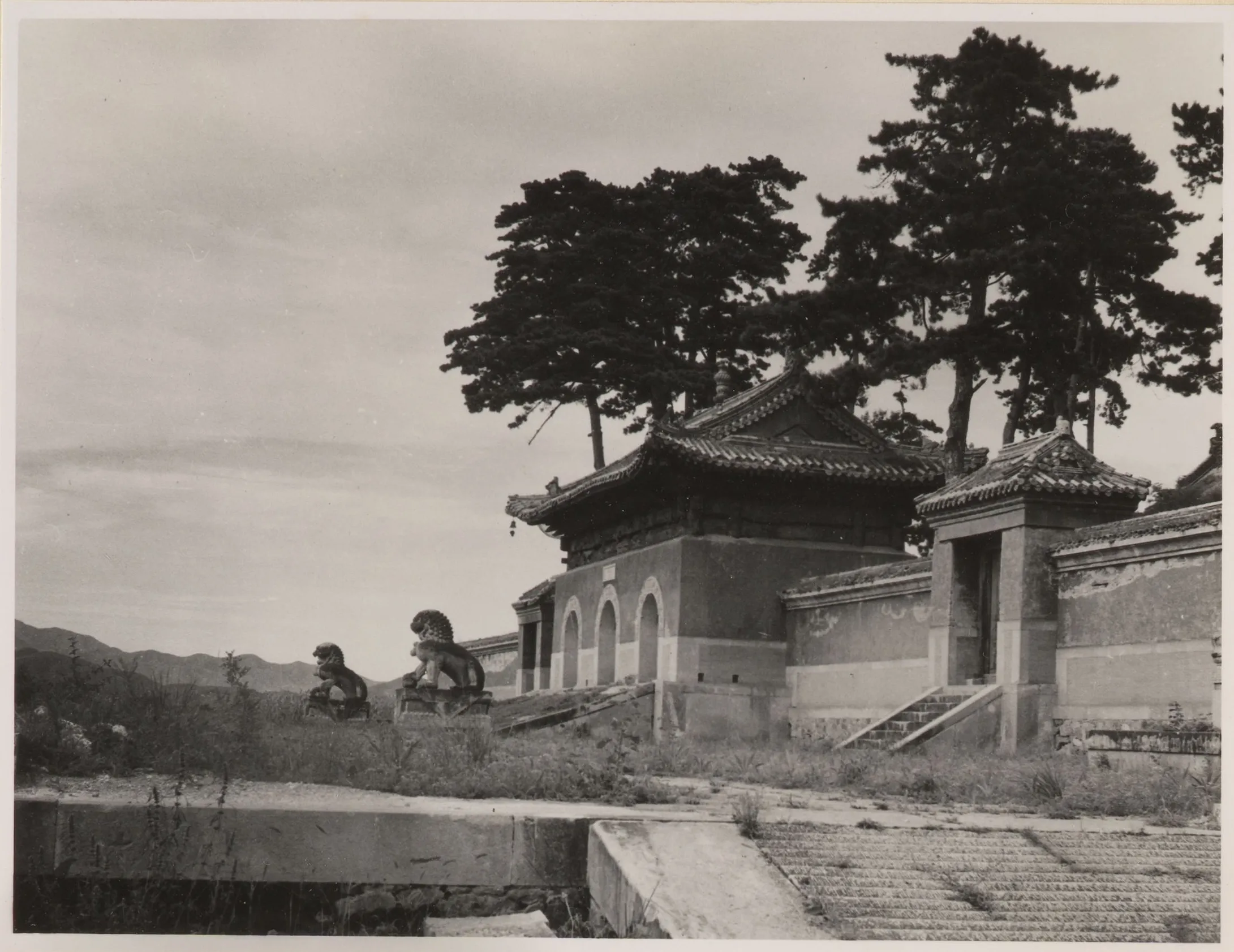
The Imperially Commissioned Gazetteer of Rehe also preserves the Qianlong Emperor’s poem “Crossing the River to Worship at Pule Temple”: he crosses the river to reach the temple, noting along the way the makeshift bridge of stone and timber and the grain and millet on the two banks, and says that the meaning of “universal joy” lies precisely in the harvest that can be hoped for, not in inquiring into the Buddhist “six perfections” (pāramitās). Old photographs from the 1930s and 1940s preserve the temple gate, Zongyin Hall, and Xuguang Pavilion, and allow us to see the whole composition: terraces rising tier upon tier, with the round Xuguang Pavilion set high above.
Historical Documents
《钦定热河志》 (Imperially Commissioned Gazetteer of Rehe)
普乐寺,在热河行宫东北二里许。西陲平定后,既建普宁寺、安远庙,以示绥怀。庙南地势宽广,三十一年复敕建兹寺。东向,御书门额曰“普乐寺”,前殿额曰“宗印殿”,左右配殿各一,北为胜因殿,南为慧力殿,皆兼清、汉、蒙古、唐古忒四体书。正殿供上乐王佛,额曰“福慧圆成”。联二,一曰:“龙象护诸天,毫相瞻时妙严普觉;漠瀛会初地,法轮转处安乐常臻。”一曰:“三摩印证喻恒河,人天皆大欢喜;七宝庄严现香界,广轮遍诸吉祥。”西有门达经坛,门内植碑一,恭镌御制碑记。坛上四面有门,东额曰“须弥增胜”,西额曰“舍卫现祥”。上有圆亭二层,前檐额曰“旭光阁”,皆兼四体书。亭中四面有联,东曰:“竺干法示西来意;震旦光圆东向因。”西曰:“化成层拱通乾闼;属国环归过月氐。”南曰:“花凝宝盖皈真相;云拥祥林现化身。”北曰:“妙演梵城超最上;广臻法会乐无遮。”又东山门一座,额曰“通梵门”,亦兼四体书。每岁秋巡,诸藩入觐,瞻礼金容,如上春台,同游化宇也。
Pule Temple lies some two li northeast of the traveling palace at Rehe. After the pacification of the western frontier, Puning Temple and Anyuan Temple had already been built to show soothing cherishment. The ground south of those temples being broad and open, in the thirty-first year [of the Qianlong reign] this temple was further built by imperial decree. It faces east; the emperor’s brush inscribed the gate plaque “Pule Temple,” and the plaque of the front hall reads “Zongyin Hall.” To left and right stands one side hall each, Shengyin Hall to the north and Huili Hall to the south, all inscribed concurrently in the four scripts of Manchu (Qing), Chinese, Mongolian, and Tangut (Tibetan). The main hall enshrines the King of Supreme Bliss Buddha (Chakrasamvara); its plaque reads “Perfect Consummation of Blessing and Wisdom.” There are two couplets. One reads: “Dragons and elephants guard the hosts of devas; as one beholds the ūrṇā mark, wondrous adornment and universal awakening. Peoples of desert and sea gather at this primal ground; where the Dharma wheel turns, peace and joy ever arrive.” The other reads: “The seal of samādhi attained is likened to the Ganges; men and devas are all filled with great joy. The adornment of the seven treasures reveals the fragrant realm; the broad wheel spreads over all that is auspicious.” To the west a gate leads to the scripture altar; within the gate stands a single stele, reverently engraved with the imperially composed stele inscription. On the altar there are gates on four sides: the eastern plaque reads “Mount Sumeru Augmented in Splendor,” and the western plaque reads “Śrāvastī Revealing Auspiciousness.” Above stands a round pavilion of two stories; the plaque at its front eave reads “Xuguang Pavilion,” all likewise in the four scripts. Within the pavilion there are couplets on four faces. The eastern reads: “The Dharma of Zhuqian (India) proclaims the intent of the coming from the West; in Zhendan (China) the light is made full in the cause of facing east.” The western reads: “Transformation completed, its tiered vaults reach through to Gandhāra; the subject states circle round in homage, coming from beyond the Yuezhi.” The southern reads: “Flowers gather into a precious canopy, taking refuge in the true marks; clouds throng the auspicious grove, revealing the transformation body.” The northern reads: “Wondrously expounded, the brahma-city surpasses the highest; the Dharma assembly, vast in reach, is a joy without hindrance.” There is also one eastern mountain gate, its plaque reading “Gate that Reaches the Brahma,” likewise in the four scripts. Each year on the autumn tour, the princes of the dependencies enter audience and gaze in worship upon the golden countenance, as though mounting the terrace of spring, roaming together in the realm of transformation.
野彴砌石架木,为涨来易圮亦易就。月前经雨兹重搘,便以渡河礼耆囿。彼岸平原多种田,低禾高黍如错绣。才十余日未曾观,则已吐穗硕且茂。或垂〈禾穗〉或仰〈柔穗〉总殊致,芃绿酿黄各争候。西成可望为额庆,时尚遥虞望难副。普乐之意原在斯,六波罗蜜非所究。
The rustic footbridge is piled of stones and laid with timbers, for after the floods it collapses easily, yet is easily rebuilt. A month ago it was wrecked by rain; now it has been propped up anew, and I avail myself of it to cross the river and worship at the venerable grove. On the far bank the level plain is full of planted fields, the low grain and the tall millet like an interwoven brocade. It is barely ten-odd days since I last looked, and already they have put forth ears, sturdy and lush. Some hang down 〈the grain ears〉 and some rise up 〈the pliant ears〉, each of a differing grace; their luxuriant green is brewing into yellow, each vying for its season. That the autumn harvest may be hoped for, I touch my brow in celebration; yet the season is still far off, and I fear the hope will be hard to fulfill. The meaning of universal joy lies from the first right here; the six pāramitās are not what I seek to probe.
《御制诗集》 (Imperial Poetry Collection)
伊犁耆定后,黄教示遐方。来觐都欢喜,〈兹寺以西陲大功告成,自丙戌春经始,丁亥秋蒇工。嗣后每岁各蒙古王公、扎萨克及卫拉特各部分班来觐者,无不仰瞻欢喜,如游春台化宇。详见向所制普乐寺碑记。〉成功久晏康。实非先所料,〈自西陲平定,至今三十年,伊犁无兵戈,来往新疆者夜行无滞,仰蒙眷佑,中外晏康,实非始用兵时所敢料也。〉益凛后无遑。罔不兴稼穑,惟祈若雨旸。
After Ili had been settled and pacified, the Yellow Church was shown forth to the distant quarters. Those who come to audience are all joyful 〈This temple, upon the accomplishment of the great work on the western frontier, was begun in the spring of the bingxu year and completed in the autumn of the dinghai year. Thereafter, each year, the Mongol princes, jasaks, and Oirat tribes who come to audience in their appointed rotations all gaze upward in delight, as if roaming upon the terrace of spring in the realm of transformation. For details see the Stele Inscription of Pule Temple composed earlier.〉; the work accomplished has long been at ease and in repose. Truly this was not what was foreseen at first 〈Since the pacification of the western frontier, thirty years have now passed; Ili has known no war, and those who travel to and from Xinjiang go by night without hindrance; looking up we have received gracious protection, and within and without all is tranquil—truly nothing we dared expect when the troops were first raised.〉; ever more awed, I have no leisure hereafter. Nowhere do the crops fail to flourish; I only pray for rain and sunshine in their season.
《普乐寺碑记》 (Stele Inscription of Pule Temple)
避暑山庄,当兴桓隩区,直北地亘狮沟,西南官廨民庐,聚落殷羡,独其东偏列嶂邈绵,周原案衍,则诸经所称广长清净,于佛土宜。乾隆乙亥,西陲大功告成,卫拉特各部长来会时事,尝肖西域三摩耶建寺曰普宁。嗣是达什达瓦属人内徙,即次旅居,环匝山麓。越岁乙酉,复于迤左仿伊犁固尔札都纲建庙曰安远。然自庙南延望锤峰,式垲式闳,厥壤犹隙。惟大蒙之俗,素崇黄教,将欲因其教,不易其俗,缘初构而踵成之。且每岁山庄秋巡,内外扎萨克觐光以来者,肩摩踵接,而新附之都尔伯特及左右哈萨克、东西布鲁特,亦宜有以遂其仰瞻,兴其肃恭,俾满所欲,无二心焉。咨之章嘉国师云:“大藏所载,有上乐王佛,乃持轮王佛化身,居常东向,洪济群品。必若外辟重闉,疏三涂,中翼广殿,后规阇城,内叠磴悬折而上置龛正与峰对者,则人天咸遂皈仰。”
The Mountain Resort lies in a sheltered recess of the region of Xing and Huan; directly north the land stretches to Lion Gully, and to the southwest the official buildings and commoners’ dwellings form thriving settlements. Only to its east do ranked peaks stretch far and unbroken, and broad plains spread level and wide—what the scriptures call vast and long, pure and clean, a fitting site for a Buddha-land. In the yihai year of Qianlong (1755), when the great work on the western frontier was accomplished and the chiefs of the Oirat tribes came to join the seasonal gathering, a temple was built in the likeness of Samye of the Western Regions and named Puning (Universal Peace). Thereafter the people of the Dashidawa moved within the frontier and were lodged in due order, encircling the foot of the hills. In the following yiyou year (1765), yet another temple was built to its left, in imitation of the dugang (assembly hall) of Ghulja in Ili, and named Anyuan (Pacifying the Distant). Yet looking south from that temple toward Hammer Peak, the ground there—high and dry, broad and grand—still lay vacant. As the custom of the great Mongols has always honored the Yellow Church, I wished to follow their religion without altering their customs, and to carry the first foundations through to completion. Moreover, each year at the autumn tour of the Mountain Resort, the inner and outer jasaks who come for audience jostle shoulder to shoulder and heel upon heel; and the newly submitted Dörbet, together with the Kazakhs of the Left and the Right and the Kirghiz of the East and the West, should likewise be given the means to fulfill their upward gazing and to stir their solemn reverence, so that their hopes may be satisfied and no second heart arise. I consulted the National Preceptor Changkya, who said: “In what the Great Canon records there is a King of Supreme Bliss Buddha (Chakrasamvara), an emanation of the Wheel-Holding King Buddha, whose dwelling ever faces east, vastly delivering all orders of beings. Only if without you open layered gate-walls and clear the three approaches, in the middle wing a broad hall, at the rear lay out the mandala-city, and within stack stairs that climb by winding turns to set a niche directly facing the peak—then men and devas will all have their refuge and veneration fulfilled.”
将作如制,以丙戌正月经始,洎丁亥八月讫工,爰取普乐颜寺额,而为之记曰:自西人之濒于涂炭也,湫隘阽危,不能终日,朕则为之求宁焉。既宁之后,奔走偕徕,室家还定,朕则为之计安焉。既宁且安,其乐斯在。譬如佛影覆于鸽身,四大得所,离怖畏想,生欢喜心,蕲自刹那以逮亿劫,同游春台化宇,乐其乐而不能名其乐,真上乐耳。虽然,曷易臻此哉?语曰:“民可与乐成,难与虑始。”又曰:“先天下之忧而忧,后天下之乐而乐。”是朕所由继普宁、安远而命之为普乐者,既以自慰,且重以自勖,而匪直梵文胜因福利之云云也。记成,并系以赞。
The construction was carried out according to this plan: it was begun in the first month of the bingxu year (1766) and completed by the eighth month of the dinghai year (1767). I thereupon took “Pule” (Universal Joy) to inscribe the temple’s plaque, and made this record for it: Ever since the western people neared the mire and the charcoal—low and cramped, trembling on the brink of peril, unable to last out the day—I sought tranquillity for them. Once they were tranquil, they came hurrying together, and their households returned and settled; I then planned security for them. Once tranquil and secure, herein lies their joy. It is like the Buddha’s shadow spreading over the dove’s body: the four great elements find their place, the thought of fear is left behind, a heart of joy is born, and they pray that from an instant to a hundred million kalpas they may roam together on the terrace of spring in the realm of transformation—rejoicing in their joy yet unable to name their joy: this is true Supreme Bliss. Even so, how easily is such a state attained? The saying goes: “The people may be made to share in the joy of completion, but cannot be made to share in the planning at the start.” It is also said: “Be first to worry at the world’s worries, and last to rejoice at the world’s joys.” This is why, following upon Puning and Anyuan, I named this temple Pule: both to comfort myself and, again, to exhort myself, and not merely for the Sanskrit texts’ talk of excellent causes, blessings, and benefits. The record completed, I append to it a hymn of praise.
善哉大能仁,无去亦无住。
How excellent, the great Muni of mighty benevolence, who neither departs nor abides.
以何因缘故,现此说法身。
By what cause and what condition does he manifest this body that expounds the Dharma?
人天咸护持,功德甚希有。云何称上乐?自小千、中千暨三千大千,法界无究竟。
Men and devas all uphold and shelter him; his merit and virtue are exceedingly rare. Why is he called Supreme Bliss? From the small thousand, to the middle thousand, to the three-thousand great-thousand world-systems, the Dharma-realm has no final limit.
尔时两足尊,甘露为灌顶。
At that time the Honored One of Two Feet pours the nectar of consecration upon the crown.
一切诸众生,若有情无情,念彼佛力者,受持陀罗尼。
All the multitude of beings, whether sentient or insentient, who keep that Buddha’s power in mind receive and uphold the dhāraṇī.
三世诸如来,神力并加汝。
The Tathāgatas of the three times together confer their spiritual might upon you.
第一具根性,即身得证佛。其次小乘人,得八大成就。灵丹净眼方,彻地智慧剑。空行遍周历,延年无疾病。
The foremost, endowed with the faculties and the nature, in this very body attain Buddhahood; next, the followers of the Lesser Vehicle obtain the eight great siddhis: the numinous elixir and the eye-cleansing recipe, the wisdom sword that pierces the earth, sky-going traversed everywhere, and lengthened years free of illness.
自洛义俱胝,无量僧祇劫,万行齐完满,求福不唐捐。
From lakṣas and koṭis of measureless asaṃkhyeya kalpas, the ten thousand practices are all brought to fulfillment, and the seeking of blessings is never spent in vain.
普种福德田,普荫如意树。普覆大慈云,普渡大愿船。
Universally he plants the field of blessing and virtue; universally he shades with the wish-fulfilling tree; universally he covers with the cloud of great compassion; universally he ferries across in the ship of the great vow.
震旦阎浮提,清宁共安隐。而彼狼荒俗,永脱修罗天。
In China, this Jambudvīpa, all is pure and tranquil, together secure; and those folk of the wolfish wilds are forever delivered from the asura realm.
合十白佛言,此是法王力。要知大自在。本分元自足,无苦强言乐,即堕分别相。
With palms joined I say to the Buddha: this is the power of the King of Dharma. One must know the Great Sovereign Ease: one’s original portion is in itself sufficient; to force talk of joy where there is no suffering is at once to fall into the mark of discrimination.
乐故无名名,上亦无等等。东峰开妙鬘,宝阁照旭光。举似曰出处,了了正知见。光与曰无尽,谁识所本来。八宝庄严成,香华天乐备。大会启无遮,同证无上道。
Joy, therefore, has no name that names it; the supreme, too, has none equal to it. The eastern peak opens into a wondrous garland; the precious pavilion shines with the light of dawn. Presented with the place where the sun comes forth, one sees clearly with right knowledge and view. The light and the sun are without end—who knows whence they first came? The adornment of the eight treasures is complete; incense, flowers, and heavenly music are all at hand. The great assembly opens, unhindered; together we realize the unsurpassed Way.
《钦定皇朝通典》 (Imperially Commissioned Comprehensive Statutes of the August Dynasty)
溥仁寺、普乐寺、安远庙、普陀宗乘庙、殊像寺千总各一人,副千总各一人。普宁寺、广安寺、罗汉寺把总各二人。行宫总管、苑副掌总理翊卫各处行宫及陈设稽察之政令。千总、副千总、把总,掌典守陈设、稽察内围,董率扫除之事。热河总管,康熙四十二年设。苑副,乾隆三十五年设。各处千总,康熙四十一年以来,陆续增设。
At Puren Temple, Pule Temple, Anyuan Temple, Putuo Zongcheng Temple, and Shuxiang Temple there is one first captain (qianzong) and one deputy first captain each; at Puning Temple, Guang’an Temple, and Luohan Temple there are two second captains (bazong) each. The superintendent-general of the traveling palaces and the park deputy are charged with the overall direction and guarding of the various traveling palaces, and with the administrative orders concerning furnishings and inspection. The first captains, deputy first captains, and second captains are charged with keeping the furnishings, inspecting the inner precincts, and directing the work of sweeping and cleaning. The Rehe superintendent was established in the forty-second year of the Kangxi reign (1703); the park deputy in the thirty-fifth year of the Qianlong reign (1770); and the first captains at the various sites have been added in succession since the forty-first year of the Kangxi reign (1702).
《钦定八旗通志》 (Imperially Commissioned General Gazetteer of the Eight Banners)
普乐寺,千总一人,副千总一人,委署副千总一人。
Pule Temple: one first captain, one deputy first captain, and one acting deputy first captain.
Historical Photographs
1930s–1940s
Hedda Morrison’s China album, photographed and assembled by Hedda Morrison between about 1933 and 1946, includes a group of old photographs captioned “Pule Temple,” recording the temple gate, the incense burner in the courtyard, Zongyin Hall, Xuguang Pavilion, and a glazed stupa.
1932–1940
The edited compilation Illustrated Catalogue of Chinese Historic Architecture includes one further old photograph captioned “Xuguang Pavilion of Pule Temple, Chengde, Rehe.” The editor Lin Zhu explains in the book’s preface that the photographs and measured drawings in the volume were taken from the Society for Research in Chinese Architecture’s surveys of historic architecture conducted between 1932 and 1940; the caption of this single photograph names neither photographer nor exact year, so it is provisionally assigned to this date range.
References
- Luo Zhewen, “Xuguang Pavilion of Pule Temple, Chengde,” Cultural Relics Reference Materials, 1956, no. 9, p. 52
- Li Keyu, “The Architectural Art of Pule Temple and Its Esoteric Buddhist Philosophy,” Tibetan Studies, 1984, no. 2, pp. 97–105
- Zhao Xiumei, “The Mandalas inside Pule Temple, Chengde,” Wenwu Chunqiu, 2008, no. 3, pp. 43–46, 81
- Chengde Municipal Cultural Relics Bureau and the Office of the Command Headquarters for the Cultural Heritage Conservation Project of the Chengde Mountain Resort and Its Outlying Temples, eds., Record of the Cultural Relics Conservation Works at Pule Temple, Chengde, Beijing: Cultural Relics Press, 2020
- Li Jianhong, “A Study of the Mandala of Pule Temple,” Journal of Gugong Studies, no. 25, 2023, pp. 236–256
- Bao Surina, “Pule Temple of Chengde and the Qianlong Emperor’s Thought on Statecraft, with a Discussion of Han–Tibetan Cultural Exchange,” Tibetan Studies, 2025, no. 2, pp. 26–36, 156