Introduction
Labrang Monastery stands in Xiahe County, Gannan Tibetan Autonomous Prefecture, Gansu, on the north bank of the upper reaches of the Daxia River. The name “Labrang” is a transliteration of the Tibetan word lachang (拉章, bla brang), meaning the residence of a living Buddha; Qing gazetteers also record its Tibetan name as “Jamkhyil,” from which the present-day name Tashikhyil Monastery derives. In the forty-eighth year of the Kangxi reign (1709), Chaghan Danjin, a Khoshut Mongol beile[1] of Qinghai (later advanced to prince), invited the eminent monk Ngawang Tsondru back to his homeland in the Daxia River valley to found the monastery, and donated five hundred households of his subjects to serve as its incense-and-fire households[2]. Ngawang Tsondru had previously served as the khenpo of Drepung Monastery in Lhasa—that is, as the monastery’s abbot—and is known to later generations as the First Jamyang Zhepa. In the autumn of the fiftieth year of the Kangxi reign (1711), the eighty-pillared Grand Sutra Hall was completed, followed in succession by the Jamyang Buddha Hall and the Lower Tantric College; the monastery and the town attached to it thus grew up on the north bank of the Daxia River, becoming in time a great Gelug-school[3] monastery of Tibetan Buddhism with six colleges and the seat of the successive Jamyang Zhepa incarnations.
The area in which Labrang Monastery lies had been incorporated into the territory of Xunhua Subprefecture by the Qianlong reign, yet the monastery itself remained under the jurisdiction of the Mongol commandery prince of Qinghai—as the saying went, “the monastery stands on subprefecture land, yet does not belong to the subprefecture.” During the Qianlong period the monks, relying on the commandery prince’s power, repeatedly disputed land with the neighboring Tibetan tribes, and lawsuits arose in an unending stream. Among these, the lawsuit with Heicuo Monastery ran for a full nineteen years. Beginning in the thirteenth year of the Qianlong reign (1748), Labrang Monastery sent monks to Heicuo Monastery to serve as its abbot (dharma-throne holder); by the thirty-seventh year it had sent seven men in succession. That year, the clergy and laypeople of Heicuo learned that the abbot their monastery had invited from Tibet in earlier years had been reborn at Songpan, and so they invited the new incarnation from Songpan instead. Labrang Monastery would not accept this, and its monk Jamyang promptly filed a plaint. The case passed through multiple rounds of judgment and reversal at the hands of the Qinghai Imperial Resident, the prefect of Lanzhou, and the deputy subprefect of Xunhua before it was finally settled in the fifty-fifth year of the Qianlong reign (1790) on the principle of “each monastery governing itself.” Gong Jinghan, the Xunhua deputy subprefect who compiled the gazetteer, wielded an even heavier brush against this monastery. In his comment he stated plainly that “Labrang Monastery is, after all, immensely wealthy,” called it outright “a plague in the very heart of Xunhua,” and advocated demolishing the monastery and rebuilding it in Mongol territory, “so as to cut off future trouble.”
In the twenty-second year of the Jiaqing reign (1817), Labrang Monastery went to law with Rongwo Monastery, southwest of Xunhua, over the jurisdiction of a monastery. Narsungga, the Xining Imperial Resident, credited the one-sided account of the Labrang Monastery lamas and wrote to Changling, Governor-General of Shaanxi and Gansu, proposing to mobilize three or four thousand Salar troops (forebears of today’s Salar people) to exterminate the Rongwo side, the captured livestock to be rewarded to the soldiers. The following year Changling impeached Narsungga for rashly moving troops without even examining the case files, and the court, holding him “unfit for the post of Imperial Resident,” had him handed over to the ministry for deliberation and discipline. In the early Daoguang reign, Nayancheng, Governor-General of Shaanxi and Gansu, set Qinghai’s Tibetan affairs in order and regarded Labrang Monastery as a strategic point to be fortified. The monastery was the collecting-and-distributing route by which the Tibetans of the Songpan region in Sichuan trafficked tea, lead and sulfur, ironware, and grain rations, and the commissioner sent to survey the ground petitioned to establish a checkpoint beside the monastery, with a permanent garrison of one hundred soldiers to keep watch. Discussing Tibetan affairs, Nayancheng estimated that the three monasteries of Labrang, Tsongkha, and Rongwo “draw together as many as twenty or thirty thousand lamas”—the clergy too numerous to guarantee that no evildoers lurked among them; and the ban on tea and grain rations was tantamount to gripping these great monasteries by the lifeline.
In the twelfth year of the Tongzhi reign (1873), the Tibetans of the eight tribes of Mewu petitioned to be transferred to the jurisdiction of Taozhou, and Zuo Zongtang, Governor-General of Shaanxi and Gansu, ruled that Labrang and the Mewu tribes “form a single whole” and transferred them together to Taozhou; at the same time he noted that the various monasteries of Labrang paid over five thousand taels of the likin[4] they levied on goods into the public account, while “the more than two hundred thousand taels they collect and spend each year have never been questioned.” The following year, in Zuo Zongtang’s memorial reporting the accounts of Shaanxi–Gansu military expenditures, there also appeared an item “received: a donation of 4,816 taels of silver from the Labrang Tibetan monastery of Gansu.” In the eighth year of the Guangxu reign (1882), when the authorities investigated long-standing cases among the Tibetan tribes, the Jamyang Khutukhtu came forward to exhort the Tibetans to submit, and for this merit was rewarded with the title “Chan Master Guangji”—“Khutukhtu” being the rank the Qing court conferred upon great living Buddhas. At the end of the fifteenth year of the Guangxu reign (1889), Tibetan monks of Labrang Monastery in Xunhua Subprefecture provoked an armed affray; after it was suppressed, the case was settled according to Tibetan customary law. On the same day the court sternly ordered Labrang Monastery to hand over Bangzhou, a fugitive pursued by Sichuan. By the eighteenth year of the Guangxu reign (1892) the case was still unresolved, and the Jamyang Khutukhtu himself stood accused; the court ordered the Governor-General of Shaanxi and Gansu and the Sichuan side each to send officials to investigate. The matter was not concluded until the twenty-third year of the Guangxu reign (1897): Labrang Monastery withdrew from the Sichuan-border Tibetan stockades it had occupied and paid compensation in silver and goods, while Bangzhou was never captured.
In June of the sixteenth year of the Republic (1927), Gansu Province established the Labrang Administrative Bureau—a transitional body preceding the creation of a county—directly under the provincial government; in the first month of the following year it was reorganized as Xiahe County, named after the Daxia River. A Republican-era gazetteer, recording the architecture of Gansu, made a point of noting: “At Labrang Monastery in Xiahe County, the gilded roofs are especially numerous.” Beginning in 1932, the American journalist Harrison Forman visited Labrang Monastery repeatedly, leaving a systematic photographic record of the monastery; among his 1937 photographs are Buddha halls under repair behind scaffolding, as well as the Fifth Jamyang Zhepa, Tenpai Gyaltsen, who had just turned twenty-one.
During the War of Resistance against Japan, the Fifth Jamyang Zhepa organized the one hundred and eight monasteries attached to Labrang and the various tribes to support the front. In 1938 he sent his third elder brother, Huang Zhengji, to lead a delegation of clergy and laypeople to Chongqing and the various war zones to offer comfort; in 1943 he composed the Letter to Our Mongolian and Tibetan Compatriots Propagating the War of Resistance and Reconstruction, printed in both Tibetan and Chinese, which he carried to the pastoral regions where Gansu, Qinghai, and Sichuan meet to preach; and together with his elder brother Huang Zhengqing he launched a donation drive that raised a sum sufficient to buy thirty airplanes, for which the National Government bestowed upon Labrang Monastery a plaque inscribed “Contributing Wealth to Defend the Nation.” At the end of the letter he made this vow: “May the soldiers of the War of Resistance enjoy peace and happiness for generations, may the nation stand firm for ten thousand years, and may the world enjoy everlasting peace.”
Historical Documents
《循化厅志》 (Gazetteer of Xunhua Subprefecture)
拉卜楞寺在甘家寨,青海蒙古郡王所辖。
Labrang Monastery is at Ganjia Stockade, under the jurisdiction of the Mongol commandery prince of Qinghai.
按拉卜楞寺,番名札木奇尔,寺在厅地而非厅所属。僧众杂还,倚恃郡王之势,屡与各番争地,控案不一而足。又招内属番族为其所属,或藏匿亡命,此循化腹心之一害也。当令拆毁,于蒙古界别建寺字,不许在内地,以绝后患。拉卜楞即拉布楞,番语也。
Note: Labrang Monastery, whose Tibetan name is Jamkhyil, stands on subprefecture land yet is not subject to the subprefecture. Its monks, a motley multitude, rely on the commandery prince’s power and have repeatedly disputed land with the various Tibetan tribes; lawsuits are beyond counting. It has also drawn internally subject Tibetan tribes into its own allegiance and sometimes harbors fugitives: this is a plague in the very heart of Xunhua. It should be ordered demolished and its temple buildings erected anew within Mongol territory, and not permitted in the interior, so as to cut off future trouble. “Labuleng” (拉卜楞) is the same as “Labrang” (拉布楞); both are Tibetan words.
黑作寺在黑作寨厅治南二百八十里。
Heizuo Monastery is at Heizuo Stockade, two hundred and eighty li south of the subprefecture seat.
按今呼黑错寺,番名札木喀尔寺,据拉卜塄呈,又称为加卡尔寺。
Note: it is now called Heicuo Monastery; its Tibetan name is Jamkhar Monastery, and according to a submission from Labrang it is also called Jakar Monastery.
康熙二十一、二年间,土官喇嘛盆错却合旦建。雍正二年,该番投诚,始归厅辖。寺内住持,前为蒙古亲王代庆和硕齐于西藏请噶尔旦胡图克图即夕只喇嘛,未详年分,是为该寺法台之始。其后夕只喇嘛赴藏物故,至乾隆十三年,始以拉卜楞寺僧在黑错寺坐床管事,至三十七年,前后共选七人。嗣黑错僧俗闻夕只转生出世,在松潘地方,而拉卜楞寺所放法台又作践滋扰,心怀不服,遂于松潘请喇嘛坐床管事。而拉卜楞寺僧加木样又名札木养,不甘,于三十七年八月呈控青海都统伍,同知张春芳未及细查,但照旧令拉卜楞寺选放。黑错不遵,拉卜楞寺僧又控,都统委大喇嘛索克𠂔、通事刘福才,会同张同知审断,令各管各寺,其法台仍由黑错自行延请,详批完结。
The monastery was built in the twenty-first or twenty-second year of the Kangxi reign by the native official Lama Pencok Chohedan. In the second year of the Yongzheng reign this tribe pledged allegiance and first came under the subprefecture’s jurisdiction. As for the monastery’s abbacy: formerly—though the year is not recorded—the Mongol prince Daiching Khoshchi invited from Tibet the Galdan Khutukhtu, that is, Lama Xizhi, and this was the beginning of the monastery’s dharma-throne line. Later Lama Xizhi went to Tibet and died there. It was not until the thirteenth year of the Qianlong reign that a monk of Labrang Monastery was first enthroned at Heicuo Monastery to take charge of its affairs; by the thirty-seventh year, seven men had been selected in all. Subsequently the clergy and laypeople of Heicuo heard that Xizhi had been reborn and appeared in the Songpan region; and as the abbot installed by Labrang Monastery had moreover been abusive and troublesome, they grew resentful and invited a lama from Songpan to be enthroned and take charge. The Labrang monk Jamyang—whose name is also written 札木养—would not accept this, and in the eighth month of the thirty-seventh year he filed a plaint with Wu, the Qinghai Imperial Resident. Deputy Subprefect Zhang Chunfang, without examining the matter closely, simply ordered Labrang Monastery to make the appointment as before. Heicuo refused to comply, and the Labrang monks filed another plaint. The Imperial Resident delegated the Grand Lama Soktsa and the interpreter Liu Fucai to judge the case jointly with Deputy Subprefect Zhang; they ruled that each side should govern its own monastery, the dharma-throne still to be filled by Heicuo’s own invitation, and on approval of the report the case was closed.
其后都统伍离任,加木样又翻控,委河州业中、候补知县黎珠,同青海员外即百,于三十九年诣黑错查讯,因该寺有当年蒙古亲王改建之说,议令法台由郡王选放,不得仍放拉卜楞寺僧。而加木样不遵断出结,复控都宪。四十一年,委署兰州府康基田、前同知张春芳、署同知谢桓会审,议以黑错寺与拉卜楞寺蒙古喇嘛本无干涉,番民公共香火延请法台,自应听从民便。加木样本不得违众强争,而该处寺院僧俗悉属内地粮民,蒙古喇嘛尤不得公然争控。其所执印照,一为康熙三十七年达赖喇嘛给盆错却合旦之物,拉卜楞既代管多年,何难窃取而托之前生相好布施,不知死后照存何处,转生又何以偕来?妄诞已甚。一为乾隆二十九年章嘉呼图克图所给,内载西北蒙古部落,东南至松潘,并喀加六族皆属管,而今查讯喀加二十一寨寺庙,并无该寺放法台者;一为乾隆十三年蒙古亲王江克楚所给,其中以朝廷粮户属之喇嘛,尤属不合。应请照前次西宁大喇嘛所断,各管各寺,各具译结存案,并咨明理藩院立案。批准饬遵,并咨青海大人,饬郡王追销执照。加木楞未遂所欲,以审断不公,复控青海,移咨查讯。四十二年,饬谢同知传唤两造赴省,而谢桓擅带官兵二千人,将黑错僧俗诱获解讯,以致黑错畏惧求和,仍令加木样选放法台,移咨青海,勒石饬遵。然终不能服黑错之心,因转生之夕只喇嘛尚幼,隐忍十余年。至五十四年,遂自放管事,逐出拉卜楞寺所放法台。加木样又控,经厅营会禀,饬司查案议详:以黑错僧俗七百余户,久隶循化厅管辖,耕田输赋,为内地户民。拉卜楞寺系蒙古郡王所辖,何得以外服喇嘛,思将内地粮户占为己有?且寺内法台,乾隆十三年以前,不经拉卜楞寺选放,则黑错寺本非拉卜楞所管,已可概见。所云前生布施,本妄诞之词。果有此情,青海之大喇嘛又何以断令各管各寺?其为借端妄争,已无疑义。今黑错已将旧日法台之夕只喇嘛仍请入寺,是原人仍归本寺,更无可争。从前谢同知谬断,前司草率议结,以久经咨明理藩院之案,忽而翻断,又不咨明理藩院而私勒石,实为错谬。应照从前各管各寺,咨明理藩院查照,并咨青海都统,将加木样严加管束。总督批准,并出示晓谕两寺。
Later, after Imperial Resident Wu left office, Jamyang filed a fresh plaint to overturn the judgment, and the Hezhou official Yezhong, the expectant county magistrate Lizhu, and Jibai, a vice director of the Qinghai establishment, were delegated to go to Heicuo in the thirty-ninth year to investigate. Because there was a claim that the monastery had been rebuilt by the Mongol prince in earlier years, they proposed that the dharma-throne be filled by the commandery prince’s appointment, and that Labrang monks no longer be installed. Jamyang, however, would neither accept the judgment nor close the case, and lodged another plaint with the Censorate. In the forty-first year, Kang Jitian, acting prefect of Lanzhou, the former deputy subprefect Zhang Chunfang, and the acting deputy subprefect Xie Huan were delegated to hold a joint hearing. They held that the Mongol lamas of Heicuo Monastery and Labrang Monastery had never had anything to do with one another; that inviting a dharma-throne holder being a matter of the Tibetan people’s communal worship, the people’s convenience should naturally be followed; that Jamyang ought not to have pressed the quarrel against the community’s will; and that the clergy and laypeople of that monastery were all grain-tax-paying subjects of the interior, whom the Mongol lamas especially could not be permitted to sue openly. Of the seals and patents Jamyang held: one had been given by the Dalai Lama to Pencok Chohedan in the thirty-seventh year of the Kangxi reign; but since Labrang had managed the monastery for many years, what difficulty would there have been in stealing it and claiming it was a gift from a friend in a previous life? Who knows where the patent was kept after his death, and how could it have been brought along when he was reborn? The absurdity is extreme. Another had been given by the Changkya Khutukhtu in the twenty-ninth year of the Qianlong reign, stating that the Mongol tribes from the northwest and as far as Songpan in the southeast, together with the six tribes of Kaja, were all under his jurisdiction; yet investigation of the monasteries of the twenty-one stockades of Kaja found none with a dharma-throne installed by that monastery. The third had been given by the Mongol prince Jiangkechu in the thirteenth year of the Qianlong reign, in which households paying grain tax to the court were assigned to the lamas—especially improper. It was proposed to follow the previous judgment of the Grand Lama of Xining: each side governing its own monastery, each submitting a closing statement in translation for the record, with the Court of Colonial Affairs to be notified so that the case could be placed on file. This was approved and ordered to be obeyed, and the Qinghai authorities were notified to direct the commandery prince to recall and cancel the patent. Jamyang, having failed to get his way, lodged another plaint with Qinghai on the grounds that the trial had been unfair, and a communication was sent requesting investigation. In the forty-second year, Deputy Subprefect Xie was ordered to summon both parties to the provincial capital; but Xie Huan, on his own authority, took two thousand government troops, tricked the Heicuo clergy and laypeople into capture, and sent them under escort for trial, so that Heicuo sued for peace out of fear, and Jamyang was again allowed to appoint the dharma-throne; Qinghai was notified, and the order was carved in stone for compliance. Yet Heicuo’s hearts could never be won over; because the reborn Lama Xizhi was still a child, they bore it in patience for more than ten years. In the fifty-fourth year they finally appointed their own manager and expelled the dharma-throne holder installed by Labrang Monastery. Jamyang filed another plaint, and upon the joint report of the subprefecture and the garrison, the provincial office was ordered to examine the case and deliberate in detail: the seven-hundred-odd households of Heicuo’s clergy and laypeople had long been subject to the jurisdiction of Xunhua Subprefecture, tilling fields and paying taxes as registered people of the interior; Labrang Monastery was subject to the Mongol commandery prince—by what right could a lamasery of an outer dependency claim the grain-tax households of the interior as its own? Moreover, before the thirteenth year of the Qianlong reign the monastery’s dharma-throne was not appointed by Labrang Monastery, which makes plain enough that Heicuo Monastery was never under Labrang’s control. The talk of gifts in a previous life is inherently absurd; had there truly been such a thing, why would the Grand Lama of Qinghai have ruled that each govern its own monastery? That this is a trumped-up dispute is beyond doubt. Now that Heicuo has invited back into the monastery the former dharma-throne holder Lama Xizhi, the original man has returned to his own monastery, and there is nothing further to dispute. The former Deputy Subprefect Xie’s erroneous judgment and the former office’s hasty closure—suddenly reversing a case that had long been reported to the Court of Colonial Affairs, and privately carving the decision in stone without notifying the Court—were truly mistaken. The case should revert to the former arrangement of each governing its own monastery; the Court of Colonial Affairs should be notified for its reference, and the Qinghai Imperial Resident should be asked to place Jamyang under strict control. The Governor-General approved and issued a proclamation to make this known to both monasteries.
按:谢同知即四十一年同康署府会审之人,未及一年,自行翻案,闻当时实有所为而然。盖拉卜楞寺本豪富也。此案自三十七年至五十五年七月始结,凡十九年。今加木样已死,争端庶几永息矣。
Comment: Deputy Subprefect Xie is the very man who had sat in the joint hearing with Acting Prefect Kang in the forty-first year; within a year he had reversed the case himself, and it is said there was indeed something behind it at the time. Labrang Monastery was, after all, immensely wealthy. This case, from the thirty-seventh year to its settlement in the seventh month of the fifty-fifth year, lasted nineteen years in all. Now that Jamyang is dead, the dispute may perhaps be stilled forever.
《辛卯侍行记》 (Diary of a Journey in Attendance in the Xinmao Year)
循化东南三十里张尕工,折西南十里崖慢工,皆撒拉地。十里夕厂沟,有东乡番五寨。南行五十里甘家川,居捏工丨之西,莽剌川之东番族。插帐游牧地五十里拉布楞寺南番十二寨,南抵和硕特南右翼中旗地。拉布楞南有达那河,俗呼大夏河之上游也。如河东北行四十里拉家寺,五十丂里沙沟寺,十五里哈家寺。寺东逾山,即河州老鸦关。寺南七十里黑错寺。黑错东北一日程卡家寺。又东北二百余里至石嘴关,河州商旅赴南番贸易之径也。黑错东南五十里买吾寺,八十里根岔,入洮州番地。六十里旧洮城,四十里杨土司卓尼城。今土司杨作霖,已传十六世,所辖四十八旗,十二章哈族,封疆千余里,俨然牧伯也。卓尼东南渡洮入岷山,经上铁布、下铁布野番上下包坐寨。其八日至四道城,为四川松潘北境。
Thirty li southeast of Xunhua is Zhanggagong; turning southwest, ten li further is Yamangong; both are Salar territory. Ten li beyond is Xichang Gully, where there are five stockades of Dongxiang Tibetans. Fifty li south is the Ganjia River, lying west of Niegong and east of the Mangla River, ground where Tibetan tribes pitch their tents and roam. Fifty li further is Labrang Monastery, with twelve Tibetan stockades to its south, reaching south as far as the land of the Khoshut Southern Right-Wing Middle Banner. South of Labrang is the Dana River, popularly called the upper course of the Daxia River. Following the river northeast: forty li to Lajia Monastery, fifty-odd li to Shagou Monastery, and fifteen li to Hajia Monastery. East of the monastery, across the mountains, lies the Laoya Pass of Hezhou. Seventy li south of the monastery is Heicuo Monastery. One day’s journey northeast of Heicuo is Kajia Monastery. A further two hundred-odd li northeast leads to the Shizui Pass, the route by which Hezhou merchants travel to trade with the southern Tibetans. Fifty li southeast of Heicuo is Mewu Monastery; eighty li further is Gencha, entering the Tibetan lands of Taozhou. Sixty li on is the old Taozhou city, and forty li further is Joné, the city of the Yang chieftain. The present chieftain, Yang Zuolin, is of the sixteenth generation; he governs forty-eight banners and the twelve Zhangha tribes, a domain of over a thousand li—in every way a border lord. Southeast of Joné one crosses the Tao River into the Min Mountains, passing through Upper Tiebu, Lower Tiebu, and the upper and lower Baozuo stockades of the wild Tibetans. Eight days beyond them one reaches Sidao City, on the northern frontier of Songpan in Sichuan.
循化西南行四十里,边堵沟十里、边堵塘边堵番七寨。二十里,尕楞沟有下隆务、西番六寨。三十里,上隆务二十里、保安营小堡在山上,有都司。二十里吴屯前明吴、李等四姓防戍留此,言语衣服,变从番族,谓之土民。十里隆务寺上隆务西番十六寨寺东一百二十里有阿巴。那西番八寨。又东南一百十里即拉布楞矣。
Traveling southwest from Xunhua: forty li to the Biandu Gully; ten li further are the Biandu Pond and the seven Biandu Tibetan stockades. Twenty li on, at the Galeng Gully, are Lower Rongwo and six stockades of Western Tibetans. Thirty li on is Upper Rongwo; twenty li further is the small fort of Bao’an Camp on the hill, where a major is posted. Twenty li further is Wutun: in the former Ming, garrison soldiers of the four families Wu, Li, and others were left behind here; their speech and dress have changed to follow the Tibetans, and they are called the native people. Ten li further is Rongwo Monastery, with the sixteen stockades of the Upper Rongwo Western Tibetans. One hundred and twenty li east of the monastery is Abana, with eight stockades of Western Tibetans. Another one hundred and ten li southeast brings one to Labrang.
《平番奏议》 (Memorials on the Pacification of the Tibetans)
当即查勘地势保安营迤西惟黑加硖口为贵德硕乃黑贼番潜入之所应请安设卡隘一处把总一员外委一员兵丁五十名保安营迤南宗卡寺为西南番兴贩口粮接济野番出入之要路应请安设卡隘一处千总一员把总一员外委二员兵丁八十名循化营属迤东南拉布楞寺为四川松潘番子兴贩茶叶铅磺铁觔口粮之总路应请安设卡隘一处守备一员把总一员外委二员兵丁一百名
Having examined the terrain forthwith: west of Bao’an Camp, only the Heijia Gorge pass is a place where the bandit Tibetans of Shonai in Guide slip in; a checkpoint should be established there, with one ensign, one supernumerary officer, and fifty soldiers. South of Bao’an Camp, Tsongkha Monastery is a key route by which the southwestern Tibetans traffic in grain rations to supply the wild Tibetans coming and going; a checkpoint should be established there, with one lieutenant, one ensign, two supernumerary officers, and eighty soldiers. Southeast of the Xunhua Battalion’s jurisdiction, Labrang Monastery is the main route by which the Tibetans of Songpan in Sichuan traffic in tea, lead and sulfur, ironware, and grain rations; a checkpoint should be established there, with one captain, one ensign, two supernumerary officers, and one hundred soldiers.
夕厂又为汉奸兴贩口粮茶布出入之要路应请安设卡隘一处把总一员外委一员兵丁五十名中库沟路通贵德巴燕戎撒拉汉奸兴贩口粮往拉布楞寺之要路应请安设卡隘一处把总一员外委一员兵丁四十名奇台堡营迤南桥沟为河州土门关汉回奸民兴贩口粮茶布夹带违禁各物之路应请安设卡隘一处外委一员兵丁四十名以上安设卡隘六处官十五员兵丁共三百六十名参将都司按月轮流亲履查勘
Xichang, again, is a key route for renegade Han trafficking in grain rations, tea, and cloth; a checkpoint should be established there, with one ensign, one supernumerary officer, and fifty soldiers. Zhongku Gully, connecting to Guide, is a key route for Bayanrong Salar renegades trafficking grain rations toward Labrang Monastery; a checkpoint should be established there, with one ensign, one supernumerary officer, and forty soldiers. South of Qitai Fort Camp, Qiao Gully is a route for Han and Muslim smugglers from the Tumen Pass of Hezhou trafficking grain rations, tea, and cloth with contraband goods mixed in; a checkpoint should be established there, with one supernumerary officer and forty soldiers. Of the six checkpoints established above, with fifteen officers and three hundred and sixty soldiers in all, the colonel and the major shall take turns inspecting them in person each month.
现据隆务寺苏拉喇嘛旧昂赏根敦尖木错新昂𧴺根敦什加布同称该族所管番侩一千余家皆系熟番种地者十之三四余俱牧放为业其不敷口粮向由巴燕戎之甘都堂地方并拉布楞寺二处驮运应请责令隆务寺新旧昂负查明不敷粮数每年请票易换并严禁该僧人等亦不得私入内地各自易换口粮以杜接济野番之獘
It is now reported jointly by the Sula lama of Rongwo Monastery, the former ang Gendun Jamtso, and the new ang Gendun Shijab that the thousand-odd Tibetan broker households under their tribe’s management are all settled Tibetans, of whom three or four tenths farm while the rest make their living by herding; the grain rations they lack have hitherto been hauled from two places, Gandutang in Bayanrong and Labrang Monastery. It should be ordered that the former and new angs of Rongwo Monastery investigate and ascertain the quantity of grain they lack and obtain permits each year to exchange for it, and that those monks be strictly forbidden from entering the interior privately to barter for rations on their own, so as to stop the abuse of supplying the wild Tibetans.
又拉布浪宗卡隆务招聚喇嘛至二三万人僧侣太繁中藏奸宄亦情事所必有而茶粮之禁我已制其生死之命亦无难逐细编查清其流獘
Moreover, Labrang, Tsongkha, and Rongwo draw together as many as twenty or thirty thousand lamas; with the clergy so numerous, that traitors lurk among them is only to be expected. Yet through the ban on tea and grain we already hold their very lives in our hands, so it will not be difficult to register them one by one in detail and purge the abuses that have crept in.
《懋亭自定年谱》 (Self-Compiled Chronological Biography of Maoting)
六月二十九日具奏西宁办事大臣纳尔松阿来信言拉布楞寺喇嘛与隆务昂肖控争随桑喇嘛所居寺院并未杳看案卷率听拉布楞寺喇嘛呈控之言即欲檄调撒拉儿兵三四千名将隆务昂肖剿灭所获牲畜赏给撒抗儿兵丁以完其事
On the twenty-ninth day of the sixth month, I memorialized: the Xining Imperial Resident Narsungga wrote to say that the lamas of Labrang Monastery and the Angxiao of Rongwo were litigating over the monastery where the Suisang lama resides; without even looking into the case files, and credulously heeding the plaint of the Labrang Monastery lamas, he wished at once to order the mobilization of three or four thousand Salar troops to exterminate the Rongwo Angxiao, the captured livestock to be rewarded to the Salar soldiers, so as to finish the matter.
《清实录》 (Veritable Records of Qing)
壬子,谕内阁:长龄奏西宁办事大臣纳尔松阿办理蒙古番子事务,粗心轻率一折。上年拉布楞寺喇嘛与隆务昂𭕆控争寺院,纳尔松阿辄听拉布楞寺喇嘛之言,札致长龄,欲檄调撒拉尔兵三四千名,将隆务昂𭕆剿灭,实属冒昧。纳尔松阿不胜办事大臣之任,著交部议处,即来京听候部议。
On the renzi day, an edict to the Grand Secretariat: Changling has memorialized that the Xining Imperial Resident Narsungga handled Mongol and Tibetan affairs with carelessness and rashness. Last year, when the Labrang Monastery lamas and the Rongwo Angxiao were litigating over a monastery, Narsungga simply heeded the Labrang Monastery lamas’ account and wrote officially to Changling, wishing to order the mobilization of three or four thousand Salar troops to exterminate the Rongwo Angxiao—truly reckless. Narsungga is unfit for the post of Imperial Resident; let him be handed over to the ministry for deliberation and discipline, and let him come at once to the capital to await the ministry’s decision.
丙子,谕内阁:理藩院奏遵议呼图克图开导番族出力奖叙一折,嘉木样呼图克图于查办番族积案之时,切为开导,俾番众倾心向化,实属深明大义,志向可嘉。加恩著赏给广济禅师名号,以示优异。
On the bingzi day, an edict to the Grand Secretariat: The Court of Colonial Affairs has memorialized in compliance on the matter of commending the Khutukhtu who exerted himself in exhorting the Tibetan tribes. When the long-standing cases of the Tibetan tribes were being investigated, the Jamyang Khutukhtu earnestly exhorted them, causing the Tibetan people to turn their hearts to civilization; he truly understands the great principles deeply, and his resolve is commendable. By special grace, let him be granted the title Chan Master Guangji, so as to show exceptional favor.
四川总督刘秉璋奏:请饬陕甘总督等将番匪棒周解川审办。得旨:著即咨行杨昌濬、萨凌阿,严饬拉布浪寺,将首匪棒周交出,解赴四川,归案审办。
The Governor-General of Sichuan, Liu Bingzhang, memorialized: please order the Governor-General of Shaanxi and Gansu and others to send the Tibetan bandit Bangzhou to Sichuan under escort for trial. He received the decree: Let an official communication be sent at once to Yang Changjun and Saling’a, strictly ordering Labrang Monastery to hand over the arch-bandit Bangzhou, to be escorted to Sichuan and brought to trial in that case.
陕甘总督杨昌濬等奏:甘肃循化厅拉布楞寺番僧搆衅械斗,业经弹压解散,照番例断结,请将出力各员酌予奖叙。得旨:著准其酌保数员,毋许冒滥。
The Governor-General of Shaanxi and Gansu, Yang Changjun, and others memorialized: the Tibetan monks of Labrang Monastery in Xunhua Subprefecture, Gansu, provoked a feud and fought with weapons; they have already been suppressed and dispersed, and the case has been settled according to Tibetan customary law. We request that the officials who rendered service be granted appropriate commendations. He received the decree: Let several of them be recommended as appropriate, without reckless excess.
谕军机大臣等:杨昌濬、奎顺奏查明川属番案大概情形一折。据称拉布浪寺呼图克图、嘉木样被控各节,现已派员究办。惟棒周系川属热档坝土百户之侄,是否逃回该坝,抑窜入果洛克番族,均属川省所辖,请饬该将军、总督就近缉拏讯办。等语。此案日久未结,必应迅将棒周严拏到案,即著雅尔坚、刘秉璋迅饬所属严密查拏,归案审办。并著杨昌濬等督饬派出之员,认真查办,总期妥速办结,毋得彼此推诿,再事耽延。杨昌濬等原折著钞给雅尔坚、刘秉璋阅看。将此谕知雅尔坚、刘秉璋、杨昌濬,并传谕奎顺知之。
An edict to the Grand Council ministers and others: Yang Changjun and Kuishun have memorialized the general circumstances of their investigation into the Tibetan case under Sichuan’s jurisdiction. It is stated that the various accusations against the Khutukhtu of Labrang Monastery, Jamyang, have now been assigned to officials for prosecution. However, Bangzhou is the nephew of the native centurion of Redangba under Sichuan’s jurisdiction; whether he has fled back to that ba or has slipped into the Golok Tibetan tribes, all falls within Sichuan Province’s jurisdiction, and it is requested that the general and the governor-general there be ordered to make the arrest and conduct the trial nearby. So runs the memorial. This case has long gone unconcluded; Bangzhou must swiftly be arrested and brought to trial. Let Yaljian and Liu Bingzhang at once direct their subordinates to search strictly and arrest him, and bring him to trial in the case. Let Yang Changjun and others also supervise and direct the officials they have dispatched to investigate earnestly, aiming always to conclude the case properly and speedily; they must not shift blame back and forth and delay matters further. Let the original memorial of Yang Changjun and others be copied for Yaljian and Liu Bingzhang to read. Let this be made known by edict to Yaljian, Liu Bingzhang, and Yang Changjun, and let it also be conveyed to Kuishun for his information.
又谕:恭寿、刘秉璋奏:甘省拉布浪寺侵占川番各寨,请饬严办一折。据称甘省查办番案,拉布浪寺嘉木㨾窝藏匪犯棒周,串同抢劫,纵令黑窝、香错等率兵侵占焚掠,杨昌濬等漫无觉察,以致案久未结。请饬勒令该寺退还各寨,撤回管寨喇嘛,并严办带兵焚掠之黑窝。等语。此案前经谕令杨昌濬等派员认真查办,并令恭寿等会商妥办,不得互相推诿。兹据恭寿等所奏各节,是拉布浪寺显有欺诳刁抗情形,亟应彻底查究,以遏乱萌。即著杨昌濬等按照川省所指各节,懔遵前旨,确切查办,迅速覆奏,不得稍涉回护,致干咎戾。恭寿等折著钞给杨昌濬、奎顺阅看。将此各谕令知之。
A further edict: Gongshou and Liu Bingzhang have memorialized that Labrang Monastery of Gansu Province has encroached upon and occupied various stockades of the Sichuan Tibetans, requesting that strict punishment be ordered. It is stated that, while Gansu Province was investigating the Tibetan case, Jamyang of Labrang Monastery harbored the bandit criminal Bangzhou, colluded in robbery, and allowed Heiwo, Xiangtso, and others to lead troops to occupy, burn, and plunder; Yang Changjun and others noticed nothing of it, so that the case long remained unconcluded. It is requested that the monastery be compelled to return the stockades, withdraw the lamas managing them, and that Heiwo, who led troops in burning and plundering, be severely punished. So runs the memorial. In this case an edict previously ordered Yang Changjun and others to send officials to investigate earnestly, and also ordered Gongshou and others to confer and settle it properly, without shifting blame onto one another. Now, according to the various points memorialized by Gongshou and others, Labrang Monastery is plainly guilty of deceit and crafty defiance; this must be thoroughly investigated at once, so as to check the sprouts of disorder. Let Yang Changjun and others, in accordance with the points indicated by Sichuan Province and in reverent compliance with the previous decree, investigate the facts and reply swiftly by memorial; they must not show the least partiality or shielding, on pain of censure. Let the memorial of Gongshou and others be copied for Yang Changjun and Kuishun to read. Let this be made known to each of them by edict.
谕军机大臣等:恭寿、鹿传霖奏:甘肃拉布浪寺番僧滋扰川边番寨,查办完结,并将退还各寨及赔偿银两,开单呈览一折。甘省循化厅属拉布浪寺番僧,恃其人强地远,部落又与川境毗连,川属各番寨被其句诱并吞,为时已久。现经夏毓秀前往查办,该寺番僧将所占番寨一律退还,并赔偿银物,办理尚为妥协。即著恭寿、鹿传霖督饬夏毓秀,转饬该土千百户,各安住牧,不得再听句结,并将札、盖二十一户积案,速为清理。其棒周一犯,仍饬严缉,务获惩办,以绝根株。将此谕令知之。
An edict to the Grand Council ministers and others: Gongshou and Lu Chuanlin have memorialized that the investigation into the Tibetan monks of Labrang Monastery in Gansu who disturbed the Tibetan stockades on the Sichuan border has been concluded, submitting for inspection an itemized list of the stockades returned and the silver paid in compensation. The Tibetan monks of Labrang Monastery under Xunhua Subprefecture in Gansu Province, presuming on their strength of numbers and remoteness, and with their tribes adjoining the Sichuan border, had for a long time been inveigling and annexing the various Tibetan stockades under Sichuan. Xia Yuxiu has now gone to investigate, and the monastery’s Tibetan monks have returned all the occupied stockades and paid compensation in silver and goods; the handling of the matter has been fairly satisfactory. Let Gongshou and Lu Chuanlin supervise and direct Xia Yuxiu, transmitting orders to the native chiliarchs and centurions that each is to dwell and pasture in peace and must no longer allow themselves to be drawn into leagues; and let the long-standing case of the twenty-one households of Zha and Gai be cleared up speedily. As for the criminal Bangzhou, let strict pursuit still be ordered, so that he is captured and punished without fail, to cut off the root. Let this be made known to them by edict.
《左文襄公书牍》 (Letters of Zuo Zongtang)
至拉卜塄各寺头目,该局抽费一节,原因河、循回氛猖獗,力图扞御,所抽之货物,厘课甚重,大抵皆海藏及玉树土司等处东来者。陈舫仙于河、循平定后,谕其毋复私抽厘金。拉卜塄各寺以所收五千两缴公,而每年所收用之二十余万,未尝过问,弟亦未尝言及,盖大体应如此而止也。
As for the headmen of the various Labrang monasteries and the fees levied by that bureau: the reason was that the Hui rebellion was then raging in Hezhou and Xunhua, and every effort was bent on defense; the goods levied upon were charged a heavy likin, and were mostly coming east from the Kokonor, from Tibet, and from places such as the Yushu chieftaincies. After Hezhou and Xunhua were pacified, Chen Fangxian instructed them not to levy likin privately again. The various Labrang monasteries paid the five thousand taels they had collected into the public account, while the more than two hundred thousand taels they collect and use each year have never been questioned—nor have I ever raised the matter—for in the broad view it should properly rest there.
来书既以拨归洮州为是,即可照此定局,免致因彼此意见参差,酿成事故。弟于此事,原以买吾等番既求改拨,自宜就近度地处之,方符愚民心愿,且将来入告,不患无词。买吾等番既改隶洮州,拉卜塄事同一体,即如来书一并拨归洮州可也。
Since your letter also regards transferring them to Taozhou as right, the matter can be settled on this basis, so as to avoid incidents brewing from discrepancies of opinion between the parties. In this matter my view was originally that, since the Mewu Tibetans had themselves requested the transfer, they should properly be settled according to the nearest suitable territory, which would accord with the simple people’s wish; and when the matter is later reported to the throne, there will be no want of justification. Since the Mewu Tibetans are being transferred to Taozhou, and Labrang forms a single whole with them, it may, as your letter proposes, be transferred to Taozhou together with them.
《左文襄公奏稿》 (Memorials of Zuo Zongtang)
一收甘肃拉卜楞番寺捐款银四千八百一十六两
One item of revenue: a donation of 4,816 taels of silver from the Labrang Tibetan monastery of Gansu.
《甘肃通志稿文化志》 (Draft Gazetteer of Gansu: Treatise on Culture)
西宁县塔儿寺有大小金瓦寺,皆铜瓦鋈金■。夏河县拉卜愣寺,金瓦尤多。临洮、临潭之间,莲花山有铁瓦寺,长十尺奇。贵德县东南有铁瓦寺。
At Ta’er Monastery in Xining County there are a large and a small Golden-Tiled Monastery, both roofed with gilded copper tiles. At Labrang Monastery in Xiahe County the gilded roofs are especially numerous. Between Lintao and Lintan, on Lianhua Mountain, there is an Iron-Tiled Monastery, just over ten chi in length. Southeast of Guide County there is an Iron-Tiled Monastery.
Historical Photographs
1932–1933
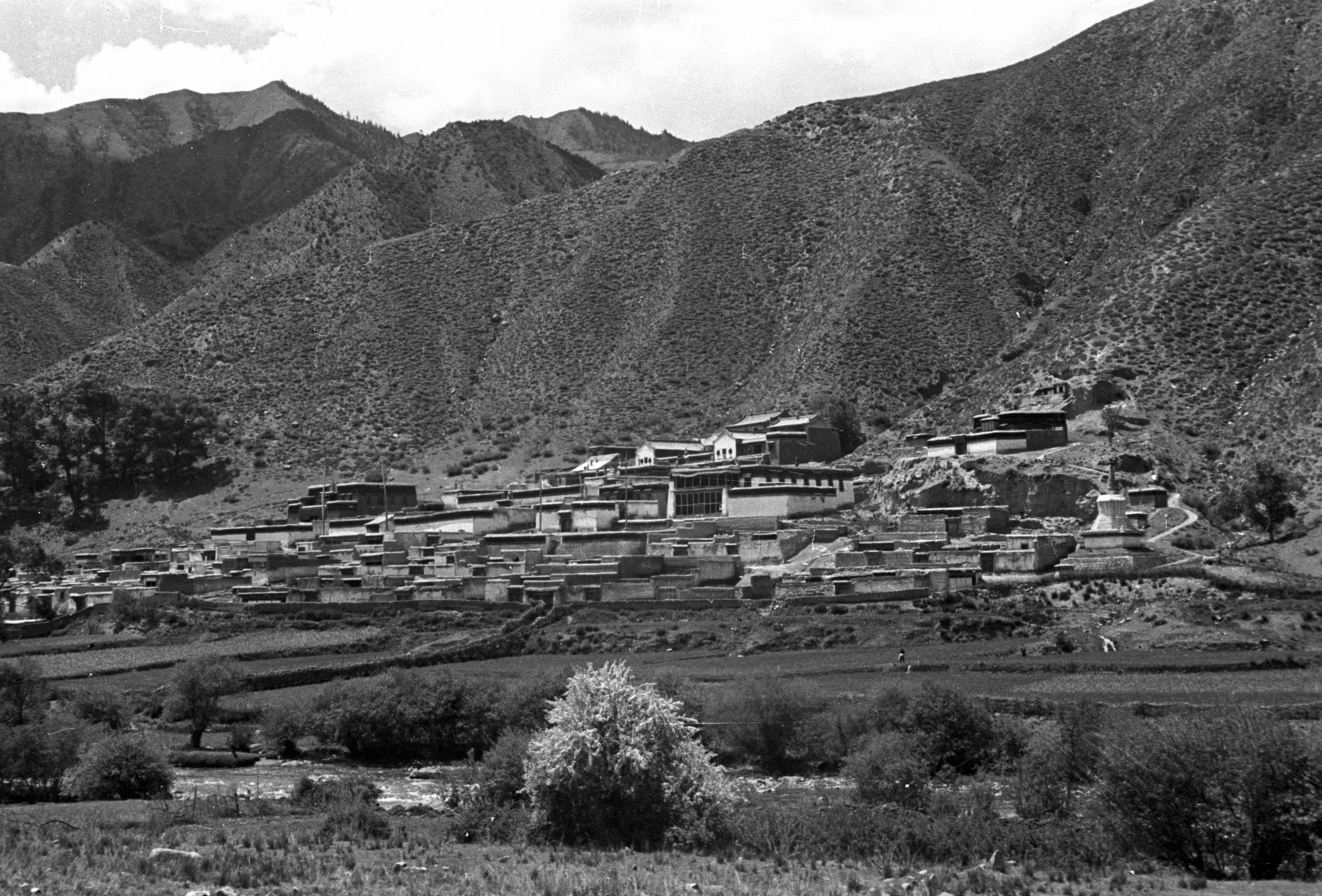
Between 1932 and 1933 the American journalist Harrison Forman photographed Labrang Monastery for the first time, recording a bird’s-eye view of the monastery and its town, the Grand Sutra Hall, the Golden-Tiled Hall, the Golden Chorten, the market beside the monastery, devotees circumambulating the chorten, and the Black Hat dance. The negatives are now held by the American Geographical Society Library at the University of Wisconsin–Milwaukee; the catalog records are Monastery and town viewed from above, Grand Sutra Hall, Golden-Tiled Hall, Golden Chorten, Market beside the monastery, Devotees circumambulating the chorten, and Black Hat dance.
1936
Forman revisited Labrang Monastery in 1936, leaving a close-up of the gilded top of the Golden Chorten.
1937
In 1937 Forman photographed Labrang Monastery once again: a panorama, the Grand Sutra Hall and prayer-wheel corridor, the front facade of the Golden-Tiled Hall, a Buddha hall under repair behind scaffolding, and a portrait of the Fifth Jamyang Zhepa, Tenpai Gyaltsen.
References
- 《甘南藏族自治州志·民族志》 (Gannan Tibetan Autonomous Prefecture Gazetteer: Nationalities Treatise) (Gansu Local Gazetteers website): the entry recording that in the forty-eighth year of the Kangxi reign Chaghan Danjin invited Jamyang Zhepa Dorje back to his homeland to found Labrang Monastery, donating five hundred subject households as its incense-and-fire households.
- 《夏河县志》 (Gazetteer of Xiahe County) (Gansu Local Gazetteers website): the entry on the Grand Sutra Hall begun in the fiftieth year of the Kangxi reign, with the Jamyang Buddha Hall and the Lower Tantric College completed in succession; and, in the biography of the Fifth Jamyang Zhepa and the chronology of major events, the entries on the 1938 comfort mission, the 1943 donation of airplanes, and the plaque “Contributing Wealth to Defend the Nation.”
- 《五世嘉木样活佛:为抗日,虽肝脑涂地亦不辞》 (“The Fifth Jamyang Zhepa: For the War of Resistance, He Would Not Shrink Even from Death”) (China Tibetology website, lecture by Xirao Nima): the circumstances of the preaching of the Letter to Our Mongolian and Tibetan Compatriots Propagating the War of Resistance and Reconstruction, with excerpts of its concluding prayer.
- Yu Liping, Guo Jiayin, and Ning Peilin, “The Role and Significance of the Fifth Jamyang Zhepa’s ‘Letter to Our Mongolian and Tibetan Compatriots Propagating the War of Resistance and Reconstruction’” (于丽萍、郭佳音、宁沛林:《五世嘉木样〈为宣传抗建告蒙藏同胞书〉的作用和意义》), Journal of Tibet Minzu University (Philosophy and Social Sciences Edition), 2023, no. 6: the format and content of the lithographed Tibetan–Chinese edition of the Letter, with excerpts of its mobilization orders and prayer.
- Gönchok Tenpa Rabgyé of Drakgön (智观巴·贡却乎丹巴饶吉), 《安多政教史》 (A Political and Religious History of Amdo), translated into Chinese by Wu Jun, Mao Jizu, and Ma Shilin, Gansu Nationalities Publishing House, 1989 (Tibetan text 1987): a Tibetan-language political and religious history of Amdo completed in 1865, the core Tibetan account of Labrang Monastery’s founding and of the Jamyang lineage.
- Labrang Tashikhyil, The Treasury of Lives: the monastery’s institutional history and its six colleges.
- 《历史沿革概述》 (Overview of the Historical Development) (Xiahe County People’s Government): the entries on the establishment of the Labrang Administrative Bureau in the sixteenth year of the Republic and its conversion into Xiahe County in the seventeenth year.