Introduction
In the winter of the twentieth year of the Qianlong reign (1755), the chiefs of the four Oirat tribes received investiture and rewards at the Mountain Resort and raised wine in wishes for the emperor’s long life at the banquet; it was against this background that Puning Temple was built. The name “Puning” (Universal Peace) expresses the wish that the subjects from the Snow Mountains and the Onion Range (the Pamirs) as far as the Western Sea might “dwell in peace in their homes and take joy in their occupations”; the temple itself was built in imitation of Samye Monastery in Tibet. In the twenty-seventh year of the Qianlong reign (1762), the works of Puning Temple were completed. Fifty years later, in the seventeenth year of the Jiaqing reign (1812), the Hall of Mahavira (Daxiong Hall) was already leaking, its rafters and sheathing[1] rotted, its eave rafters fallen away, and the stones of its moon terrace fretted and in places broken; a memorial of the following year proposed stripping and repairing the hall roof, replacing the stonework, and patching up the memorial archways and walls.
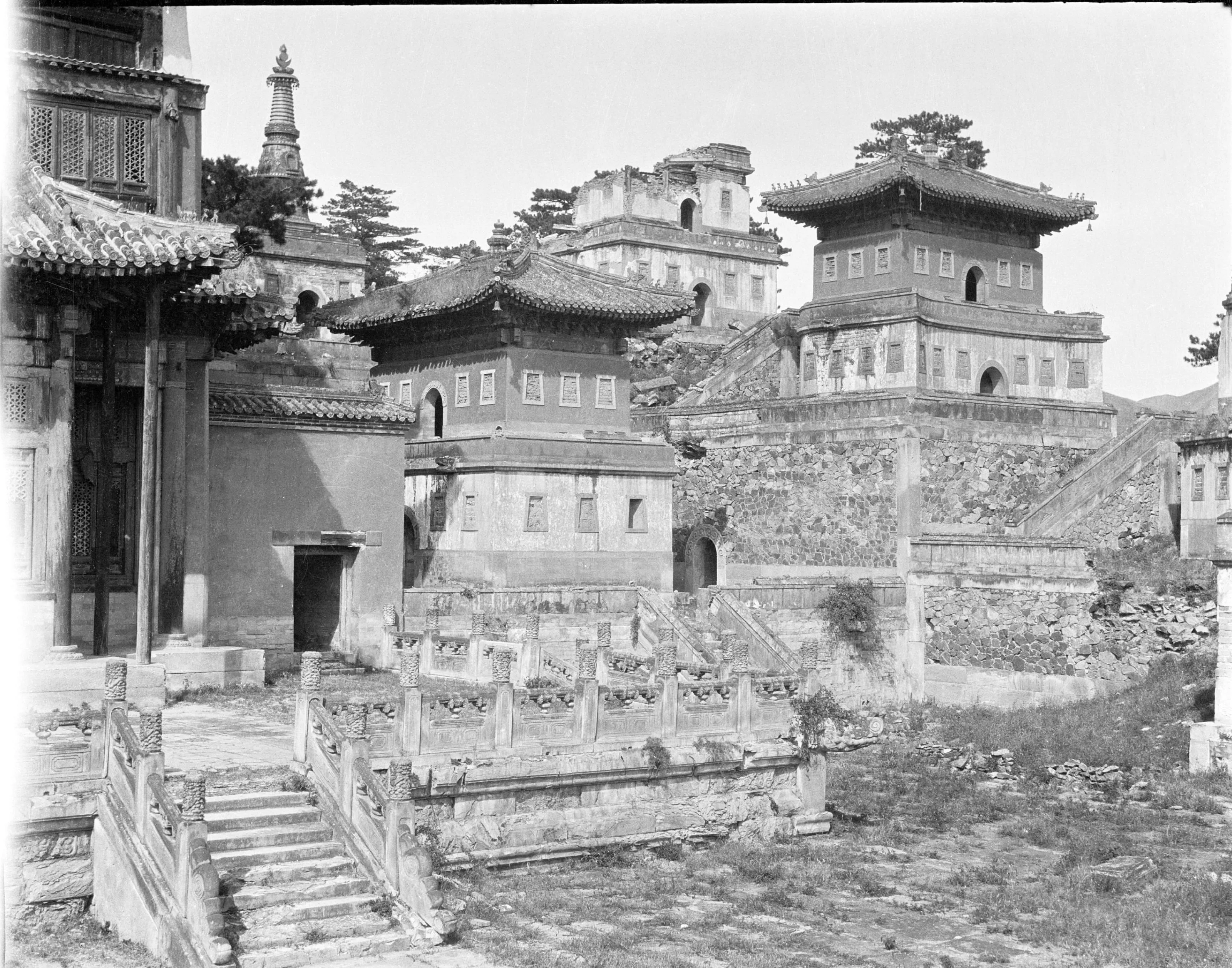
Entering through the mountain gate, the visitor first meets three imperially composed steles in the four scripts of Manchu, Chinese, Mongolian, and Tibetan; behind the steles stand in turn the Hall of the Heavenly Kings and the Hall of Mahavira. Climbing farther north onto a high terrace, the three-story Mahayana Pavilion stands at the center, ringed by stupas of four colors, the four great continents[2], and the four lesser continents. The Buddhist cosmic image of Mount Sumeru[3], the sun and moon, and the four continents thus becomes an architectural route that rises step by step from south to north.
Bojun later wrote in a poem: “Lifting my head to gaze, I cannot reach its belly”; one must “climb one more story” before the Buddha’s true countenance comes into view. The great Buddha cannot be taken in from a single spot; it reveals itself layer by layer as one climbs the pavilion.
Historical Documents
《普宁寺碑文》 (Stele Inscription of Puning Temple)
乾隆二十年夏五月,平定准噶尔。
In the twentieth year of the Qianlong reign, in summer, the fifth month, the Dzungars were pacified.
冬十月,大宴赉四卫拉特部落旧附新归之众于避暑山庄。曰绰罗斯,曰都尔伯特,曰辉特,曰和硕特。四族台吉,各封以汗王、贝勒、贝子、公若而人,其无隶属之宰桑,则归之公,如内八旗、外四十九旗喀尔喀四部之例。至是而内外一家,遐迩同风之言允符。昔我皇祖之定喀尔喀也,建汇宗寺于多伦诺尔,以一众志,式循旧章,建普宁寺于山庄之北麓,而为之记曰:皇天有辅德之私,至圣有越世之度,君子有见几之作,兆人有可格之诚。我国家抚有众蒙古,讵准噶尔一部终外王化,虽庸众有威之不知畏,惠之不知怀,地不可耕,民不可臣之言,其然岂其然哉?以我皇祖皇考圣德神功,经文纬武,其于奠伊犁,勒铭格登山,朝四部落之众,而锡之爵,赐之币,式宴陈舞,可汗起奉酒,称万寿,如今日者,何难默契大造,意若有待,是以遵养时晦,垂成弗为。
In winter, the tenth month, a great banquet with bestowals was given at the Mountain Resort for the multitudes of the four Oirat tribes, those long attached and those newly come over: the Choros, the Dörbet, the Khoid, and the Khoshut. The taijis of the four tribes were each enfeoffed as khans, princes, beile, beise, and dukes in due number, and those jaisangs who had no allegiance were assigned to dukes, following the precedent of the eight banners within and the forty-nine banners and four Khalkha divisions without. At this, the saying that within and without are one family, that near and far share one way, was truly fulfilled. In former days, when my august grandfather pacified the Khalkha, he built Huizong Temple at Dolonnur to unite their minds; duly following that old precedent, I have built Puning Temple at the northern foot of the Mountain Resort, and I make this record for it: August Heaven has a partiality for aiding virtue; the utmost sage has a foresight reaching beyond his age; the gentleman acts upon seeing the first stirrings; the multitudes possess a sincerity that can be won over. Our state has brought the many Mongols under its care—how could the Dzungar tribe alone remain forever outside the royal transformation? Though common talk had it that they knew not to fear majesty, knew not to cherish kindness, that their land could not be tilled and their people could not be made subjects—was it really so, how could it really be so? With the sage virtue and divine merit of my august grandfather and august father, ordering the civil and marshalling the martial, as for settling Ili, engraving the inscription on Mount Geden, having the multitudes of the four tribes come to court, bestowing upon them ranks and granting them silks, setting out the banquet and arraying the dances, the khans rising to offer wine and crying out wishes for ten thousand years of life—as on this day: what difficulty was there? They silently concurred with the great Creator; their intent seemed to be waiting. Therefore they bided their time and kept their light hidden, and refrained when on the very verge of completion.
予小子敬承乾佑,以为不可失者,时迟徊观望,宁二圣付托藐躬之意。且此山庄即皇祖岁时巡觐诸蒙古宾客之所也。越三十年而克见准噶尔之众咸觐于此,岂非皇天无私,惟德之辅,至圣之度,越世先知,而见几君子之作,予亦不敢不勉。卫拉特之众岂终不可格以诚哉?蒙古向敬佛,兴黄教,故寺之式,即依西藏三摩耶庙之式为之,名之曰普宁者,盖自是而雪山葱岭以逮西海恒河沙数臣庶咸愿安其居,乐其业,永永普宁云尔。复依普贤世界品而述偈言:抖赞转轮王,功德甚深大,造寺于西域。其名三摩耶,逮今千岁余,愿海装严就。肖彼须弥山,巍阁凡三层,日月在两肩,地金水风轮,其内,小铁围大咸海水满,持地障碍山,马耳及善见担木并持轴持双凡七山,其中乃香水,其上坚手天持鬘及恒骄四天王所住。
I, the little son, reverently receiving the protection of Heaven, hold that what must not be lost is the moment; to tarry, hesitate, and watch from the sidelines would betray the intent with which the two sages charged my slight person. Moreover, this Mountain Resort is the very place where my august grandfather received the Mongol guests in audience on his yearly tours. That, after thirty years, I have been able to see the multitudes of the Dzungars all come to audience here—is this not proof that August Heaven has no partiality but aids only virtue, that the utmost sage’s foresight knows in advance beyond his age, and that the gentleman acts upon seeing the first stirrings? I too dared not but exert myself. How could the multitudes of the Oirats be forever beyond the reach of sincerity? The Mongols have ever revered the Buddha and fostered the Yellow Church; therefore the temple’s form was made in the very form of Samye Monastery in Tibet. That it is named Puning (Universal Peace) is because from this time forth the subjects as many as the sands of the Ganges, from the Snow Mountains and the Onion Range as far as the Western Sea, all wish to dwell in peace in their homes and take joy in their occupations, in universal peace for ever and ever. Further, following the chapter on Samantabhadra’s world, I set forth these verses: In praise I sing of the wheel-turning king, whose merit and virtue were profound and great, who built a temple in the Western Regions. Its name is Samye, now a thousand years and more, and the ocean of vows has been adorned and fulfilled. Fashioned after Mount Sumeru, the towering pavilion has three stories in all; the sun and moon rest upon its two shoulders. The wheels of earth, gold, water, and wind; within them, the small iron-encircling mountains and the great salty sea filled full; Earth-Holder, Obstacle, Horse-Ear and Good-Sight, Burden-Wood together with Axle-Holder and Pair-Holder—seven mountains in all; within them is the perfumed water; above them dwell the Firm-Handed devas, the Garland-Bearing and the Ever-Proud, the dwellings of the Four Heavenly Kings.
复有四方天,其数各以八,中乃忉利天、喜见、帝释宫,欲界四天子,色界、无色界次第居其上。东曰胜神洲,小胜及胜胜左右以次住。南曰赡部洲,妙拂并小拂左右以次住。西曰牛贺洲,行道将小行,左右以次住。北曰俱卢洲,最胜复谄胜,左右以次住。供养佛无数,如普贤愿海。复为四色塔,义出陀罗尼,四智标功用。懿此避暑庄,古佛所游历,较彼卫藏地,佛土无差别。有来众蒙古及新卫拉特,咸敬黄教人,爰作大利益。肖彼三摩耶,为奉人天师,作此曼挐罗,严洁身口意,依法香泥涂,一切皆清净,香花供养具,法螺法音声,转无量法轮,聚无量法众,诵无量法宝,作无量法事。我闻普贤言,华藏庄严海,是毗卢遮那往劫修行处,种种宝光明,大云遍一切,舍身等尘刹。
There are further the heavens of the four quarters, eight in number each; in their midst is the Heaven of the Thirty-Three, the Joyful to Behold, the palace of Indra; the four son-of-heaven mansions of the desire realm, and the form realm and the formless realm ranged above them in due order. To the east is Pūrvavideha, the Continent of Surpassing Spirit, with the Lesser Surpassing and the Surpassing-Surpassing dwelling to left and right in order. To the south is Jambudvīpa, with the Wondrous Whisk and the Lesser Whisk dwelling to left and right in order. To the west is Aparagodānīya, the Continent of Cattle-Wealth, with the Way-Going and the Lesser Way-Going dwelling to left and right in order. To the north is Uttarakuru, with the Most Excellent and again the Flattering-Excellent dwelling to left and right in order. Offering worship to Buddhas without number, like the ocean of Samantabhadra’s vows. There are further the stupas of four colors, their meaning drawn from the dhāraṇīs, the four wisdoms marking their work and function. Splendid is this Mountain Resort, a place the Buddhas of old have wandered; compared with that land of Ü and Tsang, this Buddha-land is without difference. The many Mongols who come, and the newly submitted Oirats, all revering the men of the Yellow Church—thereupon I have made this great benefit. Fashioned after that Samye, to worship the Teacher of men and devas, I have made this maṇḍala, solemnly cleansing body, speech, and mind; by the rite it is smeared with fragrant clay, and all is pure. The implements of offering of incense and flowers, the Dharma-conch and the sound of the Dharma; turning the measureless Dharma wheel, gathering the measureless Dharma multitudes, chanting the measureless Dharma treasure, performing the measureless Dharma works. I have heard Samantabhadra say: the adorned ocean of the Lotus Treasury is the place where Vairocana cultivated his practice in kalpas past; its manifold jewel-lights, a great cloud spreading over all, and he gave up bodies as many as the dust-motes of the lands.
以昔愿力住,遍十方国土,出苦向菩提,方便示调伏。世界所有尘,一一见法界,现佛如云集。此是如来刹,大愿周法界,一切化群生,庄严从此出。西土及震旦,究竟无同异,众生皆安隐。暨蠕动肖翘,遂生明佛性。稽首天人师,普贤行如是。
By the power of those vows of old he abides, throughout the lands of the ten directions, leading beings out of suffering toward bodhi, by skillful means showing them the way of discipline. In every dust-mote of the worlds, one by one, the Dharma-realm is seen, and Buddhas appear gathered like clouds. This is the Tathāgata’s land; the great vow reaches throughout the Dharma-realm, transforming all the multitudes of beings, and its adornment comes forth from here. The Western Land and China are ultimately one, without distinction; all beings are at peace and secure, down to the wriggling worms and flying insects, quickening to life and awakening to the Buddha-nature. I bow my head to the Teacher of men and devas: such is the practice of Samantabhadra.
《平定准噶尔勒铭伊犁之碑》 (Stele Inscribed at Ili on the Pacification of the Dzungars)
惟天尽所覆,俾我皇清,罔不在宥。惟清奉昊天,抚薄海兆庶,悉主悉臣。太祖、太宗、世祖,肇基宅中,皇耆其武。圣祖、世宗,觐光扬烈,克臻郅隆。逮予藐躬,思日孜孜,期四海同风。咨汝准噶尔,亦蒙古同类,何自外携?数世梗化,篡夺相仍,硕仇其下。厥达瓦齐,甚毒于酲,众心胝胝。如苗斯蟊,如虺斯蛰,众口嗷嗷。视尔嗷止,予焦劳止,期救不崇朝止。视尔胝止,予噫嘻止,亟出汝涂泥止。乃命新附,尔为先锋,熟悉其路。乃命劲旅,携数月粮,毋或掠掳。师行时雨,王旅啴啴,亦无潦阻。左旋右抽,王旅浑浑,既暇以休。乌鲁木齐,及五集赛,度之折折。台吉宰桑,迎降恐后,奚事斧吭?波罗塔拉,闼尔奇岭,险如关阖。倒戈反攻,达瓦齐走,旦夕途穷。回部遮获,彼鼠斯喙,地入无隙,露布飞至,受俘午门,爰贷其罪。自今以始,四部我臣,伊犁我宇。曰绰罗斯及都尔伯特、和硕特、辉特,封四可汗,众建王公,游牧各安。宰桑公臣,属我旗籍,谁汝苦辛?尔恭尔长,尔孳尔幼,徐以教养。尔驼尔牛,尔羊尔马,畜牧优游。分疆各守,毋相侵陵,以干大咎。齐御外域,曰布鲁特,越哈萨克。醉饮饱食,敬兴黄教,福自天锡。伊犁平矣,勒贞珉矣,于万斯年矣。
Heaven covers all that is, and of our August Qing there is none not within its shelter. The Qing, serving Vast Heaven, cherishes the myriad people of all within the seas; all are its charges, all its subjects. Taizu, Taizong, and Shizu laid the foundation and dwelt in the center, greatly extending their martial might. Shengzu and Shizong beheld the light and carried forward the glorious work, attaining the utmost flourishing. Coming down to my slight person, I think day by day with diligence, hoping that the four seas may share one way. Ah, you Dzungars, you too are of Mongol kind—why did you stand aloof and turn away? For generations you blocked the transforming influence, usurpation following upon usurpation, greatly making enemies of those below you. That Dawazi was more baneful than the sickness of drink; the hearts of the multitude grew calloused with toil. Like grubs among the sprouts, like hibernating vipers, the mouths of the multitude cried out in hunger. Seeing your crying out, I toiled with anxious care, resolving to save you before the morning was out. Seeing your calluses, I sighed, resolving to draw you quickly out of the mire. Then I ordered the newly submitted: you shall be the vanguard, familiar as you are with the roads. Then I ordered the sturdy brigades to carry several months’ grain, and not to plunder or seize. The army marched with seasonable rain; the royal host moved in dense array, yet met no floods to bar the way. Wheeling left and thrusting right, the royal host rolled on, finding leisure to rest. Urumqi and the five jisai—they crossed them with ease. The taijis and jaisangs vied to come forward in surrender—what use was there for the executioner’s axe? At Borotala, at the Tarqi Ridge, the passes were as perilous as gates and bars. Turning their spears in counterattack, Dawazi fled, his road at an end by dawn or dusk. The Muslim tribes caught him in their net; that rat had nowhere to put his snout, the earth afforded him no crack to enter. The victory dispatch flew to court; the captives were received at the Meridian Gate, and I then forgave their crimes. From this day forth, the four tribes are my subjects and Ili is my realm: the Choros, the Dörbet, the Khoshut, and the Khoid—I have enfeoffed four khans and established many princes and dukes, each at peace in his nomadic grounds. The jaisangs and ducal ministers are enrolled in my banners—who now will trouble you with hardship? Revere your elders, nurture your young, gently teach and raise them. Your camels and cattle, your sheep and horses—graze and wander at your ease. Keep each to your allotted bounds; do not encroach upon one another, lest you incur great blame. Together guard the outer realms, the Kirghiz and, beyond them, the Kazakhs. Drink deep and eat your fill; reverently foster the Yellow Church, and blessings will be bestowed from Heaven. Ili is pacified; the steadfast stone is engraved; for ten thousand years and more.
《平定准噶尔后勒铭伊犁之碑》 (Stele Inscribed at Ili after the Pacification of the Dzungars)
天之所培者,人虽倾之,不可殛也。
What Heaven nurtures, though men overthrow it, cannot be destroyed.
天之所覆者,人虽栽之,不可殖也。嗟汝准噶尔,何狙诈相延以世而为贼也。强食弱,众凌寡,血人于牙而蔑知悛易也。云兴黄教,敬佛菩萨,其心乃如夜叉、罗刹之以人为食也。故罪深恶极,自作之孽,难逭活也。先是分封四部,众建宰桑,四图什墨,廿一昂吉,盖欲继绝举废,以休以息也。而何煽乱不已,焦烂为期,终于沦亡胥尽。伊犁延袤万里,寂如无人之域也。是非我佳兵不戢,以杀为德也,有弗得已耳。西师之什,实纪其详悉也。以其反复无常,迟益久而害益深,则其叛乱之速,未尝非因祸而致福也。是盖天佑我皇清,究非人力也。伊犁既归版章,久安善后之图要焉已定者,讵宜复失也。然屯种万里之外,又未可谓计之得也。其潜移默运,惟上苍鉴之。予惟奉时相机,今日之下,亦不敢料以逆也。
What Heaven covers, though men cut it down, cannot be rooted out. Alas for you, Dzungars! Why did you prolong your cunning treachery from generation to generation and make yourselves bandits? The strong devoured the weak, the many oppressed the few; they bloodied men between their teeth and never knew repentance or change. You said you fostered the Yellow Church and revered the Buddhas and bodhisattvas, yet your hearts were like those of yakṣas and rākṣasas that feed on human flesh. Therefore your crimes ran deep, your wickedness reached its height: a calamity of your own making, from which life could not be reprieved. Before this, the four tribes were enfeoffed, the many jaisangs established, the four tüshimel and the twenty-one anggi—this was done, in truth, to restore broken lines and raise up the fallen, to give them rest and repose. Yet why did your fomented turmoil not cease, with ruin and burning as your appointed end, until at last you sank into destruction and all was lost? Ili stretched for ten thousand li, silent as a realm without people. This is not because I delight in arms and will not sheath them, taking slaughter for virtue; it was simply unavoidable. The verses on the Western Army have in truth recorded all this in detail. Because they were fickle and inconstant, and the longer the delay the deeper the harm, the very swiftness of their rebellion was not, perhaps, a case of blessing brought forth from misfortune. This was, I think, Heaven’s protection of our August Qing, and not in the end the work of human power. Now that Ili has returned to the imperial registers, the plan for its long security and good order has been settled as the essential task—how should it be fitting to lose it again? Yet to set up military colonies ten thousand li away cannot be called a well-laid plan either. Its silent working and hidden turning—only Heaven above discerns it. I can only act in accord with the times and the occasion; even of what lies ahead today, I dare not predict it in advance.
是平定准噶尔后勒铭伊犁之碑所由作也。
This is why the Stele Inscribed at Ili after the Pacification of the Dzungars was made.
《钦定热河志》 (Imperially Commissioned Gazetteer of Rehe)
普宁寺,在热河行宫东北五里狮子沟。乾隆二十年,平定准噶尔,上幸避暑山庄,四卫拉特部落来觐,赐宴封赉,敕建普宁寺,以昭武成。仿西藏三摩耶庙制,寺南向,联额皆御书。门外树坊三,中额曰“胜缘”,曰“法护”,东额曰“金界”,曰“宝林”,西额曰“福田”,曰“觉海”。门额曰“普宁寺”。门内正中碑亭植碑三,恭镌御制碑文。左右钟鼓楼,中天王殿五楹,又内正殿七楹,供三世佛,前楹额曰“金轮法界”,联曰:“镇留岚气闲庭贮,时落钟声下界闻。”殿内额曰“大雄宝殿”,联曰:“福溥人天阿耨耆,阇开紫阙妙涵空。有栴檀薝卜拥金绳。”殿内佛背光上额曰“仁佑大千”,后楹联曰:“震旦教宏宣,广刹昙霏,普资福荫;朔陲功未定,新藩鳞集,长庆宁居。”殿后从盘道上,阁供诸佛菩萨,额曰“大乘之阁”。月台左右,五色浮屠四列,四大部洲,四小部洲,阁三层,各七楹,下层额曰“鸿庥普荫”,前楹联曰:“耆崛天开,金碧辉煌香界朗;精蓝云护,栴檀馣𩡖梵林深。”阁内联曰:“具大神通完十行,是真清净现三身。”二层联曰:“广大真言参不漏,色空妙谛证无遮。”上层额曰“真如圆满”。联曰:“传大千法宝,阐第一宗风。”阁东精舍五楹,为临憩之所,额曰“妙严室”,联曰:“对物共春台,豳风入咏;愿人登福地,王会成图。”阁西为讲经堂。洪维我皇上以无量愿力,创开福地,俾西域万象,亿载普宁,入寺瞻仰者,合掌顶礼,颂神功而祝圣寿,真如普贤震旦涌现皈依也。
Puning Temple lies at Shizigou (Lion Gully), five li northeast of the traveling palace at Rehe. In the twentieth year of the Qianlong reign (1755), when the Dzungars were pacified, the emperor visited the Mountain Resort; the four Oirat tribes came to audience, were granted a banquet, investitures, and gifts, and Puning Temple was built by imperial decree to proclaim the martial achievement. Modeled on the system of Samye Monastery in Tibet, the temple faces south, and its couplets and plaques are all in the imperial hand. Outside the gate stand three archways: the central ones bear the plaques “Excellent Conditions” and “Guardian of the Dharma”; the eastern ones “Golden Realm” and “Jewel Grove”; the western ones “Field of Blessings” and “Ocean of Awakening.” The gate plaque reads “Puning Temple.” Inside the gate, the stele pavilion at the center holds three steles, reverently engraved with the imperially composed inscription. To left and right are the bell tower and drum tower; in the middle is the Hall of the Heavenly Kings of five bays; further within, the main hall of seven bays enshrines the Buddhas of the Three Ages. The plaque at the front bays reads “Golden Wheel of the Dharma Realm,” and the couplet reads: “The mountain mists linger, kept in store within the quiet courtyard; from time to time the bell’s chime falls, heard in the world below.” The plaque inside the hall reads “Hall of Mahavira,” with the couplet: “Blessings spread over men and devas, from Anavatapta to Gṛdhra-kūṭa; the purple palace opens, wondrously holding the void within. Candana and campaka throng along the golden cordon.” The plaque above the halo of the Buddha within the hall reads “Benevolence Sheltering the Great Thousand,” and the couplet behind reads: “In China the teaching spreads far and wide: from the broad monasteries udumbara-mist drifts, all alike drawing on its blessed shade; on the northern frontier the work was not yet settled: the new vassals gathered like scales, rejoicing forever in tranquil dwelling.” Behind the hall, a winding path leads up; the pavilion enshrines Buddhas and bodhisattvas, its plaque reading “Mahayana Pavilion.” To left and right of the moon terrace stand stupas of five colors in four rows, the four great continents, and the four lesser continents. The pavilion has three stories, each of seven bays. The plaque of the lower story reads “Vast Shelter of Universal Shade,” and the couplet at its front reads: “Gṛdhrakūṭa opens to the heavens, gold and azure resplendent, the fragrant realm bright; the vihāra is cloud-protected, candana dense in fragrance, the brahma grove deep.” The couplet inside the pavilion reads: “Possessing great spiritual power, perfecting the ten practices; this is true purity, manifesting the three bodies.” The couplet of the second story reads: “The vast and great true words penetrate without omission; the wondrous truth of form and emptiness is realized without hindrance.” The plaque of the upper story reads “Bhūtatathatā Perfected and Complete,” and the couplet reads: “Transmitting the Dharma treasure of the great thousand; expounding the foremost tradition of the school.” East of the pavilion is a retreat of five bays, a place for repose during visits; its plaque reads “Chamber of Wondrous Adornment,” with the couplet: “Facing things, all share the terrace of spring; the airs of Bin enter the song; may men ascend this blessed ground, and the royal audience become a picture.” West of the pavilion is the scripture-preaching hall. Great is Our Emperor, who with measureless power of vow has opened up this blessed ground, that the myriad images of the Western Regions may have universal peace for a hundred million years; those who enter the temple to gaze up in reverence press their palms together and bow their heads, praising the divine merit and wishing long life to the sage—truly as if Samantabhadra had welled forth in China for them to take refuge in.
《清实录》 (Veritable Records of the Qing)
又谕:据额勒登额等奏,普宁寺工程告竣,新添千总兵丁等,请照守护热河之例,给予地亩等语。普宁寺千总兵丁,既同守护热河千总兵丁一体当差,著施恩照例给予养赡家口地亩。
A further edict: According to the memorial of Eledeng’e and others, the works of Puning Temple having been completed, they request that the newly added first captains and soldiers be granted land allotments after the precedent of those guarding Rehe, and so on. The first captains and soldiers of Puning Temple, since they serve on the same footing as the first captains and soldiers guarding Rehe, shall by grace be granted, in accordance with the precedent, land allotments for the support of their families.
《嵩年奏档》 (Memorial Archives of Songnian)
普宁寺大雄宝殿一座头停渗漏椽望糟朽后坡檐椽脱落琉璃瓦片爆釉残坏月台一座周围石料酥碱间有破碎庙前牌楼三座头停渗漏椽望铁木糟朽栅栏门散卸
At Puning Temple: one Hall of Mahavira, whose roof seeps and leaks, whose rafters and sheathing are rotted, and from whose rear slope eave rafters have fallen away, its glazed tiles with burst glaze, damaged and spoiled; one moon terrace, the stonework all around it fretted and effloresced, in places broken; three memorial archways before the temple, whose roofs seep and leak, whose rafters, sheathing, iron fittings, and timbers are rotted, and whose palisade gates have come apart.
普宁寺揭宥渗漏大雄宝殿七间殿座下月台一座换安酥减石料山门外揭定牌楼三座粘补抹饰三面宇墙凑长三十二丈六尺
At Puning Temple: strip and repair the leaking Hall of Mahavira of seven bays; on the one moon terrace beneath the hall, remove and reset the fretted stonework; outside the mountain gate, strip and refit the three memorial archways; and patch and replaster the enclosing walls on three sides, totaling thirty-two zhang and six chi in length.
《薜箖吟馆钞存》 (Bilin Yinguan Chaocun (Transcribed Poems of the Bilin Poetry Lodge))
吾闻妙喜空王有阿𬮥,不坏金身高丈六。恒山古郡招提中,曾见慧容百仞矗。朅来塞上多精蓝,黄衣法侣同修恭。天家创建有深意,或仿卫藏或江南。扎什伦布布达拉。万间檀宇千尺塔。玉幢金瓦影焜煌,鼍鼓鲸钟声镗鞳。惟兹寺肖三摩耶,藩部皈依观步踏。大乘之阁千丈强,真如宝像高无量。日月两肩冰镜满,风轮千手昙花香。璎珞垂垂灿金粟。昂首睇视不及腹,振衣更上一层楼,才见如来真面目。阎浮同此欢喜缘,销兵护法庇中千。不须合十作呗赞,普佑震旦慈无边。
I have heard that in Abhirati, the realm of the King of Emptiness, there is Akṣobhya, whose indestructible golden body stands sixteen feet tall. In a monastery in the ancient commandery of Hengshan I once saw a countenance of wisdom towering a hundred ren. Since coming beyond the passes, I have found many vihāras here, with yellow-robed Dharma companions cultivating reverence together. The imperial house built them with deep intent, some modeled on Ü and Tsang, some on Jiangnan—Tashilhunpo, the Potala, sandalwood halls in ten thousand bays and stupas a thousand feet high. Jade pillars and golden tiles, their shadows gleaming; alligator drums and whale bells, their sounds resounding. This temple alone is the image of Samye, toward which the vassal tribes turn in refuge and walk in procession. The Mahayana Pavilion rises more than a thousand zhang; the precious image of Bhūtatathatā is high beyond measure. Sun and moon upon its two shoulders like brimming ice-mirrors; wind-wheel and thousand hands amid udumbara fragrance. Strings of jewels hang down, glittering with golden grains. Lifting my head to gaze, I cannot reach its belly; shaking out my robes, I climb one more story, and only then see the Tathāgata’s true countenance. Jambudvīpa shares this joyful karmic bond: weapons melted down, the Dharma protected, sheltering the middle-thousand worlds. No need to press palms together and chant hymns of praise—his universal protection of China is a compassion without bounds.
Historical Photographs
1924–1927
Sidney D. Gamble took a number of photographs at Puning Temple in Chengde between 1924 and 1927. The three images included in the Sidney Gamble Photograph Collection, captioned “Buildings within the Temple,” “Great Buddha Temple,” and “Pagoda on the Hillside,” record respectively the rear building complex, a panorama of the Mahayana Pavilion, and a stupa within the temple.
Published in the 1930s
Issue 119 of the tenth series of Grand Views of Asia, published by the Society for the Photographic Grand Views of Asia, was devoted to the subject “Puning Temple, Chengde.” The following four images record respectively a panorama of the temple, the main hall, the Mahayana Pavilion, and the roofs of the multi-story halls.
ca. 1933–1946
A group of photographs of Rehe in Hedda Morrison’s China album is captioned “Great Buddha Temple”; the direction of view and the buildings can be identified as Puning Temple. The following four images preserve respectively a distant view of the temple, the front of the Mahayana Pavilion, a stupa, and the former appearance of one of its halls.