Introduction
Before Yongle Palace became a great monastic complex, it was only a shrine to Lü Dongbin in the town of Yongle in Hedong, known at the time as the “Yongle shrine.” The Quanzhen Daoist[1] Song Defang, a disciple of Qiu Chuji known by the hao Piyunzi, came here early on and gathered a community of Daoists to take up residence. When he arrived, the shrine was already “overgrown and cramped,” and his work on the site laid the foundation for its later expansion.
Qiu Chuji had also said to another disciple, Pan Dechong: “Your destiny in years to come lies in the southwest; Yongle will then be where our Way rests on you”—meaning that Pan Dechong’s later calling lay in the southwest, and that the order’s affairs around Yongle would be his to bear. By then the Quanzhen order had won the recognition and patronage of the Mongol court, and the fortunes of the Yongle shrine thereby entered the court’s field of vision.
Not long afterward, the old shrine was destroyed by fire. The court did not have it rebuilt as it had been, but resolved to convert it into Chunyang Wanshou Palace[2] and bestowed a plaque upon it; the Quanzhen order, for its part, nominated Pan Dechong to direct the construction—an appointment also read as the fulfillment of Qiu Chuji’s earlier charge. Pan Dechong led his disciples in surveying the foundations, mustering craftsmen, firing bricks, and felling timber, until “a hundred walls rose at once.” Within a few years the halls, galleries, refectories and kitchens, stables and storehouses, and the monks’ quarters each stood in their place, with branch cloisters[3], farmland, and watermills in the surroundings.
After the Yuan-dynasty works were completed, Yongle Palace remained in use and continued to be repaired. When the spirit tablets were renewed in the late Ming, the walls of the halls still bore paintings of three hundred and sixty celestial deities, with more than four hundred spirit tablets set out in rows, and sacrifices were held every year. The Qing in turn repaired the halls one after another, and parts of the upper roof frames of Sanqing Hall and Chunyang Hall were replaced with Qing-style members. During the twentieth-century relocation project, these Yuan-dynasty halls, which had lived through Ming and Qing repairs, were dismantled piece by piece, and the murals were detached and moved to their present site.
Historical Documents
《冲和真人潘公神道之碑》 (Spirit Way Stele of Lord Pan, Perfected Chonghe)
翰林侍讲学士少中大夫知制诰兼修国史徙单公履撰
Composed by Tudan Gonglü, Hanlin Academician Expositor-in-waiting, Lesser Grand Master of the Palace, Drafter of Proclamations, and Concurrent Compiler of the National History
自黄帝问道于广成,而神仙之说始兴。老氏跨殷历周,以道德五千言推极要妙,其教被于万世。降秦及汉,代有显人,安期、赤松、张道陵之流,或出而不晦,或见而不常,福奇之征,昭揭于世人之耳目者,非一事也。涉魏晋隋唐以来,蜕迹阛嚣,凝神碧落者,其名不可殚纪。至于胁阴阳之秘幻,集灵异之大成,微而草野鄙人、幽而深闺稚女,一聆其名,知其为列仙者,唐吕纯阳一人而已。盛矣哉。其传之也,全真之教盖发源于此,其流逮于金初,祖师王公倡之于前,七真继起于后,而道大行矣。惟丘公超东海之滨,玄教真风,弥漫洋溢,其高弟一十八人,世称为十八大士者,师其一也。师姓潘氏,讳德冲,字仲和,冲和其号也。淄之斋东人,家世业农,大父秉政,适大安兵兴,起家为军都统,戍莱州。父楫,字济之,以儒为业,辟充益都府学教授。世父泽民,莱州节度判官。自高祖以上及于师,九世同居,家素饶财,尝遇岁凶,发粟赈饥,民赖以全活者甚众。乡闾有贫者即假贷之,不责其偿,其乐施如此。一日,有术士过其家,语之曰:是家有阴德,必获阳报,当生异子。初,师之母王氏,尝梦有祥云入室,覆其身,良久乃去。自尔有娠,妊十九月师乃生,七岁不能言,其父忧之,忽有一道者来乞食,父延之入门,问所从来,云自东海,将适长安,师即从傍与之语,应答如流。父骇愕。道者曰:是子神韵冲粹,非凡儿也。异日当为人天师,宜善鞠之。自此遂能言,后稍长,警悟敏慧,常人莫及,读书日记千余言,后闻父母欲为娶妻,遂宵遁,即往栖霞滨都观。道过潍阳,时清和真人住持玉清宫,问所适,知其将诣长春,乃引见焉,自是服膺。问道,得传心之要。长春委师以焚修之事,至其暇日,则默坐静室中,凝神涤虑,物我两忘,一归于要妙幽玄之境。如是者十余年。太祖圣武皇帝亲征西域,闻长春之名,遣仲录刘君赍诏诣海上起之。乃从长春西觐,风沙万里,不以为劳也。还燕之三年,长春仙去。真人尹公嗣法,命充燕京都道录,兼领宫事。真常复总玄机,注倚尤深。燕去和林数千里,朝觐往返,凡十有三,供拟之费,皆倚办于师,一无所阙。所以玄教真风恢张诞布,薄海内外无所不至者,师与有力焉。师之内诚外方,各有所任,道并行而不相悖者,又可见于此。岁乙未,平遥官长梁公,偕同僚恳疏请清和真人重修兴国观,真人命师往。甫逾年,撤其旧而新之。壬寅,署师诸路道教都提举,仍兼本路道录。甲辰,河东永乐祠堂灾,祠盖吕纯阳之仙迹也。朝议以为纯阳之显道如此,祠而祀之,事涉简陋,可改为纯阳万寿宫,命李真常遴选道望隆盛、人所具瞻者崇建焉。先是,长春自西域回,抵盖里泊,夜与诸门弟子谈,语次谓师曰:汝缘他年当在西南,此时永乐吾道矣。至是,真常泊清和二宗师,集众言曰:纯阳,吾教之祖也。今朝廷崇饬如此,孰可任其事者?众以师德望干才,绰有余裕,即欲堪其役,无逾于师。况长春盖里泊之言,已尝命之矣。乃署师为河东南北两路道教都提点,命往营之。师率其徒至永乐,百工劝缘,源源而来,如子之趋父事。陶甓伐木,云集川流。于是略基址,度远迩,程功能,平枝干,合事庀徒,百堵皆作,不数稔新宫告成。堂殿、廊庑、斋厨、厩库,下至于寮舍、湢浴之属,各有位置,莫不焕然一新。北逾一舍,有山曰九峰,土人云此纯阳得道处也。遣其徒刘若水起纯阳上宫,及于宫侧创下院十余区,市良田竹苇及蔬圃果园、舟车碾硙,岁充常住百色之费。至于四方宾侣过谒宫下者,周爰四顾,见其严饬壮盛,俨敬之心油然而生。夫撤祠宇而为宫庭,其崇卑相去奚啻万万,然于纯阳之本真何加损益?但致饬之道,斯其行者远矣,而人之观感异焉,此象教所以不可废于后世。耸天下耳目于见闻之际,而绝其亵易之心,严乎外者所以佐乎内,象之所以崇者,道之所以尊也。由是言之,师之恢大盛缘,作新崇构,岂徒以夸其壮丽也哉?己酉秋,中宫懿旨,凡海岳灵山及玄教师堂,遗近侍护师悉降香以礼之。乃增葺潍阳玉清宫,至昆嵛山麻姑洞,取历代诰册刊之石,以彰灵迹。壬子夏四月,真常因奉朝命祀岳渎,过永乐,见其规模宏敞,喜谓师曰,非师不能毕此胜缘,乃倾帑以助其经费。明旦,与师同跻九峰之巅,见其秀拔如椅,遂易其名曰玉椅峰。甲寅春,圣天子在藩邸,命设普天醮于长春宫,于是召四方羽侣道行清高者毕集,师首与其选。致彩云鸾鹤之瑞,真常曰;此瑞公适当之,遂以清和真人所遗金冠锦服为赠。事毕还永乐。丙辰夏四月适上宫,至五月朔旦,忽谓左右曰:吾幼遇长春师,授以秘传,终身诵之,粗有所得。继而清和、真常以纯阳师祖世缘见付,吾比年经营,略有次第。今世缘道念亦庶几兼修而并举,无复事矣,吾其行乎?众不知所谓。二十六日,将返下宫,时方盛夏,畏日载途。从者咸以为病,师曰:汝众弟行,无伤也。忽阴雾四合,抵下宫四十余里,人不知暑,此尤可讶。初,纯阳殿前有古柿二本,根干盘错,枝叶茂盛,一夕无风自折,众方惊悟曰:此柿无风而折,可谓大异。吾师前日之言,其兆于此矣。是夜二更将尽,师忽扶杖而出,面四方,诵咒语。随即以灰掺之,露坐移时,若有所待,寻复入,以汤颒其面,即易衣索笔,书颂一篇,既毕,乃就枕翛然而逝,春秋六十有六。门人奔讣于掌教诚明真人,遣提点孟公,赙赗甚厚。庚申岁三月初五日,葬于宫之乾位,仍建别祠,令嗣事者以奉岁时香火,报本反始之道也。既而诚明疏师之德,上于朝,赐冲和微妙真人之号。师性资仁裕,戒履修洁,虽居道流,然乐善好施。中条东西居民每岁初或有贷粟于宫者,数逾千石。适时凶荒,道侣不赡,众议欲征之,师曰:岁荒人饥,夺彼与此,是岂仁人之用心哉?负者闻而德之,后每于纯阳诞日相率设会,献香资以致报,岁以为常。癸丑春旱,总管徐德禄拉诸耆老祷于师,师为诵灵宝经,不旬日致甘澍盈尺。师尝居九峰纯阳上宫,又号九峰老人,门人三宫提点渊静大师刘若水,乃于师诵经处筑台,志之曰:九峰老人诵经台。因状其行,付提点纯阳万寿宫事文志通,自永乐走燕,凡二千里,拉知宫刘志复诣予而言曰:师之道行如此,然神隧之石未有所纪,敢请。予以不敏辞,凡四五往返,请益坚,予以志通尊其师也笃,而托于予也专,是可嘉已,乃为述其始终而次第之,因系之以说焉。夫道之为教尚矣,小而始于炼度之微,大而极于性命之奥,无非事者。至于营葺宫宇,惠鲜贫乏,此但触物应缘随感而动,劳而不有,施而不报,特神化之糟粕耳,非师之至也。与接为构,纷纷扰扰,殆多事矣。然游神于淡,合气于漠,超然独观以自出于尘境之外者,彼何足土苴芥蒂乎其间也耶?故自从师海上,缔构诸方,迹与世俱,道随神运,固未尝一日不接于事为,亦未尝一日不在乎悠然泊然之中也。世徒见师之揆日作室,不少辍于斯须之顷,以为若是而止耳,岂知至人循其故然,无所事事,寂感一致,虚中泛应之心迹也哉。道一而已,自随其所见而名之者,盖不止于一而已也。试以四者言之,曰微、曰妙、曰玄、曰通。谓之微者,以其杳冥恍惚,不可为象者也。谓之妙者,以其变化不测,莫知所以然也。玄者,深而不可探也。通者,其化无不遍也。模状形容,固亦至矣,然智者之智,仁者之仁,虽所见殊方,会归则一,亦岂有二本哉!浑沦圆周,无所玷缺,在山满山,在河满河,道之全也。极六合之内外,尽万物之洪纤,虽神变无方,而莫非实理,道之真也。由是而为命,由是而为性,由是而为心,又由是而之于情,或源也,或委也,引而伸之,亦将何有不全,何有不真者乎?然则全也、真也,一而二,二而一者也。其万化之本根,一元之统体欤?长春之传于师者盖如此,师则有以推而广之,是可铭也。铭曰:
From the time when the Yellow Emperor inquired of the Way from Guangchengzi, the teaching of divine immortals first arose. Laozi spanned the Yin and passed through the Zhou; with the five thousand words of the Daodejing he sounded the uttermost essentials and subtleties, and his teaching has been spread over ten thousand generations. Down through the Qin and into the Han, each age had its illustrious men—Anqi Sheng, Chisongzi, Zhang Daoling, and their kind—who either came forth and were not obscured, or appeared but not constantly; the signs of their marvelous blessings, displayed openly before the eyes and ears of the world, were more than one. From the Wei and Jin through the Sui and Tang, those who shed their traces amid the clamor of the marketplace and fixed their spirits in the azure empyrean—their names cannot be exhaustively recorded. But as for one who commanded the secret transformations of yin and yang and gathered the great consummation of numinous marvels, so that the humble rustic of the fields and the sheltered girl of the inner chambers alike, on a single hearing of his name, knew him to be a ranked immortal—there was only Lü Chunyang of the Tang. How glorious indeed! In the transmission of his way, the teaching of Quanzhen had its fountainhead here; its current reached the early Jin, when the founding patriarch, Lord Wang, championed it first and the Seven Perfected rose up after him, and the Way spread far and wide. Lord Qiu transcended the shores of the Eastern Sea, and the genuine spirit of the Mysterious Teaching billowed and overflowed; among his eighteen eminent disciples, whom the world calls the Eighteen Great Adepts, our master was one. The master was surnamed Pan, his tabooed name Dechong, his courtesy name Zhonghe, and Chonghe his hao. He was a man of Zaidong in Zizhou. His family had farmed for generations; his grandfather Bingzheng, happening upon the raising of troops in the Da’an era, rose from his household to become a military commander-in-chief and was posted to defend Laizhou. His father Ji, courtesy name Jizhi, made his profession in Confucian letters and was summoned to fill the post of instructor at the Yidu prefectural school. His uncle Zemin served as administrative assistant to the military commissioner of Laizhou. From the generation of his great-great-grandfather and before down to the master, nine generations lived together under one roof. The family had long been wealthy; once, meeting a year of dearth, they opened their granaries to relieve the starving, and the people who owed their survival to this were very many. To the poor of the neighborhood they made loans without pressing for repayment—such was their joy in giving. One day a practitioner of the arts passed by their home and told them: “This household has hidden virtue; it will surely receive a manifest recompense and will give birth to an extraordinary son.” In the beginning, the master’s mother, of the Wang clan, once dreamed that an auspicious cloud entered her chamber and enveloped her person, departing only after a long while. From that time she was with child; after nineteen months of pregnancy the master was born. He could not speak at the age of seven, and his father was worried over it, when suddenly a man of the Way came begging for food. His father invited him in through the gate and asked whence he had come; he said from the Eastern Sea, on his way to Chang’an. The master thereupon spoke with him from the side, answering as readily as a flowing stream. His father was astonished. The man of the Way said: “This boy’s spirit-resonance is pure and unmixed; he is no ordinary child. In days to come he will become a teacher of men and gods; you should nurture him well.” From then on he was able to speak. As he grew somewhat older, he was alert, quick-witted, and keen beyond the reach of ordinary men, memorizing more than a thousand words of reading each day. Later, hearing that his parents wished to take a wife for him, he fled by night and went straight to the Bindu Abbey at Qixia. On the road he passed through Weiyang, where at the time Perfected Qinghe was abbot of the Yucheng Palace. Qinghe asked where he was bound; learning that he was on his way to Changchun, he led him in to an audience, and from that time Pan held the teaching fast in his breast. He inquired of the Way and obtained the essentials of the transmission of mind. Changchun entrusted the master with the duties of burning incense and cultivating the rites; on his leisure days he would sit in silence in a quiet chamber, fixing his spirit and cleansing his thoughts, forgetting both things and self, returning wholly to the realm of the essential, the subtle, the hidden, and the mysterious. Thus it went on for more than ten years. When Emperor Taizu Shengwu personally campaigned in the Western Regions, he heard Changchun’s name and dispatched Liu Zhonglu bearing an edict to the seacoast to summon him. The master then followed Changchun on the western audience; through ten thousand li of wind-blown sand he did not count it a hardship. In the third year after their return to Yan, Changchun departed as an immortal. When Perfected Lord Yin succeeded to the teaching, he appointed the master to serve as Daoist registrar of the Yan capital, concurrently in charge of the palace’s affairs. When Zhenchang in turn took overall charge of the mysterious pivot, his confidence in and reliance on the master were deeper still. Yan lay several thousand li from Qaraqorum; the journeys to and from court audiences numbered thirteen in all, and the costs of supplies and provisions were all managed by the master, with nothing whatsoever wanting. That the genuine spirit of the Mysterious Teaching expanded and spread so that there was nowhere within the seas or beyond them it did not reach—the master had a real share in this. That the master, sincere within and square without, gave each its charge, and that the two ways ran in parallel without contradicting one another, can again be seen in this. In the yiwei year, Lord Liang, the chief official of Pingyao, together with his colleagues earnestly petitioned Perfected Qinghe in writing to rebuild the Xingguo Abbey; the Perfected ordered the master to go. Scarcely more than a year had passed when he had torn down the old and made it new. In the renyin year, the master was appointed chief commissioner of Daoism for all circuits, still concurrently serving as registrar of his own circuit. In the jiachen year, the Yongle shrine in Hedong burned. The shrine marked an immortal trace of Lü Chunyang. The court deliberated that, Chunyang’s manifestation of the Way being such as this, to enshrine and sacrifice to him thus verged on the mean and crude; it should be changed into Chunyang Wanshou Palace, and Li Zhenchang was ordered to select a man of flourishing Daoist prestige, one to whom all looked up, to raise it on a grand scale. Earlier, when Changchun had returned from the Western Regions and reached Gaili Lake, he talked one night with his disciples, and in the course of conversation said to the master: “In years to come your destiny shall lie in the southwest; then in Yongle shall our Way rest with you.” Now Zhenchang and Qinghe, the two lineage masters, assembled the community and said: “Chunyang is the patriarch of our teaching. Now that the court honors and adorns his cult in such fashion, who is fit to undertake the work?” The community held that the master’s virtue, prestige, and executive talent were more than ample; if one was to be equal to the labor, none surpassed the master. Moreover, Changchun’s words at Gaili Lake had already charged him with it. They accordingly appointed the master chief supervisor of Daoism for the northern and southern circuits of Hedong and ordered him to go and build it. The master led his disciples to Yongle, and artisans of a hundred trades answered the call, coming in an unbroken stream, like sons hastening to a father’s service. Those firing bricks and felling timber gathered like clouds and flowed like rivers. Thereupon he marked out the foundations, measured the far and near, assessed the work and its means, leveled and trimmed, gathered the tasks and marshaled the crews, and a hundred walls rose at once; before a few years had passed, the new palace was declared complete. The halls and chambers, the galleries and side rooms, the refectories and kitchens, the stables and storehouses, and down to the dormitories and bathhouses and the like each had its proper place, and none was not made utterly new. More than one stage to the north there is a mountain called Jiufeng (Nine Peaks); the local people say it is the place where Chunyang attained the Way. He sent his disciple Liu Ruoshui to raise the Chunyang Upper Palace there, and beside the palace he founded more than ten branch cloisters, purchasing good fields, bamboo and reed beds, vegetable plots and orchards, boats and carts, mills and grindstones, so that each year they furnished the permanent community’s manifold expenses. As for the guests and companions from the four quarters who came to pay their respects below the palace, they would look all around them and, seeing its solemn order and mighty flourishing, feel a reverent awe arise of itself within them. Now to pull down a shrine and erect a palace court in its place—the difference in loftiness and lowliness is not to be measured in mere myriads; yet what does this add to or take from Chunyang’s original genuineness? But the way of bringing about such adornment is what makes the teaching travel far, and men’s regard and response differ accordingly; this is why the teaching of images must not be dispensed with in later ages. To strike the ears and eyes of the realm at the very moment of seeing and hearing, and to cut off every heart of irreverence and contempt—strictness without is the means by which the within is aided; that by which the image is exalted is that by which the Way is honored. Speaking from this, the master’s enlarging of a mighty karmic occasion and raising of a new and lofty fabric—how could it have been merely to boast of its grandeur? In the autumn of the jiyou year, a gracious decree of the empress’s palace provided that for all the numinous mountains of the seas and peaks and the halls of the masters of the Mysterious Teaching, a close attendant be dispatched to escort the master to offer incense and do them reverence. He thereupon enlarged and repaired the Yucheng Palace in Weiyang and went to the Magu Grotto in the Kunyu Mountains, taking the patent-scrolls of successive dynasties and engraving them in stone to make the numinous traces manifest. In the summer, the fourth month, of the renzi year, Zhenchang, having received the court’s command to sacrifice to the sacred peaks and rivers, passed through Yongle. Seeing the breadth and loftiness of its plan, he said to the master with delight that none but the master could have brought this splendid karmic work to completion, and thereupon emptied his purse to aid the expenses. The next morning he climbed with the master to the summit of Jiufeng; seeing it rise sheer and graceful like a chair, he changed its name to Jade Chair Peak. In the spring of the jiayin year, while the sage Son of Heaven was still in his princely residence, he ordered a Universal Offering held at the Changchun Palace, summoning feathered companions of pure and lofty conduct from the four quarters to gather, and the master was first among those chosen. It brought about the auspice of colored clouds, simurghs, and cranes. Zhenchang said, “This auspice properly falls to you,” and accordingly presented him with the gold cap and brocade robe bequeathed by Perfected Qinghe. When the rite was done he returned to Yongle. In the summer, the fourth month, of the bingchen year, he went up to the Upper Palace. On the dawn of the new moon of the fifth month he suddenly said to those around him: “In my youth I met Master Changchun, who imparted to me the secret transmission; I recited it all my life and gained a rough measure of attainment. Then Qinghe and Zhenchang entrusted me with the worldly karmic charge of Chunyang, our patriarch-teacher, and in recent years my management of it has fallen roughly into order. Now that the worldly charge and the thought of the Way have both been cultivated and carried forward together, there is nothing further to do—shall I not be on my way?” The assembly did not know what he meant. On the twenty-sixth day, as he was about to return to the Lower Palace, it was the height of summer and the dreaded sun filled the road. His attendants all thought it would do him harm, but the master said: “Go on, all of you, my brothers; no harm will come of it.” Suddenly a cloudy mist closed in on four sides, and for the forty-some li down to the Lower Palace no one felt the heat—this was especially to be marveled at. Earlier, in front of Chunyang Hall there had stood two ancient persimmon trees, their roots and trunks intertwined, their branches and leaves luxuriant. One night, without any wind, they broke of themselves. The assembly then awoke in astonishment, saying: “These persimmons broke without wind—this may be called a great portent. Our master’s words of the other day had their omen in this.” That night, as the second watch was drawing to its end, the master suddenly rose, leaned on his staff, and went out; facing the four quarters he recited incantations, and straightaway scattered ash over the ground. He sat in the open for some while as if waiting for something; presently he went back in, washed his face with warm water, changed his clothes, and called for a brush. He wrote out a eulogy, and when it was done, lay down upon his pillow and passed away as free as a falling leaf, at the age of sixty-six. His disciples hastened with the obituary to the head of the order, Perfected Chengming, who dispatched Supervisor Meng with funeral gifts of great bounty. On the fifth day of the third month of the gengshen year, he was buried at the qian, or northwest, position of the palace; a separate shrine was also built, so that those who succeeded to the charge might tend the incense fire through the seasons of the year—the way of repaying one’s root and returning to one’s beginning. Thereafter Chengming drew up a memorial on the master’s virtue and submitted it to the court, which bestowed upon him the title Perfected of Chonghe of Subtle Wonder. The master’s nature was endowed with benevolence and magnanimity; his observance of the precepts was cultivated and pure. Though he dwelt in the Daoist current, he delighted in goodness and loved to give. Each year at its start, some of the people dwelling east and west of the Zhongtiao Mountains would borrow grain from the palace, the amounts exceeding a thousand shi. Once, meeting a year of famine, when the Daoist community itself was ill supplied, the assembly debated exacting repayment. The master said: “The year is lean and the people starve; to take from them and give to us—would that be the heart of a benevolent man?” The debtors heard of it and held him in gratitude; thereafter, every year on Chunyang’s birthday, they would band together to hold a gathering and offer incense money in requital, which became a yearly custom. In the spring of the guichou year there was a drought; the commander Xu Delu brought the various elders to pray before the master. The master recited the Lingbao scriptures on their behalf, and within ten days brought sweet rain of a full foot. The master had once dwelt at the Chunyang Upper Palace on Jiufeng and was also known as the Old Man of Jiufeng. His disciple Liu Ruoshui, supervisor of the three palaces and Grand Master of Abyssal Quiescence, thereupon built a terrace where the master had recited the scriptures and inscribed it “Terrace of the Old Man of Jiufeng’s Scripture Recitation.” He then drew up an account of the master’s conduct and entrusted it to Wen Zhitong, supervisor of the affairs of Chunyang Wanshou Palace, who traveled from Yongle to Yan, a full two thousand li, and, bringing with him Liu Zhifu, administrator of the palace, came to me and said: “Our master’s conduct in the Way being such as this, yet the stone of his spirit way still bears no record—we venture to request one.” I declined on the grounds of my own dullness; all told there were four or five journeys back and forth, and the request grew ever more insistent. Considering that Zhitong’s reverence for his master was steadfast and his charge to me undivided—this being worthy of praise—I thereupon set forth the whole course of his life in due order, and appended to it a discourse. The Way as a teaching is exalted indeed: in its small beginnings it starts with the subtleties of refinement and deliverance, and at its great extreme it reaches the arcana of nature and destiny—there is nothing it does not serve. As for building and repairing palaces and bestowing kindness on the poor and wanting, these are but motions stirred on contact with things and in answer to conditions: to labor without possessing, to give without seeking return—these are no more than the dregs of the divine transformation, not the master’s utmost attainment. To meet and engage with what one encounters, amid tumult and confusion, might well be called a surfeit of doing. Yet one who roams his spirit in the bland and merges his breath with the still, who stands aloof in solitary contemplation and lifts himself beyond the dusty realm—how could he ever take such things for dust and dregs, for burrs and blockage, within him? Thus from the time he followed his master by the sea and built foundations in every region, his traces moved with the world while the Way moved with his spirit; truly there was never a day when he was not engaged in affairs, nor ever a day when he was not at rest in the serene and the calm. The world saw only that the master took the sun’s measure and built his halls without a moment’s pause, and supposed that he was merely thus and no more; how could it know the mind-traces of the utmost man, who follows what is so of itself, with nothing that he must do, his stillness and responsiveness one, empty within and answering all things as they come? The Way is one alone; yet those who name it according to what they see of it are surely more than one. Let me try to speak of it under four terms: the subtle, the wondrous, the mysterious, and the penetrating. It is called subtle because it is dim, dark, and elusive and cannot be given an image. It is called wondrous because its transformations cannot be fathomed and none knows how it is so. Mysterious means deep beyond sounding; penetrating means its transforming reaches everywhere. To model and describe it, to give it shape and semblance—this much may indeed be done; yet the wise man’s wisdom and the benevolent man’s benevolence, though what each sees lies in a different quarter, converge in a single return—how could there be two roots? Undivided and perfectly rounded, without flaw or lack—on the mountain filling the mountain, in the river filling the river: this is the completeness of the Way. Reaching to the utmost within and beyond the six directions, exhausting the great and small of the myriad things, though its divine transformations have no fixed direction, there is nothing that is not the real principle: this is the genuineness of the Way. From this comes destiny, from this comes nature, from this comes the heart-mind, and from this it reaches into the feelings—now the source, now the confluence; draw it out and extend it, and what could fail to be complete, what could fail to be genuine? Thus completeness and genuineness are one becoming two and two becoming one. Are they not the root-stock of the myriad transformations, the unified body of the single origin? What Changchun transmitted to the master was roughly this, and the master had the means to extend it and make it broad. This is worthy of inscription. The inscription reads:
浑沦妙理含元精,先天后天无坏成,一真融冶储万形,繄谁不足谁奇赢。
The undivided, wondrous principle holds the primal essence; before heaven and after heaven there is neither decay nor completion. One genuineness, smelted and fused, stores up the myriad forms—who then is wanting, who overfull?
于于天乐诚难名,无何七凿情窦萌,以智相轧机相倾,纷然百伪无一诚。
Serene is the music of heaven, truly beyond naming; then in no time the seven apertures are bored and the sprouts of feeling stir. With cunning men grind against each other, with contrivance overthrow each other—a hundred falsehoods in confusion, and not one sincerity.
风颓俗靡三千龄,何人椅挈还大庭,岂谓否极时方亨,粤有奇人悼含灵。
Customs declined and morals crumbled for three thousand years; who could lift them and lead them back to the great court? Who says that when obstruction reaches its end the time then turns to flourish? Lo, there was an extraordinary man who grieved for the souls that harbor spirit.
因心悟理开聩盲,尔全尔真性尔情,若醉而醒昏而醒,六尘莹彻神珠明。
Following the heart he awakened to the principle and opened the deaf and blind: your wholeness, your genuineness, your nature, your feelings. As the drunken sober and the benighted wake, the six dusts are made crystal clear and the spirit-pearl shines bright.
维师启钥通玄扃,十年动息静不凝,外营扰扰中常宁,功成羽化何泠泠。
It was the master who turned the key and opened the mysterious gate; for ten years he moved and rested, yet his stillness never congealed. Without, he bustled amid the turmoil; within, ever tranquil—his work complete, he rose on feathered wings, how cool and clear.
乘风万里游太清,俯视八极尘冥冥,中条之山郁葱青,黄流宛转相抱萦,纪师盛德存吾铭。
Riding the wind ten thousand li, he roams the Grand Clarity; looking down on the eight extremes, the dust lies dim and dark. The Zhongtiao mountains stand lush and green; the yellow current winds and winds about them, clasping them round. To record the master’s abundant virtue I set down this inscription.
《纯阳帝君神化妙通纪》 (Chronicle of the Divine Transformations and Wondrous Penetration of Imperial Lord Chunyang)
彖章曰:夫大道,人人本具,物物全彰。奈人自有生以来,物欲交攻,利名迷昩,况自己无福缘,祖宗无善德,所以弃道远矣。故仙师云:达道登真,必仗祖宗阴德厚实。自己夙生灵慧,刚志果决,可以省力成证,岂虚言哉!本纪帝君天性纯厚,仁孝聪敏,三教经书,一览圆贯,岂非夙生灵慧果乎?祖陕州都督,乐善好道,政多阴德,生四子,皆显达。乃父让,纯厚仁善,政有佳声,百姓敬慕,故上知名,迁太子官属。以此诚实,遂感真仙谪降,岂非善积余庆乎?帝君自冠以来,不肯婚娶,宝贵精神,岂非身体发肤不敢毁伤乎?笃志修真,心澄性朗,养浩乐天,名扬后世,岂非全德要道以显父母乎?况继嗣玄元道统,名袭紫府仙宗,为天人圣师,神化无方,隐显莫测,岂可以常贤圣共语哉!或疑各本载帝君生所及居处不一,详推乃父仕宦迁移,又作者欲在本乡人物为美,是以差误不一。今考河中府永乐镇九峰山故宅,基址俨然,今建纯阳万寿宫是矣。永乐县至宋熙宁间改作镇。愚校正的实,亦不敢固执,庶几同志无疑矣。
The Judgment says: The great Way is originally complete in every person and fully manifest in every thing. Yet ever since men are born, material desires attack them from all sides and profit and fame bemuse them; moreover, when one has no karmic blessedness oneself and one’s ancestors have no virtuous merit, one abandons the Way and strays far. Therefore the immortal masters say: to reach the Way and ascend to perfection, one must rely on the thick and substantial hidden virtue of one’s ancestors, and on one’s own numinous intelligence from a former life; with firm resolve and resolute decision, one may achieve realization with sparing effort—how could these be empty words? The Imperial Lord of this chronicle was by nature pure and sincere, benevolent, filial, keen, and quick; the scriptures of the three teachings he comprehended roundly at a single reading—is this not the fruit of numinous intelligence from a former life? His grandfather, the area commander of Shanzhou, delighted in goodness and loved the Way, his administration rich in hidden virtue; he begot four sons, all of whom rose to prominence. His father, named Rang, was pure, sincere, benevolent, and good, and his administration enjoyed a fine repute; the hundred surnames revered and admired him, and so he became known to the throne and was transferred to the staff of the heir apparent. By this genuine sincerity he moved a true immortal to descend in exile—is this not the surplus blessing of accumulated goodness? From the time of his capping, the Imperial Lord was unwilling to marry, treasuring his vital essence and spirit—is this not “not daring to injure one’s body, limbs, hair, and skin”? He fixed his resolve on cultivating perfection, his heart limpid and his nature luminous, nurturing the flood-like qi and delighting in heaven, his name resounding in later ages—is this not “keeping one’s virtue whole and fulfilling the essential Way so as to bring honor to one’s parents”? Moreover, he inherited and continued the Daoist line of the Mysterious Origin and succeeded by name to the immortal lineage of the Purple Palace, becoming the sage teacher of gods and men, his divine transformations without fixed direction, his hiding and appearing unfathomable—how could he be spoken of in the same breath as ordinary worthies and sages? Some doubt because the various texts do not agree on the Imperial Lord’s birthplace and dwelling place. On careful reckoning, his father moved about in his official career, and moreover writers wished to glorify a figure of their own native district; hence the discrepancies. Now, on examination, the former residence at Jiufengshan in the town of Yongle, Hezhong Prefecture, has foundations still plainly in place, and the Chunyang Wanshou Palace built there today is indeed the very spot. Yongle County was changed into a town during the Xining era of the Song. In my collation I have corrected matters to the actual facts, yet I dare not hold to them obstinately; may like-minded readers be without doubt.
《金莲正宗仙源像传》 (Illustrated Biographies of the Immortals of the Orthodox Golden Lotus Lineage)
师姓吕名岩,字洞宾,号纯阳子,蒲州蒲坂县永乐镇招贤里人也,生于唐德宗贞元丙子四月十四日。年弱冠登进士第,未调,因暮春游沣水之上,遇正阳子授神仙之道。后隐庐山修炼成道,周游人间,每称回道士,或隐或显,世莫能测。有诗云:捉得金精作命基,日魂东畔月华西。于中炼就长生药,服了还同天地齐。尝于邯郸逆旅以枕授卢生,又于东邻沈氏家作诗,以榴皮书壁,其灵踪圣迹,载于书传者,不可胜纪。世之言神仙者,必宗钟吕,其所至处后,人皆建观宇。有诗词名浑成集,行于世。今永乐镇大纯阳万寿宫,即其故居也。元世祖皇帝封号纯阳演正警化真君,武宗皇帝加号纯阳演正警化孚佑帝君。
The master was surnamed Lü, named Yan, courtesy name Dongbin, and hao Chunyangzi. He was a man of Zhaoxian Ward in the town of Yongle, Puban County, Puzhou, born on the fourteenth day of the fourth month of the bingzi year of the Zhenyuan reign of Emperor Dezong of Tang. At about twenty he passed the jinshi examination; before receiving an assignment, he was roaming along the banks of the Feng River in late spring when he met Zhengyangzi, who imparted to him the Way of divine immortals. Later he lived in retreat on Mount Lu, cultivating and refining until he accomplished the Way; he wandered through the human world, often calling himself the Daoist Hui, now hidden, now manifest, beyond the world’s power to fathom. There is a poem that says: “Having caught the golden essence, I make it the foundation of my life; the sun-soul to the east, the moon-flower to the west. Within, I refine and perfect the medicine of long life; swallow it, and you will stand level with heaven and earth.” He once, at an inn in Handan, gave a pillow to the scholar Lu; and again, at the home of his eastern neighbor of the Shen family, he composed a poem, writing it on the wall with a pomegranate peel. Of his numinous tracks and sacred traces, those recorded in books and traditions cannot be fully numbered. All in the world who speak of divine immortals must take Zhongli and Lü as their patriarchs, and wherever he had been, people afterward built abbeys and halls. There is a collection of his poems and lyrics named the Huncheng Ji, circulating in the world. The Great Chunyang Wanshou Palace in the town of Yongle today is his former residence. Emperor Shizu of the Yuan enfeoffed him with the title Perfected Lord of Pure Yang, Propagating the Right and Awakening Transformation; Emperor Wuzong added to it the title Imperial Lord of Pure Yang, Propagating the Right, Awakening Transformation, and Aiding with Blessing.
赞曰:一剑横秋,清风两袖。道在函三,丹成转九。苍梧北海,白云帝乡。甘河一滴,源远流长。
The eulogy says: A single sword athwart the autumn sky, clear wind in both his sleeves. The Way resides in the three contained as one; the elixir is perfected in nine cyclical turnings. From Cangwu to the Northern Sea, white clouds drift toward the god’s homeland. One drop of the Sweet River—its source is long and its flow far.
《终南山祖庭仙真内传》 (Esoteric Biographies of the Immortals and Perfected of the Zhongnan Ancestral Court)
乙巳春,命潘冲和主领河东永乐纯阳宫之法席,以事建立。无何,中宫遣近侍赐黄金冠服,仍敕有司卫护。
In the spring of the yisi year, Pan Chonghe was ordered to preside over the Dharma seat of the Chunyang Palace at Yongle in Hedong, taking charge of its establishment. Not long afterward, the empress’s palace dispatched a close attendant to bestow a gold cap and robe, and further commanded the officials to guard and protect him.
乙巳,奏请河东永乐纯阳祠宇及师真堂下,并赐宫额,以彰玄化。
In the yisi year, he memorialized requesting that palace plaques be bestowed both upon the Chunyang shrine at Yongle in Hedong and upon the Hall of the Perfected Masters, in order to glorify the mysterious transformation.
师奉旨。驿车南下,遍诣岳渎,以行祀事。越明年春正月初吉,来终南祖庭,敬展精哀,恭行祀礼,规度营建,整治玄纲,凡山下仙宫道观,皆为一到建功师德赐赉各有差,以是地系教门根本故也。至四月既望,仙仗东归,由中条之纯阳宫,亦如终南故事。秋九月。还燕。
The master received the edict. His post carriage went south, and he visited all the sacred peaks and rivers to perform the sacrifices. In the first auspicious days of the first month of the following spring, he came to the ancestral court at Zhongnan, reverently displaying his pure devotion and respectfully performing the sacrificial rites; he laid plans for construction and set the mysterious guidelines in order, and of all the immortal palaces and Daoist abbeys at the foot of the mountain there was none he did not visit in person, bestowing rewards in due measure upon those who had rendered service and possessed virtue—for this place is bound to the very root of the teaching’s gate. On the day after the full moon of the fourth month, the immortal cortege returned east by way of the Chunyang Palace in the Zhongtiao Mountains, where he did as had been done at Zhongnan. In the autumn, the ninth month, he returned to Yan.
辛丑春正月,会葬重阳祖师于终南。癸卯,自甘棠来永乐镇,拜谒于纯阳祠下,见其荒芜狭隘,师乃招集道众住持。后虽掌教真常李君奏请朝命,大行兴建者,师实为之张本。
In the first month of spring of the xinchou year, he joined the burial of the founding patriarch Chongyang at Zhongnan. In the guimao year, he came from Gantang to the town of Yongle and paid his respects below the Chunyang shrine; seeing it overgrown and cramped, the master thereupon gathered a community of Daoists to take up residence. Although it was later Li Zhenchang, the head of the order, who memorialized and obtained the court’s command for the great works of construction, it was the master who had in truth laid the foundation for them.
戊申冬,门人迁仙柩于河东永乐镇纯阳宫葬之,建祠立𥓓,以事香火。至元庚午岁春三月,圣旨追赠玄通弘教披云真人,号白云真人。
In the winter of the wushen year, his disciples moved his immortal coffin to the Chunyang Palace in the town of Yongle in Hedong and buried him there, building a shrine and erecting a stele to tend the incense fire. In the spring, the third month, of the gengwu year of the Zhiyuan era, a sacred edict posthumously granted him the title Perfected Piyun, Mysteriously Penetrating and Vast in Teaching, with the hao Perfected of the White Cloud.
《西云集》 (Xiyun Ji (Collection of Western Clouds))
余畴昔甚爱河中永乐纯阳宫之西,地势极佳,尝拟改葬先师披云真人。未决,忽一日静中见先师过门,急从之,已失所在。遂得一绝云:
In former days I greatly loved the land west of the Chunyang Palace at Yongle in Hezhong; its lay of the land is superb, and I once planned to rebury my late master, Perfected Piyun, there. Undecided, one day in the midst of stillness I suddenly saw my late master pass by the gate; I hurried after him, but he had already vanished from where he was. Thereupon I obtained a quatrain:
不觉不知可便归,明明白白也宜时。
两端事理从君用,远近无为无不为。Without awareness, without knowing, one may simply return home; clearly, brightly, plainly—it is also meet in its season.
The truth of both ends I leave for you to use; near or far, in non-action nothing is left undone.
《道藏阙经目录》 (Catalogue of Missing Scriptures in the Daoist Canon)
元启运,有披云子宋真人,收索到藏经七千八百余秩,锓梓于平阳府永乐镇,东祖庭藏之,此道藏经历朝兴废之大者也。敬刻之石,俾百世之后寻经目者,有考证焉。至元十二年岁次乙亥九月望日立石。
When the Yuan’s fortune began, there was Perfected Song, Piyunzi, who collected and sought out more than 7,800 cases of the canon scriptures and had them carved on printing blocks at Yongle Town in Pingyang Prefecture; the Eastern Ancestral Court kept them. This is the greatest of the rises and falls the Daoist Canon has undergone through the dynasties. We respectfully engrave it in stone, so that a hundred generations hence, those who seek the canon catalogues may have something to examine and verify. The stone was set up on the day of the full moon of the ninth month of the yihai year, the twelfth year of the Zhiyuan era.
《侗轩集》 (Dongxuan Ji (The Dongxuan Collection))
紫陌红尘二十年,寻真有志苦无缘。
楼头黄鹤何时借,袖里青蛇几日传。
三岛烟霞棋局畔,五湖云浪密声前。
金房玉洞如容造,乞与邯郸枕一眠。
For twenty years on the purple highways, in the red dust, with the will to seek the genuine yet, alas, no karmic bond.
When may I borrow the yellow crane from the tower’s head? In how many days will the blue serpent in the sleeve be passed on?
Amid the misted haze of the three isles, beside a game of chess; face to the close-pressed murmur of the five lakes’ cloud-waves.
If the golden chambers and jade grottoes would but admit me, I beg the loan of the Handan pillow for one sleep.
《居来先生集》 (Collected Works of Master Julai)
税驾南山麓,投栖永乐宫。
地偏云下榻,殿古夜垂虹。
旧里真人后,浮生过客中。
相期华表鹤,来往大行东。Unhitching my carriage at the foot of the southern mountains, I lodge for the night in Yongle Palace.
In this out-of-the-way place the clouds lower my couch; in the ancient hall a rainbow hangs by night.
In the old village, after the Perfected one; a floating life amid passing travelers.
I make a tryst with the crane on the marble pillar, coming and going east of the Taihang range.老柏知何代,残碑不问年。
斗牛行画壁,枕簟出飞泉。
玉检神霄秘,金宫绛节悬。
石坛中夜月,吾欲采婵娟。Of what age the old cypresses know, the broken steles I do not ask their years.
The Dipper and Ox constellations course along the painted walls; from beneath pillow and mat a flying spring wells forth.
Jade tablets hold the secrets of the Divine Empyrean; in the golden palace crimson standards hang.
On the stone altar, the midnight moon—I would pluck its lovely light.扶筇探胜迹,深为碧云停。
河势周遭见,峰阴表里青。
鼎湖看袅袅,函谷接冥冥。
方丈蓬壶外,无如此地灵。Leaning on my bamboo staff I seek out the traces of splendor, lingering deep among the azure clouds.
The river’s course is seen winding all around; the shaded peaks are green within and without.
At Dinghu I watch the mists curl upward; the Hangu Pass joins the dark beyond.
Apart from Fangzhang and Penghu, the isles of the immortals, no place has a numen like this.两年疲郡阁,一日卧云林。
瑶草随人把,山花绕砌深。
眼前皆大药,身外是华簪。
何故遗荣者,难忘婚嫁心。Two years worn out in the prefectural chambers, one day lying at rest in a cloudy forest.
Jasper herbs are there for the hand to gather; mountain flowers crowd deep around the steps.
All before my eyes is the great elixir; beyond my body lies the flowered hat-pin of office.
Why is it that one who forsakes glory still cannot forget the heart that minds the marrying of one’s children?
《莲洋集》 (The Lianyang Collection)
久说双珠树,今来永乐宫。
云霞生户牖,日月近帘栊。
扶木千年宅,昆仑万里风。
刀圭如可觅,丹火夕阳红。
Long have I heard tell of the twin pearl trees, and now I come to Yongle Palace.
Clouds and rosy mists arise at door and window; the sun and moon draw near the blinds.
The Fusang tree—a thousand-year dwelling; from Kunlun, a wind of ten thousand li.
If the pinch of elixir may yet be found, the cinnabar fire glows red in the setting sun.
《蒲州府志》 (Puzhou Prefecture Gazetteer)
玉簪山在永济县永乐镇纯阳宫侧,有松竹桃杏之观。
Yuzan Mountain lies beside the Chunyang Palace in the town of Yongle, Yongji County, affording a prospect of pines, bamboo, peaches, and apricots.
九峰山在永济县南六十里,上有道士院。
Jiufeng Mountain lies sixty li south of Yongji County; atop it is a Daoist cloister.
玉洞泉在永济县永乐镇纯阳观后,与寒谷涧水并入河。
The Yudong Spring lies behind the Chunyang Abbey in the town of Yongle, Yongji County; together with the waters of the Cold Vale ravine it flows into the river.
仙人遗宅碧山隈,剑影萧萧去不回。
沧海月明天万里,有情乡国暂归来。
The immortal’s abandoned home in the bend of the green mountains—his sword-shadow, whistling, departed and never returned.
Over the grey sea the moon is bright for ten thousand li of sky; with feeling for his native land he comes back for a while.
《光绪山西通志》 (Shanxi Provincial Gazetteer (Guangxu edition))
《蒲州府志》:永乐纯阳宫在府南一百二十里南张村,唐吕岩故宅也。岩仙去,后因其宅为道士观。元中统三年,改号纯阳宫。中有古柏及连理银杏树,为岩手植。金进士袁从义碑存。
The Puzhou Prefecture Gazetteer states: The Yongle Chunyang Palace is at Nanzhang Village, one hundred and twenty li south of the prefectural city; it was the former residence of Lü Yan of the Tang. After Yan departed as an immortal, his residence was later made into a Daoist abbey. In the third year of the Zhongtong era of the Yuan, it was retitled Chunyang Palace. Within are ancient cypresses and a ginkgo with interlocked branches, said to have been planted by Yan’s own hand. A stele by the Jin-dynasty jinshi Yuan Congyi survives.
谨案:神于元时封为演正警化孚佑帝君。国朝嘉庆九年,加燮元赞运纯阳六字,令直省通祀。今所在有庙,与他道院自别,故举会城之祠类次于此。永乐则以桑梓地连及之。
Respectfully noted: In the time of the Yuan the god was enfeoffed as Imperial Lord Yanzheng Jinghua Fuyou. In the ninth year of the Jiaqing reign of the present dynasty, the six characters “Xieyuan Zanyun Chunyang” were added to his title, and the direct-administered provinces were ordered to sacrifice to him throughout. Since temples to him now stand wherever one may be, quite apart from other Daoist cloisters, the shrine in the provincial capital is accordingly classed and placed here; Yongle, for its part, is included as the land of his native mulberry and catalpa.
Historical Layout
The Yongle Palace map in the Qianlong 《蒲州府志》 (Puzhou Prefecture Gazetteer)
The Puzhou Prefecture Gazetteer compiled by Zhou Jingzhu in the twentieth year of the Qianlong reign of the Qing (1755) includes two pages of a “Map of Yongle Palace” at the head of the work, marking the Qiu Patriarch Hall, the Hall of the Seven Perfected, Chunyang Hall, Sanqing Hall, and the Dragon-Tiger Hall, as well as such buildings as the Piyun Cloister, the Shrine of Recompensed Merit, the academy, and the Lü Patriarch Shrine. View the original book pages
Historical Photographs
1950s
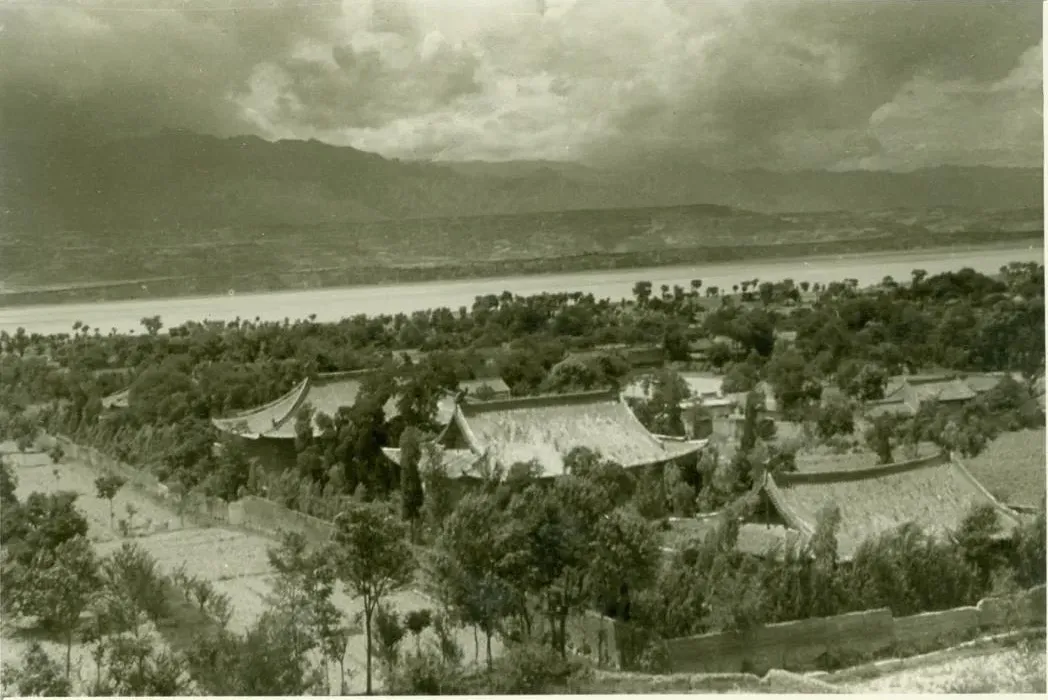
A panorama of the original site of Yongle Palace before the relocation, shot from northeast to southwest, with the Yellow River and distant mountains visible behind the complex. The image is preserved by the Chinese Academy of Cultural Heritage and published in the 《永乐宫迁建工程档案初编》 (Preliminary Compilation of the Archives of the Yongle Palace Relocation Project).
1959–1965
The relocation project archives record the protection of the timber members before dismantling, the detachment of the Sanqing Hall murals, and the detached murals laid flat. The following images are likewise published in the 《永乐宫迁建工程档案初编》 (Preliminary Compilation of the Archives of the Yongle Palace Relocation Project).
References
The following inscriptions can at present be verified on public webpages only as to their titles, object information, or excerpts quoted in scholarly articles; no continuous and complete transcription published by a formal institution has yet been found, so they are not reproduced here as source texts.
- Shanxi Provincial Academy for the Conservation of the Yongle Palace Murals: 《元泰定元年有唐纯阳吕真人祠堂记碑》 (Stele of the Record of the Shrine of the Tang Perfected Lü Chunyang, First Year of the Taiding Reign of the Yuan), a catalogue record of a stele in the collection.
- Shanxi Provincial Academy for the Conservation of the Yongle Palace Murals: 《永乐宫文献》 (Documents of Yongle Palace), recording Wang E’s Stele of the Rebuilding of the Great Chunyang Wanshou Palace under the Great Dynasty and other Yongle Palace documents.
- Wang Jinping: 《蒙古征服之后:华北地区社会秩序格局的变迁》 (After the Mongol Conquest: Changes in the Pattern of Social Order in North China), National Institute for Advanced Humanistic Studies, Fudan University. Drawing on the reverse of the Stele of the Rebuilding of the Great Chunyang Wanshou Palace under the Great Dynasty, the article discusses Yongle Palace’s network of monasteries and the donor inscriptions for its construction.
- Shanxi Provincial Academy for the Conservation of the Yongle Palace Murals: 《明万历四十五年永乐镇纯阳宫肇修善事碑》 (Stele of the First Undertaking of Good Works at Chunyang Palace of Yongle Town, Forty-fifth Year of the Wanli Reign of the Ming), a catalogue record of a stele in the collection.
- Shanxi Provincial Academy for the Conservation of the Yongle Palace Murals: 《明天启甲子永乐宫重修诸神牌位碑》 (Stele of the Renewal of the Spirit Tablets of the Gods at Yongle Palace, Jiazi Year of the Tianqi Reign of the Ming), a catalogue record of a stele in the collection.
- Li Luke: 《永乐宫的“鼎盛”与“贵盛”:建筑、壁画及室内空间》 (The “Flourishing” and “Eminence” of Yongle Palace: Architecture, Murals, and Interior Space), Shanxi Provincial Academy for the Conservation of the Yongle Palace Murals. The article quotes excerpts from the Record of the Renewal of the Spirit Tablets of the Gods at Yongle Palace and the Stele Record of the Great Qing Restoration of Wanshou Palace and, combining inscribed bricks and records in the Daoist Canon, sorts out the construction phases of Yongle Palace.
- Shanxi Provincial Academy for the Conservation of the Yongle Palace Murals: 《明崇祯九年永乐宫重修墙垣碑》 (Stele of the Rebuilding of the Walls of Yongle Palace, Ninth Year of the Chongzhen Reign of the Ming), a catalogue record of a stele in the collection.
- Du Xianzhou: 《永乐宫的建筑》 (The Architecture of Yongle Palace), Wenwu, 1963, no. 8. The article quotes excerpts from the Stele Record of the Rebuilding of the Walls of Chunyang Wanshou Yongle Palace and systematically discusses the construction of Yongle Palace, its repairs through the ages, its overall layout, and its four Yuan-dynasty timber structures.