Introduction
Zhihua Temple in Beijing’s Dongcheng District was completed in the ninth year of the Zhengtong reign of the Ming (1444). Its patron Wang Zhen was a Ming-dynasty eunuch: during the reign of Emperor Xuanzong he served for many years in the inner court, and after the young Emperor Yingzong ascended the throne he became both an intimate attendant and an important early tutor of the emperor, quickly gaining his trust and amassing power. The Record of the Imperially Bestowed Zhihua Chan Temple records that the monastery was built beside Wang Zhen’s private residence, with halls, gatehouses, covered walkways, banners, and ritual implements[1] all complete, the entire cost of labor and materials borne by Wang Zhen himself.
In the fourteenth year of the Zhengtong reign (1449), the Oirats attacked the Ming frontier. The Veritable Records of Emperor Yingzong of Ming records that Wang Zhen pressed from within the palace for Emperor Yingzong’s personal expedition; once the army had set out, he suppressed the assembled officials’ requests to halt the advance and to re-enter the passes as quickly as possible. By the time the Ming army fell back to Tumu Fortress it was already cut off from water and under siege; when the Oirat forces feigned retreat, Wang Zhen ordered the entire army to move camp to fetch water, and as the formations shifted they were struck on all sides by cavalry and collapsed. Emperor Yingzong was captured, and Wang Zhen died amid the routed troops.
After Emperor Yingzong’s restoration, he issued an edict posthumously restoring Wang Zhen’s former offices and erected the Jingzhong Shrine[2] to him inside Zhihua Temple. In the seventh year of the Qianlong reign (1742), Shen Tingfang, a censor who had taken part in compiling the History of Ming, passed by Zhihua Temple and found Wang Zhen still receiving offerings. Believing that Wang Zhen had monopolized power and ruined the state, he petitioned the Qianlong emperor to demolish Wang Zhen’s statue and the stele extolling his merits; the following year the statue and the stele were demolished by imperial decree. Thereafter Zhihua Temple lost its patronage and upkeep and gradually declined. The Ancient Monastery of Zhihua states that the temple was damaged when the Eight-Nation Alliance invaded Beijing in 1900, without detailing the losses; a 1930s site plan shows the five successive courtyards and the central, eastern, and western axes still largely intact. By the Republican era, temple affairs were in the hands of the twenty-fifth abbot, Abbot Puyuan; the monks could only make a living by renting out rooms, and Puyuan also cut down the pines and cypresses in the courtyards and sold them.
In the summer and autumn of 1930, the antiquities dealer Ji Xiaobian (known as Third Master Ji) handled the dismantling and sale of the two caisson ceilings[3]. Nearby residents later recalled that Third Master Ji entered the temple many times to negotiate; the dismantling lasted several days, and porters carried the components away on rainy nights to the Ji family courtyard in Yangweiba Hutong (today’s Yangzhao Hutong), where a few days later they vanished without trace. In 1930 the Philadelphia Museum of Art acquired the Zhihua Hall ceiling: the museum’s records list it as a gift of Joseph Wasserman and his wife, while the University of Chicago’s Zhihua Temple digital project states that Horace Jayne purchased it on the museum’s behalf; the publicly available materials do not yet explain the relationship between the two records. The Philadelphia museum later used measured drawings of Zhihua Temple to fabricate reconstructed architectural members completing the ceiling in its gallery. In 1931, Langdon Warner, an adviser to the Nelson-Atkins Museum of Art, learned that the Wanfo Pavilion ceiling was for sale and entrusted Laurence Sickman, then in Beijing, with its acquisition; in May of the same year the museum purchased the ceiling through the Beijing antiquities dealer E. A. Punnett & Co., with funds from the William Rockhill Nelson Trust. The ceiling was installed in the “Chinese Buddhist Temple” gallery in 1932 and has been on public view since the museum opened in December 1933. The museum’s existing archives still cannot establish whether this dealer obtained the ceiling directly from Zhihua Temple.
Historical Documents
《敕赐智化禅寺之记》 (Record of the Imperially Bestowed Zhihua Chan Temple)
今上皇帝嗣承大宝以来天下太平百谷丰稔无间远迩内外皆家给而人足是以安生乐业之余又得以遂其报本追远之愿焉
Since Our present emperor succeeded to the Great Treasure, the realm has been at peace and the hundred grains abundant; without distinction of far or near, within or without, every household is provided for and every person has enough. Thus, beyond living in peace and delighting in their occupations, the people have also been able to fulfill their wish to repay their origins and remember their distant forebears.
夫万物本乎天人本乎祖譬之达海之水其流百折而愈远者由其源之所自深也千霄之木其干千寻而益茂者由其根之所托厚也
The myriad things have their root in Heaven, and man has his root in his ancestors. It is like water that reaches the sea: that its stream winds through a hundred turns yet runs ever farther is because its source lies deep; it is like a tree that rises a thousand fathoms toward the sky: that its trunk grows ever more luxuriant is because the ground in which its roots rest is rich.
人有此身福禄荣显康宁寿禄享无穷之庆者孰非由于祖宗积德深厚之所致哉
That a man in this body enjoys fortune and emolument, honor and distinction, health and tranquillity, long life and prosperity, celebrating blessings without end—what is all this if not the result of the deep and abundant virtue accumulated by his ancestors?
于乎水本乎源能浚涤而不忘则其流之远也不达于海不止木本乎根能培养而不遗则其干之茂也不干乎霄不已
Ah! Water that springs from a source, if that source is dredged and cleansed and not forgotten, will run far and not stop until it reaches the sea; a tree that grows from roots, if those roots are tended and nurtured and not neglected, will flourish in its trunk and not cease until it touches the sky.
人于祖宗而能不忘不遗生则致其养没则尽其哀追远之忱则克竭足以福庇其身于永久而于君子尊祖敬宗报本追远之道亦庶几矣
If a man, toward his ancestors, can neither forget nor forsake them—while they live giving them their due support, when they are gone giving full vent to his grief, and exhausting his utmost sincerity in remembering those far away—this will suffice to bless and shelter his own person for all time, and he will have drawn near to the gentleman’s way of honoring ancestors and revering the lineage, repaying his origins and remembering the distant dead.
以物言之则身与物皆万物也以天言之则天与佛无非天也天者在天之佛佛者在世之天万物欲效报于天者非皈依佛不能而人欲效报于祖者舍佛其谁能资其冥福哉
To speak in terms of things, the body and all things are equally among the myriad things; to speak in terms of Heaven, Heaven and the Buddha are nothing other than Heaven: Heaven is the Buddha in the heavens, and the Buddha is Heaven in the world. If the myriad things wish to render repayment to Heaven, there is no way but to take refuge in the Buddha; and if a man wishes to render repayment to his ancestors, who but the Buddha can aid their unseen blessedness?
此吾一念惓惓在于佛者盖以报本追远为主其次增延福寿济渡幽显于无穷也
This is why my single earnest thought rests with the Buddha: repaying my origins and remembering the distant dead comes first, and next the increase and prolongation of fortune and longevity, ferrying the hidden and the manifest across without end.
京城之东稍北为顺天府大兴县黄华坊振之私第在焉
To the east of the capital city and slightly to the north lies Huanghua Ward in Daxing County of Shuntian Prefecture; there stands Zhen’s private residence.
境幽雅喧尘之所不至乃即其间旷高朗处垣而寺之将俾吾后之人掌持而供奉于其间永敬无怠
Its setting is secluded and elegant, beyond the reach of noise and dust; so I walled an open, lofty, and bright spot within it and made a temple of it, intending that my descendants should take charge of it and make offerings there, reverent forever and never remiss.
寺之建也殿堂门庑各以序为与夫幡幢法具庖湢廪庾之类靡或不备
In the building of the temple, the halls, gatehouses, and side galleries were each laid out in their due order, and of banners and streamers, ritual implements, kitchens and bathhouses, granaries and storehouses, there was nothing that was not provided.
规制弘敞像设尊严涂暨坚完采绘鲜丽凡百工材之费一出己赀
Its plan is grand and spacious, its images solemn and dignified, its plasterwork solid and sound, its painted decoration fresh and brilliant; the cost of all the labor and materials came entirely from my own funds.
盖始于正统九年正月初九日而落成于是年三月初一日既而以闻上嘉之特赐名曰智化禅寺
The work began on the ninth day of the first month of the ninth year of the Zhengtong reign and was completed on the first day of the third month of that same year. When this was reported to the throne, the emperor praised it and specially bestowed upon it the name Zhihua Chan Temple.
奎章赫弈佛日光辉诚无量之幸也然念不可无记仅拜稽首记而铭之铭曰
The imperial calligraphy shines resplendent and the Buddha-sun casts its radiance: truly this is boundless good fortune. Yet reflecting that this must not go unrecorded, I respectfully bow and prostrate myself, record it, and inscribe it. The inscription reads:
稽首诸佛诸龙天
巍巍功德浩无边
慧光普照三大千
如日出地明了然
迷途渺渺生青莲
欲海茫茫浮舟船
众生乘此妙因缘
度脱艰虞离纠缠
我惟真发愿力坚
手中珍宝乐弃捐
黄华之境何幽偏
筑构庄严精且专
成此大刹奉金仙
幸殚一念善果圆
心不忘佛佛在前
一灯初起千灯传
上资慧力福我先
下叶集禧兼延年
恒河沙界智与贤
共此见闻增福田I bow my head to all the Buddhas and all the dragon-devas,
lofty, whose merit is vast and boundless;
the light of wisdom shines through the three thousand great-thousand worlds,
like the sun rising over the earth, clear and bright.
On the distant road of delusion, blue lotuses spring forth;
on the boundless sea of desire, boats are set afloat.
Sentient beings ride upon this wondrous karmic condition,
crossing over hardship and danger, freed from entanglement.
My own true vow-power is firm;
the treasures in my hand I gladly cast away.
How secluded and remote this realm of Huanghua,
built and adorned with single-minded devotion;
this great monastery completed in honor of the Golden Immortal,
fortunate to exhaust one thought, the good fruit made perfect.
When the heart forgets not the Buddha, the Buddha stands before it;
one lamp first kindled, a thousand lamps pass it on.
Above, aiding with wisdom’s power and blessing my forebears;
below, gathering felicity for later generations and lengthening their years.
May the wise and worthy of worlds as many as Ganges sands,
sharing in this sight and hearing, increase the field of blessings.大明正统九年九月初九日佛弟子□□□□□□□□□
Ninth day of the ninth month of the ninth year of the Zhengtong reign of the Great Ming; the Buddhist disciple [nine characters effaced].
《敕赐智化禅寺报恩之碑》 (Stele of the Imperially Bestowed Zhihua Chan Temple in Repayment of Kindness)
臣□窃惟一介微躬生逢盛世爰自早岁获入禁庭列官内秩
Your servant [one character effaced] humbly considers: a single insignificant person, I was born into a flourishing age, and from my early years I was admitted into the forbidden palace and ranked among the officers of the inner court.
受太宗文皇帝眷爱得遂问学日承诲谕既而俾侍仁宗昭皇帝于青宫复蒙念臣小心敬慎委以腹心之任
I received the affection of Emperor Taizong Wen, so that I was able to pursue learning and daily received his instruction; thereafter I was made to attend Emperor Renzong Zhao in the Eastern Palace of the heir apparent, and further, in consideration of my care and reverent caution, I was entrusted with the confidence of a trusted intimate.
暨登大宝屡加显庸宣宗章皇帝临御猥以久在侍从眷顾有加龙驭上升之日遂荷付托之重
When he ascended the Great Treasure, I was repeatedly advanced to illustrious service. When Emperor Xuanzong Zhang came to the throne, because I had long been among his attendants he unworthily bestowed ever greater favor upon me; and on the day the dragon chariot ascended on high, I thus bore the weight of his dying charge.
今上皇帝察臣愚忠益隆亲信恩德之大天地难名
Our present emperor, perceiving my simple loyalty, has grown ever more intimate with me and trusted me the more; the greatness of his grace and virtue is such that heaven and earth cannot name it.
是以祇慎竞惕敬恭夙夜披沥肝胆竭诚瘁躬惟恐上不能副列圣属任之意而下无以效涓埃之报于万一也
Therefore I remain reverent and cautious, anxious and watchful, respectful and diligent from dawn to night, laying bare my very heart and liver, exhausting my sincerity and wearing out my body, fearing only that above I cannot answer the charge laid upon me by the succession of sage emperors, and below have no way to render even a trickle or a mote of repayment out of ten thousand.
仰惟佛氏之道以寂静为宗以能仁为用率不言之生成妙无为之教化
Looking up, I consider that the way of the Buddha takes quiescence as its doctrine and capable benevolence as its function; it leads to a birth and becoming beyond words, and is wondrous in its teaching through non-action.
阐明天人之理昭示幽显之报大要欲人万尘绝垢不陷于迷途明心见性同归于正觉功德无量不可思议
It expounds the principle of heaven and man, and clearly shows the recompense of the hidden and the manifest; its great aim is that men should leave behind the ten thousand dusts and defilements, not fall into the road of delusion, make luminous their minds and see their nature, and all alike return to right awakening—its merit is measureless and inconceivable.
故自其教流入中国以来自王公以至于民庶具有高明之识者莫不敬信崇重
Therefore, since its teaching flowed into China, from kings and dukes down to the common people, all who possess lofty and clear understanding have without exception revered, believed in, and honored it.
至若臣子怀君亲之大恩亦皆于此祝祷祈寿禄以图报于无穷实人天之珍宝大化之均陶也
As for ministers and sons who harbor the great kindness of sovereign and parents, they too all pray here, beseeching longevity and emolument, seeking to repay it without end; truly it is the treasure of men and devas, the even molding of the great transformation.
惟兹胜力允惬良缘于是谨秉微诚悉捐己赀僦工市材建兹宝刹
Meditating on this surpassing power, truly fitting for a good karmic bond, I thereupon reverently took up my slight sincerity, donated all of my own funds, hired workmen and bought materials, and built this precious monastery.
庄严法御暨诸像设供荐之具百尔咸备事闻蒙敕赐额曰智化禅寺
The adornments, the Dharma seats, and the various images, together with the implements for offerings and presentation, were provided in their hundreds, all complete. When the matter was made known, I received an imperial decree bestowing the plaque name Zhihua Chan Temple.
颁榜辉煌法门庄严将以休沐之暇时获瞻礼及诸眷属朝夕崇奉
The bestowed tablet is resplendent and the gate of the Dharma is adorned; in my leisure hours of rest and bathing I shall from time to time obtain to gaze upon it and worship, and all my dependents shall honor it morning and evening.
缉祈圣天子福寿万年永膺景命福惠苍生
Gathering my prayers, I beseech that the sage Son of Heaven have fortune and longevity for ten thousand years, forever receiving the bright mandate, and bestow blessing and benefit on the black-haired people.
再愿天地清宁和气充溢雨旸时顺年谷屡丰以及国家天下民物之众无间远迩钜细贵贱愚良均沾化育之恩同跻仁寿之域
Further I vow that heaven and earth be pure and tranquil, that the harmonious breath overflow, that rain and sunshine come timely and seasonable, that the year’s grain be repeatedly abundant, and that the multitudes of the state, the realm, the people and things—without distinction of far or near, great or small, noble or mean, foolish or good—all alike be touched by the grace of its transforming nurture, and together ascend to the realm of benevolence and long life.
庶副区区平素之志夫天地虽未尝责报于万物而万物自不忘生成之德
May this in some measure answer my humble constant resolve. Although heaven and earth have never demanded repayment from the myriad things, the myriad things of themselves do not forget the virtue of their birth and becoming.
圣人虽未尝责报于臣下而臣下之心自不能忘恩德之重
Although the sage has never demanded repayment from his ministers and subjects, the hearts of his ministers and subjects of themselves cannot forget the weight of his grace and virtue.
此所以惓惓于此摅衷恳吁而不能已□谨拜稽首而祝颂曰
This is why, earnest upon this point, I pour out my heart and fervently entreat, unable to stop myself. [One character effaced] I reverently bow and prostrate myself, and in blessing and praise I say:
于赫皇明诞育万方
列圣继作仁泽汪洋
凡在两间靡不渐被
沉滋伊尔沾沐尤至
顾我微躬希世遭逢
受知委任恩德兼隆
天地之大物何能报
惟此一诚庶格穹昊
剀惟我佛悯念众生
有求皆遂靡愿弗成
功德宏深实同覆载
慧光遍照幽显咸赖
爰卜爰筑有伊梵宫
既完既洁晨夕鼓钟
颙祈天福寿永亿太平
六气时调八表宁谧
年谷顺成民生滋殖
法门广大佛日辉光
国祚延永万世无疆Oh, resplendent august Ming, giving birth and nurture to the myriad regions;
the succession of sages arising one after another, their benevolent bounty vast as the sea.
All that lies between heaven and earth, none is not steeped and covered;
deeply nourished are you all, and I have been drenched and bathed the most.
Looking back on my slight person, a rare meeting in the world,
recognized and entrusted, grace and virtue doubly magnified.
Vast as heaven and earth, how can a thing repay?
Only this one sincerity—may it reach the azure vault.
Truly our Buddha takes pity and thinks on sentient beings;
every request is fulfilled, no vow left unaccomplished.
His merit and virtue are vast and deep, truly like the covering and bearing of heaven and earth;
the light of wisdom shines everywhere, and hidden and manifest alike rely on it.
Thereupon divined and thereupon built, this brahma palace,
complete and pure, with drum and bell at dawn and dusk.
Reverently praying for heavenly blessing and long life, for a hundred million years of peace;
the six breaths in timely harmony, the eight extremities tranquil;
the year’s grain ripening in season, the people’s livelihood growing and multiplying.
The gate of the Dharma is vast and great, the Buddha-sun radiant;
the state’s fortune prolonged forever, for ten thousand generations without limit.大明正统九年九月初九日佛弟子□□□□□□
Ninth day of the ninth month of the ninth year of the Zhengtong reign of the Great Ming; the Buddhist disciple [seven characters effaced].
《双槐岁抄》 (Shuanghuai Suichao (Jottings from the Twin Locust Trees))
英庙九龄嗣位,宠信司礼太监王振,窃弄威福,或请太皇太后张氏垂帘听政,不允。一日,召英国公张辅、内阁杨士奇、杨荣、杨溥,尚书胡濙入见便殿,宣振至前,戒谕之。正统壬戌,太后崩,振恣肆,作大宅皇城东。又明年,作智化寺于宅左以祝厘,自撰碑文。及土木之难,言官劾其擅权误国,今陷虏中,反为虏用。籍其家产,玉盘径尺者十枚,金银十余。库马数万匹,族党皆坐诛夷,宅没入官,改京卫武学。天顺改元,振党以闻,上大怒曰:振为虏所杀,朕亲见之,追责言者过实,皆贬窜。诏复其官,刻香木为振形,招魂以葬。塑像于智化寺北祠之,敕赐额曰旌忠。僧然胜奉其香火,夤缘以孝行被旌。磁州同知龙约自京还任,以语州人罗绮。时绮以副都御史降参政,家居,为人奏其谤讪,皆获罪。许学士彬积不平,赋诗曰:忠臣偶尔陷车驾,孝子胡然伤发肤。智化寺中祠屋上,蓟门风峻夜啼乌。
Emperor Yingzong succeeded to the throne at the age of nine and favored and trusted Wang Zhen, director of the Directorate of Ceremonial, who usurped the powers of reward and punishment. Someone proposed that Grand Empress Dowager Zhang hold court from behind a lowered screen, but she refused. One day she summoned Zhang Fu, Duke of Ying; the grand secretaries Yang Shiqi, Yang Rong, and Yang Pu; and Minister Hu Ying to an audience in a side hall, called Wang Zhen before her, and admonished him. In the renxu year of the Zhengtong reign (1442) the empress dowager died, and Wang Zhen grew unrestrained, building a great mansion east of the imperial city. The year after next he built Zhihua Temple to the left of the mansion to pray for blessings, composing the stele text himself. When the disaster at Tumu came, censors impeached him for monopolizing power and ruining the state, saying that now, fallen among the captors, he had turned and served the enemy. His family property was confiscated: ten jade dishes a foot across, more than ten units of gold and silver, and tens of thousands of horses in his stables. His kin and partisans were all condemned and exterminated; the mansion was seized by the state and converted into the Capital Guards Military Academy. When the era changed to Tianshun, Wang Zhen’s partisans reported these accusations to the throne; the emperor was furious and said, “Zhen was killed by the enemy—I saw it with my own eyes,” and, finding that the censors’ words had been exaggerated, had them all demoted and banished. He decreed the restoration of Wang Zhen’s offices, had his likeness carved in fragrant wood, and summoned his soul for burial. A statue was modeled and enshrined in a shrine north of Zhihua Temple, to which an imperial plaque reading “Jingzhong” (Honoring Loyalty) was bestowed. The monk Ransheng tended its incense fire and, trading on the connection, was commended for filial conduct. Long Yue, vice prefect of Cizhou, returned to his post from the capital and spoke of it to Luo Qi, a man of that prefecture. Qi, then demoted from vice censor-in-chief to administration commissioner and living at home, was accused by others of slanderous criticism, and both men were punished. Academician Xu Bin, long nursing indignation, composed a verse: “A loyal minister by chance entrapped the imperial carriage; a filial son somehow wounded his own hair and skin. Above the shrine hall within Zhihua Temple, crows cry at night in the sharp wind of Jimen.”
《明武宗实录》 (Veritable Records of Emperor Wuzong of Ming)
正德二年五月,升僧录司右觉义性道为右讲经佥押管事兼智化寺住持。寺乃故太监王振所建,天顺初赐振碑文,立旌忠祠于寺内,以僧官主之。至性道,三传矣。刘瑾欲效振所为,故乞升性道。
In the fifth month of the second year of the Zhengde reign (1507), Xingdao, right preceptor of enlightenment in the Central Buddhist Registry, was promoted to right lecturer and assistant administrator, concurrently serving as abbot of Zhihua Temple. The temple had been built by the late eunuch Wang Zhen; early in the Tianshun reign, Wang Zhen was granted a stele inscription, and the Jingzhong Shrine was established inside the temple, administered by a Buddhist official. By Xingdao’s time it had passed through three transmissions. Liu Jin wished to imitate what Wang Zhen had done, and therefore requested Xingdao’s promotion.
《明史纪事本末》 (Ming shi jishi benmo (Narrative History of the Ming))
初,张太后既崩,王振遂无忌惮,作大第于皇城,又作智化寺于居东以祝厘,自撰碑,始弄威福。时杨荣先卒,杨士奇以子稷故,坚卧不出。惟杨溥在朝,年老势孤。继登庸者,悉皆委靡,于是大权悉归振矣。
Earlier, after Empress Dowager Zhang had died, Wang Zhen cast off all restraint: he built a great mansion in the imperial city and also built Zhihua Temple east of his residence to pray for blessings, composing the stele himself, and began to wield the powers of reward and punishment. At that time Yang Rong had already died, and Yang Shiqi, on account of his son Ji, stayed obstinately at home and would not come forth. Only Yang Pu remained at court, old in years and isolated in influence. Those appointed to office thereafter were all spineless and timid, and thus all great power fell to Wang Zhen.
《钦定日下旧闻考》 (Imperially Commissioned Study of Old Accounts of the Capital)
臣等谨按:智化寺今存,在禄米仓东。王振祠及像,明典汇谓在智化寺北,实录谓在智化寺内,其实在寺中之北,非两处也。振以阉竖误国,罪不容诛。英宗复位,刻像立祠,勒碑寺中,其惑已甚。本朝乾隆八年,御史沈廷芳奏闻,奉旨毁像及碑。
Your servants respectfully note: Zhihua Temple still stands today, east of Lumicang. As for Wang Zhen’s shrine and statue, the Ming dianhui states that they were north of Zhihua Temple, while the Veritable Records states that they were inside Zhihua Temple; in fact they stood in the northern part of the temple grounds, not in two separate places. Wang Zhen, a castrated menial, ruined the state, and no punishment could match his crime. When Emperor Yingzong was restored, he had a likeness carved and a shrine erected and a stele engraved in the temple—his delusion was extreme indeed. In the eighth year of the Qianlong reign of the present dynasty (1743), Censor Shen Tingfang memorialized the throne, and by imperial decree the statue and the stele were destroyed.
《[光绪]顺天府志》 (Shuntian Prefecture Gazetteer (Guangxu edition))
在朝阳门内禄米仓东。寺正统间,太监王振建。天顺元年四月,复王振官,并赐振碑文。立旌忠祠于寺内,塑像祠之。本朝乾隆八年,毁像及碑,御史沈廷芳奏请也。其寺西有武学,久废,存石狮二,云即武学遗址。
It stands inside Chaoyang Gate, east of Lumicang. The temple was built during the Zhengtong reign by the eunuch Wang Zhen. In the fourth month of the first year of the Tianshun reign (1457), Wang Zhen’s offices were restored and a stele inscription was bestowed upon him; the Jingzhong Shrine was established inside the temple, and a statue was modeled and worshipped there. In the eighth year of the Qianlong reign of the present dynasty (1743), the statue and the stele were destroyed at the request of Censor Shen Tingfang. West of the temple stood a military academy, long disused; two stone lions survive, said to mark the academy’s former site.
《天咫偶闻》 (Tianzhi Ouwen (Incidental Heardings from the Capital))
智化寺在禄米仓胡同,为明王振舍宅所建,极宏丽,今已半颓矣。殿宇极多,像塑尚出明代。西殿为转轮藏,别无佛像,亦它寺所无。万佛阁规模巨丽,碑述振事极详。盖振自宣德时入宫用事,宜宣宗之末,三杨不能制之矣。旧有振祠,今毁。
Zhihua Temple is in Lumicang Hutong. It was built from the residence donated by Wang Zhen of the Ming; it was exceedingly grand and beautiful, but today half of it has fallen into ruin. Its halls are very numerous, and its statues and images still date from the Ming. The western hall houses a revolving sutra cabinet and contains no other Buddhist images—something no other temple has. The Wanfo Pavilion is immense and splendid in scale, and the stele recounts Wang Zhen’s affairs in great detail. Wang Zhen had entered the palace and taken charge of affairs from the Xuande reign onward, and by the end of Emperor Xuanzong’s reign even the three Yangs could no longer restrain him. There was formerly a shrine to Wang Zhen; it has now been destroyed.
Historical Photographs
Early twentieth century
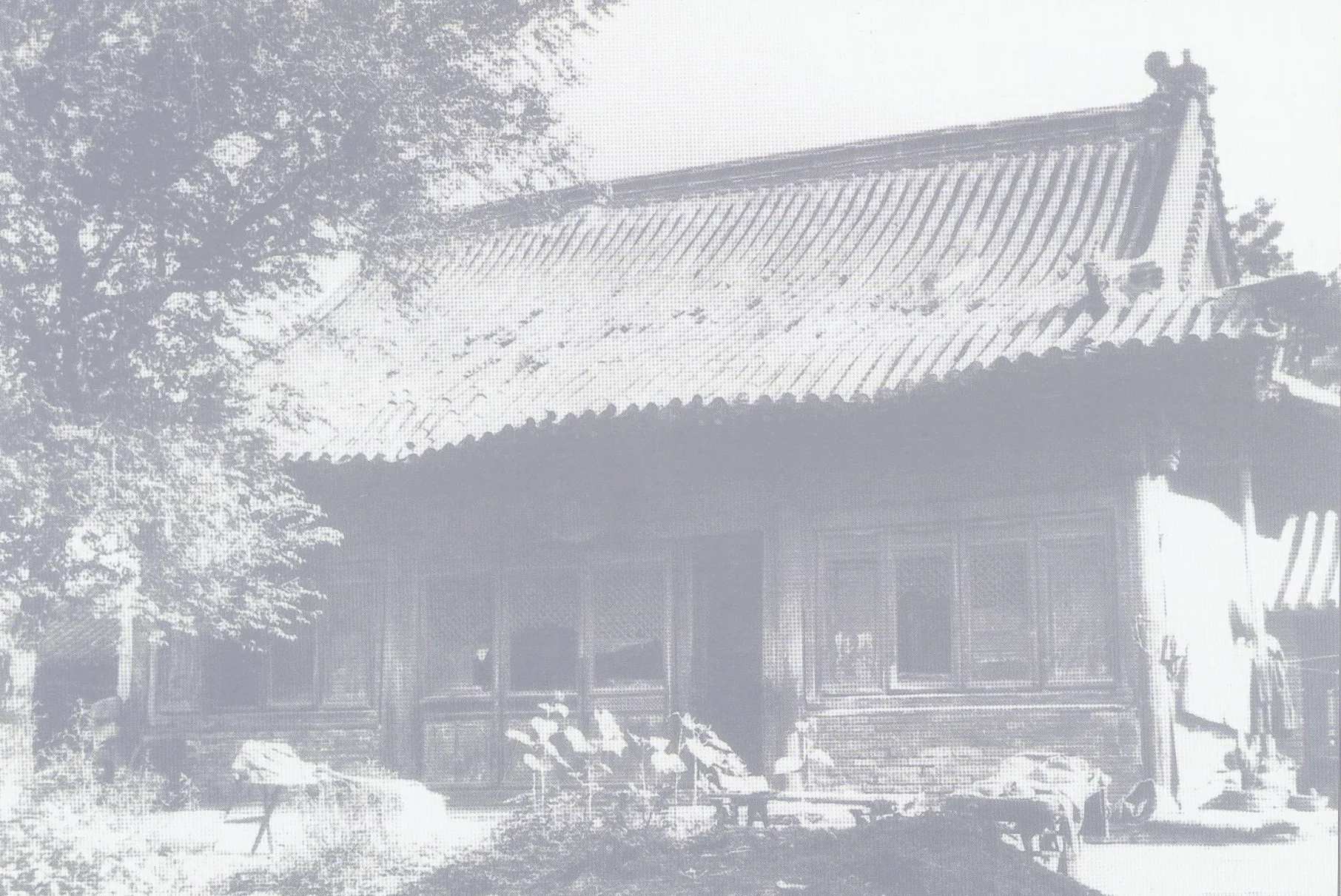
The edited compilation Illustrated Catalogue of Chinese Historic Architecture includes a group of old photographs captioned “Zhihua Temple, Beiping,” recording the Zhihua Gate, the bell and drum towers, Zhihua Hall, Wanfo Pavilion, Rulai Hall, the lattice partition doors of Zhihua Hall, and the Sumeru pedestal of the revolving sutra cabinet. The original book does not identify the photographer or the exact dates in the individual captions, so no finer dating is attempted here.
1931
An interior view of Wanfo Pavilion published by the Center for the Art of East Asia at the University of Chicago and provided by the Nelson-Atkins Museum of Art was taken in 1931. The photograph still shows the caisson ceiling, the celestial palaces, the Buddhist images, and the small indoor shrines together in their original setting.
References
- 《明英宗实录》 (Veritable Records of Emperor Yingzong of Ming), vol. 180 (seventh month of the fourteenth year of the Zhengtong reign)
- 《明英宗实录》 (Veritable Records of Emperor Yingzong of Ming), vol. 181 (eighth month of the fourteenth year of the Zhengtong reign)
- The Palace Museum: The Zhengtong Emperor
- Center for the Art of East Asia, University of Chicago: Digital Reconstruction of Zhihua Temple
- Center for the Art of East Asia, University of Chicago: The Caisson Ceilings of Zhihua Temple
- Center for the Art of East Asia, University of Chicago: Joining Histories—The Dispersal and Digital Restoration of the Zhihua Temple Ceilings
- Beijing Municipal Cultural Heritage Bureau: Zhihua Temple, from the series Looking Back on Sixty Years of Nationally Protected Sites
- Yang Wei, “Study of the Dispersal of Zhihua Temple’s Cultural Relics during the Republican Era,” Wencong, 2022, no. 4
- Philadelphia Museum of Art: Caisson ceiling from Zhihua Hall, Zhihua Temple
- Nelson-Atkins Museum of Art: Caisson ceiling from Wanfo Pavilion, Zhihua Temple
- CAEA Collections, University of Chicago: Photograph of the face of the Record of the Imperially Bestowed Zhihua Chan Temple stele
- CAEA Collections, University of Chicago: Photograph of the face of the Stele of the Imperially Bestowed Zhihua Chan Temple in Repayment of Kindness
- Liu Dunzhen, “Survey Report on Rulai Hall of Zhihua Temple, Beiping,” Bulletin of the Society for Research in Chinese Architecture, vol. 3, no. 3
- Beijing Cultural Relics Exchange Museum and Beijing Zhihua Temple Administration Office, eds., The Ancient Monastery of Zhihua