Introduction
In the seventh year of the Hongwu era of the Ming (1374), Chen Yong, a military officer then guarding Dongchang, used timber left over from the building of the city walls to raise a watch-and-drum tower[1] at the center of the prefectural city; at first it was called the “Yumu Tower,” the Tower of Leftover Timber. From its height the defenders kept lookout beyond the walls and watched for enemy movements, and its drums sounded the night watches for the city. During the Chenghua era the prefect Yang Neng repaired the tower; it was also once called the “Dongchang Tower,” after the prefecture. In the ninth year of the Hongzhi era (1496), Li Zan, an official of the Ministry of Personnel, climbed to its topmost tier together with Jin Tianxi, prefect of Dongchang; gazing down over the city walls, they marveled that so tall a tower should have no fitting name. The two settled on the name “Guangyue Tower,” taking the sense that it stands near Lu and sheds luster upon Mount Tai[2].
In the twelfth year of the Jiajing era (1533), the prefect Chen Ru climbed the tower, saw that its beams and timbers were damaged, and raised funds and materials and summoned craftsmen to rebuild it; the work was finished in less than a month. Beneath the tower’s high terrace a passage runs through, and upon the terrace the wooden tower rises in four tiers; to ascend it one first climbs a stone stair, then follows a winding stair inside the tower, the hollow core running through from bottom to top, with railings on every side. From a window opened on high one gazed afar: the boats on the canal east of the city passed in unbroken file, on clear days the hills of Jinliang[3] could be seen to the south, and Mount Tai could be descried to the east. On the day it was completed, Chen Ru invited his guests to climb the tower for a feast, and the company raised their cups by the windows, awaiting the moon.
By the twentieth year of the Qianlong era (1755), the Guangyue Tower’s stone terrace had begun to lean and its timbers were gradually rotting. The tower, moreover, stands where the roads from the four quarters meet, and it had become dangerous for those passing below. Several previous prefects had discussed repairing the tower, but none had broken ground, for the work was great and the cost heavy. When Cai Xueyi took up his post, the wheat harvests happened to be good two years running; he first donated his own salary, then invited the local gentry and the townspeople to contribute. He also chose gentry members to take separate charge of the works and materials, lest the clerks who handled them fish for profit and the work be done poorly. The work ran from the ninth month of that year to the fourth month of the next; Cai Xueyi was transferred just as it neared completion, and the official acting in his stead pressed the final work through. The eaves, columns, doors, and windows were repaired in their old form, and the tower kept its four tiers.
In the thirtieth year of the Qianlong era (1765), the Qianlong Emperor, on his southern progress, passed through Dongchang; entering the city by its east gate, he climbed the Guangyue Tower, gazed down over the fields and the land and water routes beyond the walls, and inscribed a plaque for the tower. What he climbed in the city was the Guangyue Tower, yet the gazetteers also record a Wangyue Tower at the northeast corner of the city; whether the two towers were the same or different, on his later visits he kept trying to distinguish them in verse. In the forty-ninth year of the Qianlong era (1784), he wrote the line “The city has the Guangyue; the Wangyue is no more,” concluding that the tower one can climb in the city is the Guangyue Tower and that the Wangyue Tower northeast of the city could no longer be found.
More than eighty years after the Qianlong-era rebuilding, the tower’s frame once again faced the danger of snapping and collapse. Zhan En, a military provincial graduate of Liaocheng, held that if it were not repaired then, the work would only grow harder later, and so proposed the repair to Zhu Qinggu, prefect of Dongchang, and Zhang Xiao, magistrate of Liaocheng County. The prefectural and county officials, the Shanxi and Shaanxi merchants trading in Liaocheng, and the local people all contributed funds; Zhan En superintended the work, which ran from the eighth month of the twentieth year of the Daoguang era (1840) to the tenth month of the twenty-fifth year (1845), at a cost of twelve thousand four hundred min[4] of standard cash. This rebuilding shored up the stone foundation, the brick base, and the timber frame, and the eaves, columns, doors, and windows were freshly painted. In the twenty-eighth year of the Daoguang era (1848), Yang Yizeng, a native of Liaocheng, composed the Record of the Rebuilding of the Guangyue Tower of Dongchang for the work; the stele later carved with it still stands west of the south gate of the terrace.
In November 1938, the Japanese army besieged Liaocheng. As shells fell one after another into the courtyard of the administrative commissioner’s office, Fan Zhuxian, the general commanding the city’s defense, moved his headquarters to the vicinity of the Guangyue Tower and continued to direct the defense of the four gates. The next day, after the east gate was breached, Fan Zhuxian and the defending troops fell back to the Guangyue Tower to resist, then shifted to street fighting around the Wanshou Abbey; Fan Zhuxian finally met his death at the Wanshou Abbey.
When the terrace foundation was reinforced in 1967, the brick outer walls and the platform surface were plastered over with cement. Twenty-some years later, the cement layer had cracked and was flaking away, and water seepage appeared. From 1992 to 1993, the builders first stripped off the outer cement, cut out and patched the damaged parts of the walls, then sheathed the outer walls with grey bricks and relaid the platform with square bricks.
Historical Documents
Dongchang Fu Zhi (Gazetteer of Dongchang Prefecture)
光岳楼
The Guangyue Tower
楼在城中央。洪武七年,东昌卫指挥佥事陈镛以修城余木建,名余木楼,以料敌望远。后西平李赞名之日光岳,取其近鲁有光于岱岳也。成化丙午,知府杨能修,有梁玺记。嘉靖间知府陈儒,万历间知府莫与齐重修。国朝顺治十七年知府卢𬭎,乾隆二十年知府蔡学颐重修。
The tower stands at the center of the city. In the seventh year of the Hongwu era, Chen Yong, assistant commander of the Dongchang Guard, built it with timber left over from the building of the city wall and named it the Yumu Tower, [using it] to spy out the enemy and see afar. Later, Li Zan of Xiping named it the Guangyue, taking the sense that it stands near Lu and sheds luster upon Mount Tai. In the bingwu year of the Chenghua era the prefect Yang Neng repaired it, and there is a record by Liang Xi. During the Jiajing era the prefect Chen Ru, and during the Wanli era the prefect Mo Yuqi, rebuilt it. Under the reigning dynasty, the prefect Lu Hong rebuilt it in the seventeenth year of the Shunzhi era, and the prefect Cai Xueyi in the twentieth year of the Qianlong era.
Guangyue Lou Ji (Record of the Guangyue Tower)
皇上御极之十有二年,惟献臣越我庶邦御事,罔不祗恊。维时海岳效灵,百度顺轨,而道化雝然以洽,君子日嘻,此大顺之实也。先是,嘉靖已丑,儒以大司徒之属出守东郡,爰按图籍,得所谓光岳楼者,乃窃叹曰:猗欤体哉!光岳之义大矣哉!南望兴思,恍若凭虚御风,独立于泰山乔岳之上。暨庚寅入郡,岁且告饥,儒乃匍匐往救之不暇,矧敢逸?越明年辛卯,贤隽汇征,冠诸列郡。时则与诸君子徘徊登眺,俯察仰观,欲一记诸,未能也。
In the twelfth year of Our Sovereign’s ascent of the throne, the appointed ministers and the officers of our many domains were all reverent and in harmony. At that time the seas and the marchmounts offered up their numinous virtue, the hundred measures followed their courses, and the transforming Way flowed in concord; the gentlemen daily exclaimed: this is the substance of the Great Accord. Earlier, in the jichou year of the Jiajing era, I, Ru, as an officer of the Ministry of Revenue, was sent out to govern the Eastern Commandery. Consulting the maps and registers, I found what is called the Guangyue Tower, and I privately sighed: Ah, how grand its form! Great indeed is the meaning of “Guangyue”! Gazing south, my thoughts rose as though I were riding upon the void and driving the wind, standing alone atop Mount Tai, the lofty marchmount. When I entered the commandery in the gengyin year, the year was already reporting famine; I went crawling to its relief without pause—how should I dare to be idle? The following year, xinmao, the worthy and accomplished converged in service, foremost among the neighboring commanderies. Then I lingered, climbed, and gazed with the gentlemen, observing below and beholding above; I wished to make a record of it, but could not yet.
又明年壬辰暨癸巳,雨旸时若,民物熙熙。时维九月,乃复偕诸君子以登,则见栋宇翚飞,檐阿雾隐,凌空纾瞩,东岳增辉,兹光岳之所以名乎?客曰:未也。又从而跻之,则见其灿然而列岫者,云物兴也;晶然而垂象者,日月丽也。左顾而群峰崒嵂,如距如伏者,泰岳之毓奇也;右盼而羊肠迤逦,如拱如障者,太行之呈秀也。又南睇而衡湘吞吐,北望而燕云闪烁者,诸岳之辉映于两閒也。兹光岳之所以名乎?客曰:似也,请更跻之曰:圣人兴神物以前民用,王者全至德以昭太和。昔者成周定鼎于洛邑,曰:此天地之中也,四时之所交也,风雨之所会也,而万世仰文明之治不衰。是故光岳气完,则贤圣出而天下治;光岳气分,则天地闭而贤人隐。兹光岳之所以名乎?诸君子乃作而言曰:嘻!
The next year, renchen, and the one after, guisi, rain and sunshine came in their seasons and the people and their goods flourished. It was the ninth month when I again climbed with the gentlemen, and we saw the roof soaring like a pheasant on the wing, the eaves’ curves hidden in the mist; letting the gaze go free into the vault of sky, the Eastern Marchmount gained new luster—is this not why it is called Guangyue? A guest said: not yet. Climbing yet higher, we saw that which gleams bright in ranged peaks: it is the rising of the cloud-forms; that which shines crystal in suspended images: it is the splendor of the sun and moon. Looking left, the host of peaks, sheer and towering, as if crouching, as if couched: this is the prodigy bred by Mount Tai. Looking right, the sheep-gut trails winding on and on, as if arched in salute, as if set as a screen: this is the beauty shown forth by the Taihang. Looking south again, the Heng and the Xiang seemed to breathe out and in; gazing north, the clouds of Yan shimmered: it is the reflected splendor of all the marchmounts between heaven and earth. Is this why it is called Guangyue? The guest [said]: that comes close; let us climb yet higher. He said: The sage brings forth the divine things so as to be beforehand of use to the people; the king completes the utmost virtue so as to make manifest the Great Harmony. Of old, the house of the completed Zhou fixed the tripod at Luoyi, saying: this is the center of heaven and earth, the meeting of the four seasons, the gathering of wind and rain; and for ten thousand ages men have looked up to the governance of culture and light, undiminished. Thus, when the qi of the shining marchmount is whole, then worthies and sages come forth and all under heaven is well governed; when the qi of the shining marchmount is divided, then heaven and earth close and the worthy men hide away. Is this why it is called Guangyue? The gentlemen then rose and said: Ah!
育是哉!夫鲁介在东藩,泰岳奠一其极,汶洄导其流,是故春秋贤圣繇此其兴,而万世道时学是宗焉。乃兹东郡,实据上游,则所以钟灵孕秀,以上二继千载之绪者,将无其人乎?儒尝阅志而品题于百世二之上,或以德业,或以文章,或以节义,遐哉邈乎,光映史策,吾不得而见之矣。乃今昭代人文,乘运以出,洋洋如也,侃侃如也,其所以对扬先烈而奋庸熙载者,亦既有其人矣。吾又安知百世之下,所以上继鲁、邹者,将无其人乎?乃遂书之,用昭不朽,而复系以诗曰:于维我明,奠兹鳌极。奄有龟蒙,泰山壁立。东有长河,壮兹金汤。源流浩渺,洙泗之将。中起危楼,古称光岳。伟哉形胜,伊谁之作?天祐我邦,诞兴文运。光岳储祥,乘时思奋。爰有作者,上继鲁邹。道垂千载,岂伊人谋。
How splendid it is! Now Lu is set as a bulwark in the east; Mount Tai fixes its single pole; the Wen’s winding waters guide its streams. Therefore the worthies and sages of the Spring and Autumn arose from here, and for ten thousand ages the learning of the Way has taken it as its fountainhead. Now this Eastern Commandery truly occupies the upper reaches; then as for those who shall concentrate its numen and breed its flowering, continuing above the thread of a thousand years—shall there be no such men? I have read the records and weighed the men of a hundred generations past: some for their virtue and works, some for their letters, some for their integrity and righteousness—far and remote they are, their light shining upon the slips of history, and I could not see them. Yet now, in this enlightened age, men of letters come forth riding the times, in such abundance, in such forthrightness; and of those who answer and glorify the ardor of the forebears and rise to brighten the tasks of the age, such men there already are. And how should I know whether, a hundred generations hence, there will be none to continue the line of Lu and Zou above? Thereupon I wrote it down, to make it shine undying, and further appended a poem: Lo, our Ming! It sets fast this pillar of the world. It holds all Gui and Meng; Mount Tai rises like a wall. To the east runs the long river, a bulwark for this metal-strong wall. Its source and stream stretch vast, great as the Zhu and the Si. In their midst rises the towering tower, of old called Guangyue. Magnificent is the strength of the land—whose work was it? Heaven blesses our land and grandly stirs the fortune of letters; Guangyue stores up blessing, and riding the time we think to strive. There was one who wrought it, continuing on from Lu and Zou. The Way hangs down a thousand years—how should it be the contriving of men?
我莅东藩,于兹四纪。大有频仍,贤豪胥继。爰荷天休,会逢其适。我士我民,乐且无极。明明天子,建乃中和。昭兹大顺,元气匪磨。敢用大书,阐兹微义。于万斯年,永绥厥治。
I have governed at this eastern bulwark these four years. Great harvests have come one upon another; the worthy and eminent have all succeeded one another. Receiving heaven’s grace, I met the fitting hour. Our officers and our people rejoice without end. The illustrious Son of Heaven has established his central harmony; making manifest this Great Accord, the primal qi is never worn away. I have dared to write it in large characters, to expound this subtle meaning. For all these myriad years, may it ever bring peace to this governance.
Xu Chengming, Chongxiu Guangyue Lou Ji (Record of the Rebuilding of the Guangyue Tower)
癸巳之秋八月辛酉,芹山陈子政平之暇,登光岳而览焉。顾栋宇摧折,惧曰:守兴百废,眷兹胜迹,实维具瞻,而栋桡,其谁之责?吾闻之,待敝者艰,蒙旧者易。于是相势筹资,罗诸工役,而播告日若。惟专攻无泛乃力而玩时;若;惟揆材,无舛乃施而滥费若;惟远图无绚乃文而具观。无亟而疲,无倦而惩,无方,予尔咎。巳。乃区材治廪,凡取诸公羡,及裁诸市贾,而官帑靡丝于故,猷奋响臻,费廉工迅,不弥月而事集,殆炳乎非旧观矣。陈子业育著光岳楼之幽,余复状其略日:楼中城而立,距河里许,河自巽下,抱城之左背,出乾,若涣弗结者。惟光岳既崇,四方景附,获翕受之义焉。楼之台,高数丈,下空洞旁达,上四叠,而峻楹准易卦,再叠符大衍,又再缩之三,末缩之五,翚举鹄冲,状削芙蓉,曲斗斜触,折回曼衍。
On the xinyou day of the eighth month of the autumn of guisi, Master Chen of Qinshan, in the leisure of his settled governance, climbed the Guangyue Tower to survey it. Seeing its beams and rafters broken and sagging, he said in alarm: in keeping the charge, the hundred derelictions are to be raised; and this splendid relic is truly what all eyes look up to—if its beams sag, whose charge is it? I have heard it said: to wait for ruin is hard; to rest upon the old is easy. Thereupon he surveyed the ground and raised the funds, assembled the works and laborers, and proclaimed it abroad, saying: Let effort be concentrated—do not scatter your strength and idle away the time; let materials be measured—do not misapply what is laid out and spend wastefully; let plans be far-seeing—do not gloss the surface merely to make a show. Do not press the men to exhaustion; do not weary them to resentment; be not without method, or I lay the blame on you. […] Then he apportioned the timber and provisioned the stores; all was taken from the public surplus and apportioned from the market merchants, and the official treasury was not taxed by so much as a thread. The plan pressed on and the response came; the cost was frugal and the work swift; before a full month the task was done, and it shone forth, no longer the former sight. Master Chen’s work had already made manifest the hidden depths of the Guangyue Tower; I now sketch its outline, saying: The tower stands in the middle of the city, about a li from the river; the river comes down from the xun quarter, embraces the city’s left flank, and issues at the qian quarter, as though dispersed and never congealed. With the Guangyue so exalted, the four quarters cleave to it like shadows to form—thus it wins the meaning of gathering and receiving. The tower’s terrace is several zhang high; below, a hollow passage opens through; above, four tiers are stacked. Its tall columns accord with the hexagrams of the Yi; the second tier matches the number of the Great Expansion; the next is diminished by three, and the last diminished by five. Rising like a pheasant, darting like a swan, shaped like a sheared lotus, its curved brackets slant and jut, folding and spreading in rich array.
构梯盘互,始达其巅,虚中彻上,缭以方栏,俯而股栗。启窗延眺,邈周数百里。伫抚流云,动接飞鸟,浦村溪树,历析秋毫。城之东隅,万艘鳞贯,霄澄雨霁,南见金梁诸山,亘接齐、兖,错峙低横,如拱如赴。东望岱岳,指顾双峰,烟霭冥蒙,如睹沧海。窃谓东邦海山之胜,雄诸四国。而魏博千里,野豁原舒,如砥如掌。兹楼跨清漕之津,据两都之会,胜奚尚耶?落成之日,陈子集朋僚,萃冠舄而往陟焉。维时秋爽气清,霜高宇净,霖敛遥林,烟沈万井。攀石橙,蹑丹梯,厉飘鸿,凌碧汉,眇远岫之如卷,睇长河之一线。陟而饮焉,命席临轩,举觞待月,揖序宾筵,秩秩楚楚,式礼罔愆,无乱樽俎。饮而乐焉,吹洞箫,击鼍鼓,扬霓曲,翻燕舞,铿金戛石,繁响激越,神融襟旷,遗落嚣纷,将凌汗漫于庄周,寄风流乎谢眺者矣。
Build the winding, interlocking stair, and only then does one reach its summit; the hollow core pierces through to the top, ringed with square balustrades—to look down makes the legs tremble. Open the windows and extend the gaze: the remoteness encompasses several hundred li. Standing, one brushes the drifting clouds; moving, one meets the flying birds; the bankside villages and the trees by the streams are sorted out to the finest autumn hair. At the city’s east corner, ten thousand boats pass in scale-like file; when the sky clears and the rain lifts, to the south appear the hills of Jinliang, stretching on to join Qi and Yan, standing jumbled, lying low and athwart, as if bowing in salute, as if hurrying forward. Gazing east at Mount Tai, one points to its twin peaks, dim in mist and haze, as though beholding the grey sea. I venture to say that among the sea-and-mountain splendors of the eastern lands, it is foremost of the four quarters; while the thousand li of Wei and Bo open wide in field and plain, level as a whetstone, flat as a palm. This tower bestrides the ford of the clear canal and holds the meeting of the two capitals—what prospect could surpass it? On the day of completion, Master Chen gathered his friends and colleagues; crowding in caps and shoes, they went up together. The season was autumn’s crispness, the air clear; the frost was high, the sky clean; the long rains withdrew from the distant groves, and mist sank over the myriad wells. We climbed the stone steps, trod the vermilion stair, surpassed the drifting swans, and mounted the azure empyrean, gazing afar at the distant peaks as though rolled up, beholding the long river as a single thread. Having ascended, we drank there; the mats were spread by the balustrade; we raised our cups awaiting the moon; the guests bowed and took their places at the feast, all in order and array; in the rites there was no fault, and none disordered the goblets and platters. Drinking, we made merry: the vertical flutes were blown, the alligator drums beaten, the rainbow tunes raised, the dances of Yan turned; metal rang and stone sounded, the manifold notes urgent and high; our spirits melted and our hearts opened wide, and the clamor of the world fell away—we would ride the boundless with Zhuangzi and lodge our free airs with Xie Tiao.
乐而歌焉,咏古而思巢父,怀贤而仰仲连。诵白露之什,赓黄鹤之篇,被之鸣弦,赏而击节,冥思支颐交欢,舞掌歌既,客有感焉。耆曰:噫嘻!吾属滥庾生之游,罔先范老之忧;餍肥甘之腴,罔知藜藿之味;适堂宇之便,罔思蓬荜之艰。诗曰:无已太康。易谓坚冰履霜,胡可忘戒乎哉?陈子闻而叹日:山可薪者,无完肤之材;泽可钓者,寡巨鳞之鱼。吾东郡滨于漕流,困供荐而削,坐驰驱而敝,征赋告迭,丰歉相代,匪予弗敬之堪,予何能措吾民于光岳之安乎?客曰:不然,吾固睹若敏矣,绥奠穷黎,匡祐亨豫。子之心,持颠拯溺,宣郁烛幽;子之政,起衰振靡,倒峡回澜;子之文,砭蒙启瞆,雨化云集。子之教。是故民苏而士变,道立而治兴,吾其谁归哉?曰:是非吾所能,敢请事斯语耳。
In our joy we sang: chanting of the ancients, we thought of Chaofu; cherishing the worthy, we looked up to Zhonglian. We recited the ode of the white dew and continued the verse of the Yellow Crane, set them to resounding strings, and beat time in delight; deep in thought, chin in hand, sharing our joy, we clapped our hands. When the songs were done, a guest was moved and said: Ah! We who idly share in this excursion like Master Yu [Yu Xin] have not first felt the foreboding of old Fan [Fan Zhongyan]; sated with the fat of rich meats, we know not the taste of goosefoot and pulse-leaves; at ease in the comfort of hall and chamber, we think not on the hardship of the bramble-door hovel. The Odes say: let there be no excessive ease. The Yi, in “treading on frost,” speaks of the hard ice to come—how may the warning be forgotten? Master Chen heard this and sighed, saying: A mountain that may be cut for firewood keeps no whole-skinned timber; a marsh that may be fished holds few great-scaled fish. Our Eastern Commandery borders the canal’s current; worn down by the burdens of provision and tribute, it sits exhausted by the galloping couriers; levies and taxes press one upon another, and plenty and dearth succeed each other. If I did not reverence what is worthy of reverence, how could I place my people in the peace of Guangyue? The guest said: It is not so; we have long seen your diligence—you have soothed and settled the poor, and aided and blessed them into ease and plenty. Your heart holds up the fallen and rescues the drowning, vents the pent-up and lights the hidden; your governance raises the failing and rouses the prostrate, like turning back the torrent of the gorge; your letters needle the benighted and open the unseeing, raining transformation and gathering like clouds—such is your teaching. Therefore the people revive and the officers are transformed; the Way stands and good governance flourishes—to whom else should we turn? He said: This is not within my power; I venture only to act upon these words.
君子曰:乐而知戒,安而虑危,有功而弗居,可以训矣。龙石子在侧,获备辑之,为楼记。
The gentleman says: to know caution amid joy, to think of danger amid safety, to have merit and not dwell upon it—this may serve as instruction. Master Longshi was by his side and was able to assist in compiling it; thus was made the record of the tower.
Cai Xueyi, Chongxiu Guangyue Lou Ji (Record of the Rebuilding of the Guangyue Tower)
余早岁通籍东郡,为入都要津,往来至止,即闻光岳楼之胜,与射书台并传,心志之有年。癸酉冬,余守登郡,甫及岁,奉天子命,量移于兹,周览层台,诚巨观也。楼之创始修废,备载乘碣閒无烦更仆述。惟是风雨飘飖,石欹木烂,日就倾圯,地处四术之冲,行者危之。历任前守,数经议复,皆以工大费繁而止,甚则动众招尤之说入,益迟回不果。余素勇于任事,不避艰巨。来之日,窃愿举之,而庶政殷繁,不遑议。及越岁,尘案渐理,地方日有起色,且幸麦秋两稔,民食裕则工易集,修举废坠,此其时矣。爰进绅士而公议之,佥曰可。余随捐俸为倡,而邑人咸乐余之锐意兴复,鼓舞相从,争投金钱无倦色。余思事繁重,杂以吏胥,恐渔利而工多窳,因慎选一二乡大夫分司其事,即余臧获无与焉。
In my early years I was entered in the official rolls; the Eastern Commandery, being a key crossing on the road into the capital, I passed through and stayed at in my comings and goings, and so heard of the splendor of the Guangyue Tower, famed together with the Archery-Letter Terrace, and bore it in mind for years. In the winter of guiyou I was made prefect of Dengzhou; scarcely a full year had passed when, by the Son of Heaven’s command, I was transferred here. Surveying the tiered terrace all about, it is truly a grand sight. The tower’s first building and its repairs and ruin are fully set down in the gazetteers and upon the steles; there is no need to recount them afresh. Only, buffeted by wind and rain, its stones leaning and its timbers rotting, it daily drew nearer to collapse; and standing at the crossing of the four roads, it put those who passed in danger. Successive former prefects several times deliberated on restoring it, but all stopped because the work was great and the cost manifold; worse still, the talk that it would stir the multitude and invite blame entered in, so that they wavered the more and it came to nothing. I have always been bold in taking up tasks and do not shun difficulty. From the day I arrived, I privately wished to undertake it, but the many affairs of government were pressing and I had no leisure to consider it. When the year had turned, the dusty files were gradually put in order, the locality daily improved, and by good fortune the wheat harvests of two years were abundant; when the people are well fed, labor gathers easily—to repair and raise what had fallen, this was the time. Thereupon I called in the gentry to deliberate openly, and all said it could be done. I then donated my salary to lead, and the townspeople, all glad of my keen resolve to restore it, followed with beating hearts, vying to give money without a weary look. I considered that the work was heavy, and if clerks were mixed into it I feared they would fish for profit and the work would prove slipshod; so I carefully chose one or two country gentlemen to take charge of its parts, and even my own servants had no share in it.
部署既就,具公牍而上闻之。时督河都御史白公,兼行抚篆,亟为嘉予。总藩阿公,且日:此余之素志也,幸为之无懈。秉臬卢公、观察朱公,司鹾胡公,咸谓不谬,都人士靡不踊跃从事。鸠工财材,备竭心力,自秋徂春,无告瘁者。二月中,余被恩命,擢任监司,筦钥河防,而工将竣,摄事者司马陈君,更砥砺勖勉,楼遂以成计。首役于乙亥九月,讫工于丙子四月,八阅月而功就。其始也,有以道旁筑舍私为言者,余力剖之,遂翻然悔,且欣然趋。亦可见任大事者,不畏难于谋始,不摇动于浮言,斯为得矣。是楼也,位耸离宫,𤷖霄矗起,或以郡多巍科,咸视此,此又惑于形家之言。官斯土者,果克雅意作人,力振文教,而贤士大夫复能善培其后,诱掖不辍,所谓父兄之教先,子弟之率谨,则英杰挺生,当代不乏人,岂尽系一楼之屹嵲哉?
When the arrangements were complete, I drew up an official dispatch and reported it upward. At the time Lord Bai, the censor-in-chief in charge of the [Yellow] River, who was concurrently exercising the governor’s seal, repeatedly praised and approved it. Lord A, the provincial administration commissioner, even said: this has long been my own wish—see it done without flagging. Lord Lu, the provincial judicial commissioner, Lord Zhu, the circuit intendant, and Lord Hu, the salt commissioner, all pronounced it sound, and the gentry and people of the prefecture all without exception eagerly took part. Laborers were mustered and materials purchased; all gave the utmost of their heart and strength; from autumn to spring, none complained of weariness. In the middle of the second month I received the gracious command, promoted to circuit supervisor with charge of the river defenses; the work was near completion, and Master Chen, the deputy prefect acting in the charge, pressed and encouraged it the more, and so the tower was brought to its planned completion. The work began in the ninth month of yihai and was finished in the fourth month of bingzi; in eight months the task was done. At its beginning, there were those who muttered against it, as at a house built by the roadside that is never finished; I argued it through with all my strength, and they turned about in contrition and gladly hastened to it. From this it may be seen that he who undertakes a great affair must not fear difficulty at the first planning nor be shaken by drifting talk—then he has it right. This tower, its station towering in the li quarter, rises sheer into the empyrean; some hold that the commandery’s many lofty examination degrees all look to this—but that is to be deluded by the words of the geomancers. If those who govern this soil can truly, with noble intent, form men and vigorously raise up letters and teaching, and if the worthy gentlemen moreover can nurture well those who come after, guiding them without cease—what is called the fathers and elders teaching first, and the sons and younger brothers following with care—then heroes and men of talent will arise outstanding, and the age will not lack for men. How should it all be bound to the towering of a single tower?
至于齐云、落星,侈言胜概,恐涉华脢之讥,余故不及,惟记其颠末,以志岁月。
As for the Cloud-Leveling and the Star-Falling towers, to speak extravagantly of such splendid prospects would risk the charge of florid excess; I therefore do not reach for them, but only record the matter from first to last, to mark the months and years.
Niu Yunzhen, Chongxiu Guangyue Lou Beiji (Stele Record of the Rebuilding of the Guangyue Tower)
太行以东,沧海以西,山之巉岩高大,兴云雨,见怪物者以十数,泰岳最胜。泰岳以西,山势中断,崩崺平衍,跨州连郡,轮蹄四达,殷阗辐辏之区以十数,东郡最胜。郡城。距泰岳二百五十里,东接齐、兖,西通邢、魏,南则漕运之河,自左偏来,挟连樯万艘,以达京畿。其中多古迹名地,有楼归然起于城郭闾阎阛暗之中。盘磴悬梯,耸倚重霄,奔星蜿虹,髣髴出入。棂槛俯吹行云,倒睨飞鸟,日观天门,隐隐步相接也。而襟带枕腋之交,四顾秋毫,泱漭,周延于数百里之外。夫东之为郡,撼清漕之津,据都邑之会,而四达形胜,一光岳楼悉取之。然则于寰宇之中有东郡,于东郡之中有光岳楼。楼之系重于东郡,此与有泰岳于山左之国,天之下,地之上也,有辨乎?
East of the Taihang and west of the grey sea, of the mountains that tower steep and high, raise the clouds and rain, and show strange prodigies, there are a score and more, and Mount Tai is the finest. West of Mount Tai, where the mountain ranges break off into collapsed and level ground, where prefectures straddle and commanderies adjoin and wheel and hoof reach in the four directions, of the rich and thronging districts where all things converge as spokes to a hub, there are a score and more, and the Eastern Commandery is the finest. The commandery city lies two hundred and fifty li from Mount Tai; to the east it joins Qi and Yan, to the west it communicates with Xing and Wei; and to the south the tribute-bearing river comes from the left flank, bearing a linked forest of ten thousand masts, to reach the capital region. Within it are many ancient sites and famous places, and there is a tower that rises lone and towering amid the walls and wards, the gates and markets of the city. Its winding stair and hanging ladder soar leaning upon the layered heavens; shooting stars and curling rainbows seem to pass in and out of it. From its latticed balustrade one looks down on clouds blowing past and gazes down upon flying birds; the Sun-Gazing Peak and the Heaven’s Gate seem faintly but a step apart. And at this crossing of girdle and sash, pillow and armpit, one looks about to the finest autumn hair, across the boundless expanse, stretching round for several hundred li beyond. Now the East as a commandery commands the ford of the clear canal and holds the meeting of cities; and of all the grand prospects reaching in the four directions, the single Guangyue Tower gathers them whole. Thus it is that within the world there is the Eastern Commandery, and within the Eastern Commandery there is the Guangyue Tower. The tower’s weight upon the Eastern Commandery is as Mount Tai’s upon the land east of the mountains—beneath heaven, above earth: is there any disputing it?
曰:无辨。
The answer is: there is none.
于是东郡之人士原任灌县知县蒋亮、监利县知县任士珑,锐然议修之,曰:兹楼以泰岳名,泰岳不可仆,兹楼不可毁,无兹楼,是无东郡也。楼距初建之岁,历年多所,听其圮且坏,是昭东郡士大夫之不能也。乃以其事请于有司。当是时,今河道观察蔡公学颐为东郡守,具状白大府及诸宪司,又倡为之劝,敛钱鸠工,经始乾隆二十年七月,落成于二十一年六月。役以夫计,凡若千,银以两计,凡若干。檐楹户牖,悉如其旧,益完以新,凡皆蔡公及东郡有司诸人士之力也。滋阳牛运震闻其事而壮之。往余三十年前尝一过斯楼,及是,蔡公以书属余纪其事。余惟斯楼其崇四复,凡十有一丈,制不可谓不壮。楼之役,郡人士襄事者数十人,费累千百计,志不可谓不坚。制之壮,志之坚,则保之不可以不久。
Thereupon the gentlemen of the Eastern Commandery—Jiang Liang, former magistrate of Guan County, and Ren Shilong, magistrate of Jianli County—resolved with keen resolve to repair it, saying: This tower is named for Mount Tai; Mount Tai cannot fall, and this tower cannot be destroyed; without this tower, there is no Eastern Commandery. Many years have passed since the year of its first building; to let it crumble and decay would make plain the inability of the commandery’s gentry. They therefore petitioned the responsible offices in the matter. At that time Lord Cai Xueyi, now the river-conservancy circuit intendant, was prefect of the Eastern Commandery; he drew up a full account and reported it to the high authorities and the various provincial offices, and moreover took the lead in urging it on; money was gathered and laborers assembled. The work began in the seventh month of the twentieth year of the Qianlong era and was completed in the sixth month of the twenty-first year. The labor, reckoned in workmen, came to so many thousand; the silver, reckoned in taels, came to so many thousand. The eaves and columns, doors and windows were all as of old, made whole and new—all of it the strength of Lord Cai and the officers and gentlemen of the Eastern Commandery. I, Niu Yunzhen of Ziyang, heard of the affair and held it grand. Thirty years before, I had once passed by this tower; and now Lord Cai wrote to charge me with recording the affair. I consider: this tower rises four tiers, eleven zhang in all; its measure cannot but be called grand. In the work on the tower, several score of the commandery’s gentlemen assisted, and the cost mounted into the thousands; the resolve cannot but be called firm. With the measure so grand and the resolve so firm, its preservation cannot but be long.
夫雀鼠之角触,罘罳制之,风雨之飘激,甃石拒之,水火之不虞,恒隶戒之。然楼之设,不过以岁计,而楼之毁,亦可以世待也。保之之难何如哉?古者吏治与民事合,而后城郭宫室峙以不敝。国之育楼,所以望云物,察氛祥,节物候,料民事也。东郡为微子遗封,颛顼高阳氏临莅之故地,贤有司守兹土,登兹楼,察民疾苦而噢咻之,视其劳役而休息之。俯瞰商货之殷辏,思以宣其滞;远览河漕之曲折,思以畅其流。如是则民安富,民安富,则士和附,士和附,则本末之力赡,公私之事举。然则光岳一楼,以东郡亿万人守之,墙壁日益坚,栋宇日益峻,虽谓斯楼永永无壤,更千万年雀鼠风雨,与泰岱、东岳终古俱不敝可也,以此保之,何有哉?蔡公曰:然,遂书以俾东郡人。
Now against the gnawing of sparrows and rats, the openwork screens forestall it; against the lashing of wind and rain, the brick and stone withstand it; against the unforeseeable harms of water and fire, the appointed keepers are ever on guard. Yet a tower’s standing is reckoned in years, and its ruin too may await an age. How then stands the difficulty of preserving it? In antiquity the governance of officials and the affairs of the people were made one, and so the walls and palaces stood and did not decay. The state’s fostering of towers is for watching the clouds and mists, observing the vapors of weal and woe, marking the seasons, and taking account of the people’s affairs. The Eastern Commandery is the bequeathed fief of Weizi and the ancient ground where Zhuanxu of the Gaoyang lineage once stood; may the worthy officers who keep this soil climb this tower, observe the people’s hardship and suffering and soothe them, regard their toil and labor and give them rest. Looking down on the rich convergence of merchants and goods, let them think how to free what is stagnant; gazing afar on the windings of the river and canal, let them think how to smooth their flow. Thus the people are at peace and prosper; when the people are at peace and prosper, the gentry join in harmony; when the gentry join in harmony, the strength of root and branch is made ample, and public and private affairs are all accomplished. Thus, then, this single Guangyue Tower, kept by the hundred million people of the Eastern Commandery, its walls daily firmer, its beams and eaves daily loftier—though one say that this tower shall never be cast down, that through ten million years of sparrows and rats, wind and rain, it shall with Mounts Tai and Dai abide unbroken to the end of time—so it may be. To preserve it thus, what difficulty is there? Lord Cai said: it is so; and thereupon it was written and given to the men of the Eastern Commandery.
Beiyou Riji (Diary of a Northern Journey)
十九曰到东昌府通济桥闸。东昌旧治在巢陵,宋淳化三年,河决城圮,乃移治孝武渡西,即今治也。城中鼓楼五层,名光岳楼。屠隆登光岳楼诗:万里风尘连海岱,千家烟火接淮徐。城外鲁仲连台,或云即射书处。肇域志云:府西北一十五里有古聊城。史记:田单攻聊城不下,鲁连为书约之矢,以射城中者也。韩慕庐有怀堂诗稿有鲁仲连射书处,自注云:有碑在聊城东门下。聊墄,春秋聊摄地。元裕之诗:杏花春酒记聊城。其东北有摄城。过东柳行墩,到永通闸。
On the nineteenth day [we] arrived at the Tongji Bridge Lock of Dongchang Prefecture. The old seat of Dongchang was at Chaoling; in the third year of the Chunhua era of the Song the [Yellow] River broke its banks and the city was ruined, so the seat was moved west of the Xiaowu Crossing, which is the present seat. Within the city, the drum tower has five stories and is named the Guangyue Tower. Tu Long’s poem on climbing the Guangyue Tower: “Ten thousand li of wind and dust link the sea and Mount Tai; the hearth-smoke of a thousand homes joins Huai and Xu.” Outside the city is the Terrace of Lu Zhonglian, which some say is the place where he shot the letter. The Zhaoyu Zhi says: fifteen li northwest of the prefecture is the ancient Liaocheng. The Records of the Grand Historian: when Tian Dan attacked Liaocheng and could not take it, Lu Lian wrote a letter, bound it to an arrow, and shot it into the city. Han Mulu’s Youhuai Tang Shigao has [a poem on] the Place Where Lu Zhonglian Shot the Letter, with his own note: there is a stele beneath the east gate of Liaocheng. Liaocheng was the Liao-She territory of the Spring and Autumn. Yuan Yuzhi’s poem: “Apricot blossoms and spring wine—I remember Liaocheng.” To its northeast is the city of She. Passing the East Liuhang Mound, [we] reached the Yongtong Lock.
Da Ming Yitong Mingsheng Zhi (Record of Famous Sites of the Unified Great Ming)
城中有望岳楼,以可眺望泰岳而名。台基高广数丈,楼作四层,矗立云表,雄胜甲于齐鲁。今名光岳楼。
Within the city is the Wangyue Tower, named because one can gaze out toward Mount Tai from it. Its terrace base is several zhang high and broad; the tower is built in four stories, standing erect beyond the clouds, its grand eminence first in all Qi and Lu. It is now named the Guangyue Tower.
Gujin Tushu Jicheng, Zhifang Dian (Complete Collection of Illustrations and Writings Old and New, Section on Administrative Geography)
光岳楼 在府城中,创始莫考,其台高数丈,楼四叠而上,盘互玲珑,缥缈云表,雄胜甲于中原。成化间知府杨能修,万历间莫与齐重修,知府陈儒、侍郎许成名、主事梁玺各有记。
The Guangyue Tower stands within the prefectural city; its first building cannot be ascertained. Its terrace is several zhang high; the tower rises in four tiers, winding and intricate, dimly seen above the clouds, its grand eminence first in all the Central Plain. During the Chenghua era the prefect Yang Neng repaired it, and during the Wanli era Mo Yuqi rebuilt it; the prefect Chen Ru, the vice-minister Xu Chengming, and the secretary Liang Xi each wrote a record.
Historical Photographs
1936
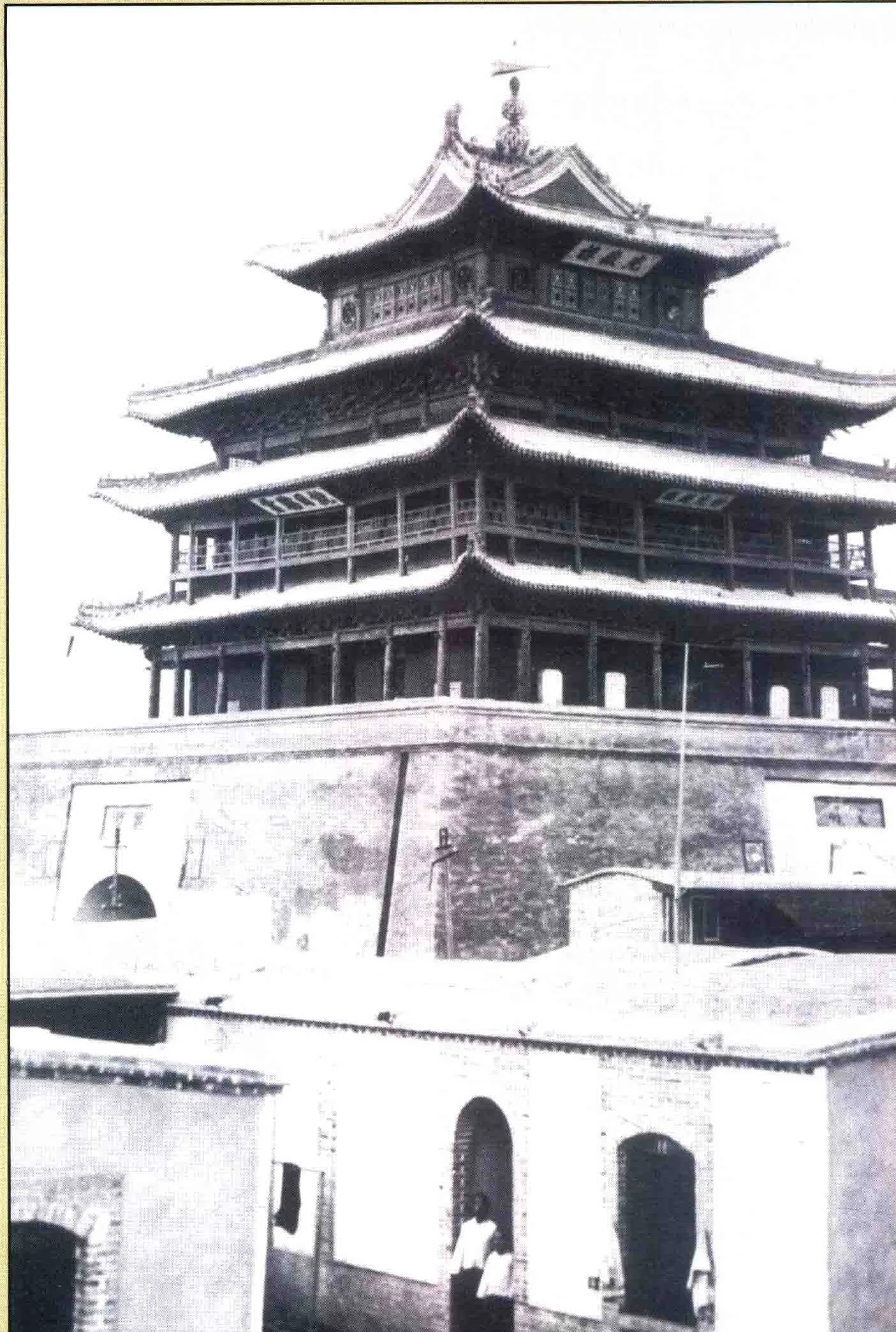
In 1936, the Society for Research in Chinese Architecture sent Liu Zhiping and Mo Zongjiang to Liaocheng to survey and photograph it. The third volume of the Illustrated Compendium of Chinese Historic Architecture, edited by Lin Zhu, includes an old photograph of the Guangyue Tower captioned “The Yumu Tower of Liaocheng, Shandong.” For the date and personnel of the survey, see “What Is the Connection between the Guangyue Tower and the Shanxi–Shaanxi Guildhall?”.
1947
An old photograph from 1947 published in the color plates of the Gazetteer of Liaocheng City records Gulou East Street, the houses along it, and the Guangyue Tower; the original maker is unknown. For the image’s title, see the gazetteer page preserved in the Shandong Chorography Archive.
References
- Fan Jinghua, “A Textual Study of the Inscription Record of the Rebuilding of the Guangyue Tower of Dongchang”, Shandong Library Journal, no. 2 (2016).
- “Historic Buildings”, in the Liaocheng volume of The Beijing–Hangzhou Grand Canal, Shandong Chorography Database.
- “Imperial Tours, Remissions, and Imperial Calligraphy”, opening section of the Gazetteer of Liaocheng County, containing the Qianlong Emperor’s poems on climbing the Guangyue Tower.
- “Historic Buildings”, in the Gazetteer of Liaocheng City, Shandong Chorography Archive.
- “Military Affairs: The Defense of Liaocheng”, part 15 of the Gazetteer of the Liaocheng Region, Liaocheng Regional Gazetteer Database.
- Dong Hua, “The Towering Guangyue Tower, Six Hundred and Fifty Years,” Qilu Evening News, “Culture of Qilu” page, June 12, 2024.