Introduction
Ta’er Monastery, located in Huangzhong, Xining, Qinghai, is a monastery built around the birthplace of Tsongkhapa, founder of the Gelug school[1]. Huangzhong belongs to Amdo in traditional Tibetan geography; centered on present-day Qinghai, Amdo also includes parts of southern Gansu and northern Sichuan. According to the monastery’s institutional history, tradition holds that Tsongkhapa’s mother built a stupa here in 1379. In 1560 the monk Rinchen Tsondru Gyaltsen founded a small temple beside the stupa, and in 1583 the Third Dalai Lama[2], Sonam Gyatso, asked him to continue expanding it. Ta’er Monastery thus began with the stupa on the birthplace, with the monastery developing around it afterward.
Not long after the monastery was established, the Ming frontier defenses at Xining expanded to its south. The Manuscripts of the Forest Lodge records that the Xining border wall rebuilt in the twenty-fourth year of the Wanli reign (1596) passed south of the monastery, bringing Ta’er Monastery—formerly beyond the frontier—inside the wall, and that the monastery was further required to deliver forty-odd horses each year. From then on, Ta’er Monastery was incorporated into the Ming military-defense and tribute system for the Xining region.
In the early Qing, Ta’er Monastery also became a node through which the central government handled affairs in Qinghai and Tibet. In the fifty-ninth year of the Kangxi reign (1720), the thirteen-year-old Seventh Dalai Lama, Kelzang Gyatso, ascended the throne in the monastery to preach; by imperial decree he received investiture and a golden seal, and Qing troops then escorted him from Ta’er Monastery into Tibet. In the first year of the Yongzheng reign (1723), the Khoshut Mongol chief Lobsang Danjin attempted to bring the Mongol tribes of Qinghai under his own rule, styling himself “Dalai Khungtaiji[3].” The Sacred Military Records records that the monastery’s abbot, Chaghan Nomun Khan, was incited by him into responding, whereupon more than two hundred thousand nomads and lamas “attacked Xining, plundered cattle and horses, and resisted the government troops.” After the incident was suppressed, the Draft History of Qing preserves a set of rectification proposals: three hundred “mature and prudent” men were to be selected from among the monastery’s clergy and issued official seals and certificates, with two inspections per year; the temple buildings and monk quotas of the monasteries of Xining were likewise restricted, while the grain taxes of the Tibetan populace were placed under the administration of local officials. These proposals show that the Qing court sought to bring the monastery’s clergy, buildings, and monastic tax revenues together under administrative supervision.
In the first year of the Tongzhi reign (1862), the Shaanxi Hui uprising broke out, and the fighting subsequently spread to Gansu, Ningxia, and Qinghai—an event known in history as the Shaanxi–Gansu Hui revolt. Ta’er Monastery lies not far from the city of Xining; the Xining authorities listed it, together with the Dangar Subprefecture city and Zhenhai Fort, as locations for joint suppression operations, mustering Mongol and Tibetan soldiers to garrison them, and the monastery was thus drawn into the war as well. The Memorials on Qinghai records that the monastery’s buildings were later burned down, and that because the monastery had “nowhere to live at present,” the reincarnate child of the Ajia Khutukhtu had to go instead to a lama temple at Dolonnur to study the scriptures. From the early Guangxu reign onward, Ta’er Monastery successively repaired and rebuilt its damaged halls on the original site, with some minor expansion.
Historical Documents
《林屋文稿》 (Manuscripts of the Forest Lodge)
佛山寺一曰塔儿寺去卫西南四十里在经纳硖之北先在塞外
Foshan Monastery, also called Ta’er Monastery, lies forty li southwest of the garrison, north of the Jingna Gorge; it was formerly beyond the frontier.
明万历二十四年田乐修边权筑新墙周其南寺遂在塞内
In the twenty-fourth year of the Wanli reign of the Ming, Tian Yue repaired the frontier defenses and provisionally built a new wall enclosing it to the south, whereupon the monastery came within the frontier.
有飞泉出其前山其秀若罘罳焉岁输马四十有奇
A flying spring issues before it, and the hills are as graceful as a fine-meshed screen; each year it delivers forty-odd horses.
《阅边至塔儿寺》 (Arriving at Ta’er Monastery on a Frontier Inspection)
山外岩边边外山招提鳞次白云间
Beyond the mountains, beside the crags, mountains beyond the frontier: monasteries ranged row upon row among the white clouds.
佛尊谁更知天大境僻因而见俗蛮
Who, in the Buddha’s honored presence, knows still that Heaven is greater? In this remote land one sees how savage the local customs are.
挂锡僧闲金布地执殳人老玉门关
Monks rest their staffs at leisure where gold is spread upon the ground; the spear-bearing guards have grown old at the Jade Gate Pass.
却因未遂初衣赋坐对如来觉原颜
Only because I never fulfilled my wish to retire do I sit facing the Tathagata and feel shame upon my face.
《秦边纪略》 (Brief Records of the Shaanxi Frontier)
银塔寺。寺有树,叶形如人,谓之千佛树,其实即菩提树也。广东亦有之。其叶经絣澼则如绢如纱,其绞有如人如云者。
Silver Stupa Monastery. In the monastery is a tree whose leaves are shaped like human figures; it is called the Thousand-Buddha Tree, though it is in fact a bodhi tree. Such trees are also found in Guangdong. When its leaves are washed and bleached they become like silk or gauze, their veins forming patterns like people and like clouds.
海夷达赖将银裹树,每岁六月不分,番夷尽集于寺礼拜。寺无隙地,霍英所谓以拜佛为名者也。
The Dalai Lama of the tribes beyond the Kokonor wrapped the tree in silver; every year in the sixth month, without distinction, all the Tibetans gather at the monastery to worship. The monastery has not an inch of empty ground—this is what Huo Ying meant by “taking the worship of the Buddha as a pretext.”
至此者,北由北川暗门,西北由镇海多巴,西由两石硖,西纳川口、癿迭沟口,东南由南川口寺,北至镇海四十里。
Those who come here arrive from the north by way of the Beichuan hidden gate, from the northwest by way of Zhenhai and Doba, from the west by way of the Twin-Stone Gorge and the mouths of the Xina River and the Baidie Gully, and from the southeast by way of the temple at the Nanchuan River mouth; the monastery lies forty li north of Zhenhai.
《西宁府新志》 (New Gazetteer of Xining Prefecture)
塔儿寺在郡西南四十里,一名佛山,经纳峡之壮也。刺麻有红教、黄教之分,此为黄教祖亭。倡黄教者,名宗喀巴,产时胞衣埋此地,上生菩提树一株,往在塞外。
Ta’er Monastery lies forty li southwest of the prefectural city; it is also called Foshan, the grand site of the Jingna Gorge. The lamas are divided into the Red School and the Yellow School, and this is the ancestral shrine of the Yellow School. The founder of the Yellow School, named Tsongkhapa, had his afterbirth buried here when he was born, upon which a bodhi tree grew; the site was formerly beyond the frontier.
明万历二十四年,议大修边窄,创筑新垣,周其南,入塞内矣。
In the twenty-fourth year of the Wanli reign of the Ming, it was resolved to repair the frontier barriers on a large scale and to build a new wall for the first time, which enclosed the monastery to the south; it thus came within the frontier.
有银塔一,殿瓦皆流金,宏厂壮丽,兹寺为特。又有飞泉,前山奇秀,若罘罳焉。
There is one silver stupa; the roof tiles of the halls are all gilded—grand, spacious, and magnificent, in which this monastery stands out. There is also a flying spring, and the hills before it are wonderfully graceful, like a fine-meshed screen.
《塞外杂识》 (Miscellaneous Knowledge from Beyond the Frontier)
佛氏相传云:文殊舍利化身为宗哈巴,而达赖喇嘛为宗哈巴大弟子,阐扬佛教,法力宏深,托胎变化,已六转人世。今世名噶拉藏嘉谟撮。
The Buddhists have a tradition that a relic of Manjushri was transformed and incarnated as Tsongkhapa, and that the Dalai Lama was Tsongkhapa’s great disciple, who expounded and spread the Buddhist teaching with vast and profound spiritual power; taking embodiment through successive wombs, he has already passed through six turns in the human world. In the present generation he is named Kelzang Gyatso.
年甫十三,在西宁塔儿寺登宝座说法,凡贵贱人等罗拜台下者,何啻亿万。
Having just turned thirteen, he ascended the precious throne at Ta’er Monastery in Xining to preach the Dharma; those of high and low station who bowed in rows beneath the platform numbered not merely in the millions.
康熙五十九年,奉旨封以国师,赐以金印,大兵护送起行,住持西藏。聆其谢恩语有云:我本童幼,岂知前身是否佛子,今既邀封,谅已无差。可谓谨而知礼矣。
In the fifty-ninth year of the Kangxi reign, by imperial decree he was invested as State Preceptor and granted a golden seal, and the grand army escorted him on his way to take up residence in Tibet. Listening to his words of thanks for the grace: “I am but a child; how could I know whether my former incarnation was a son of the Buddha? Now that I have received this investiture, presumably there can be no mistake.” He may indeed be called circumspect and versed in propriety.
《西域遗闻》 (Anecdotes of the Western Regions)
是人天踊跃奉为佛其父母命名曰噶尔藏嘉暮番人称曰甲凹革桑姜错西海诸部称曰虎必尔汗
For this, men and gods leapt with joy and revered him as the Buddha; his parents named him Kelzang Gyatso, the Tibetans called him Jao Kelzang Gyatso, and the tribes of the Kokonor called him Khubil Khan.
时拉藏汗在藏立假达赖以诱附诸番闻之恶离众心遣兵谋袭之而西海诸部求援于准酋合兵与争里人先奉虎必尔汗避于德格土司
At that time Lhabzang Khan had set up a false Dalai Lama in Tibet in order to win over the tribes; hearing of this child and fearing that the people’s allegiance would be divided, he sent troops in a plot to attack him, while the Kokonor tribes sought aid from the Dzungar chief and joined forces to contend with him. The local people first took Khubil Khan to seek refuge with the Derge chieftain.
西海诸部遂迎居于西宁之塔儿寺年二岁矣事闻命虎必尔汗坐床而准酋已袭藏地乃发大兵逐准酋给虎必尔汗达赖喇嘛管辖藏众
The Kokonor tribes then welcomed him to reside at Ta’er Monastery in Xining when he was two years old. When this was reported to the throne, Khubil Khan was ordered to be enthroned; but as the Dzungar chief had already attacked the land of Tibet, a grand army was dispatched to drive out the Dzungars, and Khubil Khan was granted the title of Dalai Lama to govern the people of Tibet.
五十九年夏四月大兵自塔儿寺护送达赖进征贼夷远遁秋九月十五日于藏之布达拉坐床封成教度生喇嘛管辖藏众
In the summer, in the fourth month of the fifty-ninth year, the grand army escorted the Dalai Lama from Ta’er Monastery on the campaign, and the rebel barbarians fled far away. In autumn, on the fifteenth day of the ninth month, he was enthroned at the Potala in Tibet and invested as the Lama of the Perfected Teaching Who Ferries the Living, to govern the people of Tibet.
《圣武记》 (Sacred Military Records)
至是,达什巴图之子罗卜藏丹津袭亲王爵,从大军入藏,归,以青海及唐古特旧皆和硕部属,而己固始汗嫡孙,阴觊复先人霸业,总长诸部,乃于雍正元年夏,诱诸部盟于察罕、托罗海,令各仍故号,不得复称王、贝勒、公等爵,而自号达赖浑台吉以统之。欲胁诸台吉奉己如鄂齐尔汗,据唐古特以遥制青海。
By this time Lobsang Danjin, son of Dashi Batur, had inherited the princely title and followed the grand army into Tibet. On his return, considering that Qinghai and Tangut had formerly all been dependencies of the Khoshut, and that he himself was the direct grandson of Gushi Khan, he secretly aspired to restore his forebears’ hegemony and assume overall command of the tribes. Thus in the summer of the first year of the Yongzheng reign he lured the tribes into a covenant at Chaghan and Torghai, ordering each of them to resume their old titles and no longer to style themselves wang, beile, gong, or other ranks, while he styled himself Dalai Khungtaiji in order to rule over them. He intended to coerce the taijis into honoring him as they had Ochir Khan, and, holding Tangut, to control Qinghai from afar.
亲王察罕丹津、郡王额尔德尼等不从,遂受罗卜藏丹津之兵,仓卒不能抗。秋八月,挈众内奔河州关外。诏许其众入边。复命驻西宁之侍郎常寿往谕,反为丹津所执。
Prince Chaghan Danjin, Commandery Prince Erdeni, and others refused to submit, and accordingly came under attack by Lobsang Danjin’s troops, which they could not withstand in haste. In autumn, in the eighth month, they led their people in flight inward beyond the passes of Hezhou. By decree their people were permitted to enter the frontier. The Vice Minister Changshou, stationed at Xining, was further ordered to go and admonish Danjin, but was instead seized by him.
初,青海有大剌麻曰察罕诺们汗者,自西藏分支,住持塔尔寺,为黄教之宗,番夷信向,丹津以术诱煽,使从己。大剌麻既从,于是远近风靡。游牧番子剌麻等二十余万,同时骚动,犯西宁,掠牛马,抗官兵。
Earlier there had been in Qinghai a great lama called Chaghan Nomun Khan, a branch line from Tibet, who resided as abbot of Ta’er Monastery and was a leader of the Yellow School, in whom the Tibetans placed their faith. Danjin incited and inflamed him by guile to take his side. Once the great lama had followed him, those near and far were swept along like grass in the wind. More than two hundred thousand nomads, Tibetans, and lamas rose up simultaneously, attacking Xining, plundering cattle and horses, and resisting the government troops.
诏暂居西宁红山寺,旋移塔尔寺。塔尔寺者,西宁卫城西南四十里之塔山宗喀巴瘗胞衣地,黄教祖寺也。
By decree he was to reside temporarily at Hongshan Monastery in Xining, and soon moved to Ta’er Monastery. Ta’er Monastery is the ancestral monastery of the Yellow School, located on Stupa Hill forty li southwest of the Xining garrison city, the place where Tsongkhapa’s afterbirth was buried.
青海周数百里,十三峰环绕之。海中有二岛,人迹不至。即唐时所谓龙驹岛。番僧习禅定者,于冰合时,裹一岁粮休焉,往往出异僧。故青海佛法与西藏相亚。
The Kokonor is several hundred li in circumference, ringed by thirteen peaks. In the lake are two islands that human footsteps do not reach—these are what in Tang times were called the Dragon-Colt Islands. Tibetan monks who practice meditation, when the ice freezes over, wrap up a year’s provisions and rest there, and extraordinary monks often emerge from among them. Thus the Buddhist teaching of the Kokonor is second only to that of Tibet.
《清史稿》 (Draft History of Qing)
又西宁各寺喇嘛多者数千,少者以五六百,易藏奸,前罗卜藏丹津叛,喇嘛率番众抗大兵。
Moreover, the lamas of the various monasteries of Xining number in the thousands at most and five or six hundred at the least, among whom traitors can easily be hidden; formerly, when Lobsang Danjin rebelled, the lamas led the Tibetan people in resisting the grand army.
请于塔尔寺喇嘛选老成者三百给印照,嗣后岁察二次,庙舍不得过二百,喇嘛多者百余,少者十余。番民粮赋,令地方官管理,度各寺岁用给之。
It was proposed that three hundred mature and prudent men be selected from among the lamas of Ta’er Monastery and issued official seals and certificates, with two inspections per year thereafter; that temple buildings not exceed two hundred, with lamas numbering over a hundred at most and a dozen or so at least; and that the grain taxes of the Tibetan people be administered by the local officials, who would disburse funds to each monastery according to its annual needs.
《青海奏疏》 (Memorials on Qinghai)
为请旨择尤保奖积年出力青海蒙番以示鼓励恭折具陈仰祈圣鉴事窃查青海地处边荒极为辽阔处处通透内地自军兴以后回匪不时纠股犯扰海疆大肆枪杀各旗蒙古王公贝勒贝子台吉等暨新附刚咱等族番目均能攒集蒙番各兵随时堵击力挫贼锋前大臣玉通任内因西宁各属凶焰孔炽叠经调派各该旗族蒙番兵丁在于丹噶尔厅城塔尔寺康缠镇海堡申中喇课等处地方援应协剿斩馘甚多阵伤蒙番兵丁亦属不少均据呈报有案
Regarding the request for an imperial decree to select the most meritorious among the Mongols and Tibetans of Qinghai who have rendered service over the years for commendation and reward, so as to show encouragement, this memorial is respectfully submitted in full for the sagacious scrutiny of the throne. I respectfully observe that Qinghai lies in the border wilderness and is exceedingly vast, with passages leading everywhere into the interior. Since the armies were raised, the Hui rebels have repeatedly gathered bands to invade and harass the Kokonor frontier, slaughtering wantonly with firearms. The Mongol princes, beile, beise, and taijis of the various banners, together with the newly submitted chieftains of the Gangtsa and other tribes, have all been able to muster their Mongol and Tibetan troops to block and strike at any time, forcefully blunting the rebels’ vanguard. During the tenure of the former Imperial Resident Yutong, because the rebels’ ferocity burned fierce in the Xining dependencies, the Mongol and Tibetan soldiers of those banners and tribes were repeatedly transferred and dispatched to the Dangar Subprefecture city, Ta’er Monastery, Kangchan, Zhenhai Fort, Shenzhong, Lake, and other such places to support and join in the suppression campaigns; they beheaded and captured a great many, and the Mongol and Tibetan soldiers wounded in battle were also not few. All of this is on record in submitted reports.
迨同治十一年秋间官军大举进剿如深恐受创败匪潜由边地窜逸通行飞饬各该蒙番严密防御免滋边患嗣于十二年二月据统带湘军道员刘锦棠咨会探得陕回白彦虎伍钧和余小虎三逆震慑兵威率其逆眷及能战悍党由草地逃窜请饬青海蒙番一体防堵截剿等因复经分饬实力防剿旋据台台噶拉布札纳木楚克旗梅堽章京达科及阿里克族番目等呈报二月二十二日陕回四百余人窜向该处当即堵击追剿杀毙悍贼三十余名夺获器械骡马锅帐什物在案
In autumn of the eleventh year of the Tongzhi reign, when the government armies launched a major suppression campaign, deeply fearing that the defeated rebel bands, having been struck, might slip away across the borderlands, orders were transmitted by flying dispatch to all those Mongols and Tibetans to defend strictly, so as to prevent the spread of frontier troubles. Subsequently, in the second month of the twelfth year, the circuit intendant Liu Jintang, commander of the Hunan Army, sent an official communication reporting that the three arch-rebels of the Shaanxi Hui—Bai Yanhu, Wu Junhe, and Yu Xiaohu—overawed by the army’s might, had led their rebel families and battle-hardened partisans in flight through the grasslands, requesting that the Mongols and Tibetans of Qinghai be directed to guard, block, intercept, and suppress them all together. Separate orders were again issued for a vigorous defense and suppression. Shortly thereafter, the meiren janggin Dake of the banner of the taiji Galabzha Namuchuk, together with the chieftains of the Arik tribe, reported that on the twenty-second day of the second month more than four hundred Shaanxi Hui rebels had fled toward that locality; they immediately blocked, struck, and pursued them, killing over thirty hardened rebels and capturing weapons, mules and horses, cauldrons, tents, and sundry goods, which is on record.
窃努据阿嘉呼图克图呼弼勒罕之徒弟得木奇巴札尔噶布楚等呈称前经喇嘛邱务处接奉理藩院饬知由院具奏大皇帝恩施格外在于雍和宫金瓶内掣出贺勒加族番子格布娘莫吉特之子巴特玛车楞作为我僩师傅阿嘉呼图克图呼弼勒罕等因由喇嘛印务处转饬前来我们徒弟等谨遵实在顶感不尽
I, your slave, respectfully note that according to the report submitted by Demchi Bajar Gabchu and others, disciples of the Ajia Khutukhtu Khubilghan: previously, through the Lama Affairs Office, they received instructions from the Court of Colonial Affairs that the Court had memorialized the Great Emperor, who bestowed extraordinary grace by drawing from the golden urn at the Yonghe Palace the name of Badma Tsereng, son of the Tibetan Gebu Nyangmojite of the Heljia tribe, to serve as the Ajia Khutukhtu Khubilghan, our master; these instructions having been transmitted to them by the Lama Seal Office, we, your disciples, respectfully comply and are truly boundless in our gratitude.
理应将我们师傅阿嘉呼图克图呼弼勒罕由贺勒加族迎请至塔尔寺居住学经但前被回匪将塔尔寺房屋焚烧现在无处居住因此我门徒弟等将师傅呼弼勒罕迎请前往多伦诺尔喇嘛庙居住学经
We ought properly to have invited our master, the Ajia Khutukhtu Khubilghan, from the Heljia tribe to reside at Ta’er Monastery and study the scriptures; but as the Hui rebels previously burned down the buildings of Ta’er Monastery, there is now nowhere to live. Therefore we disciples have invited our master the Khubilghan to go and reside and study the scriptures at the lama temple at Dolonnur.
今我们师傅呼弼勒罕巴特玛车楞叩谢天恩呈进哈达三方佛一尊恳祈转奏呈递并给发路照等情呈请前来
Now our master the Khubilghan Badma Tsereng, kowtowing in thanks for the celestial grace, presents three khata scarves and one Buddha statue, earnestly requesting that these be transmitted by memorial and that a travel passport be issued; this request has been submitted to me.
努即照该徒弟得木奇巴札尔噶布楚等所呈给发路照于本年八月二十二日由寺起身前赴多伦诺尔喇嘛庙居住学经外该呼弼勒罕巴特玛车楞所递哈达三方佛一尊谨照成案另装护桓随折一并呈进为此奏闻军机大臣奉旨知道了钦此
I, your slave, in accordance with the submission of the disciples Demchi Bajar Gabchu and others, issued the travel passport, and he departed from the monastery on the twenty-second day of the eighth month of this year to proceed to the lama temple at Dolonnur to reside and study the scriptures. In addition, the three khata scarves and one Buddha statue presented by the Khubilghan Badma Tsereng are respectfully packed separately in a protective case according to precedent and submitted together with this memorial. This is submitted for the throne’s information. The Grand Council ministers received the decree: “Noted.” Respect this.
《清史》 (History of Qing)
达赖自出奔后先卓锡于库伦意在投俄奏请于库伦建庙讽经不许而与哲布尊丹巴呼图克图不睦经库伦办事大臣德麟电奏乞命诏西宁办事大臣延祉俟过冬后迎护至西宁
After the Dalai Lama fled, he first sojourned at Urga, intending to throw himself upon Russia; he petitioned to build a temple at Urga and recite scriptures there, which was not permitted. As he was on bad terms with the Jebtsundamba Khutukhtu, the Urga Imperial Resident Delin telegraphed a memorial pleading for instructions, and by decree the Xining Imperial Resident Yanzhi was ordered to welcome and escort him to Xining after the winter had passed.
达赖又欲在代臣王旗小住廷旨以王旗部落甚小达赖随带人众恐难供亿翌年侨居塔尔寺又与阿嘉呼图克图积不相能
The Dalai Lama further wished to stay for a while in the banner of the Daichen Prince; the court decreed that, as that princely banner’s tribe was very small, it might be unable to provision the crowds the Dalai Lama had brought with him. The following year he sojourned at Ta’er Monastery, where he also had a long-standing incompatibility with the Ajia Khutukhtu.
陕甘总督升允奏达赖性情贪啬久驻思归应否准其回藏得旨俟藏大定再行回藏调阿嘉来京以和解之
The Governor-General of Shaanxi and Gansu, Shengyun, memorialized that the Dalai Lama’s temperament was greedy and miserly, that having long resided away he longed to return, and asked whether he should be permitted to return to Tibet. He received the decree to wait until Tibet was greatly pacified before returning, and the Ajia was transferred to the capital in order to effect a reconciliation.
张荫棠亦奏班禅受英唆使屡与达赖抵牾而全藏实权仍归达赖替身掌握电请外部请以恩泽笼络班禅并羁縻达赖勿急旋藏寻达赖由西宁往五台山
Zhang Yintang also memorialized that the Panchen, instigated by the British, had repeatedly come into conflict with the Dalai Lama, while the real power of all Tibet remained in the grasp of the Dalai Lama’s regent; he telegraphed the Foreign Ministry requesting that the Panchen be won over with favors and that the Dalai Lama be kept under loose rein and not hurried back to Tibet. Soon afterward the Dalai Lama went from Xining to Mount Wutai.
Historical Photographs
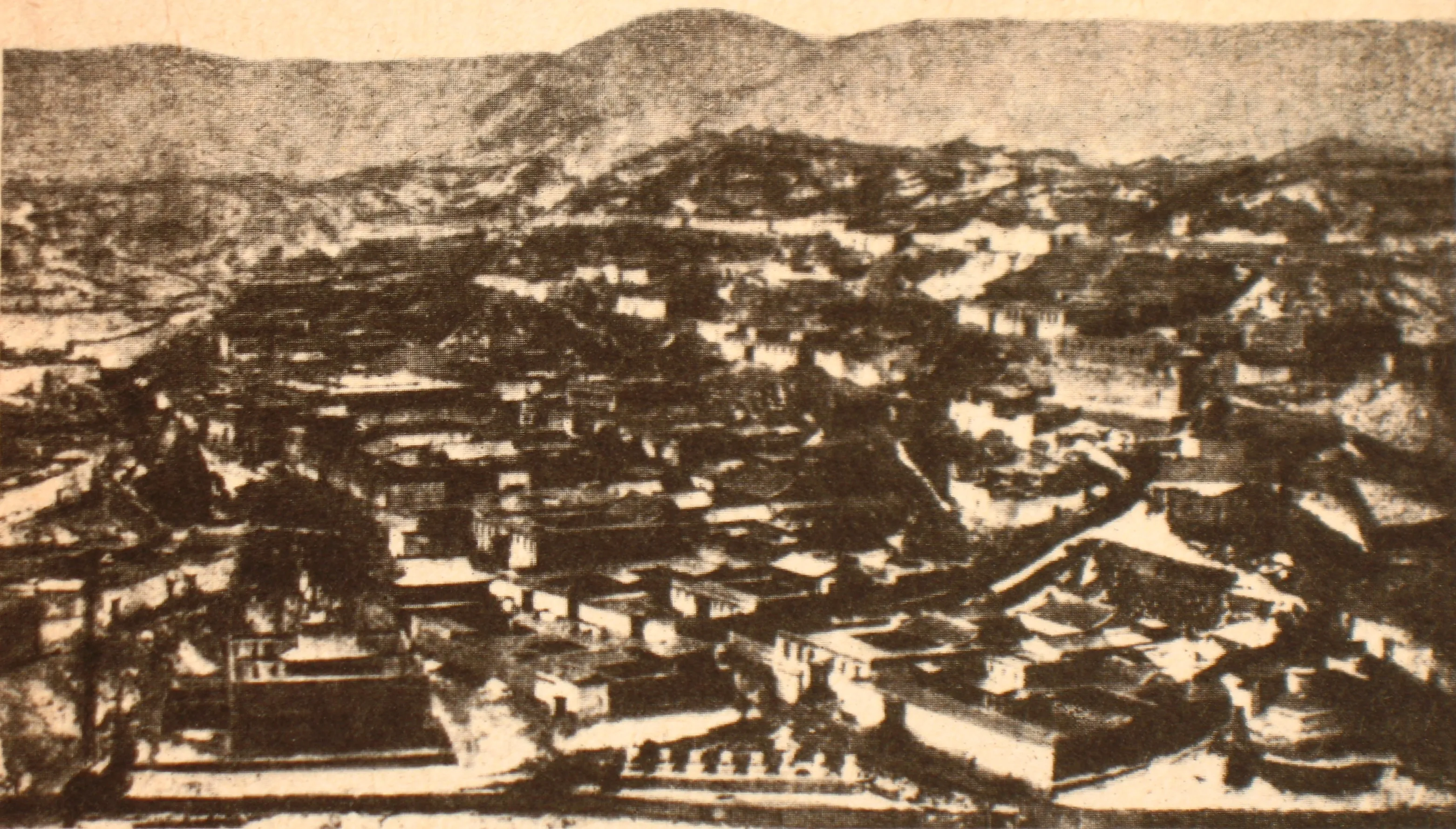
1900
G. Ts. Tsybikoff photographed a panorama of Ta’er Monastery in 1900 while on his way to Tibet. The original is captioned “Tumbum Monastery” and is now held by Wikimedia Commons.

1932–1933
Between 1932 and 1933, Harrison Forman photographed the chorten at the entrance to Ta’er Monastery and the crowds gathered outside the monastery. The two negatives are now held by the American Geographical Society Library, whose catalog records are titled Chorten at entrance of Kumbum Monastery in Qinghai province and People outside Kumbum Monastery in Qinghai province.
1936
In 1936 the American journalist Harrison Forman photographed a panorama of Ta’er Monastery, the market in front of the Eight Stupas, two golden-roofed buildings, rooftop pillar ornaments, monks’ quarters, and courtyards. The negatives are now held by the American Geographical Society Library at the University of Wisconsin–Milwaukee; the catalog records for the four additional photographs are Golden-Roofed Buddha Hall, Rooftop Pillar Ornaments, Rooftops and Monks’ Quarters, and Courtyard beneath Distant Mountains.
1937
In 1937 Forman photographed Ta’er Monastery again, leaving images of the main facade of a Buddha hall and the mural of a guardian deity at the entrance to a Buddha hall.