Introduction
The Humble Administrator’s Garden lies in the northeast of Suzhou’s old city, between the Lou Gate and the Qi Gate. In the Tang and Song, the residence-gardens of Lu Guimeng and others already stood near Lindun Lane, though the sites of those old estates can only be roughly fixed and need not all lie within the garden’s present boundaries. In the Yuan, the Dahong Temple was built in this area and was destroyed at the end of that dynasty. In the fourth year of the Zhengde era of the Ming (1509), Wang Xianchen (courtesy name Jingzhi, literary name Huaiyu), who had served as a supervising censor[1], was dismissed from office and returned to Suzhou, where he used the abandoned foundations of the Dahong Temple and the old land nearby to build a garden: he dredged the standing water, planted trees, and raised halls, towers, pavilions, and studios along the water. In the twelfth year of the Jiajing era (1533), Wen Zhengming (literary name Hengshan), a painter and calligrapher of the Wu school[2] who had been Wang Xianchen’s friend for many years, made paintings and inscribed poems for the garden’s thirty-one scenes and wrote the garden record. The garden’s name is taken from the phrase “the governance of the clumsy man” in the Xianju Fu (Rhapsody on Idle Living) by the Western Jin writer Pan Yue: Wang Xianchen said that, being no good at maneuvering in officialdom, he would in retirement build a house, plant trees, water the garden, and grow vegetables — precisely the lot he could describe with that word “clumsy.”
The garden remained in the Wang family for only one generation. After Wang Xianchen’s death, his son lost the garden to Xu Shaoquan in a wager. Early Qing records say only that it was “lost at a single throw”; later poems and essays embroidered this into a night of high-stakes gambling. What the wager actually was can no longer be known; the garden then passed into the hands of the Xu family and was handed down for several generations. By the fourth year of the Chongzhen era (1631), more than ten mu in the garden’s eastern part had fallen into wasteland; Wang Xinyi bought it, and from then on the old garden was split into eastern and western parts.
Wang Xinyi (courtesy name Chunfu, literary name Xuanzhu) was a jinshi of the forty-first year of the Wanli era (1613); he had served as a censor and resigned to return home because his father was old. He built his garden according to the lay of the land: he cut ponds where the ground was low, heaped the excavated earth into hills, and put up buildings only where the ground between water and hill suited them. For the southeastern rockeries he chose delicately perforated, fine-grained lake stones[3], taking the elegant moistness of the landscapes of the Yuan painter-calligrapher Zhao Mengfu; for the northwestern rockeries he chose the yellow-blue, plain and archaic stones of Yaofeng, taking the archaic bluntness of the landscapes of the Yuan painter Huang Gongwang — and then engaged the rockery builder Chen Siyun to work on them for three years. When finished, the garden was named the “Return-to-the-Fields Garden”; within it were such scenes as the Hall of Orchid Snow, the Pool of Embosomed Azure, the Cloud-Adorning Peak, and the Little Peach Spring. It joined the Humble Administrator’s Garden to the west with “woods linked without a seam,” so that from afar the two still looked like one continuous garden; but they already had their own gates, buildings, and owners.
At the turn from Ming to Qing, the late-Ming poet and bibliophile Qian Qianyi (literary name Muzhai) built secluded chambers in the Xu family garden for his wife Liu Rushi; Liu Rushi was herself a poet renowned throughout Jiangnan, known to the world as the Lady of Hedong. Qian and Liu lived in the garden’s secluded chambers, but the garden’s owner was still a descendant of the Xu family. In the early Shunzhi years the garden served for a time as a camp officer’s lodging, and was later sold by the Xu descendants to the early-Qing grand secretary Chen Zhilin. After Chen Zhilin was exiled to Liaodong, the garden was converted in turn into the garrison general’s residence and the military-defense circuit’s lodging[4]. The property was later returned to the Chen family, who then sold it to Wang Yongning, son-in-law of Wu Sangui, Prince Who Pacifies the West. After taking it over, Wang Yongning drastically altered the garden’s hills and waters, rebuilding its structures tall and splendid; the column bases of the nanmu hall were even carved with ascending dragons. After Wu Sangui raised his troops in rebellion, although Wang Yongning was already dead, the garden buildings were confiscated because of the ties between the two families, and the column bases of the nanmu hall were taken down and carted to the capital. In the eighteenth year of the Kangxi era (1679), the authorities added a great hall and double gates within the old garden and converted the place into the offices of the Su-Song-Chang Circuit.
After the Su-Song-Chang Circuit offices were abolished, the grounds scattered into dwellings. In the eighteenth century the proprietor Jiang Qi acquired one part of them, heaped hills and dredged ponds anew, and built halls, towers, belvederes, studios, covered walks, kiosks, terraces, and pavilions, naming it the “Restored Garden.” In the twelfth year of the Qianlong era (1747), when the Suzhou poet Shen Deqian (literary name Guiyu) visited the place again, he saw that the hills were higher than before, the ponds had been dredged deeper, and the halls had been repaired over many years. After Jiang Qi’s death the Restored Garden declined once more. In the fourteenth year of the Jiaqing era (1809), Zha Shitan of Haining (literary name Danyu), who had served as a director in the Ministry of Justice, acquired the Restored Garden, kept its old name, and spent more than a year on repairs. Thereafter the Restored Garden passed to the family of the assistant grand secretary Wu Jing (courtesy name Shiru, literary name Songpu) and was renamed the “Wu Garden.” In the tenth year of the Xianfeng era (1860), the Taiping army occupied Suzhou, and the Loyal Prince Li Xiucheng used the scattered parcels of the garden as princely residences. After Qing forces recovered the city of Suzhou, the Rehabilitation Bureau paid the Wu family three thousand taels of white silver and took the garden into public ownership, where it served for a time as the governor’s traveling headquarters.
In the tenth year of the Tongzhi era (1871), Zhang Zhiwan (courtesy name Ziqing), then governor of Jiangsu, together with several fellow-provincial officials serving in Suzhou, proposed establishing a guild hall here. They raised three thousand taels of silver to match the garden’s original price and another two thousand for repairs; the following year the Eight Banners Fengzhi Guild Hall was formally founded. Thereafter fellow-provincial officials sojourning in Suzhou held their collective New Year gatherings and feasts in the garden, and the central grounds passed from private garden to native-place guild hall.
In the fifth year of the Guangxu era (1879), Zhang Lüqian of Wu County (courtesy name Yuejie) moved to the Yingchun Ward, where north of his house he saw a tract of ground whose ponds were still clear and whose trees were still thick, with only one or two pavilions and terraces left standing, on the verge of collapse. He cleared away the wild growth, made light repairs, and named it the “Supplementary Garden.” The Supplementary Garden is separated from the old Humble Administrator’s Garden by a single wall, and from the courses of the ponds and the lines of the trees one can still see that the two sides were originally joined. Later Zhang Lüqian obtained an old rubbing of the engraving of Wen Zhengming’s Illustrated Record of the Humble Administrator’s Garden; fearing that the characters would continue to fade into oblivion, he asked Qian Xinzhi to copy it anew and carve it in stone. By the end of the Qing, the central part was the Eight Banners Fengzhi Guild Hall, the western part was Zhang’s Supplementary Garden, and the eastern Return-to-the-Fields Garden had fallen into neglect.
Of the thirty-one scenes in Wen Zhengming’s record, by Zhang Lüqian’s time “the former aspect was wholly altered, and nothing remained to be verified.” In his Record of the Supplementary Garden he sighed: “Those who have dwelt in this garden have altered and rearranged it turn by turn; from the Jiajing era until now is nearly four hundred years, and its robes and bells and drums have indeed changed masters many times.” In those four hundred years the garden was gambled away, confiscated, and converted into circuit offices and a guild hall; its halls, kiosks, hills, and waters were altered again and again, and at last the old garden was cut into three by successive walls. Yet those three old boundaries are what have survived — the eastern, central, and western parts of today’s Humble Administrator’s Garden are still respectively the old grounds of Wang Xinyi’s Return-to-the-Fields Garden, the old Humble Administrator’s Garden, and Zhang Lüqian’s Supplementary Garden.
Historical Documents
Wangshi Zhuozhengyuan Ji (Wang’s Record of the Humble Administrator’s Garden)
槐雨先生王君敬止所居,在郡城东北,分娄、齐门之间。居多隙地,有积水亘其中,稍加濬治,环以林木,为重屋其阳,曰梦隐楼,为堂其阴,曰若墅堂。堂之前为繁香坞,其后为倚玉轩。轩北直梦隐,绝水为梁,曰小飞虹。逾小飞虹而北,循水面行,岸多木芙蓉,曰芙蓉隈。又西,中流为榭,曰小沧浪亭。亭之南,翳似修竹,而西出于水澨,有石可坐,可俯而濯,曰志清处。至是水折而北,滉漾渺弥,望若湖泊,夹岸皆佳木,其西多柳,曰柳隩。东岸积土为台,曰意远台。台之下植石为矶,可坐而渔,曰钓䂬。遵䂬而北,地益回,林木益深,水益清驶。水尽,别疏小沼,植莲其中,曰水花池。池上美竹千挺,可以追凉,中为亭,曰净深。循净深而东,柑橘数十本,亭曰待霜。又东出梦隐楼之后,长松数植,风至冷然有声,曰听松风处。自此绕出梦隐之前,古木疏篁,可以憩息,曰怡颜处。又前,循水而东,果林弥望,曰来禽囿。囿尽,缚四桧为亭,曰得真亭。亭之后为珍李坂,其前为玫瑰柴,又前为蔷薇径。至是水折而南,夹岸植桃,曰桃花沜。沜之南为湘筠坞。又南,古槐一株,敷阴数弓,曰槐幄。其下跨水为杠,逾杠而西,篁竹阴翳,榆槐蔽亏,有亭翼然,西临水上者,槐雨亭也。亭之后为尔耳轩,左为芭蕉槛。凡诸亭、槛、台、榭,皆因水为面势。自桃花沜而来,水益微,至是伏流而南,逾百武,出于别圃丛竹之间,是为竹涧。竹涧之东,江梅数百植,花时香雪烂然,望若瑶林玉树,曰瑶圃。圃中有亭,曰嘉实,有泉,曰玉泉。凡为堂一,楼一,为亭六,轩、槛、池、台、坞、涧之属二十有三,总三十有一,名曰拙政园。王君之言曰:昔潘岳仕宦不达,作间居赋自广,以筑室种树、灌园鬻蔬为拙者之政。余自筮仕扺今余四十年,同时或起家至八座,登三事,而余仅以一郡倅老退林下,其为政殆有拙于岳者,园所以识也。虽然,君于岳则有间矣。君以进士高科仕为名法从,直躬殉道,非久被斥。其后旋起旋废,迄摈不复。其为人岂龌龊自守,视时浮沉者哉?岳虽漫为间居之言,而谄事时人,至于望尘雅拜,乾没势权,终罹咎祸。考其平生,盖终其身未尝𫏐去官守,以即其间居之乐也。岂惟岳哉?古之名贤胜士,固有有志于是,而际会功名不能解脱,又或升沈迁徙,不得遂志如岳者,何限哉?而君甫及强仕,即解官家处,所谓筑室种树、灌园鬻蔬,享有间居之乐者,二十年于此矣。究其所得,虽古之名贤胜士有所不逮也,而何岳之足云?所谓区区以岳自况,则聊以宣其不达之名焉耳。而其志之所乐,固有在彼而不在此者。是故高官脢仕,人所慕乐,而祸患攸伏,造物者每消息其中。使君得志一时,而或横罹灾变,其视抹杀斯世而优游余年,果孰多少哉?君子于此,必有所择矣。征明漫仕而归,虽踪迹不同于君,而潦倒抹杀,亦略相似。顾无一亩之宫以寄其栖佚之志,而独有羡于君。既取其园中景物,悉为赋之,而复为之记。嘉靖十二年癸巳九月既望,长洲文征明著。
The dwelling of Master Huaiyu, Wang Jingzhi, lies in the northeast of the prefectural city, between the Lou and Qi gates. Much of the place was open ground, with standing water stretching across it; he had it slightly dredged and ordered, ringed it with trees, and built a two-storied structure on its sunny side, called the Tower of Dreamed Seclusion, and a hall on its shaded side, called the Hall of the Country Villa. Before the hall is the Bank of Dense Fragrance; behind it is the Studio of Leaning Jade. North of the studio, facing the Tower of Dreamed Seclusion, a bridge crosses the water, called the Little Flying Rainbow. Crossing the Little Flying Rainbow to the north and following along the water’s face, the bank is rich in hibiscus and is called Hibiscus Cove. Further west, a pavilion stands midstream, called the Little Surging-Waves Pavilion. South of the pavilion, shaded as if by tall bamboo, and westward out at the water’s edge, there is a stone where one may sit and bend to wash, called the Place of Purified Resolve. Here the water bends north, rippling and boundless, looking like a lake; fine trees line both banks, and to the west willows abound — the Willowy Recess. On the eastern bank earth was heaped into a terrace, the Terrace of Far-Reaching Thought. Below the terrace stones were planted as a jetty where one may sit and fish, the Fishing Weir. Following the weir north, the ground grows more secluded, the trees deeper, the water clearer and swifter. Where the water ends, a small pond was separately cut and planted with lotus, the Water-Blossom Pool. Above the pool stand a thousand fine bamboos, where one may go in search of cool; in their midst is a pavilion, called Pure Depths. East of Pure Depths stand several dozen orange and tangerine trees, with a pavilion called Awaiting Frost. Further east, behind the Tower of Dreamed Seclusion, several tall pines make a chill sound when the wind comes, the Place for Hearing the Wind in the Pines. From here one winds out before the Tower of Dreamed Seclusion, where ancient trees and sparse bamboo offer rest, the Place of the Cheerful Countenance. Further on, following the water east, fruit trees fill the view, the Orchard of the Alighting Birds. Where the orchard ends, four cypresses were bound into a pavilion, the Pavilion of Attained Truth. Behind the pavilion is the Precious Plum Slope; before it the Rose Thicket; and further on the Briar Path. Here the water bends south, with peach trees planted along both banks, the Peach-Blossom Bank. South of the bank is the Bank of Xiang Bamboo. Further south, a single ancient sophora spreads its shade over several bow-lengths, the Sophora Canopy. Beneath it a footbridge crosses the water; beyond the bridge to the west, where bamboo shades thickly and elms and sophoras half-hide the sky, there stands a pavilion with wing-like eaves facing west over the water — the Pavilion of Sophora Rain. Behind the pavilion is the Studio of So-Be-It, and to its left the Plantain Balustrade. All these pavilions, balustrades, terraces, and kiosks take their aspect from the water. From the Peach-Blossom Bank onward the water grows ever slighter; here it runs hidden southward for more than a hundred paces, emerging among the clustered bamboos of a separate plot — this is the Bamboo Rill. East of the Bamboo Rill stand several hundred riverside plum trees; in blossom their fragrant snow gleams bright, looking like a forest of jade — the Garden of Jade. Within the garden is a pavilion, Fine Fruit, and a spring, the Jade Spring. In all there is one hall, one tower, six pavilions, and twenty-three studios, balustrades, pools, terraces, banks, and rills of like kind — thirty-one scenes in all — and the garden is named the Humble Administrator’s Garden. Master Wang’s own words were these: “Of old, Pan Yue, failing to advance in office, wrote the Rhapsody on Idle Living to console himself, taking the building of a house and planting of trees, the watering of a garden and selling of vegetables, as the governance of a clumsy man. From my first taking of office until now is more than forty years; among my contemporaries some rose from their households to the Eight Seats and ascended to the Three Ministries, while I, merely a prefectural vice-administrator, retired old into the woods. In my governance I was surely clumsier even than Yue — hence the garden’s name.” Yet even so, between you, sir, and Pan Yue there is a real difference. You entered service with high honors in the jinshi examinations and became a noted officer of the law; upright in person and devoted to the Way, you were dismissed before long. Thereafter you were repeatedly raised and repeatedly cast down, until at last you were cast out and not restored. How could such a man be one who guards himself meanly, drifting with the times? Though Yue idly spoke of idle living, he fawned upon the men of his day, going so far as to bow in homage at the dust of their carriages and to profit under cover of their power, and in the end he met with calamity. Examining his whole life, to its end he never once briefly left his official post to taste the joys of that idle living. Nor is this true of Yue alone. Among the famed worthies and outstanding gentlemen of old, there have always been those who cherished such a wish yet could not free themselves from the entanglements of fame and merit, or who, through rises and falls, banishments and transfers, could not fulfill it — men like Yue, beyond counting. But you, sir, had barely reached the age of strengthened service when you laid down your office and dwelt at home; the building of a house and planting of trees, the watering of a garden and selling of vegetables — the enjoyment of the pleasures of idle living — you have had these twenty years now. Weighing what you have gained, even the famed worthies and outstanding gentlemen of old did not attain it — what then is Yue worth mentioning? As for likening yourself so modestly to Yue, it was but a way to give voice to the name of one who did not rise. Yet what your heart delights in surely lies there, not in this. High office and prosperous careers are what men admire and covet, yet calamity lurks within them, and the Creator ever waxes and wanes within that balance. Had you fulfilled your ambitions for a time, yet perhaps met sudden disaster, how would that compare, in more or less, with wiping your hands of this world and wandering at ease through your remaining years? The noble man, facing this, will surely make his choice. I, Zhengming, served desultorily and came home; though my tracks differ from yours, my downcast erasure from the world is much the same. Only I have not so much as an acre of lodging in which to lodge my thoughts of roosting at ease, and so I cannot but envy you. I have therefore taken the garden’s scenes and composed poems on them all, and now I make this record of them. Written on the day after the full moon of the ninth month of the twelfth year of the Jiajing era, the guisi year (1533), by Wen Zhengming of Changzhou.
Guitian Yuanju Ji (Record of the Return-to-the-Fields Garden)
余性有邱山之癖,每遇佳山水处,俯仰徘徊,辄不忍去。凝眸久之,觉心间指下,生气勃勃。因于画事,亦稍知理会。辛未以先府君年高,弃官归田,敝庐之后,有荒田十数余亩,偶地主求售,余勉力就焉。
My nature bears a passion for hills and mountains; whenever I come upon fine scenery, I linger and wander, unable to tear myself away. After gazing long, I feel a living spirit stir between my heart and my fingertips, and so in the art of painting I have also come to some understanding. In the xinwei year (1631), because my late father was advanced in years, I left office and returned to the fields. Behind my humble cottage were more than ten mu of wasteland; it happened that the owner sought to sell, and I stretched my means to acquire it.
地可池则池之,取土于池,积而成高,可山则山之。池之上,山之间,可屋则屋之。肇于是岁之秋,落成于乙亥之冬,友人文湛持为余额之曰“归田园居”。门临委巷,不容旋马,编竹为扉,质任自然。入门不数武,有廊直起,为“墙东一径”,友人归文休额之也。径尽,折北为秫香楼。楼可四望,每当夏秋之交,家田种秫,皆在望中。自楼折南皆池,池广四五亩,种有荷花,杂以荇藻,芬葩灼灼,翠带柅柅。修廊蜿蜒,驾沧浪而度,为芙蓉榭,为泛红轩。自泛红轩绕南而行,轩前有丛桂参差,友人蒋伯玉名之曰“小山之幽”。又西数武,有堂五楹,爽塏整洁,文湛持取李青莲“春风洒兰雪”之句,额之曰“兰雪堂”。东西桂树为屏,其后则有山如幅,纵横皆种梅花。梅之外有竹,竹邻僧舍,旦暮梵声,时从竹中来。其前则有池,取储光羲“池草涵青色”句,曰涵青。诸山环拱,有拂地之垂杨,长丈之芙蓉,杂以桃、李、牡丹、海棠、芍药,大半为予之手植。池南有峰特起,云缀树杪,名之曰缀云峰。池左两峰并峙,如掌如帆,谓之联璧峰。峰之下有洞,曰小桃源。内有石床、石乳。南出洞口,为漱石亭,为桃花渡。其石之出没池面者,或锐如啄,或凸如背。又折北磴而上,为夹耳冈,为迎秀阁,为红梅坐,直接竹香廊,以至山余馆,渐逼余室。余性不耐,家居不免人事应酬,如苦秦法。步游入洞,如渔郎入桃源,桑麻鸡犬,别成世界,故以小桃源名之。洞之上为啸月台、紫藤坞,可扪石而登也。洞之东有池曰清泠渊。池上有屋三楹,竹木蒙密,友人陈古白额之曰“一邱一壑”。自兰雪以东,此其最幽者。兰雪以西,石磴重叠,皆可布坐。梧桐参差,竹木交荫,一径可通聚花桥。东折,诸峰攒翠,下临幽涧,颇有茂林修竹、流觞曲水之意。自此渡试望桥,曲径数折,即得缀云峰,北望兰雪堂,又隔盈盈一水矣。山径逶迤,从高趋下,上接缀云峰,俯瞰涵青池者,为连云渚;绝涧欲穷,得石如螺,因之而渡者,为螺背渡。又折而东,为听书台,以可听儿子辈读书声也。西折,为悬井岩,有洞幽邃,蹈水傍崖,四面悬崖直削,盖如井然。再拾磴而造其颠,诸峰高下,或如霞举,或如舞鹤,各争雄长于缀云下者,余不能尽名之。又西则为幽悦亭。亭之左有石丈余,夭矫如龙,余自采之包山云。自此层磴而下,溪涧相连,植有杨家果数树,是为杨梅隩。又北折,有屋半楹,四望皆竹,是为竹邮。由竹邮又西折从南,为饲兰馆,庭有旧石数片,玉兰、海棠,高可蔽屋,颇堪幽坐。北折,则回廊曲而且幽。廊半有小径,斜通石塔岭。廊尽由南折西,皆架山茶,有亭曰延绿。延绿之北,有石如玉,拱立檐际,谓之玉拱峰。每至春月,山茶如火,玉兰如雪,而老梅数十树,偃仰屈曲,独傲冰霜,如见高士之态焉。插篱成径,至梅亭、紫薇沼,亦园居之一幽胜也。北临漾藻池,遥望紫逻山,飞翠直来扑坐。夏月之荷,秋月之木芙蓉,如锦帐重叠,又一胜观。有桥横跨池面,谓卧虹桥。桥之东,有石如云,向空而涌,为片云峰。桥尽,有石可憩,为卧虹渚。转径而北,依山傍水,苍松杂卉,接叶连阴,为小剡溪。有石横亘如门,四山崒律,停水一泓,有古杏覆其上,为杏花洞。渡洞盘旋而上,是为紫逻山,以言其石之色也。山有五峰,曰紫盖,曰明霞,曰赤笋,曰含华,曰半莲,又谓之五峰山。有亭曰放眼。西与南洲之拙政园,连林靡间。北则齐女门雉堞半控中野,似辋川之盂城。东南一望,烟树弥漫,惟见隐隐浮图,插青汉间,近以林木蓊郁,不可纵目,濮上叶润山额之为“流翠亭”。自流翠而南,于石阿间得路,东折为拜石坡,水石俱备,梅杏交枝。左有花红果树,扶疏如盖,有阁耸树杪间,曰资清。资清之下,三囿其户,是为串月矶,复设柴扉,尝扃之。自拜石折北又西,则为紫逻之背,众峰迭涌,乱石嶙峋。环山有濠,从水中央,结有草亭。架梁而登,可通濠北,有地皆种木奴,因号其亭曰奉橘,盖借王逸少奉橘帖名之也。至此则山尽水穷。东行长廊为想香径,竹梅夹道,香韵悠然,沈启南有“可竹”之额,尚恨无人以梅匹之。出想香,已在兰雪堂矣。
Where the ground could be a pond I made a pond; the earth taken from the pond was piled up into height, and where it could be a hill I made a hill. Above the ponds and among the hills, where a building could stand I built one. Work began in the autumn of that year and was completed in the winter of the yihai year (1635); my friend Wen Zhanchi inscribed its plaque as the “Return-to-the-Fields Garden.” The gate faces a winding lane too narrow to turn a horse; I wove bamboo for its door, plain and left to nature. A few paces within the gate a corridor rises straight ahead — “A Path East of the Wall” — inscribed by my friend Gui Wenxiu. At the path’s end, turning north, is the Tower of Sorghum Fragrance. From the tower one may look out on all sides; each year at the turn of summer and autumn, the sorghum planted in our family fields all lies within view. Turning south from the tower, all is pond; the pond is four or five mu across, planted with lotus and mingled with floating-heart and algae — fragrant blossoms gleaming, verdant ribbons trailing. A long covered walk winds its way, riding the grey-green waves across, to the Hibiscus Pavilion and the Studio of Floating Red. Circling south from the Studio of Floating Red, before the studio stands a thicket of uneven cassia, which my friend Jiang Boyu named “Seclusion of the Little Hill.” A few paces further west is a five-bay hall, bright, high, clean, and trim; Wen Zhanchi took Li Qinglian’s line “the spring breeze scatters orchid snow” and inscribed it “Hall of Orchid Snow.” Cassia trees screen it east and west; behind it rises a hill like a painted scroll, planted over its length and breadth with plum trees. Beyond the plums is bamboo, and the bamboo neighbors a monks’ lodging, whence morning and evening the sound of chanting comes at times through the bamboo. Before it lies a pond, taking Chu Guangxi’s line “the pond grasses hold an azure hue,” and called Embosomed Azure. The hills arch round it; there are weeping willows brushing the ground and hibiscus ten feet tall, mingled with peach, plum, peony, crabapple, and herbaceous peony — more than half planted by my own hand. South of the pond a peak rises solitary, clouds seeming stitched to its treetops; I named it the Cloud-Adorning Peak. To the pond’s left two peaks stand side by side, like a palm and like a sail, called the Twin-Jade Peaks. Beneath the peaks is a grotto, the Little Peach Spring, with a stone couch and stalactites within. Emerging south from the grotto’s mouth are the Stone-Rinsing Pavilion and the Peach-Blossom Ford. The stones that rise and sink at the pond’s surface are some sharp as beaks, some humped as backs. Turning again north and climbing by steps are the Ear-Pinching Ridge, the Belvedere of Welcoming Beauty, and the Seat of the Red Plum, leading straight to the Gallery of Bamboo Fragrance and on to the Lodge Beyond the Hill, drawing ever nearer my own chambers. My temper is impatient; living at home I cannot escape the entertainments of human intercourse, and I suffer them as under the laws of Qin. But strolling into the grotto is like the fisherman’s entering the Peach Spring: mulberry and hemp, chickens and dogs — a world apart — and so I named it the Little Peach Spring. Above the grotto are the Moon-Whistling Terrace and the Wisteria Bank, which may be climbed by clambering up the stones. East of the grotto is a pond, the Clear-Cold Deep. Over the pond is a three-bay house, thickly mantled in bamboo and trees, which my friend Chen Gubai inscribed “One Hill, One Vale.” East of the Hall of Orchid Snow this is the most secluded spot. West of the hall, stone steps rise in tiers, all fit for spreading seats; parasol trees stand at uneven heights, bamboo and trees weave their shade, and a single path leads through to the Bridge of Gathered Blossoms. Turning east, the peaks cluster their verdure above a dark ravine, much in the spirit of “dense woods and tall bamboo” and “floating cups on a winding stream.” From here one crosses the Bridge of Tentative Gazing; the twisting path turns several times and arrives at the Cloud-Adorning Peak, whence looking north toward the Hall of Orchid Snow, one is parted from it again by a glimmering stretch of water. The mountain path winds on, descending from the heights; that which joins the Cloud-Adorning Peak above and looks down upon the Pool of Embosomed Azure is the Islet of Joined Clouds. Where the ravine runs nearly out and a stone like a conch affords a crossing is the Conch-Back Crossing. Turning east again is the Terrace for Listening to Reading, so called because one can hear the voices of my sons at their books. Turning west is the Hanging-Well Crag, with a deep and dark grotto; treading the water along the cliff, sheer cliffs drop straight on four sides, as though within a well. Mounting the steps once more to reach its summit, the peaks high and low — some like rising mist, some like dancing cranes, each vying for mastery beneath the Cloud-Adorning Peak — are more than I can name. Further west is the Pavilion of Hidden Delight. To the pavilion’s left is a stone more than ten feet long, undulating like a dragon, which I myself gathered at Mount Bao. From here, descending tiered steps where stream and ravine join, several Yang-family fruit trees are planted — this is the Bayberry Recess. Turning north again, there is a half-bay hut with bamboo on every side — the Bamboo Halt. From the Bamboo Halt, turning west and then south, is the Orchid-Feeding Lodge; in its court are several old stones, and magnolias and crabapples tall enough to screen the house — well worth a secluded sitting. Turning north, a winding gallery curves into seclusion. Midway along the gallery a small path slants through to Stone-Pagoda Ridge. At the gallery’s end, turning from south to west, camellias are trained overhead, with a pavilion called Extending Green. North of Extending Green a stone like jade arches up beside the eaves, called the Jade-Arch Peak. Each year in the spring months the camellias are like fire, the magnolias like snow, and several dozen old plum trees, bowed and twisted, alone defy the frost — as if one beheld the bearing of lofty scholars. Fences set in rows make a path leading to the Plum Pavilion and the Crape-Myrtle Marsh, another secluded excellence of this garden dwelling. To the north it overlooks the Pool of Swaying Algae, whence gazing afar at the Purple Screen Hill, its flying verdure comes straight to strike one’s seat. The lotus of the summer months and the hibiscus of the autumn months, like layered brocade curtains, are yet another splendid sight. A bridge spans the pond’s breadth, called the Recumbent-Rainbow Bridge. East of the bridge a stone like a cloud surges toward the sky — the Peak of a Cloud Shard. At the bridge’s end a stone invites rest — the Recumbent-Rainbow Islet. The path turns north, leaning on the hill and skirting the water, where grey pines and mingled flowers join leaf to leaf in continuous shade — the Little Shan Stream. A stone lies athwart like a gate; the four mountains rise steeply, a single expanse of still water held between them, an ancient apricot spreading over it — the Apricot-Blossom Cave. Passing the cave and spiraling upward, this is the Purple Screen Hill, so named for the color of its stones. The hill has five peaks — Purple Canopy, Luminous Mist, Red Bamboo-Shoot, Enfolded Bloom, and Half Lotus — and is also called the Hill of Five Peaks. It has a pavilion called Unfettered Eyes. To the west, with the Humble Administrator’s Garden at Nanzhou, its trees join without a seam. To the north, the battlements of the Qinü Gate half command the open fields, like the Yu City of the Wangchuan estate. To the southeast one sweeping gaze: misty trees flood the view, and only a dim pagoda is seen thrusting into the blue empyrean; nearby the luxuriant trees forbid a free-ranging eye — Ye Runshan of Pushang inscribed this “Pavilion of Flowing Verdure.” From the Flowing Verdure southward, a path is found among the rocky slopes; turning east is the Rock-Bowing Slope, where water and stone are both at hand and plum and apricot intertwine their branches. To the left a crab-apple tree spreads like a canopy, and a belvedere rises amid the treetops, called Nurtured Purity. Beneath the Belvedere of Nurtured Purity, its doorway is thrice enclosed — this is the String-of-Moons Jetty — and a rustic wicket is set there, once kept latched. From the Rock-Bowing Slope, turning north and then west, lies the back of the Purple Screen, where the peaks surge in ranks and jumbled stones jut gauntly. A moat rings the hill, and in the water’s center a thatched pavilion is knit together. Crossing by a bridge one may reach the moat’s north side, where the ground is planted all with “wooden slaves” — hence the pavilion is called the Orange Offering, borrowing the name of Wang Yishao’s Fengju note. Here hill and water both come to an end. The long gallery running east becomes the Path of Imagined Fragrance, with bamboo and plum lining the way and their fragrance drifting afar; Shen Qinan once inscribed the plaque “Fit for Bamboo,” and one only regrets that no one has matched it with plum. Emerging from the Imagined Fragrance, one is already at the Hall of Orchid Snow.
东南诸山,采用者湖石,玲珑细润,白质藓苔,其法宜用巧,是赵松雪之宗派也。西北诸山,采用者尧峰,黄而带青,质而近古,其法宜用拙,是黄子久之风轨也。余以二家之意,位置其远近浅深,而属之善手陈似云,三年而工始竟。甲戌余复流连尘网。庚辰归田,又为修其颓坏,补其不足。予无间阴晴,散步畅怀,聊以自适其邱山之性而已。所谓此子宜置邱壑中,余实不能辞避。崇祯壬午九月日,园居主人王心一记。
For the southeastern hills I used lake stones, delicately perforated, fine and moist, white in substance and mossed — a manner fit for artfulness, in the lineage of Zhao Songxue. For the northwestern hills I used stones from Yaofeng, yellow tinged with blue, plain in substance and near to the antique — a manner fit for bluntness, in the manner of Huang Zijiu. Taking the intent of these two masters, I set the stones at their distances and depths, and entrusted the work to the skilled hand Chen Siyun; only after three years was the work complete. In the jiaxu year (1634) I was again caught in the dusty net of office. Returning to the fields in the gengchen year (1640), I repaired what had fallen to ruin and made up what was lacking. Fair weather or foul, I stroll and give my heart free play, merely to suit my hill-and-mountain nature. As the saying goes, “this fellow belongs among the hills and ravines” — of that charge I truly cannot acquit myself. Recorded on a day of the ninth month of the renwu year of the Chongzhen era (1642) by the master of the garden dwelling, Wang Xinyi.
Susongchang Dao Xinshu Ji (Record of the New Offices of the Su-Song-Chang Circuit)
分守苏松常道驻苏州,故时道署在城之西南隅,隘庳敝陋,不足以称三府一州十六县之守令受教承事,及搢绅耆老来观政令之和布,及部曲将校所以走趋奉指麾者。康熙十八年,参议某使君因王永宁入官园屋为新署,增置堂三楹,重门三楹,甍栋墉阈,皆中程度。赋财庀徒,不日而成,乃揆辰日而移治焉。其地在娄、齐二门之间,所谓拙政园者是也。
The Su-Song-Chang Circuit of divided jurisdiction is stationed at Suzhou. In former times the circuit yamen stood in the southwest corner of the city, cramped, low, worn, and mean — unfit for the magistrates of three prefectures, one department, and sixteen counties to receive instruction and take up their charges, for gentry and elders to come observe the harmonious spread of government, or for the troops and officers to hasten about in obedience to command. In the eighteenth year of the Kangxi era (1679), a certain administration commissioner, Lord So-and-so, took the garden buildings that Wang Yongning had forfeited to the state as the new offices, adding a three-bay hall and three-bay double gates; ridgepoles and walls and thresholds all answered to due measure. Levying funds and mustering workmen, it was completed in short order, and an auspicious day was chosen to move the seat of government there. The place lies between the Lou and Qi gates — what is called the Humble Administrator’s Garden.
案明嘉靖中,有王侍御某者,因大弘寺废地营别墅老焉,为陂池台榭之乐,以自托于潘岳所谓“拙者之为政”。一时名士如文待诏征明辈,为图记诗赋以志其胜,此拙政园之名所以著于吴中也。侍御有子,弗克负荷,以樗蒲与里中豪士徐君决赌,一掷失之。徐君传子及孙,而生产亦耗矣。入国朝以来三十余年,园凡数易主,而后今为官署云。
It is recorded that in the Jiajing era of the Ming there was a certain censor Wang who, using the derelict grounds of the Dahong Temple, built a country villa in which to grow old, making his delight in ponds and terraces and kiosks, and entrusting himself to what Pan Yue called “the governance of a clumsy man.” Famed gentlemen of the time, such as Wen Zhengming, Drafter of the Hanlin, made paintings, records, poems, and rhapsodies to commemorate its beauties — hence the name of the Humble Administrator’s Garden became known throughout Wu. The censor had a son who could not bear the charge; playing chupu with a bold gentleman of the neighborhood, Squire Xu, he lost it at a single throw. Squire Xu passed it to his son and grandson, and their substance too was spent. In the thirty-odd years since the founding of the present dynasty, the garden changed masters several times, and now it has become a government office.
始,虞山钱宗伯尝构曲房其中,以娱所嬖河东君,而海宁相公继之,门施行马。海宁得祸入官,而驻防将军以开幕府。禁旅既还,则有镇将某某者迭馆焉。亡何,而前备兵使者安公,以为治所,未暇有所改作。既而归于永宁。凡前此数人居之者,皆仍拙政之旧,自永宁始,易置丘壑,益以崇高彤镂,盖非复图记诗赋之云云矣。滇黔作逆,永宁与凶渠有连,既先事死,而园屋犹以藩本入官。其最侈僭,则楠木厅柱础皆刻升龙,今已撤而辇至京师,供将作矣。
At the beginning, Minister Qian of Yushan once built secluded chambers within it to delight his beloved, the Lady of Hedong; then the grand secretary of Haining succeeded to it, and carriage-barriers were set before his gate. When the man of Haining met with ruin and the property entered the state, the garrison general made it his headquarters. When the imperial guard had returned, certain garrison commanders lodged there in turn. Not long after, the former military-defense commissioner Lord An made it his seat of administration, without leisure for any rebuilding. Thereafter it came to Yongning. All those who had dwelt there before had kept to the old Humble Administrator’s order; from Yongning onward the hills and ravines were rearranged and heightened with towering, red-carved splendor — it was no longer what the paintings, records, poems, and rhapsodies had described. When Yunnan and Guizhou rose in rebellion, Yongning had ties to the arch-traitor; though he had died before the event, the garden buildings were nonetheless confiscated as appanage property. The most extravagant presumption was that the column bases of the nanmu hall were all carved with ascending dragons; these have now been removed and carted to the capital for the imperial works.
盖数有其极,而物有其变,向之废兴,不已亟哉!夫古之封国,如齐为爽鸠氏之墟,季荝因之,有逢、伯陵因之,薄姑氏因之,而后太公因之。鲁为少昊之墟,而国中有大庭氏之库。盖因前代之都邑,其城郭沟涂宫室,可以无创事之劳,而又即其废兴之由,以为南面者之戒。古人之用心至矣。然则使君之为是举也,其亦有古人之心哉?为之记,使来者有考焉。成之日为康熙十八年月甲子,记之者某官崐山徐某也。
Truly, every cycle has its limit and every thing its mutation — how swift have been this place’s falls and risings! Among the fiefed states of old, Qi was the ruin of the Shuangjiu lineage, which Jice succeeded, Youfeng and Boling succeeded, the Bogu lineage succeeded, and only afterward did the Grand Duke succeed. Lu was the ruin of Shaohao, yet within the state stood the treasury of the Daiting lineage. For in occupying the capitals of former ages, their walls and moats and roads and palaces could be had without the toil of fresh construction, while the very causes of their fall and rise served as warnings to those who would sit facing south. The ancients’ thoughtfulness was complete. So then, in this undertaking of the commissioner, is there not something of the ancients’ heart? I make this record so that those to come may have it for examination. The day of completion was a jiazi day of the month, in the eighteenth year of the Kangxi era; the recorder is a certain Xu of Kunshan, holding a certain office.
Suzhou Fu Zhi (Gazetteer of Suzhou Prefecture)
拙政园在娄门内迎春坊,本道观也,中多乔木,御史王宪臣侵以为园,大弘寺在其后,亦半侵焉。崇台重屋,清川映带,水木擅胜吴中。待诏文徵明有记一传,而其子以蒱博为徐鸿胪少泉所得,更几世。至国朝顺治初年,为营将寓居,后归大学士陈之遴。之遴谴谪辽左,园亦籍没,扃户荒凉。中有宝珠山荼树,连理交柯,花时烂红夺目。
The Humble Administrator’s Garden lies at the Yingchun Ward within the Lou Gate. It was originally a Daoist abbey, with many tall trees within; the censor Wang Xianchen encroached upon it to make his garden, and the Dahong Temple behind it he likewise half encroached upon. Lofty terraces and storied buildings, clear streams winding in reflection — its waters and trees claimed first beauty in Wu. Drafter Wen Zhengming left one record of it, which survives; but the censor’s son, through dicing, let it fall to Xu Shaoquan of the Court of State Ceremonial, where it remained for several generations. At the beginning of the Shunzhi era of the present dynasty it served as a camp officer’s lodging, and afterward came to Grand Secretary Chen Zhilin. When Zhilin was condemned and banished to Liaodong, the garden was also confiscated, its gates barred in desolation. Within it is a Baozhu camellia tree, its branches joined and interlaced, dazzling red at blossom time.
Baicheng Yanshui (Mist and Waters of a Hundred Cities)
拙政园,故大弘寺基也。其地林木绝胜,有王御史者侵以广其宫,后归徐氏最久。兵兴为镇将所据。已而海昌陈相国得之。内有宝珠山茶三四株,交柯合理,花时巨丽鲜妍,纷披照瞩,为江南所仅见。
The Humble Administrator’s Garden is the old foundation of the Dahong Temple. Its grounds are supremely fine in trees; a certain Censor Wang encroached upon them to enlarge his estate, and afterward it belonged longest to the Xu family. When war arose it was seized by a garrison commander. Presently Grand Secretary Chen of Haichang obtained it. Within are three or four Baozhu camellias, their branches interlaced and their trunks conjoined; in blossom they are grand, lovely, fresh, and dazzling, spilling splendor before the eye — a sight to be seen nowhere else in Jiangnan.
Sanyue Sanri Guitian Yuan Xiuxi Xu (Preface to the Purification Gathering at the Return-to-the-Fields Garden on the Third Day of the Third Month)
吴中名园,归田独存。王君四怀克绍前烈,招我友朋,续修禊事。维时春风方和,百物呈象,绿草夹径,紫藤挂空,新荷舒钱,幽篁拂粉,坐危石,荫乔柯,陟前贤之故墅,逢佳日以娱宾,致足乐焉。于是解衣磅礴,散发咏歌,谈仙释之玄理,征古今之逸闻。林鸟来窥,渊鱼聚听,锋铦尽泯,俯仰皆宽,寄躯寰中,结想天外矣。迨主客既醉,少长忘年,手掬悬溜,身卧落花,慨彼桎梏轩冕,驰驱市朝,明月碧云,失之当境,曷若抗迹巢由,追踪支许,鸿飞鹄举,离尘避弋之适乎?未知右军兰亭,视此何如也。因思自有斯园,名流接踵。司寇公集胜国之衣冠,遴汝先生,联两朝之耆旧,相与锵金戛玉,投辖衔杯。无何埋白骨于青山,检赠诗于残箧,风景不殊,并为异物。抚今忆往,是用怆怀。百年以后,游者何人?
Among the famed gardens of Wu, the Return-to-the-Fields alone survives. Squire Wang Sihuai, ably continuing the legacy of his forebears, summoned me and my friends to renew the rite of purification. At that season the spring breeze was mild and all things showed their aspect: green grass lined the paths, wisteria hung in the air, new lotus spread their coins, and secluded bamboo brushed off their powder. Seated on towering stones, shaded by lofty boughs, we trod the former villa of past worthies and, meeting a fair day, made our guests merry — it was joy enough. Thereupon we loosened our robes in ease, let down our hair, and sang; we discussed the mysteries of immortals and Buddhas and adduced stray tales of past and present. The forest birds came to peep, the fishes of the deep gathered to listen; every edge and point was blunted, and in every glance up or down all was spaciousness — our bodies lodged within the world, our thoughts knit beyond the sky. When host and guests were drunk, young and old forgot their years; our hands cupped the hanging rills, our bodies lay among the fallen petals. We sighed for those shackled by cap and carriage, galloping through market and court, letting moonlight and azure cloud slip past unheeded — how could that compare with walking in the tracks of Chaofu and Xu You, following after Zhidun and Xu Xun, taking flight like the wild geese, aloof from the dust and safe from the fowler’s dart? I know not how the Army General’s Orchid Pavilion gathering would compare with this. And I reflected that since this garden came to be, men of renown have followed one upon another. The Minister of Justice gathered here the caps and gowns of the fallen dynasty, and Master Linyu joined the venerable elders of two reigns; together they rang metal and struck jade, cast carriage-pins into the well and held cups to their lips. But soon their white bones were buried in the green hills, and their parting poems were found again in a battered case; the scenery is unchanged, yet all are become things of the past. Touching the present and recalling the past, my heart is grieved. A hundred years hence, who will the wanderers be?
Yong Zhuozhengyuan Shancha Hua (Ode on the Camellias of the Humble Administrator’s Garden)
拙政园,故大弘寺基也。其地林木绝胜,有王御史者,侵之以广其宫,后归徐氏最久。兵兴,为镇将所据。已而海昌陈相国得之。内有宝珠山茶三四株,交柯合理,得势争高。每花时,巨丽鲜妍,纷披照瞩,为江南所仅见。相国自买此园,在政地十年不归,再经谴谪辽海,此花从未寓目。余偶过太息,为作此诗。他日午桥独乐,定有酬唱,以示看花君子也。
The Humble Administrator’s Garden is the old foundation of the Dahong Temple. Its grounds are supremely fine in trees; a certain Censor Wang encroached upon them to enlarge his estate, and afterward it belonged longest to the Xu family. When war arose it was seized by a garrison commander; presently Grand Secretary Chen of Haichang obtained it. Within are three or four Baozhu camellias, their branches interlaced and their trunks conjoined, vying for height in their vigor. Each year in blossom they are grand, lovely, fresh, and dazzling, spilling splendor before the eye — a sight to be seen nowhere else in Jiangnan. Since buying this garden the grand secretary spent ten years at the seat of power without returning, and was twice condemned and banished beyond the Liao Sea; these blossoms he never once beheld. Passing by one day I sighed deeply and made this poem for him. Some day, at his own Wuqiao or his Garden of Solitary Delight, there will surely be verses in reply, to show to all you gentlemen who look at flowers.
拙政园内山茶花,一株两株枝交加。艳如天孙织云锦,赪如姹女烧丹砂。吐如珊瑚缀火齐,映如䗖𬟽凌朝霞。百年前是空王宅,宝珠色相生光华。长养端资鬼神力,优昙涌现西流沙。歌台舞榭从何起,当日豪家擅闾里。苦夺精蓝为玩花,旋抛先业随流水。儿郎纵博赌名园,一掷留传犹在耳。后人修筑改池台,石梁路转苍苔履。曲槛奇花拂画楼,楼上朱颜娇莫比。千条绛蜡照铅华,十丈红墙饰罗绮。斗尽风流富管弦,更谁瞥眼閒桃李。齐女门边战鼓声,入门便作将军垒。荆棘从填马矢高,斧斤勿剪莺簧喜。近年此地归相公,相公劳苦承明宫。真宰阳和暗回斡,长安日日披薰风。花留金谷迟难落,花到朱门分外红。独有君恩归未得,百花深锁月明中。灌花老人向前说,园中昨夜零霜雪。黄沙淅淅动人愁,碧树垂垂为谁发。可怜塞上燕支山,染花不就花枝殷。江城作花颜色好,杜鹃啼血何斑斑。花开连理古来少,并蒂同心不相保。名花珍异惜如珠,满地飘残胡不扫。杨柳丝丝二月天,玉门关外无芳草。纵费东君着意吹,忍经摧折春光老。看花不语泪沾衣,惆怅花间燕子飞。折取一枝还供佛,征人消息几时归。
Within the Humble Administrator’s Garden, camellia flowers — one tree and two trees, their branches intertwining. Bright as the Weaver Maid’s brocade of clouds, crimson as the cinnabar fired by the Fair One. Spitting like coral strung with fire-gems, glowing like a rainbow outshining the dawn clouds. A hundred years ago this was the dwelling of the King of Emptiness, where the hue of precious pearls gave forth its luster. Its growth drew wholly on the strength of spirits; like the udumbara it welled up from beyond the western sands. Whence arose the singing terraces and dancing kiosks? In those days a mighty house lorded the neighborhood. Greedily they seized the monastery to make their flower-show, then cast their patrimony away upon the flowing water. The young blade gambled for the famous garden — the tale of that single throw still rings in our ears. Later heirs built and altered pond and terrace; where the stone bridge turns, green mosses take the tread. By curving balustrades rare blossoms brush the painted tower; within the tower a rosy face, lovely beyond compare. A thousand crimson candles light her powdered face; ten fathoms of red wall are dressed in gauze and silk. Vying to the utmost in elegance, rich in pipes and strings — who now would spare a glance for the idle peach and plum? By the Qinü Gate came the sound of war drums; once through the gate, it became a general’s rampart. Thorns and brambles filled it high as horse dung; no axe or hatchet trimmed the warbling orioles’ delight. In recent years this place came to the grand secretary; the grand secretary toils and labors in the Palace of Received Light. The true ruler’s harmony with the sun works its hidden turning, and in Chang’an day by day he spreads the balmy breeze. Flowers kept in the Golden Valley are slow to fall; flowers that reach the vermilion gates are red beyond measure. Only you, by the lord’s grace, may not yet return — a hundred flowers locked deep in the bright moonlight. The old man who waters the flowers comes forward to tell it: last night frost and snow fell in the garden. The yellow sand hisses, stirring a man’s sorrow; the verdant trees droop low — for whom do they bloom? Alas for Rouge Mountain beyond the frontier — its rouge never once took to the flowering branches’ crimson. By the riverside city the flowers’ color is fair; how mottled, the blood the cuckoo weeps. Flowers blooming on conjoined boughs have been rare since olden days; twin blooms on one stalk, hearts as one, cannot keep faith. The famed flowers, precious and rare, are cherished like pearls; yet strewn and fallen all over the ground — why does no one sweep? Willow threads in the skies of the second month; beyond the Jade Gate Pass there is no fragrant grass. Though the Lord of the East take pains to blow, who could bear the breaking and ruin as the spring light grows old? Gazing at the flowers, speechless, tears wet my robe; disconsolate, among the flowers the swallows fly. I break off a single branch to offer again before the Buddha; news of the far-faring man — when will it come home?
Fuyuan Ji (Record of the Restored Garden)
吴中娄、齐二门之间,有名园焉。园以“复”名,蒋司马葺旧地为园而名之者也。前此为拙政园,创于王侍御,归于陈相君,先后为王、严二镇将所有。其中飞楼画栋,崇岩广池,与夫连理奇花,靡曼歌舞,胜概甲于吴下。百年来废为秽区,既已丛榛莽而穴狐兔矣。主人得其地而有之,谓奢侈可戒而名区不容弃捐也。于是与客商略,因阜垒山,因洼疏池,集宾有堂,眺远有楼、有阁,读书有斋,燕寝有馆、有房,循行往还,登降上下,有廊榭亭台、碕沜村柴之属。既已经营缔造,历有年所矣。
Between the Lou and Qi gates of Wu there is a famous garden. The garden takes the name “Restored”: it was Vice-Administrator Jiang who repaired the old grounds into a garden and so named it. Before this it was the Humble Administrator’s Garden, founded by Censor Wang, coming later to Chancellor Chen, and held in turn by the garrison commanders Wang and Yan. Within it, soaring towers and painted beams, towering crags and broad ponds, together with the wondrous conjoined flowers and the languorous songs and dances — its splendor was first beneath Wu’s sky. For a hundred years it lay waste, a foul quarter, grown thick with scrub and burrowed by foxes and hares. The master obtained the ground and made it his own, holding that luxury might serve as a warning but a famous tract could not be cast away. Thereupon, taking counsel with his guests, he piled hills upon the rises and dredged ponds in the hollows: a hall for assembling guests, a tower and a belvedere for gazing afar, a study for reading, lodges and chambers for repose, and for going back and forth, ascending and descending, covered walks, kiosks, terraces, shoreside jetties, and rustic palisades of every kind. Thus he laid it out and built it, and the years have passed.
戊午、庚申,余两经其地,谓是园告成,将丰而不侈,约而不陋,百里之内,可以接踵乐郊,而邾莒学山茧园也。时予方之京师,未及俟其断手何日,日月既久,常往来于心。丁卯春以乞假南归,复游其中,觉山增而高,水浚而深,峰岫互回,云天倒映。堂宇不改,而轩邃高朗,若有加于前;境地依然,而屈盘合沓,疑新交于目。秾柯蔽日,低枝写镜,岸欹怪状之石,砌列不名之蘤。主人举酒酌客,咏歌谈谐,萧然泊然。禽鱼翔游,物亦同趣。不离轩裳而共履闲旷之域,不出城市而共获山林之性。回忆初游,心目倍适。屈指数之,盖园之成,已四五年于兹矣,旧观仍复,即以复名其园。
In the wuwu (1738) and gengshen (1740) years I twice passed through this place, and thought that when the garden was finished it would be ample without extravagance, restrained without meanness — so that within a hundred li one might tread upon the heels of the Happy Suburbs, and make of it what the little states of Zhu and Ju made of their hills and cocoon gardens. At the time I was bound for the capital and could not await the day of its completion; as the days and months grew long, it often came and went in my thoughts. In the spring of the dingmao year (1747) I begged leave and returned south, and wandered in it once more: I felt the hills had grown higher, the waters been dredged deeper, the peaks and ridges answering one another, clouds and sky reflected upside down. The halls were unchanged, yet seemed more spacious, deep, high, and bright than before; the grounds were as of old, yet in their windings and overlappings seemed newly met before my eyes. Luxuriant boughs blot out the sun; low branches trace their image on the mirror of the pond; along the banks lean rocks of strange shapes, and by the steps are ranged flowers I cannot name. The host raised his wine and poured for his guests; we chanted and talked and laughed, at ease and unperturbed. Birds and fishes soared and swam — creatures sharing the same delight. Without leaving cap and gown we trod together a realm of leisure and openness; without quitting the city walls we shared the very nature of mountain and forest. Recalling my first visit, my heart and eye were doubly content. Counting on my fingers, the garden’s completion was already four or five years past; its former aspect had been restored, and so he named the garden “Restored.”
予尝思古来名园,如辟疆,如金谷,如铜池,如华林,如奉诚、平泉、履道、独乐,一切擅胜寰中者,时叠见咏歌,形诸记载,然既废以后,无人焉起而新之,求如宋玉故居复归庾信者,艺林流传,不可多见。今因拙政废园而复之,虽林庐息影,栖情颐神,视前人之竞豪侈、饰土木者,若各自乐其所乐,而不欲自标其名,恐使前此之殚心规画者,因我而遽归于乌有之乡也。其用心之厚,非戋戋者所能共喻也已。且主人用心,又不止于此。主人高祖为兵宪雉园公。雉园文章风节,养晦树德,焯焯一时,后之子孙,故当思贻前光而扬清芬者。主人承先人庇荫,本无藉于复业,而敛抑之怀,常有事于复德。则夫奉世泽而继述之,味道风而涵泳之,以修身之不远复,进于中行之独复、无悔之敦复,有日惓惓于寸衷而不能暂释者也。取以名园,其即谢康乐述祖德意乎?因承命作记,而书其说以俟。主人名棨,字诵先,需次司马,今跧伏未出,固以天爵为贵者云。乾隆十二年丁卯夏日同学弟归愚沈德潜撰。
I have often pondered the famous gardens of old — the Pijiang, the Golden Valley, the Bronze Pond, the Flowery Grove, the Fengcheng, the Pingquan, the Lüdao, the Garden of Solitary Delight — all that held first beauty within the world, sung again and again in verse and given form in records; yet once they fell to ruin, no one rose to make them new. To find one like Song Yu’s old dwelling coming again to Yu Xin — that is handed down in the grove of letters, but rarely to be seen. Now, on the ruined Humble Administrator’s Garden, he has restored it; though he rests his shadow in the wooded lodge and lodges his spirit in quiet nourishment, compared with those before him who vied in magnificence and dressed their works in ornament, each, it seems, delights in his own delight. Yet he does not wish to blazon his own name, lest those who before him exhausted their hearts in planning should, because of him, vanish forthwith into the land of nothingness. The generosity of his thought is not what small men can share in understanding. Moreover, the master’s thoughtfulness goes beyond this. The master’s great-great-grandfather was Lord Zhiyuan, Military Commissioner. Zhiyuan’s letters and bearing, his nurturing of obscurity and planting of virtue, shone bright in his time; and his descendants after him must indeed think of handing on that earlier light and wafting abroad its pure fragrance. The master, sheltered by his forebears’ shade, had in truth no need to restore an estate; yet in his restrained and humble heart he was ever engaged in restoring virtue. Thus to receive the grace of generations and carry on their work, to savor the winds of the Way and swim immersed in them; by the self-cultivation of the “return not far,” to advance to the “solitary return” of the central path and the “unregretted return” of sincerity — this he holds earnestly day by day in his inch of heart, unable for a moment to set it down. To take this as the garden’s name — is it not the very intent with which Xie Kangle recounted his ancestors’ virtue? Receiving his command, I made this record and wrote down this account to await the future. The master is named Qi, courtesy name Songxian, an expectant vice-administrator; now crouched in retirement, not yet come forth — truly one who holds Heaven’s honors as his dignity. Written on a summer day of the twelfth year of the Qianlong era, the dingmao year (1747), by his fellow student junior, Shen Deqian, Guiyu.
Baqi Fengzhi Huiguan Sixian Chuangjian Ji (Record of the Founding of the Eight Banners Fengzhi Guild Hall by the Four Excellencies)
凡兴作之事,莫难于创始,而创始之难有三,曰财曰地曰人。无财不可以图功;有财而无其地,平地为山,事劳而功倍,鲜不隳于半涂;有财有地矣,而经始之人学品闻望不足以率众而服公,则名胜之地,众所争羡,亦乌能购而有之哉。
In all undertakings, nothing is harder than the first founding, and the difficulty of founding is threefold: funds, ground, and men. Without funds one cannot plan the work; with funds but without the ground, raising a hill on flat land is twice the toil for half the result, and few such works do not collapse midway; with funds and ground both, if the men who begin the work lack the learning, character, and repute to lead the multitude and satisfy the public, then a place of famed beauty, which all contend to covet — how could they ever purchase and possess it?
吴郡为各省官商辐辏之区,皆有会馆以为联络乡谊之地。独八旗奉直未之或有。岂我朝二百余年侨寓于斯者,即无一二有志之士,倡议于其间?徒以财力不足,而又无名位兼隆之人以振兴之耳。
The prefecture of Wu is a hub where officials and merchants of every province converge, and all have guild halls as places to bind the friendship of their native soil. The Eight Banners, Fengtian, and Zhili alone had none. Can it be that in the two hundred-odd years of our dynasty, among those sojourning here, there was never one or two men of resolve to propose it in their midst? It was merely that their means were insufficient, and that there was no man of doubly eminent name and station to raise it up.
己巳,榷使静山德公寿,粮道茂文英公朴,先后奉命来苏。每于同乡属佐谒见时,慨然动念,故于庚午、辛未两岁,首倡团拜,藉联桑梓,常以借地宴叙为阙如。适南皮殿撰子青张公之万抚苏,以吴园为行馆,爱其地之幽旷,略加修葺,已隐有备价购作会馆之意。及升任浙闽总督,予告归养,行有日矣。乃与竹樵方伯恩公锡议及,意相符合,毅然任之,又经德、英二公极力赞成,遂各出俸余,照原买价并加修葺工本,如数缴公,于壬申正月改此园为八旗奉直会馆。爰集同乡僚属,会宴于斯,略分言情,迭相酬酢,以尽欢为乐。此诚二百余年未有之盛举,而督抚榷使司道萃于一时,谦光下逮,无分贵贱,皆与于燕,此又他省所未有,历任所不能遇合者也。千载一时,官于斯者抑何幸焉。自兹以往,凡我同乡,居于斯,燕于斯,游咏于斯,聚乡族于斯,皆出自四宪之所赐也。襄其事者前署苏州守绶臣杨靖,前署泰州牧云衢长康,商诸同人,为四宪设长生位于园中之见山楼,以不忘兴始之功,属予为记以志感。同治壬申三月潞河李翰文谨记并书。时年六十有二。
In the jisi year (1869), the customs commissioner Lord De Shou, Jingshan, and the grain intendant Lord Ying Pu, Maowen, came to Suzhou under orders one after the other. Whenever fellow-provincial subordinates came to pay their respects, they were moved with feeling; and so in the gengwu (1870) and xinwei (1871) years they first instituted the collective New Year gathering, thereby to bind the native soil — but they always felt the want of having to borrow a place for their feasts. It happened that Lord Zhang Zhiwan, Ziqing, the academician of Nanpi, was governor of Suzhou and made the Wu Garden his traveling residence; loving the seclusion and openness of the grounds, he had them lightly repaired, already harboring the intent of raising a price to purchase them for a guild hall. When he was promoted to Governor-General of Zhejiang and Fujian and granted leave to return home for family care, his day of departure drew near. He then took counsel with Lord En Xi, Zhuqiao, the provincial treasurer, and their intentions agreed; resolutely they took it up, and with the utmost advocacy of Lords De and Ying, each contributed from the surplus of his salary, paying over to the public treasury in full the original purchase price together with the added costs of repair, and in the first month of the renshen year (1872) this garden was made the Guild Hall of the Eight Banners, Fengtian, and Zhili. Thereupon the fellow-provincial officers gathered and feasted here, laying aside rank to speak their feelings, pledging cup for cup, taking perfect joy as their pleasure. This was truly a grand undertaking without precedent in two hundred years; that governor-general, governor, customs commissioner, and circuit officials should be assembled at one time, their condescension reaching down so that noble and mean without distinction all joined the feast — this too is what other provinces have not had and what successive officeholders could not have chanced upon. Once in a thousand years, one moment — how fortunate are those who hold office here! From this time forth, all we fellow provincials who dwell here, feast here, wander and sing here, gather our countrymen here — all comes from the gift of the Four Excellencies. Those who assisted in the work were the former acting prefect of Suzhou Yang Jing, Shouchen, and the former acting prefect of Taizhou Chang Kang, Yunqu; consulting with their colleagues, they set up longevity tablets for the Four Excellencies in the garden’s Tower of Viewing Mountains, so that the merit of the founding might not be forgotten, and charged me to make a record to commemorate our gratitude. Respectfully recorded and inscribed by Li Hanwen of Luhe, in the third month of the renshen year of the Tongzhi era (1872). His age was then sixty-two.
Baqi Fengzhi Huiguan Ji (Record of the Eight Banners Fengzhi Guild Hall)
往岁备官京师,交游中有至自苏者,道及吾乡会馆之胜,辄神为之往。嗣于光绪九年秋,忝膺简命,视织斯邦,数与乡人游宴于中。向之所闻,历历在目,流连光景,欣慨交心。馆界娄、齐二门间,在明为王氏别墅,名拙政园。国初海宁陈氏得之。旋入官,为驻防将军府,又为兵备道馆。继为吴三桂婿王氏所有,籍没,复入官。改苏松常道新署。署裁散为民居。历蒋氏、查氏,最后归吴氏。咸丰庚申,粤匪入踞为伪府。城复,由善后局拨白银三千作值,付吴氏,而以园归公,暂为巡抚行辕。同治十年冬,今南皮相国来抚吴,适德静山尚衣、恩竹樵方伯、英茂文观察三君皆同乡,乃倡建立会馆之议,以价银三千、修理银二千,汇交藩库,改称今名。其中文槛参差,修廊迤逦,清泉贴地,曲沼绮交,峭石当门,群峰玉立,吴中园亭之美,未有出其右者。当夫风日清和,迎神迓福,衔杯情话,冠盖偕来,于以观少长之仪,而申桑梓敬恭之义,甚盛事也。独念斯馆创于明嘉靖中,迄今三百余年,天运易于上,人事迁于下,烟云变态,迭废迭兴,由后溯前,感慨系之。计为吾乡会馆,又十年矣。日月不居,风摧雨蚀,保无有井干、庑廊、榱桷哆剥者乎?勋莅吴三载,虽与诸君子经纪其事,稍为修葺之谋,然又愿我乡人同心断金,合力润屋。俾斯馆之美轮美奂,历久恒新,毋令后人更笑其拙。斯则抚衷深念,而属望无穷者也。爰泚笔而为之记。光绪柔兆阉茂之岁,皋月下浣,长白世勋识并书。
In years past, while I held a place among the officials of the capital, among my acquaintances were some who came from Suzhou, and when they spoke of the beauties of our native-place guild hall, my spirit would go out to it. Then in the autumn of the ninth year of the Guangxu era (1883) I unworthily received the imperial appointment to oversee the silk weaving of this region, and often wandered and feasted within it with my countrymen. What I had heard before now lay vivid before my eyes; lingering amid the light and scene, joy and melancholy mingled in my heart. The hall lies between the Lou and Qi gates. In the Ming it was the villa of the Wang family, named the Humble Administrator’s Garden. At the beginning of our dynasty the Chen family of Haining obtained it; soon it entered the state, becoming the garrison general’s residence, then the military-defense circuit’s lodging. Next it belonged to Wang, son-in-law of Wu Sangui; confiscated, it entered the state again and was made the new offices of the Su-Song-Chang Circuit. When the offices were abolished it scattered into dwellings; it passed through the Jiang and Zha families, and last came to the Wu family. In the gengshen year of the Xianfeng era (1860), the Yue rebels entered and occupied it as a pretender’s palace. When the city was recovered, the Rehabilitation Bureau allotted three thousand taels of white silver as its price, paid to the Wu family, and the garden reverted to the public, serving for a time as the governor’s traveling headquarters. In the winter of the tenth year of the Tongzhi era (1871), the present grand secretary of Nanpi came to govern Wu; it chanced that Lord De, Jingshan, of the Imperial Wardrobe; Lord En, Zhuqiao, the provincial treasurer; and Lord Ying, Maowen, the circuit intendant — all three being fellow provincials — then proposed the founding of a guild hall, paying three thousand taels of price silver and two thousand of repair silver into the provincial treasury, and it was renamed as it is now. Within it, patterned balustrades rise uneven, long galleries wind away, clear springs hug the ground, winding ponds cross like figured silk, a steep stone stands before the gate, and the clustered peaks rise like jade — among the beauties of Wu’s gardens and pavilions, none surpasses it. When wind and sun are clear and mild, we welcome the spirits and greet the blessings; cup in hand we speak the words of friendship, and caps and canopies come together — here we observe the courtesies of young and old and extend the reverence due to the native soil: a grand occasion indeed. Only I reflect that this hall was founded in the Jiajing era of the Ming, now more than three hundred years ago; heaven’s revolutions shift above, men’s affairs alter below, and like the changing shapes of mist and cloud it has fallen and risen in turn. Tracing back from the latter end to the beginning, one’s feelings are bound to it. Reckoning its time as our native guild hall, it is ten years again. Sun and moon do not stand still; wind batters and rain erodes — can we be sure there are no well-rails, cloisters, or rafters flaking away? I have been stationed in Wu for three years; though together with you gentlemen I have managed its affairs and laid some plans for repair, I further wish that our countrymen, of one heart that severs metal, would join their strength to enrich the house. May this hall’s beauty and splendor remain ever new through long years, and may we not let later men laugh once more at its “clumsiness.” This is what I hold deep in my breast, with hope that knows no end. Thereupon I wet my brush and made this record. Noted and inscribed by Shixun of Changbai, in the last decade of the fifth month of the rouzhao-yanmao year of the Guangxu era (the bingxu year, 1886).
Buyuan Ji (Record of the Supplementary Garden)
岁己卯,卜居娄门内迎春坊。宅北有地一隅,池沼澄泓,林木蓊翳,间存亭台一、二处,皆欹侧欲颓,因少葺之,芟夷芜秽,略见端倪,名曰补园。园之东即故明王槐雨先生拙政园也。一垣中阻,而映带联络之迹,历历在目。观其形势,盖创造之初,当出一手,后人剖而二之耳。
In the jimao year (1879) I divined for a dwelling at the Yingchun Ward within the Lou Gate. North of the house was a corner of ground, its ponds clear and deep, its trees luxuriant and dense, with one or two terraces and pavilions surviving among them, all leaning and near collapse. I therefore repaired them a little, cleared the weeds and filth, and its outline faintly reappeared; I named it the Supplementary Garden. East of the garden is the Humble Administrator’s Garden of Master Wang Huaiyu of the former Ming. A single wall parts them, yet the traces of their mirroring and joining are vivid before the eyes. Observing the lie of the land, at its first creation it must have come from a single hand; later men split it in two.
今秋顾君若波客予家,偶检得旧藏文待诏《拙政园记》石刻,首尾完好,举以见赠。因就两园遍索是石不可得,询好古者,亦鲜知之。《记》中所谓胜处三十有一,各为赋之,既未知待诏集中诗尚在否?即其标举诸胜,亦旧观尽改,无复可征。盖居是园者,迭有变置,自嘉靖迄今,垂四百年,衣裳钟鼓,固已屡易主矣。
This autumn Squire Gu Ruobo lodged as a guest in my house; by chance he came upon an old stone engraving of Drafter Wen’s Record of the Humble Administrator’s Garden in his collection, whole from head to tail, and presented it to me. I searched both gardens throughout for this stone and could not find it; asking the lovers of antiquity, few knew of it either. Of the thirty-one famed scenes spoken of in the Record, for each he composed a poem; I do not know whether those poems survive in the Drafter’s collected works. And even the celebrated scenes themselves — their former aspect is wholly altered, and nothing remains to be verified. For those who have dwelt in this garden have altered and rearranged it turn by turn; from the Jiajing era until now is nearly four hundred years, and its robes and bells and drums have indeed changed masters many times.
予恐待诏手迹,久亦湮没,属钱新之重摹上石,以永其传,且俾游者。虽不获睹当时之胜,而三十一景具载其名,尚足资考订一助也。曩得征仲、石田先生遗像,为构一椽,勒石奉之。曾未几时,适获是刻,毋亦先生之灵,式凭有在,是固拙政园一大幸,而吾补园亦与有光已。遂忘不文,爰赞数言,志欣慰焉。
Fearing that the Drafter’s autograph would with time be lost as well, I charged Qian Xinzhi to copy it anew and set it in stone, that it might be handed down forever; and so that wanderers, though they cannot behold the beauties of that time, might yet find in the recorded names of the thirty-one scenes some aid to their study. Earlier I had obtained surviving portraits of Masters Zhengzhong and Shitian, and built a small hall for them, carving their images in stone for veneration. Scarcely any time had passed when I chanced to obtain this engraving — is it not that the spirits of those masters have a place on which to lean? This is indeed a great fortune for the Humble Administrator’s Garden, and my Supplementary Garden shares in its luster. So, forgetting my want of learning, I add these few words to record my gladness.
光绪二十年岁在甲午除夕前三日,吴县张履谦月阶甫识,嘱古娄俞宗海粟庐氏书于拜文揖沈之斋。
Noted by Zhang Lüqian, Yuejie, of Wu County, three days before New Year’s Eve of the jiawu year, the twentieth year of the Guangxu era (1894); he charged Yu Zonghai, Sulu, of Gulou to inscribe it in the Studio of Bowing to Wen and Saluting Shen.
Jiaolang Cuolu (Miscellaneous Notes from the Plantain Veranda)
文待诏拙政园图册子嘉靖十二年癸已五月画,图中诸景凡三十有一,曰若墅堂、梦隐楼、繁香岛、倚玉轩、小飞虹、芙蓉隈、小沧浪、志清处、意远台、钓䂬、水华池、深净亭、待霜亭、听松风处、怡颜处、来禽囿、玫瑰柴、珍李坂、得真亭、蔷薇径、桃花沂、湘筠呜、槐幄、槐雨亭、尔耳轩、芭蕉槛、竹涧、瑶圃、嘉实亭、玉泉。每一景系以一诗,诗有小引,述命名意。诗后拙政园记一首,亦待诏作。园主人王敬止,字槐雨,又字献臣,以御史忤权贵,逮系赦归。卷首有林庭棉小泉题识云:“文子有声画、无声诗,两臻其妙。”又云:“槐雨在诏狱,祸且不测,先文安官南铨冢宰,抗奏论救,始获从轻。”文安论救事见《明史》本传。小泉谥康懿。此图旧藏吴门蒋氏,后归海宁胡豫波,道光间归朱仲青中翰。有吴槎客骞、钱梅溪泳、查仲湛人供、殷云栖树柏、文后山鼎、程万伯庆华、苏厚子惇元、顶芝生廷绶、顾兰厓翃、钱叔美杜、黄霁青安涛、徐子勉楙、陈登之延恩、张叔未廷济诸人诗跋,何子贞、张子祥、吴平斋诸公题识。最后子贞丈一诗并跋云:“此册归鄞县蒋君芝舫,则同治乙丑春也。”册面钱梅溪书“衡山先生三绝册”,文待诏“拙政园图”七字为俞曲园师题。钱题之前,别有戴文节画拙政园图一帧,自题云:“余平生所见文画,无如拙政园之多者,可谓极文之大观。”又云:“予于文画爱之入骨,此偶尔兴发为之,自忘其陋。近时松壶、后山两先生皆深于文者,仲青倘能为予就正,则予于文或可得进步尔。”末署“文衡山私淑弟子戴熙”,则文节他画所未有也。此园二百年来兴废无常,云烟变幻,尤足为东吴掌故画矣。今为南林蒋孟苹以重直得之。光绪中游吴门,曾访兹园,时已为八旗会馆,屋宇敝陋,而水石林木之胜,金闲诸园皆不逮也。园在明嘉靖间王御史献臣筑,侵大宏寺基以辟之。其子与里中徐氏子博,一夕失之,归于徐氏。国初归海宁陈相国之遴。陈败,时方添设驻防兵,改将军府;驻防兵撤,又为兵备道行馆。既而吴三桂婿王永康居之,寻籍没入官。康熙十八年改苏松常镇道官署,旋裁,园散入民居。郡人蒋太守邳得之,名曰复园。嘉庆中查憺余孝廉人倓购得之。道光中家菘圃相国又得之。至今虽屡易主,而谈者尚呼为吴园云。
Drafter Wen’s album of paintings of the Humble Administrator’s Garden was painted in the fifth month of the guisi year, the twelfth year of the Jiajing era (1533). The scenes in the paintings are thirty-one in all: the Hall of the Country Villa, the Tower of Dreamed Seclusion, the Isle of Dense Fragrance, the Studio of Leaning Jade, the Little Flying Rainbow, Hibiscus Cove, the Little Surging Waves, the Place of Purified Resolve, the Terrace of Far-Reaching Thought, the Fishing Weir, the Water-Blossom Pool, the Pavilion of Deep Purity, the Pavilion of Awaiting Frost, the Place for Hearing the Wind in the Pines, the Place of the Cheerful Countenance, the Orchard of the Alighting Birds, the Rose Thicket, the Precious Plum Slope, the Pavilion of Attained Truth, the Briar Path, the Peach-Blossom Bank, the Bank of Xiang Bamboo, the Sophora Canopy, the Pavilion of Sophora Rain, the Studio of So-Be-It, the Plantain Balustrade, the Bamboo Rill, the Garden of Jade, the Pavilion of Fine Fruit, and the Jade Spring. To each scene is attached a poem, and each poem has a small preface telling the meaning of the name. After the poems comes a single Record of the Humble Administrator’s Garden, also the Drafter’s work. The garden’s master, Wang Jingzhi — courtesy name Huaiyu, and also courtesy-named Xianchen — as censor offended the powerful and was arrested and imprisoned, then pardoned and sent home. At the head of the scroll is a colophon by Lin Tingmian, Xiaoquan, saying: “Master Wen’s paintings with sound and poems without sound both attain the marvelous.” It also says: “When Huaiyu lay in the imperial prison and calamity beyond measure threatened, the late Wen’an, then serving as Chief Minister of the Southern Selection, submitted a bold memorial pleading for his rescue, and he was first granted leniency.” Wen’an’s plea for his rescue appears in his biography in the History of the Ming. Xiaoquan’s posthumous name was Kangyi. This album was formerly kept by the Jiang family of Wumen; later it came to Hu Yubo of Haining, and in the Daoguang era to the Secretary Zhu Zhongqing. It bears poetic colophons by Wu Qian (Chake), Qian Yong (Meixi), Zha Rengong (Zhongzhan), Yin Shubai (Yunqi), Wen Ding (Houshan), Cheng Qinghua (Wanbo), Su Dunyuan (Houzi), Ding Tingshou (Zhisheng), Gu Hong (Lanya), Qian Du (Shumei), Huang Antao (Jiqing), Xu Mao (Zimian), Chen Yan’en (Dengzhi), and Zhang Tingji (Shuwei), together with inscriptions by Lords He Zizhen, Zhang Zixiang, and Wu Pingzhai. Last of all, Elder Zizhen’s poem with its colophon says: “This album came to Squire Jiang Zhifang of Yin County in the spring of the yichou year of the Tongzhi era (1865).” On the album’s cover Qian Meixi wrote “Album of Master Hengshan’s Three Perfections”; the seven characters “Paintings of the Humble Administrator’s Garden by Drafter Wen” were inscribed by my master Yu Quyuan. Before Qian’s inscription there is separately a single painting of the Humble Administrator’s Garden by Dai Wenjie, which he himself inscribed: “Of all the paintings by Wen that I have seen in my life, none are so many as those of the Humble Administrator’s Garden; it may be called the grand consummation of Wen.” He also wrote: “My love of Wen’s paintings has entered my very bones; this was done on a chance stirring of inspiration, and I have forgotten my own crudeness. Recently Masters Songhu and Houshan are both deeply versed in Wen; should Zhongqing be able to take it to them for correction on my behalf, then perhaps in Wen’s art I might make some progress.” At the end he signed himself “Dai Xi, self-taught disciple of Wen Hengshan” — something found in no other painting of Wenjie’s. For two hundred years this garden has risen and fallen without constancy, shifting like cloud and mist — fit indeed to be a painting of the old lore of Eastern Wu. It has now been obtained by Jiang Mengping of Nanlin at a heavy price. During the Guangxu era I traveled in Wumen and once visited this garden; by then it had become the Eight Banners guild hall, its buildings worn and mean, yet the beauties of its waters, rocks, and trees none of the gardens of Jinchang could equal. The garden was built in the Jiajing era of the Ming by Censor Wang Xianchen, who encroached on the foundations of the Dahong Temple to open it up. His son gambled with the son of the Xu family of the neighborhood and lost it in a single night, and it came to the Xu family. At the beginning of our dynasty it came to Grand Secretary Chen Zhilin of Haining. When Chen fell, garrison troops were just then being added, and it was made the general’s residence; when the garrison troops were withdrawn, it became again the military-defense circuit’s lodging. Presently Wu Sangui’s son-in-law Wang Yongkang dwelt there, and soon it was confiscated into the state. In the eighteenth year of the Kangxi era (1679) it was made the offices of the Su-Song-Chang-Zhen Circuit; soon these were abolished, and the garden scattered into dwellings. Prefect Jiang Pi of this commandery obtained it and named it the Restored Garden. In the Jiaqing era the licentiate Zha Rentan, Danyu, purchased it. In the Daoguang era my kinsman Grand Secretary Songpu obtained it again. To this day, though it has changed masters many times, those who speak of it still call it the Wu Garden.
Historical Photographs
Published in 1929
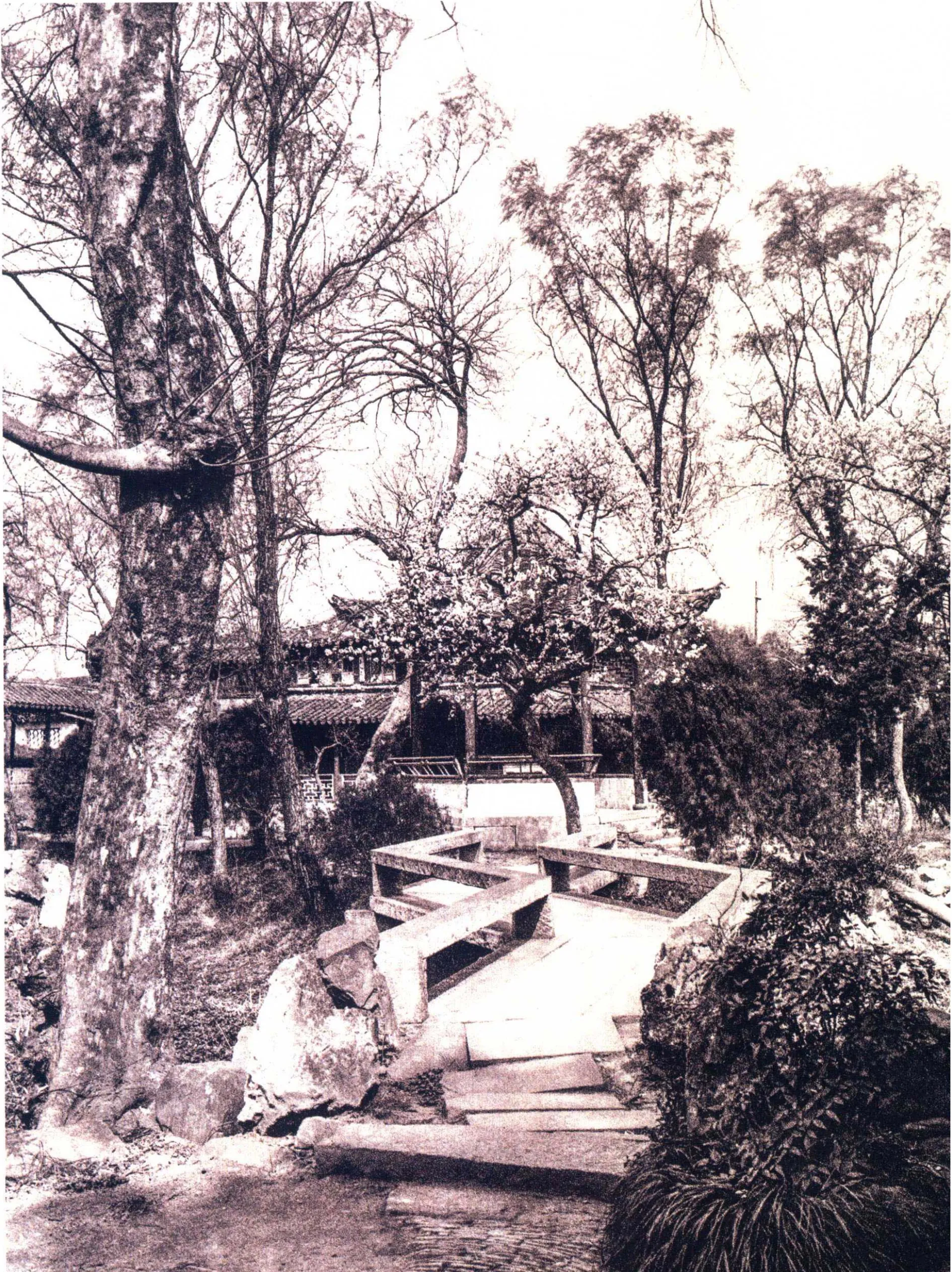
The appendix “Chinese Landscapes” of Osvald Sirén’s A History of Early Chinese Art, published in 1929, includes three clearly captioned photographs of the Humble Administrator’s Garden, labeled respectively as a garden view, before a moon gate, and a lotus scene. The original publication does not give the specific years in which the three photographs were taken.
Published in 1986
The Zhuozhengyuan Zhigao (Draft Gazetteer of the Humble Administrator’s Garden), compiled and printed in 1986 by the Office of the Suzhou Local Gazetteer Compilation Committee and the Suzhou Gardens Administration, gathers at its front twelve photographs: the Hibiscus Pavilion, the Pavilion of Embosomed Azure, views of the central garden, the Hall of Distant Fragrance with the Studio of Leaning Jade, the Tower of Viewing Mountains, the Secluded Dwelling of Parasol Trees and Bamboo, the Fragrant Isle with the Little Flying Rainbow, the “Another World” gateway with the Pavilion Suited to Both, the western water gallery, and the window views and interior furnishings of the Hall of Thirty-Six Mandarin Ducks. The book does not give the specific months or years in which these photographs were taken.
References
- Cao Lindi, “Scroll in Hand, Teaching the Children to Till: Reading the Humble Administrator’s Garden”, Suzhou Library “Suzhou Grand Forum” lecture series, June 28, 2009.
- Guo Mingyou, “Five Hundred Years of Wind and Rain at the Humble Administrator’s Garden: A History of the Garden”, Suzhou Library “Suzhou Grand Forum” lecture series, April 17, 2013.
- Suzhou Gardens and Greening Administration: “The Humble Administrator’s Garden”.
- Suzhou Museum: “The Architecture of Suzhou Museum”.
- Suzhou Museum: “Baoshan Lou” special exhibition page, “Du Mu’s Letter to Huaiyu”, December 13, 2018.