Introduction
In the thirty-eighth year of the Jiajing era (1559), after failing the metropolitan examination[1], Pan Yunduan began piling stones and cutting ponds, building pavilions and planting bamboo, in a few beds of vegetable garden on the west side of his own residence within the city of Shanghai. Three years later he passed the jinshi examination, and for more than a decade afterward he moved from post to post; during this time the work in the garden stopped and started and never took full shape. In the fifth year of the Wanli era (1577), Pan Yunduan left his post as right administration commissioner[2] of Sichuan and returned home, and only then did he devote himself to enlarging the garden, expanding its grounds and ponds and turning the entire annual yield of his fields into funds for its construction. His father Pan En had feasted and chanted verses in the garden as it gradually took form, and Pan Yunduan therefore took the sense of “gladdening one’s aged parents” and named the garden the “Yu Garden.” The Hall of Joyful Longevity, too, had been intended for Pan En, but the work was delayed again and again; before the hall was finished, Pan En died. Pan Yunduan later wrote that his father never lived to see it completed, and that this was his own “regret to the end of heaven.” The many years of building also gradually emptied the family fortune; though he did not repent of it, he still admonished his descendants at the end of his Record of the Yu Garden never again to bank up a single spadeful of earth or plant a single tree.
On the garden’s east side Pan Yunduan raised a row of storied buildings to shut out the noise of the city, and made the middle three bays the garden gate, inscribed “Yu Garden.” Not far west of the gate came the Gate of Growing Excellence; beyond the “Pot-Heaven in the Human Realm” archway and a stone bridge spanning the water stood the Hall of Jade Splendor. Before the hall rose the wondrous rock Exquisite Jade; behind the hall the Studio of the Fishes’ Delight overlooked the water, the Pavilion of Embosomed Azure spread over the water’s surface, and covered walks joined the two banks together. Further on, through the Gate of Treading Auspiciousness, giant stones flanked the entry and drew it tight, then suddenly opened onto a broad stone-paved court, where the five-bay Hall of Joyful Longevity faced the great pond across a stone balustrade. A small island lay athwart the pond, with hills piled and bamboo planted on its southern side; in the garden’s west stood the Tower of the Drunken Moon, the Zhengyang Tower, the Belvedere of Pure Yang, and a small hill built of Wukang stone. Winding corridors threaded ridges, ravines, and stone grottoes, joining the Pavilion of Gathered Loveliness, the Nunnery of the Great Bodhisattva, the Hall of Assembled Views, and the waterside studio into a single line. The Yu Garden was not at first a place for viewing alone: within it were the Pan family ancestral shrine, the halls where Pan Yunduan read and lived, and the Hall of Cherished Days, built for his son to dwell in so that morning and evening greetings would be close at hand — a living space continuous with the family residence.
After Pan Yunduan died in the twenty-ninth year of the Wanli era (1601), the Pan family’s fortunes declined, and they could no longer sustain a private garden of this scale. At the end of the Ming the grounds passed into the name of Zhang Zhaolin. In the twenty-fifth year of the Qianlong era (1760), local gentry and wealthy merchants of Shanghai jointly purchased the former site of the Pan family’s Yu Garden and attached it to the neighboring City God Temple. Because the City God Temple already had an East Garden on its eastern side, these grounds were called the West Garden. The whole tract now belonged to the City God Temple, and the various trades later repaired and used its halls, pavilions, ponds, and hills parcel by parcel.
In the thirty-sixth year of the Qianlong era (1771), the Hall of Fragrant Snow on the former site of the Hall of Jade Splendor was rebuilt, and the Studio of Falling Jade was added at the same time. Early in the Daoguang era, merchants from the three Fujian prefectures of Tingzhou, Quanzhou, and Zhangzhou who dealt in flower-sugar and foreign goods jointly built the Hall of Touched Spring in the garden’s northeast corner, for sacrificing to the gods and deliberating their affairs. In the first year of the Daoguang era (1821), a covered walkway was added east of the Hall of Fragrant Snow, with a stone beam-bridge spanning to the south and a level bridge set to the north; in the tenth year of Daoguang the Hall of the Crane’s Longevity was added.
In the twenty-second year of the Daoguang era (1842), after British forces captured the walled county city of Shanghai, they set up their headquarters inside the City God Temple and quartered soldiers at the Mid-lake Pavilion. In the twenty-sixth year of Daoguang, a small boat-pavilion was added behind the Studio of Falling Jade. During the Small Swords Society uprising[3] from the third to the fifth year of the Xianfeng era (1853–1855), the Hall of Touched Spring served as the rebel headquarters north of the city; after the uprising failed, Qing troops burned and plundered through the city, and the Hall of Touched Spring, the Hall of Fragrant Snow, the Tower of the Attained Moon, and other buildings were destroyed in the fighting. In the ninth year of the Xianfeng era (1859) the Hall of Fragrant Snow was rebuilt; the following year, the Qing government again used the City God Temple and the Yu Garden as quarters for British and French troops. The stationed soldiers stripped away the garden’s hill-stones, filled in its ponds, and built Western-style barracks; the newly rebuilt Hall of Fragrant Snow was damaged once more, and the former site of the Hall of Touched Spring was also occupied by barracks.
In the fourth year of the Tongzhi era (1865), the Hall of Fragrant Snow was built once again, the Studio of Falling Jade was renamed the Studio of the Four Beauties, and the ponds that had silted up were dredged. The flower-sugar and foreign-goods merchants to whom the Hall of Touched Spring belonged, for their part, raised subscriptions through their director Su Sheng, compensated the value of the barracks, and recovered the occupied former site.
In the seventh year of the Tongzhi era (1868), the Shanghai-group fresh-meat guild that managed the Hall of Fragrant Snow, the capital-goods hat trade guild that managed the Pavilion of Flying Cinnabar, and the oil-and-bean-cake trade guild that managed the Hall of Gathered Elegance each obtained a proclamation from the Shanghai county yamen permitting them to “assume the tax grain and take charge of the property.” The Shanghai-group fresh-meat guild was made up of local Shanghai fresh-meat shops; having obtained the proclamation, the guild paid the tax grain on the garden land where the Hall of Fragrant Snow stood and took responsibility for managing that parcel.
In the seventh year of the Tongzhi era (1868), the rebuilding of the Hall of Touched Spring also began. The work lasted four years: craftsmen channeled springs into ponds, piled stones into hills, and set towers, terraces, pavilions, and winding corridors along the ponds. Early in the Guangxu era the garden already held more than twenty trade guilds[4]; in the seventh year of the Guangxu era (1881), the Hall of Genial Warmth was added to the Hall of Touched Spring. At the end of the Guangxu era, the grounds of the Hall of Touched Spring, the Hall of Gathered Elegance, and other places still kept their garden spaces, while the Nine-Bend Bridge, the Mid-lake Pavilion, and the teahouses and wineshops around them became a gathering place for sightseers within the old city. In the third year of the Xuantong era (1911), the Hall of the Crane’s Longevity within the Hall of Fragrant Snow was rebuilt as the Tower for Enjoying Music, and the fresh-meat merchants of the Shanghai and Suzhou groups also jointly ran a lower primary school here.
In 1956 the Shanghai municipal government began a comprehensive restoration of the Yu Garden: schools, shops, and households were moved out of the garden, pavilions and towers were repaired, ponds were dredged, and flowers and trees were replanted. During the restoration the West Garden was merged with the Inner Garden, and the name Yu Garden was used for the unified whole; the Mid-lake Pavilion, the Nine-Bend Bridge, and the Lotus Pond were not incorporated into the garden. The work lasted five years, and the restored Yu Garden reopened in September 1961, forming its basic extent today.
Historical Documents
Yuyuan Ji (Record of the Yu Garden)
余舍之西偏,旧有蔬园数畦。嘉靖己未,下第春官,稍稍聚石凿池,构亭艺竹,垂二十年,屡作屡止,未有成绩。万历丁丑,解蜀藩绶归,一意充拓。地加辟者十五,池加凿者十七。每岁耕获,尽为营治之资。时奉老亲觞咏其间,而园渐称胜区矣。园东面架楼数楹,以隔城市之嚣,中三楹为门,扁曰豫园,取愉悦老亲意也。入门西行可数武,复得门曰渐佳,西可二十武,折而北,竖一小坊,曰人境壶天。过坊得石梁,穹窿跨水上,梁竟而高墉中陷,石刻四篆字,曰寰中大快。循墉东西,得堂曰玉华,前临奇石曰玲珑玉,盖石品之甲,相传为宣和漏网,因以名堂。堂后轩一楹,朱槛临流,时饵鱼其下,曰鱼乐。由轩而西,得廊可十余武,折而北,有亭翼然,覆水面曰涵碧,阁道相属,行者忘其度水也。自亭折而西,廊可三十武,复得门曰履祥。巨石夹峙若关,中藏广庭,纵数仞,衡倍之,甃以石如砥。左右累奇石,隐起作岩峦坡谷状,名花珍木,参差在列。前距大池,限以石阑,有堂五楹,岿然临之,曰乐寿堂,颇擅丹雘雕镂之美。堂之左室曰充四斋,由余之名若号而题之,以为弦韦之佩者也。其右室曰五可斋,则以往昔待罪淮漕时,苦于驰驱,有书请于老亲曰:“不肖自维有亲可事,有子可教,有田可耕,何恋恋鸡肋为。”比丁丑岁首,梦神人赐玉章一方,上书“有山可樵,有泽可渔”,而是月即有解官之命,故合而揭斋焉。嗟嗟!乐寿堂之构,本以娱奉老亲,而竟以力薄愆期,老亲不及一视其成,实终天恨也。池心有岛横峙,有亭曰凫佚。岛之阳,峰峦错叠,竹树蔽亏,则南山也。由五可而西,南面为介阁,东面为醉月楼,其下修廊曲折可百余武。自南而西,转而北,有楼三楹,曰徵阳。下为书室,左右图书可静修。前累武康石为山,峻嶒秀润,颇惬观赏。登楼西行,为阁道,属之层楼曰纯阳。阁最上奉吕仙,以余揽揆,偶同仙降,故老亲命以徵阳为小字。中层则祁阳土神之祠,盖老亲守祁州时,梦神手二桂,携二童至,曰:“上帝以大夫惠泽覃流,以此为尔子。”已而诞余兄弟。老亲尝命余兄弟祀之,语具祠记中。由阁而下,为留春窝,其南为葡萄架。循架而西,度短桥,经竹阜,有梅百株,俯以蔽阁,曰玉茵。玉茵而东为关侯祠。出祠东行,高下纡回,为冈,为岭,为涧,为洞,为壑,为梁,为滩,不可悉记,各极其趣。山半为山神祠,祠东有亭北向,曰挹秀。挹秀在群峰之坳,下临大池,与乐寿堂相望。山行至此,藉以偃息。由亭而东,得大石洞,窅窱深靓,几与张公、善卷相衡。由洞仰出,为大士庵,东偏禅堂五楹,高僧至止,可以顿锡。出庵门,奇峰矗立,若登虬,若戏马,阁云碍月,盖南山最高处。下视溪山亭馆,若御风骑气而俯瞰尘寰,真异境也。自山径东北下,过留影亭,盘旋乱石间。转而北,得堂三楹,曰会景堂,左通雪窝,右缀水轩。出会景,度曲梁,修可四十步,梁竟,即向之所谓广庭,而乐寿以南之胜尽于此矣。乐寿堂之西,构祠三楹,奉高祖而下神主,以便奠享。堂后凿方塘,栽菡萏,周以垣,垣后修竹万挺,竹外长渠,东西咸达于前池,舟可绕而泛也。乐寿堂之东,别为堂三楹,曰容与,琴书鼎彝,杂陈其间。内有楼五楹,曰颐晚楼,旁庖湢咸备,则余栖息所矣。容与堂东为室一区,居季子云献,便其定省。其堂曰爱日,志养也。大抵是园不敢自谓辋川、平泉之比,而卉石之适观,堂室之便体,舟楫之沿泛,亦足以送流景而乐余年矣。第经营数稔,家业为虚,余虽嗜好成癖,无所于悔,实可为士人殷鉴者。若余子孙,惟永戒前车之辙,无培一土,植一木,则善矣。
On the west side of my dwelling there were formerly several beds of a vegetable garden. In the jiwei year of the Jiajing era (1559), when I failed the examination of the Ministry of Rites, I began in a small way to pile stones and cut a pond, to build a pavilion and plant bamboo; for nearly twenty years the work was taken up and abandoned again and again, and nothing was accomplished. In the dingchou year of the Wanli era (1577) I gave up the seal of the Sichuan administration commission and returned home, and devoted myself single-mindedly to expansion: of the ground, five parts in ten were added, and of the ponds, seven parts in ten were further cut. Each year the entire harvest from my fields went to the costs of construction. At that time I attended my aged parents with wine and song in its midst, and the garden gradually came to be called a place of beauty. On the east face of the garden I raised several bays of storied buildings to shut out the din of the city; the middle three bays form the gate, whose plaque reads Yu Garden, taking the sense of gladdening my aged parents. Entering the gate and going west a few countable paces, one comes to another gate, called Growing Excellence; some twenty paces further west, turning north, stands a small archway, called Pot-Heaven in the Human Realm. Past the archway one finds a stone beam-bridge, vaulting archlike across the water; where the bridge ends, a high wall is recessed in the middle, carved in stone with four seal-script characters reading The Greatest Delight within the World. Following the wall east or west, one comes to a hall called Jade Splendor, facing a wondrous rock before it called Exquisite Jade — reckoned the first rank among stones, and handed down by tradition as one that escaped the net of the Xuanhe transport fleets; from it the hall takes its name. Behind the hall is a one-bay studio, its vermilion railing overlooking the current, where I would now and then bait the fish below; it is called the Fishes’ Delight. From the studio westward one gains a corridor of some ten-odd paces; turning north, there is a pavilion winged like a bird, spread over the water’s surface, called Embosomed Azure; covered walkways link it, so that the passer forgets he is crossing water. From the pavilion turning west, the corridor runs some thirty paces, and one comes to another gate, called Treading Auspiciousness. Giant stones flank it like a pass; within is hidden a broad court, several fathoms deep and twice as broad, paved with stone smooth as a whetstone. Left and right are heaped wondrous stones, rising half-hidden in the forms of crags, peaks, slopes, and valleys, with famed flowers and rare trees ranged unevenly among them. In front, facing the great pond and bounded by a stone balustrade, stands a five-bay hall towering above it: the Hall of Joyful Longevity, which greatly possesses the beauty of red pigment and carved ornament. The chamber to the hall’s left is called the Studio of the Four Fullnesses, inscribed from my own name and style, to serve as a girdle-warning like the bowstring and the leather of old. The chamber to its right is called the Studio of the Five Sufficiencies: in former days, when I held charge of the Huai grain transport, worn by the galloping to and fro, I wrote to beg leave of my aged parents, saying: “Your unworthy son considers that he has parents to serve, sons to teach, and fields to plow — why cling so fondly to this chicken rib?” Then, at the head of the dingchou year, I dreamed that a spirit gave me a square jade seal on which was written “There are mountains to be cut for firewood, there are marshes to be fished,” and in that very month came the order releasing me from office; so I joined the two and displayed them in the studio’s name. Alas, alas! The building of the Hall of Joyful Longevity was meant from the first for the joy and service of my aged parents, yet in the end, my strength being slight, the appointed time was missed, and my parents never once saw its completion — truly a regret to the end of heaven. At the pond’s heart an island lies athwart, with a pavilion called the Resting Ducks. On the island’s sunny side, peaks and ridges jostle in layers, shaded and hidden by bamboo and trees: this is the South Hill. West of the Studio of the Five Sufficiencies, facing south is the Jie Belvedere and facing east the Tower of the Drunken Moon, with a long winding corridor below of a hundred-odd paces. From south to west, turning north, stands a three-bay tower, called Zhengyang. Below it is a study, with books to left and right, where one may cultivate quiet. In front, Wukang stones are heaped into a hill, steep and lofty, fine and moist, most satisfying to behold. Ascending the tower and going west, a covered walkway leads on to a storied belvedere called Pure Yang. At the belvedere’s topmost level is worshipped the immortal Lü; because my nativity chanced to coincide with the immortal’s descent, my aged parents ordered that Zhengyang be my childhood name. The middle level is the shrine of the tutelary god of Qiyang: when my father was prefect of Qizhou, he dreamed that a god, holding two cassia branches and leading two boys, came to him and said, “The Lord on High, because the Grand Master’s beneficent influence flows far and wide, gives these to you as sons”; and presently my brother and I were born. My parents once ordered us two brothers to sacrifice there; the account is set out fully in the shrine’s record. Descending from the belvedere is the Nest of Detained Spring, and south of it a grape trellis. Following the trellis west, crossing a short bridge and passing a bamboo mound, stand a hundred plum trees, bending down to shade a belvedere called the Jade Cushion. East of the Jade Cushion is the Shrine of the Marquis Guan. Leaving the shrine and going east, high and low, twisting and turning — there are ridges, crests, rills, grottoes, ravines, bridges, and strands, more than can be fully recorded, each carried to the height of its charm. Halfway up the hill is the shrine of the mountain god; east of the shrine stands a pavilion facing north, called Gathered Loveliness. Gathered Loveliness lies in the fold of the clustered peaks, looking down upon the great pond and facing the Hall of Joyful Longevity across it; climbing the hill, one rests oneself here. East of the pavilion one finds a great stone grotto, deep, still, and lovely, nearly the match of the Zhanggong and Shanjuan caverns. Climbing up out of the grotto one comes to the Nunnery of the Great Bodhisattva, whose eastern wing has a five-bay meditation hall where eminent monks who come may rest their staffs. Leaving the nunnery gate, wondrous peaks stand sheer, like mounting dragons, like sporting horses, touching the clouds and hindering the moon — this is the highest point of the South Hill. Looking down on the streams, hills, pavilions, and lodges, it is as if one rode the wind and bestrode the vapors, gazing down upon the dusty world: truly a realm apart. Descending the hill path to the northeast, past the Pavilion of the Detained Shadow, one winds about among the tumbled stones. Turning north, one gains a three-bay hall, called the Hall of Assembled Views; to the left it communicates with the Snow Nest, to the right it is joined to the waterside studio. Leaving Assembled Views and crossing a winding beam-bridge some forty paces long, at the bridge’s end one is back at the broad court spoken of before — and here the beauties south of the Hall of Joyful Longevity are complete. West of the Hall of Joyful Longevity I built a three-bay shrine, to set the spirit tablets of my high ancestors on down, for the convenience of offering and sacrifice. Behind the hall a square pond was cut and planted with lotus, walled all about; behind the wall stand ten thousand tall bamboos, and beyond the bamboo a long canal, which reaches the front pond both east and west, so that a boat may circle round and float. East of the Hall of Joyful Longevity, set apart, is another three-bay hall, called Leisure Ease, where lutes and books, tripods and vases are ranged in company. Within is a five-bay tower, called the Tower for Nourishing Age, with kitchen and bath fully provided at its side: this is the place of my repose. East of the Hall of Leisure Ease is a suite of rooms for my youngest son Yunxian to dwell in, that his morning and evening greetings might be near at hand; its hall is called Loving the Day, to record his filial care. In the main, I dare not claim that this garden bears comparison with the Wangchuan Villa or the Pingquan Villa; yet in the fitness of its flowers and stones to the eye, the ease of its halls and chambers to the body, and the drifting of its boats along the water, it is enough to see off the flowing days and give joy to my remaining years. Only, after several years of management, the family fortune has been emptied by it; though my fondness has become a passion, I have no regret in it — yet it may truly serve as a warning mirror for gentlemen. As for my sons and grandsons, may they forever take warning from the rut of the cart ahead, and neither bank up a single spadeful of earth nor plant a single tree: that would be well.
Yanzhou Sibu Gao (Fourfold Manuscripts of Yanzhou)
潘氏豫园者,方伯允端所创也,成仅可五年。其东为广场十余亩,中杂积潦,一门翼然傍据之,榜曰豫园。入门折而西南,有坊楔孤耸,榜曰度坊为石桥,过桥稍西曰玉华堂,前列峰石曰五老峰,一峰曰玉玲珑,移自乌泥泾朱尚书园,秀润透漏,天巧宛然,狭于昆山之龙头石,而高过之,皆隋唐时物也,不知何以得免宣和纲。其西十余武,得一门呀然,辟为崇堂五楹,曰乐寿堂,其高造云,朱甍画栋,金碧照耀。左右两楹为方伯书室,尤自胜丽,岿然鲁灵光也。前为广除,临大池,可十亩,左有岑楼,门牡甚严,方伯与其嬖寔居之。右折为楼,楼不甚精好,而中庭一小山,皆叠武康石为之。方伯指示,意沾沾自喜。出循池右方路,不甚饬。已入山,蛇行而上,正枕大池,与乐寿堂对,中亦有峰峦、涧壑、亭馆之属,而不甚奇。竹细而疏,木庸而童,石亦称是。盖方伯志大而力不副,廊庙多而泉石寡,宜其尔也。时月色致佳,而方伯偕伯氏学宪俱不饮,诸从与门下客能饮而非予所荐,促巨觞十余行而别。
The Pan family’s Yu Garden was created by the Provincial Treasurer Yunduan, and had been completed barely five years. To its east lies a broad square of more than ten mu, in the midst of which stand pools of collected rainwater; a single gate, winged like a bird, stands beside it, its plaque reading Yu Garden. Entering the gate and turning southwest, an archway rises solitary on its piers, its plaque reading Cross the Archway to the Stone Bridge; past the bridge, a little to the west, is the Hall of Jade Splendor, ranged before it the peak-stones called the Five Elders Peak, of which one peak, called Exquisite Jade, was moved from the garden of Minister Zhu at Wunijing — fine and moist, pierced and leaky, its natural artfulness fully present; narrower than the Dragon-Head Stone of Kunshan, yet taller than it. Both are things of the Sui and Tang, and one knows not how they escaped the Xuanhe transport fleets. Some ten-odd paces to its west one comes upon a gate gaping open, which opens into a lofty five-bay hall called the Hall of Joyful Longevity, whose height reaches the clouds, with vermilion ridges and painted beams, shining in gold and azure. The bays to left and right are the Treasurer’s study, of surpassing beauty, standing firm like the Lingguang Palace of Lu. Before it lies a broad terrace overlooking the great pond, of some ten mu; on the left is a tall tower, its door-bolt most strict, where the Treasurer dwells with his favorite. Turning right is another tower, not particularly fine, but in its central court is a small hill made entirely of heaped Wukang stones. The Treasurer pointed things out to us, plainly pleased with himself. Leaving by the road along the pond’s right side, which is not well kept, we presently entered the hill and wound our way up like snakes; it lies squarely upon the great pond, facing the Hall of Joyful Longevity, and within it too are peaks and ridges, rills and ravines, pavilions and lodges of a kind — but nothing very remarkable. The bamboo is thin and sparse, the trees common and bare, and the stones much the same. For the Treasurer’s ambition was great while his strength did not match it — his halls are many and his springs and stones few; it is fitting that it should be so. That night the moonlight was exceedingly fine; the Treasurer and his elder brother the Education Intendant both abstained from drink, and the attendants and retainers who could drink were none of them recommended by me; so we hastened through a dozen rounds of great goblets and took our leave.
Songjiang Fu Zhi (Chongxiu Songjiang Fu Zhi) (Gazetteer of Songjiang Prefecture [Revised Edition])
豫园在上海城内。潘方伯允端奉父恭定公之所,有奇石曰玉玲珑,因颜其堂曰玉华。王世贞谓其秀润透漏,天巧,宛然为隋唐时物。西辟乐寿堂,其高造云,朱甍画栋。金碧照耀,又有涵碧阁、留春窝、玉茵阁、颐晚楼、会景堂,无不擅丹雘之美。
The Yu Garden lies within the city of Shanghai. It is the place where Provincial Treasurer Pan Yunduan served his father, Lord Gongding. It holds a wondrous rock called Exquisite Jade, for which he inscribed his hall Jade Splendor. Wang Shizhen said of it that it is fine and moist, pierced and leaky, its natural artfulness seeming a thing of the Sui and Tang. To the west he opened the Hall of Joyful Longevity, whose height reaches the clouds, with vermilion ridges and painted beams, shining in gold and azure; there are moreover the Belvedere of Embosomed Azure, the Nest of Detained Spring, the Belvedere of the Jade Cushion, the Tower for Nourishing Age, and the Hall of Assembled Views, every one possessed of the beauty of red pigment.
Lüyuan Conghua (Assorted Talks from the Lü Garden)
豫园在上海城内,明潘恭定公恩之子方伯允端所筑。方伯自有记。其地甚宽广。园中有乐寿堂,董思翁为作乐寿堂歌,书于屏障,字径三四寸许,其墨迹至今存焉。余于张芥航先生案头见之。堂前为千人坐,有池台之胜。池边有湖石,甚奇峭,名五老峰,有玉玲珑、飞骏、玉华之名,相传为宣和遗物也。今造城隍庙于其中,为市估所估,作会集公所。游人杂遝,妇女如云,医卜星相之流,亦无不毕集,虽东京大相国寺不能过之。
The Yu Garden lies within the city of Shanghai; it was built by Pan Yunduan, Provincial Treasurer of the Ming, son of Lord Gongding, Pan En. The Treasurer wrote his own record of it. Its grounds are exceedingly broad. Within the garden is the Hall of Joyful Longevity, for which Dong Siweng composed a Song of the Hall of Joyful Longevity, written out on a screen in characters three or four inches across; his ink trace survives to this day. I saw it on the desk of Master Zhang Jiehang. Before the hall is the Thousand-Man Seat, with the beauties of pond and terrace. By the pond stand lake-stones, most wondrous and sheer, called the Five Elders Peak, bearing the names Exquisite Jade, Flying Steed, and Jade Splendor; by tradition they are relics left from the Xuanhe era. Now the City God Temple has been built within it, appraised by the dealers of the market and made into guild halls for their assemblies. Sightseers throng in confusion, women are numerous as clouds, and the tribe of healers, diviners, astrologers, and physiognomists also all gather there without exception — even the Great Xiangguo Temple of the Eastern Capital could not surpass it.
Songnan Yuefu (Ballads of Songnan)
淞南好,兴废劫灰红。神庙重新花娅姹,豫园依旧玉玲珑。杯酒酹潘公。
Fine is Songnan, where rise and fall leave the ashes of calamity red. The god’s temple restored, its flowers charming and fair; the Yu Garden as of old, its Exquisite Jade still. With a cup of wine I pour a libation to Lord Pan.
Shanghai Xiangtu Zhi (Local Records of Shanghai)
豫园在新北门内,向为潘氏之园,构以娱亲,即今邑庙是也。亭台池石,备极壮丽,为一邑园林之冠。内有点春、萃秀两堂,景象清幽,更有九曲桥、湖心亭诸胜地,均为著名之处。其间茶肆酒楼,行人如织,每逢佳节,益见繁盛云。
The Yu Garden lies within the New North Gate; it was formerly the garden of the Pan family, built to gladden his parents — it is the present county temple. Its pavilions, terraces, ponds, and stones are magnificent to the utmost, the crown of the county’s gardens. Within are the two halls of Touched Spring and Gathered Elegance, of pure and secluded aspect, and moreover such famed places as the Nine-Bend Bridge and the Mid-lake Pavilion, all celebrated spots. Among them teahouses and wineshops stand with passersby woven thick as fabric, and on every festival day they grow the more prosperous and thronged.
Shanghai Xian Xuzhi (Continued Gazetteer of Shanghai County)
香雪堂在邑庙豫园,为沪帮鲜肉业公所。堂本玉华堂旧址,以庭前有玉华三峰并峙故名。乾隆三十六年改建,并建霏玉轩。道光元年,于其东设游廊,南驾石梁,北设平桥。十年,建鹤寿堂。二十六年,设小舫于霏玉轩后。咸丰三年,悉毁于寇,惟鹤寿仅存。九年重建。十年,驻西兵又遭毁损。同治四年,重行修建,更霏玉轩曰四美轩,池之湮没者浚之。七年,由县给谕承粮。宣统三年,改建鹤寿堂曰赏乐楼。附设香雪义务初等小学校,沪、苏两帮联合捐资创办。又殡舍在二十五保九图,光绪十一年建。又公共宰作,在薛家滨口,沪、苏、宁三帮公建。
The Hall of Fragrant Snow lies in the Yu Garden of the county temple; it is the guild hall of the Shanghai-group fresh-meat trade. The hall stands on the former site of the Hall of Jade Splendor and is so named because three Jade Splendor peaks stand side by side before its court. In the thirty-sixth year of the Qianlong era it was rebuilt, and the Studio of Falling Jade was built together with it. In the first year of the Daoguang era a covered walkway was set to its east, with a stone beam-bridge spanning to the south and a level bridge set to the north. In the tenth year the Hall of the Crane’s Longevity was built. In the twenty-sixth year a small boat-pavilion was set behind the Studio of Falling Jade. In the third year of the Xianfeng era all were destroyed by the rebels; only the Hall of the Crane’s Longevity survived. In the ninth year it was rebuilt. In the tenth year, with Western troops stationed there, it again suffered damage. In the fourth year of the Tongzhi era it was built once more, the Studio of Falling Jade was renamed the Studio of the Four Beauties, and the ponds that had silted up were dredged. In the seventh year the county granted a proclamation for assuming the tax grain. In the third year of the Xuantong era the Hall of the Crane’s Longevity was rebuilt as the Tower for Enjoying Music. Attached to it is the Xiangxue Free Lower Primary School, founded by the joint contributions of the Shanghai and Suzhou groups. There is also a coffin repository at the Ninth Tu of the Twenty-fifth Bao, built in the eleventh year of the Guangxu era. There is also a communal slaughterhouse at the mouth of Xuejiabin, built jointly by the Shanghai, Suzhou, and Ningbo groups.
飞丹阁在邑庙豫园,为京货帽业公所,乾隆年设。咸丰十年,驻西兵毁。同治七年管业承粮。九年重建厅楼、水阁。光绪二十年,重建前阁。
The Pavilion of Flying Cinnabar lies in the Yu Garden of the county temple; it is the guild hall of the capital-goods hat trade, established in the Qianlong era. In the tenth year of the Xianfeng era it was destroyed by stationed Western troops. In the seventh year of the Tongzhi era the guild took charge of the property and assumed the tax grain. In the ninth year the hall-tower and waterside pavilion were rebuilt. In the twentieth year of the Guangxu era the front pavilion was rebuilt.
点春堂在豫园东北隅。道光初年,福建汀、泉、漳三府业花糖。洋货各商公立,为祀神会议之所。咸丰三年,寇占被毁。十年,借驻西兵,改造洋房,风景荡然。事平,群谋规复。董事苏升倡募捐款,集资万五干金,贴偿兵房价值,收回旧址,重图建筑。同治七年经始,越四载告竣。疏泉为池,叠石成山,其间楼台亭阁,绕以回廊,颇饶幽趣。光绪七年,复筑和煦堂,益形完美。公所事轮举司年经理。
The Hall of Touched Spring lies in the northeast corner of the Yu Garden. Early in the Daoguang era it was founded jointly by the merchants of the three Fujian prefectures of Tingzhou, Quanzhou, and Zhangzhou who dealt in flower-sugar and foreign goods, as a place for sacrificing to the gods and holding deliberations. In the third year of the Xianfeng era it was occupied by the rebels and destroyed. In the tenth year it was lent for the stationing of Western troops, who rebuilt it into foreign-style houses, and its scenery was utterly swept away. When matters had settled, the company planned together to restore it. The director Su Sheng took the lead in soliciting subscriptions, gathering fifteen thousand in gold, compensated the value of the barracks, recovered the former site, and planned the building anew. Work began in the seventh year of the Tongzhi era and was completed after four years. They channeled springs into ponds and piled stones into hills; among them towers, terraces, pavilions, and belvederes are wound about with winding corridors, rich in secluded charm. In the seventh year of the Guangxu era the Hall of Genial Warmth was further built, rendering it yet more perfect. The guild’s affairs are managed by a yearly officer chosen in rotation.
萃秀堂在邑庙豫园,为油豆饼业公所,即前志所称以萃秀堂为东园者是。道光间承修作公所。咸丰三年,匪乱遭损。十年,驻西兵后,残毁尤甚。同治七年,承粮管业,复大加修葺。当时禀县给谕勒石,以萃秀为二十一业之领袖。萃秀堂外有厅事四,曰三穗堂、仰山堂、格思堂、神尺堂,亭榭池沼,回廊曲折,均极园林之胜。而大假山层峦叠嶂,尤为邑中独有之境。历年修费不资。公所向由司月轮管,近举董事一人,会同司月六家办事。光绪三十二年,与米业合组之豆米业小学校,分设于此。又采菽堂,在豆市街万瑞衖,为同业与号商论市交易之所。从前租用市房,光绪七年购屋改建对照厅六间。
The Hall of Gathered Elegance lies in the Yu Garden of the county temple; it is the guild hall of the oil-and-bean-cake trade — the very one of which the former gazetteer speaks as taking the Hall of Gathered Elegance for the East Garden. During the Daoguang era it was taken on for repair as a guild hall. In the third year of the Xianfeng era it suffered damage in the bandit turmoil. In the tenth year, after the stationing of Western troops, the ruin was yet worse. In the seventh year of the Tongzhi era the guild assumed the tax grain and took charge of the property, and again repaired it on a great scale. At that time it petitioned the county for a proclamation to be carved in stone, so that Gathered Elegance became the leader of twenty-one trades. Beyond the Hall of Gathered Elegance are four audience halls, called the Hall of the Three Ears, the Hall of Gazing at the Mountain, the Hall of Arriving Thought, and the Hall of the Divine Measure; pavilions, kiosks, ponds, and pools, with winding corridors twisting and turning — all the utmost in garden beauties. And the Great Rockery, with its ranges of peaks rising one upon another, is a sight unique within the county. Over the years the costs of repair have been beyond counting. The guild’s affairs were formerly managed by monthly officers in rotation; lately one director has been chosen to conduct affairs together with the six monthly-officer houses. In the thirty-second year of the Guangxu era, the bean-and-rice trade primary school organized jointly with the rice trade was established here as a branch. There is also the Hall of Bean-Gathering, at Wanrui Lane on Bean Market Street, the place where the trade deliberates the market and transacts with the merchant houses; formerly they rented market buildings, and in the seventh year of the Guangxu era they bought a house and rebuilt it into six facing-hall rooms.
得月楼在邑庙豫园,为布业公所。道光三十年,承办供布创始设立。咸丰三年寇毁,僦居于外。八九年建前楼。十年,园驻西兵,又遭毁损。同治七年,承粮执业,十二年迁回。其时供布已归官办。光绪九年,磊石北浒筑环垣,十七年重行建筑,阅三载落成。上为得月楼,下为绮藻堂,中奉城隍神。庭列峰石五,植槐二。西南隅有亭曰跋织,东廊额曰月府。后有楼三楹,斋厨一,曰还缘居,供业董栗主公所事,举司董经理,银钱归司月掌管云。
The Tower of the Attained Moon lies in the Yu Garden of the county temple; it is the guild hall of the cloth trade. In the thirtieth year of the Daoguang era it was founded by those who undertook the supply of tribute cloth. In the third year of the Xianfeng era it was destroyed by the rebels, and the guild lodged outside. In the eighth and ninth years the front tower was built. In the tenth year Western troops were stationed in the garden, and it again suffered damage. In the seventh year of the Tongzhi era the guild assumed the tax grain and took up the property, and in the twelfth year it moved back. By that time the supply of cloth had already come under official management. In the ninth year of the Guangxu era stones were piled on the northern shore and an encircling wall was built; in the seventeenth year it was built anew, completed after the passing of three years. Above is the Tower of the Attained Moon, below the Hall of Elegant Pattern, and in the midst is worshipped the god of the city wall and moat. In the court are ranged five peak-stones, and two sophora trees are planted. At the southwest corner is a pavilion called the Weaving Maid; on the eastern corridor a tablet reads Moon Office. Behind is a three-bay tower with a refectory-kitchen, called the Dwelling of Returned Affinities, in which are kept the chestnut-wood spirit tablets of the guild’s founder. The guild’s affairs are conducted by officers chosen as directors, and its silver and cash are under the charge of the monthly officers.
清芬堂在邑庙豫园,为旧花业公所。同治七年给谕承粮。宣统二年重修。
The Hall of Pure Fragrance lies in the Yu Garden of the county temple; it is the guild hall of the old cotton trade. In the seventh year of the Tongzhi era it was granted a proclamation to assume the tax grain. In the second year of the Xuantong era it was repaired.
Historical Photographs
1902
A stereograph held by the Library of Congress, “The Willow Pattern Tea House, Shanghai”, photographs the Mid-lake Pavilion from the front of the zigzag bridge, together with the surrounding water, covered walks, and sightseers. The library’s catalog record names it from the original caption on the card and dates it to 1902.
1913–1915
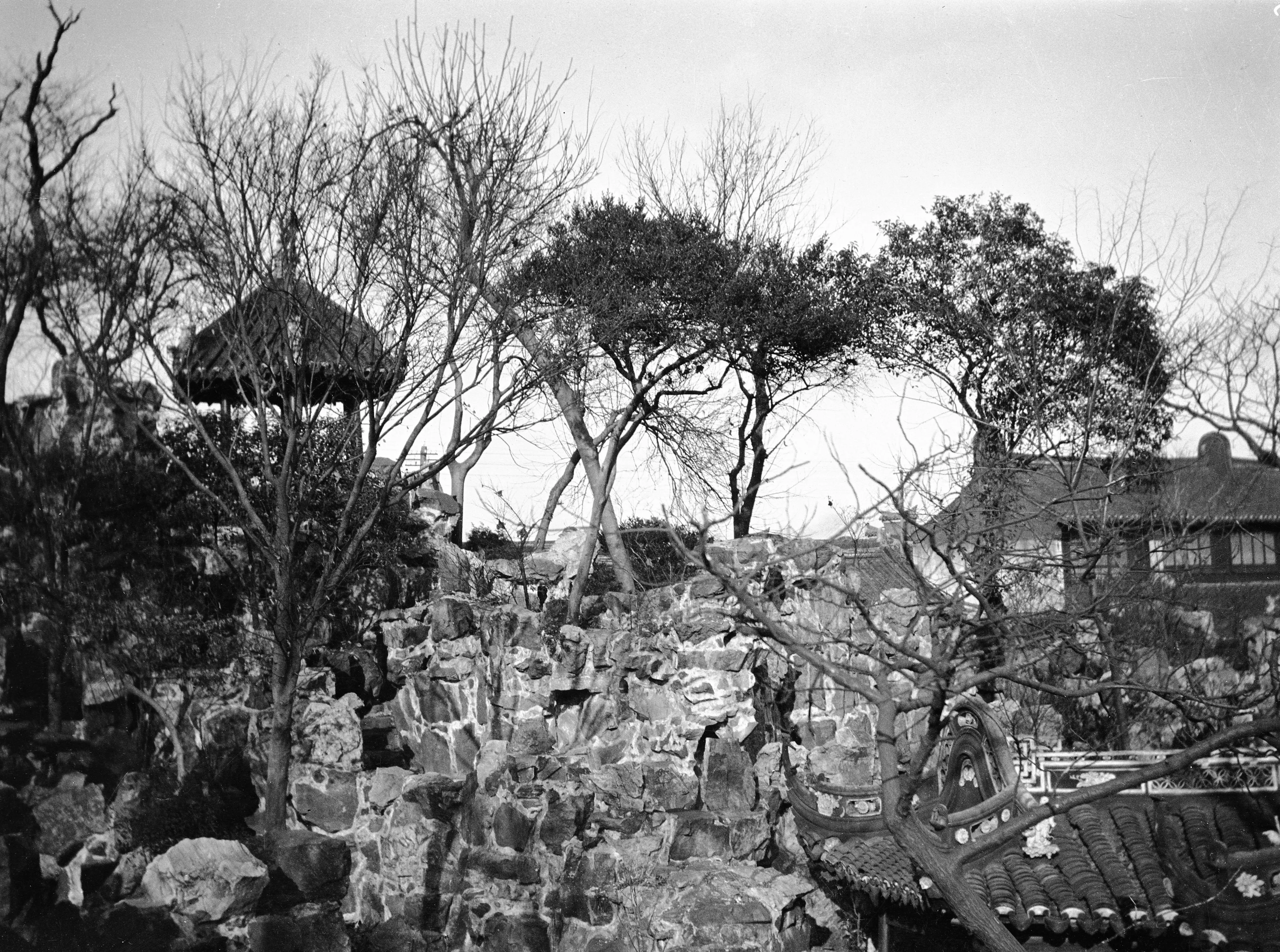
The American geologist Frederick G. Clapp photographed Shanghai’s old city between 1913 and 1915. Among the Clapp nitrate negatives held by the American Geographical Society Library, the Mid-lake Pavilion under repair, a view of the Yu Garden, the dragon wall of the Yu Garden, and the Nine-Bend Bridge and the old city’s market buildings seen from near the Mid-lake Pavilion preserve in sequence the rockeries, walls, rooftops, and waterfront spaces outside the garden as they then were.
References
- Yu Garden: “Seasons of the Old Garden”
- Shanghai Archives Information Network: “Memories of the Old City — The City God Temple”
- Local Gazetteers of Shanghai: “Forty Years since the Yu Garden Was Listed as a Major Historical and Cultural Site Protected at the National Level”
- Shanghai Huangpu: “The Yu Garden in Modern Times: From County-Temple Garden to Civic Square”