Introduction
In the Jiajing era of the Ming, Fan Qin, who had held office in many places, resigned and returned to Ningbo. During his years in office he continually searched out and purchased books, paying particular attention to rarely seen commentaries on the classics and to the poetry and prose of his home region; when he lacked a book, he would compare catalogs with the household of the Suzhou bibliophile Wang Shizhen, and the two copied from each other. To keep these books together, Fan Qin built a two-story library in his residence west of Moon Lake, placing the bookcases on the upper floor. He dug a pond before the pavilion and ringed it with bamboo and trees; later, among the stone engravings[1] he had collected, he found an inscription reading “Tianyi Pond” written by the Yuan calligrapher Jie Xisi, and the Fan family accordingly named the library “Tianyi.”
After Fan Qin’s death, when the family divided its property, the collection was not split up; instead, the intact library and a sum of ten thousand in gold were made into two shares: the branch willing to guard the books received the library, while the second son took the gold and departed. Quan Zuwang later wrote: “Now the gold is gone, yet the books remain.” To prevent any single branch from opening the pavilion alone, carrying books downstairs, or pawning and selling them, the Fan descendants divided the keys to the pavilion gate and the bookcases among the branches, and the locks could be opened only when the descendants of every branch were present together; anyone who ascended the pavilion without permission, brought in outsiders, or lent books out was punished by exclusion from the family sacrifices. In the twelfth year of the Kangxi era (1673), the scholar Huang Zongxi came to Ningbo, and the Fan descendant Fan Youzhong “broke the rule” by taking him upstairs and opening all the bookcases. Huang Zongxi recorded this exception in the Record of the Tianyi Pavilion Collection, leaving a scene of the family rules in actual operation.
In the thirty-eighth year of the Qianlong era (1773), the court requisitioned books from across the country for the compilation of the Siku Quanshu (Complete Library of the Four Treasuries), and Fan Maozhu, an eighth-generation descendant of Fan Qin, presented 638 titles from the pavilion. The court had originally stipulated that the books be returned after copying, but in fact a number of them never came back to the Tianyi Pavilion; the Qianlong Emperor bestowed the Gujin Tushu Jicheng (Complete Collection of Illustrations and Writings from the Earliest to Current Times) and two albums of battle paintings, and ordered the Hangzhou textile commissioner[2] Yinzhu to go to Ningbo to measure the library and its bookcases. The seven imperial libraries built thereafter were modeled on the Tianyi Pavilion’s form, and the Fan library thereby grew from a private book repository of Ningbo into a nationally renowned library. In the Jiaqing era, Ruan Yuan, governor of Zhejiang, further ordered the Fan descendants to inventory the collection case by case and compile it into a ten-juan catalog, which was block-printed in the thirteenth year of the Jiaqing era (1808).
From the nineteenth century onward, war and theft successively broke the order of book-keeping that the Fan family had maintained for generations. In the twenty-first year of the Daoguang era (1841), after British forces occupied Ningbo they entered the Tianyi Pavilion and carried off several dozen works of geography such as the Comprehensive Gazetteer; in the eleventh year of the Xianfeng era (1861), when the Taiping army entered Ningbo, the Fan descendants guarding the pavilion fled, and vagrants from the neighborhood broke open the back wall of the library and stole the books — some passed into the hands of missionaries, some were sold to paper mills at the price of waste paper, and afterward the Fan family could only manage to buy back part of them. In 1914 a Shanghai book dealer hired Xue Jiwei to slip into the library and steal at least a thousand titles according to a preselected catalog. As it was told at the time, Xue Jiwei hid inside the pavilion for more than ten days, subsisting on dried black dates; by the time the Fan family discovered the theft, large numbers of rare books[3] had already been shipped to Shanghai. Part of these were later purchased by Zhang Yuanji and others and deposited in the Hanfen Lou of the Commercial Press, only to be burned with the Oriental Library when Japanese forces bombed Shanghai in 1932. By the early 1930s the old collection had shrunk from more than seventy thousand juan in Fan Qin’s day to fourteen or fifteen thousand juan, and with the Fan family’s declining means the building lost any stable source of funds for repair.
On September 18, 1933, a violent storm struck Ningbo and a corner of the east wall of the Baoshu Lou collapsed. The Fan descendants could no longer fund repairs themselves, so the Yin County Committee for Documents and Records met on October 1 and proposed raising money from the public for the work; after three weeks of preparation, the Committee for the Rebuilding of the Tianyi Pavilion was established on October 24, with its office at the Yin County Committee for Documents and Records inside Ningbo’s Zhongshan Park. The committee had twenty-five members, chaired by the Yin County magistrate Chen Baolin; Ye Qianliang, Feng Zhenqun, Lin Shaokai, and Chen Xiankai took charge respectively of general affairs, liaison, engineering, and finance, and six descendants of the Fan family were among the members. The committee hoped to restore the Tianyi Pavilion to its former appearance and to enlarge it, so the funds raised went not only to repairing the fallen wall but also to refurbishing the garden, relocating the Zunjing Pavilion, and seeking out and purchasing books that had been dispersed from the pavilion.
On March 18, 1934, the committee first decided to move the collection out, requiring that every book chest bear the three seals of the Yin County government, the committee, and the Fan family. On June 1, the more than nine thousand volumes on the Baoshu Lou, together with printing blocks and rubbing stones, began to be packed into fifteen wooden chests, and by the 10th all had been moved to the Fan family’s Yigu Hall, where Fan clan elders and police constables kept watch day and night. Only after the craftsmen had stripped off all the roof tiles did they discover that the columns and rafters had rotted and the walls had crumbled, and that much of the timber, stone, and brick had to be replaced; the work proceeded to change out the decayed columns and floorboards, relay the brick paving, retile the roof, and refurbish the rockeries, stone paths, and ponds front and back. The Baoshu Lou was completed on December 17, and Chen Baolin, Feng Zhenqun, Ye Qianliang, and the Fan members of the committee jointly inspected and accepted the work on the 20th; on January 10, 1935, the collection was moved back upstairs from the Yigu Hall in its entirety. The committee then relocated the Zunjing Pavilion of the Ningbo Prefectural School to the north of the library and established the Mingzhou Forest of Steles and the Qianjin Studio, so that this emergency repair continued to change the architectural and garden landscape around the Tianyi Pavilion.
Two years after the rebuilding was completed, the full-scale War of Resistance broke out, and the committee again had to move the rare books that had only just returned to the pavilion. In August 1937, citing the reason that “foreign invasion presses close, and cultural institutions are in particular danger,” the committee first packed Ming local gazetteers, examination rolls, and the like into three chests and moved them out; in 1939, with the assistance of the Zhejiang Provincial Department of Education and the Zhejiang Library, three batches of the collection — twenty-three chests totaling 9,080 volumes — were transported to Longquan in southern Zhejiang, accompanied and guarded by the Fan descendant Fan Zhaonan. When Ningbo fell in April 1941, the principal rare books had already left the pavilion; in June of the same year, the Committee for the Rebuilding of the Tianyi Pavilion handed its funds, archives, keys, and implements over to the Fan family and in effect ceased its work, and the Fan descendant Fan Yingsheng lived in a small hut east of the pavilion guarding the empty building, sustaining himself by street vending and growing vegetables behind the pavilion. Because Longquan and Lishui later came under threat of war as well, the collection was moved again between August 1942 and January 1943, together with the rare books of the Zhejiang Library, to Yushang in Qingyuan. After the victory in the war, these books were first shipped back to Hangzhou and did not return to the Tianyi Pavilion until December 25, 1946; Ma Yamin later recorded that when they came back to the pavilion, only a few titles of local gazetteers were missing.
Historical Documents
Yongshang Qijiu Shi (Poems of the Venerable Elders of Yong)
兵部右侍郎范公钦,字尧卿,号东明。以进士出知随州,有治行,迁工部员外郎。时大工频起,武定侯郭勋为督,其势张甚。公以事忤之,勋谮于上,下公狱,杖之阙下。出知袁州。相嵩,其郡人也。嵩子世蕃欲取宣化公宇,公不可。世蕃怒,欲斥之,嵩曰:是抗郭武定者,踣之适高其名。遂得寝。稍迁按察副使,备兵九江。历广西、福建、云南、陕西诸藩臬,进副都御史,巡抚南赣诸郡。擒剧贼李文彪,平其穴。疏请筑城程乡之濠居村,设一通判,以消豫章、闽粤之奸。复攻大盗冯天爵,斩之。迁兵部右侍郎,解组归。时郡中东沙张公、竹墟屠公亦以事废,与公并里居,投闲啸咏,主一时文柄,人称为东海三司马。而公筑居在两湖深处,舍径窅曲,林木翳然,不知在城市中。性喜藏书,于舍中起天一阁,尽购海内异本,列为四部。尤善收说经诸书及先辈诗文集未传世者。与吴门王凤洲家岁以书目取较,各钞所未见相易,故浙东藏书家以范氏天一阁为第一。卒年八十三。所著天一阁集、抚掌集。
Fan Qin, Vice Minister of War of the Right, had the courtesy name Yaoqing and the sobriquet Dongming. Taking the jinshi degree, he went out as prefect of Suizhou, where he earned a record of good administration, and was promoted to vice director in the Ministry of Works. At that time great construction works arose in quick succession, and the Marquis of Wuding, Guo Xun, served as superintendent, his power waxing strong. In some affair the lord offended him; Xun slandered him to the throne, and the lord was thrown into prison and flogged at the foot of the palace gate. He was sent out as prefect of Yuanzhou. Grand Secretary Yan Song was a man of that prefecture. Song’s son Shifan wished to seize the public offices at Xuanhua; the lord would not permit it. Shifan was enraged and wanted to have him dismissed, but Song said: this is the man who stood up to Guo of Wuding; to bring him down would only raise his name. So the matter was dropped. He was gradually promoted to surveillance vice commissioner, in charge of military defense at Jiujiang. He served through the provincial administration and surveillance commissions of Guangxi, Fujian, Yunnan, and Shaanxi, was advanced to vice censor-in-chief, and became grand coordinator of the various prefectures of southern Gan. He captured the notorious bandit Li Wenbiao and razed his lair. He memorialized requesting that a walled town be built at Haoju Village in Chengxiang and that an assistant prefect be established there, so as to extinguish the evildoers between Yuzhang and the Fujian-Guangdong border. He again attacked the great bandit Feng Tianjue and beheaded him. He was promoted to Vice Minister of War of the Right, then laid down his seals and returned home. At that time Lord Zhang of Dongsha and Lord Tu of Zhuxu, of the same prefecture, had likewise been dismissed from office; living in retirement alongside the lord, they idled away their days whistling and singing, presiding over the literary judgment of the age, and men called them the Three Ministers of the Eastern Sea. The lord built his residence deep between the two lakes; its paths wound dim and secluded, shaded by forest trees, so that one did not know one was within a city. By nature he loved collecting books; within his residence he raised the Tianyi Pavilion, buying up all the rare editions within the seas and arranging them in the four divisions. He was especially good at collecting works expounding the classics and the collections of earlier worthies’ poetry and prose that had not been transmitted to the world. With the household of Wang Fengzhou of Wumen he compared catalogs each year, each copying what the other had not seen and exchanging them, so that among the bibliophiles of eastern Zhejiang the Fan family’s Tianyi Pavilion was accounted first. He died at the age of eighty-three. His writings were the Tianyige Ji and the Fuzhang Ji.
公天一阁所藏书最有法,至今百余年,卷帙完善。适余选里中耆旧诗,公曾孙光燮为余扫阁,尽开四部书使纵观,因得郑荥阳、黄南山、谢廷兰、魏松云诸先生集诗,录入选中,俱前此选家所未见者,其有功吾乡文献为甚大矣。
The books collected in the lord’s Tianyi Pavilion were ordered with the greatest method; down to the present, for more than a hundred years, the fascicles have remained complete and sound. It happened that I was selecting the poems of the aged worthies of my district, and the lord’s great-grandson Guangxie swept the pavilion for me and opened all the books of the four divisions for my free perusal; thus I obtained the collected poems of the masters Zheng Xingyang, Huang Nanshan, Xie Tinglan, and Wei Songyun and entered them into the selection — all of them things earlier anthologists had never seen. His service to the written heritage of our district was very great indeed.
Huang Lizhou Xiansheng Tianyige Cangshu Ji (Huang Lizhou’s Record of the Tianyi Pavilion Collection)
天一阁书,范司马所藏也。从嘉靖至今,盖已百五十年矣。司马殁后,封闭甚严。癸丑,余至甬上,范友仲破戒引余登楼,悉发其藏。余取其流通未广者,抄为书目,凡经、史、地志、类书,坊间易得者,及时人之集、三式之书,皆不在此列。余之无力,殆与东里少时伯仲,犹冀以暇日握管怀铅,拣卷小书短者抄之。友仲曰:“诺。”荏苒七年,未蹈前言。然余之书目,遂为好事流传。昆山徐健庵使其门生誊写去者,不知凡几。友仲之子左垣,乃并前所未列者,重定一书目,介吾友王文三求为藏书记。
The books of the Tianyi Pavilion were collected by Minister Fan. From the Jiajing era to the present, it is now some hundred and fifty years. After the Minister’s death, the seals were kept extremely strict. In the guichou year (1673) I came to Yong, and Fan Youzhong broke the rule and led me up the stairs, opening the whole of the collection for me. I took those works whose circulation was not yet wide and copied them into a catalog; of the classics, histories, geographical treatises, and classified compendia that could easily be had in the bookshops, and of the collections of contemporaries and the books of the three cosmological arts, none were included in this list. My own lack of means was about on a par with Dongli’s in his youth; I still hoped that in some leisure day I might take up the brush and carry the lead tablet, and pick out short scrolls and little books to copy. Youzhong said: “Agreed.” Seven years slipped by, and I had not fulfilled my earlier word. Yet my catalog was thereafter circulated by lovers of such things. Xu Jian’an of Kunshan had his disciples make fair copies of it — who knows how many. Youzhong’s son Zuoyuan then took those I had previously not listed and fixed a new catalog, and through my friend Wang Wensan begged of me a record of the collection.
近来书籍之厄,不必兵火,无力者既不能聚,聚者亦以无力而散,故所在空虚。屈指大江以南,以藏书名者不过三四家。千顷斋之书,余宗兄比部明立所聚,自庚午讫辛巳,余往南中,未尝不借其书观也。今闻虞稷好事过于其父,无由一见之。曹秋岳倦圃之书,累约观之而未果,据秋岳所数,亦无甚异也。余门人自昆山来者,多言健庵所积之富,亦未寓目。三家之外,即数范氏。韩宣子聘鲁,观书于太史氏,见《易象》与《鲁春秋》,曰:“周礼尽在鲁矣。”范氏能世其家,礼不在范氏乎?幸勿等之云烟过眼,世世子孙如护目睛,则震川覆护之言,又未必不然也。
The calamities of books in recent times do not require war or fire: those without means cannot gather them, and those who have gathered them lose them for lack of means, so that everywhere lies empty. Counting on one’s fingers, south of the Great River those famed for book collecting amount to no more than three or four houses. The books of the Qianqing Studio were gathered by my clansman Mingli of the Bureau of Review; from the gengwu year (1630) to the xinsi year (1641), whenever I went to the southern capital I never failed to borrow his books to read. Now I hear that Yuji’s love of such things surpasses his father’s, yet I have had no way to see them once. Of the books of Cao Qiuyue’s Juanpu, I repeatedly made appointments to view them without result; by Qiuyue’s own reckoning there is nothing very extraordinary there either. Of my disciples who come from Kunshan, many speak of the riches of Jian’an’s accumulation, but I have not laid eyes on it. Beyond these three houses, one comes to count the Fan. When Viscount Xuan of Han paid a court visit to Lu and viewed the books with the Grand Historian, seeing the Images of the Changes and the Spring and Autumn of Lu, he said: “All the rites of Zhou are in Lu.” If the Fan can keep their house through the generations, are the rites not in the Fan? May they not treat it as mist and clouds passing before the eyes; if generation upon generation of descendants guard it as they would the pupils of their eyes, then Zhenchuan’s words of shelter and protection may yet prove not otherwise.
Quan Xieshan Xiansheng Tianyige Cangshu Ji (Quan Xieshan’s Record of the Tianyi Pavilion Collection)
南雷黄先生记天一阁书目,自数生平所见,四库落落如置诸掌,予更何以益之?但是阁肇始于明嘉靖间,而阁中之书不自嘉靖始,固城西丰氏万卷楼旧物也。丰氏为清敏公之裔,吾乡南宋四姓之一,而名德以丰为最。清敏之子安常。安常子治,监仓扬州,死于金难,高宗锡以恩恤。治子谊,官吏部,以文名。谊子有俊,以讲学与象山、慈湖最相善,亦官吏部。有俊子云昭,官广西经略。云昭子稌,稌子昌传,并以学行为时师表。而云昭群从,曰芑、曰𦶜,皆有名。盖万卷楼之储,实自元祐以来启之。自吏部以后,迁居绍兴。其后至庚六迁居奉化,庚子茂四迁居定海。茂孙寅初,明建文中官教谕。寅初子庆,眷念先畴,欲归葬父于鄞,而岁久,其祖茔无知者,旁皇甬上。或告之曰:“城西大卿桥以南紫清观,吉地也。”庆乃卜之,遇丰之革,私自喜曰:“符吾姓矣。”是日适读元延祐《四明志》云:“紫清观者,宋丰尚书故园也。”庆大喜,即呈于官,请赎之,并为访观中旧籍,得其附观圃地三十余亩,为邻近所据者,尽清出之,遂葬其亲,而以其余治宅。庆喜三百年故居之无恙也,作十咏以志之。而于是元祐以来之图书,由甬上而绍兴,而奉化,而定海者,复归甬上。庆官河南布政,庆子耘官教授,耘子熙官学士,即以谏“大礼”拜杖遣戍者也。丰氏自清敏后,代有闻人,故其聚书之多,亦莫与比。
When Master Huang of Nanlei recorded the catalog of the Tianyi Pavilion, enumerating what he had seen in his life, the four treasuries lay open as if set in the palm of his hand — what more could I add to it? Only, this pavilion was first founded in the Jiajing era of the Ming, yet the books within it did not begin with the Jiajing era: they were originally the old possessions of the Tower of Myriad Volumes of the Feng family, west of the city. The Feng were descendants of Lord Qingmin, one of the four great surnames of our district under the Southern Song, and in name and virtue the Feng stood first. Qingmin’s son was Anchang. Anchang’s son Zhi supervised the granaries at Yangzhou and died in the Jin catastrophe; Emperor Gaozong granted him posthumous favor and solace. Zhi’s son Yi served in the Ministry of Personnel and was famed for letters. Yi’s son Youjun, through his discourses on learning, was on the closest terms with Xiangshan and Cihu, and likewise served in the Ministry of Personnel. Youjun’s son Yunzhao served as military commissioner of Guangxi. Yunzhao’s son Tu, and Tu’s son Changchuan, were both models of learning and conduct for their time. And among Yunzhao’s cousins, those named Qi and Zhi were all renowned. Thus the store of the Tower of Myriad Volumes had in truth been opened up since the Yuanyou era. After the officer of the Ministry of Personnel, the family moved to Shaoxing. Thereafter, in the time of Gengliu they moved to Fenghua, and Gengliu’s son Maosi moved to Dinghai. Maosi’s grandson Yinchu served as instructor in the Jianwen era of the Ming. Yinchu’s son Qing, cherishing the fields of his forebears, wished to return and bury his father in Yin; but the years had grown long and none knew the ancestral graves, and he wandered about Yong in distress. Someone told him: “South of Daqing Bridge, west of the city, the Ziqing Abbey is auspicious ground.” Qing then divined for it and cast the hexagram Feng changing into Ge, privately rejoicing: “It tallies with my surname.” That same day he happened to read in the Siming Gazetteer of the Yanyou era of the Yuan: “The Ziqing Abbey is the former garden of Minister Feng of the Song.” Qing was overjoyed; he at once petitioned the officials, begging to redeem it, and sought out the abbey’s old registers, recovering more than thirty mu of the abbey’s garden plots that neighbors had occupied and clearing them all out; he then buried his parent and made his dwelling on the remainder. Delighted that the three-hundred-year-old family seat stood unharmed, Qing made ten poems to commemorate it. And thus the books and charts that since the Yuanyou era had passed from Yong to Shaoxing, to Fenghua, to Dinghai returned once more to Yong. Qing served as administration commissioner of Henan; Qing’s son Yun served as instructor; Yun’s son Xi served as academician — the very man who was flogged and sent into garrison exile for remonstrating in the Great Rites controversy. After Qingmin, the Feng family had men of note in every generation, so that in the multitude of their gathered books none could compare with them.
迨熙子道生晚得心疾,潦倒于书淫墨癖之中,丧失其家殆尽,而楼上之书,凡宋椠与写本为门生辈窃去者,几十之六。其后又遭大火,所存无几。范侍郎钦素好购书,先时尝从道生钞书,且求其作藏书记,至是以其幸存之余,归于是阁,又稍从弇州互钞以增益之,虽未能复丰氏之旧,然亦雄视浙东焉。
When Xi’s son Daosheng in his later years fell prey to a malady of the mind, collapsing into a mad addiction to books and ink, he squandered nearly all his family’s substance; and of the books in the tower, the Song printings and manuscripts stolen away by his disciples amounted to almost six in ten. Afterward it suffered a great fire, and what survived was little. Vice Minister Fan Qin had always loved buying books; earlier he had copied books from Daosheng and even begged him to write a record of the collection, and at this point what had luckily survived came into this pavilion, which he further augmented somewhat by mutual copying with Yanzhou — though he could not restore the Feng family’s former state, yet he gazed down in majesty upon eastern Zhejiang.
初,道生自以家有储书,故谬作《河图石本》《鲁诗石本》《大学石本》,则以为清敏得之秘府;谬作《朝鲜尚书》《日本尚书》,则以为庆得之译馆。贻笑儒林,欺罔后学,皆此数万卷书为之厉也。然则读书而不善,反不如专己守陋之徒,尚可帖然相安于无事。吾每登是阁,披览之余,不禁重有感也。
At first Daosheng, relying on the books stored in his house, falsely fabricated the Stone Text of the River Chart, the Stone Text of the Lu Recension of the Odes, and the Stone Text of the Great Learning, claiming that Qingmin had obtained them from the imperial treasury; he falsely fabricated the Korean Book of Documents and the Japanese Book of Documents, claiming that Qing had obtained them from the translators’ bureau. Becoming a laughingstock of the world of letters and deceiving later students — it was these tens of thousands of juan of books that did the mischief. So then, to read books and yet not be good is worse than those who keep narrowly to themselves and guard their ignorance, who may at least rest calmly in mutual peace without incident. Whenever I climb this pavilion, amid my browsing I cannot keep from feeling this deeply once more.
吾闻侍郎二子方析产时,以为书不可分,乃别出万金,欲书者受书,否则受金,其次子欣然受金而去。今金已尽而书尚存,其优劣何如也?自易代以来,亦稍有阙佚,然犹存其十之八,四方好事,时来借钞。闽人林佶尝见其目,而嫌其不博,不知是固丰氏之余耳。且以吾所闻,林佶之博亦仅矣。
I have heard that when the Vice Minister’s two sons were dividing the estate, they held that the books could not be divided, and so set apart ten thousand in gold: he who wanted the books would receive the books, otherwise he would receive the gold. The second son gladly received the gold and departed. Now the gold is gone, yet the books remain — which was the better, which the worse? Since the change of dynasty there has been some loss, yet eight in ten still survive, and lovers of books from the four quarters come from time to time to borrow and copy. Lin Ji of Fujian once saw the catalog and complained that it was not broad, not knowing that it is but the remnant of the Feng family. And by what I have heard, Lin Ji’s broadness was itself but slight.
Yuzhi Wenyuan Ge Ji (Imperially Composed Record of the Wenyuan Pavilion)
阁之制,一如范氏天一阁,而其详则见于御园文源阁之记。
The design of the pavilion follows in every particular the Tianyi Pavilion of the Fan family; the details may be found in the record of the Wenyuan Pavilion in the imperial garden.
Qian Zhuting Xiansheng Tianyige Beimu Xu (Qian Zhuting’s Preface to the Stele Catalog of the Tianyi Pavilion)
四明范侍郎天一阁藏书,名重海内久矣,其藏弆碑刻尤富,顾世无知之者。癸卯夏,予游天台,道出鄞,老友李汇川始为予言之,亟叩主人,启香厨而出之,浩如烟海。未遑竟读。今年予复至鄞,适海盐张芑堂以摹石鼓文寓范氏,而侍郎之八世孙苇舟亦耽嗜法书,三人者晨夕过从,嗜好略相似。因言:天一石刻之富,不减欧、赵,而未有目录传诸世,岂非阙事?乃相约撰次之。拂尘祛蠹,手披目览,几及十日,去其重复者,自三代讫宋、元,凡七百二十余通,以时代前后为次,并记撰书人姓名,俾后来有考。明碑亦有字画可喜者,以近不著录,仿欧、赵之例也。余尝读《弇州续稿》中答范司马小简,有书籍互相借钞之约。今检圉令赵君碑,背面有侍郎手书“凤洲送”三字,风流好事,令人叹慕不置。顾弇山园书画,不五十年尽归它姓,而范氏所藏,阅三百年,手泽无恙,此则后嗣之多贤,尤足深羡者矣。明代好金石者,惟都、杨、郭、赵四家,较其目录,皆不及范氏之富。若于司直辈道听涂说,徒供覆瓿耳。此书出,将与欧、赵、洪、陈并传。苇舟可谓有功于前人,而考证精审,俾先贤搜罗之苦心,不终湮没,则予与芑堂不无助焉。乾隆五十二年,岁在丁未六月十九日,竹汀居士钱大昕序。
That the books collected in the Tianyi Pavilion of Vice Minister Fan of Siming have long borne a great name within the seas, and that its store of stele engravings is especially rich — of this the world has had no one who knew. In the summer of the guimao year (1783) I traveled to Tiantai, passing through Yin, and my old friend Li Huichuan first told me of it; I at once knocked upon the host’s door, and they opened the fragrant cases and brought them out, vast as a misty sea — I had no leisure to finish reading them. This year I have come to Yin again, and it happened that Zhang Qitang of Haiyan was lodging with the Fan family to copy the Stone Drum inscriptions, while the Vice Minister’s eighth-generation descendant Weizhou likewise doted on model calligraphy; the three of us passed our mornings and evenings together, our tastes much alike. Thereupon I said: the riches of the Tianyi stone engravings are no less than those of Ouyang and Zhao, yet no catalog has been transmitted to the world — is this not a want? So we agreed to compile and arrange them. Brushing off the dust and driving out the bookworms, we unrolled them by hand and scanned them by eye for nearly ten days, removed the duplicates, and from the Three Dynasties down to the Song and Yuan obtained some seven hundred and twenty pieces in all, ordering them by the sequence of their ages and recording the names of their composers and calligraphers, so that later men may have something to examine. Among Ming steles there are also some whose brushwork is pleasing; because they are recent we have not recorded them, following the precedent of Ouyang and Zhao. I once read in the Continued Drafts of Yanzhou a brief note in reply to Minister Fan containing a pledge to lend and copy books mutually. Now, examining the stele of Lord Zhao, Magistrate of Yu, on its reverse there is an autograph of the Vice Minister in three characters: “Sent by Fengzhou” — such graceful connoisseurship makes one sigh in admiration and cannot be put down. Yet the paintings and calligraphy of the Yanshan Garden, in less than fifty years, all passed to other surnames, while what the Fan family has collected, over the course of three hundred years, retains the touch of its master’s hand unharmed — this is because the heirs have been so many and so worthy, and is all the more deeply to be envied. Of those in the Ming who loved bronze and stone, there were only the four houses of Du, Yang, Guo, and Zhao; comparing their catalogs, none matched the riches of the Fan. As for the likes of Yu Sizhi, hearsay picked up on the road, they serve only to cover pickle jars. When this catalog comes forth, it will be transmitted side by side with Ouyang, Zhao, Hong, and Chen. Weizhou may indeed be said to have done service to his forebears; and that the research is exact and careful, so that the painstaking search of former worthies does not sink at last into oblivion — in this Qitang and I are not without some part. The fifty-second year of the Qianlong era, the dingwei year, the nineteenth day of the sixth month; prefaced by Qian Daxin, Retired Scholar of Zhuting.
Ningbo Fanshi Tianyige Shumu Xu (Preface to the Book Catalog of the Fan Family’s Tianyi Pavilion of Ningbo)
海内藏书之家最久者,今惟宁波范氏天一阁岿然独存。其藏书在阁之上,阁通六间为一,而以书厨间之,其下乃分六间,取天一生水,地六成之之义。乾隆间,诏建七阁,参用其式,且多写其书入四库,赐以《图书集成》,亦至显荣矣。余自督学至今,数至阁中翻所藏书。其金石拓本,当钱辛楣先生修《鄞县志》时,即编之为目,惜书目未编。余于嘉庆八九年间,命范氏后人登阁,分厨写编之,成目录一十卷。十三年秋,以督水师复来宁波,与宁绍台道陈君廷杰言及之。陈君请观其目,遂属府学汪教授本校其书目、金石目,并刻之。刻既成,请序焉。余闻明范司马所藏书,本之于丰氏。此阁构于月湖之西,宅之东,墙圃周回,林木荫翳,阁前略有池石,与阛阓相远,宽闲静閟,不使持烟火者入其中,其能久一也。
Of the book-collecting houses within the seas that have lasted longest, today only the Tianyi Pavilion of the Fan family of Ningbo stands towering and alone. Its books are kept in the upper story of the pavilion; the pavilion joins six bays into one, with bookcases marking the divisions, while below it is divided into six bays, taking the meaning that Heaven One engenders water and Earth Six completes it. In the Qianlong era an edict ordered the building of seven imperial pavilions, which took this one’s design into use; moreover many of its books were copied into the Four Treasuries, and it was bestowed a copy of the Complete Collection of Illustrations and Writings — glory and honor indeed. From my time as education commissioner until now, I have several times entered the pavilion and leafed through the books it keeps. Its rubbings of bronze and stone inscriptions were compiled into a catalog when Mr. Qian Xinmei was editing the Gazetteer of Yin County; only the catalog of the books had not yet been compiled. In the eighth and ninth years of the Jiaqing era I ordered the Fan descendants to ascend the pavilion and, dividing the work by cases, write out a catalog, completing it in ten juan. In the autumn of the thirteenth year I came again to Ningbo as commander of the naval forces, and spoke of it with Lord Chen Tingjie, circuit intendant of Ningbo, Shaoxing, and Taizhou. Lord Chen begged to see the catalog, and thereupon entrusted Professor Wang of the prefectural school to collate the book catalog and the bronze-and-stone catalog and to carve and print them together. When the carving was finished, he asked me for a preface. I have heard that the books collected by Minister Fan of the Ming were based on those of the Feng family. This pavilion was built west of Moon Lake, east of the residence; walls and garden plots surround it, forest trees shade it, before the pavilion there is a little pond with rocks, it lies far from the market gates, broad and quiet, secluded and still, and none who carry fire or smoke are suffered to enter — this is the first reason it could last.
又司马没后,封闭甚严,继乃子孙各房相约为例,凡阁厨锁钥,分房掌之,禁以书下阁梯,非各房子孙齐至,不开锁。子孙无故开门入阁者,罚不与祭三次;私领亲友入阁及擅开厨者,罚不与祭一年;擅将书借出者,罚不与祭三年;因而典鬻者,永摈逐不与祭。其例严密如此,所以能久二也。
Again, after the Minister’s death the seals were kept extremely strict; thereafter the descendants of the several branches made a compact among themselves as a standing rule: the keys to the pavilion’s cases were held divided among the branches, and it was forbidden to take books down the pavilion stairs; unless the descendants of every branch were present together, the locks were not opened. A descendant who without cause opened the gate and entered the pavilion was punished with exclusion from the sacrifices three times; one who privately led relatives or friends into the pavilion or opened the cases without leave was punished with exclusion from the sacrifices for one year; one who lent a book out without leave was punished with exclusion from the sacrifices for three years; and one who thereby pawned or sold a book was forever cast out and barred from the sacrifices. With rules so strict as this — this is the second reason it could last.
Quan Xieshan Xiansheng Tianyige Beimu Ji (Quan Xieshan’s Record of the Stele Catalog of the Tianyi Pavilion)
阁之初建也,凿一池于其下,环植竹木,然尚未署名也。及搜碑版,忽得吴道士龙虎山天一池石刻,元揭文安公所书,而有记于其阴,大喜,以为适与是阁凿池之意相合,因即以名阁。
When the pavilion was first built, a pond was dug below it and ringed with bamboo and trees, but it had not yet been given a name. Later, as he searched among stone engravings, he suddenly came upon the stone inscription of the Tianyi Pond made for the Daoist priest Wu of Dragon-Tiger Mountain, written by Lord Jie Wen’an of the Yuan, with a record on its reverse; greatly delighted, he held that it answered exactly to the intent of this pavilion’s pond, and so took it to name the pavilion.
Historical Photographs
1920s–1930s
The photograph of the Tianyi Pavilion collected in the fourth volume of Historical Monuments of Chinese Culture (《中国文化史迹》), compiled by Tokiwa Daijō and Sekino Tadashi, records pond rocks, trees, and a corner of a building in the garden.
Around October 1934
The Illustrated Guide to Ancient Chinese Architecture (《中国古建筑图典》), edited by Lin Zhu, includes three further survey photographs of the Baoshu Lou and the Taihu rocks in the garden. The book gives no specific dates of exposure; the chronology of activities of the Society for Research in Chinese Architecture records that in October 1934 Liang Sicheng, Lin Huiyin, and Liu Zhiping went to Zhejiang on survey, their route clearly passing through Ningbo, so the three images were taken around October 1934.
1933 to the 1960s
Five images — the inspection and boxing of the books in 1934, the book inspection at the Baoshu Lou, the removal and storage of the collection, and the start of the restoration work — were originally published in the Commemorative Album of the Restoration of the Tianyi Pavilion (《修葺天一阁纪念册》), compiled by the Committee for the Rebuilding of the Tianyi Pavilion (1934, in the collection of the National Library of China); of these, three use images released on the official WeChat account of the Tianyi Pavilion Museum, and the two “Book Inspection at the Baoshu Lou” images are taken from the National Library of China’s scanned copy. The remaining old photographs of the restoration appear in the exhibition “Memories of the Old Pavilion: Modern Historical Images of the Tianyi Pavilion” held by the museum in 2019.
After the typhoon of September 1933, the east wall of the Baoshu Lou collapsed, leaving the wall, roof, and timberwork exposed.
On June 1, the Committee for the Rebuilding of the Tianyi Pavilion inspected the books and boxed them and conducted the book inspection at the Baoshu Lou; on June 10, the collection in the pavilion was removed to the Fan family’s Yigu Hall, and the Baoshu Lou began to have its roof stripped and its timberwork repaired.
In the same year, craftsmen were also refurbishing structures in the garden; the Zunjing Pavilion, formerly at the Ningbo Prefectural School, was likewise moved into the Tianyi Pavilion at this stage.
Photographs taken after the restoration preserve the appearance of the Baoshu Lou, the Tianyi Pond, and the surrounding garden.
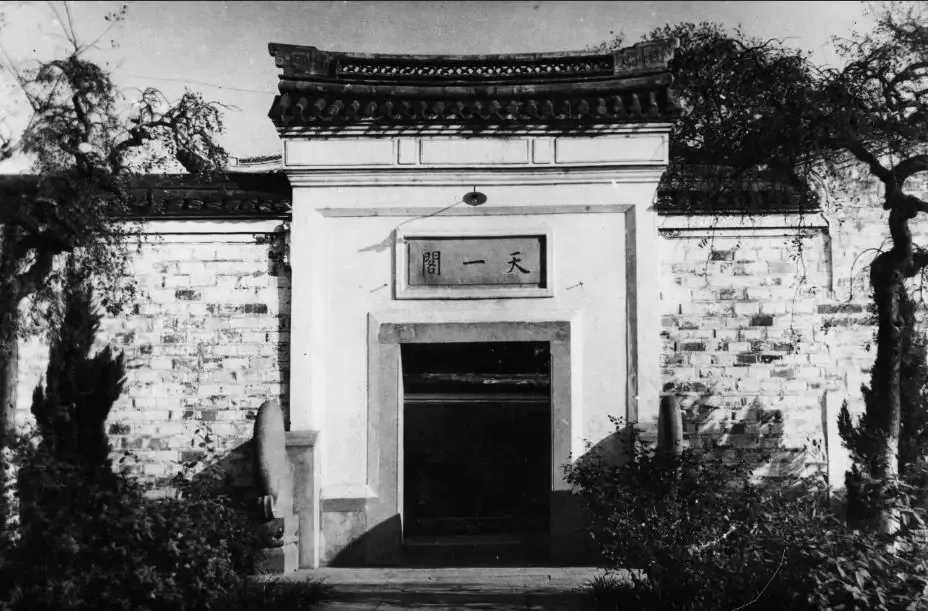
A photograph from the 1960s records the west gate of the Tianyi Pavilion, which no longer survives.