Introduction
During the Wanli era of the Ming, the gentry of central Yunnan wished to cast copper and raise a hall for the worship of Zhenwu, the Perfected Warrior[1], modeled on the layout of the Taihe Palace of the Wudang Mountains, and they asked Chen Yongbin, the governor of Yunnan, to direct the undertaking. Chen Yongbin went out of the city with the local officials and gentry to survey several sites; as they pushed aside the vines on the left side of the Huancui Palace, a colorful pheasant suddenly flew up from the grove, and on this sign the party fixed upon the palace site on Mingfeng Mountain. Chen Yongbin further invited Mu Changzuo, the Duke of Qian[2], to come and examine the site, and Mu Changzuo likewise judged it fit for a palace.
Once the site was settled, the civil and military officials taking part in the work contributed funds by category. The regional inspector[3] donated his salary grain; the officers charged with local military affairs donated money; and the officials of the Provincial Administration and Surveillance Commissions and of the prefectures, subprefectures, and counties, together with such military officers as assistant regional commanders, mobile-corps commanders, and garrison commanders, donated salary according to rank. The craftsmen first fixed the orientation, measured out the scale, and marked the positions for construction; then they assembled timber and stone, lime and earth, and all that was needed for forging and casting, apportioned the materials and the labor, and drew up regulations for supervising the work. Construction began in the first month and was completed in the first month of the following year, exactly one year from start to finish. The palace precinct was centered on the copper hall, and also included a dharma treasury for storing the scriptures, courtyard steps, a bell frame, a guest lodge where visitors might spend the night, a double gate, and an encircling wall.
The original copper hall was later moved to the summit of Siguan Peak on Mount Tianzhu of Mount Jizu, where the temple likewise took the name Jinding Temple, the Golden Summit Temple, from the copper hall. As to this move, one account holds that it was directed by the regional inspector Zhang Fenghe in the tenth year of the Chongzhen era (1637), another that it was directed by Mu Tianbo, Duke of Qian, in the fourteenth year of the Chongzhen era (1641). In the ninth to tenth years of the Kangxi era (1670–1671), Wu Sangui, the Prince Who Pacified the West, then guarding Yunnan, recast the copper hall on Mingfeng Mountain. The Qing-dynasty man of letters Zhang Jiuyue followed the mountain path through the First Heaven Gate, the Second Heaven Gate, and the Third Heaven Gate in turn, and climbed to the Taihe Palace at the summit. This complex was then also called the Copper-Tile Temple; the image of Zhenwu, the tortoise and snake, the walls and columns, the screens and railings, the tables and mats, and the steps were all cast of copper.
In the seventh year of the Xianfeng era (1857), during the first siege of Kunming by the Yunnan Hui rebel army, the militia commander Yang Chunhe led his troops to quarter in Taihe Palace; at first he still protected it, but later he dismantled its halls for materials. In the fourth month of the following year, an armed band of unknown identity attacked Taihe Palace from all four sides; on the ninth day the various palaces, towers and terraces, halls and pavilions, elixir chambers, and Daoist halls were burned, the sacred images were damaged, and of the Daoist community half fled for their lives while the other half perished. When the fighting had somewhat subsided, the abbots of Taihe Palace, Li Yuanlong and Gui Mingqiu, asked Huang Cong—a former left vice minister of war then living in retirement in Kunming—the assistant regional commander Shi Yinggui, and the local gentry to raise subscriptions; they recast the image of Zhenwu and rebuilt the guest hall. Beginning in the fifth year of the Tongzhi era (1866), the Daoists, merchant shops, guild halls, and officials and gentry contributed funds in turn to repair the Jingle Palace, the mountain gate, the palace towers, the drum tower, and other structures. The Daoists also intended to go on and restore the Sanyuan and Huancui palaces, but by the sixteenth year of the Guangxu era (1890) the work had still not begun.
Historical Documents
Kunming Xian Zhi (Gazetteer of Kunming County)
鸣凤山,在昆明县东北二十里。云南府志:距金马山三里,旧名鹦鹉山,明巡抚陈用宾改今名,且称其山光灵爽,境物葳蕤,九龙奔朝,双凤翔舞,皆纪实也。上有太和宫诸胜。
Mingfeng Mountain lies twenty li northeast of Kunming County. The Gazetteer of Yunnan Prefecture states: it is three li from Jinma Mountain; its old name was Yingwu Mountain; the Ming governor Chen Yongbin changed it to its present name, and further described it as a place where “the mountain light is numinous and fresh, the scene and its growth luxuriant; nine dragons rush to pay court and a pair of phoenixes soars and dances”—all a factual record. Upon it stand the various scenic sights of Taihe Palace.
金马山西北距敷泽门二十里,鸣凤山为太和宫,一曰铜瓦寺。范铜为瓦,覆寺三楹,环之砖城,规制宏丽。始建于明巡抚陈用宾,以祀北极上帝。其后崇祯十年,巡按张凤翮移之鸡足山,康熙九年乃重铸焉。宫之右为环翠宫,为霞绮宫。其自太和宫还而西,至韭菜园侧,为福国寺。
Jinma Mountain lies twenty li northwest of the Fuze Gate. On Mingfeng Mountain stands Taihe Palace, also called the Copper-Tile Temple. Copper was cast into tiles to roof its three bays, and a brick wall surrounds it; its plan is grand and splendid. It was first built by the Ming governor Chen Yongbin for the worship of the Supreme Lord of the North Pole. Thereafter, in the tenth year of the Chongzhen era, the regional inspector Zhang Fenghe moved it to Mount Jizu, and in the ninth year of the Kangxi era it was recast. To the right of the palace stand the Huancui Palace and the Xiaqi Palace. Returning west from Taihe Palace, beside the Jiucai Garden, stands the Fuguo Temple.
Dingjian Taihegong Ji Ming (Record and Inscription of the New Construction of Taihe Palace)
恭惟玄帝天乙之精,乘玄枵当帝座,迹最著于太和。贞观而还,代能尊祀。我成祖文皇帝穆有遐思,式廓其制,千古让隆焉。予尝阅《大岳志略》:“稽首飏言曰:至矣哉,文皇帝神道设教之意乎。”及抚滇之九年,滇人士有言于予曰:“远方冠掖瞻慕圣容,拟稍仿太和规度冶金为殿,以昭假玄穹。积诚已久,第难其所以为地,子大夫盍谋诸。”予闻而喜,喜其知所慕,可以道德齐礼之大机也。《易》不云乎?圣人以神道设教而天下服,服之说者柔其血气,心知而皈,诸道之谓。然柔人邪气,牖人真知,莫神于帝矣。武当垂训,其词甚严,令人见者辄毛骨竦然,思所以改过而迁善,直与《大诰》律例幽明相表里,而潜消迨之。予䌷绎帝训,至于“吃着国王水土,终身不得忘恩。有此发肤身体,须当孝养双亲”,肃容发念,愿含生负气之伦,悉皈心帝命,信受奉行。庶几亲见无极上道,沦于人之肌肤,洽于人之骨髓乎。此予夙昔之愿也。今佩此入滇,滇人能以帝像顾諟为图,予敢爱夫心力。居旬日,乡缙绅中丞朱公即其事告予,予幸可资定志,偕卜胜城东,相度山原间几一舍许,无当者,延伫环望,真气英英,连蜷环翠宫左,扪萝视之,适彩雉从中盘起,玉局宛然,无亦光岳之閟有待欤。中丞朱公曰:“胜在是矣。”予重兹举,再延黔国公沐世老胥之曰:“胜在不疑已。”乃偕黔国佐费须帝尊严,直指公则捐廪,镇府督理公则捐赀,司道郡县、条游备而下则捐俸,各有差,乃穆卜天元一气之辰,而以启字告向背,是景广轮,是规营表正也。甄梓是鸠,髬垩是简,工作集也。绳墨是虔,厉锻是取,财用庀也。物事是班,教护是敦,章程课也。始事竣,事俱以王正之月,甫一载而缮完,奕奕乎,翼翼乎,激日曜而纳光者,中严之厂殿也。拥云英而封阒者,鸿秘之法藏也。青阳开而鳞城者,庭唐之浩级也。应晴曀而訇鞳者,列虡之镛贲也。渊雷声而竦敕者,竭款之宾庐也。森天阔而偊旅肃者,扞启之重门也。通坤轴而循走惧者,蹛缭之周垣也。挥太微、标天柱,跧伏而昂骧者,旋共之辅弼也。邻绛阙、接殊庭,遹皇而肸赫者,混辟之元始也。是役也,天作其奇,地呈其秘,人綦其图,三资合而若待,以成厥胜,然藉匪玄功之翔洽而幽赞也,亦曷克臻厥成矣。夫通国之精诚,凛重元而积之历禩,历禩之精诚合三资而奉之,今兹是谓定志,是谓谋同,于以灵承神依,质之大岳璇宫规制,固一一合者。凡诸人士试思一水一土,孰非皇家之毛,一孔一窍,尽出双亲之里。登宝构,瞻帝容,绎帝训,其濯而心,涤而虑。为臣忠,必纯其衷,为子孝,必完其量。暗室屋漏,恍如陟降,则气和于意,而应感于神。隤祉函蒙,必且阴骘行,且消阳九之阨,臻大有之祥,扫欃枪之妖,洗银河之甲。雨旸时若,干戈载戢,荒服奠安,皇图巩固。若诸挟愿而祈者,祓而禳者,其应如影响者,又第二义矣。似此崇报,庶几文皇帝设神教之深意。而帝与山灵相为悠久,予之愿其少纾矣乎,敬砻石以铭。铭曰:元黄既剖,大道难醇。帝实念之,眷兹下民。爰显太和,于缠翼轸,岂其井参,而殊厥闵。林林总总,业缮精诚。覃尔萌庶,迄于弁缨。咸向臣言,美谐广愿。幸采群情,藉而攸劝。臣谨稽首,北望玉皇。虚左以待,气珥瑶光。呵护閟灵,俶开佑圣。大罗清都,万真叶庆。谓我求者,奚啻人求。何蕲鄯阐,中有十洲。人谋鬼谋,敢为臣力。奉天扶化,亦臣之职。庀徒揆日,各有司存。圣颜咫尺,恍叩帝阍。待从有臣,香案有吏。丹刻翚飞,武当可二。象设孔辟,众志合宁。莫民护国,亿万斯龄。
Respectfully I consider: the Dark Emperor is the essence of the Celestial Unity; riding the station of Xuanxiao he occupies the imperial seat, and his traces are most illustrious at Taihe. Since the Zhenguan era, every dynasty has honored him with sacrifice. Our Chengzu, Emperor Wen, in solemn majesty conceived far-reaching designs and greatly enlarged his institutions; for a thousand ages none has matched their grandeur. I once read in the Dayue Zhilüe (Brief Gazetteer of the Great Mountain): “Bowing my head, I raise my voice and say: How supreme is Emperor Wen’s intent in establishing the teaching by way of the spirits!” In the ninth year of my governance of Yunnan, gentlemen of Yunnan said to me: “The capped and belted of this distant quarter gaze in longing upon the sacred countenance; we propose to imitate in some measure the plan of Taihe, smelting metal to make a hall, so as to bring bright communion with the dark empyrean. Our accumulated sincerity is of long standing; only the ground on which to build is hard to determine. Will you, sir, not take counsel on it?” Hearing this, I rejoiced—rejoiced that they knew what to admire, for herein lies the great pivot by which the people may be made one through the Way and its virtue and through rites. Does not the Book of Changes say: “The sage established the teaching by the way of the spirits, and all under heaven submitted”? The meaning of submission is this: it softens men’s blood and breath, so that their hearts know and turn in refuge—this is what is called the Way. Yet for softening men’s deviant humors and opening a window onto true knowledge, none is more numinous than the Emperor. The instructions handed down from Wudang are most severe in their wording, causing all who see them to bristle in awe to the very bones and to think how they might correct their faults and move to goodness; they stand as the hidden counterpart, within and without, of the Grand Announcement and the statutes and precedents, silently dissolving what those overtake. As I unrolled and savored the Emperor’s instructions and came to the words “Eating and drinking of the king’s water and soil, to the end of your life you must not forget the grace; having this hair, skin, and body, you must nourish your two parents in filial duty,” I composed my countenance and formed a resolve: may all that harbor life and bear breath turn their hearts in refuge to the Emperor’s command, receive it in faith, and carry it out, so that they may themselves behold the supreme Way of the Infinite soaking into men’s skin and flesh and steeping men’s very marrow. This has long been my wish. Now, bearing it, I entered Yunnan; if the people of Yunnan could take the Emperor’s image as the pattern of their gaze, how should I dare begrudge my heart’s strength? Some ten days later, Vice Censor-in-Chief Zhu, a gentleman of this region, reported the matter to me. Glad that it could serve to fix our resolve, I went with him to divine for a fine site east of the city; we surveyed among the mountains and plains for nearly a stage, and nothing answered. As we stood long, gazing about us, a true aura, gleaming bright, coiled in an unbroken curve to the left of the Huancui Palace. Pushing aside the creepers to look, we saw a colorful pheasant just then circling up from within, and a jade-like layout lay plain before us—was this not the hidden treasure of the shining mountains, waiting upon its time? Vice Censor-in-Chief Zhu said: “The fine site is here.” Regarding the undertaking with gravity, I further invited the Duke of Qian, the elder Mu, to examine it with me, and he said: “That the site is fine admits no doubt.” Then, together with the Duke of Qian, we arranged the expenses, for the Emperor’s dignity required it: the imperial inspector donated from his granary, the superintendent of the princely establishment donated funds, and the officials of the provincial commissions, circuits, prefectures, and counties, down through the assistant commanders, mobile-corps commanders, and garrison commanders, donated salary, each in his grade. Then we solemnly divined for the day of the single breath of heaven’s origin, marked out the orientation and facing, measured the shadows for length and breadth, and set the posts and lines of the construction. Timber was assembled and earth and plaster selected—thus the work was gathered in. The ink-line was held in reverence and the forge and tempering taken in hand—thus the means were made ready. Tasks were apportioned and instruction and oversight made earnest—thus the regulations were laid down. The work began and ended alike in the king’s first month, and in just one year the building was complete. How splendid, how grave! Striking the sun’s brilliance and drinking in its light—this is the solemn great hall at the center. Enfolding the essence of the clouds in sealed quiet—this is the vast secret of the dharma treasury. Opening to the green spring and scaling like a city wall—this is the mighty flight of the courtyard steps. Answering clear skies and dark with resonant clangor—this is the great bell upon its frame. Standing in awed good order beneath the thunder from the deep—this is the guest lodge for those who come in utmost sincerity. Soaring against the vastness of heaven in solemn ranks—this is the great double gate that wards the entrance. Piercing the axis of earth as it courses round in dread—this is the encircling perimeter wall. Reaching toward the Taiwei palace and marking the Pillar of Heaven, crouching low then rearing high—this is the circling support of the flanking wings. Neighboring the crimson towers and joining the wondrous courts, glorious and effulgent—this is the primal beginning made one. In this work Heaven made the marvel, Earth proffered its secret, and man perfected the plan; the three endowments joined as though they had waited for one another, and so this splendor was achieved. Yet had it not relied on the pervasive, unseen aid of the Dark Emperor’s merit, how could it have reached completion? The utmost sincerity of the whole country, reverently heaped up over the years before the primal origin; the utmost sincerity of those years, joined with the three endowments and here offered up—this is called fixed resolve, this is called concord of purpose. Hereby the numinous is received and the spirit finds its stay; measured against the plan of the jasper palace of the Great Mountain, every item tallies, one by one. Let all who come reflect: every stream and clod of earth—what is not the very hair of the royal house? Every orifice and pore—all issue from within one’s parents. Ascending the precious structure, gazing upon the Emperor’s countenance, pondering the Emperor’s instructions, let them wash their hearts and cleanse their thoughts: as subjects, be loyal and make your innermost hearts pure; as sons, be filial and make your measure whole. Even in a dark chamber where the roof leaks, be as though he were ascending and descending beside you; then the breath will harmonize with the will, and response will be felt from the spirits. Blessings will descend upon the shrouded and the ignorant; surely hidden merit will be practiced, the calamities of the yang-nine cycle dissolved, the auspice of Great Possession attained, the baleful comets swept away, and the armor in the Silver River washed clean. Rain and sunshine will keep their season, shields and spears will be laid aside, the wild borderlands will rest in peace, and the imperial plan will stand firm. As for those who come bearing wishes to pray, to be cleansed, or to avert evil, and receive answers like echo answering sound—that is a meaning of the second order. Such exalted requital comes near, one hopes, to Emperor Wen’s deep intent in establishing the spirit teaching. May the Emperor and the spirits of the mountain endure together in everlastingness, and may my own wish thereby be somewhat eased. Respectfully I have polished the stone and engraved it. The inscription says: When dark and yellow were first cleft apart, the great Way could scarce remain unmixed; the Emperor truly took thought of this, and looked with care upon the folk below. Then he made Taihe illustrious, where the lodges of Wings and Axletree revolve; was it for the lodges Well and Alignment that his pity should differ? The teeming multitudes all set about perfecting their utmost sincerity; it spread to the common folk and reached the capped and pinned. All came to their servant with their words, finely harmonizing a broad vow; happily gathering the feelings of the multitude, I was thereby encouraged. Your servant bows his head in reverence, gazing north toward the Jade August One, leaving the honored seat empty in waiting, while the aura haloes the Jasper Radiance. Guarding and cherishing the hidden numen, newly opening the blessings of the sage; in the pure capital of the Great Net, the myriad Perfected join in celebration. To say that we sought him—how could it be only men who sought? What need to beg revelation afar—within it lie the Ten Isles. In the counsels of men and of spirits, I dared to spend a subject’s strength; to serve Heaven and uphold its transformation is also a subject’s charge. Assembling the laborers and measuring the sun, each office kept its charge; the sacred countenance a foot away, it was as if one knocked at the gate of heaven. There are attendants among the courtiers and officers at the incense table; with vermilion carving and pheasant-soaring eaves, this may stand second to Wudang. The images set up are greatly open, the wills of the multitude joined in peace: to settle the people and guard the state, for a hundred million ages.
万历甲辰岁春王正月谷旦。
On an auspicious morning of the king’s first month of spring, in the jiachen year of the Wanli era (1604).
钦差巡抚云南兼建昌毕节等处地方赞理军务、兼督川贵兵饷、都察院御史、兼兵部右侍郎资德大夫正治上卿晋江陈用宾谨撰。
Respectfully composed by Chen Yongbin of Jinjiang: Imperial Commissioner and Governor of Yunnan, concurrently assisting in the administration of military affairs for Jianchang, Bijie, and other regions, and concurrently supervising the army provisions of Sichuan and Guizhou; Censor of the Censorate, concurrently Right Vice Minister of War; Grand Master of Abundant Virtue and Senior Minister of Upright Government.
Xu Yunnan Tongzhi Gao (Draft Continuation of the Comprehensive Gazetteer of Yunnan)
太和宫在城东二十里鸣凤山,一名金殿。明巡抚陈用宾建。铸铜为殿,环以砖城。崇祯十年,巡按张凤翮移之鸡足山。国朝康熙九年重铸,咸丰八年毁。同治、光绪间续修。
Taihe Palace lies twenty li east of the city on Mingfeng Mountain; it is also called the Golden Hall. It was built by the Ming governor Chen Yongbin. The hall was cast of copper and surrounded by a brick wall. In the tenth year of the Chongzhen era, the regional inspector Zhang Fenghe moved it to Mount Jizu. In the ninth year of the Kangxi era of the present dynasty it was recast; in the eighth year of the Xianfeng era it was destroyed. It was repaired in succession during the Tongzhi and Guangxu eras.
Jizu Shan Zhi (Gazetteer of Mount Jizu)
金顶寺在天柱山四观峰,古有方塔一座,今毁。弘治间,有僧建庵其上。至嘉靖年,郡人李元阳建普光殿。万历己未,直指潘澽建观风阁。天启丁卯,直指朱泰祯建天长阁。崇祯丁丑,直指张凤翮建善雨亭,筑罗城上,立四观楼。己卯,直指涂必泓建景星亭。辛巳,黔国沐天波移云南省城太和宫金殿来山,废普光殿并塔,就其址以立金殿。
Jinding Temple stands on Siguan Peak of Mount Tianzhu; in ancient times there was a square pagoda there, now destroyed. During the Hongzhi era a monk built a hermitage upon it. In the Jiajing period, Li Yuanyang, a man of the prefecture, built the Puguang Hall. In the jiwei year of the Wanli era, the imperial inspector Pan Ju built the Guanfeng Pavilion. In the dingmao year of the Tianqi era, the imperial inspector Zhu Taizhen built the Tianchang Pavilion. In the dingchou year of the Chongzhen era, the imperial inspector Zhang Fenghe built the Shanyu Pavilion, built upon the encircling wall, and erected the Siguan Tower. In the jimao year, the imperial inspector Tu Bihong built the Jingxing Pavilion. In the xinsi year, Mu Tianbo, Duke of Qian, moved the Golden Hall of Taihe Palace from the provincial capital of Yunnan to this mountain; he demolished the Puguang Hall together with the pagoda and set up the Golden Hall on its site.
顺治甲午,因殿宇颓废,合山耆宿同僧自玉重修,因观风阁旧址为佛殿,废天长阁为伽蓝殿,废阿难殿为藏经阁,废善雨亭为卧龙轩,废景星亭为碑亭,后有土主殿,前有灵官殿。康熙三十年,殿阁俱灾,惟铜殿独存。三十一年,总督范承勋、提督诺穆图重建天一阁于观风台旧址。僧慧酪、福峙募姚安土官高奣映、子映厚重修殿庑。过道山门,山顶风厉,冬春之间,积雪不消,而寺居其上,孤耸寒寂,非有志者不能久居也。
In the jiawu year of the Shunzhi era, because the halls had fallen into ruin, the elders of the whole mountain, together with the monk Ziyu, rebuilt them: they made a Buddha hall on the old site of the Guanfeng Pavilion, turned the Tianchang Pavilion into a sangharama hall, the Ananda Hall into a scripture repository, the Shanyu Pavilion into the Wolong Gallery, and the Jingxing Pavilion into a stele pavilion; behind was the Tuzhu Hall, and in front the Lingguan Hall. In the thirtieth year of the Kangxi era, the halls and pavilions were all destroyed by fire; only the copper hall survived. In the thirty-first year, the governor-general Fan Chengxun and the provincial military commander Nomutu rebuilt the Tianyi Pavilion on the old site of the Guanfeng Terrace. The monks Huilao and Fuzhi solicited the native official of Yao’an, Gao Wengying, and his son Yinghou to rebuild the halls and galleries. Passing the mountain gate, one finds the wind fierce upon the summit; between winter and spring the piled snow does not melt, and the temple stands above it, solitary, towering, cold, and still—none but one with true resolve can dwell there long.
金殿在四观峰顶,铜铸为殿,外以金装,梁柱窗壁,备极精巧。此殿原在云南省城鹦鹉庵太和宫,崇祯辛巳,黔国公沐天波移建峰顶,因名此寺为金顶寺。
The Golden Hall stands on the summit of Siguan Peak; the hall is cast of copper and sheathed in gold outside, its beams, columns, windows, and walls of the utmost refinement. This hall was originally at the Taihe Palace of the Yingwu Nunnery in the provincial capital of Yunnan; in the xinsi year of the Chongzhen era, Mu Tianbo, Duke of Qian, moved and rebuilt it on the summit of the peak, and for this the temple was named Jinding Temple.
Xu Xiake Youji (The Travel Diaries of Xu Xiake)
其名之重,以张代巡凤翮同乡,命其住持绝顶迦叶殿,而沐府又以中和山铜殿移而畀之,故声誉赫然。
The weight of his renown came from the fact that the touring censor Zhang Fenghe was his fellow countryman and appointed him abbot of the Kasyapa Hall at the very summit, while the Mu household further had the copper hall of Zhonghe Mountain moved and bestowed upon him; hence his fame blazed.
You Tongwasi Ji (Record of a Visit to the Copper-Tile Temple)
出滇城东郊,循盘龙江东北行,平田绮错,残柳亏映。至小村,策蹇乱流以渡,十里而遥为鹦鹉山,或曰山形如鹦鹉,故名。或曰以产鹦鹉。山萃然起于苍莽之中,北控陲商、南蹑金马,与玉案、碧鸡争雄,长若狎齐盟然,未至里许,旭日晃漾,金光赫奕,射山谷欲动。仆夫指曰:“此铜瓦寺也。”由山南折西北麓,绝壁杰立数千仞,黮黕无寸肤,怪石如狮象,上下狞逐,欲啮人,左崖悬一线石关,曰一天门,磴而上,踵顶摩错老树怪竹,轇轕森映,凡三百余磴,得二天门。欲少憩,壁下横风冲突,万马奔蹴,黝然虚黑,不敢驻足,又历四五百磴,闯然谽衍,仰见白日,曰三天门。平地二百亩,太和宫峙焉。宫势瑰丽,周廊层阿绝顶,翼然耸出,则铜瓦寺也。
Setting out from the eastern suburbs of the city of Dian, I followed the Panlong River northeast. Level fields lay in brocade-like patterns, and the remaining willows cast broken shadows. Reaching a small village, I urged my lame mount across the racing stream; ten li farther on rose Yingwu Mountain. Some say the mountain is shaped like a parrot, hence the name; others say it produces parrots. The mountain rises abruptly out of the boundless wilds, holding the frontier marches to the north and treading upon Jinma to the south, vying for dominance with Yu’an and Biji, forever as if in close alliance with equals. When I was still a li or so away, the morning sun shimmered and swayed, and a golden radiance, bright and glorious, shot through the mountain valley till it seemed to move. My groom pointed and said: “That is the Copper-Tile Temple.” From the south of the mountain I turned toward the northwest foot, where sheer cliffs towered thousands of ren, black and glistening without an inch of soil, and strange rocks like lions and elephants chased savagely up and down, as if to bite. On the left a threadlike stone pass hung upon the cliff, called the First Heaven Gate. Climbing up by its steps, my heels and head brushing the old trees and strange bamboo, tangled and densely mirrored, after some three hundred steps I reached the Second Heaven Gate. I wished to rest a while, but below the cliff a crosswind struck and clashed like ten thousand horses galloping and kicking, dark and hollow-black, and I dared not stop my feet. After another four or five hundred steps, the way opened wide and hollow, and looking up I saw the white sun: this was the Third Heaven Gate. On a level ground of two hundred mu, Taihe Palace stood towering. The palace’s aspect was magnificent and beautiful, with circling galleries tier upon tier; at the very summit, soaring out with winged eaves, was the Copper-Tile Temple.
寺祀真武,自神像、侍从、龟蛇及墙柱、帘槛、几席、阶城、瓴甋之属,皆笼铜为之。阶下铜幡竿十余丈,亭亭特立。
The temple worships Zhenwu. From the sacred image itself, the attendants, the tortoise and snake, down to the walls and columns, screens and railings, tables and mats, steps and parapets, and the roof tiles—all are made of cast copper. Below the steps, copper banner-poles of more than ten zhang stand tall and solitary.
读旧碑,为明初建,以山似均州太和,建宫于上,为祈祷所,不载铜瓦之始。道士出迎,年九十余,询之,云:吴逆踞滇时所易。尝怪古奸雄僭窃之徒,诛求杀戮,草菅人命。惧天降罚,乃遁于浮屠老子之教,斩山以为窟,笼金以为像,九层之台,黄金之液,曾不之惜,如魏太武、唐武后之金佛,刘鋹之铁塔,杨吴之大铁炉,莫可枚举。吴逆以釜底游魂,拒命抗讨,鲸呿豨突,剉人如羊豕,而庄头之箕敛,彝汉之科派,剥二十四郡之脂膏,以饱欲壑,天怒人怨,莫此为尤。而崇鬼神之宫,范铜至五百余万之多,为前古所未有。日率伪属熏拜讽诵,自谓可以欺天邀神,不知王师一至,草薙禽狝,虽铜城铁垒,立见销灼。向之金题玉槛,荡然无复灰烟。呜呼!彼侈泰以祈福也,何为者哉!何为者哉!存而不毁,非独彰国家威德之远,亦使千古之悖逆者有所慑。
Reading the old steles, I found that the temple was built early in the Ming; because the mountain resembled the Taihe Mountain of Junzhou, a palace was built upon it as a place of prayer, but the beginning of the copper tiles is not recorded. A Daoist priest came out to welcome me, a man of more than ninety years. I asked him, and he said it had been replaced when the rebel Wu occupied Yunnan. I have always found it strange that the usurping arch-villains of old, who exacted and slaughtered and treated men’s lives as grass, fearing that Heaven would send down punishment, took refuge in the teachings of Buddha and Laozi: cutting open mountains to make grottoes, casting metal to make images, nine-tiered terraces and molten gold—nothing was too costly, like the golden buddhas of Emperor Taiwu of Wei and of Empress Wu of Tang, the iron pagoda of Liu Chang, the great iron furnace of Yang Wu—too many to enumerate. The rebel Wu, a wandering soul at the bottom of the cauldron, resisted the mandate and defied the punitive campaign, gaping like a whale and charging like a boar, mincing men like sheep and swine; and with the rake-like exactions of his estate stewards and the levies upon Yi and Han, he stripped the fat and marrow of twenty-four commanderies to fill his gulf of desire—of Heaven’s wrath and the people’s resentment, none was worse. Yet he exalted this palace of gods and spirits, casting copper to the amount of more than five million catties, a thing never before seen in all antiquity. Daily he led his false adherents in censing, bowing, and chanting, thinking he could deceive Heaven and invite the spirits—little knowing that when the royal armies arrived, they would mow him down like grass and hunt him like game, and though his walls were of copper and iron, they would at once be seen to melt and burn. The gold-inscribed beams and jade railings of before were swept away, not even ash and smoke remaining. Alas! That he should pray for blessing through such extravagance—what was the use of it! What was the use of it! That it is preserved and not destroyed not only displays how far the state’s aweful virtue reaches, but also gives the treasonous of a thousand ages something to fear.
道士饭余松棚下,俯视西南诸山,夕阳动荡,云压归鸟之背,滇海风帆点缀,胸次心殊乐之,乞取败帚扫廓壁,纪游之年月,乃去。
The Daoist priest fed me beneath a pine shed. Looking down at the mountains to the southwest, I saw the evening sun trembling and swaying, clouds pressing upon the backs of homing birds, and sails on the Dian Sea dotting the view. My heart within was greatly gladdened. I begged a worn broom to sweep the gallery wall, recorded the year and month of my visit, and departed.
Lici Xiugai Taihegong Beiji (Stele Record of the Successive Repairs of Taihe Palace)
盖闻可创之事,莫为之前,虽美弗彰。可继之事,莫为之后,虽盛弗传。滇南苴兰会垣东门外,距城十五里许,有山曰鸣凤,又俗名鹦鹉山。前明万历壬寅年,道士徐正元叩请云南巡抚军门陈公用宾,会同黔国公沐公昌祚,右都督沐公睿,御史刘公会于山之巅,仿照湖广武当山七十二峰之中峰修筑紫禁城,冶铜为殿,铸供真武祖师金身。名其宫曰“太和”,亦仿照武当山中峰宫名也。其时并建三元、环翠二宫,所供圣神仙佛,各有专司,瞻拜者历历可溯,而其殿宇,概以“太和宫”统之。其地左挹华山之秀,金马腾辉;右临昆海之滨,碧鸡焕彩,洵为滇南一胜境也。乡人称之或曰金殿,或曰金顶,任其信口而出耳。我国朝康熙己卯年,有道教法师钦奉谕旨,为替度道者沈妙章,由江南迎请道教藏经入宫,添盖藏经楼藏之。其余各宫之布置周密,各处之庄严辉煌,真如洞天福地。入其宫者,不啻山阴道上,应接不暇。丛林称极盛焉。无如年深日久,文昌殿、魁星殿、王帅殿倾塌不堪,有省城善士张耀,募捐重修,焕然一新。其庙内古规,每逢祖师圣诞及祈晴祷雨、禳灾迓福之时,文武各官亲临拈香,无不灵应如响。至咸丰六年丁巳而后叠遭兵燹,七年练目杨春和驻扎于此,始犹保护,继则拆毁。
We have heard that for a work that can be founded, if there is none to do it first, however fine, it will not be made manifest; and for a work that can be continued, if there is none to do it after, however great, it will not be handed down. Outside the east gate of the provincial capital of Julan in southern Dian, some fifteen li from the city, there is a mountain called Mingfeng, also commonly named Yingwu Mountain. In the renyin year of the Wanli era of the former Ming, the Daoist Xu Zhengyuan earnestly petitioned Chen Yongbin, the governor-general of Yunnan, who, together with Mu Changzuo, Duke of Qian, Mu Rui, the right commander-in-chief, and Censor Liu, met at the summit of the mountain. They built a Purple Forbidden Enclosure in imitation of the central peak among the seventy-two peaks of the Wudang Mountains in Huguang, smelted copper to make a hall, and cast a golden image of the Patriarch Zhenwu to be worshipped. They named the palace “Taihe,” likewise in imitation of the name of the palace on the central peak of the Wudang Mountains. At the same time they also built the Sanyuan and Huancui palaces. The sages, immortals, and buddhas worshipped in them each had their special charge, and those who came to gaze and bow can be traced one by one, but the whole of its halls is comprehended under the single name “Taihe Palace.” The site laves the elegance of Mount Hua on its left, where the Golden Horse sends up its radiance; on its right it overlooks the shore of the Kun Sea, where the Jade Rooster gleams in color—truly a fine realm of southern Dian. The country people call it sometimes the Golden Hall, sometimes the Golden Summit, whatever comes freely to their lips. In the jimao year of the Kangxi era of our dynasty, a Daoist master, by imperial decree and acting for the ordained Daoist Shen Miaozhang, welcomed the Daoist canon from Jiangnan into the palace, and a scripture repository tower was added to house it. The arrangement of the other palaces was thorough, and everywhere the adornment was resplendent, truly like a grotto-heaven, a blessed land. Those who entered the palace felt as if on the road over Shanyin—more than the eye could take in. The monastic community was called the very height of flourishing. But as the years grew deep and long, the Wenchang Hall, the Kuixing Hall, and the Marshal Wang Hall collapsed into ruin. A worthy man of the provincial capital, Zhang Yao, raised subscriptions and rebuilt them, so that they were wholly renewed. By the temple’s old rule, whenever the Patriarch’s birthday came round, or at times of praying for clear skies or for rain, of averting disasters or welcoming blessings, the civil and military officials would come in person to offer incense, and never was the numinous response not like an echo. From the dingsi year, the sixth of the Xianfeng era, the palace repeatedly suffered the fires of war. In the seventh year the militia leader Yang Chunhe stationed his troops here; at first he still protected it, but then he tore it down.
八年四月被贼四面围攻,至初九日攻破。所有诸宫、楼台、殿阁、丹室、道堂尽行烧毁,圣像亦遭损坏。道众逃生者半,殉难者亦半。名胜之区,变为瓦砾之场矣。嗣军务松,住持李元龙、桂明秋,目击心伤,恳请在籍兵部左侍郎黄公琮、参将施公应贵,绅士官鏸李炘、缪志鲁、邹泽、简宗杰、张耀等募捐补铸真武金身供奉,并建太和本宫客堂楼房。同治五年,李秀、李藻、宛荣、黄玉龙仝住持李元龙,募捐修建净乐宫殿宇三楹,山门三间。又善士李秀、张耀、李富捐赀修建灵山圣母殿三间,并新塑圣母金身,朱天君、邱祖、吕祖、观音真官、土地各像,及修补二天门牌坊。光绪二年,善士李承霖,捐赀修建紫禁城上鼓楼三间,潘国元捐赀修建五福殿三间,并装严圣像。光绪三年,住持李元龙见朝山人众,无处栖止,商请省号布铺、盐铺、芦茶铺、古庭庵、龙华会、同会城官绅士庶人等,捐资新建净乐宫左右宫楼十二间。杨经、周崇信庄严佛龛三间。其时开化镇蔡公标、临元镇何公秀林、协镇衔解公连科,暨绅耆冯义、王会等捐赀庄严真武金身及侍坐四尊。善士李彩、马沅、杨安、陶世贵、栗世魁等,修饰七星旗、龟蛇二将。上下清油行仝城乡内外各善信人等,每月捐油赀,供点天灯。谢荣清修补三天门、王帅殿,及庄严金身。云南粮储道松公林,修补刘元帅殿。中衡参府岑公有富,修补魁星楼。其余传茶之处有殿宇者,系传茶会修建。自光绪六年,又有善士李国宝、冯义、潘国元、张联森、高尚志、顾英、欧谦吉、吕彬、王绍恒、吴昇等与助善同人,启建賩会一轮,至十年二月賩竣,将抽获功德,建盖紫禁城外左右鼓楼二座,头天门牌坊一座。内有太华寺賩会捐来银壹百两,如数归开支项下报用,彩画圣父母大殿,修补玉阶栏杆,并土地殿。又于光绪十二年,前届办賩善士李国宝、冯义等,添约善士杨淮、黄嘉兴、马士杰、施永盛、吕彬、刘口等,同海源寺复启賩会一轮,分得抽获功德,修盖雷神殿六间,众善信捐赀修塑神像十八尊。此自咸丰六年后,截至光绪十六年二月止,历次修理,约略记其梗概,而先行叙出者,盖恐日久遗失,而没入之善也。至其中不无遗漏,留待后来阖宫工程全完,一同补叙,且此次系就太和一宫而言。至于三元、环翠二宫工程浩大,需费甚钜,尚未一篑伊始,惟冀十方宰官善信,或量力而捐助,集腋成裘;或解囊而布施,告成全功。俾三宫大制克复,则庶几前人创始之规不废,而美愈彰。后人继起之功不朽,而盛愈传矣。是为记。
In the fourth month of the eighth year it was besieged on all sides by the rebels, and on the ninth day it was taken. All the palaces, towers and terraces, halls and pavilions, elixir chambers, and Daoist halls were burned down, and the sacred images were damaged too. Of the Daoist community, half escaped with their lives, and half died martyrs. A district of famous beauty became a field of rubble. Afterward, when the military situation eased, the abbots Li Yuanlong and Gui Mingqiu, whose eyes had witnessed it and whose hearts were wounded, earnestly requested Huang Cong, the left vice minister of war then residing in his native place, the assistant regional commander Shi Yinggui, and the gentlemen and officials Li Xin, Miao Zhilu, Zou Ze, Jian Zongjie, Zhang Yao, and others to raise subscriptions to recast the golden image of Zhenwu for worship, and to build the guest-hall building of the main Taihe Palace. In the fifth year of the Tongzhi era, Li Xiu, Li Zao, Wan Rong, and Huang Yulong, together with the abbot Li Yuanlong, raised subscriptions to build three bays of the Jingle Palace and three bays of the mountain gate. Also, the worthy men Li Xiu, Zhang Yao, and Li Fu donated funds to build three bays of the Hall of the Holy Mother of Numinous Mountain, and newly modeled the golden image of the Holy Mother, the images of the Celestial Lord Zhu, Patriarch Qiu, Patriarch Lü, Guanyin, the Perfected Officers, and the Earth God, and repaired the memorial arch of the Second Heaven Gate. In the second year of the Guangxu era, the worthy man Li Chenglin donated funds to build three bays of the drum tower above the Purple Forbidden Enclosure, and Pan Guoyuan donated funds to build three bays of the Wufu Hall and to adorn the sacred images. In the third year of the Guangxu era, the abbot Li Yuanlong, seeing that the pilgrims to the mountain were many and had nowhere to lodge, consulted with the provincial firms—the cloth shop, the salt shop, the reed-tea shop—the Guting Nunnery, the Longhua Society, and the officials, gentry, and commoners of the provincial city, who donated funds to build twelve new bays of palace towers to the left and right of the Jingle Palace. Yang Jing and Zhou Chongxin adorned three bays of the Buddha niches. At that time Cai Biao of the Kaihua garrison, He Xiulin of the Linyuan garrison, Xie Lianke of the rank of assistant brigade commander, and the elders among the gentry Feng Yi, Wang Hui, and others donated funds to adorn the golden image of Zhenwu and the four attendant figures. The worthy men Li Cai, Ma Yuan, Yang An, Tao Shigui, Li Shikui, and others refurbished the Seven-Star Banner and the two generals Tortoise and Snake. The upper and lower clear-oil guilds, together with the faithful within and without the city and countryside, donated oil money each month to keep the heavenly lamps lit. Xie Rongqing repaired the Third Heaven Gate and the Marshal Wang Hall and adorned the golden images. Song Lin, the grain-intendant circuit of Yunnan, repaired the Hall of Marshal Liu. Cen Youfu, vice commander of the central garrison, repaired the Kuixing Tower. The other halls at the tea-service stations were built by the tea-service societies. From the sixth year of the Guangxu era, the worthy men Li Guobao, Feng Yi, Pan Guoyuan, Zhang Liansen, Gao Shangzhi, Gu Ying, Ou Qianji, Lü Bin, Wang Shaoheng, Wu Sheng, and others, together with their charitable fellows, opened a round of a subscription society; when the subscription was completed in the second month of the tenth year, they used the merit funds drawn from it to build two drum towers to the left and right outside the Purple Forbidden Enclosure and one memorial arch at the First Heaven Gate. Of this, one hundred taels of silver donated by the subscription society of Taihua Temple were credited in full to the expenditure account and used to paint in colors the Great Hall of the Holy Father and Mother, to repair the balustrades of the jade steps, and the Earth God Hall. Again in the twelfth year of the Guangxu era, the worthy men of the previous subscription round, Li Guobao, Feng Yi, and others, additionally engaged the worthy men Yang Huai, Huang Jiaxing, Ma Shijie, Shi Yongsheng, Lü Bin, Liu [character illegible], and others, and together with Haiyuan Temple opened another round of the subscription society; from the merit funds allotted to their share they built six bays of the Hall of the Thunder God, and the assembled faithful donated funds to repair and model eighteen sacred images. This is a rough outline of the successive repairs from after the sixth year of the Xianfeng era down to the second month of the sixteenth year of the Guangxu era, set out in advance for fear that with time they would be lost and the goodness of those involved submerged. That there are omissions among them must be left until the works of the whole palace are fully complete, to be added together; moreover, this account concerns the single palace of Taihe. As for the Sanyuan and Huancui palaces, their works are vast and the expense required very great, and not the first basket of earth has yet been laid; it is only to be hoped that the officials and faithful of every direction will either donate according to their means, gathering many small contributions into a whole, or open their purses in almsgiving, so that the completion of the whole work may be announced. So shall the great plan of the three palaces be restored, and the founding rule of the forebears not fall into disuse while its beauty shines the brighter; and the work of those who rise to continue it will not perish, while its glory is handed down the more. Thus is this record made.
前任湖北筠州知州舒藻撰文,内阁中书舍人李相书。
Composed by Shu Zao, former prefect of Junzhou in Hubei; calligraphy by Li Xiang, secretariat drafter of the Grand Secretariat.
大清光绪十六年四月初五日,太和宫住持李元龙率徒李明清,孙李智洪、曹智慧、杨智聪,重孙陈理金、王理森、王理宾,同波罗堡、小坝堡阖村管事人等仝立石,镌石李承麟。
On the fifth day of the fourth month of the sixteenth year of the Guangxu era of the Great Qing, the abbot of Taihe Palace, Li Yuanlong, leading his disciple Li Mingqing, his grand-disciples Li Zhihong, Cao Zhihui, and Yang Zhicong, and his great-grand-disciples Chen Lijin, Wang Lisen, and Wang Libin, together with the managers of the whole villages of Boluobao and Xiaobabao, jointly erected this stone; the stone was engraved by Li Chenglin.
Yunnan Tongzhi (Comprehensive Gazetteer of Yunnan)
三月三日,谒真武庙于西山罗汉寺,或东之鸣凤山金殿,或先期赴易隆、中和,山行两日程;或负香之襄阳,谒武当山,往返数月。
On the third day of the third month, they pay their respects at the Zhenwu temple of the Luohan Temple in the Western Hills, or eastward at the Golden Hall of Mingfeng Mountain; some set out early for Yilong and Zhonghe, a two-day journey through the mountains; and some carry incense to Xiangyang to pay their respects at the Wudang Mountains, a journey of several months there and back.
Yunnan Tongzhi Gao (Draft Comprehensive Gazetteer of Yunnan)
迎仙桥旧云南通志:在城东北二十里鸣凤山麓。明万历二十七年,巡抚陈用宾建。
Yingxian Bridge. The old Comprehensive Gazetteer of Yunnan states: it lies at the foot of Mingfeng Mountain, twenty li northeast of the city. It was built in the twenty-seventh year of the Wanli era of the Ming by the governor Chen Yongbin.
Chunrong Tang Ji (Collected Works of the Chunrong Hall)
朱乌南交地,偏崇北极祠。虚危昭法象,元武动旌旗。衾冕威灵壮,风雷陟降迟。松林环翠外,金碧耀罘罳。
In the land where the Vermilion Bird meets the southern frontier, a shrine to the North Pole is especially revered. The lunar lodges Xu and Wei display his celestial pattern; the Dark Warrior stirs the banners. Robed and crowned, his awesome spirit is mighty; amid wind and thunder his ascents and descents are slow. Beyond the encircling green of the pine forest, gold and azure glitter upon the latticed screens.
Historical Photographs
1911
William Edgar Geil’s Eighteen Capitals of China, published in 1911, reproduced an early photograph of the front of the Golden Hall.
1920–1922
A postcard of Taihe Palace captioned “La Pagode du Cuivre,” printed between 1920 and 1922, preserves the former appearance of the front of the Golden Hall.
First Half of the Twentieth Century
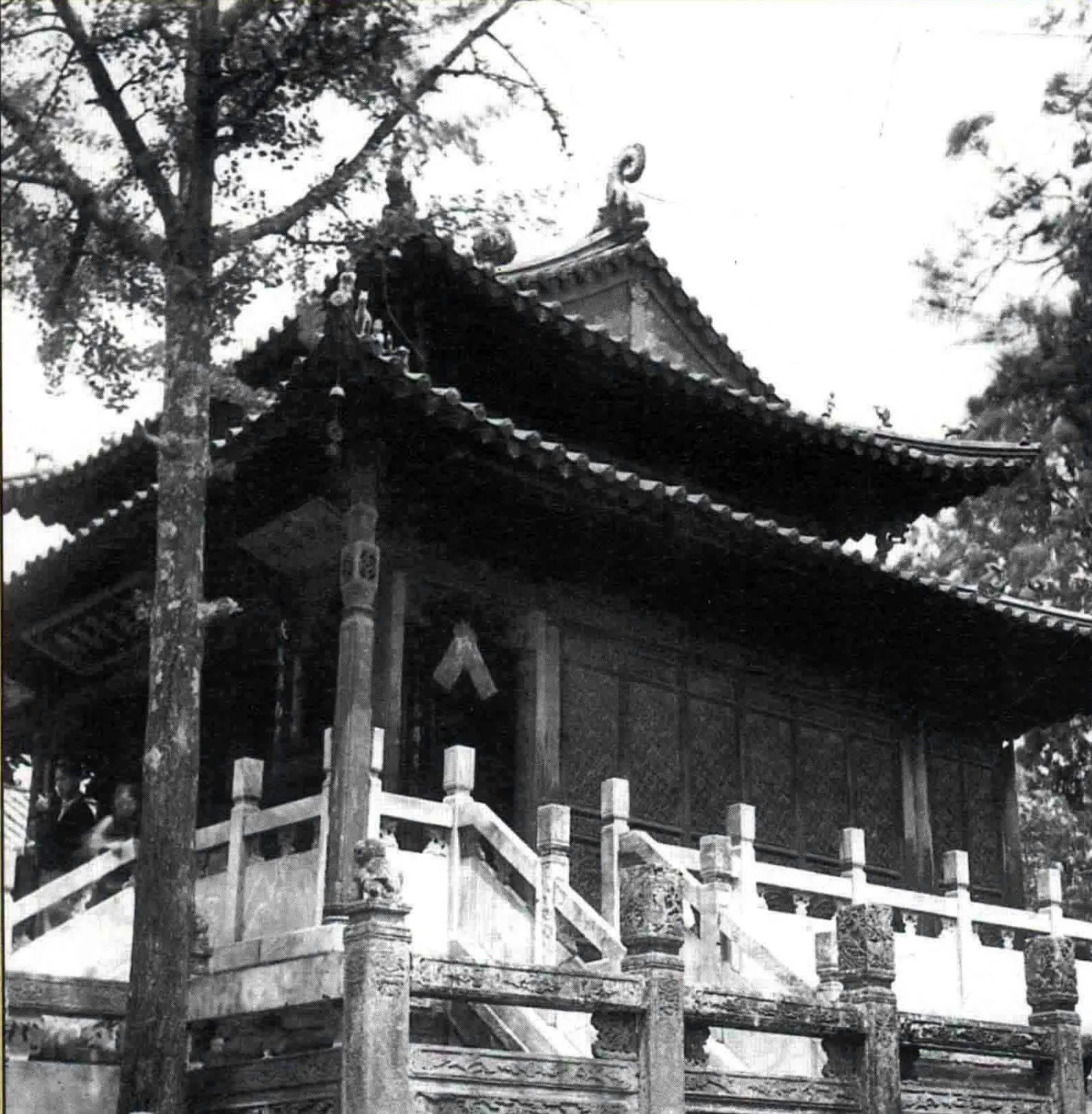
Some time in the first half of the twentieth century, Liang Sicheng and others photographed Taihe Palace, the Golden Hall, and its balustrades and steps. This group of photographs was later included in volumes 2 and 4 of the Illustrated Guide to Ancient Chinese Architecture, edited by Lin Zhu.
References
- Xiao Jihong, “The “Blessing God of Southern Dian”: A Study of the Zhenwu Faith and Its Worship in Yunnan”, Hongdao, no. 1 (2017), pp. 230–242.