Introduction
This mansion on Qianhai West Street, on the western shore of the Shichahai lakes, is first reliably documented as the residence of Heshen, the powerful favorite of the Qianlong years. In it he built a nanmu house imitating the regulations of the Palace of Tranquil Longevity, its curio cabinets and partition screens all following that palace’s patterns, while his garden villa was adorned no differently from the Penglai Isle and Jasper Terrace of the Yuanmingyuan. It is said that in the last years of Qianlong the princes gathered to discuss the succession, and when talk turned to Heshen they vied with one another to bring him to justice; Yonglin, the seventeenth son of the Qianlong emperor, said that he harbored no improper designs on the throne—if one day, when the princes received their establishments, he could have Heshen’s house to live in, he would be content. In the fourth year of Jiaqing (1799) Heshen was condemned; the confiscation of his property uncovered more than 26,000 taels of gold hidden in double walls and more than two million taels of silver buried in cellars, and when his crimes were proclaimed the nanmu house and the garden villa were listed as the thirteenth capital crime, the hidden gold and buried silver as the eighteenth. Heshen confessed that the nanmu house had been built after he sent a eunuch to study the patterns in the Palace of Tranquil Longevity. The mansion was then divided in two: one half remained with Heshen’s daughter-in-law, Princess Hexiao, and one half was granted to Prince Qing Yonglin, the Jiaqing emperor’s younger brother by the same mother. Heshen’s garden villa, a separate property, was granted to Prince Cheng Yongxing.
Yonglin lived here for twenty years, and the mansion kept throughout the four Vairocana-hat gates[1], fifty-four great vats[2], and thirty-six pairs of copper street lamps that Heshen had left behind, none of it ever reported to the throne. In the twenty-fifth year of Jiaqing (1820) Yonglin died, and his son Mianmin, newly succeeded, reported them truthfully as soon as he took over. The edict judged them to be regulation-breaking objects privately installed by Heshen: the gates were dismantled by the mansion, the vats and lamps handed over to the Imperial Household Department, and they were eventually placed outside the Jingyun and Longzong gates of the Forbidden City. Mianmin died in the sixteenth year of Daoguang (1836) without a son. By Qing rule a title dropped one grade with each succession, but the Daoguang emperor made an exception and let Yicai, an adopted clansman, still inherit as a commandery prince. In the twenty-second year of Daoguang (1842), Yicai took a concubine while in mourning and was handed to the Imperial Clan Court[3] for judgment, then tried to bribe his way out; Yonglin’s sixth son Mianxing likewise bribed in hopes of seizing the title. When this came out, Yicai was stripped of his title and Mianxing was exiled to Shengjing (present-day Shenyang), and the title fell vacant. Yonglin’s fifth son Mianti was charged with the ancestral rites, but was soon demoted to defender-general of the state and died in the twenty-ninth year of Daoguang (1849).
In the second year of Xianfeng (1852), the Xianfeng emperor allotted the mansion to his younger brother Prince Gong Yixin for his establishment. The Qingyi Hall on the mansion’s west axis, whose plaque is said to date from the Qing prince’s occupancy, is the very nanmu house of the thirteenth crime. Yixin also laid out a garden north of the residence; when it was completed in the Tongzhi era, he hung the plaque reading “Langrun” that the Xianfeng emperor had bestowed, and the garden took the name. In the garden stood a hall for entertaining called the Yishensuo, whose plaque was the Jiaqing emperor’s calligraphy. In the Guangxu years Grand Secretary Baojun was a frequent guest, drinking and watching opera at the Yishensuo and exchanging verse with Yixin. Yixin was the prince-counselor on whom the two empress dowagers had relied in the early Tongzhi years; when he lay gravely ill in the spring of 1898, the Guangxu emperor twice accompanied Empress Dowager Cixi to the mansion to see him. In the fourth month Yixin died; he received the posthumous name Zhong (Loyal), a tablet in the Imperial Ancestral Temple, and a five-day suspension of court audiences.
The title and mansion passed to Yixin’s grandson Puwei; Puwei and his younger brother, the painter Puru, both lived in the mansion. Its copy of the Pingfu Tie, said to be in the hand of Lu Ji of the Jin dynasty and honored as the “patriarch of model letters,” had been brought into the mansion in 1881 by Yixin while he was administering the affairs of the Prince Cheng line. In 1910 Puwei inscribed a colophon on the scroll declaring that among the one hundred and twenty celebrated works he owned “this piece stands above all,” and named the studio “Xijin” after it—whereupon the Qingyi Hall became the Xijin Studio, which survives today. In the Republican years Puwei mortgaged the mansion to the Catholic Xishiku Church in 1921 to fund a Qing restoration; the debt compounded until he could not repay it and the property had to be sold. In 1937 the mansion became the women’s college of the Catholic Fu Jen University, and the Duofu Hall was turned into the college library; that same year, to pay for his mother’s funeral, Puru sold the Pingfu Tie to Zhang Boju, and the scroll eventually entered the Palace Museum. After 1949 the mansion was used by several arts institutions; in the nationwide reorganization of higher education in 1952, Fu Jen University was abolished and its departments merged into Beijing Normal University and other schools. From 2002 the mansion came under the management of Prince Gong’s Mansion, and today it is the Prince Gong’s Mansion Museum.
Historical Documents
《清实录》 (Veritable Records of the Qing)
○又谕:昨经降旨,将和珅罪状,宣谕各督抚,令其议罪。兹据直隶总督胡季堂奏称:和珅丧尽天良,非复人类,种种悖逆不臣,蠹国病民,几同川楚贼匪,贪黩放荡,真一无耻小人,丧心病狂,目无君上,请依大逆律凌迟处死,并查出和珅蓟州坟茔,僭妄违制,及附近州县置有当铺资财,现饬查办各等语。又据连日续行抄出和珅金银等物,特再行谕众知之。朕于乾隆六十年九月初三日,蒙皇考册封皇太子,尚未宣布谕旨,而和珅于初二日即在朕前先递如意,漏泄机密,居然以拥戴为功,其大罪一。上年正月,皇考在圆明园召见和珅,伊竟骑马直进左门,过正大光明殿,至寿山口,无父无君,莫此为甚,其大罪二。又因腿疾,乘坐椅轿台入大内,肩舆出入神武门,众目共睹,毫无忌惮,其大罪三。并将出宫女子娶为次妻,罔顾廉耻,其大罪四。自勦办教匪以来,皇考盼望军书,刻萦宵旰,乃和珅于各路军营递到奏报,任意延搁,有心欺蔽,以致军务日久未竣,其大罪五。皇考圣躬不豫时,和珅毫无忧戚,每进见后,出,向外廷人员叙说,谈笑如常,丧心病狂,其大罪六。昨冬皇考力疾披章批谕,字画閒有未真之处,和珅胆敢口称不如撕去,竟另行拟旨,其大罪七。前奉皇考谕旨,令伊管理吏部、刑部事务,嗣因军需销算,伊系熟手,是以又谕令兼理户部题奏报销事件,伊竟将户部事务一人把持,变更成例,不许部臣参议一字,其大罪八。上年十二月内,奎舒奏报循化、贵德二厅贼番聚众千余,抢夺达赖喇嘛商人牛只,杀伤二命,在青海肆劫一案,和珅竟将原奏駮回,隐匿不办,全不以边务为事,其大罪九。皇考升遐后,朕谕令蒙古王公未出痘者不必来京,和珅不遵谕旨,令已未出痘者俱不必来京,全不顾国家抚绥外藩之意,其居心实不可问,其大罪十。大学士苏凌阿两耳重听,衰迈难堪,因系伊弟和琳姻亲,竟隐匿不奏。侍郎吴省兰、李潢、太仆寺卿李光云,皆曾在伊家教读,并保列卿阶,兼任学政,其大罪十一、军机处记名人员,和珅任意彻去,种种专擅,不可枚举,其大罪十二。昨将和珅家产查抄,所盖楠木房屋,僭侈逾制,其多宝阁及隔段式样,皆仿照宁寿宫制度,其园寓点缀,竟与圆明园蓬岛瑶台无异,不知是何肺肠,其大罪十三、蓟州坟茔,居然设立享殿,开置隧道,附近居民有和陵之称,其大罪十四。家内所藏珍宝,内珍珠手串竟有二百余串,较之大内多至数倍,并有大珠,较御用冠顶尤大,其大罪十五。又宝石顶并非伊应戴之物,所藏真宝石顶有数十余个,而整块大宝石不计其数,且有内府所无者,其大罪十六。家内银两及衣服等件,数逾千万,其大罪十七。且有夹墙藏金二万六千余两,私库藏金六千余两,地窖内并有埋茂银两百余万,其大罪十八。附近通州、蓟州地方,均有当铺钱店,查计资本又不下十余万。以首辅大臣,下与小民争利,其大罪十九。伊家人刘全,不过下贱家奴,而查抄赀产,竟至二十余万,并有大珠及珍珠手串,若非纵令需索,何得如此丰饶?其大罪二十。其余贪纵狂妄之处,尚难悉数,实从来罕见罕闻者。著将胡季堂原折发交在京文武三品以上官员,并翰詹科道阅看,即著悉心妥议具奏。此内如有自抒所见者,不妨另折封陈,若意见皆合,即连衔具奏。至福长安祖父叔侄兄弟,世受厚恩,尤非他人可比。其在军机处行走,与和珅朝夕聚处,凡和珅贪黩营私,种种不法罪款,知之最悉。伊受皇考重恩,常有独对之时,若果将和珅纵恣藐玩各款,据实直陈,较之他人举劾,尤为确凿有据。皇考心早将和珅从重治罪正法,如从前办理讷亲之案,何尝稍有宽纵,岂尚任其贻误军国重务,一至于此?即谓皇考高年,不敢仰烦圣虑,亦应在朕前据实直陈。乃三年中并未将和珅罪迹奏及,是其扶同徇隐情弊显然。如果福长安曾在朕前有一字提及,朕断不肯将伊一并革职拏问。现在查抄伊家资物,虽不及和珅之金银珠宝,数逾千万,但已非伊家之所应有。其贪黩昧良,仅居和珅之次,并著一并议罪。
Another edict: Yesterday an edict was issued proclaiming Heshen’s crimes to all governors-general and governors, bidding them deliberate on his punishment. Now Governor-General Hu Jitang of Zhili has memorialized that Heshen has lost all heavenly conscience and is no longer human; that his treasonous and unsubjected conduct, his injury to the state and harm to the people, approaches that of the Sichuan-Hubei rebels; that his greed, corruption and dissoluteness make him a shameless villain, demented and without respect for the throne; and he asks that Heshen suffer slow slicing under the statute for great treason. He further reports that Heshen’s tomb at Jizhou usurps regulations, and that Heshen held pawnshops and capital in the neighboring prefectures, which he has ordered investigated. Let this be proclaimed to all. On the third day of the ninth month of the sixtieth year of Qianlong, I was invested as heir apparent by my late imperial father; before the edict was announced, Heshen had already presented me with a ruyi scepter on the second day, leaking the secret and arrogating to himself the merit of supporting my accession—his first capital crime. In the first month of last year, when my late imperial father summoned Heshen to the Yuanmingyuan, he rode his horse straight through the left gate, passed the Hall of Rectitude and Brightness, and reached Shoushan Pass—no father, no sovereign could be worse—his second capital crime. For a leg ailment he had himself carried in a chair into the Grand Interior, entering and leaving by the Shenwu Gate in a sedan, in full view of everyone, without the slightest scruple—his third capital crime. He took a palace woman as a secondary wife, with no regard for decency—his fourth capital crime. Since the campaign against the sectarian rebels began, my late imperial father awaited the military dispatches, his mind on them night and day; yet Heshen delayed the reports from the various armies at will, deliberately deceiving and concealing, so that the war dragged on unsettled—his fifth capital crime. When my late imperial father fell ill, Heshen showed no grief at all; after each audience he went out and talked with the outer court officials, chatting and laughing as usual, demented and heartless—his sixth capital crime. When my late imperial father, despite illness, was reviewing memorials last winter and some characters in his brushwork were not quite legible, Heshen dared to say they might as well be torn up, and even drafted another edict in their stead—his seventh capital crime. Previously ordered by my late father to manage the affairs of the Ministries of Personnel and of Punishments, and then, because he was practised in the accounting of military expenditure, also entrusted with the memorial business of the Ministry of Revenue, Heshen single-handedly controlled that ministry’s affairs, altered the established rules, and allowed the ministers of the ministry not one word of counsel—his eighth capital crime. In the twelfth month of last year Kuishu reported a case of rebel bands in the Xunhua and Guide offices gathering in their thousands, seizing merchants’ cattle and killing two men; Heshen had the original memorial sent back and suppressed it, showing no concern for the frontier—his ninth capital crime. When my late imperial father passed away, I ordered that Mongol princes and nobles who had not had smallpox need not come to the capital; Heshen disobeyed and ordered that none of them, whether they had had smallpox or not, should come, wholly disregarding the state’s purpose of cherishing the outer vassals—his tenth capital crime. Grand Secretary Su Ling’a was hard of hearing and too decrepit for office, yet because he was a marriage relative of Heshen’s brother Helin, Heshen concealed this and did not report it; the vice ministers Wu Shenglan and Li Huang and Li Guangyun of the Court of the Imperial Stud had all tutored in his household and were recommended to ministerial rank and made education commissioners—his eleventh capital crime. He removed staff from the Military Council’s register at will, a multitude of abuses that cannot be enumerated—his twelfth capital crime. Recently his household property was confiscated: the nanmu house he had built usurped the regulations in its extravagance, its curio cabinets and partition screens all modeled on the Palace of Tranquil Longevity, its garden villa adorned no differently from the Penglai Isle and Jasper Terrace of the Yuanmingyuan—who knows what was in his mind—his thirteenth capital crime. His tomb at Jizhou even set up a sacrificial hall and opened a tomb passage, so that the nearby people called it the He Mausoleum—his fourteenth capital crime. Among the treasures in his house, the pearl bracelets alone numbered more than two hundred strings, several times as many as in the palace, and among them a great pearl larger than that on the imperial crown—his fifteenth capital crime. Gem finials that he was not entitled to wear: he had hoarded several dozen genuine gem finials, and whole great gems beyond counting, some of which the imperial storehouse itself did not possess—his sixteenth capital crime. The silver and garments in his house exceeded ten million in value—his seventeenth capital crime. There were also 26,000 taels of gold hidden in double walls, 6,000 taels of gold in his private vault, and more than two million taels of silver buried in cellars—his eighteenth capital crime. In the districts of Tongzhou and Jizhou he held pawnshops and money shops, with capital reckoned at no less than a hundred thousand; a chief minister competing with commoners for profit—his nineteenth capital crime. His servant Liu Quan, a lowly household slave, yet had confiscated property exceeding two hundred thousand taels, with great pearls and pearl bracelets; had Heshen not indulged his extortions, how could the man have grown so rich—his twentieth capital crime. His other excesses and arrogant follies are too many to recount, truly rarely seen or heard of. Let Hu Jitang’s original memorial be circulated to the capital’s civil and military officials of the third rank and above and to the academicians and censors, who shall deliberate carefully and report; any who hold their own views may submit separate sealed memorials, and if all agree they may memorialize jointly under their names. As for Fu Chang’an: his grandfather, uncles, and brothers have all received the throne’s deep grace, beyond compare. Serving on the Military Council at Heshen’s side day and night, he knew every detail of Heshen’s greed and lawlessness. Enjoying my late father’s great favor, he often had private audiences; had he reported Heshen’s wanton abuses truthfully, his testimony would have been more conclusive than any other’s. My late father would have punished Heshen severely long ago, as he did in Neqin’s case, never tolerating such harm to the army and the state. Even if he feared to trouble my late father’s advanced mind, he should have told me plainly. Yet for three years he never reported a single one of Heshen’s crimes—his collusion and concealment are plain. If Fu Chang’an had ever mentioned one word of it to me, I would certainly not have dismissed him and imprisoned him together with Heshen. The property now confiscated from his house, though less than Heshen’s gold, silver, pearls and gems, already exceeds ten million in value, and is not what his family should have possessed. His greed and blindness were second only to Heshen’s; let him be handed over for judgment together with them.
○谕内阁:前据萨彬图奏:和珅财产甚多,断不止查出之数,必有埋藏寄顿、侵蚀挪移等项情獘。刑部查审时,司员等意存含混,应请密派大臣研讯追究等语。朕以其言不足取,当即详加开导,不可苛求。昨又据萨彬图具奏,向伊亲戚问出和珅家掌管金银内帐使女四名,请交伊一人至慎刑司提讯,所言更属乖谬。萨彬图系副都统,并非原派籍没和珅之员,乃忽思越俎,欲以一人独讯数女子,且开列使女之名,形之奏牍,达于朕前,实为从来未有之事。朕若即加駮饬,转恐不足以服其心。是以特派怡亲王永琅、尚书布彦达赉,同萨彬图提集使女等,再三究讯,仍无指实,果不出朕之所料。永琅、布彦达赉素称公正和平,萨彬图亦会同研鞫,更有何人为之徇隐?岂伊尚不凭信,必请朕廷讯使女乎?是萨彬图无知妄渎之罪,百喙难辞矣。朕所以办理和珅者,原因其蠹国病民,专擅狂悖,和珅一日不除,则纲纪一日不肃,是以即于正月初八日,将各珅革职拏问,宣示罪状,用申国宪。犹念其在皇考前扶掖奔走微劳,不忍肆诸市朝,节降谕旨甚明,天下臣民,自必咸知朕意。自办理此案后,军机王大臣及大臣中,如朱圭等,从未于朕前奏及和珅财产隐寄,乃萨彬图屡以为言,竟似利其私蓄者然。岂萨彬图视朕为好货之主,敢以此尝试乎?或伊心欲陷朕等。于唐之德宗,伊亦未必有此伎俩也。向来治罪之员,多有应行查抄者,况和珅获罪重大,焉有不行抄藉之理?自古有籍没之例,所以惩戒贪黩,初不计多寡而事株连。即和珅家仆刘全、呼什图等,亦因平日倚恃和珅声势,横肆不法,招摇受贿,不可不一并查抄治罪。在朕方以办理此案,为日已久,已觉过当,是以谕令速结,不为已甚。而无识之徒,鳃鳃计较和珅财产,不惟不知政体,实太不知仰体朕之本意矣。朕在藩邸时,则一切财用,犹有人己之别。今以天下为家,岂仅以藏诸府库者视为己有?此项查抄资物,纵有隐寄,自朕观之,亦不过在天之下、地之上耳,何必辗转根求,近于搜括间架陌钱等事耶?萨彬图又以内务府、步军统领官员均意存袒护,并疑及刑部,亦不肯认真究问,则承审各衙门举不足信乎?又萨彬图折内有和珅窖埋金银,大概不离住宅之语,和珅之宅,已赏给庆郡王永璘居住,和珅之园已赏给成亲王永瑆居住,若将所指管帐使女严切刑求,必致畏刑妄供:某物埋藏某处,以庆郡王府第、成亲王寓园,令番役多人遍行掘视,断无此事,岂有令成亲王、庆郡王自行刨挖之理?现在朕赐公主物件甚多,累日携运不尽,焉肯转向公主、额驸追问寄顿?况连日阅查抄物件,即随时颁赐者,亦复不少耶?萨彬图原以阁学兼副都统,因其未娴清语,恐以读本错误,护咎,故开阁学之缺,令其专管旗务,得资廉俸养瞻。前盛京兵部侍郎出缺时,朕本欲将萨彬图补授,复念其家计艰难,恐与伊父达椿分居两地,日用或致不给,故令铁保前往。又达椿于本年超升阁学,并授蒙古副都统,旋调满洲旗分,且将伊缘事监禁之女乌苏氏释放。是朕之体恤萨彬图父子,加恩不啻再三。萨彬图不知感戴,辄以此等谬妄之言渎听,竟以欲藉追究和珅财产为图报之地,实为卑鄙不堪聚敛之臣。朕断不用。前严饬给事中明绳开矿一事,旨内详言及此,萨彬图宁不知之耶?又萨彬图曾奏请派京兵五千名,交伊一人带往勦贼,今又奏请独审此事。萨彬图才具平庸,有何阅历,而于出师谳狱之事,自任不疑若此,其谬妄冒渎之咎,实难宽贷。萨彬图著交部严加议处,先将副都统开缺另简。至所奏伊戚告知管帐使女之语,乃刑部员外郎哈丰阿所言。哈丰阿系刑部司员,既有所闻,何不禀知堂官,乃私向亲戚议论,实属意存取巧。哈丰阿亦著交部严加议处,即行开缺。嗣后大小臣工,不得再以和珅资产妄行渎奏。将此通谕知之。
Edict to the Grand Secretariat: Recently Sabintu memorialized that Heshen’s property was very great, that the amount uncovered could by no means be all of it, and that there must be concealment, embezzlement, and diversion. When the Ministry of Justice examined the case, its officials were deliberately vague, so he asked that ministers be secretly appointed to investigate and pursue it. I found his words unworthy and at once instructed him that there must be no harsh demands. The next day Sabintu again memorialized that he had learned from his relatives the names of four maidservants who kept Heshen’s secret gold-and-silver ledgers, and asked that they be handed to him alone for interrogation by the Office of Careful Punishment—still more preposterous. Sabintu is a deputy lieutenant-general, not an official originally appointed to the confiscation, yet he suddenly presumed to interrogate several women alone and even set down their names in a memorial laid before me—truly unprecedented. Had I rebuked him at once, I feared it would not satisfy his mind; so I specially appointed Prince Yi Yonglang and Minister Buyandalai to question the maids together with Sabintu, and after repeated interrogation there was still no substance, exactly as I had expected. Yonglang and Buyandalai have always been known as just and even-tempered, and Sabintu joined in the examination—who then could have been shielding anyone? Would he not believe even a public interrogation before me? Sabintu’s crime of ignorant and reckless address can hardly be excused by a hundred mouths. My handling of Heshen was because he injured the state and harmed the people, monopolized power and defied order: if he was not removed for a single day, discipline would not be restored for a single day. So on the eighth day of the first month I had him dismissed and arrested, proclaimed his crimes, and upheld the law; yet remembering his small service in attending my late father, I could not bear to put him to death in the market—this has been made plain in successive edicts, and all under heaven must know my intent. Since the case began, the grand ministers of the Military Council and others, such as Zhu Gui, have never once spoken to me of hidden property of Heshen’s; yet Sabintu spoke of it repeatedly, as though coveting his private hoard. Does Sabintu take me for a sovereign greedy for goods, that he dares try this? If he means to make me another Dezong of Tang, he hardly has the craft. It has always been the rule that the property of the condemned is confiscated; Heshen’s crimes being grave, confiscation was unavoidable, and the law of confiscation exists to punish greed, not to measure amounts or implicate others. Even his household servants Liu Quan and Hushitu, who traded on his power to commit outrages and take bribes, had to be confiscated and punished as well. I already felt the case had dragged on too long and ordered it closed quickly, going no further; but ignorant men kept fussing over Heshen’s property, failing to understand statecraft and still less my intent. When I was a prince in my establishment, I still distinguished my own goods from others’; now that all under heaven is my household, how could I regard only what lies in the treasury as my own? Whatever hidden property may remain, in my eyes it still lies under heaven and above earth—why dig for it like some tax on rafters and coin? Sabintu further claimed that officials of the Imperial Household Department and the Gendarmerie Command were shielding one another, and even suspected the Ministry of Justice of lax inquiry—are then none of the examining offices to be trusted? His memorial also said that Heshen’s buried gold and silver probably lay within the residence. Heshen’s residence has already been granted to Prince Qing Yonglin for his dwelling, and Heshen’s garden to Prince Cheng Yongxing for his; if the maids he named were tortured into false confessions that some object was buried at some spot, the Prince Qing mansion and the Prince Cheng garden would have to be dug up by throngs of runners—such a thing cannot be, and how could the princes be made to dig through their own homes? I am now bestowing many gifts upon the princess, which daily bearers cannot finish carrying; how could I turn and question the princess and her consort about hidden property? Moreover, among the confiscated objects recently reviewed, many have already been bestowed at once. Sabintu once held the posts of grand secretary of the cabinet and deputy lieutenant-general; because he was not versed in the Manchu language and feared errors in reading, he was relieved of the cabinet post so as to devote himself to banner affairs with a salary to support him. When the vice-ministership of war at Shengjing fell vacant, I meant to appoint Sabintu, but considering his straitened means and unwillingness to part him from his father Dachun, I sent Tiebao instead. Dachun was this year promoted to grand secretary and made Mongol deputy lieutenant-general, then transferred to a Manchu banner, and his daughter Usu, imprisoned over some affair, was released—my care for Sabintu and his father, grace upon grace. Yet instead of gratitude, Sabintu comes to me with such absurd talk, hoping to make his name by pursuing Heshen’s property—truly a base minister of extortion, and I will have none of him. When I recently rebuked the supervising secretary Mingsheng over the mining matter, the edict dwelt on this very point; did Sabintu not know it? He once asked to lead five thousand capital troops to fight the rebels, and now asks to conduct the interrogation alone. A man of mediocre talent and no experience, how could he so confidently take on both battle and trial? His absurd and presumptuous fault can hardly be pardoned. Sabintu shall be handed to the ministry for severe deliberation; first let him be removed from the deputy lieutenant-generalship and replaced. As for the words of his relative who told him of the ledger maids—those came from the Ministry of Justice’s expectant official Hafeng’a. Hafeng’a, being a ministry official, if he had heard something should have reported to his superiors, yet he gossiped privately to relatives—clearly a schemer; let him likewise be handed to the ministry for severe deliberation and dismissed at once. Henceforth, great and small officials shall not again address me recklessly on the subject of Heshen’s property. Let this be proclaimed to all.
○庚午,谕内阁:本日据阿克当阿代庆郡王绵愍转奏,伊府中有毗卢帽门口四座,太平缸五十四件,铜路灯三十六对,皆非臣下应用之物,现在分别改造呈缴。国家设立制度,辨别等威,一名一器,不容稍有僭越。庆亲王永璘府第,本为和珅旧宅,此等违制之物,皆系当日和珅私置,及永璘接住以后,不知奏明更改,相沿至二十年之久。设当永璘在日查出,亦有应得之咎。今伊子绵愍甫经袭爵,即知据实呈报,所办甚是。所有毗卢帽门口,该府业已自行拆改,其交出之太平缸、铜路灯,著内务府大臣另行择地安设,并通谕亲王、郡王、贝勒、贝子及各大臣等:会典内王公百官一应府第器具,俱有定则,以昭限制。如和珅之骄盈僭妄,必至身罹重罚,后嗣陵夷。各王公大臣等均当引以为戒。凡邸第服物,务恪遵定宪,敬慎自持,宁失之不及,不可稍有僭逾,庶几久膺爵禄,永保令名也。
Gengwu, edict to the Grand Secretariat: Today Akedang’a, reporting on behalf of Commandery Prince Qing Mianmin, stated that his mansion still contains four Vairocana-hat gates, fifty-four great vats, and thirty-six pairs of copper street lamps, none of which a subject may possess, and that they are now being altered and handed in. The state institutes regulations to distinguish ranks; not one name or one vessel may be exceeded in the slightest. The mansion of Prince Qing Yonglin was originally Heshen’s old residence, and all these offending objects were installed by Heshen; after Yonglin took it over, he failed to report and alter them, and so they remained for twenty years. Had they been found in Yonglin’s lifetime, he too would have deserved blame. Now his son Mianmin, newly succeeded, has at once reported truthfully—well done. The gates have already been dismantled by the mansion; the vats and lamps handed in shall be placed elsewhere by the ministers of the Imperial Household Department. Let this also be proclaimed to the princes of the blood, commandery princes, beile, beise, and all ministers: in the Collected Statutes the residences and furnishings of princes and officials all have fixed rules, so that limits are clear. With arrogance such as Heshen’s, heavy punishment was bound to follow, and his line declined. Let all princes and ministers take warning: in residences and furnishings, be scrupulous in keeping the constitution—rather fall short than overstep a fraction, so that rank and honor may long be kept.
○乙丑,上奉慈禧端佑康颐昭豫庄诚寿恭钦献崇熙皇太后幸恭亲王府视疾。
Yichou: the emperor accompanied Empress Dowager Cixi (with the honorific Duanyou Kangyi Zhaoyu Zhuangcheng Shougong Qinxian Chongxi) to the Prince Gong mansion to visit the sick.
○丁卯,上奉慈禧端佑康颐昭豫庄诚寿恭钦献崇熙皇太后幸恭亲王府视疾。
Dingmao: the emperor again accompanied Empress Dowager Cixi (with the same honorific) to the Prince Gong mansion to visit the sick.
《清史稿》 (Draft History of Qing)
庆僖亲王永璘,高宗第十七子。乾隆五十四年封贝勒。嘉庆四年正月,仁宗亲政,封惠郡王,寻改封庆郡王。三月,和珅诛,没其宅赐永璘。
Prince Qingxi Yonglin, the Gaozong emperor’s seventeenth son, was made a beile in the fifty-fourth year of Qianlong. In the fourth year of Jiaqing, when the Renzong emperor assumed personal rule, he was made Commandery Prince Hui, then retitled Commandery Prince Qing. In the third month, Heshen was executed and his residence confiscated and bestowed on Yonglin.
子绵愍袭郡王。绵愍奏府中有毗卢帽门山四座,太平缸五十四件,铜路镫三十六对。上谕曰:庆亲王府第本为和珅旧宅,凡此违制之物,皆和珅私置。嗣后王贝勒、贝子当依会典服物,宁失之不及,不可僭逾,庶几永保令名。府置谙达二,亦命裁汰。
His son Mianmin succeeded as commandery prince. Mianmin memorialized that the mansion still contained four Vairocana-hat gates, fifty-four great vats, and thirty-six pairs of copper street lamps. The emperor instructed: Prince Qing’s mansion was originally Heshen’s old residence; all these offending objects were privately installed by Heshen. Henceforth princes, beile, and beise shall follow the Collected Statutes in their furnishings, rather fall short than overstep, and so keep their good names. The two house stewards assigned to the mansion were also ordered dismissed.
道光三年正月,赐绵愍三眼孔雀翎管雍和宫中正殿。十六年十月薨,赐银四千治丧,谥曰良。上命再袭郡王一次。以仪顺郡王绵志子奕彩为后,袭郡王。十七年正月,命在御前行走。二十二年十月,奕彩以服中纳妾,下宗人府议处。奕彩行赇请免。永璘第六子辅国公绵性亦行赇,觊袭王爵。事发,奕彩夺爵,绵性戍盛京,以永璘第五子不入八分镇国公绵悌奉永璘祀。旋又坐事,降镇国将军。二十九年卒,以绵性子奕劻为后。三十年,袭辅国将军。
In the first month of the third year of Daoguang, Mianmin was granted a three-eyed peacock feather and made superintendent of the Yonghe Palace’s central hall. In the tenth month of the sixteenth year he died; four thousand taels were granted for his funeral, with the posthumous name Liang. The emperor ordered the commandery-prince title to pass once more, and Yicai, son of Commandery Prince Yi Mianzhi, was made heir and succeeded. In the first month of the seventeenth year Yicai was ordered to walk before the emperor. In the tenth month of the twenty-second year, Yicai took a concubine while in mourning and was handed to the Imperial Clan Court for judgment; he then offered bribes to escape it, and Yonglin’s sixth son, Duke Mianxing, likewise bribed in hopes of seizing the title. When this came out, Yicai was stripped of his title and Mianxing exiled to Shengjing, and the ancestral rites for Yonglin passed to his fifth son Mianti, a duke not within the eight privileges. Soon afterward Mianti too was punished and demoted to defender-general of the state; he died in the twenty-ninth year, and Yikuang, son of Mianxing, was made heir, succeeding in the thirtieth year as bulwark-general of the state.
《啸亭续录》 (Sequel to the Xiaoting Records)
庆亲王府在三转桥,系和珅宅。
The Prince Qing mansion stands at Sanzhuan Bridge; it was Heshen’s residence.
《京师坊巷志稿》 (Draft Gazetteer of the Capital’s Wards and Lanes)
啸亭续录:庆亲王府在三转桥,系和珅宅又云:庆僖亲王讳永璘,纯庙十七子,乾隆末年,或有。私议储位者,王曰:天下至重,何敢妄觊?惟冀他日将和珅邸第赐居,则愿足矣。故睿庙籍没和珅,即将其宅赐王以酬。昔言谨案:庆王府今为恭亲王府。王为宣宗六子,同治初任议政,后复任军机大臣。
The Sequel to the Xiaoting Records says: the Prince Qing mansion stands at Sanzhuan Bridge and was Heshen’s residence. It also says: Prince Qingxi, named Yonglin, was the Chun emperor’s seventeenth son. In the last years of Qianlong some secretly discussed the succession; the prince said, “The empire is too weighty—how dare I covet it? I only hope that one day Heshen’s residence will be granted me to live in; then my wish is fulfilled.” When the Rui emperor confiscated Heshen’s property, he bestowed the residence on the prince in fulfillment of those words. Xiyan respectfully notes: the Prince Qing mansion is now the Prince Gong mansion. The prince was the Xuanzong emperor’s sixth son; in the early Tongzhi era he served as prince-counselor and later again as grand minister of the Military Council.
梁章钜归田琐记:和珅籍没后,分其第半为和孝公主府,半为庆亲王府。公主盖和之子丰伸、殷德所尙者也。嘉庆二十五年,庆亲王薨,管府事阿克当阿代嗣郡王,呈出昆庐帽门口四座,太平缸五十有四,铜路灯三十六对,皆亲王所不应有之。物,而和珅有之。铜路灯,较大内所陈尤为精致。今分设景运隆宗两门外。
Liang Zhangju’s Guitian Suoji says: after Heshen’s property was confiscated, his mansion was divided—half became Princess Hexiao’s residence, half the Prince Qing mansion. The princess was the one married to Heshen’s son Fengshen Yinde. In the twenty-fifth year of Jiaqing, after the Prince of Qing died, the household manager Akedang’a, on behalf of the succeeding commandery prince, handed in four Kunlu-hat gates, fifty-four great vats, and thirty-six pairs of copper street lamps—things no prince should possess, yet Heshen had them. The copper street lamps were finer even than those in the palace. They are now placed outside the Jingyun and Longzong gates.
《天咫偶闻》 (Occasional Notes within a Foot of Heaven)
恭忠亲王邸在银定桥,旧为和珅第,从李公桥引水环之,故其邸西墙外小溪清驶,水声霅然。其邸中山池,亦引溪水,都城诸邸,惟此独矣。珅败,以赐庆亲王。相传乾隆之末,诸王相聚,语及和珅,争欲致之法,王独无言。仁宗及诸王诘之,王曰:我自顾无此大志,但欲异日分封时,得居其第足矣。一笑而罢。珅败,上竟如其言。恭邸分府,乃复得之。邸北有鉴园,则恭邸所自筑。宋牧仲有过银定桥旧居诗,或即此第乎?
The residence of Prince Gongzhong stands at Yinding Bridge; it was formerly Heshen’s mansion. Water is led from Ligong Bridge to encircle it, so that beyond the west wall a clear stream runs with a murmuring sound. The hills and ponds within the mansion are likewise fed by that stream—among all the capital’s mansions, this alone has it. When Heshen fell, it was granted to the Prince of Qing. It is said that in the last years of Qianlong the princes gathered and spoke of Heshen, all eager to bring him to justice; one prince alone was silent. When the Renzong emperor and the others pressed him, he said, “I have no such great ambition for myself—only that one day, when we receive our establishments, I might have his residence.” They laughed and let it pass. When Heshen fell, the emperor granted him his wish. When Prince Gong received his establishment, he obtained it again. North of the mansion is the Jian Garden, which Prince Gong built himself. Song Muzhong once wrote a poem on an old residence at Yinding Bridge—could it be this very mansion?
《竹叶亭杂记》 (Miscellaneous Notes from the Bamboo-Leaf Pavilion)
和珅查抄议罪后,分其第半为和孝公主府,半为庆亲王府。及嘉庆二十五年,庆亲王薨,五月十五日,管府事阿克当阿、代郡王愍绵呈出毗卢帽门口四座,太平缸五十有四,铜路镫三十六对,皆和家故物也。此顶亲王尚不应有,而和乃有之,庆亲王未及奏者。且二十年,缸较大,内稍小,镫则较内为精致,因分设于紫禁。今景运、隆宗两门外,凡所陈设铁缸及白石座、细铜丝罩之路镫,皆其物也。
After Heshen’s property was confiscated and his crimes judged, his mansion was divided—half became Princess Hexiao’s residence, half the Prince Qing mansion. In the twenty-fifth year of Jiaqing, after the Prince of Qing died, on the fifteenth day of the fifth month the household manager Akedang’a, on behalf of Commandery Prince Mianmin, handed in four Vairocana-hat gates, fifty-four great vats, and thirty-six pairs of copper street lamps, all formerly Heshen’s belongings. Even a prince should not have had such things, yet Heshen had them, and for twenty years the prince had not reported them. The vats were somewhat larger than the palace’s, the lamps finer than the palace’s, and they were accordingly placed in the Forbidden City. Today, outside the Jingyun and Longzong gates, the iron vats on white-stone stands and the lamps in fine copper-wire cages on display are those very objects.
《艺风堂杂钞》 (Miscellaneous Notes from the Yifeng Hall)
一问和珅,现在查钞你家产,所盖楠木房屋,僭侈逾制,并有多心。
First question to Heshen: your household property is now being confiscated; the nanmu house you built usurps the regulations in its extravagance, and there is more besides.
奴才城内原不该有楠木房子,多宝阁及福段式样,是奴才打发太监胡什同到宁寿宫看的式样仿照盖造的。至楠木都是奴才自己买的,玻璃柱子内陈设都是有的,总是奴才糊涂该死。
Your servant should never have had a nanmu house in the city at all. The curio cabinet and partition-screen patterns were copied after I sent the eunuch Hushitu to study them in the Palace of Tranquil Longevity. The nanmu timber I bought myself; the furnishings in the glass-fronted cases were all mine. It was all my folly and I deserve to die.
《文靖公遗集》 (Posthumous Collection of Lord Wenjing)
山色远悠然,心遐地自偏。有情欣竹拜,无用爱匏悬。园杏红披锦,阶苔翠晕钱。衢歌闲击壤,浩荡帝尧天。
Mountain hues stretch unhurried into the distance; a far-reaching mind finds the place secluded of itself. With feeling I delight in bowing bamboos; useless, I cherish the gourd hung on the wall. Garden apricots spread red like brocade; step-moss blooms green like coins. Singing idly of pounding earth in the lanes—the vast and boundless sky of Emperor Yao.
中秋前三日,赴鉴园主人雅约,欢然畅叙。
Three days before the Mid-Autumn Festival, at the Jian Garden Master’s gracious invitation, a joyful and genial gathering.
时在坐者为李兰荪协揆荣仲华司空绍葛民都护崇受之少空。率成一律,聊志欣感。
Present were Assistant Grand Secretary Li Lansun, Minister Rong Zhonghua, Commandant Shao Gemin, and Vice Minister Chong Shouzhi. On the spur of the moment I formed a regulated verse to record my gratitude.
掀髯一笑广寒游,十二红栏百尺楼。天上桂花香雪海,云边枫叶锦屏秋。放怀飒爽风生袖,顾影萧骚霜满头。共祝团豳好朋月,年年诗酒列仙俦。
Laughing with beard uplifted, I wander the lunar chill—twelve red balustrades, a hundred-foot tower. In heaven the cassia scent, a sea of fragrant snow; at cloud’s edge, maple leaves, an autumn of brocade screens. Freed of care, the bracing wind rises in my sleeves; catching my shadow, frost has come to fill my head. Together let us wish upon the good moon of fellowship: year after year, poetry and wine among the ranks of the immortals.
怡神所小饮观剧,敬和鉴园主人原韵。
Drinking and watching opera at the Yishensuo, respectfully matching the Jian Garden Master’s rhymes.
不知今夕是何年,锦瑟峥嵘五十弦。箫倚凤凰歌并妙。觞飞鹦鹉酒争传。蕊珠宫峻尊诗圣,群玉峰高悦众仙。我亦蟠桃花底客,岁星学步大罗天。
I know not what year this night may be—the ornate zither with its fifty soaring strings. Flutes lean on phoenixes, songs wondrous in pairs; goblets fly like parrots, wine vies in the passing. The Rui-zhu Palace stands high, honoring the sage of song; the clustered jade peaks rise, gladdening all the immortals. I too am a guest beneath the immortal peach trees, a year-star learning to walk beneath the great sky.
再叠怡神所招饮观剧元韵。
Matching again the rhymes of the Yishensuo’s invitation to drink and watch opera.
喜值羲皇熙皞年,雅宜急管趁繁弦。春生竹叶金杯漾,夜永莲花玉漏传。素履安閒真古佛,红尘游戏即飞仙。怡神得所宫庭法,远胜三唐白乐天。
Fortunate to meet the radiant years of Xihuang, it is fitting that swift pipes should follow the busy strings. Spring is born in bamboo-leaf wine within golden cups; the night grows long as lotus drips from jade water-clocks. In plain shoes at ease, one is truly an ancient Buddha; sporting in the red dust, one is already a flying immortal. The Yishensuo has found its palace measure—far surpassing Bo Juyi of the Tang.
《萃锦吟》 (Songs of Gathered Brocade)
庆宜堂避暑偶作。
Occasional verses on escaping the heat in the Qingyi Hall.
积善欣余庆,安闲更得宜。留欢殊自惬,出语总成诗。竹翠烟深锁,荷喧雨到时。乐天庶知命,此外复何为。
Piling up goodness, I delight in lingering favor; at ease, all the more fitting it feels. Keeping joy, I am quite content; words once uttered all turn to verse. Bamboos, green mist locked deep within; lotus clamor, the hour the rain arrives. Like Bo Juyi I would know my lot—what more is there to seek?
邸第西斋,颜曰庆宜堂。传闻系庆邸居时旧额。
The west study of the mansion bears the plaque Qingyi Hall; it is said to be the old plaque from the Qing prince’s occupancy.
堂内敬悬道光闲成庙御书,赐额曰:乐寿安身。
Within the hall hangs reverently the calligraphy of the Daoguang-era Emperor Cheng, a bestowed plaque reading: Joy in Long Life, Peace in Person.
佩蘅相国、醖卿大司农今岁皆八旬正寿,因于邸中朗润园置酒为贺。翌日相国寄赠一律,即次元韵奉和。
Minister Peiheng and Minister Yunqing, both of whose eightieth birthdays fall this year; I therefore set wine for them in the mansion’s Langrun Garden. The next day the minister sent me a regulated verse, and I answered with a poem following his rhymes.
怡神在灵府,高卧偃羲皇。皓彩中宵合,金釭凝夜光。盐梅已佐鼎,绮席遰华觞。寿爵传三礼,明星映碧堂。
The spirit at ease in the numinous house, I lie at ease like one of Xihuang’s days. White radiance joins at midnight; the golden lamp gathers the light of night. Salt and plum have served the tripod; the figured mat now passes the festive cup. The birthday cup passes the three rites; a bright star shines upon the emerald hall.
园内设席处,敬悬仁庙御书匾额,曰怡神所。
The spot where the feast was set in the garden bears the honor of the Renzong emperor’s calligraphy, the plaque: Yishensuo.
遰,一作递。
For 遰, one text gives 递.
朗润观荷,并志。
Viewing the lotuses at Langrun, with a record.
海淀园寓为咸丰辛亥显庙赐居,锡名朗润,当即镌额恭悬,并自撰记,以志殊恩。已刊入乐道堂文钞,兹不复赘。嗣于同治年间,邸园落成,敬将御书墨宝装裱悬挂,故亦名曰朗润。年来淀园多故,未能尝往盘桓,遂至半就荒芜。今岁命园丁稍为修葺,补种芰荷数亩,虽未能尽复旧观,聊可小住居停,藉消长夏。抚今忆昔,不能无感慨之意云:
The garden residence at Haidian was bestowed on me in the xinhai year of Xianfeng by the Xian emperor, who named it Langrun; the plaque was at once carved and reverently hung, and I wrote a record of it myself to mark the special grace, already printed in the Ledao Hall Literary Drafts and not repeated here. Later, in the Tongzhi years, the garden by the mansion was completed, and I respectfully had the imperial calligraphy mounted and hung there, so that garden too was called Langrun. In recent years the Haidian garden has met many troubles; unable to visit it often, I let it fall half into ruin. This year I had the gardeners repair it a little and planted several more acres of lotuses; though the old look cannot be wholly restored, it serves for a small stay to pass the long summer. Recalling the past in the present, I cannot but feel a sigh:
点溪荷叶叠青钱,半采红莲半白莲。姬姹含情娇不语,东西分艳蒂相连。落花舞絮成春梦,感物吟诗对暮天。低槛晚晴笼翡翠,鹭鸶飞破夕阳烟。
Over the dotted stream the lotus leaves stack green coins; half-gathered red lotuses, half white ones. The lass holds her feeling, silent and shy; east and west, the twin blooms share one stalk. Falling petals and dancing willow-fluff become a spring dream; moved by things, I chant verse facing the twilight sky. By the low rail, the clear dusk cages the halcyon; egrets fly up, breaking the mist of the setting sun.
《故都变迁记略》 (A Brief Record of Changes in the Old Capital)
辅仁大学在定阜大街,为涛贝勒府旧址。辅仁中学。男部在大学东侧,门临李广桥西街。恭王府旧在李广桥南街,近亦售归辅仁大学。司铎书院在恭王府南三座桥之西北,内五区。区署在刘海胡同。恭王府东墙外。大翔凤胡同,旧名大墙缝胡同;小翔凤胡同,旧名小墙缝胡同。
Fu Jen University stands on Dingfu Street, on the old site of Prince Tao’s mansion. Fu Jen Middle School’s boys’ division stands east of the university, its gate facing West Street of the Liguang Bridge. The old Prince Gong mansion stood on South Street of the Liguang Bridge and has lately also been sold to Fu Jen University. The Priests’ Seminary lies northwest of Sanzuo Bridge, south of the Prince Gong mansion; the Inner Fifth District office stands on Liuhai Lane, outside the mansion’s east wall. Great Xiangfeng Lane was once called Great Wall-Seam Lane; Little Xiangfeng Lane was once called Little Wall-Seam Lane.
Historical Photographs
Early twentieth century (circa)
Based on the album’s early photographs of princely mansions, this photograph is assigned approximately to the first half of the twentieth century. The album’s first-press report records that many of its photographs appeared in publications of that period. This photograph comes from Old Photographs of Princely Mansions of the Great Qing, published by the Prince Gong’s Mansion Museum image archive. The view faces the hanging-flower gate; lattice walls flank the gate, and through the gateway the eaves, doors and windows of another building can be seen.
1922–1930
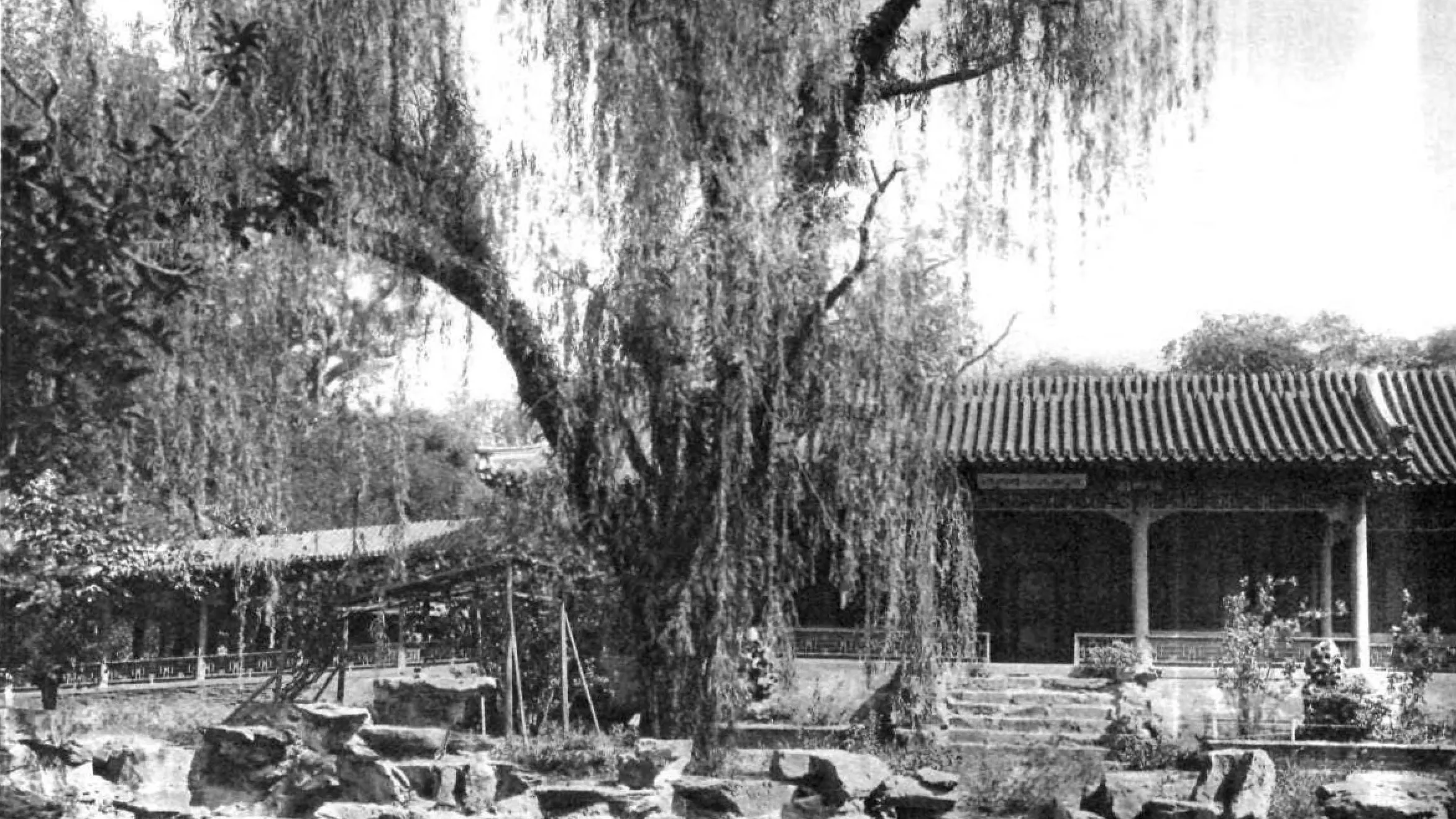
The following eight photographs are collected in Osvald Sirén’s Gardens of China, published by the Ronald Press Company, New York, in 1949. The museum’s research fellow Hao Li dates Sirén’s photography in the mansion to 1922–1930; the book does not date each photograph individually. The photographs show the pond shore before the hall, the Dicui Cliff, the Poetry-and-Painting Boat, the Fish-Viewing Terrace, and the entrance rockwork as they then appeared. See also “Appreciation: Many Charms in a Slice of Hill, Feeling Born from an Inch of Stone”.
An old photograph of Prince Gong’s Mansion collected in Sirén’s Gardens of China: willows before the Anshan Hall, the pond shore and covered walkways.
An old photograph of Prince Gong’s Mansion collected in Sirén’s Gardens of China: the Dicui Cliff, the entrance of the Secret Cloud Cave, and the terraces on the hill.
An old photograph of Prince Gong’s Mansion collected in Sirén’s Gardens of China: the Poetry-and-Painting Boat, the pond shore and weeping willows.
An old photograph of Prince Gong’s Mansion collected in Sirén’s Gardens of China: a close view of the Fish-Viewing Terrace.
An old photograph of Prince Gong’s Mansion collected in Sirén’s Gardens of China: the Fish-Viewing Terrace, the courtyard and the east long corridor.
An old photograph of Prince Gong’s Mansion collected in Sirén’s Gardens of China: the gate-shaped rockwork at the garden entrance.
An old photograph of Prince Gong’s Mansion collected in Sirén’s Gardens of China: the flat-roofed pavilion, its roof railed on all sides, with trees and rocks before it.
An old photograph of Prince Gong’s Mansion collected in Sirén’s Gardens of China: the garden paving, with small stones forming a camel-train pattern against geometric borders.
Circa 1932–1940
The preface to the Pictorial Compendium of Ancient Chinese Architecture states that its photographs come from the Society for Research in Chinese Architecture’s surveys of 1932–1940; this photograph is dated accordingly. It appears in the second volume under the title “A Corner of Prince Gong’s Mansion, Beiping.” The view looks from beneath a covered walkway into the courtyard, with columns and carved ornament in the foreground and storied pavilions, balustrades and rocks beyond.
1940 (year of publication)
Sources of the two photographs: “The Historical Evolution and Restoration of the Duofu Hall”; dating and identification per “A Study of the Restoration of the Interior Furnishings of the Duofu Hall, Prince Gong’s Mansion”.
The Duofu Hall after its conversion into the Fu Jen University library: exterior view with the front steps, columns, doors and windows. Prince Gong’s Mansion Museum published this photograph in “The Historical Evolution and Restoration of the Duofu Hall”; the museum’s furnishing-restoration study identifies it as a photograph carried in the 1940 journal of the Fu Jen University alumni association. 1940 is the year of publication.
The Duofu Hall after its conversion into the Fu Jen University women’s library: students reading at long tables, with the ceiling and the “Shangde Yanxi” plaque still visible above. Published by the museum in “The Historical Evolution and Restoration of the Duofu Hall”; the furnishing-restoration study identifies it as the interior of the women’s library in the 1940 journal.
References
- Osvald Sirén: Gardens of China, Ronald Press Company, New York, 1949.
- Prince Gong’s Mansion Museum: “The Collection, Restoration, and Study of Historical Materials on Prince Gong’s Mansion and Princely-Mansion Culture”, 2009.
- Hu Yihong: “The Historical Evolution and Restoration of the Duofu Hall”, Prince Gong’s Mansion Museum, 2012.
- Prince Gong’s Mansion Museum, Ministry of Culture and Tourism: “The Xijin Studio”, 2014.
- Meng Qingzhong: “The Inseparable Bond between the Pingfu Tie and Prince Gong’s Mansion”, Prince Gong’s Mansion Museum, 2018.
- H.-S. Ch’en and G. N. Kates: Prince Kung’s Palace and its Adjoining Garden in Peking, Monumenta Serica, vol. 5, nos. 1–2, 1940, pp. 1–80.
- First Historical Archives of China and the Prince Gong’s Mansion Administration Center of the Ministry of Culture, eds.: Complete Archives of Prince Gong’s Mansion in the Qing Palace: The Secret Files on Heshen, National Library of China Publishing House, 2009.
- Yang Naiji: “On Prince Gong’s Mansion,” in Discourses beyond the Threshold: Essays on Architectural History, China Architecture & Building Press, 2008.
- Zhao Xun: “Prince Gong’s Mansion and Its Garden,” in Collected Studies on Princely-Mansion Culture of the Qing Dynasty, vol. 2, Culture and Art Publishing House, 2012.