Introduction
In the forty-third year of the Qianlong reign (1778), the Sixth Panchen Lama[1] requested leave to travel to the interior; in the sixth month of the following year he set out from Tashilhunpo Monastery in Tsang, and by way of Xining, Guihua City, and Dolonnur finally reached Rehe in the seventh month of the forty-fifth year. Qianlong had already raised a new temple on the ridge to the left of the Putuo Zongcheng Temple, rendering “Tashilhunpo” as “Xumi Fushou,” and lodged the Panchen and his accompanying disciples there after the model of his monastery in Tsang.
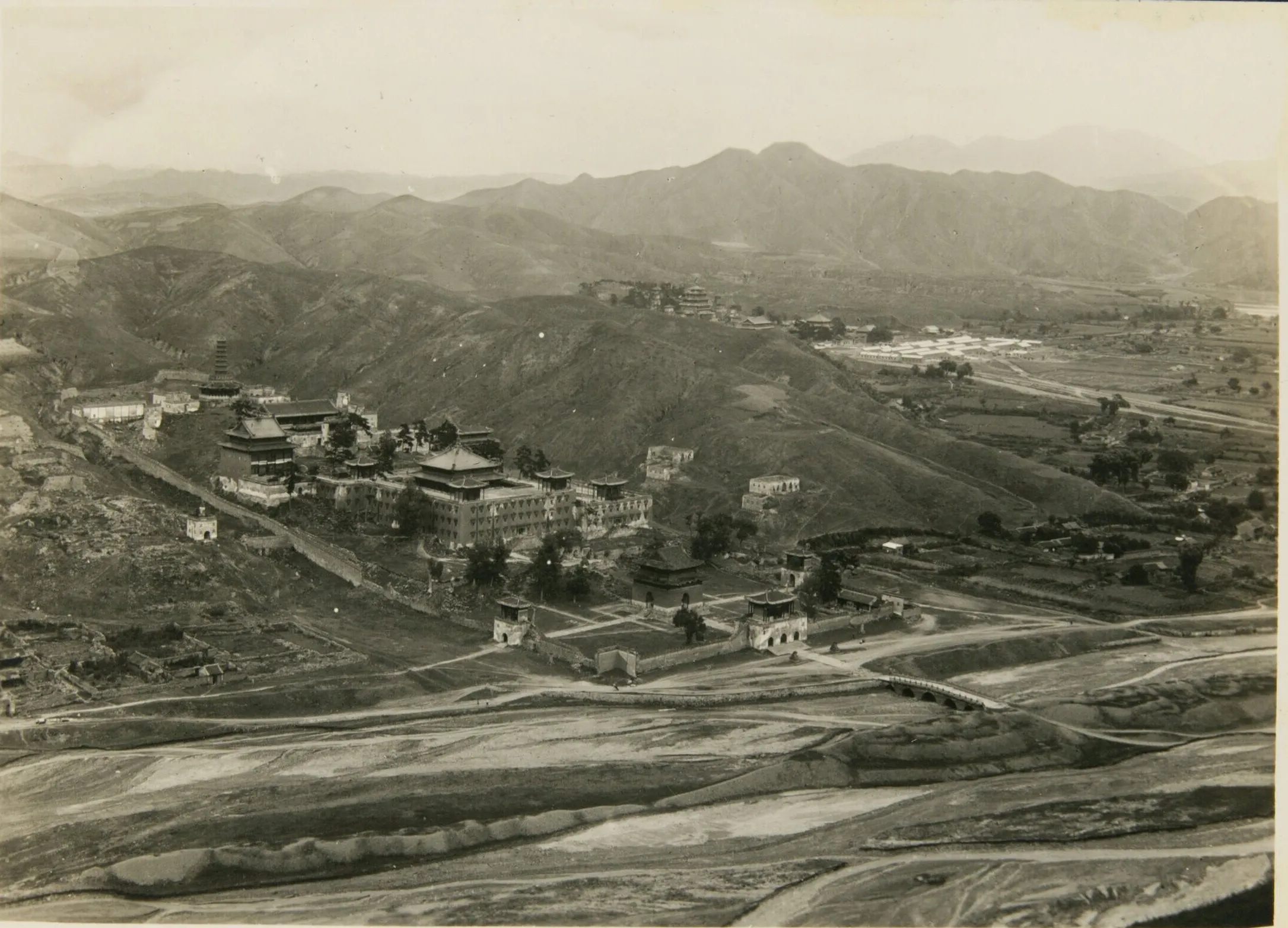
Though this temple was built for the Panchen, it also contains an Imperial Seat Tower used by Qianlong. From the mountain gate northward, the stele pavilion and the precious archway lead to the three-story assembly-hall tower “Miaogao Zhuangyan”; the Imperial Seat Tower stands east of the hall, and deeper within are a two-story Buddha tower and the “Jixiang Faxi” Hall. The assembly hall and the living quarters were built in the style of Tsang, while the mountain gate, hall towers, Imperial Seat Tower, and Buddha tower are ranged tier upon tier along the north–south axis. Thus the Panchen’s residence and the spaces Qianlong used when visiting the temple came to rest within a single building complex.
In the seventh month the Panchen moved in by imperial command; in the ninth month he left Rehe for the capital, and in the eleventh month he died of smallpox in Beijing. The monastery built to welcome him actually hosted the Panchen for only about two months. The next spring, twenty of the Sixth Panchen’s leading disciples, Lobsang Döndrup among them, remained at the temple, transmitting the sūtras and discipline of Tsang to one hundred and eighty lamas of the interior; the Xumi Fushou Temple thereby became a place where the sūtras and discipline of Tsang were taught. In the nineteenth year of the Jiaqing reign, the seventeen leaking enclosing rooms of the Jixiang Faxi Tower’s courtyard were surveyed, and the work was deferred because the damage was relatively light; what was actually repaired afterward was the terrace roof of the three-bay portico[2] projecting before the tower, while a further two zhang three chi of the temple wall was relaid. In 1934 and 1935 Hedda Morrison came to Rehe twice in succession, the second time reshooting with a large-format camera better suited to architectural photography. The photographs she left of the distant view, the roof ridges of the inner courtyard, and the gilded roof, together with the panoramas published in the same period, preserve the form of the Great Red Terrace, the Miaogao Zhuangyan Hall, and the glazed pagoda joining one behind another.
Historical Documents
Qinding Rehe Zhi (Imperially Commissioned Gazetteer of Rehe)
须弥福寿庙 岁在庚子,恭逢
Xumi Fushou Miao (the Xumi Fushou Temple). In the year gengzi, reverently meeting
皇上七旬万寿,时则班禅额尔德呢祝
the seventieth birthday of the Emperor, the Panchen Erdeni, to offer
厘来自后藏,
felicitations, came from Tsang;
上嘉其远至,于山庄建札什伦布庙居之。唐古特语“札什为福寿,伦布谓须弥山也。庙门南向,恭刻
the Emperor praised his coming from afar, and at the Mountain Resort built a Tashilhunpo temple to lodge him. In the Tangut tongue, “zhashi is fortune and longevity; lunbu means Mount Sumeru.” The temple gate faces south; reverently engraved
御书额曰“须弥福寿之庙”。庙额多具四体书,东西二山门有题额,一曰梵香遍满,一曰法界圆成。碑亭一,额曰智光普照,宝坊一,额曰总持佛境。都纲殿楼三重,额曰妙高庄严,殿内面南,额曰宝地祥轮。联曰:开大般若台,朗照宗镜;具妙庄严相,深护法云。又曰:证三摩菩提,圆装七宝;超六波罗密,座涌千花。又曰:圆镜照三千,是空是色,妙香闻二六,即佛即心。又曰:妙曼拥珠城,庄严具足,芬陀承宝盖,福慧圆成。面北额曰福缘恒演,联曰:现象香国身,增五福德,说最上乘法,证八吉祥。又曰:仙露净尘根,花垂薝卜,香风翔法界,乐送迦陵。又曰:证最胜因,光华开七宝,溥无量寿,安乐演三乘。东为
above it is the imperial inscription: “Xumi Fushou zhi Miao” (Xumi Fushou Temple). The temple plaques are mostly in four scripts. The two mountain gates, east and west, bear inscriptions: one reads “Fanxiang Bianman” (Brahma-Incense Pervading All), the other “Fajie Yuancheng” (Perfect Consummation of the Dharma-Realm). There is one stele pavilion, inscribed “Zhiguang Puzhao” (Universal Radiance of the Light of Wisdom); one precious archway, inscribed “Zongchi Fojing” (the Buddha-Realm that Upholds All). The assembly-hall tower of three tiers is inscribed “Miaogao Zhuangyan” (Wondrous Loftiness and Solemnity); within the hall, facing south, is inscribed “Baodi Xianglun” (Auspicious Wheel of the Precious Ground). A couplet reads: “Opening wide the terrace of prajñā, it brightly mirrors the mirror of the doctrine; endowed with the wondrous adorned form, it deeply shelters the clouds of the Dharma.” Another reads: “Realizing the bodhi of samādhi, perfectly arrayed with the seven treasures; transcending the six pāramitās, a thousand flowers welling from its seat.” Another reads: “The round mirror illumines the three thousand worlds—be it emptiness, be it form; the wondrous incense is sensed through the twelve watches—it is Buddha, it is mind.” Another reads: “Gentle and wondrous, embracing the city of pearls, adornment fully complete; the white lotus bearing the precious canopy, blessing and wisdom perfectly consummated.” Facing north, the plaque reads “Fuyuan Hengyan” (The Conditions of Blessing Unfold Forever); the couplet reads: “Manifesting a body of the Fragrant Land, it increases the five blessings and virtues; preaching the Dharma of the supreme vehicle, it realizes the eight auspicious marks.” Another reads: “Immortal dew cleanses the dusty roots, blossoms drooping from the champak; fragrant winds soar through the Dharma-realm, music bidding the kalaviṅka on its way.” Another reads: “Realizing the most supreme cause, its radiance unfolds the seven treasures; spreading Immeasurable Life, in peace and joy it expounds the Three Vehicles.” To the east is
御座楼,联曰:“风铃常转莲花藏,贝叶闲披金字经。”更内佛楼二重,额曰生欢喜心,联曰:龙象庄严,妙不可思议,人天欢喜,普如是吉祥。又曰:见性悟真源,参圣如意,定心观妙谛,示佛因缘。殿上层额曰吉祥法喜,殿内联曰:宝阁护香云,静资礼梵,灵峰呈寿相,妙悦安禅。下层额曰芬陀普涌,殿内联曰:初地总持超梵乘,恒沙普演护祥轮。又
the Imperial Seat Tower, whose couplet reads: “Wind-bells ever turn the lotus-treasury; palm-leaves at ease unroll the golden-lettered sūtras.” Deeper within is a Buddha tower of two tiers, inscribed “Sheng Huanxi Xin” (Giving Rise to a Joyful Heart); its couplet reads: “Dragons and elephants in adornment, wondrous beyond thought; men and gods rejoicing, universally thus auspicious.” Another reads: “Seeing the nature, awakening to the true source, one partakes in the sage’s wish-fulfilling; steadying the mind, contemplating the wondrous truth, he shows the causes and conditions of Buddhahood.” On the hall’s upper level the plaque reads “Jixiang Faxi” (Auspicious Dharma-Joy); the couplet within reads: “The precious pavilion shelters the incense clouds, in stillness aiding the worship of Brahma; the numinous peak presents the aspect of longevity, in wondrous delight resting in dhyāna.” On the lower level the plaque reads “Fentuo Puyong” (White Lotuses Welling Everywhere); the couplet within reads: “From the first ground, upholding all, transcending the Brahma vehicle; like Ganges sands, universally expounding, guarding the auspicious wheel.” Also
御座楼南北殿各二重,北殿悬“南无阿弥陀佛”额,联曰:到来佛相原如是,静处尘心那更生。又曰:功德无边复无量,因缘非色亦非空。南殿东楹联曰:现法化报身,共依圆觉;摄闻思修教,遍示妙明。西楹联曰:象法涌祥轮,西方震旦;智光腾宝炬,海藏天宫。客堂额曰:万法宗源。联曰:便有香风吹左右,似闻了义示缘因。仰惟
the Imperial Seat Tower has a southern and a northern hall, each of two tiers. The northern hall hangs a plaque reading “Namo Amituo Fo” (Homage to Amitābha Buddha); its couplet reads: “Come here, and the Buddha’s aspect is originally thus; in the stillness, how could the worldly mind arise again?” Another reads: “Merit without bounds and beyond measure; causes and conditions neither form nor emptiness.” In the southern hall, the eastern pillar couplet reads: “Manifesting the Dharma-, transformation-, and enjoyment-bodies, all rest on perfect awakening; gathering the teachings of hearing, pondering, and practice, it everywhere shows wondrous clarity.” The western pillar couplet reads: “The teaching of images wells up the auspicious wheel, from the West to China; the light of wisdom soars like a precious torch, through the ocean-treasury of the celestial palaces.” The reception hall’s plaque reads “Wanfa Zongyuan” (Source from which the Myriad Dharmas Spring). Its couplet reads: “Then a fragrant wind blows left and right; one seems to hear the revealed meaning showing the causes.” Looking up, we reflect:
寿宇宏开,
the edifice of long life is grandly opened;
皇风普鬯,西方妙法,同我太平。伏诵
the imperial sway spreads everywhere; the wondrous Dharma of the West shares in our peace. Humbly reciting
御制记文,仰见我
the imperial record, we look up and see that our
朝声教恢纮,卓越千古,非独耆崛阇山阿耨达水,颂无量功德已也。
dynasty’s fame and teaching stretch vast, surpassing all ages—it is not at Mount Gṛdhrakūṭa and the waters of Anavatapta alone that immeasurable merit is extolled.
先是,四十三年,章嘉胡图克图奏称:后藏大喇嘛班禅额尔德呢久欲瞻仰天颜,因庚子岁恭遇皇上七旬万寿,敬拟入觐祝厘,得旨俞允,命驻藏大臣传旨宣谕。”
Previously, in the forty-third year, the Changkya Khutukhtu memorialized: “The great lama of Tsang, the Panchen Erdeni, has long wished to gaze upon the imperial countenance; as the gengzi year reverently meets the Emperor’s seventieth birthday, he respectfully proposes to enter audience and offer felicitations.” He received an edict of assent, and the Grand Minister Resident of Tibet was ordered to transmit the decree and proclaim it.
四十四年,经驻藏大臣留保住等奏称:“班禅额尔德呢接奉俞旨,不胜感悦,即于本年六月由扎什伦布起程,谢恩进佛等语。旋命留保住护送遄行,至西宁衮布庙,命西安将军伍弥泰协同经理,又命理藩院侍郎保泰、散秩大臣万福等往迎,赐东珠、朝珠、鞍马、银币等件。
In the forty-fourth year, the Grand Minister Resident of Tibet, Liubaozhu, and others memorialized: “The Panchen Erdeni, receiving the decree of assent, is moved beyond measure, and will set out from Tashilhunpo in the sixth month of this year, to give thanks for the grace and present Buddhas,” and so on. Soon Liubaozhu was ordered to escort him on a swift journey; on reaching the Gonpo Temple of Xining, the Xi’an general Wumitai was ordered to assist in managing the matter; the vice minister of the Court of Dependencies, Baotai, the unattached minister Wanfu, and others were further ordered to go welcome him, with gifts of eastern pearls, court necklaces, saddled horses, and silver and silk.
四十五年三月,命乾清门侍卫乌尔图那逊、銮仪卫大臣达福等至归化城,以上用车舆仪仗赐之。至岱罕庙,命皇六子及章嘉胡图克图、尚书永贵等往迎,赐嵌帽袈裟、朝珠等件。至多伦诺尔,命御前侍卫丰绅济伦往,赐敕书及嵌珠帽金丝袈裟等件。至是抵热河。
In the third month of the forty-fifth year, the Qianqing Gate guard Wertunarsun, the minister of the Imperial Equipage Department Dafu, and others were sent to Guihua City to bestow upon him the carriages and regalia used by the Emperor. On reaching the Daikhan Temple, the sixth imperial prince, the Changkya Khutukhtu, the minister Yonggui, and others were ordered to go welcome him, with gifts of an inlaid hat, a kasaya, and court necklaces. On reaching Dolonnur, the imperial bodyguard Fengshenjilun was sent, with gifts of a patent letter, a pearl-inlaid hat, and a gold-thread kasaya. Thereupon he reached Rehe.
七月丁酉,于澹泊敬诚殿跪请圣安,赐金银曼达各一,及金壶香炉等件。上御依清旷殿,赐坐,赐茶果筵宴,命至须弥福寿之庙居住。
On the dingyou day of the seventh month, at the Danbo Jingcheng Hall he knelt and asked after the Emperor’s well-being, and was granted one gold and one silver mandala, together with gold pots, incense burners, and other articles. The Emperor proceeded to the Yiqingkuang Hall, granted him a seat, bestowed tea, fruit, and a banquet, and ordered him to reside at the Xumi Fushou Temple.
庚子,上御万树园,赐宴,赐嵌正珠祖衣一分及金银器皿。辛丑,复赐茶果。八月己酉、戊午,亦如之。庚申,上御万树园,赐观火戏,壬戍亦如之。乙丑,赐宴,赐冠服。九月丁丑,命护送至京,住西黄寺。
On gengzi, the Emperor proceeded to the Garden of Ten Thousand Trees, bestowed a banquet, and granted a set of ancestral robes inlaid with true pearls and vessels of gold and silver. On xinchou he again bestowed tea and fruit. On jiyou and wuwu of the eighth month, likewise. On gengshen, the Emperor proceeded to the Garden of Ten Thousand Trees and granted him a viewing of a fireworks display; on renxu, likewise. On yichou he bestowed a banquet and granted caps and robes. On dingchou of the ninth month, orders were given for him to be escorted to the capital, to reside at the Western Yellow Temple.
谨按:黄教以宗喀巴为祖,其二大弟子,一曰根敦珠巴,八转世而为今达赖喇嘛,一曰凯珠布格埒克巴勒藏,六转世而为今班禅额尔德呢。世祖章皇帝时,达赖喇嘛来朝京师,建北黄寺以居之,越今百有余年,额尔德呢仰慕圣化,思觐天颜,因庚子岁,皇上七旬万寿,自后藏扎什伦布起程,跋涉二万里,虔申庆祝,出于至诚,实为国家吉祥盛事。上特命皇子大臣往迎,赐敕褒美,锡予优渥。而蒙古王公、台吉及喀尔喀卫拉特等,一闻其来,无不观欣舞蹈,执役恐后。至是展觐山庄宴赉有加命住须弥福寿之庙,肖其所居,以安徒众。嗣于上回銮前,先期进京,居西黄寺。臣等恭绎御制碑记,所谓“上以扬历代致治保邦之谟烈,下以答列藩倾心向化之悃忱”,仰见重熙累洽,中外一家,实为亿万年无疆之庆矣。
Respectfully noted: The Yellow Teaching takes Tsongkhapa as its patriarch; of his two great disciples, one was Gendun Drup, who in the eighth reincarnation became the present Dalai Lama, and one was Khedrup Gelek Palzang, who in the sixth reincarnation became the present Panchen Erdeni. In the time of Emperor Shizu Zhang, the Dalai Lama came to the capital for audience, and the Northern Yellow Temple was built to lodge him; now, more than a hundred years later, the Erdeni, admiring the sage’s transforming virtue and longing to behold the imperial countenance, on the occasion of the gengzi year, the Emperor’s seventieth birthday, set out from Tashilhunpo in Tsang, toiling over twenty thousand li to offer devout celebration with utmost sincerity—truly an auspicious and grand event for the state. The Emperor specially ordered princes and ministers to go welcome him, bestowing patents of praise and generous gifts. And the Mongol princes and dukes, the taijis, and the Khalkha and Oirat peoples, as soon as they heard of his coming, all rejoiced and danced, vying to be first in rendering service. Thereupon he was received at the Mountain Resort, banqueted and rewarded with added honors, and ordered to reside at the Xumi Fushou Temple, made in the likeness of his own dwelling, so as to give peace to his followers. Later, before the Emperor’s return to the capital, he went ahead to Beijing, residing at the Western Yellow Temple. Your servants have respectfully pondered the imperial stele inscription, which says, “above, to exalt the plans and achievements of successive dynasties in ordering and guarding the state; below, to answer the sincere devotion of the vassal peoples in turning their hearts toward transformation”—looking up, we see repeated brightness and accumulated harmony, within and without a single family: truly a boundless celebration for a hundred million years.
华言福寿等须弥,〈唐古特语伦布者,须弥山;札什者,福寿也。〉 建以班禅来祝厘。〈今年班禅额尔德尼来热河,为余祝七旬万寿,因仿后藏班禅所居庙式,特建此寺。〉 旧例已遥遵顺治,〈谓北黄寺,因五辈达赖喇嘛于顺治年间来京,特敕建寺居之。〉 新工犹近比康熙。〈去声。溥仁寺康熙五十二年建,为热河最古寺。〉 层楼初耸辉佛日,万树分栽蔚慧枝。 一语欲询驻锡者,有无法也抑无为。
In Chinese speech, “fortune and longevity” equal Sumeru 〈in the Tangut tongue, lunbu is Mount Sumeru, and zhashi is fortune and longevity〉. Built because the Panchen came to offer blessings 〈this year the Panchen Erdeni came to Rehe to celebrate my seventieth birthday; imitating the style of the temple where the Panchen dwells in Tsang, I specially built this monastery〉. The old precedent already reaches back to Shunzhi 〈this refers to the Northern Yellow Temple: because the fifth Dalai Lama came to the capital in the Shunzhi years, a temple was specially built by decree to lodge him〉. The new work still stands near to Kangxi 〈read in the departing tone; the Puren Temple was built in the fifty-second year of Kangxi and is the oldest temple of Rehe〉. Tiered towers newly risen gleam against the Buddha-sun; ten thousand trees planted out grow lush with branches of wisdom. One thing I would ask the one who has laid down his staff here: is there no Dharma, or rather non-action?
Xumi Fushou zhi Miao Beiji (Stele Inscription of the Xumi Fushou Temple)
黄教之兴,以宗喀巴为鼻祖,有二大弟子:一曰根敦珠巴,八转世而为今达赖喇嘛;一曰凯珠布格埒克巴勒藏,六转世而为今班禅额尔德呢喇嘛。是二喇嘛盖递相为师,以阐宗风而兴梵教,则今之班禅额尔德呢喇嘛,实达赖喇嘛之师也。达赖喇嘛居布达拉,译华言为普陀宗乘之庙;班禅额尔德呢居扎什伦布,译华言为须弥福寿之庙,是前卫后藏所由分也。辛卯年,曾建普陀宗乘之庙于避暑山庄之北山,以祝厘也,亦以土尔扈特归顺也。今之建须弥福寿之庙于普陀宗乘之左冈者,则以班禅额尔德呢欲来觐,而肖其所居,以资安禅,且遵我世祖章皇帝建北黄寺于京师,以居第五达赖喇嘛之例也。然昔达赖喇嘛之来,实以敦请。兹班禅额尔德呢之来觐,则不因招致,而出于喇嘛之自愿来京,以观华夏之振兴黄教,抚育群生,海宇清晏,民物敉宁之景象,适值朕七旬初度之年,并为庆祝之举也。
The rise of the Yellow Teaching takes Tsongkhapa as its first ancestor; he had two great disciples: one called Gendun Drup, who in the eighth reincarnation became the present Dalai Lama; one called Khedrup Gelek Palzang, who in the sixth reincarnation became the present Panchen Erdeni Lama. These two lamas have in turn been teacher to one another, expounding the tradition and promoting the Brahma teaching; thus the present Panchen Erdeni Lama is in truth the teacher of the Dalai Lama. The Dalai Lama dwells at the Potala, which translated into Chinese speech is the Putuo Zongcheng Temple; the Panchen Erdeni dwells at Tashilhunpo, which translated into Chinese speech is the Xumi Fushou Temple: this is how the division into Ü and Tsang came about. In the xinmao year the Putuo Zongcheng Temple was built on the northern hill of the Mountain Resort, both for the offering of birthday prayers and for the submission of the Torghuts. That the Xumi Fushou Temple is now built on the ridge to the left of Putuo Zongcheng is because the Panchen Erdeni wished to come for audience; it is made in the likeness of his dwelling, to serve his tranquil meditation, and moreover it follows the precedent of my ancestor Emperor Shizu Zhang, who built the Northern Yellow Temple in the capital to lodge the fifth Dalai Lama. Yet when the Dalai Lama came of old, it was truly at our earnest invitation; the Panchen Erdeni’s coming now for audience is not because he was summoned, but of the lama’s own wish to come to the capital, to see how China revives the Yellow Teaching, nurtures all living beings, and enjoys a realm at peace, its people and goods settled—and it happens to fall in the year I first enter my seventies, so it is also an act of celebration.
夫朕七旬不欲为庆贺繁文,已预颁谕旨,而兹喇嘛之来,则有不宜阻者。盖国家百余年,升平累洽,中外一家,自昔达赖喇嘛之来,至今亦百余年矣。且昔为开创之初,如喀尔喀、厄鲁特尚有梗化者;今则重熙休和,喀尔喀久为世臣,厄鲁特亦无不归顺,而一闻班禅额尔德呢之来,其欢欣舞蹈,欲执役供奉,出于至诚,有不待教而然者。则此须弥福寿之庙之建,上以扬历代致治保邦之谟烈,下以答列藩倾心向化之悃忱,庸可已乎?既为记,复作赞言。
For my seventieth I did not wish for elaborate celebrations, and an edict to that effect had been issued beforehand; yet the coming of this lama is something that should not be obstructed. For more than a hundred years the state has enjoyed mounting peace and harmony, within and without as one family; from the Dalai Lama’s coming of old to today, again more than a hundred years have passed. Moreover, those days were the beginning of the founding, when among the Khalkha and the Oirat there were still some who resisted our transforming influence; now there is redoubled brightness and serene concord—the Khalkha have long been hereditary servants, and the Oirat too have all submitted—and at the first news of the Panchen Erdeni’s coming, their joy and dancing, their wish to render service and offerings, comes from utmost sincerity, arising without being taught. Thus the building of this Xumi Fushou Temple, above to exalt the plans and achievements of successive dynasties in ordering and guarding the state, below to answer the sincere devotion of the vassal peoples in turning their hearts toward transformation—how could it be dispensed with? Having made this record, I further compose these words of praise:
印度既迥遥,佛教亦式微。梵僧舍天竺,多临卫藏地。自唐代已然,是为法源处。一译犹云近,三乘无舛讹。
India being remote and far away, the Buddha’s teaching there also fell into decline. The monks of Brahma left India and came mostly to the land of Ü-Tsang. So it has been since the Tang dynasty: this is the wellspring of the Dharma. One translation removed, it may still be called near; the Three Vehicles suffer no corruption.
宗乘向东昌,诚如佛所记。
The vehicle of the doctrine flourishes eastward, truly as the Buddha recorded.
卫藏虽徼外,实在震旦中。达赖及班禅,宗喀巴高弟,前后燃智灯。三车之纲领,真文与满字。于是溯轨躅。
Though Ü-Tsang lies beyond the marches, it is in truth within China. The Dalai and the Panchen, Tsongkhapa’s highest disciples, one after another have kindled the lamp of wisdom. The guiding thread of the three vehicles is found in the true letters and the Manchu script; thereby we trace their tracks.
蒙古众林林,莫不倾心向。皈依三宝门,神道易设教。兹闻班禅来,如婴儿遇母。观化阐宗风,诚为吉祥事。
The Mongol multitudes, a teeming host, all incline their hearts toward it. Taking refuge at the gate of the Three Jewels, the way of the spirits readily lends itself to teaching. Now hearing that the Panchen comes, they are like infants meeting their mother. To behold his transformation and expound the tradition is truly an auspicious thing.
布达拉既建,伦布不可少,择向兴工作,亦以不日成。都纲及寝室,一如后藏式。
Since the Potala was built, the Lunbu could not be lacking; choosing a site we raised the works, and it too was finished in a matter of days. The assembly hall and the sleeping quarters were all after the style of Tsang.
金瓦映日辉,玉幢扬风舞。自成动静偈,朗标色空喻。以是善因缘,资无碍法喜。祝嘏犹其小,所欣象教宏。
Golden tiles mirror the sun’s gleam; jade banners flutter and dance in the wind. Of themselves they form a gāthā of motion and stillness, brightly setting forth the parable of form and emptiness. By these good causes and conditions, unhindered Dharma-joy is nourished. The prayers for blessing are but the lesser part; what gladdens me is the greatness of the teaching of images.
举似西域居,无来亦无去。上人演法轮,蠢蠢普超度。佐我无为治,雨顺与风调。
It may be shown as the dwelling of the Western Regions, where there is no coming and no going. The eminent one turns the wheel of the Dharma, and the teeming creatures are all ferried across. He aids my government of non-action, bringing rain favorable and winds in season.
众生登寿世,慧炬永光明。
May all beings ascend to a world of long life, and the torch of wisdom shine bright forever.
合十作赞言,初非为一己。
With palms joined I make these words of praise, which from the first are not for myself alone.
如悬大圆镜,遍照于十方。而镜本无心,回向亦如是。
Like a great round mirror hung aloft, shining everywhere upon the ten directions—and the mirror is in essence without mind: so too is this dedication of merit.
Songnian Zoudang (Songnian Memorials Archive)
白括拏嵩年俊山跪
…Songnian and Junshan, kneeling,
奏为奏闻销算工料银两事
memorialize to make report concerning the accounting of silver for labor and materials.
恭查嘉庆十九年分经努等查明热河园庭外庙内有殿宇楼座渗漏残坏情形较重及迎水霸坍塌闪裂石堤𫝑须于春令急行修理者共五项敬缮清单于正月二十六日具奏
Respectfully examined: in the nineteenth year of Jiaqing, your servants ascertained that within the gardens and the outer temples of Rehe there were halls and towers whose leaking and damage was relatively serious, as well as a collapsed water-facing dam and a shifted and cracked stone dike, which must be urgently repaired in the spring season—five items in all; a list was respectfully drawn up and submitted by memorial on the twenty-sixth day of the first month.
奉旨文园延景楼如意洲延薰山馆大殿永佑寺后楼扎什伦布吉祥法喜楼德汇门外迎水霸东面石堤着总理工程处派员前往踏勘如系刻不可缓之工即于本年修理钦此
We received the edict: “For the Yanjing Tower of the Wenyuan Garden, the great hall of the Yanxun Mountain Lodge on Ruyi Islet, the rear tower of the Yongyou Temple, the Jixiang Faxi Tower of Tashilhunpo, and the stone dike east of the water-facing dam outside the Dehui Gate, let the Office of Imperial Works dispatch personnel to make surveys; if they prove to be works that truly cannot brook delay, let them be repaired within this year.” Respect this.
钦遵经总理工程大臣派员查勘除扎什伦布吉祥法喜楼院内渗漏围房十七间德汇门外迎水霸东面迤南闪裂石堤长十丈五尺情形稍轻暂拟缓修外其余情形较重𫝑须修理者按例核估银一万七千六百九两三钱三分一厘等因行知前来拏等遵即缮揭奏明饬交岁修监督购料兴修
Respectfully complying, the ministers in charge of imperial works dispatched personnel to survey them. Excepting the seventeen leaking enclosing rooms in the courtyard of the Jixiang Faxi Tower of Tashilhunpo and the shifted and cracked stone dike to the south of the water-facing dam east of the Dehui Gate, ten zhang and five chi long, whose condition was somewhat lighter and which it was for the time being proposed to defer, the remainder—being in more serious condition and requiring urgent repair—was estimated according to the regulations at 17,609 taels, 3 qian, 3 fen, and 1 li of silver. Having been so informed, your servants accordingly drew up a report and made it known by memorial, ordering that the work be handed to the annual-repair supervisors to purchase materials and begin construction.
嗣据该监督呈称修理得热河文园拆盖延景楼一座三间运走物料拆修有碍藤萝架五间院墙二叚凑长二丈八尺三寸随墙门口一座粘修药栏十堂山道上补安巡杖栏杆十堂楼座周围拆墁石子散水院内河泡上成搭运料浮桥二座凑长十四丈进水沟口成搭𫽮水月牙霸一道长四丈八尺如意洲揭𡧄延薰山馆大殿一座七间前抱厦五间永佑寺揭宣后楼一座五间扎什伦布吉祥法喜楼座前檐平台抱厦楼三间拆修台顶德汇门外迎水霸东面修砌石堤二叚凑长十九丈八尺三寸补安水簸箕一座添砌迎水虎皮石创墩二座堤根添砌虎皮石坦水二叚凑长十八丈七尺接大河上哨挑挖引河一道长一百八十丈成搭𫽮水坝二道凑长五十四丈以及各殿座油饰彩画内里裱糊铺苦锡背圈搭砖灰木厂出运渣土清理地面等项工程除领用修建敦仁镇违神祠用剩枝稍木植四百二十件并行取颜料锡铅纱绢布疋花竹席摆钖钉高丽𥿄张应用外净销筫工料银一万七千九百七十二两四钱二分
Subsequently, according to the report of the said supervisors, the repairs completed were as follows: at the Wenyuan Garden of Rehe, dismantling and re-roofing the Yanjing Tower, one building of three bays, and carrying away the materials; dismantling and repairing five bays of obstructing wisteria trellis; two sections of courtyard wall, together two zhang eight chi and three cun long; one gate set into a wall; mending ten sets of balustrades; supplementing and installing ten sets of patrol railings along the mountain path; re-laying the pebble aprons around the tower; erecting two floating bridges for conveying materials over the ponds within the courtyard, together fourteen zhang long; erecting one crescent-shaped water-check dam at the mouth of the intake channel, four zhang eight chi long; at Ruyi Islet, re-roofing the great hall of the Yanxun Mountain Lodge, one building of seven bays, with five bays of front portico; at the Yongyou Temple, re-roofing the rear tower, one building of five bays; at Tashilhunpo, dismantling and repairing the terrace roof of the three-bay portico tower on the platform before the eaves of the Jixiang Faxi Tower; outside the Dehui Gate, repairing and laying two sections of the stone dike east of the water-facing dam, together nineteen zhang eight chi and three cun long; replacing one water-spreader; adding two tiger-skin-stone breast abutments facing the water; and adding at the foot of the dike two sections of tiger-skin-stone revetment, together eighteen zhang seven chi long; connecting with the upper reach of the main river, excavating one diversion channel one hundred and eighty zhang long; erecting two water-check dams, together fifty-four zhang long; together with the oiling and color-painting of the various halls, the papering of their interiors, the laying of felt and tin backing, the enclosure scaffolding, the lime and timber yards, the removal of spoil, and the clearing of the ground. Apart from the four hundred and twenty pieces of branch and tip timber left over from the construction of the shrine at Dunren Town that were drawn for use, and the pigments, tin and lead, gauze and silk, cloth, figured bamboo mats, tin nails, and Korean paper sheets requisitioned for application, the net expenditure of silver for labor and materials was 17,972 taels, 4 qian, and 2 fen.
又于上年六七月间屡经雨水续行奏明动用热河节存生息利银修理得围内前宫继德堂等处修砌大墙院墙四叚凑长八丈八尺清音阁修砌院墙二叚凑长二丈七尺五寸坦坦荡荡修砌月牙墙二叚凑长四丈一尺狮子园修砌大墙七叚凑长十二丈三尺普乐寺修砌大墙一叚长三丈安违庙修砌大墙四叚凑长二丈三尺五寸普宁寺修砌大墙二叚凑长十一丈三尺扎什伦怖修砌大墙一叚长二丈三尺布达拉东常处修砌院墙一叚长五丈五尺南路喀喇河屯行宫修砌大墙院墙二叚凑长五丈马圈大墙五叚凑长十二丈五尺常山峪行宫修砌大墙八叚凑长十五丈八尺北路十八里太行宫修砌大墙四叚凑长九丈三尺波洛河屯行宫修砌大墙院墙二叚凑长七丈五尺阿穆呼朗图行宫修砌大墙二叚凑长三丈三尺以及出运渣土清理地面等项工程销𮅕工料银八百三十九两七钱
Further, in the sixth and seventh months of the previous year there was repeated rain, and by a further memorial it was made known that the interest-bearing surplus silver held at Rehe was drawn upon to carry out repairs: within the enclosure, at the Jide Hall of the Front Palace and elsewhere, repairing and laying four sections of main walls and courtyard walls, together eight zhang eight chi long; at the Qingyin Pavilion, two sections of courtyard wall, together two zhang seven chi and five cun long; at Tantandangdang, two sections of crescent wall, together four zhang one chi long; at the Lion Garden, seven sections of main wall, together twelve zhang three chi long; at the Pule Temple, one section of main wall, three zhang long; at the Anyuan Temple, four sections of main wall, together two zhang three chi and five cun long; at the Puning Temple, two sections of main wall, together eleven zhang three chi long; at Tashilhunpo, one section of main wall, two zhang three chi long; at the eastern quarters of the Potala, one section of courtyard wall, five zhang five chi long; at the Karahetun traveling palace on the southern route, two sections of main wall and courtyard wall, together five zhang long, and five sections of the main wall of the horse corral, together twelve zhang five chi long; at the Changshanyu traveling palace, eight sections of main wall, together fifteen zhang eight chi long; at the Shibali Tai traveling palace on the northern route, four sections of main wall, together nine zhang three chi long; at the Boluohetun traveling palace, two sections of main wall and courtyard wall, together seven zhang five chi long; at the Amuhulangtu traveling palace, two sections of main wall, together three zhang three chi long; together with the removal of spoil and the clearing of the ground—expending 839 taels and 7 qian of silver for labor and materials.
以上二案通共报销工料银一万八千八百十二两一钱二分造册备文咨报总理工程处派员查验收工经总理工程事务大臣遴派内务府郎中祝麟户部主事额腾伊前赴该工逐一查量覆交总理工程处按例详细斟核内有与例不符之处通共核减银七百八十二两二钱四分七厘净准销工料银一万八千二十九两八钱七分三厘
For the above two cases, the total expenditure of silver for labor and materials reported was 18,812 taels, 1 qian, and 2 fen; registers were prepared and a dispatch was sent reporting to the Office of Imperial Works, asking that personnel be dispatched to inspect and accept the completed works. The ministers in charge of imperial works selected and assigned Zhu Lin, a director of the Imperial Household Department, and Etengyi, a secretary of the Ministry of Revenue, to proceed to the works and measure item by item; the results were then returned to the Office of Imperial Works for detailed checking against the regulations. Where items did not conform to the regulations, a total of 782 taels, 2 qian, 4 fen, and 7 li of silver was deducted, leaving a net approved expenditure of 18,029 taels, 8 qian, 7 fen, and 3 li of silver for labor and materials.
又文园拆盖延景楼修做地脚昼夜打霸绹水并拆堆靠楼座有碍山石泊岸山洞高峰以及德汇门外迎水霸石堤修做地脚打𭐏掏水等项活计用过工料银六千六百七十四两七钱六分五厘经总理工程事务大臣覆核无异行知前来努等理合将准销银两细数另缮黄册一并恭呈御览仍照向例咨呈总管内务府大臣覆行查核为此谨奏
Further, for the dismantling and re-roofing of the Yanjing Tower at the Wenyuan Garden—laying the foundation, damming and bailing water day and night, and dismantling the piled rockeries, lakeshore revetments, grottoes, and high peaks that leaned against and obstructed the tower—and for laying the foundation of the stone dike at the water-facing dam outside the Dehui Gate, damming and bailing water, and other such tasks, 6,674 taels, 7 qian, 6 fen, and 5 li of silver for labor and materials was expended; the ministers in charge of imperial works reviewed it and found no discrepancy, and so informed us. Your servants therefore ought to draw up separately a yellow register of the approved sums in detail, to be respectfully presented together for the imperial perusal, and, following established practice, submit it to the ministers of the Imperial Household Department for a further examination. For this we respectfully memorialize.
等因于嘉庆二十年六月初六日差副千总李铭赍赴圆明园于初十日恭递十四日赍回奉到朱批内务府知道钦此
For these reasons, on the sixth day of the sixth month of the twentieth year of Jiaqing, the deputy company commander Li Ming was dispatched to carry the memorial to the Yuanming Garden; it was respectfully presented on the tenth day and brought back on the fourteenth, bearing the vermilion rescript: “The Imperial Household Department takes note.” Respect this.
Shengwu Ji (Records of Sacred Military Achievements)
四十五年,高宗七旬万寿,第六世班禅来朝祝厘,诏仿后藏札什伦布式,建须弥福寿之庙于热河。班禅自崇德中同达赖通贡。顺治初,以年老未随达赖入觐者,皆其第四世罗卜藏垂吉嘉穆错也。第五世曰罗卜藏伊什,于乾隆二年示寂,第六世曰罗卜藏巴丹伊什,于乾隆六年登坐,至是年四十有二矣。七月,班禅至,接见于避暑山庄之澹泊诚敬殿。初,上习蒙古语,及平回部、金川,即习回语、西番语,兹因班禅来觐,复习唐古特语,故重译朝见,告语如一家。旧以达赖、班禅有高行,八觐惟跽不拜。至是班禅固请拜,上嘉其恪诚,从之。至京,接见于南苑德寿荆,仍居西黄寺,讲经放参,皆世祖礼达赖处也。京师西山有僧某者,往论佛法,责以宜居西番清净式众,不宜入中国,过受崇奉。班禅谢之。十一月,以痘终京师。诏即其地建清净化域。明年春,舍利金龛西归,驾幸西黄寺拈香送之,而留其高弟子罗卜藏敦珠布者,领班第二十人,住持札什伦布庙传授后藏经律,选内地刺麻百八十人习焉。是年,遗使赍册印封第七世达赖。刺麻时年二十二岁,尚未受封。至是班禅卒,乃封达赖,以绥唐古特之众。
In the forty-fifth year, Gaozong’s seventieth birthday, the sixth Panchen came to court to offer felicitations; by edict, in imitation of the style of Tashilhunpo in Tsang, the Xumi Fushou Temple was built at Rehe. The Panchen had, together with the Dalai, sent tribute since the Chongde era. That in the early Shunzhi years he did not accompany the Dalai to audience on account of old age refers to the fourth of his line, Lobsang Chökyi Gyaltsen. The fifth was called Lobsang Yeshe, who passed into stillness in the second year of Qianlong; the sixth was called Lobsang Palden Yeshe, who ascended the seat in the sixth year of Qianlong and by then was forty-two years old. In the seventh month the Panchen arrived and was received at the Danbo Chengjing Hall of the Mountain Resort. Earlier, the Emperor had learned the Mongol tongue, and after pacifying the Muslim regions and Jinchuan he learned the Muslim and Xifan tongues; now, because the Panchen was coming to audience, he further studied the Tangut tongue, so that through repeated translation the audience was held and they conversed like one family. Of old, because the Dalai and the Panchen were of high conduct, at audiences they only knelt and did not bow. On this occasion the Panchen earnestly asked leave to bow; the Emperor praised his reverent sincerity and permitted it. On reaching the capital he was received at the Deshou Temple of the Southern Park, and again lodged at the Western Yellow Temple, where he preached the sūtras and released the assemblies from meditation—the very place where Shizu had received the Dalai with ceremony. A certain monk of the Western Hills of the capital came to dispute the Buddha-Dharma with him, reproaching him that he ought to dwell in Xifan, pure, exemplifying the assembly, and ought not to enter China and receive excessive veneration. The Panchen declined his argument. In the eleventh month he died of smallpox in the capital. By edict the Qingjing Huacheng (Realm of Pure Transformation) was built on the spot. The next spring, when the golden reliquary shrine with his remains returned west, the imperial cortege visited the Western Yellow Temple to take up incense and see it off; and his eminent disciple Lobsang Döndrup, with twenty of his leading monks, was retained to preside over the Tashilhunpo temple and transmit the sūtras and discipline of Tsang, one hundred and eighty lamas of the interior being selected to study under them. That year an envoy was sent bearing patent and seal to invest the seventh Dalai. The lama was then twenty-two years old and had not yet received investiture; only upon the Panchen’s death was the Dalai invested, so as to pacify the Tangut multitudes.
Jiaolitang Shiji (Poetry Collection of the Jiaoli Hall)
皇帝四十有五年,班禅万里来朝天。
In the Emperor’s forty-fifth year, the Panchen came ten thousand li to pay court to Heaven.
诏建扎什伦布庙,仿厥制以居之焉。
By edict a Tashilhunpo temple was built, its design imitated, to lodge him therein.
琳宫巍峨数十丈,金碧照耀青山巅。朱门沉沉静不启,巨字四体当中𫔔。峰回树锁望靡极,天半隐隐楼台悬。黄衣比邱六时课,撞钟伐鼓声喧阗。牟尼夜腾宝月朗,婆律昼结慈云圆。列藩新旧众蒙古,膜拜顶礼心精虔。此僧虽寂神不灭,再世复得为班禅。递相授受主彼教,亦如衣钵宗风传。历数百载弊稍出,灵异现示非从前。因时立法圣人事,革除积习无拘牵。金瓶贮名令探取,守臣监视公不偏。自兹卫藏众僧俗,益仰圣德巍巍然。
The jasper palace towers some tens of zhang, gold and azure shining upon the green mountain’s crest. Its vermilion gates stand deep and still, unopened; great characters in four scripts hang in the center. Peaks turn and trees enclose it, the gaze finding no end; midway up the sky the towers and terraces dimly hang. Yellow-robed bhikṣus keep the office of the six hours, striking bells and beating drums in clamorous sound. By night the Sage sends up the jeweled moon, bright; by day borneol incense coils into perfect clouds of compassion. The vassal peoples old and new, the many Mongols, prostrate themselves in worship, hearts utterly devout. Though this monk has passed into stillness, his spirit is not extinguished: born again, he is once more the Panchen. Handing down one to the next, they preside over that teaching, as robe and bowl transmit the wind of the tradition. Over several hundred years abuses slowly crept out; the numinous signs shown were no longer as of old. To make laws according to the time is the work of the sage, casting out accumulated habits without let or tie. A golden urn stores the names, which are drawn by lot, with resident ministers overseeing, impartial and just. From then on, the monks and layfolk of Ü-Tsang alike have looked up the more to the sage’s towering virtue.
我皇神武古莫比,四海震詟无烽烟。俘达瓦齐定准部,馘索诺木平金川。昨来复降廓尔喀,异域稽首争相先。称臣纳贡受约束,须弥福寿长绵绵。太平佛亦效瑞应,舍利腾跃金刚坚。庙前经过瞻壮丽,击壤聊当康衢篇。
Our Emperor’s divine martial prowess has no match since antiquity; the four seas tremble in awe, and no beacon-fires rise. Dawachi was taken captive and the Dzungar tribes settled; Sonom was slain and Jinchuan pacified. Of late the Gurkhas too were brought to submit; the alien realms bow their heads, vying to be first. Pledging fealty, paying tribute, accepting restraint: may the fortune and longevity of Sumeru stretch on and on. In peace the Buddha too lends his auspicious response: the relics leap up, diamond-firm. Passing before the temple, I gaze upon its grand beauty; beating the clods in the old game, I make of it a song of the broad highway.
Historical Photographs
Published in the 1930s
The eleventh volume of Ajia Taikan (Grand Views of Asia), published by the Ajia Shashin Taikan Sha, takes the Xumi Fushou Temple as its special subject, including old views of a panorama of the monastery, its mountain gate, the Miaogao Zhuangyan Hall, the Buddha hall on the upper story of the dugang assembly hall, and the Glazed Buddhist Pagoda. The original publication gives neither the photographer nor the specific years in which the individual photographs were taken.
1934–1935
In Travels of a Photographer in China, 1933–1946, Hedda Morrison records that she first visited Rehe in the summer of 1934 and came again in 1935, reshooting with a large-format camera better suited to architectural photography. The Rehe chapter of the book prints in sequence five clearly captioned photographs of the Xumi Fushou Temple, recording the monastery’s distant view, the Glazed Buddhist Pagoda, the building complex, the dragon ornaments on the roofs of the inner courtyard, and the gilded roof of the Miaogao Zhuangyan Hall.