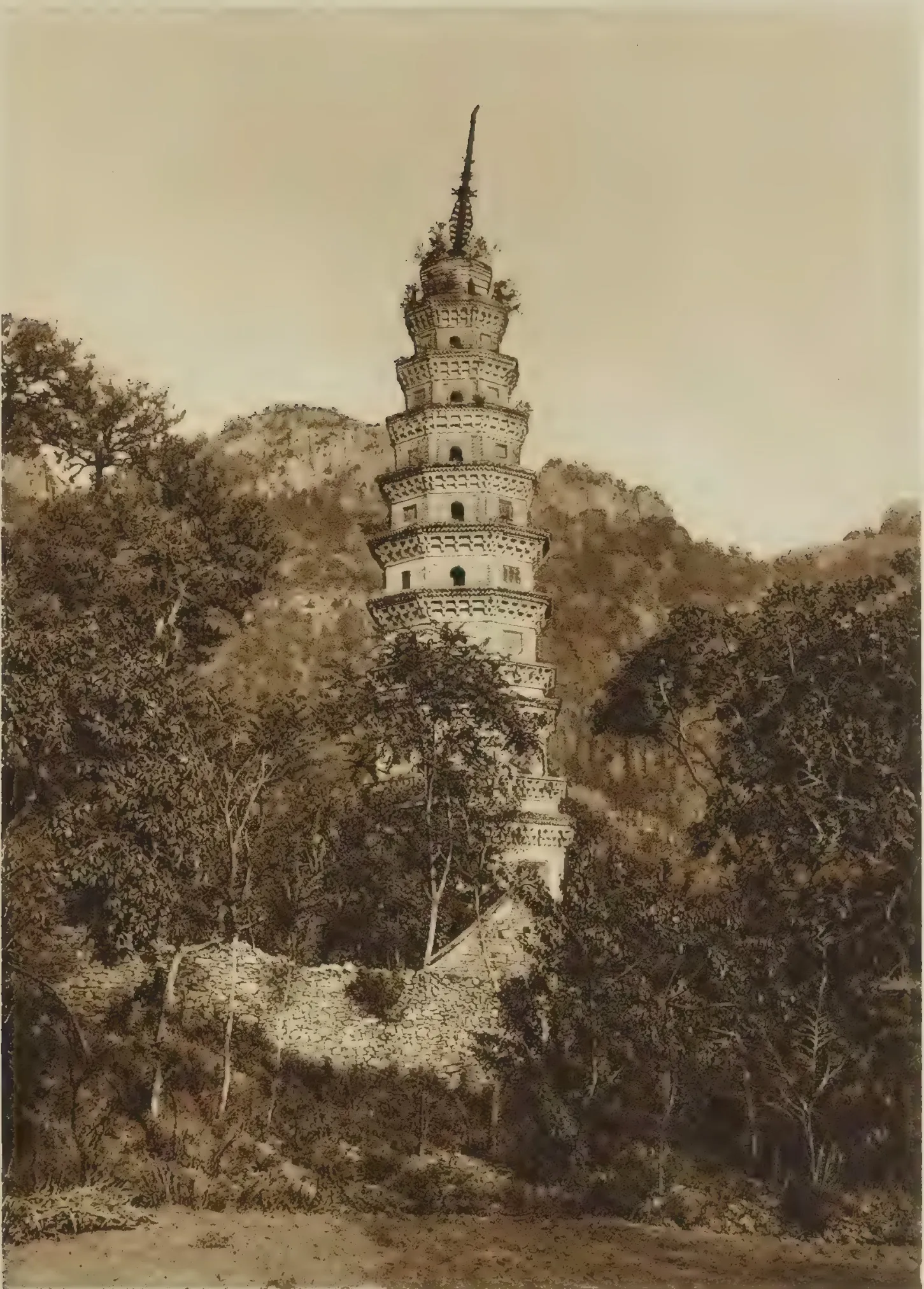
Introduction
In the Zhengguang era of the Northern Wei, the Chan master Fading came to Mount Fang. Legend relates that when he entered the mountains, a blue serpent led the way and two tigers carried the scriptures on their backs, while a white hare and a pair of cranes also appeared in the mountains. Moved by these wonders, the local people built him a dwelling and asked him to stay in the mountains to preach the dharma and take disciples; believers and donors gathered in his wake, and a monastery gradually rose in the valley. During the construction they also met with the difficulty of a lack of water; according to legend, after the pair of cranes flew crying over one spot, two springs welled up there.
At the beginning of the Tang, a boy named Shanzi, not yet ten years old, came to Mount Fang from the region between present-day Anyang in Henan and Daming in Hebei. Legend has it that he gave up his body in the mountains in search of the Way, and that before his body had fallen halfway it was wrapped in five-colored auspicious clouds and borne away to the west, while the monks and laypeople of the temple heard music sounding in the sky. The people thereupon cut a niche into the mountain and set up an image in commemoration. In the fifth year of the Huichang era (845), when Buddhism was suppressed, the Buddhist image in the niche was damaged. In the fifth year of the Dazhong era (851), the court permitted a monastery to be re-established at the old site; the temple began to be rebuilt, and the stone image in the niche was newly adorned. By the time the stele was erected in the eighth year of the Dazhong era (854), the stone niche held nine images—Maitreya, attendant bodhisattvas, divine beasts, and others—and the names of more than two hundred donors were likewise engraved upon the stele.
In the Jingde era of the Song, the court bestowed upon it the name “Jingde Lingyan Temple.” In the Jingyou era, the abbot Qionghuan built a two-storied hall to the east of the assembly hall, and later added further halls, cutting earth and piling stone and filling in a mountain ravine to make covered walkways. By the second year of the Zhihe era (1055), the temple’s halls, cloisters, kitchens, storehouses, and monks’ quarters came to five hundred and forty bays in all, with one hundred and fifty monks and novices[1]. Every spring and summer, pilgrims from near and far carried goods and valuables into the mountains; the alms the temple received each year were counted in the thousands, and even after providing the monastic meals there was a surplus. In the Qingli and Huangyou eras, famines struck in succession, and of those who had formerly entered the mountains to make offerings to the temple, scarcely one or two in a thousand still came; the monks for the most part scattered, only a few remaining, and the temple was never again as flourishing as before.
In the third year of the Xining era (1070), Lingyan Temple changed its original mode of abbatial succession and began to invite monks from all quarters to direct the temple’s affairs. In the sixth year of the Xining era (1073), the Chan master Yangtian Yuangong of the Yunmen school[2] came to the temple to transmit the dharma, and Chan study flourished from that time; thereafter the abbacy was no longer confined to a single school.
By the Jin dynasty, Lingyan Temple still had over a hundred monks. To support these hundred-odd men, about two-thirds of the expense of clothing and food came from the fields and gardens held in the temple’s name. In the sixth year of the Dading era (1166), the Jin court relaxed its prohibitions on mountain forests, allowing the common people to enter the mountains to cut firewood and take timber, and the formerly protected mountain forests in many places were felled one after another. Lingyan Temple produced its old steles and official documents proving that the mountain forest belonged to the temple, and so alone preserved this forest intact. In the third year of the Mingchang era (1192), the authorities again permitted the people to enter Lingyan Temple’s forest to cut timber. After the abbot Guangchen appealed, only a tenth or two of the land was recovered; two years later he traveled to the capital to press the appeal further, and only then recovered all of the old holdings. In the sixth year of the Mingchang era (1195), the temple re-engraved and erected the stele of the fields and gardens, writing down the course of the dispute to leave as evidence for later generations in guarding the temple’s property.
In the twenty-fourth year of the Zhiyuan era (1287), the abbot Baofeng Shun, seeing that the monks of the temple needed scriptures for lecture and recitation, sent men to the Puning Temple in Hangzhou to purchase more than five thousand volumes of sutras, vinaya, and treatises[3]. Two years later the scriptures arrived at Changqing and were temporarily stored in the Wuhua Hall. For the forty-five years that followed, the temple never built a dedicated scripture-treasury hall; the specific reasons have left no record. Not until 1335 did the abbot Xi’an Rang begin to prepare the timber and labor needed to build the hall. Soon afterward, at another’s invitation, he left Lingyan Temple for Shaolin Temple; his successor as abbot, Dingyan, took over the project, deciding to build the hall on the foundation of the temple’s old scripture-treasury building and to divert the timber originally prepared for repairing the outer mountain gate. The Dragon Treasury Hall was begun in the winter of 1336 and completed in the summer of 1340: three bays in all, in which the more than five thousand volumes of scripture at last found a place of keeping.
From the fourteenth to the seventeenth year of the Wanli era (1586–1589), Changqing was struck in succession by drought, hail, and frost, and the wheat and grain harvests failed. By the eighteenth year of the Wanli era (1590), the monks of Lingyan Temple had already scattered on account of famine, the halls and pavilions had fallen into ruin under the erosion of wind and frost, the springs had ceased to flow, and the trees had grown sparse. The princely establishment of De contributed funds from the princely treasury to repair the temple and sent the princely official Chen Feng to supervise the work; the mountain gate and the Hall of the Thousand Buddhas were rebuilt. In the fourteenth year of the Qianlong era of the Qing (1749), the Dragon Treasury Hall built under the Yuan was destroyed by fire. Whether those five thousand–odd volumes of scripture were still kept in the hall at the time, the extant records do not say.
Historical Documents
Xiu Fangshan Zhengming Gongde Ji (Record of the Meritorious Restoration of Mount Fang)
此山前面有石龛龛有石像从弥勒佛并侍卫菩萨至神兽计九躯案寺记云唐初有一童见名善子十岁已下自相魏间来于此山舍身未及半五云封之西去乃凿此山成龛立像旌之会昌五年毁天下有额佛寺五千余所兰若三万余所复僧尼二十六万七百余人此龛佛像微残大中五年奉旨许于旧踪再启精舍寺主闻于州县起立此寺有杭州盐官县人僧子儒俗姓董氏不远江湖访寻名迹至六年五月七日得度金采步饰方山证明功德施主二百余人一镌姓名于左其山龛在寺之艮直上可四里谤视沧溟有同蓬岛龛右有泉来从细窦玉液金浆泄石盆而已大唐大中八年四月八日镌记
Before this mountain there is a stone niche, and within the niche are stone images: from the Buddha Maitreya together with attendant bodhisattvas to divine beasts, nine figures in all. According to the temple records, at the beginning of the Tang there was a boy named Shanzi, ten years of age or younger, who came from the region between Xiang and Wei to this mountain and gave up his body; before he had fallen halfway, five-colored clouds enfolded him and bore him away to the west. Thereupon this mountain was cut to make a niche and an image was set up to commemorate him. In the fifth year of the Huichang era, over five thousand titled Buddhist temples and over thirty thousand convents were destroyed throughout the realm, and more than two hundred and sixty thousand seven hundred monks and nuns were returned to lay life; the Buddhist image in this niche was slightly damaged. In the fifth year of the Dazhong era, by imperial decree permission was granted to re-establish a monastery at the old site; the head of the temple reported it to the prefecture and county, and this temple was raised anew. There was a monk from Yan’guan County in Hangzhou named Ziru, whose secular surname was Dong, who, undeterred by the distance of rivers and lakes, came visiting and seeking famous traces; on the seventh day of the fifth month of the sixth year he was ordained, and with gold and colors he adorned [the images] in stages. The merit-donors of the attestation of Mount Fang, more than two hundred persons, each had his name engraved to the left. The mountain niche lies to the northeast of the temple, straight up about four li; gazing out upon the gray-green sea, it seems the same as the isle of Penglai. To the right of the niche is a spring, coming from a narrow cleft, jade liquor and golden liquor, draining into a stone basin and no more. Engraved and recorded on the eighth day of the fourth month of the eighth year of the Dazhong era of the Great Tang.
Qizhou Jingde Lingyansi Ji (Record of the Jingde Lingyan Temple of Qizhou)
泰山西北阯,群山拥翼,连属百余里,摩空干云,秀拔万状。曲如列屏,削如立壁,矗如攒剑,锐如直圭。帏幌掩映,城堡环绕。虎兕奔突,龙蛇盘屈。崟为岩谷,岈为洞穴,断为溪涧,引为林麓。峰卓岭耸,峦跳𪩘叠,翠木荫蔚,飞泉激越。中有川焉,厥土衍沃,齐鲁通道出于其间。左一山特起,曰鸡鸣。缘北麓绝涧,循峪口上,东北走二十里,险尽地平。山势围抱,四面峭绝如堵墙。苍岩之下,绀殿崛起,峻塔贯云,宝楼结瑶,高门嵯峨,长廊连延,远而望若画图中物,即是寺也。按图经本希有佛出现之地。后魏正光年,法定师始置寺。有青蛇、白兔、双鹤、二虎之异。我朝景德方锡今额,先是旧制质略,率意缔构,因地任材,行列不次。景祐中,主僧琼环者,即众堂东,架殿两层,龟首四出。南向安观音像,文楣藻栱,颇极精丽。设〼刻鲸,以警昏晓。后主事者复置殿之两楹,辟土叠石,填涧为回廊。庭除显敞,乃为大壮寺。有石三门,千佛殿与释迦殿,辟支佛塔,皆古制。塔西长松,状若偃盖,背有一峰,耸起百丈。北望正方,青壁削成,如靺鞨玉。半有石龛,金容俨然。西尖峰可登,下视深谷千仞,前有洞东西三门相通。中设罗汉像,西南望一山壁穴如车轮。午达晴日在南,飞光透彻。讲堂东石壁下,一泉曰锡杖。又东南五步,一泉曰白鹤。一见一否,又东西二百步,一泉曰甘露。门西百步,一泉曰黄龙,皆为绝景。神宗章圣尝锡御书,琅函凤篆,辉映岩谷。皇上复降御篆飞白为赐,天文炳焕,云日相照。寺之殿堂廊庑厨库僧房间总五百四十僧行童百有五十举全数也。每岁孟春迄首夏,四向千里,居民老幼匍匐而来。散财施宝,惟恐不及,岁入数千,𦈏斋粥之,余羡盈积,多以至计。司筦榷外台督责寺僧纷扰,应接不暇,大违清净寂寞之本教。庆历皇祐间,荐饥,旧供者千百无一二至。僧徒解散,仅有存焉。由是官禁亦弛,虽财货所殖,非复曩时之盛。而方袍员顶,得以宴坐。噫。天其或者俾释氏徒复其本欤。东北崖上平处,古堂殿基宛然,石柱础铁像,下体尚存。盖法定始置于此,后为来者迁之也。今屋其上缺之辟谷者,讲习者,居之,以远喧杂。川中有一易之田,十夫,屋千楹。岁租月僦,以足经费。唐相李吉甫纂十道图,以润之栖霞台之国,清荆之玉泉,合兹寺为四绝。庆历三年,予为长清尉,寺居封内,周览绝景,不知属厌,余三则未之见也。尔后十二年之官于亟道,复过寺,主事僧重净以记见托。暇日,因具道山水奇伟,经始肯构盛衰本末,附勒于石,或模之远方,俾未游者见之,一览如目击,且使知灵迹巨丽,信为一绝。又得以较雄胜于三者云。
Northwest of the foot of Mount Tai, a host of mountains crowds like wings, linked together for over a hundred li, brushing the sky and piercing the clouds, rising in elegance in myriad forms: curving like ranged screens, sheared like standing walls, towering like clustered swords, sharp as straight scepters. Curtains and canopies shade and set off one another; walls and moats ring them round. Tigers and rhinoceroses charge and thrust; dragons and serpents coil and bend. Sheer, they form crags and gorges; gaping, they form caves and caverns; broken, they form streams and ravines; drawn out, they form forests and foothills. Peaks jut and ridges rise, ranges leap and pile upon one another; verdant trees shade in profusion, and flying springs leap and dash. In their midst lies a river vale, its soil spread level and fertile, through which runs the thoroughfare between Qi and Lu. To the left a single mountain rises apart, called Cockerel-Crow. Following the northern foot across a ravine, going up along the mouth of the vale and traveling northeast for twenty li, the steepness ends and the ground is level. The mountain folds embrace on every side; on four sides the cliffs are sheer as a wall. Beneath the blue-gray crags a dark-red hall rears up, a lofty pagoda pierces the clouds, jeweled towers join in alabaster, tall gates rise in grandeur, long galleries stretch on and on; seen from afar, like a thing within a painting—this is the temple itself. According to the illustrated classics, this is the place where the Rare Buddha appeared. In the Zhengguang era of the Later Wei, the master Fading first established the temple. There were the marvels of the blue serpent, the white hare, the paired cranes, and the two tigers. In the Jingde era of our own dynasty the present name-tablet was bestowed. Before that, the old construction was plain and rough, built at will, following the lay of the land and the materials at hand, with no ordering of ranks and rows. In the Jingyou era, the head monk Qionghuan, east of the assembly hall, erected a hall of two stories with tortoise-heads projecting on four sides. Facing south he placed an image of Guanyin, with carved lintels and painted brackets, extremely fine and beautiful. He set up a […] and a carved whale, to give warning of dusk and dawn. Later, those in charge of affairs further built the two side-chambers of the hall, cutting the earth and piling stones and filling the ravine to make winding galleries. The courtyard and steps were made broad and open, and so it became a grand and imposing temple. There are three stone gates; the Hall of the Thousand Buddhas and the Hall of Śākyamuni and the pratyekabuddha pagoda are all of old construction. West of the pagoda a tall pine is shaped like a lowered canopy; behind it rises a peak, towering a hundred zhang. Looking north toward the square front, a blue wall is sheared as if cut, like Mohe jade. Halfway up is a stone niche, its golden countenance solemn and distinct. The western pointed peak can be climbed; looking down, the deep valley drops a thousand ren; before it is a cave with three openings, east and west, communicating with one another. Within are set arhat images. To the southwest one sees in a mountainside a cave like a chariot wheel. At noon, when the sun is clear in the south, flying light pierces through it. East of the lecture hall, at the foot of the stone wall, is a spring called the Pewter Staff. Five paces further southeast is a spring called the White Crane—the one shows itself and the other not—and two hundred paces further, east and west, is a spring called Sweet Dew. A hundred paces west of the gate is a spring called the Yellow Dragon: all are supreme sights. Emperor Shenzong Zhangsheng once bestowed imperial calligraphy, in cases of jade with phoenix seal-script, glowing against crag and vale. The reigning emperor has further sent down as a gift his imperial seal-script and flying-white; the heavenly patterns gleam, shining with cloud and sun. The temple’s halls, chambers, galleries, kitchens, storehouses, and monks’ quarters total five hundred and forty bays, the monks and novices one hundred and fifty—this is the full count. Every year, from early spring to the first month of summer, from a thousand li in the four directions, the residents, old and young, come crawling on hands and knees. They scatter wealth and bestow treasure, fearing only to be too late; the yearly income is several thousand, and after providing for the congee and vegetarian meals the surplus accumulates, often reaching a count of ten. The officials in charge of the monopoly, pressed by the outer tribunals, supervised and harassed the temple monks, who were kept busy receiving them without respite—much contrary to the fundamental teaching of purity and stillness. In the Qingli and Huangyou eras there was repeated famine, and of the old donors not one or two in a thousand came. The monks dispersed, and only a few remained. Because of this the official prohibitions also relaxed, and though goods and wealth were produced, it was no longer the flourishing of former times. Yet those in square robes and round crowns were able to sit in repose. Ah—perhaps Heaven thereby caused the followers of the Śākya to return to their root. On the level ground atop the northeast cliff, the foundations of an ancient hall are still faintly visible; stone pillar-bases and an iron image, its lower half, still survive. Presumably Fading first built at this spot, and later comers moved it. Today those who dwell in the houses built above—the grain-fasters and the lecturers—live there to keep far from noise and confusion. In the river vale there is a parcel of exchangeable land of ten husband-units, and a thousand bays of housing; the yearly rents and monthly leases suffice for the operating expenses. The Tang chancellor Li Jifu, in his compilation Maps of the Ten Circuits, took Qixia in Runzhou, Guoqing in Taizhou, and Yuquan in Jingzhou, and together with this temple made the Four Supremes. In the third year of the Qingli era, I served as commandant of Changqing; the temple lay within my jurisdiction, and I roamed all its supreme sights without ever tiring of them; of the other three I have seen none. Twelve years later, on official business in a distant region, I passed by the temple again, and the monk in charge, Chongjing, entrusted me with a record. On days of leisure I therefore set out in full the marvelous grandeur of the mountains and waters and the whole course of the founding, the building, and the flourishing and decline, appending it to be engraved on stone, so that it may be copied to distant places, that those who have not traveled here may see it and with one viewing have it as before their eyes, and moreover that they may know that the numinous traces in their vast beauty truly are a supreme wonder—and also that it may be compared in eminence with the other three.
Shifang Lingyan Chansi Tianyuan Ji (Record of the Fields and Gardens of the Shifang Lingyan Chan Temple)
济南灵岩自法定禅师肇建道场,于今几干载矣。峰峦奇秀,祠宇雄丽,号天下四绝之一,比邱恒一百余众。虽四方布施者源源而来,然其衣食之用,出于寺之田园者盖三之二。其地实口宋、口德间所赐也。逮天圣初,稍为人侵,昌主寺者不克申理,但刻石以纪其当时所得。顷亩界畔而已。其后绍圣间,掌事者稍恪,左右口□,遂伺隙而口之。时长老妙空者,虽讼于有口,其地未之能归也。至废齐时,始征天圣石记,悉归所侵地。然石记字书已皆驳缺。寺僧口其口,久愈不可考,因请于所司之令,主首故老与夫近邻共正界,至迄今阜昌碑石存焉。圣朝天德间,复有指寺之山栏为东岳火路地者。既而省部委官验视,考之阜昌碑文,不得遂其诈,因符移府司,府司乃印署文帖给付焉。大定六年,朝廷推恩,弛天下山泽以赐贫民,由是诸山林旧所固护者,莫敢为口。樵者薪之,匠者材焉,凡森郁丛茂之处,皆濯濯如也。惟灵岩山林以其有得地之本末,故独保完。明昌三年,提刑司援他山例,许民采伐,由是长老广琛诉于部,于省,才得地之十一二也。五年,琛复走京师,诣登闻院陈词,蒙二奏断,用阜昌、天德所给文字为准,尽付旧地。省符既下,于是口事僧悟宝陈于府,再给公帖矣。将复刻石以为后人之信,遂囗文于历下周驰,乃为序其终始之实而书之。或曰:口人所以不能脱世网而逃死生者,以其贪爱为病也。如来有药,为之口治,止于一舍而巳。故深于道者,视囗外物,况外物乎?口生饥祇,虽刲割支体,了无靳惜。今琛公以土地之故,至取必口朝廷而后巳。斯无乃口割支体以噉众生则可矣,若刲割众生支体以噉众生,岂理口哉?抑尝闻客有捐万囗口口以遣累者,盖初无难色。及有人托守斗粟,则不敢纵鸟雀耗囗一龠。何则?自为为他之理异也。且夫寺之常住,所以赡养十方囗囗囗也,渠盖不得巳而口众主持口尔,非所私有囗如俟其湮没而弗与保护,因而绝人众日用之资,乃曰吾能以舍为心,然则所舍之口囗谁物耶?知是理,则知琛公之口口违佛教矣。或者释然,因并书其言,以告来者,使谨守焉。
Since the Chan master Fading first founded the sacred site, the Lingyan of Jinan has stood for now nearly a thousand years. Its peaks and ridges are wondrous and fine, its shrine buildings grand and beautiful; it is reckoned one of the Four Supremes of the realm, and its bhikshus have constantly numbered over a hundred. Although donors from the four quarters come in an unbroken stream, yet of its expenses for clothing and food, some two-thirds come from the temple’s fields and gardens. This land was in truth bestowed by […] Song and […] De. At the beginning of the Tiansheng era it began to be encroached upon by others; the […] head of the temple at that time was unable to obtain redress and merely carved stone to record the boundaries of the acres obtained at that time—nothing more. Later, in the Shaosheng era, those in charge of affairs became somewhat remiss, and [men] on either side […], watching for an opening, [seized] it. At that time the elder Miaokong, though he brought suit with the [authorities], could not get the land returned. Only in the time of the deposed Qi was the stone record of the Tiansheng era called in, and all the encroached land was returned. But the characters of the writing on the stone record were by then all fragmentary and defective. The temple monks […], and as time went on it became ever more impossible to make out; they therefore petitioned the authorities to order the elders of the place, together with the near neighbors, jointly to correct the boundaries, and the stele of the Fuchang era survives to this day. In the Tiande era of our sage dynasty, there were again those who pointed to the temple’s mountain enclosure as belonging to the fire-road land of the Eastern Marchmount. Presently the ministry of state delegated an official to examine the matter, and consulting the inscription of the Fuchang stele, the fraud could not be carried out; the ministry therefore issued a warrant to the prefectural office, and the prefectural office then sealed and endorsed the document and gave it over. In the sixth year of the Dading era, the court extended its grace and opened the mountains and marshes of the realm to bestow upon the poor folk; from this, of the mountain forests formerly firmly protected, none dared [resist]. The woodcutters cut them for firewood, the craftsmen took them for timber, and all the places that had been dense and flourishing were left bare and bald. The forest of Lingyan alone was preserved intact, because it possessed the whole record of how the land had been obtained. In the third year of the Mingchang era, the judicial commission, citing the precedent of other mountains, permitted the people to cut timber; from this the elder Guangchen appealed to the ministry and to the secretariat, and recovered only a tenth or two of the land. In the fifth year, Chen again hastened to the capital and presented his plea at the Dengwen Court, and received two memorial decisions ruling that the documents issued in the Fuchang and Tiande eras should serve as the standard, and all the old land was handed over. When the secretariat’s warrant had come down, the monk in charge of [affairs], Wubao, petitioned the prefecture and was again given an official warrant. Being about to carve the stone anew as a testimony for later men, they [requested] a text from Zhou Chi of Lixia, who then set down in order the true course of its end and beginning and wrote it out. Someone may say: “[…] men are unable to escape the net of the world and flee birth and death because their greed and love are a sickness. The Tathāgata has a medicine to [cure] it for them, which stops at a single renunciation and no more. Therefore one who is deep in the Way regards […] external things—how much the more mere external things! […] in former ages, though they sliced off their own limbs, they had not the least regret. Now the venerable Chen, for the sake of land, went so far as to exact it from the […] court and only then stopped. Is this not [to say]: to slice off one’s own limbs to feed the multitude of beings is permissible—but to slice off the limbs of the multitude of beings to feed the multitude of beings, how can that be [reasonable]?” Yet I have heard of a man who gave away ten thousand […] to rid himself of encumbrance, and indeed showed no sign of reluctance; but when someone entrusted him with the keeping of a single peck of grain, he dared not let the birds and sparrows waste […] a single gill. Why is this? Because the principle of doing for oneself and doing for another differs. Moreover, the permanent property of the temple is that by which the monks of the ten quarters are nourished […]; they indeed have no choice but to [have] the multitude preside over [it], and it is not privately owned [by anyone]. If one were to wait until it had sunk into oblivion and give it no protection, thereby cutting off the multitude’s means of daily use, and then say “I am able to make renunciation my heart”—then what is renounced […], whose property is it? Knowing this principle, one knows that the venerable Chen’s […] did not violate the Buddhist teaching. The questioner was satisfied, and so I have written down his words as well, to tell those who come after, that they may carefully guard it.
明昌六年十月二十有三日记。
Recorded on the twenty-third day of the tenth month of the sixth year of the Mingchang era.
首座僧悟伦,书记僧普迁,经藏僧广藏、知客僧祖清、知阁僧蕴奥,殿主僧宗坚,监寺僧宗彻,副寺僧广仲,维那僧悟宝,典座僧正演、直岁僧志口、库头僧觉胤,当山住持传法嗣祖沙门广琛立石。
The head seat, the monk Wulun; the scribe, the monk Puqian; the keeper of the canon, the monk Guangzang; the guest prefect, the monk Zuqing; the pavilion prefect, the monk Yun’ao; the hall master, the monk Zongjian; the temple supervisor, the monk Zongche; the prior, the monk Guangzhong; the rector, the monk Wubao; the chief cook, the monk Zhengyan; the provost, the monk Zhi[…]; the storekeeper, the monk Jueyin; the abbot of the mountain, the śramaṇa Guangchen, transmitter of the Dharma and heir of the patriarchs, erected the stone.
Shifang Lingyansi Ji (Record of the Shifang Lingyan Temple)
名山胜境,天地所以储灵菩秀,非福力浅薄者所能栖止,必待仙佛异人,建大功德,吹为众生无量福田。泰山为诸岳之宗口,峰峦拱揖,溪麓回抱,神秀之气,尤钟于西北,而西北之胜,莫胜于方山。昔人相传以为希有如来于此成道,今灵岩是其处也。后魏正光初,有梵僧曰法定,杖锡而至,经营基构,始建道场。定之至也,盖有青蛇前导,两虎负经,四众惊异,檀施云集,于是空崖绝谷,化为宝坊,历随至宋。土木丹绘之功,日增月葺,庄严为天下之冠。四方礼谒,委金帛以祈福者,岁无虑千万人。佛事口兴,而居者益众,分而为院者凡卅有六。趣向既异,遂生分别。主僧永义,律行孤介,以接物应务为劳,力辞寺事。时开封僧行口方以圜觉密理讲么后学,众共推举,可以住持,乃更命详实来代。
Famous mountains and excellent lands are where heaven and earth store up the numinous and foster the fine; they cannot be dwelt in by those of shallow merit and power, but must await an immortal, a buddha, an extraordinary man, to found a great work of merit and make of them a boundless field of blessing for all beings. Mount Tai is the ancestor of all the marchmounts […]; its peaks and ridges bow in attendance, its streams and foothills curve round in embrace, and its spirit-fine aura gathers most of all in the northwest; and of the excellences of the northwest, none surpasses Mount Fang. Men of old handed down the tradition that the Rare Tathāgata achieved the Way here, and the present Lingyan is that place. At the beginning of the Zhengguang era of the Later Wei, there was a foreign monk named Fading who came leaning on his pewter staff, laid out the foundations, and first established the sacred site. When Ding came, there was a blue serpent that went before him as guide and two tigers that bore the scriptures; the four assemblies were astonished, and donors gathered like clouds, and thereupon the empty cliffs and remote valleys were transformed into a jeweled precinct, continuing on through the Sui to the Song. The works of timber, earth, and painted decoration increased by the day and were renewed by the month, its solemn splendor the crown of the realm. Those from the four quarters who came in reverence, offering gold and silk to pray for blessing, numbered yearly no less than ten million men. The Buddhist works [flourished], and the residents grew ever more numerous, dividing into cloisters, thirty-six in all. Their aims being different, distinctions arose. The head monk Yongyi, solitary and strict in his observance of the discipline, finding the labor of receiving people and answering affairs burdensome, firmly declined the temple’s affairs. At that time the monk Xing[…] of Kaifeng was lecturing to later students on the esoteric principles of the Sutra of Perfect Enlightenment; the assembly together recommended him as fit to be abbot, and so they changed the appointment and had Xiangshi come to take his place.
义仍改甲乙以居十方之众,实熙宁庚戌岁也。越三年癸丑,仰天元公禅师以云门之宗,始来唱道,自是禅学兴行,丛林改观,是为灵岩初祖。尔后法席或虚,则请名德以主之,而不专口宗。暨今琛公禅师廿代矣,其传则临际裔也。师至之日,属山门魔起,规夺寺田,四垣之外,皆为魔境,大众不安共居。师为道口猛,卒以道力摧伏群魔,山门之旧,一旦还复,罢遂安焉。师以书属怀英𡆤:吾寺之名著于诸方旧矣。繇希有至于定公,则不口计其岁月。繇定至于今,几七百年,中更衰叔,历朝刊纪,断泐磨灭,荡然无余。而佛祖之因地,建置之本来,与夫禅律之改口,口派之承传,后来者鲜或知之,念无以起信心,镇魔事。虽然,佛法坚固,与虚空等,而魔者如浮云,浮云,弹指变灭,而虚空无有口尽,何忧乎魔事?
Yi then changed [the succession] from masters-and-disciples to house the assembly of the ten quarters; this was in truth the gengxu year of the Xining era. Three years later, in the guichou year, the Chan master Yangtian Yuangong, of the Yunmen school, first came to proclaim the Way; from this the study of Chan flourished and the groves of the monastery were transformed—he is the first patriarch of Lingyan. Thereafter, whenever the dharma seat was vacant, men of renowned virtue were invited to preside over it, and it was not confined to a single […] school. Down to the present venerable Chen it has been twenty generations, and his transmission is of the lineage of Linji. When the master arrived, it happened that demons had arisen at the mountain gate, plotting to seize the temple’s fields, and beyond the four walls all was a demon’s realm; the great assembly could not dwell together in peace. The master […] for the Way with fierce [resolve], and in the end by the power of the Way crushed and subdued the host of demons; the old holdings of the mountain gate were restored in a single morning, and thereafter all was at peace. The master by letter charged Huaiying, saying: “The name of our temple has long been renowned in all quarters. From the Rare One down to the venerable Ding, the years and months cannot be […] reckoned; from Ding down to the present is nearly seven hundred years. In between there have been declines and falls; the inscriptions of successive dynasties are broken, eroded, and worn away—utterly, nothing remains. And as to the causal ground of the buddhas and patriarchs, the origins of the founding, and the changes of Chan and Vinaya and the transmission of the […] lineages, those who come later rarely know anything of them. I think there is no means to awaken the heart of faith and to quell the works of demons. And yet the Buddha-dharma is firm and solid, equal to empty space, while demons are like floating clouds: floating clouds vanish in the snap of a finger, but empty space never [comes to an] end. Why then worry about the works of demons?
惟是著述铭勒,佛事门中,旧所不废,子无以有为谯我,帑为我一言。余报之曰:诺。已,乃叙师之所欲言者,书囗遗之。若夫山川光怪,灵迹示现,山中老宿,皆能指其所而详之,此不复道也。明昌七年炑九月十有九日记。
“Only these writings and inscriptions are, among the gates of Buddhist works, of old not set aside. Do not chide me for having attachments; condescend to write me a word.” I answered him: “Very well.” When it was done, I then set in order what the master wished to say and wrote it out to give to him. As for the prodigies of the mountains and streams and the manifestations of the numinous traces, the old elders of the mountain can all point out their places and detail them; I do not speak of them here again. Recorded on the nineteenth day of the ninth month of the seventh year of the Mingchang era.
首座僧即敏,书记僧普置,知藏僧蕴奥,知客僧宗彻,知阁僧广仲,殿主僧宗坚,监寺僧法叙,副寺僧普迁,维那僧悟宝,典座僧普守,直岁僧志功、库头僧觉獐。明昌七年十月十四日,当山住持传法嗣祖沙门广琛立石,历山贾德摸并刊。
The head seat, the monk Jimin; the scribe, the monk Puzhi; the keeper of the canon, the monk Yun’ao; the guest prefect, the monk Zongche; the pavilion prefect, the monk Guangzhong; the hall master, the monk Zongjian; the supervisor, the monk Faxu; the prior, the monk Puqian; the rector, the monk Wubao; the chief cook, the monk Pushou; the provost, the monk Zhigong; the storekeeper, the monk Juezhang. On the fourteenth day of the tenth month of the seventh year of the Mingchang era, the abbot of the mountain, the śramaṇa Guangchen, transmitter of the Dharma and heir of the patriarchs, erected the stone; Jia De of Lishan traced and engraved it.
Lingyan Chansi Guijian Longzang zhi Ji (Record of the Planned Construction of the Dragon Treasury at Lingyan Chan Temple)
The seventh volume of Shina Bunka Shiseki (Historical Monuments of Chinese Culture) catalogs the rubbing of this stele under the title Record of the Planned Construction of the Dragon Treasury at Lingyan Chan Temple; the title at the head of the inscription reads Record of the Creation of the Dragon Treasury at the Lingyan Chan Temple of Mount Tai under the Great Yuan.
大元泰山灵岩禅寺创建龙藏之记,则正奉大夫、侍御史、燕南河北道肃政廉访使张起岩撰,并篆额,中奉大夫、岭北等处行中书省参知政事张蒙古台书。
Record of the Creation of the Dragon Treasury at the Lingyan Chan Temple of Mount Tai under the Great Yuan: composed, with the seal-script heading, by Zhang Qiyan, Grand Master for Proper Service, Attendant Censor, and Surveillance Commissioner of Integrity for the Yannan-Hebei Circuit; and inscribed by Zhang Menggutai, Grand Master for Central Service and Participant in Determining Governmental Matters in the Lingbei and Other Branch Secretariats.
天下佛宇以岩名者,则泰山灵岩为之冠。以境属中土,占岱宗右腋,面势环抱,当秀绝处。前乎此未有识其胜槩以据有者,殆天造地设,神灵珍藏,以待夫雄尊崇大者处之,然后为称也耶?盖岩之巅,东如列屏,如窣堵波,献奇骈秀,矗乎云表;北如连城,截然展拓,高出千仞,俯临真境,若向若护。东岩南引而左拱,与北岩子午相直。其上有穴洞明,望之若月。元魏正光间,法定禅师驻锡于此。睹其形胜,不坐独处,德风所扇,慧照所加,灵怪敛避,虎兽驯伏。复有泉涌于窦,泓而为池。土俗目其神异,为构丈室,延居其中,演教授徒,是为开山初祖。历隋暨唐,殿堂斋寮,日新以盛。宋太平兴国、天禧、景德徧以其号锡宇内寺院,故寺尝号景德。寺之千佛。五花殿构于其时,石刻具在。迄今广宇周廊,遗制尚存。
Of the Buddhist temples of the realm named for a crag, the Lingyan of Mount Tai is the crown. Its setting lies within the central land, occupying the right flank of the Daizong, its facing aspect curving in embrace, at the point of utmost fineness. Before this there had been none who recognized its excellent aspect so as to take possession of it—doubtless it was made by heaven and set by earth, treasured in store by the spirits, to await one of majestic honor and greatness to dwell in it, and only then be deemed fitting. For the summit of the crag, to the east, is like ranged screens, like a stupa, offering marvels and paired fineness, towering into the clouds; to the north it is like a joined wall, spread out sheer and even, rising over a thousand ren, bending down to overlook the true realm, as if facing it, as if guarding it. The eastern crag stretches south and arches to the left, due north-and-south with the northern crag. Upon it is a cave, bright through, which seen from afar looks like the moon. In the Zhengguang era of the Yuan Wei, the Chan master Fading stayed his pewter staff here. Beholding its fine configuration, he could not sit idle alone; where the wind of his virtue fanned and the light of his wisdom fell, the spirits and prodigies withdrew and hid, and the tigers and beasts were tamed and subdued. Again there was a spring that welled from a cleft, deep and broad, becoming a pool. The local folk, seeing his divine marvels, built him a ten-foot chamber and invited him to dwell within it, where he expounded the teaching and took disciples—this is the first patriarch who opened the mountain. Through the Sui and down to the Tang, the halls and chambers, refectories and cells grew newer by the day and flourished. In the Song, the Taiping Xingguo, Tianxi, and Jingde eras each bestowed their titles on temples throughout the realm, and so this temple was once called Jingde. The temple’s Thousand Buddha [Hall] and Wuhua Hall were built in that time; the stone inscriptions are all extant. To this day the broad halls and surrounding galleries of the old design still in part survive.
皇元崇奉释教,视前代为有加。泰安分土王邸,于是寺外护尊礼,尤切注意。至元二十四年丁亥,第三十代住持宝峰顺禅师,以为名山大刹,大众云集,受学之人,必资讲诵。我佛之教,其言传于世者为经,历代高识发扬翼成者曰律、曰论,曰疏,增衍广大,至五千余卷。今𦙀本在江浙,在闽,于是专普觉大师提点广往购。至杭,则普宁寺已具经、律、论完本,遂购而航致之,浮江绝进,逾河抵郡之阴河镇,以二十六年三月十八日具法师作礼迎致,权置寺之五花殿。后四十五年,当至元后元乙亥,息庵让禅师图建外三门右,具材庀役。俄受少林之请。佛智明悟通理大禅师定岩慧公嗣主法席,乃相旧轮藏之基,规抚故在也,谓宜起废,庶琅函宝笈,贮阁有所。咨于广智大师提点川、明德大师监寺贞等,度为藏殿三楹,辍三门材为之。寺之耆德法属,闻是语已,欣然出衣孟资以助,以倡邻郡济南达宦善士之乐施者相继也。经始于至元后二年冬十月,毕工于六年夏四月,宏敞虚静,位置崇整,扁其额曰龙藏。中为龛帐,以庥象设,以覆藏函,供张器皿,殿所宜有,种种备具。金碧绚烂,芗灯芬灼,装严佛界,观者起敬。总其所用,为楮泉二万三千余缗。
The august Yuan honored and served the Buddhist teaching more than any previous dynasty. The princely establishment enfeoffed at Tai’an, moreover, showed the temple especial reverence as an outer protector, attending to it with particular care. In the twenty-fourth year of the Zhiyuan era, the dinghai year, the thirtieth-generation abbot, the Chan master Baofeng Shun, held that in a great monastery of a famous mountain, where the great assembly gathers like clouds, those who receive instruction must needs rely on lecture and recitation. Of the teaching of our Buddha, that which has been handed down in the world in words is the sutras; that which men of high discernment through the ages have developed and expanded is called the vinaya, the treatises, and the commentaries, growing ever broader, to more than five thousand volumes. Now the printing-block editions are in Jiangzhe and in Min; thereupon he specifically sent the great master Pujue, the superintendent Guang, to go and purchase them. Reaching Hangzhou, he found that the Puning Temple already had complete copies of the sutras, vinaya, and treatises; he therefore purchased them and had them brought by water, floating down the Yangzi, crossing [the Huai] and the Yellow River, reaching Yinhe Town in the prefecture; and on the eighteenth day of the third month of the twenty-sixth year, a dharma master was assembled to receive them with ceremony, and they were provisionally placed in the temple’s Wuhua Hall. Forty-five years later, in the yihai year of the later Zhiyuan era, the Chan master Xi’an Rang planned to build to the right of the outer triple gate, and prepared the timber and set the labor in order. Soon he received an invitation from Shaolin. The great Chan master Dingyan Hui, Buddha-Wisdom Bright-Awakening Penetrating-Principle, succeeded him as head of the dharma seat; he then examined the foundation of the old revolving canon, whose design and traces were still extant, and held that it was fitting to raise up what had fallen, so that the jade cases and precious books might have a place of storage in a pavilion. Consulting with the great master Guangzhi, the superintendent Chuan, and the great master Mingde, the supervisor Zhen, and others, he measured out a treasury hall of three bays, taking the timber of the triple gate to make it. When the temple’s elders and dharma-kin heard these words, they gladly contributed from their robe-and-bowl funds to aid it, and the eminent officials and good men of the neighboring prefecture of Jinan who delighted in giving followed one after another. The work was begun in the winter, the tenth month, of the second year of the later Zhiyuan era, and completed in the summer, the fourth month, of the sixth year; spacious and open, empty and still, its disposition lofty and ordered, they inscribed its tablet “Dragon Treasury.” Within are niches and canopies to shelter the images and to cover the treasury cases; the offerings, vessels, and utensils that a hall ought to have were all of every kind complete. Gold and azure dazzling, incense and lamps fragrant and bright, adorning the Buddha-realm in splendor, beholders rose in reverence. In all that was used, the cost came to over twenty-three thousand strings of paper cash.
师偕提点贞、监寺挥等来请记于予。子隹大雄氏之教,肇自东汉,流传震旦,其为言说,普合一切世间,识原达本,发无上妙心,如良药疗众疾,如慈航济苦海,如慧烛破幽暗,以之开迷惑颠倒,以之释贪著爱欲。人之求其法者,舍是经何以哉?知有是经而不能读,读而不能思,思而不能从,是与未尝见闻者无以异也。夫采药疗疾,取米救饥,而药与米究竟有尽,惟是经也,取而读诵,思惟其义,开觉发悟,深造自得,利已利人,普蒙福惠,于是经也复无所损。义盍明畅,如清净水,洗涤尘垢,水亦还洁;如大宝月照彻昏暗,月自明朗。然则学者舍此弗究可乎?
The master, together with the superintendent Zhen and the supervisor Hui and others, came to ask a record of me. I consider: the teaching of the Great Hero began in the Eastern Han and spread through this land of China; its verbal teachings universally suit all the world, knowing the source and reaching the root, awakening the unsurpassed wondrous mind—like good medicine healing the many ills, like the ferry of compassion crossing the sea of suffering, like the torch of wisdom breaking the gloom. By it the deluded and the perverse are opened; by it greed, attachment, and desire are released. Of what then should a man who seeks that teaching avail himself, if not these scriptures? To know that these scriptures exist and yet be unable to read them, to read them and yet be unable to ponder them, to ponder them and yet be unable to follow them—this is no different from never having seen or heard them. Now gathering herbs to cure sickness and taking rice to relieve hunger—herbs and rice in the end are exhausted; only these scriptures: take them up and read and recite them, ponder their meaning, awaken and become enlightened, deeply attain and gain it for oneself, benefit oneself and benefit others, universally receive blessing and favor—and in these scriptures there is again nothing lost. Their meaning is bright and clear, like pure water washing away the dust and grime, and the water returns clean; like the great jeweled moon shining through the dimness, and the moon itself is bright and clear. Can the student then leave these aside and not pursue them?
师张姓,世为保定完州人,居州之南檀山。年八岁,礼古唐甘露禅院诠公为师,得法于灵岩桂庵达禅师。至元后丙子,得锡今号,是为住山四十代师云。至正元年二月望日记。山门提点子贞,提点子廉,监寺子挥、监寺子洪、修造思柳,维那维智、副寺思霭、典座子时、副寺子泰、子可、维宽、觉喜、净心,直岁子路、觉昌、觉宗、觉千船,耆宿首座思让、首座子英、书记思岑,藏主思周、知客子全、仓主子敞、钱帛子庆、库主觉初、浴主思淇、外库觉增、侍者戒信、殿主子延等,合十方灵岩禅寺住持传法嗣祖沙门佛智明悟、通理大禅师定岩野衲德慧立石,会石工张克让、苏亨刊。
The master’s surname was Zhang; for generations his family were men of Wanzhou in Baoding, dwelling at Nantan Mountain in that prefecture. At the age of eight he took as his master the venerable Quan of the Ganlu Chan Cloister of Gutang, and obtained the dharma from the Chan master Gui’an Da of Lingyan. In the bingzi year of the later Zhiyuan era he received the bestowal of his present title; this is the fortieth-generation master to dwell on the mountain. Recorded on the fifteenth day of the second month of the first year of the Zhizheng era. The mountain-gate superintendents Zizhen and Zilian; the supervisors Zihui and Zihong; the builder Siliu; the rector Weizhi; the priors Si’ai, the chief cook Zishi; the priors Zitai, Zike, Weikuan, Juexi, and Jingxin; the provosts Zilu, Juechang, Juezong, and Jueqianchuan; the elder and head seat Sirang; the head seat Ziying; the scribe Sicen; the keeper of the canon Sizhou; the guest prefect Ziquan; the granary master Zichang; the bursar Ziqing; the storekeeper Juechu; the bath master Siqi; the outer storekeeper Juezeng; the attendant Jiexin; the hall master Ziyan; and others: the entire assembly of the Shifang Lingyan Chan Temple, the abbot, śramaṇa and transmitter of the Dharma and heir of the patriarchs, the great Chan master Buddha-Wisdom Bright-Awakening Penetrating-Principle, the rustic mendicant Dingyan Dehui, erected the stone, with the stone-workers Zhang Kerang and Su Heng doing the engraving.
右碑连额,高八尺五寸,广三尺五寸,篆额题大元泰山灵岩禅寺龙藏殿记十二字,径三寸,分三行。文二十四行,行五十五字,字径九分,并真书。碑阴刻施钞人名二十六行,字径八分。案杭州普宁寺印经一大藏,系世祖至元二十六年事,详见广公提点寿碑。至是顺帝至元元年始建龙藏殿,盖越四十七年矣。碑文为张起岩总起𭗭之官中台侍御史,转燕南廉访使,史不详其何年。以此碑证之,则至正元年二月,而碑阴在是年十月,盖刻文在毕工之初,碑阴则俟施钞之数已定而后刻也。碑阴列诸寺职,有所谓铸泻者,不知所职何事,识以俟考。在藏经殿故基前,东向。
The stele at right, together with its heading, is eight chi five cun high and three chi five cun wide. The seal-script heading reads “Record of the Dragon Treasury Hall of the Lingyan Chan Temple of Mount Tai under the Great Yuan,” twelve characters, three cun in diameter, in three lines. The text is in twenty-four lines of fifty-five characters each, the characters nine fen in diameter, all in standard script. On the reverse of the stele are engraved the names of the money donors in twenty-six lines, the characters eight fen in diameter. Note: the printing of a complete canon of scriptures by the Puning Temple of Hangzhou was an affair of the twenty-sixth year of the Zhiyuan era of Emperor Shizu, as set out in detail in the longevity stele of the superintendent, the venerable Guang. Only in the first year of the Zhiyuan era of Emperor Shun was the Dragon Treasury Hall first built—some forty-seven years having passed. The inscription was composed by Zhang Qiyan; [as to] his taking office as attendant censor of the central tribunal, then transferring to be surveillance commissioner of Yannan, the histories do not detail in what year. As evidenced by this stele, it was in the second month of the first year of the Zhizheng era, while the reverse of the stele was in the tenth month of that year; presumably the text was engraved at the beginning of the work’s completion, while the reverse awaited the fixing of the sum of donated money before being engraved. Among the monastic offices listed on the reverse there is one called “foundryman”; what duty it was is not known—I record it to await investigation. [The stele stands] before the old foundation of the scripture-treasury hall, facing east.
Da Yuan Guoshi Fazhi Bei (Stele of the Decree of the National Preceptor of the Great Yuan)
皇帝圣旨里管著儿咸藏大元国师法旨里军官每根底,军人每根底,断事官每根底,来往使臣每根底,管城子达鲁花赤官人每根底,本面官人每根底,来往收检和尚、俗人、百姓每根底。省谕的法旨,泰安州长清县大灵岩寺住坐的僧人定岩长老,端与上位祝延圣寿,依体例里住坐者在前。但属寺家的田地、水土、园林、碾礳店铺、解典库、浴堂、人囗头疋等物,不拣是谁,休倚力。气夺,要者,休谩昧欺付者,休推是故。取问要东西者,交他安稳住坐者,执把行的法旨与了也。见了法旨,别了呵,依著圣旨体例里,恁不怕那是么,这的每有法旨么道,无体例的勾当,休做者。蛇儿年三月二十三日,高良河大护国仁王寺里有时分写来。
By the strength of the Emperor’s sacred decree: the decree of the National Preceptor Guanzhu’er Xianzang of the Great Yuan. To the military officers, to the soldiers, to the judges, to the envoys passing to and fro, to the darughachi officials in charge of the city, to the local officials, to the traveling inspectors, to monks, laymen, and common folk: a decree to be proclaimed. The elder Dingyan, a monk residing at the Great Lingyan Temple of Changqing County in Tai’an Prefecture, properly offers prayers for the Sage Longevity of the One Above and resides [there] according to the regulations as before. Whatever fields, lands, waters and soils, gardens and groves, mills and shops, pawnshops, bathhouses, persons, [and] head of livestock belonging to the temple—let no one, whoever it may be, rely on force to seize them by main strength; let none demand them; let none deceive or cheat; let none knowingly make them over. Let those who would demand and take goods be questioned; let him dwell in peace. A decree for him to hold and exercise has been given. Having seen the decree, if any act contrary to it—in accordance with the regulations of the Sacred Decree, are you not afraid?—if these men say they have a decree, let them do no irregular deeds. Written at the time in the Great Huguo Renwang Temple on the Gaoliang River, on the twenty-third day of the third month of the snake year.
右碑额篆大元国师法旨碑,高四尺四寸,广二尺三寸。碑分上下二层。上层刻西僧梵书,凡十一例横读,字如钩丝下垂。下层刻法旨二十五行,行十四字,真书径六分,即上层西僧书,而以汉文译之。
The heading of the stele at right is in seal script: “Stele of the Decree of the National Preceptor of the Great Yuan”; it is four chi four cun high and two chi three cun wide. The stele is divided into upper and lower registers. The upper register is carved with the Brahmi writing of the western monks, in eleven lines read horizontally, the characters like hanging filaments of drawn silk. The lower register is carved with the decree in twenty-five lines of fourteen characters each, in standard script six fen in diameter—the same as the western monks’ writing of the upper register, translated into Chinese.
案泰山道里记称:灵䕾寺千佛殿前后壁勒宋、元、明碑,有元蛇儿年国师法旨碑蒙古字。今验此碑是西僧梵书,云蒙古字者,非也。碑云大灵岩寺住坐的僧人定岩长老。据提点贞公塔铭,是定岩撰,其碑立于至正元年,则定岩之住持灵岩,自属至正元年以前之事。又举公提点塔铭亦定岩书,已称当代住持。其碑立于后至元二年,则是时定岩已住持矣。文称举公于大德丁未诣朝廷陈告,钦赍圣旨,还民占僧田,回付本寺,又奉皇太子令旨、帝师法旨,护持山门云云,似即此碑所刻之圣旨、法旨也。但大德丁未非蛇年,或陈告在大德丁未,赍领法旨又在已年,又或国师法旨旧文是蛇年所发,当举公陈告时,国师即取已前法旨写付之,皆未可知。在殿外东壁,西向。
Note: the Record of the Roads of Mount Tai states: on the front and rear walls of the Thousand Buddha Hall of the Lingyan Temple are engraved steles of the Song, Yuan, and Ming, among them a stele of the decree of the National Preceptor of the snake year of the Yuan in Mongolian script. Examination of the present stele shows it to be the Brahmi writing of the western monks; to call it Mongolian script is incorrect. The stele says “the elder Dingyan, a monk residing at the Great Lingyan Temple.” According to the pagoda-inscription of the superintendent, the venerable Zhen, which was composed by Dingyan, that stele was erected in the first year of the Zhizheng era; therefore Dingyan’s abbacy of Lingyan properly belongs to the time before the first year of Zhizheng. Also, the pagoda-inscription of the superintendent, the venerable Ju, was likewise written by Dingyan and already calls him the abbot of the time; that stele was erected in the second year of the later Zhiyuan era, so by that time Dingyan was already abbot. The text relates that the venerable Ju, in the dingwei year of the Dade era, went to the court to make a complaint and respectfully received a sacred decree returning to the temple the monks’ fields that the people had occupied, and again received the order of the crown prince and the decree of the Imperial Preceptor to guard and protect the mountain gate, and so on—this seems to be the sacred decree and decree engraved on this stele. But the dingwei year of Dade was not a snake year. Perhaps the complaint was made in the dingwei year of Dade and the receipt of the decree came in a si year; or perhaps the original text of the National Preceptor’s decree had been issued in a snake year, and when the venerable Ju made his complaint, the National Preceptor simply took an earlier decree and wrote it out for him—none of this can be known. [The stele is] on the eastern wall outside the hall, facing west.
Qi Cheng (Records of Qi)
灵岩寺,府南八十里灵岩山中。其山与方山相连,南接泰山,北带龙洞,极为深秀,疑即水经之玉符山也。寺乃佛图澄卓锡之地,有立鹤泉、佛日岩、辟支塔。自山麓至寺门十余里,古松参天,亦谓之十里松。历代碑志具存。
Lingyan Temple lies in the Lingyan mountains eighty li south of the prefectural city. Those mountains join with Mount Fang, connect with Mount Tai to the south, and girdle the Dragon Cave to the north—utterly deep and fine; I suspect it is the Yufu Mountain of the Classic of Rivers. The temple is the place where Fotucheng planted his staff; it has the Standing-Crane Spring, the Buddha-Sun Crag, and the Pizhi Pagoda. From the foot of the mountain to the temple gate, over ten li, old pines reach to the sky; it is also called the Ten-Li Pines. The steles and records of successive dynasties are all extant.
Chongxiu Qianfodian Ji bing Ci (Record of the Rebuilding of the Hall of the Thousand Buddhas, with a Eulogy)
夫金轮御世,道化敷于四洲;玉历授时,仁风被于九月。然有功限于齐量,势穷于舆图,未尽人天,宁遍沙界。惟夫佛者,四生慈父,三界明师。于微尘中含授十方世界,非少非多,以利那顷,过百千万劫,无久无速。来而非来,降王宫而离兜率,去而非去,坐双树而入涅盘。修而无修,历三祗而成万行,证而无证,空十地。而贝三身,半偈片言,照昏途之朗炬;千函万辅,越苦海之起航。此共等出界于渔。二视功德干滴水不容拟议,岂可知而五理,萧关开据,各成功愿。于是随机应世,劫分后先,说法度生,土有净秽。惟华藏世界,娑婆层在十三,贤劫慈尊释迦,名当第四,过去庄严,未来呈宿,俱有千佛,圆果十方,历穷三世,数等恒沙。性海无边,心光遍摄,尘沙刹境,不隔毫端;十世古今,未移当念。是故一即一切,一切即一。况供千尊,巳该无量;二闻名号,早脱轮回。但睹光明,即登极乐,信解者自证无生,迷惑者竟沉有漏。此诸方耆宿,借严饬以启真缘;历代王臣,假檀施以明信力。总之,然慧灯以继日川之先,浚灵源以滋江海之润者也。
When the golden wheel governs the world, the transforming way spreads over the four continents; when the jade calendar bestows the seasons, the wind of benevolence covers the ninth month. Yet there are merits bounded by equal measure and powers exhausted within the mapped realm, not reaching all of gods and men—how could they pervade the world of sands? Only the Buddha is the compassionate father of the four kinds of birth, the bright teacher of the three realms. Within a mote of dust he contains and bestows the worlds of the ten directions, neither few nor many; in the space of an instant he passes through hundreds of thousands of myriads of kalpas, neither long nor swift. Coming, and yet not coming: descending from the Tuṣita heaven to be born in the royal palace; going, and yet not going: sitting between the twin trees and entering nirvana. Cultivating, and yet without cultivation: passing through the three asaṃkhyeyas to perfect the ten thousand practices; realizing, and yet without realization: emptying the ten stages [and perfecting] the three bodies. A half-verse, a single phrase: a bright torch lighting the darkened road; a thousand cases, ten thousand [scrolls]: the vessel that sets forth across the sea of suffering. These together lead all equally out of the realm of the caught. […] merits measured against a drop of water admit of no comparison—how could they be known? And the five principles, like the Xiao Pass opening and holding fast, each accomplish the work of the vow. Thereupon, responding to the occasion in answer to the world, kalpas were divided into after and before; preaching the dharma and saving the living, the lands have pure and defiled. Only the Flower Treasury world: our Sahā world stands at the thirteenth layer; of the compassionate honored ones of the Worthy Kalpa, Śākyamuni’s name stands fourth. The past Adorned kalpa and the future Constellation kalpa each have their thousand buddhas; the perfect fruit fills the ten directions, passing through the three ages, their number equal to the sands of the Ganges. The sea of nature is boundless, the light of the mind universally gathers in; the dust-and-sand lands of the kṣetras are not separated by a hair’s tip; the ten ages, past and present, have never moved from the present thought. Therefore one is all, and all is one. How much the more: to make offerings to a thousand honored ones already encompasses the immeasurable; […] to hear their names is early to escape the wheel of rebirth; but to behold their light is straightway to ascend to the utmost bliss. Those who believe and understand realize for themselves the unborn; those who are deluded sink at last into the outflows. This is why the old elders of every quarter have borrowed adornment and order to open up true conditions, and why kings and ministers of successive dynasties have availed themselves of giving to make bright the power of faith. In sum, it is to kindle the lamp of wisdom to succeed the [light] of the sun and rivers, and to dredge the numinous source to nourish the moisture of the rivers and seas.
灵岩禅寺者,峰连岱岳,谷号金舆。朗和尚开山于初,则七帝承风而遥礼;定禅师宏法于后,则四众钦德而皈依。龙象经行,灵异互显。逮于今曰,道法陵夷,僧废清规,人罕正信,苾𫇴散于饥馑,殿阁北干风霜,灵泉鸣咽而断流,宝树萧疏而失荫。于是德藩先定王以夙世机缘,捐施帑藏;世殿下以深心仁孝,成就功德。先是丁亥之春,有密藏上人结盟于林壑;戊子之夏,则达观和尚说法于山岩。于时典宝副陈奉者,方奉王命,督理寺工,受三言于密藏,投五体于达观。奉戒精严,监工勤慎,遂尔山门炳焕,殿宇崔嵬。千佛殿者,面拥群峰,背环万壑。方文廊庑,隐苍蔼于星罗;宝刹浮屠,出翠微而云起。玲珑栋宇,映日月而绕烟霞;轩豁檐楹,俯林峦而开紫翠。香灯于金碧辉煌,梵呗杂风泉上下。莲花座上,依然三十二相之庄严;菩提树前,俨然八万千门之妙好。一投礼而千佛慈光,总为摄受;一瞻仰而十方觉圣,尽属便依。此众生成佛之良因,诸佛度生之宏愿,时有待而道法兴,缘既合而事理会,大非偶然之故者矣。余幼攻坟典,叨列贤科;长阅梵文,未究精义。天地雷雨,半偈才闻,燕市香花,一言偶契,望云肠断,息骢继以西来,跪雪心安,值鹫影而东步。时复有曹林文上人、昙旭晓行者,依杖履而参最上之乘;新安汪车骑,平阴张参军,受经偈而求无生之义。余媿非利根,幸赡盛事。勒文金石,历万劫以长存;矢志星霜,尽群生而普度。爰作颂言,用诏来世。
As for the Lingyan Chan Temple: its peaks join with the Dai marchmount, and its valley is called the Golden Carriage. The venerable Lang opened the mountain at the beginning, and seven emperors received his influence and revered him from afar; the Chan master Ding spread the dharma afterward, and the four assemblies admired his virtue and took refuge in him. Dragons and elephants passed through it in their course, and numinous marvels appeared by turns. Down to the present day, the way of the dharma has fallen into decline; the monks have abandoned the pure rules, and men rarely keep right faith; the monks have scattered in famine, and the halls and pavilions [have been beaten] by wind and frost; the numinous springs have sobbed and ceased to flow, and the jeweled trees have grown sparse and lost their shade. Thereupon the former Prince Ding of the princely establishment of De, by reason of a karmic bond from former lives, gave from the treasury in alms; and the Heir Apparent, with deep heart and benevolent filial piety, accomplished the work of merit. Earlier, in the spring of the dinghai year, the venerable Mizang formed a bond in the woods and ravines; in the summer of the wuzi year, the venerable Daguan preached the dharma among the mountain crags. At that time the deputy keeper of the treasury Chen Feng was, by the prince’s command, overseeing the temple works; he received the three words from Mizang and cast his five limbs to the ground before Daguan. Observing the precepts with purity and rigor, he supervised the work with diligence and care, and so the mountain gate shone bright and the halls rose towering. The Hall of the Thousand Buddhas faces the host of peaks before it and is ringed by ten thousand ravines behind. Its square cloisters and galleries hide in the blue mists like scattered stars; its jeweled spires and pagodas rise from the azure haze like rising clouds. Its intricate beams and pillars reflect the sun and moon and are wound about with mist and haze; its lofty eaves and columns look down on the woods and ridges and open onto purple and verdure. Incense and lamps [gleam] amid the resplendence of gold and azure; the Brahman chanting mingles with the wind and springs above and below. Upon the lotus throne, still the majesty of the thirty-two marks; before the bodhi tree, manifest the wondrous excellence of the eighty thousand gates. A single prostration, and the compassionate light of the thousand buddhas receives and gathers all; a single act of gazing upward, and the awakened sages of the ten directions are all made one’s reliance. This is the good cause by which all beings become buddhas, the vast vow by which all buddhas save the living; that the time awaited and the way of the dharma flourished, that the conditions having met, principle and affair accorded—this was no cause of mere chance. In my youth I studied the ancient canons and unworthily ranked among the presented scholars; grown, I have read the Sanskrit texts but never fathomed their subtle meaning. Amid the thunder and rain of heaven and earth, I heard but a half-verse; in the Yan market amid the incense and flowers, a single word chanced to accord. Gazing at the clouds, my heart broke; I reined in my piebald and came on from the west; kneeling in the snow, my mind was at peace, and meeting the shadow of the vulture I stepped eastward. At that time there were also the venerable Wen of Caolin and the practitioner Xiao, called Tanxu, who, leaning on staff and shoes, came to study the supreme vehicle; and the cavalier Wang of Xin’an and the adjutant Zhang of Pingyin, who received the scriptures and verses and sought the meaning of the unborn. I am ashamed that my roots are not sharp, yet fortunate to have beheld the splendid affair. I engrave this text in metal and stone, to abide unchanging through ten thousand kalpas; I set my resolve as of the stars and frost, to the end of all beings’ universal salvation. And so I have made these words of praise, to proclaim it to ages to come.
其词曰:邈焉无始,真妄混淆。情尘结集,爱流动摇。想成国土,识作众生。六趣轮回,苦海冥冥。爰有觉皇,发慈宏愿。用作津梁,登之彼岸。大海无润,至仁无恩。恒沙普度,谁测弘深。大发东流,名蓝星列。金碧香花,然灯长夜。泰山之麓,是惟灵岩。云霞荟蔚,峰壑连绵。汉魏晋唐,代有龙象。禅律相承,玄风远畅。正法既邈,相教亦微。缁流奔散,谁复皈依。天启哲王,克仁克孝。藩屏帝邦,金汤圣道。内帑既捐,宝刹维新。智人振锡,重转法轮。永奠皇图,长明正法。功德明明,中宵则月。贞石既刊,山泉同久。敢曰能文,共慈不杇。滴水见海,昭昭见天。一薰一觞,成佛因缘,如金在矿,矿去成金,不生不灭,谛信惟心。
Its words say: Far away, before all beginning, the true and the false were mingled in confusion. The dust of the feelings gathered and clustered; the current of craving moved and shook. Thought formed the lands of the world; consciousness made the living beings. The six destinies wheel round; the sea of suffering is dark and deep. Then there was the Awakened King, who put forth a vast vow of compassion, to make of it a bridge and ford, to mount them to the farther shore. The great sea refuses no moisture; perfect benevolence shows no favor. The sands of the Ganges all are saved; who can fathom its vast depth? The great dharma flowed eastward; the famous monasteries stand ranged like stars. Gold and azure, incense and flowers; lamps are kindled through the long night. At the foot of Mount Tai is this Lingyan. Clouds and haze gather in luxuriance; peaks and ravines stretch on and on. Through Han, Wei, Jin, and Tang, each age had its dragons and elephants; Chan and Vinaya succeeded one another, and the mysterious wind was wafted far. The true dharma having grown distant, the semblance teaching too grew faint; the black-robed stream fled and scattered—whom could they again take refuge in? Heaven brought forth the wise prince, able in benevolence, able in filial piety, a hedge and screen to the imperial realm, a wall of metal and boiling moat for the sage’s way. When the inner treasury was given, the jeweled monastery was made new; the wise man took up his pewter staff and turned the wheel of the dharma once more. May the imperial design be firmly based forever; may the true dharma shine bright for long. Their merit and virtue bright and clear, at midnight it is the moon. The steadfast stone is engraved; with the mountain springs it shall endure as long. I dare not say I can write; together in compassion, may it not decay. A drop of water reveals the sea; in its brightness, heaven is seen. A single censing, a single cup, are the conditions of becoming a buddha; like gold within the ore—the ore removed, it becomes gold; unborn and undying: in truth, believe that it is only mind.
Changqing Xianzhi (Gazetteer of Changqing County)
十四年大旱十五年大旱十六年大旱秋陨霜杀菽十七年雨雹伤麦陨霜杀菽大无麦禾
In the fourteenth year, a great drought. In the fifteenth year, a great drought. In the sixteenth year, a great drought; in autumn, frost fell and killed the beans. In the seventeenth year, rain and hail injured the wheat; frost fell and killed the beans; there was a great failure of wheat and grain.
You Lingyan Ji (Account of a Journey to Lingyan)
域中有四大刹,灵岩居其一,以泰岱之屋乌也,乃希有佛化。见道场,当谷口,有峰堡而立,就之,猊蹲人谷三里许,一梁横跨,水淙淙出焉。北山但苦渴,得水便隹。寺古废,然材尽豫章丽,犹旧家面目。谒五华殿,中须弥,南观音,北药师,东释迦,西阿弥,各庄严精好,云是晋像。殿右古柏,则霜溜石根,与泰山松通寒接气矣。上千佛殿,鲁藩所布金钱也,万𦈏一绘耳。乃入禅室,绿竹漪漪,亦山之阿。从香积厨扪泉而上,谒后土夫人殿,俱雄兀阶前。
Within the realm there are four great monasteries, and Lingyan holds one of the places, being, as it were, the roof-crow of the Tai and Dai mountains—the place where the Rare Buddha manifested a sacred site. At the mouth of the valley there is a peak standing like a rampart; drawing near, one passes a crouching-lion rock and enters the valley for three li or so, where a single bridge spans across and water comes out, murmuring. The northern mountains suffer only from thirst; where they get water, they are fine. The temple is old and ruinous, yet its timber is all fine camphor-wood, still the face and bearing of an old family. I paid respects at the Wuhua Hall: in the center Sumeru; to the south Guanyin; to the north the Medicine Master; to the east Śākyamuni; to the west Amitābha, each adorned and fine; they say they are Jin-dynasty images. To the right of the hall is an old cypress, frost streaming down to its stone roots, sharing the chill and breath of the pines of Mount Tai. I climbed to the Hall of the Thousand Buddhas, for which the prince of Lu spread his gold coins—ten thousand [threads] in a single painting. Then I entered the meditation room, where the green bamboo ripples—a fold of the mountain as well. From the fragrant-accumulation kitchen I clambered up along the spring and paid respects at the hall of the Lady of the Earth, all towering before the steps.
看四山宫宇,费几许膏汗,而今尽不仁也。上达磨庵,随喜铁袈裟从山涌起,高四尺,袒其半文,似水田区金耶。石耶不可辨。或曰神通游戏名山中,往往有之。更上为曲水亭,石可几而流可觞,望江南耶。又上为甘露亭,佛座下,一勺之,多旨而沁。又上为抱灵亭,老壁千仞,云木毵稠,绝似五台秘魔厓。欲访禅林、功德两洞,而路瞑不可即,乃归宿。夜肃如秋,鱼剥鲸𥔀,梦回峰冷。质明礼辟支塔,佛图澄以之镇水者,今渐殂落,愍道人救饥不暇矣。入鲁班洞,门揵不启,幻其事耳。而所谓通明窍者,亦牛首倒影之意,惑愚儿便笑也。王弇州谓其弟有泰山,不可无灵岩。予固食指不静者,即弃此寸脔可矣。是山开于汉,盛于晋唐,中兴于弘正,碣碑卧立,乱如漏泽之标,见未曾有,而皆应付灵岩者。似此间不书一通,终少一段。某人来此也。归途欲草一疏上之,不果,然犹记其略曰:愿乞陛下一专敕使臣乘传走四天下,得便宜行事,仍锡臣墨煤万斛,加以如月之斧。凡遇名胜之地,有所题说者,间存其可,余悉听臣劈抹,用冷泉浇之,三日一雪山川冤辱,以章陛下好生之德。
Looking at the palaces and halls on the four mountains—how much sweat and toil was spent on them, and now they are all without pity. I climbed to the Bodhidharma Nunnery and, following my fancy, saw the iron cassock rising out of the mountain, four chi high, half of it bared in its folds—was it like a paddy-field robe divided in gold? Was it stone? It could not be told. Someone said: in famous mountains there are often such sportive miracles of supernatural power. Higher still is the Winding-Water Pavilion, where the stone can serve as a table and the stream can float a cup—one gazes toward Jiangnan, so to speak. Higher again is the Sweet-Dew Pavilion, beneath the Buddha’s seat, where a single ladleful is sweet and piercing. Higher again is the Embracing-the-Numinous Pavilion, where the old cliff of a thousand ren, with clouds and trees trailing thick, greatly resembles the Secret-Demon Cliff of Mount Wutai. I wished to visit the two caves of Chan Grove and Merit-and-Virtue, but the path was dark and could not be reached, so I returned to lodge. The night was austere as autumn; the fish-drum and whale-bell sounded, and I woke from dreams to the chill of the peaks. At dawn I paid reverence at the Pizhi Pagoda, which Fotucheng used to pacify the waters; it is now gradually falling into ruin—I pity the monks, who have no leisure even to save themselves from hunger. I entered the Luban Cave, but the door was barred and would not open; the tale of it is but illusion. And the so-called “aperture that lets through the light” is also in the vein of the Ox-Head inverted reflection—a thing to deceive fools, which only makes one laugh. Wang Yanzhou said that his younger brother, having Mount Tai, could not do without Lingyan. I am indeed one whose eating-finger is never at rest; even to cast aside this inch-long slice would do. This mountain was opened in the Han, flourished in the Jin and Tang, and was revived in the Hongzhi and Zhengde eras; its tablets and steles lie and stand, tangled like the markers of a public cemetery, a sight never seen before—and all have been laid at Lingyan’s charge. It seems that if I do not write one piece here, in the end a passage will be missing: so-and-so came here. On the road home I wished to draft a memorial to submit, but did not carry it through; yet I still remember its gist, which ran: “I beg to ask of Your Majesty a special commission, that your servant, riding the post-relay, may run through all the lands under heaven, empowered to act as he sees fit; and further, that Your Majesty bestow on your servant ten thousand hu of ink and soot, together with an axe like the moon. Whenever I come upon a place of famous scenery where people have made inscriptions and remarks, I would keep what is acceptable among them, and all the rest your servant would be permitted to hack away and blot out, pouring cold spring water over them, and every three days make one washing-away of the wrongs and insults the mountains and streams have suffered, so as to make manifest Your Majesty’s virtue of loving life.”
Taishan Shuji (Account of Mount Tai)
灵岩山,在泰山西北四十余里,隶长清县。古称方山,亦称玉符山。岩前多松柏,谓之十里松。元八达氏题识云:岩前松桧时时绿。〇《泰山道里记》云:东晋京兆竺僧朗,事佛图澄,硕学渊通。初止于琨瑞山,降锡焉,往来于此说法,猛兽归伏,乱石点头。灵岩所由名也。旧属泰山郡,唐隶齐州山茌县,寻改为长清县,元属泰安州,今属济南府。按山面南向,自泰山逾长城岭,西北经西棋子岭,蜿蜒挺特,周回六十里。登泰山继游灵岩者,若由泰山后路虽近而崚嶒难行,多由泰安府城西北绕九十里,经长清境之湾德村而入。
Lingyan Mountain lies forty-odd li northwest of Mount Tai and belongs to Changqing County. In ancient times it was called Mount Fang, and also Mount Yufu. Before the crag grow many pines and cypresses, called the Ten-Li Pines. The inscription of Madame Bada of the Yuan says: “Before the crag the pines and junipers are ever green.” The Record of the Roads of Mount Tai says: “Zhu Senglang of Jingzhao, in the Eastern Jin, served Fotucheng; his learning was vast and his understanding profound. At first he stopped at Mount Kunrui, setting down his staff there; he came and went here preaching the dharma, and fierce beasts submitted and the scattered stones nodded their heads.” This is the origin of the name Lingyan. Of old it belonged to Taishan Commandery; in the Tang it belonged to Shanchi County of Qizhou, which was soon changed to Changqing County; in the Yuan it belonged to Tai’an Prefecture; today it belongs to Jinan Prefecture. Note: the mountain faces south; from Mount Tai one crosses the Changcheng Ridge and passes northwest by way of the Western Chess-piece Ridge, winding and rising singular, some sixty li around. Those who climb Mount Tai and then go on to visit Lingyan, if they go by the road behind Mount Tai, find it near but steep and hard going; most go around by way of the northwest of the city of Tai’an Prefecture, ninety li, entering through Wande Village in the bounds of Changqing.
东北为鸡鸣山,下有台有洞,夜半尝闻鸡鸣。山西岩曰麻衣洞,元李坚栖隐处。束北过大溪,为入灵岩各路之会。
To the northeast is Cockerel-Crow Mountain, below which are a terrace and a cave; at midnight the crowing of a cock is often heard. On the western cliff of the mountain is the Mayi Cave, where Li Jian of the Yuan lived in seclusion. To the northeast, crossing a great stream, one reaches the meeting point of the several roads into Lingyan.
济南府境东南为宋靳八公故里,曰靳庄。有迟贤亭,壁内勒号啕归别处,结彩便飞云十大字,后书熙庆留题,疑为吕仙迹。
In the southeast of the bounds of Jinan Prefecture is the old home of Lord Jin Ba of the Song, called Jinzhuang. There is the Chixian Pavilion, within whose wall are engraved the ten great characters “wailing loudly, I return to another place; with joined colors, forthwith I fly to the clouds,” followed by the words “left in inscription by Xiqing”—it is suspected to be a trace of the immortal Lü.
东南为塔宝峪,立石如塔,中空莹然。又东跨道为坊,额曰灵岩胜境,乾隆二十六年建。
To the southeast is Tabao Vale, where stands a stone like a pagoda, hollow within and lustrous. Further east, spanning the road, is an archway with the tablet “Excellent Realm of Lingyan,” built in the twenty-sixth year of the Qianlong era.
东南为黄岘山,有老虎窝。东为明孔山,其山一孔,南北相通,盘旋北入,内有石佛像。再入一窟甚深。山巅有灵光亭。圯。
To the southeast is Huangxian Mountain, which has a Tiger’s Den. To the east is Mingkong Mountain; the mountain has a single hole passing through from north to south; winding in from the north, within there are stone Buddhist images. Entering further, there is a cave, very deep. On the summit of the mountain is the Numinous-Light Pavilion—collapsed.
东为涤思峪,又东为大横沟、崇兴桥,俗呼大石桥,又名通灵桥。有宋大观二年侩仁钦修桥碑,郭思撰,王高篆额,郭升卿正书。北面先勒元丰王临飞白大书灵岩道场四大字。
To the east is Disi Vale; further east are the Daheng Ditch and the Chongxing Bridge, popularly called the Great Stone Bridge, also called the Penetrating-the-Numinous Bridge. There is a stele for the repair of the bridge by the monk Renqin in the second year of the Daguan era of the Song, composed by Guo Si, with seal-script heading by Wang Gao and standard script by Guo Shengqing. On the north face was first engraved the flying-white large calligraphy of Wang Lin of the Yuanfeng era: the four great characters “Sacred Site of Lingyan.”
又东为小横沟、明空桥,俗呼小石桥,明人重建。东有龟背石。西南为滴水崖,乾隆二十二年,皇上赐名雨花崖。〇《泰山道里记》云:其地出上水石,徵泥如石,虽小亦自具丘壑。
Further east are the Xiaoheng Ditch and the Mingkong Bridge, popularly called the Little Stone Bridge, rebuilt by men of the Ming. To the east is a Tortoise-back Rock. To the southwest is the Dripping-Water Cliff; in the twenty-second year of the Qianlong era the emperor bestowed upon it the name Rain-flower Cliff. The Record of the Roads of Mount Tai says: “The place produces superior water-stones; the […] clay is like stone, and though small, each forms hills and ravines of itself.”
东南为凌霄峰,又东为黄茅冈,为南溪,东为北溪,即饮马沟。有新石桥。李兴祖《灵岩志》称:宋真宗幸灵岩,曾此饮马。
To the southeast is the Lingxiao Peak; further east are the Huangmao Ridge and the South Stream; to the east is the North Stream, that is, the Horse-Watering Gully. There is a new stone bridge. Li Xingzu’s Gazetteer of Lingyan states: “When Emperor Zhenzong of the Song visited Lingyan, he once watered his horses here.”
东为伽蓝殿,西壁勒宋李尧文题名。西南为地藏𤲅,东南为药师佛殿、思议佛殿,皆圮。
To the east is the Galan Hall, on whose west wall is engraved an inscription of Li Yaowen of the Song. To the southwest is the Kṣitigarbha Hall; to the southeast are the Hall of the Medicine-Master Buddha and the Hall of the Inconceivable Buddha—all collapsed.
又西北为方山神祠,壁勒前贤题咏,补书苏辙诗跋。东旁有丰碑,元文书讷大书大灵岩寺四字,南面镌僧家奴跋。北即灵岩寺,则《泰山道里记》云:殿阁层晖。按《北魏孝文帝本纪》:太和三年,起灵泉殿、思远佛寺于方山,遂屡幸焉。正光初,僧法定复兴拓建,曰灵岩寺,见郭思石桥碑记。《隋文帝本纪》:开皇十五年,旅玉符,疑即此寺。旧址在甘露泉西,唐贞观时,徙于西南麓。宋熙宁间移建于此,仍额灵岩。有敕牒碑,历代修葺,制加详焉。
Further northwest is the shrine of the god of Mount Fang, on whose walls are engraved the poems of former worthies, with a colophon to a poem of Su Zhe added later. At its eastern side is a large stele, on which Shuna of the Yuan wrote in large characters the four characters “Great Lingyan Temple”; on the south face is engraved a colophon by Sengjianu. Immediately north is Lingyan Temple, of which the Record of the Roads of Mount Tai says: “halls and pavilions in layered splendor.” Note: according to the Basic Annals of Emperor Xiaowen of the Northern Wei, in the third year of the Taihe era he built the Lingquan Hall and the Siyuan Buddhist Temple at Mount Fang, and thereafter frequently visited it. At the beginning of the Zhengguang era, the monk Fading again restored and expanded it, calling it Lingyan Temple, as seen in Guo Si’s record of the stone bridge. The Basic Annals of Emperor Wen of the Sui: in the fifteenth year of the Kaihuang era, he lodged at Yufu—this is suspected to be this temple. The old site was west of the Sweet-Dew Spring; in the Zhenguan era of the Tang it was moved to the southwestern foot; in the Xining era of the Song it was moved and built here, still with the tablet “Lingyan.” There is a stele with an imperial warrant, and through successive dynasties it has been repaired and added to, its design ever more complete.
北为大雄殿,殿七间,祀观音、文殊、普贤。〇《泰山道里记》云:此殿即宋之献堂及山门,本无像设,皆明正德褒鲁藩所增置也。
To the north is the Great-Hero Hall, of seven bays, worshipping Guanyin, Mañjuśrī, and Samantabhadra. The Record of the Roads of Mount Tai says: “This hall is the Song-dynasty offering hall and mountain gate; originally it had no images—all were added in the Zhengde era of the Ming by the princely establishment of Lu.”
东为韦驮殿,西为观音堂,由甘露泉迁此。大殿北为五花阁,上祀大士,下祀圆通菩萨。西有古桧一株,皇上赐名曰摩顶松。《灵岩志》云:唐贞观中,僧陈元奘降锡灵岩,将往西域求经,时,有小桧掌摩其顶,今干枯枝茂,石栏护之。
To the east is the Weituo Hall; to the west is the Guanyin Hall, moved here from the Sweet-Dew Spring. North of the great hall is the Wuhua Pavilion, above worshipping the Great Being and below the Perfect-Interpenetration Bodhisattva. To the west is an old juniper, to which the emperor bestowed the name “Pine that Rubs the Crown.” The Gazetteer of Lingyan says: “In the Zhenguan era of the Tang, the monk Chen Yuanzang set down his staff at Lingyan; about to go to the Western Regions in search of the scriptures, at that time a little juniper brushed his crown; it is now dried and withered, yet its branches are luxuriant, and a stone railing protects it.”
西为蒲勒殿,又西地洞深邃,口鲁班洞,又曰巨和洞。上为十王殿,外有宋宣和五百罗汉碑。
To the west is the Pule Hall; further west a cave in the ground, deep and dark, called the Luban Cave, also called the Juhe Cave. Above it is the Hall of the Ten Kings; outside is the Song Xuanhe-era stele of the Five Hundred Arhats.
五花阁东北为弥勒殿旧基,乾隆二十一年建。驻跸亭内有古柏一株,明王之士碣曰汉柏。周垣勒前人题咏。
Northeast of the Wuhua Pavilion is the old foundation of the Maitreya Hall, built in the twenty-first year of the Qianlong era. Within the Traveling-Halt Pavilion is an old cypress, which a Ming tablet of Wang Zhishi calls a Han cypress. On the surrounding wall are engraved the poems of former men.
又东北苍崖之阳,有卓锡泉,又名锡杖泉,世传为佛图澄锡枝卓出者。泉水西流,汇为镜池,俗呼功德池。上有卓锡亭。东有二井相连,碣曰双鹤泉,亦曰立鹤泉。金陈寿恺记云:昔法定建。寺患其无水,双鹤飞鸣其下,涓涓,果得二泉,今一泉塞。
Further northeast, on the sunny side of the blue cliff, is the Staff-Planted Spring, also called the Pewter-Staff Spring, traditionally said to have been brought forth where Fotucheng planted his pewter staff. The spring water flows west and gathers into the Mirror Pool, popularly called the Merit-and-Virtue Pool. Above it is the Staff-Planted Pavilion. To the east are two wells joined together, with a tablet reading “Twin-Crane Spring,” also called the Standing-Crane Spring. The record of Chen Shoukai of the Jin says: “Of old, when Fading built [the temple], the temple suffered from having no water; a pair of cranes flew crying beneath it, and trickling forth, two springs were indeed found; today one spring is blocked.”
西北为千佛殿,殿七间,中祀毗卢,漆藤为之,配以药师、弥陀,范铜为之。左右小佛千余。唐贞观中,侩慧崇移建,历代拓修。内有宋元明碑。
To the northwest is the Hall of the Thousand Buddhas, of seven bays; in the center is worshipped Vairocana, fashioned in lacquer, flanked by the Medicine Master and Amitābha, cast in bronze. To left and right are over a thousand small buddhas. In the Zhenguan era of the Tang, the monk Huichong moved and built it, and in successive dynasties it has been enlarged and repaired. Within are steles of the Song, Yuan, and Ming.
东北为御书阁,慧崇建唐僧陈元奖译经处。〇《泰山道里记》云:有大观时仁钦篆书阁额,万历间重刊,而志误为贞观御笔。阁壁周嵌历代石刻,如蔡卞所书圆通经,尤妙绝。
To the northeast is the Imperial-Calligraphy Pavilion, built by Huichong, the place where the Tang monk Chen Yuanjiang translated the scriptures. The Record of the Roads of Mount Tai says: “There is a seal-script pavilion tablet by Renqin of the Daguan era, re-engraved in the Wanli era, but the gazetteer errs in taking it for an imperial brush of the Zhenguan era.” Around the walls of the pavilion are inset stone engravings of successive dynasties, such as the Perfect-Interpenetration Sutra written by Cai Bian—especially marvelous.
北上为超然亭,圯,今为方文禅堂。阁东为后土殿,阁西为般舟殿,周垣嵌历代石刻。西为辟支塔,塔九级,唐天宝中建,宋元明重修。西偏为藏经殿,乾隆十四年毁于火,元张起岩创建龙藏碑。其后为倚翠亭。西为和尚林,有唐夭宝中慧崇塔及宋元塔铭。西北为松风阁,稍西为朝元殿。
Further up to the north is the Chaoran Pavilion—collapsed; it is now the abbot’s meditation hall. East of the pavilion is the Houtu Hall; west of the pavilion is the Panzhou Hall, its surrounding walls inset with stone engravings of successive dynasties. To the west is the Pizhi Pagoda, of nine stories, built in the Tianbao era of the Tang and rebuilt under the Song, Yuan, and Ming. To the west side is the Scripture-Treasury Hall, destroyed by fire in the fourteenth year of the Qianlong era; [there is] the stele of Zhang Qiyan of the Yuan on the creation of the Dragon Treasury. Behind it is the Leaning-on-Verdure Pavilion. To the west is the Monks’ Grove, with the pagoda of Huichong of the Tianbao era of the Tang and pagoda-inscriptions of the Song and Yuan. To the northwest is the Pine-Wind Pavilion; a little west is the Chaoyuan Hall.
南下为关帝庙,后土殿东为定公殿,圯,有陈寿恺撰定公图序碣。
Going down to the south is the Guandi Temple; east of the Houtu Hall is the Dinggong Hall—collapsed; there is a tablet with the “Preface to the Portrait of the Venerable Ding” composed by Chen Shoukai.
又北为玉皇殿,自韦驮殿东为转轮藏,内为孔雀佛殿,址改为公馆。东为达摩殿,自伽蓝殿东过仙人岩,为白衣殿、星月楼及𫄙摩恭皆圯。稍东为铁袈裟亭,旁有印池,上有接引佛殿圯。
Further north is the Jade-Emperor Hall; east from the Weituo Hall is the revolving canon; within is the Peacock-Buddha Hall, whose site has been changed into a public hostel. To the east is the Bodhidharma Hall; from the Galan Hall eastward, past the Immortal’s Crag, are the White-Robed Hall, the Star-and-Moon Tower, and the […]mogong—all collapsed. A little east is the Iron-Cassock Pavilion; beside it is the Seal Pool; above it is the Receiving-and-Guiding Buddha Hall—collapsed.
《灵岩志》云:昔法定时,有铁物自地涌出,高六尺许,如袈裟披折,上篆书铁袈裟三字。旧在甘露泉之达摩殿,后移置于此。
The Gazetteer of Lingyan says: “Of old, in the time of Fading, an iron object welled up out of the ground, over six chi high, like a cassock spread and folded, with the seal-script characters ‘iron cassock’ upon it. It was formerly in the Bodhidharma Hall by the Sweet-Dew Spring, and was later moved here.”
北为行宫,中有爱山楼,北崖如屏帏,有仁钦所建抱灵亭,又曰绝景池。西别构观花亭,对峙。崖之东北址,甘露泉出焉,为灵岩第一名泉也。池西旧有石龟泉,今涸。〇《泰山道里记》云:其地相传为金陈寿恺、元杜仁杰隐居处。古木参差,多老檀,礧砢臃肿,若虬龙状。志称千岁檀也。
To the north is the Traveling Palace; within it is the Love-the-Mountain Tower; the northern cliff is like a screen, and there is the Embracing-the-Numinous Pavilion built by Renqin, also called the Peerless-View Pool. To the west is separately built the Viewing-Flowers Pavilion, facing it across. At the northeast foot of the cliff the Sweet-Dew Spring comes out, the first of all the famous springs of Lingyan. West of the pool there was formerly the Stone-Tortoise Spring, now dried up. The Record of the Roads of Mount Tai says: “The place is traditionally said to be where Chen Shoukai of the Jin and Du Renjie of the Yuan lived in seclusion. The old trees grow at uneven heights, many of them old sandalwoods, lumpy and swollen, like coiling dragons. The gazetteer calls them thousand-year sandalwoods.”
东北为小石尸,峭壁平台,曰可公床,明释嗔可憩此,《朗公传》勒崖侧。东为大石尸,一名半室崖。由小石厂而上,北为白云洞,旁有驻跸亭。西过转山,亦有驻跸亭。北崖最高处为悬星崖,俗呼功德顶。石龛宏敞,有佛像,皆因石为之则。《北魏孝文帝本纪》:太和三年,于方山起文石室。五年,建永固石室于山上,立碑于石室之庭。八年,幸方山石窟寺,盖谓此也。龛刻宋元人题名。
To the northeast is the Little Stone Chamber, a steep cliff with a level terrace, called the Couch of the Venerable Ke; the Ming monk Chenke rested here, and the Biography of the Venerable Lang is engraved beside the cliff. To the east is the Great Stone Chamber, also named Half-Chamber Cliff. Going up from the Little Stone Shelter, to the north is the White-Cloud Cave, beside which is a Traveling-Halt Pavilion. West, past Turning-the-Mountain, there is also a Traveling-Halt Pavilion. At the highest point of the northern cliff is the Hanging-Star Cliff, popularly called the Merit-and-Virtue Top. The stone niche is broad and open, with Buddhist images, all made following the stone. The Basic Annals of Emperor Xiaowen of the Northern Wei: in the third year of the Taihe era, he raised a patterned-stone chamber at Mount Fang; in the fifth year, he built the Yonggu stone chamber on the mountain and erected a stele in the courtyard of the stone chamber; in the eighth year, he visited the stone-cave temple of Mount Fang—this presumably refers to this place. In the niche are engraved the inscriptions of Song and Yuan men.
迤西为拂日岩,顶西北有饮虎池,东崖有老佛窝。西为积翠岩、拂日岩。南为巢鹤岩,相传昔有双鹤止此,直接石坪,幽旷坦豁,谓之哂经台。前有狮蹲岩。东谷口有云窝。又南悬崖有观音洞,三门相通,中有佛像。东南崖勒宋人题名。有坦附岱,地约三亩,不生草,曰无生地。佛家以无生为上乘,故云。
Winding west is the Brushing-the-Sun Crag; at its top, to the northwest, is the Tiger-Watering Pool; on the eastern cliff is the Old-Buddha’s Nest. To the west are the Gathering-Verdure Crag and the Brushing-the-Sun Crag. To the south is the Cranes’-Nest Crag, where, tradition says, a pair of cranes once alighted; directly adjoining is a stone terrace, secluded, broad, level, and open, called the Sunning-the-Sutras Terrace. Before it is the Lion-Crouching Crag. At the mouth of the eastern valley is the Cloud Nest. Further south, in the overhanging cliff, is the Guanyin Cave, with three openings communicating with one another and Buddhist images within. On the southeast cliff are engraved inscriptions of Song men. There is a level tract adjoining Dai, about three mu of ground, where no grass grows, called the Lifeless Ground. The Buddhists take the unborn as the supreme vehicle—hence the name.
西为香霏岩,一名绣球山。白云洞。三里为石尾峰。南为灵辟峰,峡通一线,即小天门。东二里有华岩泉,北为华岩寺。圯北五里为野老村,晋张忠隐处。灵辟峰南为朗公山,西岩有朗公石,状如老僧伛立。迤南为九曲峪、朗公寨、朗公泉、朗公石。西南为如来顶、快活岩、卧象岭。又南为珠山。又东双峰圆特,俗呼东西磨山。
To the west is the Fragrant-Mist Crag, also named Embroidered-Ball Mountain. The White-Cloud Cave. Three li further is the Shiwei Peak. To the south is the Lingpi Peak, where a gorge passes through a single thread of sky, that is, the Little Heaven’s Gate. Two li east is the Huayan Spring; to the north is the Huayan Temple—collapsed. Five li north is the Yelao Village, where Zhang Zhong of the Jin lived in seclusion. South of the Lingpi Peak is the Langgong Mountain; on the western crag is the Langgong Rock, shaped like an old monk standing bent. Winding south are the Nine-Bend Vale, the Langgong Stronghold, the Langgong Spring, and the Langgong Rock. To the southwest are the Tathāgata’s Crown, the Happy Crag, and the Recumbent-Elephant Ridge. Further south is the Pearl Mountain. Further east, twin peaks, round and singular, are popularly called the East and West Millstone Mountains.
长城铺北为中川,上有神宝寺,北魏正光初,侩法定创建,今废。有断碑篆额曰大唐齐州神宝寺之碑。开元廿四年十月,口子襄篹,兼八分书。碑侧行书心经,最古残缺,书人姓名。
North of Changchengpu is the Zhongchuan, upon which is the Shenbao Temple, founded by the monk Fading at the beginning of the Zhengguang era of the Northern Wei, now fallen into ruin. There is a broken stele whose seal-script heading reads “Stele of the Shenbao Temple of Qizhou of the Great Tang.” In the tenth month of the twenty-fourth year of the Kaiyuan era, […] Zixiang compiled it and also wrote it in clerical script. On the side of the stele is the Heart Sutra in running script, of great antiquity; it is fragmentary, and the name of the calligrapher [is lost].
Qiugu Lu (Record of Seeking Out Antiquities)
右石刻大小不一,凡十三通,俱在灵岩寺。其它刻宋时者,则有田积五言诗。嘉祐五年王逵千佛殿记。元丰庚申李公颜金像记,元祐壬申卞育游山记。大观戊子郭思游山记。大观三年,住持仁钦篆书。心经大观四年仁钦。生老病死苦颂仁钦十二时歌,仁钦灵岩十二景诗,政和元年净熙和尚诫文,政和五年札付。政和乙未赵子明题名,靖康元年高直臣题名。而蔡卞经碑四幅,前元符二年十二月十三日书,后建中靖国元年十一月五日书,在御书楼下,特为书家所珍。又有面壁像碑,宋建中靖国元年陈师道记,金皇统七年重立。金时者,则有皇统七年云公禅师像,正隆丙子张汝为题名,大定戊戌萧守中题名。明昌六年本寺田园记,明昌七年党怀英灵岩寺记。元时者则有蛇儿年大元国师法旨碑蒙古字,至元龙儿年帝师法旨碑,蒙古字。大德六年天童觉和尚默照铭,至正四年察罕普华碑书。唵嘛呢巴弥吼一行,汉字一行蒙古字。凡元碑最多,不尽录善。其稍异者,有至治元年忽都虎郡王太夫人八达氏诗只二句曰岩前松桧时丶绿,殿上君王岁春大字刻之。六不颜妇人笔也。又有宋苏子由五言验,为后人补刻,而复有子瞻徐州一歌,误刻于此。其诗各见集中,不录。后之君子,知予之所取者,非以二氏之狂澜,拾国朝之落艳,而情深好古,意在阐幽,自有不能己者。且因以览世道之污隆,考文辞之醇杂,亦岂不为学人之一助哉?
Of the stone engravings at right, of various sizes, thirteen in all, all are at Lingyan Temple. Of the others engraved in the time of the Song, there is a five-character poem by Tian Ji; the record of the Hall of the Thousand Buddhas by Wang Kui of the fifth year of the Jiayou era; the record of the golden images by Li Gongyan of the gengshen year of the Yuanfeng era; the record of a journey to the mountain by Bian Yu of the renshen year of the Yuanyou era; the record of a journey to the mountain by Guo Si of the wuzi year of the Daguan era; in the third year of the Daguan era, the abbot Renqin’s seal-script Heart Sutra; in the fourth year of the Daguan era, Renqin’s “Hymn on Birth, Old Age, Sickness, Death, and Suffering”; Renqin’s “Song of the Twelve Hours”; Renqin’s “Poems on the Twelve Sights of Lingyan”; the admonition text of the monk Jingxi of the first year of the Zhenghe era; the official warrant of the fifth year of the Zhenghe era; the inscription of Zhao Ziming of the yiwei year of the Zhenghe era; and the inscription of Gao Zhichen of the first year of the Jingkang era. As for Cai Bian’s sutra stele in four panels, the first written on the thirteenth day of the twelfth month of the second year of the Yuanfu era, and the latter on the fifth day of the eleventh month of the first year of the Jianzhong Jingguo era, they stand below the Imperial-Calligraphy Pavilion, especially treasured by calligraphers. There is also the stele of the facing-the-wall image, with a record by Chen Shidao of the first year of the Jianzhong Jingguo era of the Song, re-erected in the seventh year of the Huangtong era of the Jin. Of the Jin, there are: the portrait of the Chan master Yungong of the seventh year of the Huangtong era; the inscription of Zhang Ruwei of the bingzi year of the Zhenglong era; the inscription of Xiao Shouzhong of the wuxu year of the Dading era; the record of the fields and gardens of this temple of the sixth year of the Mingchang era; and Dang Huaiying’s record of Lingyan Temple of the seventh year of the Mingchang era. Of the Yuan, there are: the stele of the decree of the National Preceptor of the Great Yuan of the snake year, in Mongolian script; the stele of the decree of the Imperial Preceptor of the dragon year of the Zhiyuan era, in Mongolian script; the Silent-Illumination Inscription of the monk Jue of Tiantong of the sixth year of the Dade era; and the stele-writing of Chaghan Buqa of the fourth year of the Zhizheng era. One line of the mantra “oṃ maṇi padme hūṃ,” one line of Chinese characters, one line of Mongolian script. The Yuan steles are the most numerous and are not recorded in full. Among the somewhat unusual ones, there is a poem of Madame Bada, the grand consort of the Commandery Prince Quduqu, of the first year of the Zhizhi era, of only two lines, which say: “Before the crag the pines and junipers season by season are green; in the hall the prince and his men year by year in spring”—engraved in large characters. […] it is in truth the brush of a woman. There is also a five-character poem of Su Ziyou of the Song, added in engraving by later men, and again a song of Zizhan’s from Xuzhou, engraved here by mistake. The poems are each to be found in their collected works and are not recorded. May the gentlemen who come after know that what I have selected is not because of the raging flood of the Two Teachings, nor gathering the fallen splendors of the reigning dynasty, but that my heart is deep in its love of antiquity and my intent lies in bringing to light the obscure—there is indeed that which cannot help itself. And moreover, by these one may survey the foulness and glory of the age’s way and examine the purity and mixture of its language and letters—would this not also be an aid to scholars?
Historical Photographs
Stele Rubbings
The seventh volume of Shina Bunka Shiseki (Historical Monuments of Chinese Culture), edited by Tokiwa Daijō and Sekino Tadashi, includes rubbings of the Record of the Planned Construction of the Dragon Treasury at Lingyan Chan Temple, of the reverse of the Record of the Fields and Gardens of the Shifang Lingyan Chan Temple, of the Stele of the Decree of the National Preceptor of the Great Yuan, and of the Record of the Shifang Lingyan Temple. Of these, the Record of the Planned Construction of the Dragon Treasury at Lingyan Chan Temple is the plate title; the title at the head of the inscription reads Record of the Creation of the Dragon Treasury at the Lingyan Chan Temple of Mount Tai under the Great Yuan.
1906–1909
The German architectural scholar Ernst Boerschmann photographed Lingyan Temple and Mount Fang during his survey of China from 1906 to 1909. These photographs later appeared in Baukunst und Landschaft in China and Pagoden, preserving views of the monastery in panorama, the arhat images of the Hall of the Thousand Buddhas, the pagoda forest of the cemetery, the valley of Mount Fang, and the Pizhi Pagoda.
First Half of the Twentieth Century
The seventh volume of Shina Bunka Shiseki (Historical Monuments of Chinese Culture), edited by Tokiwa Daijō and Sekino Tadashi, includes on-site photographs of Lingyan Temple, the Pizhi Pagoda, the Hall of the Thousand Buddhas, the Fading Pagoda, the Huichong Pagoda, and the grave pagodas of the successive abbots.