Introduction
The founding legend of Xiuding Temple begins with Zhang Sengmeng. In his youth he made his living as an archer-hunter. Once he shot a doe heavy with young; seeing that she still bent her body to shield her fawn, he broke his bow and arrows and built a thatched hermitage in the valley, where he cultivated the Way. More than ten years later, Emperor Xiaowen of the Wei led a great battue, and a tiger fleeing the hunters ran into Sengmeng’s hermitage. Sengmeng covered the tiger with his monk’s robe and hid it beneath his rope-seat, refusing to let the pursuers harm it. When Emperor Xiaowen heard how Sengmeng had protected the tiger, he visited the mountain in person and issued an edict founding a temple for him. The valley is ringed by mountains on four sides, shaped like city walls, and so the temple was named “Tiancheng Temple” (Heaven’s Ramparts).
In the third year of the Xinghe era of the Eastern Wei (541), Gao Cheng invited the monk Fashang to the city of Ye and put him in charge of the local clergy. Fashang, however, preferred the quiet life of the mountains. He asked Gao Cheng for leave to depart from Ye, and when this was granted he moved into Tiancheng Temple. Thereafter Gao Cheng renamed Tiancheng Temple “Chengshan Temple” (Rampart Mountain). In the first year of the Tianbao era of the Northern Qi, Emperor Wenxuan came to the mountain to pay reverence to Fashang; because two streams joined in front of the temple, he changed the plaque again to “Heshui Temple” (Joining Waters), and marked off ten li around it, forbidding woodcutting and hunting and posting soldiers to guard and repair it. Fashang devoted the temple’s accumulated surplus to building a pagoda; the biography says that a workman of unknown origin appeared all at once, able to “exhaust the arts of the potter and drain the subtlety of carving,” and made the jeweled canopy of Maitreya and the image of Śākyamuni. By the Kaiyuan era, the pagoda in the stele text already had a lofty dew-basin[1] and wheel-rings[2], its golden bells and jeweled chimes sounding with dawn and dusk.
In the sixth year of the Jiande era of the Northern Zhou, Emperor Wu extinguished Buddhism: the more than two thousand temples of the two counties of Ye city were ordered burned within a limit of ten days, and Xiuding Temple was among them. The envoy charged with carrying out the order could not bear to destroy it utterly—he burned only the railings and stepped platforms and took down the dew-basin and the immortal-palm from the pagoda’s top—and so the biography preserves the line “this pagoda alone survived.”
On the fifteenth day of the tenth month of the third year of the Kaihuang era of the Sui, the court issued an edict to repair this temple, ordaining monks and assigning them to reside there, and restoring its boundaries and endowment according to the old arrangements of the Northern Qi; at the same time the temple was renamed Xiuding Temple. In the seventh year of the Wude era of the Tang, Xiuding Temple was again abolished by the court. In the fourth month of the tenth year of the Zhenguan era, as Empress Zhangsun had long been ill without recovering, Emperor Taizong of the Tang issued an edict to pray blessings for her, restoring three hundred and ninety-two ruined temples across the realm. In Xiangzhou, six temples received name-plaques at the same time and were allotted monks, and Xiuding Temple was among them.
Thereafter Xiuding Temple passed through several more cycles of rise and ruin, yet the temple pagoda was preserved throughout. When, in the second year of the Xiande era of the Later Zhou of the Five Dynasties, temples without imperial name-plaques[3] were once again abolished, Xiuding Temple was kept because it had received plaques three times over the dynasties. By the fifth year of the Xining era of the Northern Song, when Han Zhengyan climbed the mountain, what met his eyes was already “the old temple on the mountaintop has changed five times; only the terracotta pagoda stands intact as ever”: the Sui and Tang terraces and halls had turned to dust, the Zhenguan steles were broken and worn, the altar had few monks, the mountain paths were remote, and only the pagoda and the stone gate still stood. In the Yuan the monk Hao rebuilt the cloister gate, the Guanyin hall, the Maitreya pavilion, the monks’ quarters, and the kitchen; and when the Yuan poet Cao Chang roamed the mountain, the first landmark his poem singled out was still the “tall and lone pagoda.”
Historical Documents
Continued Biographies of Eminent Monks
末敕住相州定国寺。而容德显著,感供繁多,所得施利,造一山寺,本名合水,即邺之西山,今所谓修定寺是也。山之极顶,造弥勒堂,众事庄严,僃殚华丽,四事供养百五十僧。及齐破法湮,不及山寺。上私隠俗服,习业如常,愿若终后,觐覩慈尊;如有残年,愿见隆法,更一顶礼慈氏如来。而业行精专,幽明感遂。属隋运将动,佛日濳离,深果宿心,喜遍心府,形羸微笃,设轝坐之,袈裟覆头,弟子扛举,往升山寺,合掌三礼,右绕三周,便还山舍,诵维摩胜鬘,卷讫而卒于合水故房,春秋八十有六,即周大象二年七月十八日也。
At the end [Fashang] was by decree moved to reside at Dingguo Temple in Xiangzhou. His countenance and virtue shone forth, and the offerings he attracted grew many; with the alms he received he built a mountain temple, originally named Heshui, in the Western Hills of Ye—what is now called Xiuding Temple. At the very summit of the mountain he built a Maitreya hall, its every appointment solemnly adorned and exhaustively splendid, providing the four requisites to one hundred and fifty monks. When the Qi fell and the Dharma was drowned in ruin, it did not reach the mountain temple. Fashang hid himself privately in lay clothing and pursued his practice as before, vowing: “If after my end, may I behold the Compassionate Honored One; if years remain to me, may I see the Dharma flourish, and once more bow in reverence to the Tathāgata Maitreya.” His practice was devoted and pure, and the unseen and seen worlds answered his prayer. When the fortune of the Sui was about to stir and the sun of the Buddha had hidden away, his long-cherished wish was deeply fulfilled and joy filled his heart. His body grew frail and faintly ill; he had a seat set for him, his kasaya covering his head, and his disciples bore him up to the mountain temple. He pressed his palms together in three salutations, circumambulated three times to the right, then returned to his mountain lodging, recited the Vimalakīrti and Śrīmālā sūtras, and when the scrolls were finished he died in his old room at Heshui, aged eighty-six—on the eighteenth day of the seventh month of the second year of the Daxiang era of the Zhou.
Yongle Encyclopedia
寺在彰德府临彰县镇西七十里合水山下。本名合水寺,北齐大统法上所建。后有释僧猛修道于此寺。齐帝尝猎于西山,失一虎,搜逐甚急。虎驰入寺,若投僧猛。僧猛以衣覆之,虎遂获免。众以其修道坚定,故改名修定寺。内有龙花浮图。又山之极顶有弥勒堂,众物装严,备弹华丽。按续高僧传,亦法上所作也。隋大业十一年,寺废,唐正观十年重建。
The temple lies seventy li west of the town of Linzhang County, Zhangde Prefecture, at the foot of Mount Heshui. It was originally named Heshui Temple, built by Fashang, Great Controller of the Northern Qi. Later the śramaṇa Sengmeng cultivated the Way at this temple. The emperor of Qi once hunted in the Western Hills and lost a tiger, and the search and pursuit were urgent. The tiger galloped into the temple as if to throw itself upon Sengmeng. Sengmeng covered it with his robe, and the tiger thus escaped harm. Because his cultivation of the Way was firm and steadfast, the name was changed to Xiuding Temple. Within it is a dragon-flower stupa. Also, at the very summit of the mountain is a Maitreya hall, its every furnishing splendid and ornate. According to the Continued Biographies of Eminent Monks, this too was made by Fashang. In the eleventh year of the Daye era of the Sui the temple fell into ruin; in the tenth year of the Zhenguan era of the Tang it was rebuilt.
Stele of Xiuding Temple on Mount Tiancheng in Ye County, Xiangzhou, of the Tang
天城山修定寺者,本邺人张僧猛之禅居。魏太和十七年,孝文口于此山初立为天城寺也。始僧猛射尘,而恋恋弗去;及孝文逐口,又投房弗出。公既感而摈俗,帝亦奇而创寺。重以大统灋师,粤投兹境,香花供养,三十余年。若其警跸諠岩,旌麾沓嶂,降万乘之周衞,下千官之舆辇,绳山风海越,国归口绝党,殊邻星邮。请道岁时首路,前后弗绝。齐天保元年,宣帝以山有二水合流,改名合水寺。随开皇三年,文帝追猛公薰修致志,更名曰修定寺,故今则因其号也。观其经搆之博,弥山跨岛,设象之峻,干星列云。负曾槛以揷虚,架修栌而瞰绝。其左则太行西陈,万里壁奔;沓谷骈岗,森矗天倚。其右则山东列国,平畴锦章。连缘黛阴,沓蔼魂极。南有逶迤缘水,滨岛花明;北有阴岑玄洞,风雷濳震。
Xiuding Temple on Mount Tiancheng was originally the Chan retreat of Zhang Sengmeng, a man of Ye. In the seventeenth year of the Taihe era of the Wei, Emperor Xiaowen […] on this mountain first established it as Tiancheng Temple. At first Sengmeng shot a deer, and it lingered, unwilling to go; and when Xiaowen pursued [a tiger …], it fled into his cell and would not come out. The master, moved, renounced the world; the emperor, marveling, founded the temple. Moreover the Great Controller, the Dharma master [Fashang], came to dwell in this realm, making offerings of incense and flowers for more than thirty years. When the imperial cortege rang through the crags and banners crowded the peaks, when the guard of the lord of ten thousand chariots descended and the carriages of a thousand officials alighted, [then came men] crossing mountains and braving seas, from states […] and far-flung tribes, from strange neighbors by starry post-roads, seeking the Way, setting out upon the road in season after season, unbroken behind and before. In the first year of the Tianbao era of the Qi, Emperor Wenxuan, because the mountain had two streams joining in flow, changed the name to Heshui Temple. In the third year of the Kaihuang era of the Sui, Emperor Wen, honoring Master Meng’s perfumed cultivation and devoted resolve, changed the name again to Xiuding Temple, and so it bears that name today. Behold the breadth of its fabric, spreading over the mountain and spanning its islands, and the loftiness of its images, touching the stars and ranged among the clouds. It leans on tiered balustrades to pierce the void and rears long rafters to gaze down upon the abyss. To its left the Taihang range spreads to the west, its cliffs racing for ten thousand li; crowded valleys and paired ridges stand dense and towering, leaning upon the sky. To its right are the states east of the mountains, their level fields patterned like brocade. Verdant shade joins along the edges, mist upon mist as far as the soul can reach. To the south a winding stream follows the water, the isles along its shore bright with flowers; to the north are shadowed peaks and dark grottoes, where wind and thunder rumble unseen.
于是山祗营道,谷灵模节。征桂林之翠碧,采辰水之朱丹。扪珍海伯之府,探产河侯之藏。南阳枫柙,西辅柽松。飞柱则开阳夜至,浮刹则新甯朝下。黯疑天降,修廊岖岉以云生;赩若海飞,广殿口𡼳而赮布。雕楣绣拱,红口口以矜然;走楯行栏,岌硠硠而争动。白纨表里,红纱上下,风含水精之瓦,烟照石英之砌。又有龙花瑞塔,降于忉利,雀离仙图,来于天竺。露盘墆垷以云表,相轮峥嵘乎风半。金铃欲曙,欹璀璨而称晨;宝铎将昏,奏铿𬭎而司闭。七重行树,一一树而百枝;四色祥花,一一花而千朶。鹰鸠听呗,居得鸟口之果;鹿虎驯禅,尽登师子之位。竹无心而自扫,松不意以独吟。果则低枝献采,花则倾跌投折。松乔东适,疑方壶而下问;安凌西驾,谓板桐而中止。登攀之恋,信宿忘返而未周;游览之娱,穷年不归而无厌。
Thereupon the mountain spirits built the Way and the valley numina took it as their pattern. They levied the emerald green of the cinnamon forests and gathered the cinnabar red of the Chen waters; they felt for treasures in the mansions of the Earl of the Sea and sought produce in the stores of the Marquis of the River. From Nanyang came maple […], from the western flank tamarisk and pine. The flying pillars arrived from Kaiyang by night; the floating finials came down from Xinning at dawn. Somber as if fallen from heaven, the long galleries rose towering, born of the clouds; ruddy as if flying over the sea, the broad halls […] spread in glowing ranks. Carved lintels and embroidered brackets, red […] in stately array; running rails and pacing balustrades, steep and rumbling as if vying to move. White silk within and without, red gauze above and below; the wind held the crystal tiles and the mist shone upon the quartz steps. There was also the auspicious dragon-flower pagoda, descended from the Trāyastriṃśa heaven, and an immortal image of Queli, come from India. Its dew-basin rose above the clouds, its wheel-rings towered halfway into the wind. Golden bells at nearing dawn tilted resplendent to herald the morning; jeweled chimes at nearing dusk sounded their clang to mark the closing. Seven rows of trees, each tree with a hundred branches; auspicious flowers of four colors, each flower with a thousand petals. Eagles and doves listened to the chanting, dwelling to obtain the fruit of Bird[’s Nest]; deer and tigers, tamed in meditation, all ascended the lion’s seat. The bamboo swept itself without intent; the pine hummed alone without design. The fruits offered their colors on lowered boughs; the blossoms bent and cast themselves down. Chisong and Wangzi Qiao, faring east, would have suspected this was Fanghu and descended to inquire; An and Ling, driving west, would have called it Bantong and halted midway. Those who climbed in longing stayed two nights and forgot to return, yet still had not seen it all; those who roamed in delight could stay the whole year without going home and never tire.
又况乎曹公台观,石国园池,东魏龙蟠之所,北齐凤扬之迹。山川若旧,朝市革而气幽;故雉其荒,刍牧吟而泪尽。时有寺主僧灋爽、上坐玄瓘、都维𨚗玄湜等,并邺都纯粹,漳河英颖,逝袪疑䋄,即断惑绳,口步檀𨚗,便倾法本。戒珠圆净,优波离解律之高;虚印方平,富楼𨚗说经之最。亦犹舍利弗华光之号,当居离垢之境;须菩提名相之尊,仍临有宝之刼。不口聪明第一,识空无二,其何以臻乎?尝以为泥金树德,摽诫之深;刋石纪声,崇劝之大,传之所以示化,闻之足为自勉。以弟子学该儒奥,才擅史坟,将勒丰碑,俾旌华口不。知晋之文伯,方媿𭂬官之唱,宋之词英,亦谢定林之作。恭口不黙,夫岂讨精。于时开元三年,岁次乙卯,三月己未,建于寺之南门,大唐有天下之九十九载也。
Moreover there were the terraces and towers of Duke Cao and the gardens and ponds of the Shi state—the place where the Eastern Wei coiled like a dragon, the traces where the Northern Qi rose like a phoenix. The mountains and streams are as of old, but courts and markets have changed, and the air is somber; the old walls lie in ruin, and the herdsmen’s songs bring one’s tears to an end. At that time there were the temple abbot, the monk Fashuang, the chief seat Xuanguan, the rector Xuanshi, and others—all pure blossoms of the Ye capital, outstanding talents of the Zhang River, who had stripped off the net of doubt and straightway cut the rope of delusion, […] pacing the sandalwood, pouring forth the root of the Dharma. Their precept-pearls were round and pure, high as Upāli’s understanding of the discipline; their seal of emptiness was square and level, supreme as Pūrṇa’s preaching of the sutras. Like Śāriputra bearing the title Flower-Light, they dwelt in the realm free of defilement; like Subhūti, honored in name and form, they still came to the kalpa of the treasure. Were they not first in intelligence, knowing emptiness without duality, how could they have attained to this? I have always held that to inscribe virtue in gilt is the deepest of admonitions, and to carve renown in stone the greatest of encouragements: passing it down is how the teaching is displayed, and hearing it suffices for self-exhortation. Because I, your disciple, am broadly learned in the mysteries of the scholars and skilled in the books of the historians, [they] would carve a great stele and bid me blazon its splendor […]. The civil patriarch of Jin would be shamed beside the song of this office; the literary flower of Song would decline the work of Dinglin. Respectfully […] yet not silent—how could this be called a quest for refinement? At that time, the third year of the Kaiyuan era, the year being yimao, in the third month on the jiwei day, [the stele] was erected at the south gate of the temple—the ninety-ninth year of the Great Tang’s possession of the realm.
词曰:大通普胜,释伽牟尼。先觉之主,正乘之师。灋华抚运,般若乘时。明行咸了,正偏皆知。妙哉筏喻,不可思议。舌相濳融,毫光普遍。铿𬭎雷怒,煜𤆢飞口。有顶上周,无闲下徧。六趣悲恐,三涂矜。口乘佛声光,尽得闻见。暗维载谢,槃不归。正灋西住,象教东飞。律什传授,生融启挥。理究冥灭,功探密微。于嗟眇眇,复得其依。兹山峻屿,眇间奇特。下括漳河,同临邺国。猛公营剏,统师刋勒。从魏增修,经随改卜。禅居森蔼,遗踪此得。崇堂烟耸,广殿云敷。滞堄矜戴,峥嵘。鬬龙花飞,塔雀离涌。图含海月,䋞络星珠。千楣万棋,赫弈筏宝海游,擿金屺嶂。下括坤宰,上邀天真,容雕模妙相,药萦莲花。回向庵园,悠然可望。宇崇邃,道门虚寂。梵首昻昻,缁徒弈弈。
The words read: Great in penetration, universally victorious, Śākyamuni. Lord of those first awakened, master of the true vehicle. The Dharma Flower accorded with the times; the Prajñā rode the moment. In clarity and practice all was perfected; true and provisional both were known. Wondrous is the parable of the raft, inconceivable. His tongue-mark secretly blended; the light of his brow reached everywhere. Clangorous as thunder’s rage, blazing […] flying […]. Above, it circled to the Summit of Being; below, it reached everywhere without interval. The six destinies grieved and feared; the three mires were pitied. […] riding the Buddha’s voice and light, all obtained hearing and sight. When darkness […] faded, he entered nirvāṇa, not to return. The True Dharma dwelt in the west; the Image Teaching flew east. The discipline and [Kumāra]jīva handed it down; [Dao]sheng and [Dao]rong opened and wielded it. Its principle fathoms dark extinction; its work probes the secret and subtle. Alas, how faint—and again it finds its stay. This mountain, a steep isle, […] rare and wondrous. Below it gathers in the Zhang River; together it overlooks the state of Ye. Master Meng built and founded it; the Controller-Master carved and engraved it. From the Wei it was augmented and repaired; through the Sui its site was changed and divined. The Chan dwellings stand dense and luxuriant; the remaining traces are found here. Lofty halls rise through the mist; broad halls spread like clouds. […] battlements proudly borne, towering. […] the dragon-flowers fly; the pagoda wells up like Queli. Its images hold the moon over the sea; its nets string together starry pearls. A thousand lintels and ten thousand brackets, glorious […] the raft roams the jeweled sea, […] golden peaks and islets. Below it encompasses the steward of earth; above it invites the true ones of heaven; its countenance carved and modeled in wondrous features, […] wreathing lotus blossoms. Turned toward the nunnery garden, it may be serenely beheld. The halls […] deep; the gates of the Way are empty and still. The Brahman heads lift high; the black-robed followers move in multitudes.
四分律要,七众岳冬,齐智流春。碧珠灋印,淸风流迪。泥金纪德,刋石载声。崇劝之要,摽诫之精。思延华妙,式播词英。树此功实,传诸令名。秋千古万,不颓不倾。
The essentials of the Four-Part Vinaya; the sevenfold assembly […] winter upon the peaks, equal wisdom flowing in spring. The seal of the Dharma, a jade-green pearl; the pure wind flows on and guides. Recording virtue in gilt, carving renown in stone. The essence of exhortation, the purity of admonition. Thinking to extend its wondrous splendor, thus spreading forth this flower of words. Planting this merit and substance, transmitting its fair name. For a thousand autumns and ten thousand ages, may it neither topple nor lean.
Record of Xiuding Temple in Ye County of the Great Tang
盖闻赤骥西幸启声教于隆周白马东廵降灵仪于盛汉圝 澄北迈息威怒于赵邦僧会南游止邪谤于吴国安上驭秦 口之乘飞令誉于弥天生公居宋帝之宫播芳猷于窗地遂 致人王顶敬天主归心修邸苐叺拟兵园茔陵台而模像设 八解流液注溟渤叭涟漪七觉辍荣冠嵩华而共峙是以𨤾 塲寳狥鳞次于郊畿振锡乘杯羽翊于都邑矣
It is heard that the red steed’s western progress opened the sound-teaching in the lofty Zhou, and the white horse’s eastern course sent down the numinous rite in the glorious Han. [Fo]tucheng strode north and stilled the wrath in the state of Zhao; Senghui roamed south and stopped the false slanders in the state of Wu; Anshang drove to Qin; […] flew on wings, his fine renown reaching Mitian; Master Sheng dwelt in the palace of the Song emperor, spreading fragrant counsels […]. Thereby kings of men bowed their heads in reverence and lords of heaven turned their hearts; they built mansions and […] in imitation of the [Jetavana] park, and raised terraces, modeling and setting up images. The eight liberations flowed like liquid, pouring into the dark sea […] ripples; the seven factors of awakening […] stood crowned, towering together with Song and Hua. Thus the […] grounds and precious […] were arrayed like scales in the suburbs and environs, and, shaking the khakkhara and riding the cup, they winged their way to the capital.
修定寺者后 魏兰若沙门释僧猛之所立也法师俗姓张氏少游邺境唯 工弋猎道缘将发爰降异征于此山下遇一尘鹿应机飮羽 因即隆胎曲躬遮护更无惧意乃叹曰昔闻此兽死不择阴 没易系立曰录矣十二五 今者怀恋麛殀轻命若是我虽人也诚不及之悲恸澘泫遂 挫拉弓矢即于此地结搆草庵哲求真觉割爱纳于人世委 形质于林泉兽狎无惊禽驯不扰栖遅此谷积十余年有一 神虎常随翊卫于时盒行运否水德潜通五马逸于江湖二 龙徙于河洛大和十有八载六军自北徂南陈万骑于此山 设三驯之盛礼大縁既下此虎来奔猛㕥纳衣覆里安肎绳 床之下逐者寻至猛房前温鿌才讫即陈本意猛谓彼曰若 不屠戮在近不遥必拟杀伤定难可得彼矫荅猛乃抱彪还 群虞崩骇莫敢前受既覩希有遂吟奏闻孝文惊其灵异銮 驾亲瞩素崇玄化是用弥殷庻旌厥事爰诏立寺㕥此谷四 靣山势状类城𡌨因此给额名天城寺
Xiuding Temple was founded by the śramaṇa Sengmeng, a monk of the āraṇya of the Later Wei. The master’s lay surname was Zhang. In his youth he roamed the borders of Ye, skilled only at shooting with the bow. When his karmic affinity with the Way was about to ripen, a strange sign descended: at the foot of this mountain he met a deer, which took the feathered arrow as it came. Great with young, she bent her body to shield it, with no trace of fear. He sighed and said: “Of old I heard that this beast, when dying, does not choose the shade […]; now she clings to her fawn and makes light of her life—though I am a man, I am truly not her equal.” Weeping with grief, he broke and tore apart his bow and arrows, and on this spot built a thatched hermitage, resolved to seek true awakening, cutting off affection and yielding it to the world of men, committing his body to the forest and springs. Beasts grew familiar and were not startled; birds grew tame and did not disturb him. He lingered in this valley for more than ten years. There was a divine tiger that constantly followed and guarded him. At that time […] the times had fallen into decline, the virtue of water secretly passing; five horses had fled to the rivers and lakes, two dragons had moved to the Luo. In the eighteenth year of the Taihe era, the six armies came from north to south, marshaling ten thousand riders on this mountain and performing the grand rite of the three-sided drive. When the great banner came down, this tiger came running. Meng took it in, covered it within his robe, and laid it quietly beneath his rope-seat. The pursuers soon arrived; before Meng’s room, a courteous exchange barely finished, they straightway stated their purpose. Meng said to them: “If you will not slaughter, it is near and not far; if you intend to kill or wound it, that can certainly not be had.” They answered him falsely, and Meng then took the tiger in his arms and turned back. The huntsmen were shattered with fright, none daring to step forward and take it. Having witnessed this rare thing, they chanted it up in memorial to the throne. Emperor Xiaowen, astonished at this numinous marvel, came in his own carriage to see for himself; having always honored the dark teaching, he was all the more fervent, and to honor this deed he decreed the founding of a temple. As the mountains of this valley on its four sides resembled the form of city walls, he accordingly granted the plaque-name Tiancheng Temple.
次有沙门法上者汲 郡朝歌人也业行优裕声闻天朝兴和三年大将军尙书令 高澄奏请入邺为昭立沙门都维𨚗居大定国寺而充道首 既非所好辤乐幽闲不违所请移居此寺澄又别改本号为 城山寺焉魏歴既革禅位大齐交宣登极敬奉逾甚天保元 年八月廵幸此山礼谒法师进受菩萨戒布发于地令师践 之因以为大统既见二水寺前合流又改为合水寺焉封方 十里禁人樵采射猎仍给武官兵士守卫修营三时视觐四 事无阙
Next there was the śramaṇa Fashang, a man of Zhaoge in Ji Commandery, whose practice was abundant and whose fame reached the heavenly court. In the third year of the Xinghe era, the general-in-chief and director of the imperial secretariat Gao Cheng petitioned that he be brought into Ye, and set him […] as rector of the śramaṇas, residing at Great Dingguo Temple and serving as head of the Way. As this was not what he loved, he delighted in the quiet of seclusion; [the court] not going against his request, he moved to dwell in this temple. Cheng further separately changed its original name to Chengshan Temple. When the mandate of Wei had passed and the throne was ceded to the Great Qi, [Emperor] Wenxuan ascended the throne and honored him yet more exceedingly. In the eighth month of the first year of the Tianbao era he made a progress to this mountain, paid reverence to the Dharma master, advanced and received the bodhisattva precepts, spread his hair upon the ground and bid the master tread upon it, and accordingly made him Great Controller. Having seen the two streams join before the temple, he again changed it to Heshui Temple. He enfeoffed an area ten li square, forbade men to cut wood, gather, or hunt, and further provided armed officers and soldiers to guard it and carry out repairs and building; at the three seasons he came in audience, and the four requisites were never wanting.
师以什物余积拟辶支提有一工人忽然而至入定 思虑出观剖讐穷陶甄之艺能竭雕镂之微妙写慈天中寳 帐图释主之盒容虽𣟒优之役龙神无以加也自后齐师失 律鼎迁于周建德六年武帝纳张宾邪谏先废释宗邺城二 县二千余寺限十曰内竝使燌除此寺于时亦同毁灭赖使 者深重三宝不忍全除虽奉严𠡠𦆵烧栏槛阶砌堤去露盘 僊掌而巳是以齐国灵迹此塔独存也
The master, with the accumulated surplus of goods, resolved to make a caitya. A workman arrived suddenly of himself; entering trance in his thought, emerging to observe and carve, he exhausted the arts of the potter and molder and drained the subtlety of carving and engraving, depicting the jeweled canopy of the Compassionate Heaven in its midst and figuring the countenance of the Lord Śākya […]. Even the works of [Qiaoyou] that employed dragon-spirits could add nothing to it. Thereafter the Qi armies lost their discipline and the tripod passed to the Zhou. In the sixth year of the Jiande era, Emperor Wu accepted the perverse counsel of Zhang Bin and first abolished the Śākya’s teaching: in the two counties of Ye city, more than two thousand temples were ordered all to be burned within a limit of ten days. This temple at that time was likewise destroyed. But the envoy in charge, deeply revering the Three Jewels, could not bear to destroy it utterly: though obeying the stern decree, he burned only the railings and stepped platforms and took down the dew-basin and the immortal-palm, and that was all. Thus of the numinous traces of the state of Qi, this pagoda alone survived.
自后周氏无道神器 授随文皇践祚大宏佛法开皇三年十月十五曰下 𠡠修理度人配住改名为修定寺封疆赒给一同齐曰 皇朝武德七年又被省癈至贞观十年四月𠡠为皇后 虚风曰久未善痊除修复废寺以希福力天下三百九十二 所佛事院宇并好山水形胜有七塔者竝依旧名置立相州 六所同时得额均人配住名修定寺故今则㶡其早也
Thereafter the Zhou house lost the Way, and the sacred vessel was given to the Sui. Emperor Wen ascended the throne and greatly magnified the Buddha-dharma. On the fifteenth day of the tenth month of the third year of the Kaihuang era, a decree was sent down to repair [the temple], ordaining men and assigning them to reside, changing the name to Xiuding Temple; its boundaries and its endowment were all the same as in the days of the Qi. In the seventh year of the Wude era of our august dynasty, it was again abolished. In the fourth month of the tenth year of the Zhenguan era, a decree—because the empress had long been weakened by illness and had not yet recovered—restored the ruined temples in hope of the power of blessing: in all the realm, three hundred and ninety-two Buddhist establishments, monasteries with fine mountains, waters, and scenic beauty, having […] pagodas, were all reestablished under their former names. In Xiangzhou, six temples at the same time received plaques and were allotted men to reside, [this one] named Xiuding Temple. Hence it bears that name to this day […].
开元七年岁次巳未律师僧元昉建
In the seventh year of the Kaiyuan era, the year being jiwei, erected by the Vinaya master, the monk Yuanfang.
Record of the Preservation by Imperial Rescript of Xiuding Temple on Mount Tiancheng under the Great Song
若夫忘机渺道谷𨗹峰孤之地天城山之幽矣金田宝塔龙 神守护之方修定寺之胜焉独冠声华群推秀丽寺之兴也 案旧记云后魏沙门释僧猛毳云饵禾之定安禅十有余年 慝于此也至太和中因拒猎人救于困虎帝闻异之乃降 口宸文慰于慈力天城之号自此兴焉
As for that place where one forgets all scheming and finds the distant Way, where the valley […] and the peak stands lone—such is the seclusion of Mount Tiancheng; that quarter where the jeweled pagoda of the golden field is guarded by dragon-spirits—such is the excellence of Xiuding Temple. Alone it crowns all in fame, and all concede its comeliness. Of the temple’s rise, according to the old records: the śramaṇa Sengmeng of the Later Wei […] dwelt in meditation here for more than ten years. In the Taihe era, because he resisted the hunters and rescued the beleaguered tiger, the emperor heard of it and marveled, and thereupon sent down […] imperial writing to console his compassionate power. The name Tiancheng arose from this.
后有沙门法上践猛 芳踪深味四禅独明五净性似白云情同古木至后齐天保 中文宣亲幸美水同流锡其号也合水之名因此称焉
Afterward the śramaṇa Fashang trod in Meng’s fragrant footsteps, deeply savoring the four dhyānas and alone illumining the five purities; his nature was like white clouds, his feeling like ancient trees. In the Tianbao era of the Later Qi, Wenxuan came in person, and admiring the waters that joined in flow, bestowed its name: the name Heshui was thus applied.
慈氏宝帐异事竒功乃法上之修也后周建德中沦口释宗 阅酒仁辠系沴不录犬一三 燔毁房廊惟存宝帐随开皇载灵兴教大阐立宗修定之 号于斯建矣
The Maitreya’s jeweled canopy—strange works, marvelous craftsmanship—was Fashang’s creation. In the Jiande era of the Later Zhou, the Śākya’s teaching was cast down […]; the rooms and galleries were burned, and only the jeweled canopy survived. In the Kaihuang era of the Sui, [the court] in its numinosity raised the teaching again and greatly expounded its tenets: the name Xiuding was established at this time.
自随歴唐有会昌昌之难佛像虽降宝怅弗圯自 唐歴晋汉周至显德二年帝曰若城邑聚落山林旷野 凢有兰若未蒙𠡠额者悉可并口于是停废者不可胜数 湮毁者莫究其涯惟修定寺之蔚兴独天城山之蔼盛自权 舆巳来𠡠额三降灵踪久口自经千载歴僃百王住止 一同修供不坠
From the Sui through the Tang there was the catastrophe of the Huichang era: the buddha-images were cast down, but the jeweled canopy did not collapse. From the Tang through the Jin, Han, and Zhou, coming to the second year of the Xiande era, the emperor said: “All āraṇyas in the cities and towns, in the mountains, forests, and wilds, that have not received an imperial plaque may all be abolished […].” Thereupon those closed and abolished could not be numbered, and those effaced and destroyed were beyond reckoning. Only Xiuding Temple flourished in its luxuriance; Mount Tiancheng alone was dense in its splendor. Since its beginning, imperial plaques have thrice descended; its numinous traces long […]. Having passed through a thousand years and seen a full hundred kings, its dwelling [monks] continue as one, and its offerings have not fallen away.
时寺主释道芽杳蔼行业扶疎继祖明 灯传师法印既道暇伏摄口心虑有废兴玉石同烬乃騐 其旧记刋此新文使泾泞之有分要朱蓝之各色于是琢其 璧口雕与琼文青眼倾心鸿儒启志普申妙菓时送异秀同 发菩提咸口胜事咸口慈力上福宸襟沚口长清慈云广润 纪其厯代马久崇修叙而书之乃为賛贝
At that time the temple abbot, the monk Daoya, […] in conduct, luxuriant in works, succeeded to the patriarchs’ bright lamp and transmitted the masters’ Dharma-seal. Having leisure in the Way, he took […] to heart, pondering that there had been flourishings and ruinings, and that jade and stone might burn together; he therefore examined the old records and carved this new text, so that clear and muddy might be distinguished and red and blue keep their several colors. Thereupon he carved its jade […], engraving its gemlike text; those who regarded it with favor inclined their hearts, and great scholars opened their wills; all extended wondrous fruits, each season offered rare blossoms; together they roused the bodhi-mind, all […] the excellent work, all […] the compassionate power, blessing the imperial breast above […]. May the compassionate cloud broadly moisten. Recording its successive ages […] long honored and cultivated, setting them in order and writing them down, he made this eulogy.
宝塔攒金岫巍峩接星斗秀丽镇山河声华传宇宙 瞻部国元无率陁宫本有凢圣悉同游龙神常护守 瑞气膺天心异香薰海口八万岁非遥三生刼长久 重书鴈圆再刋龟文就记歴代兴亡神功标不朽
The jeweled pagoda crowns the golden peak, towering to touch the stars; in comeliness it guards the mountains and rivers, its fame transmitted through the cosmos. The land of Jambudvīpa originally lacked it; the palace of Tuṣita has it from of old; the ordinary and the holy all roam here together; dragon-spirits ever watch and ward. Auspicious aura answers heaven’s heart; a strange fragrance perfumes the sea[…]; eighty thousand years are not far, the kalpas of three lives are long. The wild-goose […] is written again; the turtle-script carving is once more done: recording the rise and fall of successive ages, the divine work marks it immortal.
时干德三年岁次乙丑十月丁酉朔二十八日甲子建 鄕贡进士齐拯撰进士贺昼书并赞
At the time, the third year of the Qiande era, the year being yichou, in the tenth month whose new moon was dingyou, on the twenty-eighth day, jiazi, erected. Composed by the tribute presented-scholar of the prefecture Qi Zheng; written, with the eulogy, by the presented-scholar He Zhou.
Record of the Construction of the Stone Pagoda at Xiuding Temple
维南口郭州大宋国相州彰德军口口
In the […] of the Great Song state, Xiangzhou, Zhangde Army […].
治平二年五月初一曰造立石塔一座记
On the first day of the fifth month of the second year of the Zhiping era, one stone pagoda was made and erected. Recorded.
南旡二十忆千惊欢吼声口佛
Homage to the twenty-hundred-million-thousand Startled-Joy Roaring-Voice […] Buddha.
南无二十忆百日月燃灯口佛
Homage to the twenty-hundred-million-hundred Sun-Moon Lamp-Lighting […] Buddha.
南无二十忆百妙声口佛
Homage to the twenty-hundred-million-hundred Wondrous-Voice […] Buddha.
南旡二十忆百云口口佛
Homage to the twenty-hundred-million-hundred Cloud […] […] Buddha.
Inscription Left at the Jeweled Pagoda of Xiuding Temple
魏齐去今逮千年岁时奄忽如跳丸山头旧寺巳五改惟有 陶塔依然完
The Wei and Qi are now near a thousand years away; the seasons flit past like skipping pellets. The old temple on the mountaintop has changed five times; only the terracotta pagoda stands intact as ever.
此塔固与常塔异鬼神夜叠磨琅玕当时规横 非世有肖形上拟天人冠
This pagoda is indeed unlike ordinary pagodas: ghost-spirits piled it by night, polishing precious stones. Its design in that age was nothing the world possessed; its semblances above rival the crowns of the gods.
阴工故欲露绝巧千态万状劳刻 割周环象马就行列出没毁螭相屈蟠鬼趋胡舞卫宝幛
Its hidden craft sought ever to reveal consummate skill: a thousand modes and ten thousand aspects, wrought by laborious carving. All around, elephants and horses move in file; emerging and sinking, maimed chi-dragons coil and twine; demons scurry and foreigners dance, guarding the jeweled canopy.
四 璧莹滑琉璃寒常闻在昔隋唐闲高僧定坐隣岩端猛虎逐 鹿到坐侧覆之裳下获全安由此揭名曰修定
The four walls are lustrous and smooth, cold as lapis lazuli. I have often heard that in days of old, in the time of Sui and Tang, a high monk sat in meditation beside the cliff; a fierce tiger chasing a deer came to the side of his seat; he covered it beneath his robe, and it won whole safety. Hence the name was raised: Xiuding.
纪载异迹乘 不刋时移事变人巳往廻思曰月空漫漫大业台殿化尘土 正观碑碣皆皴残孤标独与石门固
The records of the strange traces are not effaced as [time] passes; times have shifted, events have changed, the men are gone; looking back, the days and months stretch vain and endless. The terraces and halls of the Daye era have turned to dust; the steles of the Zhenguan era are all cracked and worn; this lone monument, with the stone gate, alone stands firm.
南有石闲门山寂依旧安方 坛僧残地僻人罕到云深水净空林峦
To the south there is a stone […] gate; the mountain is silent, at peace as of old; at the square altar the monks are few; the ground is remote and men rarely come; the clouds are deep, the waters pure, empty the wooded ridges.
我闻胜槩巳两纪今 曰邂逅来游观搜寻遗事不可见感时吊古空盘桓周行数 匝兴未巳西山落曰亏金盘
I heard tell of these fair sights two twelve-year cycles ago; today by chance I come to roam and see. I search out the remaining tales, but they cannot be found; moved by the times and mourning the past, I linger in vain. Circling round several turns, my mood not yet spent—the sun setting over the west mountain, a waning golden disc.
熙宁五年八月十一日题院主僧文立石井怀宝刋
Inscribed on the eleventh day of the eighth month of the fifth year of the Xining era; the cloister-head Sengwen erected the stone; Jing Huaibao engraved it.
Record of Chen Gao’s Name Inscription
朝奉大夫安阳县令陈高游礼修定宝塔时天德庚午十二月十一曰
The Grand Master for Court Service and magistrate of Anyang County, Chen Gao, roamed here and paid reverence at the jeweled pagoda of Xiuding—at the time, the Tiande gengwu year, twelfth month, eleventh day.
Record of the Merit Works of Xiuding Temple on Mount Qingliang
相之西七十里有聚落千余家其民鼓铸曰铜山镇镇之西 又十五里少南有山郁然而深秀巍然而峭授者曰清凉口 有名刹曰修定寺有僧灋讳皓俗姓王淮南人也年甫十岁 见掠于兵手从之而北渡河止于相幸脱险艰誓落空门遂 礼资公祝䯸受业于此师幼勇智性聦悟诸贝叶书无不记 诵且粗通晓旨义至若接物处世作事不凡高出时辈梵语 所云羯摩陀者也尝礼龙岩都坛主清公嗣法降衣自是三 无漏之学愈得其宗称讲主其后云游北至京师声动上人 庆寿緫统筠庵公荜公白塔緫统䉍公咸爱重更相赐号曰 玉峰曰明道曰通慧皆大师之美称也
Seventy li west of Xiang there is a settlement of more than a thousand households; its people cast metal, and it is called Copper Mountain Town. Fifteen li west of the town, a little to the south, there is a mountain, luxuriant and deep in beauty, towering and […], called Mount Qingliang. On it is a famous monastery called Xiuding Temple. There was a monk whose Dharma name was Hao, lay surname Wang, a man of Huainan. When he had just reached the age of ten he was seized by soldiers and taken with them north across the River, stopping at Xiang. Luckily escaping peril, he vowed to leave the household, and thereupon paid reverence to the master Zi, shaved his hair, and received his training here. The master was brave and wise from youth, keen of understanding by nature; of all the palm-leaf scriptures there was none he did not recite and remember, and he roughly comprehended their purport. As for receiving others and conducting himself in the world, he did everything with distinction, high above his contemporaries—what Sanskrit calls a karmadāna. He once paid reverence to the head of the Longyan altar, the master Qing, inherited the Dharma, and received the robe; from then on, in the outflow-free learning of the three [vehicles], he all the more attained its essence, and was called lecture-master. Afterward he roamed like a cloud north to the capital, and his fame moved the eminent monks: the general-controller of Qingshou, the master Yuan’an; the master Bi; and the general-controller of the White Pagoda, the master Jian—all loved and esteemed him, and in turn bestowed on him the titles Yufeng (Jade Peak), Mingdao (Illuminating the Way), and Tonghui (Penetrating Wisdom), all fine appellations for a great master.
后复还相下实为本 院住持主有年矣
Afterward he returned to Xiang and in truth served as abbot of this cloister, presiding for many years.
其寺之源乃沙门张猛古道塲也考诸石 刻始建于元魏见毁于后周逮贞观闲天下废寺𠡠修理之 本寺规模稍仍旧制噫自五代绍唐而禅宋至我圣元上下 相悬数百载其殿宇庑廊及诸圣像又经几刼尘矣欲求完 者甚众皆有心而力中道以自止
The temple’s origin was the ancient way-place of the śramaṇa Zhang Meng. Examining the stone inscriptions: it was first founded under the Yuan Wei, was seen destroyed under the Later Zhou, and in the Zhenguan era, when the ruined temples of the realm were ordered repaired, this temple’s plan somewhat followed the old arrangement. Alas! From the Five Dynasties, succeeding the Tang and passing to the Song, and coming to our sacred Yuan, above and below are separated by several hundred years, and its halls, cloisters, and galleries, and all its holy images, have passed through how many kalpas of dust. Those who wished to make it whole were many, but all had the heart while their strength failed midway, and so stopped.
师一念既兴百废皆举独 以经理院门为至元卯年春筮时揆日鸠匠命工遂塑十地 菩萨十六罗汉精巧庄严千态万状观音之堂弥勒之阁张 马腾虬勾心闘角周以水坟种以竹木积翠繁隂既森且东 凡法堂寮舍帑庾庖厨向未僃者剏建以新之荒废者补葺 而完之缯塐孔严妙尽其工会不数年乃继克就于至元十 三年秋九月始落其成
Once the master’s single thought arose, the hundred ruins were all raised. Taking sole charge of the work on the cloister gate, in the spring of the mao year of the Zhiyuan era he divined the season and measured the days, gathered craftsmen, and commanded the work. He then molded the bodhisattvas of the ten stages and the sixteen arhats, finely wrought and majestic, in a thousand modes and ten thousand aspects. The hall of Guanyin and the pavilion of Maitreya […], horses rearing and dragons leaping, their bracket-hearts interlocking and angles contending, ringed with water and mounds and planted with bamboo and trees, gathering verdure and thick shade, dense and […]. All the dharma-halls, monks’ quarters, treasuries and storehouses, kitchens and cookhouses that had heretofore been lacking he built anew; those fallen to ruin he repaired and made whole; the silks and images were greatly resplendent, the craftsmanship wondrously complete. Before many years had passed, it was successively brought to completion: in the autumn, the ninth month, of the thirteenth year of the Zhiyuan era, its completion was first celebrated.
轮焉奂焉金碧辉映四方游观者莫 不赞扬前后陶梓之废工役之劳实惟艰哉切闻童子聚沙 亦可成佛况复具足种种供养诚可以为大因縁大福德以 吾道言之可谓善于报本者也
Lofty and resplendent, gold and azure shining upon one another; those who came from the four quarters to roam and see all praised it. The ruin of pottery and timber before and after, the labor of the work and service, was truly hard indeed. I have earnestly heard that children piling sand may also become buddhas; how much more one who fully provides every kind of offering—truly this may be called a great karmic condition, a great blessing and virtue. To speak of it in terms of our Way, it may be called being good at repaying the root.
适有徒德委者造门问讯持 状本师之行而言曰先师归寂已久如斯勤迹周心不苟未 见箸朙此实吾众法嗣之罪人也敢烦以文志诸石永诏厥 后庻不负先师之意也
Just then there was a disciple, Dewei, who came to my gate to make inquiry, bearing a written account of his master’s conduct, and said: “Our late master returned to stillness long ago; such diligent traces, so thorough a heart, never careless, have yet to be made clear and manifest. This truly makes us, his Dharma-heirs, guilty men. We venture to trouble you for a text to record it in stone, forever to instruct his posterity, so as not to betray our late master’s intent.”
余谓曰清凉修定古今福地也师乃 口 高僧也吾乡秉笔者名公宿儒不为不多何遽至我辈累 弗获辤闻此盛事姑以鸠工之岁月就而为之记
I said to him: “Qingliang and Xiuding are blessed lands ancient and modern; the master was a […] eminent monk. In our district, those who wield the brush—famous lords and veteran scholars—are not few; how has it so quickly come to my kind? Repeatedly I could not decline, and hearing of this fine undertaking, I have for the moment made a record of it according to the years and months of the gathered work.”
大元皇庆改元岁次壬子十二月癸丑望曰住持僧德委立 石 安阳吴友谅刋
In the Great Yuan, the first year of the changed era Huangqing, the year being renzi, in the twelfth month, on the day guichou, the day of the full moon, erected in stone by the abbot-monk Dewei; engraved by Wu Youliang of Anyang.
Mount Qingliang
几年浪迹嗟萍梗,跋涉风沙亦何幸。于今未了看山缘。闻说清凉在斯境,四山回抱开翠屏。中有招提曰修定,主人载酒。邀我游石境,崎岖度重岭。羸骖垂耳鞭不前,挽葛攀藤历参井。白云暗蔼无处寻,路转峰回意方省。亭亭孤塔认高标,满谷松杉密相映,半天金碧照双眸。人道经营自师猛,豁然到此脱羁囚,尘梦悠悠一朝醒。雄楼突出倚晴空,万壑千岚归引领。逸兴翩翩不可收,拟著新诗状堙景。寺僧亦爱诗人清,自汲山泉泼松茗。呼童洗盏开芳樽,况有嘉肴荐春饼。酒酐大笑发高歌,舞袖婆娑乱云影。一时文采重刘曹,千古高情慕箕颍。惜无止日鲁阳戈。胜地可能留少顷,据鞍归去复徘徊,野烟漠漠平林溟。
For years my wanderings have sighed like duckweed and broken stalks; yet tramping through wind-blown sand—what fortune after all! To this day my karmic bond with viewing mountains is not done. I heard that Qingliang lies within these bounds: four mountains curve round it, opening a screen of green. Within is a monastery named Xiuding. My host brought wine and bade me roam the stony reaches; over rugged ground we crossed the layered ridges. My weary steed drooped its ears and would not go for whipping; clinging to creepers, grasping vines, we passed Shen and Jing overhead. White clouds, dim and dense, nowhere to be found; the road turned, the peak swung round, and then my mind awoke. Tall and lone, a pagoda—I marked its lofty sign; the whole valley’s pines and cedars mirrored close upon it; gold and azure halfway up the sky shone upon my eyes. Men said its building began with Master Meng. Arriving here, suddenly I slipped my bonds; the dusty dream of ages woke in a single morning. A mighty tower juts out, leaning on the clear sky; ten thousand ravines, a thousand mists, come craning into view. My free mood flutters on and cannot be called back; I mean to write a new poem to picture this hidden scene. The temple monks too love a poet’s purity; they drew the mountain spring themselves to brew pine tea. They called the boy to wash the cups and broach the fragrant jar, and there were fine viands to boot, with spring cakes offered. Wine-flushed, laughing loud, we broke into high song; dancing sleeves whirled, tangling the cloud shadows. For a time the literary grace weighed heavy with Liu and Cao; through the ages the lofty feeling longs for the Ji and the Ying. Alas, there is no spear of Luyang to halt the sun; how long can one linger in so fine a place? Grasping the saddle, homeward bound, yet still I paced and tarried; the wild mists stretched vast, the level woods grew dark.
Historical Photographs
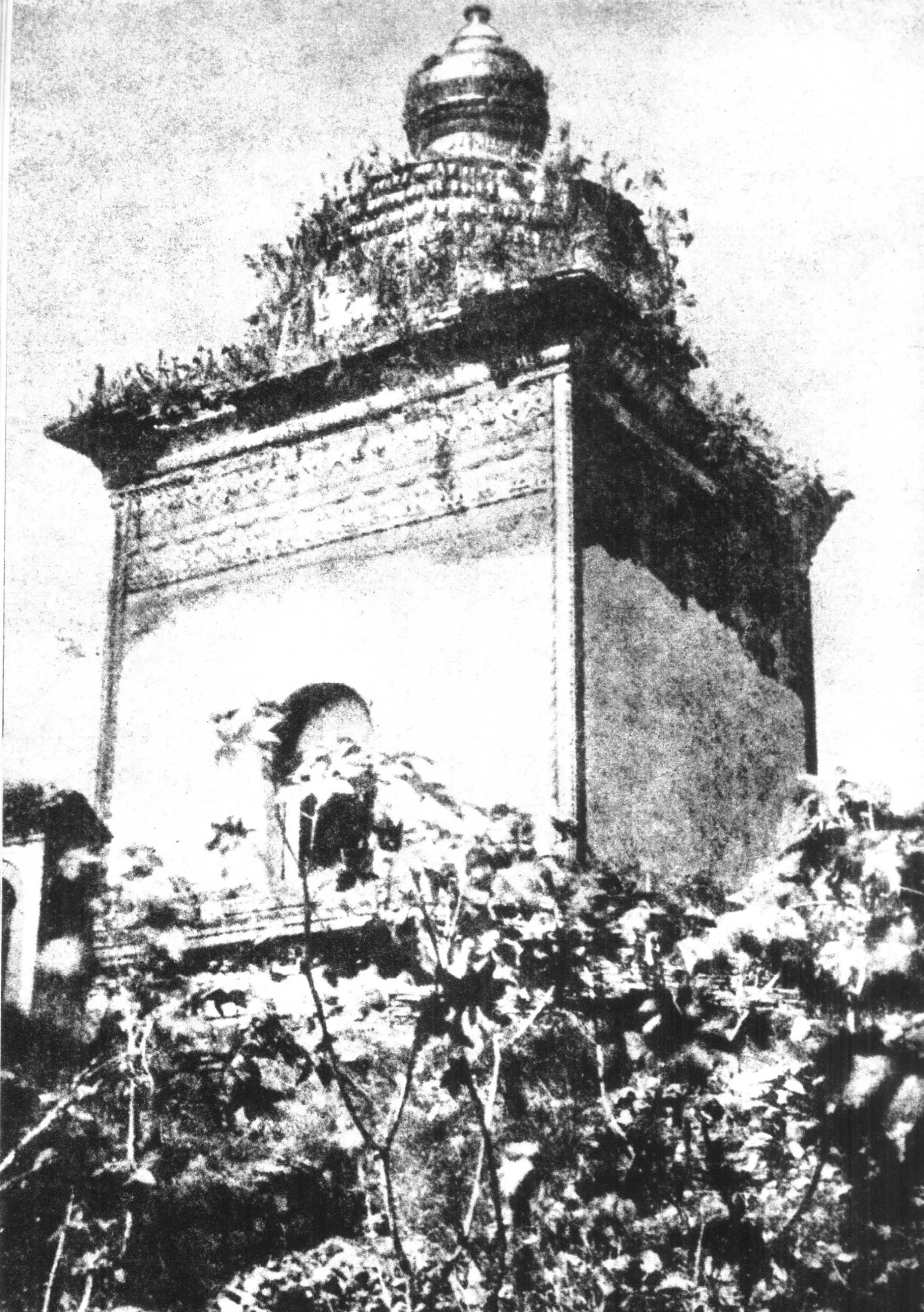
1930s
A plate collected in Anyang Xiudingsi Ta (The Xiuding Temple Pagoda of Anyang), edited by the Henan Provincial Institute of Cultural Relics, the Anyang Prefecture Cultural Relics Administration Committee, and the Anyang County Cultural Relics Administration Committee, originally captioned “the former appearance of the Xiuding Temple Pagoda (photographed in the 1930s)”; the photographer is not credited. In the image the pagoda body is still covered over large areas by plaster, and the top still preserves the later-added eaves and finial.
1961
A 1961 photograph collected in Anyang Xiudingsi Ta; the photographer is not credited. By this time the pagoda top was already broken, large patches of plaster had flaked from the pagoda body, and the entrance and part of the brick carvings were already exposed.
Before 1983
Anyang Xiudingsi Ta includes this photograph under the title “the relief-brick pagoda of Xiuding Temple”; it gives no date or photographer. The photograph records the state of the pagoda before the monograph’s publication: the brick carvings on the body exposed, the top already broken.
References
- Henan Provincial Institute of Cultural Relics, Anyang Prefecture Cultural Relics Administration Committee, and Anyang County Cultural Relics Administration Committee, eds., Anyang Xiudingsi Ta (The Xiuding Temple Pagoda of Anyang), Beijing: Cultural Relics Press, 1983.
- Yang Yang, “An Overview of the Rubbings of Stone Inscriptions from the Anyang Region in the Collection of Ma Heng”, Journal of Gugong Studies, 2020, cumulative issue no. 21.
- Fu Ssu-nien Library, Institute of History and Philology, Academia Sinica, digital collection: “Ye xian Xiudingsi zhuanji” (Record of Xiuding Temple in Ye County).
- Academia Sinica Center for Digital Cultures: “Xiudingsi Ta” (Xiuding Temple Pagoda), Digital Archive of Buddhist Grotto Sculpture.
- Li Meng, “The Rule and the Exception: The Implementation of the Abolition of Temples and Clergy in the ‘Rebel Territories’ in the Middle and Late Wude Era”, Bulletin of the Institute of History and Philology, Academia Sinica, vol. 90, pt. 3 (2019), pp. 399–448.
- Liu Changjiang, “The Xiuding Temple Pagoda of Anyang, Henan, and Zoroastrian Culture”, Journal of Anyang Normal University, 2019, no. 6, pp. 17–20.