Introduction
In the second year of the Qingli era of the Northern Song (1042), Guo Zhigao, the prefect of Dengzhou, was ordered to build a fortified stockade along Danya Hill, later popularly called the Daoyu Stockade. Nineteen years later, Zhu Chuyue, the prefect of Dengzhou, moved the Sea God Temple on the hill to level ground on its west side and built the Penglai Pavilion on the old temple’s foundations. The Daoyu Stockade stood beside the harbor at the foot of the hill, while the Penglai Pavilion rose on the summit of Danya Hill; the two stand next to each other, but they are not the same building.
In the Yuan dynasty, Yu Qin, a man of Shandong, came to the seashore of Dengzhou to investigate the sea-mirage (haishi)[1], and together with Li Shuzhi, the prefect of Dengzhou, prayed at the Shrine of King Guangde. Two days later they climbed the Binri Tower behind the government offices and waited. As the sun rose, what seemed a huge ship lay across Dazhu Island; banners and halberds suddenly appeared and then vanished, and the empty ship gradually drew out into a long gallery before it disappeared. Yu Qin therefore came to believe that the three divine mountains of the sea spoken of by the fangshi (masters of esoterica) of the Qin and Han were perhaps mirages of this kind. The Binri Tower they climbed is not the Penglai Pavilion on Danya Hill. When Yu Qin wrote of the Penglai Pavilion, he noted separately that beneath the pavilion lies the Lion’s Cave; before the cave is the Lingran Spring, also called the Wave Well, which the sea covers when the tide rises, yet whose water remains as sweet as ever once the tide withdraws; and the Sweet Spring Pavilion was already an old ruin by the time he put brush to paper.
Nor did the harbor basin below the hill fall out of use in the Yuan. In the silt at the southwest corner of the Water City’s Small Sea (Xiaohai) three fragmentary Yuan-dynasty ships are buried; the one that was excavated still held an iron sword, iron cannon, iron hand-guns, ash-bomb bottles, and iron cannonballs, and its long, narrow hull, suited to swift maneuvering in coastal waters, marks it as a warship. The southern stretch of the Water City had as yet no east–west wall at that time; the basin lay open to the south and was a place where ships gathered and nearshore defense was mounted.
In the ninth year of the Hongwu era of the Ming (1376), the Dengzhou Guard used seagoing ships to transship military supplies for Liaodong. Finding the mouth of the New River shallow and narrow, the commander Xie Guan memorialized for the channel to be dredged; an earthen wall was thrown up around the harbor, a water gate was built on the north side to let the sea into the harbor, and a barrier was set up on the south to inspect passing traffic. A command headquarters for defense against the wokou (Japanese pirates) was later established within the walls, and the earthen city thus came to be called Beiwo City[2] — that is, the Dengzhou Water City. The Water City lay north of the great city of Dengzhou; its wall crossed up onto Danya Hill in the northwest and hugged the river channel in the southeast, and the Penglai Pavilion stood above the Water City. In the twenty-fourth year of the Wanli era (1596), the regional commander Li Chengxun refaced the earthen wall with brick and stone and added three more watchtowers[3].
In the fourth year of the Chongzhen era (1631), Kong Youde, formerly a Ming commander, was ordered to lead troops to the aid of Liaodong; reaching Wuqiao, he mutinied, then turned back and stormed Dengzhou, which Geng Zhongming opened to him from within. The Ming court sent Zhu Dadian, the grand coordinator of Shandong, with an army to besiege the city and recover Dengzhou from the rebels. Though their grain ran out, the rebels, counting on the Water City as an escape route by sea, refused to surrender. In the second month of the sixth year of Chongzhen (1633), Kong Youde was the first to flee, loading his children and treasure aboard ship and putting out to sea; Geng Zhongming likewise slipped away in a single boat, leaving the Water City in the keeping of the deputy commander Wang Bingzhong. The Ming army first broke into the great city of Dengzhou on land, yet the Water City beside the harbor, under Wang Bingzhong’s control, still had not fallen. The guerrilla commander Liu Liangzuo proposed tunneling from the Yongfu Temple and planting gunpowder; the wall was blasted open, and the defenders fell back to hold the Penglai Pavilion. Only after Zhu Dadian offered terms of surrender did the rebels who had retreated onto the pavilion lay down their arms; the Ming army took more than a thousand prisoners, including Wang Bingzhong and seventy-five rebel commanders, and with that the fighting at Dengzhou came to an end.
In the eighteenth year of the Shunzhi era of the Qing (1661), the naval battalion of the Dengzhou garrison standard was posted to the Water City, with a garrison lieutenant (shoubei), a company commander (qianzong), and platoon commanders (bazong) of the left and right watches, and troops were rotated to guard the beacon towers at the eastern and western sea mouths, the defense sector running east to the border of Ninghai Prefecture and west to the border of Laizhou Prefecture. Thereafter the harbor basin was long troubled by silt. Ships entering port had to observe anti-silting rules, and on leaving they had to carry a set quantity of silt out to dump in the open sea; another large-scale dredging was carried out in the Xianfeng years, and in the late Qing five dedicated workers were appointed to clear the ground inside and outside the water gate at every low tide.
The walls of the Water City were likewise repaired again and again. In the fifty-eighth year of the Qianlong era (1793), An Kuiwen, the magistrate of Penglai County, requested funds for a major rebuilding; in the twentieth year of the Daoguang era (1840), the magistrate Wang Wentao refurbished it once more. Thereafter Chang Jun, the prefect of Dengzhou in the first year of the Tongzhi era (1862); Zhou Yunan, the magistrate of Penglai; and Zheng Xihong, the magistrate in the first year of the Guangxu era (1875), successively raised donations for repairs. The Qing scholar Ruan Yuan climbed here twice, and he stated the positional relationship between the Penglai Pavilion and the Water City most directly: “The Penglai Pavilion stands upon the Dengzhou Water City.”
Historical Documents
Qi Sheng
蓬莱阁,登州北三里海滨,田横寨相对,本海神庙基。宋治平中,郡守朱处约以其地太高峻,移庙西置平地,于此建阁,实为山海登临胜概。阁下有狮子洞,洞前有泠然泉,古称浪井,潮生浪起则没,水退则甘洌如故。旧有甘泉亭。阁下碎石为海浪淘激,岁久圆滑,土人谓之弹子涡,黑白者可以奕。坡公尝以数百枚养石菖蒲,作诗遗垂慈堂老。阁上古今题咏甚多,而宋人秦楼月一词颇飘逸。词云:烟漠漠,水天摇荡蓬莱阁。蓬莱阁,朱甍碧瓦,半浸寥廓。三山谩有长生药,茫茫云海风涛恶。风涛恶,仙槎不见,暮沙潮落。登人皆歌之。
The Penglai Pavilion lies on the seashore three li north of Dengzhou, facing the Tianheng Stockade; it stands on what was originally the site of the Sea God Temple. In the Zhiping era of the Song (1064–1067), the prefect Zhu Chuyue, finding the spot too high and steep, moved the temple west onto level ground and built the pavilion here; it is truly a magnificent vantage for climbing to overlook mountain and sea. Below the pavilion is the Lion’s Cave, and before the cave is the Lingran Spring, called in ancient times the Wave Well: when the tide rises and the waves surge, it is submerged, but when the water withdraws it is as sweet and clear as ever. There was formerly a Sweet Spring Pavilion. The broken stones below the pavilion, scoured and battered by the waves, have grown round and smooth over the years; the local people call them “pellet whorls,” and the black and white ones can be used to play weiqi. Duke Po (Su Shi) once used several hundred of them to grow sweet-flag among the rocks and wrote a poem for the elder of the Chuici Hall. On the pavilion there are a great many inscribed poems, ancient and modern, among which a Song lyric to the tune Qin Lou Yue is especially free and ethereal. The lyric runs: “Mist dim and distant; where water and sky sway and rock stands the Penglai Pavilion. The Penglai Pavilion — vermilion ridgepoles and azure tiles, half steeped in the vast empyrean. The Three Mountains vainly hold the elixir of long life; boundless is the sea of clouds, and cruel the wind and waves. Cruel the wind and waves; the immortal’s raft is nowhere seen; evening sands, the ebbing tide.” All the people of Deng sing it.
沙门岛南来转帆入渤海者,皆望此岛以为表志。其相联属,则有鼍矶岛、牵牛岛、大竹岛、小竹岛,历历海中,秀如画。海市现灭,常在五岛之上。海市之名,始见江邻几杂志。东坡诗序,或谓类南海蜃楼蛟蜃嘘气所成,殆不然。钦尝至登州海上访之。盖海市常以春夏晴和之时,杲日初升,东风微作,云脚齐敷于海岛之上,海市必现。现则山林城阙,楼观旌幢,毡车驼马,衣冠人物,凡世间所有,象类万殊,或小或大,或𫏐或久,或变现终日,或际海皆满,其为灵怪赫奕,岂蜃楼可拟哉?盖沧溟与元气呼吸,神龙变化,浩不可测,如佛经所谓龙王能兴种种雷电云雨,居于本宫,不动不摇,山海幽深,容有此理。钦以中秋后至海滨,天已微寒,知州事李述之,诗人也,亦相与祷于广德王之祠。越二日,忽报云:今晨风色云气,海市当现。同登宾日楼候之。日初出,大竹岛上横一巨艘,长余百寻,述之指以示余,余曰:此海舟耳。述之曰:谛观之,何故不动?须臾,前后曳数旗,剑戟纷纭,忽不见,惟有空舟渐变,如长廊而灭。述之曰:风稍急而寒,不然,现未已也。呜呼神哉!然则史汉所称三神山、蓬莱、方丈、瀛洲,望之如云,未能至者,殆此类耳。且秦、汉入海方士,仅能往来于矶岛之间,偶见此异,慕之为仙,亦不为过。非若今人航海远泛黑水洋外,或飘荡岁月而后返,果有蓬莱仙山,何不闻也?斯言足破千古之惑矣。
Ships sailing from the south that round their sails into the Bohai all look to Shamen Island as their landmark. Connected with it are Tuoji Island, Qianniu Island, Dazhu Island, and Xiaozhu Island, standing out clearly in the sea, lovely as a painting. The appearing and vanishing of the sea-mirage always takes place above these five islands. The name “sea-mirage” is first seen in the miscellany of Jiang Linji; the preface to Dongpo’s poem says that some take it to be formed, like the mirage-towers of the Southern Sea, from the puffed-out breath of krakens and giant clams — but that is surely not so. I once went to the sea off Dengzhou to look into it. The mirage generally occurs in spring or summer, when the weather is clear and mild, the bright sun has just risen, an east wind stirs gently, and the feet of the clouds lie evenly over the islands of the sea — then the mirage is certain to appear. When it appears, there are mountain forests and city watchtowers, belvederes and bannered standards, felt carriages and camels and horses, capped and robed figures — everything the world possesses, in ten thousand different likenesses, now small, now great, now brief, now lasting, now transforming all day long, now filling the sea to its farthest edge. So numinous and strange, so blazing and splendid — how could any clam-mirage be compared to it? For the gray sea breathes together with the primal ether, and the transformations of the divine dragons are vast beyond measure; as the Buddhist scriptures say, the dragon kings can raise every kind of thunder, lightning, cloud, and rain while dwelling in their own palaces, unmoving and unshaken — the mountains and seas are deep and hidden, and such a principle may well be admitted. I reached the seashore after the Mid-Autumn Festival, when the sky had already turned slightly cold. Li Shuzhi, the prefect, a poet, went with me to pray at the Shrine of King Guangde. After two days came a sudden report: judging by this morning’s winds and clouds, the mirage should appear. Together we climbed the Binri Tower and waited. Just as the sun came up, a huge ship lay across Dazhu Island, more than a hundred xun long. Shuzhi pointed it out to me. I said: “That is an ocean-going vessel.” Shuzhi said: “Look closely — why does it not move?” In a moment, several banners trailed fore and aft, swords and halberds multiplied in confusion; then suddenly they were gone, and only the empty ship slowly changed, stretching out like a long gallery before it vanished. Shuzhi said: “The wind has turned somewhat sharp and cold; otherwise the display would not yet have ceased.” Ah — how divine! Thus the Three Divine Mountains of which the Shi ji and the Han shu speak — Penglai, Fangzhang, and Yingzhou, which loom like clouds yet could never be reached — are surely of this kind. Moreover, the fangshi who put to sea under the Qin and Han could only ply back and forth among these rocky isles; chancing to see this marvel and admiring it as the abode of immortals is, in them, no great fault. It is not like the seafarers of today, who sail far out beyond the Black Water Ocean and drift for years on end before returning: if there truly were an immortal Mount Penglai, why has no word of it ever been heard? These words suffice to dispel the bewilderment of a thousand ages.
Penglai Ge Ji
世传蓬莱、方丈、瀛洲在海之中,岂□□□□其处,其□恍惚□异,多出方士之说,难□。登州所居之邑曰蓬莱,岂非秦、汉之君东游以□□迹,意神仙果可求也,蓬莱不得见,而空名其邑曰蓬莱,使后传以为惑。据方士三山之说,大抵草木鸟兽神怪之名,又言仙者宫□伟大,气序和平之状,餐其草木,则可以长生不死。长往之士,莫不欲到其境,而脱于无何有之乡。祭海而望,翕然注想物外,不惑其说者有矣。嘉祐辛丑,治邦逾年,而岁事不愆,风雨时若,春蓄秋获,五谷登成,民皆安堵。因思海德润泽为大,而神之有祠,俾遂新具庙,即其旧以构此阁,将为□人游览之所。层崖千仞,重溟万里,浮波涌金,扶桑日出,霁河横银,阴灵生月,烟浮雾横,碧山远列,沙浑潮落,白鹭交舞,游鱼浮上,钓歌和应。仰而望之,身□翔,俯而瞰之,足蹑鳌背。听览之间,恍不知神仙之蓬莱也,乃人世之蓬莱也。上德远被,恩涵如春,恍若致俗于仁寿之域,此治世之蓬莱也。后因名其阁曰蓬莱,盖志一时之事,意不知神仙之蓬莱也。
The world has handed down that Penglai, Fangzhang, and Yingzhou lie in the midst of the sea, but how could [……] their location? Their […] dimness and […] strangeness come largely from the tales of the fangshi and are hard to […]. The county in which Dengzhou is seated is named Penglai: was it not that the rulers of Qin and Han journeyed east and [……] traces, thinking that divine immortals could indeed be sought, yet, never beholding Penglai, named their county Penglai in vain, leaving later ages to hand down the error? According to the fangshi account of the Three Mountains, they give mostly the names of plants, trees, birds, beasts, spirits, and marvels, and they tell of the immortals’ palaces […] magnificent, of a climate mild and harmonious, and that to feed upon their plants and trees is to live long and never die. Of those who long to depart for good, none does not wish to reach that realm and shed himself in the Land of Nothing-Whatsoever. To sacrifice to the sea and gaze out, the whole mind poured beyond the things of this world — yet there have been those who were not deluded by such talk. In the xinchou year of the Jiayou era (1061), I had governed this prefecture for more than a year; the year’s tasks went without fault, wind and rain came in season, what was stored in spring was gathered in autumn, the five grains ripened, and the people all dwelt in peace. Reflecting then that the sea’s bounty of moisture is the greatest of virtues, and that the god has his shrine there, I had the temple renewed and furnished and, on its old site, built this pavilion, to be a place where […] people might roam and gaze. Tiered cliffs of a thousand ren, layered seas of ten thousand li; floating billows surging with gold, the sun rising from the Fusang tree; the cleared sky’s river laid across in silver, the moon born of the hidden spirit; mist drifting and fog stretched out, emerald mountains ranged afar; sands churned as the tide falls, white egrets dancing across one another, swimming fish floating up, and fishermen’s songs answering in harmony. Looking up to behold it, one’s body […] soars; bending down to survey it, one’s feet tread the turtle’s back. Amid all that is heard and seen, one forgets in a trance that this is not the Penglai of gods and immortals — it is the Penglai of the human world. When the sovereign’s virtue reaches afar and his grace nourishes like spring, it is as though the people were brought into a realm of benevolence and long life: this is the Penglai of a well-governed age. Thereupon I named the pavilion Penglai, to record the affairs of a single time, mindful that it is not the Penglai of gods and immortals.
Zheng Kaiyang Zazhu
登、莱二郡突出于海,如人吐舌,东、南、北三面受敌,故设三营联络,每营当一面之寄。登州营所以控北海之险也,登、莱二卫并青州左卫俱隶焉。策应地方,语所,则有奇山、福山、中前、王徐前诸所;语寨,则有黄河口、刘家、汪解、宋芦、徐马停、皂河、马埠诸寨;语巡司则有杨家店、高山、孙𡵚镇、马亭镇、东良海口、柴胡、海仓、鱼儿铺、高家港诸司。三营各立把总二员总辖之。在海外则岛屿环抱,自东北崆峒、半洋,西抵长山、蓬莱、田横、沙门、鼍矶、三山、芙蓉、桑岛,错落盘踞,以为登州北门之护。过此而北,则辽阳矣。此天造地设之险也。然诸岛虽近登州,而居岛中以取鱼盐之利者,乃辽阳之编伍,非山东之戍卒也。叫呶跳梁,可畏而不可恃。故北海之滨,既有府治,复建备倭城于新河海口,以为屏翰,且有本营之建焉。沿海兵防,特重其责,非若他省但建水寨于岛屿,良有以也。夫岛屿既不设险,则海口所系匪轻。自营城东,若抹直石、落湾子、刘家汪、平畅、芦洋诸处,自营城西若西王庄、西山、栾家、孙家、海洋、山后八角、城后芝罘、莒岛诸处,皆可通番舶登突。严外户以绥堂阃,其本营典守之责乎!
The two prefectures of Dengzhou and Laizhou jut out into the sea like a man’s protruding tongue, exposed to the enemy on three sides — east, south, and north; therefore three battalions were established in mutual liaison, each battalion charged with one face. The Dengzhou Battalion exists to control the narrows of the Northern Sea; the two guards of Dengzhou and Laizhou, together with the Qingzhou Left Guard, are all subordinate to it. As for the places it supports: speaking of the stations (suo), there are Qishan, Fushan, Zhongqian, Wangxuqian, and the rest; speaking of the stockades (zhai), there are Huanghekou, Liujia, Wangxie, Songlu, Xumating, Zaohe, Mabu, and the rest; speaking of the patrol offices (xunsi), there are Yangjiadian, Gaoshan, the town of Sun𡵚, Ma’anting, Dongliang Haikou, Chaihu, Haicang, Yu’erpu, Gaojiagang, and the rest. Each of the three battalions has two platoon commanders (bazong) appointed to exercise overall command. Out at sea, islands enfold it in a ring: from Kongtong and Banyang in the northeast, reaching west to Changshan, Penglai, Tianheng, Shamen, Tuoji, Sanshan, Furong, and Sangdao — strewn about and crouching in array, they serve as the shield of Dengzhou’s northern gate. North beyond them lies Liaoyang. This is a fastness fashioned by heaven and set by earth. Yet though the islands lie near Dengzhou, those who dwell among them to take the profit of fish and salt are the registered levies of Liaoyang, not the garrison troops of Shandong; clamorous and unruly, they are to be feared, not relied upon. Therefore on the shore of the Northern Sea, in addition to the prefectural seat, the Beiwo City was built at the mouth of the New River to serve as a screen and bulwark, and this battalion was established there as well. Coastal defense is a charge of particular weight here, unlike other provinces, which merely build water stockades among the islands — and there is good reason for it. Since the islands offer no defensible fastness, the responsibility borne by the sea mouths is no light one. East of the battalion city, such places as Mozhishi, Luowanzi, Liujiawang, Pingchang, and Luyang; and west of the battalion city, such places as Xiwangzhuang, Xishan, Luanjia, Sunjia, Haiyang, Bajiao behind the hill, and Zhifu and Judao behind the city — all are points where foreign ships may come in and make sudden landings. To make the outer door fast so as to pacify the hall within — is that not the charge this battalion is appointed to keep?
Shandong Tongzhi
登州府城。水城二丈四尺,四门,门上有楼,池阔一丈四尺,深八尺。
The city of Dengzhou Prefecture. The Water City’s wall is two zhang and four chi high, with four gates and towers atop the gates; the moat is one zhang and four chi wide and eight chi deep.
Zengxiu Dengzhou Fu Zhi
水城在城北,与大城相连,即宋之刀鱼寨。明洪武九年,设登州卫,置海船运辽东军需。指挥谢观以河口浅隘,奏议挑濬,绕以土城,北砌水门,引海入城,名新开口,南设关禁,以讥往来。后因备倭,立帅府于此,名备倭城。周三里许,高三丈五尺,厚一丈一尺,西北跨山,东南濒河,南一门曰振扬,楼铺共二十六。万历二十四年,总兵李承勋甃以砖石,增敌台三,知府徐应元复修之。崇祯十一年,知府陈钟盛,同知来临增修。国朝乾隆五十八年,知县安奎文请帑重修。道光二十年知县王文焘,同治元年知府常筠、知县周毓南、光绪元年知县郑锡鸿相继劝捐修葺。
The Water City lies north of the prefectural city and is joined to the great city; it is the Daoyu Stockade of the Song. In the ninth year of the Hongwu era of the Ming, the Dengzhou Guard was established, and seagoing ships were set to transport military supplies for Liaodong. The commander Xie Guan, finding the river mouth shallow and narrow, memorialized in favor of dredging; an earthen wall was thrown around it, a water gate was built in the north to let the sea into the city — named the New Opening — and a barrier was set up in the south to inspect comings and goings. Later, for defense against the wokou, a commander-in-chief’s headquarters was established here, and it was named Beiwo City. Its circumference is about three li, its height three zhang and five chi, its thickness one zhang and one chi; in the northwest it strides across the hill, in the southeast it borders the river, and the single southern gate is called Zhenyang, with twenty-six gate-towers and guardhouses in all. In the twenty-fourth year of the Wanli era, the regional commander Li Chengxun faced it with brick and stone and added three watchtowers, and the prefect Xu Yingyuan repaired it again. In the eleventh year of the Chongzhen era, the prefect Chen Zhongsheng and the vice-prefect Lai Lin added to the repairs. In the fifty-eighth year of the Qianlong era of the present dynasty, the magistrate An Kuiwen requested treasury funds for a major rebuilding. Thereafter the magistrate Wang Wentao in the twentieth year of the Daoguang era, the prefect Chang Jun and the magistrate Zhou Yunan in the first year of the Tongzhi era, and the magistrate Zheng Xihong in the first year of the Guangxu era successively raised donations for repairs.
Ming Shi
贼窜归登州,国臣等筑长围守之。城三面距山,一面距海,墙三十里而遥,东西俱抵海,分番戍,贼不能出,发大𪿫,官军多死伤。李九成出战相当。十一月,九成搏战,降者泄其谋。官军合击之,馘于阵,贼乃晓夜哭。贼渠魁五,九成、有德、有时、耿仲明、毛承禄也,及是杀其二。帝嘉解围功,进大典右副都御史,将吏升赏有差。是月,国奇卒,以襄代。攻围既久,贼粮绝,恃水城可走,不降。及王之富、祖宽夺其水门外护墙,贼大惧。六年二月中旬,有德先遁,载子女财帛出海。仲明以水城委副将王秉忠,己亦以单舸遁。官军遂入大城,攻水城未下。游击刘良佐献轰城策,匿人永福寺中,穴城置火药发之,城崩,官军入,贼退保蓬莱阁。大典招降,始释甲,俘千余人,获秉忠及伪将七十五人,自缢及投海死才不可胜计,贼尽平。
The rebels fled back to Dengzhou, and Wu Guochen and the others built a long circumvallation to hold them. The city fronts hills on three sides and the sea on one; the siege wall stretched a full thirty li, reaching the sea at both its eastern and western ends, and was garrisoned in rotation, so the rebels could not get out. They fired great cannon, and the government troops suffered many killed and wounded. Li Jiucheng sallied to give battle. In the eleventh month, Jiucheng fought hand to hand, but turncoats betrayed his plan; the government troops struck him from all sides and cut him down in the field, and the rebels wept day and night. There had been five rebel chieftains — Jiucheng, Kong Youde, Li Youshi, Geng Zhongming, and Mao Chenglu — and by this time two of them had been killed. The emperor commended the merit of the siege, promoted Zhu Dadian to right vice censor-in-chief, and advanced and rewarded officers and men in due degree. That month Wu Guoqi died and was replaced by Chen Xiang. The assault and siege had gone on long; the rebels’ grain was exhausted, but they counted on escaping by way of the Water City and would not surrender. When Wang Zhifu and Zu Kuan seized the protecting wall outside the water gate, the rebels were greatly afraid. In the middle of the second month of the sixth year, Youde fled first, carrying his children and treasure out to sea. Zhongming entrusted the Water City to the deputy commander Wang Bingzhong and himself fled in a single skiff. The government troops then entered the great city, but their attack on the Water City failed to take it. The guerrilla commander Liu Liangzuo proposed a plan to blast the city: hiding men in the Yongfu Temple, they tunneled under the wall, planted gunpowder, and set it off; the wall collapsed, the government troops entered, and the rebels fell back to hold the Penglai Pavilion. Only when Dadian offered terms did they lay down their arms. More than a thousand prisoners were taken; Bingzhong and seventy-five rebel commanders were captured; and of those who hanged themselves or cast themselves into the sea to die, the number was beyond reckoning. The rebels were entirely pacified.
Chongxiu Penglai Ge Ji
□按史,秦皇东游海上,登之罘,以冀与神仙遇。汉武时,燕、齐迂怪之士扼腕言海上有蓬莱、方丈、□□三神山之属,仙人可致。帝欣然庶几遇之,即其地望莱□。蓬莱阁之名,实昉此焉。说者曰:兹名也,侈心也。胡为乎沿之而以重修烦也。考郡乘,宋嘉祐□,守臣朱处约氏实创构之,谓上德远被,致俗仁寿,此治世之蓬莱也。语具农珉中。余览而旨之,叹曰:知言哉!古人一丘一壑,不凿登咏。矧是阁首踞丹崖,𫖯瞰□滨,千折之槛,三至之阶恍然出人。间世固城内一奇也。岛可无修在□□天海涵,寅宾日出,周波不扬,肃旗东来,□鸣氏之所宅,管敬仲之所官,升降不知凡几,于海王之国仅一瞬也,可以观世。风雨□冥之潮□万状,沙门□矶,牵竹之楼台闪忽,鱼龙犀□象罔之出没无常,安期美门,紫芝瑶草之若有若无。凭栏一睇,桐心骇目,斯诧□吊诡之间也。□以观变。尔乃观海摅襟,登高作赋,或明风干。爰□,或□物于□矢,或寓言于齐谐,或侈谈于□海,或□□□以见奇,或祷海市以志感,秀色雄乎涛声,□思巧于蜃气,可以观材。至若东扼岛夷,北控辽左,南通吴会,西翼燕云,艘运之所达,可以济咽喉;备倭之所据,可以崇保障。封豕靡所渔,长鲸罔敢吸,可以观要。抚时察变,度材修要,四者备,天下之大观矣。
[…] Consulting the histories: the First Emperor of Qin journeyed east to the sea and climbed Zhifu, hoping thereby to meet gods and immortals. In the time of Emperor Wu of Han, the devious and wonder-telling men of Yan and Qi, wringing their wrists in fervor, declared that out on the sea there were Penglai, Fangzhang, [……], and other such divine mountains, and that the immortals could be induced to come. The emperor gladly hoped that he might meet them, and from that place gazed toward Lai[…]. The name of the Penglai Pavilion truly has its beginning in this. A critic might say: such a name bespeaks an extravagant heart; why follow it and put oneself to the trouble of a rebuilding? But examining the prefectural gazetteer, in the Jiayou […] era of the Song it was in truth the prefect Zhu Chuyue who first built it; he said that when the sovereign’s virtue reaches afar and brings the people to benevolence and long life, this is the Penglai of a well-governed age. His words are preserved in the stone inscription. I read them, savored them, and sighed: he knew how to speak! The men of old, though they had but one hill or one ravine, did not carve up the land merely to make a climb worth singing. How much more this pavilion, first perched upon Danya, gazing far down upon the […] shore — its balustrades of a thousand turns, its steps of three ascents, transport one in a trance. Amid the works of man it is truly a marvel within the city walls. That it could not be left unrepaired is plain: [……] the heavens and the sea contain all things — the rising sun ceremonially greeted, the waves on every side never stirred, the solemn banners coming from the east; this was the dwelling of the […]ming clan and the office of Guan Jingzhong, and how many risings and fallings there have been none can know, yet to the sea-king’s realm they are but an instant: here one may contemplate the ages. In wind and rain […] gloom, the tide takes […] ten thousand shapes; off Shamen and […]ji, the towers and terraces of Qianniu and Dazhu flicker and flash; fish-dragons, rhinoceros[…], and water-illusions appear and vanish without constancy; Anqi and Xianmen, purple magic-fungi and jasper herbs seem now to be, now not to be. One glance from the railing startles the heart and dazzles the eye — this, amid wonders strange and uncanny: […] here one may contemplate change. Then, gazing upon the sea, one opens one’s breast; climbing high, one composes a fu: some brighten the wind in […], some […] things in […] arrows, some lodge their meaning in the tales of Qi Xie, some discourse extravagantly of the […] sea, some [……] to display the marvelous, some pray for the sea-mirage to record what moved them — the fair scene more heroic than the sound of billows, the […] thought more artful than the clam-vapor: here one may contemplate talent. As for this: eastward it chokes the island barbarians, northward it holds Liaodong in check, southward it communicates with Wu and Kuaiji, westward it wings over Yan and Yun. Where the grain-ships’ transport reaches, it succors the throat of the realm; where the defense against the wokou holds its ground, it exalts the bulwark of the state. The great boars find nowhere to fish, the long whales dare not suck the seas: here one may contemplate strategic weight. To hold fast to the times and discern change, to measure talent and cultivate the vital points — with these four complete, here is the grandest spectacle under heaven.
鸟可无修。语有之:台以察氛祲,节劳佚,微独于目观美也。盖古之仁人君子,遐思逖览,罔不在民。记超然台则起物外之想,登岳阳楼则勤先忧之思,宁独骋盻望,流光景为旷巳乎?若乃登兹阁者,纪网之臣肃其宪令,封疆之臣宣其慈惠,文学之臣藻其鞶悦,将帅之臣振其武略,俾物无疵厉,民无夭札,跻斯世而蓬莱之,庶几仁人君子之用心哉!无论世无神仙蓬莱,政使有之,以方我大明盛治,摹唐型周,海静风恬,真人天境界果何若也?抑方丈瀛洲,君子固掩日不欲道耶?然则是阁也,修于治世尤亟矣。余固曰:知言哉!宋臣也,卑卑秦汉,从臾者流,奚置喙焉。是役也,前□□□檄经始,稽费则公课百余𦈏,乡官成□□□□□□,预办材□左。会巡抚□东顾公海檄□□价壁,谕水□金,输运三年,财靡帑出,力靡民□□□□□□旧贯,什倍之□。阁入国朝,一修于永□间,□修于成化七年北,兹三修也。阁事竣,适不谷建节之初,郡吏具状守、巡以请,佥谓材美制巨,地胜名䢢,不可以不记也。于是乎记。
How could it go unrepaired? There is a saying: terraces are for observing the baleful and benign vapors and for regulating toil and ease — the beauty that meets the eye is not their only end. For the benevolent men and noble persons of old, in their far thoughts and distant views, kept always to the people. To record the Terrace of Transcendence is to rise to thoughts beyond the things of this world; to climb the Yueyang Tower is to labor at the sorrow that comes before all others — how could these be only the free play of gazing, the spending of light and scene in self-abandonment? As for those who climb this pavilion: let the ministers of the law keep their statutes stern; let the ministers of the frontiers spread their kindness and bounty; let the ministers of letters adorn the elegance of their sashes; let the ministers of war rouse their martial strategy — so that no creature suffers blight or plague and none of the people are cut off untimely, and this whole age is lifted up and made a Penglai: that would come near to the heart’s purpose of benevolent men and noble persons. Not only is there no immortal Penglai in the world — but even supposing there were, set beside the flourishing rule of our Great Ming, patterned on Tang and modeled on Zhou, the sea stilled and the winds gentle, what would the true realm of heaven amount to? Or is it that the noble man simply covers his eyes at Fangzhang and Yingzhou, unwilling to speak of them? Thus the repair of this pavilion is all the more urgent in a well-governed age. I have indeed said: he knew how to speak! That minister of Song — those puny Qin and Han and the crowd of flatterers who urged them on — what place had they to put in a word? As for this work: previously [……] it was begun by dispatch; reckoning the cost, a hundred-odd min of public revenue were assessed, the local officials [……], and materials were prepared in advance […]. Then the grand coordinator, Lord Gu of […]dong, by maritime dispatch [……] the price for the wall, instructed the water[…] funds; over three years of transport, no coin came from the treasury and no labor from the people [……] the old scheme, [raised to] ten times the […]. Since the pavilion entered the present dynasty, it was repaired once in the Yong[le] period and […] repaired in the seventh year of the Chenghua era in the north; this is the third repair. When the work on the pavilion was finished, it chanced to be the beginning of my taking up this commission; the prefectural officers drew up a report, the prefect and the circuit intendant made the request, and all agreed that with materials so fine and a structure so great, a site so surpassing and a name so apt, it could not go unrecorded. And so this record was made.
Haijing Ting Ji
登州临观之胜,曰蓬莱阁,枕丹崖,俯沧海,士大夫燕游歌咏,必于是焉在。樽酒未终,云物百变,然长山诸岛逼出其左,若得海之一隅。阁下四壁皆石刻,多世俗所□。蓬莱八景,殊少善本。苏文忠巂书海市歌,字剥落,类刓削者几煎人。碑刻名迹,吏多微榻□本,不予其直,民怨其病已也,而毁之,如此者甚众,是□惜也。右折而下,为海潮庵,庵左侧有亭皎然,轩楹□厂,盖先朝台使者阅水师处。今武备不讲久矣。把酒凭栏,左右洲岛参差,至此则一碧万里,无复织芥。风微日霁,波平如熨,上可以凭虚御风,与三山十洲相往来,而下可以接鲛宫蜃市于几席间也。丁酉夏四月十有四日,予夜宿亭畔,水月空明,毛发可数,书其上曰海镜。明年再至,则郡丞马君扫除丹雘,登望潇洒,留连不能去。事固有名微而实胜,居卑而视广者,有类于是。后之好事者,其毋务崇其观,礼其垣,以废吾亭,乃龙石而记之。
The finest of Dengzhou’s prospects over the sea is called the Penglai Pavilion: pillowed on Danya, it bends over the gray sea, and when gentlemen gather to feast, roam, and sing, it is always here. Before the wine in the goblet is finished, the clouds and scene have changed a hundred times; yet the Changshan islands press out close on its left, as if one had caught but a corner of the sea. The four walls below the pavilion are all stone inscriptions, most of them […] by the common crowd; of the Eight Views of Penglai there are singularly few good versions. Su Wenzhong’s (Su Shi’s) large-script Song of the Sea-Mirage has flaked and peeled, as though worn away by scraping — nearly enough to torment the beholder. As for the famous stones, the clerks often take rubbings on the sly without paying their worth; the people, resenting the harm done them, have destroyed them — and such cases are very many: it is […] to be lamented. Turning right and descending, one comes to the Haichao Nunnery; on the nunnery’s left stands a pavilion, bright and gleaming, its porch and pillars […] spacious — this was where, in the former dynasty, the censorate’s envoys reviewed the naval force. Now military preparedness has long gone undrilled. With wine in hand, leaning on the railing, the isles rise unevenly to left and right; but from here it is one unbroken azure for ten thousand li, without a fleck or flaw. When the breeze is faint and the sun clear, the waves lie flat as though ironed: above, one might lean on the void and ride the wind, passing back and forth with the Three Mountains and the Ten Isles; below, one might receive the merman-palaces and clam-markets across one’s table and mat. On the fourteenth day of the fourth month of summer in the dingyou year (1657), I lodged for the night beside the pavilion; the water and moon were empty and bright, so that one might have counted one’s hairs, and I wrote upon it the name Sea-Mirror. When I came again the next year, the vice-prefect, Master Ma, had swept it clean and given it fresh red and white; climbing to gaze in carefree ease, I lingered and could not tear myself away. Among the things of this world there are indeed those whose name is slight but whose substance surpasses, whose seat is low but whose view is wide — and this is of their kind. May lovers of such things in later days not labor to raise the prospect high and honor it with walls, only to do away with my little pavilion. And so I had the stone dressed and made this record.
Gujin Tushu Jicheng · Zhifang Dian
登镇标水师营,原系登州水营,顺治十八年设守备一员,千总一员,左哨把总一员,右哨把总一员,驻札登州水城并分防水城东西海口墩台,其东至宁海州交界,西至莱州府交界,拨把总带领兵丁轮流分防。
The naval battalion of the Dengzhou garrison standard was originally the Dengzhou naval camp. In the eighteenth year of the Shunzhi era were appointed one garrison lieutenant (shoubei), one company commander (qianzong), one platoon commander (bazong) of the left watch, and one platoon commander of the right watch, stationed at the Dengzhou Water City and dividing the defense of the beacon towers at the sea mouths east and west of the Water City, their sector running east to the border of Ninghai Prefecture and west to the border of Laizhou Prefecture; a platoon commander was detached to lead the soldiers in rotating assignments to the defense.
登州滨海而郡有山蜿蜒分脉,泰宗来自东南,崒〼海岸作镇城北,前人构阁其上,榜曰蓬莱,夫蓬莱境界号称仙居,其说见于山经水注所记载骚士韵客所托兴,不一而足,而是阁之构乃以是名,其有慕而为之耶。抑将以形破影,以迹蹈空,使登是阁者悟蓬莱,亦如是阁不必更从阁外觅蓬莱耶。予以丙子秋奉命守登,初一登临,见荒烟蔓草颓垣裂瓦,满目萧条,感极而悲,盖以崇祯五年燹于兵故也。及考诸舆志则登为古嵎夷地,寅宾出日于是乎,在而西北有田公寨,是固五百义士所慷慨发愤不为汉臣者也。北折而南则有之罘岛、文登山、不夜城、系马台,是固秦皇汉武所巡幸驻跸,祷祀祈求希望长生而不可得者也。极目浩渺,浮波隐见,则有皇城岛、鼍矶诸峦峙其间,太宗渡辽之绩,仁贵天山之功,流传约略犹有可论述者,然则登虽小郡,实南北关钥,自昔圣帝明王英雄豪杰之所式化驰骛之区也,乌睹所谓瑶花琪树,玉阙金楹之胜,概安期子晋王乔叶善之,往来而号曰蓬莱也哉,虽然世外蓬莱有与无不必论,而解脱缰锁,涤除烦苛以自心蓬莱造斯世蓬莱,其得失可还商也。我明太祖肇造,区夏薄海内外,靡非臣妾列圣相承,重熙累洽民生三百年来不见兵革,鸡犬桑麻嬉游歌舞声影闻望迄于四境,前后长兹土者或公慈而廉明,或易直而子谅,政无虎猛,俗鲜鸿哀,所称至治之世,纳兆庶于春台,其在斯时乎,使世外果有蓬莱,其优游自得与物无竞之景当亦如是,已耳无何乱起刊湮荡析之惨,仳离怨旷之气通于城野,而曩之所谓鸡犬桑麻嬉游歌舞声影闻望迄于四境者盖已不可复识矣,予抵登之年,竭蹶砥砺,积粟储器,以戒不虞,幸而鲸波载息,蛟穴爰清,虽不敢谓学道爱人遽臻上理,而生聚教训固守土者之责也,其荡析仳离之景行且一转而曩,昔嬉游歌舞之乐不且再见欤,其纳兆庶于春台,使之优游自得也,即以环登为蓬莱亦可耳,至若流连景会随物悲喜,写骚情于毫端,抒逸兴于赋底,则善乎范希文之言曰:君子先天下之忧而忧,后天下之乐而乐。虽是阁之中风潮月汐,雾彩星碁,一日之内晦暝异态,可娱宴而匪所思存也。时因葺治城垣修建,海神天妃诸庙以为国祝,厘为民祈祷,用纪其事,与予之意以告登众,以贻后来有如此者。
Dengzhou borders the sea, and the prefecture has a hill whose winding spurs branch from the veins of Mount Tai, coming from the southeast to stand abrupt on the sea coast as the guardian of the city on its north. Men of old built a pavilion upon it and inscribed its board “Penglai.” Now the realm of Penglai is famed as the dwelling of immortals; its account appears in what the classics of mountains and the commentaries on waters record and in the songs to which poets and rhymesters have entrusted their fancies, more than can be numbered — and that this pavilion’s building took this for its name: did they admire it and so name it? Or did they mean to break the shadow with the form, to tread the void with solid traces, so that one who climbs this pavilion would wake to see that Penglai is like this pavilion, and need not be sought beyond it? In the autumn of the bingzi year (1636) I received my orders to govern Deng. When first I climbed to gaze, I saw desolate mist and creeping weeds, toppled walls and shattered tiles, bleakness filling the eye, and I was moved to the point of grief — for in the fifth year of the Chongzhen era it had been burned in war. When I examined the gazetteers, I found that Deng is the ancient land of the Yuyi, where the rising sun is ceremonially greeted; and to the northwest is the Stockade of Lord Tian, where the five hundred righteous men in ardent indignation refused to become subjects of the Han. Turning north and then south are Zhifu Island, Mount Wendeng, the City of Never-Night, and the Terrace of the Tethered Horse, where the First Emperor of Qin and Emperor Wu of Han once journeyed and lodged, offering prayers and sacrifices and hoping for long life without ever obtaining it. As far as the eye can reach, vast and boundless, now hidden, now seen upon the floating waves, stand Huangcheng Island and the peaks of Tuoji among them; the deeds of Taizong’s crossing to Liao and the feats of Rengui at the Tianshan mountains are handed down in outline and can still be recounted. Thus, though Deng is but a small prefecture, it is truly the lock and key of north and south, a ground where since olden times sage emperors and enlightened kings, heroes and stout-hearted men, have held sway and galloped. Where here are the so-called glories of jasper flowers and coral trees, jade towers and golden columns — the comings and goings of Anqi, Zijin, Wang Qiao, and Ye Shan, that it should be called Penglai? Even so, whether the Penglai beyond this world exists or not need not be argued: to loose oneself from bridle and fetters, to wash away vexation and harshness, to make a Penglai of one’s own heart and thereby make a Penglai of this world — the gains and losses of that may still be weighed and discussed. Our Ming Taizu first fashioned the realm, and all within and beyond the four seas were his servants; the successive sage emperors carried on in accumulating splendor and harmony, and for three hundred years the people’s life saw no clash of arms; chickens and dogs, mulberry and hemp, play and song and dance — their sounds and sights reached to the four borders. Those who governed this land, before and since, were some just and kind, incorrupt and discerning, some plain and honest, tender and true; the governance had no tiger’s ferocity, the people few a homeless wanderer’s lament. What is called an age of utmost order, gathering the multitudes onto the terrace of spring — was it not then? If beyond this world there truly is a Penglai, its carefree ease, contending with nothing, must also have looked like this — that is all. But before long turmoil arose: the misery of erasure and scattering, the air of parting and desolate longing, spread through city and countryside, and the former so-called chickens and dogs, mulberry and hemp, play and song and dance whose sounds and sights reached the four borders can no longer be recognized. In the year I arrived at Deng, I toiled and honed myself, husbanding grain and storing arms as a guard against the unforeseen; by fortune the whale-waves came to rest and the kraken-dens were cleared. Though I dare not claim that by learning the Way and loving the people I have at once attained the highest order, yet to gather the people and teach them is the standing duty of one charged with the land. That scene of scattering and parting shall soon turn back into the past, and the joys of play and song and dance of former days — shall they not be seen again? To gather the multitudes onto the terrace of spring and give them carefree ease — one may take the whole circuit of Deng as Penglai, and that is enough. As for lingering over the meeting of scenes, rejoicing and grieving with the things of the moment, writing a poet’s feelings with the brush’s tip, pouring out untrammeled spirit at the bottom of a rhyme — there Fan Xiwen’s words are apt: “The noble man sorrows before all under heaven sorrow, and rejoices only after all under heaven rejoice.” Though within this pavilion there are wind and tide, moon and ebb, mist in colors and stars strewn like chess pieces, and within a single day its aspects change from gloom to dark, these can gladden a feast but are not where my thoughts abide. At that time, taking occasion from the repair of the city walls, I rebuilt the temples of the Sea God, the Heavenly Consort, and the rest, to offer prayers for the state and to make supplication for the people; and I have recorded the matter, together with my meaning, to tell the people of Deng and to leave it to those who come after, as is set out above.
Xiao Canglang Bitan
蓬莱阁在登州水城上几席之外海天万里沙门诸岛浮青数痕耳予两至此皆天气晴朗风清日丽绝未见所谓海市者故余有句云天能包括鲸波静日有光辉蜃气销余考史书地志山东沼海州县多有海市唐以前绝无海市之说凡史记所称秦始皇见仙人之地皆今有海市之地一一相合然则方士所以惑始皇者皆是物耳
The Penglai Pavilion stands upon the Dengzhou Water City; a few mats beyond it, sea and sky stretch ten thousand li, and the Shamen islands float as a few traces of green. Twice I have been here, and both times the weather was clear, the breeze fresh and the sun fair, and I never saw the so-called sea-mirage. Therefore I have a couplet: “The sky can embrace all, the whale-waves are stilled; the sun holds its radiance, the clam-vapors melt away.” I have examined the histories and gazetteers: of the prefectures and counties along the sea coast of Shandong many have the sea-mirage, but before the Tang there was never any mention of it. Every place where the Records of the Grand Historian say the First Emperor of Qin saw immortals corresponds, one by one, with a place that has the sea-mirage today. Thus the means by which the fangshi deluded the First Emperor were all this thing and nothing else.
Historical Photographs
1903
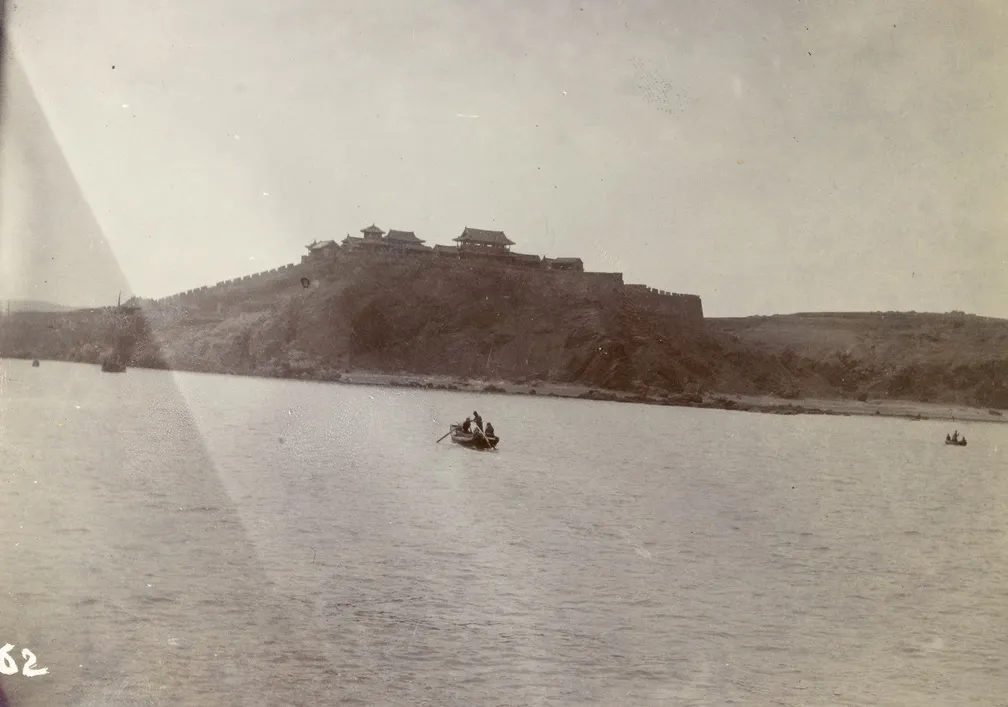
The album Shantung and Kiaochou: Photographs of a Tour in 1903, held by The National Archives of the United Kingdom, preserves two old views of Penglai. The first photographs the Penglai Pavilion, the city wall, and boats on Danya Hill from the water; the second looks down from the direction of the Penglai Pavilion over the Water City, the harbor, and the city of Dengzhou. The images were licensed by The National Archives to the University of Bristol’s “Historical Photographs of China” project.
1906–1907
A set of negatives taken by G. Warren Swire in the Dengzhou Water City in 1906–1907 is now held by the Archives and Special Collections of SOAS University of London and published by the University of Bristol’s “Historical Photographs of China” project; image copyright belongs to John Swire & Sons Ltd. The four images record, respectively, the Water City’s sea gate and boats, the breach in the city wall and the building complex on Danya Hill, rooftops within the city and the harbor basin, and the harbor basin, boats, and inner wall of the Water City. Two further negatives from the same roll, captioned “Temple at Tengchow,” record a courtyard building complex from the front and, taken close to the seaward side, a double-eaved pavilion with its railings and walls.
1928
On the sixteenth day of the first lunar month of 1928, Jiang Weizhou, a photographer at the Wuhua photographic studio on East Street in Penglai, photographed the Tianhou Temple fair at the Penglai Pavilion. The photograph records the building complex on Danya Hill at the time, its courtyard walls, the mountain path, and the crowds attending the fair; as Jiang Weizhou’s granddaughter Jiang Yanli recounts in “Hello, Old Times: A Century-Spanning Story of Light and Shadow Between Three Generations and the Penglai Pavilion”, the glass plate of this photograph survives to this day.
References
- Qu Lianfu and Luo Shiheng, “The Evolution of the Harbor Area of the Ancient Port of Dengzhou”, originally published in Ancient Ships of Penglai and the Ancient Harbor of Dengzhou, Dalian Maritime College Press, 1989.
- Xie Ruijie, “Lecture Notes | Dang Baohai: Archaeological Questions in the Study of Yuan-Dynasty Transport History”, School of Archaeology and Museology, Peking University, 2025.