Introduction
In the second year of the Qiande era of the Northern Song (964), Fuzhou was still ruled by the Wuyue Kingdom, one of the Ten Kingdoms. When the Wuyue official Bao Xiurang served as commandery governor of Fuzhou, wishing to pray for peace within the realm, he chose the wasteland at the southern foot of what is now Mount Pingshan—which the old gazetteers call the ruined city of Wuzhu, king of Minyue[1]—cleared the scrub, leveled the slope, and founded the Yueshan Jixiang Chan Cloister. Since the Sui and Tang, firewood cutting had been forbidden here because of its association with the old land of the King of Yue, and so the temple was built upon the site of an old city long kept under closure.
In the fourth year of the Shaoxing era of the Southern Song (1134), Zhang Jun, the celebrated minister of the war against the Jin, was demoted and sent to live in Fuzhou. He lodged at the Yueshan Jixiang Chan Cloister, where he fitted out a small reading room; borrowing the Northern Song philosopher Zhang Zai’s phrase “to continue the lost learning for the sages of the past,” he named it the “Juexue Lodge” (Lodge of Continued Learning), to show that, though banished, he had not abandoned his ambition to govern well and serve the state. Five years later, Zhang Jun once more took office as prefect of Fuzhou. In the third year of the Qiandao era (1167), after Zhao Gou, the founding emperor of the Southern Song, had abdicated, he bestowed a name upon the temple’s Huanfeng Pavilion in his capacity as emperor emeritus and inscribed the words “Yueshan” (Mount Yue) for it.
Entering the Ming, at the petition of Song Zhang, right vice commissioner[2] of Fujian, the temple was renamed “Hualin Temple,” the name it bears to this day. By the late Ming, the Fuzhou scholar-official Cao Xuequan had been on familiar terms with four successive abbots of the temple for more than thirty years. He often brought guests to Hualin Temple to see the pine forest and even thought of thatching a hut to live in there. Later the abbot asked him to write an appeal for donations toward the repair of the Golden Buddha Hall; bound by a deep friendship with the temple’s monks and hoping that the rebuilding would bring blessings upon Fujian, Cao Xuequan wrote the Hualinsi Jinfodian Yuanman Shu (Petition for the Completion of the Golden Buddha Hall of Hualin Temple).
In the twenty-third year of the Jiaqing era of the Qing (1818), after long years without repair, Hualin Temple stood on the verge of collapse. Fearing that the temple would deteriorate further, the abbot Mu’an first drew on his own savings to build the flanking galleries, then raised funds from donors to repair the main hall, the Hall of the Heavenly Kings, and the monks’ quarters, and to refashion the Buddhist images. The work was completed in the summer of the sixth year of the Daoguang era (1826); Mu’an asked Lin Zexu, an official native to Fuzhou, to compose a stele record, and the eight years of the rebuilding were engraved in stone.
In the 1950s, Fujian’s cultural-relics workers began investigating Hualin Temple. As religious activity ceased and the buildings went unmaintained, the mountain gate, the Hall of the Heavenly Kings, and the monks’ quarters—everything but the main hall—fell into ruin and collapsed one after another in the 1960s. Around 1970, the main hall was enclosed within a government-agency compound, and demolition was at one point planned; because the agency happened to be short of warehouse space, it used the hall to store sundries, and that is why the hall was not torn down.
In 1979, Mo Zongjiang, a professor of architectural history at Tsinghua University, traveled to Xiamen on a field study; passing through Fuzhou, having long heard of the main hall of Hualin Temple, he asked to have a look at the site. The visit kept him in Fuzhou for three extra days, and back in Beijing he managed to submit a conservation application to the National Cultural Heritage Administration. In 1980 the administration commissioned him to return with two graduate students and survey the hall once more. Beginning in 1986, the historic-building specialist Li Zhujun directed the restoration: craftsmen dismantled the building piece by piece from the roof down to the columns and beams, repaired each member, reassembled the whole, and moved the hall away from its low-lying original site. The single-eaved[3] main hall seen today is the result of that conservation project, which lasted nearly six years.
Historical Documents
Chunxi Sanshan Zhi (Chunxi-Era Gazetteer of the Three Mountains)
怀安越山吉祥禅院,乾元寺之东北,无诸旧城处也。晋太康三年,既迁新城,其地遂虚。隋、唐间,以越王故,禁樵采。钱氏十八年,其臣鲍修让为郡守,遂诛秽夷巇为佛庙,乾德二年也。御书绍兴六年,张丞相浚奉安。御书裴度传。环峰亭,绝学寮胜会亭,旧产钱三贯四十三文。
The Yueshan Jixiang Chan Cloister of Huai’an lies northeast of the Qianyuan Temple, at the site of the old city of Wuzhu. In the third year of the Taikang era of the Jin, once [the county] had moved to the new city, the ground lay empty. Between the Sui and the Tang, on account of the King of Yue, firewood cutting was forbidden. In the eighteenth year of the Qian house, its minister Bao Xiurang served as commandery governor and thereupon cut down the weeds and leveled the crags to make a Buddhist temple; this was the second year of the Qiande era. An imperial inscription of the sixth year of the Shaoxing era was respectfully installed by Chancellor Zhang Jun—an imperial transcription of the Biography of Pei Du. The Huanfeng Pavilion, the Juexue Lodge, and the Shenghui Pavilion; its former endowment was three strings and forty-three cash.
Fuzhou Fu Zhi (Gazetteer of Fuzhou Prefecture)
华林寺在左一坊,旧名越山吉祥禅院。闽都记:在乾元寺东北无诸旧城处。晋太康间,既迁新城,其地遂虚。隋、唐间以越王故,禁樵采。钱氏十八年,其臣鲍修让为郡守,诛秽夷巇,始创寺。西廊有转轮经藏,今圯。东廊有文昌祠、普陀岩。正殿之后为法堂、法堂西祖师殿,以越王山为斧扆。正德间赐额。国朝顺治初修。康熙七年重修。今寺僧散,改为普济堂。
Hualin Temple is in the Zuoyi Ward; its old name was the Yueshan Jixiang Chan Cloister. The Mindu Ji says: it lies northeast of the Qianyuan Temple, at the old city of Wuzhu. During the Taikang era of the Jin, once [the county] had moved to the new city, the ground lay empty. Between the Sui and the Tang, on account of the King of Yue, firewood cutting was forbidden. In the eighteenth year of the Qian house, its minister Bao Xiurang served as commandery governor; cutting down the weeds and leveling the crags, he first founded the temple. The west gallery held a revolving scripture repository, now collapsed. The east gallery held the Wenchang Shrine and the Putuo Crag. Behind the main hall was the Dharma Hall, and west of the Dharma Hall the Patriarchs’ Hall, which took Mount Yuewang as its screen. A name-plaque was bestowed during the Zhengde era. Under the present dynasty it was repaired early in the Shunzhi era and again in the seventh year of the Kangxi era. Today the temple’s monks have scattered, and it has been converted into a Puji Hall (Hall of Universal Relief).
Cao Dali Ji (Collected Works of Chamberlain Cao)
省龙自北而来,越王山为之顶,而华林寺其臂也。金佛殿虽寺中之一体,而枕此臂为甚固。余乐其风气磅礴,松林郁苍,每携客来游,欲结茅而居焉。乃其住持之僧与余兄弟相处,又更四世三十余年之久,至则如家焉,而忘其主宾也。余三山多所缘事而不克竣,其住持亦不与余言本山之缘,今年因少间而有请也。夫以省龙之臂,理宜兴隆,广作佛事,以褆福于全闽者。主僧有相知之素,而又乐善好客,余以此为搜裘焉。是一举而众善备,故不辞而为之疏。
The dragon of the province comes from the north; Mount Yuewang is its crown, and Hualin Temple is its arm. Though the Golden Buddha Hall is but one member of the temple, it pillows upon this arm most firmly. I delight in the surging vigor of its airs and the deep verdure of its pine forest; each time I bring guests to wander here, I wish to thatch a hut and dwell among them. Moreover, its abbot monks have treated me as a brother, and this through four generations and more than thirty years; when I arrive, it is as if I had come home, and the roles of host and guest are forgotten. In the Three Mountains I have many karmic undertakings that I have been unable to bring to completion, and the abbot likewise never spoke to me of the mountain’s causes; this year, taking advantage of a brief leisure, he made his request. Being the arm of the provincial dragon, it is fitting that it should prosper and broadly perform the Buddha’s works, so as to bring blessing upon all of Fujian. The abbot monk has long been a true friend, and moreover he delights in good deeds and welcomes guests; I therefore took this up as my gathering of furs for the robe. In this single act every good is made complete; therefore I did not decline and composed this appeal on his behalf.
Chongxiu Yueshan Hualin Chansi Beiji (Stele Record of the Rebuilding of the Yueshan Hualin Chan Temple)
佛浮屠之宫,闽中特盛,会城三山以数百十计。然唐宗古刹至今仅有存者,或存而上雨旁风,倾覆是惧;而越山华林寺独岿然。寺旧为吉祥禅院,钱氏有闽,郡守鲍修让创焉,明正德赐额今名,顺治初年、康熙七年两修之。月异岁迁,今改将半。乾隆初,有住持本馥者,重葺坏坠,椽角一新。三传为今主僧牧庵,虑梵宇之就颓也,出橐中金庀工建廊庑,且求诸施者修大殿暨天王殿,治僧寮,饰佛像,巩固巨丽,而寺遂还旧观。以余闻,前志所载,寺之遗规,西廊有转轮、经藏,东廊有文昌祠、普陀岩,正殿之后为法堂,法堂西为祖殿。其环诡殊绝、材美匠能者,久已荡为榛芜,不可复观矣。而牧庵独能绍述先师之绪,不吝己力,积岁经营,杰构崔嵬,精庐幽敞,课佛弟子,斋鱼粥鼓,为南中祝圣道场,不其盛欤!工兴于嘉庆二十三年四月,至今夏竣事。牧庵欲余为文刊石以志之。牧庵,名增辉,福州王氏子,曹洞鼓山永觉禅师九世孙也。道光六年六月。
The palaces of the Buddha flourish especially in Fujian; in the Three Mountains of the provincial capital they are numbered in the hundreds and tens. Yet of the ancient monasteries of the Tang lineage barely any survive to this day, and those that do are rained upon from above and blown against from the side, in constant fear of collapse—while the Yueshan Hualin Temple alone stands towering and secure. The temple was formerly the Jixiang Chan Cloister; when the Qian house possessed Fujian, the commandery governor Bao Xiurang founded it. In the Zhengde era of the Ming it was granted its present name-plaque, and it was twice repaired, in the early years of the Shunzhi era and in the seventh year of the Kangxi era. As the months change and the years move on, it has now altered by half. Early in the Qianlong era there was an abbot named Benfu, who re-roofed what was broken and fallen, making every rafter and eave-corner new. Three transmissions later came the present abbot monk, Mu’an. Troubled that the Brahma-halls were nearing ruin, he drew gold from his own purse, mustered workmen, and built the side galleries, and moreover sought from the donors the means to repair the main hall and the Hall of the Heavenly Kings, to set the monks’ quarters in order, and to adorn the images of the Buddha, until the buildings stood solid and grandly beautiful and the temple had returned to its former appearance. From what I have heard, the former gazetteers record that among the temple’s surviving layout, the west gallery held the revolving repository and the scripture store, and the east gallery held the Wenchang Shrine and the Putuo Crag; behind the main hall was the Dharma Hall, and west of the Dharma Hall was the Patriarchs’ Hall. Those works of surpassing strangeness and wonder, of fine material and able craftsmanship, have long since been swept away into thorns and undergrowth, and can be beheld no more. Yet Mu’an alone has been able to carry on the thread of his former masters; unsparing of his own strength, he labored at the task through the years, until heroic structures tower aloft and pure cells stand tranquil and spacious; he instructs the Buddha’s disciples amid the wooden fish and the porridge drum, making the temple a southern sanctuary for prayers on behalf of the sovereign—is this not magnificent! The work began in the fourth month of the twenty-third year of the Jiaqing era and was completed this summer. Mu’an asked me to compose a text to be cut in stone to record it. Mu’an, whose name is Zenghui, is a son of the Wang family of Fuzhou, a ninth-generation descendant of Chan Master Yongjue of Mount Gu in the Caodong lineage. Sixth month of the sixth year of the Daoguang era.
Historical Photographs
The 1950s
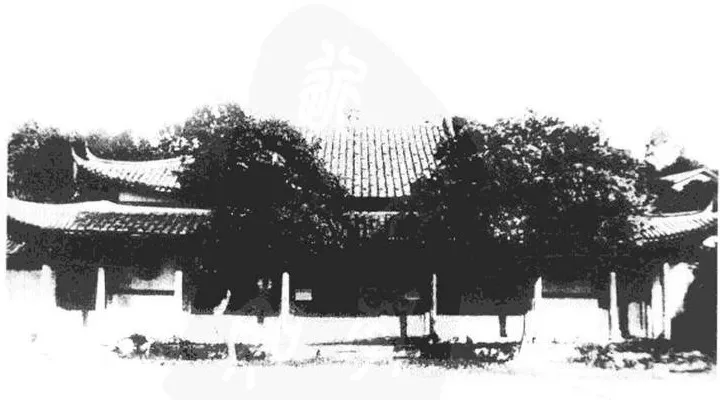
A photograph in Old Images of Fuzhou, compiled by Zeng Yidan, was taken around the 1950s and records the old frontal appearance of the main hall of Hualin Temple while its flanking auxiliary buildings still stood.
1956
In 1956, Lin Zhao surveyed the main hall of Hualin Temple; in addition to the temple’s original appearance and the hall’s front, A Brief Report on the Survey of the Mahavira Hall of Hualin Temple in Fuzhou also publishes photographs of the courtyard, the bracket-set framework, and the beams inside the hall.
References
- Yang Binglun, Wang Guixiang, and Zhong Xiaoqing, “The Main Hall of Hualin Temple in Fuzhou”, in Department of Architecture, Tsinghua University (ed.), Collected Essays on Architectural History, vol. 9, Beijing: Tsinghua University Press, 1988, pp. 1–32.
- Editorial Committee of the Complete Works of Lin Zexu (ed.), Complete Works of Lin Zexu, vol. 5, “Wenlu Juan” (Records of Writings), Haixia Literature and Art Publishing House, 2002, p. 443.
- Fuzhou Local Gazetteer Compilation Committee, “Celebrities and Hualin Temple”, portal of the Fuzhou Municipal People’s Government, September 25, 2024.
- Party History and Local Gazetteer Research Office of the CPC Fuzhou Municipal Committee, “Figures of the Central Plains Gathered in the Southeast: The Southward Shift of the Political Center in the Two Song Dynasties”, Fuzhou Local Gazetteer website, August 18, 2019.
- Party History and Local Gazetteer Research Office of the CPC Fuzhou Municipal Committee, “National Heritage | The Main Hall of Hualin Temple: A Small Hall with Great Spirit!”, Fuzhou Local Gazetteer website, December 28, 2020.
- Committee for Culture, Literature and History, and Learning of the Fuzhou Municipal Committee of the CPPCC, “Enjoying Fuzhou’s Literature and History | Historical Traces of the Southern Song Chancellor Zhang Jun in Fuzhou”, website of the Fuzhou Municipal Committee of the Chinese People’s Political Consultative Conference, April 27, 2025.