Introduction
Legend has it that in the second year of the Chuigong reign of the Tang (686), Huang Shougong dreamed of a monk who asked him to donate his residence as a Buddhist temple. Huang did not agree at once, saying only that they could discuss it again when the mulberry trees bore lotus blossoms. A few days later, white lotuses indeed covered the branches of the mulberry trees, and only then did he give up his residence to build a temple, named Lotus Flower Temple. This is a legend, but “Lotus Flower Temple” is indeed the earliest name of Kaiyuan Temple; the monastery was later called Xingjiao Temple and then Longxing Temple, until in the twenty-sixth year of the Kaiyuan reign of the Tang (738) it was renamed Kaiyuan Temple.
In the sixth year of the Xiantong reign (865), Chan Master Wencheng built a nine-story wooden pagoda on the east side of the monastery, named the Zhenguo Pagoda. At the end of the Tang, the temple’s Buddha hall, sutra library, and bell tower were all reduced to ashes in a single night. The man who presided over the rebuilding contributed three thousand strings of cash[1] from his salary, gathered craftsmen, and purchased timber; in less than a year the new Buddha hall was complete. The great hall was still built to the old plan of five bays with two flanking annexes, with the bell tower standing to the northeast and the sutra library to the northwest; at its completion, more than a thousand monks came to the temple for the dedication feast. In the second year of the Zhenming reign of the Liang during the Five Dynasties (916), a seven-story wooden pagoda was built on the west side of the monastery, first named the Wuliangshou (Amitayus) Pagoda and later renamed the Renshou Pagoda. During the Shaoxing reign, the two wooden pagodas, east and west, were struck by fire; when they were rebuilt thereafter, the monks successively rebuilt them in brick, and in the Southern Song work began to rebuild them in stone.
The first to be completed was the western pagoda, the Renshou Pagoda. From the first year of the Shaoding reign to the first year of the Jiaxi reign (1228–1237), the stone pagoda rose story by story, and Buddhas, bodhisattvas, and Dharma-protecting deities were carved onto its body. On the northeast wall of the fourth story is carved a pilgrim with a monkey’s head and a human body, a copy of the Peacock King Spell sutra tied at his waist and a short knife in his hand. Later generations often call him “Sun Wukong,” but he carries no golden-hooped staff, and the three characters “Sun Wukong” do not appear on the stone wall. More precisely, he is a Southern Song “Monkey Pilgrim,” carved about three hundred years before the Ming-dynasty hundred-chapter Journey to the West—an image of the westward journey left from before the figure of Sun Wukong took its final shape.
In the first year of the Chunyou reign (1241), Quanzhou suffered a famine. In the height of summer, several thousand people waiting for alms congee sat in rows beneath the monastery’s galleries, dozens of zhang long. Lin Xiyi, then a prefectural functionary[2], supervised the congee distribution here in the early morning, then hurried after midday to Chengtian Temple to handle the sale of relief grain; beneath Chengtian Temple’s long galleries likewise gathered several thousand people. Writing about this relief effort many years later, Lin Xiyi still marveled that without these spacious monastic buildings, there would have been no ready place to shelter the famine victims.
In the tenth year of the Chunyou reign (1250), the eastern pagoda, the Zhenguo Pagoda, was likewise completed in stone, and the twin pagodas at last stood side by side.
In the fifth year of the Xianchun reign (1269), Lin Xiyi wrote a record of the rebuilding of a monastic cloister at the northeast corner of Kaiyuan Temple. The cloister was named Xingfu Temple and was popularly called the Congee Cloister, for it was said to have once served congee to a thousand monks. Lin Xiyi also heard a story about a congee bucket: a military officer snatched the monastery’s wooden bucket to feed his horses. The monk then in charge of the congee, known as “Huayan,” did not pursue the officer; instead he pressed the painted image of the qielan, the monastery’s guardian deity[3], beneath a millstone, demanding to know why the temple’s protector had let its property be taken. That night, a figure eight or nine chi tall came to beg him to restore the god’s seat, promising to retrieve the bucket at once. Before long someone knocked at the gate in the night to return the bucket, saying that the officer’s two horses had both died. Later the qielan god asked to drive rats and sparrows away from the monastery kitchen, and the monk erected a shrine for him in the temple. The story has no specific date, and Lin Xiyi himself says it came from the oral tradition of local elders.
In the seventeenth year of the Zhizheng reign (1357), Kaiyuan Temple suffered another disaster: the Mahavira Hall and the Sweet Dew Ordination Platform[4] were destroyed together. Early in the Hongwu reign the Buddha hall was rebuilt; in the thirty-third year of the Hongwu reign (1400), the monk Zhengying rebuilt the Sweet Dew Ordination Platform. In the sixth year of the Yongle reign (1408), the monastery was expanded once again.
On the eighth day of the eleventh month of the thirty-second year of the Wanli reign (1604), an earthquake struck Quanzhou. The following night the city shook more than ten times in succession; the ground split open, houses collapsed, and many boats capsized. Inside Kaiyuan Temple, stones fell from the spire of the Zhenguo Pagoda, smashing the balustrades. After the earthquake, Zhan Yangbi of Quanzhou raised funds and repaired the damaged east pagoda. Two years later, on the seventh day of the eighth month, a great wind blew down more than ten stone memorial archways in the city of Quanzhou and broke the bronze gourd finial atop the Renshou Pagoda. Grand Secretary Li Tingji then raised funds, and the west pagoda was repaired as well.
On the evening of the nineteenth day of midsummer in the tenth year of the Chongzhen reign (1637), Jiang Dejing of Jinjiang invited several friends to sit in the shade beside the east pagoda of Kaiyuan Temple, drinking tea and eating vegetables and fruit. Someone said that a pagoda can rise high only because its base is firm; Jiang Dejing steered the talk to the “heart of the pagoda,” and the party talked their way from the pagoda’s root and its spire to the human heart, then argued from the merit of building pagodas to Confucian moral principle and the Buddhist Diamond Sutra. When the evening bell sounded, they circled the east pagoda in worship several times. As they passed through the great hall, the courtyard was “bright as daylight under the moon”; their enthusiasm not yet spent, the party circled the west pagoda a few more times before taking their leave.
Historical Documents
《泉州开元寺佛殿碑记》 (Stele Record of the Buddha Hall of Kaiyuan Temple, Quanzhou)
混沌死而天地生,道德销而仁义作。情军业网,始脉旋波。天谓洛龟河龙,文有生而不文无生。乃产金圣人于西国,钻智慧火,干烦恼海。理不吾吾,而一贯生生。其姿电㸌于周室,其波派漾于汉代。繇是馆移鸿胪,城崇白马,斯有寺之始也。寺制殿,象王者之居,尊其法也。其后金地莲扃,周旋四海,乌飞兔走,或故或新。至如神运之灵莫灵矣,亦靡得而岿然。则我州开元寺佛殿之与经楼、钟楼,一夕飞烬,斯革故鼎新之数也。初,仆射太原公以子房之帷幄布泉城,以叔度之袴𥜗纩泉民,而谓竺干之道与尼聃鼎,宜根乎信而友乎理。矧开元宇,五十载之圣容,实寺之冠。洎帅闽也,愈进其诚。缮经三千卷,皆极越藤之精,书工之妙。驾以白马十乘,送以府僧,迎以郡僧,置兹之楼。既而蜀雨不飞,识者以为物之尤罕留于世,敬之至必动乎神。是必为地祗所搜,龙宫之索。不然者,曷与斯故新之数期?厥理则明,我宜悄然不已。仲弟检校工部尚书,为兹郡之秋也,武则拍孙吴之背,文则席夏商于前,而复龙虎之内,以埙以篪,大耸孟龙之旨。乃割俸三千缗,鸠工度木,烟岩云谷之𣏌、梓、楩、楠,投刃以时,趋功以隙,食以月粟,付以心倕,不期年而宝殿涌出。栋隆旧绮,梁修新虹,八表四隅,悉半乎丈。柱盛镜础,方圭丛斗。楣承蟠螭,飞云翼栱。文榱刻桷,轇轕𭩚枒。或经纬以开织,或丹雘而缬耀。皛若蟾窟,嶪如鳌背。风夏触而秋生,僧朝梵而谷应。升者骨冰,观者目波。而五间两厦,昔之制也。自东迦叶佛、释迦牟尼佛,左右真容,次弥勒佛、弥陀佛、阿难、迦叶菩萨卫神,虽法程之有常,而相貌之欲动。东北隅则揭钟楼,其钟也新铸,仍伟旧规。西北隅则揭经楼,双立岳峰,两危蜃云,东瞰全城,西吞半郭。霜韵扣而江山四爽,金字骈而讲诵千来。是知天地、日月、鬼神,不欲一存其物,将有待于后人也。设使斯殿也,斯楼也,不有之故,其何以新?我公之作之为,其何以布之哉?三略六韬,流通贝多,戈霜剑雪,为甘露洁,信英智之所措也。既毕,召化内之缁锡,数迈于千,斋而落之累中。慈云五色,慧日重轮,谭者以为梵天之宇,化于是矣;灵山之会,俨于是矣。我公之倅试大理评事宋君曰骈,才推博古,识洞真如,请立贞珉,垂于不朽。公以小儒不佞,俾刻斯文。僧正临坛,大德僧宣一,桑门之关楗者曰:寺有记,亡之矣。垂拱二年,郡儒黄守恭宅桑树吐白莲花,舍为莲花道场。后三年,升为兴教寺,复为龙兴寺。逮玄宗之流圣仪也,卜胜无以甲兹,遂为开元寺焉。尝有紫云覆寺至地,至今凡草不生其庭。大矣哉!自垂拱之迄开元,四朝而四易号及,谅兆水于木,垂云雉草,天启地灵之如是,则开元实寺之冠,斯又冠开元焉。金圣人无为也,尧舜亦无为也,诚参错其道,巍巍圣仪,永与诸佛如来俱,岂不其然?愚是以奋笔于一公之说。乾宁四年丁巳冬十一月日记。
When Chaos died, heaven and earth were born; when the Way and its Power faded, benevolence and righteousness arose. The hosts of passion and the nets of karma began to pulse in the wheeling waves. Heaven spoke through the turtle of the Luo and the dragon of the River: where there is pattern, there is life; where there is no pattern, there is no life. Then it brought forth the Golden Sage in the western land, who drilled the fire of wisdom and dried up the sea of afflictions. His principle did not make a self of the self, yet threaded all living things into one continuing life. His countenance flashed like lightning upon the house of Zhou; his ripples spread in branching waves through the Han. Thereupon the guests’ lodging was moved to the Court of State Ceremonial, and the White Horse was exalted in the city: this was the beginning of temples. Temples were built with halls in the image of a king’s residence, to honor the Dharma. Thereafter golden grounds and lotus gates spread through the four seas; as the crow flew and the hare ran, some grew old and some were made new. Even the most numinous of god-conveyed shrines could not abide towering forever. So it was that the Buddha hall of our prefecture’s Kaiyuan Temple, together with its sutra library and bell tower, flew into ashes in a single night: this is the appointed reckoning by which the old is cast off and the new established. In the beginning, the Lord of Taiyuan, the Vice Director, spread over the city of Quan the strategy-tent of Zifang, and wrapped the people of Quan in the padded trousers of Shudu; and he held that the Way of India stands as a tripod with Confucius and Laozi, fit to be rooted in faith and made a friend in principle. Moreover this Kaiyuan monastery, which for fifty years has housed the sacred countenance, is truly the crown of temples. When he came to command Min, his devotion deepened further. He had three thousand scrolls of sutras copied, all in the finest of Yue rattan paper and the subtlest art of the calligraphers. Borne on ten white horses, seen off by the monks of the headquarters and welcomed by the monks of the prefecture, they were placed in this very library. Presently the rains of Shu did not fly; those who understood held that a thing of supreme rarity cannot long remain in the world, and that reverence carried to the utmost must stir the spirits. Surely they were sought out by the earth spirits and claimed by the dragon palace. Were it not so, why should they have kept this appointed meeting with the reckoning of old and new? That principle being clear, I could not but grieve without ceasing. His next younger brother, the Acting Minister of the Board of Works, when he governed this prefecture: in arms he could clap Sun and Wu on the back, in letters he spread Xia and Shang as a mat before him; and, back within the dragon-and-tiger circle, piping xun and chi in concord, he greatly magnified the Elder Dragon’s design. Thereupon he set aside three thousand strings of cash from his salary, assembled workmen, and measured out timber—gui and catalpa, pian and nanmu from misty cliffs and clouded valleys. The blades were set to them in due season, the work pressed forward in spare hours, the men fed with monthly grain and entrusted to carpenters skilled as Chui, and before a year was out the precious hall welled up from the ground. Its ridges towered, figured like old damask; its beams stretched long like new rainbows; the eight faces and the four corners all came to half a zhang. Pillars rose richly from mirror-bright bases, squared gui-blocks and clustered capitals overhead; lintels bore coiling chilong dragons, and flying clouds winged the brackets. Patterned rafters and carved eaves jostled and interlaced: some warp and weft in open weave, some dyed red in blazing patterns. White-bright as the moon-toad’s grotto, towering as the great turtle’s back. Summer winds striking it turned to autumn; monks chanting at dawn woke the valley’s echo. Those who mounted it felt their bones turn to ice; those who beheld it found their eyes rippling. And its five bays with two flanking annexes were the plan of old. From the east: the Buddha Kasyapa and the Buddha Sakyamuni, with true countenances to left and right, then the Buddhas Maitreya and Amitabha, Ananda and Kasyapa, bodhisattvas and guardian deities; though their canonical measures followed constant rule, their features seemed on the point of moving. At the northeast corner rose the bell tower; its bell was newly cast, yet still grand in the old measure. At the northwest corner rose the sutra library. The pair stood like sacred peaks, both towering into mirage-clouds, overlooking the whole city to the east and swallowing half the outer wall to the west. When the frost-toned bell was struck, the rivers and hills freshened on all four sides; when the golden-lettered scrolls were ranged, a thousand came to lecture and chant. Thus it is known that heaven and earth, sun and moon, ghosts and spirits did not wish a single thing of it to survive: they were holding something in store for men of later times. Had this hall and these towers not been lost, by what means could they have been made new? And had my lord not acted as he did, how could his work have been displayed? The Three Strategies and the Six Secret Teachings circulated together with the palm-leaf scriptures; the frost of halberds and the snow of swords were washed clean into sweet dew: truly this was the disposition of heroic wisdom. When all was finished, he summoned the black-robed, staff-bearing monks within his civilizing sway, their number exceeding a thousand, and feasted them, consecrating the completion in their assembled midst. Clouds of compassion showed five colors, the sun of wisdom wore doubled halos; those who spoke of it held that the palace of Brahma had been transformed here, and that the assembly on Vulture Peak was solemnly present here. My lord’s lieutenant, the probationary case reviewer of the Court of Judicial Review, Lord Song named Pian, whose talent was praised for broad knowledge of antiquity and whose insight pierced true thusness, asked that a firm stone be set up to hand it down without perishing. My lord, finding this petty scholar not without talent, bade me carve this text. The rector of monks presiding over the altar, the monk of great virtue Xuanyi, a very bolt and bar of the samana order, said: the temple once had a record, but it is lost. In the second year of the Chuigong reign, the mulberry trees at the residence of the prefectural scholar Huang Shougong put forth white lotus blossoms, and he gave it up as the Lotus Flower sanctuary. Three years later it was raised to Xingjiao Temple, and then became Longxing Temple. When Emperor Xuanzong diffused his sacred countenance, no site divined for its excellence could outrank this one, and so it became Kaiyuan Temple. Once a purple cloud covered the temple down to the ground, and to this day no common grass grows in its courtyard. How great it is! From Chuigong down to Kaiyuan, through four reigns the name was changed four times; truly the water-flower was portended on wood, the hanging cloud hung above the pheasant grass—when heaven’s disclosure and earth’s numen are thus, then Kaiyuan is truly the crown of temples, and this one crowns the Kaiyuan temples. The Golden Sage acts through non-action; Yao and Shun likewise acted through non-action. Truly, if their ways are interwoven, the lofty sacred countenance will abide forever together with all the Buddhas, the Tathagatas—is it not so? Dull as I am, I have therefore boldly plied my brush upon the account of the Venerable Yi. Recorded on a day in the eleventh month of winter of the dingsi year, the fourth year of the Qianning reign.
《景德传灯录》 (Jingde Record of the Transmission of the Lamp)
师将顺世,舍众欲入山待灭。过苎溪石桥,乃遗偈曰:
When the master was about to depart this world, he left the assembly and wished to enter the mountains to await extinction. Passing the stone bridge over the Zhu Stream, he left behind a verse, saying:
“世人休说路行难,鸟道羊肠咫尺间。
“People of the world, say no more that the road is hard to walk: a bird’s track, a sheep’s winding path—these lie within a foot.
珍重苎溪溪畔水,汝归沧海我归山。”
Fare well, waters beside the banks of the Zhu Stream: you go home to the gray sea, I go home to the mountains.”
即往贵湖卓庵。未几谓门人曰:“吾灭后,将遗骸施诸虫蚁,勿置坟塔。”言讫,潜入湖头山,坐磐石,俨然长往。弟子戒因入山追见,禀遗命延留七日,竟无虫蚁之所侵食,遂就阇维,散于林野。今泉州开元寺净土院影堂存焉。
He then went to Guihu and set up a hut. Before long he said to his disciples: “After my extinction, give my remains to the insects and ants; do not set up a grave or stupa.” When he had spoken, he slipped away into Hutou Mountain, sat upon a flat rock, and was gravely gone forever. His disciple Jieyin entered the mountains and came upon him; honoring his last behest, he kept the body for seven days, and in the end no insect or ant invaded or consumed it. Thereupon he was cremated and the ashes scattered over the woods and fields. Today his portrait hall survives in the Pure Land Cloister of Kaiyuan Temple in Quanzhou.
《竹溪鬳斋十一稿续集》 (Sequel to the Eleven Drafts of Yanzhai of Zhuxi)
温陵佛国也。中郡之城,有曰开元寺者,聚僧舍百二十所而居之。兴福其一也,俗呼为粥院,谓开山某师戒行严,诵法华得力,常主千僧粥食于斯也。地居东北隅,始甚隘。元符中,圆觉师本观主之,得镇海超禅掌示之旨,道化盛行,学侣云集,无所容。请于郡,并数刹而辟之。其寺始大中,毁于绍兴,旧碑俱不存,其复也亦莫之记。
Wenling is a veritable Buddha-land. Within the city of the prefecture there is one called Kaiyuan Temple, which gathers one hundred and twenty monastic dwellings into its precinct. Xingfu is one of them, popularly called the Congee Cloister, because the master who founded it was strict in discipline, gained power from chanting the Lotus Sutra, and long presided over the congee meals of a thousand monks here. The site lies in the northeast corner and was very cramped at first. In the Yuanfu reign, Master Yuanjue—Benguang by name—took charge of it. Having received the purport of the personal instruction of Chaochan of Zhenhai, his Way and teaching flourished greatly, companions in the study gathered like clouds, and there was no room to hold them. He petitioned the prefecture, absorbed several neighboring cloisters, and opened the site up. The temple began in the Dazhong reign and was destroyed in the Shaoxing reign; its old steles have all perished, and of its restoration no record survives.
予昔为郡掾,屡尝往来其间。淳祐辛丑,岁大饥,予领赈济二局,朝则散粥开元,午则济籴承天。两寺修廊,东西各数十丈,食者列坐,籴者分给,皆容数千人不翅。时方隆暑,非此何所措?故尝谓僧庐亦非无助于政也。
Formerly I served as a prefectural functionary and often passed back and forth among these places. In the xinchou year of the Chunyou reign (1241), the harvest failed in a great famine, and I was put in charge of two relief bureaus: in the morning I distributed congee at Kaiyuan, at midday I managed the grain sales at Chengtian. The long galleries of the two temples, each dozens of zhang from east to west, held those who came to eat seated in rows and those buying grain receiving their portions—each could hold not merely several thousand people. It was then the height of summer heat; without these, where could the people have been put? So I used to say that monks’ lodgings are not without their help to governance.
时住兴福者,前则善立,后则宗端。立以有为称,端以静嘿胜,皆可语,相与颇密。今偻指三十年间,寺敝久矣。戊辰冬,忽得圆悟书,以重修法堂、香积诸因缘来请记。悟,予里人也,向为双径、演溪记室,演以高弟许之。予尝叙其《枯崖集》矣,而未知其志行若此。主此席未一载,而役于土木,不惮其劳。某月鸠工,某月毕事,縻金钱若干。吁,亦难矣!遂乐为之书。
Those who dwelled at Xingfu in those days were first Shanli and later Zongduan. Li was known for his engagement, Duan excelled in quiet silence; both were worth talking with, and I was on close terms with them. Now, bending my fingers to count, thirty years have passed, and the temple has long been in disrepair. In the winter of the wuchen year (1268), I unexpectedly received a letter from Yuanwu, asking me, on the karmic occasion of rebuilding the Dharma hall and the kitchen, to write a record. Wu is a man of my own village; formerly he served as secretary at Shuangjing and Yanxi, and Yan commended him as a disciple of high promise. I once wrote a preface for his Dry Cliff Collection, yet I did not know his resolve and conduct were like this. He had presided over this seat for not yet a full year when he labored at earth and timber, undaunted by the toil. In such-and-such a month he gathered the workmen, in such-and-such a month the work was finished, and such-and-such a sum of money was spent. Ah—it was hard indeed! So I gladly wrote this for him.
独惜寺之始事无所考,耆老相传,但曰华严董粥事。时有兵官夺其桶饲马,师取伽蓝画像,压以磨石而诃责之。一夕,行庑下有人,身长八九尺,乞还位设。师曰:“寺失桶而汝不知,汝职何事?”答曰:“即索之。”中夜,俄有叩门而还桶者曰:“二马俱毙。”监者惧而归之。一夕,又见师曰:“未足言劳,何以庙食于此?”神曰:“愿为香厨屏鼠雀。”师许之,置祠焉。至今厨无此耗。神则神矣,非师何以令之?圆觉有传,开山遗其名,其所传竟尔,因并录于此。是岁实为咸淳己巳嘉平月,林某记。
My only regret is that nothing can be ascertained of the temple’s beginnings. What the village elders pass down says only that Huayan directed the congee service. At that time a military officer seized the monastery’s bucket to feed his horses; the master took the painted image of the qielan guardian and, pressing it beneath a millstone, rebuked it. One night, as he walked beneath the gallery, there was a man eight or nine chi tall who begged that his seat be restored. The master said: “The temple lost its bucket and you knew nothing of it—what is your office?” He answered: “I shall fetch it at once.” In the middle of the night, suddenly someone knocked at the gate to return the bucket, saying: “Both horses have died.” The stable-keeper, frightened, gave it back. One night the god appeared again to the master. The master said: “That was not labor enough—by what should you receive temple offerings here?” The god said: “Let me screen rats and sparrows from the fragrant kitchen.” The master consented and set up a shrine for him there. To this day the kitchen suffers no such losses. The god was numinous indeed, but without the master, how could he have been so commanded? There is a biography of Yuanjue; the founding master’s name has been lost, and what has been handed down turns out to be of this kind, so I record it here together. This year is in truth the jiasi year of the Xianchun reign, the twelfth month; recorded by Lin.
《记紫云双塔游》 (Record of a Visit to the Twin Pagodas of Ziyun Temple)
净师从紫云寺住持清源西洞天,以予喜石,舍洞石见供,佐以乳泉一缶。日:吾徃来清源、紫云间,甚适也。紫云有东塔殿,吾师泒上人旧址,詹司宼题诗林禅榻处,虽数楹,然以附塔隂凉,可𫏐憇,遂约。黄公季弢、林公为磐,与予茗饮其下,而肝江邓君应瑞者,徴君濳谷先生曾孙也,远来访予,侨于寺东偏,因邀共坐,啖蔬菓,甚香絜。晩钟鸣,起,踏月绕塔礼数廵。
Master Jing, abbot of Ziyun Temple at the West Grotto-Heaven of Mount Qingyuan, knowing that I love stones, gave me a grotto stone as an offering, together with a jar of milk-spring water. He said: “I come and go between Qingyuan and Ziyun, and it suits me very well. Ziyun has the East Pagoda Hall, the former seat of my teacher the Venerable Gu, the place where Minister of Justice Zhan inscribed a poem at the meditation couch in the grove; though it is only a few bays, it lies against the pagoda, cool and shady, where one may rest.” So we made an engagement. Lord Huang Jitao and Lord Lin Weipan drank tea with me beneath it; and Lord Deng Yingrui of Ganjiang, great-grandson of the Summoned Gentleman Master Qiangu, had come from afar to visit me and was lodging at the temple’s east side, so I invited him to sit with us, eating vegetables and fruit, most fragrant and pure. When the evening bell sounded, we rose and, treading the moonlight, circled the pagoda in worship several rounds.
林公日:伟哉塔也!当其愿力所至,架石揷云,鬼斧神鞭,不可思议。吾党立地作圣,肻辨如此愿力,不愁不到塔尖。黄公日:亦全在塔根。闻塔下尚有巨石两层,合上为七,无此两层,即万仭安顿何处?予日:塔尖髙,塔根实亦更在塔心。有塔心,方有塔身,八靣许多玠珑,中间只是一个。黄公日:此心合下便具七层。老僧初下手时,已具全塔在胸中,不是逐层做去,如吾夫子志学,就合下有从心地位也。予日:塔有尖心恐无尖,百尺竿头更有进处。因举无所住而生其心扣埩净日:心无住,塔有作,即心是塔,元来无住无生。复举一切有为法偈,净未荅。林公日:有为无为,总从心造。造自梁武帝,是有为法,即有漏因;造自老僧,是无为法,即真功德。众为豁然。
Lord Lin said: “How grand this pagoda is! When the power of the vow arrives, stones are stacked to pierce the clouds, as if ghosts and gods had whipped them into place—beyond thought or measure. If our company, standing on the ground, would become sages and could wield such vow-power, we need not worry about failing to reach the pagoda’s tip.” Lord Huang said: “It also lies wholly in the pagoda’s root. I hear that beneath the pagoda there are two more courses of great stones, making seven with those above; without these two courses, where would ten thousand ren find their footing?” I said: “The pagoda’s tip is high and its root is firm, but beyond these it lies in the pagoda’s heart. Only with a heart is there a body; for all the gleaming tracery of its eight faces, in the middle there is but the one.” Lord Huang said: “This heart, from the very outset, possesses all seven stories. When the old monk first set his hand to the work, the whole pagoda was already complete in his breast; it was not built story by story—just as our Master’s resolve on learning already contained within it the ground of following the heart’s desire.” I said: “The pagoda has a tip; I fear the heart has none—atop the hundred-foot pole there is yet a further place to advance.” Then I raised the phrase “give rise to the mind without dwelling on anything” and pressed Master Jing with it: “The mind has no dwelling, the pagoda has its making; the very mind is the pagoda, and from the first there is no dwelling and no arising.” I further raised the verse on all conditioned dharmas; Jing did not answer. Lord Lin said: “Conditioned and unconditioned—all are made by the mind. Made by Emperor Wu of Liang, it is a conditioned dharma, a tainted cause; made by the old monk, it is an unconditioned dharma, true merit.” At this the whole party was enlightened.
时有吴烈妇杨氏,卜日就义,林公举似日:此是真愿力。予日:渠看得金刚偈透,将死生作梦幻泡影𮗚,才能从容尔尔,此即是真佛。丈六金身,非佛也。佛皆吾儒所有,只吾儒说出成仁取义,既足主张名教,亦与佛理关通,而徒以一切梦幻泡影空之,则塔亦属有为法。虽造自梁武帝,与造自老僧,其为人天小果一也。林公为之启齿。巳,复举退之人其人三语日:退之实孟子后一人,阳明又退之后一人,皆真造浮图手。黄公戯日:李文节有言,未闻明先王之道以道之,而輙庐其居。亦不必予日坛越孙应作是语,因哄堂一𠰷。
At that time there was the martyred wife of Wu, née Yang, who had chosen a day to go to her righteous death. Lord Lin raised the case and said: “This is true vow-power.” I said: “She had seen through the verse of the Diamond Sutra—taking death and life as dream, illusion, bubble, and shadow—and so could go to it with such composure; this very one is the true Buddha. A sixteen-foot golden body is not the Buddha. All that the Buddha has, we Confucians also possess; only we Confucians speak it out as perfecting benevolence and choosing righteousness, which both suffices to uphold the teaching of names and connects through to the Buddha’s principle. But if one simply empties everything as dream, illusion, bubble, and shadow, then the pagoda too belongs among conditioned dharmas: whether made by Emperor Wu of Liang or made by the old monk, they are one and the same as the small fruits of men and devas.” Lord Lin broke into a smile at this. Presently I further raised Tuizhi’s three words “make men of them,” saying: “Tuizhi is truly the one man after Mencius, and Yangming is again the one man after Tuizhi—both true hands at building stupas.” Lord Huang jested: “Li Wenjie had a saying: Never have I heard of one who made clear the Way of the former kings to guide them and then straightaway made huts of their dwellings. Nor is that necessary either.” I said that the donor Sun should have uttered such words, whereupon the whole hall burst into one great laugh.
既自东塔出大殿,庭月如昼,复绕西塔数廵而归。按志:紫云寺,唐𡸁拱中,州民黄守恭故宅,地舍为寺,即黄公始祖也。东镇国塔,咸亨中,文偁禅师以木为之,凡九级。咸通中,仓曹徐宗仁以佛舎利镇塔申。宋天禧中,改为十三级。绍兴乙亥灾。淳熈丙午,僧了性重建。寳庆丁亥复灾,僧守淳易以砖,凡七级。嘉熈戊戌,僧本洪始易以石,仅一级而止,法权继之。至第四级,天竺讲主作第五级及合尖,凡十年始成。
Coming out from the east pagoda into the courtyard of the great hall, the moon in the courtyard was bright as day; we circled the west pagoda several more rounds and then went home. According to the gazetteer: Ziyun Temple was, in the Chuigong reign of the Tang, the former residence of the commoner Huang Shougong of this prefecture, the land having been given up to make the temple—he is Lord Huang’s first ancestor. The eastern Zhenguo Pagoda: in the Xianheng reign, Chan Master Wencheng made it of wood, nine stories in all. In the Xiantong reign, the granary officer Xu Zongren placed a Buddha relic within the pagoda to secure it. In the Tianxi reign of the Song it was changed to thirteen stories. It burned in the yihai year of the Shaoxing reign. In the bingwu year of the Chunxi reign the monk Liaoxing rebuilt it. It burned again in the dinghai year of the Baoqing reign, and the monk Shouchun rebuilt it in brick, seven stories in all. In the wuxu year of the Jiaxi reign the monk Benhong first changed it to stone, but stopped after only one story; Faquan continued it, reaching the fourth story; the lecturer Tianzhu made the fifth story and closed the spire—ten years in all before it was completed.
其上有铁香罏铜宝葢,于塔八角,以銕𬫵上钩之,顶作沃金葫芦,幌幌若黄金色。毎层中为塔心,环转空洞,层各八龛,龛供石菩萨一尊,两壁刻二大神像翼之。外绕廊簷,䕶以石栏,圆广一百七十二尺,高一百九十三尺五十。凡大柱四十,大小梁各四十,大斗百九十二,小斗四百四十,枅四十,大拱百有十二,小拱八十,皆巨石为之。
Upon it are an iron incense burner and a bronze jeweled canopy; at the pagoda’s eight corners they are hooked fast with iron chains, and at the top is a wash-gold gourd, glittering as though of yellow gold. In the middle of each story is the pagoda’s heart, a hollow void around which one turns; each story has eight niches, each niche housing one stone bodhisattva, with two great god-images carved on the two walls to flank it. Outside, eaved galleries run around it, guarded by stone railings; the circumference is one hundred and seventy-two chi, the height one hundred and ninety-three chi and five cun. In all there are forty great pillars, forty large and forty small beams, one hundred ninety-two large blocks, four hundred forty small blocks, forty pillar-top brackets, one hundred twelve large arms, and eighty small arms—all made of great stones.
西仁寿塔,建于梁贞明二年戊申。先是,地踊者数尺,俄有神僧浮海止于寺。适闽王审知于大都督府造木塔,塔成,沉而涌泉。夜夣一僧日:塔沉而涌泉,泉者,泉也,可移镇泉州。王怒,斩僧,白乳高涌数尺。王觉,以物色求之,泉人云:有风,和尚去矣。王乃以木植浮海至泉建塔。明年成,号无量寿塔。宋政和甲午十月十日,有青黄光起塔中,高侵云,须臾五色,质明乃灭,因赐名仁寿。绍兴乙亥灾。淳熈间,僧了性再造,复灾,僧守淳易以砖。绍定元年,僧自证始易以石,顶藏金银诸寳,规制如东塔,而围广杀五尺高。减一丈五尺五寸,𧈺丽耸㧞,则相伯仲也。葢嘉熈元年始竣工,实先东塔十年云。二塔及蔡忠惠万安桥,皆为海内冠。丁丑仲夏十九日,德璟记。
The western Renshou Pagoda was built in the wushen year, the second year of the Zhenming reign of the Liang. Before this, the ground had welled up several chi, and presently a divine monk came floating over the sea and stopped at the temple. It happened that Wang Shenzhi, King of Min, was building a wooden pagoda at the Grand Governor’s headquarters; when the pagoda was finished, it sank and a spring welled forth. In the night he dreamed of a monk who said: “The pagoda sank and a spring welled up; quan means spring—it may be moved to guard Quanzhou.” The king was enraged and beheaded the monk; white milk spurted several chi high. When the king awoke, he sought the man by his likeness, and the people of Quan said: “A wind came, and the reverend has gone.” The king then had the timber floated over the sea to Quan to build the pagoda. It was completed the following year and named the Wuliangshou Pagoda. On the tenth day of the tenth month of the jiawu year of the Zhenghe reign of the Song, a blue-and-yellow light rose from within the pagoda, so high it invaded the clouds; in a moment it turned five-colored, and only at full dawn did it go out, for which reason the name Renshou was bestowed. It burned in the yihai year of the Shaoxing reign. During the Chunxi reign the monk Liaoxing built it anew; it burned again, and the monk Shouchun changed it to brick. In the first year of the Shaoding reign the monk Zizheng first changed it to stone, with gold, silver, and various treasures stored at its top; its proportions are like those of the east pagoda, though its girth is five chi smaller and its height one zhang, five chi, and five cun less. In ornate beauty and soaring height, the two are as elder and younger brother. It was finished in the first year of the Jiaxi reign, in fact ten years before the east pagoda. The two pagodas, together with Cai Zhonghui’s Wan’an Bridge, are all the finest within the four seas. Nineteenth day of midsummer of the dingchou year; recorded by Dejing.
《泉州府志》 (Quanzhou Prefecture Gazetteer, Ming edition)
开元寺,在肃清门外,唐之城西门外也。邑长者黄守恭昼梦有僧欲化其宅为寺,守恭曰:待桑树生莲花乃可耳。不数〔日〕,桑树尽生莲花,守恭神之,即舍为寺。初名莲花寺。唐开元二十六年,令天下佛寺皆名开元,遂改今额。元至正间灾。洪武初,重建佛殿。永乐戊子,再增广之。寺有东西二塔,东塔号镇国,唐咸通六年,文称禅师作木塔九层。宋天禧中,改十三层。绍兴中,改木为砖,高七层。嘉熙二年,本供禅师易砖为石,仅一层,止。法权继之,造四层,天锡成之,作第五层,至淳祐十年完。其上合尖有铁香炉、铜宝盖、镀金钢葫芦,塔八角以铁索钩之。每层中为塔心,𤨔转空洞,外为八窗,各有龛,龛内安后像一,龛外两壁翼以神像各二,又外绕以檐廊,护以石栏,广围圆一十七丈二尺,高凡一十九丈三尺五寸。西塔号仁寿,五代梁贞明二年建。初,闽王审知于都督府造木塔七层,塔成而沉,地涌出泉。审知梦应在泉州,遂以木植浮海至泉建塔。石塔比东塔工巧相似,第围少,然尽高少一,乃五尺五寸,海内以为壮观。万历〔癸〕酉年,守恭裔孙参政黄文炳修正殿、法堂及两廊。万历三十二年,地震,东塔顶盖石角折,邑人侍郎詹公仰庇鸠财自修之。万历三十四年,大风,西塔葫芦坏,大学士李公廷机鸠财命修之。
Kaiyuan Temple lies outside Suqing Gate, which in the Tang was outside the city’s West Gate. The village elder Huang Shougong dreamed by day of a monk who wished to convert his residence into a temple. Shougong said: “Wait until the mulberry trees bear lotus blossoms, then it may be done.” Not many days later, the mulberry trees were all bearing lotus blossoms; Shougong, awed by the miracle, gave it up as a temple. It was first named Lotus Flower Temple. In the twenty-sixth year of the Kaiyuan reign of the Tang, all Buddhist temples in the empire were ordered to be named Kaiyuan, and so it took its present title. It burned in the Zhizheng reign of the Yuan. Early in the Hongwu reign the Buddha hall was rebuilt. In the wuzi year of the Yongle reign it was again enlarged. The temple has two pagodas, east and west. The east pagoda, named Zhenguo: in the sixth year of the Xiantong reign of the Tang, Chan Master Wencheng made a nine-story wooden pagoda. In the Tianxi reign of the Song it was changed to thirteen stories. In the Shaoxing reign the wood was changed to brick, seven stories high. In the second year of the Jiaxi reign, Chan Master Bengong changed the brick to stone, completing only one story before stopping. Faquan continued it, building four stories, and Tianxi completed it, making the fifth story; it was finished in the tenth year of the Chunyou reign. At its closed spire are an iron incense burner, a bronze precious canopy, and a gilded steel gourd; the pagoda’s eight corners are hooked with iron chains. In the middle of each story is the pagoda’s heart, a void around which one turns; outside are eight windows, each with a niche, each niche holding one stone image; on the two walls outside each niche, two god-images flank it; beyond these run eaved galleries, guarded by stone railings. The circumference is seventeen zhang and two chi, the height in all nineteen zhang, three chi, and five cun. The west pagoda, named Renshou, was built in the second year of the Zhenming reign of the Liang during the Five Dynasties. Earlier, Wang Shenzhi, King of Min, had made a seven-story wooden pagoda at the governor’s headquarters; when the pagoda was completed it sank, and a spring welled up from the ground. Shenzhi’s dream answered to Quanzhou, so the timber was floated over the sea to Quan to build the pagoda. The stone pagoda compares with the east pagoda in workmanship and art, only its girth is somewhat smaller, and its total height is less by one zhang, five chi, and five cun; within the seas it is accounted a grand sight. In the guiyou year of the Wanli reign, Huang Wenbing, administration commissioner and descendant of Shougong, repaired the main hall, the Dharma hall, and the two corridors. In the thirty-second year of the Wanli reign there was an earthquake; the corner stones of the east pagoda’s top canopy broke, and Vice Minister Zhan Yangbi of the county raised funds and repaired it himself. In the thirty-fourth year of the Wanli reign a great wind broke the west pagoda’s gourd, and Grand Secretary Li Tingji raised funds and had it repaired.
《重纂福建通志》 (Recompiled Comprehensive Gazetteer of Fujian)
文偁,仙逰人,住持晋江开元寺。时仙游属泉州,剌史,闻偁有道,延致之于州四门,募施者,为造浮图于寺东。偁性行高洁,手未尝出入泉布,凡工直使匠自取之,多取则迷,不知所如。凡六年,浮图成,赐名镇国塔。偁自是闭户三十年,昼夜诵金刚经不辍。室为生白净,瓶水不涸,寒燠盥濯,辄随其宜。干符三年坐化。葬时,途遇大雷雨,停棺石嘴中。雨止石合,棺不可出,至今禽鸟莫敢栖止其上。
Wencheng was a man of Xianyou, abbot of Kaiyuan Temple in Jinjiang. At that time Xianyou belonged to Quanzhou. The prefect, hearing that Cheng possessed the Way, invited and brought him, and at the four gates of the prefecture gathered donors, to build a stupa east of the temple. Cheng’s nature and conduct were lofty and pure; his hands never took in or gave out money. For all the workmen’s wages, he had the craftsmen take it themselves; if they took too much, they would become lost, not knowing where they went. In all it took six years, and when the stupa was completed it was granted the name Zhenguo Pagoda. From then on Cheng closed his door for thirty years, chanting the Diamond Sutra day and night without ceasing. His room grew pure white of itself; the water in his pitcher never dried up; in cold or heat, washing and bathing, all followed as was fitting. In the third year of the Qianfu reign he died sitting. When he was buried, a great thunderstorm was met on the way, and the coffin was rested in the mouth of a rock. When the rain stopped, the rock closed and the coffin could not be brought out; to this day no bird dares to perch upon it.
《泉州府志》 (Quanzhou Prefecture Gazetteer, Qing edition)
崇祯间,南安郑芝龙重修。国朝为祝厘福地。中为大雄殿,下为拜庭,东西两廊。庭外拜圣亭,山门,门外紫云屏。殿后戒坛,坛后禅堂,禅堂之左为黄氏檀越祠。寺有东西二塔,东塔号镇国,唐咸通六年,僧文称以木为之,高九成。宋天禧中增十三成。绍兴中,易木为砖,高七成。嘉熙二年,僧本供易砖为石,仅一成止。僧法权继造四成,僧天锡造第五成,至淳祐十年,工乃竣。顶有铁香炉、铜宝盖、镀金铜葫芦,塔八角以铁索钩之,每成。环转空洞,外为八窗,各有龛,安石像一,两壁翼以神像,外绕以檐廊,护以石栏,围一十七丈二尺,高一十九丈三尺五寸。
In the Chongzhen reign it was rebuilt by Zheng Zhilong of Nan’an. In the present dynasty it is a blessed site for imperial prayers. In the center is the Mahavira Hall; below it the worship court, with two corridors east and west. Outside the court are the Pavilion for Worshipping the Sage and the mountain gate, and outside the gate the Purple Cloud Screen. Behind the hall is the ordination platform; behind the platform the meditation hall; to the left of the meditation hall is the shrine to the donor Huang. The temple has two pagodas, east and west. The east pagoda, named Zhenguo: in the sixth year of the Xiantong reign of the Tang, the monk Wencheng made it of wood, nine stories high. In the Tianxi reign of the Song it was increased to thirteen stories. In the Shaoxing reign the wood was changed for brick, seven stories high. In the second year of the Jiaxi reign the monk Bengong changed the brick for stone, completing only one story before stopping. The monk Faquan continued with four stories, and the monk Tianxi made the fifth story; by the tenth year of the Chunyou reign the work was complete. At the top are an iron incense burner, a bronze precious canopy, and a gilded bronze gourd; the pagoda’s eight corners are hooked with iron chains. Each story turns around a hollow core; outside are eight windows, each with a niche holding one stone image, the two walls flanked by god-images; outside run eaved galleries, guarded by stone railings. Its girth is seventeen zhang and two chi, its height nineteen zhang, three chi, and five cun.
三十二年十一月初八日,泉州地震。初九夜连震十余次,山石海水皆动,地裂数处,郡城尤甚。开元镇国塔尖石坠,损扶栏,城内外庐舍倾圮,覆舟甚多。
On the eighth day of the eleventh month of the thirty-second year, Quanzhou was shaken by an earthquake. On the night of the ninth it shook more than ten times in succession; mountain rocks and sea waters all moved, the ground split in several places, and the prefectural city suffered worst. Stones fell from the spire of the Zhenguo Pagoda of Kaiyuan Temple, damaging the balustrades; houses within and without the city toppled and crumbled, and a great many boats capsized.
三十四年八月初七日,泉州飏风,飘圮石坊十余,折开元寺西塔顶铜葫芦。是年饥。
On the seventh day of the eighth month of the thirty-fourth year, a whirlwind struck Quanzhou, blowing down more than ten stone archways and breaking the bronze gourd atop the west pagoda of Kaiyuan Temple. That year there was famine.
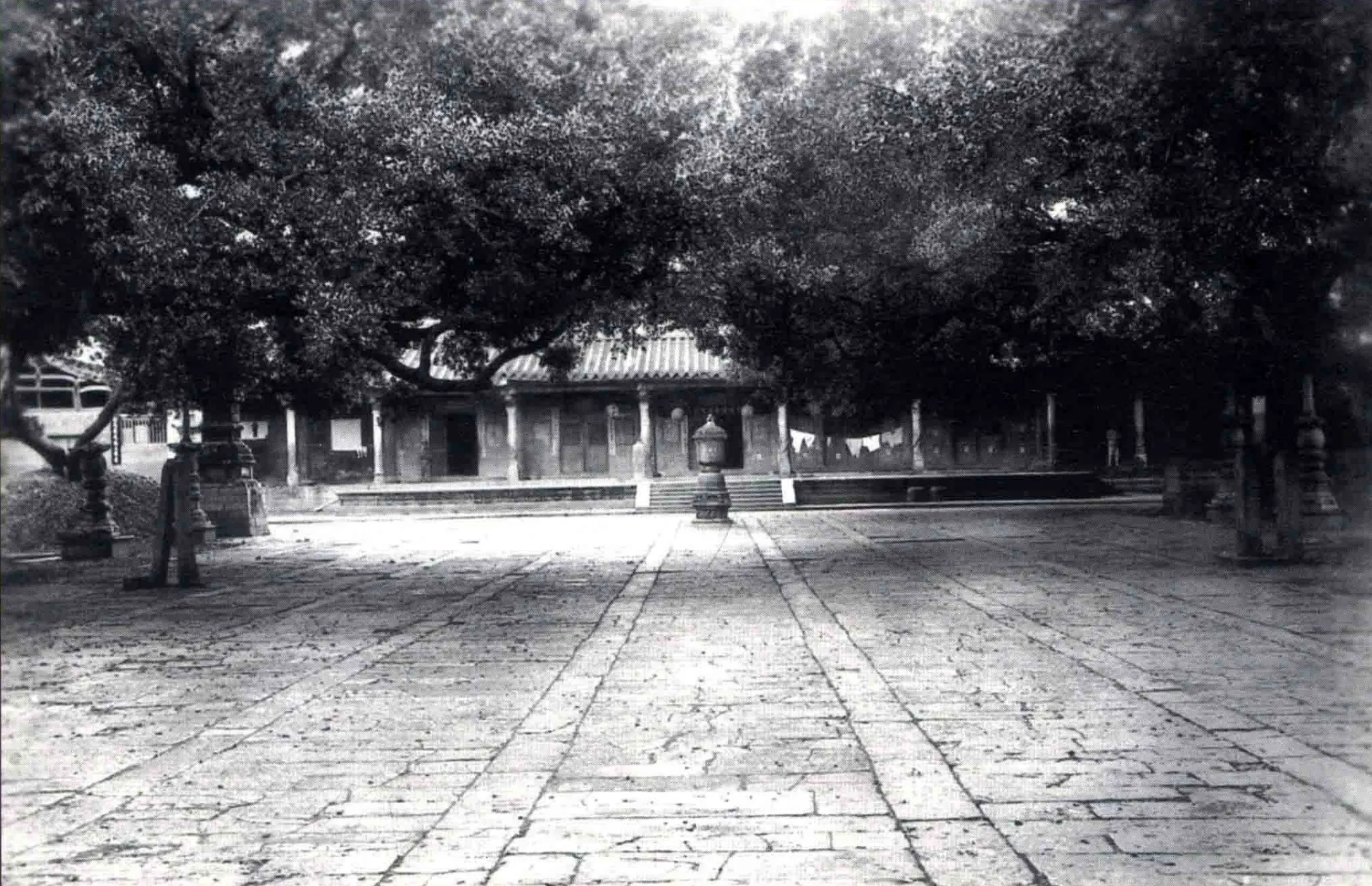
Historical Photographs
1891
The University of Southern California Digital Library titles this photograph “Chinese temple, Quanzhou, Fujian Province, China, 1891,” with the original caption “Kai Goan Temple, Chin-chiu.” The photograph comes from an album formerly in the collection of Lilia Graham; the photographer is unknown. The original is held by the Library of the School of Oriental and African Studies, University of London, and is included in the International Mission Photography Archive.
First half of the twentieth century
Volume 2 of the Illustrated Catalogue of Chinese Historic Architecture includes old photographs of the main hall of Kaiyuan Temple in Quanzhou, of the Song-dynasty pagoda and sutra pillars in the courtyard, and of a corner of the monastery; volume 4 additionally includes an old photograph of the base of the Zhenguo Pagoda. According to the Quanzhou Municipal Bureau of Natural Resources and Planning, most of the photographs in the book’s Quanzhou section were taken and provided by Gustav Ecke, a foreign member of the Society for Research in Chinese Architecture.